

INTRODUCTION
Milk is a major agricultural commodity with c. 600 million tonnes being produced in 2010 worldwide (FAO 2012) The expansion of livestock production has been criticized as a key driver of land use change such as tropical deforestation (Stifled et al. Reference Steinfeld, Gerber, Wassenaar, Castel, Rosales and de Haan2006), eutrophication of surface waters (Di & Cameron Reference Di and Cameron2002) and loss of biodiversity (Kleijn et al. Reference Kleijn, Kohler, Báldi, Batáry, Concepción, Clough, Díaz, Gabriel, Holzschuh, Knop, Kovács, Marshall, Tscharntke and Verhulst2009). Ireland is a small European country with the land area dominated by grassland used for livestock production, where milk is a key product contributing 0·29 of the economic output from agriculture in 2010 (DAF 2011). Cattle farming was responsible for a large share of the greenhouse gas (GHG) emissions in 2010, i.e. 0·89 and 0·94 of national CH4 and N2O emissions (Duffy et al. Reference Duffy, Hanley, Hyde, O'Brien, Ponzi, Cotter and Black2012a); it was also an important contributor to ammonia emissions (EPA 2012) and nitrate leaching to groundwater (Baily et al. Reference Baily, Rock, Watson and Fenton2011). Urgent action is needed to ensure sustainable milk production in Ireland if dairy enterprises are to continue contributing to farming, rural life and the national economy.
In the past two decades, life-cycle assessment (LCA) has emerged as a holistic tool that addresses the environmental impacts throughout a product's life-cycle, i.e. from raw material extraction and production to end-of-life and waste management (ISO 2006). Two types of LCA can be distinguished according to the way the inventory is compiled: process-based and input–output (I–O) based (Suh et al. Reference Suh, Lenzen, Treloar, Hondo, Horvath, Huppes, Jolliet, Klann, Krewitt, Moriguchi, Munksgaard and Norris2004). Life-cycle assessments can also be divided into attributional and consequential LCA, depending on the modelling techniques used and the objective of study (descriptive or change-oriented, European Commission 2010). However, consequential LCAs tend to be process-based because they are intended to identify the processes that would be affected by the system analysed (Zamagni et al. Reference Zamagni, Guinée, Heijungs, Masoni and Raggi2012).
A process-based LCA describes the production system as a series of activities (processes) that transforms inputs (e.g. raw materials and energy) into outputs (e.g. product and emissions) (ISO 2006). To ‘isolate’ the system under study from the massive amount of processes in the global economy that are essentially inter-linked, a system boundary is set to control the number of processes included in the model. For example, production, transportation and application of fertilizer are often included in LCA of milk production on dairy farms, but not necessarily considered for the off-farm production of concentrate feed, and capital goods and services are generally excluded due to difficulty with quantification (Yan et al. Reference Yan, Humphreys and Holden2011). Owing to its conceptual simplicity, process-based LCA has been widely used for assessing the environmental impact of milk production (Yan et al. Reference Yan, Humphreys and Holden2011). Intensive studies have been carried out using the process-based approach and guidelines have been provided for both methodology and practices in the dairy industry (IDF 2010). Significant experience of process-based LCA has been gained for Irish milk production at the research (Casey & Holden Reference Casey and Holden2005a; O'Brien et al. Reference O'Brien, Shalloo, Patton, Buckley, Grainger and Wallace2012) and commercial farm scales (Casey & Holden Reference Casey and Holden2005b). However, the exclusion of resource requirements and pollutant releases of higher-order upstream stages of the production process has been criticized as ‘truncation error’ (Lenzen Reference Lenzen2000), which may significantly underestimate the real impacts of milk production. For example, Lenzen (Reference Lenzen2000) showed that 0·49 of the energy consumption was omitted in process-based LCA of dairy cattle and milk production even when the system boundary included second-order inputs of energy. Nevertheless, the details covered by process-based LCA make it suitable for farm-scale environmental management.
An I–O-based LCA uses economic I–O tables that summarize the sectorial financial transactions among interdependent industries within a national economy (Suh et al. Reference Suh, Lenzen, Treloar, Hondo, Horvath, Huppes, Jolliet, Klann, Krewitt, Moriguchi, Munksgaard and Norris2004). Leontief (Reference Leontief1986) quantified the I–O relationship among industries with a general equilibrium model and laid the foundation of I–O analysis of economies. Economic I–O tables are used to obtain a detailed picture of the monetary transactions of all goods and services by industries and consumers in an economy in a year while accounting for the intermediate consumptions within industries due to final demand for products from each sector. ‘Extending’ the economic I–O tables with environmental account (e.g. emissions from each industrial sector) can help determine the environmental impact triggered by final demand of products from each sector (Leontief Reference Leontief1970). Since all industrial sectors are included in the I–O table, the boundary selection is no longer needed and ‘truncation error’ is avoided in I–O-based LCA (Hendrickson et al. Reference Hendrickson, Horvath, Joshi and Lave1998). However, the linear relationship between input and output of industrial sectors assumes homogeneity of products within each sector, which may not reflect reality. I–O-based LCA, on its own, is considered less adequate for detailed LCA studies (Suh et al. Reference Suh, Lenzen, Treloar, Hondo, Horvath, Huppes, Jolliet, Klann, Krewitt, Moriguchi, Munksgaard and Norris2004). In addition, I–O tables and environmental accounts are often not compiled by the same agency and therefore often do not have the same grouping of economic sectors (Lenzen Reference Lenzen2011). In the Irish context, the I–O table contained 53 industrial sectors, whereas the national environmental inventories contained only 19 sectors. An environmental account at the national scale is only available for GHG and acidifying emissions due to Ireland's commitment to the Kyoto Protocol (UN 1998) and National Emissions Ceiling Directive (European Council 2001). Nevertheless, I–O-based LCA can offer guidance to environmental impact mitigation at the national scale due to its inclusion of the interaction among all industrial sectors in the economy.
To date the only published I–O-based LCA for Ireland focused on the construction sector (Acquaye & Duffy Reference Acquaye and Duffy2010) and I–O LCA of Irish milk production has not been performed. Thus, the aim of the current paper was to develop and evaluate process-based and I–O-based LCA models to assess the GHG and acidifying emissions from Irish milk production, and to provide insights from both approaches for improving the environmental sustainability of milk production.
METERIALS AND METHODS
Process-based life-cycle assessment
The four stages of LCA methodology were implemented according to ISO 14040 (ISO 2006).
Goal and scope
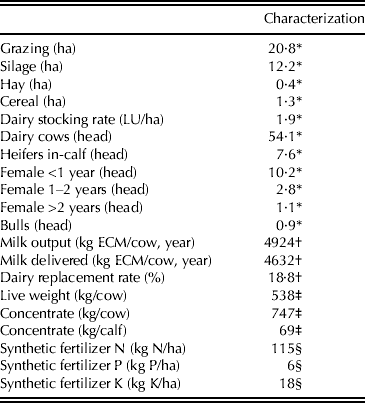
The goal was to undertake a process-based LCA of milk production for an average dairy unit in Ireland during 2008, based on national agricultural statistical data. Irish dairy farms tend to be less specialized than other Northwest European countries and other enterprises (typically rearing beef cattle or surplus dairy heifers for sale) are found on Irish dairy farms (Treacy et al. Reference Treacy, Humphreys, McNamara, Browne and Watson2008). Thus, the dairy unit rather than the whole dairy farm was considered. The dairy unit was defined as the functioning component of the farm producing liquid milk, consisting of the dairy cows, replacement animals (=replacement rate×number of cows) and bulls. In the current study, the livestock units (LU) of the dairy unit made up 0·77 of the total LU of the farm (calculated from Connolly et al. Reference Connolly, Kinsella, Quinlan and Moran2009). Thus, 0·77 of the farm's land was assigned to the dairy unit. The system boundary was set as cradle to farm gate, including the foreground processes of milk production (the animals, grass management and manure management), and the background processes of production and transportation of synthetic fertilizers, cultivation, processing and transportation of concentrate feed, production and use of electricity and diesel fuels. Infrastructure (sheds, slurry lagoon and roads), machinery (tractor and milk cooling system), medicines, refrigerant for milk cooling, pesticides, udder disinfectant, field work such as topping and hedge cutting and disposal of silage plastic were not included due to lack of data. The production system evaluated was low-cost, grass-based rotational grazing as described by Casey & Holden (Reference Casey and Holden2005a) and Fitzgerald et al. (Reference Fitzgerald, Brereton and Holden2005), but with updated statistics (Table 1). The functional unit (FU) was defined as 1 tonne energy-corrected milk (ECM, Sjaunja et al. Reference Sjaunja, Baevre, Junkkarinen, Pedersen, Setala, Gaillon and Chabert1990):
 $$\eqalign{{\rm ECM} = {\rm Milk\ delivered} \times \left(0 {\cdot} 25 + 0 {\cdot} 122 \times {\rm fat}\%\right.\cr \left. + 0 {\cdot} 077 \times {\rm protein}\% \right)}$$
Economic allocation was used between ingredients and their by-products. The unavoidable co-production of live weight exported from the dairy herd (e.g. sale of surplus calves) required that the environmental burden of milk was separated from that of the live weight export (Flysjö et al. Reference Flysjö, Cederberg, Henriksson and Ledgard2011), and in the current study allocation was based on economic sales of the milk and live weight export from the dairy unit, resulting in 0·97 allocation to milk (Connolly et al. Reference Connolly, Kinsella, Quinlan and Moran2009).
Table 1. Characteristics of an average dairy unit in 2008

Livestock unit: dairy cow=1, heifer in calf=0·67, <1 year=0·28, 1–2 years=0·67, >2 years=0·76, according to nitrogen excretion, SI No. 610, 201.
* Connolly et al. Reference Connolly, Kinsella, Quinlan and Moran2009; † CSO, 2012b, c, d; ‡ O'Mara, Reference O'Mara2006; § approximated from fertilizer applied to silage, grazing, hay and cereals in dairy farming, Lalor et al. Reference Lalor, Coulter, Quinlan and Connolly2010.
Life-cycle inventory
The inventory of GHG and acidifying emissions was made by multiplying life-cycle activity data by emission factors (EF) derived from the literature. Methane (CH4), nitrous oxide (N2O) and carbon dioxide (CO2) were the main GHG and sulphur dioxide (SO2), nitrogen oxide (NOX: nitric oxide (NO) and nitrogen dioxide (NO2), European Council 2001) and ammonia (NH3) were the main acidifying emissions. Enteric CH4 from cows was determined by estimating net energy (NE) for maintenance, lactation and pregnancy (Shalloo et al. Reference Shalloo, Dillon, Rath and Wallace2004; O'Mara Reference O'Mara2006). The NE of grazed pasture was calculated as the difference between NE intake from silage (both made on-farm and purchased) plus concentrate and that needed to meet the total NE requirements (Humphreys et al. Reference Humphreys, O'Connell and Casey2008). The NE of pasture, silage and concentrate intake were then converted into dry matter intake (DMI) and multiplied by the EF for enteric fermentation of 21·6 g CH4/kg DMI (O'Mara Reference O'Mara2006). Enteric CH4 from non-dairy animals and CH4 emissions from manure management of all animals were estimated using national average EFs for each type of animal (Duffy et al. Reference Duffy, Hanley, Hyde, O'Brien, Ponzi, Cotter and Black2012a).
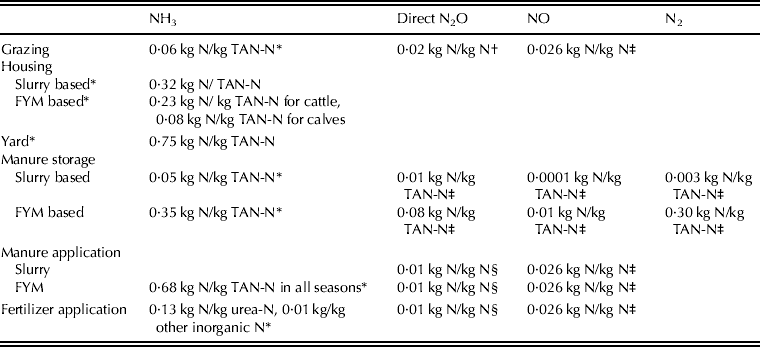
Ammonia and direct N2O emissions were estimated using the mass flow approach, where loss of nitrogen (N) in each stage reduced the N available for emission in later stages (Misselbrook et al. Reference Misselbrook, Chadwick, Gilhespy, Chambers, Smith, Williams and Dragosits2010). Tier 2 methodologies of the Intergovernmental Panel on Climate Change (IPCC Reference Eggleston, Buendia, miwa, Ngara and Tanabe2006) and the air pollutant emission inventory guidebook of European Environmental Agency (EEA 2009) were used for NH3 and direct N2O emissions with national specific EFs (Duffy et al. Reference Duffy, Hanley, Hyde, O'Brien, Ponzi, Cotter and Black2012a, Reference Duffy, Hyde, Hanley and Barryb) (Table 2). To fully account for the available N for each stage, emissions of NO and N2 from manure storage and application were estimated using Tier 1 EFs (Table 2). Nitrogenous emissions were accounted for from the moment of excretion. The N excretion rate for each type of animal was taken from Statutory Instrument No. 610 (SI 2010, pp. 38–39), and apportioned among housing, yard (only applicable to dairy cows during lactation) and grazing depending on the time spent in each location. Ammonia emissions were estimated from the total ammoniacal nitrogen (TAN), which was assumed to be 0·6 kg/kg N excreted (EEA 2009). During the housing period, NH3 emissions were estimated for liquid- (slurry) and solid (farm yard manure, FYM)-based housing. During manure storage, the fraction of the organic N in slurry that was mineralized to TAN (0·1 kg/kg) and the TAN in FYM that was immobilized in organic matter (0·0067 kg/kg) were considered before calculating NH3 emissions. After deducting NO and N2 emissions during manure storage, the available N and TAN were used for estimating NH3 and N2O emissions from manure application, where the seasonal proportion of manure application was taken from Hennessy et al. (Reference Hennessy, Buckley, Cushion, Kinsella and Moran2011). The EFs used for NH3 emissions from fertilizer applications to grassland were 0·13 kg/kg applied urea-N and 0·01 kg/kg other inorganic N fertilizers (Duffy et al. Reference Duffy, Hyde, Hanley and Barry2012b). The NOX emissions during denitrification processes were estimated to be 0·21 kg/kg direct N2O emission from soils (Nemecek & Kägi Reference Nemecek and Kägi2007). Indirect N2O emissions were estimated using IPCC Tier 2 methods where 0·01 kg/kg of NH3-N and NOX-N and 0·0025 kg/kg of N input to soils were assumed to be re-emitted as N2O-N (Duffy et al. Reference Duffy, Hanley, Hyde, O'Brien, Ponzi, Cotter and Black2012a).
Table 2. Emission factors of NH3, direct N2O, NO and N2 used in the process based LCA
TAN=total ammoniacal nitrogen, FYM=farm yard manure.
* Duffy et al. Reference Duffy, Hyde, Hanley and Barry2012b; † Duffy et al. Reference Duffy, Hanley, Hyde, O'Brien, Ponzi, Cotter and Black2012a, excluding NH3 and NOX emissions; ‡ EEA, 2009; § IPCC, Reference Eggleston, Buendia, miwa, Ngara and Tanabe2006.
Carbon dioxide emissions from diesel used in silage making, reseeding and nutrient management (e.g. fertilizer spreading) were modelled with datasets from Ecoinvent v 2.2 (Ecoinvent 2012). All silage was assumed to be made into silage pit rather than bales, since the number of bales on the average dairy farm was not known. Reseeding was assumed to be done on 0·068 of the grazing area by ploughing and broadcasting (Creighton et al. Reference Creighton, Kennedy, Shalloo, Boland and O'Donovan2011). Carbon dioxide emissions from urea spreading were excluded, since the CO2 consumption during urea production was not included in Ecoinvent v 2.2 (Nemecek & Kägi Reference Nemecek and Kägi2007).
GHG and acidifying emissions associated with purchased concentrate, silage, fertilizer and transportation were approximated using datasets in Ecoinvent v 2.2 (Ecoinvent 2012). A standard formulation of concentrate was obtained from feed suppliers. It was assumed that concentrate was fed to the dairy unit only, while consumption of purchased silage and fertilizer by the dairy unit were 0·77 that of the farm as a whole. According to the national farm survey, average dairy farms spent €1839 on purchased bulk feed in 2008 (Connolly et al. Reference Connolly, Kinsella, Quinlan and Moran2009), and that was assumed to be grass silage; therefore 18 tonnes dry matter (DM) (assumed to cost €100/t DM) was estimated to have been purchased. Fertilizer N was assumed to be from calcium ammonium nitrate (CAN), urea and diammonium phosphate, fertilizer phosphorus (P) from diammonium phosphate and fertilizer potassium (K) from potassium chloride, which are the most commonly used fertilizers in Ireland (S. Lalor, personal communication). Emissions associated with electricity use on farm were taken from Irish energy reports as 0·533 kg CO2 eq/kWh (SEAI 2008), which was considered more reliable than the 0·216 kg CO2 eq/kWh from Ecoinvent v 2.2 (Ecoinvent 2012). Only electricity used for milking was included, assuming 5·7 kWh/cow/week during lactation (Upton Reference Upton2011). Transportation of goods for the dairy unit was considered and assumed to start from origin (fertilizer from Germany, lime from local quarries, and concentrates from various places) and as necessary through overseas freight shipping to Rotterdam, via a barge tanker to Dublin, Ireland and lorry (>32 t) to farms.
Life-cycle impact assessment
The LCA calculation was performed in Simapro v 7.3. The ReCiPe midpoint (default, v 1.06, Goedkoop et al. Reference Goedkoop, Heijungs, Huijbregts, De Schryver, Struijs and Van Zelm2009) was selected as assessment method and results from two impact categories (climate change and terrestrial acidification) were analysed and compared with the I–O-based approach. The global warming potential (GWP, kg CO2 eq/kg) of CO2, CH4 and N2O were 1, 25 and 298, and the acidification potential (AP, kg SO2 eq/kg) of SO2, NOX and NH3 were 1, 0·56 and 2·45, respectively.
Input–output-based life-cycle assessment
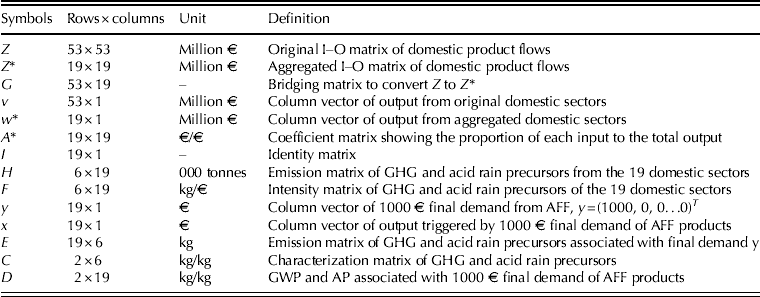
National I–O tables that provided the input coefficients for the interaction of 53 product sectors in the Irish economy for 2005 were used (CSO 2009a). The GHG and acidifying emissions compiled by Irish Environmental Protection Agency during 1998–2007 were attributed into 19 economic sub-sectors by Central Statistic Office (2009b). The ‘residential’ sector in the original report (CSO 2009b) was excluded in the current study since it described the energy use in households and was not relevant to the I–O table, which describes the product flows among industrial sectors. This brings the I–O LCA in line with the process-based LCA, where the consumption of milk by consumers was not taken into account. Both the I–O tables and the environmental accounts were based on Revision 1 (Rev 1) of the two-digit ‘European statistical classification of economic activities’ (NACE) classification (EUROSTAT 1996). The 53 sectors in the I–O table were aggregated into the 19 sectors of the environmental accounts based on NACE Rev 1 codes. The definitions of matrix and vectors are summarized in Table 3. The calculations were implemented in a spreadsheet following the method of Su et al. (Reference Su, Huang, Ang and Zhou2010) to arrive at emissions per tonne ECM, briefly:
(a) A bridging matrix G was used to convert the I–O table, a 53×53 matrix Z into a 19×19 matrix Z* using the NACE Rev 1 code for the sectors. For example, to aggregate three sectors (a, b, c) into two sectors (A, c), where sector A encompasses the codes of both sectors a and b, then a and b would be aggregated into the new sector, A, whereas sector c remains unchanged in the aggregation process, resulting the bridging table
 and the bridging matrix G=$\left( {\matrix{ 1\ \cr 1\ \cr 0\ \cr} \matrix{ 0\ \cr 0\ \cr 1\ \cr}} \right)$
(b) The aggregated matrix Z* was calculated as
(2)where T indicates transposition.$$Z^* = G^T \times Z \times G$$(c) The aggregated output matrix w* was calculated as
(3)where v was the original output vector$$w\ast = G^T \times v$$(d) The coefficient matrix A* was calculated for aggregated I-O product flows
(4)where$$A^* = Z^* \times (\hat w)^{ - {\rm 1}}$$$\hat w$=$\left( {\matrix{ {w_1} & {...} & 0 \cr {} & {...} & {} \cr 0 & {...} & {w_n} \cr}} \right)$ and −1 means inversion(e) The intensity matrix F of GHG and acidifying emissions was calculated as
(5)where the total emission matrix H was obtained from CSO (2009b)$$F = H \times (\hat w)^{ - {\rm 1}} $$(f) The output x triggered by €1000 final demand for agriculture, forestry and fishery (AFF) products (y) was calculated as
(6)where y=(1000, 0, 0…0)T$$x = (I{\rm} -{\rm} A^* )^{ - {\rm 1}} \times y$$(g) The emission matrix E associated with output x was calculated
(7)$$E = F \times (\hat x)$$(h) The same GWP and AP were used as for the process-based LCA, resulting in the following characterization table:
and the characterization matrix C=$\left( {\matrix{ {25} & {298} & 1 & 0 & 0 & 0 \cr 0 & 0 & 0 & 1 & {0{\cdot}56} & {2{\cdot}45} \cr}} \right)$(i) The GWP and AP associated with €1000 final demand of products from AFF was defined as D, where
(8)$$D = C \times E$$(j) The raw milk price for 2005 (P=0·271 €/l, basic price, calculated from CSO (2012a), was multiplied by the conversion factor for kg milk to kg ECM according to Eqn (1), then divided by raw milk density (ρ 0=1·03 kg/l), to obtain raw milk price per kg ECM:
(9)$$\rho = P \times 0 {\cdot} {\rm 993}/\rho _0 $$(k) Finally the sum of the first and the second row of matrix D was multiplied by the raw milk price (ρ) to estimate the GWP and AP emissions associated with producing 1 tonne of ECM
(10)$${\rm GWP}_{{\rm milk}}\! =\! {\rm sum}\,{\rm of}\,{\rm first}\,{\rm row}\,{\rm of}\,D\!\times\! \rho \!\times\! 1000$$(11)$${\rm AP}_{{\rm milk}} \!=\! {\rm sum}\,{\rm of}\,{\rm second}\,{\rm row}\,{\rm of}\,D\! \times\! \rho \!\times\! {\rm 1}000$$
 and the bridging matrix G=
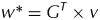


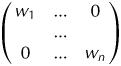
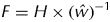







Table 3. Definitions for matrix and vectors used in I–O LCA
Capital cases indicated matrix, lower cases indicated vectors.
AFF=agriculture, food and fishery sector.
Interpretation of the two approaches
The results of the process-based LCA were compared with other peer reviewed studies of milk production (mainly in Ireland). The underlying assumptions in the I–O LCA were analysed and results of I–O LCA of Irish AFF sector were later compared with Ecoinvent datasets of Danish and US I–O LCA of dairy sector (Ecoinvent 2012). Insights derived from the two approaches for estimating the GWP and AP of milk production in Ireland were considered and the suitability of the two approaches for farm and national scale sustainability guidance was evaluated.
RESULTS
Process-based life-cycle assessment
The GHG emissions of milk production from the average dairy farm in 2008 were found to be 1338·3 kg CO2 eq/tonne ECM, with CH4, N2O and CO2 contributing 0·62, 0·29 and 0·09, respectively, and 0·87 of the emissions originated in Ireland. The main contributors of CH4 (i.e. accounting for c. 0·90) were enteric fermentation (0·84) and manure storage (0·16). The main contributors of N2O were grazing (0·36), fertilizer N application (0·25), fertilizer production (0·15) and concentrate production (0·10). The main contributors of CO2 were fertilizer production (0·34), electricity production (0·23), concentrate production (0·20) and diesel combustion for field work (0·13).
The acidifying emissions of milk production from the average dairy farm in 2008 were 14·4 kg SO2 eq/t ECM, with SO2, NOX and NH3 contributing 0·02, 0·03 and 0·95, respectively, and 0·86 of the emissions originated in Ireland. The main contributors of SO2 were transportation (0·39), fertilizer production (0·27) and concentrate production (0·25). The main contributors of NOX were concentrate production (0·22), diesel combustion for field work (0·22), fertilizer production (0·19), transportation (0·15) and grazing (0·11). The main contributors of NH3 were housing and yard (0·40), manure application (0·19), fertilizer application (0·15) and grazing (0·11).
Input–output-based life-cycle assessment
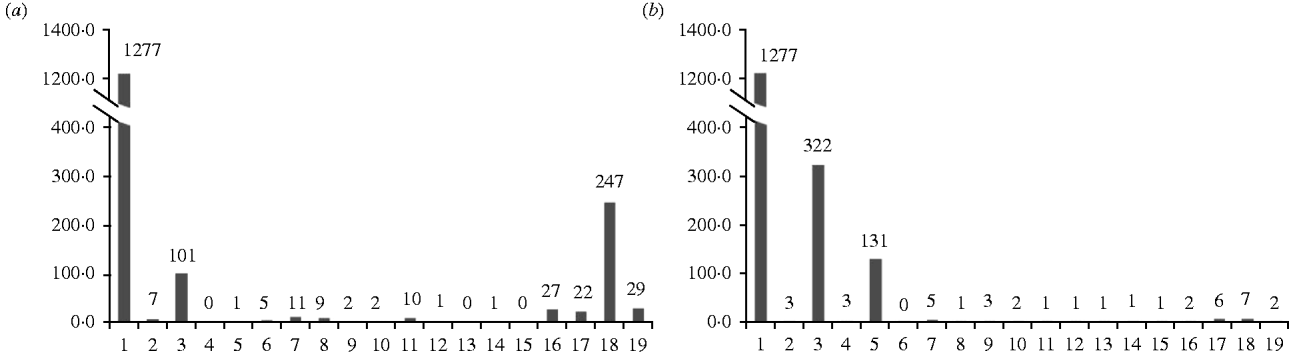
To satisfy every €1000 demand for domestic output of products from the AFF sector in 2005, production from each domestic sector (including AFF itself) was triggered proportionately as input to the AFF sector. The largest input to AFF was €1277·2 production from AFF itself, followed by €247·4 from transportation services, and €100·9 from food, beverage and tobacco (Fig. 1a). Similarly, to satisfy every €1000 demand for domestic output of products from each domestic sector in 2005, production from AFF was triggered proportionately as input (i.e. use) to each domestic sector. The largest use of AFF production was €1277·2 by AFF itself, followed by €321·6 by food, beverage and tobacco, and €130·8 by wood and wood products (Fig. 1b).
Fig. 1. (a) Production of domestic sectors (€) triggered by 1000 € demand for AFF products in Ireland during 2005 based on the aggregated 19 sectors. (b) Production of sector AFF (€) triggered by 1000 € demand for products from each domestic sector. Names of the 19 sectors were the same as Table 4.
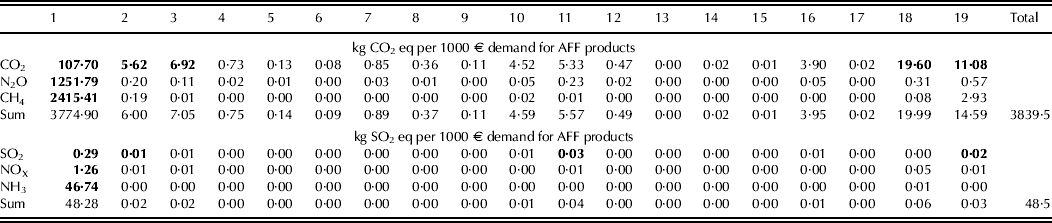
In response to every €1000 demand for domestic output of products from AFF in 2005, a total of 3839·5 kg CO2 eq were generated, with CH4, N2O and CO2 contributing 0·63, 0·33 and 0·04, respectively (Table 4). AFF itself was the dominant source of the CH4 and N2O (>0·999) and the largest source of CO2 (0·64). The second largest source of CO2 was transportation (0·12), followed by service industry (0·07), food, beverage and tobacco (0·04), and mining and quarrying (e.g. coal, peat, petroleum, metal ores and limestone) (0·03) (Table 4). Similarly, 48·5 kg SO2 eq were triggered from production of every €1000 demand for domestic output of products from AFF in 2005, with SO2, NOX and NH3 contributing 0·01, 0·03 and 0·96, respectively (Table 4). The AFF itself was the dominant source of the NH3 (>0·999), NOX (0·93), and the largest source of SO2 (0·75). The second largest source of SO2 was metal products excluding machinery and transport equipment (0·07), followed by transportation (0·06), and mining and quarrying (0·04) (Table 4).
Table 4. Emissions from the 19 sectors triggered by 1000 € demand for products from sector of AFF. Highlighted are emissions that accounting for 90% of the emissions of each type of gas
Sector names: 1, AFF (NACE Rev 1 codes 1, 2, 5, the same below); 2, Mining and quarrying (codes 10–14); 3, Food, beverage, tobacco (codes 15, 16); 4, Textiles, clothing, leather and footwear (codes 17–19); 5, Wood and wood products (code 20); 6, Pulp, paper and print production (codes 21, 22); 7, Other manufacturing (codes 23, 36, 37); 8, Chemical production (code 24); 9, Rubber and plastic production (code 25); 10, Non-metallic mineral production (code 26); 11, Metal products excluding machinery and transport equipment (codes 27, 28); 12, Agriculture and industrial machinery (code 29); 13, Office and data process machines (code 30); 14, Electrical goods (codes 31–33); 15, Transport equipment (codes 34, 35); 16, Fuel, power, water (codes 40, 41); 17, Construction (code 45); 18, Transportation (codes 50–52, 55, 65–95); 19, Services excluding transportation (codes 60–64).
After multiplying the above emission matrix by the milk price, milk density and converting into ECM (1 t ECM=0·993 t milk in the current study), the GHG and acidifying emissions associated with milk production were found to be 1003·1 kg CO2 eq and 12·7 kg SO2 eq/t ECM.
DISCUSSION
Comparisons of process life-cycle assessment with similar studies
The estimated GHG emissions from the process-based LCA (1338·3 kg CO2 eq/t ECM) was similar to the previous study of the average dairy farm in Ireland during 1997 and 2001 (1·3 kg CO2 eq/kg ECM, Casey & Holden Reference Casey and Holden2005a), although differences existed in activity data, EFs and GWP factors. The milk yield per cow (4967 kg/cow) given in Casey & Holden (Reference Casey and Holden2005a) was probably overestimated since a recalculation according to the statistics suggested delivery of 4359 kg/cow and if accounting for the calf consumption the yield would be 4660 kg/cow (CSO 2012b, c, d). The number of dairy cows on the average dairy farm was slightly higher in the current study, compared with Casey & Holden (Reference Casey and Holden2005a) (54 v. 47) and the non-dairy cattle was lower (41 v. 66), which suggested a move towards specialization. The allocation factor between milk and live weight in the current study was greater (0·97 v. 0·85), which was however subject to market fluctuation. The contribution from concentrate production was found to be lower (0·06 v. 0·17 kg CO2 eq/t ECM) owing to differences in assumed ingredients and sources of data; contribution from manure storage was found to be higher (0·15 v. 0·04 kg CO2 eq/t ECM) and contribution of fertilizer production was found to be lower (0·10 v. 0·18 kg CO2 eq/t ECM) due to different EFs for CH4 emission from manure management and EFs for CH4 and N2O emission from fertilizer production. The GWP factor for CH4 in the current study was higher (25 v. 21 kg CO2 eq/kg) and of N2O was lower (298 v. 310 kg CO2 eq/kg) than used by Casey & Holden (Reference Casey and Holden2005a), the effect of which was probably balanced out.
Greenhouse gas emissions in the current study fell into a similar range as other LCA studies on Irish commercial farms (0·92–1·51 kg CO2 eq/kg ECM, Casey & Holden Reference Casey and Holden2005b), but much higher than LCA studies on Irish research farms, which suggested 874·3 kg CO2 eq/t fat- and protein-corrected milk (FPCM, similar to ECM) for pasture-based milk production (O'Brien et al. Reference O'Brien, Shalloo, Patton, Buckley, Grainger and Wallace2012) and 0·87–1·05 kg CO2 eq/kg ECM for clover- and fertilizer-based milk production (Yan et al. Reference Yan, Humphreys and Holden2013). The same trend of higher GHG emissions found in average dairy farms than in research farms has also been noticed in a New Zealand study (Basset-Mens et al. Reference Basset-Mens, Ledgard and Boyes2009). The tightly controlled management and higher efficiency (e.g. milk output per cow) on research farms probably reduces the life-cycle GHG emissions per unit of milk.
Greenhouse gas emissions in the current study were also higher than in other LCA studies of average Irish dairy farms based on modelling and European statistics (Weiss & Leip Reference Weiss and Leip2012), and the typical Irish dairy farm based on International Farm Comparison Network (Hagemann et al. Reference Hagemann, Hemme, Ndambi, Alqaisi and Sultana2011), both of which found 1 kg CO2 eq/kg milk. The higher assumed milk output per cow (6039 kg/cow) probably explains the lower results found by Hagemann et al. (Reference Hagemann, Hemme, Ndambi, Alqaisi and Sultana2011) since GHG emissions tend to decrease as milk yield increases (Gerber et al. Reference Gerber, Vellinga, Opio, Henderson and Steinfeld2010). The inclusion of carbon sequestration (0·87 t CO2/ha/year) for grassland probably explains the lower results found by Weiss & Leip (Reference Weiss and Leip2012).
When using the same characterization factors as Huijbregts (Reference Huijbregts1999), where AP of SO2, NOX and NH3 was 1·2, 1·6 and 0·5 kg SO2 eq/kg, the result in the current study was 9·6 SO2 eq/t ECM, higher than the 6·9 kg SO2 eq/t FPCM found in pasture-based milk production on an Irish research farm (O'Brien et al. Reference O'Brien, Shalloo, Patton, Buckley, Grainger and Wallace2012). A similar trend of higher AP found in average dairy farms than in research farms was noted by Basset-Mens et al. (Reference Basset-Mens, Ledgard and Boyes2009), where the AP from average dairy farms in New Zealand was 8·1 kg SO2 eq/t milk and that from clover- and fertilizer-based research farmlets were 3·9 and 6·7 kg SO2 eq/t milk.
Underlying assumptions use in the input–output life-cycle assessment
Before comparing the I–O LCA with other studies, it is necessary to discuss the underlying assumptions used in the I–O LCA. Both the Irish I–O table and the environmental account only covered domestic production (CSO 2009a,b, except for flight landing, taking off and cruising) and thus the I–O LCA excluded emissions associated with imported goods and services (e.g. fertilizer). Considering that c. 0·14 of the GHG and acidifying emissions have been estimated to arise outside of Ireland (according to the results from the current study), there could be substantial underestimation in the I–O LCA of milk production in Ireland. Using I–O tables in the current study thus only partially avoided the truncation error by including higher order domestic production.
The static linear relationship between input and output (Leontief Reference Leontief1986) among sectors also brought uncertainty to the current results. One unit demand for sector AFF was assumed to trigger a constant proportion of production and emissions from all sectors including AFF itself (Fig. 1a). The underlying assumption was therefore an equal impact of products within each sector in terms of both economics and environment. Since AFF was the largest contributor to itself, the commodities in AFF are more influential on the results. The main products in AFF under Irish context include milk, pork, beef, sheep, poultry, cereals, vegetables, timber and aquaculture, with values ranging from €1332 million for milk, €1403 million for cattle and calves, to €125 million for cereals in 2005 (DAF 2006). It is unlikely that the €1277·2 output of AFF triggered by €1000 demand for AFF products (Fig. 1a) was evenly distributed among the different commodities. There is also large variation in the intensities of GHG and acidifying emissions among AFF products, ranging from 0·9 kg CO2 eq/kg of FPCM (pasture-based system, O'Brien et al. Reference O'Brien, Shalloo, Patton, Buckley, Grainger and Wallace2012) to 25 kg CO2 eq/m3 round wood logs under bark (Michelsen et al. Reference Michelsen, Solli and Strømman2008), and from 0·008 SO2 eq/kg of milk (Basset-Mens et al. Reference Basset-Mens, Ledgard and Boyes2009) to 0·5 SO2 eq/kg dead weight of non-organic beef (Williams et al. Reference Williams, Audsley and Sandars2006). Also, 811 000 t of CO2 were estimated to be sequestered by forestry and thus the total GHG emissions of AFF was reduced (CSO 2009b). Owing to the much larger production volume of milk and cattle in the AFF sector, the results of the I–O LCA was probably biased towards milk and cattle production, which may explain why the I–O and process-based LCA resulted in similar GHG and acidifying emissions per tonne of ECM. Lenzen (Reference Lenzen2011) suggested that since large amounts of environmental information may exist for commodities in agriculture (e.g. emissions from dairy animals, energy use on dairy farms), it causes less error to disaggregate the I–O table to match the environmental data and estimate the emissions associated with the commodity (e.g. milk) directly. Detailed I–O tables within the AFF sector are thus necessary to analyse the interactions among AFF commodities so as to gain more precise estimation for the environmental impact of milk or any other products.
The aggregation of the I–O table from 53 sectors to 19 to match the emission accounts added further uncertainty to the results. For the majority of the manufacturing industries (NACE codes between 1 and 45), little aggregation occurred (e.g. aggregation of two sectors in the I–O into one sector in the emissions accounts). For the services sector (NACE codes between 50 and 95), there was a lack of detailed emission accounts, and five sectors were thus bundled into ‘transportation’ and the other 20 sectors into ‘services excluding transportation’. Owing to the small contribution of transport and service sectors to the emissions triggered by demand for AFF products (Table 4), disaggregation of transport and services sector may not significantly influence the result of I–O LCA.
Comparing input–output life-cycle assessment with other studies
The results from I–O-based LCA are not easily compared with other studies due to large differences between economies. For example, a hybrid (including physical and monetary units), 133×133 I–O table was developed for the Danish economy in 2003 (Schmidt Reference Schmidt2010) and incorporated to Ecoinvent (2012). Using the same characterization factors as the current study, 16·8 kg CO2 eq and 0·17 kg SO2 eq were found to be associated with 1 kg dry solids of the ‘bovine meat and milk’ products in the Danish economy during 2003 (Ecoinvent 2012), and dividing that by the price of €2·74 per kg dry solids gives 6113·1 kg CO2 eq and 63·1 kg SO2 eq per €1000 of ‘bovine meat and milk’ products (Ecoinvent 2012). Considering that in the current study 3839·5 kg CO2 eq and 48·5 kg SO2 eq were found to be triggered by €1000 of AFF products, the aggregation of other AFF commodities (e.g. pork, poultry, forestry and aquaculture) seems to have lowered the GHG and acidifying emissions of the current study. In addition, the Irish I–O table covered only domestic production whereas the Danish I–O model treated all imports as if there were produced domestically. The exclusion of imported goods for AFF production in Ireland has likely further reduced the estimated GHG and acidifying emissions reported in the current study. Another example can be found in the US, where a 424×424 I–O table was developed for the US economy during 2002 by Dr Suh of IERS, LLC based on the Comprehensive Environmental Data Archive (http://www.cedainformation.net) and incorporated into Ecoinvent (2012). Again using the same characterization factors as the current study, 2327·7 kg CO2 eq and 48·1 kg SO2 eq were found to be associated with $1000 of ‘dairy cattle and milk production’ in the US economy during 2002 (Ecoinvent 2012), both of which are lower than that found by Schmidt (Reference Schmidt2010). The mostly confinement-based milk and cattle production system in the USA has probably played a role in lowering the GHG and acidifying emissions.
Insights from the two approaches of life-cycle assessment
It is important not to compare the results of the two approaches directly but rather to find insights revealed by both with regard to sustainability strategies. The process-based LCA used detailed information about the farm management and is thus suitable for developing farm scale strategy for environmental management because the process detail in the model is of similar scale and resolution as farm management. However, there is always some uncertainty as to how representative the average dairy farm can be (van der Werf et al. Reference van der Werf, Tzilivakis, Lewis and Basset-Mens2007). When using national statistics averaged across all farms, the influence of management tactics, which has been found to influence the GHG and acidifying emissions of milk production (O'Brien et al. Reference O'Brien, Shalloo, Patton, Buckley, Grainger and Wallace2012; M.-J. Yan, J. Humphreys & M. N. Holden, unpublished), is likely to be lost. Process-based LCA to facilitate farm scale environmental sustainability thus needs to capture the variation of management tactics across a wide range of farms.
The I–O LCA, on the other hand, cannot reveal the details of the system itself, but rather reflect the interactions between the sector to which the system belongs and other sectors in the economy. In the present study, it was found that the major impact of GHG and acidifying emissions in AFF resulted from interaction with itself. This suggests that AFF is self-contained within the national economy; therefore policy measures aimed elsewhere will have little impact on AFF and vice versa. For example, moving to renewable energy may not be found to have a big impact on environmental performance of AFF by the I–O LCA due to the minor interaction between the energy sector and AFF (Fig. 1a, group 16) and small contribution of GHG and acidifying emissions from energy sector (Table 4, group 16). Nevertheless, the food, beverage and tobacco sectors and transportation were influenced by demand for AFF products (Fig. 1a, groups 3, 18), which contributed a notable share of CO2 emissions (Table 4, group 3, 18). The services and metal production sector had no significant economic response to demand for AFF products (Fig. 1a, groups 11, 19) but resulted in a large share of CO2 and SO2 (Table 4, groups 11, 19). The I–O LCA offers potential for sustainability guidance at the national scale because it can account for holistic interactions in the national economy.
CONCLUSIONS
Greenhouse gas and acidifying emissions of Irish milk production were assessed by process and I–O-based LCA, which suggested 1338·3 kg CO2 eq and 14·4 kg SO2 eq/t ECM, and 1003·1 kg CO2 eq and 12·7 kg SO2 eq/t ECM. The process-based LCA revealed details of the farm management but did not assess the influence of management tactics due to the use of national statistics that averaged across farms. The I–O-based LCA found that the major impact of GHG and acidifying emissions in AFF was resulted from itself. The process-based LCA is thus suitable for developing farm-scale strategies for environmental sustainability while the I–O LCA offers sustainability guidance at the national scale. Given the limited development of I–O LCA in Ireland, foreign production needs to be included into the I–O table to fully account for imported goods and services in the LCA and a detailed disaggregation of AFF sectors is necessary to gain further understanding of the environmental sustainability of agricultural commodities.
The work was supported by the Department of Agriculture and Food research Stimulus Fund Programme (RSF07-516) and European Research and Development Fund (ERDF) via Interreg IVB project O96D: Dairyman. The authors would like to thank Yi Yang and Thomas Gibon for their help with the manuscript.