

Introduction
It has become customary among European scholars to emphasize that political representation through parties has entered a state of crisis that affects their “role as active intermediaries between the citizen and the government” (Mair, Reference Mair1984: 173). The major symptoms of such a crisis are known and have been widely discussed among scholars: a decline in election turnout (Kostelka and Blais, Reference Kostelka and Blais2021), growth in electoral volatility (Emanuele et al., Reference Emanuele, Chiaramonte and Soare2020), weakening linkages between parties and collateral organizations (Lisi and Oliveira, Reference Lisi and Oliveira2022), public distrust of political parties (Dalton, Reference Dalton2013), and a decline in party membership (Van Biezen et al., Reference Van Biezen, Mair and Poguntke2012). Parties are seen as increasingly distant and no longer in touch with society and its needs. Further fueling discontent among citizens, particularly in times of economic crisis, political parties in Europe receive the large majority of their funding through taxpayers’ money. Should alternatives to highly state-subsidized parties be considered? Could private political financing help mitigate public disaffection toward political parties? These are complex questions that require careful examination. International recommendations have urged states to adopt regulations that promote a balance between public and private funding sources, aiming to prevent political actors from becoming overly dependent on the state and to maintain strong connections between parties and their electorates.Footnote 1 In the European context, where political parties primarily depend on public funds, this perspective has been largely neglected. Private political financing has mainly been associated with political corruption, involving industrial groups and lobbies seeking to sway political actors in favor of their own interests. Of course, this is an important part of the story, with profound implications for democratic processes. Especially in light of the growing concentration of economic resources, the ability to influence policies though private donations is increasingly skewed in favor of affluent citizens, undermining the fundamental principle of political equality (Cagé, Reference Cagé2024). However, this is not the whole picture. Milbrath's seminal study (Milbrath, Reference Milbrath1965) already recognized monetary contributions to a party or candidate as a fundamental form of political participation and civic engagement. Barack Obama's successful small-dollar fundraising campaigns further demonstrated the democratic potential of citizens’ donations. These examples highlight the need to reconsider the possible positive implications of private funding within the European context, particularly in times of party crisis. By addressing this contentious topic, this Special Issue aims to fill a relevant gap in the European scholarly literature on the subject. Research on political party funding in Europe is remarkably unbalanced, mainly dealing with the public sources of party income. The impact of public funding on party revenues (Katz and Mair, Reference Katz and Mair1995, Reference Katz and Mair2009; Van Biezen and Kopecky, Reference Van Biezen and Kopecky2014), the balance of power within party organizations (Bardi et al., Reference Bardi, Calossi and Pizzimenti2017), and party system dynamics (Detterbeck Reference Detterbeck2005; Scarrow Reference Scarrow2006; Van Biezen and Rashkova Reference Van Biezen and Rashkova2014) has been extensively examined. In contrast, the study of private funding for political parties has remained largely confined to Anglo-Saxon countries, where states provide minimal public support for political financing, and parties and campaigns rely predominantly on private contributions (Fisher and Eisenstadt, Reference Fisher and Eisenstadt2004; Ewing and Issacharoff, Reference Ewing and Issacharoff2006; Norris and Van Es, Reference Norris and Van Es2016). However, as we will show in this introduction, private political financing is far from negligible in continental Europe, as it constitutes a significant share of political parties’ revenue regardless of the public support they receive.
This article is structured as follows. We first introduce the distinction between private and public sources of party income, presenting how party revenues have changed over the last century following the introduction of forms of public funding to party organizations in virtually all European countries. Despite parties’ growing reliance on the public purse to run election campaigns and maintain their organizations, we will show how sources of private income still play a relevant role for parties. Next, we look at ways in which private funding has been studied and discuss how scholars could profitably use the research questions raised in the Anglo-Saxon region by adapting them to the European context. Lastly, we summarize the arguments of the individual papers that make up this Special Issue.
Public versus private sources of party income
In the early twentieth century, political parties used to be conceived as private associations of citizens. The fact that they were financed virtually exclusively from private sources seemed like a logical corollary. First, wealthy individuals and companies supplied with the bulk of the parties’ revenues of the elite parties. Later, members’ fees and supporters’ contributions became crucial resources for mass parties. According to Duverger (Reference Duverger1954), the involvement of citizens in the economic support of party organizations constituted an important step ahead toward a more democratic financing. Indeed, financing became one the numerous forms of political involvement by the newly enfranchised citizens. This was the so-called “golden age” of political parties, with parties acting as links between the state and the civil society (Mair, Reference Mair1998: 2), which largely coincides with the time in which private forms of funding were dominant. Things changed radically from the second half of the century. Together with a changing conception of political parties, whose role in democracies came to be considered as “unthinkable” (Schattschneider, Reference Schattschneider1942), countries started introducing a growing number of rules that both regulated and legitimated political parties in their key role of intermediaries between the citizens and the state (Van Biezen, Reference Van Biezen2008). Among these rules, public funding to political parties stood central, Germany leading the way by introducing state support to parties as early as 1957, followed in the late 1960s by Sweden, Finland and Norway, and later from virtually all European countries (Piccio, Reference Piccio2014). To level the playing field and mitigate the risks of corruptive practices were the main justifications behind the introduction of these rules (Nassmacher, Reference Nassmacher2009; Koß, Reference Koß2011).
The public financing of political parties is a crucial policy that impacted on political parties and party systems in continental Europe in important ways, which scholars have been widely discussing.Footnote 2 Most importantly, for the purpose of this Special Issue, it affected the very nature of party funding, largely substituting public sources of income to the private sources discussed above. In their early 1990s writings, Katz and Mair anticipated the increasing trend in state transfers to the parties and warned that parties would become growingly dependent on state resources (Katz and Mair, Reference Katz and Mair1995). This is indeed what happened.
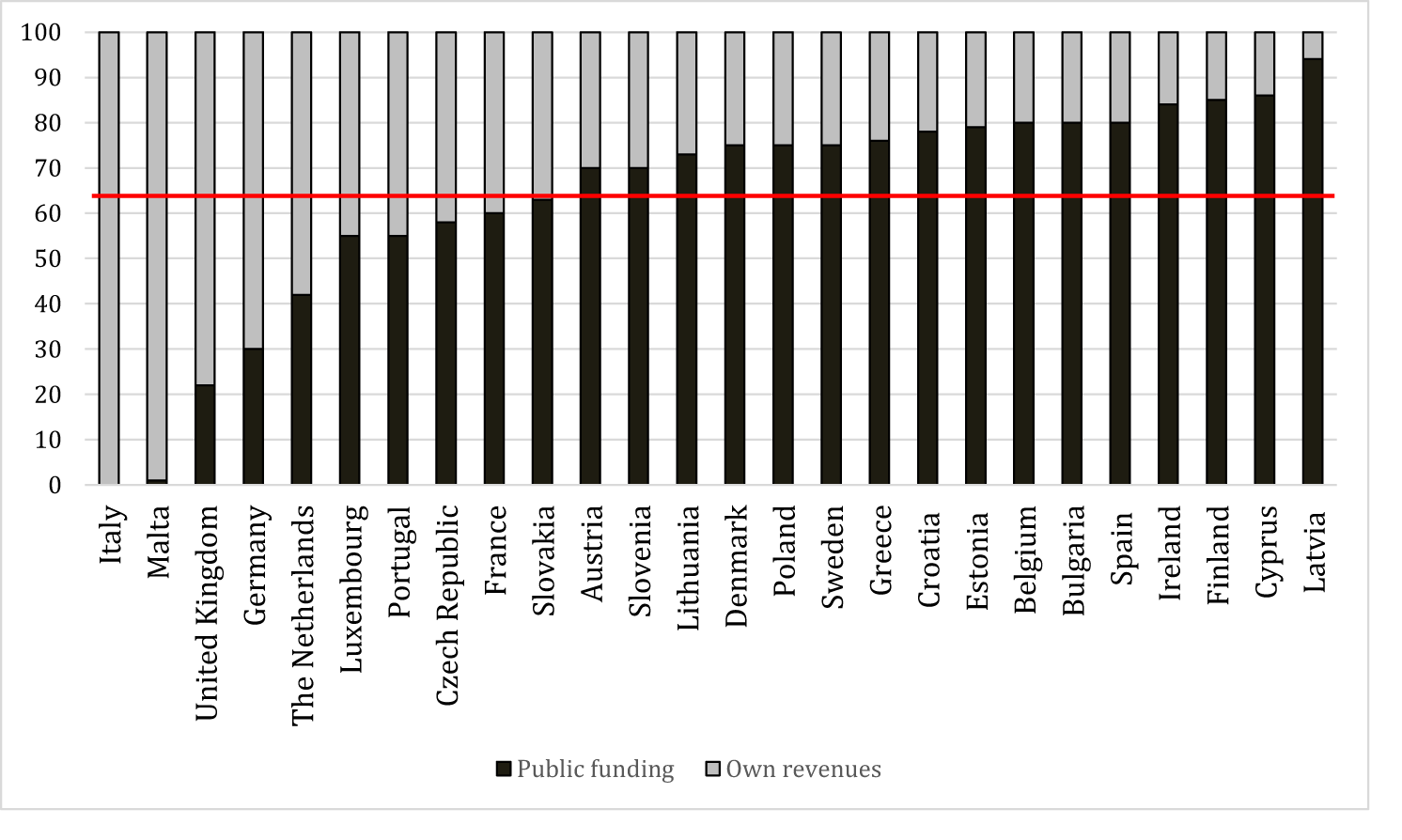
Figure 1 reports the most recently available comparative figures on the distribution of private and public funds of political parties in Europe. While confirming previous analyses that highlighted the significance of public subsidies in the total income of political parties (Piccio, Reference Piccio2014; Van Biezen and Kopecky, Reference Van Biezen and Kopecky2014), the data presented above indicate a slightly lower cross-country average (63.3% compared to the 67% reported in the 2010s). Notably, Southern European countries (e.g. Italy, Portugal, Spain, and Greece) exhibit a declining reliance on public funding. Overall, the insights of Katz and Mair (Reference Katz and Mair1995) regarding the consequences of public funding measures have indeed been reaffirmed: party organizations in Europe have become increasingly state-dependent. What did not occur as a result of the introduction of public funding schemes is the anticipated “moralization of political life,” a goal frequently cited by legislators as one of their primary objectives.Footnote 3 Despite the increasing amount of public funds at the parties’ disposal, political corruption has remained a persistent problem throughout the region (Alexander and Shiratori, Reference Alexander and Shiratori1994; Nassmacher, Reference Nassmacher2009; Casal Bértoa et al., Reference Casal Bértoa, Molenaar, Piccio and Rashkova2014). Scandals related to money in politics are just as prevalent in continental Europe as they are elsewhere in the world, with illegal donations still flowing into the parties’ pockets, and cases of trafficking of influence, donations in exchange for contracts and misuse of public funding as recurrent routines. Thus, while public funding has increased, perceptions of corruption and instances of illicit financial practices in politics have reached record scores (Transparency International, 2022). Noticeably, this does not only highlight the failure of public funding schemes to protect political parties from external influences, it also tells about the failure of the regulation of private funding. Indeed, if political finance legislation has often been criticized for being incoherent and unsystematic (see Norris and Van Es, Reference Norris and Van Es2016; Cagé, Reference Cagé2020), this particularly applies to the area of private funding. Scholars as well as international organizations have pointed to frequent inconsistencies and loopholes, which candidates and parties have proved willing to exploit (OECD; Phelippeau Reference Phelippeau2018). In a number of countries, for example, strict rules are established on the sources of income of parties, while no similar rules apply to candidates. If corporate donations are banned for parties but no corresponding rules exists for candidates, parties may easily get around bans asking corporate actors to fund candidates directly (Ohman, Reference Ohman2012). Similarly, some countries regulate national level parties, leaving what happens at the local level unregulated (Trapman, Reference Trapman2023). Caps on political donations, moreover, have often been circumvented by splitting large donations into smaller amounts (Hopkin and Wilks-Heeg, this Special Issue) or asking another individual (or legal entity) to donate under their name.Footnote 4 Other poorly regulated areas include the links between political actors and party-linked foundations, as well as campaign financing by individuals or organizations other than political parties or candidates (so-called “third party spending”). The numerous loopholes in the regulation and oversight of private funding are, according to some, the smoking gun proving the self-serving nature of political funding legislation (García-Viñuela, Reference García-Viñuela2019). This suggests that political actors are unwilling to loosen their economic ties to interested private money.
National parties’ sources of funding.

It is clear from the discussion so far that private funding remains important for political parties, despite the increasing availability of state resources. This does not only hold for illicit – hence hardly quantifiable – sources of income but also for private donations officially reported in the political parties’ annual balance sheets. It suffices to re-examine Figure 1 in terms of the information it provides on the sources of income other than public funding to observe that it accounts for over 40–50 per percent over the total reported income of parties in EU member states. Figures vary greatly per country, with Italy and Malta presenting the largest share of income from private resources (99–100%) and Finland and Ireland the lowest (15–16%). However, they indicate that private funding still constitutes a significant portion of party finances, even for political parties in Europe. In Germany, for example, the grand total of donations exceeding 10,000 euros (i.e. the disclosure threshold) for the major parties corresponded in 2015 (a non-electoral year) of about 13.4 million of euros (Cagé, Reference Cagé2020). In France, despite the ban on corporate contributions established in 1995 and the high dependency of political parties on public subsidies, a total of over 14 million of euros were disbursed to political parties in 2016 – another non-electoral year (Phelippeau 2022). This is empirical evidence that has been largely overlooked.
Moving beyond public funding research in Europe
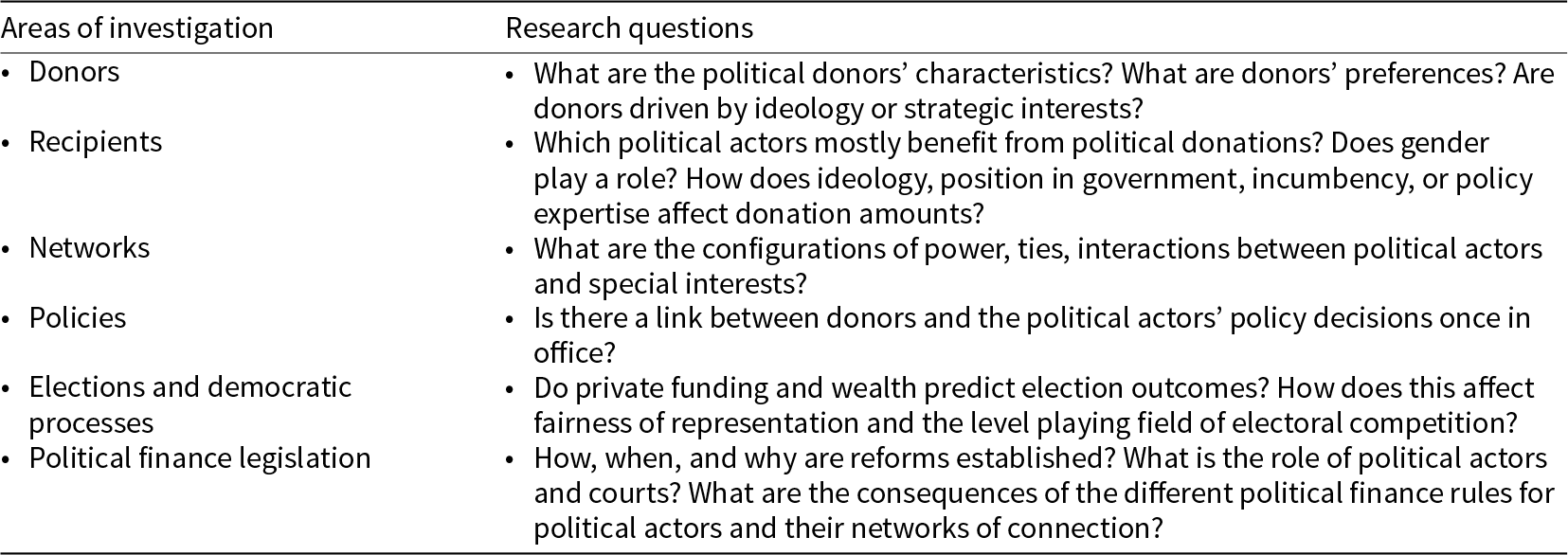
In this context, a focus on the private funding to politics in Europe is both essential and timely. To address this research field, looking across the Channel and across the Atlantic appears as a useful strategy. As opposed to political finance regimes in continental European countries, the United Kingdom and the United States adopted a liberal approach to political finance, with minimal funding from the state, few restrictions on private donations, and high degrees of transparency. The result of such a regime is a largely privately funded politics. As Katz recently argued, “the virtual absence of public money and the absence of effective limits either on spending or contributions help to explain why it might make sense to identify American parties as dominated by/defined as coalitions of well-endowed policy demanders” (Katz, Reference Katz2019: 439). The centrality of private funding in the political game, along with the exceptional degree of transparency of these systems (Briffault, Reference Briffault2010), stimulated a large body of literature on the subject. In Table 1, we present the main areas of investigations of the political finance literature overseas (as recently reviewed by Weschle, Reference Weschle2022) and a list of related research questions that scholars have sought to investigate. While not exhaustive of the vast scholarly literature in the field, it offers a fundamental guideline to the key research topics and concerns that have emerged within predominantly private political finance regimes.
Political finance research in the Anglo-Saxon region

Note: Authors’ elaboration based on Weschle (Reference Weschle2022).
Regarding the characteristics of political donors, research conducted in the United States overwhelmingly demonstrates that donors are far from representative of the general population and that a disproportionate share of campaign funds comes from corporations and interest groups.
Inequality in contributions in the United States, moreover, has significantly increased over time. Bonica et al. reported that in 2012, the top 0.01% of Americans accounted for over 40% of campaign contributions, compared to just 10% in 1982 (Bonica et al., Reference Bonica, McCarty, Poole and Rosenthal2013: 111–112). When addressing other research questions, scholarly responses have been less uniform. Donors’ motivations have been analyzed through the lenses of ideology, policy preferences, and pragmatism, yielding mixed results (McMenamin, Reference McMenamin2013; Vonnahme, Reference Vonnahme2014; Barber, Reference Barber2016).
Similarly, the extent to which donors receive preferential treatment in policy decision-making remains highly debated (Gilens, Reference Gilens2012; Powell, Reference Powell2012; Tomashevskiy, Reference Tomashevskiy2022). Undoubtedly, campaign finance plays a crucial role and influences democratic processes in multiple ways. According to Burrell (Reference Burrell and Carroll2003), for example, electoral success is directly correlated with the amount of funding political actors can secure, which, in turn, depends on their connections to affluent networks. Vonnahme (Reference Vonnahme2014) referred to this as the “rich-get-richer” process, with political finance practices reproducing and reinforcing societal disparities into the political realm (OECD, 2016; Muriaas et al., Reference Muriaas, Wang and Murray2019). Needless to say, this has been raising much concerns among scholars about the role of private funding for democratic politics (Hopkin, Reference Hopkin2004; Mutch, Reference Mutch2014; Boatright, Reference Boatright2015; Cagé, Reference Cagé2020), the principle of equality of opportunity being clearly undermined. Finally, attention has been paid to the political finance (changing) regulation and on how this has impacted the parties and their connections with interested money. Rule adaptation and reform processes have been particularly at stake in the United States since the 2010 Supreme Court Citizens United v. Federal Electoral Commission ruling, which took away campaign finance restrictions enabling corporations and other outside groups to spend unlimited funds on elections (Boatright, Reference Boatright2015).
Certainly, the scholarly literature on political finance in Europe cannot be “Americanized” by transposing Anglo-Saxon-driven research questions onto the scholarly agendas of the old continent (Piccio, Reference Piccio, Carter, Keith, Sindre and Vasilopoulou2023). As Bonotti and Nwokora argue, “political finance is a complex phenomenon, which involves a variety of interconnected institutional factors” (Bonotti and Nwokora, Reference Bonotti and Nwokora2025: 6) including the nature of a country's party system and the interaction between different parties. However, the areas of investigation as well as many of the concerns raised by scholars working on political finance in mostly private political finance regimes can be profitably used, adapted, and contextualized according to the peculiarities of the different electoral and political finance regulations in Europe, the (mostly) party-centered political competition, as well as according to the specific systems of interests present in the individual contexts.
We believe that the most relevant challenge for researchers interested in the private funding to political actors in continental Europe is not theoretical but empirical. Indeed, regulations and practices vary significantly across the two regions.
In the United States, all donations above a few hundred dollars to political parties and candidates have to be disclosed to the public and are accessible more or less in real time on the website of the Electoral Commission. Such requirements allow journalists, citizens, and researchers to trace private money along various levels of the political system (federal, state, and local levels) and reconstruct the networks of the actors and private interests involved (see Tripathi et al., Reference Tripathi, Ansolabehere and Snyder2002; Vanberg, Reference Vanberg2004; Currinder, Reference Currinder2018). Such a fine-grained analysis on the private funding to political actors based on public registers would be unthinkable in the large majority of countries in continental Europe. Even though significant improvements have been made regarding the transparency of political finance legislation (Smulders and Maddens, Reference Smulders and Maddens2016), requirements for political parties to disclose political finance information to the public remain relatively lax, if not entirely absent.
Data collection on the private income of political actors becomes even more challenging if we aim to open up to cross-country comparative research, given the diversity of political finance rules across the region. Anonymous donations, for example, are prohibited in 16 European Union countries but remain permitted in 11 others, with varying threshold limits. Such donations are inherently difficult to track. Similarly, disclosure thresholds vary significantly across Europe, ranging from as low as 125 euros in Belgium to as high as 10,000 euros in Germany. Additionally, even when registers are public and disclosure thresholds low, accessing the data can still be challenging. In Italy, for example, candidates’ financial accounts are available to the public by law. However, the process of obtaining this information from regional auditing authorities is highly complex (Perrotta, Reference Perrotta2001; Fiorelli, Reference Fiorelli2021), making a comprehensive reconstruction of private financial flows to political actors extremely difficult. Finally, financial accounts across countries vary in terms of templates. Not all countries require itemized information on donations to be published and even when details are provided, different information may be found under the same headings. A comparative analysis on the percentage of private income deriving from membership fees, for example, should consider that in a number of countries contributions from elected representatives – the so-called “party tax,” an important share of the private income of parties (Bolleyer and Bytzek, Reference Bolleyer and Bytzek2014; Ignazi and Fiorelli, Reference Ignazi and Fiorelli2022) – are grouped into this category, with the risk of overestimating the value of the contributions “from below” substantially. Given such cross-country differences, systematic comparative analyses are indeed complex.
We believe that these limitations should not prevent research on private funding to move forward. Compared to the past, researchers do have greater information at their disposal. This holds for larger contributions in particular – after all, the most sensitive ones for research on the linkages between parties and special interests, which can be profitably used for both qualitative and quantitative studies (see McMenamin, Reference McMenamin2013; Tomashevskiy, Reference Tomashevskiy2022; as well as the Political Party Data Base cross-national initiative presented in Scarrow et al., Reference Scarrow, Webb and Poguntke2017). Not least, research methodologies that complement the analysis of the parties’ financial accounts, such as large-scale surveys on candidates (see, for example, Van Erkel et al., Reference Van Erkel, Thijssen and van Aelst2017 as well as the Comparative Candidate Survey project), in-depth interviews with party officials (Wolfs, Reference Wolfs2022) and/or donors, or narrative analysis exploring the donors’ career trajectories (Gherghina et al., Reference Gherghina, Marian and Farcas2023), provide crucial additional assets for advancements in the field.
This Special Issue
While allowing authors flexibility in their approaches, the articles in this Special Issue approached the topic of private political financing from various theoretical and methodological perspectives, examining several interrelated themes: political finance regulations, reforms, and their intended and unintended consequences; the network of interests between private and political actors; the relationship between money, wealth, and democracy.
Centered on the case of the United Kingdom, whose distinctive feature is the dependence of political parties on private sources of income, the article by Jonathan Hopkin and Stuart Wilks-Heeg present the one of the most relevant acts regulating political parties in the country, the Political Parties, Elections and Referendums Act of 2000. The study reveals that the Conservative Party ultimately benefited from these reforms by strategically adapting its fundraising practices and consolidating its financial dominance over labor. This case illustrates how regulatory efforts can produce unintended consequences, reinforcing disparities rather than mitigating them. Private political finance regimes, however, are not the only viable alternative to highly subsidized parties. Using process tracing to explore the causal mechanisms that explain the regulation of donations in “the deviant German case,” Michael Koß sheds light on the important role played by ideational shifts in forming discourse, consensus, and ultimately institutional conversion in the regulation of donations. The study traces how ideas – starting with the Green Party's advocacy for stricter transparency rules – led to the 1993 reforms which combined transparency obligations and incentives for small donations. The research article by Wouter Wolfs explores the connections between elites and private interests focusing on the strategies that European Political Parties and Foundations adopt to seek private donations. The significant variations he finds in the Europarties’ fundraising strategies are explained in the light of an interplay of factors, such as institutional rules, inter-party dynamics, intra-party rules and practices, as well as donors’ interests. The contribution by Daniela Piccio questions whether a deregulatory turn in political finance legislation is in sight in the European continent. Analyzing the main rules affecting the private funding of political parties across 15 Western European democracies, the author rejects this hypothesis. However, she points to a selected number of countries where the amounts of public subsidies available to political parties were substantially reduced, thereby disproving the conventional wisdom of an inexorable move from private to public subsidization and suggesting a potential rebalancing of party income sources in the future.
By critically examining specific aspects of private political financing within distinct contexts, the articles that make up this Special Issue contribute to rethinking private political financing in several important ways. A key theme highlighted across all contributions, for example, is the challenge of effectively regulating private political financing. Transparency measures alone seem insufficient and do not necessarily reduce donations from major donors. This is partly because public and media attention to political financing is inconsistent, thus failing to act as a deterrent to large contributions. Similarly, the imposition of caps on political donations, a particularly contentious issue within Anglo-Saxon political finance regimes (see Dawood, Reference Dawood2015, and Hopkin and Wilks-Heeg, this SI), seems to do little to curb the vicious cycle between economic and political inequality (Cagé, Reference Cagé2024), particularly due to the pervasive loopholes in political finance legislation. Overall, the regulation of private financial flows proves insufficient in restraining undue influence over the political process. At the same time, as showed in Wolfs’ article, interactions between political actors and corporate interests can manifest in various forms beyond financial contributions, including policy consultations, network building, and public contracting. Together with large donors’ contributions, these forms of quid pro quo nonmonetary arrangements constitute an important challenge for democratic processes.
Many questions remain to be addressed. This Special Issue thus serves as an invitation to reconsider private political financing as a critical indicator of the interactions between political parties and private actors. Whether involving wealthy individuals, corporations, associations, or private citizens and supporters, the analysis of private funding offers a critical lens through which to examine the network of relationships political parties cultivate with civil society actors, revealing which stakeholders are granted privileged access and whose voices resonate in the political sphere. As a first step in this direction, the insights and perspectives presented here that inform and be further developed in in future research on private political financing, particularly within the European context.
Funding
This research received no specific grant from any public or private funding agency.
Competing interests
The authors declare none.

 Open access

