


Introduction
The National Center for Advancing Translational Sciences (NCATS) is committed to “research in the science of translation, to… (provide) the scientific foundation for improvements in translational efficiency that will accelerate the realization of interventions that improve human health”[1]; however, perspectives on how to achieve this aim have undergone substantial change. Early translational research frameworks generally depicted a linear process that starts with discovery at the basic science level (referred to as T0); followed by translation to humans in Phase 1 clinical trials (T1), then in Phase 2 and 3 clinical trials (T2); progressing to incorporation into healthcare practice (T3); and concluding with widespread dissemination to communities through population level research and policy (T4). Emerging frameworks suggest more complex models of iterative translation that incorporate bidirectional engagement between investigators and both clinical and community stakeholders and investigators across the translational spectrum and at multiple times [Reference Fleming2–Reference van der Laan and Boenink4].
Participation in translational research by community stakeholders – defined broadly here to include patients, families, disease advocacy groups, healthcare providers, clinical researchers, faith-based organizations, and local health departments – can help to ensure relevance and to speed up the translation of discoveries [Reference Graham5,Reference Michener6]. While strategies to engage community stakeholders in T3–T4 research have begun to make positive inroads [Reference Kahn7–Reference Wennerstrom9], community participation in T0–T2 translational research is far less developed and frequently unidirectional (i.e., information transfer from scientists to communities). There remains substantial uncertainty about how to implement stakeholder engagement in early phase translation and whether stakeholder engagement can contribute positively to translational research [Reference Graham5,Reference Kost10]. Progress in engagement in early translational research will require more substantial understanding of barriers and benefits for both stakeholders and researchers and discussions between them.
As a step toward designing a comprehensive program to engage community stakeholders in T0– T2 research, our multi-institutional investigator and community partner team hosted discussion groups to better understand investigators’ perspectives on community stakeholder participation in translational science research. To the best of our knowledge, this is the first systematic attempt to assess researchers’ perspectives on both their own and community stakeholder engagement in T0–T2 research and to identify CTSI opportunities for community engagement in these under addressed translational research phases.
Methods
Participants
Translational science researchers at four UCLA CTSI academic partner institutions (UCLA, Cedars-Sinai Medical Center, Charles R. Drew University of Medicine and Science, and the Los Angeles Biomedical Institute at Harbor-UCLA Medical Center) were eligible for the discussion groups. A community or academic partner at each site helped identify interested researchers using snowball recruitment methods. An effort was made to include opinion leaders from each site who would be willing to participate in these types of activities. UCLA CTSI Community Engagement Research Program (CERP) sent an introductory e-mail invitation providing information about the discussion group(s) to be held at each institution.
Group discussions
From March 2016 to January 2018, we conducted five two-hour discussion groups facilitated by a team of community members, academic faculties, and research staff. Each discussion group included a brief presentation on stakeholder participation in research and examples of engagement in T3–T4 research in Los Angeles County. Trained facilitators led semi-structured discussions with researchers on (1) potential benefits of community stakeholder inclusion in early stage translational research, (2) potential challenges/barriers, and (3) skills/training needed for both community stakeholders and investigators for successful engagement (see Supplement 1 for Moderator’s Guide).
Data collection
Characteristics of participating researchers (career level, type of research, etc.) were collected via institutional records. Notes from each discussion group were reviewed, revised, and approved by attending community and academic team members.
Analyses
Key themes were identified, reviewed, and revised by the community and academic team until consensus was achieved. The team developed summary lists of challenges and barriers, researcher-identified suggestions to address these barriers, and potential benefits of stakeholder engagement. Using these themes, the partnered team then identified a list of opportunities for the CTSI to support in order to incentivize stakeholder engagement in early stage research.
Results
The five discussion groups included 37 researchers, 75% of whom were engaged in basic science studies and 25% were in clinical research; 81% of the researchers held an academic position, 11% were post-doctoral researchers, and 8% were laboratory managers (Table 1); and almost 80% had received NIH funding.
Characteristics of participants (n = 37)
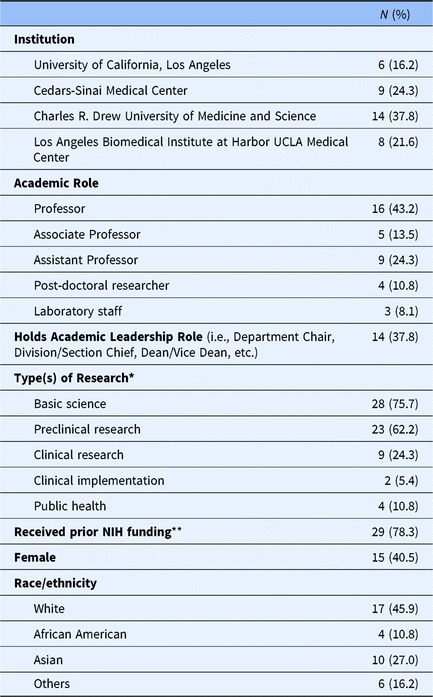
* Collecting via survey/PubMed search for survey nonrespondents. Participants were engaged in more than one category of research.
** Data abstracted from National Institutes of Health (NIH) Research Portfolio Online Reporting Tools (RePORTer).
Benefits of Community Stakeholder Engagement
A topic mentioned prominently in most of the discussion groups was the benefit of having patients, their caregivers, and communities who are directly affected by the condition(s) being studied as part of the research team. Discussions with such patients and their caregivers were thought to increase the researchers’ own motivation for the research and could change their research priorities over time. Researchers also suggested that community stakeholders with education in other fields (e.g., accountants, teachers, etc.) have different perspectives that can be usefully applied to research (Table 2). Participating scientists indicated that improving their skill in explaining their research in lay language could enhance their ability to communicate research to funders and donors. They also observed that stakeholder engagement could contribute to the dissemination plans now required by many grant applications and would demonstrate evidence of previous collaboration between researchers and stakeholders, particularly if they had publications co-authored by community stakeholders. The researchers also felt that including stakeholders in developing dissemination strategies could expand the reach of the research to non-academic venues.
Researcher-identified benefits
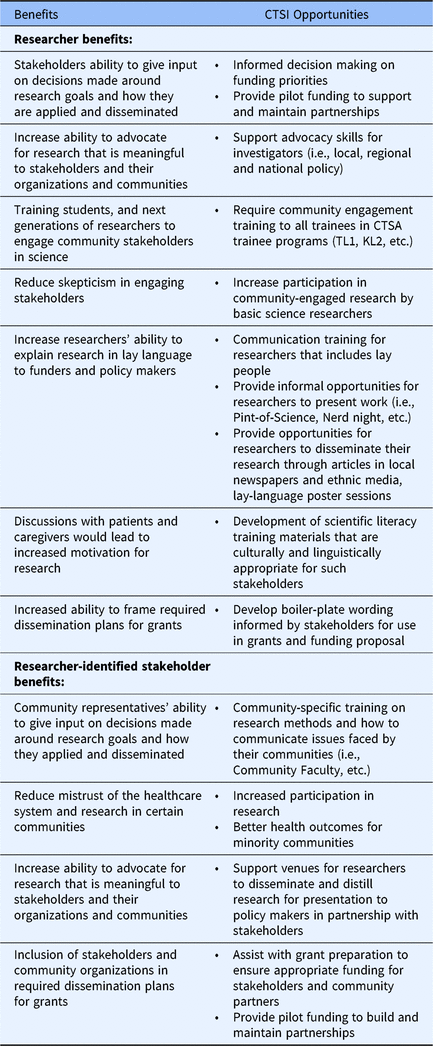
Participating scientists acknowledged the history of mistrust in certain communities toward the healthcare system and biomedical research. They believed that efforts to engage communities with particular interest in the problems being studied in early stages of translational research could contribute toward reducing mistrust, increasing participation in research, and eventually enhancing health outcomes. They judged that better knowledge of the research conducted at academic institutions could lead stakeholders to advocate more effectively for communities and patients affected by the disease, which would have the potential to influence (a) the scope and direction of research, (b) advocacy for science funding, and (c) policy at local, state, and national levels, making all these activities more robust and beneficial to the interests of the community. The academicians understood that co-authored publications could also benefit stakeholder organizations by providing scholarly credentials to enhance advocacy and funding opportunities.
Challenges of Community Engagement and Researcher Suggestions
Identification of appropriate stakeholders was the biggest concern discussed in each group. Meaningful participation in laboratory discussions would require some basic knowledge and ongoing and consistent commitment from highly motivated stakeholders (Table 3). Individuals with some background in science, or patients, families, and/or caregivers with direct experience or some familiarity with the condition being studied might be best suited to this role. However, the investigators acknowledged that many members of these groups may not have time, energy, and resources to make this additional commitment. The researchers suggested offering educational sessions for both stakeholders and researchers on how community participation in research can influence medicine and science to better address community and patient needs and enhance research quality.
Researcher-identified challenges and suggestions and opportunities for the CTSI

The level of technical discourse in research meetings may pose a barrier to stakeholder comprehension of the discussion and may intimidate them from participating in it. All researchers agreed that stakeholders would need to complete two kinds of trainings: (1) general training for research (e.g., general laboratory safety for those embedded in laboratories and human subject research certification) and (2) training specific to the work of the research group (basic scientific theory and methods and laboratory-specific knowledge about animal models, laboratory techniques, common acronyms, etc.). Some felt that graduate students and fellows may be well suited to lead laboratory-specific information sessions directed to community stakeholders. Researchers acknowledged that it will be important to explain to stakeholders that failure or null results are frequently part of the process and may promote new discoveries.
Researchers who had worked previously with community stakeholders noted that building trust between academic and stakeholder partners requires time and commitment from both partners. They also endorsed the need for a discussion of the distinct priorities of researchers and community stakeholders early in the partnership and at regular intervals, as priorities may change over time. For example, academic faculty members are often overwhelmed by multiple projects and priorities, and it may be difficult to consistently dedicate the time for meaningful community engagement if it is not a requirement of a funded grant. Additionally, embedding stakeholders in laboratory research may require frequent discussions about common laboratory procedures (especially early in the partnership) that may slow down time-sensitive research processes.
Logistical and administrative barriers to community stakeholder participation were described at all sites: the need for credentials to enter the laboratory or building (which may require background checks), parking, and travel time, and reimbursement. Most researchers felt that these were not overwhelming obstacles but could be time consuming and lengthy processes, especially to get security clearances. Several observed that allowances are made for donors to visit laboratories, and their institutions could employ a similar process for stakeholders. Others suggested an option of holding regular meetings with stakeholders outside the laboratory setting, or even outside the academic setting (i.e., at a community venue or library).
Discussion
We conducted one of the first extensive assessments of potential barriers and facilitators to inculcating community engagement into basic and preclinical translational research. We found overall broad support for such approaches, but also elicited key needs to effectively conduct community–basic science partnerships. Our findings are consistent with the reports examining challenges for basic scientists to partner with clinical investigators. These challenges include complex regulatory requirements and limited recognition and funding for translational research [Reference Weston11], barriers to engagement such as identifying funding sources, preparing a budget for a grant application, and establishing collaborations and consultant agreements along with limited infrastructural support for establishing partnerships [Reference Dao12]. Our findings also support the emerging use of novel structured approaches to community engagement such as community engagement studios, which provide a supportive space for researchers to engage with stakeholders [Reference Joosten13].
Other challenges that have been identified include bridging the gap between the structures, processes, and goals of research institutions, healthcare organizations, and community stakeholders in order to facilitate successful translational research (5). Such gaps include infrastructural challenges such as the lack of a collaborative institutional environment, and the increased bureaucratization of universities leading to an audit culture in research [Reference Fudge14]. For example, to provide legal protection, research institutions may require multistep review processes taking many months before community stakeholders can be brought into translational science environments. Similarly, if the institutional culture for collaboration is weak, effective partnering efforts engaging community stakeholders in translational research may be difficult.
A more bidirectional and collaborative approach to translational research requires improved understanding of several potential issues, including (1) how to meaningfully identify and involve communities from the earliest stages of research so that they can participate in establishing research agendas and priorities, study designs and the whole innovation trajectory [Reference Wennerstrom9,Reference Jones15–Reference Anderson17]; (2) how to change the culture of research at the institutional level to eliminate “siloed” working environments and undue regulatory and bureaucratic burdens that may preclude engaging community stakeholders [Reference Norris18]; (3) how to achieve bidirectional and iterative interaction between community and researchers [Reference Wells19,Reference Caldwell20]; and (4) what types of additional skills do basic scientists and community stakeholders need to engage together. Based on the discussion themes and researcher suggestions, we identified several opportunities at the UCLA CTSI level that support such an approach to address challenges and opportunities to community stakeholder engagement in basic science research (Tables 2 and 3).
Our study has some limitations. Because these findings are based on a convenience sample of researchers, they may not be generalizable to all basic scientists. Additionally, our team included several experienced community stakeholders whose familiarity with research may have mitigated concerns and apprehensions of basic scientists during the discussion groups. A parallel study to explore community stakeholders’ perspectives on engaging in basic science research is a necessary complement to this study. We made an effort to seek out opinion leaders; therefore, nearly 40% of the participants were in leadership positions, and thus the sample may not represent all faculty in T1–T2 research.
In summary, engaging community stakeholders in basic science research was perceived by investigators as challenging, but with exciting potential to incorporate “real-life” community health priorities into basic research, resulting in a new model of full-spectrum translational research. Realizing this potential will require that such stakeholders receive appropriate scientific literacy training and that participating scientists enhance their communication skills in translating the content and relevance of their science into lay language. Finally, while the scientists participating in our discussion groups did not identify this need, researchers may also need education on the sociocultural contexts, needs, and experiences of different types of community stakeholders for both individuals (e.g., patients and community activists) and groups (e.g., patient advocacy and community organizations).
Acknowledgements
This research was supported by NIH National Center for Advancing Translational Science (NCATS) UCLA Clinical & Translational Science Institute Grant Number UL1TR001881 and Weill Cornell Medicine Clinical & Translational Science Center 1UL1TR002384, and from the California Tobacco-Related Disease Research Program (TRDRP; Grant number 251P003).
Disclosures
The authors have no conflicts of interest to report.
Supplementary material
To view supplementary material for this article, please visit https://doi.org/10.1017/cts.2019.384.


 Open access

