

Introduction
Eating and body image concerns are highly prevalent in school pupils (Ghazzawi et al., Reference Ghazzawi, Nimer, Sweidan, Alhaj, Abulawi, Amawi, Levine and Jahrami2023), with 82.2% of eating disorders (EDs) emerging before the age of 25 years (Solmi et al., Reference Solmi, Radua, Olivola, Croce, Soardo, Salazar de Pablo, Il Shin, Kirkbride, Jones, Kim, Kim, Carvalho, Seeman, Correll and Fusar-Poli2022). Several precipitating, pre-disposing and perpetuating factors make adolescents particularly vulnerable, with social media becoming of increasing concern (Saul et al., Reference Saul, Rodgers and Saul2022). Indeed, identified rates of EDs in children and young people are growing (Hopkinson and Petty, Reference Hopkinson and Petty2022), with four times more children and young people waiting for routine ED treatment in 2021 compared with the previous year (NHS England, Reference England2023). One in eight pupils worldwide are considered ‘at risk’ of having an ED (Ghazzawi et al., Reference Ghazzawi, Nimer, Sweidan, Alhaj, Abulawi, Amawi, Levine and Jahrami2023), suggesting that there are likely to be many more experiencing disordered eating and EDs who have not yet sought help. As an example, the National Health Service England has developed an ED training strand under the Severe Mental Health Problems element of the Improving Access to Psychological Therapies programme, including training in evidence-based CBT and supervision, in order to address this growing demand, and a similar initiative has been developed to enhance access to family based treatment for younger cases.
Consequently, there is a pressing need for improved access to early prevention and treatment to enhance outcomes for adolescents and their families. The duration of untreated EDs appears to increase with age (Austin et al., Reference Austin, Flynn, Richards, Hodsoll, Duarte, Robinson, Kelly and Schmidt2020), partly reflecting the greater opportunity for a prolonged untreated period over the life course. Longer illness duration can also increase levels of burden and distress in caregivers (Anastasiadou et al., Reference Anastasiadou, Medina-Pradas, Sepulveda and Treasure2014), reducing their productive income (Streatfeild et al., Reference Streatfeild, Hickson, Austin, Hutcheson, Kandel, Lampert, Myers, Richmond, Samnaliev, Velasquez, Weissman and Pezzullo2021), as well as negatively affecting the prognosis and quality of life of the individual affected. Early intervention could therefore reduce length of illness, improve prognosis and reduce the burden on loved ones. The National Institute for Health and Care Excellence has advocated such early interventions (National Institute for Health and Care Excellence, 2017). Brief cognitive behavioural therapy (CBT-T), a 10-session form of CBT for EDs, was originally developed to reduce treatment costs and shorten waiting times (Streatfeild et al., Reference Streatfeild, Hickson, Austin, Hutcheson, Kandel, Lampert, Myers, Richmond, Samnaliev, Velasquez, Weissman and Pezzullo2021; Wilksch, Reference Wilksch2023), as an alternative to longer traditional CBT for ED. CBT-T consists of 10 sessions and two follow-ups, typically delivered by trained therapists or assistants under supervision, following a published manual (Waller et al., Reference Waller, Turner, Tatham, Mountford and Wade2019). CBT-T has comparable effectiveness and remission rates to traditional, longer CBT-ED for individuals aged 15 years and over (Keegan et al., Reference Keegan, Waller and Wade2022), and evidence of effectiveness for children and adolescents (Hart et al., Reference Hart, Hirneth, Mendelson, Jenkins, Pursey and Waller2024). Furthermore, it has been successfully used as an early intervention for adults in workplaces with ED features (Toro et al., Reference Toro, Payne, Jackson, Russell, Daly, Waller and Meyer2023). Given its brief format and adaptability to non-specialist settings, we propose the use of CBT-T as a potential early intervention within school contexts, where timely, scalable approaches are urgently needed to prevent the escalation of ED symptoms.
The use of CBT-T is not the only possible route to implementation of brief therapies in schools, as Allen et al. (Reference Allen, Courtney, Croft, Hyam, Mills, Richards, Ahmed and Schmidt2025) have shown that a range of therapies are viable and effective for young people in the First Episode Rapid Early Intervention for Eating Disorders (FREED) programme. Guided self-help is an alternative approach that could be considered, as it is also brief and low-cost. However, it is noteworthy that patients offered guided self-help under FREED have a higher body mass index (BMI), binge more, and purge less than those who receive CBT-T. Furthermore, CBT-T was offered to over twice as many young people as guided self-help. Therefore, it appears that guided self-help is regarded by services as being more suitable for young people with binge-eating disorder, while CBT-T is seen as more broadly effective.
In light of the growing demand for ED services, one possible approach is to bring treatment directly to schools. While not specific to ED, evidence from a systematic review suggests that school-based delivery of mental health interventions (for a range of conditions including depression, anxiety, substance misuse, conduct disorder), can be as effective as those delivered in clinical settings (Pilling et al., Reference Pilling, Fonagy, Allison, Barnett, Campbell, Constantinou, Gardner, Lorenzini, Matthews, Ryan, Sacchetti, Truscott, Ventura, Watchorn, Whittington and Kendall2020), supporting the feasibility of school-based interventions.
Following the UK government’s commitment to expand access to mental health care for children and young people, Mental Health Support Teams were established and piloted in schools. Trained Educational Mental Health Practitioners deliver brief, evidence-based treatment for anxiety and depression (Department of Health & Social Care & Department of Education, 2018; Ellins et al., Reference Ellins, Hocking, Al-Haboubi, Newbould, Fenton, Daniel, Stockwell, Leach, Sidhu, Bousfield, McKenna, Saunders, O’Neil and Mays2023; National Institute for Health and Care Excellence, 2019). Treatment waiting times are typically shorter than traditional community mental health services, thereby preventing problems escalating, and avoiding damaging long-term impacts (Ellins et al., Reference Ellins, Hocking, Al-Haboubi, Newbould, Fenton, Daniel, Stockwell, Leach, Sidhu, Bousfield, McKenna, Saunders, O’Neil and Mays2023). However, this provision does not yet support individuals with eating and body image concerns. Briefer ED interventions have the potential to be completed during one school term, unlike other treatments (e.g. CBT-T at 10 sessions rather than 20 sessions), allowing more individuals to receive effective and timely treatment.
Some evidence-based universal body image interventions have been piloted in UK secondary schools, evidencing effectiveness and acceptability (e.g. Diedrichs et al., Reference Diedrichs, Atkinson, Garbett and Leckie2021). However, while such programmes can play an important role in promoting positive body image and reducing risk factors at the population level, they are not sufficient for those with emerging or clinical levels of wider ED symptoms. This is because such interventions typically do not address core eating concerns (e.g. dietary restraint, binge eating) or offer structured therapeutic content required to support symptom reduction. Targeted interventions that focus on both ED behaviours and body image are therefore needed to provide adequate support for this group. Evidence suggests that school staff can play an essential role in the early identification of EDs (Department of Health & Department of Education, 2017). Given that young people spend a significant proportion of their time in school, staff are often well-placed to observe changes in behaviour, appearance, mood, or eating patterns, many of which could signal emerging eating difficulties. Therefore, school-based CBT-T may be particularly well-suited to address the needs of young people with emerging or early-onset eating difficulties, with school staff playing a key role in early identification and signposting to appropriate support. However, any such suggestion needs to be supported by the involvement of potential stakeholders in the planning of service implementation (World Health Organisation, 2016). Therefore, this study aims to explore preliminary qualitative insights in a potential brief school-based treatment for EDs. The objectives were:
-
(1) To explore the views of staff, parents and pupils on a potential in-school CBT-T programme.
-
(2) To ascertain the levels of interest in such a programme.
-
(3) To gain insights on how to overcome practical obstacles for in-school delivery.
Method
This qualitative study adheres to the guidelines set out for reporting qualitative approaches using the COREQ checklist (Tong et al., Reference Tong, Sainsbury and Craig2007). Ethical approval was received from the Biomedical and Scientific Research Ethics committee, University of Warwick (BSREC 77/22-23).
Participants and design
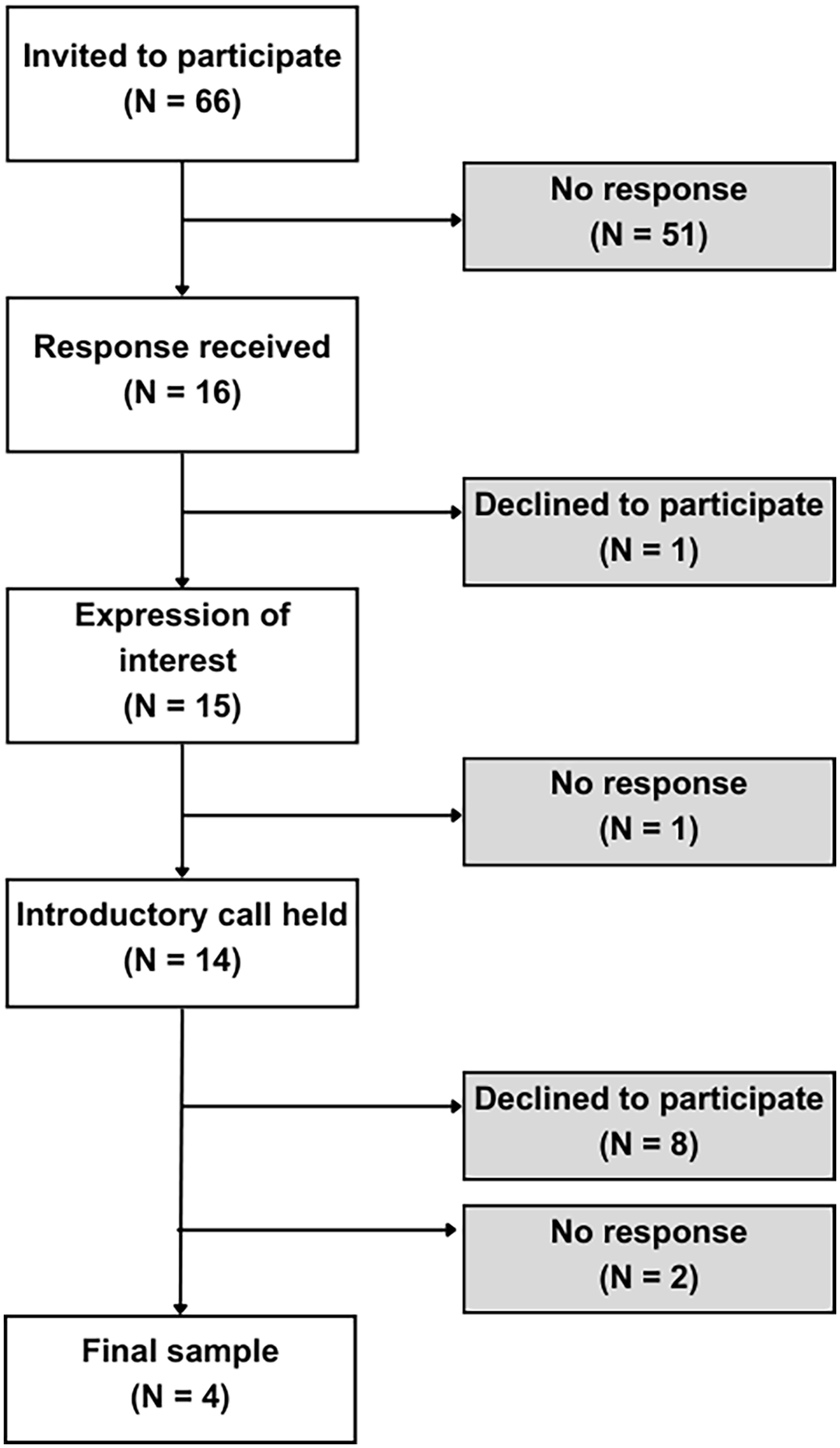
This study used a mixture of convenience and snowball sampling. Sixty-six Midlands-based secondary schools were identified through known direct contacts of the research team, known organisations within the health and education sectors who had existing school contacts, and schools listed on local council websites. The schools were approached via email and invited to take part in the study. Fifteen schools expressed interest, and four schools participated (Fig. 1), with indices of multiple deprivation (IMD) decile scores noted for each school postcode (1 = most deprived area, 10 = least deprived area). The IMD decile is an official measure of relative deprivation of a small area in England (e.g. used by the Office for National Statistics and National Health Service), compiling weighted information from seven domains (income deprivation, employment deprivation, education, skills and training deprivation, health deprivation and disability, crime, barriers to housing and services, living environment deprivation; Ministry of Housing, Communities, and Local Government, 2019).
Recruitment flowchart. All state-funded, mixed-gender schools. Operates a selective admissions policy through completion of entrance exam.

Schools invited pupils, parents and staff to participate through existing networks (e.g. pupil wellbeing committees). The advertising materials made clear that lived experience of EDs was not necessary. Following provision of an information leaflet, all participants provided informed consent prior to the focus groups. Parental/guardian informed consent was also obtained for pupils under the age of 16.
Participating schools took part in separate pupil, parent and staff focus groups conducted between 20 June and 20 October 2023. Focus groups were hosted at each school during operating hours, with a diverse range of participants in each stakeholder group (e.g. age, ethnicity, staff role). Most pupil groups also had a teacher observing. One school decided that this could impact pupil responses, so chose not to have a teacher present. Focus group duration ranged from 45 to 60 minutes.
Focus groups were audio recorded using OBS Studio with a research team member taking notes. Each participant was given an identifying number to collate responses during transcription. Participants were briefed on study aims, withdrawal processes, audio recording and anonymity before receiving a visual and verbal summary of the intervention (see Supplementary material, Fig. S1). The focus groups followed a semi-structured guide, covering topics about practical implementation of the intervention in schools, intervention acceptability (content, recruitment, delivery mode), and potential future uptake. The discussion guide was slightly amended after the first two focus groups were completed, adding further prompts to the existing questions (see revisions in tables on pages 3, 5–8 in Fig. S2 of the Supplementary material). All participants were provided with in-school and external signposting information following the focus group (e.g. eating disorder charities).
Research team characteristics and reflexivity
Five female members of the research team (T.J., S.F., Ch.M., T.M., C.K.) were involved in delivering the focus groups – with two present at each group. One team member primarily facilitated the focus groups, whilst the note taker supported the lead facilitator when needed (i.e. ask clarification or follow-up questions). Two team members (T.J., S.F., research assistants) hold masters-level qualifications in Psychology; T.J. is also a trained CBT-T therapist. Ch.M. is a doctoral student in Health Psychology (research assistant), and T.M. holds a psychology PhD (assistant Professor). C.K. is a project manager specialising in wellbeing research projects. The research team held no prior relationships with study participants, with the exception of S.F.’s childhood school participating (one parent participant was known to this researcher). T.J., S.F., Ch.M. and T.M. all had experience in delivering qualitative interviews and/or focus groups.
As a predominantly female research team with academic and professional backgrounds in psychology, mental health and wellbeing, we acknowledge that our perspectives could have shaped both the focus group facilitation and the interpretation of data. All of us have prior experience in mental health research and clinical practice, which may have sensitised us to particular themes such as emotional burden, stigma, or coping strategies. We approached the study with a shared commitment to improving mental health and wellbeing support, which could have influenced our attention to challenges and systemic barriers. Throughout the analytic process, we engaged in regular reflexive discussions to critically examine our interpretations, acknowledge our assumptions, and ensure that participants’ voices were central to the findings.
Data analyses
Audio recordings from the focus groups were transcribed verbatim by a university approved third-party transcription company. Personally identifiable information was removed and the transcription was quality-checked against the audio file and focus group notes before being transferred into NVivo version 1.6.1 for analysis. Original recordings were then deleted.
Template thematic analysis was used to analyse the data (e.g. Brooks et al., Reference Brooks, McCluskey, Turley and King2015; King, Reference King2012), due to its flexibility in allowing initial analysis whilst data collection is ongoing, the option to use a priori themes, and its structured coding approach facilitating multiple coders’ involvement in the analytic process. These features of template analysis were particularly important due to time and resource constraints, allowing the participant-driven focus of the analytic approach to remain closely aligned to the study’s aims.
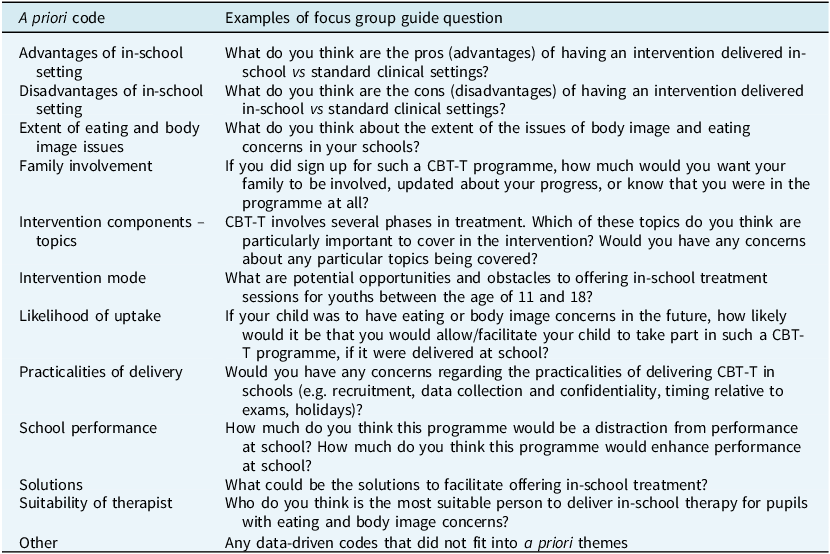
Analysis of focus groups was conducted by the lead authors (T.J., S.F.), with additional guidance from senior researchers and clinicians (T.M., C.T., C.M., G.W.). The six procedural steps outlined by King (Reference King2012) were followed. Three transcripts were selected to create the initial template, including one from each stakeholder group (i.e. pupil, parent/caregiver, staff). An initial template of a priori themes was used to guide the initial coding, informed by the study’s research aims and focus group guide questions (Table 1). Transcripts were then coded by T.J. and S.F. using both inductive and deductive approaches, resulting in further refinement of the template as new codes emerged. The coders met three times to identify prominent themes and finalise the template. Although the frequency of occurrence of codes across cases does not solely define the importance of a theme (King, Reference King2012), approximate markers of three or more references per code, across three or more stakeholder groups, were used to guide the final refinement of the template to capture the key tertiary themes from the focus groups. The final template was shared with the wider research team (see Table S1 in the Supplementary material), receiving minor amendments and suggestions. The final template was not shared with participants for feedback due to the time constraints of the study.
Initial a priori codes from research questions and example focus group guide questions

To address the COREQ reporting criteria regarding data saturation, Malterud et al. (Reference Malterud, Siersma and Guassora2016) propose that ‘information power’ can be a useful indicator of determining whether a group size is sufficient for qualitative analysis, as an alternative approach to data saturation (more applicable to grounded theory analysis). Following the principles they outlined, the research team concluded that the group size was justified when taking into consideration: (1) the relatively broad scope of the research questions; (2) the desired diversity in experiences and characteristics of the sample; (3) the rich (albeit variable) quality of dialogue; and (4) the exploratory purpose of the analysis.
Results
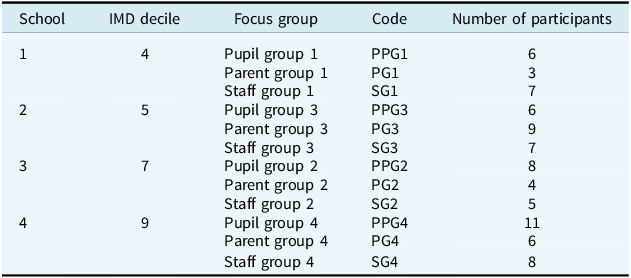
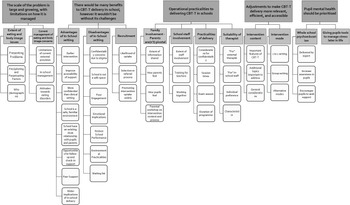
Overall, 80 participants (31 pupils, 22 parents and 27 staff) took part in 12 focus groups across the four schools, covering a range of areas from low to high relative deprivation (Table 2). Five over-arching themes and 12 subthemes were created (Fig. 2). Themes reflect participants’ perceptions on the current scale of eating and body image concerns and current limitations in their management. In turn, participants offered their views on the potential of CBT-T being delivered in schools, proposing a number of advantages, challenges, considerations and solutions on how best to implement the intervention in school settings in order to enhance acceptability and uptake.
School IMD decile numbers and number of participants
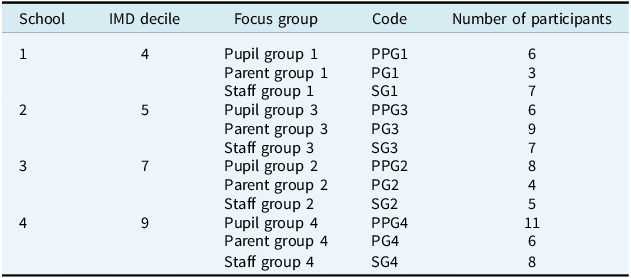
IMD, indices of multiple deprivation.
Thematic map outlining the five primary-level themes, as well as secondary and tertiary level subthemes emerging from each.

Theme 1: The scale of the problem is large and growing, with limitations on how it is managed
Staff and parents outlined presenting problems, and precipitating and perpetuating factors, in relation to eating and body image concerns in their schools. The most pertinent problems included having difficulty eating with others present, or not eating at all during the school day, with issues seen in both boys and girls. Concerns about pupils skipping meals contribute to staff and parents feeling that they are unaware of the true scale of the problem:
SG1: ‘In some cases, we will have no idea that they have an eating problem … there might be some kids who just completely go under the radar and we have no idea they’re not eating at lunchtime or they’re not having breakfast and they’re skipping meals.’
Many parents and staff members believe that the ‘constant drip feed’ (SG3) of social media and the comparison with ideals online are perpetuating these body image issues:
SG3: ‘When I get referrals through to pass on, social media is always mentioned …’
Participants commented on how eating and body image concerns are often insufficiently managed by external services, with long waiting lists and rigid CAMHS frameworks resulting in deterioration of problems. Some schools have offered internal eating or body image awareness sessions. However, a lack of confidence and education for teachers could mean that poor eating habits have been inadvertently promoted amongst students.
PG4: ‘Even food tech, or home economics, whatever they call it these days, they were talking about fats being bad, and carbohydrates, and … fats are essential for living. If you don’t have them, you’re not properly eating …’
SG3: ‘… for me, it’s an area where I don’t feel very confident … I’m quite nervous of saying the right thing and doing the right thing. So, I’m not making anything worse …’
Theme 2: There would be many benefits to CBT-T delivery in school; however, it wouldn’t be without its challenges
All participant groups described how delivering CBT-T in school could have advantages. Staff are well placed to identify early signs of EDs, facilitating earlier intervention through in-school delivery. Accessibility was also described as a benefit, where minimising absence from lessons and subsequent educational advantage were highlighted:
PPG4: ‘If you wanted to get an actual therapist outside of school and go to regular sessions, you’d have to ask your parents … and that can be stressful. So, if you could do it like just in school and you can tell your parents about it but like, you know, they don’t need to organise things, it gets rid of a lot of steps.’
Some participants valued the option of accessing CBT-T independently of their parents, increasing confidentiality through in-school delivery. Where some suggested that in-school sessions would draw less attention to a pupil (compared with leaving for external services), others had concerns that being pulled out of lessons, or being seen going into therapy, could trigger questions or bullying from pupils. This could mean pupils are less likely to access CBT-T. On the other hand, many participants described school as a safe, familiar environment for therapy to take place in, resulting in students being more likely to open up:
PPG2b: ‘I think on the other hand, you could also say that it might be easier for some people to talk to someone in school in the environment they’re familiar with, rather than having to take themselves to a hospital or a clinical setting where they might feel a lot more unfamiliar and unsupported.’
Relationships between stakeholders presented as both a benefit and a challenge for in-school CBT-T. The school setting offers unique opportunities for peer support and staff check-ins, sharing the load of support for pupils amongst those with close relationships. However, some suggested that school is not always a safe space for pupils and their parents, particularly if there are poor relationships with staff, limiting potential engagement with therapy.
The emotional implications of accessing school-based therapy were noted, resulting in students finding it difficult to return to lessons, and perhaps avoiding school altogether – impacting their educational performance. Environmental practicalities were also expressed, including difficulties fitting sessions into timetables, and the lack of appropriate in-school spaces for therapy.
All groups expressed enthusiasm about CBT-T, although some felt that the likelihood of uptake may depend on individual preferences. Some had concerns about possible selection or referral processes – for example, if pupils were asked to self-refer, they may be reluctant to seek help, or may not recognise the signs. Some parents raised the issue of parental consent for referrals and expressed that they would want to be informed. Staff felt discomfort about referring based on appearances, e.g. sudden weight gain or weight loss. Finally, participants felt that when promoting CBT-T, care must be taken to eliminate the stigma of EDs amongst pupils.
Theme 3: Operational practicalities to delivering CBT-T in schools
When discussing how CBT-T could be delivered in schools, participants spoke about the level of parental involvement, school staff involvement, the suitability of the therapist, and practicalities of delivery. Throughout each of these subthemes, it was clear that pupils, staff and parents each had their own preferences.
Staff described how parents would be pivotal to the roll-out of CBT-T in schools, and believed that parents are key to facilitating engagement with CBT-T outside of sessions. Parents and pupils also spoke about parents being able to provide active support for their children – through gaining an awareness of triggers, supporting with homework, and being able to signpost to further support. Some suggested that schools could run a parental workshop on CBT-T intervention content and the process:
PG2: ‘Whatever you’re teaching the children, the parents need to know so that they can complement it and be the support network at home and continue that and not contradict it, do you know what I mean?’
Participants expressed mixed opinions about the level of parental involvement required for CBT-T, with parents feeling ‘shut out’ of their children’s lives. Pupils and some parents valued the option of parental involvement to be guided by the pupils, noting some concerns about confidentiality.
On the other hand, several participants suggested the existing support networks in place within the school setting could facilitate CBT-T delivery. Following additional training on strategies to support students, staff could be well placed to provide follow-up support. Many staff advocated for a collaborative pupil-centred approach involving staff, parents and therapists, including sharing of key background information, regular progress update meetings and immediate communication of risk. However, some staff felt only relevant information for teaching is required (e.g. triggers).
Participants discussed the practicalities of delivering CBT-T in school. Considerations for confidentiality was a prominent theme following previous concerns raised. Suggestions included more discreet session locations (e.g. the library), timing (e.g. quieter times before school, during study periods), and methods of communication (e.g. a card system to inform staff of the need to leave the lesson).
Different opinions emerged through discussion of session timings. Pupil preferences on timing were deemed a priority, as well as specific coordination across different year groups. If sessions occurred during standard lessons, participants were primarily concerned about missing lessons, highlighting implications for educational performance and confidentiality. Extracurricular periods (e.g. ‘tutor time’, PSHE lessons), or sessions before or after school were all suggested as possible alternatives, mitigating the educational and confidentiality concerns raised. Although some felt that before school sessions may be ‘really stressful’ (PPG4) and impact on the rest of the school day. After-school sessions could therefore be advantageous in giving pupils time to reflect, without having to return to lessons. Lunch sessions were also proposed, although others felt that this would deny students a proper ‘brain break’ (SG1), or even perpetuate eating concerns.
Pupils felt that it would be important to continue therapy during the school holidays, due to the large break and loss of routine. They suggested that sessions could be offered remotely or less regularly. During exam season, participants indicated that CBT-T may be needed more, as exam stress could trigger deterioration of disordered eating. However, some pupils and parents felt that CBT-T could be an additional stressor during exam time:
PPG4: ‘I feel like during exam periods it’s one of the most important times to keep it going because especially with stress, people are going to be more inclined to stop eating or to like, they might feel worse … it doesn’t have to be like as regular but still like check-ins to make sure that they’re still on the right path.’
Participants also commented on the duration of the programme, with several expressing the opinion that 10 weeks of intervention is too short. Some suggested that pupils should be offered the option to continue the programme further if they wish.
Finally, participants discussed the suitability of the therapist – including who is best placed to deliver (in-school staff vs external therapist), and their characteristics. The majority of participants were ‘for’ an external therapist, highlighting their specialist and neutral positioning compared with in-school staff. Staff and parents stressed the lack of capacity for in-school staff to deliver CBT-T, with teachers being less qualified. Pupils preferred not to speak to their teachers about their eating and body image concerns, and valued not regularly seeing an external therapist around school.
Some participants did express a preference for in-school staff to deliver CBT-T sessions, suggesting that pupils might prefer or feel more comfortable with a ‘familiar face’ (SG1); however, this person would need appropriate training and supervision. Participants felt that the CBT-T therapist should be down to individual preference. Regardless of who delivers therapy, participants stressed the importance of appropriate professional training, good rapport, and feeling comfortable.
Theme 4: Adjustments to make CBT-T delivery more relevant, efficient and accessible
Participants felt that there were several advantages to 1:1 delivery, including it being more personal, better suited to more severe symptoms, and perceived by parents and staff to be preferred by pupils – although some raised concerns as to the intensity of 1:1 therapy.
In turn, group CBT-T could offer less focus on individuals and reduce the length of a waiting list, whilst also promoting a sense of togetherness and peer support. However, some parents and staff felt that pupils may not want to open-up in a group setting and were concerned that pupils may become competitive with their disordered behaviours. Some participants suggested a mixed mode of delivery and optional online attendance, reinforcing the importance of individual preference.
Participants felt that the most relevant CBT-T components were beliefs about food, emotional triggers and body image, acknowledging that the uncomfortable nature of these topics necessitates the need for its inclusion. Parents and pupils suggested the impact of social media should be additionally included, to address its perpetuating impact on body image problems:
PPG4: ‘I think body image work is really important especially now because like pretty much everyone’s on social media so like the importance of what that can do to people that are suffering with eating as well.’
General considerations regarding CBT-T content delivery were discussed, disputing the ‘one-size-fits all’ approach and emphasising the considerations needed for age, psychosocial development, and background. Parents and staff felt there needed to be careful consideration of the use of ED-related language (e.g. focusing on behaviours rather than diagnoses), to minimise stigma and encourage pupil participation.
Theme 5: Pupil mental health should be prioritised
Participants voiced their belief that pupil mental health should take priority over education, and that giving pupils tools now would help them to manage stress later in life:
PPG1: ‘… health and mental health, I believe, always comes first because if you don’t have, them, you know, you can’t learn anyway.’
All three groups felt that mental health should take priority over a child’s education, and that some sort of psychoeducational provision should be made for all students – not just those who may need CBT-T. An expert-led whole school psychoeducation was proposed, which could increase ED awareness amongst pupils, encourage them to seek support and help them to identify other related issues. However, pupils themselves expressed concerns about confidentiality, emphasising that personal stories should not be shared. Another pupil worried that some students ‘might take the mickey’ (PPG1).
Discussion
This study explored insights regarding a brief, school-based CBT-T intervention for EDs, examining the perspectives of secondary school pupils, parents and staff. We found that such a programme would be welcomed by staff, pupils and parents alike, suggesting good potential feasibility and acceptability – although some adjustments need to be considered. These findings reflect those of equivalent stakeholder groups evaluating mental health support teams within schools (Ellins et al., Reference Ellins, Hocking, Al-Haboubi, Newbould, Fenton, Daniel, Stockwell, Leach, Sidhu, Bousfield, McKenna, Saunders, O’Neil and Mays2023), suggesting similar learning points for schools and clinical services.
Unsurprisingly, all groups were concerned about the level of eating and body image problems in this age group. That awareness supports early identification, which is important because it provides an alternative route for accessing early intervention – a route that is not dependent on attendance in health settings. Such early intervention is stressed under programmes such as FREED (e.g. Allen et al., Reference Allen, Courtney, Croft, Hyam, Mills, Richards, Ahmed and Schmidt2025). Delivery within school settings could clearly facilitate rapid access, and the brevity of CBT-T makes it suitable for delivery within school terms/semesters, avoiding breaks in the delivery of the intervention.
Given the concerns raised about the school setting as an environment for therapy, it will be important to make the delivery mechanisms and environments central, determining ways of working round timetabled teaching and finding confidential spaces for either in-person or online delivery. On the other hand, some identified issues are more generic when planning therapy for this age group – particularly parental involvement, child consent, social media use and the importance of short-term focus on the child’s mental health over their education. These issues need to be considered as they would be for any therapy in any setting for such patients. CBT-T should be offered in a frame of maximising engagement and therapeutic benefits while minimising issues of shame and potential bullying (Gronholm et al., Reference Gronholm, Nye and Michelson2018). Issues such as access, confidentiality and minimising educational disruption should be addressed collaboratively with schools and families, using the methods developed by clinicians from Mental Health Support Teams and Educational Mental Health Practitioners programmes (e.g. whole-school psychoeducation to normalise mental health issues and their treatment).
The findings also stressed the importance of external therapists, allowing clinician expertise to support the education experience. Extending the training of Educational Mental Health Practitioners and other therapists working into schools should include physical health monitoring, in association with medical professionals. CBT-T has been delivered successfully in multiple settings by clinicians with different levels of training, although expert supervision is a key requirement (Waller et al., Reference Waller, Turner, Tatham, Mountford and Wade2019). To ensure the sustainability of such a model in the public health sector, relatively inexpensive therapists under specialist supervision would be optimal, as shown by Pellizzer et al. (Reference Pellizzer, Waller and Wade2019), Toro et al. (Reference Toro, Payne, Jackson, Russell, Daly, Waller and Meyer2023) and Hoskins et al. (Reference Hoskins, Blood, Stokes, Tatham, Waller and Turner2019). Such an approach has been shown to work without loss of effectiveness in other disorders (Pilling et al., Reference Pilling, Fonagy, Allison, Barnett, Campbell, Constantinou, Gardner, Lorenzini, Matthews, Ryan, Sacchetti, Truscott, Ventura, Watchorn, Whittington and Kendall2020). Furthermore, there is potential for substantial economic savings, through minimising losses in parental/caregiver productivity and reduced health system costs (Streatfeild et al., Reference Streatfeild, Hickson, Austin, Hutcheson, Kandel, Lampert, Myers, Richmond, Samnaliev, Velasquez, Weissman and Pezzullo2021; Wilksch, Reference Wilksch2023). Of course, such therapists should be trained and supervised to identify lack of progress and emergent risk, to support a stepping up of care if necessary. Although not frequently raised by participants, managing physical health risks is essential when delivering ED interventions in schools. CBT-T would not be suitable for pupils with high medical risk without clinical oversight. Therefore, clear screening procedures and referral pathways are needed to ensure that any physical health concerns are identified and managed appropriately, potentially involving school nurses or external clinical services.
In short, given the need for treatment of EDs in younger people, CBT-T is a strong contender for introduction to schools, possibly via the Educational Mental Health Practitioners curriculum. This therapy has positive outcomes with this age group (e.g. Hart et al., Reference Hart, Hirneth, Mendelson, Jenkins, Pursey and Waller2024), it is brief relative to other interventions, and it has the support of teachers, pupils and parents. While it needs to be shaped to consider some of the concerns raised here (e.g. confidentiality, referral processes, space requirements), all these issues would need to be addressed, regardless of the therapy being considered in the education context.
Strengths and limitations
Overall, this study has provided insights to shape a future CBT-T programme in schools, based on the perspectives of stakeholders. The sample included individuals from a diverse range of schools, adding value by considering the local needs in the development of people-centred health services (World Health Organisation, 2016). However, there were some limitations to the current study that require addressing when developing the programme. First, the presence of staff members in pupil focus groups might have influenced what the young people had to say. Further consideration on how to mitigate bias in this area is needed.
Secondly, the low school participation rate (4/66 schools) was likely due to a short recruitment period overlapping with exam season, summer holidays and the start of the new academic year. Although the sample size permitted sufficient in-depth analysis for this initial exploratory phase, the time of year and longer duration of recruitment should be considered when planning future recruitment within schools. Teachers worldwide face significant time and resource constraints (OECD, 2021), whereby any extracurricular activities are considered as a trade-off of capacity vs added value. As this initial exploratory phase offered no immediate tangible benefits, it is likely that schools with a specific interest in EDs (e.g. a lot of cases; demands on pastoral support) will more likely participate in future feasibility and efficacy studies. Similarly, the sample was self-selected from relevant networks, and demographic characteristics were not recorded. As well as collecting demographic data, any future study should aim for a more randomised sample of schools and participants. In addition, the IMD decile might not fully represent pupils (e.g. those who live outside of the catchment area), including those in areas of rural deprivation. Future research should aim to collect additional deprivation data based on where the child lives (as implemented by the NHS National Child Measurement Programme).
A third limitation of the study is the lack of demographic data for pupil and parent participants. Recruitment was managed by the participating schools, and no formal information was collected on age, gender, or year group. Therefore, while participants attending included a mix of ages and genders, this could not be systematically reported. As a result, we are unable to assess the representativeness of the sample or explore how perspectives may have varied across demographic groups.
Conclusions
This study demonstrates there is a pressing need and enthusiasm from school stakeholders to develop and trial the effectiveness of the CBT-T programme for eating and body image concerns in schools. Future research will consider the insights shared in this exploratory phase, to ensure the long-term sustainability and scalability of the programme to support this under-served group.
Supplementary material
To view supplementary material for this article, please visit https://doi.org/10.1017/S1352465825101148
Data availability statement
The data that support the findings of this study are available from the corresponding author, T.M., upon reasonable request.
Acknowledgements
The authors would like to thank Chloe Mitchell (Ch.M.) for her contributions to the delivery of the focus groups. The authors would also like to express their gratitude to our partner schools and their pupils for their valuable contribution to this research.
Author contributions
Tabitha Jackson: Data curation (equal), Formal analysis (equal), Investigation (equal), Methodology (equal), Project administration (equal), Visualization (equal), Writing - original draft (equal), Writing - review & editing (equal); Sophie Fletcher: Data curation (equal), Formal analysis (equal), Investigation (equal), Methodology (equal), Project administration (equal), Visualization (equal), Writing - original draft (equal), Writing - review & editing (equal); Talar Rita Moukhtarian: Corresponding Author, Conceptualization (equal), Funding acquisition (supporting), Investigation (equal), Project administration (equal), Supervision (equal), Writing - review & editing (equal); Charlotte Kershaw: Data curation (supporting), Funding acquisition (supporting), Project administration (lead); Carla Toro: Conceptualization (equal), Funding acquisition (supporting), Supervision (equal), Writing - review & editing (equal); Glenn Waller: Conceptualization (equal), Funding acquisition (lead), Resources (equal), Supervision (equal), Writing - review & editing (equal); Caroline Meyer: Conceptualization (equal), Funding acquisition (lead), Resources (equal), Supervision (equal), Writing - review & editing (equal).
Financial support
This work was supported by the Rosetrees Trust (grant number: Seedcorn2022\100167). Rosetrees Trust had no role in the study design, collection, analysis or interpretation of the data, writing the manuscript, or the decision to submit the paper for publication.
Competing interests
The authors declare none.
Ethical standards
All authors have abided by the Ethical Principles of Psychologists and Code of Conduct as set out by the BABCP and BPS.


 Open access


Comments
No Comments have been published for this article.