The Gospel and Letters of John are linked by pervasive imitation and copying. But why is imitation a core feature of this corpus? Why did the authors of these epistles, or letters, borrow so extensively from earlier works? To answer these questions, we must recognize one other feature, one other commonality, uniting these texts that is widely overlooked by contemporary scholars: their authorial claims.
By the late twentieth century, most scholars had rejected the view that a single individual wrote the Gospel and Epistles of John. But that view rests on a valid observation, one easily overlooked by critics trained to read these texts as the work of different hands. Although these texts may not share a common real author, they do share a common implied author.1 Each letter positions itself as the work of the same anonymous eyewitness first encountered in the Gospel: a voice who speaks in a “we”/“I” voice and uses distinctive speech patterns. Even if these texts were not written by a single hand, they were meant to appear as if they were.
When we understand this point, we can fully appreciate what the Gospel and Epistles are: they are a chain, a lineage, of falsely authored works. This kind of literature is quite familiar to biblical scholars. It survives in such collections as the canonical letters of Paul, which include numerous pseudonymous works (2 Thessalonians, Colossians, Ephesians, 1 and 2 Timothy, and Titus). Those letters were also written by multiple authors, they also contain signs of direct copying and borrowing, and they also claim a single authorial persona. As I will argue here, conceptualizing the Johannine Epistles as a similar collection allows us to make sense of all the data we have gathered to this point, clarifying the unique interplay of dissimilarity and similarity across the Epistles.
3.1 Disguised Authorship in the Gospel of John
Across two millennia, most Christians have believed that all four texts – John, 1 John, 2 John, and 3 John – were written by a single hand. The success of this tradition is no accident. The idea that a single author stands behind all four works is the most natural way to read the authorial claims of each, and with good reason. As I will argue here, this reading has been deliberately planted in the texts by their authors.
To appreciate this point, we must begin with the text we have already identified as the earliest Johannine work: the Gospel of John. Although the Gospel is mostly opaque about its origins, it positions itself as an eyewitness record, one condensing the witness of an enigmatic “disciple whom Jesus loved.” This claim takes shape in chapters 1–20 at various strategic points, but it is most explicitly stated in chapter 21.
3.1.1 “We”
The Gospel begins constructing its implied author as an eyewitness to the life of Jesus in its prologue, a typical site for authors to introduce themselves. There, one encounters a brief instance of first-person speech by the narrator – the only such statement in chapters 1–20:
And the Word became flesh and dwelled among us [ἐν ἡμῖν], and we saw [ἐθεασάμεθα] his glory – glory as of the unique son from the Father, full of grace and truth.
The author first positions himself among Jesus’ contemporaries (“the Word became flesh and dwelled among us”). Then, continuing in the same “we/us” first-person voice, he claims, “and we saw his glory.” (Note that the “we” of 1:14 is anaphoric, referring back to the “us” of the previous clause.) According to the Gospel, Jesus manifested his glory to others through the miraculous “signs” he performed in his time on earth, as in 2:11: “Jesus performed this, the first of his signs, at Cana in Galilee, and manifested his glory; and his disciples believed in him” (cf. 11:40). In 1:14, then, the text constructs its narrator as an eyewitness voice – a voice that can speak with authority to the life of Jesus and the signs he performed.
At this point, however, the Gospel still leaves a great deal unsaid. Is the eyewitness “we” the voice of multiple eyewitnesses who collectively produced this text? Or is the “we” the voice of a single figure among these eyewitnesses, either speaking on behalf of a group or speaking in a plural “we” (a nosism)? Any of these interpretations is plausible. Notably, other texts in the Gospel show individual figures speaking in the “we” form. This is true of Nicodemus, meeting with Jesus alone (3:2); this is true of Mary Magdalene (20:2); this is also true of Jesus himself, who (quite jarringly) shifts between “we,” “I,” and third-person self-references in consecutive lines:
Very truly, I tell you, we speak of what we know and testify to what we have seen, yet you do not receive our testimony. If I have told you about earthly things and you do not believe, how can you believe if I tell you about heavenly things? No one has ascended into heaven except the one who descended from heaven, the Son of Man.
3.1.2 “The Disciple Whom Jesus Loved”
Although the prologue remains vague about the identity of this narrator, later chapters add depth to this authorial cast. Midway through the narrative, a new character emerges among the many eyewitnesses to Jesus’ life mentioned in the account: a nameless, male follower of Jesus referred to as “the disciple whom Jesus loved.”2 The appellation given to this disciple suggests his special character, and indeed, the narrative casts this figure as Jesus’ most intimate and steadfast companion through the climactic events of his life. When Jesus reclines for his final, earthly supper (13:2, 4), this disciple occupies the most privileged position at the table: he reclines on Jesus’ “bosom,” evoking the image of Jesus reclining in the bosom of the Father (13:23; cf. 1:18). By contrast, the text positions Peter – Jesus’ most prominent disciple in other texts (e.g., Matt. 16:18) – at a greater distance from Jesus. In the scene, Peter must have his questions to Jesus relayed through the disciple whom Jesus loved:
One of his disciples, whom Jesus loved, was lying close to the breast of Jesus, so Simon Peter beckoned to him and said, “Tell us who it is of whom he speaks.” So lying thus, close to the breast of Jesus, he said to him, “Lord, who is it?”
Later chapters reinforce the impression that this disciple is superior to the others. During the supper, Jesus predicts that all the disciples will scatter and abandon him (16:32) and that even Peter would deny him (13:38; cf. 18:25–27). In those later scenes, however, the disciple Jesus loves remains steadfast. He is the only male disciple depicted at Jesus’ crucifixion, and moments before his death, Jesus entrusts his mother to this figure (19:26–27). Likewise, at the resurrection, when Mary Magdalene tells the disciples that she cannot find the body of Jesus, Peter and “the other disciple, the one whom Jesus loved” run to the empty tomb. The narrator is keen to note that “the other disciple outran Peter and reached the tomb first … stooping to look in” before him, and that the disciple, upon entering the tomb with Peter, “saw and believed” (20:2–8).3
The fact that the Gospel calls this disciple “the other disciple, the one whom Jesus loved” in 20:2 further implies that he is also the unnamed “other disciple” who appears with Peter in one other text:
Simon Peter followed Jesus, and so did another disciple. As this disciple was known to the high priest, he entered the court of the high priest along with Jesus while Peter stood outside at the door. So the other disciple, who was known to the high priest, went out and spoke to the maid who kept the door and brought Peter in.
The attributes of this “other disciple” also fit “the disciple whom Jesus loved.” This disciple adheres to Jesus more steadfastly than Peter or any other disciples, following him even into the place of his interrogation. He also mediates Peter’s access to Jesus, as in 13:23–25. The disciple’s uniqueness is also implied by the fact that the Gospel describes this disciple as one “known to the high priest” – a description that casts him as a figure of some stature (18:15).
Although the Gospel does not expressly identify this figure as one of the twelve disciples of Jesus, there are good reasons for thinking that the disciple should be understood as a member of that group.4 A position among the Twelve would be consistent with the disciple’s prominence and close association with Peter. All the “disciples” named in the Farewell Discourse are also numbered among the Twelve – specifically, Peter, Thomas, and Judas (6:68–71; 20:24).5 Likewise, Jesus tells the Twelve that he has chosen them in 6:70, language that echoes Jesus’ later claim that he has chosen those present for the Farewell Discourse, including “the disciple whom Jesus loved” (John 15:16, 19).6 The text stops short of indicating who among the Twelve the disciple might specifically be, however.7 Instead, it would seem that the elusive identity of the disciple is a critical facet of his persona.8
Even if the identity of “the disciple whom Jesus loved” is kept elusive, his function is clear. As the narrative unfolds, he becomes a key guarantor of the text’s witness. More importantly, he is also cast as an implied author of the text, if not the sole implied author of the text.
The crucifixion scene clearly demonstrates the disciple’s involvement with the Gospel’s production. In that episode, the narrator describes a miraculous sign that purportedly occurred at the scene but which is unknown from earlier gospels, namely, a flow of “water” from the pierced side of Jesus (19:34).9 Perhaps anticipating skepticism over the accuracy of his account or to emphasize the significance of this miracle, the narrator parenthetically mentions that “he who saw it has borne witness – his testimony is true, and he knows that he tells the truth – that you also may believe” (19:35). The “he” (masculine pronoun) refers to the disciple whom Jesus loved mentioned at 19:26–27 – the only male disciple who did not abandon Jesus but remained with him up to the crucifixion (16:32; cf. 18:15–16).
But what is the narrator’s relationship to this “he?” Although the Gospel stops short of directly identifying the narrator with this disciple, the text closely links them – so much so that one must conclude that the narrator encompasses this “he” voice, at least in part. On the one hand, if we understand this narrator as the collective voice of a group of eyewitnesses – a perfectly valid reading – then it would be natural to locate the eyewitness disciple within this “we” as a member of the group.10 On the other hand, if we take the “we” to be the voice of a single, individual author using a nosism (“we” in place of “I”), then the likeliest candidate to be that author is “the disciple whom Jesus loved.” This makes sense in the abstract; after all, why would an eyewitness narrator need to rely on the testimony of a separate eyewitness, and why would he construct an extraordinary cast for a different disciple, the disciple whom Jesus loved?11
Other features of 19:35 strengthen the case for closely identifying the narrator’s voice with the voice of the disciple Jesus loved. First, the parenthetical comment “he knows [οἶδεν] that he tells the truth” suggests that the disciple is presently alive. It is also most fitting for a speaker who knows and can validate his inner mental state. Still more telling is the narrator’s note that the disciple’s testimony is made precisely to and for the text’s readers: “he who saw it has borne witness … so that you may believe.” It is, in short, a testimony firmly contextualized in the production of the Gospel. Finally, one cannot miss the alignment between the claim that the disciple “has borne witness … so that you may believe” to the narrator’s own stated purpose in writing later in the text: “these things are written so that you may believe” (20:31).12
In this case, then, the “we” of 1:14 would seem to include, if not directly correspond to, the “he” of 19:35. The second option, of course, is precisely how ancient Christians understood the authorial claim of John, and with good reason. Ancient readers were accustomed to ancient historians and biographers – among them, Herodotus, Xenophon, Thucydides, Polybius, and Josephus – alternating pronouns in similar ways, using first-person pronouns in framing sections (including nosisms) but preferring the use of third-person references in the narrative proper (illeisms).13 Polybius, for one, links the practice to stylistic reasons and the desire for narratorial modesty:
One need not be surprised if we refer to ourselves by proper name and other times by common expressions … For since we have been much involved in the events to be recorded hereafter, it is necessary to alter our self-designations so that we not … fall into a boorish rhetorical style without being aware by constantly interjecting “of me” or “on account of me.” But by making use of all these and substituting always what is fitting at the time, we should avoid as much as possible the exceeding offensiveness of speaking about ourselves, since by nature such expression is unacceptable but is often necessary when what is being represented cannot be signified in a different way.14
3.1.3 Eyewitness Claims in Chapter 21
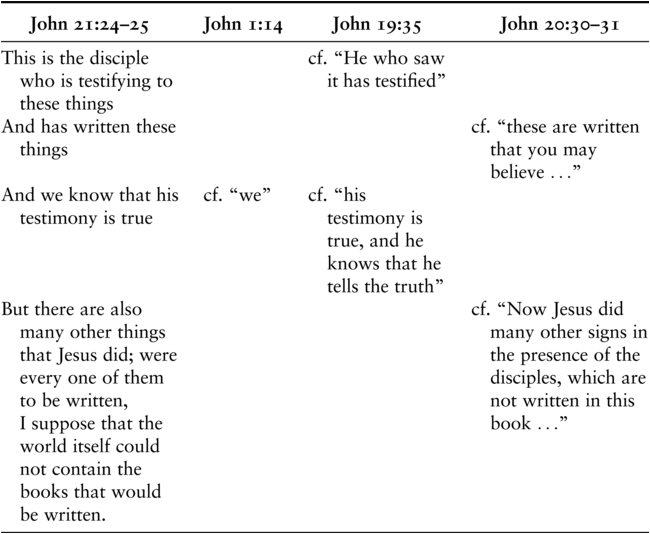
The idea that John is an eyewitness work is implicit through the first twenty chapters of John, but it is made explicit in chapter 21, an appendix to the text added by a later scribe.15 That scribe, hoping to authenticate his product, introduced a second epilogue reaffirming the eyewitness authorship of the Gospel up to and (crucially) including his interpolated chapter. Tellingly, this second epilogue is a bricolage of three verses of the original Gospel (including two that communicate the text’s eyewitness claims), namely, 1:14; 19:35, and the text's original conclusion, 20:31:16
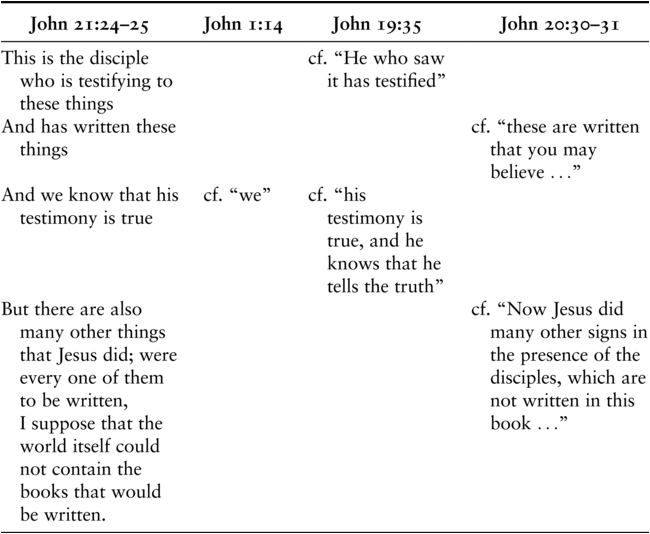
At first, the narrator follows the pattern of all preceding verses in the Gospel; the narrator speaks in the first-person plural (“we”) and makes only third-person references to “the disciple.”17 In this line, however, the narrator makes explicit what was only implicit in previous chapters, namely, that a single male eyewitness, “the disciple whom Jesus loved,” is both “testifying” in the Gospel of John and has actually “written these things” (that is, all its text up to and including the epilogue).18 Then, following through on this premise that a single disciple “has written these things,” the author allows the individual “disciple” to inhabit a singular “I” voice for the first time – something that the author of chapters 1–20 does not do, but that the authors of 1, 2, and 3 John, who freely move between “we” and “I” language, will do.19
3.1.3.1 A Single Implied Author
Not all scholars agree with this interpretation of 21:24–25. Some cite the clause “and we know that his testimony is true” as definitive proof that the disciple cannot be the implied author of John – as if, through the shift from “we” to “he,” “the author differentiates himself (as is not always recognized) from the ‘beloved disciple.’”20 I disagree. The claim that the “we”/“I” voice of 21:24–25 cannot possibly be the voice of the disciple himself is invalidated by the simple fact that many readers – in fact, all known ancient readers of John – had no trouble equating the two.
The reasons why ancient Christians read 21:24 in a different way are obvious, and they are persuasive. First and foremost, the text explicitly casts the disciple as the one “who has written these things.” This is precisely how a text would identify its implied author (cf. 3 John 9). It is unthinkable, then, to read this verse in the opposite vein. Second, a single author is more compatible with the “I” language of 21:25. Third, as jarring as the sudden shift from “we” to “he” of 20:31 may seem, ancient readers were accustomed to authors fluidly slipping between first-person plural, first-person singular, and third-person self-references in compressed spaces. This was especially true around framing material, such as prologues and epilogues. For example, in the opening lines of his History of the Peloponnesian War, Thucydides shifts from a third-person self-reference (“Thucydides the Athenian”) to first-person singular (“I”) and plural (“we”) self-references.21 Josephus too shifts from narratorial “we” to “I” in an epilogue, mirroring the shift we see in John 21:24–25:
Here we close the history, which we promised to relate with perfect accuracy for the information of those who wish to learn how this war was waged by the Romans against the Jews. Of its style my readers must be left to judge; but, as concerning truth, I would not hesitate boldly to assert that, throughout the entire narrative, this has been my single aim.22
In some cases, these shifts could produce tangles like the one observed in 21:24, in which an author refers to himself in the first and third persons in the same line. Especially striking is a single passage from the writings of Polybius, in which he juxtaposes not three but five forms in a tightly compressed space: “Polybius,” “I,” “we,” and (in references to himself and Scipio) “the men” and “them”:
For I promised before to describe in detail why and how the fame of Scipio in Rome advanced so much and burst forth more quickly than was his due and with this how it happened that Polybius grew in friendship and intimacy with the aforementioned person to such an extent that, not only did the report about them extend as far as Italy and Greece, but their conduct and companionship also became well known in more distant regions. We have, therefore, indicated in what has been said previously that the beginning of the friendship between the aforementioned men came out of a certain loan of books and the conversation about them.23
We also find these constructions in other genres, including epistolary. One especially instructive example appears in 2 Corinthians. There, Paul, simultaneously speaks of himself in the first and third persons for reasons of modesty, that is, to avoid boasting over his visionary experiences (vv. 12:6–7). In the process, he builds statements extremely close to what we find in John 21 (“we know that his testimony is true”):
I know a person in Christ who fourteen years ago was caught up to the third heaven – whether in the body or out of the body I do not know; God knows. And I know that such a person – whether in the body or out of the body I do not know; God knows – was caught up into paradise and heard things that are not to be told, that no mortal is permitted to repeat.
It is possible that the similar alternations we see in John 21:24 25 – the casual drift between “we,” “I,” and “he/him” language – also represent an instance of narratorial modesty. Alternatively, this sort of drift might have been part of the scribe’s natural style. Or perhaps the construction was entirely artificial. It is possible that the scribe might have felt a particular need to compress so many different self-references in the verses for strategic reasons, that is, to cover all the various forms of narratorial self-reference in the original text of John (“we,” “disciple,” “he/his”). Recall again that the verses are essentially a bricolage of phrases derived from chapters 1–20. Whatever the case, ancient readers of John had no difficulty distilling the scribe’s point in 21:24–25. These verses draw out the essential authorial claim of chapters 1–20 – that the Gospel is, in some way, an eyewitness account. – a point the redactor of John made to convince readers that his work, chapter 21, was the conclusion of that account, invested with the same authority.24
3.1.4 Evaluating the Claim
As we have seen, the Gospel constructs its implied author as an eyewitness to the life of Jesus. And yet, we have every reason to question this claim. Much of the text is of suspect historicity, including entire discourses whose style, tone, and contents differ so radically from the sayings of Jesus preserved in Paul and the Synoptics as to indicate “creativity … on a large scale.”25 That these discourses are the author’s fabrications is evident from the fact that “when Jesus, the literary character, speaks, he speaks the language of the author and his narrator.”26 In some passages, in fact, “it is impossible to tell when Jesus … stops speaking … and when or if the narrator speaks,” most notably 3:13–21, 31–36.27 In short, Jesus’ voice has been commandeered by the author, who makes him the mouthpiece of an intricate system of ideas foreign to the Synoptics, including the need to be “born from above,” “abide/dwell in God,” and “walk in the light.”
More to the point, the eyewitness claimed by the text is probably a fabrication in his own right. Since the literary turn in Johannine studies (1980s onwards), several writers have argued that the “disciple whom Jesus loved” may be a mere literary device or invention.28 The text casts the eyewitness as Jesus’ most intimate disciple – a figure moving in his inner circle and outranking even Peter in access to him (13:23–25). And yet, the identity of this figure is unknown, concealed under what Harold Attridge describes as “studied anonymity.”29 All efforts to identify him with a known disciple of Jesus result in “a dead end”; the text “systematically defeats any attempt to identify who that witness was.”30 He is unattested in other early sources. For example, every Synoptic parallel that could corroborate his presence at a given moment in Jesus’ life does not. No such disciple appears in the Synoptic crucifixion scenes (Mk 15:40–41; Mt. 27:55–56; cf. John 19:26–27) nor in Luke’s description of Peter’s visit to the tomb (Lk. 24:12; cf. John 20:2–10). No less problematically, the eyewitness has a highly artificial texture. “Unlike the other Johannine characters … he is the ideal disciple, the paradigm of discipleship,” who “has no misunderstandings.”31
As David Litwa writes, the similarities between John’s eyewitness and those found in ancient pseudepigrapha “force the critical reader to reflect on why scholars even today argue strongly for the historicity of the Beloved Disciple … while easily discounting the historicity of similar eyewitness claims.”32 Some such works adopt in-text characters as narrators or sources, often presenting them in similarly idealized casts:
[In the Life of Apollonius] Damis, for instance, is Apollonius’ closest disciple who sticks by him and even suffers arrest in Rome … A basic similarity can be detected in John. Although Jesus loves all his disciples, the Beloved Disciple is the most intimate. Unlike Jesus’ other followers, the Beloved Disciple does not abandon Jesus after he is arrested. Rather, he follows Jesus into the courtyard of his enemy (John 18.15). Presumably it was even more dangerous to stand at the foot of the cross (John 19.26).33
The identification of these in-text characters with the implied author may also unfold as gradually as in John, surfacing in isolated fragments of first-person speech.34 Similarly, these eyewitnesses may be obscure or anonymous.35 In pseudepigrapha, anonymity serves a particular purpose: it ensures that the eyewitness remains “beyond empirical verification,” and “to a certain degree, unfalsifiable as well.”36 Texts may even imply the (fictional) deaths of these figures to sustain a sense of realism – a device also seen in John 21.37
The author of John had strong incentives to invent such an eyewitness. The device not only imbues the Gospel an air of historical authenticity, it also gave the Gospel an edge in the quest for readers. Mark and Matthew do not claim to be eyewitness accounts, and Luke distinguishes himself from “those who … were eyewitnesses” (1:2). As David Litwa notes, if the author of John “knew the Synoptic Gospels (as seems likely to many), he may have used the eyewitness convention to outperform his perceived competitors.”38
3.2 Disguised Authorship in the Epistles
The Gospel of John claims that it was written by an invented “disciple whom Jesus loved,” a character who sometimes speaks as a “we” or “I” and other times in the third person (1:14; 19:26, 35; 21: 24–25). What scholars overlook, however, is that the letters of 1, 2, and 3 John participate in the same authorial pretense; they also position themselves as works by the same character. The Epistles similarly alternate between first-person plural “we” and singular “I” speech (1 John 1:1; 2:1; 2 John 5, 8, 12; 3 John 1, 12–14). They also present themselves as works by an eyewitness to the life of Jesus who “testifies” to what he has “seen” or who insists that his “testimony is true” (1 John 1:1–4; 3 John 1:12; cf. John 1:14; 19:35; 21:24). Last, and perhaps most strikingly of all, these texts also take up the same idiolect – the same individual speech patterns – as the Gospel’s author, including the same distinctive turns of phrase and critical terms.
These similarities are hardly coincidental. Instead, they are evidence that these works were meant to appear to be works by the same hand. Since the Epistles were not written by the same author as the Gospel, however, the conclusion is inescapable: the Epistles are falsely authored works, as, indeed, all three – and especially the latter two – were suspected of being in antiquity.
3.2.1 1 John
First John shows an astute awareness of the complexities of the Gospel’s authorial self-representation, and it mirrors that authorial cast to a great extent. Not surprisingly, the construction of this duplicate implied author begins in the opening lines of 1 John, a section of the text I have already highlighted as a site of deliberate imitation of the Gospel. Those sentences are written in an exclusive first-person plural (“we”), they present the text’s implied author as one who has “seen” Jesus, and they draw language from the narrator’s affidavit in 19:35 (cf. “he who saw this has testified” and “we have seen and testify”):
That which was from the beginning, which we have heard, which we have seen with our eyes, which we have looked upon, which our hands have touched – concerning the word of life … we have seen and testify and proclaim to you the eternal life which was with the Father and was made manifest to us. That which we have seen and heard we also proclaim to you, so that you may have fellowship with us … And we are writing this that our joy may be fulfilled.
Especially beside so many other Johannine touches – expressions such as “beginning,” “word,” “life,” “with the Father,” and “joy… fulfilled” – this preface leaves readers with the impression that the passage’s “we” voice is the “we” narrator who speaks in the Gospel.
As the epistle continues, the narrator also takes up a second pronoun: a singular “I” (“My little children, I am writing this to you …” [2:1]; “Beloved, I am writing you …” [2:7; cf. 2:11–14, 21, 26; 5:13]). Far from distancing the text’s implied author from his counterpart in the Gospel, this alternation strengthens the link between the two. It echoes the diverse and changing ways in which the Gospel’s narrator speaks in his text: as a plural “we” in the prologue and as the singular “disciple whom Jesus loved” in later chapters. In the same passages, the author also continues imitating the speech inventory of the Gospel’s narrator, reproducing his distinctive idioms. In this way, the text suggests that the voice of the Gospel speaks in 1 John.
As unmistakable as these features are, many scholars miss these connections. They miss them because their imaginations are constrained by the dominant scholarly paradigms around these texts, namely, that the texts have different authors, situated in a later community. Under the influence of these views, some writers go so far as to deny that the narrator makes “a claim to an eyewitness experience of the historical ministry of Jesus.”39 Here, Ehrman is correct: “When more critical commentators – Brown, Lieu, Schnackenburg, and others – reject the idea that the author is claiming to be an eyewitness to the fleshly reality of Jesus in his public ministry, it is almost always because they are convinced that in fact he was not an eyewitness.”40 Each “fails to consider the possibility that the author wants to portray himself as an eyewitness in order to validate his claims about the real fleshly existence of Jesus.”41
3.2.1.1 Strict Anonymity
For all the consistencies between the narrators of the Gospel and 1 John, the latter departs from the former in one important respect. In the Gospel, the narrator refers to himself (or to a constituent eyewitness) in the third person under the epithet “the disciple whom Jesus loved” (21:24; cf. 19:26, 35). Not so in 1 John. In this text, written in the first person, the narrator maintains a strict, even intense, anonymity.
The fact that 1 John’s narrator does not directly identify himself as the “disciple whom Jesus loved” does not prevent us from equating the two. The same narrator does not style himself “the Elder” either, as do the narrators of 2 or 3 John, and yet, most biblical scholars assign these epistles to a single authorial persona. Note too that although the author does not expressly identify himself as a particular “disciple,” he casts himself as a disciple by positioning himself among those who knew Jesus firsthand – an essential attribute of Jesus’ disciples.
Notably, other falsely authored works also shy away from direct authorial claims even while assuming the identity of specific figures. The book of Wisdom, for example, never names its author, but it signals to its readers that it was composed by Solomon, the biblical king who constructed the first Temple and was renowned for his wisdom. More than halfway through the text, its anonymous speaker relates that he prayed for the gift of wisdom (7:7; cf. 1 Kings 3:9); he later addresses God with the words, “you have chosen me to be king of your people … you have commanded the building of a temple on your holy mountain” (9:7–8). The implication is clear. Similarly, the book of Hebrews never names its author, but elements of the text suggest to its readers that they are reading a work of Paul’s. In its closing verses, the text’s voice signals that he is located in Italy, a region where Paul ministered (13:24); he also explains that he will visit soon in the company of Timothy, a known companion of Paul’s (13:23). These cues and others have led Christians to attribute the work to Paul through most of the past two millennia.42
It is unclear why the author of 1 John opted for an implicit, rather than explicit, claim to the identity of the “disciple whom Jesus loved.” The author might have wanted to mimic the strong anonymity of most parts of the Gospel.43 It is also possible that the author preferred not to deploy the title “disciple whom Jesus loved” in a first-person letter since the Gospel only takes up the title in the third person. Alternatively, as Clare Rothschild observes, some authors chose to keep their authorial claims implicit since pseudonymity was “a culpable offense risking punishment.”44 In this case, the author of 1 John might have shied away from a direct identification to preserve deniability. We can also not rule out modesty as a factor. Whatever the case, we are meant to read 1 John as a work by the same author as John.
3.2.2 2 and 3 John
What is true of 1 John is true of the other epistles. Although 2 and 3 John construct their implied author(s) in a more developed cast than the implied author of 1 John by styling him “the Elder,” they do nothing to deter their readers from conflating these figures. On the contrary, they invite – even direct – that identification. For this reason, even today, most critical commentators speculate that a single author penned the three letters.
3.2.2.1 2 John
Many scholars assume that 1 John and 2 John may be works of a single author, and with good reason: the two fit together.45 Second John constructs an implied author situated within the same crisis described in 1 John: the emergence of “antichrists” who “have gone out into the world” (v. 7; cf. 1 John 2:18–19; 4:1–3). The narrator of the text stakes out the same ideological position as the author of 1 John within that crisis, reiterating the same points, even verbatim. Finally, the implied author speaks in the familiar idiolect of the narrators of John and 1 John – an idiolect suffused with such Johannine language as “truth,” “abide/dwell,” and “new commandment.”
Nevertheless, 2 John makes a critical modification to the eyewitness. Unlike 1 John, which keeps its narrator veiled in strict anonymity, 2 John has its narrator identify himself under an enigmatic title: “the Elder” (1:1). The use of a substitute title for an implied author is not unknown, even in pseudo-historical letter collections that present themselves as works by known authors. One example appears in the pseudepigraphal letters of Diogenes, a collection of letters incrementally expanded by multiple hands between the first century BCE and the first century CE.46 In the prescript of Letter 49, an author presenting himself as Diogenes identifies himself merely as “the Cynic”:47
The Cynic to Aroueca [Ὁ κύων Ἀρουέκᾳ]. Know yourself (for thus you would do well) and, if there is any disease afflicting your soul, senselessness for example, get a doctor for it. And pray the gods that you do not do more harm than good by choosing one that only seems to be a good physician. Do not thus delay, for wine is being stored up for you, but you will ruin it if you do not filter it. But if you do this, you will be a valuable friend, not only to me but to all the others too. My greeting and salutation has been sent on the condition that you do not disregard what is written.48
The same device also appears in other kinds of pseudepigrapha. Consider, for one, a work included in contemporary Bibles: the book of Ecclesiastes. The prescript of that text identifies its author merely as “the Teacher [Qoheleth], the son of David, king in Jerusalem” (1:1). Later chapters, in turn, sustain this use of an epithet alone (1:2, 12; 7:27; 12:8, 9, 10), while folding in indications that this royal figure “acquired great wisdom” (1:16) and crafted “proverbs” (12:9). The reference here is obviously to the ancient Israelite king Solomon, renowned for his wisdom (1 Kings 4:29–34). Still, the text studiously avoids taking up Solomon’s name. The epithet “Teacher” does not disconfirm the idea that the text was written by Solomon, but it shies away from an explicit claim. Ecclesiastes, in short, deliberately leaves space for both receptive and skeptical readers to engage the text and defer a judgment on authorship. All the while, it works more subtly to consolidate its false authorial claim.49
Similar factors might have motivated the epithet “the Elder” in 2 John. Unlike its predecessors, 2 John adopts a conventional letter form, which requires the sender to identify himself in the prescript (“X to Y”). The author might have been hesitant to use a specific name since his models, John and 1 John, never named their narrators.50 To stand within the same tradition, however, he chose the epithet “Elder.” On its face, the designation is ambiguous – a title appropriate for any Christian leader or figure of advanced age but specific to none. And yet, by extension, it was also a term suitable for the particular author implied by the text: an eyewitness disciple of Jesus. In 1 Peter, the voice of “Peter” identifies himself as “a fellow elder [συμπρεσβύτερος] and a witness to the sufferings of Christ” (5:1; cf. 1:1).51 And in the extant fragments of his Exposition of the Sayings of the Lord, Papias applies the term “elder” to the disciples:
But if any who had also followed the elders ever came along, I would examine the words of the elders – what did Andrew or what did Peter say, or what did Philip, or what did Thomas or James, or what did John or Matthew, or any other of the disciples of the Lord – and what Aristion and John the elder, disciples of the Lord, were saying.52
Selecting “the Elder” allowed the author to claim the identity of this eyewitness, perhaps directly in conversation with one or another of these texts. At the same time, the ambiguity of the title might have also allowed the author to remain strategically elusive, leaving space for skeptical readers to defer judgment on the text’s authorship.53
3.2.2.2 3 John
Written after 2 John, the epistle now known as 3 John lays the most decisive claim on earlier Johannine forms of address. First, by presenting itself as a letter from “the Elder” and deploying his familiar formulae, the text introduces itself as the work of the same hand as 2 John.54 Once again, “the Elder” addresses his reader(s) as those whom he “loves in truth,” praises them for walking “in the truth,” and closes with the note that he has more to write but would rather not use ink. But 3 John reaches further back in the Johannine tradition, building links to the Gospel and 1 John as well. Like the narrator constructed in John and 1 John, the narrator of 3 John alternates between “we” (v. 12) and “I” (1–4, 9–10, 13–14) forms. Furthermore, he uses the term “beloved” for his readers (vv. 2, 5, 11; cf. v. 1), a form also used by the narrator of 1 John (2:7; 3:2, 21; 4:1, 7, 11). Finally, near the end of the letter, “the Elder” uses the language of testimony, endorsing a figure named Demetrius with the words, “we also testify, and you know that our testimony is true” (3 John 12). As noted in Chapter 2, this statement parallels and seems to be modeled on the Gospel narrator’s affidavit: “he who saw this has testified so that you also may believe. His testimony is true, and he knows that he tells the truth” (John 19:35).55 In fact, the clause “you know that our testimony is true” may allude to the Gospel, expressly citing and leveraging the existing trust its (implied and real) readers have in the author from his other supposed works. The net effect of these moves is obvious. The narrator casts himself as the one – the same – writer who supposedly penned all the earlier Johannine texts.
3.2.3 Ancient Skepticism
The Epistles of John claim the same author of the Gospel of John: an unnamed eyewitness to the life of Jesus. This claim fails on three counts, however. It fails, first, because several features of the letters – their different reception histories, different linguistic features, and different theological claims – do not support the idea that these texts were written by the same hand as wrote the Gospel. It fails, second, because the texts show signs of direct literary borrowing from the Gospel – a peculiarity for a single author. But above all, it fails because although these texts claim the same implied author as the Gospel, that figure did not exist. The Gospel is not the work of an eyewitness, let alone the specific unnamed disciple it constructs as its author. Neither, then, are the Epistles. By claiming an invented figure as their implied author, these works expose themselves for what they are: extensions of a fabrication and fabrications in their own right. They are a lineage of falsely authored texts.
The idea that three Johannine epistles are all falsely authored texts fits one other feature of the Epistles: their problematic reception histories. We know that all three epistles were suspected of being falsely authored works by at least some ancient and medieval Christians. The most intense scrutiny fell on 2 and 3 John, which were excluded from some canonical lists for centuries. In reopening questions about these works, I stand within an established line of Christian skepticism. It is probably telling that all other New Testament texts once under the same clouds of suspicion – for example, Jude and 2 Peter – are recognized as pseudonymous by scholars today.56
The situation is, of course, somewhat different for 1 John. Many features of the letter – its divergences from the Gospel, signs of literary borrowing, and dubious authorial cast – suggest that it too is a falsely authored work. Nevertheless, it received far less scrutiny than 2 and 3 John, though its authenticity was challenged in some later Syriac sources.57 Then again, 1 Peter was not subject to the scrutiny of 2 Peter, even though many critical scholars have concluded that it too is pseudonymous.58 Many critical scholars also reject the authorial claims of 2 Thessalonians, Colossians, Ephesians, James, and others – all because of their dubious internal features. We can, then, still posit that 1 John is pseudepigraphal. As for why 1 John might have escaped greater suspicion, it is possible that its early date was a factor. (The epistle, after all, enters the historical record about the same time of the Gospel of John and significantly before 2 and 3 John.) Alternatively, the internal features of 1 John might not have raised the same suspicions as those of 2 and 3 John.59
3.2.4 A Lineage of Falsely Authored Works
The idea that a text such as John might have triggered the production of multiple falsely authored texts written by different pens is perfectly plausible. Many ancient literary corpora attracted these sorts of additions. Within Christian literature, the canonical Pauline letter collection includes contributions by roughly a half-dozen different authors – namely, (1) Paul himself (the authentic core), (2) the author of 2 Thessalonians, (3) the author of Colossians, (4) the author of Ephesians, (5+) the author(s) of the Pastorals, and (6) the author of Hebrews.60 Even more authors created the non-canonical (7) 3 Corinthians, (8) Laodiceans, (9) Letters of Paul and Seneca, and (10) the lost Epistle of Paul to the Alexandrians.61 Similarly, the extant Petrine letters – 1 Peter, 2 Peter, the Epistula Petri (embedded in the Pseudo-Clementine Homilies), and the Letter of Peter to Philip – are pseudonymous, and yet each was also written by a different hand.62
Chains of pseudepigraphy could also transcend genres, as in the case of the Johannine literature.63 Beyond the Pauline and pseudo-Pauline letters mentioned above, an Apocalypse of Paul and a Prayer of the Apostle Paul were discovered at Nag Hammadi.64 Likewise, other writers contributed to an emerging “Petrine Discourse” by penning a narrative Apocalypse of Peter and a Coptic Apocalypse of Peter – texts with some direct literary relationship to 2 Peter – as well as a Gospel of Peter.65
Since these collections span multiple centuries, it is clear that many of the above authors had no direct connection to or contact with one another. Instead, these authors wrote from different (intellectual, geographical, and temporal) matrices.66 In this case, then, we are more than justified in suspecting that the Epistles of John might have also come from writers who hailed from different matrices.
3.3 Conclusion
Ancient Christians were able to see a vital fact that eludes many scholars, namely, that the Gospel and Letters of John were written in a single voice as if they were works of a single individual. But contemporary scholars can appreciate what most ancient Christians, less equipped to conduct careful literary analyses, were not in a position to see. They can understand that the Gospel and Epistles of John were written by different hands. The similarities between these works indicate a common authorial claim in these texts; the differences, in turn, falsify that claim. In the subtle interplay of the two – the tension of similarity and difference – the true character of the Epistles of John shines through. These letters are falsely authored works written in the persona of the invented eyewitness of the Gospel of John.
What makes this thesis so compelling is that it can answer multiple questions, core questions, about the Epistles that other scholarly models, especially the Johannine Community Hypothesis, fail to address. If the Epistles were written by multiple known authors and transmitted by a single community, why do these works borrow so directly and extensively from the Gospel and one another, even to the point of double-digit percentages of verbal overlap? (Under the Community Hypothesis, there is no obvious reason why they should have; one needs a separate explanation for this.) For that matter, why do the Epistles mirror the Gospel in their “we”/“I” “testifying” cast? (That, too, is hardly necessary for letters by different authors. One again needs a special explanation for this.) Why would later Christians attribute these works to a single author? (Wouldn’t a common community have transmitted the memory of multiple authors?) And why did a large segment of Christians question the authenticity of some of these texts? (Wouldn’t the community that transmitted 1 John as an authentic work also have commended 2 and 3 John as authentic?) Although the Community Hypothesis is meant to explain the basic features of the Epistles, it stops decidedly short of resolving the many riddles surrounding these texts. To answer these tangled questions, we need either more than the Community Hypothesis or something other than the Community Hypothesis.
By contrast, the idea that the Epistles are a lineage of falsely authored works cuts through all these questions in a single, swift stroke. Falsely authored works are known to extensively borrow language from their models by design (imitation of style). Falsely authored works would also assume a single “we”/“I” “testifying” authorial cast, again by design. Falsely authored works sharing the same authorial pretense would be misperceived by certain audiences as works by the same author by design. And falsely authored works would very likely have different circulation histories than their models and be the object of legitimate and enduring scrutiny. (Consider, for example, the doubts surrounding the pseudonymous letters of Jude, 2 Peter, and Laodiceans in antiquity.) In the search for the simplest and most elegant explanation for the internal features and external reception of the Epistles, this model stands alone.