

The dynamics of autocratic politics have undergone important shifts since the end of the Cold War. As the rate of coups declines (Marinov and Goemans Reference Marinov and Goemans2014), mass protests increasingly constitute a key threat to autocratic survival. Scholars have thus sought to understand the dynamics of protests: who participates (Rosenfeld Reference Rosenfeld2017), how protesters organize (Howard and Hussain Reference Howard and Hussain2013), and which tactics are effective (Chenoweth and Stephan Reference Chenoweth and Stephan2011). Prior research has also sought to understand how autocrats attempt to inoculate themselves: by incarcerating dissidents (Truex Reference Truex2019) and employing censorship and propaganda to manipulate citizens' beliefs (Huang Reference Huang2015; King, Pan and Roberts Reference King, Pan and Roberts2013; King, Pan and Roberts Reference King, Pan and Roberts2017; Little Reference Little2017; Rozenas and Stukal Reference Rozenas and Stukal2018).
When do autocrats use propaganda to threaten citizens with repression? Are these threats effective? We develop a theory of propaganda-based threats that builds on insights from experimental psychology. Threats of repression, we argue, are costly. For propaganda apparatuses that aim to persuade citizens of the regime's merits – and hence invest in acquiring credibility – threats of repression undermine those efforts. For propaganda apparatuses that aim to signal to citizens the regime's repressive capacity – for instance, by broadcasting absurdly positive propaganda that everyone knows to be false – the force of a threat may diminish the more often it is issued. Threats of repression may also give special salience to moments that are already politically sensitive or recall the regime's historical crimes. For these reasons, we expect propaganda-based threats of repression to be used sparingly: when the regime is most concerned about mass protests. Since we expect threats to be deployed to maximize their effect on citizen behavior, we also expect them to be effective.
Empirically, we focus on China, the world's most populous autocracy. We employ computational tools to collect all 164,707 articles published between 2009 and 2016 in the Workers' Daily (工人日报), a state-run newspaper that targets a non-elite audience. Scholars have long understood that the Chinese Communist Party (CCP) uses codewords to threaten citizens with repression: terms like ‘social stability’ and ‘harmony’, as well as allusions to the repressive apparatus (Benney Reference Benney2016; Huang Reference Huang2015; Sandby-Thomas Reference Sandby-Thomas2011; Steinhardt Reference Steinhardt2016; Wang and Minzner Reference Wang and Minzner2015; Yang Reference Yang2017; Yue Reference Yue2012). For example, Huang (Reference Huang2018) finds that after reading a newspaper article about ‘social stability’ in an online survey experiment, Chinese citizens reported more negative views of the government, a greater willingness to move abroad and less willingness to protest. We find that propaganda-based threats are occasioned chiefly around the time of anniversaries of ethnic separatist movements in Tibet and Xinjiang regions, and secondarily by major political anniversaries. Put simply, the CCP disproportionately targets its political out-group: ethnic and identity groups that are excluded from the Party's core constituency. Huang (Reference Huang2015) suggests that citizens interpret the CCP's pro-regime propaganda as threatening. We likewise find that threats of repression are correlated with spikes in pro-regime propaganda.
This calendar of propaganda-based threats suggests an identification strategy that lets us probe whether these threats have an effect on popular protest. We employ an instrumental variables (IV) estimator based on two features of China's political geography. First, propaganda in the Workers' Daily is set at the national level, but occasionally responds to local conditions, which are salient in one province but unknown in other provinces. As a result, citizens in one province are occasionally ‘treated’ with propaganda content that is intended for citizens in geographically and culturally distant provinces. Secondly, because China is ethnically diverse and geographically sprawling, the ethnic separatist anniversaries in Tibet and Xinjiang that drive propaganda-based threats are salient only in those regions, and are effectively unknown elsewhere. We argue that ethnic separatist anniversaries in these two regions plausibly condition protest rates in geographically and culturally distant provinces only through the propaganda-based threats that the regime issues via its propaganda apparatus.
We provide a range of evidence that this exclusion restriction is plausible. First, we conducted a nationally representative survey that asks citizens to identify the dates of many holidays, anniversaries and events. As expected, the dates of these ethnic separatist anniversaries are unknown to citizens outside Tibet and Xinjiang, which demonstrates that they lack political salience in geographically and culturally distant provinces. Secondly, we show that China's security apparatus does not repress protests outside Tibet and Xinjiang during these separatist anniversaries at higher rates than on other days. This suggests that, during ethnic separatist anniversaries, Chinese security services are not on high alert outside Tibet and Xinjiang. As a precaution, we exclude not only Tibet and Xinjiang from our analysis, but seven other provinces as well, including the capitol and provinces that are geographically contiguous or contain substantial numbers of co-ethnics or other ethnic minorities. After dropping these nine provinces, our sample still includes 88.5 per cent of Chinese citizens. We find that propaganda-based threats have a plausibly causal effect on protest levels outside the nine provinces we drop. By doubling the number of references to ‘stability’ or ‘harmony’, the CCP's propaganda apparatus halves the number of protests over the course of the subsequent week. Crucially, we employ Conley, Hansen and Rossi's (Reference Conley, Hansen and Rossi2012) sensitivity analysis to show that these IV estimates are robust to non-trivial violations of the exclusion restriction.
To the best of our knowledge, this article is the first to study propaganda-based threats of repression in autocracies. It advances three literatures. First, scholars have recently learned much about autocratic propaganda: why it is employed (Edmond Reference Edmond2013; Gehlbach and Sonin Reference Gehlbach and Sonin2014; Huang Reference Huang2015), when (Egorov, Guriev and Sonin Reference Egorov, Guriev and Sonin2009; Qin, Strömberg and Wu Reference Qin, Strömberg and Wu2018; Rozenas and Stukal Reference Rozenas and Stukal2018), its effects (Adena et al. Reference Adena2015; DellaVigna and Kaplan Reference DellaVigna and Kaplan2007; Enikolopov, Petrova and Zhuravskaya Reference Enikolopov, Petrova and Zhuravskaya2011), and the cognitive mechanisms used to achieve those effects (Little Reference Little2017). Broadly, this literature conceptualizes propaganda as designed to persuade citizens: either of the regime's merits or its repressive capacity (Gehlbach, Svolik and Sonin Reference Gehlbach, Svolik and Sonin2016, 578).
Secondly, scholars have begun to understand the role of fear in autocracies. Young (Reference Young2018) finds that cuing fears of political violence renders citizens less willing to engage in dissent, even without new information about the government's capacity for repression or willingness to employ it. ‘It may be easier’, Young concludes, ‘for autocrats to influence citizens through the more emotional channels of propaganda, including fear of repression’. Threats of repression, we argue, are a key component of propaganda, and have distinctive analytical properties. Our results are consistent with the possibility that autocrats use propaganda to cue fear and discourage collective action.
Thirdly, this article advances our understanding of collective action in China. Many scholars argue that the CCP permits protests as a ‘fire alarm’ to discourage corruption by local officials (Cai Reference Cai2010; Chen Reference Chen2012; Lorentzen Reference Lorentzen2013; O'Brien and Li Reference O'Brien and Li2006). We challenge this assertion. While some protests may indeed be permitted, the CCP treats protests around ethnic secessionist anniversaries as profoundly threatening.
This article proceeds as follows. The next section presents our theoretical framework. Then we introduce our data. The section after that shows that propaganda-based threats are driven by the anniversaries of ethnic separatist movements in Tibet and Xinjiang. We then provide evidence that threats of repression in the Workers' Daily reduce the number of protests. The final section concludes.
Theoretical Framework
Strategies of Autocratic Propaganda: Persuasion vs. Domination
Scholars increasingly recognize that autocrats employ two distinctive propaganda strategies. In the first strategy, propaganda seeks to persuade citizens of the regime's merits. Propaganda apparatuses can acquire reputations for credibility in several ways, such as by occasionally conceding bad news (Chen and Xu Reference Chen and Xu2015; Egorov, Guriev and Sonin Reference Egorov, Guriev and Sonin2009; Gehlbach and Sonin Reference Gehlbach and Sonin2014; Guriev and Treisman Reference Guriev and Treisman2015) or by plausibly obscuring the regime's responsibility for policy failures (Rozenas and Stukal Reference Rozenas and Stukal2018). This strategy has long historical antecedents. For instance, Joseph Goebbels, architect of Nazi Germany's propaganda, instructed the state media to report information that damaged the government, ‘otherwise the facts might expose falsehoods’ (Doob Reference Doob1950). This strategy appears common in Vladimir Putin's Russia (Adena et al. Reference Adena2015; Enikolopov, Petrova and Zhuravskaya Reference Enikolopov, Petrova and Zhuravskaya2011; Rozenas and Stukal Reference Rozenas and Stukal2018).
In the second strategy, propaganda serves to signal to citizens the autocrat's capacity for repression (Edmond Reference Edmond2013). As Orwell wrote, forcing citizens to consume propaganda that everyone knows to be false serves to dominate them, and to broadcast the regime's capacity for domination to others. In turn, the regime's capacity for repression becomes common knowledge among citizens, which helps suppress dissent (Little Reference Little2017). This insight underlies Wedeen's (Reference Wedeen1999) account of Syria under Hafez al-Assad and Huang's (Reference Huang2015) work in contemporary China. Huang (Reference Huang2015, 420) puts it succinctly: ‘Such propaganda is not meant to “brainwash” people …about how good the government is, but rather to forewarn the society about how strong it is via the act of the propaganda’.
Why Propaganda-Based Threats are Useful
We define a threat as a commonly understood claim by the government that anti-regime behavior will be met with repression. Repressive governments can threaten citizens in a range of ways. For instance, they can dispatch security forces to protest locations. They can employ repressive measures against some citizens to discourage protests by others. They can use codewords that remind citizens of past repression or make clear that the government will employ repression in response to certain behaviors. For these threats to shape citizen behavior, they must be received. This is the key benefit of broadcasting threats via propaganda. Repressive governments can threaten many citizens simultaneously at relatively little cost.
Threats of repression may render citizens less likely to protest in several ways. Perhaps most obviously, such threats may signal to citizens the consequences of a certain form of dissent, or the consequences of dissent at a given moment. Alternatively, threats of repression may also induce fear. In Zimbabwe, Young (Reference Young2018) finds that cuing fears of political violence among opposition sympathizers reduces their willingness to engage in anti-regime dissent, even without new information about the government's capacity for repression or willingness to employ it. Political psychologists find that fear leads to pessimism, and hence risk aversion (Cohn et al. Reference Cohn2015; Druckman and McDermott Reference Druckman and McDermott2008; Johnson and Tversky Reference Johnson and Tversky1983; Lerner and Keltner Reference Lerner and Keltner2001).
Propaganda-based threats of repression are useful. They may remind citizens of the consequences of protest or they may cue fear. Insofar as threats reduce the likelihood of protest, they enable the autocrat to forgo the costs associated with outright repression. These costs can be substantial, since outright repression can give citizens focal moments around which to mobilize in the future (Carter and Carter Reference Carter and Carter2020b; Goldstone and Tilly Reference Goldstone, Tilly, Aminzade, Goldstone, McAdam, Perry, Sewell, Tarrow and Tilly2009; Lawrence Reference Lawrence2017).
Why Propaganda-Based Threats are Costly
Regardless of whether autocrats employ propaganda to persuade citizens or to dominate them, issuing threats of repression is costly. We identify three mechanisms via which such threats may be delivered.
Mechanism 1: source derogation (propaganda as persuasion)
When pro-regime propaganda aims to persuade citizens of the regime's merits, we expect source derogation to be salient. Source derogation occurs when individuals evaluate the source of a message as ‘less trustworthy’ (Smith Reference Smith1977). This mechanism is consistent with both Bayesian updating and experimental psychology. From a Bayesian perspective, publishing threats alongside content designed to persuade citizens should invalidate the persuasive content. If citizens are strictly rational, then propaganda-based threats should compel citizens to update their beliefs about the regime's commitment to their interests. Psychologists have long explored why individuals resist persuasion (Cialdini Reference Cialdini2006). Many accounts rest on the notion that individuals have an intrinsic desire for autonomy. When that freedom is threatened, individuals are compelled to maintain the opinion or behavior that elicited the threat (Burgoon et al. Reference Burgoon2002; Rains Reference Rains2013). Psychologists refer to these as ‘threats to freedom’ (Kronrod, Grinstein and Wathieu Reference Kronrod, Grinstein and Wathieu2012). Messages that constitute threats to freedom compel individuals to contest its source, and hence elicit source derogation (Smith Reference Smith1977).
Source derogation has clear implications for propaganda-based threats. Building credibility with readers requires conceding policy failures (Gehlbach and Sonin Reference Gehlbach and Sonin2014; Rozenas and Stukal Reference Rozenas and Stukal2018), which makes them common knowledge. Since these concessions help citizens coordinate protests (Egorov, Guriev and Sonin Reference Egorov, Guriev and Sonin2009), building credibility is costly. Accordingly, propaganda apparatuses that aim to persuade citizens of regime merits should attempt to avoid source derogation, and hence threats of repression.
Mechanism 2: boomerang effect (propaganda as persuasion or domination)
Messages that constitute threats to individual freedom may elicit a second response: a boomerang effect, in which individuals contest the message's content. Individuals do so by engaging in less (more) of the encouraged (discouraged) behavior (Baek, Yoon and Kim Reference Baek, Yoon and Kim2015). As a result, messages that include threats to freedom may not only prove ineffective, but also lead to the opposite of the desired result (Ringold Reference Ringold2002). The boomerang effect also has clear implications for understanding propaganda-based threats in autocracies. If citizens perceive the threat as a warning against mass protests in response to an event or grievance, then the boomerang effect suggests that the threat itself could endow that event or grievance with special salience. In turn, the threat may help catalyze the very collective action it sought to discourage. The boomerang effect can also be placed in a Bayesian context. By issuing a threat prior to some event, a regime may signal to citizens that it regards that event as a focal moment for protests: that the regime believes other citizens will engage in collective action around a specific day.
The boomerang effect has clear precedence in China. On 26 April 1989, the People's Daily published a profoundly threatening editorial. There would be ‘no peace’, it warned, if student protesters in Tiananmen Square failed to disband. The editorial elicited a boomerang effect: tens of thousands of citizens joined the students the next day. The boomerang effect should deter propaganda-based threats of repression in both strategic contexts: where autocrats employ propaganda to persuade and to dominate.
Mechanism 3: desensitization (propaganda as domination)
Even if absurdly positive propaganda makes the regime's repressive capacity common knowledge among citizens, there is no ex ante reason to believe autocrats employ absurdly positive propaganda and threats in the same way. When absurdly pro-regime propaganda is implicitly designed to threaten citizens, as Huang (Reference Huang2015) argues, regimes may wish to employ threats of repression as well, since the force of such positive propaganda may diminish over time. Threats of repression may provide a vivid reminder of the regime's capacity for repression.
Psychologists refer to this as desensitization: ‘a reduction in emotion-related physiological reactivity to real violence’ (Carnagey, Anderson and Bushman Reference Carnagey, Anderson and Bushman2007). Desensitization has been widely documented. The canonical experiment entails exposing treatment and control groups to a particular mode of violence via some media platform, and then measuring the physiological responses of both groups to a subsequent exposure to a violent stimulus. Across variants, past exposure to violence renders individuals less sensitive to violence in the future (Carnagey, Anderson and Bushman Reference Carnagey, Anderson and Bushman2007).
Hypotheses
For these reasons, propaganda-based threats of repression are costly. Accordingly, our theory suggests that such threats should be reserved for when autocrats need them most: when popular collective action is most threatening.
Hypothesis 1 (Timing): Propaganda-based threats of repression should be reserved for moments when collective action is most likely.
Our second hypothesis focuses on cross-regime variation. The source derogation mechanism suggests that propaganda-based threats should be especially costly where autocrats are constrained to employ propaganda to persuade citizens of the regime's merits. The reason is that threats of repression undermine these claims. In a setting like China, where propaganda signals the regime's capacity to dominate citizens, we expect the baseline threat rate to be higher than in autocracies that use propaganda to persuade.
Hypothesis 2 (Cross-regime variation): Propaganda-based threats of repression should be more likely where autocrats employ propaganda to intimidate rather than persuade.
Hypothesis 2 provides a foundation for understanding which political groups are most often targeted with threats of repression. Many theories of autocratic politics feature an in-group whose support the autocrat must retain and an out-group that is excluded from political decision making and is thus subject to more repression (Acemoglu, Robinson and Verdier Reference Acemoglu, Robinson and Verdier2004; Bueno de Mesquita et al. Reference Bueno de Mesquita2003; Padro i Miquel Reference Padro i Miquel2007). Insofar as the autocrat's hold on power rests on satisfying the demands of an in-group, we expect the propaganda strategy to vary accordingly: more persuasive propaganda for the in-group and more threatening propaganda for the out-group. In Cameroon, for instance, President Paul Biya produces different propaganda content for his francophone in-group than his anglophone out-group. Proclamations of the military's strength and international support are published overwhelmingly in English, and are intended to discourage anglophone citizens from engaging in anti-regime collective action (Carter and Carter Reference Carter and Carter2020a). To be clear, this is not to suggest that in-groups are not occasionally threatened. The CCP's 26 April Tiananmen editorial suggests that when in-group protests become sufficiently large, autocrats may threaten in-group citizens as well. Rather, our theory suggests that out-groups should be threatened with repression more often than in-groups via propaganda.
Hypothesis 3 (Targeting): Propaganda-based threats of repression should more often target a political out-group than a political in-group.
Whether propaganda-based threats of repression reduce protests depends on a variety of factors: how frustrated citizens are, how mobilized they are and how vulnerable they believe the regime is. Our theory suggests, however, that since propaganda-based threats are costly for autocrats, citizens should view them as at least somewhat credible. In turn, we expect propaganda-based threats to condition citizen behavior.
Hypothesis 4 (Efficacy): Propaganda-based threats of repression should reduce protests.
Scope Conditions
We conclude with several scope conditions. For Hypotheses 1 through 3, we assume the autocrat exercises control over the propaganda apparatus, either because he oversees it directly or because he delegates authority to a trusted agent. We believe this condition is easily satisfied, since propaganda is widely regarded as key to autocratic survival. Mao Zedong once called propaganda ‘the most important job of the Red Army’ and routinely edited the People's Daily himself (Mao Reference Zedong1929; Yu Reference Yu1964). For Hypothesis 4, we assume that propaganda reaches a large enough share of the population to condition their behavior. Citizens may consume propaganda directly, either because they choose to or are effectively forced to, or indirectly, via others who do.
We make no assumptions about the strength of the autocrat's repressive apparatus. Rather, we regard this as a comparative static. Previous studies suggest that when the autocrat's capacity for repression is relatively limited, he is forced to employ a propaganda strategy that aims to persuade citizens of the regime's merits (Carter and Carter Reference Carter and Carter2020a). In turn, from Hypothesis 2, our theory suggests that the baseline rate of propaganda-based threats should be lower. From Hypothesis 1, however, our theory still suggests that relatively constrained autocrats will employ them when threats to regime survival are sufficiently profound, which is why such threats of repression are at least somewhat credible. This credibility is the premise of Hypothesis 4. Of course, the deterrent effect of propaganda-based threats may be greater in the presence of a stronger repressive apparatus.
Data
Threats of repression are often contextual. In Rwanda, Kagame's occasional appeals to the 1994 genocide are understood as evidence of his willingness to repress in the future (Thomson Reference Thomson2018). In Uzbekistan, President Islam Karimov threatens the Christian minority, which often travels around Christmas, by emphasizing surveillance on public transportation. In Cameroon, President Paul Biya reminds the separatist anglophone community that the international community provides military support to the government. In the Republic of Congo, President Denis Sassou Nguesso refers to ‘peace’ to remind citizens of the 1997 civil war, from which he emerged victorious (Carter and Carter Reference Carter and Carter2020a).
To accommodate this specificity, we focus on China, the world's most populous autocracy, where CCP propaganda serves to broadcast the regime's capacity for repression (Huang Reference Huang2015). Although our focus on a single country allows us to be sensitive to context, it requires us to restrict attention to Hypotheses 1, 3 and 4: that propaganda-based threats of repression are driven by a society's calendar of collective action, that those threats are more likely to target out-groups, and that threats should, on average, condition citizen behavior. We leave Hypothesis 2, about cross-regime variation, for future studies.
China and the Workers' Daily
Although scholars often focus on the People's Daily, which circulates primarily among elites, we focus on the Workers' Daily, which circulates widely among urban workers and professionals. Mao Zedong established the Workers' Daily in 1949, just months after the PRC was founded. It initially targeted Chinese workers, who were central to CCP legitimacy. Its language was colloquial and it routinely replaced ‘politicized’ content from the People's Daily with labor issues of genuine interest to readers. On the eve of the Cultural Revolution, the Workers' Daily had a circulation of 400,000 each day. The newspaper has since expanded its target audience to include migrant workers, intellectuals and civil servants.Footnote 1 It now reports a daily circulation of 960,000, nearly twice the weekday circulation of the New York Times.
The Workers' Daily also reaches citizens through three other channels, which amplify its readership. First, it is routinely posted in factories and public spaces. In 2016, for instance, officials in Gansu Province mandated that ‘factories, departments, and labor unions should subscribe to the Workers’ Daily’ (Gansu Province Trade Union Federation 2016). In 2017 and 2018, government documents in Guangxi Province instructed that ‘newspapers like the Workers’ Daily and Guangxi Workers’ News should be posted in the bulletin board of towns and communities, so that citizens can read them easily’ (Liuzhou Trade Union Federation 2016; Wuming District Trade Union Federation 2018). These directives explicitly aimed to expand its readership: ‘Grassroots units must subscribe to the “two newspapers” in the worker bookstore, the worker activity room, and the reading room, so that the voices of the CCP and trade union organizations can reach the broad masses of workers.’ Secondly, since 41.6 per cent of migrant workers access the internet via their mobile phone (China Internet Network Information Center 2012), the Workers' Daily is active on social media, with 2.3 million followers on Weibo (a Chinese-language social media platform similar to Twitter). Thirdly, there is strong evidence that the CCP coordinates propaganda content across platforms, and therefore any increase in threatening content in the Workers' Daily's is likely mirrored across state media (Roberts Reference Roberts2018).Footnote 2
The Workers' Daily sits alongside local and regional propaganda newspapers, which are operated by sub-national governments. We focus on the Workers' Daily, however, because it is widely regarded as a more authoritative CCP mouthpiece (Stockmann Reference Stockmann2013). Provincial newspapers, by contrast, are often used by local leaders to advance their private interests (Chen and Hong Reference Chen and Hong2020; Shih Reference Shih2008).
Measuring propaganda-based threats: supervised learning
To identify threats of repression in the Workers' Daily, we scraped its online archive, which yielded 164,707 unique articles between 2009 and 2016. We then read several thousand articles to catalogue all possible coverage topics, which appear in Table 1. We randomly sampled 500 articles, which we refer to as our training set, and labeled each with as many topics as appropriate.
Topic list

We identified two coverage topics that routinely threaten citizens, which are presented in bold in Table 1. The first, ‘social stability maintenance’ (维稳), is widely regarded by observers of Chinese politics as profoundly threatening. ‘The term’, Huang (Reference Huang2015, 426) writes, ‘is broadly understood as a code word for maintaining the stability of the existing regime’.Footnote 3 It is associated with Deng Xiaoping's response to the Tiananmen Square massacre: ‘Stability overrides everything.’ We regard articles labeled ‘social stability’ as our gold standard. This set has no false positives; each article is threatening. To accommodate the possibility of false negatives – articles that threaten in some other way – we identify a second topic, which highlights the capacity of the law enforcement apparatus. By emphasizing the loyalty and efficiency of the security services, CCP propaganda may communicate to citizens that anti-regime behavior will be repressed. We refer to this as our ‘law enforcement’ set of threat articles.Footnote 4
After labeling our training set, we processed our corpus for text analysis and implemented a multi-label topic model.Footnote 5 Our classifier identified sixteen social stability articles and forty-five law enforcement articles. We validated our classifier in two ways. First, we asked a native speaker to read a random sample of 300 articles and apply all relevant topic labels to each. We then compared these human classification decisions with the results of the topic model. We employed a binary classification decision for each topic in each article: whether, for instance, a social stability tag or a law enforcement tag was appropriately applied. We then computed accuracy rates by topic, which appear in Figure 1. Each topic appears as a cell, shaded by accuracy. The legend on the right visualizes our accuracy gradient, with red representing random accuracy and blue representing perfect accuracy. The accuracy rates, in gray, are high across topics. Our classifier identified articles about social stability with 95 per cent accuracy and articles about law enforcement with 89 per cent accuracy. We also validate the topic model by inspecting the most common words for each topic (results available in the Appendix). Again, our classifier has substantial validity.
Validation of the classifier

Measuring propaganda-based threats: word frequency counts
We identify propaganda-based threats in a second way: by measuring frequency counts for two terms associated with repression in China – ‘stability’ (稳定) and ‘harmony’ (和谐). Stability is routinely employed to underscore the regime's commitment to maintaining social stability. Harmony is so widely identified as a threat that it has entered colloquial speech. The phrase ‘being harmonized’ (被和谐了) is a euphemism for being detained, arrested or censored. The Appendix presents several articles to illustrate the validity of these threats.
These word frequency counts are attractive for measurement purposes. The topic labels described above are dichotomous: whether an article focused on either social stability or law enforcement. It includes no information about what portion of the article threatened citizens with repression. We show below that the Workers' Daily generally publishes no more than one such article per day. By contrast, these word frequency counts are continuous: combined, ranging from 0 to 188 per day, with a mean of 17. Accordingly, they let us measure how threatening Workers' Daily content was on day t. The Appendix includes histograms of ‘stability’ and ‘harmony’ counts.
Collective Action in China
To measure protests, we employ data from Manfred Elfstrom and the China Labour Bulletin (CLB), a Hong Kong non-governmental organization that advocates for labor rights. Drawing on international, domestic and social media, they maintain a geocoded dataset of all known strikes and protests. Elfstrom's dataset covers 2006 through 2012; the CLB dataset covers 2011 through 2016. Their respective coding rules and sources are essentially identical; in the Appendix, we show that the two datasets are virtually identical in 2011 and 2012, the years they overlap. To maximize coverage, we therefore merged the Elfstrom and CLB datasets.Footnote 6 The variable Protests t records the number of protests in province i on day t. For 2006 through 2010, we use Elfstrom's data; for 2011 through 2016, we use CLB data.
The Elfstrom/CLB datasets are especially appealing for two reasons. First, they are an ideal complement to the Workers' Daily. The Workers' Daily targets urban labor; the Elfstrom/CLB datasets record strikes and protests. Secondly, both datasets appear to be very similar to records of protest derived from social media. Göbel and Steinhardt (Reference Göbel and Steinhardt2019) find that, between 2013 and 2016, some 97 per cent of the protests recorded by the CLB also appear in Wickedonna, a blog that represents their gold standard source for protests since 2013. This ‘extreme overlap’, as Göbel and Steinhardt (Reference Göbel and Steinhardt2019, 8), describe it, gives us confidence in the Elfstrom/CLB datasets.
The Appendix explores the CLB/Elfstrom datasets more extensively. First, it presents empirical distributions for the number of protests each day and the number of protests over the course of the coming week. The mean values for the two distributions are 2.9 and 20.2, respectively. We use both protest measures as outcome variables in the statistical models below. Secondly, the Appendix includes descriptive statistics for protests by province and over time. There is some evidence that, at the province level, protests are correlated with economic output, which may reflect higher levels of social media use or urbanization rates. Likewise, there is some evidence that protests have increased over time. These patterns may reflect reporting bias. To accommodate unobserved differences in the data-generating process, we employ year fixed effects for intertemporal variation and province fixed effects for geographic variation.
Calendars of threats and Protests
Descriptive Statistics
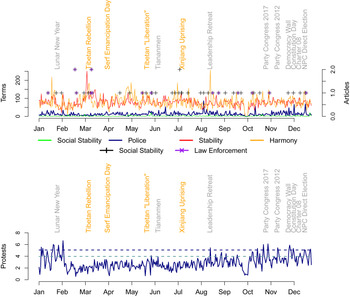
The top panel of Figure 2 visualizes the life cycle of propaganda-based threats. We index each calendar day as d ∈ {1, 365}. For each day d along the x-axis, the left and right y-axes report our measures of threats. The left y-axis reports the total number of times, per day, between 2006 and 2016 that the Workers' Daily mentioned stability and harmony, as well as two other terms associated with social stability maintenance: social stability and police. The right y-axis reports the number of articles, by day, that are classified as social stability and law enforcement. In the Appendix, we show that our measures of threats are correlated.
Life cycle of threats and protest in China
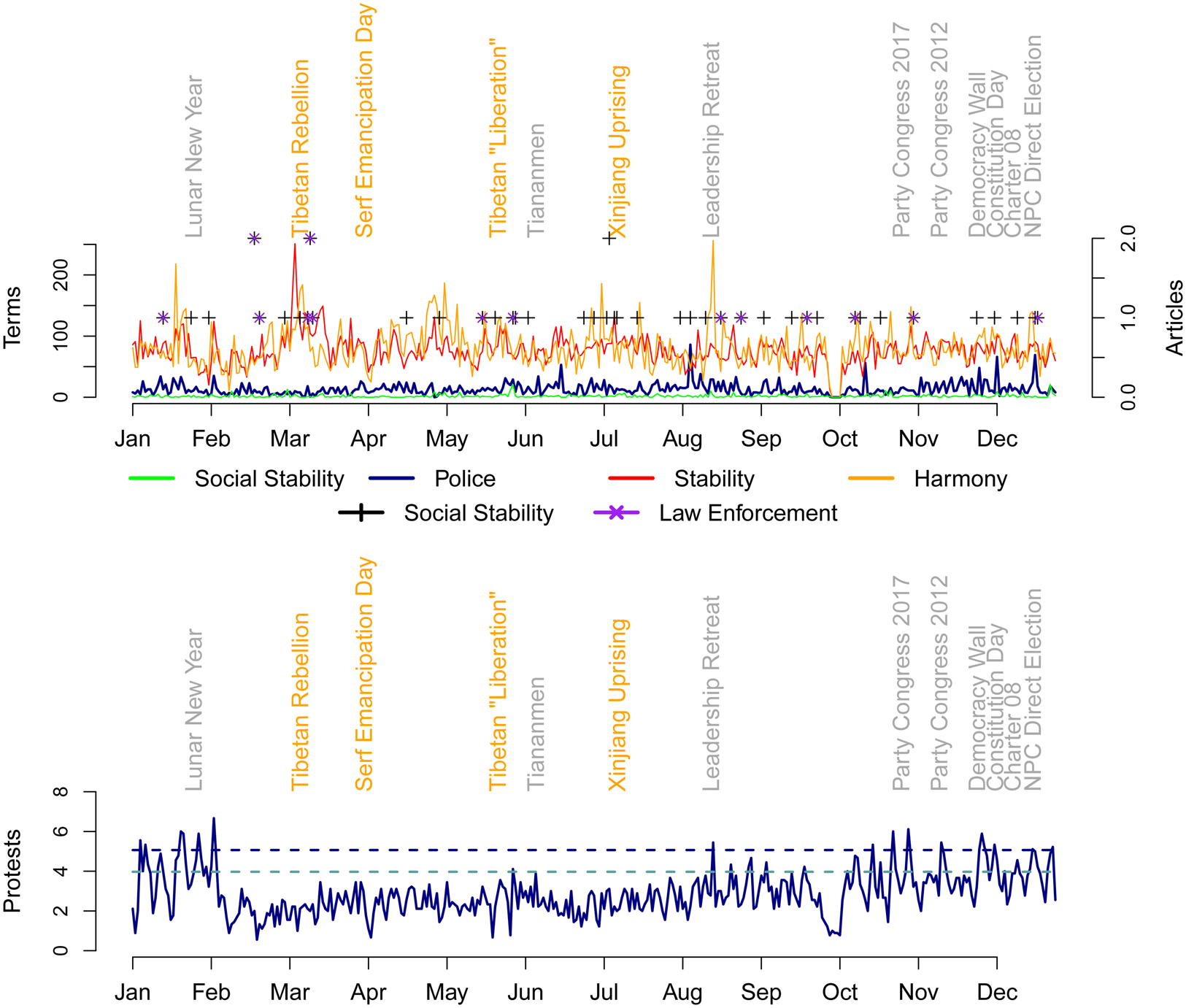
The bottom panel visualizes the life cycle of protest in China. For each day along the x-axis, we compute the total number of protests, nationwide, between 2006 and 2016. The two dashed horizontal lines indicate daily protest levels equal to the mean plus one or two standard deviations, respectively. These descriptive statistics suggest that propaganda-based threats cluster around politically sensitive moments, when citizens are politically engaged and aware of their shared frustrations with the regime. We label two sets of sensitive dates above both panels: the anniversaries of ethnic separatist movements, as well as political meetings and anniversaries of failed pro-democracy movements. We discuss these in turn.
Anniversaries of ethnic separatist movements
Modern China has experienced two major separatist movements: one in Tibet and one in Xinjiang. These separatist movements have accumulated four anniversaries that are now focal points for protest and state repression in those regions (Hillman and Tuttle Reference Hillman and Tuttle2016). These anniversaries are deeply salient in Tibet and Xinjiang, but not elsewhere. Table 2 describes these anniversaries.
Ethnic separatist anniversaries

Figure 2 suggests that these separatist anniversaries compel the government to issue propaganda-based threats. Figure 3 confirms this. The left panel reports descriptive statistics for threat measures based on topic models. Social stability articles are four times as likely during separatist windows, defined as the seven-day period centered on a separatist anniversary (that is, the day of the anniversary plus three days either side), and law enforcement articles are three times as likely during these periods. The right panel reports our threat measures based on term frequency counts. References to stability and harmony are 20 per cent more likely during separatist windows. These threats may be directed principally at ethnic minorities in Tibet and Xinjiang, but citizens across China are exposed to them.
Rates of propaganda-based threats
Note: in the left panel, the x-axis gives the percent of days on which a threatening article was published. In the right panel, the x-axis gives the number of times a threatening term was referenced per day.

Anniversaries of failed pro-democracy movements, political anniversaries and cultural anniversaries
The bottom panel of Figure 2 suggests that protests cluster around the anniversaries of China's failed pro-democracy movements: Tiananmen, Democracy Wall, Constitution Day, Charter 08 and NPC Direct Elections. We discuss these pro-democracy anniversaries in detail in the Appendix.
In Figure 2, political and cultural anniversaries have a less obvious relationship with threats and protest. Nonetheless, the government regards some of these moments as sensitive and prepares for them in advance: by arresting dissidents, increasing censorship and flooding social media with pro-regime content (King, Pan and Roberts Reference King, Pan and Roberts2013; King, Pan and Roberts Reference King, Pan and Roberts2017; Truex, Reference Truex2019). In the Appendix, we present a list of China's political anniversaries and cultural anniversaries.
Specification
To explore the timing of propaganda-based threats, we estimate models of the form:
 $$Y_t = \alpha + \beta ( {{\rm Separatist}\,{\rm Anniversary}\,{\rm Windo}{\rm w}_t} ) + \phi {\bf X}_{\bf t} + {\boldsymbol \gamma }_{\bf s} + {\rm \epsilon }, \;$$
where t indexes day and s indexes year. Our dichotomous outcome variable, Threat t, is coded 1 if the Workers' Daily published a threatening article on day t, and 0 otherwise. Our continuous outcome variable, Count t, denotes the number of times the Workers' Daily published either stability or harmony on day t. We use logit models for dichotomous outcomes and negative binomial models for counts.
Our explanatory variable is Separatist Anniversary Window t. Although we expect threats to cluster around these anniversaries, we accommodate the possibility that the regime issues threats several days before or after. We do so by constructing anniversary windows, ranging from the anniversary plus/minus zero days to the anniversary plus/minus five days. ${\bf X}_{\bf t}$ is a vector of day-level controls. It includes dichotomous indicators for the anniversaries of failed pro-democracy movements, political anniversaries and cultural anniversaries. As for Separatist Anniversary Window t, we construct anniversary windows, ranging from the anniversary plus/minus zero days to the anniversary plus/minus five days. We are unaware of any features that may be correlated with these anniversary windows and propaganda-based threats, save one. We include in ${\bf X}_{\bf t}$ a measure of underlying political instability. The variable Protests t−1 counts the number of protests that occurred nationwide on day t – 1.Footnote 7 Year fixed effects, given by ${\boldsymbol \gamma }_{\bf s}$, accommodate unobserved annual features, such as changes in economic conditions, the data-generating process and the government's political strategy.
Results
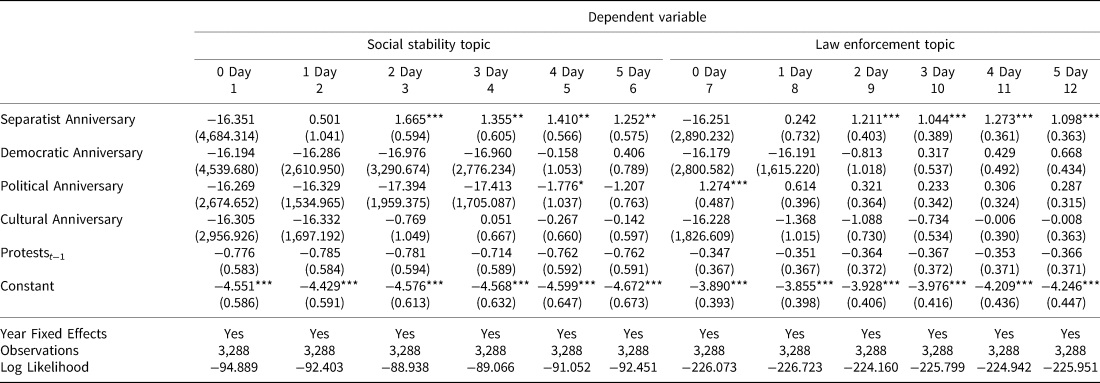
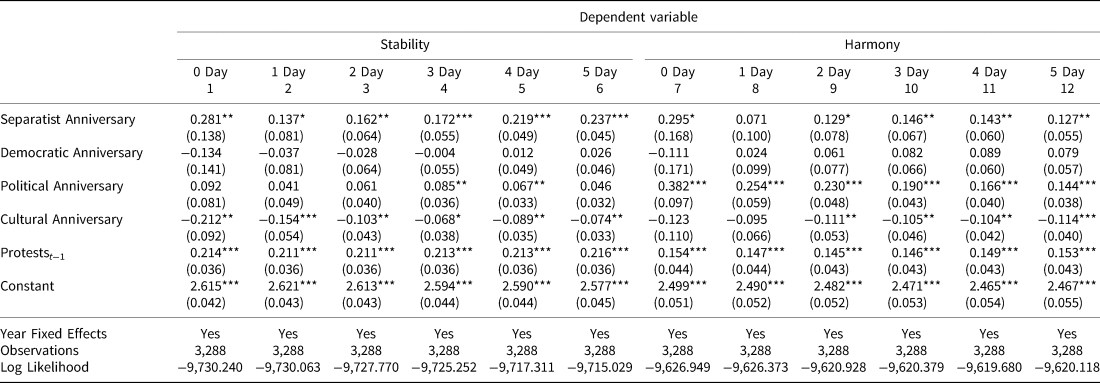
The results appear in Tables 3 and 4. In Table 3, Models 1 through 6 focus on the social stability topic label as the outcome of interest; Models 7 through 12 focus on the law enforcement topic label. In Table 4, Models 1 through 6 use references to stability as the outcome of interest; Models 7 through 12 use harmony references.
When autocrats issue propaganda-based threats: topics
Note: N Day column names give ±N size of anniversary windows. *p < 0.1; **p < 0.05; ***p < 0.01
When autocrats issue propaganda-based threats: references
Note: N Day column names give ±N size of anniversary windows. *p < 0.1; **p < 0.05; ***p < 0.01
The results are consistent with Hypotheses 1 and 3. The CCP is far more likely to issue propaganda-based threats around the anniversaries of ethnic separatist movements. Table 3 shows that the daily odds that the government will publish a social stability or law enforcement article are between 330 and 530 per cent greater around ethnic separatist anniversaries than other days of the year. From Table 4, each day within an ethnic separatist anniversary window experiences 14–26 per cent more mentions of stability and harmony.Footnote 8
By contrast, the only other sensitive moments around which the CCP issues propaganda-based threats of repression are major political anniversaries. We find that law enforcement related articles are roughly 350 per cent more likely on the day of a major political anniversary; references to stability are roughly 8 per cent more likely during the three and four days surrounding major political anniversaries; and references to harmony are 15–46 per cent more likely around major political anniversaries. Table 4 also suggests that protests on day t – 1 compel the government to issue propaganda-based threats on day t, which is consistent with Hypothesis 1.
These results are striking in two other ways. First, they are consistent with the CCP's political strategy in Tibet and Xinjiang. The government routinely conducts military patrols; imposes curfews, internet and cellular shutdowns; and incarcerates Tibetans and Uyghurs in mass. In Xinjiang, the government banned the Quran, the name ‘Mohammed’, and ‘unreasonably long’ beards. At least one million and perhaps as many as three million Uyghurs are held in ‘re-education’ camps (Stewart Reference Stewart2019). The CCP, we find, also issues propaganda-based threats of repression around the anniversaries of ethnic separatist movements, which are profoundly salient for Tibetans and Uyghurs but not the Han majority.
Secondly, Truex (Reference Truex2019) shows that the CCP begins incarcerating dissidents several days before politically sensitive moments, and not just on the sensitive day itself. We find the same pattern. The CCP begins issuing propaganda-based threats several days before ethnic separatist anniversaries and continues several days after.
Threats and Pro-Regime Propaganda
Scholars increasingly understand CCP propaganda as a signal to citizens: that the regime's capacity for repression is so substantial that it can compel citizens to consume propaganda content that everyone knows to be false (Huang Reference Huang2015). In a sense, spikes in pro-regime propaganda are implicitly threatening. Accordingly, we might expect spikes in pro-regime propaganda to be correlated with propaganda-based threats of repression.
We measure pro-regime propaganda by identifying every reference to the CCP on day t, and then extracting the ten words before and after. Drawing on a standard semantic dictionary (Dong and Dong Reference Dong and Dong2014), we measure how fulsome or critical these twenty words are. The variable Positive Coverage t constitutes our measure of pro-regime propaganda. It gives the number of fulsome words less critical words, among the twenty surrounding each reference, summed for day t. We detail this procedure in the Appendix, and we also show that the Chinese government's propaganda apparatus employs pro-regime propaganda and threats of repression at roughly the same moments. This is consistent with our theory of propaganda-based threats and prior research that understands Chinese pro-regime propaganda as itself implicitly threatening. The number of threats spikes during moments of tension.
Do threats of repression work?
Selection Bias and Identification
Determining whether threats of repression reduce protests is complicated by the fact that threats are strategic: the CCP is more likely to threaten repression during politically sensitive moments and in response to protests on day t – 1. This creates two competing effects on protests: a negative effect due to the threat, and a positive effect due to tensions that compelled the threat. In the Appendix, we estimate a naive regression model that shows essentially no effect of propaganda-based threats on protest.
The results presented above help us address this selection bias and obtain plausibly causal estimates of the effect of propaganda-based threats on protest. We treat these results as a model of the treatment assignment mechanism: of how the Chinese government chooses when to threaten citizens. We then use this treatment assignment mechanism as the foundation for our IV estimates. The key idea is that Workers' Daily content is set at the national level, but occasionally responds to conditions that are salient in one province but not others. As a result, provinces that are geographically and socially distant from each other are occasionally ‘treated’ with propaganda content that is directed at the other province's readership. In practice, this identification strategy entails identifying events that generate protests in province i, and induce the CCP to issue propaganda-based threats to citizens in province i, but are effectively unknown in some geographically and culturally distant province j.
We argue that the ethnic separatist anniversaries discussed above provide a suitable instrument. They are highly salient in Tibet and Xinjiang, but, because of China's ethnic diversity, sprawling geography, and low out-migration rates from Tibet and Xinjiang, essentially unknown in Han China. Put differently, we exploit profoundly salient events in Tibet and Xinjiang to probe whether the propaganda-based threats induced by those events decrease protests by Chinese citizens elsewhere.
Exclusion Restriction
To be a valid instrument, anniversaries of ethnic separatist movements in Tibet and Xinjiang must reduce protests elsewhere only through their effects on propaganda-based threats. This exclusion restriction would be violated if the Chinese government deploys security forces in provinces other than Tibet and Xinjiang during ethnic separatist anniversaries, and these security force deployments reduce protest rates. We employ three strategies to rule out this possibility.
Dropping provinces
Ethnic separatist anniversaries elicit widespread repression in Tibet and Xinjiang. Shortly before the 50th anniversary of the Tibetan Rebellion, Zhang Qingli, the CCP chief in Tibet, said this to local police:
We must keep a watchful eye, and with clenched fists, constantly be on the alert. We must resolutely and directly strike at criminal elements who dare to stir up incidents. We must foil the separatist schemes of the Dalai clique (FlorCruz Reference FlorCruz2009).
The CCP regularly imposes region-wide security alerts, organizes military parades, and bans foreign travel in Tibet and Xinjiang around these anniversaries. In 2013, one Xinjiang party member told reporters that ‘during each anniversary, he had to patrol the neighborhood or visit residents for a whole month to ensure stability’ (Choi and Zuo Reference Choi and Zuo2013). Accordingly, we exclude Tibet and Xinjiang from our analysis.
We also exclude the four provinces that border Tibet and Xinjiang: Qinghai, Gansu, Sichuan and Yunnan. We do so because these neighboring provinces may have Tibetan and Uyghur communities along the Tibet and Xinjiang borders. There is substantial evidence that regional security apparatuses in these neighboring provinces treat the ethnic separatist anniversaries as sensitive. In 2017, the CCP blocked internet access in the ten Sichuan counties that neighbor Tibet in the weeks around the Tibetan Rebellion anniversary (Finney Reference Finney2017).
We drop three other provinces from the sample as well. First, Ningxia contains the Hui ethnic group, China's second-largest Muslim population. While the Hui are ethnically, linguistically and culturally distinct from Uyghurs and do not have separatist aims, they may be sympathetic to Uyghur grievances. Secondly, Inner Mongolia is home to several minority communities, which may be more sympathetic to Uyghur grievances than ethnic Han citizens. Thirdly, separatist anniversaries may have special significance in Beijing, but for different reasons. Anecdotal reports suggest that anti-terrorism precautions in Beijing were heightened after the 2009 Uyghur bombing in Urumqi, Xinjiang's capital (Yang Reference Yang2014). Uyghur terrorists conducted bombings in Beijing in 2013, and so Beijing residents may be more aware of Uyghur separatism.
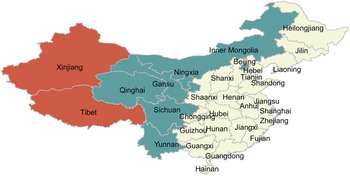
In total, we drop nine provinces in which the regime is likely to deploy additional security forces – or place existing security forces on alert – during ethnic separatist anniversaries in Tibet and Xinjiang. Figure 4 visualizes our final province sample. Tibet and Xinjiang appear in red; the other seven provinces we exclude appear in green. In 2016, the nine provinces we exclude accounted for 11.5 per cent of Chinese citizens. Our sample, in white, accounted for 88.5 per cent of Chinese citizens.
Map of China
Note: provinces with separatist movements appear in red. The analysis excludes these provinces and those in green. The remaining provinces appear in white.

Are citizens aware of ethnic separatist anniversaries?
In a second strategy, we conducted a nationally representative survey to confirm that citizens in our final province sample are unaware of ethnic separatist anniversaries from Tibet and Xinjiang. This is important for two reasons. First, if citizens are unaware of these ethnic separatist anniversaries, there is no reason to believe they constitute moments of tension. Secondly, there is no reason to believe the regime places security services on high alert in other provinces during these periods.
A professional survey company in China administered our online survey to 1,000 individuals in November 2018.Footnote 9 The panel was balanced to be nationally representative on gender, age, province and income. Balance statistics appear in the Appendix. Our survey protocol consisted of standard demographic questions, followed by ‘What is the day of X? (Please respond from memory, do not search on the internet)’, where X represents a series of thirteen political, cultural and sensitive holidays.Footnote 10 Respondents answered in an open-ended text response box.Footnote 11 In pre-testing, the survey took native speakers approximately three minutes to complete. To ensure that respondents were not searching for answers online, we dropped all responses that took longer than five minutes to complete. This restriction reduced our sample to 521 respondents.
The results appear in the left panel of Figure 5. As expected, Chinese citizens accurately identify the dates of major cultural and political holidays, as the top bars make clear. Also as expected, they were almost totally unable to identify the dates of ethnic separatist anniversaries in Tibet and Xinjiang. Put simply, these dates are salient only in Tibet and Xinjiang.
Chinese citizens are generally unable to identify the dates of ethnic separatist anniversaries in Tibet and Xinjiang

Readers may be concerned that respondents were too scared to acknowledge ethnic separatist anniversaries, perhaps because they feared detection by the CCP's online surveillance. Therefore, we recruited a sample of eighty-five Chinese undergraduates studying abroad at the University of Southern California using a snowball sampling method. Among China's most educated citizens and far from the government's surveillance apparatus, these students are ‘most likely cases’ for recognizing sensitive anniversaries. These undergraduates recognized major cultural and political holidays with precision. Yet again, few were able to identify the dates of ethnic secessionist anniversaries in Tibet and Xinjiang.
These results suggest that the vast majority of Chinese citizens are unaware of ethnic secessionist anniversaries in Tibet and Xinjiang. They also imply that the CCP has not drawn attention to these anniversaries by mobilizing its repressive apparatus on these dates.
A stricter form of this claim might posit that only protest organizers must know these dates. Protest organizers are more connected, savvy and aware of sensitive dates. They are also difficult to include in survey samples. In the Appendix, we address this concern in two ways. First, we show that there is no ‘donut pattern’ in which protests cluster before and after separatist dates. This suggests that protests are not being strategically rescheduled. Secondly, we used optical character recognition to convert the roughly 70,000 CLB photographs of protest banners, posters and tweets into textual data. We then used a distinctiveness algorithm to visualize the most distinctive terms during separatist anniversary protests vs. other protests. There is no substantive difference, which suggests that separatist anniversary windows do not motivate different protest behavior.
Is the security apparatus on high alert?
Our data enable us to confirm that the security apparatus is not on high alert in Han China in a third strategy. The Elfstrom/CLB data records whether the CCP's security apparatus responded to a given protest j by repressing participants. The key idea is that if, during ethnic separatist anniversaries that are sensitive in Tibet and Xinjiang, the security apparatus is on high alert in Han provinces, it should be more likely to repress protests that emerge during these anniversaries. To test this notion, we estimate the model:
 $$\eqalign{{\rm Pr}( {{\rm Repression}_j^{Han} = 1\vert {\rm Protest}_j^{Han} = 1} ) & = \alpha _R + \beta _R( {{\rm Separatist}\,{\rm Anniversary}\,{\rm Windo}{\rm w}_j} ) \cr & \quad + \phi _{\bf R}{\bf X}_{\bf j} + {\boldsymbol \psi }_{\bf R}{\bf W}_{\bf s} + {\bf \gamma }_{{\bf Rk}} + {\rm \epsilon }_R} $$
Where j indexes protest, s indexes year and k indexes province. The vector  ${\bf X}_{\bf j}$ includes recent protests and dichotomous indicators for the anniversaries of failed pro-democracy movements, political anniversaries and cultural anniversaries. The vector ${\bf W}_{\bf s}$ includes annual covariates that may influence repression: logged GRP, logged population, rural population share, sex ratio and urban unemployment. ${\bf \gamma }_{\bf s}$ denotes province fixed effects.
Summary statistics and sources for all variables appear in the Appendix. The Han superscript indicates that our analysis is limited to provinces in white in Figure 4, which are dominated by ethnic Han.
The results, which appear in Table 5, suggest that protests during ethnic separatist anniversaries in our final province sample are no more likely to be repressed than those on other days. Rather, the best predictor of whether a protest will be repressed is the number of protests in the preceding week. Put otherwise, in our final province sample, local security apparatuses mobilize in response to past protests, not ethnic separatist anniversaries in Tibet and Xinjiang. There is no evidence that CCP security forces are on high alert during ethnic separatist anniversaries outside the nine provinces that we exclude from the analysis.
State repression

Note: this analysis excludes red and green provinces from Figure 4. Recent protests records the number of protests in t – 1:t – N, for anniversary window length N. *p < 0.1; **p < 0.05; ***p < 0.01
In the Appendix, we also control for dissident detentions in the weeks before sensitive anniversaries – a form of preventive repression that might decrease protests by removing their leaders. We measure political detentions using the Congressional-Executive Commission on China's Political Prisoner Database.Footnote 12 Our results are robust to controlling for dissident detentions in the 7, 14 and 30 days prior to the separatist anniversary.
IV Specification
Above we suggest that the exclusion restriction holds for three reasons: virtually no Chinese citizens recognize ethnic separatist dates, the probability of repression is statistically unchanged during these dates, and we conservatively focus only on eastern provinces that are ethnically and geographically distant from Xinjiang and Tibet.
To probe the effect of propaganda-based threats, we create the variable Protests  $_{t + 1\colon t + 7}^{Han} $, which counts the total number of protests across the country – save for the nine provinces we exclude – over the course of the coming week. This accommodates the possibility that Workers' Daily content may take several days to fully disseminate, or for citizens to update their beliefs following a threat. Our second stage model is:
 $${\rm Protests}_{t + 1\colon t + 7}^{Han} = \alpha _P + \beta _P( {\widehat{{{\rm Threa}{\rm t}_t}}} ) + \phi _{\bf P}{\bf X}_{\bf t} + {\bf \psi }_{\bf P}{\bf W}_{\bf s} + {\bf \gamma }_{{\bf Ps}} + {\rm \epsilon }_P, \;$$
where t indexes day, s indexes year, and the Han superscript indicates that we restrict attention to Han-dominated provinces from Figure 4. The endogenous regressor  $\widehat{{Threat_t}}$ is the propaganda-based threat level predicted by the first stage:
 $$\eqalign{{\rm Threa}{\rm t}_t & = \alpha _T + \beta _T( {{\rm Separatist}\,{\rm Anniversary}\,{\rm Windo}{\rm w}_t} ) \cr & \quad + \phi _{\bf T}{\bf X}_{\bf t} + {\bf \psi }_{\bf T}{\bf W}_{\bf s} + {\bf \gamma }_{{\bf Ts}} + {\rm \epsilon }_T} $$
 In both models, vector  ${\bf X}_{\bf t}$ includes day-level covariates: whether day t falls within any of the other anniversary windows defined above and the number of nationwide protests on day t – 1. Vector ${\bf W}_{\bf s}$ includes year-level covariates observed at the national level: logged GRP, logged population, rural population share, sex ratio and urban unemployment. The parameter ${\bf \gamma }_{\bf s}$ gives year fixed effects. The endogenous regressors are our word count measures of threats – references to stability and harmony by day – which are continuous and non-negative. Our outcome measure of nationwide protests is also continuous and non-negative. We employ two-stage least squares.
Results
The results appear in Tables 6 and 7. Models 1–3 use the daily number of references to stability as the endogenous regressor; Models 4 through 6 use the daily number of references to harmony. Table 6 gives first-stage estimates; Table 7 gives second-stage estimates. The models pass standard weak instrument tests at the 1 per cent level and Wu-Hausman consistency tests at the 10 per cent level. The first-stage results are consistent with those in Table 4. Ethnic separatist anniversaries are strongly correlated with threats, as are protests on day t – 1.
IV results: first stage

Note: this analysis excludes red and green provinces from Figure 4. *p < 0.1; **p < 0.05; ***p < 0.01
IV results: second stage

Note: this analysis excludes red and green provinces from Figure 4. *p < 0.1; **p < 0.05; ***p < 0.01
In the second stage, we find that propaganda-based threats reduce the daily rate of protest in provinces that are geographically and culturally distant from Tibet and Xinjiang. The results are visualized in Figure 6. When the Workers' Daily publishes the mean number of references to stability – 8.5 per day – the predicted number of protests over the subsequent week is twenty. At sixteen references, or the mean plus one standard deviation, the predicted number of protests in the subsequent week falls to ten. We estimate slightly larger effects for mentions of harmony.
Simulated IV results

These effects are substantively meaningful. To halve the number of protests over the course of a subsequent week, CCP propaganda must publish eight additional references to stability or harmony on day t. This represents a doubling of its baseline daily rate of 8.5 stability references and 8.9 harmony references. We interpret this as reflecting a general linguistic shift towards more threatening content. The CCP issues propaganda-based threats sparingly. When it does, we find, citizens take them seriously.
Robustness Checks
The Appendix presents a series of robustness checks. Perhaps most importantly, we use a sensitivity analysis proposed by Conley, Hansen and Rossi (Reference Conley, Hansen and Rossi2012) to confirm that the IV estimates in Table 7 are robust to non-trivial violations of the exclusion restriction. For the IV estimates above to be statistically indistinguishable from zero, violations of the exclusion restriction would have to reduce the protest rate around ethnic separatist anniversaries by an amount greater than the difference between the mean and third quartile protest rates. Based on the discussion above, we believe this is unlikely.
Readers may wonder whether the protest reduction in Han provinces around ethnic separatist anniversaries is generated by Tibetan and Uyghur residents who refrain from protesting because they want to avoid being branded terrorists. We use China's most recent census data to show that migrants from Tibet and Xinjiang constitute a vanishingly small share of the population in our final province sample. Given so little out-migration from these two regions, we view this potential violation of the exclusion restriction as unlikely, and certainly not capable of generating the protest reduction required to invalidate the IV estimates.
We also show that the IV estimates reported in Table 7 are robust to different modeling decisions. We vary the size of protest windows for our outcome variable. We focus only on the 2009–2012 period, before a 2013 terrorist attack in Beijing brought national attention to Uyghur separatism. We drop Guangdong Province, which experienced a Han–Uyghur factory brawl in 2009 and a terrorist attack in 2015. We drop the winter months, when the Lunar New Year – and associated internal travel – occasions protests by migrant laborers who are owed back pay. In each case, the IV estimates are substantively unchanged.
Next, though we believe that controlling for political anniversaries absorbs their effects, we nonetheless drop two separatist anniversaries due to their proximity to political anniversaries. The Tibetan Rebellion anniversary occurs on 10 March, just a week after the National People's Congress opens. The Tibetan Liberation occurs on 23 May, two weeks before 4 June. Our results are robust to excluding these two anniversaries from the instrument.
Finally, we show that our measures of propaganda-based threats of repression almost entirely account for the reduction in the number of protests over the subsequent week across the country during separatist anniversaries.
Conclusion
Popular protests constitute a chief threat to the world's autocrats, and they often emerge around elections and other politically sensitive moments. Autocrats prepare for these moments in advance: by incarcerating opposition leaders, amplifying censorship and engineering social media campaigns. This article shows that autocrats also employ propaganda-based threats of repression. These threats are issued sparingly, and, in China, coincide with anniversaries of ethnic separatist movements in Tibet and Xinjiang, and, secondarily, with major political anniversaries. This is consistent with our theoretical framework. Regardless of whether propaganda is employed to dominate citizens or persuade them, threats of repression are costly. They should therefore be timed for maximum effect: when protests are threatening, especially by political out-groups.
The CCP's calendar of propaganda-based threats offers an opportunity to plausibly measure whether these threats condition citizen behavior. China is ethnically diverse and geographically sprawling, and so the ethnic separatist anniversaries that are profoundly salient in Tibet and Xinjiang are effectively unknown throughout much of the country. This is the premise of our identification strategy. Since propaganda is set at the national level but must occasionally respond to local conditions, citizens in provinces that are geographically and culturally distant from Tibet and Xinjiang are occasionally ‘treated’ with content that is not intended for them. Accordingly, ethnic separatist anniversaries in Tibet and Xinjiang plausibly condition protests in geographically and culturally distant provinces only through the propaganda-based threats that the regime directs at Tibet and Xinjiang. Our IV estimates suggest that, by doubling the number of references to stability or harmony, CCP propaganda halves the number of protests during the subsequent week. Language, we find, matters. Conley, Hansen and Rossi's (Reference Conley, Hansen and Rossi2012) sensitivity analysis suggests that these estimates are robust to non-trivial violations of the exclusion restriction.
Though we focus empirically on China, our theory predicts cross-regime variation in the rate of propaganda-based threats. Since threats of repression should invalidate efforts to persuade, we expect them to be less common where propaganda chiefly aims to persuade citizens of the regime's merits. We regard this cross-regime variation as key for future research. Likewise, we suspect that different autocrats use different language to threaten their citizens with repression. While the CCP uses harmony and social stability, other autocrats may be more explicit. Insofar as this variation exists, what explains it? Alternatively, there may be temporal variation within the same regime: explicit threats may be reserved for some moments, while codeword threats may be reserved for others. These too are critical directions for future research.
Supplementary material
Online appendices are available at https://doi.org/10.1017/S0007123420000575.
Data availability statement
The data and replication instructions can be found in Harvard Dataverse at https://doi.org/10.7910/DVN/GD0DL9.
Acknowledgements
We thank two anonymous research assistants for their excellent work. For helpful feedback, we thank three anonymous reviewers, Carles Boix, Manfred Elfstrom, John Kennedy, Lucas Leeman, Paul Orner, Bryn Rosenfeld, Victor Shih, Rory Truex, Maiting Zhuang, Yuri Zhukov, and seminar participants at Princeton University, Stanford University, University of Southern California, University of California Los Angeles, University of California San Diego, Yale University, the 2018 Western Political Science Association Non-Democratic Politics Mini-Conference, the 2019 Midwestern Political Science Association Annual Conference, and the 2019 American Political Science Association Annual Conference.
Financial support
Support for this research was provided by the Center for International Studies at the University of Southern California.
Ethical standards
The survey in this paper was approved by the Institutional Review Board at the University of Southern California






 Open access

