

Introduction
The demand for cereals in sub-Saharan Africa (SSA) is set to more than triple by 2050, due principally to shifts in dietary habits and growth in human population (van Ittersum et al. Reference van Ittersum, van Bussel, Wolf, Grassini, van Wart, Guilpart, Claessens, de Groot, Wiebe, Mason-D’Croz, Yang, Boogaard, van Oort, van Loon, Saito, Adimo, Adjei-Nsiah, Agali, Bala, Chikowo, Kaizzi, Kouressy, Makoi, Ouattara, Tesfaye and Cassman2016). To meet both present and future demand for food would require agriculture to become more productive as projections set the global demand for food – majority of which will come from SSA – to increase by 60–110% between 2005 and 2050 (Alexandratos and Bruinsma Reference Alexandratos and Bruinsma2012; Lal Reference Lal2016; Tilman et al. Reference Tilman, Balzer, Hill and Befort2011). Whilst some studies argued that it is possible to feed the world by narrowing the substantial gaps between actual and attainable yields on existing farmlands (Lal Reference Lal2016; Mauser et al. Reference Mauser, Klepper, Zabel, Delzeit, Hank, Putzenlechner and Calzadilla2015; Pradhan et al. Reference Pradhan, Fischer, van Velthuizen, Reusser and Kropp2015), especially of those in SSA, others have advocated for a combination of crop area expansion and food imports to complement yield gaps closure in SSA (van Oort et al. Reference van Oort, Saito, Tanaka, Amovin-Assagba, Van Bussel, van Wart, de Groot, van Ittersum, Cassman and Wopereis2015). However, concerns that crop area expansion could lead to increased greenhouse gas emissions and biodiversity losses (Bennetzen, Smith, and Porter Reference Bennetzen, Smith and Porter2016; Loon et al. Reference Loon, Hijbeek, Berge, De Sy, Broeke, Solomon and van Ittersum2019), and the assertion that low-income economies do not have ample foreign reserves to incessantly meet their food demand through imports, as well as the requisite infrastructure to store food for onward distribution (Chang Reference Chang2009; van Ittersum et al. Reference van Ittersum, van Bussel, Wolf, Grassini, van Wart, Guilpart, Claessens, de Groot, Wiebe, Mason-D’Croz, Yang, Boogaard, van Oort, van Loon, Saito, Adimo, Adjei-Nsiah, Agali, Bala, Chikowo, Kaizzi, Kouressy, Makoi, Ouattara, Tesfaye and Cassman2016), make yield gaps closure very crucial for SSA. Hence, on-farm productivity of all cereals must be improved in SSA if domestic supply is to keep pace with both current and future demand. Such farm-level productivity gains are also essential for the realization of the Science Agenda for Agriculture in Africa, which seeks to ensure that: “By 2030, Africa is food and nutrition secure; becomes a recognized global scientific player in agriculture and food systems, and the world’s breadbasket” (FARA 2014).
The smallholder producers who dominate (80%) the agrarian sector of SSA undertake most (90%) of the agricultural operations on atomized farm holdings with low productivity (Wiggins and Keats Reference Wiggins and Keats2013), using unimproved farm inputs. Compared to other regions of the world, SSA continues to experience an enormous productivity gap (i.e., the difference between potential and observed crop yields) in agricultural production (Deininger et al. Reference Deininger, Byerlee, Lindsay, Norton, Selod and Stickler2011), with agricultural total factor productivity growth being generally low (Fuglie, Jelliffe, and Morgan Reference Fuglie, Jelliffe and Morgan2021; World Bank 2018). Unlike Asia and South America, where growth in agricultural production was as a result of intensification and gains in labor productivity due to widespread mechanization, respectively, agricultural output growth in SSA has largely been driven by extensification (i.e., the continuous expansion of crop area), rather than potential gains in farm productivity (Brink and Eva Reference Brink and Eva2009; FAO 2019; Jayne and Sanchez Reference Jayne and Sanchez2021). According to Jayne and Sanchez (Reference Jayne and Sanchez2021), most of the gains SSA has recorded in agricultural production over the years were derived mainly from area expansion (75%) with yield improvement accounting for just 25%. Consequently, sizeable yield gaps are still widespread on current croplands in the region that need to be fully exploited. Available estimates indicate that narrowing these yield gaps could raise total farm output by 45–70% globally. Specifically, SSA stands to benefit substantially from output gains in major cereals if the productivity of these crops is raised to 50% of their potential (Mueller et al. Reference Mueller, Gerber, Johnston, Ray, Ramankutty and Foley2012). As noted by Jayne and Sanchez (Reference Jayne and Sanchez2021), improved rates of farm productivity growth are attainable in SSA through a higher and more efficient deployment of available farm inputs and by doing existing things differently, what the authors jointly referred to as technical innovation. Since efficiency improvement at the farm level requires an empirical assessment of the present level of technology and resource deployment, and the identification of its determinants, this study endeavors to provide this evaluation for different cereal crops across diverse agro-ecological zones, which serve as prime cereal production sites.
Low agricultural productivity continues to be a challenge for both staple and cash crop farmers in SSA (World Bank 2018). Attempts to address this challenge have led to the development and introduction of modern production technologies such as improved crop varieties and farming practices in several developing countries (Abate et al. Reference Abate, Fisher, Abdoulaye, Kassie, Lunduka, Marenya and Asnake2017; Abdulai and Huffman Reference Abdulai and Huffman2005; Bänziger et al. Reference Bänziger, Setimela, Hodson and Vivek2006; Diagne Reference Diagne2006; Fisher, Abate, and Lunduka Reference Fisher, Abate and Lunduka2015; Khonje et al. Reference Khonje, Manda, Mkandawire, Tufa and Alene2018; Manda et al. Reference Manda, Alene, Gardebroek, Kassie and Tembo2016). As a result, continuous evidence on agricultural productivity improvement has largely been focused on either the adoption and impacts of these new agricultural technologies on farm productivity (Abdulai and Huffman Reference Abdulai and Huffman2014; Abdul-Rahaman, Issahaku, and Zereyesus Reference Abdul-Rahaman, Issahaku and Zereyesus2021; Katengeza and Holden Reference Katengeza and Holden2021; Katengeza, Holden, and Lunduka Reference Katengeza, Holden and Lunduka2019; Kotu et al. Reference Kotu, Alene, Manyong, Hoeschle-Zeledon and Larbi2017), or the efficiency of use of existing technologies (Baffoe-Bonnie and Kostandini Reference Baffoe-Bonnie and Kostandini2019; Bravo-Ureta et al. Reference Bravo-Ureta, Moreira, Troncoso and Wall2020; Lawin and Tamini Reference Lawin and Tamini2019). Documented evidence however indicates that, to date, the pace of uptake of improved technologies among farm households in SSA continues to be generally slow (Duflo, Kremer, and Robinson Reference Duflo, Kremer and Robinson2011; Dzanku et al. Reference Dzanku, Osei, Nkegbe and Osei-Akoto2020; Rodenburg, Büchi, and Haggar Reference Rodenburg, Büchi and Haggar2020; Teklewold, Kassie, and Shiferaw Reference Teklewold, Kassie and Shiferaw2013). Furthermore, even though copious empirical studies have explored the efficiency of agricultural production in SSA, most of these studies have not been able to account for the likely impacts of farm-level technological heterogeneity on agricultural production, which may arise from disparities in the production settings of the various farms. Failure to account for these distinctions in production technology may lead to wrongly ascribing production shortfalls due to uneven distribution of technologies (i.e., technology gaps) to managerial inefficiency (Battese, Rao, and O’Donnell Reference Battese, Rao and O’Donnell2004). Since output shortfalls from both sources require different policy interventions, empirical investigations targeted at an in-depth understanding of the potential contributions of each of these sources of output shortfalls may prove useful in designing suitable policies for cereal farms faced with dissimilar agro-ecological constraints. Such exhaustive studies entailing different cereal crops across different geographical settings are limited in the literature globally.
Although several studies (Bachewe, Koru, and Taffesse 2015; Čechura et al. Reference Bachewe, Koru and Taffesse2015; Croppenstedt and Demeke Reference Croppenstedt and Demeke1997; Hadley and Irz Reference Hadley and Irz2008; Latruffe, Fogarasi, and Desjeux Reference Latruffe, Fogarasi and Desjeux2012; Wouterse Reference Wouterse2010; Zhou et al. Reference Zhou, Wang, Hu and Duan2021) have evaluated the efficiency and productivity of cereal farms in different parts of the globe, just a handful focused on SSA (Bachewe, Koru, and Taffesse Reference Bachewe, Koru and Taffesse2015; Croppenstedt and Demeke Reference Croppenstedt and Demeke1997; Wouterse Reference Wouterse2010). Whereas most of these studies have essentially concentrated on technical efficiency (TE) estimation and the identification of its determinants by assuming a homogenous production technology for all sampled farms, only a few (Čechura et al. Reference Čechura, Hockmann, Malý and Žáková Kroupová2015; Latruffe, Fogarasi, and Desjeux Reference Latruffe, Fogarasi and Desjeux2012) accounted for heterogeneity in cereal production technology among selected European Union member countries. Thus, most of these earlier studies on cereal production efficiency have not been able to aptly isolate technology gap effects from managerial inefficiency effects for appropriate policy formulation. Additionally, akin to several existing studies on cereal production efficiency, most previous meta-frontier studies have only relied on cross-sectional data with just a handful considering meta-frontier analysis over time.
Study context
Accounting for heterogeneities in the production performance of cereal farms across different zones is crucial in Ghana, where there are six distinct agro-ecological zones, including, the Guinea Savanna, Forest-Savanna Transition, Deciduous Forest, Sudan Savanna, Coastal Savanna, and Rain Forest zones (MoFA 2021). These zones differ based on the characteristics of the soil, type of vegetation, climatic conditions, and rainfall patterns, and in their level of infrastructural and resource endowments. For instance, whereas the Forest-Savanna Transition, Deciduous Forest, Coastal Savanna, and Rain Forest zones experience two rainfall seasons in a year, the Sudan and Guinea Savanna zones experience just a single rainfall season (MoFA 2021). Further, in addition to being highly prone to erosion, the soils of the Sudan and Guinea Savanna zones are characterized by low organic matter content (Oppong-Anane Reference Oppong-Anane2006). These distinctions in agro-ecological conditions do considerably contribute to differences in the production technology adopted by farm households in each zone and thus, the productivity difference, which is reflected by the disparities in the level of output generated across these zones and regions (Asante et al. Reference Asante, Temoso, Addai and Villano2019; Asravor et al. Reference Asravor, Wiredu, Siddig and Onumah2019; Danso-Abbeam and Baiyegunhi Reference Danso-Abbeam and Baiyegunhi2019; Owusu, Reference Owusu2016; Tsiboe Reference Tsiboe2021; Tsiboe, Aseete, and Djokoto Reference Tsiboe, Aseete and Djokoto2021; Tsiboe, Asravor, and Osei Reference Tsiboe, Asravor and Osei2019).
Recent studies on cereal productivity and efficiency in Ghana have either been limited to individual crops such as rice (Abdul-Rahaman, Issahaku, and Zereyesus Reference Abdul-Rahaman, Issahaku and Zereyesus2021; Asravor et al. Reference Asravor, Wiredu, Siddig and Onumah2019; Owusu, Donkor, and Owusu-Sekyere Reference Owusu, Donkor and Owusu-Sekyere2018) and maize (Asante et al. Reference Asante, Temoso, Addai and Villano2019) or undertaken in limited agro-ecological zones (Asante et al. Reference Asante, Temoso, Addai and Villano2019; Asravor et al. Reference Asravor, Wiredu, Siddig and Onumah2019). Additionally, none of these previous studies have evaluated the performance of cereal farms in all agro-ecological zones of Ghana. Furthermore, majority of the existing studies are silent on the nature of the observed production shortfalls throughout the country. Thus, the limited scope of these existing studies on cereal production efficiency in Ghana makes it infeasible for any of such studies to formulate comprehensive policies for the cereal subsector of the country. In this study, we account for productivity variations in cereal production across all agro-ecological zones in Ghana by examining both TE and technology gaps – two important components of productivity gaps (Assefa et al. Reference Assefa, Chamberlin, Reidsma, Silva and van Ittersum2020; Dossou-Yovo et al. Reference Dossou-Yovo, Vandamme, Dieng, Johnson and Saito2020; Silva et al. Reference Silva, Reidsma, Laborte and van Ittersum2017), to inform policy on the possible ways to narrow the prevailing gaps on cereal farms in the country. Further, unlike prior studies which used only cross-sectional data covering just one production season, the present study employed a nation-wide data set across several production seasons to unpack the prime drivers of the existing productivity gaps whilst highlighting the nature of the observed production shortfalls across various cereals and agro-ecological zones throughout Ghana.
Analogous to earlier studies which focus on vegetables (Tsiboe, Asravor, and Osei Reference Tsiboe, Asravor and Osei2019), cocoa (Tsiboe Reference Tsiboe2021), and legumes (Tsiboe, Aseete, and Djokoto Reference Tsiboe, Aseete and Djokoto2021), this study utilizes a nationally representative data set of 26,449 cereal farms, collated from 10 cross-sectional population-based surveys periodically fielded throughout Ghana from 1987 to 2017. This novel data set represents three decades of cereal production experience at the farm level and has the widest coverage across time and space than that of previous cereal productivity studies conducted in Ghana. Using this data set, the study estimates the stylized Translog meta-stochastic frontier (MSF) (Huang, Huang, and Liu Reference Huang, Huang and Liu2014), whilst accounting for heterogeneity in technical inefficiency and farm technology for maize, rice, sorghum, and millet. The data and models are used to answer these germane research questions: (1) what prevailing productivity gaps do Ghana need to narrow; (2) for which cereals; and (3) in which agro-ecological zones, to substantially contribute to the county’s quest to be self-sufficient in cereal production? By finding answers to these questions, our study intends to contribute to improved food production in Ghana with minimal environmental impacts through farm-level efficiency improvement by pinpointing the possible sources of productivity shortfalls for each of Ghana’s main cereal crops across major production sites throughout the country. This study responds to recent concerns about the decline in global agricultural output growth, especially in developing countries (Fuglie, Jelliffe, and Morgan Reference Fuglie, Jelliffe and Morgan2021), and the need for agricultural productivity to be expanded in SSA through a superior and more efficient use of extant resources (Jayne and Sanchez Reference Jayne and Sanchez2021).
Methodology
This study implements the MSF approach proposed by Huang, Huang, and Liu (Reference Huang, Huang and Liu2014), to capture farmers’ adoption of specific technologies based on their agro-ecological zones. We assumed a homogenous farm technology in each cereal production system, coupled with the adoption of best management practices that allow maximum potential output for a given set of inputs, situating all farmers on the same production frontier. Thus, any production performance below this frontier can be attributed to technical inefficiency and/or downside production risk (Bokusheva and Hockmann Reference Bokusheva and Hockmann2006). Additionally, it has been observed that maize and rice farmers in Ghana operate under spatially differentiated technologies (Asante et al. Reference Asante, Temoso, Addai and Villano2019; Asravor et al. Reference Asravor, Wiredu, Siddig and Onumah2019), which is not surprising because Ghana’s agro-ecologies vary by climate, soil, and vegetation types (Abbam et al. Reference Abbam, Johnson, Dash and Padmadas2018; MoFA 2019; Owusu et al. Reference Owusu, Ma, Emuah and Renwick2021). Thus, it is important to account for these spatial heterogeneities when investigating the production performance of cereal farmers operating at different levels relative to the best practice frontier.
The stochastic frontier production function for the j th agro-ecology is specified as:
 $${y_{jit}} = f_t^j\left( {{x_{jit}}} \right){e^{{v_{jit}} - {u_{jit}}}}$$
where ${y_{jit}}$
denotes the total farm output (kg) of the i
th farmer at a given time t. The
${y_{jit}}$
denotes the total farm output (kg) of the i
th farmer at a given time t. The ${x_{jit}}$
represents the inputs used, including land, seed, household labor, hired labor, fertilizer, and pesticide. For
${x_{jit}}$
represents the inputs used, including land, seed, household labor, hired labor, fertilizer, and pesticide. For $f_t^j\left( \cdot \right)$
, the study assumes the Translog functional form due to its relative flexibility (Coelli, Rao, and Battese Reference Coelli, Rao and Battese2005). Furthermore, the parameters
$f_t^j\left( \cdot \right)$
, the study assumes the Translog functional form due to its relative flexibility (Coelli, Rao, and Battese Reference Coelli, Rao and Battese2005). Furthermore, the parameters ${u_{jit}}$
and
${u_{jit}}$
and ${v_{jit}}$
describe the deviations from the efficient frontier due to technical inefficiency and random noise effects, respectively.
${v_{jit}}$
describe the deviations from the efficient frontier due to technical inefficiency and random noise effects, respectively.
The distributional assumptions underpinning ${u_{jit}}$
and
${u_{jit}}$
and ${v_{jit}}$
support the estimation of Equation (1). The literature assumes different distributions and specifications for
${v_{jit}}$
support the estimation of Equation (1). The literature assumes different distributions and specifications for $\;{u_{jit}}$
; these distributions include the truncated-normal, exponential, half-normal, and gamma distributions (Belotti et al. Reference Belotti, Daidone, Ilardi and Atella2013). However, this study assumes that
$\;{u_{jit}}$
; these distributions include the truncated-normal, exponential, half-normal, and gamma distributions (Belotti et al. Reference Belotti, Daidone, Ilardi and Atella2013). However, this study assumes that ${u_{jit}}$
follows a half-normal distribution with zero mean and variance,
${u_{jit}}$
follows a half-normal distribution with zero mean and variance, $\;\sigma _{uj}^2$
[
$\;\sigma _{uj}^2$
[ ${u_{jit}}\sim {N^ + }\left( {0,\sigma _{uj}^2} \right)$
]. On the other hand,
${u_{jit}}\sim {N^ + }\left( {0,\sigma _{uj}^2} \right)$
]. On the other hand, ${v_{jit}}$
is generally assumed to follow a normal distribution with zero mean and variance,
${v_{jit}}$
is generally assumed to follow a normal distribution with zero mean and variance, $\sigma _{{v_j}}^2$
[
$\sigma _{{v_j}}^2$
[ ${v_{jit}}\sim N\left( {0,\sigma _{{v_j}}^2} \right)$
].
${v_{jit}}\sim N\left( {0,\sigma _{{v_j}}^2} \right)$
].
To capture the heterogeneity of ${u_{jit}}$
, the variance of technical inefficiency was defined as
${u_{jit}}$
, the variance of technical inefficiency was defined as $\sigma _{uj}^2 = {{\boldsymbol w}_i}\boldsymbol\alpha $
, where
$\sigma _{uj}^2 = {{\boldsymbol w}_i}\boldsymbol\alpha $
, where ${{\boldsymbol w}_i}$
and
${{\boldsymbol w}_i}$
and $\boldsymbol\alpha $
, are vectors of explanatory variables and estimated parameters, respectively (Caudill, Ford, and Gropper Reference Caudill, Ford and Gropper1995). Vector
$\boldsymbol\alpha $
, are vectors of explanatory variables and estimated parameters, respectively (Caudill, Ford, and Gropper Reference Caudill, Ford and Gropper1995). Vector ${{\boldsymbol w}_i}$
contains covariates that control for: farmer characteristics (the natural log of age, natural log of education, and dummy for gender); institutional factors (dummies for land ownership, credit, extension, and mechanization); and a trend variable. Rejecting the null hypothesis,
${{\boldsymbol w}_i}$
contains covariates that control for: farmer characteristics (the natural log of age, natural log of education, and dummy for gender); institutional factors (dummies for land ownership, credit, extension, and mechanization); and a trend variable. Rejecting the null hypothesis, ${H_o}:{\boldsymbol \alpha} = 0$
, provides the statistical justification that the technical inefficiency function is heteroskedastic (Aigner, Lovell, and Schmidt Reference Aigner, Lovell and Schmidt1977). Furthermore, the location-specific TE (
${H_o}:{\boldsymbol \alpha} = 0$
, provides the statistical justification that the technical inefficiency function is heteroskedastic (Aigner, Lovell, and Schmidt Reference Aigner, Lovell and Schmidt1977). Furthermore, the location-specific TE ( $T{E_{jit}}$
) of the i
th farmer in period t is calculated as:
$T{E_{jit}}$
) of the i
th farmer in period t is calculated as:
 $$T{E_{jit}} = \;E\left[ {\exp \left( { - {u_{jit}}} \right)|{{\hat \varepsilon }_{jit}}} \right]$$
The empirical econometric estimation of the MSF was conducted in two stages. First, we estimated the forgoing agro-ecology-specific stochastic frontier production function in Equation (1) using maximum likelihood. Second, the predicted output levels from the agro-ecology-specific frontiers were used as the observations for a pooled frontier that captures all agro-ecologies to estimate a meta-frontier. We specify our meta-frontier [ $f_t^j\left( {{x_{jit}}} \right)$
] function as:
$f_t^j\left( {{x_{jit}}} \right)$
] function as:
 $$f_t^j\left( {{x_{jit}}} \right) = f_t^M\left( {{x_{jit}}} \right){e^{ - u_{jit}^M}},\,\,u_{jit}^M\sim {N^ + }\left( {{{\boldsymbol w}_{it}}{\boldsymbol \beta} ,\sigma _u^2} \right)$$
where $u_{jit}^M$
is strictly greater than 0 and
$u_{jit}^M$
is strictly greater than 0 and $f_t^j\left( {{x_{jit}}} \right) \le f_t^M\left( {{x_{jit}}} \right)$
. Thus, the ratio of agro-ecology j’s frontier to the meta-frontier is the technology gap ratio (TGR), which is represented as:
$f_t^j\left( {{x_{jit}}} \right) \le f_t^M\left( {{x_{jit}}} \right)$
. Thus, the ratio of agro-ecology j’s frontier to the meta-frontier is the technology gap ratio (TGR), which is represented as:
 $$TG{R_{jit}} = {{f_t^j\left( {{x_{jit}}} \right)} \over {f_t^M\left( {{x_{jit}}} \right)}} = {e^{ - u_{it}^M}} \le 1$$
The technology gap depends on the adoption level of the best available technology, which in turn depends on the production environment (climate and soil), institutional factors (credit, extension, and land ownership), and the characteristics of the farmer (gender, education, and age). Given these factors, each farmer’s meta-frontier technical efficiency (MTE) is calculated as:
 $$MT{E_{jit}} = {\rm{\;}}f_t^j\left( {{x_{jit}}} \right){\left[ {f_t^M\left( {{x_{jit}}} \right){e^{{v_{it}}}}} \right]^{ - 1}} = TG{R_{jit}} \times T{E_{jit}}$$
From the outlined procedure, separate MSF models are estimated for each cereal considered in the study. Subsequently, the agro-ecology-specific TE, TGR, and MTE are summarized in maps to show their spatial heterogeneities. Whereas the TE estimates measure the extent to which the actual output generated by individual farmers in each agro-ecology deviates from the potential output defined for that agro-ecology (i.e., their group frontier), the TGR estimates capture the degree of competitiveness and the productivity potential of each group relative to the attainable potential of the cereal sector as a whole (meta-frontier). Finally, the MTE estimates provide a measure of how efficient each group is relative to the meta-frontier. Thus, these three estimates indicate where attention needs to be focused on updating the managerial skills of the farmers with respect to the group frontier (TE) and with respect to the meta-frontier (MTE), and on upgrading the production technology (TGR) of the farmers. Obtaining low TE, TGR, and MTE estimates for cereal farms in a given agro-ecology would not only require an upgrade of the overall production technology of that zone but also improvements in the managerial capacities of the farmers in that zone.
Data description
The data set used for this study comes from: (1) all the seven rounds of the Ghana Living Standards Survey (GLSS), fielded between 1987 and 2017 and are available at the Ghana Statistical Service’s National Data Archive (2019); (2) the first and second waves of the Ghana Socioeconomic Panel Survey (GSPS), fielded in 2009–2010 and 2014–2015; and (3) the Ghana Africa Research in Sustainable Intensification for the Next Generation (AR) Baseline Evaluation Survey (GARBES), fielded in 2014. Except for GARBES, the rest of the data were based on nationally representative samples, focusing on the household as the key socioeconomic unit to provide insights into living conditions in Ghana. On the other hand, the GARBES was only implemented in northern Ghana for the Monitoring and Evaluation of the AR activities. The harmonization details of these data sets are published in Tsiboe (Reference Tsiboe2020). Furthermore, previous studies (Tsiboe Reference Tsiboe2021; Tsiboe, Aseete, and Djokoto Reference Tsiboe, Aseete and Djokoto2021; Tsiboe, Asravor, and Osei Reference Tsiboe, Asravor and Osei2019) have used the same aggregation of survey data from the same sources to examine the productivity of diverse agricultural value chains in Ghana.
Upon collating the data from all the 10 surveys, the sample used for this study was limited to only cereal farmers. The influence of outliers was eliminated by restricting the sample to farmers with yields (in kg/ha) above the 5th and below the 95th percentile by survey, agro-ecology, and type of cereal. Furthermore, farms with sizes of less than 0.01 ha or located in agro-ecologies with sample sizes of less than 10 were dropped from the data set. Consequently, the final sample used for the study was composed of 26,449 farmers: of which 23,930 cultivated maize, 5,286 cultivated rice, 5,056 cultivated sorghum, and 5,515 cultivated millet. It is worth mentioning that due to the limited availability of data, the Rain Forest and Deciduous Forest agro-ecologies were combined to constitute the Forest agro-ecology (Houssou et al. Reference Houssou, Johnson, Kolavalli and Asante-Addo2018; Nin-Pratt and McBride Reference Nin-Pratt and McBride2014), and thus, the data set used covers maize, rice, millet, and sorghum productions in five, four, two, and two agro-ecological zones, respectively. These zones constitute major production sites for these crops in Ghana.
The summary statistics of the variables used in the regression models are presented in Table 1. Across all the surveys, cereal farmers originated from households with an average size of about five members – in adult equivalence (AE) – with a dependency ratio of 1.42. The AE is computed as the quotient of household energy requirements divided by that of an adult male between the ages of 19 and 50 years (National Academy of Sciences-National Research Council [NRC] 1989). On average, 24% of the sampled farmers were females. Mean farmers’ age (years of formal education) was estimated at 46 (3.7) years, respectively. The mean farm size across all cereals was estimated to be 1.23 ha. Maize (1.48 ha) was found to have the highest mean farm size, followed by sorghum (1.20 ha), millet (1.14 ha), and rice (1.10 ha). Across the entire sample, cultivated cereal land was planted with maize (69%), rice (11%), sorghum (8%), and millet (12%). Mean yields were estimated at 805, 1,107, 559, and 705 kg/ha for maize, rice, millet, and sorghum, respectively. These estimates are far below the attainable yields of 5,500, 6,000, 2,000, and 2,000 kg/ha for maize, rice, millet, and sorghum, respectively (MoFA 2019). The mean input usage rate across all the four cereal crops was estimated at 60 kg/ha for seed, 17 man-days/ha for hired labor, 182 kg/ha for fertilizer, and 9 liter/ha for pesticide. Table 1 also indicates that 61, 8, 15, 2, and 20% of the sampled households owned their cultivated land, had access to agricultural credit, mechanization, irrigation, and extension services, respectively.
Summary statistics of cereal-producing farmers in Ghana (1987–2017)

* Significance at p < 0.05.
† ,‡Significant (p < 0.05) variation across ecology and crop, respectively. The variations were determined via a linear regression for continuous variables and a probit model for dummies. A trend variable and a fixed effect for ecology and cereal crop, as well as their interactions, were included in the estimation.
a Farmer sample size: maize (23,930), rice (5,286), sorghum (5,056), millet (5,515), pooled (26,449).
b Household sample size: maize (21,287), rice (5,148), sorghum (5,011), millet (5,461), pooled (24,281).
c The trend was estimated via a linear regression for continuous variables and a probit model for dummies. A fixed effect for the region, as well as their interaction of region and trend.
Data sources: Ghana Living Standards Survey (waves 1–7), Ghana Socioeconomic Panel Survey (waves 1–2), and Africa RISING Ghana Baseline Evaluation Survey (2013–2014).
Table 1 shows that since 1987, female participation, farmer’s age/education, land ownership, cereal yield, input use (seed, labor, and pesticide), and access to irrigation and extension have all been significantly (p < 0.05) trending upwards. On the other hand, farm size, fertilizer application rates, access to credit, and mechanization have statistically (p < 0.05) been trending downwards. Table 1 also shows that the mean and trends of farmer characteristics, farm size and yield, level of input use, and access to agricultural credit, mechanization, irrigation, and extension significantly (p < 0.05) vary spatially by agro-ecology. Consequently, these spatial heterogeneities give credence to the use of the MSF approach for this study. See Figure A1 in the appendix for a visual representation of the spatial heterogeneities.
Results
Tests of different model specifications
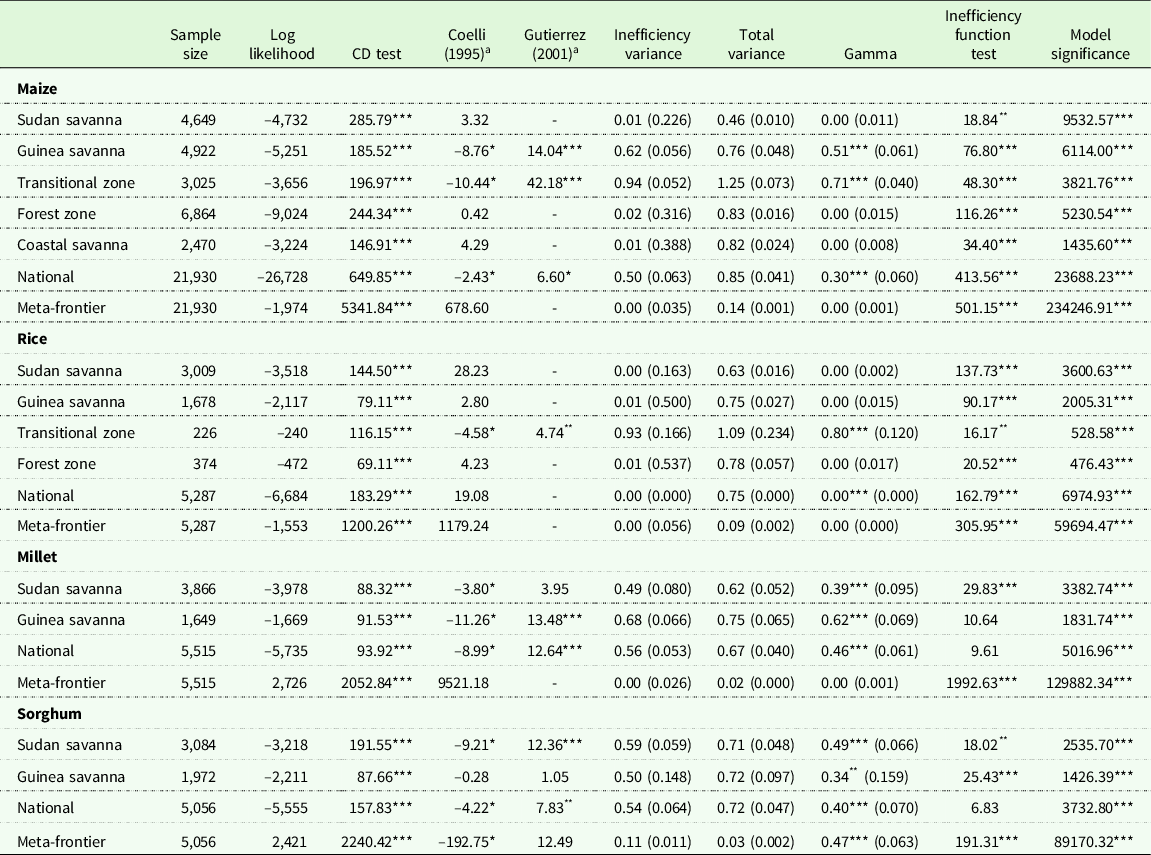
The test statistics which justify modeling cereal production via the MSF approach are shown in Table 2. First, the Cobb–Douglas functional form of the production function is tested by imposing restrictions on the Translog functional form, that is, all squared, and cross-product terms of the input variables are zero. The Cobb–Douglas restriction is rejected across all the models, implying that the Translog functional form is appropriate for the data. Furthermore, central to the stochastic frontier analysis (SFA) is the one-sided error specification, which represents technical inefficiency. Several statistical tests are recommended to justify the use of the SFA. If the null hypothesis of no one-sided error fails, the model can simply be estimated using the ordinary least squares (OLSs). In this study, we performed two tests, that is, the skewness test of the residuals resulting from an OLS estimation by Coelli (Reference Coelli1995) and the one-sided generalized likelihood-ratio test of Gutierrez, Carter, and Drukker (Reference Gutierrez, Carter and Drukker2001), and these results are presented in Table 2. Across the four kinds of cereals examined, the null hypothesis of no one-sided error is rejected for at least one agro-ecology-specific frontier, indicating that the stochastic frontier estimation is appropriate for this study. Table 2 also indicates that the proportion of variation in cereal production due to technical inefficiency ranges from 0–71%, 0–79%, 39–46%, and 34–49% for maize, rice, millet, and sorghum production, respectively. The null hypothesis, ${H_o}:\alpha = 0$
, which is also rejected, provides further statistical justification for the heteroskedastic technical inefficiency function. Furthermore, the chi-squared test statistic of the stochastic frontier model indicates that all the estimated models are statistically significant (p < 0.01).
${H_o}:\alpha = 0$
, which is also rejected, provides further statistical justification for the heteroskedastic technical inefficiency function. Furthermore, the chi-squared test statistic of the stochastic frontier model indicates that all the estimated models are statistically significant (p < 0.01).
Hypothesis tests for ecology- and meta-frontier models for cereal production in Ghana (1987–2017)
Significance levels:
* p < 0.10,
** p < 0.05,
*** p < 0.01.
a Null hypothesis of no one-sided error (i.e., no inefficiency) was tested.
Data sources: Ghana Living Standards Survey (waves 1–7), Ghana Socioeconomic Panel Survey (waves 1–2), and Africa RISING Ghana Baseline Evaluation Survey (2013–2014).
Parameter estimates of the stochastic production frontier
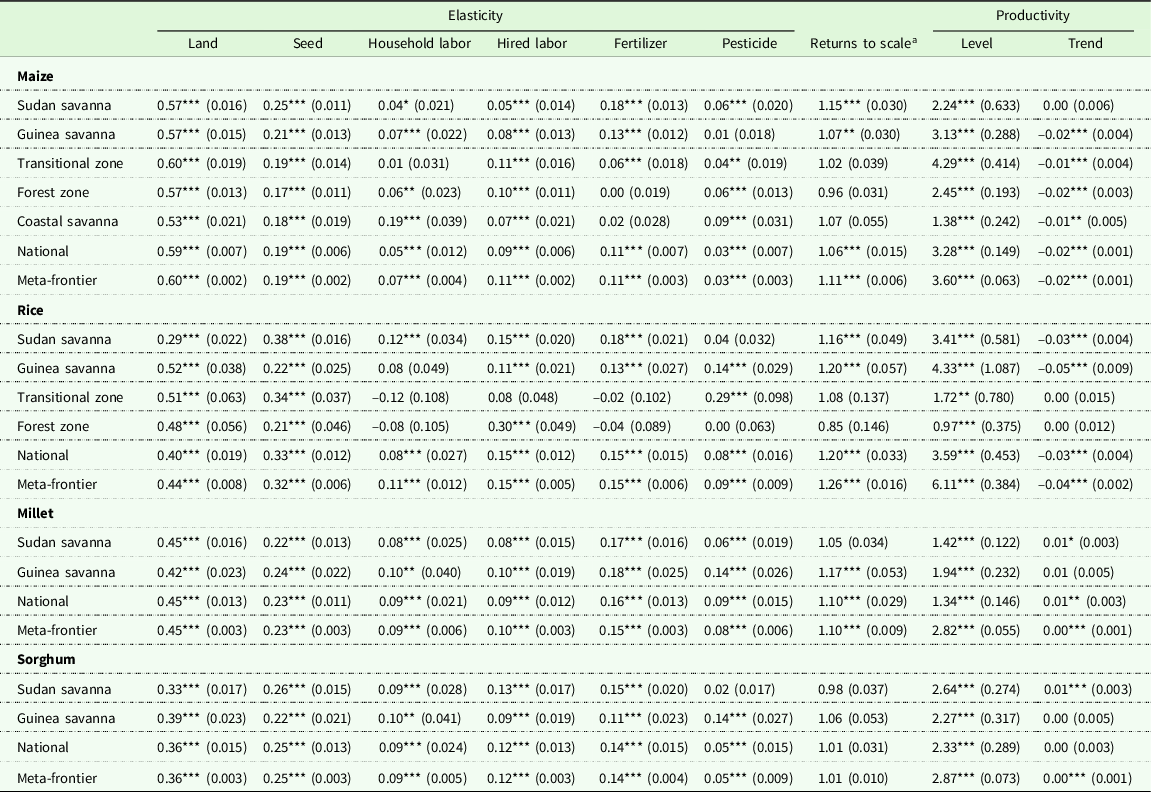
The production input elasticities displayed in Table 3 reveal that all the farm inputs used for maize production across all agro-ecologies have the expected signs, with land exerting the highest influence on output in all the agro-ecologies, followed by seed. Land exerts its largest effect on maize output in the Transitional zone and its least effect in the Coastal Savanna zone. The highest and lowest effects of seed are recorded in the Sudan Savanna and the Forest zones. Household labor is highest in the Coastal Savanna but least in the Sudan Savanna zone. Similar input use was observed for hired labor in the Transitional and Sudan Savanna zones, for fertilizer in the Sudan Savanna and Transitional zones, and for pesticide in the Coastal Savanna and Transitional zones. Except for household labor in the Transitional zone, fertilizer application in the Forest and Coastal Savanna zones, and pesticide use in the Guinea Savanna zone, whose effects are statistically insignificant, all the other inputs significantly contribute to maize production in Ghana. The results also show that maize production is characterized by constant returns to scale (CRS) in the Transitional, Forest, and Coastal Savanna zones. This implies that a proportionate increase in all factor inputs could lead to a proportionate increase in total maize output. On the contrary, maize production in the Sudan and Guinea Savanna zones exhibits increasing returns to scale (IRS), indicating that there is scope for maize farms in these two agro-ecologies to benefit from economies of scale through the expansion of their current production operations.
Elasticities for ecology- and meta-frontier models for cereal production in Ghana (1987–2017)
Significance levels:
* p < 0.10,
** p < 0.05,
*** p < 0.01.
a Null hypothesis of constant returns to scale was tested.
Data sources: Ghana Living Standards Survey (waves 1–7), Ghana Socioeconomic Panel Survey (waves 1–2), and Africa RISING Ghana Baseline Evaluation Survey (2013–2014).
Table 3 further shows that apart from household labor and fertilizer, which are negative in the Transitional and Forest zones, and pesticide use in the Forest zone, all the other factor inputs exert positive effects on rice production in all the agro-ecologies. Analogous to maize production, land had the highest impact on rice output in almost all the agro-ecologies, followed by seed. This finding agrees with Donkor, Matthews, and Ogundeji (Reference Donkor, Matthews and Ogundeji2018), who find that land and seed exert the highest impacts on rice output in Ghana. The highest and lowest effects of land are recorded in the Guinea Savanna and Sudan Savanna zones; seed in the Sudan Savanna and Forest zones; hired labor in the Forest and Guinea Savanna zones; fertilizer application in the Sudan Savanna and Guinea Savanna zones; and pesticide use in the Transitional and Guinea Savanna zones, respectively. Household labor had the highest impact on rice output in the Sudan Savanna zone. Except for the Transitional and Forest zones where rice production exhibits CRS, farm operations in the other agro-ecologies demonstrate IRS.
As shown in Table 3, all input elasticities demonstrate a significant positive effect on millet output with land exerting the largest influence, followed by seed and fertilizer in the two agro-ecologies. The highest and lowest effects of land are observed in the Sudan Savanna and Guinea Savanna zones, and that of seed, household labor, hired labor, fertilizer, and pesticide in the Guinea Savanna and Sudan Savanna zones. The results further show that millet farms exhibit CRS and IRS in the Sudan Savanna and Guinea Savanna zones, respectively.
Also, almost all the factor inputs are significant and contribute positively to sorghum production in the Sudan Savanna and Guinea Savanna zones, with land contributing the most, followed by seed and fertilizer (see Table 3). The largest and lowest effects of land and household labor are found in the Guinea Savanna and Sudan Savanna zones. That of seed, hired labor, and fertilizer are found in the Sudan Savanna and Guinea Savanna zones. Pesticide had its highest effect on sorghum output in the Guinea Savanna zone. Furthermore, sorghum production operations in both zones are found to exhibit CRS.
Table 3 indicates that at best, cereal production has not increased between 1987 and 2017, and at worst, it has decreased by about 1–5% annually over the same period depending on the type of cereal and agro-ecology. These dynamics in the annual changes of the marginal contribution of each production input as displayed in Figure 1 may likely be driving the decreasing trends in output. It is worth noting that except for sorghum production, where the marginal effect of land on output has been dwindling since 1987, that of maize, rice, and millet have generally been increasing over the same period. Also, this marginal contribution is either constant or declining for seed, hired, and household labors. A general increase is observed for fertilizer, except for rice, and for pesticide, a general increase is observed across all cereals.
Temporal dynamics of cereal production elasticities in Ghana (1987–2017). Note: Farmer-level elasticities were first estimated via a meta-stochastic frontier (MSF) analysis applied separately to 10 population-based surveys that represent 30 years of farmer-level data collection in Ghana. The surveys used included the Ghana Living Standards Survey (waves 1–7), Ghana Socioeconomic Panel Survey (waves 1–2), and Africa RISING Ghana Baseline Evaluation Survey (2013–2014). The farmer-level elasticities were subsequently averaged across seasons via a regression framework to account for controls. Each point on a subpanel represents the mean of the estimates. Given the seasonal means, the fitted line was done locally using neighborhood points, weighted by distance. The size of the neighborhood was set to 75% of the points with a tri-cubic weighting. The gray region is the 95% confidence interval of the fitted line.

Distribution of TE and TGR scores
The TE, TGR, and MTE scores are summarized in Figure 2. Mean TE estimates for maize farms in Ghana range from 0.57 in the Transitional zone to 0.86 in the Sudan Savanna zone. This implies that, given the current state of farm technology and resource endowments for each zone, there is scope for maize production in each agro-ecology to be increased by the range of 14% in the Sudan Savanna zone to 43% in the Transitional zone. Total farm output could be scaled up in each agro-ecology by performing existing farm operations more efficiently (Jayne and Sanchez Reference Jayne and Sanchez2021). These estimates are comparable to those reported by Etienne, Ferrara, and Mugabe (Reference Etienne, Ferrara and Mugabe2019), for maize farms in Zimbabwe but higher than that of Ng’ombe (Reference Ng’ombe2017) in Zambia.
Spatial dynamics in cereal production technology level and technical efficiency in Ghana (1987–2017). Note: Sudan Savanna = SSEZ; Guinea Savanna = GSEZ; Transitional = TZEZ; Forest = FZEZ; Coastal Savanna = CSEZ.
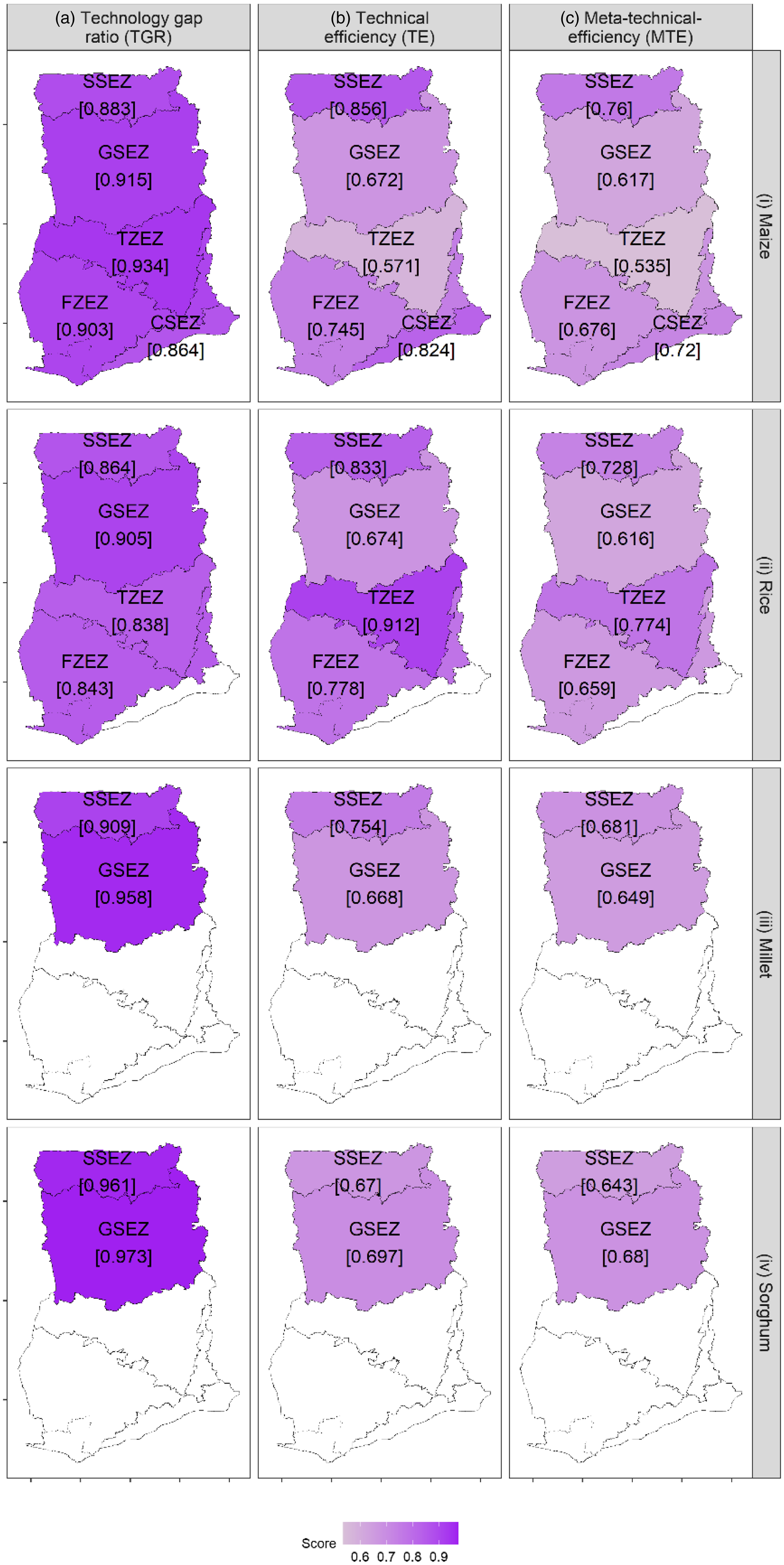
The estimated mean TGR was highest in the Transitional zone (0.93), followed by the Guinea Savanna (0.92), Forest (0.90), Sudan Savanna (0.88), and the Coastal Savanna (0.86) zones. These scores imply that on average, the total output of maize in Ghana is below the sectoral output defined by the meta-frontier. The empirical evidence also suggests that, although farms in the Transitional zone are the closest to the meta-frontier, their production technology lags behind the sectoral one by 7%. Thus, achieving the sectoral output for maize in Ghana will require narrowing these existing technology-induced gaps, which range from 7% in the Transitional zone to 14% in the Coastal Savanna zone. These findings are consistent with those reported by Asante et al. (Reference Asante, Temoso, Addai and Villano2019), for maize farms in Ghana but higher than those of Geffersa, Agbola, and Mahmood (Reference Geffersa, Agbola and Mahmood2022), for Ethiopian maize farms. Albeit farms in the Transitional zone, which is the region with the highest maize output in Ghana (MoFA 2019), are the closest to the meta-frontier, their output performance relative to their group frontier is low. Additionally, although maize farms in the Sudan Savanna and Coastal Savanna zones perform relatively well with respect to their agro-ecology-specific frontiers, their production technology seems to lag behind that of the other zones and the meta-frontier.
The results also indicate that the most technically efficient maize farms in Ghana are those in the Sudan Savanna zone with a mean MTE score of 0.76, followed by those in the Coastal Savanna (0.72), Forest (0.68), Guinea Savanna (0.62), and Transitional (0.54) zones. Farms in the Transitional zone are the least efficient in maize production due to the inefficient use of the superior farm technologies at their disposal. The results also reveal consistent improvements in maize production technology and farm-level TE between 1987 and 2017 (see Figure 3(i)).
Temporal dynamics in cereal production technology level and technical efficiency in Ghana (1987–2017). Note: Farmer-level scores were first estimated via a meta-stochastic frontier (MSF) analysis applied separately to 10 population-based surveys that represent 30 years of farmer-level data collection in Ghana. The surveys used included the Ghana Living Standards Survey (waves 1–7), Ghana Socioeconomic Panel Survey (waves 1–2), and Africa RISING Ghana Baseline Evaluation Survey (2013–2014). The farmer-level elasticities were subsequently averaged across seasons via a regression framework to account for controls. Each point on a subpanel represents the mean of the estimates. Given the seasonal means, the fitted line was done locally using neighborhood points, weighted by distance. The size of the neighborhood was set to 75% of the points with a tri-cubic weighting. The gray region is the 95% confidence interval of the fitted line.

As shown in Figure 2(ii), the TE scores for rice farms in Ghana range from 0.67 in the Guinea Savanna zone to 0.91 in the Transitional zone, indicating that relative to their agro-ecology-specific frontiers, none of the sampled agro-ecologies have attained its technically feasible frontier output for rice production. Thus, with the available technology and resources, varying levels of output growth are required for rice farms in each agro-ecology to operate on their group frontier. This could be achieved by strengthening the capacities of farm managers in each zone to use the available resources and farm technology more optimally. These estimates are higher than those obtained by Njikam and Alhadji (Reference Njikam and Alhadji2017), for rice farms in different agro-ecological zones of Cameroon. Contrasting farm performance across agro-ecologies reveals that the estimated mean TGR score for rice farms is highest in the Guinea Savanna zone (0.91), followed by the Sudan Savanna (0.86), Forest (0.84), and Transitional (0.84) zones. This suggests that whilst farms in the Guinea Savanna zone are circa 7% more productive than their counterparts in the Forest and Transitional zones, rice farms across all agro-ecologies produce with technology sets that are inferior to the meta-frontier. These estimates are close to what has been reported on rice farms in Ghana by Asravor et al. (Reference Asravor, Wiredu, Siddig and Onumah2019), and Owusu, et al. (Reference Owusu, Donkor and Owusu-Sekyere2018). Furthermore, the most technically efficient rice farms are observed in the Transitional zone with a mean MTE estimate of 0.77, followed by the Sudan Savanna (0.73), Forest (0.67), and the Guinea Savanna (0.62) zones. These estimates imply that rice farms in the various zones operate under heterogeneous technology sets and at different levels of TE, with those in the Transitional zone being the most efficient in their production operations. As displayed in Figure 3(ii), rice production appears to have witnessed a steady increase in both production technology and farm-level efficiency since 1987.
Figure 2(iii) reveals that the TE of millet production in the Guinea Savanna zone is 0.67 and 0.75 in the Sudan Savanna zone. This result suggests that millet output in the two zones is beneath the technically efficient frontier output defined for each agro-ecology and thus, possibilities for output expansion exist for each agro-ecology through the efficient deployment of resources and technology. The TGR estimates are 0.91 and 0.96 for the Sudan Savanna and Guinea Savanna zones, respectively. This shows that the production technology of millet farms in both agro-ecologies is quite close to the best-practice sectoral technology; thus, farms in both agro-ecologies could produce over 90% of the sectoral output defined by the meta-frontier. The average MTE estimates of 0.65 and 0.68 for the Guinea Savanna and Sudan Savanna zones, respectively, support the conclusion that millet is produced more efficiently in the Sudan Savanna zone than in the Guinea Savanna zone. Also, Figure 3(iii) indicates that whilst millet production technology has advanced between 1987 and 2017, the efficiency of millet production has rather declined over the period.
Figure 2(iv) shows that the farm-level TE of sorghum production is 0.70 and 0.67 for the Guinea Savanna and Sudan Savanna zones, respectively. This result implies that sorghum output in both agro-ecologies is below the technically feasible frontier set for each zone. Consequently, there is the need for producers to either improve upon their current level of output using existing inputs or cut back on the current use of farm inputs whilst maintaining the existing level of output. These estimates are consistent with those reported by Miriti et al. (Reference Miriti, Otieno, Chimoita, Bikketi, Njuguna and Ojiewo2021), for sorghum farms in Uganda. Comparing farm performance across the two agro-ecologies reveals TGR estimates of 0.97 for the Guinea Savanna and 0.96 for the Sudan Savanna zones. These findings suggest that whilst sorghum farms in the two zones could produce more than 95% of the feasible sectoral output using their respective production technologies, farms in the Guinea Savanna zone are more productive than their counterparts in the Sudan Savanna zone. With mean MTE scores of 0.68 and 0.64 for the Guinea Savanna and Sudan Savanna zones, respectively, we find substantial evidence to conclude that sorghum farms in the Guinea Savanna zone are not only more productive but are also technically more efficient than their peers in the Sudan Savanna zone. Following Figure 3(iv), we observed growth in the development of sorghum production technology in Ghana and marginal gains in sorghum production efficiency since 1987.
Drivers of technical inefficiency
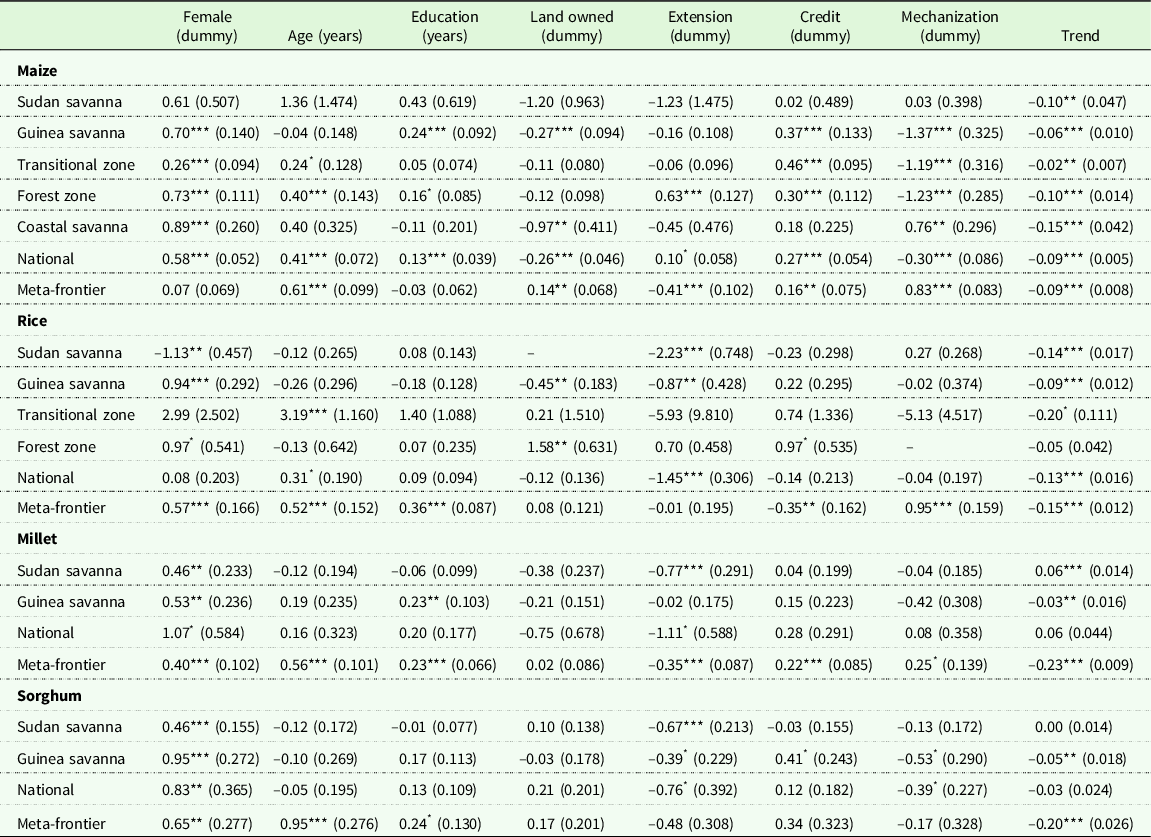
Apart from rice production in the Sudan Savanna zone where females appear to be more efficient than males, Table 4 shows that across all agro-ecologies and cereals, males are more efficient in cereal production than their female counterparts. This may be attributed to the fact that male farmers are highly likely to have access to more farm resources and may be able to participate in relevant training programs compared to their female counterparts. This finding contradicts that of Owusu, Donkor, and Owusu-Sekyere (Reference Owusu, Donkor and Owusu-Sekyere2018). In general, aged farmers operate less efficiently relative to the youngsters as asserted by Villano, Asante, and Bravo-Ureta (Reference Villano, Asante and Bravo-Ureta2019) and Wouterse (Reference Wouterse2010). As espoused by Bravo-Ureta and Pinheiro (Reference Bravo-Ureta and Pinheiro1997), aged farmers may not have the physical stamina to seek support from extension agents and thus, may be less motivated to adopt new technologies and production practices. In contrast to the findings of Bachewe, Koru, and Taffesse (Reference Bachewe, Koru and Taffesse2015), educated farmers appear to be less efficient compared to their uneducated counterparts. It is possible that higher educational attainment may tend to increase a farmer’s likelihood of engaging in off-farm income-earning activities and hence, less time to undertake essential production operations such as the uptake of new production practices.
Drivers of technical inefficiency and ecological technology gaps for cereal production in Ghana (1987–2017)
Significance levels:
* p < 0.10,
** p < 0.05,
*** p < 0.01.
Data sources: Ghana Living Standards Survey (waves 1–7), Ghana Socioeconomic Panel Survey (waves 1–2), and Africa RISING Ghana Baseline Evaluation Survey (2013–2014).
Except for rice cultivation in the Transitional zone where secure landowners tend to operate with less efficiency, land ownership largely decreases the inefficiency of cereal production. This may be particularly so because secure landowners are highly likely to invest in long-term productivity-augmenting measures (Koirala, Mishra, and Mohanty Reference Koirala, Mishra and Mohanty2016; Villano, Asante, and Bravo-Ureta Reference Villano, Asante and Bravo-Ureta2019). Consistent with Tsiboe, Asravor, and Osei (Reference Tsiboe, Asravor and Osei2019), access to extension services improves cereal production efficiency across almost all the agro-ecologies and cereal crops except maize production in the Forest zone, where extension access tends to reduce production efficiency. Extension service delivery normally equips farm households with the requisite information on modern production techniques and improved inputs. Contrary to Jimi et al. (Reference Jimi, Nikolov, Malek and Kumbhakar2019) and Martey et al. (Reference Martey, Wiredu, Etwire and Kuwornu2019), enhancing farmers’ access to credit extensively lessens their efficiency of cereal production. This finding may be attributed to a possible use of the credit for other household expenses apart from farming. Aside from maize farms in the Coastal Savanna zone which are less efficient, mechanized cereal farms are generally more efficient than those that are not mechanized, a result that is coherent with Vortia et al. (Reference Vortia, Nasrin, Bipasha and Islam2021).
Discussion
The findings from this study indicate that almost all the estimated factor inputs substantially contribute to cereal output with land and seed exerting the largest effects across all crops and agro-ecological zones. This implies that all these inputs, especially, land and seed, are very relevant productivity-enhancing inputs for cereal farms in Ghana and hence, the need to ensure that such inputs are readily available and accessible to farmers. This result agrees with the study by Bachewe, Koru, and Taffesse (Reference Bachewe, Koru and Taffesse2015), who reported land, seed, fertilizer, and labor as significant factor inputs for cereal productivity gains in Ethiopia. Further evidence on the productivity potential of cereal farms across the various zones indicates that cereal farms are characterized by either CRS or IRS. This implies that current cereal output levels across the various zones could either double or more than double if all factor inputs are doubled, and thus, there is scope for these farms to benefit from economies of scale.
Across all cereals and agro-ecologies, farms operate at efficiency scales that are beneath the technically feasible frontier defined for each zone. This finding reveals the agro-ecology-specific output gains that could be obtained through a better and more efficient use of currently deployed farm resources. Such output gains range from 14 to 43% for maize, 9 to 33% for rice, 25 to 33% for millet, and 30 to 33% for sorghum across the various zones. These existing gaps in farm-level TE further reflect the heterogeneity in farm management practices implemented by the smallholder farmers, and consequently, the need for improved knowledge on essential agronomic practices such as the timely application of agro-inputs following approved guidelines and the appropriate management of crop pests and diseases. Similar estimates have been reported by Khanal et al. (Reference Khanal, Wilson, Shankar, Hoang and Lee2018), and Njikam and Alhadji (Reference Njikam and Alhadji2017), across different agro-ecological zones of Cameroon and Nepal, respectively, and relatively higher and lower output gains recorded for cereal farms in Ethiopia (Bachewe, Koru, and Taffesse Reference Bachewe, Koru and Taffesse2015) and Europe (Čechura et al. Reference Čechura, Hockmann, Malý and Žáková Kroupová2015), respectively. Furthermore, the results indicate that the cultivation of maize and rice has consistently seen improvements in production efficiency since 1987, perhaps due to the extensive policy attention these two crops have received over the years as food security crops in Ghana (MoFA 2017; 2018). Conversely, the cultivation of millet and sorghum has witnessed a steady marginal decline and gain in TE, respectively, since 1987, possibly due to the limited policy attention to these crops in Ghana over the years compared to maize and rice.
In evaluating the competitiveness of cereal production technology in each agro-ecology in relation to the sectoral technology, we observe average technology scores of 0.90 (maize), 0.86 (rice), 0.93 (millet), and 0.97 (sorghum). These estimates suggest that maize, rice, millet, and sorghum farms across the various agro-ecologies generate on average 90%, 86%, 93%, and 97% of their potential sectoral outputs respectively, using their existing technology sets. Whereas these results demonstrate that the output defined by the meta-frontier is superior to those generated by cereal farms in all agro-ecologies, our evidence suggests that improvements in the existing technologies could offer cereal farms the opportunity to expand total output by 10% (maize), 14% (rice), 7% (millet), and 3% (sorghum). The relatively large technology gaps recorded for rice and maize farms in Ghana despite extensive policy support for these crops (MoFA 2017; 2018) could be attributed to the disproportionate distribution of new production technologies and improved farming practices for these crops throughout the country. Unlike millet and sorghum which are cultivated in just two adjoining agro-ecological zones, rice and maize are cultivated in almost all the agro-ecological zones of the country (FAO 2005); hence, it may be challenging to reach every farmer with new technologies and improved farming practices. This may result in high technology gaps for these crops in certain parts of the country. To reverse these existing gaps in technological endowment among farm families would require the redistribution of improved farming practices and technologies from the best-performing agro-ecologies to the lagging ones. This could be achieved through improved extension service and communication delivery, and the creation of conducive platforms for the exchange of technical knowledge through peer-to-peer learning. The reported estimates for this study are higher than those obtained by Latruffe, Fogarasi, and Desjeux (Reference Latruffe, Fogarasi and Desjeux2012), for cereal farms in Hungary and France, and those reported by Khanal et al. (Reference Khanal, Wilson, Shankar, Hoang and Lee2018), for Nepalese agro-ecological zones. Furthermore, we observe steady progress in the advancement of the production technology of all cereals over the years.
Conclusions
This study has assessed the available opportunities for improving the performance of cereal farms in Ghana by comparing the production technology and farm-level efficiency of four cereal crops across diverse agro-ecological zones, using a nationally representative data set from 26,449 farms and the MSF approach. The empirical results reveal that whilst all the estimated factor inputs largely contribute to cereal output, land and seed exerted the highest impacts across all agro-ecologies. We also find evidence to suggest that the current scale of cereal production operations in almost all the agro-ecologies is below optimum, and thus, farm households could benefit from economies of scale by expanding their existing production operations.
The mean TE estimates strongly suggest that the existing technology sets and farm resources at the disposal of each agro-ecology are being deployed suboptimally across all crops due to differences in the management skills of the farmers, and that, none of the agro-ecology-specific frontiers are fully efficient. Considerable opportunities, therefore, exist for cereal farms in all agro-ecologies to expand total farm output through improvements in the efficiency of farm production. Given the production potential for each agro-ecology, varying levels of output growth are required for cereal farms to be efficient. This could be achieved by updating the managerial skills of farm households on existing technologies through effective and regular training programs and the promotion of peer-to-peer learning among the smallholder farmers across the various zones.
By comparing farm performance across agro-ecologies, the evidence shows that whilst the most and least productive maize farms in Ghana are found in the Transitional and Coastal Savanna zones, respectively, farms in the Transitional zone only generate 7% more output than those in the Coastal Savanna zone. Also, maize is produced more efficiently in the Sudan Savanna, Coastal Savanna, Forest, Guinea Savanna, and Transitional zones. For rice production, the most productive farms appear to have achieved 7% more output than their least productive counterparts, with farms in the Guinea Savanna zone and, Forest and Transitional zones being the most and least productive, respectively. Besides, the estimated MTE provides evidence to support the conclusion that rice production operations in the Transitional zone are more efficient than that of the other zones.
Further evidence reveals that the best-performing millet farms are in the Guinea Savanna zone and are about 5% more productive than their counterparts. Although millet output in the two agro-ecologies is close to the sectoral output specified by the meta-frontier, an average productivity gap of 7% may have to be bridged for millet farms to attain the sectoral output for Ghana. Moreover, the MTE estimates imply that millet is cultivated more efficiently in the Sudan Savanna zone than in the Guinea Savanna zone. For sorghum production, the findings indicate that the most productive farms appear to achieve about 1% more output than their least productive counterparts, with farms in the Guinea Savanna zone being the most productive. Also, the MTE estimates lend credence to the inference that sorghum production in the Guinea Savanna zone is characterized by less inefficiency than in the Sudan Savanna zone.
To conclude, we observe agro-ecological productivity gaps and heterogeneities in cereal production across the various zones in Ghana. Whereas these gaps are generally more pronounced for rice (14%) and maize (10%), they are relatively modest for millet (7%) and sorghum (3%). These heterogeneities in farm technology and productivity levels could be ascribed to the disparities in the institutional, socioeconomic, and ecological conditions of the various agro-ecologies. Also, the current level of cereal output in all agro-ecologies is relatively inferior to the sectoral output defined for each crop by the meta-frontier. Consequently, opportunities exist for cereal output gains through improvements in the overall production technology of each cereal crop, in addition to the enhancement in the managerial prowess of farm households across the various zones. Generally, poor managerial practices contribute significantly to the existing productivity gaps on cereal farms in almost all agro-ecological zones than technology gaps.
Supplementary material
To view supplementary material for this article, please visit https://doi.org/10.1017/age.2022.16
Data availability statement
Replication materials are available in GitHub at https://github.com/ftsiboe/Agricultural-Productivity-in-Ghana
Acknowledgements
The authors gratefully acknowledge the Ghana Statistical Service, Institute of Statistical Social and Economic Research (ISSER), Economic Growth Center, and the International Food Policy Research Institute (IFPRI) for making the data set available for the study. This research was supported in part by the U.S. Department of Agriculture, Economic Research Service and the University of Hohenheim, Germany. The findings and conclusions in this publication are those of the authors and should not be construed to represent any official USDA of U.S. Government determination or policy.
Author contributions
Francis Tsiboe partly conceptualized the study, sourced, processed, and analyzed the data, and partly wrote the abstract, introduction, methods, results, and discussion sections. Jacob Asravor partly conceptualized the study, and partly wrote the abstract, introduction, methods, results, and discussion sections. Victor Owusu and Akwesi Mensah-Bonsu reviewed & editied the paper. All authors reviewed and approved the final version of the manuscript for publication.
Funding statement
This research received no specific grant from any funding agency, commercial or not-for-profit sectors.
Competing interests
The authors declare that they have no competing interests.
Ethical standards
This study does not contain result involving human participants performed by any of the authors.


 Open access

