





1. Introduction
Over the last few decades ‘feedback’ processes between the central black hole and host galaxy have become part of the accepted paradigm for galaxy evolution. Numerical simulations were initially found to over-produce the number of massive galaxies (Bower et al. Reference Bower2006; Croton et al. Reference Croton2006) until a mechanism was introduced to cool gas and prevent excessive star formation at the high mass end of the galaxy stellar mass function. This mechanism was proposed to be energy injected into the circum-galactic medium (CGM) and intracluster medium by jets from the central black hole (although feedback may occur through means other than radio jets). Now there are numerous observations which support the idea that radio jets produced by active galactic nucleus (AGN) provide one of the main forms of mechanical feedback. This negative ‘feedback’ occurs on both large scales (e.g. radio jets creating cavitites in cluster X-ray halos; Gitti, Brighenti, & McNamara Reference Gitti, Brighenti and McNamara2011) and small scales (e.g. as demonstrated by the alignment of extended emission lines with jets in compact steep spectrum (CSS) radio sources, de Vries et al. Reference de Vries1997; Axon et al. Reference Axon2000). Indeed, the compact radio-loud QSO 3C48 at $z=0.369$
is the archetypal CSS source presenting alignment between the optical and compact (
$z=0.369$
is the archetypal CSS source presenting alignment between the optical and compact ( $ \lt $
5 kpc) radio emission (Stockton et al. Reference Stockton, Canalizo, Fu and Keel2007; An et al. 2010).
$ \lt $
5 kpc) radio emission (Stockton et al. Reference Stockton, Canalizo, Fu and Keel2007; An et al. 2010).
The population of compact radio galaxies known as giga-Hertz peaked spectrum (GPS) and CSS sources (Peacock & Wall Reference Peacock and Wall1982) are prime candidates for jet feedback within the interstellar medium (ISM) of the host galaxy (O’Dea & Saikia Reference O’Dea and Saikia2021). GPS sources are characterised as having radio spectra peaking between 1–5 GHz in the observer’s frame (Gopal-Krishna, et al. Reference Gopal-Krishna1983) and tend to have sizes $\lt 500\,$
pc, but the broader class of peaked radio sources can have a peak outside typical observing frequencies depending on their redshift and age. CSS sources are compact radio sources that have steep spectra (
$\lt 500\,$
pc, but the broader class of peaked radio sources can have a peak outside typical observing frequencies depending on their redshift and age. CSS sources are compact radio sources that have steep spectra ( $\alpha \lt -0.5$
, where the flux density
$\alpha \lt -0.5$
, where the flux density $S_\nu\propto\nu^\alpha$
and
$S_\nu\propto\nu^\alpha$
and $\nu=$
frequency) over the entire observed frequency range, and are observed to be slightly larger than GPS sources, 0.5–20 kpc. As the rest-frame peak frequency of GPS sources decreases with increasing source size (O’Dea & Baum Reference O’Dea and Baum1997) the natural inference is that CSS sources are older or higher-redshift sources where the peak frequency has been shifted below the range of current observations. Indeed, radio sources with measurable peaks below
$\nu=$
frequency) over the entire observed frequency range, and are observed to be slightly larger than GPS sources, 0.5–20 kpc. As the rest-frame peak frequency of GPS sources decreases with increasing source size (O’Dea & Baum Reference O’Dea and Baum1997) the natural inference is that CSS sources are older or higher-redshift sources where the peak frequency has been shifted below the range of current observations. Indeed, radio sources with measurable peaks below $400\,$
MHz have been referred to as mega-Hertz peaked spectrum (MPS) sources (e.g. Callingham et al. Reference Callingham2017; Ross et al. Reference Ross2022) and show evidence for a redshift distribution up to, and possibly beyond,
$400\,$
MHz have been referred to as mega-Hertz peaked spectrum (MPS) sources (e.g. Callingham et al. Reference Callingham2017; Ross et al. Reference Ross2022) and show evidence for a redshift distribution up to, and possibly beyond, $z\approx 2.4$
(Coppejans et al. Reference Coppejans, Cseh, Williams, van Velzen and Falcke2015).
$z\approx 2.4$
(Coppejans et al. Reference Coppejans, Cseh, Williams, van Velzen and Falcke2015).
Evidence that GPS/CSS sources are involved in feedback include (a) the kinematics of the jet-aligned extended emission lines, (b) the asymmetry of radio morphology suggesting interaction with dense clouds in the ISM (e.g. Saikia et al. Reference Saikia, Jeyakumar, Wiita, Sanghera and Spencer1995), and (c) observations of hot gas from X-ray observations which is also shocked and aligned with the jet (e.g. Massaro et al. Reference Massaro2009). A common feature of extended, powerful radio galaxies at low-redshift is the presence of extended emission line regions (EELRs) on scales of 11–45 kpc (Fu & Stockton Reference Fu and Stockton2009a). While they are often seen with velocities of 500–1100 km s $^{-1}$
, with indications that they are photoionised by the AGN, they do not show any alignment with the radio jet (Fu & Stockton Reference Fu and Stockton2009b). This result is in contrast to CSS sources which have direct evidence that they are caused by shocks (Fu & Stockton Reference Fu and Stockton2006). The inference is that there is evolution from aligned EELRS in more compact (
$^{-1}$
, with indications that they are photoionised by the AGN, they do not show any alignment with the radio jet (Fu & Stockton Reference Fu and Stockton2009b). This result is in contrast to CSS sources which have direct evidence that they are caused by shocks (Fu & Stockton Reference Fu and Stockton2006). The inference is that there is evolution from aligned EELRS in more compact ( $\lesssim 10\,$
kpc) radio sources due to shocks to a more disorderly alignment in more extended radio sources due to photoionisation (Shih, Stockton, & Kewley Reference Shih, Stockton and Kewley2013).
$\lesssim 10\,$
kpc) radio sources due to shocks to a more disorderly alignment in more extended radio sources due to photoionisation (Shih, Stockton, & Kewley Reference Shih, Stockton and Kewley2013).
Studying radio galaxies at higher redshift provides a window into many galaxy evolution processes, e.g. the co-evolution of the galaxies with their central black hole (e.g. Drouart et al. Reference Drouart2016), their proto-cluster environments (e.g. Wylezalek et al. Reference Wylezalek2013) and the interaction of the jets with the dense ISM, improving our knowledge of physics under extreme conditions (e.g. Ighina et al. Reference Ighina2022). In fact, high-redshift radio galaxies often show intriguing alignments between the radio source and large-scale gaseous and stellar structures in the host galaxy and surrounding environment, such as those seen in rest-frame ultra-violet (UV) light (Pentericci et al. Reference Pentericci1999), submillimeter emission (Stevens et al. Reference Stevens2003), and cold molecular gas (Klamer et al. Reference Klamer, Ekers, Sadler and Hunstead2004; Emonts et al. Reference Emonts2023). While a possible explanation is that these alignments are caused by positive AGN feedback in the form of gas cooling and triggered star formation (e.g., Gullberg et al. Reference Gullberg2016; Nesvadba et al. Reference Nesvadba, Bicknell, Mukherjee and Wagner2020), kinematically perturbed and shocked gas is often seen in the ionised gas along the extent of the radio jet (e.g., Villar-Martín et al. Reference Villar-Martín2003), and negative feedback has been implied from observations of jet-induced outflows (e.g., Nesvadba et al. Reference Nesvadba2017).
Understanding AGN feedback mechanisms in these epochs is critical to unravelling how these processes shaped galaxy evolution. From a sample of 3CR galaxies at $z\approx 1$
, Best et al. (Reference Best, Röttgering and Longair2000) demonstrated that smaller radio galaxies (
$z\approx 1$
, Best et al. (Reference Best, Röttgering and Longair2000) demonstrated that smaller radio galaxies ( $\leq$
120 kpc) were more likely to have larger EELRS which are powered by shocks and have have kinematic velocities
$\leq$
120 kpc) were more likely to have larger EELRS which are powered by shocks and have have kinematic velocities $ \gt $
1000 km s
$ \gt $
1000 km s $^{-1}$
. The larger radio galaxies in this sample have EELRS powered by photoionisation instead. The same trend of high velocity, shock ionisation of EELRS in compact,
$^{-1}$
. The larger radio galaxies in this sample have EELRS powered by photoionisation instead. The same trend of high velocity, shock ionisation of EELRS in compact, $ \lt $
120 kpc, radio galaxies was also seen by De Breuck et al. (Reference De Breuck2000) in a sample of powerful radio galaxies across
$ \lt $
120 kpc, radio galaxies was also seen by De Breuck et al. (Reference De Breuck2000) in a sample of powerful radio galaxies across $0 \lt z \lt 5.2$
. GPS and CSS sources are therefore the most extreme of these powerful radio sources consistent with the idea that the photoioinisation of their EELRS is caused by jet-induced shocks.
$0 \lt z \lt 5.2$
. GPS and CSS sources are therefore the most extreme of these powerful radio sources consistent with the idea that the photoioinisation of their EELRS is caused by jet-induced shocks.
A new generation of low frequency radio surveys such as the Tata Institute of Fundamental Research (TIFR) Giant Metrewave Radio Telescope (GMRT; Swarup et al. Reference Swarup1991) Sky Survey (TGSS) Alternative Data Release 1 (Intema et al. Reference Intema, Jagannathan, Mooley and Frail2017), the LOw Frequency ARray (LOFAR; van Haarlem et al. Reference van Haarlem2013) Two-metre Sky Survey (LoTSS; Shimwell et al. Reference Shimwell2017) and the GaLactic and Extragalactic All-sky MurchisonWidefield Array (MWA; Tingay et al. Reference Tingay2013) survey (GLEAM; Wayth et al. Reference Wayth2015) has inspired several new searches for high redshift radio galaxies. While several searches rely on the classical ultra-steep spectrum (USS, $\alpha \lt -1.3$
) technique (e.g. Saxena et al. Reference Saxena2018; Gloudemans et al. Reference Gloudemans2022) the broad 72–231 MHz frequency coverage of the GLEAM survey allows the shape of the radio spectra to be used as a selection tool. Drouart et al. Reference Drouart(2020, herefter D20) used spectral curvature in the GLEAM band, non-detections in the VISTA Kilo-degree Infrared Galaxy (VIKING) survey (Edge et al. Reference Edge2013), and compact radio sizes at high-frequency as a selection method finding one out of four bright,
$\alpha \lt -1.3$
) technique (e.g. Saxena et al. Reference Saxena2018; Gloudemans et al. Reference Gloudemans2022) the broad 72–231 MHz frequency coverage of the GLEAM survey allows the shape of the radio spectra to be used as a selection tool. Drouart et al. Reference Drouart(2020, herefter D20) used spectral curvature in the GLEAM band, non-detections in the VISTA Kilo-degree Infrared Galaxy (VIKING) survey (Edge et al. Reference Edge2013), and compact radio sizes at high-frequency as a selection method finding one out of four bright, $S_\mathrm{ 151MHz} \gt 100\,$
mJy, radio galaxies lying at
$S_\mathrm{ 151MHz} \gt 100\,$
mJy, radio galaxies lying at $z=5.5$
.
$z=5.5$
.
The motivation for choosing sources with curvature at low frequency comes from empirical and theoretical modelling of the radio spectra of powerful radio galaxies at $z\approx 2-4$
(D20, Broderick et al. Reference Broderick2022). However, one can see how this method would select sources with peaked spectra within or below the GLEAM band (i.e. high redshift MPS or CSS sources) and follows the hypothesis that
$z\approx 2-4$
(D20, Broderick et al. Reference Broderick2022). However, one can see how this method would select sources with peaked spectra within or below the GLEAM band (i.e. high redshift MPS or CSS sources) and follows the hypothesis that $z \gt 7$
radio galaxies will present redshifted peaked spectra due to the denser environment within the ISM/CGM, more intense radiation from the cosmic microwave background as well as their age. From the handful of quasi-stellar objects (QSOs) detected in the radio at
$z \gt 7$
radio galaxies will present redshifted peaked spectra due to the denser environment within the ISM/CGM, more intense radiation from the cosmic microwave background as well as their age. From the handful of quasi-stellar objects (QSOs) detected in the radio at $z \gt 6$
, several show evidence for flattening of their radio spectra at lower frequencies (Bañados et al. Reference Bañados2021; Ighina et al. Reference Ighina2022; Endsley et al. Reference Endsley2022). D20 therefore confirmed that selecting sources with extreme radio to K-band flux density ratios,
$z \gt 6$
, several show evidence for flattening of their radio spectra at lower frequencies (Bañados et al. Reference Bañados2021; Ighina et al. Reference Ighina2022; Endsley et al. Reference Endsley2022). D20 therefore confirmed that selecting sources with extreme radio to K-band flux density ratios, $S_\mathrm{151MHz}/S_{2\mu\mathrm{m}} \gt 10^5$
, and faint K-band magnitudes is an effective selection technique to find
$S_\mathrm{151MHz}/S_{2\mu\mathrm{m}} \gt 10^5$
, and faint K-band magnitudes is an effective selection technique to find $z \gt 5$
radio galaxies (e.g. Broderick et al. Reference Broderick2024).
$z \gt 5$
radio galaxies (e.g. Broderick et al. Reference Broderick2024).
Another source from D20, GLEAM J091734 $-$
001243 (hereafter GLEAM J0917
$-$
001243 (hereafter GLEAM J0917 $-$
0012), was also thought to potentially be at high redshift. As well as being compact, GLEAM J0917
$-$
0012), was also thought to potentially be at high redshift. As well as being compact, GLEAM J0917 $-$
0012 has a faint K-band counterpart - both characteristics of very distant radio galaxies. However, follow-up millimetre (Drouart et al. Reference Drouart2021, hereafter D21) and near-infrared spectroscopy (Seymour et al. Reference Seymour2022, hereafter S22), failed to conclusively determine its redshift, necessitating the current study. Modelling in D21 demonstrated that the ALMA 100 GHz continuum was synchrotron dominated. In S22, Hubble Space Telescope (HST) Widefield Camera 3 (WFC3) grism observations detected one weak line at
$-$
0012 has a faint K-band counterpart - both characteristics of very distant radio galaxies. However, follow-up millimetre (Drouart et al. Reference Drouart2021, hereafter D21) and near-infrared spectroscopy (Seymour et al. Reference Seymour2022, hereafter S22), failed to conclusively determine its redshift, necessitating the current study. Modelling in D21 demonstrated that the ALMA 100 GHz continuum was synchrotron dominated. In S22, Hubble Space Telescope (HST) Widefield Camera 3 (WFC3) grism observations detected one weak line at $1.15\,\mu$
m and continuum detections of the host galaxy in the F098M and F105W bands. A nearby,
$1.15\,\mu$
m and continuum detections of the host galaxy in the F098M and F105W bands. A nearby, $\approx 1.5''$
offset, source was also identified (see Fig. 1). Broad-band UV to radio spectral energy distribution (SED) fitting in S22 constrained by the K-band, the two WFC3 detections and the 100 GHz photometry found two photometric redshift solutions at
$\approx 1.5''$
offset, source was also identified (see Fig. 1). Broad-band UV to radio spectral energy distribution (SED) fitting in S22 constrained by the K-band, the two WFC3 detections and the 100 GHz photometry found two photometric redshift solutions at $z\approx 3$
and
$z\approx 3$
and $z\approx 8$
consistent with the faint
$z\approx 8$
consistent with the faint $1.15\,\mu$
m line being MgII or Lyman-
$1.15\,\mu$
m line being MgII or Lyman- $\alpha$
, respectively.
$\alpha$
, respectively.
(left) Inverted greyscale F140W image overlaid with the Atacama Large Millimeter/submillimeter Array (ALMA) 100 GHz continuum (blue contours starting at $2.5\sigma$
with increasing steps of
$2.5\sigma$
with increasing steps of $\sqrt{2}$
). The ALMA data is unresolved with a beam of
$\sqrt{2}$
). The ALMA data is unresolved with a beam of $1.2''\times 1.4''$
and position angle of
$1.2''\times 1.4''$
and position angle of $-89^\circ$
and is offset from the host galaxy. A bar in the top right of each images indicates the physical scale at
$-89^\circ$
and is offset from the host galaxy. A bar in the top right of each images indicates the physical scale at $z=3.004$
. (right) Inverted greyscale combined F140W/F105W/F098M image overlaid with the resolved [OII]
$z=3.004$
. (right) Inverted greyscale combined F140W/F105W/F098M image overlaid with the resolved [OII] $\lambda$
3727 emission of the host (green contours, full-width half maximum (FWHM) of point spread function (PSF) in lower right) and the
$\lambda$
3727 emission of the host (green contours, full-width half maximum (FWHM) of point spread function (PSF) in lower right) and the $2.276\,$
GHz LBA data (red contours with the restoring beam in the lower left). The [OII]
$2.276\,$
GHz LBA data (red contours with the restoring beam in the lower left). The [OII] $\lambda$
3727 contours start from
$\lambda$
3727 contours start from $2.8\sigma$
and the LBA contours from
$2.8\sigma$
and the LBA contours from $6\sigma$
, both with increasing steps of
$6\sigma$
, both with increasing steps of $\sqrt{2}$
. The extended [OII]
$\sqrt{2}$
. The extended [OII] $\lambda$
3727 and the two components of the LBA data are aligned with the extension seen in the F140W band in the left panel although the alignment with the unrelated nearby source to the southwest is serendipitous.
$\lambda$
3727 and the two components of the LBA data are aligned with the extension seen in the F140W band in the left panel although the alignment with the unrelated nearby source to the southwest is serendipitous.

In this paper, we present new WFC3 and southern hemisphere long baseline array (LBA) data which demonstrate that GLEAM J0917 $-$
0012 is an extreme analogue of low redshift CSS sources with strong evidence of a jet-induced shock. Our new observations are presented in Section 2 with the results shown in Section 3. We discuss these results in Section 4 before presenting our conclusion in Section 5. Throughout this paper, we quote magnitudes in the AB system (Oke & Gunn Reference Oke and Gunn1983), adopt a flat
$-$
0012 is an extreme analogue of low redshift CSS sources with strong evidence of a jet-induced shock. Our new observations are presented in Section 2 with the results shown in Section 3. We discuss these results in Section 4 before presenting our conclusion in Section 5. Throughout this paper, we quote magnitudes in the AB system (Oke & Gunn Reference Oke and Gunn1983), adopt a flat $\Lambda$
CDM cosmology with parameters
$\Lambda$
CDM cosmology with parameters $h = 0.7$
,
$h = 0.7$
, $\Omega_\mathrm{M} = 0.3$
, and
$\Omega_\mathrm{M} = 0.3$
, and $\Omega_\Lambda = 0.7$
, and report 68% confidence interval (or
$\Omega_\Lambda = 0.7$
, and report 68% confidence interval (or $1\sigma$
) uncertainties unless otherwise specified.
$1\sigma$
) uncertainties unless otherwise specified.
2. Observations and data processing
2.1 New HST WFC3 observations
We observed GLEAM J0917 $-$
0012 with WFC3 using the G141 grism and the F140W band for pre-imaging under proposal ID 16662. Our four orbits were observed in March and April 2022 and each orbit comprised four pairs of pre-imaging plus grism exposures. The orbits were paired into two different orientations chosen to avoid contamination of the host galaxy spectrum by the nearby source. These data complemented those presented in S22 (ID 16184) which comprised one orbit of F105W imaging and four orbits of G102 grism plus F098M pre-imaging (also paired into two different orientations). We processed the data using the Grism Redshift and Line Analysis Software (grizli) 1.4.0.dev31 (Brammer Reference Brammer2019). We reprocessed both the S22 observations (F098M, F105W, G102) and new F140W+G141 ones following the same procedure as described in S22. We provide a brief description below.
$-$
0012 with WFC3 using the G141 grism and the F140W band for pre-imaging under proposal ID 16662. Our four orbits were observed in March and April 2022 and each orbit comprised four pairs of pre-imaging plus grism exposures. The orbits were paired into two different orientations chosen to avoid contamination of the host galaxy spectrum by the nearby source. These data complemented those presented in S22 (ID 16184) which comprised one orbit of F105W imaging and four orbits of G102 grism plus F098M pre-imaging (also paired into two different orientations). We processed the data using the Grism Redshift and Line Analysis Software (grizli) 1.4.0.dev31 (Brammer Reference Brammer2019). We reprocessed both the S22 observations (F098M, F105W, G102) and new F140W+G141 ones following the same procedure as described in S22. We provide a brief description below.
The initial steps include direct imaging and grism exposure associations, flat-fielding of the exposures, pixel flagging (bad pixels and cosmic-rays rejection and persistence masking), relative exposure-level astrometric alignment, sky-background subtraction, and drizzling of the direct imaging (with $0.06\times 0.06\,$
arcsec pixels) and grism visits. After these initial steps, individual exposures are aligned to the Gaia DR3 catalogue (Gaia Collaboration et al. Reference Collaboration2023), a direct F098M+F105W+F140W image mosaic is created and diffraction spikes of bright sources are masked. Source detection is then performed on the mosaic image with the Source Extractor (Bertin et al. Reference Bertin, Bohlender, Durand and Handley2002) python wrapper sep (Barbary et al. Reference Barbary2016), and matched-aperture photometry is performed on the three filters. Spectral traces are then identified based on the source catalogue and the spectral continua of the sources are modelled for contamination removal. After these steps, we then extract the 2D cutout of the spectra of the host and the nearby source and then use grizli to fit the 2D G102+G141 grism data.
$0.06\times 0.06\,$
arcsec pixels) and grism visits. After these initial steps, individual exposures are aligned to the Gaia DR3 catalogue (Gaia Collaboration et al. Reference Collaboration2023), a direct F098M+F105W+F140W image mosaic is created and diffraction spikes of bright sources are masked. Source detection is then performed on the mosaic image with the Source Extractor (Bertin et al. Reference Bertin, Bohlender, Durand and Handley2002) python wrapper sep (Barbary et al. Reference Barbary2016), and matched-aperture photometry is performed on the three filters. Spectral traces are then identified based on the source catalogue and the spectral continua of the sources are modelled for contamination removal. After these steps, we then extract the 2D cutout of the spectra of the host and the nearby source and then use grizli to fit the 2D G102+G141 grism data.
Positions of the host of GLEAM J0917 $-$
0012 (Host) and the nearby galaxy as measured by grizli.
$-$
0012 (Host) and the nearby galaxy as measured by grizli.

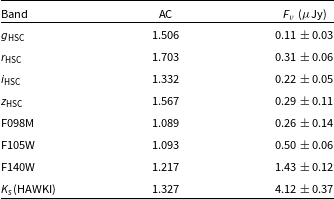
WFC3, HSC, and HAWKI K-band aperture corrections, flux densities and uncertainties for the host of GLEAM J0917 $-$
0012. The uncertainties conservatively include an extra 5% to account for absolute flux calibration and uncertainty in the aperture correction.
$-$
0012. The uncertainties conservatively include an extra 5% to account for absolute flux calibration and uncertainty in the aperture correction.
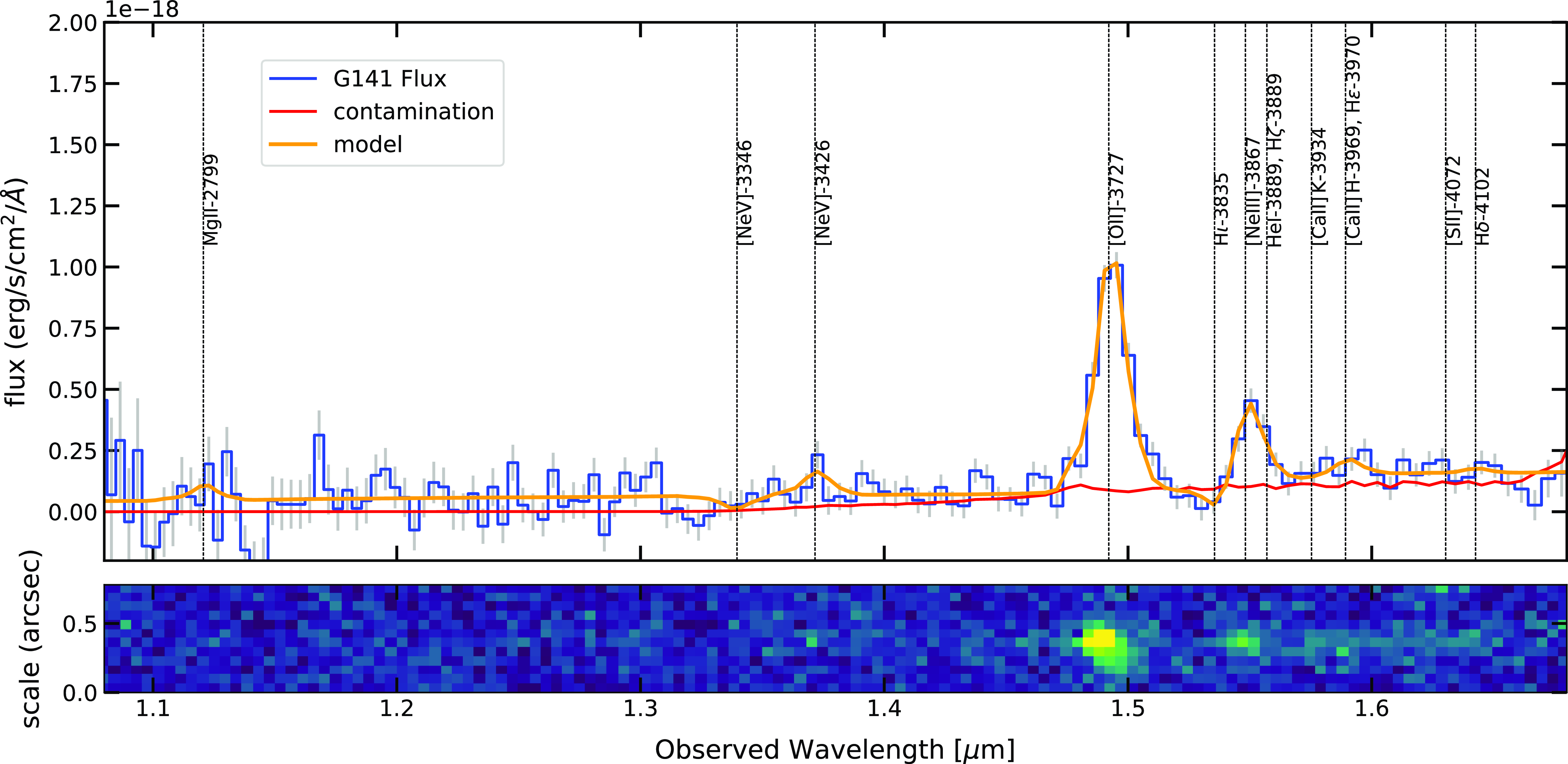
HST/WFC3 G141 grism spectrum of the host of GLEAM J0917 $-$
0012 in 1D (top) and 2D (bottom). The grizli fitting identifies numerous features, including [OII]
$-$
0012 in 1D (top) and 2D (bottom). The grizli fitting identifies numerous features, including [OII] $\lambda3727$
(at
$\lambda3727$
(at $\approx 27\sigma$
), [NeV]
$\approx 27\sigma$
), [NeV] $\lambda3426$
(at
$\lambda3426$
(at $\approx 2.5\sigma$
), [NeIII]
$\approx 2.5\sigma$
), [NeIII] $\lambda3867$
(at
$\lambda3867$
(at $\approx 7\sigma$
), which confirm the redshift of the host of GLEAM J0917
$\approx 7\sigma$
), which confirm the redshift of the host of GLEAM J0917 $-$
0012 to be
$-$
0012 to be $z=3.004\pm0.001$
. The presence of [NeV]
$z=3.004\pm0.001$
. The presence of [NeV] $\lambda3426$
and [NeIII]
$\lambda3426$
and [NeIII] $\lambda3867$
confirm the presence of a high ionisation radiation field from an AGN. The [OII]
$\lambda3867$
confirm the presence of a high ionisation radiation field from an AGN. The [OII] $\lambda3727$
is spatially extended as mapped in Fig. 1.
$\lambda3727$
is spatially extended as mapped in Fig. 1.
HST/WFC3 G141 (blue) grism spectrum of the companion galaxy. The grizli software identifies numerous features, including [OII] $\lambda3727$
, H
$\lambda3727$
, H $\beta$
and [OIII]
$\beta$
and [OIII] $\lambda5007$
) which confirm the redshift of the companion galaxy to be
$\lambda5007$
) which confirm the redshift of the companion galaxy to be $z=2.126\pm 0.001$
. Hence, this galaxy is physically unrelated to GLEAM J0917
$z=2.126\pm 0.001$
. Hence, this galaxy is physically unrelated to GLEAM J0917 $-$
0012 which is at
$-$
0012 which is at $z=3.00$
.
$z=3.00$
.

In Table 1, we present the positions of the host and nearby source from grizli. These values are the same as reported in S22. The optical photometry for the host is presented in Table 2. We use the photutils astropy package to determine the photometry with a $0.7\,$
arcsec radius aperture and a local background determined from a 3–5 arcsec annuli centred on the grizli reported position. Following S22, we determined the aperture corrections for WFC3, by taking the inverse of the nearest set of values of the fractional flux enclosed in Table 7.6 of the WFC3 instrument handbook and interpolated them linearly using the
$0.7\,$
arcsec radius aperture and a local background determined from a 3–5 arcsec annuli centred on the grizli reported position. Following S22, we determined the aperture corrections for WFC3, by taking the inverse of the nearest set of values of the fractional flux enclosed in Table 7.6 of the WFC3 instrument handbook and interpolated them linearly using the $0.7\,$
arcsec radius and central wavelength of each filter. A 5% systematic uncertainty was added to the measurement uncertainty (to account for the absolute flux uncertainty and any uncertainty in the aperture correction). In Fig. 1, we present the near-IR imaging along with the radio data described below. The spectroscopic results, including the 1D and 2D G141 spectra plus the grizli best fits, are shown in Fig. 2 for the host and Fig. 3 for the nearby source. Note the absolute positional uncertainty of an HST single pointings is 2–5 mas.Footnote
a
$0.7\,$
arcsec radius and central wavelength of each filter. A 5% systematic uncertainty was added to the measurement uncertainty (to account for the absolute flux uncertainty and any uncertainty in the aperture correction). In Fig. 1, we present the near-IR imaging along with the radio data described below. The spectroscopic results, including the 1D and 2D G141 spectra plus the grizli best fits, are shown in Fig. 2 for the host and Fig. 3 for the nearby source. Note the absolute positional uncertainty of an HST single pointings is 2–5 mas.Footnote
a
2.2 LBA observations
We observed GLEAM J0917 $-$
0012 with the Southern Hemisphere LBA under project V605a from 2021 July 17 23:00 to 2021 July 18 09:00 UTC. The following telescopes were available: Murriyang (the 64-m Parkes radio telescope), the Australia Telescope Compact Array (ATCA; five 22-m antennas in tied-array mode), Mopra, Hobart (26 m), Ceduna, Warkworth (12 m), Katherine (flagged due to poor sensitivity), Yarragadee, Hartebeesthoek (26 m), and Tidbinbilla (70 m). Target scans of duration 4 min were interleaved with 1.5-min scans of the phase calibrator B0922
$-$
0012 with the Southern Hemisphere LBA under project V605a from 2021 July 17 23:00 to 2021 July 18 09:00 UTC. The following telescopes were available: Murriyang (the 64-m Parkes radio telescope), the Australia Telescope Compact Array (ATCA; five 22-m antennas in tied-array mode), Mopra, Hobart (26 m), Ceduna, Warkworth (12 m), Katherine (flagged due to poor sensitivity), Yarragadee, Hartebeesthoek (26 m), and Tidbinbilla (70 m). Target scans of duration 4 min were interleaved with 1.5-min scans of the phase calibrator B0922 $+$
005. We also regularly observed B0906
$+$
005. We also regularly observed B0906 $+$
015 to phase up ATCA, used the sources B0208
$+$
015 to phase up ATCA, used the sources B0208 $-$
512, B0537
$-$
512, B0537 $-$
441, B0834
$-$
441, B0834 $-$
201, and J1147
$-$
201, and J1147 $-$
3812 for fringe finding, and observed B1934
$-$
3812 for fringe finding, and observed B1934 $-$
638 for ATCA flux density calibration. The observations were dual-polarisation, with four sub-bands centred at 2 252, 2 268, 2 284, and 2 300 MHz, each with bandwidth 16 MHz (i.e. a centre frequency of 2 276 MHz and a total bandwidth 64 MHz). The total time on-source for GLEAM J0917
$-$
638 for ATCA flux density calibration. The observations were dual-polarisation, with four sub-bands centred at 2 252, 2 268, 2 284, and 2 300 MHz, each with bandwidth 16 MHz (i.e. a centre frequency of 2 276 MHz and a total bandwidth 64 MHz). The total time on-source for GLEAM J0917 $-$
0012 was 5.6 h.
$-$
0012 was 5.6 h.
To correlate the data we made use of the DiFX software correlator (Deller et al. Reference Deller2011) running at the Pawsey Supercomputing Centre. The data were averaged to 2 s accumulation periods and 0.5 MHz resolution during correlation. Parkes recorded native linear polarisations which were converted to a circular basis after correlation using the PolConvert package (Mart-Vidal et al. Reference Mart-Vidal, Roy, Conway and Zensus2016). Data were calibrated in the Astronomical Image Processing System (AIPS)
Footnote
b
following standard procedures for the LBA, implemented using the Parseltongue interface (Kettenis et al. Reference Kettenis, van Langevelde, Reynolds, Cotton, Gabriel, Arviset, Ponz and Enrique2006). In the absence of good system temperature measurements at several stations, array amplitude calibration was achieved by bootstrapping to the compact source B0922 $-$
005 whose flux on LBA scales was assumed to be 90% of that measured in a near-simultaneous ATCA observation – this assumption leads to a
$-$
005 whose flux on LBA scales was assumed to be 90% of that measured in a near-simultaneous ATCA observation – this assumption leads to a $\approx 10$
% uncertainty on the flux scale for the target source (this error estimate is supported by flux densities derived for calibrators in the observation that also had near-simultaneous ATCA observations). Katherine had significantly reduced sensitivity due to a problem with the data acquisition system and was thus omitted from the final analysis.
$\approx 10$
% uncertainty on the flux scale for the target source (this error estimate is supported by flux densities derived for calibrators in the observation that also had near-simultaneous ATCA observations). Katherine had significantly reduced sensitivity due to a problem with the data acquisition system and was thus omitted from the final analysis.
The source was imaged using the Common Astronomy Software Applications (CASA; Team et al. Reference Team2022) with Briggs weighting of $R=0.5$
, a uvtaper of
$R=0.5$
, a uvtaper of $5\,000\,\textit{k}\lambda$
, and the multi-frequency synthesis option to provide a restoring beam of
$5\,000\,\textit{k}\lambda$
, and the multi-frequency synthesis option to provide a restoring beam of $73\times 26\,$
mas and a position angle of
$73\times 26\,$
mas and a position angle of $-82.4^\circ$
. The rms noise in the image is
$-82.4^\circ$
. The rms noise in the image is $54\,\mu$
Jy per beam at the effective central frequency of 2 276 MHz. The contours of this image are overlaid on the combined F098M/F105W/F140W image in the right panel of Fig. 1. We estimate the absolute astrometry uncertainty to be
$54\,\mu$
Jy per beam at the effective central frequency of 2 276 MHz. The contours of this image are overlaid on the combined F098M/F105W/F140W image in the right panel of Fig. 1. We estimate the absolute astrometry uncertainty to be $\le 1\,$
mas and is an equal combination of systematic uncertainty from a 2-degree target-calibrator separation at 2.4 GHz and the random position uncertainty (
$\le 1\,$
mas and is an equal combination of systematic uncertainty from a 2-degree target-calibrator separation at 2.4 GHz and the random position uncertainty ( $\approx\frac{\mathrm{beamsize}}{2\times \mathrm{SNR}}$
).
$\approx\frac{\mathrm{beamsize}}{2\times \mathrm{SNR}}$
).
2.3 Literature data
2.3.1 Radio data
D20 presented 25 radio photometric measurements of GLEAM J0917 $-$
0012, including 20 from the GLEAM survey, one from the National Radio Astronomy Observatory (NRAO) Very Large Array (VLA) Sky Survey (NVSS Condon et al. Reference Condon1998), and four across 5–20 GHz from the ATCA (Frater, Brooks, & Whiteoak Reference Frater, Brooks and Whiteoak1992). This target was originally selected due to its negative curvature across the GLEAM band, 70–230 MHz, which suggested a flattening of the spectral index towards the lower end of that range. Modelling of the GLEAM and higher frequency data (see D20, D21, and S22) found that the radio spectrum was best fit by a double power-law with a break frequency of
$-$
0012, including 20 from the GLEAM survey, one from the National Radio Astronomy Observatory (NRAO) Very Large Array (VLA) Sky Survey (NVSS Condon et al. Reference Condon1998), and four across 5–20 GHz from the ATCA (Frater, Brooks, & Whiteoak Reference Frater, Brooks and Whiteoak1992). This target was originally selected due to its negative curvature across the GLEAM band, 70–230 MHz, which suggested a flattening of the spectral index towards the lower end of that range. Modelling of the GLEAM and higher frequency data (see D20, D21, and S22) found that the radio spectrum was best fit by a double power-law with a break frequency of $\approx$
2 GHz,
$\approx$
2 GHz, $\alpha_\mathrm{LOW}\approx -0.9$
, and
$\alpha_\mathrm{LOW}\approx -0.9$
, and $\alpha_\mathrm{HIGH}\approx -1.8$
. A triple power-law with a low frequency turn-over below 70 MHz, to account for the 70–230 MHz curvature, was found not to provide a better model fit, despite the evident curvature across this frequency range.
$\alpha_\mathrm{HIGH}\approx -1.8$
. A triple power-law with a low frequency turn-over below 70 MHz, to account for the 70–230 MHz curvature, was found not to provide a better model fit, despite the evident curvature across this frequency range.
2.3.2 Optical and infra-red (IR) data
The Third Data Release of the Hyper Suprime-Cam (HSC) Subaru Strategic Program (Aihara et al. Reference Aihara2022) is significantly deeper than the Second Data Release used in S22. GLEAM J0917 $-$
0012 falls in the ‘Wide’ layer of this survey so we downloaded the new, deeper grizy data from the public data release webpage.Footnote
c
We used aperture photometry on the WFC3 position of GLEAM J0917
$-$
0012 falls in the ‘Wide’ layer of this survey so we downloaded the new, deeper grizy data from the public data release webpage.Footnote
c
We used aperture photometry on the WFC3 position of GLEAM J0917 $-$
0012 (Table 1) with the same
$-$
0012 (Table 1) with the same $0.7\,$
arcsec radius aperture and 3–5 arcsec annulus as in Section 2.1 with the aperture corrections determined in S22. As the y-band image was still less deep than the F098M image we excluded it from this analysis. As we used a different method for the photometry in this work (compared to D20 and S22), we re-extracted the flux density of GLEAM J0917
$0.7\,$
arcsec radius aperture and 3–5 arcsec annulus as in Section 2.1 with the aperture corrections determined in S22. As the y-band image was still less deep than the F098M image we excluded it from this analysis. As we used a different method for the photometry in this work (compared to D20 and S22), we re-extracted the flux density of GLEAM J0917 $-$
0012 in the HAWKI K-band image from D20 using the photutils method described in Section 2.1. The HSC griz and HAWKI K-band photometry, along with that from WFC3, is presented in Table 2 and used in the SED fitting presented in Section 3.3.1. We also use the mid-IR non-detections from the Widefield Infrared Survey Explorer (WISE, Wright et al. Reference Wright2010) given in S22 to constrain the AGN bolometric luminosity (Section 4.4.2).
$-$
0012 in the HAWKI K-band image from D20 using the photutils method described in Section 2.1. The HSC griz and HAWKI K-band photometry, along with that from WFC3, is presented in Table 2 and used in the SED fitting presented in Section 3.3.1. We also use the mid-IR non-detections from the Widefield Infrared Survey Explorer (WISE, Wright et al. Reference Wright2010) given in S22 to constrain the AGN bolometric luminosity (Section 4.4.2).
2.3.3 ALMA continuum data
We use the ALMA 100 GHz continuum data from D20. This data comprised five 10-min spectral scans across 85–115 GHz. No significant spectral features were found. The 100 GHz contours overlaid on the F140W image in the left panel of Fig. 1 is a naturally weighted image with an rms of $10\,\mu$
Jy per beam, a restoring beam of
$10\,\mu$
Jy per beam, a restoring beam of $1.2''\times 1.4''$
, and position angle of
$1.2''\times 1.4''$
, and position angle of $-89^\circ$
. The 100 GHz flux density reported in D21 is
$-89^\circ$
. The 100 GHz flux density reported in D21 is $60\pm 13\,\mu$
Jy.
$60\pm 13\,\mu$
Jy.
2.3.4 Interplanetary scintillation measurement
The Galaxy and Mass Assembly (GAMA)9 field (Driver et al. Reference Driver2011) was covered by Murchison Widefield Array (MWA) inter-planetary scintillation (IPS) observations at 162 MHz (Morgan et al. Reference Morgan2018; Chhetri et al. Reference Chhetri2018). GLEAM J0917 $-$
0012 has a normalised scintillation index (NSI) of
$-$
0012 has a normalised scintillation index (NSI) of $0.49\pm 0.03$
implying that around half the flux is more compact than
$0.49\pm 0.03$
implying that around half the flux is more compact than $\approx 0.3$
arcsec or there are two compact components separated by more than
$\approx 0.3$
arcsec or there are two compact components separated by more than $\approx 0.3\,$
arcsec (see D20 for details).
$\approx 0.3\,$
arcsec (see D20 for details).
2.3.5 eROSITA data
The extended ROentgen Survey with an Imaging Telescope Array (eROSITA; Predehl et al. Reference Predehl2021) instrument on the Spektrum-Roentgen-Gamma (SRG) orbital observatory (Sunyaev et al. Reference Sunyaev2021) carried out an early survey of the GAMA9 field, in which GLEAM J0917 $-$
0012 is situated, to the final depth of the planned all-sky surveys. We find that GLEAM J0917
$-$
0012 is situated, to the final depth of the planned all-sky surveys. We find that GLEAM J0917 $-$
0012 is undetected in the Final Equatorial Depth Survey (eFEDS, Brunner et al. Reference Brunner2022) implying an upper limit to its X-ray 0.5–2.0 keV flux of
$-$
0012 is undetected in the Final Equatorial Depth Survey (eFEDS, Brunner et al. Reference Brunner2022) implying an upper limit to its X-ray 0.5–2.0 keV flux of $6.5\times 10^{-15}\,$
erg cm
$6.5\times 10^{-15}\,$
erg cm $^{-2}$
s
$^{-2}$
s $^{-1}$
, the point source 80% completeness limit of eFEDS.
$^{-1}$
, the point source 80% completeness limit of eFEDS.
3. Results and analysis
3.1 HST data
3.1.1 Imaging
Both galaxies are detected in the new F140W image as well as the F105W image. The host of GLEAM J0917 $-$
0012 remains undetected in the F098M image. The F098M and F105W photometry is consistent within 10% of that reported in S22 with the small difference likely due to slightly different background subtraction method (local here vs global in S22). The left panel of Fig. 1 presents the F140W image overlaid with the 100 GHz ALMA contours. The host is extended towards the nearby source. The strongest line detected in the host ([OII]
$-$
0012 remains undetected in the F098M image. The F098M and F105W photometry is consistent within 10% of that reported in S22 with the small difference likely due to slightly different background subtraction method (local here vs global in S22). The left panel of Fig. 1 presents the F140W image overlaid with the 100 GHz ALMA contours. The host is extended towards the nearby source. The strongest line detected in the host ([OII] $\lambda 3727$
doublet, hereafter [OII] – see Section 3.1.2) is found to be spatially extended by Grizli (see Fig. 2). Hence, in the right panel, we present the combined near-IR image overlaid with contours of the [OII] emission map and our LBA observations (see Section 3.2). The [OII] line and LBA continuum emission are co-spatial and also extended towards the nearby source. However, the spectroscopy discussed in Section 3.1.2 confirms that the nearby source is at a lower redshift and that this alignment is purely coincidental.
$\lambda 3727$
doublet, hereafter [OII] – see Section 3.1.2) is found to be spatially extended by Grizli (see Fig. 2). Hence, in the right panel, we present the combined near-IR image overlaid with contours of the [OII] emission map and our LBA observations (see Section 3.2). The [OII] line and LBA continuum emission are co-spatial and also extended towards the nearby source. However, the spectroscopy discussed in Section 3.1.2 confirms that the nearby source is at a lower redshift and that this alignment is purely coincidental.
3.1.2 Spectroscopy
In Fig. 2, we present the G141 spectrum of the host of GLEAM J0917 $-$
0012. The grizl software identifies several spectral features, with the strongest line being the [OII] doublet. The other lines detected are [NeV]
$-$
0012. The grizl software identifies several spectral features, with the strongest line being the [OII] doublet. The other lines detected are [NeV] $\lambda3426$
and [NeIII]
$\lambda3426$
and [NeIII] $\lambda3867$
(hereafter [NeV] and [NeIII], respectively). This combination of lines puts GLEAM J0917
$\lambda3867$
(hereafter [NeV] and [NeIII], respectively). This combination of lines puts GLEAM J0917 $-$
0012 at
$-$
0012 at $z=3.004\pm 0.001$
, implying that the weak line previously identified with the G102 grism (S22) at
$z=3.004\pm 0.001$
, implying that the weak line previously identified with the G102 grism (S22) at $1.15\,\mu$
m is MgII
$1.15\,\mu$
m is MgII $\lambda\lambda 2796,2803$
. The properties of the [OII], [NeV], and [NeIII] lines are reported in Table 2.
$\lambda\lambda 2796,2803$
. The properties of the [OII], [NeV], and [NeIII] lines are reported in Table 2.
In Fig. 3, we present the 1D and 2D spectrum for the galaxy $\sim 1.5''$
away from the host of GLEAM J0917
$\sim 1.5''$
away from the host of GLEAM J0917 $-$
0012. We also include the best fit grizli model to the data which finds the [OII]
$-$
0012. We also include the best fit grizli model to the data which finds the [OII] $\lambda$
3727, H
$\lambda$
3727, H $\beta$
, [OIII]
$\beta$
, [OIII] $\lambda$
5007 lines confirming the redshift to be
$\lambda$
5007 lines confirming the redshift to be $z=2.126\pm 0.001$
, consistent with the photometric redshift of
$z=2.126\pm 0.001$
, consistent with the photometric redshift of $z_\mathrm{phot}=2.2^{+0.3}_{-0.6}$
presented in D21. Hence, this source is physically unrelated to the host of GLEAM J0917
$z_\mathrm{phot}=2.2^{+0.3}_{-0.6}$
presented in D21. Hence, this source is physically unrelated to the host of GLEAM J0917 $-$
0012, and we consider it no further.
$-$
0012, and we consider it no further.
The redshift solution of $z=3.004$
is consistent with the lower of the two options put forward in S22. While this radio galaxy is not at
$z=3.004$
is consistent with the lower of the two options put forward in S22. While this radio galaxy is not at $z \gt 7$
, it still demonstrates several unique properties. From the radio photometry presented in D20 and the modelling in Broderick et al. (Reference Broderick2022) the 500 MHz rest-frame luminosity of this source is
$z \gt 7$
, it still demonstrates several unique properties. From the radio photometry presented in D20 and the modelling in Broderick et al. (Reference Broderick2022) the 500 MHz rest-frame luminosity of this source is $L_{\mathrm{500MHz}}=1.0\pm0.1\times 10^{28}\,$
W Hz
$L_{\mathrm{500MHz}}=1.0\pm0.1\times 10^{28}\,$
W Hz $^{-1}$
(conservatively including a 10% uncertainty from the modelling), putting it well into the ‘powerful’ high-redshift radio galaxy (HzRG:
$^{-1}$
(conservatively including a 10% uncertainty from the modelling), putting it well into the ‘powerful’ high-redshift radio galaxy (HzRG: $z \gt 1$
and
$z \gt 1$
and $L_{\mathrm{500MHz}}\ge 10^{27.5}\,$
W Hz
$L_{\mathrm{500MHz}}\ge 10^{27.5}\,$
W Hz $^{-1}$
) regime (Miley & De Breuck Reference Miley and De Breuck2008; De Breuck et al. Reference De Breuck2010). This result, as well as the 1.4 GHz and 178 MHz luminosities, is presented in Table 4. We discuss how this high-redshift radio galaxy (HzRG) compares to others at the same redshift in Section 4.2.
$^{-1}$
) regime (Miley & De Breuck Reference Miley and De Breuck2008; De Breuck et al. Reference De Breuck2010). This result, as well as the 1.4 GHz and 178 MHz luminosities, is presented in Table 4. We discuss how this high-redshift radio galaxy (HzRG) compares to others at the same redshift in Section 4.2.
The [NeIII] and [NeV] lines are strong indicators of the presence of an AGN (Gilli et al. Reference Gilli2010) due to their high ionisation potentials (e.g. Maddox Reference Maddox2018) and equivalent widths of $\ge+4\,$
Å are enough to confirm the presence of an obscured AGN. The [OII] line is typically indicative of star formation and often used as star formation rate (SFR) tracer (e.g. Kennicutt Reference Kennicutt1992). However, from the high radio luminosity and neon lines, we know that there is a powerful AGN present. Due to its brightness we can map the [OII] (Fig. 1) and see that it extends
$\ge+4\,$
Å are enough to confirm the presence of an obscured AGN. The [OII] line is typically indicative of star formation and often used as star formation rate (SFR) tracer (e.g. Kennicutt Reference Kennicutt1992). However, from the high radio luminosity and neon lines, we know that there is a powerful AGN present. Due to its brightness we can map the [OII] (Fig. 1) and see that it extends $\approx 0.6''$
, equivalent to 4.7 kpc. Indeed, in the 2D spectrum (Fig. 2) one can see the spatially extended [OII]. The [NeV] and [NeIII] lines are too faint to be mapped out.
$\approx 0.6''$
, equivalent to 4.7 kpc. Indeed, in the 2D spectrum (Fig. 2) one can see the spatially extended [OII]. The [NeV] and [NeIII] lines are too faint to be mapped out.
Hence, if the [OII] emission is primarily powered by an AGN then we can determine an upper limit to the unobscured SFR using the equation 4 of (Kewley, Geller, & Jansen Reference Kewley, Geller and Jansen2004, K04) and the relation in (Kennicutt Reference Kennicutt1998, K98). Note no correction is made to the [OII] line luminosity for reddening as the SED fitting in Section 3.3.1 cannot constrain the dust attenuation well and the three lines are close together. From a line luminosity of $L_\mathrm{ [OII]}=3.28\times 10^{42}$
erg s
$L_\mathrm{ [OII]}=3.28\times 10^{42}$
erg s $^{-1}$
we obtain a SFR upper limit of
$^{-1}$
we obtain a SFR upper limit of $\lt 22$
and
$\lt 22$
and $\lt 46\,\textit{M}_\odot$
yr
$\lt 46\,\textit{M}_\odot$
yr $^{-1}$
for the K04 and K98 conversions, respectively (see Table 3).
$^{-1}$
for the K04 and K98 conversions, respectively (see Table 3).
Summary of the optical to near-IR properties of the host galaxy of GLEAM J0917 $-$
0012.
$-$
0012.
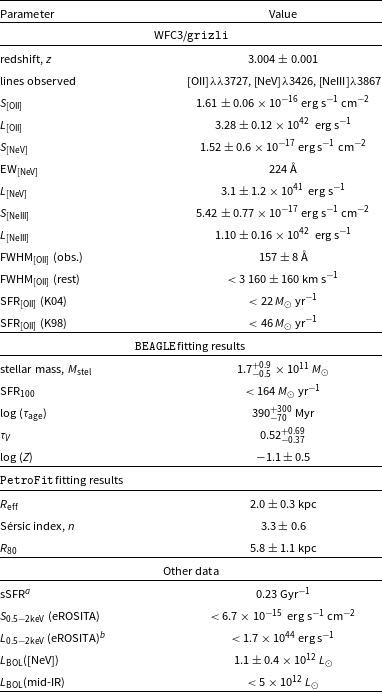
aderived from the higher of the [OII] SFR upper limits.
bassuming a photon index of $\Gamma=1.8$
.
$\Gamma=1.8$
.
Powerful radio galaxies have been classically separated into two distinct classes based on the strength of their optical emission lines (Hine & Longair Reference Hine and Longair1979). Radio galaxies with strong emission lines are referred to as high excitation (radio) galaxies, HE(R)Gs, and those with weak emission lines as low excitation (radio) galaxies, LE(R)Gs. The original work was based on the [OII] line strength (Hine & Longair Reference Hine and Longair1979), but newer criteria exist based on a combination of lines (e.g., Buttiglione et al. Reference Buttiglione2010). The grism spectra do not cover all the lines to make a formal classification with the Buttiglione et al. (Reference Buttiglione2010) criteria so we make the assumption that the [OIII] $\lambda$
5007 line luminosity is within an order of magnitude of the [OII] line luminosity (as is typically seen in radio galaxies). Taking the 178 MHz luminosity along with the [OIII]
$\lambda$
5007 line luminosity is within an order of magnitude of the [OII] line luminosity (as is typically seen in radio galaxies). Taking the 178 MHz luminosity along with the [OIII] $\lambda$
5007 line luminosity we can place GLEAM J0917
$\lambda$
5007 line luminosity we can place GLEAM J0917 $-$
0012 on the scatter plot of these two luminosity in Fig. 8 of Buttiglione et al. (Reference Buttiglione2010). We find that GLEAM J0917
$-$
0012 on the scatter plot of these two luminosity in Fig. 8 of Buttiglione et al. (Reference Buttiglione2010). We find that GLEAM J0917 $-$
0012 lies at the high luminosity end of the LERG track and well away from the HERG track. So despite these high luminosities we consider GLEAM J0917
$-$
0012 lies at the high luminosity end of the LERG track and well away from the HERG track. So despite these high luminosities we consider GLEAM J0917 $-$
0012 to be a LERG.
$-$
0012 to be a LERG.
3.2 LBA results
In Fig. 1, we show the contours of the LBA observations over the combined F140W/F105W/F098M image. The relative uncertainty in the astrometry between LBA and HST is small: the HST observations are tied to the GAIA DR3 reference frame, which is consistent with the International Celestial Reference Frame (ICRF) used by LBA within $\lt 0.01\,$
mas (Gaia Collaboration et al. Reference Collaboration2022). This difference is far less than the absolute positional uncertainty of LBA,
$\lt 0.01\,$
mas (Gaia Collaboration et al. Reference Collaboration2022). This difference is far less than the absolute positional uncertainty of LBA, $\lt 1\,$
mas.
$\lt 1\,$
mas.
The LBA data show two unresolved components separated by $620\,$
mas, equivalent to a projected separation of
$620\,$
mas, equivalent to a projected separation of $4.8\,$
kpc. The north-east (NE) component is closer to the galaxy centre, as inferred from the optical image, but it is far enough away that it is unlikely to be the core. Hence we are likely seeing the compact ends of two jets from the central black hole rather than a binary or offset AGN. The south-west (SW) component is 470 mas away from the peak of the optical emission. Assuming the central black hole is located at this optical peak, the projected length of the jet to the SW component is 3.6 kpc. The flux densities were measured with the miriad task imfit and found to be
$4.8\,$
kpc. The north-east (NE) component is closer to the galaxy centre, as inferred from the optical image, but it is far enough away that it is unlikely to be the core. Hence we are likely seeing the compact ends of two jets from the central black hole rather than a binary or offset AGN. The south-west (SW) component is 470 mas away from the peak of the optical emission. Assuming the central black hole is located at this optical peak, the projected length of the jet to the SW component is 3.6 kpc. The flux densities were measured with the miriad task imfit and found to be $10.4\pm0.4$
and
$10.4\pm0.4$
and $6.8\pm0.5\,$
mJy (not including the 10% overall flux calibration uncertainty) for the NE and -SW components, respectively. The sum of these fluxes is
$6.8\pm0.5\,$
mJy (not including the 10% overall flux calibration uncertainty) for the NE and -SW components, respectively. The sum of these fluxes is $\approx 80\%$
of the estimated 2 276 MHz total flux,
$\approx 80\%$
of the estimated 2 276 MHz total flux, $S_\mathrm{2\,276MHz}=21.8\,$
mJy, from the broad-band modelling presented in Broderick et al. (Reference Broderick2022). Hence,
$S_\mathrm{2\,276MHz}=21.8\,$
mJy, from the broad-band modelling presented in Broderick et al. (Reference Broderick2022). Hence, $\approx 20\%$
of the flux density may be resolved out in the LBA observations. If these two components indicate the ends of the jets/lobes and if we assume that the black hole is equidistant to the two hot spots, then we estimate an age of
$\approx 20\%$
of the flux density may be resolved out in the LBA observations. If these two components indicate the ends of the jets/lobes and if we assume that the black hole is equidistant to the two hot spots, then we estimate an age of $\ge 78\,$
kyr assuming the jet propagates at
$\ge 78\,$
kyr assuming the jet propagates at $0.1\,c$
. This propagation speed is a median value for GPS/CSS sources in the review by O’Dea & Saikia (Reference O’Dea and Saikia2021). Faster speeds, as assumed by the jet modelling in Section 3.4 would imply younger ages. This estimate is also consistent with the slowing jet propagation speeds for older jets seen in powerful GPS sources (An & Baan Reference An and Baan2012).
$0.1\,c$
. This propagation speed is a median value for GPS/CSS sources in the review by O’Dea & Saikia (Reference O’Dea and Saikia2021). Faster speeds, as assumed by the jet modelling in Section 3.4 would imply younger ages. This estimate is also consistent with the slowing jet propagation speeds for older jets seen in powerful GPS sources (An & Baan Reference An and Baan2012).
The compact size of the radio emission is $\ll 20\,$
kpc, consistent with the radio source being classified as CSS. The extended [OII] is aligned with the SW radio component, which is a common property of CSS sources (de Vries et al. Reference de Vries1997). We discuss the extended [OII] further in Section 4.2. The observed asymmetry suggests that the NE component is likely impacting denser ISM than the SW component.
$\ll 20\,$
kpc, consistent with the radio source being classified as CSS. The extended [OII] is aligned with the SW radio component, which is a common property of CSS sources (de Vries et al. Reference de Vries1997). We discuss the extended [OII] further in Section 4.2. The observed asymmetry suggests that the NE component is likely impacting denser ISM than the SW component.
The two compact component model with some extended flux is also consistent with the morphological models put forward to explain the IPS value of NSI $=0.49\pm 0.03$
reported in D21. An NSI of unity implies an unresolved source at 162 MHz (i.e.
$=0.49\pm 0.03$
reported in D21. An NSI of unity implies an unresolved source at 162 MHz (i.e. $\leq 0.3\,$
arcsec) whereas a value of zero implies all the flux is extended on larger scales. An in-between value implies either that only a fraction of the flux is compact and/or that there is more than one compact component, as is the case here.
$\leq 0.3\,$
arcsec) whereas a value of zero implies all the flux is extended on larger scales. An in-between value implies either that only a fraction of the flux is compact and/or that there is more than one compact component, as is the case here.
3.3 Modelling the host galaxy
3.3.1 SED
We use the SED fitting code BayEsian Analysis of GaLaxy sEds (BEAGLE; Chevallard & Charlot Reference Chevallard and Charlot2016)Footnote
d
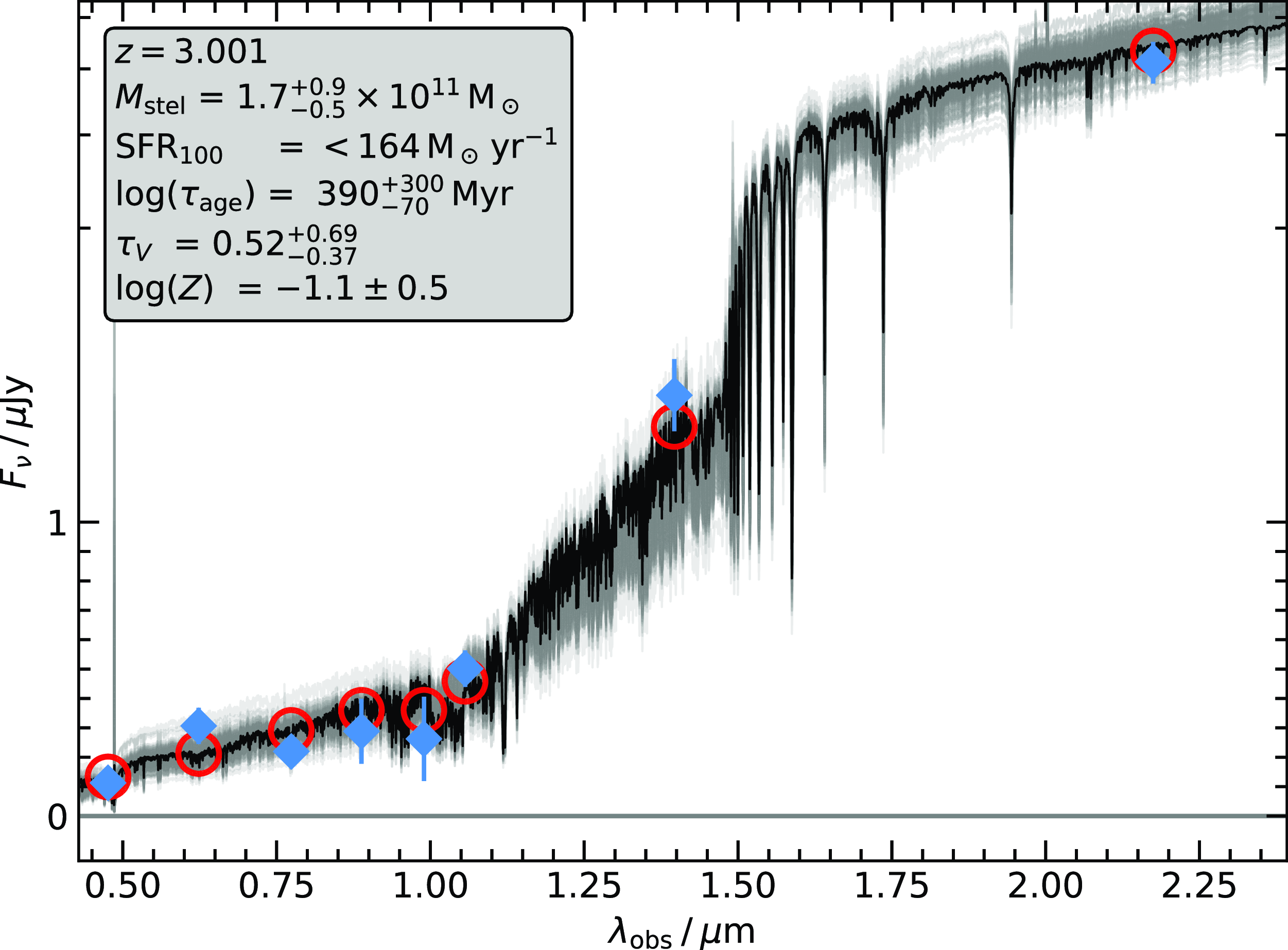
to constrain the properties of the host galaxy. For this fitting we use the eight photometric measurements in Table 2, including three from WFC3, four from HSC and the one from HAWKI K-band. Inclusion of $ \lt 3\sigma$
WISE limits from S22 made no appreciable difference to the host galaxy properties nor their uncertainties.
$ \lt 3\sigma$
WISE limits from S22 made no appreciable difference to the host galaxy properties nor their uncertainties.
Within BEAGLE we use a delayed exponential star formation (SF) history, a Calzetti (Reference Calzetti1997) dust attenuation, and broad priors. The ionisation parameter and metallicity of the nebular regions is set equal to that of the stars. The dust to metal mass ratio is left as default value of 0.3. Hence, we allow only the following five parameters to vary: timescale of SF (hereafter ‘age’), stellar mass, current SFR (we report the SFR averaged of the last 100 Myr), metallicity, and extinction.
BEAGLE provides PDFs from which we take the median value as the best fit and the 68% confidence intervals for the uncertainties. In the case where the difference between the upper and lower 68% confidence interval is more than an order of magnitude we take the 95% confidence upper value as a $2\sigma$
upper limit. This affects only the SFR. These results are reported in Table 3, and the photometry, along with the highest probability SED template, are plotted in Fig. 4.
$2\sigma$
upper limit. This affects only the SFR. These results are reported in Table 3, and the photometry, along with the highest probability SED template, are plotted in Fig. 4.
Fit of the optical/near-IR photometry of GLEAM J0917 $-$
0012 with BEAGLE showing the eight photometric detections (blue diamonds) and uncertainties (sometimes obscured by the symbols). Also shown is the template with the highest probability (in black) as well as all the fits within all the 68% confidence limits (in grey). The values of the photometry from the highest probability model are shown in red. The median SED parameters (or limits) for this fit are presented in Table 3.
$-$
0012 with BEAGLE showing the eight photometric detections (blue diamonds) and uncertainties (sometimes obscured by the symbols). Also shown is the template with the highest probability (in black) as well as all the fits within all the 68% confidence limits (in grey). The values of the photometry from the highest probability model are shown in red. The median SED parameters (or limits) for this fit are presented in Table 3.
Examining the bivariate PDFs (i.e. ‘corner plots’) there is some slight degeneracy between extinction and the stellar mass and age. However, the 68% confidence interval on the stellar mass ( $1.7^{+0.9}_{-0.5}\times 10^{11}\,\textit{M}_\odot$
) and age (
$1.7^{+0.9}_{-0.5}\times 10^{11}\,\textit{M}_\odot$
) and age ( $39^{+300}_{-70}\,$
Myr) are well constrained. The SFR is poorly constrained with the 68% confidence interval spanning three orders of magnitude. We thus report the 95% confidence interval upper limit for the SFR, but we note this is dominated by a secondary PDF peak corresponding to a very unobscured (
$39^{+300}_{-70}\,$
Myr) are well constrained. The SFR is poorly constrained with the 68% confidence interval spanning three orders of magnitude. We thus report the 95% confidence interval upper limit for the SFR, but we note this is dominated by a secondary PDF peak corresponding to a very unobscured ( $\tau_V\sim 1$
) and very young (
$\tau_V\sim 1$
) and very young ( $\tau\sim 10\,$
Myr) starburst. Hence, the true upper limit to the SFR is likely a lot lower (
$\tau\sim 10\,$
Myr) starburst. Hence, the true upper limit to the SFR is likely a lot lower ( $\ll 10\,\textit{M}_\odot$
from visual inspection of the PDF around the principle PDF peak).
$\ll 10\,\textit{M}_\odot$
from visual inspection of the PDF around the principle PDF peak).
3.3.2 Morphology
We use the F140W image to fit a Sérsic (Reference Sérsic1968) profile to the host galaxy using PetroFit (Geda et al. Reference Geda2022). The cutout fed to PetroFit was $3\times 3\,$
arcsec and the root mean squared error (RMS) image was created at a constant value equal to that of the locally determined off-source RMS. The Sérsic model was convolved with the F140W PSFFootnote
e
which was over-sampled by a factor of two relative to the drizzled pixel size. We find an effective radius (i.e. half-light radius),
$3\times 3\,$
arcsec and the root mean squared error (RMS) image was created at a constant value equal to that of the locally determined off-source RMS. The Sérsic model was convolved with the F140W PSFFootnote
e
which was over-sampled by a factor of two relative to the drizzled pixel size. We find an effective radius (i.e. half-light radius), $R_{\mathrm{eff}}$
, of
$R_{\mathrm{eff}}$
, of $2\pm0.3\,$
kpc and a Sérsic index of
$2\pm0.3\,$
kpc and a Sérsic index of $n= 3.3 \pm 0.6$
. We also determine
$n= 3.3 \pm 0.6$
. We also determine $R_\mathrm{80}$
, corresponding to the radius encompassing 80% of the total flux (using the expression from Miller et al. Reference Miller, van Dokkum, Mowla and van der Wel2019), which has the advantages of: (a) encompassing a larger fraction of the baryons and (b) finding similar sizes for both star forming galaxies (SFGs) and quiescent galaxies (Mowla et al. Reference Mowla, van der Wel, van Dokkum and Miller2019). Using this relationship, which is a function of
$R_\mathrm{80}$
, corresponding to the radius encompassing 80% of the total flux (using the expression from Miller et al. Reference Miller, van Dokkum, Mowla and van der Wel2019), which has the advantages of: (a) encompassing a larger fraction of the baryons and (b) finding similar sizes for both star forming galaxies (SFGs) and quiescent galaxies (Mowla et al. Reference Mowla, van der Wel, van Dokkum and Miller2019). Using this relationship, which is a function of $R_{\mathrm{eff}}$
and the Sérsic index, we obtain
$R_{\mathrm{eff}}$
and the Sérsic index, we obtain $R_\mathrm{80}=5.8\pm 1.1\,$
kpc where the uncertainty is propagated from the inputs. These results are presented in Table 3, discussed in Section 4.1 and are used in modelling the radio jet in Section 3.4.
$R_\mathrm{80}=5.8\pm 1.1\,$
kpc where the uncertainty is propagated from the inputs. These results are presented in Table 3, discussed in Section 4.1 and are used in modelling the radio jet in Section 3.4.
3.4 Modelling the radio jet
We constrain the jet power and age of the radio jet in GLEAM J0917 $-$
0012 using a parameter inversion informed by simulations from the latest version of Radio AGN in Semi-analytic Environments (RAISE, Turner & Shabala Reference Turner and Shabala2015; Turner et al. Reference Turner, Yates-Jones, Shabala, Quici and Stewart2023). The compact size of this source suggests its evolution will be dominated by the ISM of the host galaxy; we therefore model the distribution and density of this ambient medium in RAISE using Monte Carlo realisations of the effective radius and Sérsic profile fitted in Section 3.3.2. In doing this we are assuming that the ISM has the same distribution in the galaxy as the stars.
$-$
0012 using a parameter inversion informed by simulations from the latest version of Radio AGN in Semi-analytic Environments (RAISE, Turner & Shabala Reference Turner and Shabala2015; Turner et al. Reference Turner, Yates-Jones, Shabala, Quici and Stewart2023). The compact size of this source suggests its evolution will be dominated by the ISM of the host galaxy; we therefore model the distribution and density of this ambient medium in RAISE using Monte Carlo realisations of the effective radius and Sérsic profile fitted in Section 3.3.2. In doing this we are assuming that the ISM has the same distribution in the galaxy as the stars.
The expansion rate (velocity) of the jet-head is proportional to the velocity of the bulk flow in the jet spine (Lorentz factor of $\gamma_{\text{j}} =5$
), with a constant depending on the relative densities of the jet,
$\gamma_{\text{j}} =5$
), with a constant depending on the relative densities of the jet, $\rho_{\text{j}}$
and the ISM cloud,
$\rho_{\text{j}}$
and the ISM cloud, $\rho_{\text{c}}$
, it is propagating through (see equation 5 from Turner et al. Reference Turner, Yates-Jones, Shabala, Quici and Stewart2023). Hence, the travel time through the ISM, i.e. age of the jet, is simply the integral of the inverse of the jet-head expansion rate along the jet path. This integral can include any variation in the ISM density, but for a fixed overall gas mass it is independent of the density profile.
$\rho_{\text{c}}$
, it is propagating through (see equation 5 from Turner et al. Reference Turner, Yates-Jones, Shabala, Quici and Stewart2023). Hence, the travel time through the ISM, i.e. age of the jet, is simply the integral of the inverse of the jet-head expansion rate along the jet path. This integral can include any variation in the ISM density, but for a fixed overall gas mass it is independent of the density profile.
Local density inhomogeneities in the multiphase ISM will not affect the jet expansion – compared to a smooth profile with the same total mass – provided no very dense clouds (i.e., $\rho_{\text{c}} \gg \gamma_{\text{j}}^2 \rho_{\text{j}}$
; Turner et al. Reference Turner, Yates-Jones, Shabala, Quici and Stewart2023) lie in the path of the jet. We therefore assume the density is locally homogeneous but note as the radio source is asymmetric a slightly older source age is possible if a dense cloud is encountered (Young et al., in prep.). The total mass of gas encountered by the jet remains a free parameter; we therefore constrain the total gas mass (the sum of the molecular, neutral, and ionised gas, i.e. the sum of Baryonic matter minus the stars) as a third free parameter (in addition to the jet power and age).
$\rho_{\text{c}} \gg \gamma_{\text{j}}^2 \rho_{\text{j}}$
; Turner et al. Reference Turner, Yates-Jones, Shabala, Quici and Stewart2023) lie in the path of the jet. We therefore assume the density is locally homogeneous but note as the radio source is asymmetric a slightly older source age is possible if a dense cloud is encountered (Young et al., in prep.). The total mass of gas encountered by the jet remains a free parameter; we therefore constrain the total gas mass (the sum of the molecular, neutral, and ionised gas, i.e. the sum of Baryonic matter minus the stars) as a third free parameter (in addition to the jet power and age).
RAISE model outputs (synthetic images and SEDs) are generated over a three-dimensional grid covering all reasonable values of these three parameters. We assume the default values for other parameters in RAISE, noting these are calibrated against hydrodynamical simulations and/or based on observations of well-studied sources. The equipartition factor (ratio of energy in the magnetic field to energy in the particles) assumes a prior probability density function following Turner, Shabala, & Krause (Reference Turner, Shabala and Krause2018).
These synthetic images at 1.4 GHz are compared to the following observable values using a maximum likelihood approach: NVSS flux density and the frequency-invariant extent of the jets from the LBA image. We find the steep two-point spectral index between 1.4 and 5.5 GHz (photometry from NVSS and the ATCA, respectively) can be explained if the freshly shock-accelerated electron population is at a significantly lower magnetic field than the remainder of the population, as occurs when the jet-head passes the half-light radius of the galaxy, $R_{\text{eff}}$
, into the steep, outer-sections of the galaxy Sérsic profile. This is consistent with our constraint on the extent of the jets. We do not include lower frequencies in the modelling as RAiSE currently does not include free-free absorption, a likely cause of the radio spectral flattening.
$R_{\text{eff}}$
, into the steep, outer-sections of the galaxy Sérsic profile. This is consistent with our constraint on the extent of the jets. We do not include lower frequencies in the modelling as RAiSE currently does not include free-free absorption, a likely cause of the radio spectral flattening.
We find two potential solutions shown in the PDFs presented in Fig. 5: a ‘fast’ jet with a (slightly) younger age and higher jet power, i.e. a source that expands at the speed of the bulk flow along the jet (hence the small scatter in jet ages) and a ‘slow’ jet with an older age and lower jet power which has at least some interaction with the ambient medium leading to a slowing of the jet. The ‘slow’ solution has a higher gas mass since the jet has to work harder to expand. The gas could be slightly more extended than inferred from the stellar morphology which would decrease the jet power and increase the source age. Conversely if the gas is slightly less extended then the jet power would increase and the gas mass decrease. In HzRGS we tend to see denser gas on more extended scales, often along the jet axis (Feain et al. Reference Feain2009; Emonts et al. Reference Emonts2014). Of the two solutions, we believe the ‘slow’ jet to be more likely. First, the jet power distribution is very steep at the high powers (Quici et al. Reference Quici, Turner, Seymour and Hurley-Walker2024) so a random source is more likely to be at lower luminosity. Second, the hosts of HzRGs are more likely to be gas rich (Emonts et al. Reference Emonts2014).
The 1D probability distribution functions of the three free parameters from the Radio AGN in Semi-analytic Environments (RAiSE) modelling of the radio jet (see Section 3.4). Two potential solutions are found: a ‘fast’ jet (red dotted line – higher jet power) and a ‘slow’ jet (blue solid line – lower jet power). As discussed in the text, we favour the ‘slow’ jet solution whose best fit results are presented in Table 4.
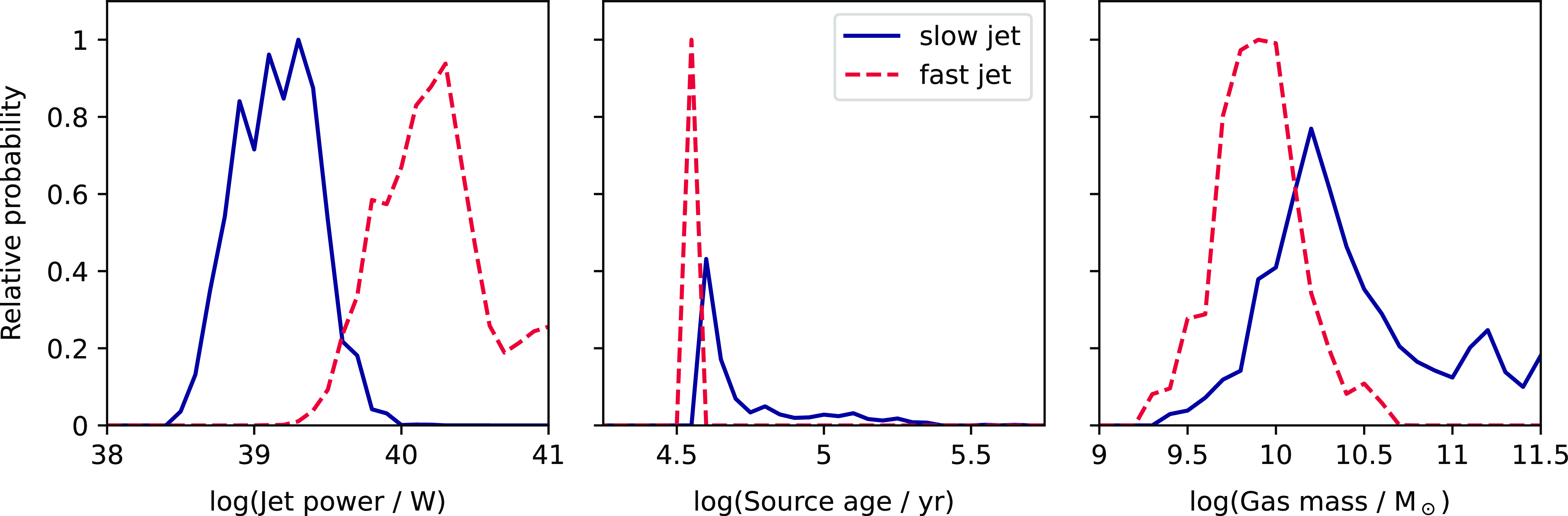
The best fit result and uncertainties for the slow jet solution are presented in Table 4 summarised as a jet power of $Q_{\mathrm{jet}} = 1.5^{+1.3}_{-0.7} \times 10^{39}\,$
W, an age of
$Q_{\mathrm{jet}} = 1.5^{+1.3}_{-0.7} \times 10^{39}\,$
W, an age of $47^{+43}_{-6}\,$
kyr (n.b. the peak in the age PDF will shift with the assumed bulk flow velocity) and a gas mass of
$47^{+43}_{-6}\,$
kyr (n.b. the peak in the age PDF will shift with the assumed bulk flow velocity) and a gas mass of $2.0^{+5.9}_{-1.1}\times 10^{10}\,\textit{M}_{\odot}$
.
$2.0^{+5.9}_{-1.1}\times 10^{10}\,\textit{M}_{\odot}$
.
Summary of radio and derived properties of GLEAM J0917 $-$
0012.
$-$
0012.
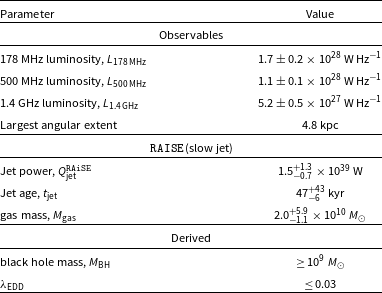
4. Discussion
The measured and derived optical/near-IR and radio properties of GLEAM J0917 $-$
0012 are presented in Tables 3 and 4, respectively.
$-$
0012 are presented in Tables 3 and 4, respectively.
4.1 Host galaxy properties
The stellar mass and size of this galaxy as measured by $R_{\mathrm{eff}}$
put GLEAM J0917
$R_{\mathrm{eff}}$
put GLEAM J0917 $-$
0012 around a factor of two below the mean mass-size relation in the redshift bin
$-$
0012 around a factor of two below the mean mass-size relation in the redshift bin $2.5 \lt z \lt 3.0$
as determined from deep HST surveys of field galaxies (van der Wel et al. Reference van der Wel2014). Using
$2.5 \lt z \lt 3.0$
as determined from deep HST surveys of field galaxies (van der Wel et al. Reference van der Wel2014). Using $R_\mathrm{80}$
, which is arguably a better measure of galaxy size (see Section 3.3.2), GLEAM J0917
$R_\mathrm{80}$
, which is arguably a better measure of galaxy size (see Section 3.3.2), GLEAM J0917 $-$
0012 is still a factor of 1.5 below the mean mass-size relation for the same redshift bin (Mowla et al. Reference Mowla, van der Wel, van Dokkum and Miller2019). Even allowing for a slight evolution with redshift, as well as the paucity of massive galaxies in pencil-beam HST surveys, this result suggests that GLEAM J0917
$-$
0012 is still a factor of 1.5 below the mean mass-size relation for the same redshift bin (Mowla et al. Reference Mowla, van der Wel, van Dokkum and Miller2019). Even allowing for a slight evolution with redshift, as well as the paucity of massive galaxies in pencil-beam HST surveys, this result suggests that GLEAM J0917 $-$
0012 is at the lower edge of the distribution of field galaxies, i.e. compact for its stellar mass and redshift.
$-$
0012 is at the lower edge of the distribution of field galaxies, i.e. compact for its stellar mass and redshift.
The stellar mass, $M_{\mathrm{stel}}\approx 2\times 10^{11}\,\textit{M}_\odot$
, puts GLEAM J0917
$M_{\mathrm{stel}}\approx 2\times 10^{11}\,\textit{M}_\odot$
, puts GLEAM J0917 $-$
0012 at the low end of distributions of stellar mass seen in HzRGs (Seymour et al. Reference Seymour2007; De Breuck et al. Reference De Breuck2010) perhaps consistent with it being at the low end of the radio luminosity distribution for this sample. This stellar mass is consistent with the total gas mass,
$-$
0012 at the low end of distributions of stellar mass seen in HzRGs (Seymour et al. Reference Seymour2007; De Breuck et al. Reference De Breuck2010) perhaps consistent with it being at the low end of the radio luminosity distribution for this sample. This stellar mass is consistent with the total gas mass, $M_{\mathrm{gas}}\approx 2\times 10^{10}\,\textit{M}_\odot$
, derived in the RAISE model fitting of the jet:
$M_{\mathrm{gas}}\approx 2\times 10^{10}\,\textit{M}_\odot$
, derived in the RAISE model fitting of the jet: $M_{\mathrm{gas}}/M_{\mathrm{stel}}\approx 0.1$
. The SFR is poorly constrained by BEAGLE due to the wavelength coverage of available photometry, but the limits from the [OII] emission (
$M_{\mathrm{gas}}/M_{\mathrm{stel}}\approx 0.1$
. The SFR is poorly constrained by BEAGLE due to the wavelength coverage of available photometry, but the limits from the [OII] emission ( $ \lt $
46 M
$ \lt $
46 M $_\odot\,$
yr
$_\odot\,$
yr $^{-1}$
) infer a specific SFR (sSFR) of 0.23 Gyr
$^{-1}$
) infer a specific SFR (sSFR) of 0.23 Gyr $^{-1}$
. This value puts GLEAM J0917
$^{-1}$
. This value puts GLEAM J0917 $-$
0012 at least 0.5 dex below the main sequence for star forming galaxies at this redshift (Koprowski et al. Reference Koprowski2024).
$-$
0012 at least 0.5 dex below the main sequence for star forming galaxies at this redshift (Koprowski et al. Reference Koprowski2024).
As the CO(4 $\rightarrow$
3) emission line is not detected at 86.4 GHz in the 85–115 GHz ALMA spectral scan reported in D21, we infer a limit to the CO luminosity of
$\rightarrow$
3) emission line is not detected at 86.4 GHz in the 85–115 GHz ALMA spectral scan reported in D21, we infer a limit to the CO luminosity of $L'_{\mathrm{CO}} \lt 10^{10}\,$
K km s
$L'_{\mathrm{CO}} \lt 10^{10}\,$
K km s $^{-1}$
pc
$^{-1}$
pc $^2$
. This luminosity is equivalent to a limit on the molecular gas mass of
$^2$
. This luminosity is equivalent to a limit on the molecular gas mass of $M_{\mathrm{mol}} \lt 4.3\times 10^{10}\,\textit{M}_\odot$
. The implied molecular gas fraction,
$M_{\mathrm{mol}} \lt 4.3\times 10^{10}\,\textit{M}_\odot$
. The implied molecular gas fraction, $f_{\mathrm{gas}}\equiv\frac{M_{\mathrm{mol}}}{M_{\mathrm{stel}}+M_{\mathrm{mol}}}$
, is very low,
$f_{\mathrm{gas}}\equiv\frac{M_{\mathrm{mol}}}{M_{\mathrm{stel}}+M_{\mathrm{mol}}}$
, is very low, $f_{\mathrm{gas}}\le 0.09 $
, consistent with the lower gas fractions seen in more massive galaxies at this redshift (e.g. Pérez-Martínez et al., submitted) with the caveat that few CSS sources have well-measured gas fractions (O’Dea & Saikia Reference O’Dea and Saikia2021).
$f_{\mathrm{gas}}\le 0.09 $
, consistent with the lower gas fractions seen in more massive galaxies at this redshift (e.g. Pérez-Martínez et al., submitted) with the caveat that few CSS sources have well-measured gas fractions (O’Dea & Saikia Reference O’Dea and Saikia2021).
Properties of GLEAM J0917 $-$
0012 (square) compared to powerful HzRGs (circles) from Seymour et al. (Reference Seymour2007) and De Breuck et al. (Reference De Breuck2010). Left to right shows 500 MHz luminosity plotted as a function of redshift, projected angular size, and the spectral index measured at high frequency (151/187/200/325–1 400 MHz) and low frequency (70–230 MHz). In the final two panels we omit sources lacking low-frequency data and those not covered by GLEAM.
$-$
0012 (square) compared to powerful HzRGs (circles) from Seymour et al. (Reference Seymour2007) and De Breuck et al. (Reference De Breuck2010). Left to right shows 500 MHz luminosity plotted as a function of redshift, projected angular size, and the spectral index measured at high frequency (151/187/200/325–1 400 MHz) and low frequency (70–230 MHz). In the final two panels we omit sources lacking low-frequency data and those not covered by GLEAM.
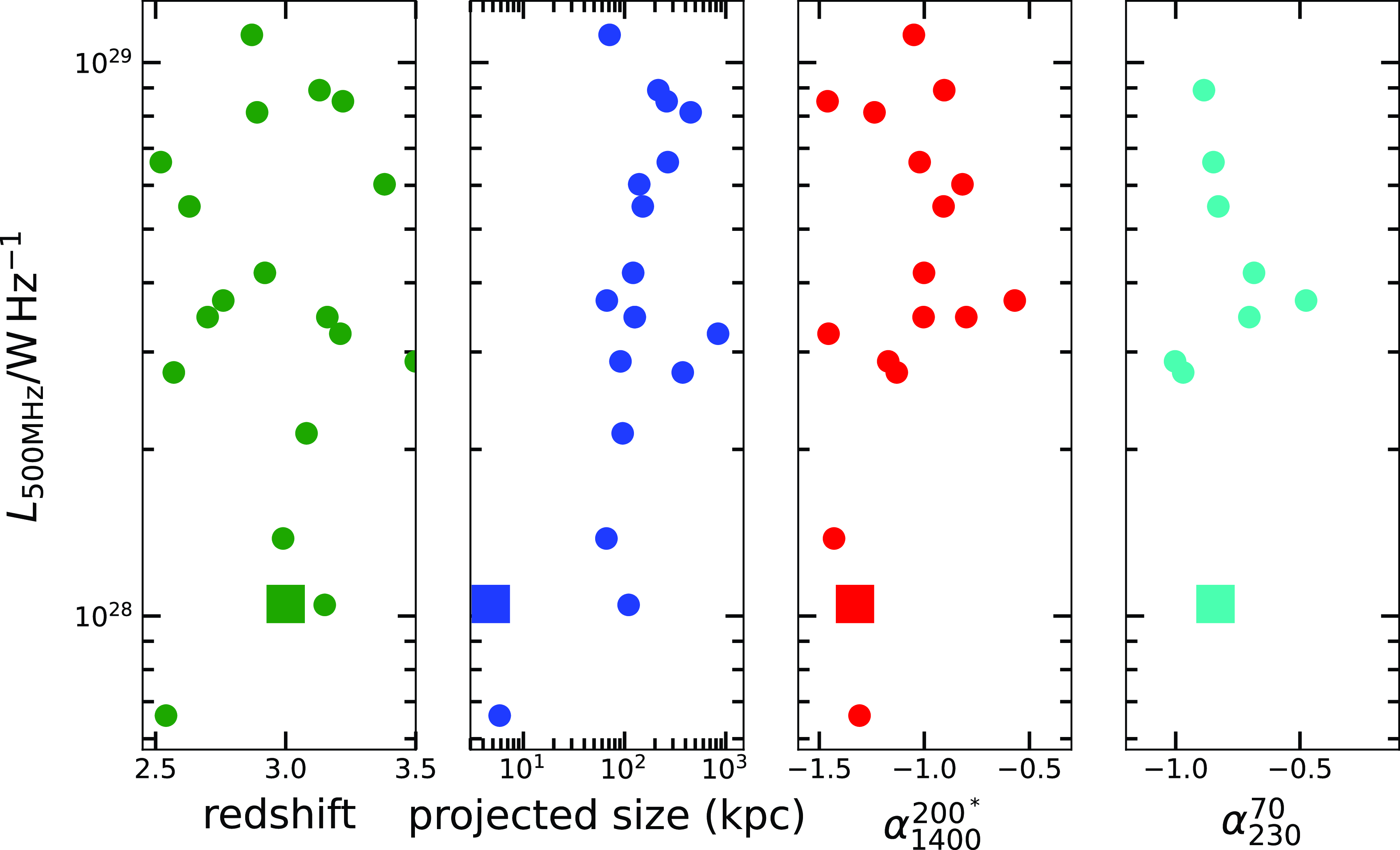
4.2 Comparison to other HzRGs and GPS/CSS sources
The fitting with RAISE (Section 3.4), unsurprising for such a compact source, finds a very young radio galaxy $\approx 50\,$
kyr, but with a very high jet power. Note, it is unlikely that this radio source is beamed given the steep spectrum (
$\approx 50\,$
kyr, but with a very high jet power. Note, it is unlikely that this radio source is beamed given the steep spectrum ( $-1.7 \lt \alpha \lt -0.8$
across
$-1.7 \lt \alpha \lt -0.8$
across $0.1 \lt \nu_{\mathrm{observed}}/\mathrm{GHz} \lt 30$
), the
$0.1 \lt \nu_{\mathrm{observed}}/\mathrm{GHz} \lt 30$
), the $\lt 2.6\%$
linear polarisation at 7.25 GHz (D21), and the fact we see both jets.
$\lt 2.6\%$
linear polarisation at 7.25 GHz (D21), and the fact we see both jets.
Fig. 6 compares the properties of GLEAM J0917 $-$
0012 to the sample of powerful HzRGs reported in Seymour et al. (Reference Seymour2007) and De Breuck et al. (Reference De Breuck2010). We limit the comparison to
$-$
0012 to the sample of powerful HzRGs reported in Seymour et al. (Reference Seymour2007) and De Breuck et al. (Reference De Breuck2010). We limit the comparison to $2 \lt z \lt 4$
and compare 500 MHz luminosities to the redshift, size, and high frequency (151/187/200/325–1 400 MHz) and low frequency (70–230 MHz) spectral indices. The latter is only available for the GLEAM detected sources and the higher frequency spectral indices are derived from NVSS (Condon et al. Reference Condon1998), i.e. 1.4 GHz, and GLEAM 200 MHz flux densities; where GLEAM data was not available, we use other low-frequency photometry: 178 MHz – Pilkington & Scott (Reference Pilkington and Scott1965), 151 MHz – Waldram et al. (Reference Waldram, Yates, Riley and Warner1996), and 325 MHz – Rengelink et al. (Reference Rengelink1997). GLEAM J0917
$2 \lt z \lt 4$
and compare 500 MHz luminosities to the redshift, size, and high frequency (151/187/200/325–1 400 MHz) and low frequency (70–230 MHz) spectral indices. The latter is only available for the GLEAM detected sources and the higher frequency spectral indices are derived from NVSS (Condon et al. Reference Condon1998), i.e. 1.4 GHz, and GLEAM 200 MHz flux densities; where GLEAM data was not available, we use other low-frequency photometry: 178 MHz – Pilkington & Scott (Reference Pilkington and Scott1965), 151 MHz – Waldram et al. (Reference Waldram, Yates, Riley and Warner1996), and 325 MHz – Rengelink et al. (Reference Rengelink1997). GLEAM J0917 $-$
0012 is on the lower end of the luminosity distribution and is smaller than all sources bar WN J1115
$-$
0012 is on the lower end of the luminosity distribution and is smaller than all sources bar WN J1115 $+$
5016 (at
$+$
5016 (at $z=2.54$
) which is a compact radio double with a size of
$z=2.54$
) which is a compact radio double with a size of $0.2''$
(1.64 kpc). WN J1115
$0.2''$
(1.64 kpc). WN J1115 $+$
5016 shows CIV
$+$
5016 shows CIV $\lambda$
1549 in broad absorption (De Breuck et al. Reference De Breuck2001) suggesting an outflow like other broad absorption line QSOs.
$\lambda$
1549 in broad absorption (De Breuck et al. Reference De Breuck2001) suggesting an outflow like other broad absorption line QSOs.
GLEAM J0917 $-$
0012 also has a steep high frequency spectral index compared to most HzRGs in this sample. Modelling of high redshift USS-selected radio galaxies suggests that the steep spectrum is partly by selection and partly due to higher inverse Compton losses at higher redshifts (Morabito & Harwood Reference Morabito and Harwood2018). As this source was selected at low-frequency, its USS nature is not by selection. Its steep high-frequency spectrum must be due to inverse Compton or simple synchrotron losses. The modelling from RAISE in Section 3.4 suggests that the steepening is likely caused by synchrotron losses combined with the sudden drop in magnetic field strength experienced by freshly shock-accelerated electrons upon exiting the galaxy.
$-$
0012 also has a steep high frequency spectral index compared to most HzRGs in this sample. Modelling of high redshift USS-selected radio galaxies suggests that the steep spectrum is partly by selection and partly due to higher inverse Compton losses at higher redshifts (Morabito & Harwood Reference Morabito and Harwood2018). As this source was selected at low-frequency, its USS nature is not by selection. Its steep high-frequency spectrum must be due to inverse Compton or simple synchrotron losses. The modelling from RAISE in Section 3.4 suggests that the steepening is likely caused by synchrotron losses combined with the sudden drop in magnetic field strength experienced by freshly shock-accelerated electrons upon exiting the galaxy.
Comparing the age and size of GLEAM J0917 $-$
0012 to a sample of bright CSO sources across
$-$
0012 to a sample of bright CSO sources across $2 \lt z \lt 2.37$
(Murgia et al. Reference Murgia1999), we find that it lies long the track of lobe dominated, rather than jet dominated, CSO sources. This result is not surprising as most (
$2 \lt z \lt 2.37$
(Murgia et al. Reference Murgia1999), we find that it lies long the track of lobe dominated, rather than jet dominated, CSO sources. This result is not surprising as most ( $\approx$
80%) of the radio emission is detected on LBA scales and our modelling with RAISE in Section 3.4 is based on these (small) lobes.
$\approx$
80%) of the radio emission is detected on LBA scales and our modelling with RAISE in Section 3.4 is based on these (small) lobes.
The extended component of the [OII] line in GLEAM J0917 $-$
0012 is reminiscent of the jet-cloud interactions observed in low-redshift sources like 3C316 (An et al. 2013) and 3C48 (Stockton et al. Reference Stockton, Canalizo, Fu and Keel2007; An et al. 2010). In these objects, the jet morphology shows clear signatures of strong interactions, including knotty jet structures with bright jet knots and large jet bending indicative of deflection. The extension of the [OII] emission along the jet axis of GLEAM J0917–0012 is also reminiscent of alignments seen between the radio plasma and various constituents of the host environment in extended HzRGs, which often also show complex and knotty radio morphologies (Miley & De Breuck Reference Miley and De Breuck2008, see also Sect. 1).
$-$
0012 is reminiscent of the jet-cloud interactions observed in low-redshift sources like 3C316 (An et al. 2013) and 3C48 (Stockton et al. Reference Stockton, Canalizo, Fu and Keel2007; An et al. 2010). In these objects, the jet morphology shows clear signatures of strong interactions, including knotty jet structures with bright jet knots and large jet bending indicative of deflection. The extension of the [OII] emission along the jet axis of GLEAM J0917–0012 is also reminiscent of alignments seen between the radio plasma and various constituents of the host environment in extended HzRGs, which often also show complex and knotty radio morphologies (Miley & De Breuck Reference Miley and De Breuck2008, see also Sect. 1).
From the broad-band radio spectral fitting in D21, the peak flux must be at $\ll 280\,$
MHz (in the rest-frame) which potentially puts this source on or below the intrinsic turnover frequency vs. linear size relation presented in O’Dea & Baum (Reference O’Dea and Baum1997). We note that the most comparable source to GLEAM J0917
$\ll 280\,$
MHz (in the rest-frame) which potentially puts this source on or below the intrinsic turnover frequency vs. linear size relation presented in O’Dea & Baum (Reference O’Dea and Baum1997). We note that the most comparable source to GLEAM J0917 $-$
0012, WN J1115
$-$
0012, WN J1115 $+$
5016 (discussed above), must also have a rest-frame peak frequency
$+$
5016 (discussed above), must also have a rest-frame peak frequency $ \lt $
255 MHz and hence may be another high redshift MPS/CSS source.
$ \lt $
255 MHz and hence may be another high redshift MPS/CSS source.
The X-ray non-detection with eROSITA implies a luminosity lower limit of $L_{\mathrm{0.5-2keV}} \lt 1.7\times 10^{44}\,$
erg s
$L_{\mathrm{0.5-2keV}} \lt 1.7\times 10^{44}\,$
erg s $^{-1}$
(see Table 3) assuming a photon index of
$^{-1}$
(see Table 3) assuming a photon index of $\Gamma=1.8$
. Comparing this result to other X-ray observations of CSS sources (Kunert-Bajraszewska et al. Reference Kunert-Bajraszewska, Labiano, Siemiginowska and Guainazzi2014) we see that (a) GLEAM J0917
$\Gamma=1.8$
. Comparing this result to other X-ray observations of CSS sources (Kunert-Bajraszewska et al. Reference Kunert-Bajraszewska, Labiano, Siemiginowska and Guainazzi2014) we see that (a) GLEAM J0917 $-$
0012 lies in the region of parameter space occupied by FR II radio galaxies (Fanaroff & Riley Reference Fanaroff and Riley1974) and (b) it could be consistent with either a HERG or LERG. The former result is not too surprising as the LBA image detects the majority of the flux finding two compact lobes. As we determined in Section 3.1.2 that this source is a LERG then we would expect the true X-ray luminosity to be roughly an order of magnitude below the limit (see Fig. 3 of Kunert-Bajraszewska et al. Reference Kunert-Bajraszewska, Labiano, Siemiginowska and Guainazzi2014).
$-$
0012 lies in the region of parameter space occupied by FR II radio galaxies (Fanaroff & Riley Reference Fanaroff and Riley1974) and (b) it could be consistent with either a HERG or LERG. The former result is not too surprising as the LBA image detects the majority of the flux finding two compact lobes. As we determined in Section 3.1.2 that this source is a LERG then we would expect the true X-ray luminosity to be roughly an order of magnitude below the limit (see Fig. 3 of Kunert-Bajraszewska et al. Reference Kunert-Bajraszewska, Labiano, Siemiginowska and Guainazzi2014).
Observed [NeV]/[NeIII] vs [OII]/[NeIII] emission line flux ratios of GLEAM J0917 $-$
0012 (square) compared to models and field galaxies from SDSS (limited to [NeV] flux
$-$
0012 (square) compared to models and field galaxies from SDSS (limited to [NeV] flux $\ge 2\sigma$
and [NeII], [OII] fluxes
$\ge 2\sigma$
and [NeII], [OII] fluxes $\ge 2.5\sigma$
). The field galaxies are a mix of SFGs and AGN according to classic BPT analysis with the density bins only shown when number of galaxies
$\ge 2.5\sigma$
). The field galaxies are a mix of SFGs and AGN according to classic BPT analysis with the density bins only shown when number of galaxies $N\ge 3$
. We also show the MAPPINGS III (Allen et al. Reference Allen, Groves, Dopita, Sutherland and Kewley2008) tracks of the radiative shock models for a galaxy with a low, Small Magellenic Cloud (SMC)-like metallicity (comparable to the host, see Table 3). The three different models are radiative shock and photoionised precursor (sp) models and the simpler shock (s) or precursor (p) only models (with the arrows indicating the direction of increasing shock velocity from 100 to 1 000 km s
$N\ge 3$
. We also show the MAPPINGS III (Allen et al. Reference Allen, Groves, Dopita, Sutherland and Kewley2008) tracks of the radiative shock models for a galaxy with a low, Small Magellenic Cloud (SMC)-like metallicity (comparable to the host, see Table 3). The three different models are radiative shock and photoionised precursor (sp) models and the simpler shock (s) or precursor (p) only models (with the arrows indicating the direction of increasing shock velocity from 100 to 1 000 km s $^{-1}$
). Finally, we show the tracks of low-luminosity AGN (LLAGN) from Groves, Heckman, & Kauffmann (Reference Groves, Heckman and Kauffmann2006) with different metallicities and ionisation parameters (the arrow indicates the direction of increasing ionisation parameter value). From this analysis the most likely cause of the line ratios seen in GLEAM J0917
$^{-1}$
). Finally, we show the tracks of low-luminosity AGN (LLAGN) from Groves, Heckman, & Kauffmann (Reference Groves, Heckman and Kauffmann2006) with different metallicities and ionisation parameters (the arrow indicates the direction of increasing ionisation parameter value). From this analysis the most likely cause of the line ratios seen in GLEAM J0917 $-$
0012 is a radiative shock with a photoionised precursor.
$-$
0012 is a radiative shock with a photoionised precursor.
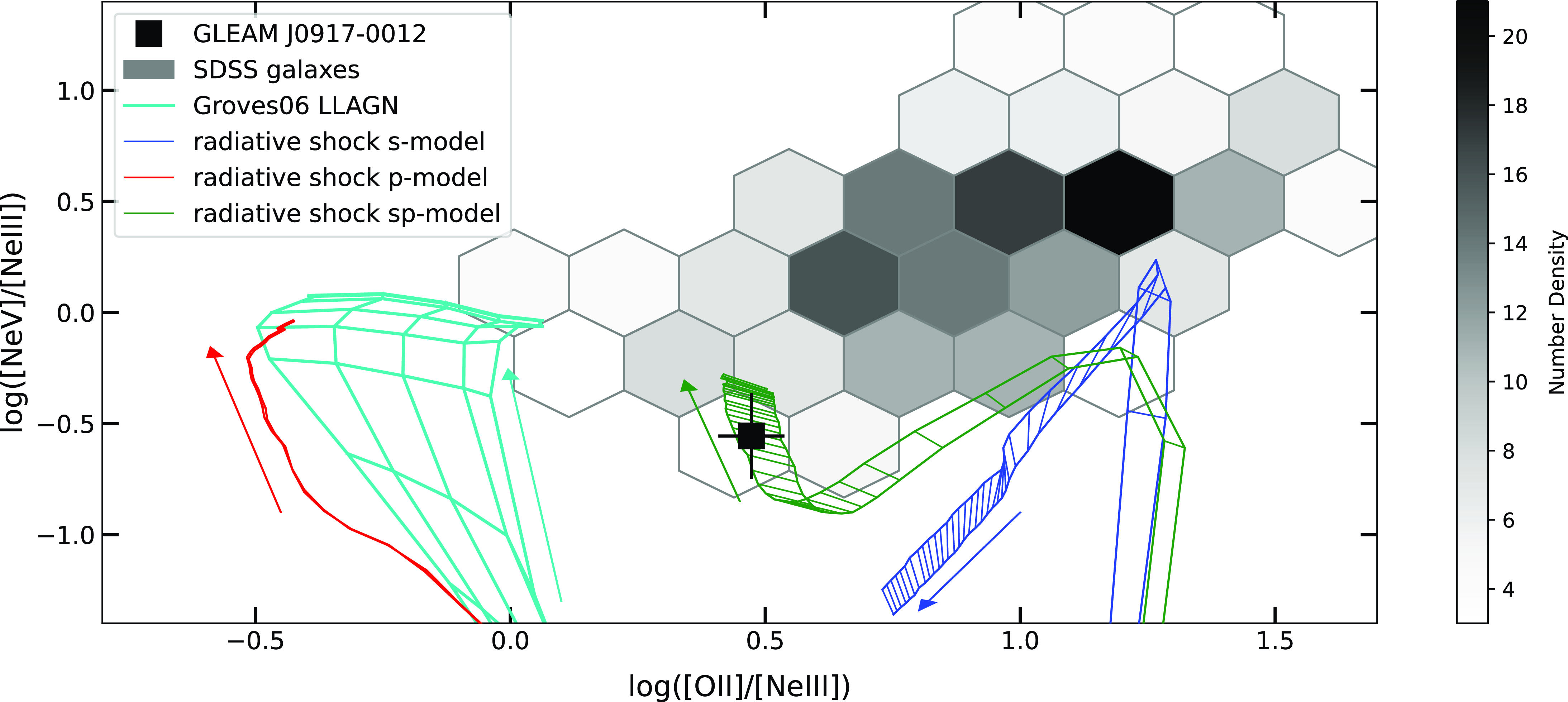
4.3 Origin of Ionising field
As discussed in Section 3.1.2, the presence of [NeV] is a strong indicator of an AGN and is often seen in radio galaxies with EELRs (e.g. Spinrad & Djorgovski Reference Spinrad and Djorgovski1984). Compact radio galaxies with EELRs aligned with the radio emission are generally powered by shock ionisation (De Breuck et al. Reference De Breuck2000; Fu & Stockton Reference Fu and Stockton2009a) as supported by observations of UV line ratios. Studies of EELRs typically focus on the [OIII] $\lambda$
5008 and H
$\lambda$
5008 and H $\alpha$
lines since the lower critical density of [OII] means it can arise well away from the narrow-line region in the EELR (e.g. Villar-Martín et al. Reference Villar-Martín2011).
$\alpha$
lines since the lower critical density of [OII] means it can arise well away from the narrow-line region in the EELR (e.g. Villar-Martín et al. Reference Villar-Martín2011).
Looking at the bright [OII] emission from GLEAM J0917 $-$
0012 we estimate an upper limit to the velocity dispersion by fitting a single Gaussian to the 1D spectrum finding (
$-$
0012 we estimate an upper limit to the velocity dispersion by fitting a single Gaussian to the 1D spectrum finding ( $\equiv 3\,160\pm 160\,$
km s
$\equiv 3\,160\pm 160\,$
km s $^{-1}$
). This will over-estimate the velocity width as source morphology and velocity are convolved in grism observations (hence it is reported as an upper limit in Table 3). Higher resolution prism/slit spectroscopy is required to determine an accurate value.
$^{-1}$
). This will over-estimate the velocity width as source morphology and velocity are convolved in grism observations (hence it is reported as an upper limit in Table 3). Higher resolution prism/slit spectroscopy is required to determine an accurate value.
Fig. 7 presents the observed [NeV]/[NeIII] and [OII]/[NeIII] line ratios of GLEAM J0917 $-$
0012 compared to low redshift (
$-$
0012 compared to low redshift ( $\langle z\rangle=0.137$
) Sloan Digital Sky Survey-III (SDSSs, York et al. Reference York2000)/Baryonic Oscillation Spectroscopic Survey (BOSS, Eisenstein et al. Reference Eisenstein2011) data. No selection is made in redshift hence the mean redshift is a survey selection effect. The measured line strengths are taken from the catalogue of emission line properties from Thomas et al. (Reference Thomas2013).Footnote
f
We restrict this comparison to galaxies with [OIII] and [NeIII] detected at
$\langle z\rangle=0.137$
) Sloan Digital Sky Survey-III (SDSSs, York et al. Reference York2000)/Baryonic Oscillation Spectroscopic Survey (BOSS, Eisenstein et al. Reference Eisenstein2011) data. No selection is made in redshift hence the mean redshift is a survey selection effect. The measured line strengths are taken from the catalogue of emission line properties from Thomas et al. (Reference Thomas2013).Footnote
f
We restrict this comparison to galaxies with [OIII] and [NeIII] detected at $\ge 2.5\sigma$
and [NeII] detected at
$\ge 2.5\sigma$
and [NeII] detected at $\ge 2\sigma$
. The uncertainties on the flux ratios are smaller than the hexagonal bins. No selection is made for galaxy type, and this sample includes both AGN and star-forming galaxies as selected by the (Baldwin, Phillips, & Terlevich Reference Baldwin, Phillips and Terlevich1981, hereafter BPT) criteria. We applied no reddening correction as all three lines are close in wavelength and hence their ratios are minimally affected by dust absorption. We also examine the parameter space of the emission line ratios from low luminosity AGN (LLAGN) modelled by Groves et al. (Reference Groves, Heckman and Kauffmann2006). Finally, we compare the line ratios to those predicted from the MAPPINGS III library of fast radiative shock models (Allen et al. Reference Allen, Groves, Dopita, Sutherland and Kewley2008). We plot the radiative shock and photoionised precursor (sp) models and the simpler shock (s) or precursor (p) only models for a low, SMC-like metallicity (comparable to the metallicity estimates from the BEAGLE fit Section 3.3.1) although the general result holds for nearly all metallicity templates.
$\ge 2\sigma$
. The uncertainties on the flux ratios are smaller than the hexagonal bins. No selection is made for galaxy type, and this sample includes both AGN and star-forming galaxies as selected by the (Baldwin, Phillips, & Terlevich Reference Baldwin, Phillips and Terlevich1981, hereafter BPT) criteria. We applied no reddening correction as all three lines are close in wavelength and hence their ratios are minimally affected by dust absorption. We also examine the parameter space of the emission line ratios from low luminosity AGN (LLAGN) modelled by Groves et al. (Reference Groves, Heckman and Kauffmann2006). Finally, we compare the line ratios to those predicted from the MAPPINGS III library of fast radiative shock models (Allen et al. Reference Allen, Groves, Dopita, Sutherland and Kewley2008). We plot the radiative shock and photoionised precursor (sp) models and the simpler shock (s) or precursor (p) only models for a low, SMC-like metallicity (comparable to the metallicity estimates from the BEAGLE fit Section 3.3.1) although the general result holds for nearly all metallicity templates.
GLEAM J0917 $-$
0012 lies in a region of parameter space below and to the left of the bulk of the Sloan Digital Sky Survey-III (SDSS) sources, clearly due to the strong [NeIII] line, but to the right of the LLAGN parameter space. GLEAM J0917
$-$
0012 lies in a region of parameter space below and to the left of the bulk of the Sloan Digital Sky Survey-III (SDSS) sources, clearly due to the strong [NeIII] line, but to the right of the LLAGN parameter space. GLEAM J0917 $-$
0012 is consistent with the sp model from MAPPINGS III. This result is driven by the observed [OII]/[NeIII] line ratio. The MAPPINGS III models are a function of velocity, magnetic parameters, preshock density, and abundances. The range of velocities modelled only reaches up to 1 000 km s
$-$
0012 is consistent with the sp model from MAPPINGS III. This result is driven by the observed [OII]/[NeIII] line ratio. The MAPPINGS III models are a function of velocity, magnetic parameters, preshock density, and abundances. The range of velocities modelled only reaches up to 1 000 km s $^{-1}$
, but the models find that for the sp models, [NeV]/[NeIII] ratio correlates with velocity and the observed value is consistent with the fastest velocities. Given the uncertainties in the observed line ratios and the overlapping nature of the sp models in this line ratio parameter space, it is not possible to place any constraints on the magnetic parameters, preshock density, or abundance. While typical EELR galaxies have [NeV]/[NeIII] line ratios
$^{-1}$
, but the models find that for the sp models, [NeV]/[NeIII] ratio correlates with velocity and the observed value is consistent with the fastest velocities. Given the uncertainties in the observed line ratios and the overlapping nature of the sp models in this line ratio parameter space, it is not possible to place any constraints on the magnetic parameters, preshock density, or abundance. While typical EELR galaxies have [NeV]/[NeIII] line ratios $ \gt 1$
(Fu & Stockton Reference Fu and Stockton2009a), which is inconsistent with GLEAM J0917
$ \gt 1$
(Fu & Stockton Reference Fu and Stockton2009a), which is inconsistent with GLEAM J0917 $-$
0012, the suggestion that GLEAM J0917
$-$
0012, the suggestion that GLEAM J0917 $-$
0012 is powered by shock emission is consistent with earlier work on compact radio galaxies (Best et al. Reference Best, Röttgering and Longair2000; De Breuck et al. Reference De Breuck2000; Inskip et al. Reference Inskip2002).
$-$
0012 is powered by shock emission is consistent with earlier work on compact radio galaxies (Best et al. Reference Best, Röttgering and Longair2000; De Breuck et al. Reference De Breuck2000; Inskip et al. Reference Inskip2002).
Recently, studies of [NeV]-selected galaxies (Cleri et al. Reference Cleri2023a) have shown that $z\approx 2$
galaxies in CANDELS with G102/G141 WPC3 grism spectra have line ratios similar to the local SDSS galaxies in Fig. 7. Cleri et al. (Reference Cleri2023b) has also shown that galaxies observed with the NIRSpec instrument on board JWST have line ratios consistent with low-luminosity AGN. Therefore, GLEAM J0917
$z\approx 2$
galaxies in CANDELS with G102/G141 WPC3 grism spectra have line ratios similar to the local SDSS galaxies in Fig. 7. Cleri et al. (Reference Cleri2023b) has also shown that galaxies observed with the NIRSpec instrument on board JWST have line ratios consistent with low-luminosity AGN. Therefore, GLEAM J0917 $-$
0012 has line ratios different from both these samples, further suggesting a unique physical mechanism compared to the general radio-quiet AGN population.
$-$
0012 has line ratios different from both these samples, further suggesting a unique physical mechanism compared to the general radio-quiet AGN population.
The presence of the [NeV] line suggests an ionisation potential strong enough to ionise helium into He $^\mathrm{2+}$
. As GLEAM J0917
$^\mathrm{2+}$
. As GLEAM J0917 $-$
0012 lies at
$-$
0012 lies at $z\approx 3$
, towards the end of the epoch of Helium reionisation, this source, and other compact radio-loud AGN, could be great targets for observations of potential absorption by the hyperfine transition of the singularly ionised helium isotope 3He
$z\approx 3$
, towards the end of the epoch of Helium reionisation, this source, and other compact radio-loud AGN, could be great targets for observations of potential absorption by the hyperfine transition of the singularly ionised helium isotope 3He $^\mathrm{+}$
(rest-frame frequency of 8.66 GHz) as well as neutral hydrogen. Future spatially resolved,
$^\mathrm{+}$
(rest-frame frequency of 8.66 GHz) as well as neutral hydrogen. Future spatially resolved, $0.1''$
, spectroscopy with JWST of the [NeV], [NeIII], and [OII] lines could map out the origin of the photoionisation across and in front of the jet. Observed asymmetry in the Lyman
$0.1''$
, spectroscopy with JWST of the [NeV], [NeIII], and [OII] lines could map out the origin of the photoionisation across and in front of the jet. Observed asymmetry in the Lyman $\alpha$
line could also be used to model line of sight absorption by HI, providing an independent comparison to HI absorption seen in the radio.
$\alpha$
line could also be used to model line of sight absorption by HI, providing an independent comparison to HI absorption seen in the radio.
4.4 Black hole mass and accretion rate constraints
4.4.1 Bolometric luminosity
Recently, Barchiesi et al. (Reference Barchiesi2024) has investigated [NeV]-selected galaxies at $0.6 \lt z \lt 1.2$
in the Cosmic Evolution Survey (COSMOS; Scoville et al. Reference Scoville2007). They found a tight correlation between the AGN bolometric luminosity derived from broad-band SED fitting and the luminosity of the [NeV] line. Here we use this relation to estimate the AGN bolometric luminosity of GLEAM J0917
$0.6 \lt z \lt 1.2$
in the Cosmic Evolution Survey (COSMOS; Scoville et al. Reference Scoville2007). They found a tight correlation between the AGN bolometric luminosity derived from broad-band SED fitting and the luminosity of the [NeV] line. Here we use this relation to estimate the AGN bolometric luminosity of GLEAM J0917 $-$
0012, finding a value of
$-$
0012, finding a value of $1.1\pm 0.4\times 10^{12}\,\textit{L}_\odot$
where the uncertainty comes from the uncertainty of the [NeV] flux measurement (i.e. does not include any scatter in the relation between AGN bolometric luminosity and [NeV] line luminosity). From the WISE non-detections presented in S22 we can derive an upper limit to the rest-frame mid-IR luminosity and hence to the AGN bolometric luminosity,
$1.1\pm 0.4\times 10^{12}\,\textit{L}_\odot$
where the uncertainty comes from the uncertainty of the [NeV] flux measurement (i.e. does not include any scatter in the relation between AGN bolometric luminosity and [NeV] line luminosity). From the WISE non-detections presented in S22 we can derive an upper limit to the rest-frame mid-IR luminosity and hence to the AGN bolometric luminosity, $L_{\mathrm{BOL}}$
. We use the conversion from
$L_{\mathrm{BOL}}$
. We use the conversion from $3.4\,\mu$
m luminosity to bolometric luminosity given in Kim et al. (Reference Kim2023). From this, we find
$3.4\,\mu$
m luminosity to bolometric luminosity given in Kim et al. (Reference Kim2023). From this, we find $L_{\mathrm{BOL}}\le 1.7\times 10^{12}\,\mathrm{L}_\odot$
(reported in Table 3). This value is consistent with the bolometric luminosity derived from the [NeV] line luminosity.
$L_{\mathrm{BOL}}\le 1.7\times 10^{12}\,\mathrm{L}_\odot$
(reported in Table 3). This value is consistent with the bolometric luminosity derived from the [NeV] line luminosity.
The luminosity of the [NeV] line is also known to correlate with the unobscured X-ray luminosity (Mignoli et al. Reference Mignoli2013). A typical value for the X-ray to [NeV] luminosity ratio, X/[NeV], is $\approx 400$
for unobscured Seyferts and QSOs (Gilli et al. Reference Gilli2010) albeit with an order of magnitude scatter. We estimate an unobscured X-ray luminosity of
$\approx 400$
for unobscured Seyferts and QSOs (Gilli et al. Reference Gilli2010) albeit with an order of magnitude scatter. We estimate an unobscured X-ray luminosity of $L_{\mathrm{X}}^\mathrm{[NeV]}\approx 1.2\times 10^{44}\,$
erg s
$L_{\mathrm{X}}^\mathrm{[NeV]}\approx 1.2\times 10^{44}\,$
erg s $^{-1}$
. This result is consistent with the X-ray luminosity upper limit inferred from eROSITA (
$^{-1}$
. This result is consistent with the X-ray luminosity upper limit inferred from eROSITA ( $L_{\mathrm{X}} \lt 1.7\times 10^{44}\,$
erg s
$L_{\mathrm{X}} \lt 1.7\times 10^{44}\,$
erg s $^{-1}$
assuming a photon index of
$^{-1}$
assuming a photon index of $\Gamma=1.8$
) although compact radio sources typically show large absorbing column densities,
$\Gamma=1.8$
) although compact radio sources typically show large absorbing column densities, $N_{\mathrm{H}}\approx 10^{21}$
–
$N_{\mathrm{H}}\approx 10^{21}$
– $10^{24}\,$
cm
$10^{24}\,$
cm $^{-2}$
(Sobolewska et al. Reference Sobolewska2019).
$^{-2}$
(Sobolewska et al. Reference Sobolewska2019).
4.4.2 Black hole mass and Eddington accretion
Assuming that the [NeV] bolometric luminosity is an approximation of the true value, we can determine rough constraints on the black hole mass and accretion rate by using the jet power calculated in Section 3.4. We use analytical solutions to the Blandford & Znajek (Reference Blandford and Znajek1977), hereafter BZ, model to express the jet power as function of black hole mass, $M_{\mathrm{BH}}$
, Eddington accretion rate,
$M_{\mathrm{BH}}$
, Eddington accretion rate, $\dot{m}$
and the dimensionless black hole spin parameter, a (i.e. we assume a spinning Kerr Reference Kerr1963, black hole). This dimensionless spin parameter is limited to
$\dot{m}$
and the dimensionless black hole spin parameter, a (i.e. we assume a spinning Kerr Reference Kerr1963, black hole). This dimensionless spin parameter is limited to $-1 \lt a \lt 1$
with a negative value corresponding to retrograde spin of the accretion disk relative to the black hole spin. The spin paradigm of the BZ model, where the magnetic fields thread the black hole, posits that the energy of the jet comes from the angular momentum of the black hole not the accretion. Even if some of the magnetic field threads the accretion disk (i.e. the BP model of Blandford & Payne Reference Blandford and Payne1982), this magnetic field is still a function of the spin as the rotating general relativistic metric of the Kerr black hole ‘frame-drags’ the magnetic field and inner accretion disk (Meier Reference Meier1999).
$-1 \lt a \lt 1$
with a negative value corresponding to retrograde spin of the accretion disk relative to the black hole spin. The spin paradigm of the BZ model, where the magnetic fields thread the black hole, posits that the energy of the jet comes from the angular momentum of the black hole not the accretion. Even if some of the magnetic field threads the accretion disk (i.e. the BP model of Blandford & Payne Reference Blandford and Payne1982), this magnetic field is still a function of the spin as the rotating general relativistic metric of the Kerr black hole ‘frame-drags’ the magnetic field and inner accretion disk (Meier Reference Meier1999).
We follow the formalism for jet power, $Q_{\mathrm{jet}}$
, developed in Meier (Reference Meier2002) which is used frequently in the literature (e.g. Fanidakis et al. Reference Fanidakis2011; Amarantidis et al. Reference Amarantidis2019). While Meier (Reference Meier2001) has formulas for the jet power which depend on extra factors, such as the disk viscosity and relative angular momentum, very similar jet powers are estimated for reasonable values of these extra (but unmeasurable) parameters. Hence, we caution that the expressions below are approximations.
$Q_{\mathrm{jet}}$
, developed in Meier (Reference Meier2002) which is used frequently in the literature (e.g. Fanidakis et al. Reference Fanidakis2011; Amarantidis et al. Reference Amarantidis2019). While Meier (Reference Meier2001) has formulas for the jet power which depend on extra factors, such as the disk viscosity and relative angular momentum, very similar jet powers are estimated for reasonable values of these extra (but unmeasurable) parameters. Hence, we caution that the expressions below are approximations.
As the strength of the jet power is largely determined by the strength of the polaroid magnetic field then it depends on the structure of the accretion disk (Livio, Ogilvie, & Pringle Reference Livio, Ogilvie and Pringle1999). Therefore, the expressions used for the jet powers have either a geometrically thin disk (TD, with efficient accretion, Shakura & Sunyaev Reference Shakura and Sunyaev1973), or the geometrically thick disk (occurring in an advection-dominated accretion flow, ADAF, with lower efficiency accretion, Rees et al. Reference Rees, Begelman, Blandford and Phinney1982):
 \begin{align} Q_{\mathrm{jet}}^{\mathrm{TD}}\approx 2.5\times 10^{36}{\bigg(\frac{M_{\mathrm{BH}}}{10^9\,\mathrm{ M}_\odot}\bigg)}^{1.1}\,{\bigg(\frac{\dot{m}}{0.01}\bigg)}^{1.2} \times a^2\ \mathrm{(W)} \\[-25pt] \nonumber \end{align}
 \begin{align} Q_{\mathrm{jet}}^\mathrm{ADAF}\approx 2\times 10^{38}\bigg(\frac{M_{\mathrm{BH}}}{ 10^9\,\mathrm{M}_\odot}\bigg)\,\bigg(\frac{\dot{m}}{0.01}\bigg) \times a^2\ \mathrm{(W).}\end{align}
Typically accretion disks are believed to transition from an ADAF to a TD as $\dot{m}$
increases through 0.01–0.03 (based of typical values of
$\dot{m}$
increases through 0.01–0.03 (based of typical values of $\dot{m}$
seen in the transition from ADAFs to TDs in Galactic black holes Vahdat Motlagh, Kalemci, & Maccarone Reference Vahdat Motlagh, Kalemci and Maccarone2019).
$\dot{m}$
seen in the transition from ADAFs to TDs in Galactic black holes Vahdat Motlagh, Kalemci, & Maccarone Reference Vahdat Motlagh, Kalemci and Maccarone2019).
We do not have a constraint on $\dot{m}$
or
$\dot{m}$
or $M_{\mathrm{BH}}$
for GLEAM J0917
$M_{\mathrm{BH}}$
for GLEAM J0917 $-$
0012, but we have a joint constraint on the black hole mass and
$-$
0012, but we have a joint constraint on the black hole mass and $\dot{m}$
from the bolometric luminosity (from the definition of the Eddington accretion rate:
$\dot{m}$
from the bolometric luminosity (from the definition of the Eddington accretion rate: $\dot{m}=L_{\mathrm{BOL}}/(k\times M)$
where k depends on the units used). Using the estimate of the bolometric luminosity derived in Section 4.4.1 from the [NeV] line (
$\dot{m}=L_{\mathrm{BOL}}/(k\times M)$
where k depends on the units used). Using the estimate of the bolometric luminosity derived in Section 4.4.1 from the [NeV] line ( $\approx 1.1\pm 0.4\times 10^{12}\,\textit{L}_\odot$
) we get:
$\approx 1.1\pm 0.4\times 10^{12}\,\textit{L}_\odot$
) we get:
 \begin{align} \bigg(\frac{M_{\mathrm{BH}}}{10^9\,\mathrm{M}_\odot}\bigg)\,\bigg(\frac{\dot{m}}{0.01}\bigg) \approx 3.2\pm 1.2\end{align}
Reconciling this result and the high jet power, $\sim 1.5\times 10^{39}\,$
W (from Section 3.4), with Equations (1) and (2) implies values of
$\sim 1.5\times 10^{39}\,$
W (from Section 3.4), with Equations (1) and (2) implies values of $a^2\gg1$
. However, the dimensionless black hole spin parameter is limited to
$a^2\gg1$
. However, the dimensionless black hole spin parameter is limited to $\le 1$
for the Kerr (Reference Kerr1963) solution for black holes, hence our observations are not consistent with Equation (1). In the ADAF case (Equation 2) it would imply
$\le 1$
for the Kerr (Reference Kerr1963) solution for black holes, hence our observations are not consistent with Equation (1). In the ADAF case (Equation 2) it would imply $a^2\approx 2.1$
, i.e. only just above unity. Therefore, allowing for the uncertainties on the jet power and/or the bolometric luminosity, this result could be consistent with the ADAF solution, i.e. realistic values of
$a^2\approx 2.1$
, i.e. only just above unity. Therefore, allowing for the uncertainties on the jet power and/or the bolometric luminosity, this result could be consistent with the ADAF solution, i.e. realistic values of $a\lesssim 1$
could be achieved, but not the TD solution. While the [NeV] constrain on the bolometric luminosity has some uncertainty, the upper limit from the WISE non-detection,
$a\lesssim 1$
could be achieved, but not the TD solution. While the [NeV] constrain on the bolometric luminosity has some uncertainty, the upper limit from the WISE non-detection, $\lt 1.7\times 10^{12}\,\textit{L}_\odot$
, is more robust and equally well supports the conclusions above. The conclusion that the accretion disk is in ADAF and not a thin disk state is consistent with the interpretation from Section 3.1.2 that GLEAM J0917
$\lt 1.7\times 10^{12}\,\textit{L}_\odot$
, is more robust and equally well supports the conclusions above. The conclusion that the accretion disk is in ADAF and not a thin disk state is consistent with the interpretation from Section 3.1.2 that GLEAM J0917 $-$
0012 is a LERG and not a HERG. Even using the equations from Meier (Reference Meier2001) we find the only consistent solution is the ADAF one.
$-$
0012 is a LERG and not a HERG. Even using the equations from Meier (Reference Meier2001) we find the only consistent solution is the ADAF one.
The inference that the BH has an ADAF disk at first may seem inconsistent with high-excitation state inferred by the [OII] luminosity (see Section 3.1.2). However, the [OII] luminosity has an unknown contribution from star formation as the SFR derived from SED fitting provides a poor constraint (see Section 3.3.1). Furthermore, in radio-loud AGN it has been shown that [OII] is predominantly due to some combination of star-formation, EELR, and shocks (Maddox Reference Maddox2018), not the broad or narrow line region, hence is not a good indicator that an AGN has a high enough accretion rate to be in TD state.
If the accretion disk is in an ADAF mode with then we can very tentatively constrain the black hole mass assuming a maximum Eddington accretion of $\dot{m}\le 0.03$
. With this value we obtain a constraint on the black hole mass of
$\dot{m}\le 0.03$
. With this value we obtain a constraint on the black hole mass of $\ge10^9\,\textit{M}_\odot$
. In this case the black hole mass would be more than an order of magnitude above the local black hole mass/host galaxy relation of Reines & Volonteri (Reference Reines and Volonteri2015) relation for local AGN hosts (which would predict a black hole mass of just
$\ge10^9\,\textit{M}_\odot$
. In this case the black hole mass would be more than an order of magnitude above the local black hole mass/host galaxy relation of Reines & Volonteri (Reference Reines and Volonteri2015) relation for local AGN hosts (which would predict a black hole mass of just $\approx 6\times 10^7\,\textit{M}_\odot$
). However, it is consistent with the Reines & Volonteri (Reference Reines and Volonteri2015) relation for local massive ellipticals which are believed to be the local descendants of powerful HzRGs (e.g., Seymour et al. Reference Seymour2007; De Breuck et al. Reference De Breuck2010). If the [NeV] bolometric AGN luminosity is over-estimated, then the inconsistency with both disk models increases. Hence, the very high jet power of GLEAM J0917
$\approx 6\times 10^7\,\textit{M}_\odot$
). However, it is consistent with the Reines & Volonteri (Reference Reines and Volonteri2015) relation for local massive ellipticals which are believed to be the local descendants of powerful HzRGs (e.g., Seymour et al. Reference Seymour2007; De Breuck et al. Reference De Breuck2010). If the [NeV] bolometric AGN luminosity is over-estimated, then the inconsistency with both disk models increases. Hence, the very high jet power of GLEAM J0917 $-$
0012 implies that it likely has a high-spin, massive black hole,
$-$
0012 implies that it likely has a high-spin, massive black hole, $\ge 10^9\,\textit{M}_\odot$
with an ADAF accretion disk, and
$\ge 10^9\,\textit{M}_\odot$
with an ADAF accretion disk, and $\approx 10^{12}\,\textit{L}_\odot$
bolometric luminosity.
$\approx 10^{12}\,\textit{L}_\odot$
bolometric luminosity.
4.5 Future evolution of GLEAM J0917 $-$
0012
$-$
0012

The compact nature and spectral properties of GLEAM J0917-0012 suggest that it might be in an early stage of radio galaxy evolution, likely classified as a MPS source or a redshifted GPS source. As GPS sources are thought to represent the progenitors of large-scale radio galaxies (O’Dea Reference O’Dea1998; Orienti Reference Orienti2016), the proposed evolutionary scenario (e.g Fanti et al. Reference Fanti1995; An & Baan Reference An and Baan2012) suggests that these radio sources expand into their host galaxies, interacting strongly with the interstellar medium. We cannot determine if GLEAM J0917 $-$
0012 will (a) keep growing from GPS to CSS to extended radio galaxy, (b) shut off and stop expanding, or (c) become ‘frustrated’ by a dense medium (van Breugel, Miley, & Heckman Reference van Breugel, Miley and Heckman1984; Kawakatu, Kino, & Nagai Reference Kawakatu, Kino and Nagai2009). We can say that the observed jet-induced shocks and extended [OII] emission in GLEAM J0917
$-$
0012 will (a) keep growing from GPS to CSS to extended radio galaxy, (b) shut off and stop expanding, or (c) become ‘frustrated’ by a dense medium (van Breugel, Miley, & Heckman Reference van Breugel, Miley and Heckman1984; Kawakatu, Kino, & Nagai Reference Kawakatu, Kino and Nagai2009). We can say that the observed jet-induced shocks and extended [OII] emission in GLEAM J0917 $-$
0012 are consistent with the picture of ongoing interaction with the host galaxy (Bicknell et al. Reference Bicknell, Mukherjee, Wagner, Sutherland and Nesvadba2018).
$-$
0012 are consistent with the picture of ongoing interaction with the host galaxy (Bicknell et al. Reference Bicknell, Mukherjee, Wagner, Sutherland and Nesvadba2018).
The high black hole mass, $\ge 10^9\,\textit{M}_\odot$
, combined with the low accretion rate, has significant implications for galaxy evolution models. Observed at roughly 2 Gyr after the Big Bang, this system coincides with the peak of cosmic star formation and AGN activity (Madau & Dickinson Reference Madau and Dickinson2014). The black hole’s mass indicates significant early growth (McAlpine et al. Reference McAlpine2018) which has now slowed and the accretion disk is in a LERG state. However, even with low accretion rate, a high black hole spin is enough to produce powerful radio jets which appear to be impacting the host galaxy via shocks and potentially strong outflows.
$\ge 10^9\,\textit{M}_\odot$
, combined with the low accretion rate, has significant implications for galaxy evolution models. Observed at roughly 2 Gyr after the Big Bang, this system coincides with the peak of cosmic star formation and AGN activity (Madau & Dickinson Reference Madau and Dickinson2014). The black hole’s mass indicates significant early growth (McAlpine et al. Reference McAlpine2018) which has now slowed and the accretion disk is in a LERG state. However, even with low accretion rate, a high black hole spin is enough to produce powerful radio jets which appear to be impacting the host galaxy via shocks and potentially strong outflows.
The host galaxy’s SFR (and hence sSFR) is poorly constrained, but we can say with confidence that it is below the main sequence for star-forming galaxies at this redshift (see Section 4.1). Could the radio jets be quenching the star-formation? Deep narrow surveys are finding many quenched massive galaxies in the early Universe (Carnall et al. Reference Carnall2023). The power of the jet reported here is more than enough to quench star-formation. If the on-time of these powerful jets is short enough, $\lt 100\,$
ky, (i.e. a low radio duty cycle where they rarely grow into large radio galaxies) then they could be too rare to be seen in the deep pencil-beam JSWT surveys.
$\lt 100\,$
ky, (i.e. a low radio duty cycle where they rarely grow into large radio galaxies) then they could be too rare to be seen in the deep pencil-beam JSWT surveys.
Hence, this source potentially demonstrates how AGN feedback might regulate growth and star formation in this critical epoch (Harrison Reference Harrison2017). The source’s high redshift provides a valuable opportunity to study this evolutionary process in the early Universe. Future observations to constrain the star formation history (e.g. is the SFR declining?) and to map out the ionisation state in and around the jet will better constrain feedback.
5. Conclusions
This paper confirms the redshift of the enigmatic radio source GLEAM J0917 $-$
0012 which, due to its compact size and faint K-band host, was originally suspected to be
$-$
0012 which, due to its compact size and faint K-band host, was originally suspected to be $z\ge 6$
, but is now revealed to be a young and compact radio galaxy at cosmic noon. The main results of this work are:
$z\ge 6$
, but is now revealed to be a young and compact radio galaxy at cosmic noon. The main results of this work are:
-
1. The 1D WFC3 spectrum detects the [OII]
$\lambda$
3727 doublet as well as the [NeV]
$\lambda$
3426 and [NeIII]
$\lambda$
3867 emission lines, confirming the redshift to be
$z=3.004\pm 0.001$
. The 2D spectrum shows extended [OII] emission (
$\approx 4.8\,$
kpc) aligned with the two components seen in the high resolution (
$60\times 20$
mas) LBA imaging at 2.276 GHz. -
2. The detection of Neon lines suggest the presence of an AGN powered extended emission line region as seen in many other radio galaxies. However, the scale of this region in GLEAM J0917
$-$
0012 is smaller than the typical
$\geq 10\,$
kpc scales. -
3. The nearby optical source is found to be at
$z=2.13$
and is hence unrelated to GLEAM J0917
$-$
0012 despite its chance alignment with the radio jets. -
4. SED fitting with BEAGLE finds a stellar mass of
$\approx 2\times 10^{11}\,\textit{M}_\odot$
, making GLEAM J0917
$-$
0012 lie at the low end of the 500 MHz luminosity,
$L_{\mathrm{500MHz}}$
, and stellar mass distribution of the most extreme radio galaxies at similar redshifts. It has a similar projected size (
$\lt 10\,$
kpc) and
$L_{\mathrm{500MHz}}$
to just one other classic HzRG: WN J1115
$+$
5016. -
5. The extended component of the [OII] line in GLEAM J0917
$-$
0012 is reminiscent of the jet-cloud interactions observed in local 3C CSS sources. -
6. Modelling of the radio emission with RAiSE along with constraints on the galaxy size from the F140W image provides measures of the jet power and age of this radio source. Unsurprising, this source is young,
$\approx 50\,$
kyr with high jet power of
$\approx 10^{39}\,$
W. -
7. The crude constraint on the bolometric luminosity,
$\approx 10^{12}\,\textit{L}_\odot$
, combined with the estimate of the radio jet power tentatively implies a highly spinning central black hole in an ADAF state with a relatively low accretion rate (
$\lambda_{\mathrm{EDD}}\le 0.03$
) and a high mass,
$\ge 10^{9}\,\textit{M}_\odot$
. This result is consistent with LERG classification of this radio galaxy based on its [OII] and radio luminosity. -
8. The [NeV]
$\lambda$
3426/[NeIII]
$\lambda$
3867 vs [OII]
$\lambda$
3727/[NeIII]
$\lambda$
3867 line ratios are most consistent with radiative shock models with precursor photoionisation. Hence, GLEAM J0917
$-$
0012 is a young radio galaxy with compact jet inducing shock ionisation.


We summarise that GLEAM J0917 $-$
0012 is a prime example of a young radio galaxy interacting via shocks with the ISM of its host galaxy as demonstrated by the close alignment of the radio jet and [OII] emission as well as modelling of the emission line ratios. Potentially GLEAM J0917
$-$
0012 is a prime example of a young radio galaxy interacting via shocks with the ISM of its host galaxy as demonstrated by the close alignment of the radio jet and [OII] emission as well as modelling of the emission line ratios. Potentially GLEAM J0917 $-$
0012 is on the way to having its star-formation quenched. If the jet is short-lived then this mechanism could account for the numerous quenched massive galaxies seen in the narrow deep surveys. Such a source is a prime target for a plethora of follow-up observations investigating the nature of interaction of the jet with the host galaxy. Observations of other extreme radio to K-band flux ratio sources with low-frequency spectral curvature (e.g. Broderick et al. Reference Broderick2024) could provide numerous more candidates for vigorous mechanical feedback at cosmic noon.
$-$
0012 is on the way to having its star-formation quenched. If the jet is short-lived then this mechanism could account for the numerous quenched massive galaxies seen in the narrow deep surveys. Such a source is a prime target for a plethora of follow-up observations investigating the nature of interaction of the jet with the host galaxy. Observations of other extreme radio to K-band flux ratio sources with low-frequency spectral curvature (e.g. Broderick et al. Reference Broderick2024) could provide numerous more candidates for vigorous mechanical feedback at cosmic noon.
Acknowledgement
The authors acknowledge the Noongar people as the traditional owners and custodians of Whadjuk boodjar, the land on which the majority of this work was completed. NS thanks Brent Groves and Mara Salvato for useful discussions. We thank the reviewer for their very useful and constructive comments on the paper.
The work of DS was carried out at the Jet Propulsion Laboratory, California Institute of Technology, under a contract with NASA.
This research is based on observations made with the NASA/ESA Hubble Space Telescope obtained from the Space Telescope Science Institute, which is operated by the Association of Universities for Research in Astronomy, Inc., under NASA contract NAS 5–26555. These observations are associated with programs 16184 and 16662. TA acknowledges the grant support through National SKA Program of China (2022SKA0120102)
This work has made use of data from the European Space Agency (ESA) mission Gaia (https://www.cosmos.esa.int/gaia), processed by the Gaia Data Processing and Analysis Consortium (DPAC, https://www.cosmos.esa.int/web/gaia/dpac/consortium). Funding for the DPAC has been provided by national institutions, in particular the institutions participating in the Gaia Multilateral Agreement.
The LBA is part of the Australia Telescope National Facility (https://ror.org/05qajvd42) which is funded by the Australian Government for operation as a National Facility managed by CSIRO. This work was supported by resources provided by the Pawsey Supercomputing Centre with funding from the Australian Government and the Government of Western Australia.
The HSC collaboration includes the astronomical communities of Japan and Taiwan and Princeton University. The HSC instrumentation and software were developed by the National Astronomical Observatory of Japan (NAOJ), the Kavli Institute for the Physics and Mathematics of the Universe (Kavli IPMU), the University of Tokyo, the High Energy Accelerator Research Organization (KEK), the Academia Sinica Institute for Astronomy and Astrophysics in Taiwan (ASIAA), and Princeton University. Funding was contributed by the FIRST program from the Japanese Cabinet Office, the Ministry of Education, Culture, Sports, Science and Technology (MEXT), the Japan Society for the Promotion of Science (JSPS), Japan Science and Technology Agency (JST), the Toray Science Foundation, NAOJ, Kavli IPMU, KEK, ASIAA, and Princeton University.
This paper is based [in part] on data collected at the Subaru Telescope and retrieved from the HSC data archive system, which is operated by the Subaru Telescope and Astronomy Data Center (ADC) at National Astronomical Observatory of Japan. Data analysis was in part carried out with the cooperation of Center for Computational Astrophysics (CfCA), National Astronomical Observatory of Japan. The Subaru Telescope is honored and grateful for the opportunity of observing the Universe from Maunakea, which has the cultural, historical and natural significance in Hawaii.
This research made use of AstropyFootnote g a community-developed core Python package for Astronomy (Astropy Collaboration et al. Reference Collaboration2013; Astropy Collaboration et al. Reference Collaboration2018). This research made use of Photutils, an Astropy package for detection and photometry of astronomical sources (Bradley et al. Reference Bradley2024). This research made use of PetroFit (Geda et al. Reference Geda2022), a package based on Photutils, for calculating Petrosian properties and fitting galaxy light profiles.
This research made use of ds9, a tool for data visualisation supported by the Chandra X-ray Science Center (CXC) and the High Energy Astrophysics Science Archive Center (HEASARC) with support from the JWST Mission office at the Space Telescope Science Institute for 3D visualisation.
Data availability statement
WFC3 and LBA raw data are available from their respective archives. Processed data and code will be shared upon reasonable request.


 Open access

