


Chapters 4 and 5 explore the two most important political stories of the year: voting reform and the war in Europe. These events dominated news coverage and permeated forms of popular culture. Though electoral reform was not actually effected, and participation in the war in Europe was sedulously avoided, these two unconsummated events were nonetheless central to life in 1859: they provided a focus and a vocabulary for contemporary concerns; surfaced questions of individual, national, and global identity; and offered an indirect commentary on the overwhelming popularity of Adam Bede.
Voting reform had been in the political air since 1857, when ‘the elections of that year produced an unexpectedly radical Parliament’ and ‘trigger[ed] the most sustained discussion of reform since 1832’.1 As we will see, a number of issues and motivations coalesce around the suffrage question. The radical MP John Bright was prompted by his concerns about the proper representation of the lower classes; the Tories by the same concerns, albeit from a different and far more anxious perspective; the Liberals were motivated in part by the Tories’ incursion into one of their traditional areas of interest; and Lord John Russell was provoked by his apprehensions for the future of the advances enshrined in the Great Reform Act of 1832, and fears for his own legacy. As debates around the issue took centre stage in parliament in early 1859, a complex matrix of issues, demanding equally complex responses, emerged. Qualifications to vote included considerations of class, education, land, wealth, location (borough vs county franchises), and custom. Both Liberals and Tories were concerned to use the constitution of the franchise to build their own power base and also, in the case of the Tories, not to estrange their traditional base whilst seeking to bring in new voters.
Debates over suffrage reform provide a case-study in how social responsibility and respectability were determined, and could be manufactured, and what their markers were. They demonstrate what is needed in order to be deemed worthy of a vote, or worthy of being embedded in a system for the benefit of one or more interested parties; they show identity formation in action, with all its complex constituent parts set out. Purportedly concerned with issues of representation and recognition, voting reform was also about how to achieve such a change safely by constructing a group of respectable voters through formally inducting them into the orbit of national responsibility. As we will see, many parliamentary hours were spent in debating the characteristics qualifying one to be a voter. A peculiarity of being able to vote is that this individual right comes about because of one’s participating in a collective identity. The vote has a synecdochic status in being both an action and an acute reminder of the responsibilities that it incurs, in mediating between the individual act and a national responsibility.
Underpinning this issue was the question of ‘English Character’. As Peter Mandler writes, ‘It seems reasonable to conclude that it was, chiefly, the political mobilization of “the people” that triggered the systematic consideration of the national character’ at this period.2 In discussions of a public monument being planned as a testimonial to the potter and abolitionist Josiah Wedgwood (1730–1795), he was described as:
A man in whom all qualities which go to make up what we claim as the English character were nobly represented. It is when we look at the career of courageous, patient, self-reliant men like him, and remember that thousands and tens of thousands are working in this spirit, that we come to understand how our country has reached its present marvellous force and development.3
This praise neatly effects the translation of personal qualities operating at scale into national success and reveals the level of cultural investment in the potentially paradoxical concept of ‘English character’, which is at once ideally determined by, at the service of, and connotative of a recognisable national identity whilst also signifying an exemplary individuality which rests in a distinctiveness, possibly a uniqueness, that is itself deemed a desirable attribute and that fosters the possibility of change, development, and progress, or, as Goodlad puts it, ‘boundless transformation and universal improvement’.4 Positioned at the nexus of past and present, and encapsulating the intersection of collective and individual, ‘English character’ is at the heart of political and industrial debates in 1859. This chapter explores how the question of voting reform informs and is informed by the matrices of identity formation specific to 1859, how it intersects with other stories of the day, and how these narratives all cohere to provoke a set of questions about the relationship and dependencies between individual and collective identity. It will go on to consider the exemplary individuals of the time, as well as a variety of social groupings, and the precise nature of the relationship between the individual and the collective. In Self-Help, Samuel Smiles would argue that ‘national progress is the sum of individual industry, energy, and uprightness, as national decay is of individual idleness, selfishness, and vice’ (p. 2), though his work does little to show how this equivalence is actually achieved. Nonetheless, this equivalence is, in its delicately determining position between progress and decay, key to this year, and to the creation of ‘a capacity for individual liberty’ consistent with the ability to ‘self-govern’ (Mandler, p. 53). Across the year, however, we see a growing anxiety about English Character as exemplary figures die off, fiction turns to the examination of masculine failure, and Britain becomes ever more conscious of challenges to its global standing in the face of its non-intervention in the war between Italy and Austria.
Voting Reform
Lord Derby’s government felt compelled to propose its Reform Bill to gain the political initiative in a popular cause ignited by the Radical Birmingham MP John Bright, but also because, as Angus Hawkins argues, there was a growing sense that the Reforms of the 1832 Act had failed to keep pace with ‘the moral, political, social, and economic changes that had occurred since’.5 The ever-pragmatic Benjamin Disraeli, Derby’s Leader in the House of Commons, wrote to a Cabinet colleague: ‘I am anxious that we should carry our measure, and that we should not get the reputation of being theorists, pursuing an ideal perfection, and in that pursuit, throwing away the opportunity of achieving a reasonable success’. Invoking the spirit of the reforms of 1832, he argued that the government should concentrate on achieving ‘the practical position. We must accommodate the settlement of [the Great Reform Act of] 1832 to the England of 1859’.6
Lord John Russell, one of the champions of the 1832 Act, argued that since 1832 there had been a significant ‘improvement of the people’ which outstripped the limits of the current voting qualifications. This concern was accompanied by a veiled threat to the security of the government from ‘the great masses’:
The authority of Government and of Parliament is sure to suffer if, when questions are discussed year by year with calmness and patience on the part of those who are petitioning for the removal of any grievance, you always end with a refusal of their petition, while, when instead of fresh reasons you have noise, and clamour, and agitation, and even threats of force and resistance, you grant the demands which are made … if you went on refusing their request [to be admitted to the elective franchise] until at last they made their demands in a loud tone, and you then granted them, instead of increasing the peace, the quiet, and the contentment of the country, you would only teach the great masses to rely upon force and not upon reason.7
Russell’s fellow Liberal, Edward Horsman, MP for Slough, echoed the view that there was a danger in postponing reform until ‘a period when the passions of the million may be brought in to override and usurp the functions of the statesman’ (§458). Punch reports the enthusiastic Horsman’s speech thus:
Politicians of both sides recognised that the political enfranchisement of individuals would help to deter the radicalisation of the masses, but that enfranchisement needed careful management. Even John Bright was not advocating an unqualified extension of the suffrage, and the question of women voting was never seriously entertained.9 However, Punch did play with the possibility of their having a vote in the ‘Great Reform Meeting. From our own Reportress’. It parodies the reform meetings that had been taking place around the country over the last four months and mocks women’s inability to speak with any seriousness about the reform issue: they squabble over who should chair the meeting, titter, bitch, whisper and groan, cheer the mention of a new bonnet, and offer their support to male politicians based on their looks. Several ‘nearly’ fainted from excitement, but ‘remembering there were no gentlemen to hold them in their arms, they restrained themselves, and didn’t’.10 In keeping with the dinner question earlier in the year, their primary weapon seems to be withholding all but the dullest food from their husbands, but their scrambling to end the meeting when ‘informed that their husbands-in-waiting had all pulled out their cigar-cases, and declared their intention of adjourning to their Clubs’ scuppers that tactic.
Whilst a reform-agenda is very much at the heart of the English Woman’s Journal, which had been founded in the previous year by women including Eliot’s friends Barbara Bodichon and Bessie Rayner Parkes, there is no mention of the Reform Bill in its April edition; reform is instead confined to issues of women’s work. The Ladies’ Treasury of 1 April writes, ‘Among the political “on dits” of the month of March, those relating to the Reform Bill take the lead, but they are not particularly interesting to our fair readers; we, therefore, turn to a question that is decidedly a ladies’ question – marriage with a deceased wife’s sister’.11 This perennial issue, which had already come before parliament on numerous occasions since being banned in the UK in the mid-1830s, was raised again this year. It would not be legalised until 1907. In its discussion of the issue, which argues for the legality of the practice, the Treasury failed to make the obvious connection between parliamentary reform and its desire that women should ‘be the arbitrators in this case’; without a vote, they would not even be able to elect those who would decide the question.
Political parties argued about the ways in which household suffrage, the qualification to vote by owning or renting a property of a certain value, might be revised and made more inclusive, and Derby’s Cabinet had spent much of the Christmas recess quarrelling about the precise nature of the markers that would decide who was and was not included. The distinct rights of borough and county voters were considered, as was the question of where they could cast their votes, the better to ensure that borough voters who were more likely to be lower class would not overwhelm the voters in the counties. Derby set out the detailed nature of his proposals, which lightly revised existing practices, to the Queen on 13 February: the new suffrage would include ‘a £10 borough franchise, including the occupiers of lodgings to the amount of £20 p.a., those receiving pensions or superannuities of £20 p.a., those with deposits of not less than £60 in Savings Banks, graduates, ministers of religion, barristers, attorneys, registered medical men, certificated schoolmasters, and a £10 county franchise’.12 Sir John Eardley-Wilmot, the Recorder and Deputy-Lieutenant of Warwickshire, also argued that ‘all commissioned officers of the army, navy, and the militia, and members of literary and scientific societies’ be included by right in the electorate.
Russell attempted to wrest back the initiative on reform by proposing a series of amendments to the government’s Reform suggestions, on the basis that their bill would undo the progressiveness of the legislation of 1832. Opening the debate on the second reading of the Bill, Russell spoke eloquently about his sense of the responsibility of honouring the provisions of the Reform Act of 1832 but also respecting the ‘antiquity’ of the voting practices that that Act enshrined. The Tories’ changes, he alleged, struck at the heart of ‘the constitution of this country’ and threatened the rights of freeholders:
I stated that I had heard a freeholder of Devonshire, when asked by the poll-clerk, ‘Have you had this freehold more than a year?’ reply ‘More than a year! we have had it since William the Conqueror.’ That shows, among a thousand other instances, what value the smaller freeholders place upon the antiquity of their possessions. It is now proposed to deprive them of their votes for counties and to compel them hereafter to exercise their suffrage only in boroughs.13
Russell’s Liberal opposition to the question of voting reform rested unambiguously on the assertion that customary measures needed to be recognised in any amendment. It is to the history and customs of suffrage that he’d largely helped to create, and to nostalgia – ‘I love the old divisions of counties, cities, and boroughs’ – that he appealed in order to make his case. His opponents, on the other hand, saw nothing but self-interest in his actions as he sought to embellish his own standing in a broadly progressive but not yet coherently ‘Liberal’, field.
In a speech to the Commons on 22 February, Sir Edward Bulwer Lytton argued that the issue came down to simple binaries: over the representation of county as opposed to town voters, and of the middle as opposed to the working classes; of the respective benefits to the government and opposition; and of the ways in which the measures of the Reform Bill respected the legacy of the past without giving hostages to the future. Crucial to these questions are the markers of class identity and the ways in which these signs can create an electorate which would work in the best interests of the nation as a whole, a consideration which, as Bulwer Lytton frequently states, was of particular concern given the current state of Europe. This was in part because of the fear of hostilities erupting, but also because Britain’s long-term status in Europe could be compromised should parliament get Reform wrong. The key issue was to ensure that all able men were eligible to vote, by which Lytton meant all who had a property or financial qualification that indicated their acquisition of either a sufficient level of education, or the financial standing that would indicate their worth, in moral as well as monetary terms: ‘We desired to extend the principle of representation by admitting personal property of all kinds. We wished to bring that qualification down to a scale that might include the artisan if he has given proofs of thrift and foresight by investment in a savings’ bank.’14 This was not just a question of money but of character, and the nature and composition of the social class that would elect legislators and who would be most likely to support the party that put forward a successful Bill.
The suffrage was being precisely calibrated in order to create a body of men who might have characteristics in common, but who would also, in being accorded a vote, achieve a collective status as voters, potential and actual members of the burgeoning middle class, raised up from the working class by their ‘thrift and foresight’ into another social formation. The Reform Bill might have created this identity, but in the end it didn’t: despite Disraeli’s keen political brain, and his energy in pursuing elaborate manoeuvres that he intended should enable him to secure a majority for the government bill that would effectively head off more radical suffrage demands whilst sufficiently acknowledging a desire for a fairer franchise that did not ostracise Conservative MPs and voters, the government lost the vote. Queen Victoria wrote in her journal: ‘Much annoyed at hearing, on waking, that the Govt had been beaten by a majority of 39! Quite unexpected.-’ (1 April). The precise stipulations of Derby’s bill had been born out of the desire to stymie the more radical clamour for voting reform stoked by John Bright earlier in the year, and its defeat deprived thousands of potential voters of their rights for another eight years, until the Second Reform Act was passed in 1867.
In a period before party lines were firmly held and enforced, the government had expected that MPs on the opposition benches would be persuaded to vote with them on an issue dear to Liberal hearts. The government’s defeat led them to propose a dissolution of parliament as soon as business would permit. As Angus Hawkins argues, Derby seemed not to be too perturbed by this turn of events: ‘Derby was confident of an appeal to the country. The government, during the past fourteen months, had done much to establish the Conservatives as a party of moderate and capable governing ability, that might be contrasted with the fragmented and factious character of the opposition’ (Hawkins, Parliament, Party, p. 225). However, the dissolution of parliament and the General Election that followed in May led ultimately to the government’s defeat, in the wake of which was created, not the collective identity of a new electorate, but a new political grouping whose impact has definitively reconfigured party politics in the UK ever since.
It was a relatively quiet election that involved only 379, or 58 per cent of, seats in the Commons.15 Previous enthusiasm for voting reforms was significantly dissipated by the business of the election itself, and particularly by the seriousness of the emerging situation in Italy: ‘in the brief interval since the Dissolution, a mightier event has changed the whole face of the sky’, and the one ‘absorbing question of the hour … was Peace or War’. The Times asked whether it was really ‘likely that any listener should have a thought left for the Reform Bill’.16 It seemed not in a period when, the paper feared, contemporary progress seemed imperilled by the ‘fire and blood’ which ‘would bury the hopes of the 19th century’. Ignoring Britain’s own military conflicts earlier in the decade, The Times wrote:
It is disgusting to reflect that in an age when popular instruction had made extraordinary progress, when the advance of science had brought nations into unprecedented intimacy with each other, when the blessings of peace had been realized by forty years of enjoyment, and recognized by solemn acknowledgements of their value, – that at such a time, and under such conditions of society, nations should once more be arrayed against each other in mortal strife as fiercely and as furiously as in any of the days long gone by.
Over the period of the election, it became clear that there would not be a significant shift of parliamentary power, and when the new parliament took its seats on 31 May the Conservatives had gained only twenty-six constituencies and were still a minority government. During May, however, prominent Liberals had been planning how they might overthrow the Conservatives. In a letter of 27 May to the former Foreign Secretary, Lord Granville, Sidney Herbert, former Secretary of War, reported on a recent meeting with Lord John Russell and pointed out that two things were necessary in order for that overthrow to happen: Lords Palmerston and Russell, rivals of old, must bury their differences and agree to serve harmoniously together should they be called upon by the Queen to do so, and:
The whole Liberal party [should be brought] into counsel, [to] discuss the risks to be run, and the objects to be attained. They will no doubt say very disagreeable things, but they had better be said now than later; better in a dining room than in the House of Commons. It is well to know how far the two sections are willing to sink differences and support a Government if formed. The party require it and have a right to demand it. They are very independent in habits and feelings, and the time is gone by when they will vote like a flock of sheep for whatever some half-dozen may concoct in a library.17
A disciplined approach to government rather than leadership by a small cabal was now needed.
On 6 June, MPs of the various Liberal factions met in Willis’s Rooms.18 The intentions of the Liberals, to ‘find out by whom and on what principles the Government is to be carried on’, were publicised beforehand, as was the Liberals’ determination to relieve the Government of its responsibilities, should it become clear that they did not have the confidence of the House.19 At the meeting, the requisite unity between Palmerston and Russell was publicly demonstrated and the decision made to challenge the Conservatives through an amendment following the Queen’s Speech. Herbert’s letter to his wife about the meeting gives a vivid sense of the excitement of the meeting:
I am just returned in a state of liquefaction from Willis’s Rooms. There were about 280 Members present … Pam., first got upon the raised dais and when he helped Johnny [Russell] up by the hand there was a droll burst of cheering. Pam. spoke shortly and well … alluded to the failures of the government in legislation, and the danger of their involving us in a war, said that he and Johnny were as one (great cheering). Then there was a pause and a call for Lord John, who spoke in the same sense, and said, if the vote succeeded it was necessary to look forward, and if the Queen sent for Pam., he, Johnny, would cheerfully co-operate with him in the formation of a government broad basis, etc. and then Pam. whispered to him, and he added as much for Pam. Then calls for Bright, who spoke in a – for him – decent manner enough; said the differences had been in the party as well as the leaders, and the fault of the leaders. Wanted some clearer assurance about war, but upon the whole promised co-operation. Pam. gave the clearer assurance, and I got up; said I also came from below the gangway (here comes Edward who says it is post time). I preached union, said I did not mind if we were beat, as if we were a minority we should know our place and watch, but also support the government in all national matters … On the whole it was very successful, no one objecting who was not expected to do so and others concurring who had not been reckoned on.20
It was thus that the Liberal Party came into being.
The new parliament’s debate on the Queen’s Speech lasted four days, with most interventions concerning reform and foreign policy, and the question of the dissolution of parliament itself, which many Liberals now felt that Derby had been irresponsible in calling at a time of such great international crisis. Disraeli reported to the Queen at the beginning of the debate that he was, as usual, sanguine as to the outcome, which belied his aggressive two-hour speech to the House combining personal digs at the opposition, and a high-minded readiness to do his duty by the country, no matter on which side of the chamber he sat. When a division was moved on a no-confidence amendment proposed by the opposition, it was carried by 323 votes to 310, and the government was ousted.21
The modern Liberal Party was born out of the need to put up an effective opposition to the Tories, and enabled by both the good relations between Palmerston and Russell, and the amalgamation of disparate groups of broadly Liberal interests. It formally eschewed the fragile pragmatics of perpetual negotiation and realignments for what would at times become the intransigence of the aggressively oppositional mode of the two-party system, and indeed of the importance of the political party. J. B. Conacher suggests that ‘1859 is less important in the political than in the intellectual history of Britain’, but in fact its contribution to the shaping of parliamentary practice and discourse in Britain has been definitive.22 Although the configurations of its two parties have evolved over the years, they have done so within what is still effectively a two-party system.
In 1859, the establishment of the Liberals as a single grouping united by common causes recognised the power of combination and collective action. Just as politicians sought to construct a class of voters out of exemplary individuals, now they themselves began more firmly to institute a party political identity in the recognition, or perhaps simply the hope, that it would better achieve their ends.
Strikes, Aspiring Individuals, and Self-Help
Outside parliament, in the summer of 1859, the working class too was beginning to realise the power of collective action, and to justify politicians’ concerns that it might act to assert its rights through extra-parliamentary means: in August a builders’ strike threatened progress on important new public buildings, including the Gilbert Scott-designed Foreign and Colonial Office, and the new military college at Sandhurst. Builders’ discontent had been growing since the previous year, but now they decided to act. The strike exposed the deeply entrenched class divisions which flourished alongside the rhetoric of political reform: on hearing about the builders’ demands to reduce their ten-hour working day to nine hours for the same rate of pay, Lady Palmerston wrote angrily, ‘The idle workmen who are now striking for nine hours work instead of ten are little aware of the labour of being Prime Minister and having occupation all day and half the night beside’, an accusation of ignorance which might as readily have been turned against her.23 A ‘large and influential meeting of master builders’ responded by instituting a lock-out of all the men who were agitating for better pay, as part of a collective response to the combining of the ‘trade societies’: in the face of such action, ‘it was essential that their victims should unite’.24 The lock-out was the masters’ answer, along with their determination only to re-employ men who undertook not to belong to any trade union. The irony of the masters deciding to ‘form themselves into a central association’ is lost on the meeting.
A few days later, 30,000 workers in the ‘united building trades’ held a peaceful mass meeting in Hyde Park: ‘The immense assemblage preserved the utmost order, and were as obedient to the instructions of the leaders of the movement as though they were soldiers being reviewed in the same park’, an image of a form of collective identity which, unlike their trade unionism, could be approved (see Chapter 5). By the end of the month other trades, including the chainmakers of the Black Country and gasworkers in London, were on strike too. The strikes featured in Lord Brougham’s Presidential Address to the National Association for the Promotion of Social Science in October. The eighty-one-year-old former Lord Chancellor, educational reformer, abolitionist, designer of the brougham carriage, scourge of electoral bribery, and populariser of the French resort of Cannes was described by Lloyd’s Weekly Newspaper as ‘the most remarkable man now living in the United Kingdom’.25 In a busy month, Brougham also successfully contested the Chancellorship of the University of Edinburgh with the Duke of Buccleuch. Newspapers celebrated him as a self-made man who, ‘by the strength of his own unaided genius’, had transformed himself from an ‘almost friendless’ boy to an eminent lawyer and pre-eminent campaigner who invoked the ‘jealousy deep and angry [with which] the great families of this country see men rise from the broad masses of the nation’. But this did not mean that Brougham was unambiguously friendly to the working man, as his speech at Bradford showed. He addressed himself squarely to the middle classes, who made up most of his audience, and whom he congratulated on their efforts to improve the lot of the working man by instituting half-holidays and giving workers Sundays off. This led to a healthier workforce that could reinforce Britain’s global power: their ‘exquisite skill and admirable dexterity bear the fame of our arts into every sea that a ship can plough, teaching envy to the proudest of her rivals, and veneration to every tribe, however remote, as soon as its existence becomes known’.26 The working classes could – should – form part of a peacefully aggrandising national effort but had to know their place within that economy.
In the same speech, Brougham came down heavily on the builders who were still on strike. He objected to this interference with the self-adjusting mechanisms of the market in goods and labour: ‘if it be not absolutely illegal [it] is in the highest degree oppressive to the employers, because it deprives them of the ordinary advantages of competition, placing the whole relations of labour in a false and unnatural position’. He went on:
There is a kind of individual instinct by which dealers in labour as well as dealers in other things adjust their demands. A combined action of 100 or 1,000 substitutes for this individual instinct a fixed rule, conceived without the least regard to the rate of supply and demand, to the circumstances of the party offering and the party accepting or refusing, and enforces that rule in an arbitrary manner, and by no natural appliances.
This is not so much a prejudice against working men (though in the same speech, Brougham suggested that one argument against the extension of the franchise was the opportunity for personal gain that bribery offered to the improvident and intemperate working classes), as against the possibility of their achieving a collective identity through which they could combine to overthrow individual masters. It was little wonder that the striking builders rejected Brougham as a possible arbitrator in their ongoing dispute. By this time, the Strong Boot and Shoemakers of Westminster were striking, as were bakers who were trying to restrict their hours to twelve a day, from 4am to 4pm, which they believed would cause no inconvenience to customers, and which would put a stop to the ‘slavery’ they suffered, which was ‘a disgrace to the civilization of the nineteenth century’.27
The management of groups and various forms of collective identity was one of the most important concerns of this year. People came together for a whole host of reasons, and the period saw ‘a burgeoning of mutual benefit societies’,28 such as the Mechanics’ Institutes, which provided education for their industrious members; and the dentists who had established the College of Dentists of England and on 5 October had opened the Metropolitan School of Dental Science: they were soon to apply to become a Royal College. Some groups needed managing, like the Friendly Societies, whose establishment was designed to promote saving, but whose effectiveness was often countered by their meeting in pubs, which were costly to rent, and which often meant that potential savers were splintered across a number of pubs in a given area, so determined were landlords to keep their lucrative business. The traditional practice of hiring agricultural labourers via ‘disorderly assemblies where men and women stand in open market like beasts of burden, to be hired’ also demanded attention: ‘Men and women met together, dram-shops are crammed, and the women often fall astray’.29 In Gloucestershire, Lloyd’s Weekly Newspaper reports, these assemblies are being replaced by ‘register offices, where men and women may engage themselves without risking contact with the bad characters of their county’.
Neither traditional practices, the observation of class obligations, nor the workings of the market were any longer guarantees of the ‘acceptable’ behaviour of the groups which were evolving to articulate their new expectations in an age promising broader prosperity, increasing democracy, greater mobility, and better education, but which was moving too slowly, hence the outbreak of strikes. In October, the Quarterly Review published a review of two books on strikes in Preston in the 1830s, and another on the history, cost, and law concerning strikes. The writer came out unequivocally against the pursuit of strikes as a means of improving the lot of the working man, citing multiple examples which entailed significant financial and social hardship for strikers who almost invariably eventually returned to their jobs at reduced rates. It was highly critical of workers whom it found living in ‘scenes of disgusting untidiness and squalor’, despite increasing wages over the last thirty years – wages which allegedly often exceeded those earned by ministers, army captains, and even some professional men.30 Whilst the English labourer ‘works harder than the labourer of any other country, … generally produces a better quality of workmanship [… and] possesses a power of throwing himself bodily into his occupation, which has always been a marvel to foreigners’ (p. 485), all this skill and effort goes to waste once the workers combine to seek better wages and conditions, and thus to set aside what the author described as ‘the inexorable law of supply and demand’ (p. 493). He continued, ‘To declare against the law of gravitation were indeed quite as futile as to declare against the law of supply and demand’ (p. 509). Whilst the workers might astonish foreigners, they can be hailed as exemplary, but as soon as they combine against the free market, their individual efforts become swamped by and within the group, he alleged.
Apparently, the only ways in which the lot of the worker might be improved were two-fold: first, through the presence of good masters, such as the late Lord Ellesmere, who ‘had exerted himself to improve the moral and physical condition’ of his workers (p. 521). (The article ended, however, with a quotation from Lord Ellesmere which spoke of the workers as if they were loyal animals: ‘It cannot be too widely known how liberally the working classes of this country are disposed to regard with their goodwill and affection those to whom rightly or wrongly, they attribute similar feelings towards themselves’ (p. 522).) The other means of self-improvement was through the individual commitment of workers to prudence, ‘economy and foresight’ (p. 521), and working hard to enable the inventive talents that workers possess to flourish. Workers could maintain their individual worth and identity through a common commitment to work, but the collective actions of the unions were seen as being wholly destructive, both to the workers and the broader prosperity of the nation. The author of the essay was Samuel Smiles, whose new book, Self-Help, came out with John Murray in November. It focused on how individuals could achieve not only success but the status of the ‘true gentleman’ without recourse to collective action.
The first edition of Smiles’s book appeared in time for the Christmas market – The Critic wrote, ‘No better Christmas present in the shape of a book, and for a thoughtful or spirited boy, could be desired, than Dr Smiles’s new volume’31 – and it went on to sell 20,000 copies within a year. Lauren Goodlad suggests that ‘it was not until the Crimean scandal and the Indian Uprising had produced widespread dissatisfaction with “English officialism” that a paean to “the determined energy and self-reliance of the national character” was deemed a marketable commodity’ (p. 146). What was being marketed, as Goodlad succinctly puts it, was ‘a profoundly individual project of self-realization’ (p. 146). This not only countered but actively eschewed the working-class politics of the year, which might have been an even more pressing reason for the book’s timely publication.
Smiles’s work consists primarily of a series of loosely grouped biographies of exemplary men, or, as Stefan Collini puts it, ‘a succession of worthies’ who had made their way to prestige and fame, no matter what their background, through hard work and good character.32 Shakespeare, one of the men of humble origins about whom Smiles writes, is invoked on the title-page through Polonius’s famous words: ‘This above all, – To thine own self be true;/ And it must follow, as the night the day,/ Thou canst not then be false to any man’ (Hamlet, I.iii.564–66). The power of the individual story, the pen-portrait of self-worth conveyed by the means of compelling narrative, is the medium and the message of Smiles’s work. Men of renown from across the centuries demonstrate how, despite impoverished circumstances, generally unsympathetic wives, and the practical difficulty of succeeding, they persevered to achieve a greatness which benefitted them, but which was also crucially the means of bringing greater prosperity to the nation.
The basic message of the book’s introduction, that ‘Heaven helps those who help themselves’, is one that early reviewers home in on. But despite its individualist ethos, Self-Help is constantly aware of the relation between the state and the individual, and the need to mediate it. Prefacing chapter 1 is a quotation from On Liberty: ‘The worth of a State, in the long run, is the worth of the individuals composing it’, and one which Smiles attributes to Disraeli: ‘We put too much faith in systems, and look too little to men’. The fundamental and often conditioning relations between the individual and the state are the background against which Smiles considers a man’s ambition and the possibility of an upward trajectory, but it is a background that he wants to keep in that subordinate position, believing that the will of the individual could and should overcome what he sees as the restraints of the state. This anxiety about the power of the super-structure pertains to the relations between men and other broader collective forms too, such as trade unions, the professions, or class. The striving individual should not be held back by the collective consciousness, or indeed even by the demands of his family, though one measure of the individual’s final worth is nonetheless the extent to which he can contribute to the good of his society. Smiles is creating the simulacrum of an alternative élite within the nation, free of constraints, but tied ultimately to a form of recognition deriving from the nation-state, and pertaining to that state’s prosperity. This is not, however, Mill’s liberal celebration of individual freedom but rather the articulation of a free market, entrepreneurial, individualist capitalism, leavened awkwardly with a final philanthropic responsibility. As such, the book rather works against its origins in a series of lectures to a group that Smiles describes as ‘mutual improvement youths’ who ‘proceeded to teach themselves and each other’ (p. iv).33 There is little room for such mutuality in Smiles’s vision.
The place of the humble but ambitious individual within this reading is ambiguous, and the examples cited maintain a pre-existing social hierarchy, both within Britain and globally. At best, the virtuous worker might use his skills to rise within, though not to disrupt, that hierarchy. It is this figure, and Smiles’s enjoining a collective aspiration to it, that mediates between the individual and the state. Co-opting the metaphors of class (‘rank’) and ownership (‘estate’) that were qualifications for the suffrage and worldly esteem, Smiles’s chapter on ‘The True Gentleman’ argues that that status lies within the grasp of all men:
The crown and glory of life is character. It is the noblest possession of a man, constituting a rank in itself, and an estate in the general good-will; dignifying every station, and exalting every position in society. It exercises a greater power than wealth, and secures all the honour without the jealousies of fame. It carries with it an influence which always tells; for it is the result of proved honour, rectitude, and consistency – qualities which, perhaps more than any other, command the general confidence and respect of mankind.
If a man’s character ‘be of sterling worth, he will always command an influence, whether it be in the workshop, the counting-house, the mart, or the senate’ (p. 315). We can see something of this form of good character in Adam Bede, whether in the workshop, his mother’s home, or in Arthur Donnithorne’s woods, but Smiles’s text actually embeds the concept within a framework which specifically locates the gentleman as an aspirational form within a determining network of established influence and control, rank, station, and estate, rather than, as in Eliot, a mode of behaviour that had subtly shifted the centre of gravity and power within society. If all men can contentedly be ‘true’ gentlemen within their own class, society will persist unchanged. This is not, of course, the situation in Adam Bede.
This chapter on the true gentleman is prefaced by two further quotations, from Tennyson and Lord Stanley: Tennyson’s is taken from section 111 of In Memoriam and speaks of Arthur Hallam’s nobility, which is summed up in ‘The grand old name of gentleman’. The charlatan will be found out:
But Smiles is selectively quoting Tennyson here: he misses out a stanza, and a final couple of lines that stress how vulnerable the name of ‘gentleman’ actually is: ‘Defamed by every charlatan,/ And soil’d with all ignoble use.’ And in an extract from Lord Stanley’s speech to ‘Fourteen English youths – ruddy, robust, well-trained boys’ graduating from the military college at Addiscombe, Surrey,34 Smiles emphasises again the sheer effort needed to maintain a gentlemanly character, and exactly why that effort has to be made: ‘Everything in Asia – public safety, national honour, personal reputation – rests upon the force of individual character [… T]he officer who forgets that he is a gentleman, does more harm to the moral influence of this country than ten men of blameless life can do good’ (p. 314). Self-Help reinforces an aspirational ethic and aesthetic based around the reputation of the popular hero as told through literary quotations and historical examples whilst producing a set of mixed messages about progress and social mobility for the aspirational working-class man: he need not be a public figure, and should always be a leader determined to preserve rather than to disrupt contemporary class and power structures. The influence of an individual is absolutely pervasive – ‘Gentleness in society is like the silent influence of light, which gives colour to all nature’ (p. 323) – but it is not entirely clear how the individual himself might benefit from his gentlemanliness. Indeed, Smiles rails against one of the new mechanisms that might benefit the intelligent, virtuous working man’: open competition. The 1854 Northcote–Trevelyan Report into the Civil Service had recommended that positions in the Service be decided by competition, but Smiles derides the system of preparing for the necessary exams as likely to turn out ‘prigs not men’ (p. 263) who, though able to support ‘a functionarism as complete as that already established in China’ (pp. 263–64), would be diverted ‘from the laths of ordinary industry’ to seek ‘salaries and Government employment’ (p. 264). It is impossible not to see this complaint as an anxiety about the disruption that might emerge from the possibility of upward mobility enabled by open competition, though masked by the year’s familiar scare-tactic of a comparison with China, and a quietly emerging sense of the deadliness of a bureaucratisation that might be fatal to an evolving competitive economy.35
Young Professionals
Yet all was not well within the group of young professionals to which an intelligent working-class youth might aspire. Just as the movement to effect voting reform entailed a realignment of political responsibilities and traditional class identities, the Northcote–Trevelyan suggestions entailed a similar reworking of expectations around both class and the specific figuration of the professional man, which had long been synonymous with the status of gentleman. Young professionals, and their intersection with gentlemanly qualities, feature in Meredith’s The Ordeal of Richard Feveel, A Tale of Two Cities, and Anthony Trollope’s 1859 novel The Bertrams. The latter is a melancholy tale of a group of young men whom we follow from their graduating from Oxford into their early middle-age, frustrated by fortune and their own desires. As The Times puts it, the novel dwells, ‘particularly on the choice of a profession and that unsettled period when a man with means at his disposal scarcely knows what to do with himself, and now thinks of entering the church, now studies law, now writes a heretical book, now sets off on a journey to Jerusalem and Mount Sinai’.36
The Bertrams begins in the Holy Land, though the setting is used as a background for romance and picnics rather than religious reflections. Trollope’s central character, George Bertram, tries both these options, unsuccessfully, in a novel that is as concerned as Self-Help with the current state of masculinity. It reflects how fraught the negotiations were between the masculine ideals demanded by politicians, (muscular) Christianity, the law, and economic interests, and men’s emotional needs, and how those negotiations impacted an individual’s adoption of a professional status, and his subsequent social worth.
Martin J. Wiener notes that the number of men in professional roles increased disproportionately between 1841 and 1881 to the extent that they achieved a common identity: ‘They grew numerous and distinct enough to be considered a class, or more strictly speaking, a subclass, with an influence on English opinion and culture far out of proportion to its size. By the second half of the nineteenth century there was a professional upper middle class in Britain alongside the capitalist class.’37
In 1859, we can see that class coming into being, but it is a delicate process that Wiener argues exposes the difficulties of moving between a land-based gentry and the burgeoning class of capitalists with attendant problems of identification. But it is also the case that The Bertrams, along with The Ordeal of Richard Feverel, and A Tale of Two Cities, exposes the fundamental problems of how to reconcile erring young masculinity with the demands of professional adult life, as that transition is not an organic one.
Trollope anticipates Smiles’s explicit concern about the impact of competition: in his opening chapter, ‘Vae Victis!’ (‘woe to the vanquished’), Trollope embeds modern competitiveness within a martial semantic field that threatens English complacency about living in an ‘age of humanity’.38 Whilst wife-beating and ‘a colonel who cannot manage his soldiers without having them beaten’ (I, p. 1) are shocking, there is no sympathy for those who are not outright winners. Using the ever-popular racing metaphor, Trollope writes:
Let the devil take the hindmost; the three or four hindmost if you will; nay, all but those strong-running horses who can force themselves into noticeable places under the judge’s eye. This is the noble shibboleth with which the English youth are now spurred on to deeds of – what shall we say? – money-making activity. Let every place in which a man can hold up his head be the reward of some antagonistic struggle, of some grand competitive examination. Let us get rid of the fault of past ages. With us, let the race be ever to the swift; the victory always to the strong. And let us always be racing, so that the swift and strong shall ever be known among us. But what, then, for those who are not swift, not strong? Væ victis! Let them go to the wall. They can hew wood probably; or, at any rate, draw water.
Competitive examinations for branches of the civil service were not widely used before the 1870s (Goodlad, p. 131), but anxiety about their potential disruptiveness was clearly felt in 1859, with Trollope denouncing their tendency to ‘produce something that shall look to be strong; that shall be swift, if it be only for a start of twenty yards’ (I, p. 5). In both Trollope and Smiles, competition is presented as entailing an inorganic break with the inherited concepts of identity, descended either via family relations or through much-lauded exemplary public figures.
Trollope’s various characters’ careers in politics, law, and the church display little or no sense of vocation as the men fall victim to a desire for renown and physical comfort, or simply the avoidance of a relative penury, which is echoed in the main female character, Caroline Waddington. She eschews George Bertram, the man she loves, because he wishes to marry her before qualifying at the bar and may therefore be unable to keep her in style and comfort. She instead marries his friend, Henry Harcourt, described in a review as ‘the ambitious, selfish, and calculating Solicitor-General, who was mainly influenced in entering into the alliance by the notion that some of the great wealth of old Bertram would fall to his grandchild [Caroline]’.39 The marriage ends within six months, and when the Government falls and Harcourt is left exposed and penniless, he shoots himself. Caroline is now free to marry George, which she does after five years; their marriage is childless, not unhappy, but nonetheless bleak. It was not a popular novel, as Trollope himself recognised. Its relative failure was due, the Daily News argued, to its writing about ‘the nomad class, unprotected females on tours all over the world, young gentlemen with uncertain aims and a small independence, old military men with nominal duties, and other people hanging equally loose on society’,40 rather than the clerical community that Trollope had made his own in the Barsetshire novels.
The Bertrams’ clergyman, Arthur Wilkinson, perceives himself to be as beset by money troubles as his friends and contemporaries, and despite having the love of his long-term sweetheart, the daughter of a neighbouring vicar, he lacks the vocation, vision, and generous other-worldliness that were the defining characteristics of Trollope’s portraits of Septimus Harding and the Bishop of Barchester in a previous generation of clergymen. These were, of course, notably men much nearer the end of their lives, and whose challenges came from the meddlesome Mrs Proudie and the campaigning Jupiter rather than from a feeling that their occupation was in itself a source of discontent and impoverishment. Arthur suffers from feelings of jealousy as he is constantly outperformed by George Bertram, and for most of the novel fails to wrest his parish position away from the oversight of his domineering mother. He may have effectively inherited his parish from his father, but the inheritance is far from straightforward in terms of the continuity of power.
Despite not itself explicitly entering into theological debate, The Bertrams will have been read first in a context of stringent anti-Catholic suspicion which inflected many of the fictional clergymen of the year. Like Arthur Wilkinson, they attest to the ways in which the figure of the clergyman continued to face significant challenges, but also how the Church might be made part of an effort to repel challenge and innovation, especially if coming from beyond Britain. In E. W. Atkinson’s Extremes, a young Anglican vicar, new to his parish, raises suspicions that he might be ‘worse as [than] a Catholic’, that is, that he imports ideas from Rome:
‘An ’ad need mend, to my thinking,’ said another new comer. ‘It’s awful to hear un talk aboot baptism, and’ water o’ regeneration and t’ lahk, an’ t’ see un turning himself round to t’ table (the ‘altar) he called it) an’ booing dahn more to that as to t’ name i’ t’ Belief; an’ then a’ preached an white dress; I canna dea nobbut grieve ower ye friends, for he’s nobbut a regular Pusey.41
Atkinson’s novel concerns the Pusey-ite tendencies of her hero the Reverend Francis Halstead, a dedicated, dutiful, ascetic young preacher, who is luckily also sufficiently physically attractive, despite his having allowed his muscles to waste through lack of exercise, to appeal to Margaret Langley, a right-thinking young woman who will, with the help of his old college tutor (also an Anglican clergyman), and a healthy dose of fishing, bring him back into the more forgiving ways and practices of mainstream Anglicanism, and persuade him against the practice of celibacy. Margaret’s ‘womanly sympathies’ determine her to rescue ‘the well-meaning young clergyman whose ill-directed zeal would otherwise very soon have driven his entire parish into dissent’,42 and are seen also in Trollope’s Adela Guantlet, arguably the novel’s most heroic figure, whose heroism lies, like Anne Elliot’s, in ‘loving longest, when existence or when hope is gone’.43
Arthur Wilkinson and Francis Halstead’s dilemmas align with Trollope’s fear that the professions no longer secure a man’s identity, let alone his prosperity. In his long review of The Bertrams, Richard Holt Hutton, editor of the National Review, responds primarily, and at length, to this aspect of the text. He is offended by George Bertram’s attitude to the law, a profession which he takes up after dropping his ambitions to be a cleric, and by Harcourt’s worldly reasons for adopting it. Hutton believes that ‘it would be difficult for any person whose ideas were formed on what he read’ in The Bertrams not to take away with him the conviction that ‘the bar is a profession into which no strictly honest man can enter’.44 Dickens’s depiction of Sydney Carton and his colleague Stryver during the summer of 1859 does little to enhance the status of the law: in the July numbers of A Tale of Two Cities, the lazy, egregious Stryver was arrogantly planning to offer his hand in marriage to Lucie Manette; Carton, though intellectually brilliant, is notoriously debauched, and only finds his nobility in his willingness to redeem himself through death (see Chapter 7). He is an interesting figure in this company. Bertram and Wilkinson are firmly embedded in their families, but of Carton’s antecedents we learn only that ‘long ago, when he had been famous among his earliest competitors as a youth of great promise, he had followed his father to the grave. His mother has died, years before’.45 Competitors, Trollope confirms, make for cold comfort.
Hutton argues that the lawyer, along with the clergyman and the soldier, are members of ‘a highly artificial system’ (p. 192). The soldier ‘is only part of a complex machinery’ (p. 194), and the clergyman ‘is perhaps more than either of the others strictly tied up in a close net of artificial arrangements. … he must serve within the limits of the church; and if the church fall short of the truth, he must teach with the same limitations’ (p. 194). These are interesting reflections on the evolving nature of the professions, suggesting that they are neither idealistic nor vocational. George Meredith’s The Ordeal of Richard Feverel shares Trollope’s concern with the development of a young Englishman. It tells the story of Sir Austin Feverel, who attempts to evade the snares of emerging adulthood for his son by bringing him up largely in isolation, and by means of a system designed to protect him from the lures and attractions of the world, principally scheming women. Sir Austin and his son were deserted by his wife when Richard was very young, and Sir Austin has never got over it. Richard’s youth was passed in the countryside, surrounded by a cast of eccentric family members, and subject to Sir Austin’s unyielding System, which is liberally quoted throughout the novel:
In Sir Austin’s Note-book was written: ‘Between Simple Boyhood and Adolescence – The Blossoming Season – on the threshold of Puberty, there is one Unselfish Hour – say, Spiritual Seed-time.’
He took care that good seed should be planted in Richard, and that the most fruitful seed for a youth, namely, Example, should be of a kind to germinate in him the love of every form of nobleness.
‘I am only striving to make my son a Christian,’ he said, answering them who persisted in expostulating with the System. And to these instructions he gave an aim: ‘First be virtuous,’ he told his son, ‘and then serve your country with heart and soul.’46
Character connotes patriotism. All goes well, albeit with some predictable boredom for high-spirited, handsome Richard until he meets ‘the farmer’s niece, Lucy Desborough, the daughter of a lieutenant in the Royal Navy, and, what was better, though the farmer did not pronounce it so loudly, a real good girl’ (p. 60), whom at the age of nineteen, Richard marries.
As is evident to the reader, Lucy is an exemplary heroine who would be the making of Richard, but his father disowns him, leaving Richard discontented and desperate to win back his father’s affection. In doing so, he is left to his own devices in London for several months, and his innocence of the world leaves him vulnerable to the attentions of a femme fatale, by whom he is seduced and eventually left to suffer the effects of a brain-fever which nearly kills him. He survives, but the distress of the situation kills Lucy, and the reader is left at the end of the novel with an overwhelming sense of futility and waste. Though Richard is not a young professional, Sir Austin’s moral System, in its wilful ignorance of human needs, and emotional aspiration, and its basis in the effort artificially to inculcate the virtues of English Character, precisely mirrors the competitive capitalism and other forms of ‘complex machinery’ that have inorganically intruded into the lives of young men and rendered them unsustainable and even destructive.
Both The Bertrams and The Ordeal of Richard Feverel are often frantically peripatetic, rootless novels, and neither was popular at the time. Trollope recalls of The Bertrams, ‘I do not know that I have ever heard it well spoken of even by my friends, and I cannot remember that there is any character in it that has dwelt in the minds of novel-readers’.47 The Athenaeum found Meredith’s novel ‘about as painful a book as any reader ever felt himself inexorably compelled to read through’ in order to see ‘what comes of it all’, and found comfort only in the fact that ‘it is not true’,48 and The Examiner writes that though the novel was clearly the result of ‘wit and more labour than we find bestowed on ninety in a hundred of the novels of the day’,49 it was not a pleasant read. The feeling was shared by Meredith: ‘On re-reading portions I can’t but say there is a dullness in the book here & there: dullness & weakness.’ He goes on, ‘My fingers started to tear out those passages, nevertheless the main design & moral purpose I hold to … The moral is that no System … succeeds with human nature’, as Mill and Trollope would agree.50 It is in part this too that A Tale of Two Cities protests against in its depiction of the juggernaut-like French Revolutionaries. These bleak novels also confound popular fictional expectations by being end-stopped. Neither George Bertram nor Richard Feverel has children, and though Arthur Wilkinson might, they are not shown. Sydney Carton, too, though a far more popular hero, also dies childless, albeit with some dubious heirs in Lucie and Charles Darnay’s children. Perhaps the erosion of the inner life required of the professional man or, in Richard’s case, one who is intended to espouse ‘character’ as a pseudo-profession, actually defeats these novels’ ability to offer a sustainable alternative.
Trollope’s, Meredith’s, and Dickens’s novels all ask something fundamental about the worth, value, and function of the respectable professional, and how that can sit alongside personal, emotional, and domestic needs. In aspiring to the status of the professional, what is being lost or sacrificed? This is central to these novels, and something with which Smiles refuses to engage. Perhaps this is why, in the first edition of Self-Help, he so determinedly eschews fiction. Whilst using a plethora of quotations to illustrate his arguments, Smiles did not quote from fiction, but did warn readers about it.51 He described the reading of contemporary fiction as ‘positively pernicious’ (p. 270), as a habit that sapped the possibility of action, and made the reader insensible to reality: ‘sodden with pleasure’, the reader might turn from reality in ‘aversion and disgust’ (p. 270). In fact, the reality of much fiction is that it accords significant importance to the home and to relationships that are beyond Smiles’s ambit and participate in what Lauren Goodlad has described as ‘a notion of civic society in which private and public mores were intimately linked and seamlessly bound’ (p. 38). The lack of this kind of link is one that the novels explore, and in so doing reveal the hazardous inadequacies of a masculine professional identity cut adrift from emotional aspiration. Indeed, in these three novels, the figures most readily acknowledged as heroic are the women whose love is an actively redeeming force. Sydney Carton of course finds his way to a heroism based in retrieving his emotional authenticity, but that can only be realised fully by his death.
At the heart of The Ordeal of Richard Feverel, according to the Saturday Review, is this question: ‘What ought a father to do? – that is the problem’.52 And it is a question that, as we have seen, novelists, commentators, and parliamentarians queued up to answer as challenges to inherited assumptions about class, character, and identity mounted up. ‘English character’, the ‘professional’, and ‘the gentleman’ are all concepts being challenged by overdue working-class demands, by competition, and by threats from overseas at the end of a decade that had seen Britain at war for the first time in forty years. An article which appeared alongside The Examiner’s review of Richard Feverel exemplifies concerns about the prospects of middle-class young men. ‘Advice to Youth’ gives an account of a speech by Lord Palmerston to University College students. His theme, like Meredith’s, is personal development, the ends of education conceived in the broadest sense. Instead of an inflexible system, Palmerston advocates instead ‘Perseverance … a hackneyed theme, but it grew fresh in his lordship’s handling’, to the extent that:
It was impossible for his hearers not to feel with what authority the most precious practical lessons fell from a man of such large acquaintance with life and its toils, and who has reached the summit of ambition neither on the pinions of fortune, or (without disparagement to his great abilities) on the wings of any transcendent genius, but by patient climbing, and the self-hewn steps of diligence and labour.53
By virtue of his own perseverance, and the pardoning of past personal failings arguably simply because of the passage of time, Palmerston seems to have won the right to ‘lay down rules, which are, indeed, an induction from his own career’. But the article and Palmerston’s advice miss the point that, as throughout this chapter, the individual is being cited as both problem and solution.
Exemplary Individuals, Explorers, and Engineers
Towards the end of the year, the public’s attention was caught by Captain Francis McClintock. He had set out two years earlier to try to find the remains of Sir John Franklin’s 1845 expedition to seek the North-West passage. Franklin’s story was well-known and had inspired Wilkie Collins’s 1856 play, The Frozen Deep.54 Franklin was last heard from in 1847, and since then his widow had been desperate to try to discover whether her husband was alive or not. Many ships and lives had been lost in the attempt to reach Franklin and his men, and the latest expedition in The Fox, captained by McClintock, was funded by Lady Franklin herself.55 On his return in September, The Times published a letter from McClintock, claiming that ‘our endeavours to ascertain the fate of the “Franklin Expedition” have met with complete success’,56 but that Franklin had in fact died in the Arctic on 11 June 1847. McClintock described the hardships he and his men encountered on their expedition, as well as their meetings with Inuits, who were able to sell to McClintock some of the relics of Franklin and his men. These were painstakingly catalogued for readers in an incantatory list of prosaic relics. McClintock’s letter was re-published in newspapers throughout Britain as his bravery and that of Franklin were celebrated by a nation keen to find even fatal examples of heroism. In his opening speech to the British Association for the Advancement of Science’s meeting in Scotland in September, Prince Albert celebrated ‘Sir John Franklin and his gallant companions, whom their country sent forth on this mission’ to open ‘these icebound regions to the researches of Science’ (p. lxi): Franklin was martyred for science and the nation.
The Franklin story was also used to distinguish the English from ‘foreigners’ in an assertion of British character based in history:
The History of Arctic adventure and discovery forms a noble chapter in the annals of Great Britain. Among all the brilliant deeds of our countrymen by sea and land, from the days of Elizabeth to those of Victoria, the achievements of such men as Ross, Parry, Franklin, and, last of all, of McClintock, and their brave comrades, stand out pre-eminent for unselfish heroism, and for almost epical grandeur. … the love of maritime adventure lies deep in the heart of our population; at the very root, as it were, of our British nature. …
The last episode in [Franklin’s] tragic story – the closing scene of a pageant of glory and of sorrow which, had it been unfolded before men’s eyes in the reign of the eighth Henry, might have afforded to the genius of Shakespeare materials for as noble a play as even he ever wrote.57
There is an echo here of Henry V: ‘And gentlemen in England now a-bed/ Shall think themselves accursed they were not here’ (Henry V, IV.iii.64-56), and yet the article is reporting on a significant loss of life and a failed mission.
Despite the celebration of McClintock’s own bravery, the persistent sense is being generated of the passing of a more overtly, or readily, exemplary generation. This was exemplified with the death, within a few weeks of each other, of two of the century’s most notable men, to whom Punch offered this unusually sincere tribute:
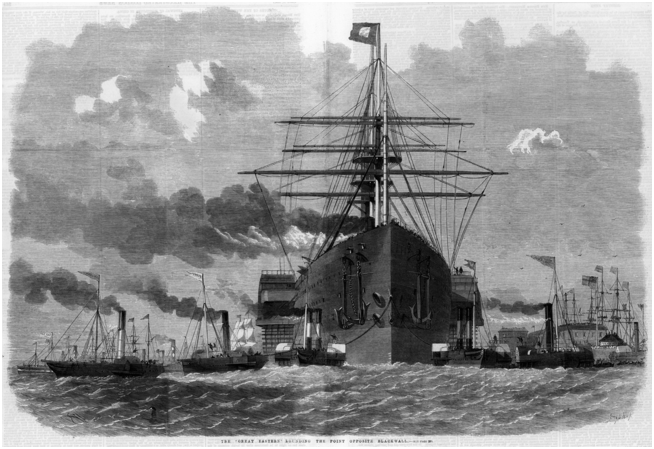
Isambard Kingdom Brunel and Robert Stephenson’s engineering achievements had been a critical part of the infrastructure of both British industry and colonial ambitions, and had enhanced Britain’s reputation without retreating into increasingly challenging alignments with the past, or demanding lengthy and expensive, as well as strategically delicate, acts of armed aggression. Brunel’s Saltash Bridge linking Devon and Cornwall had recently been opened by Prince Albert, and his final project was The Great Eastern, which was intended to revolutionise trade and commerce.59 At 693 feet long and 18,900 tonnes, it was five times heavier than any other ship in existence. Its colossal size was determined by Brunel’s ambition to build a ship that was able to carry the coal needed to reach India without having to stop to re-fuel en route. This would save time and expense, and mean that Britain need not be beholden to friendly governments between Britain and India to supply its fuel needs.
The ship, ‘the largest and finest specimen of naval architecture that ever floated’, had taken five fraught years to build, and its completion in August was cause for much nationalist aggrandisement.60 The ship came to represent the integrity of the nation, as opposed to those foreign fleets of ‘fine vessels, befriended by Governments, tenderly nourished by Legislatures, bribed, privileged, and secured from all opposition within their track’. It represented the spirit of commercial freedom as opposed to a subsidised monopoly that might stymie inventiveness; the free-market enterprise of the free Englishman rather than the wisdom of foreign Parliaments; and that ‘true dominion of the seas which survives war, but thrives most in peace’, and stood as proof of Britain’s ‘Commercial adventure’, its ‘maritime experience’ and ‘its mechanical power’.61 The Illustrated London News claimed that the ship exceeded all known ideas about the possibility of engineering projects, and that it would inaugurate ‘a new system of commerce’.62 The ship will be ‘one of the greatest facts of our age [and….] If seven was hitherto the orthodox number of the wonders of the world, the Great Eastern may now fairly rank as the eighth … the pride and admiration of the whole British nation’. The ship would ‘bring Calcutta within thirty days’ sail of London’,63 which significantly extended Britain’s trading power and its ability to ship arms and soldiers to India should the need arise. The head of the company behind the ship argued that had the ‘great ship been completed two years ago, hundreds of lives and literally millions of treasure would have been spared in the late mutiny in India’ (The Times, 9 August). It was clearly intended as a key part of Britain’s ongoing colonial incursions.
The completion of the ship’s fitting-out was celebrated with a banquet on board, which Brunel was unable to attend due to ill health. Lord Stanley proposed the toast at the banquet, joking that the ship’s ability to carry 10,000 people might have qualified it to be a parliamentary borough in a reformed parliament, and sought to locate the extraordinariness of the ship through domestic metaphors, and to embed its triumph within a stable British economy. His suggestion that the ship ‘will render the passage over the stormy ocean to remote countries as easy and as free from discomfort as the ordinary railway train is at present’ situates the Great Eastern as part of the continuum of Great British engineering and innovation. The desire to claim the ship as a manifestation of British identity is transparent, and especially helpful as Britain sought to re-assert its status on the international stage: his Imperial Highness the Russian Grand Duke Constantine declared that the Great Eastern exceeded his own government’s largest ship as much in ‘fineness of lines and beauty of form’ as it did in size and power’ (Figure 4.1).64
‘Success of the Great Eastern’, Illustrated London News, 17 September, p. 265.
However, after a great build-up of patriotic anticipation, the Great Eastern’s first voyage ended in disaster when a simple mistake with a valve led to a massive explosion which ripped through the ship’s staterooms and killed six stokers and engineers, who were effectively boiled alive. On 15 September, Brunel’s death was announced, from a stroke that many commentators believed was brought on by the stress of trying to bring the complex, expensive Great Eastern project to a successful conclusion, and by the final shock of the ship’s explosion. The ship’s failure overshadowed immediate responses to a figure whose achievements have been more warmly celebrated by subsequent generations, however many obituaries stressed Brunel’s admirable personal qualities, his humility and kindness of heart, and the friendship that he enjoyed with Robert Stephenson.65 The Great Eastern took on a notorious celebrity status and was visited daily by ‘thousands of excursionists’ as it called in at ‘all the chief towns along the south coast’.66 It was an ignominious contrast to the ambitions set out for it the previous month,67 and a chastening curtailing of Britain’s ambitions at the end of a decade that had militarily challenged its global status.
Brunel, along with Stephenson and his father, George, had revolutionised rail travel and bridge building throughout the world. Stephenson died peacefully at home, and Once a Week provided its readers with a portrait of him, along with an extended obituary which paid as much attention to his personal attributes as it did to his achievements as an engineer. As the MP for Whitby: he was ‘eminently unselfish and free from professional jealousy’ … he treated all with ‘the most high-bred courtesy and happy considerateness’ and, along with his father, left ‘grand and beneficent results to posterity’.68 Before Stephenson’s funeral at Westminster Abbey, ‘The entire route of his funeral cortege … was lined by silent crowds’ (Wiener, p. 30). But celebrations of Brunel and Stephenson confirm the fear of a world-leading era of achievement coming to an end and run the risk of their seeming the repositories of a historically based national spirit, rather than something that is more forward-looking.
Shared Reading
Throughout this challenging year, reviews and a wide variety of readers attest to the sustained popularity of Adam Bede. George Scharf recorded his mother and aunt’s enthusiasm, and John Blackwood sent a note to Eliot that he had received from Edward Bulwer Lytton, praising Adam Bede’s exquisite ‘touches of beauty in the conception of the human character’, and calling it ‘one of the very ablest works of fiction I have read for years’ (24 April; Letters, II, p. 102). Miss Winkworth, ‘a grave lady who says she never reads novels – except a few of the most famous’, wrote to Eliot to tell her that ‘she has read “Adam” three times running’ (Eliot to John Blackwood, 10 April; Letters, III, p. 44). Lewes wrote in his journal for 26 August: ‘we took the rail to Penmaenmawr and … found even at this small station, a lady reading Adam Bede! Wherever we go we see people reading it. –’ (pp. 28–29; emphases Lewes’s own). Unbeknownst to Eliot, in the summer of 1859, whilst at his favourite spa in Moor Park, Surrey, Darwin wrote to J. D. Hooker that ‘entire rest & the douche & Adam Bede have together done me a world of good’.69 And in the English Woman’s Journal, the narrator of ‘Adventures of Your Own Correspondents in Search of Solitude’ records: ‘We stopped to see Barden Tower, which was being repaired, and there, whistling and planning, was a carpenter. “Oh, how like Adam Bede!” whispered A., clutching my arm convulsively. As I knew A’s peculiar weakness for that individual, and feared there might be a previous Dinah, I hurried her off’.70 It was so popular that in October, ten copies of Adam Bede were amongst a number of books stolen from a bookseller in New Bond Street.71 Hailed as an ‘assured success’ by the summer,72 Adam Bede had constructed a national network of readers, which crossed class boundaries as well as geographical ones.
Some reviews engaged directly in contemporary arguments about masculinity in fiction, about citizenship, and the possibility of heroism at mid-century. They pondered the questions of Adam’s status as hero, and asked whether a virtuous workman, a good employee, a commonplace man, or, as the Morning Chronicle described him, a ‘high-minded peasant’, can ‘be made a very interesting being’.73 Contemporary reviewers did not claim that he was a perfect character, but Geraldine Jewsbury does approvingly describe Adam Bede as:
The secret of the substantial worth of England, the secret of her strength; it is not the number of men and women with brilliant reputations and lyrically recognized name and fame, that makes the enduring prosperity of a nation, but it lies in the amount of worth that is unrecognized, that remains dumb and unconscious of itself, not clever, but with a certain honest stupidity that understands nothing but doing its best and doing its work without shirking any portion of it.
She quotes at length from Eliot’s account of Adam as:
by no means a marvellous man, nor, properly speaking, a genius, yet I will not pretend that his was an ordinary character among workmen … He was not an average man. Yet such men as he are reared here and there in every generation of our peasant artisans – with an inheritance of affections nurtured by a simple family life of common need and common industry, and an inheritance of faculties trained in skilful courageous labour.
Such a life might not have a ‘discernible echo’ beyond its own neighbourhood, but within that sphere will be found ‘some good piece of road, some building, some application of mineral produce, some improvement in farming practice, some reform of parish abuses’ (II, p. 73) that will be their legacy. The elision and equivalence of material and moral benefits is important, as is the Glasgow Herald’s view that ‘there is neither a monster, a villain, nor a hero in it, according to the usual sense’.74 Adam Bede may be read as a fresh voice within contemporary debates.
Adam’s character does not simply represent an active legacy in the making, but also the inheritance of his life in the country, his work, and his responsibilities. He exemplifies Stefan Collini’s sense that ‘there is no obscurity about the basic core of qualities invoked by the evaluative sense of character: self-restraint, perseverance, strenuous effort, courage in the face of adversity. What is perhaps less obvious is the intimate dependence on a prior notion of duty’ (p. 100). Grounded in an inherited sense of domestic and work-based responsibilities, or the complacent inheritance of custom so feared by Mill, ‘an agreed moral code’ (Collini, p. 100) suffused Adam Bede and offered the possibility that it might also productively inform the concept of ‘English character’ in 1859.
As we have seen, a novel has ready means of creating a collective of readers. The Era notes specifically that ‘all circulating libraries and book-clubs may congratulate themselves on so brilliant an addition to their lists’.75 And in its survey of new books for the use of reading societies, the National Review said that the novel:
evinces a deeper and wider genius than any novel we have read for years. With a delicacy of touch in the quiet descriptions that often reminds us of Goethe, and great masculine vigour of imagination, the author combines a range of observation, an insight into character, and a humorous power, which render his production a really lasting work of art.76
On 1 June, George Howard, the 7th Earl of Carlisle, gave a speech at the opening of the New Hall of the Saddleworth Mechanics’ and Literary Institute. He praised the wholesomeness of the enterprise, was particularly glad to encourage reading amongst the working classes, and specifically asserted the place of fiction in busy working lives:
The mind cannot always remain on the full stretch, and I should regret very much any such pedantic and very rigorous regulations as would exclude books which the working classes might like to peruse on long winter evenings; such wholesome works of fiction and entertainment, for instance as ‘Mary Barton,’ and one more recently published, which is named ‘Adam Bede;’ and I earnestly exhort everyone I now address, though it is a novel, to read the latter, for it contains some of the deepest searchings and appeals to the higher instincts of our nature that it ever fell to my lot to come across.77
Howard is not only recommending an enlightening book to the working men whom he addresses, but more importantly sharing his own reading experience with them, addressing them as equals in the field of literature, as potential co-readers, members of the same audience, and subject to the same range of affective experiences. It is an invitation which begins to break down barriers between readers, to fulfil Eliot’s ambitions for her work, and to enact a communal process for social change. Within the novel itself, Adam does of course go through a phase of antagonism towards Arthur, but the critical mechanism of his and Hayslope’s metamorphic possibilities is ultimately not one of opposition or individualism, but of cooperation and community based in custom, and thus offers a more sustainable model than Smiles’s.
The newly recognised collective identities of the year – including that of the new Liberal Party – were based in, or were vulnerable to suspicions of, their hostility to another grouping. Increasingly, it seems that the most positive, progressive means by which collective identities could be achieved was through a shared appreciation and consumption of culture. Cultural experiences formed important nodes by means of which a non-combative sense of shared identity might be enjoyed and questions of national character further explored in a collective experience, as is demonstrated in the reception of Adam Bede. It is in this respect that Adam Bede differs most notably from the Smilesian ‘true gentleman’ with whom he’s often compared. Eliot’s character is profoundly bound up with his community, with family, and domesticity, and in the novel’s final tableau we see him with his wife and children preparing to welcome her aunt and uncle to their home. Adam is most Smilesian at the start of the novel, when his ambition and conscientious workmanship set him apart from the rest of his workfellows, and he devotes himself to self-improvement. By the end of the book, those ambitions have been tempered and are realised as just one part of a life dedicated to the ameliorative measures described above. By finding a space within which material and moral means can be recognised as complementary, Eliot suggests, might the individual best contribute to a broader national good.
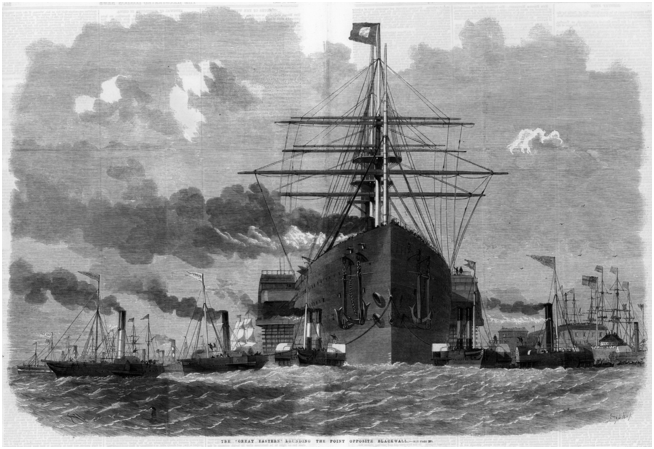

 Open access