





Introduction
Insect monitoring in North America is an important step in integrated pest management programmes, notably for migrant pests. Monitoring is a useful tool to inform agronomists and producers about outbreaks and to determine where insects are problematic, whether economic thresholds are reached, and when and where interventions are needed (Pedigo et al. Reference Pedigo, Rice and Krell2021; Fountain and Pope Reference Fountain and Pope2023). Ultimately, the objective of integrated pest management is to protect crops while reducing pesticide use, thereby benefiting business profitability for producers and the environment. Migration is often influenced by weather conditions and favoured by air masses and strong winds (Reynolds et al. Reference Reynolds, Chapman, Drake, Chilson, Frick, Kelly and Liechti2017). Consequently, migratory insect pest populations can suddenly arrive at a territory in a seemingly random distribution (Pedgley Reference Pedgley1993). The armyworm, Mythimna unipuncta (Haworth, 1809) (Lepidoptera: Noctuidae), is such a seasonal migrant pest, which travels each spring and early summer from the Midwest, eastern, and southern United States of America towards northerly latitudes (Mulder Reference Mulder1984; Hobson et al. Reference Hobson, Doward, Kardynal and McNeil2018). The northern limit of the distribution of this species is southern Canada, where it has been observed in southern British Columbia, Alberta, Saskatchewan, Manitoba, Ontario, Quebec, and New Brunswick (Ayre and Lamb Reference Ayre and Lamb1990; Doward Reference Doward2018). Batallas et al. (Reference Batallas, Rossato, Mori, Beres and Evenden2020) evaluated the preference of armyworm moths for oviposition and demonstrated they prefer to oviposit on cereals – Triticum aestivum Linnaeus, Hordeum vulgare Linnaeus, and Zea mays Linnaeus (all Poaceae) – instead of oilseed, Brassica napus Linnaeus (Brassicaceae) or pulse, Pisum sativum Linnaeus (Fabaceae). When the eggs hatch, the polyphagous and highly mobile larvae can voraciously feed on various crops (Breeland Reference Breeland1958), notably on pasture grasses, cereals, and corn (Guppy Reference Guppy1967). Armyworm is considered a secondary pest in the province of Quebec (McNeil Reference McNeil1987), where it causes major and unpredictable outbreaks every 5–20 years (Guppy Reference Guppy1961), causing enough yield and economic loss (Malo Reference Malo2017) to justify annual monitoring for this pest.
In Quebec, the armyworm has been monitored since the 1980s, using synthetic lures that mimic the pheromone produced by females (Allison and Cardé Reference Allison, Cardé, Allison and Cardé2016) and that attract only males. However, male moth captures do not reflect larval populations nor subsequent field damage (Pedgley Reference Pedgley1993; Parent et al. Reference Parent, Fréchette, Labrie, Rieux and Saguez2017). Furthermore, male trapping does not provide information on female populations nor their reproductive status when they arrive in a territory. Based on male captures, predicting if larvae will damage crops or when and where there is risk of damage is not possible. To bypass this issue, light traps (McNeil Reference McNeil1987), floral lures (Landolt et al. Reference Landolt, Jang, Carvalho and Pogue2011b), and feeding attractants (Landolt and Alfaro Reference Landolt and Alfaro2001; Landolt et al. Reference Landolt, Adams, Zack and Crabo2011a) can be used to capture both sexes of armyworm. Unfortunately, these techniques have traditionally been considered unsuitable for large-scale monitoring of the arrival and distribution of migratory insect pests. Light traps require a power supply and are not species-specific. Floral lures and feeding attractants are expensive, are time consuming to assemble, and are not species-specific. However, in a research context, they can provide important information on female migration, their reproductive status, and the risk of outbreak (Batallas and Evenden Reference Batallas and Evenden2023).
A floral attractant composed of a phenylacetaldehyde-based mixture was used to capture both sexes of the armyworm in Hawaii (Landolt et al. Reference Landolt, Jang, Carvalho and Pogue2011b) and is known to attract several noctuid species (Tóth et al. Reference Tóth, Szarukán, Dorogi, Gulyás, Nagy and Rozgonyi2010; Batallas and Evenden Reference Batallas and Evenden2023). Unfortunately, this technique is not very specific and seems to be relatively ineffective (Landolt et al. Reference Landolt, Jang, Carvalho and Pogue2011b). Another food attractant was developed based on the odour released by fermented molasses. The combined evaporation of 3-methyl-1-butanol and glacial acetic acid is known to attract both sexes of armyworm, regardless of the reproductive status of the adults (Landolt and Higbee Reference Landolt and Higbee2002). As with the floral attractant, this lure captures several other noctuids (Batallas and Evenden Reference Batallas and Evenden2023).
Most of the previous work conducted on the armyworm in Quebec has focused on ecology, reproductive physiology, and behaviour (Turgeon and McNeil Reference Turgeon and McNeil1983; Delisle and McNeil Reference Delisle and McNeil1987a, Reference Delisle and McNeil1987b; Cusson et al. Reference Cusson, McNeil and Tobe1990, Reference Cusson, Tobe and McNeil1994). Little is known about the migration of the armyworm females in Quebec. The only study on the subject was conducted more than 30 years ago, using light traps during nine consecutive years at only one site in northern Quebec (Normandin, 48.8468, –72.5408; McNeil Reference McNeil1987). That study’s trap catches revealed that the trend of male and female populations was similar throughout spring, summer, and fall. Until now, the timing and distribution of the armyworm’s female migrant populations, compared with the species’ male populations, has never been investigated on a large geographical scale across the province.
The objectives of this two-year study were (1) to compare male and female abundance, population peaks, and flight periods, and (2) to determine the reproductive status of the female moths captured throughout the seasons. Traps with feeding attractants based on the odour chemistry of fermented molasses (3-methyl-1-butanol and acetic acid; Landolt and Alfaro Reference Landolt and Alfaro2001; Landolt and Higbee Reference Landolt and Higbee2002) were used to collect both sexes of the armyworm, and females were dissected to evaluate their reproductive status.
Materials and methods
Trapping experiment
Sites and trapping periods were chosen based on historical data of captures and/or larval damage observed in different agricultural regions across southern Quebec. In 2018, trapping lasted 10 consecutive weeks between 14 May and 6 August. Trapping was conducted at five sites, located in Shawville (45.61196, –76.51278), Saint-Blaise-sur-Richelieu (45.222195, –73.353873), Saint-Mathieu-de-Beloeil (45.59278, –73.24389), Saint-Hyacinthe (45.65687, –73.00277), and Sainte-Monique (46.150516, –72.550927). In 2019, traps were set up from 20 May to 12 August (12 consecutive weeks). The experiment was conducted at six sites, located in Lac-du-Cerf (46.329131, –75.488851), Gatineau (45.550254, –75.402654), Saint-Cyprien-de-Napierville (45.2244197, –73.4115877), Saint-Mathieu-de-Beloeil (45.5804973, –73.2398378), Saint-Hyacinthe (45.60731, –72.94890), and Saint-Eugène (45.78381, –72.72661; Fig. 1).
Site locations in the province of Quebec for armyworm moth trapping in 2018 and 2019: 1, Shawville; 2, Saint-Blaise-sur-Richelieu; 3 and 9, Saint-Mathieu-de-Beloeil; 4 and 10, Saint-Hyacinthe; 5, Sainte-Monique; 6, Lac-du-Cerf; 7, Gatineau; 8, Saint-Cyprien-de-Napierville; and 11, Saint-Eugène. Five attractive traps were installed in each location.

The trapping method used was adapted from Landolt and Higbee (Reference Landolt and Higbee2002). At each site, five universal moth traps (Unitrap, Distributions Solida Inc., Saint-Ferréol-les-Neiges, Quebec, Canada) were hung on 1.2-m stakes and placed at least 10 m apart along grass pasture, corn, or cereal fields. The bucket of each trap contained an insecticidal strip (Vaportape, Hercon Environmental, Emigsville, Pennsylvania, United States of America), one lure containing acetic acid, and another lure containing 3-methyl-1-butanol. Each lure consisted of a 15-mL Falcon tube (Thermo Fisher Scientific, Waltham, Massachusetts, United States of America) containing three cotton balls and 5 mL of a single compound; the cap of the tube was pierced with a single 3-mm-diameter hole to allow the chemicals to evaporate and act as a feeding attractant that mimics the odour chemistry of fermented molasses when mixed (Landolt and Alfaro Reference Landolt and Alfaro2001; Landolt and Higbee Reference Landolt and Higbee2002). Every week, trap contents were collected, and lures were replaced. Armyworm specimens were identified (Callahan and Chapin Reference Callahan and Chapin1960), separated by sex according to Breeland (Reference Breeland1958), counted, and then stored at –20 °C. Identification of armyworm specimens was confirmed based on morphological characteristics by the Laboratoire d’expertise et de diagnostic en phytoprotection of the Ministère de l’Agriculture, des Pêcheries et de l’Alimentation du Québec (MAPAQ; City of Québec, Quebec).
Female reproductive status
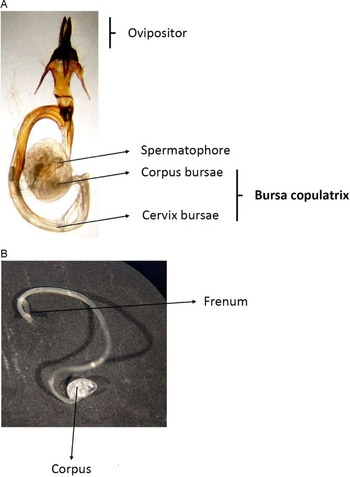
All the females collected in 2018 and 2019 were soaked overnight in a 10% potassium hydroxide solution to rehydrate them before dissection under a stereomicroscope (10× or more, as needed). Female abdomens were dissected to isolate the bursa copulatrix and to count the number of spermatophores inside them (Fig. 2; Callahan and Chapin Reference Callahan and Chapin1960). The presence of spermatophores in the bursa copulatrix indicates female mating status, and the number of spermatophores reflects the number of matings. The number of mature eggs in the abdomen of each female was also counted.
A, Dissected reproductive system of armyworm female and B, spermatophore isolated from the bursa copulatrix.

Statistical analyses
All analyses were performed using R statistical computing software, version 3.6.2 (R Core Team 2019). To evaluate the influence of the site, sex, and date on moth captures (number of moths caught per day in each trap), data were analysed using a generalised additive mixed model zero-inflated Poisson model (mgcv package). This model was chosen because it enables the creation of a nonlinear relationship composed of multiple inflection points (Wood Reference Wood2006). Explanatory variables (the fixed part of the model) were sex and date, and the model was fitted to quantify the influence of the date on the number of moths captured. Because the armyworm is migrant, moth abundance is not influenced by the previous year’s catches. For the statistical analyses, the 11 sites were therefore pooled regardless of the year, and trap number was used as a random factor. The number of moths caught per day in each trap was obtained by dividing the weekly trap catches by the number of days between two trap surveys.
Linear mixed-effects models (lmerTest package) were used to represent the linear regression that estimates the number of spermatophores in the bursa copulatrix of females in 2018 and 2019 (Cameron and Trivedi Reference Cameron and Trivedi1998). Trap number was used as a random factor, and the number of spermatophores was log-transformed to normalise data. Year was treated as fixed factor. For all models, normality and homoscedasticity were verified visually using residual plots and by Shapiro–Wilk test (shapiro.test function).
Results
Trapping experiment
During this two-year study, armyworm moths were captured at all sites, but trap catches were low. A total of 384 armyworms were caught at the 11 sites (193 in 2018 and 191 in 2019). All sites and traps combined, more than twice as many males were captured than females: 126 males versus 67 females in 2018, and 136 males versus 55 females in 2019. The maximum number of males captured per week and per site was 20, whereas that of females was 16. Other insect species, mostly Noctuidae, were also caught, among which the most abundant were Caenurgina crassiuscula (Haworth) (Lepidoptera: Erebidae), Anarta trifolii (Hufnagel) (Lepidoptera: Noctuidae), and Apamea spp. (Ochsenheimer) (Lepidoptera: Noctuidae) (Lemaire-Hamel et al., unpublished data).
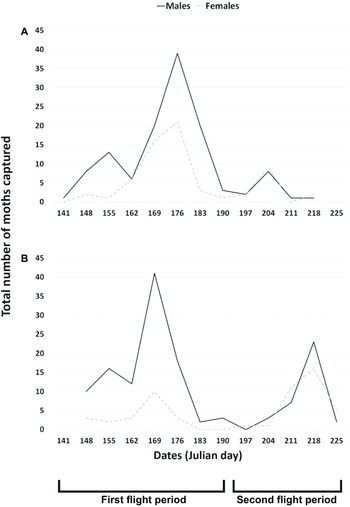
Two flight periods were observed in 2018 and 2019, but when the captures were pooled per year, the peaks did not occur on the same dates (Fig. 3), indicating that moth migration is variable each year or that weather conditions influenced moth activity. The first flight period was observed between late May and mid-July. The second flight period was composed of a smaller flight peak occurring after mid-July.
Total numbers of armyworm moths (males versus females) captured at all sites in the province of Quebec in A, 2018 and B, 2019, using traps containing a feeding attractant (acetic acid and 3-methyl-1-butanol).

Male trap catches were not consistently related with female trap catches. Indeed, more males than females were caught between 25 May and 1 June, as well as between 11 June and 28 June (Fig. 4). The sex ratio (M:F) during the first flight period was slightly above 3:1 but neared 1:1 during the second flight period. Male and female populations were both influenced by site and date (Table 1). Therefore, the moth sex ratios significantly varied from one week to another, as well as from one site to another.
Generalised additive mixed model–predicted armyworm abundance values during the season for male (dashed red curve) and female (solid black curve) trap catches. The thin curves show the 95% confidence intervals for the predicted male and female moth abundance. The large confidence intervals at the left end of the graph are caused by low number of sites with captures in early May.

Generalised additive mixed model results to predict the abundance of male and female Mythimna unipuncta, retaining only the significant variables and interactions (at the P < 0.05 level)

The number of male and female moths captured at each site was highly variable (Fig. 5). At some sites, only one flight peak was observed (e.g., in Saint-Mathieu-de-Beloeil in 2018 and in Gatineau and Lac-du-Cerf in 2019; Fig. 5A, I, and K, respectively). The dates of the peaks also varied from one site to another (Fig. 5; Table 1). Furthermore, at two of the 11 sites, no moths were captured after mid-July (Julian day 196, per the dates noted in the figures; Fig. 5A and I). In 2018, moths were captured at three sites during the last week of July, but, in 2019, they were captured at one site (Saint-Hyacinthe) during the first week of August. In one case (Saint-Mathieu-de-Beloeil in 2018), no females were caught throughout the entire trapping period (Fig. 5A), and no females were captured during the second flight period in Sainte-Monique in 2018 nor in Saint-Mathieu-de-Beloeil, Gatineau, and Lac-du-Cerf in 2019 (Fig. 5E, F, I, and K).
Total numbers of armyworm moths (males versus females) captured per location in the province of Quebec, Canada, in 2018 and 2019, using baited traps: A and F, Saint-Mathieu-de-Beloeil; B and G, Saint-Hyacinthe; C, Saint-Blaise-sur-Richelieu; D, Shawville; E, Sainte-Monique; H, Saint-Cyprien-de-Napierville; I, Gatineau; J, Saint-Eugène; and K, Lac-du-Cerf.

Female reproductive status
Dissections of females revealed that 82.7% were mated and had mature eggs in their abdomens. In contrast, none of the unmated females had mature eggs in their abdomen. The number of mature eggs per mated female varied from one to 150, with an average of 20 eggs, and the abdomens of unmated females essentially contained oocytes (Lemaire-Hamel et al., unpublished data).
Although all females captured during the first flight period of 2018 (n = 50) and 2019 (n = 21) were mated, only 41% (n = 7/17) and 76% (n = 26/34) of females captured during the second flight period were mated in 2018 and 2019, respectively. Considering all females, the log number of spermatophores in the females’ bursa copulatrixes significantly decreased during the season (F (1,103) = 6.89, P ≤ 0.01) and was not affected by site (F (9,79) = 0.54, P = 0.84; Fig. 6). The same trends were observed in 2018 and 2019. The number of spermatophores per female varied from one to five during the first flight period, and it varied from zero to four during the second flight period, independently of the year. On average, females captured during the first flight period had 2.4 spermatophores, and those captured during the second flight period carried 1.4 spermatophores.
Boxplot of the number of spermatophores in the bursa copulatrix of female armyworms captured in Quebec during the first flight period (before mid-July) and the second flight period (after mid-July) of A, 2018 and B, 2019. The thick horizontal lines inside the white boxplots represent the median number of spermatophores, the dots represent the mean number of spermatophores, and the grey area around the boxplots represents data distribution.

Discussion
The present study presents the first evidence that armyworm females migrate to the different regions of Quebec at the same time as males do but in different ratios and in variable abundances. Moth captures and peak flights varied highly from one site to another, regardless of the proximity of the sites and independently of the year. Such variability confirms previous studies in which variability was considered a characteristic of migrant pests that directly results from their annual migration process (Pedgley Reference Pedgley1993; Hobson et al. Reference Hobson, Doward, Kardynal and McNeil2018). Multiple factors can explain these differences from one site to another. Although little is known of the armyworm migration process, the insect’s flight is likely broadly influenced by landscape (Nagoshi et al. Reference Nagoshi, Meagher and Hay-Roe2012) and weather (Diez et al. Reference Diez, D’Antonio, Dukes, Grosholz, Olden and Sorte2012; Krauel et al. Reference Krauel, Westbrook and McCracken2015; Hobson et al. Reference Hobson, Doward, Kardynal and McNeil2018; Knight et al. Reference Knight, Pitman, Flockhart and Norris2019; Parmesan et al. Reference Parmesan, Root and Willig2000). These results also confirm that the distribution and abundance of armyworm moths are erratic and unpredictable (Pedgley Reference Pedgley1993).
The number of male captures was not consistently representative of the female captures. When all the sites were combined, the abundance of male moths was greater than that of females during the first flight period (from May to mid-July), whereas during the second flight period (from mid-July to August), the sex ratio was close to 1:1. Although this could explain the difficulty of associating larval damage with male captures in spring and early summer, it is surprising. Indeed, between 1982 and 1985, McNeil (Reference McNeil1987) caught both sexes of the armyworm in Normandin using light traps, and although the moth sex ratios varied weekly, the abundance of females and males was similar during both the first and second flight periods. Furthermore, in 1957, in Tennessee, Breeland (Reference Breeland1958) used light traps to capture 69.5% of females between 11 March and 20 May and 53.3% of females between 3 June and 24 June. According to Hobson et al. (Reference Hobson, Doward, Kardynal and McNeil2018), these Tennessee moth populations could be the source of Quebec spring immigrants. Breeland’s results therefore suggest that the armyworms arriving in the province stem from populations from the United States of America that have at least as many females as males. One question this begs is why more males than females were captured during the first flight period in the present study.
Several factors could influence the sex ratios in which the armyworm arrives in Quebec. First, fewer females than males could be leaving their overwintering grounds for a northbound spring migration. Because the United States of America generally has low densities of reproductively active populations throughout the year (Breeland Reference Breeland1958; McNeil Reference McNeil1987; Brou and Brou Reference Brou and Brou2020), perhaps not all armyworm moths undertake a spring migration. Although the physiological mechanisms behind the armyworm migration have been studied extensively (Delisle and McNeil Reference Delisle and McNeil1987b; Cusson and McNeil Reference Cusson and McNeil1989; McNeil Reference McNeil2011), the ecological and behavioural factors orchestrating armyworm migration have yet to be investigated (McNeil Reference McNeil2011; Chapman et al. Reference Chapman, Reynolds and Wilson2015). Because the cues initiating take-off and migratory flight in physiologically primed insects are unknown, males and females could have different levels of sensitivity to those cues (Pellegrino et al. Reference Pellegrino, Peñaflor, Nardi, Bezner-Kerr, Guglielmo, Bento and McNeil2013; Reynolds et al. Reference Reynolds, Chapman, Drake, Chilson, Frick, Kelly and Liechti2017). Second, the greater proportion of males caught during the first flight period in the present study could be explained by the female’s lower flight potential. Luo et al. (Reference Luo, Johnson, Hammond, Lopez, Geaghan, Beerwinkle and Westbrook2002) revealed that in females aged between 5 and 10 days old, ovarian development is linked to a decrease in their flight duration and speed, whereas males of the same age do not experience this decline.
Based on these observations, the reproductive system of some females develops during their migration before they arrive in Quebec and in locations where they are exposed to a favourable environment (Delisle and McNeil Reference Delisle and McNeil1987b; Cusson et al. Reference Cusson, Tobe and McNeil1994), thereby diminishing their flight potential. Even during migration, the moths’ reproductive system development is likely to be prompted by (1) temperature cycles (El Ouartassi Reference El Ouartassi1991), (2) the increase of their thoracic temperature due to the muscular activity of flight (Heath and Adams Reference Heath and Adams1965), and (3) the lengthening of the photoperiod resulting from the advancing season and their ascension to higher latitudes (Delisle and McNeil Reference Delisle and McNeil1987b). According to the oogenesis–flight syndrome hypothesis, for migrating insects, resource allocation between migration and reproduction is managed by delaying the onset of reproductive activities (oogenesis, copulation, and oviposition) until after flight termination (Johnson Reference Johnson1969). Previous authors have found this hypothesis to be a useful starting point when approaching the topics of armyworm migration and reproduction (McNeil et al. Reference McNeil, Laforge, Bédard and Cusson1996, Reference McNeil, Miller, Laforge and Cusson2000; McNeil Reference McNeil2011). According to this hypothesis, females would halt their migration once their reproductive system has developed. Therefore, if conditions are ideal and their reproductive system is mature, females may stop before arriving in Quebec and may lay their eggs in more southernly territories (e.g., in Ontario or the northern United States of America). Males, with a stronger flight potential and no oviposition urge, may continue their migration towards higher latitudes, such as Quebec. The important individual variability in the armyworm’s sexual maturation (Turgeon and McNeil Reference Turgeon and McNeil1982) might explain how some females reach the province of Quebec.
The fact that no unmated female was captured before mid-July was surprising. The oogenesis–flight syndrome hypothesis suggests that at least some unmated females should have been captured. According to this hypothesis, migration and fecundity are alternate physiological states, and migration therefore occurs before the onset of reproductive maturity (Johnson Reference Johnson1969; Rankin et al. Reference Rankin, McAnelly, Bodenhamer and Danthanarayana1986). Although exceptions to this hypothesis have been observed, most wing-monomorphic insects experience a negative association between migration and fecundity (Rankin et al. Reference Rankin, McAnelly, Bodenhamer and Danthanarayana1986; Tigreros and Davidowitz Reference Tigreros, Davidowitz and Jurenka2019). This could be the case for the armyworm for two reasons: (1) researchers have linked ovarian development of the armyworm with a decline in flight distance and speed (Luo et al. Reference Luo, Johnson, Hammond, Lopez, Geaghan, Beerwinkle and Westbrook2002), and (2) of the 7099 females caught in Normandin in the 1980s, 3.2%, on average, were unmated when captured (McNeil Reference McNeil1987). This shows that at least some females can migrate to Canada while in reproductive diapause. It is therefore likely that some of the mated females caught in the present study arrived in Quebec while sexually immature and then mated after their arrival. The absence of unmated females during the first flight period could be explained by a rapid sexual maturation period causing the proportion of unmated females in the environment to be so small that it was not detected during our experiment because of our low capture numbers (only 122 females were captured). The fact that no delay was observed between moth arrival and the beginning of oviposition is useful information for Quebec monitoring programmes.
The advanced reproductive status of females caught in the first flight period suggests that females may have been more focused on reproductive activities (mating and egg laying) than on feeding and may therefore have been less responsive to feeding attractants. Females might be more responsive to feeding attractants in the fall, when they are in reproductive diapause and are focused on finding energetic resources for their upcoming migration (Batallas and Evenden Reference Batallas and Evenden2023). If this were true, it could explain why unmated females were caught in the fall but not in early spring in the present study. Unfortunately, no study has investigated whether response to feeding attractants varies among different phases of the armyworm’s reproductive cycle. Moreover, captured of gravid females in our traps calls into question the previous hypothesis. Indeed, if females arrived in Quebec during their early sexual maturity and were insensitive to feeding stimuli, they would not have been attracted by our traps. Eventually, as their reproductive urges faded, females would have become more responsive to feeding attractants, thus creating a delay between male and female trap catches, whereas our first flight period females were trapped at the same time as males. Another element suggesting that armyworm adult females of all reproductive statuses are responsive to feeding attractants is that egg maturation is a continuous process that is sustained well after first mating and egg laying (Svärd and McNeil Reference Svärd and McNeil1994; McNeil et al. Reference McNeil, Miller, Laforge and Cusson2000) and therefore requires continuous energetic resources. It is therefore reasonable to suggest that females, having spent a vast amount of their energetic reserves during migration, are feeding during the reproductive phase of their life. For example, Guppy (Reference Guppy1961) mentioned that providing sugar water to adult armyworms is required for egg production.
The second flight period was composed of females that had developed in Quebec from the offspring locally produced by the migrant moths earlier in spring. In contrast to the first flight period, these females were largely unmated at the time they were caught, with an approximately 1:1 sex ratio during the second flight period. The natural sex ratio of eggs and larvae in armyworms has been reported to be close to 1:1, both under laboratory and under field conditions (Breeland Reference Breeland1958; Pond Reference Pond1960). We would therefore expect that any new, locally produced generation would comprise as many males as females, as was observed during the second flight period both in this study and McNeil’s (Reference McNeil1987) Normandin study in 1982–1985. Finally, the facts that armyworms were captured in the expected sex ratio during the second flight period and that both mated and unmated females were captured further suggest that the feeding attractant used in this study – i.e., the combination of 3-methyl-1-butanol and acetic acid – was equally attractive to both sexes of armyworms regardless of reproductive status, as reported earlier by Landolt and Higbee (Reference Landolt and Higbee2002). However, as no unbaited traps were set during the present study, we cannot determine the proportion of captured moths that may have been drawn to the traps in response to the feeding attractant compared to the proportion that may have been captured purely by chance.
The dates of flight periods observed in this study differed from those reported in the literature. As previously mentioned, the only other instance where both sexes of the armyworm were captured in Quebec was in 1982–1985, using light traps, in Normandin (McNeil Reference McNeil1987). Regarding the first flight period, although our greatest capture peak (June) corresponded to that of McNeil (Reference McNeil1987), the smaller and earlier one at the end of May occurred before McNeil’s earliest captures. This could be explained by the fact that Normandin is at a higher latitude and therefore represents a longer flight for the spring moths. Another possible explanation is that, with climate change, the armyworm’s overwintering grounds in the United States of America have been experiencing earlier springs (Cayan et al. Reference Cay, Kammerdiener, Dettinger, Caprio and Peterson2001; Regonda et al. Reference Regonda, Rajagopalan, Clark and Pitlick2005), thereby prompting migration at earlier dates (Obermeyer Reference Obermeyer2018). The second flight period (end of July and first week of August) occurred earlier than that reported by McNeil (Reference McNeil1987) for Normandin (end of August to September). This difference could be explained by a combination of two factors: (1) our traps were located at a lower latitude than those in Normandin, and (2) with climate change, Quebec’s temperatures have increased over the last 30 years (Ouranos 2015). Both of these factors expose the larvae to warmer conditions that would accelerate their development (Guppy Reference Guppy1969).
The present study shows for the first time high variations in the number of captured male and female armyworms and the number of flight peaks, depending on the site and the year, in different regions in Quebec. We observed no delay between the capture of females and their sexual maturity, and we noted variations in armyworm sex ratios from 3:1 to 1:1. Moreover, our study reveals that the number of male moths does not reflect the number of females and their reproductive status in the spring when they arrive in Quebec. These results have important implications for the monitoring of armyworm males and for recommendations for field scouting. Indeed, before the present study, field scouting for larvae was recommended only when a certain threshold in male captures was reached. Scouting for larvae is now recommended two weeks after the peak of abundance. The captures of females and the assessment of their reproductive status could provide more reliable information to better estimate the risk of offspring production and outbreak.
Acknowledgements
The data presented here are part of the Prime-Vert CERO-1-17-1823 project, which is being carried out under Component 4 of the Prime-Vert 2013–2018 programme and receives financial assistance from the Quebec Ministry of Agriculture, Fisheries and Food (MAPAQ) through the 2011–2021 Quebec phytosanitary strategy for agriculture. This work was also supported by Mitacs through the Mitacs Accelerate programme. The authors thank summer student Rosalye Mongrain for her technical help in the field and laboratory, Jeremy McNeil (Western University, London, Ontario, Canada) for his advice and comments throughout the project, Johanne Delisle and Michel Cusson for their useful review and comments on the manuscript, and Gaétan Daigle (Université Laval, City of Québec, Quebec) and Alexis Latraverse (CÉROM, Saint-Mathieu-de-Beloeil, Quebec) for their technical assistance in statistical analyses. The authors also thank their collaborators in the different regions, including Christine Rieux, Agr. (MAPAQ), Brigitte Duval, Agr. (MAPAQ), Caroline Leblanc (MAPAQ), Félix Moore (Club des services agroenvironnementaux de l’Outaouais, Gatineau, Quebec), Lyne Labonté (Agrinove, Acton-Vale, Montérégie, Quebec), Ann-Gabrielle Jutras, Agr. (MAPAQ), Stéphanie Mathieu, Agr. (MAPAQ), Geneviève Roy, Agr. (Groupe Pleine Terre, Napierville, Quebec), Jacques Gagnon, Agr. (MAPAQ), and all the producers who agreed to install traps in their fields.
Competing interests
The authors declare that they have no competing interests.



 Open access

