


1 Introduction
Military service has a major impact on individual behavior and decision-making, both during and after the service. The relationship between military service and risky behavior has been extensively examined in the literature (e.g., Browne et al., 2008; Reference Fear, Iversen, Chatterjee, Jones, Greenberg, Hull and WesselyFear et al., 2008; Reference Gutierrez, Blume, Schmaling, Stoever, Fonseca and RussellGutierrez et al., 2006; Reference Killgore, Cotting, Thomas, Cox, McGurk, Vo and HogeKillgore et al., 2008; Reference Wilk, Bliese, Kim, Thomas, McGurk and HogeWilk et al., 2010). Yet most previous studies have focused on soldiers that voluntarily joined the military. Thus, this target audience may be biased in its unique characteristics. For example, individuals volunteering for military service may be relatively more prone to engage in risk-taking behaviors (Reference Killgore, Cotting, Thomas, Cox, McGurk, Vo and HogeKillgore et al., 2008).
The current study examines the relationship between type of army service and risky behavior among young people in Israel, where national military service is compulsory for all Israeli citizens (men between the ages of 18-21 and women between the ages of 18-20, with exceptions based on religious, physical or psychological grounds). Thus, our data are unique because the Israeli population that serves in the army is broad and diversified. The army’s placement decision of recruits takes into account first of all the army needs, the recruit’s health profile and other educational and behavioral profiles, and finally, but not necessarily, the recruit’s preferences. Service in most combat units is compulsory for men but voluntary for women. For men, inside the combat units, the service is voluntary only for few special sub-units. Thus, we add to the literature by isolating differences in the propensity for risky behavior after army service in general and after exposure to battle experience in particular, among combat and non-combat soldiers from different socio-demographic backgrounds. Moreover, we examine the difference between risky behavior of men and women by type of army service, which to the best of our knowledge has not been examined before.
Compulsory army service in Israel, especially serving in a combat unit and even more so the experience of fighting, constitute a focused threat to the safety of soldiers during a period of several years. This threat shapes the essence, nature and character of Israelis, and it also affects their risk perceptions as well as their risky behavior during and after their army service. Thus, in this research we focus on young people under the age of 30 who are currently serving or formerly served in the military. (Some also serve in the reserves.)
The current study also contributes to the existing literature by examining the relationship between type of army service and risky behavior, both legal and illegal. We are not aware of previous studies that distinguish between legal and illegal risky behavior while examining the propensity for risky behavior following military service. We chose to focus on legal and illegal risky behaviors related to safety, health and recreation categories. The legal risky behaviors we focus on include plans to travel to a destination with a travel warning (safety and recreation categories) and respondents’ smoking habits (health category).Footnote 1 The illegal risky behaviors (according to Israeli law) are driving after drinking, driving over the speed limit (both represent safety category) and consumption of illegal substances (health category).Footnote 2
According to a survey conducted by the Israel Anti-Drug Authority in 2009, 11.4 percent of adults aged 18–40 reported using illegal substances (among them ecstasy, ketamine, GHB, cannabis, stimulants, tranquilizers and sleeping pills without a doctor’s prescription). Specifically, 8.9 percent reported using cannabis and 1.91 percent reported using other drugs, such as LSD, methadone, opiates, cocaine, and crack. Furthermore, 37.6 percent reported smoking cigarettes during the last year.
According to another survey conducted among 610 participants aged 19–34 in Israel, 64 percent reported driving after drinking 1–2 alcoholic drinks, whereas 23.9 percent reported driving after drinking 3-4 alcoholic drinks and 14% reported driving after drinking 4 and more alcoholic drinks (Reference Bord, Gesser-Edelsburg and Baron-EpelBord, Gesser-Edelsburg, Baron-Epel, 2012). In addition, 75 percent of young drivers aged 17–18 reported driving over the speed limit (Reference OrOr Yarok, 2012). Driving over the speed limit causes 15 percent of serious accidents among drivers aged 19–24, and 22 percent among drivers aged 18 and younger (Reference Lotan and GrimbergLotan & Grimberg, 2011).
Mapping the factors affecting risky behavior, both legal and illegal, is important because it can help in designing policies for reducing risky behavior among young people.
The remainder of the paper is organized as follows: The next section reviews the literature, followed by sections presenting the hypotheses of the study. The fourth section describes the methods, while the fifth section presents the major results and the final section discusses and summarizes the conclusions.
1.1 Literature review
Young people are likely to engage in various risky behaviors such as drinking and driving, consuming illegal substances and conducting unprotected sex (Reference Garcia-Retamero and CokelyGarcia-Retamero & Cokely, 2011) that can negatively affect their safety and health (Reference RomerRomer, 2003). Previous studies in many disciplines have theoretically and empirically examined the decision to engage in risky activities. For example, the theory of Reasoned Action (e.g., Ajzen, 1991) models positive and negative attitudes about a considered activity as factors affecting intentions to engage in that risky activity. Another example is the subjective expected utility (SEU) model of risk-taking (Reference FishburnFishburn, 1981; Reference GruberGruber, 2001; Reference Weber, Blais and BetzWeber, Blais & Betz, 2002), in which the individual decides whether or not to engage in a risky behavior in a rational manner by considering the probability-weighted utilities of the positive and negative outcomes of engaging in that behavior. Yet, an individual’s rationality is bounded by constraints such as limited information and even limited cognitive processing ability (e.g., Kahneman, 2003; Reference SimonSimon, 1982).
Previous studies support a bounded-rationality perspective on the decisions of young people that involve risk taking (Reference Dhami and MandelDhami & Mandel, 2012a; Reference Bauman, Fisher and BryanBauman, Fisher, & Bryan, 2006). Moreover, young people tend to focus mainly on the perceived benefits of engaging in risky behaviors rather than the perceived costs (e.g., Reference Parsons, Halkitis, Bimbi and BorkowskiParsons, Halkitis, Bimbi, & Borkowski, 2000; Reference Weber, Blais and BetzWeber, Blais, & Betz, 2002). Reference Dhami and MandelDhami and Mandel (2012a) assessed the importance and the subjective probabilities of perceived benefits and drawbacks for several risky behaviors related to recreational and health/safety domains. Their findings show that the perceived importance of the benefits of engaging in a risky behavior predicted the forecasted engagement of young people in the risky behavior. In addition, it was found that intentions to engage in illegal activity (such as buying illegal drugs) were also best predicted by the perceived value of the benefits that may be obtained, irrespective of their probabilities or drawbacks (Reference Dhami and MandelDhami & Mandel, 2012b). Nevertheless, the number of perceived benefits and drawbacks did not predict forecasted engagement in two risky driving behaviors (speeding and not wearing a seatbelt), suggesting that young adults take risks despite being aware of the potential negative consequences (Reference Dhami and Garcia-RetameroDhami & Garcia-Retamero, 2012).
Yet, for young people who have served or are serving in the military, the decision to engage in risky activities may also be affected by their military service experience. Previous studies examined the relationship between military professions, combat exposure and propensity for risky behavior. Killgore et al. (2008) examined U.S. soldiers immediately upon their return from deployment in Iraq and three months later. In the first survey, soldiers indicated whether they had been exposed to harsh experiences during their recent deployment (e.g., being attacked or ambushed and shooting or directing fire at the enemy), while three months later, they indicated emotional and mental health issues, such as use of alcohol and drugs and aggressive behaviors. They also answered a modified version of the Evaluation of Risks (EVAR) scale.Footnote 3 The findings showed that combat exposure is positively correlated with more yelling and shouting, destruction of physical property, verbal threats of physical assault, and actually physically assaulting someone, as well with a high risk-taking scores on the EVAR questionnaire. In addition, it was found that several types of exposures to violent combat were associated with greater alcohol use, though some were associated with a reduced likelihood of driving under the influence of alcohol or riding in a car with a driver who had too much to drink. The authors attribute this to the specific type of combat exposure.
Fijałkowska (2010) examined the tendency for risky behavior among soldiers in the Polish Army ground forces and found that young and short-serving soldiers appeared more inclined to undertake risky behavior than older and long-serving ones. A tendency to avoid risky behavior was displayed by soldiers from small towns. In addition, no significant relationship emerged between the propensity for risky behavior and level of dogmatism, education, personal corps and professional position. Adler, Britt, Castro, McGurk and Bliese (2011) examined the link between transitions from combat army service to home and risk-taking behaviors as well as unhealthy habits. They found that emotions such as anger/alienation, guilt/remorse and PTSD symptoms predicted a range of risk-taking behaviors. Participants were three times more likely to report getting into a fight, and almost three times more likely to carry an unnecessary weapon when scoring one unit higher on the anger/alienation factor. Wright, Foran, Wood, Eckford and McGurk (2012) examined whether alcohol problems, aggression and other externalizing behaviors following deployment could be explained by internalizing symptoms (such as depression, anxiety, and PTSD symptoms) or by the health of the social environment (such as unit leadership, organizational support and stigma/barriers to care). They found that both social environment and other symptoms (mood and anxiety) were significantly associated with level of externalizing behaviors at four months and nine months post-deployment, but also that combat exposure alone significantly predicted changes in externalizing behaviors over the follow-up period. Kelley et al. (2012) studied 319 members of a combat arms brigade one month prior to deployment to Iraq and approximately one month after their return. Their results suggest that soldiers engage in more alcohol use and reckless driving behaviors post-deployment. Reference Lee and BlaisLee and Blais (2014) examined the relationships between risk-taking propensity and demographic variables, deployment history, as well as a number of health and risk behaviors among members of the Canadian Armed Forces (CAF) in 2008 and 2009. The results consistently pointed to higher levels of risk-taking propensity among younger respondents and men. Variation in health and safety, but not in recreational risk-taking propensity, was correlated with deployment history. Thomsen, Stander, McWhorter, Rabenhorst and Milner (2011) revealed that risky behavior was much more common in civilian than in military life. In contrast, personnel who had been deployed (versus those never deployed) were significantly more likely to report both risky behavior and psychiatric problems. In addition, deployment was associated with increases in risky behavior only for those with a pre-deployment history of engaging in risky behavior.
In the current study, we focus on risk-taking behavior (rather than risk perception) by examining legal versus illegal risky behavior among soldiers and ex-soldiers in the context of their level of exposure to combat experience.
1.2 Research hypotheses
The five variables of the risky behaviors we focused on are: the respondents’ intention to travel to a destination with a travel warning, the respondents’ propensity to drive after drinking, the respondents’ propensity to drive over the speed limit, their tendency to consume illegal substances and their smoking habits.
We chose to focus on the relationship between type of service (combat versus non-combat and whether or not the respondent has fighting experience) and risky behavior.Footnote 4 In addition, we include other predictors of risky behavior, such as Evaluation of Risks (EVAR) score as well as socio-demographic characteristics.
Previous research suggests that personal characteristics affect the propensity toward risky behavior. For example, Reference Killgore, Vo, Castro and HogeKillgore, Vo, Castro and Hoge (2006) found that Evaluation of Risks (EVAR) scores are correlated with high-risk behavior. Thus, our hypothesis is:
Hypothesis 1:
Individuals with high Evaluation of Risks (EVAR) scores will have a greater probability of engaging in legal and illegal risky behavior.
Decision-making models predict that an individual decides whether or not to engage in a risky behavior by considering the perceptions of the activity’s negative versus positive outcomes (e.g., SEU model of risk taking (Reference FishburnFishburn, 1981) and the TRA model (Reference AjzenAjzen, 1991)). Furthermore, in the case of illegal risky behaviors, such as consuming illegal substances, the individual may consider the perceived enjoyment from these activities versus their severe negative outcomes (e.g., unhealthy, dangerous, punishment, etc.).
However, previous research suggests that combat experience leads to a higher propensity for risky behavior (Reference Browne, Iverson, Hull, Workman, Barker, Horn and FearBrowne et al., 2008; Reference Fear, Iversen, Chatterjee, Jones, Greenberg, Hull and WesselyFear et al., 2008; Reference Gutierrez, Blume, Schmaling, Stoever, Fonseca and RussellGutierrez et al., 2006; Reference Killgore, Cotting, Thomas, Cox, McGurk, Vo and HogeKillgore et al., 2008; Reference Wilk, Bliese, Kim, Thomas, McGurk and HogeWilk et al., 2010). Therefore our hypothesis is:
Hypothesis 2A:
Those who served in combat units will have a greater tendency toward engaging in legal risky behavior than those who served in non-combat units.
For young people who serve in the army, however, there is also the possible negative consequence of army punishment that should be taken into account in the weighted consideration. The army environment in general is inflexible and tough, with harsh discipline, and soldiers are required to obey. Moreover, in the Israeli compulsory army service, the combat units maintain the highest level of discipline. The punishment for illegal behavior within the army framework can be severe (including jail time and discharge from the unit). Therefore, we expect that for illegal risky behavior the effect of combat unit discipline will overpower the increased propensity toward the illegal risky behavior. Thus:
Hypothesis 2B:
Those who served in combat units will have a lesser tendency toward engaging in illegal risky behavior than those who served in non-combat units.
Furthermore, previous research suggests that soldiers who had higher rates of exposure to the threat of death/injury are significantly more likely to be involved in risky behavior. For example, exposure to the threat of death/injury was found to be correlated with screening positive for alcohol abuse (Reference Wilk, Bliese, Kim, Thomas, McGurk and HogeWilk et al., 2010). Our hypothesis is that the tendency to engage in risky behavior (both legal and illegal) after experiencing fighting will override the potential harsh army punishment. Therefore, we expect that:
Hypothesis 3:
Those who experienced fighting will have a greater tendency toward engaging in both legal and illegal risky behavior than those who did not experience fighting.
As for the differences between the tendencies to engage in risky behavior among current soldiers versus ex-soldiers, we do not have a solid hypothesis. On the one hand, the punishment for illegal behavior for soldiers may be more severe than the punishment meted out to civilians. Therefore we can expect that the levels of illegal risky behavior will be higher for ex-soldiers than for current soldiers. On the other hand, we can expect that the impact of military service, especially in combat units and following fighting experience, will be mitigated and become more moderate with time after discharge from the military (at least for most) and therefore the levels of illegal risky behavior will be lower for ex-soldiers than for current soldiers.
2 Methods

2.1 Sample
Our sample included 413 young respondents between the ages of 18–30 (mean, 23.38) who are now serving in the IDF or served during the last ten years.Footnote 5 The Israeli Defense Forces (IDF) is composed of several types of soldiers: conscripted soldiers doing their regular and mandatory service, soldiers in the standing army, and soldiers serving in the reserve forces (citizens are called up for active duty that includes training and fighting, usually for a few weeks per yearFootnote 6).
Table 1 shows the characteristics of the sample. The sample includes 55% men and 45% women, 66% non-religious and 34% religious. Among the respondents, 51% have 12 years of education and less, and 49% have more than 12 years. In addition, 32% are currently serving as soldiers in the IDF while 68% are ex-soldiers. 42% of the whole sample are currently serving or served in combat units (85% among men and 25% among women). Among the combat soldiers, 46% experienced fighting during their combat army service (47% among combat men and 42% among combat women).
2.2 Procedure
The study was conducted from January through March 2014. The questionnaire surveys were randomly distributed by research assistants at train stations as well as central bus stations in various places in Israel (in the north, center, and south regions of IsraelFootnote 7) during waiting time for the train/bus, and was collected after about 15 minutes. We chose public transportation since it is the main transportation means for soldiers and it reflects a random sample of young Israelis from various sectors, including soldiers. Respondents were told that the questionnaire was anonymous and that they could choose not to fill in the questionnaire.
2.3 The questionnaire
The research tool is a self-completed anonymous questionnaire that was partially based on the questionnaire of Reference Kelley, Killgore, Athy and DretschKelley, Killgore, Athy and Dretsch (2009), but was extended and adapted to the current research. The questionnaire, which was translated into Hebrew by the authors and then back-translated into English by an English editor, was tested in a pilot study. The consistency of the survey was further assessed using Cronbach’s alpha.Footnote 8 The survey questionnaire (see Appendix A) includes the following parts:
1. A partial Evaluation of Risks (EVAR) Questionnaire (see Reference Killgore, Vo, Castro and HogeKillgore, Vo, Castro & Hoge, 2006). The EVAR is a questionnaire that has been used effectively in previous research to measure individual variability in risk assessment. The EVAR, which was originally developed and normed within a sample of French-speaking participants, includes 24 visual analog scales in five categories that query about preferences for engaging in various risky behaviors (Reference Sicard, Jouve, Blin and MalhieuSicard, Jouve, Blin & Malhieu,1999). A modified English version for the U.S. military forces was presented in the studies of Killgore et al. (2006) and Killgore et al. (2008). The current study (Appendix A) uses a partial modified EVAR questionnaire with the following four out of five EVAR categories: self-control (e.g., “I feel like taking on the world”), danger seeking (“I seek the thrill of danger”), impulsiveness (“I am open to confrontation at any time”) and invincibility (“When the light turns yellow I tend to accelerate”).Footnote 9 The EVAR Likert-scale response options ranged from 1 (I do not agree at all ) to 7 (I agree very much). The average answer for the EVAR scale was 4.14 and the SD was 0.97.Footnote 10
2. Frequency of engaging in risky behaviors. This part includes questions regarding frequency of engaging in several legal and illegal risky behaviors: smoking habits, drinking under the influence of alcohol, driving faster than the law permits, the use of illegal substances and the intention to travel to a destination with a travel warning in the near future.
3. Personal details: including demographic and socio-economic details. We asked respondents whether they had served in the IDF and whether they are currently serving. We also asked about the type of their army service, i.e., whether they served or are serving as combat soldiers and whether they experienced fighting. We also asked respondents about their age, education level, gender, parents’ income and the extent of their religious observance.
2.4 Data analysis
We use Pearson correlations to examine the relation between the tendency to engage in various risky behaviors and other relevant variables such as type of army service and socio-demographic factors of young people in Israel who served/are serving in the army.
3 Results
3.1 Descriptive statistics of risky behaviors
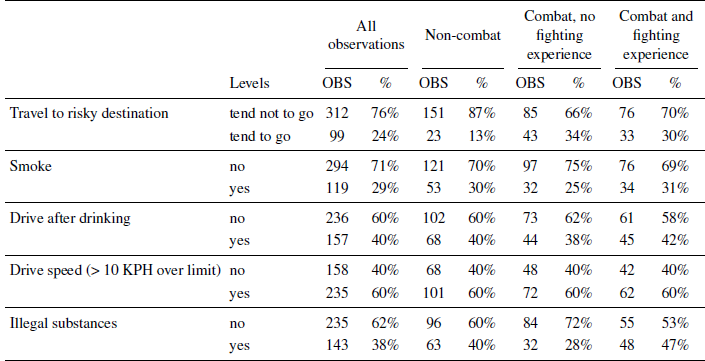
Table 2 describes the percentages of those who engage in risky behaviors according to three types of army service: non-combat service, combat service with no fighting experience and combat service with fighting experience. Participants’ complete responses regarding the risky behaviors by sex, type of unit and fighting experience are given in Table A in appendix B.
Plans to travel to a destination with a travel warning are measured on a 1 to 7 scale, where 1 is “I do not intend to go there” and 7 is “I do intend to go there.” For further correlation analyses, we divide this scale of 7 into 2 levels: level 1: answers 1,2,3,4 (do not intend to go); and level 2: answers 5,6,7 (intend to go). The respondents’ smoking habits were measured by a yes/no question (1=no, 2=yes). The risky behavior driving after drinking is measured via a scale of 5 (1=not at all, and 5=very often). For the analysis, we divide this scale of 5 into 2 levels: level 1= I do not drive and drink, and level 2 = I do drive and drink. The risky behavior driving over the speed limit is measured by a scale of 4: 1=not at all, 2=up to 10 KPH over the speed limit, 3=between 11 and 20 KPH, and 4=more than 20 KPH. For the analysis, we divided this scale of 4 into 2 levels: level 1—not at all or up to 10 KPH, and level 2—more than 10 KPH.Footnote 11 The question regarding the consumption of illegal substances is a yes/no question (1= no, 2=yes).
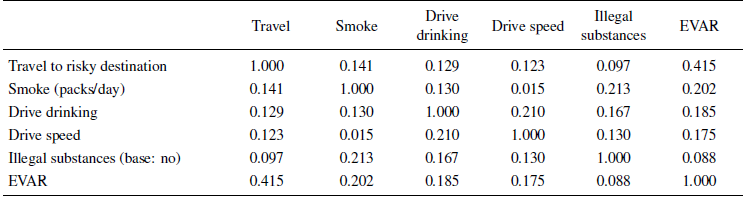
Two-tailed p-values: .17 for p<0.001, .13 for p<0.01, .10 for p<0.05; approximate because of some missing data.
In general, the results in Table 2 indicate high percentages of involvement in risky behavior among young people in Israel, both in legal as well as in illegal activities: 60% drive over the speed limit, 40% tend to drink and drive, 38% said that they consume illegal substances, 29% smoke cigarettes and 24% reported that they plan to travel to a destination with a travel warning.Footnote 12
Table 2 also shows the percentages of those who engage in risky behaviors by combat experience and fighting experience: (a) reported intention to travel to a destination with a travel warning was higher among combat soldiers without fighting experience (34%) compared to those with fighting experience (30%) and to non-combat soldiers (13%); (b) smoking cigarettes was reported higher among those with fighting experience (31%) in comparison to non-combat soldiers (30%) and combat soldiers without fighting experience (25%); (c) reported drinking and driving was similar among all groups (40%); (d) reported driving over the speed limit was similar among all groups: 60% of the non-combat, 60% of the combat without fighting experience and 60% of those with fighting experience; (e) reported consumption of illegal substances was higher among those with fighting experience (47%) in comparison to non-combat soldiers (40%) and to combat soldiers without fighting experience (28%).

*** p<0.001,
** p<0.01,
* p<0.05.
3.2 Correlations among risky behaviors and other predictors
Table 3 shows the correlations among the five risky behaviors and between the risky behaviors and the EVAR score. All measures are coded so that higher numbers indicate higher risk taking.
The results suggest that the risky behaviors are correlated to varying degrees. For example, driving over the speed limit has a low but significant correlation with all other risk measures except smoking. In addition, the results in Table 3 indicate positive and significant correlations between EVAR score and all risks except use of illegal substances. This result is in line with Hypothesis 1, suggesting that individuals with high Evaluation of Risks (EVAR) scores will have a greater probability of engaging in legal and illegal risky behavior.
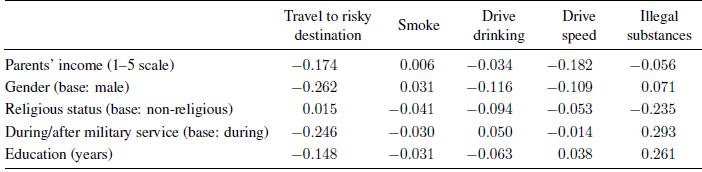
Table B in Appendix B shows the correlations between the five variables of risky behavior and the socio-demographic and personal variables. The results show significant negative correlations between intention to travel to risky destinations (coded 1–7) and the following variables: education, gender, currently being a soldier, and parents’ income. In other words, those who intend to travel to a destination with a travel warning are more likely to be men, with lower education level, higher parents’ income and still doing their army service. In addition, the table indicates significant or almost-significant correlations of tendency to drive after drinking with religiousness and being discharged from army service. Those who intend to drive after drinking tend to be less religious and being discharged from army service. Yet those whose parents’ incomes are lower, and males, tend to drive over the speed limit. For smoking habits, we did not find any significant correlations with the socio- demographic variables. Finally, the results in Table B in Appendix B reveal significant correlations between consumption of illegal substances and education, degree of religiousness and being after army service. Those who intend to consume illegal substances tend to have a higher level of education, are less religious and have been discharged from the army service.
3.3 Correlations between type of army service and EVAR score
In order to examine whether or not assignment to combat units is a matter of self-selection, we examine the correlations between type of army service and EVAR score, which can be seen as a personal attribute of risk tendency. Table 4 shows these correlations in three parts: (a) for all respondents, (b) only for men and (c) only for women.
Table 4a shows that for the whole sample there is a positive and significant correlation between combat army service and EVAR score. Yet, the results in Tables 4b and 4c indicate that combat army service is positively and significantly correlated with EVAR only for women respondents (0.212) while it is nonexistent for men respondents.
These results may suggest that assignment to combat units is a matter of self-selection for women but not for men. Actually, these results make sense since in the Israeli army assignment to combat units is always on a voluntary basis for women but not for men (only in a few special combat units is assignment of men on a voluntary basis).
Table 4 also shows the correlations between EVAR score and the variable “fighting experience”. For all respondents as well as for men only, the correlation between EVAR and fighting experience is low and insignificant. Recall that men are assigned to almost all combat units (service in only a few combat units is voluntary for men) and they certainly do not volunteer to fight. For women, however, the fighting experience variable is positively correlated with EVAR (0.152). The underlying reason is that each combat female soldier, whether she experienced fighting or not, volunteered for combat army service.
*** p<0.001,
** p<0.01.
3.4 Correlations between risky behaviors and type of army service
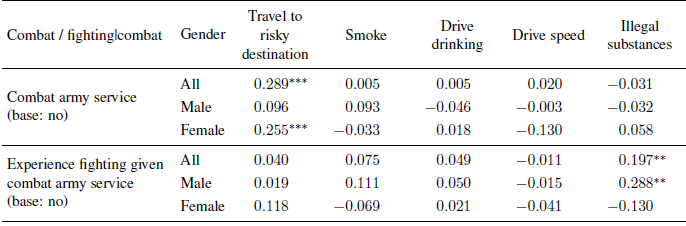
Next, Table 5 shows the correlations between the five risky behaviors and type of army service for all the respondents as well as for men and women separately.
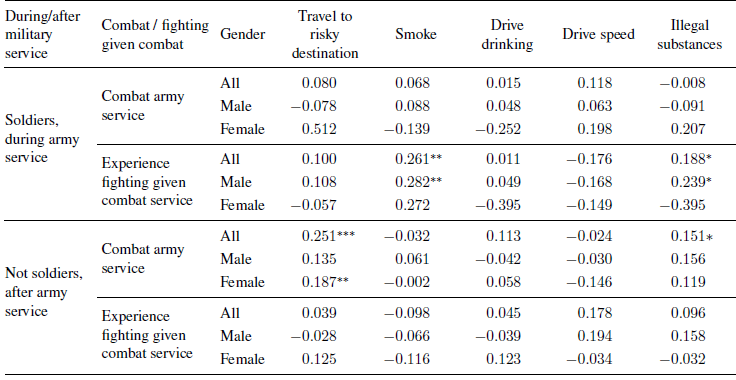
The results in Table 5 indicate that for the whole sample, the intention to travel to a destination with a travel warning is positively correlated with having served in a combat army unit (coefficient: 0.289, p-value<0.0001), compatible with hypothesis 2A. However, this correlation is significant only for women but not for men, indicating that women in combat units tend to travel to risky destinations more than women in non-combat units (probably affected by their risk attitude as represented by their EVAR score). This is consistent with the results reported in Table 4: Combat army service is positively correlated with EVAR for women respondents while combat army service is uncorrelated with EVAR for men respondents. Higher EVAR scores predict a greater tendency to travel to dangerous destinations (Table 3). Moreover, the results in Table C in Appendix B, which reports the correlations between risky behaviors and type of military service by gender and time of service (during or after service), show that the significant positive correlation between intention to travel to a risky destination and combat unit refers to women after their army service and not women who currently serve in the army. A possible reason for this may be that women with a higher tendency for risky behavior tend to travel to risky destinations after finishing their army duty because it is more difficult to travel abroad during service.
As for all the other risky behaviors (smoking, drive after drinking, drive over the speed limit and consumption of illegal substances), we did not find any significant correlations between risky behavior and type of service (combat versus non-combat units), incompatible with hypothesis 2A for smoking and 2B for all others.
Table 5 also indicates a positive and significant correlation between the consumption of illegal substances and fighting experience for those serving in a combat unit (coefficient: 0.197, p-value< 0.01), compatible with hypothesis 3. However, this correlation derives from the positive correlation for men respondents (coefficient: 0.288, p-value< 0.01) but not for women respondents. In other words, men in combat units who experienced fighting during their military service tend to consume illegal substances more than men who did not experience fighting. In addition, the results in Table C (Appendix B) indicate that this correlation is significant for men who are currently serving as soldiers in combat units and experienced fighting (but it is not significant for ex-soldiers).
As for the other four risky behaviors (both legal and illegal), we did not find any significant correlations between risky behaviors and fighting experience, incompatible with Hypothesis 3. Therefore, it seems that the main effect of fighting experience is on consumption of illegal substances by men soldiers during their army service.
4 Discussion
The current study examines the relationship between type of army service and risky behaviors, both legal and illegal. The data are unique due to the fact that army service in Israel is compulsory and that the Israeli population that serves in the army is broad and diversified. Therefore, we were also able to examine the difference between risky behavior of men and women by type of army service. The examination of gender differences in our study contributes to the existing literature, since most of male combat soldiers are assigned to these units due to the army’s needs, while women combat soldiers volunteer for serving in these units.
The illegal risky behaviors we focus on are driving after drinking, driving over the speed limit and consumption of illegal substances, while the legal risky behaviors are smoking habits and respondents’ plans to travel to a destination with a travel warning. The reason that travel to a risky destination was measured by intention to travel rather than by self-reported actual engagement is that during army service it is difficult to travel abroad.
The results suggest that high percentages of young people engage in risky behavior, especially illegal behavior: 60% drive over the speed limit, 40% tend to drink and drive, 38% reported consuming illegal substances, and 29% smoke cigarettes. These results are compatible with previous findings of surveys with respect to high percentages of young Israeli people engaging in risky behavior (Anti-Drug Authority, 2009; Reference Fear, Iversen, Chatterjee, Jones, Greenberg, Hull and WesselyBord et al., 2012).
Our findings indicate that the tendency to engage in risky behavior is related to socio-demographic variables. For example, those who intend to travel to a destination with a travel warning are more likely to be men, with lower education level, higher parents’ income and during their army service, while those who tend to drive after drinking tend to be less religious and after their army service. Those who tend to consume illegal substances have a higher level of education and are less religious.
One of the limitations of the study is that we do not know whether or not some of the risky behaviors were engaged in before the individual joined the army and are related to the individual’s personality. Although this information is missing, we use the EVAR score as a measure of the individual’s risk attitude. The EVAR correlates highly with the tendency to engage in risky behaviors (except for the tendency to use illegal substances and the tendency to drive over the speed limit).
We found positive and significant correlations between serving in combat army units and EVAR score and between “fighting experience” and EVAR score only for women respondents but not for men respondents. These results suggest that assignment to combat units and having fighting experience is a matter of self-selection for women but not for men. Actually, in the Israeli army assignment to combat units is always on a voluntary basis for women but not for men (only in a few special combat units is assignment of men on a voluntary basis).
Previous research suggests that combat experience leads to a higher propensity for risky behavior (Reference Browne, Iverson, Hull, Workman, Barker, Horn and FearBrowne et al., 2008; Reference Fear, Iversen, Chatterjee, Jones, Greenberg, Hull and WesselyFear et al., 2008; Reference Gutierrez, Blume, Schmaling, Stoever, Fonseca and RussellGutierrez et al., 2006; Reference Killgore, Cotting, Thomas, Cox, McGurk, Vo and HogeKillgore et al., 2008; Reference Wilk, Bliese, Kim, Thomas, McGurk and HogeWilk et al., 2010). In the current study, we distinguish between combat and non-combat service and in addition we distinguish between serving in a combat unit with and without fighting experience. Our findings indicate that serving in a combat unit as opposed to a non-combat unit does not affect the tendency to engage in legal or illegal risky behavior during as well as after the army service for men and for women. The only exception is that women after army service in combat units tend to travel to risky destinations more than women in non-combat units, and this is probably related to their original higher risk attitude.
As for the impact of fighting experience on risky behavior, we first found that the consumption of illegal substances was higher among those with fighting experience (47%) in comparison to combat soldiers without fighting experience (28%) and to non-combat soldiers (40%).
Further analysis suggests that the correlations between EVAR score and the tendency to use illegal substances is not statistically different from 0, meaning that engaging in this illegal risky activity is not because of the individual’s risk attitude.
However, the results indicate that fighting experience is significantly and positively correlated to the consumption of illegal substances for currently serving men soldiers. This result indicates that men soldiers in combat units who experienced fighting during their military service tend to consume illegal substances more than men in combat units who did not experienced fighting. Moreover, we found that the effect of fighting experience during army service on consumption of illegal substances may be mitigated after discharge from the army (although we do not have enough data to ask whether the apparent decrease in the effect is significant).
These findings are interesting since there are two contradicting forces affecting the tendency to engage in illegal risky behavior following fighting experience. On the one hand is the impulsive tendency to seek release after harsh events of fighting experiences, while on the other hand is the tough discipline and harsh punishments in combat units. Our results suggest that the effect of the increased propensity toward risky behavior following the experience of fighting overrides the combat unit’s discipline of men when it comes to the consumption of illegal substances.
These results are in line with previous findings that exposure to the threat of death/injury is correlated with risky behavior, such as greater alcohol use and violent behavior (Killgore et al., 2008; Kelley et al. 2012; Wilk et al., 2010 ).
Yet, except for using illegal substances, we did not find any significant correlations between fighting experience and other legal and illegal risky behaviors. One possible explanation for this result could be that male combat soldiers that experience fighting use drugs to relieve their memories of the fighting experience and that drug use is relatively difficult to expose by the enforcement authorities compared to other illegal activities, such as driving over the speed limit and driving after drinking.
For women, we did not find any significant correlation between fighting experience and risky behavior. A possible explanation is that women volunteer for combat service and probably have high propensity for risk before joining the army. It may be that for these women the discipline of the army and the responsibility of their role in the army override their propensity for risky behavior.
To conclude, our results add to the existing literature by showing that combat service alone may not affect the tendency to engage in illegal risky behavior in comparison to non-combat service. It is the fighting experience that affects the tendency to engage in risky behaviors such as consuming illegal substances, and this tendency seems to be reduced over time. These results can increase the awareness of military health units to the situation of combat soldiers following fighting experience in order to supply them suitable interventions (such as psychological treatment) and reduce their need for engaging in risky behaviors. Moreover, we call for more studies on risky behavior among soldiers, perhaps to be conducted internally by the military.
Future research can contribute by examining the impact of different fighting experience events on the tendency to engage in risky behavior. Finally, future studies can examine other illegal risky behaviors that are also difficult to expose by the enforcement forces and compare the tendency to engage in various risky behaviors before, during and after army service.
Appendix A: Questionnaire
Part A: EVAR questions
Response options ranged from 1 (I do not agree at all ) to 7 (I agree very much)
1. When the traffic light turns yellow, I tend to accelerate.
2. I feel like I can take on the world.
3. Usually, I prefer adventures over routine.
4. I seek the thrill of danger.
5. I am open to (verbal) confrontation.
6. Usually, I give priority to action rather than reason.
7. I am sure of myself.
8. I am always right.
9. I emphasize speed rather than precision.
Part B: Risky behaviors
1. I plan to travel to a destination that has been issued with a travel warning. (Likert-scale response options ranged from 1 =not at all to 7 =very much)
2. Do you smoke? Yes / No.
2. B. If so, how many cigarettes do you smoke a day? Less than half a pack / more than half a pack and less than a pack / more than a pack and less than two packs / more than two packs.
3. How often do you drive under the influence of alcohol beyond the legal limit? not at all / seldom / medium / often / very often
4. On the highway, do you usually exceed the speed limit? not at all / not more than 10 kilometers per hour / 11-20 kilometers per hour / more than 20 kilometers per hour
5. Have you ever consumed prohibited substances? Yes / No
Part C: “Please indicate your willingness to take risks in general”.
Possible answers varied between 1 (avoid risks) and 10 (take extreme risks).
Part D: Army service
1. Are you currently serving or have you ever served in the army? Yes / No
2. Are you currently a soldier? Yes / No
3. Are you currently serving or have you served in the past as a combat soldier? Yes / No
4. Have you participated in real combat (and not practice) during your service? Yes / No
Part E: Personal characteristics
Age_____
Gender_____
How do you define yourself religiously? Ultra-orthodox / religious / traditional / secular / other
The average gross monthly income for an Israeli household is 13,000NIS. Your parents’ household income is: much higher than the average / higher than the average / average / lower than the average / much lower than the average
Years of education_____
5 Appendix B
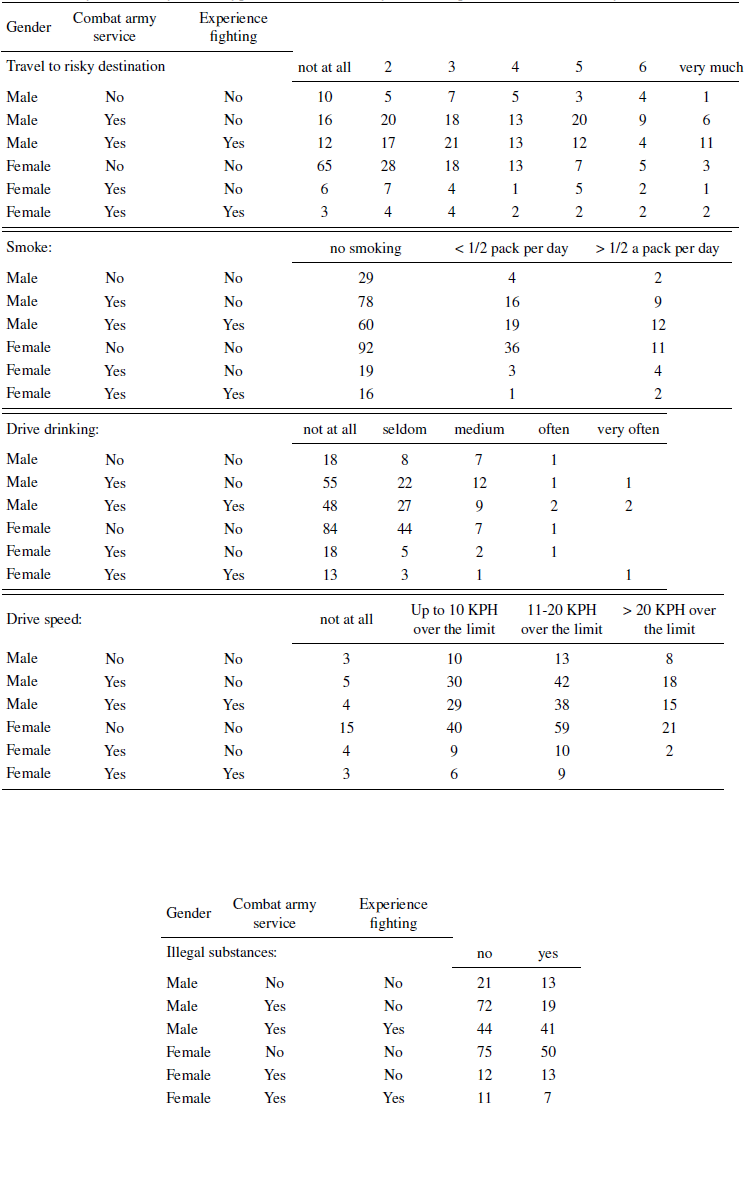
Two-tailed p-values: .17 for p<0.001, .13 for p<0.01, .10 for p<0.05; approximate because of some missing data.
*** p<0.001
** p<0.01
* p<0.05.


 Open access

