

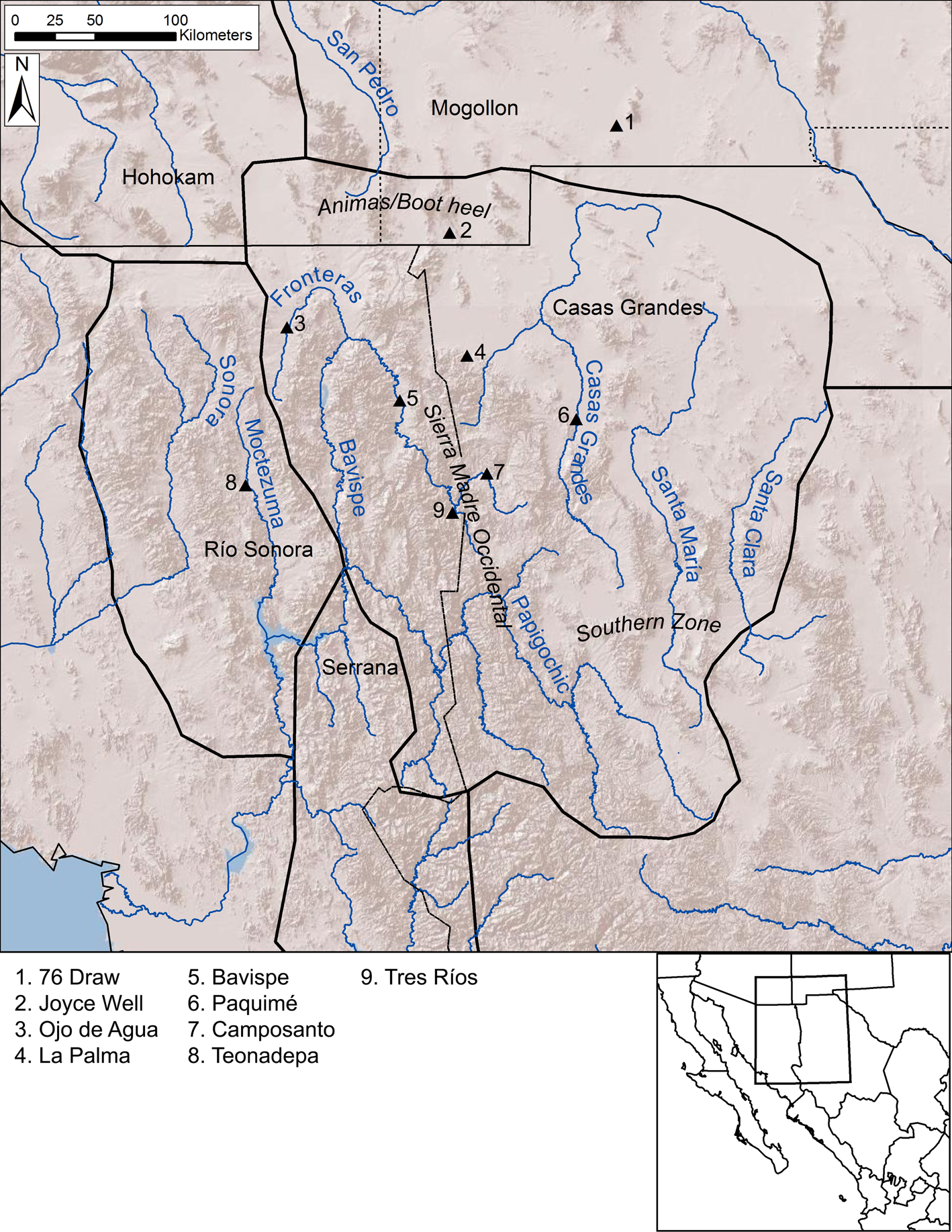
The primary goals of this article are to extend the spatial limits of the Casas Grandes tradition to the Fronteras Valley (Figure 1) and to propose a modified chronological schema in this subregion (Figure 2). Underpinning these goals is a desire to establish the cultural history of a fiercely debated period and region of the Mexican Northwest/US Southwest (hereafter, NW/SW). The data we present illuminate the nature of Casas Grandes, which is enmeshed in broader discussions over the ultimate sources of power and authority in transegalitarian societies. There are many disagreements about the social organization of the Casas Grandes region and its primary center of Paquimé (Pailes Reference Pailes2017a; Pailes and Searcy Reference Pailes and Searcy2022). Previous reconstructions offered explanations rooted either in the economics of craft production and long-distance exchange (Di Peso Reference Di Peso1974a) or of local subsistence production (Whalen and Minnis Reference Whalen and Minnis2001a, Reference Whalen and Minnis2009). Recent research refocuses this conversation on the ideological means used by elites to maintain control over these material concerns. Alternative models argue for elite-centric ancestor worship (Rakita Reference Rakita2009), the imposition of a foreign religion (Mathiowetz Reference Mathiowetz2018), shamanistic control of esoteric knowledge (VanPool and VanPool Reference VanPool and VanPool2007), and the development of a “ritual mode of production” to legitimize the expropriation of resources (Cunningham Reference Cunningham, Rosenwig and Cunningham2017). Emerging from this discussion is a consensus that direct economic and political control by Paquimé's elites did not extend far beyond the city's immediate environs but that components of the ideological system were exported across much greater distances. We situate the Fronteras Valley as another case study in Casas Grandes organization that sheds light on how selective elements of the core region's traditions found purchase in the hinterlands.
Map of Casas Grandes region.
Regional chronological sequences, including a tentative proposal for Fronteras Valley.

Another important insight of our data concerns questions of cultural and regional continuity. The descendants of the Casas Grandes tradition are typically ascribed to one of three groups. Most researchers consider the Raramuri to be a descendant community. Di Peso (Reference Di Peso1974b) suggested that their Sierra Madrean homeland was a refuge for Casas Grandes populations after the collapse of Paquimé. The hunter-gatherer groups who occupied the core of the Casas Grandes region when colonial encounters began, including the Suma and more distantly the Concho (Griffen Reference Griffen1979; Kelley Reference Kelley1990), are another potential descendant community. Third, several researchers suggest that the Ópata are a descendant community (Phillips Reference Phillips1989; Riley Reference Riley2005:390). This later interpretation argues that the western side of the Sierra Madre Occidental became the demographic and political center of the NW/SW after AD 1450, taking in many Casas Grandes refugees after Paquimé's demise. Our research finds that the Ópata were already living in Sonora during the time of Paquimé and therefore cannot be ascribed predominantly to a post-Paquimé refugee population. Some Ópata clearly participated in the apogee of Casas Grandes traditions from northeastern Sonora. These observations contribute to reconstructions of the widespread demographic reorganization that occurred across the NW/SW in the period after AD 1300.
Casas Grandes and Its Hinterland
A central element of our argument is that the material culture of people living in the Fronteras Valley (Figure 3) reflects aspects of shared identity with that of people living in the core areas of the Casas Grandes region during the Medio period (AD 1200–1450/1500). To make this claim, we must establish what constitutes a baseline of Casas Grandes traditions among hinterland regions. This effort is complicated by the heterogeneity expressed throughout the Casas Grandes region that reflects differential participation in various traditions most fully enacted at the primary center of Paquimé (Carpenter Reference Carpenter, Skibo, McCluney and Walker2002; Douglas Reference Douglas1995; Douglas and MacWilliams Reference Douglas, MacWilliams, Minnis and Whalen2015; Kelley and Villalpando Reference Kelley, Villalpando, Fish and Reid1996). Our discussion begins by summarizing core zone patterns before turning to the established hinterlands of the Southern Zone, the Sierra Madre Occidental, and the Animas/Bootheel regions; other subregions of the NW/SW such as eastern and southeastern Chihuahua also participated to varying degrees in the Casas Grandes tradition but are beyond our purview.
Map of Fronteras Valley.

The Core Zone
Extensive excavations by Charles Di Peso and the Joint Casas Grandes Project (Di Peso Reference Di Peso1974a) at Paquimé provide the baseline for comparisons to hinterland regions. Relevant material culture traditions include the following: domestic architecture elements such as raised adobe “sleeping” platforms, raised hearths, T-shaped doors, rectilinear rooms with numerous walls in esoteric shapes, and overbuilt (thick) adobe walls; communal architecture features in the form of I- and T-shaped ballcourts and variously shaped platform mounds; “storeroom” concentrations of millions of pieces of shell, hundreds of copper objects, and numerous minerals; distinctive aviculture methods for macaws and turkeys; and an elaborate polychrome tradition. The relative frequency of Ramos polychrome in decorated ceramic assemblages is a particularly valuable indicator of ascription to Paquimé religious traditions. The designs on Ramos polychrome frequently incorporate iconic images of macaws and other symbolically laden elements, and the type was likely made by specialist producers (Woosley and Olinger Reference Woosley, Olinger, Woosley and Ravesloot1993).
Di Peso (Reference Di Peso and Ward1983) argued that Paquimé was the capital of a mercantile system founded by Mesoamerican itinerant merchants. His claim developed into a world-systems theory perspective in which Paquimé operated as a semi-periphery of Mesoamerica, extracting valuable raw materials in exchange for locally produced rare goods. In subsequent decades, Whalen and Minnis (Reference Whalen and Minnis2001a, Reference Whalen and Minnis2009) questioned all major points of Di Peso's reconstruction, arguing instead that the trajectory of Paquimé reflected peer–polity dynamics. Once Paquimé emerged as a dominant center, it extracted subsistence goods from its hinterland in exchange for rare goods and ideological legitimization. Only the immediate surroundings of Paquimé were under direct political control, and only a modestly larger halo was enmeshed in regular economic exchanges. Revisionist critiques of the Whalen and Minnis model focus on the importance and scale of ideological influence exerted by Paquimé and the role of religion in its founding and maintenance. Although there are significant differences among active researchers (Lekson Reference Lekson2015; Rakita Reference Rakita2009, Reference Rakita, Minnis and Whalen2015; VanPool Reference VanPool2009; VanPool and VanPool Reference VanPool and VanPool2007, Reference VanPool, VanPool, Minnis and Whalen2015), most infer a greater degree of social complexity, reliance on religion as a mechanism of social control, and greater regional influence than suggested by Whalen and Minnis. For example, Mathiowetz (Reference Mathiowetz2018, Reference Mathiowetz2019, Reference Mathiowetz, Solar-Valverde and Nelson2020) argues not only for Mesoamerican inspiration of the religious traditions of Paquimé but also sustained contact with Mesoamerican agents, including expatriate Mesoamerican rulers. These critiques, however, do not question Whalen and Minnis's empirical data that demonstrate Paquimé is unmatched by near neighbors or more far-flung hinterland populations in regard to the consumption of rare goods, such as copper, macaws, and marine shell, or labor as indicated in architectural elements.
The Southern Zone
Research by Jane Kelley and colleagues in the Babícora Basin and the upper Santa María and Santa Clara Valleys demonstrates participation in Casas Grandes traditions from the earliest inception of the sequence. Their research focused on the Viejo period (AD 700–1200) but also recorded Medio period sites. These sites lack the architectural grandeur of Paquimé but do reflect basic core-zone construction methods with multiroom adobe pueblos. One early research effort reported T-shaped doorways and platform hearths (Carey Reference Carey1931) diagnostic of Casas Grandes domestic architecture, but these elements, as well as the distinct overbuilt features of Paquimé, are absent from most sites (Kelley and Phillips Reference Kelley, Larkin, Kelley and Phillips2017:73). Rare goods associated with Paquimé's political economy are also sparse. Researchers report only six or so cage stones, which are associated with macaw aviculture (Kelley and Phillips Reference Kelley, Phillips, Kelley and Phillips2017:62,70; Minnis et al. Reference Minnis, Whalen, Kelley and Stewart1993:272), and two copper bells (Kelley and Phillips Reference Kelley, Phillips, Kelley and Phillips2017:79). Ceramic assemblages include appreciable amounts of Casas Grandes polychrome, but Ramos polychrome is nearly absent (Kelley and Larkin Reference Kelley, Larkin, Kelley and Phillips2017). The Southern Zone also lacks evidence for public architecture, with the exception of one I-shaped ballcourt in the Santa Clara Valley (Kelley and Phillips Reference Kelley, Phillips, Kelley and Phillips2017:75).
Sierra Madre Occidental
Several researchers have investigated the small communities of the foothills and upper elevations of the Sierra Madre Occidental. Naylor (Reference Naylor and Reyman1995) recorded ballcourts in the foothills of northwest Chihuahua at the Camposanto and Las Palmas sites. The former site presents many clear parallels to Casas Grandes domestic architecture. Architectural elements such as T-shaped doorways and distinctive adobe floor platforms are common in cliff sites of the upper Bavispe watershed, but there are also architectural parallels to non-Casas Grandes traditions (Bagwell Reference Bagwell2004). Researchers make generalized inferences of Casas Grandes affiliation for the Papiogochic and other tributaries of the Río Bavispe that stretch into western Chihuahua (Di Peso Reference Di Peso1974b; Gamboa Carrera and Mancera Valencia Reference Gamboa Carrera, Mancera Valencia, Webster, McBrinn and Carrera2008). Many T-shaped doorways are present in these cliff dwellings (Gamboa Carrera and Gutiérrez Vacío Reference Gamboa Carrera, Vacío, Cruz-Antillón and Maxwell2017), but reported ceramic assemblages rarely include substantial amounts of polychromes (Di Peso et al. Reference Di Peso, Rinaldo and Fenner1974a:Figures 243–5, 244–5; Lister Reference Lister1958:70). Farther west, work at the small open-air-pueblo Bavispe site revealed T-shaped doorways, floor platforms, a modest number of Ramos polychrome sherds, and greater numbers of the Casas Grandes types Carretas and Huerigos (Martínez-Ramírez and Pérez Jaramillo Reference Martínez-Ramírez and Jaramillo2013). These areas are apparently completely devoid of the rare goods found at Paquimé.
Animas/Bootheel
Far southwestern New Mexico and southeastern Arizona include several sites with clear Casas Grandes affiliations, most notably Joyce Well, 76 Draw, and Pendleton Ruin. Joyce Well presents the strongest parallels to Paquimé of any hinterland settlement. The site includes an I-shaped ballcourt and a substantial adobe pueblo room block (Skibo and Walker Reference Skibo, Walker, Skibo, McCluney and Walker2002). Architectural features include T-shaped doorways and platform hearths. Ramos polychrome dominates the painted assemblage and was possibly made locally (McCluney Reference McCluney, Skibo, McCluney and Walker2002). The site of 76 Draw presents many of the same material connections: Casas Grandes polychromes dominate the assemblage but with less abundance of Ramos (Rakita et al. Reference Rakita, VanPool, VanPool, Sterling and Landreth2011:57). The site may include a low cross-shaped mound similar to a feature at Paquimé (Rakita et al. Reference Rakita, VanPool, VanPool, Sterling and Landreth2011:43). The limited published data from the 1940s excavations of Pendleton Ruin (Kidder et al. Reference Kidder, Cosgrove and Cosgrove1949) make comparisons difficult, but the site shows architectural similarities to Paquimé with adobe room blocks, central plazas, and two equivocal T-shaped doorways, as well as a predominance of Ramos polychrome in the small painted assemblage. Rare goods from across this region include an appreciable amount of shell at Joyce Well but no macaws or copper objects.
Implications of Shared Casas Grandes Traditions
A core issue of this discussion hinges on the significance of shared attributes in various classes of material culture and their relevance to shared aspects of identity and ultimately social boundaries (Stark Reference Stark and Stark1998). NW/SW archaeologists often approach the delineation of shared identity through the concept of communities of practice (e.g., Cordell and Habicht-Mauche Reference Cordell and Habicht-Mauche2012; Crown Reference Crown2014; Duwe and Neff Reference Duwe and Neff2007; Hegmon et al. Reference Hegmon, Nelson and Ennes2000; Mills Reference Mills2004). This perspective weds insights derived from studies of situated learning (Lave and Wenger Reference Lave and Wenger1991; Wenger Reference Wenger1998) to the concepts of technologies of style and chaînes opératoires (e.g., Dietler and Herbich Reference Dietler, Herbich and Stark1998; Leroi-Gourhan Reference Leroi-Gourhan and Berger1993). One of the central goals of these applications is to explain how socially close individuals come to produce similar material culture. In the NW/SW, this approach has been particularly fruitful in inferring ceramic manufacturing apprenticeship relationships that correspond to social identities shared in migrant communities. We borrow heuristically from this perspective but note that our analysis is applied in data-poor contexts relative to the earlier cited studies and is focused on a broader temporal scale and a more inclusive list of material culture, including ceramic type frequencies, rare goods, and architectural attributes.
We most closely follow Mills (Reference Mills, Roddick and Stahl2016) in that we deviate from prior applications by focusing on high-visibility attributes, eschewing a reliance on the low-visibility attributes that reflect routinized aspects of production practices acquired through periods of prolonged situated learning. The low- versus high-visibility distinction shares parallels with other categorizations of style such as active versus passive (Carr Reference Carr, Carr and Neitzel1995) or isochrestic versus iconological (Sackett Reference Sackett1985) but does not overtly specify intentionality (Mills Reference Mills, Roddick and Stahl2016). High-visibility attributes are manifestly apparent in finished forms and thus could be adopted to denote real or aspirational membership in groups that may or may not align with other social boundaries. Reliance on high-visibility attributes entails an implicit shift of focus from shared patterns of production to shared patterns of consumption (Mills Reference Mills, Roddick and Stahl2016), although both would be implicated in our architectural evidence. The specific architectural attributes and features we discuss are claimed by previous scholars (Bagwell Reference Bagwell2004; Cameron Reference Cameron and Stark1998; Harmon Reference Harmon, VanPool, VanPool and Phillips2006) to reflect intentional acts of affiliation to denote particular social identities. Painted ceramics in the NW/SW are widely accepted as reflecting overt secular and religious statements of affiliation (e.g., Crown Reference Crown1994; Gilman et al. Reference Gilman, Thompson and Wyckoff2014; Mathiowetz Reference Mathiowetz2018). The consumption of rare goods also has an obvious potential to indicate shared social identity.
From this succinct review, we can begin to reconstruct the facets of social identity shared across the Casas Grandes region. The Southern Zone clearly participated in the Casas Grandes tradition but does not reflect strong ties with Paquimé during the Medio period. Instead, this region developed in parallel, eschewing many of the ideological changes that occurred coincident with the political and economic fluorescence of Paquimé (Kelley et al. Reference Kelley, Stewart, Garvin, Phillips, Kelley and Phillips2017). This inference is based on a lack of public architecture, Ramos polychrome, and most rare goods. The less symbolically laden Babícora polychrome was common in this region, as were general architectural similarities, but again domestic elements that reflect overt connections such as T-shaped doorways and raised hearths are largely absent. Highly variable and likely aspirational participation in Casas Grandes traditions characterized the small communities of the Sierra Madre Occidental. Public architecture is constrained to lower elevations closer to Paquimé. Yet domestic architecture in the form of T-shaped doorways and floor platforms provides strong evidence for Paquimé emulation. There are few rare goods: these objects obviously cannot be easily replicated and must entail actual social connectivity to facilitate consumption. Casas Grandes polychromes such as Carretas or Huerigos dominate ceramic assemblages, with the symbolically laden Ramos appearing in appreciable numbers in only a few sites. The Animas/Bootheel region provides the clearest evidence for social identities shared with core regions: multiple forms of public architecture, a predominance of Ramos among consumed polychromes, and the use of distinctive domestic architecture embellishments. Evidence of relevant rare goods consumption is absent, with the exception of shell, which was not necessarily procured through Paquimé. This region may have most faithfully emulated the full suite of Paquimé's ideological traditions. In the next section, we demonstrate that the Fronteras Valley also participates in facets of the identity shared across the Casas Grandes region. In our discussion section, we return to the question of what shared consumption practices imply about social identity in the Casas Grandes region.
Casas Grandes in the Fronteras Region
Connections between the Fronteras Valley and the Casas Grandes tradition were first reported by Sauer and Brand (Reference Sauer, Brand, Sauer and Leighly1931:104). Their survey was followed by Beatriz Braniff's work in 1977, which included stratigraphic tests and partial excavation of one mound of conjoined adobe rooms. Rare goods included one copper bell, with a few more noted in reference to previous regional research (Braniff Reference Braniff1985:364). The excavations produced the only macaw known in Sonora, an Ara militaris. No public architecture was found. Based on these reports, our binational team returned to the Fronteras Valley in 2018 (Carpenter et al. Reference Carpenter, Pailes and Sánchez2019) and again in 2021. Initial efforts focused on a targeted pedestrian survey of the western side of the valley and subsequent excavation of domestic contexts. In total, we identified 22 sites ranging in age from the Late Archaic to the Late Historic. Sites dating to Fronteras II (equivalent to the Medio and Tardio periods; see Figure 2) reflected a diverse cultural landscape, presenting characteristics of both Casas Grandes and Río Sonora traditions and a gradation of increasing commitment to Casas Grandes affiliation from south to north. This discussion focuses on the two most thoroughly investigated sites, Ojo de Agua and El Estadio, but also makes references to other sites in the valley (Figure 3).
Ojo de Agua
This site has been heavily disturbed by modern activity, but a relatively well-preserved portion remains along a low sloping terrace. Our investigations focused on excavations of three visible mounds that rise 0.5–1.5 m above the terrace. In 2018 we focused on the southern mound (Mound 1), exposing a large portion of what may be a room with an eccentric rectilinear form (Figure 4). Surface exposure of walls indicates adjoining rooms to the south and possibly to the west. A doorway was in the exterior eastern wall near its juncture with the northern wall. The walls were notably thick, about 0.5 m, which is substantial for a single-story structure and is near the range associated with an “architecture of power” at Paquimé (Whalen and Minnis Reference Whalen and Minnis2001b:Table 1). Although it was disturbed, there appeared to be a platform hearth in front of the doorway. Wall heights were not sufficient to evaluate doorway shape. Casas Grandes and textured polychromes were common, including several polychromes clearly in contact with the plastered floor (Table 1). A section of a possible pithouse outline was present in the southwest corner.
Excavation results from 2018 at Ojo de Agua (photo by Matthew Pailes and map by Edson Cupa and Matthew Pailes).

Types and Selected Sub-types as a Percent of the Total Decorated Count.

In 2021 we focused efforts on Mound 3, which is 55 m to the east–northeast of Mound 1 (Figure 5). This effort exposed approximately two-thirds of a large room. A set of coursed adobe walls built in parallel for a total width of about 60+ cm comprised at least three exterior walls. The floor was plastered but poorly preserved. In the central portion of the room, there were outlines of wall foundations parallel to the long axis of the room, presumably representing earlier architectural configurations. The west end of the room contained a variety of internal features, including adobe platforms and small rooms with low walls. The adobe platforms employ construction elements reminiscent of Paquimé. Features similar to the small low-wall rooms are reported from some Southern Zone sites. No doorways were present, but they may be found in the unexcavated portion of the structure. The overall architectural plan of this mound is not overtly Casas Grandes in character, but the repertoire of elements used in its construction draws heavily from this tradition.
2021 Excavation results from 2021 at Ojo de Agua (photo by Matthew Pailes and map by Edson Cupa and Matthew Pailes).

The room contained very few artifacts in the fill and none on the floor, suggesting an organized cessation of use in which materials were removed. The fill was composed of laminated alluvial adobe melt and included Casas Grandes polychromes and textured wares, as well as several majolica sherds. These associations indicate that historic period occupation occurred while the walls of this structure were still partially standing, such that their subsequent erosion entrained the majolica sherds. The 14C date from this context dates the early fill and not the use of the structure (Table 2).
Chronometric Dates Obtained from Fronteras Valley with Contextual Information.

Mound 2 was located 25 m to the north of Mound 3. In 2021, we tested this mound in hopes of discovering another Casas Grandes room block. The immediate discovery of cow bone quickly indicated an historic age to the structure, as did the eventual discovery of several majolica sherds. Given its historic age, we only excavated the initial test trench that revealed the tops of adobe walls and a 2 × 2 m test unit. A burned floor was revealed in the test unit that produced substantial faunal material. Notably, the walls were formed through the traditional practice of coursed adobe. The proximity to what would have been a visible set of ancestral ruins using the same construction methods suggests that the room block's placement was intended to denote continuity with earlier occupations.
Approximately 2.5 km to the south at the site of Badehuachi, we excavated a test pit into an architectural mound, revealing another historic structure that also included substantial faunal remains and an ash layer on the living surface but with adobe brick walls. A luminescence date from Badehuachi indicates eighteenth-century occupation. Adobe brick architecture was also used in the seventeenth-century presidio (fort) and missions present in the valley. The coursed adobe of Mound 2 presumably represents an overt choice to use Indigenous techniques.
Thirteen historic ceramics were collected at Ojo de Agua in 2021, five from Mound 3 and eight from Mound 2, including several surface finds. Identifiable specimens include four Puebla Blue on White (AD 1650–1830), one Galera Ware (AD 1725–1850), and one Aranama Polychrome (AD 1750–1850). The Indigenous ceramics from Ojo de Agua include Casas Grandes polychromes and textured wares (Table 1). The most common textured ware is Cloverdale Corrugated, which is common in the Animas region (Douglas Reference Douglas1987). The overall frequency of Casas Grandes wares, particularly Ramos, is low. The Casas Grandes typology is notoriously variable in application (Di Peso et al. Reference Di Peso1974a), but it is noteworthy that uncommon attributes such as true glazes and bowls painted on both sides are represented in the sample (Figure 6). These oddities possibly indicate attributes that developed late in the sequence.
Diagnostic ceramics from the Fronteras Valley (produced from photos by Matthew Pailes). (Color online)

El Estadio
Today there is a gap of about 850 m between the excavated mounds of Ojo de Agua and the southernmost mounds that correspond to the proto-colonial architectural features at El Estadio. A test trench in the northern margin of Ojo de Agua indicates that Fronteras II aged deposits continue to the location of proto-colonial occupation. This later occupation is denoted by low architectural mounds located on four distinct mesas created by erosion of the terrace. Our excavations focused on the largest mesa in 2018 and 2021, which includes three distinct mounds and a plaza.
The 2018 effort exposed one entire room and demonstrated conjoined rooms extended to the north and east (Figure 7). Doorways could not be identified due to the low preserved wall height. Fragments of copper sheet, apparently recycled from a colonial origin, were located underneath a river cobble set into the floor. The minimal floor assemblage included two iron artifacts, a large bent nail, and an unidentifiable object. The context of the copper clearly reflects a ritual deposition. A test pit to the immediate east of the excavated room indicated deposits extending at least 70 cm below the floor level. To the north, a test unit revealed many overlapping wall segments, suggesting frequent remodeling of the structures.
Excavation results from 2018 at El Estadio (photo by Matthew Pailes and map by Edson Cupa and Matthew Pailes).

The 2021 effort explored a large mound to the west of the 2018 excavation. An initial trench revealed several walls of coursed adobe that were subsequently exposed, indicating a room block of seven to nine rooms (Figure 8). Two rooms were excavated completely. Plastered floors were preserved in portions. Several groundstone artifacts and one very well-made biface were in situ on the floor. One internal doorway was plugged with a broken metate. Only the lower portion of the doorways was preserved, but the narrowness of the sealed doorway is commensurate with a T-shape. Several presumed cow bones were present in the fill.
Excavation results from 2021 at El Estadio (photo by Matthew Pailes and map by Edson Cupa and Matthew Pailes).

The ceramic assemblage is particularly interesting. Surface collections produced six Casas Grandes and one Mimbres sherd, the latter indicating occupations as early as AD 1000. We denote the most common painted type with the label of Sonoran Polychrome (Figure 6). These sherds have a durable white slip and black geometric designs of mostly parallel lines. White slips are often present on both sides of the sherd, which excludes identification as defined Casas Grandes types. There is, however, a clear similarity to the Casas Grandes tradition, with the closest parallels to Huerigos. Occasionally, small red elements are present, some of which are outlined in black, following the Ramos rule of design (Phillips Reference Phillips, Cordell and Habicht-Mauche2012). Black-line hachure widths are mostly under 2 mm (n = 36, mean = 1.5, std = 0.50). This is in the range (<1.4 mm) of diagnostically late Medio (post-AD 1300) Casas Grandes polychromes (Whalen and Minnis Reference Whalen and Minnis2012). One black-on-white specimen was found on the floor of the 2021 excavation, a clearly proto-colonial context. Examples of Sonoran Polychrome are also known from the Moctezuma Valley, Mexico, predominantly from the site of Teonadepa where luminescence dates indicate use from AD 1300 to the 1500s. SEM analysis of a sample indicated that the black paints are subglazes, similar in composition to Casas Grandes subglazes (Pailes Reference Pailes2017b:86–88). Although Sonoran Polychrome is relatively rare and represented only by sherds, we believe that it reflects the continuation of Casas Grandes traditions into the colonial period.
From the 2018 materials, we selected one small sherd for luminescence dating that we thought was a Sonoran Polychrome based on context. The sherd was quite small, precluding definitive typological identification, and it was only slipped and painted on the interior. It produced a date of AD 1000 (Table 2), indicating it is, in fact, another type (likely Mimbres or Huerigos). Although not useful for defining the age range of Sonoran Polychrome, this date does indicate a lengthy occupation at the site that is otherwise imperceptible from the surface architecture.
Site Locations
Recorded sites are almost invariably close to the river's edge, a pattern common throughout eastern Sonora (Doolittle Reference Doolittle1988). Several sites in the Fronteras Valley are located on lower landforms. This contrasts with the Río Sonora and Serrana regions where sites are located on steep-sided Plio-Pleistocene terraces that rise 10 m or more above the floodplain. A pattern of sites on low first terraces or floodplains is characteristic of core Casas Grandes traditions. The excavated portion of El Estadio is located on a high terrace about 10 m above the floodplain, but unexcavated loci are found on landforms only 1–2 m in height. Ojo de Agua is located on a gently sloping terrace. The site of Tevidehuachi, on the east side of the valley, occupies a similar landform. Surface collections from this site included Casas Grandes polychromes. Las Hormigas, a tested site with much apparent adobe architecture and Casas Grandes polychromes, is located on a sloping terrace only a few meters above the floodplain. The site of Turicachi Viejo at the southern end of the valley is once again on a landform more than 10 m above the floodplain, which conforms to Río Sonora traditions. There is a gradual transition in site placements from north to south. This gradation of diagnostic landform use parallels changes in architectural techniques, with a transition from purely coursed adobe (Casas Grandes) to mostly jacal and thin-walled adobe (Río Sonora) at Turicachi Viejo. The consumption of Casas Grandes ceramics is more variable, with Turicachi Viejo exhibiting slightly more consumption of Casas Grandes types than Las Hormigas (Table 1).
Historic Site Juxtapositions
Accepting the Casas Grandes connections of these sites, we turn to the matter of continuity. The clear spatial juxtaposition of near sequential / partially contemporaneous domestic space at Ojo de Agua makes the case for continuity on a microscale, but it is also apparent at the intersite level. Five mission contexts are present in the valley, four of which were investigated. The site of Cuquiarachi is too disturbed by modern construction for useful comparison. The colonial mission forerunner of modern Fronteras (Corodehuachi) was constructed as a component of a presidio. Archaeological materials are essentially continuous from Ojo de Agua to El Estadio to the presidio, with only intervening arroyo bottoms lacking materials. The mission sites of Cuchuta and Teuricachi provide the clearest contexts in which to explore relationships of continuity. In both cases, mission architecture is located on large mesas with signs of Indigenous habitation immediately adjacent but sequestered to one end of the landform. It was common practice for missionaries to require neophytes to live close to the mission. Large precolonial sites are present immediately adjacent to both mission-site landforms across small arroyos (Figure 3). For Cuchuta, the neighboring site is Las Hormigas; for Turicachi, the neighboring site is La Puente de Turicachi. Las Hormigas was tested in 2018 and 2021 and has clear Casas Grandes affiliations. La Puente de Turicachi was surface-collected in 2018, producing Casas Grandes polychromes and a Mimbres sherd. It is inconceivable that these site pairings are a coincidence. Instead, the consistent relationships suggest an intentional effort to locate mission contexts immediately adjacent to existing population centers, which include exemplar sites for which we can infer Casas Grandes affiliation.
Date Distributions
Figure 9 depicts the distribution of all post-Archaic dates, and Table 2 provides further details on numerical ages and archaeological contexts and associations. Note that some contexts were dated more than once, so some information is repeated. Given the admittedly small sample size (n = 19) and the vagaries of the radiocarbon curve with wiggles/plateaus at AD 1300–1400 and AD 1500 to the present, we could hardly hope for a clearer record of continuous occupation that aligns with a record of gradual changes in material culture patterns and site placements. Also note that the project avoided 14C dating contexts of proto-colonial age, such as El Estadio, where there is additional clear evidence of continuity. Available data provide no basis for a chronological division equivalent to the Paquimé Medio and Tardio periods denoted by radical demographic and economic realignments. In the Fronteras Valley, the traditions of Fronteras II (Medio-period equivalent) continue well into the colonial period. Figure 2 presents our tentative chronology for the valley. The division between Fronteras I and II is tentative and reflects the earliest dates associated with both Casas Grandes polychromes and Rio Sonora textured wares at the site of Las Hormigas. The colonial period begins with the known founding of mission sites.
Date distributions obtained from Fronteras Valley; one Archaic date is omitted for clarity.
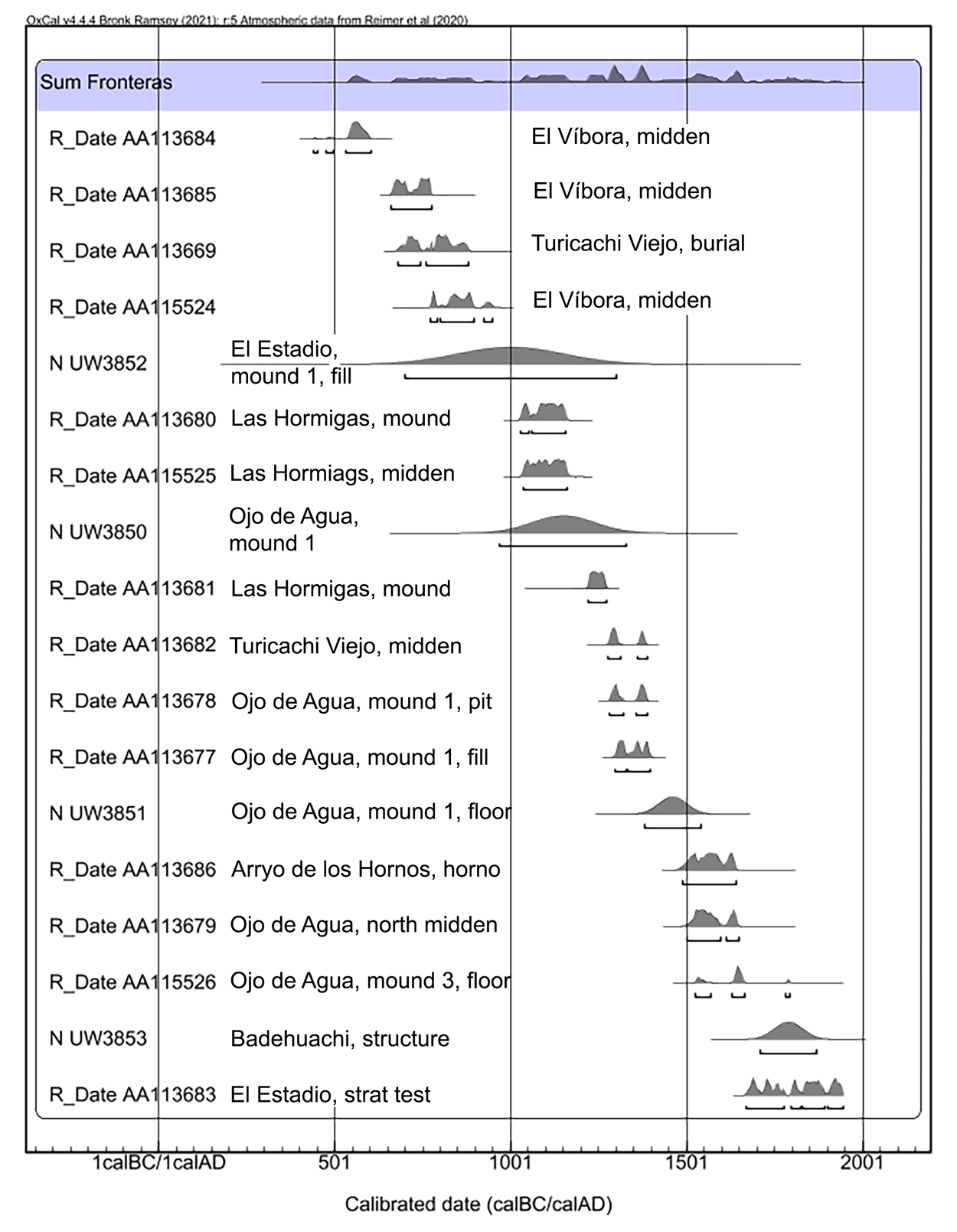
Di Peso (Reference Di Peso1974b:832–837) in his original monograph noted the likely continuation of Medio period patterns in the Sierra Madre Occidental region of Tres Rios, which included one 14C date (Haynes Reference Haynes1966:17) on a post at 300 ± 90 that produces a modern calibration of AD 1434–1696 (74% of distribution). Widespread rejection of Di Peso's dendrochronological sequence, unfortunately, led to a complete dismissal of all his chronometric interpretations, including those not based on tree rings. Our results confirm that components of Casas Grandes identity are still evident at the far northwestern corner of the Sierra Madre Occidental after AD 1450 and likely well after AD 1550; this is likely also true of many highland communities.
Discussion
We now return to the implications of our research outlined in the beginning of the article. Regarding cultural affiliation, documentary evidence indicates that multiple groups occupied the Fronteras Valley at the onset of the colonial period. Jocome are described as resident hunter-gatherer populations (Seymour Reference Seymour2016). Some O'odham groups may have also periodically lived in the valley. The most consistently identified group in historic documents are the Ópata (Yetman Reference Yetman2010), long-term and widespread denizens of the Sierra Madre Occidental. All these groups would have a claim to Casas Grandes affiliation through the Fronteras Valley, with clear historical continuity traceable from Ópata to archaeological antecedents at both settlement and community scales. We do not interpret this continuity to indicate that Ópata and Casas Grandes are merely temporal divisions in an otherwise distinct ethnicity. This view would ignore the ethnolinguistic diversity that characterized the former Casas Grandes region at contact. The Ópata, for instance, are unlikely to be the predominant descendants of the Casas Grandes people who resided outside the Fronteras Valley and some portions of the western Sierra Madre Occidental. The range of the historic Ópata stretches across three archaeological cultures, and similar arguments for ancestor–descendant continuity are even stronger for the Río Sonora and Serrana regions. It thus seems clear that the Casas Grandes tradition is not coterminous with known historic ethnicities; ethnicity in general is likely a poor model for precolonial group affiliation (MacEachern Reference MacEachern and Stark1998).
Elsewhere in the NW/SW, material cultural traditions indicative of shared identities, such as the Hohokam, have been reinterpreted as a form of religious ascription that spanned multiple ethnic groups (Bayman Reference Bayman2002; Fish and Fish Reference Fish, Fish, Carpenter and Pailes2022; Gumerman Reference Gumerman, Fish and Fish2007). This view cannot be applied directly to the Casas Grandes region. In most hinterland regions, including Fronteras, the religious practices enacted at Paquimé were drawn on only selectively, as indicated by the rarity of Ramos polychrome consumption, minimal public architecture, and very few rare goods. Current reconstructions suggest that Paquimé extracted resources from the immediate hinterland (Cunningham Reference Cunningham, Rosenwig and Cunningham2017; Whalen and Minnis Reference Whalen and Minnis2009) through the imposition of an exploitive ideology overseen by potentially foreign leaders (see Lekson Reference Lekson2015; Mathiowetz Reference Mathiowetz2018) who were ultimately found unacceptable by core-region residents (Phillips and Gamboa Carrera Reference Phillips, Carrera, Minnis and Whalen2015:166).
If the basic outline of this amalgamated reconstruction is accurate, it is unsurprising that most hinterlands opted out of the full suite of Paquimé-centric traditions while maintaining components commensurate with hinterland contexts, including more egalitarian and perhaps more archaic aspects of religious belief. The traditions that were more faithfully replicated in the hinterlands include domestic architectural features and the consumption of polychromes, with fewer iconic elements and some amount of lower-value rare goods (shell) consumption. This suite of elements may reflect household-level ritual activity and more secular aspects of identity. The hinterlands potentially channeled much of their ritual energy into pilgrimages to Paquimé (Fish and Fish Reference Fish, Fish, Schaafsma and Riley1999) while eschewing local community-scale ritual activities. Several features at Paquimé are designed to host large numbers of devotees, including exceptionally large agave ovens and an abundance of public ritual architecture (VanPool and VanPool Reference VanPool and VanPool2018:310–311, Reference VanPool, VanPool, Whitley, Loubser and Whitelaw2020:123). This view posits the spatial compartmentalization of ritual consumption practices at the landscape scale, explaining the obvious Casas Grandes affiliation of the hinterlands, despite their lack of Paquimé's most impressive attributes.
A related question is how Casas Grandes affiliations were first established in the Fronteras Valley. Three nonexclusive options are (1) parallel development from a shared ancestral tradition, (2) adoption of Casas Grandes traditions by previously unrelated groups, and (3) the actual movement of Casas Grandes people into the valley. Taking the strongest case for affiliation at Ojo de Agua, the striking similarity of architectural construction techniques and the juxtaposition of distinctive Casas Grandes elements suggest the presence of builders fully enmeshed in communities of practice, such that domestic architecture incorporates both high- and low-visibility attributes. These same architectural attributes, as well as rare glaze paint pottery production, were carried forward into the early colonial period after Paquimé itself was long since abandoned. This faithful adoption and persistence would seem unlikely to develop through the casual copying of forms based on limited exposure. It is noteworthy that the one tested Fronteras I site (El Víbora) evidences few parallels to the Casas Grandes Valley's Viejo period, suggesting these affiliations were strengthened relatively late in time, as they were elsewhere in the Sierra Madre Occidental (Douglas and Quijada Reference Douglas, Quijada, Newell and Gallaga2004).
Our preferred scenario is that actual Casas Grandes peoples entered the Fronteras Valley at the beginning of what we designate as Fronteras II. Regional migrations were common in the late precolonial NW/SW. For example, isotopic work at Paquimé suggests upward of 30% of the population was not immediately local, and nearly 10% originated from significant distances (Offenbecker Reference Offenbecker2018:78). We suspect that multiple household-level units of Casas Grandes origin made the decision to settle in the Fronteras Valley. Some of these households were integrated into existing population centers, whereas others expressed a greater degree of homophily and created communities such as Ojo de Agua that approximated site-level intrusions. This household-unit model would be in opposition to any reconstruction that suggests politically directed colonization efforts, such as that imagined by Di Peso (Reference Di Peso1974b) for other portions of the Sierra Madre Occidental. The continual, if rare, consumption of polychrome ceramics and rare goods suggests that the physical movement of peoples continued after initial migration, possibly through pilgrimage activity as outlined earlier. This continual contact presumably facilitated the synchronization of social identities long after initial migration events.
A last point to be addressed is the Fronteras Valley's anomalous demographic and cultural resilience relative to other portions of the Casas Grandes region (Hill et al. Reference Hill, Clark, Doelle and Lyons2004; Ingram and Shelby Reference Ingram and Shelby2021). At present we can offer only the outline of a materialist perspective that undoubtedly lacks nuance. Site densities in the Fronteras Valley appear far below those of most Casas Grandes or Río Sonora settings (Pailes Reference Pailes2015). The distance between large sites suggests little potential or need for coordination between population centers in subsistence infrastructure such as irrigation networks. Overall, the data suggest that the valley was more labor poor than resource poor relative to surrounding subregions. Labor-poor frontier contexts often foment fluid social contracts and lower levels of inequality. This scenario would obviate the need for the sorts of complex managerial systems co-opted by would-be elites (Earle Reference Earle1997; Hayden and Villeneuve Reference Hayden, Villeneuve, Price and Feinman2010) and reinforces why the elite-centered ideologies of Paquimé found little direct purchase in the Fronteras Valley. A future discussion will take up the issue of comparative demographic trajectories at a regional scale. In addition to low-population density, we suspect that high village autonomy and the high cultural diversity of the Fronteras Valley are important factors in explaining resilience to both environmental variance and social tumult, including that induced by colonial invasions.
Conclusion
The Casas Grandes tradition is best known from the developmental sequence of the core zone in northwest Chihuahua. Previous research demonstrates that elements of the post-AD 1200 Medio period pattern were exported to, adopted by various hinterland populations, or both. We verify that this is also true of the Fronteras Valley on the northwestern fringe of the Sierra Madre Occidental. In contrast to the core regions around Paquimé, there is a clear record of continuity between these Casas Grandes-affiliated peoples and protohistoric groups, most clearly the Ópata, who are widely accepted as the predominant sedentary group in the valley in the 1600s. Despite this continuity, we avoid equating Casas Grandes with an ethnic identity. We suspect that Casas Grandes represented a fluid set of religious ideals and practices tethered to the prestige of Paquimé but lacking any obligate ideology. Additionally, ritual practices of consumption were compartmentalized at the landscape scale, such that much of the unique material richness of Paquimé should not be expected in hinterland contexts. As outlined by previous scholars, pilgrimages provide a plausible means by which a large segment of the regional population could partake directly in the religious practices of Paquimé. Household-based ritual and secular activities of Casas Grandes derivation are directly indicated in the consumption practices of hinterlands populations.
We infer that the most likely scenario for the original incorporation of the Fronteras Valley into the Casas Grandes region took place through a mix of site-level intrusions (Ojo de Agua) in concert with diffuse incorporation of Casas Grandes peoples into existing settlements. Individual family units are the most likely scale of social unit that made decisions to migrate, as opposed to any sort of intentional colonization directed by larger political units. An issue worthy of further study is the differential incorporation of Casas Grandes traits by various hinterland groups and their persistence into the proto-colonial period. After Paquimé's dissolution, Fronteras Valley residents maintained traditions reflective of Casas Grandes identity through the continued production or importation of existing polychrome styles and the development of Sonoran Polychrome. Casas Grandes architectural practices were also retained well after colonial invasion in the form of coursed adobe architecture and occasional internal domestic features.
There is room to add substantial nuance to our understanding of these patterns of affiliation and a need to address the central question of what was so attractive about Casas Grandes, given that much of the Paquimé-centric ideology was not adopted in the hinterlands. More research is also needed to address what aspects of sociopolitical organization or ecology facilitated the differential demographic and cultural persistence of the Fronteras Valley relative to other portions of the Casas Grandes region. The answer to these questions will necessitate a larger consideration of the diverse Sierra Madre Occidental communities, which together represent a major center of demographic resilience in the otherwise tumultuous twelfth to seventeenth centuries. This article focused on the building blocks of culture history, and these observations are intended as a jumping-off point for further studies.
Acknowledgments
The research was funded by National Science Foundation Grant BCS-1724445 and a Junior Faculty Fellowship from the University of Oklahoma. We are greatly indebted to Cronista Sergio Ramos and Inginero Jesus Villalobos, Secretario del Municipio de Fronteras. The comments of three anonymous reviewers significantly improved the quality of our article.
Data Availability Statement
All original data and artifacts are curated by INAH Sonora. Data files are available on request from the corresponding author.
Competing Interests
The authors declare none.


 Open access

