


Introduction
Among the world’s eight major migratory waterbird flyways, the East Asian-Australasian Flyway (EAAF) supports not only the greatest number of shorebird populations (79 from the families of Scolopacidae, Charadriidae and Haematopodidae), but also many (at least 13) threatened taxa (International Wader Study Group 2003, MacKinnon et al. Reference MacKinnon, Verkuil and Murray2012). Many of these migratory shorebirds share similar habitat use pattern and rely heavily on intertidal flats as their staging, stopover and/or wintering grounds (Choi et al. Reference Choi, Gan, Ma, Zhang, Chen and Ma2009, Reference Choi, Gan, Hua, Wang and Ma2014, Peng et al. Reference Peng, Anderson, Chang, Choi, Chowdhury, Clark, Gan, Hearn, Li, Lappo, Liu, Ma, Melville, Phillips, Syroechkovskiy, Tong, Wang, Zhang and Zöckler2017). The loss of intertidal flats and benthic prey resources in the Yellow Sea region has been recognised as a key factor contributing to shorebird population declines along the EAAF (Piersma et al. Reference Piersma, Chan, Mu, Hassell, Melville, Peng, Ma, Zhang and Wilcove2017, Studds et al. Reference Studds, Kendall, Murray, Wilson, Rogers, Clemens, Gosbell, Hassel, Jessop, Melville, Milton, Minton, Possingham, Riegen, Straw, Woehler and Fuller2017, Zhang et al. Reference Zhang, Ma, Choi, Peng, Bai, Liu, Tan, Melville, He, Chan, van Gils and Piersma2018).
Intertidal flats of the Yellow Sea extend over 4,000 km along the coasts of China and the Koreas (Luo et al. Reference Luo, Cai, Liu, Lei, Qi and Su2015, Murray et al. Reference Murray, Ma and Fuller2015). This region has been referred to as an ecological bottleneck, where a large proportion of shorebird populations travel through this relatively confined area (Choi Reference Choi2015). If habitats deteriorate or disappear at such a bottleneck, it will have disproportionate impacts (relative to its area) on shorebird populations; this is exacerbated when no alternative sites are available (Iwamura et al. Reference Iwamura, Possingham, Chadès, Minton, Murray, Rogers, Treml and Fuller2013, Moores et al. Reference Moores, Rogers, Rogers and Hansbro2016, Zhang et al. Reference Zhang, Ma, Choi, Peng, Bai, Liu, Tan, Melville, He, Chan, van Gils and Piersma2018).
Among the shorebirds that stop at the Yellow Sea, the ‘Critically Endangered’ Spoon-billed Sandpiper Calidris pygmaea and the ‘Endangered’ Nordmann’s Greenshank Tringa guttifer are the most at risk (Birdlife International 2016, 2017). Endemic to the EAAF, these two species breed in the Russian Arctic during the boreal summer and migrate thousands of kilometres to overwinter in southern China, South-East Asia and South Asia (Zöckler et al. Reference Zöckler, Li, Chowdhury S, Iqbal and Yu2018). The latest population estimates for Spoon-billed Sandpiper and Nordmann’s Greenshank are 100–228 pairs and 900–1,200 individuals respectively (Birdlife International 2017, Zöckler Reference Zöckler2017, Clark et al. Reference Clark, Anderson, Li, Tomkovich, Zöckler, Lee and Green2018, Zöckler et al. Reference Zöckler, Li, Chowdhury S, Iqbal and Yu2018), and threats to both species, such as habitat loss and hunting, continue to be documented in their staging, wintering and breeding areas (Melville et al. Reference Melville, Chen and Ma2016, Chowdhury et al. Reference Chowdhury, Foysal, Diyan and Ahmed2017). The Yellow Sea is located near the mid-point of their migration and encompasses the key stopover areas for both species (Tong et al. Reference Tong, Zhang, Li, Zöckler and Clark2012, Peng et al. Reference Peng, Anderson, Chang, Choi, Chowdhury, Clark, Gan, Hearn, Li, Lappo, Liu, Ma, Melville, Phillips, Syroechkovskiy, Tong, Wang, Zhang and Zöckler2017). In recent years, at least 200 Spoon-billed Sandpipers and almost 1,200 Nordmann’s Greenshanks have been recorded during their southbound migration along China’s southern Jiangsu coast in the south-western part of the Yellow Sea (Zöckler et al. Reference Zöckler, Li and Clark2015). Although this area is recognised as a critical stopover site for both Spoon-billed Sandpiper and Nordmann’s Greenshank, there has been no systematic study on the stopover ecology of these threatened species. It remains unclear why this area attracts a large number of endangered shorebirds and what role it plays in the life cycle of these birds. An improved understanding of these two flagship species is needed to aid their population recovery and protect the habitats they share with many other threatened waterbird species.
To address this gap, we carried out the first detailed ecological study of Spoon-billed Sandpiper and Nordmann’s Greenshank in southern Jiangsu during their southbound migration. We aimed to 1) estimate the passage dates, and 2) investigate the pattern of primary/flight feather moult for these species. Our findings enable an assessment of the importance of the southern Jiangsu intertidal flats for these highly threatened species and can help decision-makers to safeguard their future using an evidence-based approach. Successful conservation of these habitats will have benefits that go beyond the conservation of Spoon-billed Sandpiper and Nordmann’s Greenshank, as the tidal flat system supports many other species including over 100 waterbird species, fishes and benthic organisms (Liu Reference Liu and Ying2014, China Coastal Waterbird Census Group 2015, Choi et al. Reference Choi, Jackson, Gallo-Cajiao, Murray, Clemens, Gan and Fuller2018).
Methods
Study area
This study was conducted in Rudong and Dongtai Counties of southern Jiangsu Province (32.29–32.76°N, 120.94–121.44°E), China from July to November 2015. Rudong (under the administration of Nantong city) borders the southernmost part of the Yellow Sea. It has a coastline of 106 km with 69,300 ha of intertidal flats (Song et al. Reference Song, Yang, Xu, Miu and Cai2014). Dongtai (under the administration of Yancheng city) extends 50 km to the north of Rudong, with 85 km of coastline and 104,800 ha of intertidal flats (Mei and Sun Reference Mei and Sun2013). The intertidal flats in both regions comprise mainly historical sediment from the Yangtze and Yellow Rivers, the courses of which changed long ago so they no longer discharge into the Yellow Sea (Saito and Yang Reference Saito, Yang, Tsunogai, Iseki, Koike and Oba1995). Currently, most of the coastline is enclosed by concrete seawalls (Choi et al. Reference Choi, Jackson, Gallo-Cajiao, Murray, Clemens, Gan and Fuller2018). The areas inside the seawalls are either undeveloped or reclaimed to build industrial zones, modern agricultural bases and aquaculture ponds.
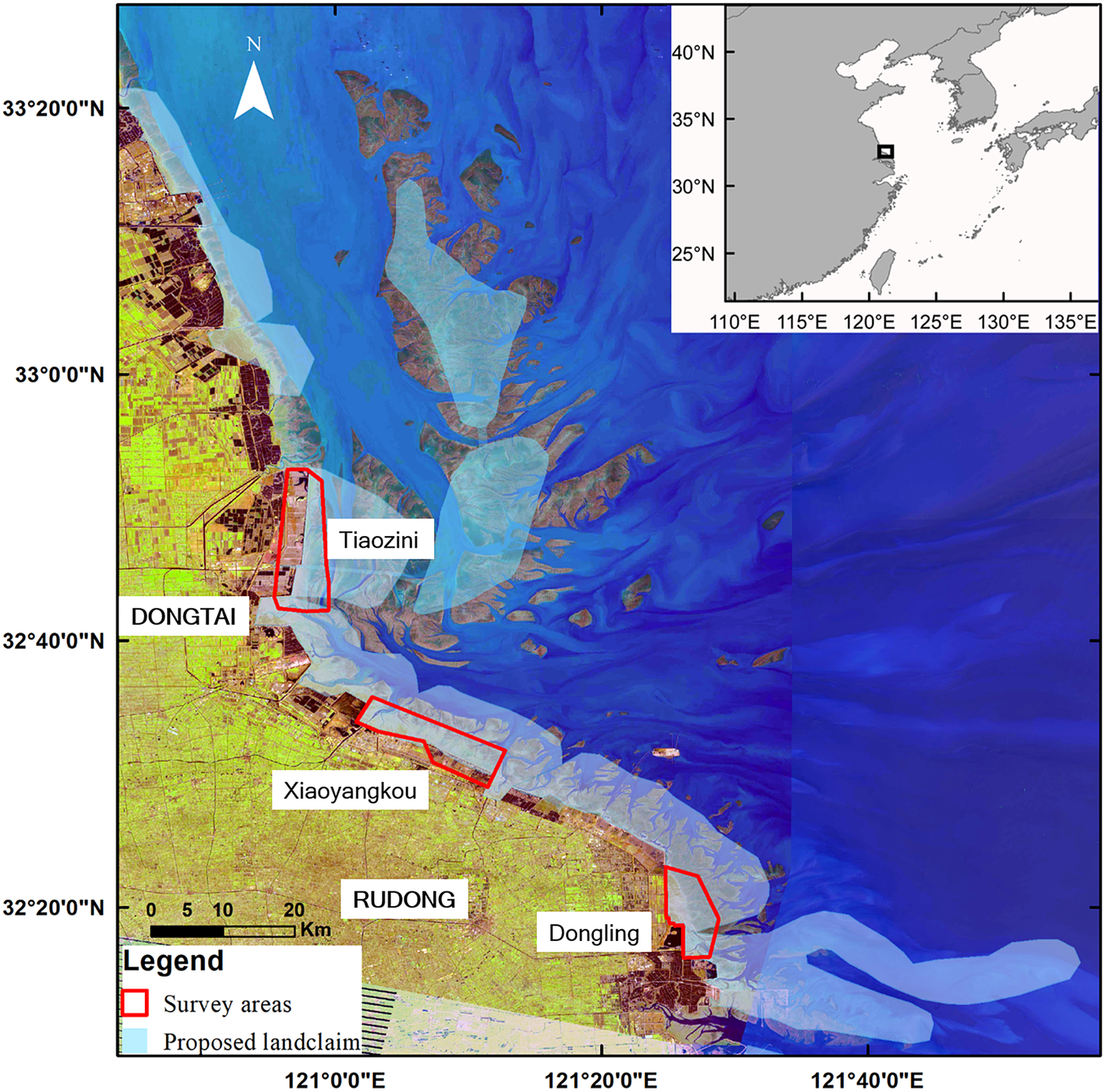
Our surveys covered three subregions along the coastline, namely, Tiaozini (32.76N°, 120.90E°; Dongtai County), Yangkou (32.52N°, 120.99E°; Rudong County) and Dongling (32.22N°, 121.45E°; Rudong County) (Figure 1). These subregions were selected because our target species were found to be most abundant in these areas between 2011 and 2015 (Tong et al. Reference Tong, Zhang, Li, Zöckler and Clark2012, Peng et al. Reference Peng, Anderson, Chang, Choi, Chowdhury, Clark, Gan, Hearn, Li, Lappo, Liu, Ma, Melville, Phillips, Syroechkovskiy, Tong, Wang, Zhang and Zöckler2017).
Map of the study area and its location in southern Jiangsu Province, China (insert). White lines (red in the online version) demarcate the boundaries of subregions where regular surveys were conducted. The land claim areas shown are those proposed in Jiangsu Province’s 2010–2020 development plan (Jiangsu Development and Reform Commission and Jiangsu Coastal Areas Development Office 2010).
Estimate of transiting dates and abundance
We conducted 21 high tide surveys mostly around spring tides, with each survey covering at least two subregions. During high tides, shorebirds congregate on intertidal flats on the seaward side of the seawalls if the flats are not inundated with seawater, or move to artificial supratidal roosting sites, such as aquaculture ponds, when intertidal flats are completely inundated (Jackson et al. Reference Jackson, Carrasco, Choi, Li, Ma, Melville, Mu, Peng, Woodworth, Yang, Zhang and Fuller2019). For much of the survey, a team of at least two experienced observers used telescopes and binoculars to systematically scan flocks of shorebirds near the seawall and/or in the supratidal roosting sites within two hours before and after high tide, to determine the number of Spoon-billed Sandpiper and Nordmann’s Greenshank present.
We used Thompson’s modelling approach to estimate average arrival dates, stopover durations and departure dates for both species (Thompson Reference Thompson1993). Thompson’s modelling approach assumes that the dates of arrival and departure are normally distributed, which is particularly suited for birds with a relatively long stopover duration and low turnover. This approach might yield more reliable abundance and stopover duration estimates compared to peak counts and resights of birds marked with leg flags because with population turnover, some birds might have already left the site before other birds’ arrival, making the peak counts inaccurate and time and resources to search for marked birds are often limited (Rogers et al. Reference Rogers, Yang, Hassell, Boyle, Rogers, Bing, Zhang and Piersma2010, Choi et al. Reference Choi, Battley, Potter, Rogers and Ma2015, Reference Choi, Rogers, Gan, Clemens, Bai, Lilleyman, Lindseyf, Milton, Straw, Yu, Battley, Fuller and Rogers2016).
Measurement of primary moult parameters
Photography can yield moult scores as reliable as conventional methods where birds are directly examined in the hand (Vieira et al. Reference Vieira, Furness and Nager2017) and it is less costly and time consuming. We therefore took photos (using an SLR camera with 400 mm lens) and videos (using Swarovski ATX 30-70×95 telescope mounted with Olympus TG-3 or Panasonic FT-5 compact cameras) of birds stretching their wings, landing, taking off or flying whenever possible during fieldwork. These photos and videos, supplemented by photos collected from citizen photographers during the same period (Figure S1 in the online supplementary material), were used to assess the progress of primary moult and determine the age structure of both species. Age was determined based on the criteria discussed in Prater et al. (Reference Prater, Marchant and Vuorinen1977), where plumage characteristics such as colour pattern and extent of wear of unmoulted primaries were used to distinguish different age classes. Whenever possible, we classed the birds as: juvenile (a bird that hatched earlier in the same year of observation), second calendar-year bird (a juvenile becomes a second calendar-year bird as of 1 January), and adult (a bird beyond its second calendar-year). We removed any individuals classed as juvenile or second calendar-year from our analysis because those young individuals have different moult schedules from the adults (Prater et al. Reference Prater, Marchant and Vuorinen1977, Eiam-ampai et al. Reference Eiam-ampai, Nimnuan, Sonsa, Sutibut and Round2011, L. Zhang pers. obs.), and including them in the analysis would confound the analysis.
To document moult progress, we used the British Trust for Ornithology standard for the scoring of primary feathers (Ginn and Melville Reference Ginn and Melville1983). Consecutive photos taken in the field were treated with extra care to avoid scoring the same individual more than once. We then used the Underhill and Zucchini moult model in the R Package moult (Erni et al. Reference Erni, Bonnevie, Oschadleus, Altwegg and Underhill2013) to estimate the average moult start dates, end dates and moult durations. The Underhill and Zucchini moult model has four key assumptions: 1) the moult index increases linearly over time for each individual; 2) the duration of moult is the same for every individual; 3) the start date of moult in the population is normally distributed, and 4) the individual observations are independent. To better meet the first assumption, we transformed primary moult scores into proportion of feather mass grown using Underhill and Joubert’s (Reference Underhill and Joubert1995) relative mass table. Unlike moult score, where each primary feather was given an equal weight regardless of size, feather material is more likely to be produced at a constant rate. Since relative feather mass data were unavailable for Spoon-billed Sandpiper and Nordmann’s Greenshank, and the proportion of feather mass is relatively constant within the same genus (Underhill and Joubert Reference Underhill and Joubert1995), we used the published data of their nearest-sized congeneric species, the Little Stint C. minuta and the Common Greenshank T. nebularia, respectively. In addition to Spoon-billed Sandpiper and Nordmann’s Greenshank, we recorded the moult progress of a few other shorebird species at the study sites whenever the opportunity arose.
Newly grown pin feathers (score 1) could be impossible to differentiate from those just emerging from the sheath (score 2), but these two categories together only represented 15% of all the feathers scored. These categories also have relatively small feather mass compared to the other categories and therefore, the uncertainty in scoring ‘1’ and ‘2’ should not significantly impact our overall results. We selected the model for Type 2 moult data, as defined by Underhill et al. (Reference Underhill, Zucchini and Summers1990), since the probability of sampling pre-moult, in-moult and post-moult individuals should be similar, and we obtained the moult scores for all three moult stages (Erni et al. Reference Erni, Bonnevie, Oschadleus, Altwegg and Underhill2013). All statistical analyses were conducted in R v3.4.3 (R Core Team 2018).
Results
Transiting dates
The maximum single-day counts for Spoon-billed Sandpiper and Nordmann’s Greenshank were 76 and 768, respectively (Figure S2). Based on our modelled estimates, Spoon-billed Sandpipers stayed along the southern Jiangsu coast for 66 days from 19 August ± 11 days (SD) to 24 October ± 6 days (SD) and Nordmann’s Greenshanks stayed for 84 days from 31 July ± 9 days (SD) to 23 October ± 16 days (SD).
Primary moult schedules
Of all the individuals whose moult scores were recorded, 85% of the Spoon-billed Sandpipers (n = 20) and 91% of the Nordmann’s Greenshanks (n = 164) were actively moulting. Ten percent of Spoon-billed Sandpipers and 6.71% of Nordmann’s Greenshanks were recorded with a moult score of 50 (all feathers new and fully grown) and all these individuals were recorded in late September (after 24 September) or October. For both species, the remaining individuals that were not actively moulting had a moult score of 0, meaning that they had yet to start their moult, and all these individuals were recorded prior to 12 August. It is possible that we failed to differentiate some juveniles from adults later in the season and recorded the former as moulted adults. However, this should be a rare case because only 4.4% of Spoon-billed Sandpipers and 0.2% of Nordmann’s Greenshanks (average weighted by the number of individuals scanned on each survey day) observed throughout the survey period were juveniles (Figure S3).
Other shorebirds, including Great Knot Calidris tenuirostris, Bar-tailed Godwit Limosa lapponica, Greater Sand Plover Charadrius leschenaultii and Eurasian Curlew Numenius arquata, also underwent primary moult from early August to late September (Figure S4). However due to the lack of data in October, it is unclear whether they completed their moult before migrating south.
The modelled average moult durations for Spoon-billed Sandpiper and Nordmann’s Greenshank were 72.58 ± 9.08 days (SE) and 65.09 ± 2.40 days (SE) respectively. On average, Spoon-billed Sandpipers started moulting on 8 August ± 4.52 days (SE) whilst Nordmann’s Greenshanks started 12 days earlier on 27 July ± 1.56 days (SE). The moult schedule of both species greatly overlapped with their stopover in southern Jiangsu. Both species showed an overall continuous moulting progress throughout the study period (Figure 2), obtaining greater proportional feather mass near the end of October, and we observed no individuals with arrested moult. We therefore conclude that the populations of both species spent an extended period in southern Jiangsu where they moulted almost exclusively at the study sites. Repeated sightings of some flagged individuals further confirmed that many birds remained at our study sites throughout the period (Z. Yang unpubl. data).
Proportion of feather mass grown (filled circles) and percentage of individuals in active primary moult (open circles) in relation to date for (a) Spoon-billed Sandpipers and (b) Nordmann’s Greenshanks in south Jiangsu region during southbound migration in 2015. Each filled circle represents an individual bird; each open circle represents all individual(s) whose moult score was obtained on a single day.

Discussion
Our study is the first to quantitatively document aspects of the stopover ecology of the ‘Critically Endangered’ Spoon-billed Sandpiper and the ‘Endangered’ Nordmann’s Greenshank. During southbound migration, both species spent at least two months in the coastal area of southern Jiangsu typified by intertidal foraging areas and supratidal roosting sites, and here the adults underwent a complete primary moult.
Critical importance of the intertidal flats of southern Jiangsu Province
The maximum single-day count for both species was lower than those documented in earlier studies (Tong et al. Reference Tong, Zhang, Li, Zöckler and Clark2012, Peng et al. Reference Peng, Anderson, Chang, Choi, Chowdhury, Clark, Gan, Hearn, Li, Lappo, Liu, Ma, Melville, Phillips, Syroechkovskiy, Tong, Wang, Zhang and Zöckler2017). This is most likely because the number of observers in our surveys was too low. The vast areas of all survey sites, especially Tiaozini where shorebirds often spread out over several flocks that occupy many kilometres of intertidal flats, would require a higher number of observers. Future results may be improved by splitting the observers into multiple survey groups and simultaneously surveying different flocks of shorebirds.
Nevertheless, the maximum single-day count for Spoon-billed Sandpiper and Nordmann’s Greenshank reached at least 16.67% and 64.0% of their estimated global population size respectively (Birdlife International 2017, Zöckler Reference Zöckler2017, Zöckler et al. Reference Zöckler, Li, Chowdhury S, Iqbal and Yu2018). This, together with the earlier studies, demonstrates that a considerable proportion of both species (Spoon-billed Sandpiper 49.34%; Nordmann’s Greenshank 80.67%; Peng et al. Reference Peng, Anderson, Chang, Choi, Chowdhury, Clark, Gan, Hearn, Li, Lappo, Liu, Ma, Melville, Phillips, Syroechkovskiy, Tong, Wang, Zhang and Zöckler2017) regularly stops at the Rudong-Dongtai intertidal flats during southbound migration, highlighting the importance of intertidal habitats in southern Jiangsu Province for these migratory shorebirds.
In addition to the large groups of adults observed, the discovery of juveniles and second calendar-year Spoon-billed Sandpipers and Nordmann’s Greenshanks on the Rudong-Dongtai intertidal flats further signifies the value of this region in supporting the populations of these species. Although we recorded few juveniles or second calendar-year birds of both species, given the low juvenile recruitment (Zöckler et al. 2010), they might represent a substantial proportion of all the juveniles or the second-calendar-years of those species for the year studied (Table S1).
Since a substantial proportion of both study species stopped at our study area and the majority of them were actively moulting, and given the limited evidence for other important moulting sites documented for either species (Green et al. Reference Green, Clark, Anderson, Weston and Hughes2018), we believe that the intertidal flats of southern Jiangsu Province are the major complete or near-complete prebasic moulting ground (Howell et al. Reference Howell, Corben, Pyle and Rogers2004) for both Spoon-billed Sandpiper and Nordmann’s Greenshank.
In addition, some individuals of several other shorebird species including the ‘Endangered’ Great Knot, the ‘Near Threatened’ Bar-tailed Godwit, the ‘Near Threatened’ Eurasian Curlew and Greater Sand Plover also underwent primary moult during their southbound migration stopover in southern Jiangsu (Figure S4 and Table S2), and these species too have been recorded in internationally important numbers on the intertidal flats of southern Jiangsu Province, with over 1% of the EAAF population (Peng et al. Reference Peng, Anderson, Chang, Choi, Chowdhury, Clark, Gan, Hearn, Li, Lappo, Liu, Ma, Melville, Phillips, Syroechkovskiy, Tong, Wang, Zhang and Zöckler2017). Therefore, the critical role of the intertidal flats of southern Jiangsu Province as the primary moulting ground could apply more broadly to other shorebird species or populations. In particular, the Bar-tailed Godwit, Great Knot and Greater Sand Plover were thought to moult primary feathers (undergo complete prebasic moult) only after they have reached the non-breeding grounds in Australia (Battley et al. 2006, Wilson et al. Reference Wilson, Nebel and Minton2007, Jackson Reference Jackson2018). Our study presents opportunities for future research on the primary moult schedules of other shorebird species on the southern Jiangsu coast, which could belong to the under-studied populations that spend their non-breeding season outside Australia.
Moult is an energetically expensive activity and most birds tend to avoid overlapping it with other monumental life history events such as breeding and migration. Moult schedule also depends largely on the availability of food (Greenwood Reference Greenwood1983, Remisiewicz Reference Remisiewicz2011). The use of the intertidal flats of southern Jiangsu Province by Spoon-billed Sandpiper, Nordmann’s Greenshank and several other shorebird species during moulting indicates that the region has rich food resources. The extended time needed for primary moult and refuelling prior to the next leg of their migration means the intertidal flats of southern Jiangsu Province are of critical importance for the continued survival of these threatened species.
Comparison of moult schedules between congeneric species
The modelled moult duration of Spoon-billed Sandpiper in southern Jiangsu is similar to that of Long-toed Stint C. subminuta in Thailand at 13.05°N (74 days) (Round et al. Reference Round, Gale and Nimnuan2012), and longer than that of Little Stint on the Atlantic coast of Morocco at 28.03–33.00°N (60 days or less) (Pienkowski et al. Reference Pienkowski, Knight, Stanyard and Argyle1976). This disagrees with the hypothesis that species moulting in more northern latitudes have shorter moult durations (Dietz et al. Reference Dietz, Rogers, Gutiérrez and Piersma2015), where the earlier onset of winter may force the species to finish moulting sooner, and the need of some northerly moulting species to continue migrating south may cause them to finish moult earlier.
The longer moult duration of Spoon-billed Sandpipers compared to Little Stints may be partially due to their slightly longer wings (Prater et al. 1977). The short moult duration of Little Stints in the Moroccan study was not conclusive, as only moult data during the early and middle moult stages were used for the moult duration estimates. In a separate study in the Kenyan rift valley (0.25–2.00°S), the moult duration estimated for adult Little Stints was considerably longer at about four months (Pearson Reference Pearson1984). The moult duration for the Nordmann’s Greenshank, on the other hand, is shorter than that estimated for the Common Greenshank at similar latitudes, which needed a total moult duration of 75 days (Pienkowski et al. Reference Pienkowski, Knight, Stanyard and Argyle1976). Again, moult data from Morocco might be limited, because the moult duration was estimated from a single re-trapped Common Greenshank using linear extrapolation.
Conservation implications
The intertidal flats of southern Jiangsu Province are of global importance as a moulting and staging area for threatened shorebird populations. The rapid loss of intertidal habitats elsewhere in Jiangsu (Cai et al. Reference Cai, van Vliet, Verburg and Pu2017, Chen et al. Reference Chen, Dong, Xiao, Ma, Tan, Melville, Li, Lu, Liu and Liu2019) means that it is highly unlikely that Spoon-billed Sandpipers and Nordmann’s Greenshanks would be able to find a nearby alternative moulting and refuelling ground if our study areas were to be destroyed. Currently, these areas still face multiple threats including invasion by exotic smooth cordgrass Spartina alterniflora (Zhou et al. Reference Zhou, Liu and Qin2009), pollution (Melville et al. Reference Melville, Chen and Ma2016, Yao et al. Reference Yao, Liu, You and Zhao2018), incidental shorebird capture by fishnet (Crighton Reference Crighton2016) and further land reclamation (Melville Reference Melville2018). In addition, the lack of management of artificial supratidal habitats is another threat because most shorebirds use these areas as roosting sites when the intertidal flats are inundated at high tide (Peng et al. Reference Peng, Anderson, Chang, Choi, Chowdhury, Clark, Gan, Hearn, Li, Lappo, Liu, Ma, Melville, Phillips, Syroechkovskiy, Tong, Wang, Zhang and Zöckler2017, Jackson et al. Reference Jackson, Carrasco, Choi, Li, Ma, Melville, Mu, Peng, Woodworth, Yang, Zhang and Fuller2019). Given the extensive stay of Spoon-billed Sandpipers and Nordmann’s Greenshanks in this area, any threat can have a devastating impact on these already threatened populations.
Recently, the Chinese government has taken action to regulate further coastal development. In January 2018, the government announced strict controls on new coastal reclamation (Lei Reference Lei2018, Stokstad Reference Stokstad2018). Furthermore, in February 2018, the government nominated 16 sites along the coast of Yellow Sea-Bohai Gulf on the tentative list of natural World Heritage Sites. Two areas along the Jiangsu coast, including Tiaozini, were inscribed on the World Heritage List in 2019; the remaining sites, including the Rudong coast, will be considered for inclusion in 2023 (UNESCO 2019). Whilst these are all very promising signs, it remains to be seen how these new regulations will be implemented, and whether the local government of Tiaozini can achieve a balance between ecosystem conservation and economic development. In the meantime, continued degradation of the remaining habitats is still a risk (Melville Reference Melville2018).
Protection of the remaining intertidal habitats must be the top priority, but there is also a need, in the longer term, to explore opportunities for coastal restoration to recreate habitats for the target species. For intertidal flats that are degraded by the smooth cordgrass and have become unsuitable for waterbirds to use (Gan et al. Reference Gan, Cai, Choi, Ma, Chen and Li2009, Ma et al. Reference Ma, Wang, Gan, Li, Cai and Chen2009), manual, mechanical and/or chemical methods may be employed to control or eliminate the spread of these invasive weeds (Zhao et al. in press). For claimed areas that have already been developed, a potential solution is to work with local communities and other key stakeholders to create shorebird-friendly environments. For example, an incentive system could be trialled with aquaculture ponds and agriculture area, where managers receive a small payment to adjust the water level and clear the vegetation surrounding their ponds, creating supplementary resting and foraging grounds for shorebirds during migration seasons (Jackson et al. Reference Jackson, Carrasco, Choi, Li, Ma, Melville, Mu, Peng, Woodworth, Yang, Zhang and Fuller2019). For claimed areas that have not been developed (such as the municipal wetland park at Tiaozini), attempts could be made to create suitable biophysical features that attract shorebirds (Ge et al. Reference Ge, Wang, Xiao and Shi2006, Jackson et al. Reference Jackson, Carrasco, Choi, Li, Ma, Melville, Mu, Peng, Woodworth, Yang, Zhang and Fuller2019).
In conclusion, our work highlights the importance of the intertidal flats in southern Jiangsu coast as the moulting ground for both Spoon-billed Sandpiper and Nordmann’s Greenshank during southbound migration stopover. Conservation of the intertidal flats in southern Jiangsu coast will not only benefit these two shorebird species, but also other members of this ecosystem.
Supplementary Material
To view supplementary material for this article, please visit http://dx.doi.org/10.1017/S0959270920000210
Acknowledgements
We thank the Conservation Leadership Programme for providing training for this project, Jiangsu Nantong Teenager Social Practice Centre for providing accommodation. We thank for Ho-fai Cheung, Peter Crighton, Tom Clarke, Richard Mundy, Andrew Baksh, Jingwei Hu, Wei Zhang, Wei Liu, Tengyi Chen, Chen Yu, Vladimir Morozov, Haiming Tang, Le Xiang and Tong Mu their assistance during field and laboratory work. We also thank Dr. Phil Atkinson, as well as the two anonymous referees for their generous and constructive feedbacks on the manuscript. This study was supported by the Conservation Leadership Programme (grant number 03244615).



