
Skip to main content Accessibility help
×
  • Cited by 20
    • Show more authors
    • Access check Access
      You have digital access to this book
    • Select format
    • Publisher:
      Cambridge University Press
      Publication date:
      02 August 2018
      09 August 2018
      ISBN:
      9781139135382
      9781107022096
      9781107606586
      Dimensions:
      (228 x 152 mm)
      Weight & Pages:
      0.84kg, 446 Pages
      Dimensions:
      (228 x 152 mm)
      Weight & Pages:
      0.73kg, 446 Pages
    Access check Access
    You have digital access to this book
    Selected: Digital
    Add to cart View cart Buy from Cambridge.org

    Book description

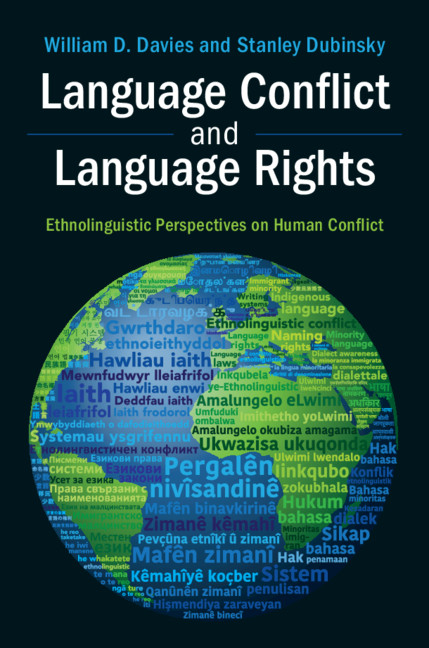
    As the colonial hegemony of empire fades around the world, the role of language in ethnic conflict has become increasingly topical, as have issues concerning the right of speakers to choose and use their preferred language(s).  Such rights are often asserted and defended in response to their being violated. The importance of understanding these events and issues, and their relationship to individual, ethnic, and national identity, is central to research and debate in a range of fields outside of, as well as within, linguistics. This book provides a clearly written introduction for linguists and non-specialists alike, presenting basic facts about the role of language in the formation of identity and the preservation of culture. It articulates and explores categories of conflict and language rights abuses through detailed presentation of illustrative case studies, and distills from these key cross-linguistic and cross-cultural generalizations.

    Reviews

    ‘This book will be a delight to teach, learn from or just read. Davies and Dubinsky have given us an extremely useful introduction to the vast and topical field of language conflicts and language rights. After a review of basic notions in linguistic science for the non-professional reader, they take up the issues of identity, language rights in the context of human rights, and present a typology of language conflicts. These include indigenous minorities such as the Sami in Norway or the Ainu in Japan, geopolitical minorities like the Hungarians in Slovakia or Hispanics in Southwest US, migrating minorities such as the Roma in Europe and Puerto Ricans in the US, then intra-linguistic minorities like African American English speakers in the US, and finally, conflicts arising from competition for linguistic dominance are discussed in detail, e.g. Flemish vs. Walloons in Belgium and French vs. English in Canada. Carefully planned, well researched and reader-friendly, this textbook will be used profitably on any continent where university courses are offered on the life and death of human languages and the fate of their speakers.'

    Miklós Kontra - Károli Gáspár University, Budapest, Hungary

    ‘What is lost linguistically when we lose a language? What is lost politically and culturally? William D. Davies and Stanley Dubinsky have written a very important book answering these crucial questions. It should be part of the library of linguists, anthropologists, psychologists, politicians and anyone interested in how our psyches are formed by language.'

    Daniel L. Everett - Dean of Arts and Sciences, Bentley University, Massachusetts, and author of How Language Began: The Story of Humanity's Greatest Invention and Don't Sleep There are Snakes: Life and Language in the Amazonian Jungle

    ‘… this book is a first attempt to treat its topic in a comprehensive fashion for a linguistic audience, and the authors have already incorporated extensive material from both linguistic and nonlinguistic sources as part of their work. In that regard, this book should provide not only a useful text for courses on this topic but also a foundation for future investigation on the interplay between language, sociopolitical conflict, and human rights from a linguistic perspective. It is a welcome addition to available resources on this topic.’

    Jeff Good Source: Language

    ‘… this welcome book covers tremendous empirical ground yet still coheres around a single, unifying theme: how language affects and is affected by human conflict. I know of no other book that addresses so many interesting issues while also remaining so accessible to a nonspecialist audience … I for one will be sure to assign this well-rounded, important, and insightful book to my own students.’

    Adam Roth Singerman Source: Language in Society

    Refine List

    Actions for selected content:

    Select all | Deselect all
    • View selected items
    • Export citations
    • Download PDF (zip)
    • Save to Kindle
    • Save to Dropbox
    • Save to Google Drive

    Save Search

    You can save your searches here and later view and run them again in "My saved searches".

    Please provide a title, maximum of 40 characters.
    ×

    Contents


    Page 1 of 2


    • Language Conflict and Language Rights
      pp i-ii
    • Language Conflict and Language Rights - Title page
      pp iii-iii
    • Ethnolinguistic Perspectives on Human Conflict
    • Copyright page
      pp iv-iv
    • Dedication
      pp v-v
    • In Memoriam
      pp vi-viii
    • Contents
      pp ix-x
    • Figures
      pp xi-xviii
    • Tables
      pp xix-xx
    • Preface and Acknowledgements
      pp xxi-xxiv
    • Introduction
      pp 1-4
    • Part I - Language and the Speaker
      pp 5-66
    • 1 - The Sounds and Sound Systems of Language
      pp 7-19
    • 2 - Words and Word Structure
      pp 20-33
    • 3 - Grammar and the Organization of Words into Expressions
      pp 34-47
    • 4 - Language Change and Variation: Languages versus Dialects
      pp 48-61
    • Glossary for Part I
      pp 62-65
    • Further Reading and Resources for Part I
      pp 66-66
    • Part II - Language in the World
      pp 67-188
    • 5 - Language and Personal Identity: Personal Names in the World
      pp 69-82
    • 6 - Language and Cultural Identity: Language and Thought
      pp 83-98
    • 7 - Language and National Identity
      pp 99-131
    • 8 - The Role of Writing Systems
      pp 132-160
    • 9 - Framing Language Rights in the Context of Human Rights
      pp 161-183
    • Further Reading and Resources for Part II
      pp 184-188
    • Part III - A Typology of Language Conflicts
      pp 189-354
    • Introduction to Part III
      pp 191-194
    • 10 - Indigenous Minorities
      pp 195-220
    • 11 - Geopolitical Minorities
      pp 221-255
    • 12 - Minorities of Migration
      pp 256-283
    • 13 - Intra-Linguistic (Dialectal) Minorities
      pp 284-309

    Page 1 of 2


    Metrics

    Altmetric attention score

    Full text views

    Total number of HTML views: 0
    Total number of PDF views: 0 *
    Loading metrics...

    Book summary page views

    Total views: 0 *
    Loading metrics...

    * Views captured on Cambridge Core between #date#. This data will be updated every 24 hours.

    Usage data cannot currently be displayed.

    Accessibility standard: Unknown

    Why this information is here

    This section outlines the accessibility features of this content - including support for screen readers, full keyboard navigation and high-contrast display options. This may not be relevant for you.

    Accessibility Information

    Accessibility compliance for the HTML of this book is currently unknown and may be updated in the future.
