


Management Implications
Targeting the earliest life stages might appear to be the most efficient way to control Cytisus scoparius (Scotch broom) populations mechanically, but it had mixed results as a method in our experiment. Two years of removing seedlings with soil scarification did not reduce C. scoparius cover 3 yr later.
Spraying with triclopyr (Garlon® 4 Ultra) was the only treatment that reduced cover of small (1-year-old) seedlings, and this effect was measurable 3 yr later, even where spraying was done through thick grass. This technique appeared to be effective in part because it does not require the operator to see the C. scoparius seedlings.
In this study, season was not a critical factor in the effectiveness of triclopyr applied to standing plants. Spraying in March, May, and September resulted in similar control of C. scoparius. This is an important finding, because managers are free to determine when plots are sprayed based on logistical priorities.
Triclopyr treatment results were persistent 3 yr after the application. While untreated plots at most sites were at 100% to 150% C. scoparius cover by 2012, plots sprayed in 2009 were still at 10% to 30% cover. In January 2014, triclopyr-treated plots were still easily distinguished.
Introduction
The invasive shrub Scotch broom [Cytisus scoparius (L) Link], native to Europe, is a serious environmental weed in North and South America, New Zealand, and Australia (Bossard Reference Bossard, Bossard, Randall and Hochovsky2000; Fogarty and Facelli Reference Fogarty and Facelli1999; Peterson and Prasad Reference Peterson and Prasad1998; Waterhouse Reference Waterhouse1988; Wearne and Morgan Reference Wearne and Morgan2004). Cytisus scoparius is a designated noxious weed in California, Hawaii, Idaho, Oregon, and Washington (USDA, https://plants.usda.gov/core/profile?symbol=CYSC4). In the state of Oregon, the economic impact of C. scoparius is an estimated $100 million per year in lost sales and personal income (Oregon Department of Agriculture 2000) with specific revenue loss to the Washington state timber industry estimated at $42.9 million annually (Washington State Department of Agriculture 2017). The conversion of prairie and forest land to C. scoparius scrub has resulted in the loss of native habitat for plants and animals (Chappell and Crawford Reference Chappell, Crawford, Dunn and Ewing1997). Furthermore, plantings of Douglas-fir have failed repeatedly in areas that had once supported Douglas-fir forest, with C. scoparius persistence in these sites a factor in Douglas-fir reestablishment (Parker and Haubensak Reference Parker and Haubensak2011). Cytisus scoparius is fast growing, reaching 2- to 3-m tall within 3 to 4 yr in the Pacific Northwest (Parker et al. Reference Parker, Haubensak and Grove2014). It generally begins reproducing in its third or fourth year (Parker Reference Parker2000; sometimes longer, see Sheppard et al. [Reference Sheppard, Hodge, Paynter and Rees2002]), and once it reaches full size, an individual plant in the introduced range produces on the order of 10,000 seeds yr−1 (Bossard and Rejmanek Reference Bossard and Rejmanek1994; Parker Reference Parker2000; Rees and Paynter Reference Rees and Paynter1997). The seeds can be long-lived when buried, resulting in the accumulation of dense, persistent seedbanks of thousands of seeds per square meter (Sheppard et al. Reference Sheppard, Hodge, Paynter and Rees2002).
Control measures for C. scoparius currently include prescribed fire, biocontrol, herbicide application, and physical removal (via brushcutting or “weedwrenching”), but some are not feasible in specific contexts. For example, while prescribed fire has been demonstrated to be very effective for C. scoparius control (e.g., DiTomaso et al. Reference DiTomaso, Brooks, Allen, Minnich, Rice and Kyser2006; Tu et al. Reference Tu, Hurd and Randall2001), it cannot be used near homes, in part due to human health concerns about smoke emissions, or in a forestry context where replanting has already occurred. Herbicides are commonly used, and their effectiveness is widely reported (e.g., Bossard Reference Bossard, Bossard, Randall and Hochovsky2000; Dunn Reference Dunn2002; Hoshovsky Reference Hoshovsky1986; Ketchum and Rose Reference Ketchum and Rose2003; Watt and Rolando Reference Watt and Rolando2014), but public perception can make their use controversial and untenable. Some of the important gaps in our knowledge about C. scoparius control include the effects of seasonality, the timing of treatments (e.g., earlier vs. later follow-up), and longevity or persistence of effects. The overall goal of this study was to address these gaps in our knowledge about C. scoparius control methods and their effectiveness in cleared Douglas-fir forest sites.
We focused on chemical and physical control methods targeted to specific life stages of C. scoparius. While most broom control studies focus on the mature life stage, we also tested control methods on seedlings, because from a management perspective it is often feasible or reasonable to treat plants when they are small, due to ease of site access and less aboveground biomass to treat. While some practitioners view interventions focused on early life stages as a potential waste of resources, because a high percentage of seedlings do not survive to the adult stage (Wilson et al. Reference Wilson, Gairifo, Gibson, Arianoutsou, Bakar, Baret, Celesti-Grapow, DiTomaso, Dufour-Dror, Kueffer and Kull2011), few data exist on the efficacy of control methods for seedlings.
Our objectives were to determine: (1) how the effectiveness of triclopyr application varied with season; (2) whether chemical or mechanical treatments were more efficient for seedlings and adults; (3) whether repeated treatments delivered more benefit; and (4) the extent to which effects of control treatments persisted over the 3 yr of the study. We tested these different control methods in a 4-yr replicated field experiment across multiple sites, using large-scale plots on a management-relevant scale.
Materials and Methods
Study Sites
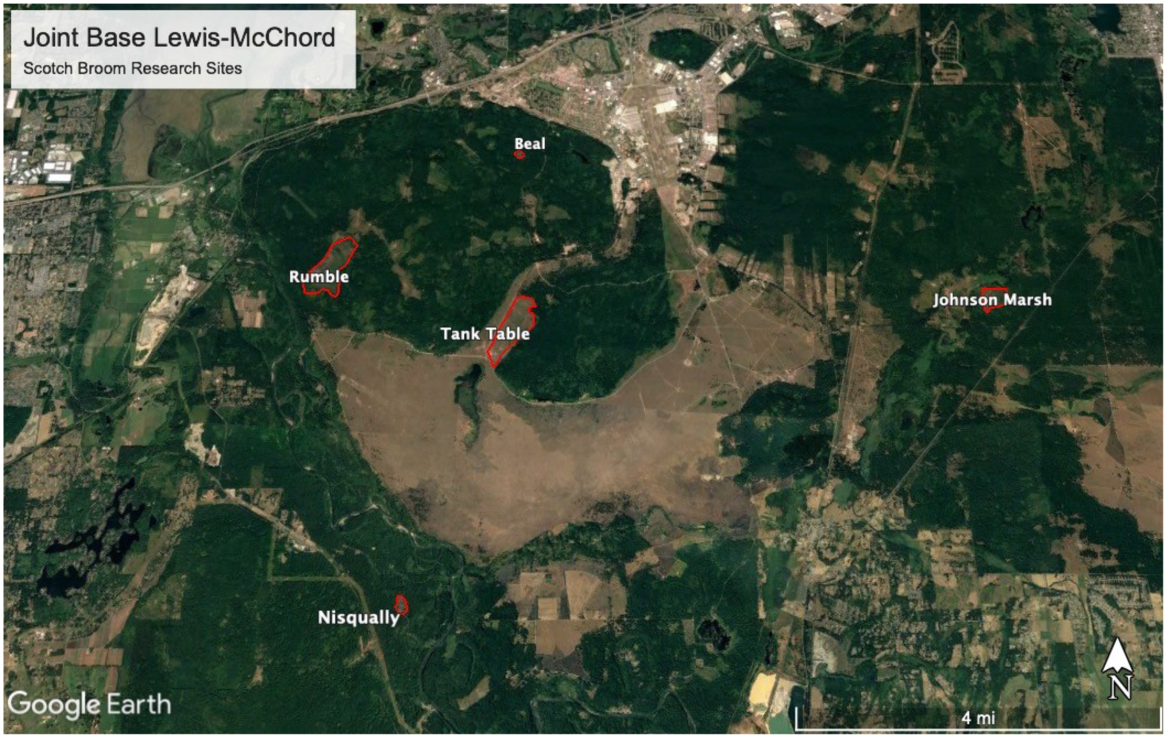
We conducted this experiment in collaboration with Joint Base Lewis-McChord (JBLM) in western Washington state, where sustainable forestry is practiced. At JBLM, C. scoparius invasion is a problem, and the use of prescribed fire is not a management option for C. scoparius in forested habitat. JBLM had not historically used any herbicides as a tool to control C. scoparius, but management was interested to learn whether triclopyr effectiveness would justify its use. The five sites were chosen by JBLM personnel from among areas where several previous attempts at reforestation had failed: Nisqually, Rumble Hill, Tank Table, Johnson Marsh, and Beal Hill within the boundaries of JBLM (Figure 1). These sites are located on drought-prone, glacial outwash soils mainly composed of gravelly sandy loams of the Spanaway series (Soil Survey Staff 2017) with flat topography (0% to 2% slope). Mean annual precipitation is 100 to 150 cm, with little precipitation falling in July and August. Sites had been cleared of mature Douglas-fir trees in the previous two to three decades and subsequently invaded by C. scoparius. Stem density varied from ~3 to 10 stems m−2, with a diameter of 1 to 2 cm on average (Table 1), with understory dominated by grasses, forbs, and individual shrubs such as Mahonia aquifolium (Pursh) Nutt. (Table 1). Beginning in November 2007, contractors were hired to cut all C. scoparius stems using industrial-sized brushcutters/mulchers following typical forestry protocols in reforestation.
Map of site locations at Joint Base Lewis-McChord in western Washington, USA.
Characteristics of experimental sites at Joint Base Lewis-McChord in western Washington.
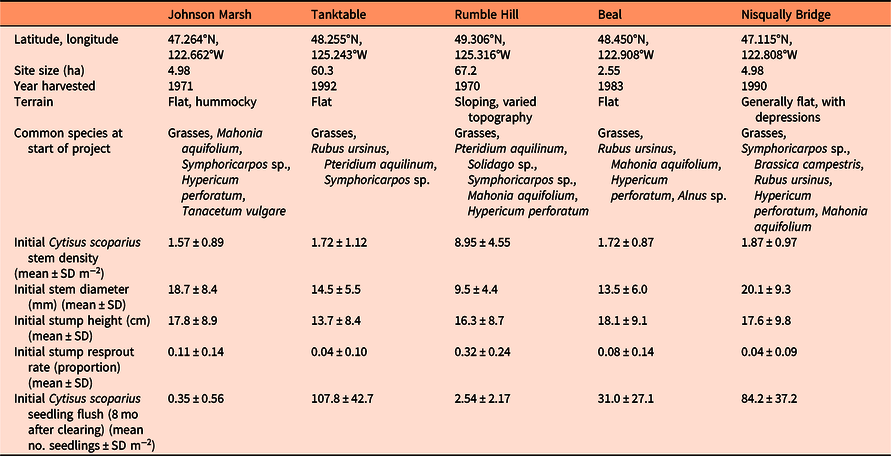
Following initial clearing, mean stump height varied from 13.7 to 18.1 cm across the five sites (Table 1). We tested whether resprout rate was predicted by stump diameter (= initial plant size) or stump height (often considered an aspect of treatment quality). In spring 2008 we marked 956 randomly selected stumps across the five sites. We measured the diameter (mm) and height (cm) of each stump and censused for resprouting in September, 2008.
The 11 treatments were applied in 2008 (Table 2). Because recovering stands included a mix of resprouting C. scoparius and new seedlings, sites varied in how size and age structure of C. scoparius stands developed following initial control (Table 1). At each site, we laid out 17.1 by 17.1 m plots; each treatment listed in Table 2 was replicated four times per site in a random design. Beal Hill was much smaller than the other four sites and thus did not contain all possible treatments (see Table 2).
Treatments implemented across sites in n = 4 plots per site.
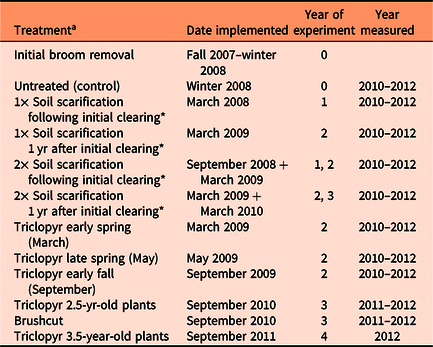
a Treatments marked by asterisks (*) were not implemented at Beal due to smaller area of that site. Cytisus scoparius plants were cut at ~10-cm height (“Initial broom removal”) in all plots before receiving one of the treatments.
We tested chemical and physical treatments targeting specific life stages, with brushcutting suppressing tall individuals and soil scalping and triclopyr potentially controlling all C. scoparius plants. Chemical treatments were implemented using triclopyr, a POST herbicide, following the best management practices of our practitioner partners (details in Dunn Reference Dunn2002). To test which time of year was most efficacious to apply triclopyr, we implemented an early-season (March) spray, a later-season (May) spray, and a fall dry-season spray (September). To examine the advantage of spraying smaller versus larger plants, we implemented treatments where differently aged plants (2.5 yr old and 3.5 yr old) were sprayed with triclopyr. Hand-operated backpack sprayers (SOLO 475 Backpack Sprayer [SOLO® Incorporated, Newport News, VA 23605 USA] 14.8 L [3.9 gal] volume) were used to broadcast entire plots with a suspension of 2% Garlon® 4 Ultra (active ingredient: triclopyr ester; Dow AgroSciences) with 0.25% Nufilm IR (a vegetation surfactant; Miller Chemical and Fertilizer, Hanover, PA 17331, USA) in a water carrier, plus blue indicator dye (Mark-It Blue, Monterey Lawn and Garden, USA). The rate of application was 6.65 L ha−1 (or 0.076 kg ae ha−1).
To determine whether scraping the soil surface was effective in removing C. scoparius seedlings, we used a compact track loader with mulcher attachment (Supertrak® SK140 TR-C, Punta Gorda, FL) to remove vegetation down to mineral soil. A blade on the loader was used to disrupt the top several centimeters of soil. This treatment was intended to remove all C. scoparius seedlings, and stimulate germination from the seedbank. We refer to this treatment as “soil scarification,” because although a mulcher was used, the resulting material was not left on the soil surface as in a traditional mulching treatment. We implemented this treatment once (2008) and twice (2008 and 2009). The other mechanical treatment was brushcutting conducted with a handheld brushcutter with 10-inch-diameter blade. Plants were approximately 0.5- to 2.0-m tall when cut down to about 10 cm in 2010.
Response Variables
We evaluated response of C. scoparius to treatments by quantifying mortality or “kill rate,” and percent cover over time. To assess C. scoparius cover, we used a line-intercept method, recording the linear distance of every individual along an 18.0-m transect along the diagonal of each plot, leaving a 3-m buffer at each end. Cytisus scoparius percent cover was measured in May 2009, May 2010, September 2011, and September 2012. For triclopyr and brushcut treatments in September 2010, and triclopyr treatment in September 2011, we quantified mortality (kill rates) by randomly selecting and marking seven plants in each cut or sprayed plot and assessed mortality the following September.
Data Analysis
Resprout occurrence from the initial clearing of the sites was assessed as a function of stump height via logistic regression, with “site” as a random effect in the model. Analyses for seedlings and larger individuals were conducted separately. To examine percent cover at the seedling or larger stages, we used ANOVA, with “site” as a random effect and “treatment” as a fixed effect. We analyzed each year separately. Means were compared post hoc with Tukey’s honest significant difference (HSD). We used site means in paired t-tests to compare kill rates in cut versus sprayed plots. All analyses were conducted in R v. 3.5.0 (R Core Team 2018) with the lme4 and multcomp packages.
Results and Discussion
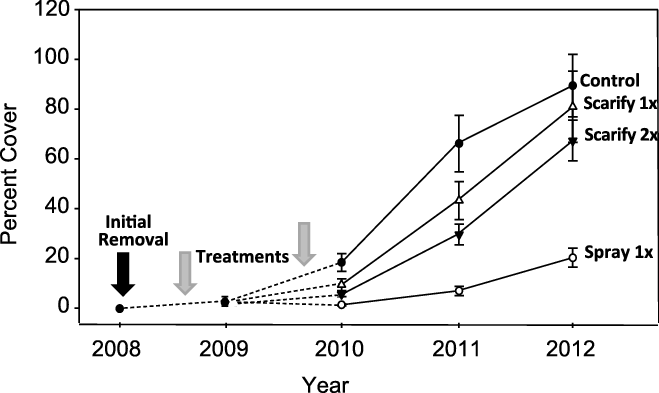
Overall, our results suggest that triclopyr treatments had the most persistent and consistent effects in controlling C. scoparius. At the early life stage (i.e., seedling stage), although there were immediate and strong effects of both scarifying and spraying, only the effect of triclopyr persisted over time (Figure 2; Table 3). For example, in the first year after treatment (2010), scarifying once or twice as well as triclopyr spray reduced C. scoparius cover to about half that of untreated plots (P < 0.001). By the next year (2011) all treatments continued to have reduced C. scoparius cover relative to untreated plots (P < 0.001), but the scarified and sprayed plots began to diverge from one another. In that year, the once- and twice-scarified plots had 43% and 30% C. scoparius cover, respectively, compared with 66% in untreated plots, whereas the triclopyr plots contained the lowest amount of C. scoparius cover at 9%. By the last year (2012), only the triclopyr plots had less C. scoparius cover than the untreated plots (P < 0.001) at 22% compared with untreated plots at 90% cover.
Percent cover (2008–2012) of Cytisus scoparius in treatments targeting early life stages. Timeline includes 2008 to indicate initial removal (black arrow). Treatments occurred in 2008 and 2009 (gray arrows). Values are means (n = 4 sites; treatments were not implemented at Beal due its small size) ± 1 SE.
Results of ANOVA to examine percent cover of Cytisus scoparius at the seedling or larger growth stages with “site” as a random effect and “treatment” as a fixed effect.
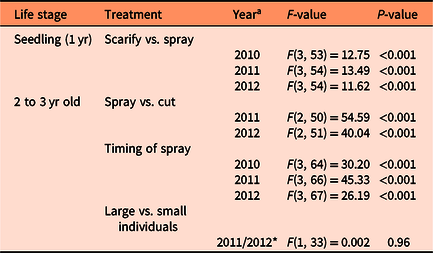
Means were compared post hoc with Tukey’s honest significant difference (HSD).
a An asterisk (*) indicates analysis was conducted in both years to account for variable time since treatment (see text for details).
By 2012, C. scoparius cover in soil scarification plots (whether once or twice scarified) was similar to cover in untreated plots (Figure 2; Table 3). This suggests that although soil scarification removed the standing C. scoparius seedlings (Parker et al. Reference Parker, Haubensak and Grove2014), within 2 yr plants germinated from the seedbank in large enough numbers to compensate for the seedlings that were removed. Thus soil scarification did remove both seedlings and, through germination, some seeds from the seedbank, similar to other studies (e.g., Richardson and Kluge Reference Richardson and Kluge2008). However, one extra year of soil scarification ultimately did not reduce C. scoparius cover. Cytisus scoparius is a prolific seed producer: mature individuals produce thousands to tens of thousands of seeds (Bossard and Rejmanek Reference Bossard and Rejmanek1994; Parker Reference Parker2000; Rees and Paynter Reference Rees and Paynter1997). Sheppard et al. (Reference Sheppard, Hodge, Paynter and Rees2002) estimated seedbanks in mature C. scoparius stands at 4,000 to more than 21,000 seeds m−2, with younger stands having about an order of magnitude less. It seems that the seedling densities in our study represented the germination of only a small proportion of the viable seeds in the seedbank, and our plots were not seed limited, even after two rounds of seedling removal. Estimates of field germination rates of C. scoparius have varied greatly among studies, from 65% (Bossard Reference Bossard1993) to less than 1% (Parker Reference Parker2000; Sheppard et al. Reference Sheppard, Hodge, Paynter and Rees2002). Where seedbank density is high and seed germination rate is low, attaining effective control will be very difficult. The use of PRE herbicides such as synthetic auxins shows some promise on C. scoparius seed germination, as demonstrated by Harrington (Reference Harrington2014). Fire can also be used to kill seeds or to stimulate germination in order to increase germination and exhaust the seedbank (Bossard Reference Bossard1993; Parker Reference Parker2001). Understanding and control of the seedbank remains a key problem in C. scoparius management.
In our treatments targeting larger (2- to 3-yr-old) individuals, we compared chemical (triclopyr spray) versus physical (brushcutting) treatments. Mean average mortality of marked individuals measured 1 yr following treatment was not different, although there was a trend toward greater mortality in sprayed than in cut plots (paired t-test, t = −2.58; P = 0.06) (data not shown). The triclopyr effect on mortality was very consistent across sites (82% to 98%), whereas cutting resulted in highly variable mortality across sites (ranging from 26% to 96%) (F-test to compare variances, F = 33.51; P = 0.005) (for details, see Parker et al. Reference Parker, Haubensak and Grove2014). We also measured large variation in average resprout rates across sites after initial removal, from 4% to 32% (Table 1; also see Parker and Haubensak Reference Parker and Haubensak2008). Combining the data with site as a blocking factor resulted in no significant effect of stump height on whether or not stumps resprouted (N = 956; z = 0.97; P = 0.33). Consistent with our results, Bossard and Rejmanek (Reference Bossard and Rejmanek1994) reported no effect of stump height on C. scoparius resprout rate, which they tested in one site. On the other hand, Bossard and Rejmanek (Reference Bossard and Rejmanek1994) did report strong effects of seasonality on resprout rates, where C. scoparius plants tended to resprout more in the wet winter months (January to March) than during the dry summer months (July until early fall), which our data do not address.
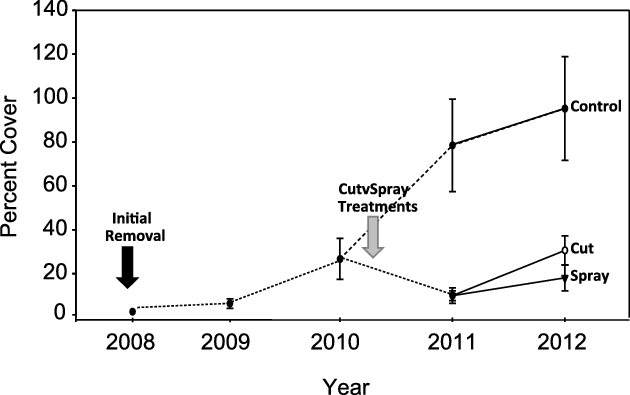
While spraying appeared to be slightly more effective and consistent than cutting for C. scoparius mortality, both treatments were effective in decreasing percent cover compared with untreated plots. In 2011, 1 yr following treatment, both sprayed and cut plots had less than 10% cover compared with untreated plots with 80% cover (P < 0.001; Figure 3; Table 3). In 2012, 2-yr posttreatment, both triclopyr-treated and brushcut plots had ~20% to 30% C. scoparius cover, whereas there was ~100% cover in untreated plots (P < 0.001; Figure 3). These 2 yr of results suggest that cutting is equally as effective as spraying (P = 0.99 for 2011 and P = 0.39 for 2012). However, cutting often results in resprouting; plants that resprout may achieve greater cover and seed production within a shorter period compared with individuals emerging from seed. Although percent cover was not different between triclopyr-treated and brushcut treatments in 2012, the trajectories of the plots suggest that differences might amplify over time, with triclopyr treatment effects more sustained than brushcutting. These results are consistent with a meta-analysis of 74 studies of invasive plant control (Kettenring and Adams Reference Kettenring and Adams2011), which concluded that herbicide treatment (e.g., glyphosate, 2,4-D, picloram, and triclopyr) reduced invasive plant cover, density, and biomass more effectively than burn or cut/removal treatments.
Percent cover (2011–2012) of brushcut (Cut) versus triclopyr-treated (Spray) Cytisus scoparius. Plants were the same age when treated (2.5 yr old). Arrows indicate initial removal of mature C. scoparius (black arrow) and when treatments occurred (gray arrow). Values are means (n = 5 sites) ± 1 SE.
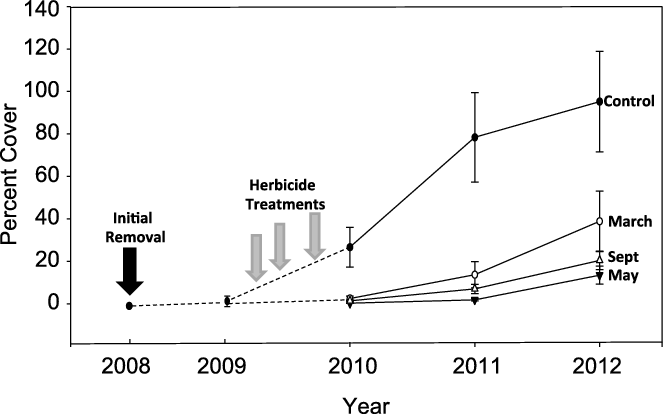
Weed control literature often advises specific timing for herbicide spraying. Interestingly, different sources advocate for different periods, with some recommendations for early spring treatment (Bossard Reference Bossard, Bossard, Randall and Hochovsky2000; Delvin et al. Reference Delvin, Grosboll and Kessler2005), others during the periods before and after flowering (Oregon State University Extension Service, https://extension.oregonstate.edu/scotch-broom-smackdown), still others during seed head stage (Hoshovsky Reference Hoshovsky1986; Matthews Reference Matthews1960). We subjected these various recommendations to a test, spraying in early spring (March), late spring (May), and late summer (September) in 2009, predicting that efficacy of spraying would vary due to different physiological states of C. scoparius as well as variable weather conditions. However, in the first year after treatment (2010), we determined that triclopyr reduced C. scoparius cover compared with unsprayed plots, regardless of whether spraying occurred in March, May, or September (P < 0.001) (Figure 4; Table 3). Sprayed plots had <3% cover in 2010, compared with >25% cover in unsprayed plots. Consistent with our results, Oneto et al. (Reference Oneto, Kyser and DiTomaso2010) determined that a range of herbicides (e.g., glyphosate, triclopyr, and imazapyr) applied to C. scoparius in a montane site significantly reduced C. scoparius cover, regardless of whether the spraying occurred in spring or fall, at any rate, for any application method. Further, their evaluation of treatments occurred 22 mo after treatment, suggesting a strong persistence of herbicide effectiveness. We, too, found that the lack of difference among seasons persisted into the second and third years following the initial treatment, with a strong effect of triclopyr (P < 0.001) but without differences across season of treatment in 2011 or 2012.
Percent cover (2008–2012) of Cytisus scoparius in plots sprayed in March, May, and September 2009. Arrows indicate initial removal of mature C. scoparius (black arrow) and when triclopyr treatments occurred (gray arrows). Values are means (n = 5 sites) ± 1 SE.
Cytisus scoparius can grow up to ~3 m in height, which increases the difficulty of herbicide treatment both in terms of applicators’ safety and ability to reach the tops of plants. To test the impact of plant size on effectiveness of triclopyr spraying (and allowing for the same “time since treatment”), we compared plots sprayed in 2010 (2.5-yr-old plants) with plots sprayed in 2011 (3.5-yr-old plants) that were then measured in 2011 and 2012, respectively. The 2.5-yr-old plants were 1.0-m tall on average, whereas the 3.5-yr-old plants were 1.4-m tall (averaged across all sites). We used unsprayed plots from 2011 and 2012 as checks and calculated an effect size by subtracting the percent cover of C. scoparius in the sprayed plots from the unsprayed plots, divided by percent cover in unsprayed plots. Our results indicated that triclopyr was equally effective for smaller and larger plants (P = 0.96; Table 3). Across all sites, spraying smaller and larger plants resulted in 70% to 80% less cover compared with untreated (data not shown). The triclopyr kill rate between smaller and larger plants was correspondingly similar (paired t-test, t = −0.91; P = 0.43). It might be that plant sizes were not different enough (~40 cm average difference between the 2 yr); plants were also likely at a similar growth stage and were thus similarly responsive to triclopyr. Nonetheless, from a management perspective, our results suggest that the timing of follow-up spray treatments with triclopyr can vary up to several years without major consequences for the effectiveness of C. scoparius control.
We conclude that the effectiveness of triclopyr treatment was sustained and consistent irrespective of plant size or time of year. Our results suggest that triclopyr is an effective tool to reduce the persistence and spread of C. scoparius in these cleared Douglas-fir forest sites. With vigorous debate occurring on the appropriate use of herbicides in invasive species management, data comparing the outcomes of mechanical and chemical control treatments are more important than ever.
Acknowledgments
This research was supported by funding from JBLM, a National Science Foundation (NSF) Doctoral Dissertation Improvement Grant DEB-1210661 to SG and IMP, and an NSF DEB-1354985 to KAH, SG, and IMP. We thank Nancy Benson at JBLM for financial, logistical, and intellectual support. We thank the many undergraduate field and lab assistants at Northern Arizona University and University of California, Santa Cruz: Stephanie Kimituska, Steve Hartwell, Megan Bontrager, Holly Makagon, Angelica Amesquita, Brandon Mertz, Kari Potter, and Scott Francis. No conflicts of interest have been declared.



