





Introduction
Terrestrial gastropods (land snails) can incorporate carbon from a variety of sources into their carbonate shells. This can include carbon from atmospheric CO2, either in air or dissolved in water; organic carbon from consumed plants, animals, and detritus; and from carbonate minerals present in the local environment. Problematically, the latter may include 14C-depleted carbonate from limestone and other carbonate rocks, which would cause terrestrial snails to appear “too old” from a radiocarbon dating perspective. This scenario, referred to as the “limestone problem” (Goodfriend and Stipp Reference Goodfriend and Stipp1983), can produce radiocarbon age offsets on the order of centuries to 1000 14C yr or more (e.g., Goodfriend and Hood Reference Goodfriend and Hood1983; Quarta et al. Reference Quarta, Romaniello, D’Elia, Mastronuzzi and Calcagnile2007), although in some studies negligible offsets are reported (e.g., Macario et al. Reference Macario, Alves, Carvalho, Oliveira, Ramsey, Chivall, Souza, Simone and Cavallari2016; Pigati et al. Reference Pigati, Rech and Nekola2010; Stott et al. Reference Stott2002). One hypothesis suggests that terrestrial gastropods may consume carbonate rocks to supplement their calcium intake, if they cannot acquire enough from their diet (Pigati et al. Reference Pigati, Rech and Nekola2010). Thus, the magnitude of the limestone problem is highly variable by species, habitat, and physiology. Local, taxonomically specific validation studies are needed before terrestrial snails are included in a radiocarbon dating program.
Our research group conducted a preliminary study (Pluckhahn et al. Reference Pluckhahn, Rogers, Hadden, Jackson, Thompson and Garland2024) to assess the reliability of radiocarbon dating subfossil terrestrial snails from the Florida Peninsula (USA), a porous karstic limestone plateau. In that study, we compared radiocarbon dates from archaeological specimens of land snails, wood charcoal, and animal bone from Indigenous shell mounds and middens at the Cockroach Key archaeological site. While some age offsets were observed, they were not systematic, with terrestrial snails sometimes being older and sometimes younger than the reference date. Due to the limitations of the research design, we could not conclusively determine whether the age offsets reflected the limestone problem, archaeological site formation processes (e.g., vertical displacement, bioturbation), or a combination.
In the current study, we take a different approach to addressing the same question. Specifically, we test whether modern (post-1950) terrestrial snail shells reflect atmospheric 14C at the time of biomineralization—a key requirement for reliable radiocarbon dating. We focus on two taxa that are common at shell-midden archaeological sites of the Florida peninsula: the rosy wolfsnail (Euglandina rosea) and flatcoil snails (Polygyra spp.). These terrestrial snails are often interpreted as synanthropic organisms, attracted to and benefiting from human-modified environments such as decomposing food waste. Specimens included in this study were live-collected from peninsular Florida between 1967 and 2015, with precisely known collection dates and locations. We compare radiocarbon dates from the snail shell carbonates to the high-precision, high-resolution atmospheric 14C record spanning 1950–2019 (Hua et al. Reference Hua, Turnbull, Santos, Rakowski, Ancapichún, De Pol-Holz, Hammer, Lehman, Levin, Miller and Palmer2022). This “bomb curve” provides a sensitive baseline for comparison, enabling us to detect and quantify even small 14C offsets between terrestrial snail carbonates and the atmosphere.
Study area
Florida’s geology has been shaped by changing sea levels. The region was submerged from 160–23 million years ago, and calcium carbonate from sea life accumulated, forming a limestone platform. Today’s Florida Peninsula is the exposed portion of this mostly underwater geological formation. While carbonate production continues around the Florida Keys, the surficial carbonate layers (Figure 1) that dominate the western and central peninsula range up to around 35 million years old (Allen and Main Reference Allen and Main2005; Bostick et al. Reference Bostick, Johnson and Main2018). In the northern and central peninsula, surficial deposits that are dominated by sand, silt, and clay overlay older carbonate rock (FDEP 2022).
Simplified map of Florida surface geology (modified from FDEP 2022) with sample locations. Carbonate-dominated terrains are shown in white. Pink triangles indicate sample locations of rosy wolfsnail (E. rosea), and green circles indicate flatcoils (Polygra spp.). Numerals correspond to Map ID in Tables 1 and 2.

Shell middens, archaeological accumulations of mollusc shells, are common in Florida, and are typically dominated by oysters, clams, and other aquatic/marine molluscs, although terrestrial snails are frequently identified in these assemblages (e.g., Hadden Reference Hadden2015; Jackson et al. Reference Jackson, Pluckhahn and Duke2020; Sassaman et al. Reference Sassaman, Steffy, Shanefield, Mahar and Slapcinsky2024). The aquatic and marine organisms that dominate archaeological shell assemblages of Florida are challenging materials for radiocarbon dating due to often large and variable reservoir effects (e.g., Hadden and Cherkinsky Reference Hadden and Cherkinsky2015, Reference Hadden and Cherkinsky2017; Hadden and Schwadron Reference Hadden and Schwadron2019; Hadden et al. Reference Hadden, Hutchinson and Martindale2023). Terrestrial snails, which are attracted to shell middens, would be a convenient alternative for radiocarbon dating in these contexts, if it can be demonstrated that they build their carbonate shells in 14C equilibrium with the atmosphere.
Materials and methods
The rosy wolfsnail, E. rosea, is a large (up to 80 mm) predatory carnivorous snail native to Florida (Auffenberg and Stange Reference Auffenberg and Stange2001). They are common in Florida’s marshes and woodlands, as well as disturbed areas such as roadsides and gardens (Hubricht Reference Hubricht1985). Mostly ground-dwelling, rosy wolfsnails are voracious predators that will consume almost any mollusc they encounter, even tracking their prey into trees and underwater, sometimes ingesting smaller snails whole (Kinzi 1992).
Snails of the family Polygyridae are among the most ubiquitous terrestrial gastropods in North America. Multiple species of the genus Polygra are native to Florida, including the southern flatcoil, P. cereolus, and the Florida flatcoil, P. septemvolva. Polygyrid snails are herbivores and detritivores that may favor calcium-rich environments (Minton et al. Reference Minton, Hertel, Lathrop, Mattocks, Nimmagadda, Roberts, Steblak and Stubler2022). Ranging in size from 7–18 mm, and commonly occurring in high densities in soil, detritus, and vegetation (Capinera and White 2014; Emberton Reference Emberton1988), flatcoils are common prey items for rosy wolfsnails. Both taxa are presumably short-lived (<2 yr).
Our sampling strategy targeted museum specimens that were (1) identified to species; (2) alive when they were collected, with soft tissues present; (3) collected from peninsular Florida, with locality coordinates recorded; and (4) collected after 1950. Additionally, museum lots containing only a single individual specimen were excluded from the study to lessen the impacts of destructive sampling of museum collections. Unfortunately, we were only able to locate a small number of specimens that satisfied all these criteria, and most were collected from carbonate terrains (Figure 1). Rosy wolfsnail (n=6) and flatcoil (n=5) specimens were loaned by the Field Museum of Natural History (Chicago, USA) to the Center for Applied Isotope Studies with permission for destructive analysis.
Carbonate subsamples were collected from the terminal edge of each snail shell using forceps, taking care to avoid damage to soft tissues. (Note: Although soft tissues were present for all specimens, permission for destructive analysis was limited to the shells.) Subsamples averaged ∼7 mg for flatcoils, and ∼20 mg for the rosy wolfsnails, which are much larger. Carbonate subsamples were cleaned with ultrapure water, dried, and pulverized. Carbonate powder was reacted with 100% phosphoric acid at 60˚C in evacuated reaction vessels to produce CO2. CO2 was catalytically converted to graphite using the method of Vogel et al. (Reference Vogel, Southon, Nelson and Brown1984). Graphite 14C/13C ratios were measured using the NEC 500 keV Tandem Pelletron accelerator mass spectrometer (AMS) at the CAIS, University of Georgia, USA. The sample ratios were compared to the ratios measured from oxalic acid I (NBS SRM 4990). Results are reported as fraction modern (F14C), which is useful for post-bomb 14C data to avoid confusion caused by negative radiocarbon ages in 14C yr BP. The error is quoted as one standard deviation and reflects both statistical and experimental errors. The values have been corrected for isotope fractionation using IRMS-derived δ13C values following Prasad and colleagues (Reference Prasad, Culp and Cherkinsky2019).
Following the mass balance approach of Goodfriend and Hood (Reference Goodfriend and Hood1983), we modeled the isotopic fractions of carbon in the snail shells.
We first estimated the proportion of carbon derived from limestone (XL) from F14C using linear mixing models as follows:
 $$X_{L} = {F^{14}{C}_{shell} - F^{14}{C}_{atmosphere}}{F^{14}{C}_{Limestone} - F^{14}{C}_{atmosphere}}$$
where F14Catmosphere is the modeled F14C of the atmosphere at the time of sample collection based on the Bomb21 NH2 curve (Hua et al. Reference Hua, Turnbull, Santos, Rakowski, Ancapichún, De Pol-Holz, Hammer, Lehman, Levin, Miller and Palmer2022). Limestone is of infinite 14C age, therefore we assume F14CLimestone = 0. This approach makes the simplifying assumption that limestone is the only possible source of “pre-aged” carbon. This is not strictly correct, given that flatcoils assimilate pre-aged organic carbon from consumed detritus, and both taxa could incorporate pre-aged inorganic carbon from carbonate of finite age (e.g., from archaeological accumulations of marine shells). Dating fleshy bodies would be particularly helpful for resolving the questions of pre-aged carbon, though not possible in this case. Either scenario would result in a non-zero value for F14CLimestone. However, quantifying the relative contributions of these pre-aged carbon sources is beyond the scope of the current study. Suffice it to say that the resulting limestone estimate is the absolute minimum proportion of carbon in the snail shell that is from pre-aged sources.
We then apportioned the remaining “non-limestone” carbon based on δ13Cshell values. The proportion of carbon not derived from limestone (XNL) is
 $${X_{NL}} = \;1 - {X_L}.$$
Given that
 $${\delta ^{13}}{C_{shell}} = \left( {{X_L}\;{{\rm{\delta }}^{13}}{C_{Limestone}}} \right) + \;({X_{NL}}{\delta ^{13}}{C_{NL}})$$
and making the simplifying assumption that δ13CLimestone = 0 (Note: following Romaniello et al. 2002:Eq. 3 we neglect fractionation caused by dissolution and precipitation of limestone as aragonite), we can rewrite Equation 3 as
 $${\delta ^{13}}{C_{NL}} = {{{{\delta ^{13}}{C_{shell}}}}\over{{{X_{NL}}}}}.$$
Possible carbon sources contributing to δ13CNL include vegetation (both C3 and C4 plants are locally abundant) and atmosphere:
 $${\delta ^{13}}{C_{NL}} = \left( {{X_{C3}}\;{{\rm{\delta }}^{13}}{C_{C3}}} \right) + \left( {{X_{C4}}\;{{\rm{\delta }}^{13}}{C_{C4}}} \right) + \;\left( {{X_{atmosphere}}\;{{\rm{\delta }}^{13}}{C_{atmosphere}}} \right).$$
For δ13CC3 we use the value of −13‰, which assumes δ13C of vegetation of –25‰ and is adjusted (+12‰) for diet-shell carbonate offsets in terrestrial snails (Stott Reference Stott2002). For C4 vegetation, we assume a value of –10‰ and apply the same offset, resulting in a value of +2‰. For atmosphere, we assume a value of +1‰, taking into account the δ13C value for atmosphere (–7‰) and the fractionation effect due to dissolution in water (+8‰) (Romaniello et al. 2008).
C4 vegetation and atmosphere produce similar δ13Cshell values. In cases such as these, where δ13Cshell does not sufficiently separate sources, analysis of soft body tissues may help further differentiate among sources (e.g., Hill et al. Reference Hill, Reimer, Hunt, Prendergast and Barker2017). In this case, the two sources (C4 and atmosphere) are simply combined into a single category, “other,” and an intermediate value for δ13Cother of +1.5‰ is used. Equation 5 then becomes:
 $${\delta ^{13}}{C_{NL}} = \;({X_{C3}}{\delta ^{13}}{C_{C3}}) + \left( {{X_{other}}{{\rm{\delta }}^{13}}{C_{other}}} \right)$$
and
 $${X_{NL}} = \;{X_{C3}} + \;{X_{other}}.$$
From this system of equations and assumed source δ13C values, we can calculate
 $$X_{C3} = { \delta^{13}\textrm{C}_{NL} - 1.5X_{NL}}{-14.5}$$
Results and discussion
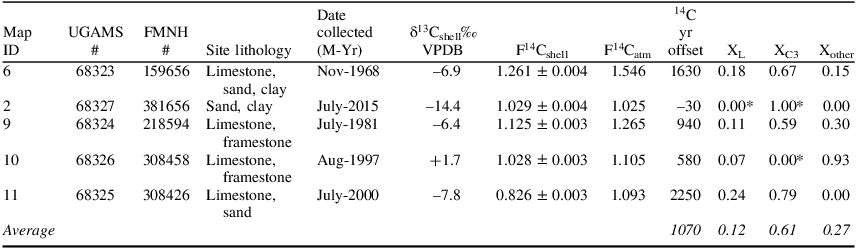
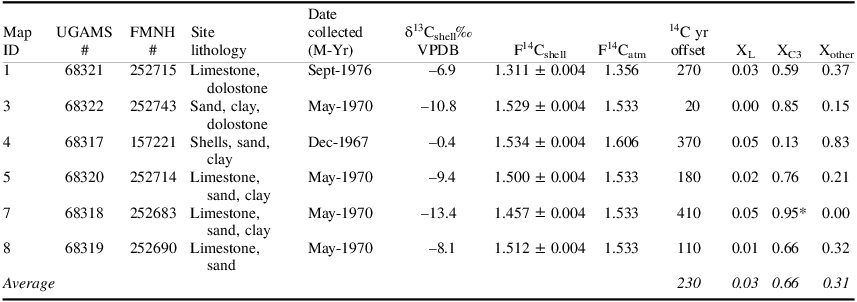
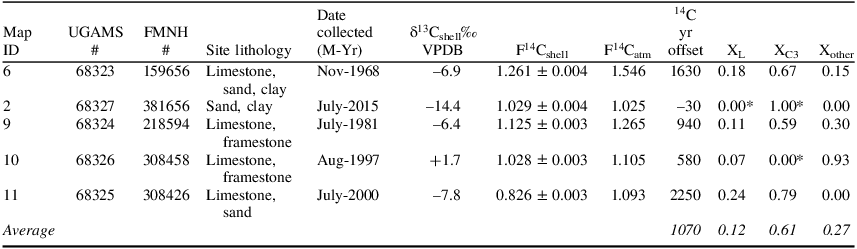
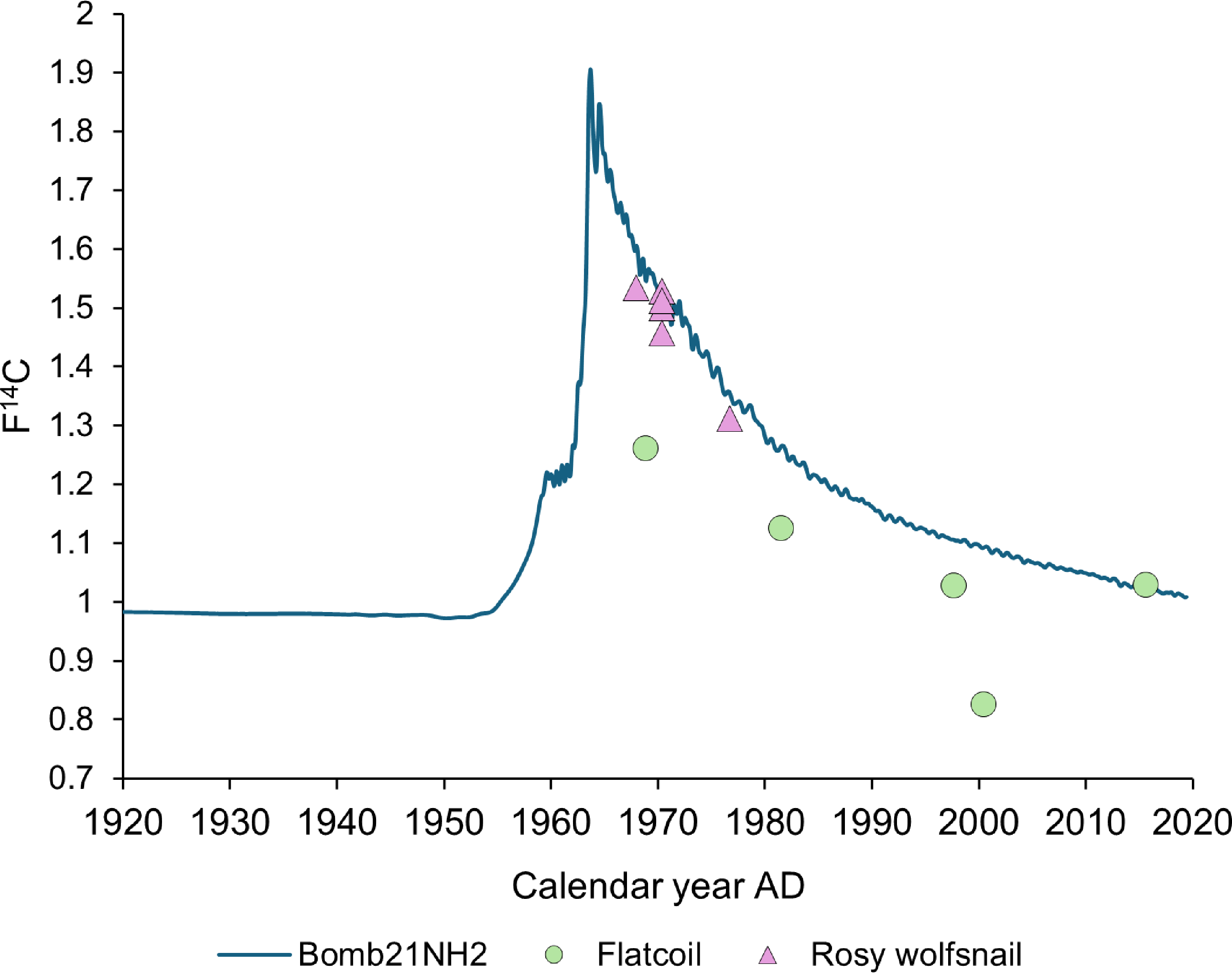
Stable isotope and radiocarbon results are presented in Tables 1 and 2, as well as estimates of carbon sources estimated by mass balance. Shell carbonate 14C values are plotted in comparison to the Bomb21NH2 curve (Hua et al. Reference Hua, Turnbull, Santos, Rakowski, Ancapichún, De Pol-Holz, Hammer, Lehman, Levin, Miller and Palmer2022) in Figure 2. The majority of specimens are significantly depleted in 14C with respect to the atmosphere at the time they were collected. However, the magnitude of the offset varies by surface geology, taxa, and among individuals.
Known-age post-bomb rosy wolfsnails (Euglandina rosea) from peninsular Florida, USA, and estimated proportions of carbon derived from limestone (XL), C3-derived carbon (XC3), and carbon derived from other sources (Xother). *Denotes values that were slightly adjusted to be within the 0–1 range.

Known-age post-bomb flatcoil snails (Polygyra spp.) from peninsular Florida, USA, and estimated proportions of carbon derived from limestone (XL), C3-derived carbon (XC3), and carbon derived from other sources (Xother). *Denotes values that were adjusted slightly to be within the 0–1 range.
Shell carbonate F14C values compared to atmospheric F14C values as represented by the Bomb21NH2 curve (Hua et al. Reference Hua, Turnbull, Santos, Rakowski, Ancapichún, De Pol-Holz, Hammer, Lehman, Levin, Miller and Palmer2022). Error bars are smaller than the symbols.

Surface geology
Terrestrial snails collected from carbonate terrains were all depleted in 14C compared to atmosphere, with differences ranging up to 0.267 in F14C space. Terrestrial snails inhabiting carbonate terrains of Florida incorporate fossil carbon into their shells, causing them to appear anomalously old. Translated to radiocarbon years, this represents age offsets of up to 2250 14C yr. This should be interpreted as a warning against incorporating terrestrial snail shells into radiocarbon dating programs in Florida and biogeographically similar regions, such as the Bahamas and the Yucatan Peninsula (Mexico).
In contrast, the only two specimens collected from sandy terrains (Map IDs 2 and 3 in Figure 1 and Tables 1 and 2) were free of limestone-derived carbon. This provides preliminary evidence that terrestrial snail shells from sandy terrains may produce reliable radiocarbon dates. However, while this may seem promising, it is worth noting that archaeological specimens are generally found in shell heaps, which are themselves unique carbonate microenvironments. Although additional testing is necessary, one should assume that terrestrial snails could potentially incorporate pre-aged carbonate of finite age from the shell deposits themselves, through the same pathways they can incorporate limestone (e.g., direct ingestion), which would also cause the shells to appear “too old.” The size of the age anomaly would depend on the actual difference in age between the terrestrial snail and the deposit, as well as any “reservoir effects,” such as the marine and freshwater/hardwater effects (Hadden et al. Reference Hadden, Hutchinson and Martindale2023).
Species, feeding ecology, and behavior
We observed significant differences in the magnitude of 14C offsets between the two taxa studied. Focusing on flatcoils collected from carbonate terrains (i.e., excluding the one specimen collected from sandy terrain), flatcoil shell carbonates contained between 7–24% limestone C, with an average of 15% limestone C. This produced large and variable age offsets ranging from 580–2250 14C yr, with an average age offset of 1360 ± 740 14C yr. In comparison, the contribution of limestone-derived carbon was much lower among rosy wolfsnails. Focusing again on specimens collected from carbonate-dominated terrains, wolfsnail shell carbonates ranged from 1–5% limestone-derived C, with an average age offset of 230 ± 140 14C yr and a maximum offset of ∼ 400 14C yr. We assume the differences in limestone content between taxa reflect differences in feeding ecology and behavior. Flatcoils are herbivores and detritivores, and are attracted to damp, calcium-rich environments. Rosy wolfsnails are semi-arboreal predators, and obligate molluscivores. One possibility is that flatcoils have more direct physical contact with surficial limestone rocks than wolfsnails, therefore have greater passive exposure to limestone-derived carbon dissolved in water on the ground, or in secreted mucus (Goodfriend and Hood Reference Goodfriend and Hood1983). However, rosy wolfsnails primarily hunt on the ground. Passive contact alone is not likely a sufficient explanation for the differences observed.
Another possibility is that flatcoils, but not wolfsnails, intentionally ingest limestone to supplement their calcium intake. The “calcium-limiting hypothesis” (Pigati et al. Reference Pigati, Rech and Nekola2010) posits that if terrestrial gastropods cannot acquire enough calcium from consumed plants, detritus, and water, then they may have to consume carbonate rocks to supplement their calcium intake. This may be necessary for flatcoils to obtain the calcium needed to build their shells. Wolfsnails, on the other hand, consume smaller snails whole—including their shells—providing an excellent source of calcium. As a result, wolfsnails may acquire most of their calcium through the smaller ground-dwelling snails they consume (including flatcoils), without needing to supplement by consuming 14C-depleted limestone. The majority of rosy wolfsnail shell carbonate ultimately derives from C3 vegetation (Table 1), likely C3-consuming prey items such as flatcoils. The fossil carbon in wolfsnail shells may be derived from limestone indirectly, from the shells of their limestone-consuming prey.
One might intuitively expect δ13Cshell to correlate with the age offset, with limestone carbon resulting in δ13Cshell values near zero. However, mass-balance models suggest the majority of shell carbon is derived from diet, especially C3 sources (Tables 1 and 2). The relative contributions of carbon sources vary widely among individuals, suggesting these animals adjust their feeding ecology in response to local environmental conditions. In flatcoils, for instance, diets potentially range from entirely C3 to entirely C4 vegetation. For example, the two flatcoils with the lowest fossil C content (Map IDs 2 and 10 in Table 2) exhibited extreme δ13Cshell values of −14‰ and +1.7‰, respectively. As a result, δ13Cshell is not a reliable predictor of age offset.
Unfortunately, in this study, we were unable to analyze specimens of both taxa collected from the same location, nor were we able to analyze soft tissues from the study specimens. A promising direction for future research would be to collect modern specimens of both taxa from the same localities, measuring not only shell carbonate but soft tissue 14C and δ13C to better resolve carbon sources in both archaeological shell middens to those from non-midden habitats. This approach would help clarify potential environmental or dietary influences on their isotopic signatures and provide a more direct basis for comparison.
Conclusions
This brief study is presented as a followup to an earlier investigation of 14C chronologies based on two taxa of terrestrial snails that are common in archaeological assemblages across the Florida Peninsula. Due to the abundance of limestone in the region’s surficial geology, we sought to quantify the extent of the “Limestone Problem” by measuring the 14C composition of known-age terrestrial snails collected in the “post-bomb” period.
We conclude the following:
-
Rosy wolfsnails and flatcoil snails from carbonate terrains of Florida incorporate fossil carbon into their shell carbonates. Fossil carbon produced age anomalies up to ∼400 14C yr among rosy wolfsnails and up to 2250 14C yr among flatcoils.
-
δ13Cshell is not a reliable predictor of age offset. δ13Cshell predominantly reflects the non-limestone derived carbon sources, potentially ranging from entirely C3 to entirely C4 food chains.
-
Larger and more variable 14C anomalies were observed in flatcoils compared to rosy wolfsnails. Differences may reflect passive exposure to exposed carbonate, intentional ingestion of carbonate rocks, or both.
-
Rosy wolfsnails and flatcoil snails from carbonate-free terrains may produce reliable 14C dates. However, it is worth noting that terrestrial snails may incorporate 14C-depleted but finite-age carbonate from archaeological shell middens. Additional testing would help quantify this possibility.
-
Overall, rosy wolfsnails produce more accurate 14C dates than flatcoils, consistent with the earlier findings of Pluckhahn et al. (Reference Pluckhahn, Rogers, Hadden, Jackson, Thompson and Garland2024). For archaeological purposes, we recommend applying a correction of 230 ± 140 14C yr for rosy wolfsnails from areas with surficial limestone. While not adequate for dating materials from the last few centuries (e.g., the post-Contact era in American archaeology), they may provide useful chronological information for older periods, albeit with less precision than dates on other terrestrial materials.
While additional studies of snail diet, behavior, and physiology may help explain the differences observed between taxa, and among conspecifics, we discourage archaeologists from using flatcoils for chronology building in Florida archaeology and recommend exercising caution with rosy wolfsnails. Furthermore, we caution archaeologists working in adjacent regions with similar geological histories (i.e., the Yucatan peninsula of Mexico, and the Bahamas).
Acknowledgments
We are grateful to the organizers of the 4th International Conference on Radiocarbon in the Environment (RIE-IV) for providing a valuable forum for discussion and collaboration, and two anonymous reviewers for their kind and constructive feedback. We also thank iDigBio for its efforts in enabling museums and academic institutions across the U.S. to make their collections accessible to researchers. Special thanks to Dr. Sean Keogh, Collections Manager of Invertebrates at the Field Museum of Natural History, for his assistance in identifying appropriate specimens for this study. We further acknowledge the Field Museum of Natural History for granting access to its collections and providing permission for destructive analysis.
Competing Interests Declaration
The authors declare that they have no competing interests.


 Open access

