


1. Introduction
On 5 October 2020, the French AGEC law required that all households be able to sort bio-waste at source from January 2024 onwards. In April 2024, only 34% of the population was actually able to sort waste at source. Consequently, on the 34 Mt/year of residual waste from households (38% was bio-waste, or 13 Mt) only 3.4 Mt was actually sorted and sent to recovery facilities (Ademe, 2024). The difficulties in implementing the transition required by law are not limited to this sorting-at-source condition. Indeed, the need to develop subsequent structures for the collection and valorisation of this bio-waste is crucial, as these structures are currently insufficient to handle the volumes that need to be processed. However, these structures are being developed, with the number of composting sites increasing from 322 in 2002 to 723 in 2020. The development of anaerobic digestion has been focused on the agricultural sector (more than 1,850 centres between 2010 and 2023) (Ademe, 2023), with household bio-waste treatment centres remaining few and far between in France.
The work presented in this article is part of a much broader framework. It contributes to the development of a tool to assist in the design of regional superstructures for the treatment of bio-waste. The role of this tool will be to integrate specific territorial data (e.g., annual bio-waste volumes, land costs, types and treatment capacities of existing facilities) to propose economically, environmentally, and socially optimised alternative solutions. These solutions will specify the technological choices (anaerobic digestion vs. composting) and combine them in a superstructure. But they will also make it possible to determine the optimal reprocessing capacity sizes to be favoured for each of them. In terms of design, this category of design situation (the territorial network for bio-waste reprocessing) has the characteristics of complex problems that involve, in particular, large-scale engineering, numerous interdependent design problems to be considered simultaneously (Reference Eppinger, Whitney, Smith and GebalaEppinger et al., 1994) and a high degree of uncertainty regarding the data used to establish requirements (Reference Eckert and ClarksonEckert et al., 2010). The preliminary design phases, in which this tool will be used, are also a source of complexity due to the numerous interrelationships they give rise to (Reference Fernandes, Henriques, Silva and PimentelFernandes et al., 2017) between the client (in this case, representatives of urban areas awaiting the services provided by these facilities), the suppliers of technical and organizational solutions, and possibly representatives of associations of citizens concerned about the impact of these future facilities. The role of this tool will therefore be to help bring together the perspectives of these different stakeholders by exploring the socio-technical-economic constraints they can understand and interrelate through stages of joint analysis of the problem and its solutions, in order to co-construct solutions. The social dimension associated with these reprocessing facilities is a key factor in their acceptability to the population. In the rest of this article, we propose to explore only this social dimension to contribute to the definition of the evaluation system for this tool to assess the expected sustainability of future facilities.
The first part of this research program, dedicated to evaluating the environmental performance of bio-waste recovery facilities in the Île-de-France region, has been produced and published (see Reference Ottini, Yannou-Le Bris, Domenek and BuendiaOttini et al., 2025). Building on this work, the present study contributes to the social dimension of the broader objective of evaluating the sustainable performance of the analysed system prior to design. To do so, we we use a methodology called Life Cycle Social Assessment (LCSA) (Reference Guinée, Heijungs and HuppesGuinée et al., 2011). Indeed, while it is essential to consider the environmental impacts of these facilities, this alone is insufficient to qualify their contribution to a transition towards a more sustainable waste management model. Therefore, this article focuses on selecting social indicators that enable us to distinguish between composting and anaerobic digestion facilities, taking into account their contributions to more sustainable activities under the specific conditions of the areas where they are located. The scope of our work is limited to waste transport logistics (excluding sorting at source), the distribution of resources produced by treatment centres, and, above all, the facilities, personnel, and equipment of these valorisation sites, as well as the resources they require or reject.
2. Conceptual framework
The consideration of the social dimension in forecasting the performance of waste valorisation facilities remains poorly documented, most often assessed using only one or two indicators, such as “number of jobs created” or “minimum wage”. Thus, Reference RamosRamos (2024) observes that, even though the social dimension is mentioned in many studies, it remains “methodologically marginal and unevenly taken into account” in analyses of waste-to-energy recovery. In order to counteract this situation, various recent publications report on systematic analyses of the literature (e.g. Reference Costa, Mancini and PaesCosta et al., 2022; Reference Gutierrez-Lopez, McGarvey and CostelloGutierrez-Lopez et al., 2023) or sectoral studies (Reference Min, Chew, Jiří, Yee and KokMin et al., 2023; Reference Mattos and CalmonMattos et al., 2023) on work that has sought to enrich the base of social indicators that designers can use to assess the social impacts of waste treatment facilities. These analyses demonstrate that studies with this objective are mostly based on the social life cycle assessment (SLCA) methodology framework, while highlighting its methodological weaknesses. They also reveal that few studies have documented the situation in Western European countries (Reference Gutierrez-Lopez, McGarvey and CostelloGutierrez-Lopez et al., 2023).
The Social Life Cycle Assessment (UNEP, 2020; AFNOR: 14075) has therefore become the most frequently cited methodology for determining the social indicators required to assess a system’s contribution to greater or lesser social sustainability. Following a perspective similar to that of environmental life cycle assessment (Reference KlöpfferKlöpffer, 2008), SLCA aims to assess the social impacts associated with a system throughout its life cycle. Based on the UNEP/SETAC guidelines (2020) and ISO 14040, SLCA integrates four phases: definition of objectives and scope of study, social inventory, assessment of social impacts, and interpretation. This framework structures the analysis by proposing to consider six stakeholder groups: workers, local communities, value chain actors, consumers, society and children (UNEP, 2020), as well as 40 subcategories of impacts, including health, working conditions, human rights, and access to resources (Reference Mattos and CalmonMattos & Calmon, 2023). The concept of materiality allows for the selection of stakeholders to be considered, the scope of the analysis, the impacts of the system’s activities (product or organisation) and the indicators that reflect these impacts. The process of identifying these hotspots is nonlinear. It involves collecting both secondary data (scientific publications, technical and industrial literature, and institutional socio-economic documentation) and primary data (interviews, questionnaires, and stakeholder workshops, among others). These approaches underpin a method of analysis that involves analysing the existing situation, in a sense, an audit. They therefore do not fully meet the need for a pre-design assessment of a facility. From this perspective, it is not a question of selecting indicators that relate to the operating mode or organisation of a particular structure, but rather of diagnosing aspects specific to technologies and facility choices that can account for the “general” properties of these structures. The work presented below reports on the methodology used, the results obtained, and the indicators that designers can use to compare the social properties of different bio-waste treatment technologies.
3. Methodology
3.1. Literature review
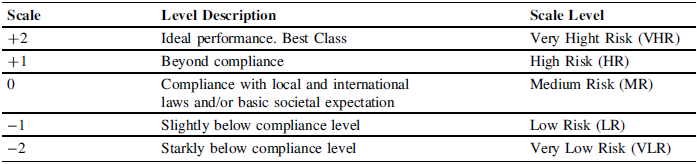
An analysis of scientific publications identified the main social indicators used in studies on waste treatment sectors (Table 1).
Social evaluation criteria used in this work

Generic ascending reference scale for assessing social performance (left scale in the table); Generic descending reference scale for assessing social risks (right scale in the table) based on the UNEP document (2020).
Additionally, an analysis of French institutional reports (ADEME, ANSES, INRS, ARIA, etc.) was conducted to determine the national inventory data available for qualifying the positive and negative social impacts of these facilities. This work enabled refinement of the descriptive indicators for the more relevant impacts. The highly localised nature of the work (determining the relevant social indicators to be considered in analysing a French situation) explains the numerous French references in our bibliography. However, the approach remains generic, and the French results are likely similar to those in other European countries.
3.2. Field survey
Visits to two anaerobic digestion facilities of very different sizes (one treating bio-waste from a professional canteen with a capacity of around 100 covers, the other treating bio-waste from an inter-municipal community in the Ile de France region) complemented the analysis of the situation, in particular through observation of the operation of the sites and discussions with the staff working there. In addition, an ergonomic assessment was carried out at a composting site. This assessment took place over three days and included direct observations, videos, field notes, noise level measurements, microbiological sampling, and risk and musculoskeletal disorder analyses.
3.3. Identification of social evaluation indicators in the pre-design phase
An initial summary was prepared based on the chosen stakeholders and the desirable impacts to be considered, to focus our study on a purely French situation and limit it to the impacts of treatment facilities. A second selection phase was based on the data actually available and the results of the detailed analysis of the composting site. The summarised results were transcribed using two measurement grids (in accordance with UNEP recommendations). The first of these grids has five levels that reflect social performance, while the second expresses the risk level associated with a type of facility (Table 1).
4. Results
4.1. Choice of stakeholders and impacts highlighted in the scientific literature
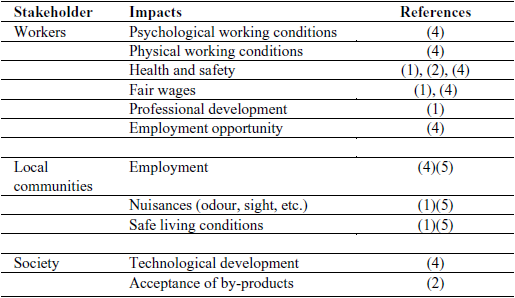
Given the scope of our study and the national location of the facilities to be assessed, we chose to retain the following stakeholders: workers and local communities. However, our review of the literature led us to consider an additional stakeholder: society. For the same reasons, we assumed that labour law was being applied with all that this implies in terms of respect for trade union rights and social benefits. We also equated job satisfaction with physical and psychological working conditions. On this basis, the impacts proposed in our literature review and retained are those set out in Table 2.
Preselection of social impacts based on the literature

Equivalence of references provided in Table 1: (1) Reference Costa, Mancini and PaesCosta et al., 2022; (2) Reference Chin, Lee, Klemeš, Fan and WoonChin et al., 2023; (3) Reference Gutierrez-Lopez, McGarvey and CostelloGutierrez-Lopez et al., 2023; (4) Reference Mattos and CalmonMattos & Calmon, 2023; (5) Reference Sandoval-Reyes, He, Semeano and FerrãoSandoval-Reyes et al., 2024.
4.2. Identification of inventory data that can feed into indicators
4.2.1. Inventory data concerning workers
As a preamble to this section, we assume that composting and anaerobic digestion sites will be managed in accordance with labour law. This includes the wearing of safety equipment by operators and compliance with working hours and breaks that structure working days and weeks. We are aware that some facilities, particularly small ones, may not strictly comply with these obligations, but the search for generic characteristics specific to the facilities we want to establish prevents us from considering this reality related to site management and governance methods.
Data from ANSES (2019) on annual health problems among workers in the waste sector indicate a rate of 59 reported illnesses/accidents per 1,000 employees, compared with a French average of 33.8. Unfortunately, the aggregation of national data does not allow us to distinguish between the respective performances of (i) waste collection and waste treatment; (ii) composting facilities and anaerobic digestion facilities (or incineration and landfill facilities).
This ANSES report also highlights mental health issues that have been little investigated (related to a lack of consideration for waste workers, exposure to incivility, etc.). The composting, anaerobic digestion and sorting sector is regularly used in employment policies as a lever for professional integration, particularly for people with few qualifications or who are distant from the labour market. As part of the green economy (Reference Boudra, Falzon, Le Breton and JouvenotBoudra, 2021), this sector combines environmental issues with local employment opportunities (Reference BoudraBoudra, 2016), but it raises persistent questions about the quality of the jobs on offer. Their conditions are conducive to the emergence of psychological and ethical suffering, particularly when the work is perceived as contrary to professional or personal values (Reference Rolo and LhuilierRolo, 2015; Reference Vaxevanoglou and PonnelleVaxevanoglou & Ponnelle, 2021). In our aim to compare the situations of composting and anaerobic digestion, it is once again impossible to differentiate between them on the basis of figures on this subject of psychological suffering. It can, however, be noted that the rate of blue-collar employment is 65% in the waste management sector, with an integration employment rate of 8%. In Europe, composting activities are more suited to employing people without qualifications because the labour intensity is higher per tonne of bio-waste: 4,200 T/FTE in composting compared to 5,300 T/FTE in anaerobic digestion (Reference Gibert and SiebertGilbert et al., 2022), with jobs in this sector ranging from 11,000 to 18,000 FTE for composting compared to 2,000 to 5,000 FTE for anaerobic digestion. According to Reference Gibert and SiebertGilbert et al. (2022), the number of these jobs is set to double in the coming years. The degree of automation is also higher in anaerobic digestion, thereby limiting the occurrence of musculoskeletal disorders, as shown by our ergonomic study. In France, average remuneration levels are €3,000 net/month in anaerobic digestion and around €2,000 net/month in composting (estimates based on job offers available on the Jooble website in October 2025). These two figures should be considered in relation to the average French net monthly salary, defined by INSEE as €2,020 in 2024. Therefore, despite the lack of national data, we hypothesise that psychological distress is potentially higher in the composting sector than in the anaerobic digestion sector.
The waste sector also presents a high potential for “undetermined” risks (ANSES, 2019) of both a chemical and biological nature. On this last point, however, an older study (Reference Ségala and GuillamSégala et al., 2012) targets more specific risks. In particular, it mentions potential risks associated with fungal spores in composting that can cause lung diseases (from allergies to lung cancer), nausea linked to bacteria, dangers linked to bioaerosols from the decomposition of bio-waste, and PAHs (polycyclic aromatic hydrocarbons), some of which are highly toxic, mutagenic and carcinogenic. PAHs are organic pollutants resulting from the incomplete combustion of biomass. French regulations do not require them to be monitored in either composting or anaerobic digestion facilities. However, the risk of their occurrence is lower in anaerobic digestion because it does not involve combustion. The possible presence of PAHs at composting sites has been confirmed by the ergonomic analysis conducted during our research. Microbiological samples have shown exposure levels at certain workstations that are of concern for the health of operators. Although it has not been possible to find data that fully confirms this hypothesis, we propose to state that: (i) that the causes of health risks in composting facilities (degradation of plant matter) are also present in anaerobic digestion facilities (ii) that the closure of biomass storage and treatment systems in anaerobic digestion facilities limits the release into the air compared to what can be measured at composting sites. Consequently, the potential health risk appears to be higher in these two activities than in conventional industrial activities, but with a higher risk potential in composting than in anaerobic digestion.
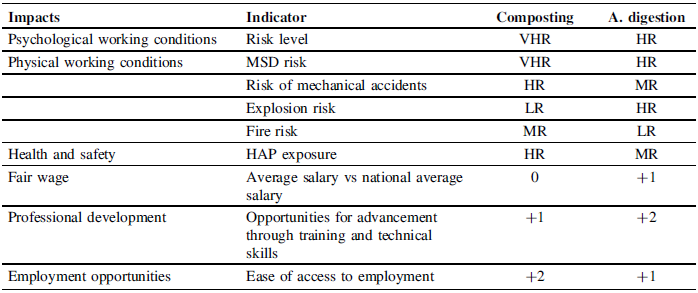
In terms of accident statistics, the data collected is also aggregated at the global level of waste management, without explicit differentiation between technical processes (composting, anaerobic digestion, incineration, etc.). These data indicate that the accident rate in the waste sector is twice that of other economic sectors (ARIA, 2021). The primary factor implicated is manual handling (approximately 50% of accidents). Once again, the more manual nature of composting works against it in this respect. French regulations for Classified Facilities for the Environment (ICPE) define the primary accident hazard of anaerobic digestion (Section 2781) as exposure due to methane leakage and accumulation. With regard to composting, the primary accident hazard is fire (ICPE Section 2780), which is defined as less dangerous and less likely than an explosion in anaerobic digestion. We summarise these results in Table 3.
List of social indicators used to report on the comparative impacts of composting and anaerobic digestion facilities on professionals in these activities (As a reminder, the abbreviations are explained in Table 1)

4.2.2. Inventory data concerning local communities
Social acceptability is a key issue in analysing the social impacts of composting facilities, particularly regarding coexistence with local residents. Scientific and institutional literature highlights that complaints about odour nuisance, health concerns or feelings of territorial injustice can permanently compromise the infrastructure’s integration into its local environment.
Qualitative studies, such as those by Reference Rinck, Bensafi and RoubyRinck, Bensafi and Rouby (2011), report a deep emotional rejection: the terms used by local residents, such as “it stinks”, “it’s disgusting” and “it’s awful”, reflect sensory discomfort and mistrust of the technical measures proposed (such as odour masks). Other recent research (Reference DeljurieDeljurie, 2025; Agence de l’Eau Rhône-Méditerranée-Corse, 2018) report visible and persistent forms of opposition, such as the installation of signs or collective actions. These authors emphasise the gap between regulatory compliance and perceived acceptability, thus highlighting the importance of integrating this dimension into a contextualised reading of social impacts.
The reports available in France do not distinguish between composting and anaerobic digestion facilities. In both cases, complaints most often relate to odour emissions (France Nature Environnement, 2021), but water and air pollution are also reported, although it is not currently possible to compare the situations of the two types of facilities. Furthermore, compliance with rules and good practices should not lead to this type of problem, making it difficult to include such criteria in a pre-design project. We have therefore decided not to include these types of criteria relating to local residents in the pre-evaluation of design solutions. However, we recognise the need to locate these sites away from residential areas and plan to include these distance criteria in the territorial location optimisation algorithm that will be proposed by the decision support tool. Furthermore, as job creation is a strong trend in activities with higher employment potential in composting, we include this criterion, and certain accidentology elements identified for treatment plant workers also apply to local residents. We summarise these results in Table 4.
List of social indicators selected to report on the comparative impacts of composting and anaerobic digestion facilities on local residents

4.2.3. Inventory data concerning the company
Although the technological development of both sectors is a subject of debate, to our knowledge, there have been relatively few publications on the subject, and those that do exist focus on anaerobic digestion. However, various complaints from residents living near both types of facility point to the need for technological developments to reduce the gas leaks, leachate and tank spills that still occur today. Furthermore, the arduous nature of manual composting tasks should drive automation in the sector, reduce the need to store windrows outdoors, and increase the use of IoT to improve the performance of compost production processes. The GRDF (2024) status report and forecast for the French anaerobic digestion sector anticipates strong growth in anaerobic digestion facilities, involving the development of larger facilities than those currently in existence.
The compost market is expected to grow: the global compost market is projected to reach approximately $10 billion by 2030, with a CAGR of 7% between 2023 and 2030 (Lucintel, 2024). However, the quality of this compost is crucial to achieving these targets. The Multi-Year Energy Programme of the French Energy and Climate Strategy (2019-2018) aims to increase the volume of biogas injected to 22 TWh in 2028, up from 11.6 TWh in 2024 (Ministère de la Transition écologique et solidaire, 2020). We summarise these results in Table 5.
List of social indicators selected to report on the comparative impacts of composting and anaerobic digestion facilities on French society

4.3. Challenges of integrating social indicators into processing system design
The integration of the social dimension into process design and optimization remains a major methodological challenge. Unlike the environmental and economic dimensions of sustainability, which can be expressed through continuous models directly linked to process decision variables (e.g., energy consumption, operating conditions, material flows), social indicators generally lack this quantitative formulation as functions of process design choices (Reference Gutierrez-Lopez, McGarvey and CostelloGutierrez-Lopez et al., 2023). Our study allowed us to implement a small-scale quantitative approach. Specifically, by linking technological choices and waste allocation to full-time equivalent (FTE) requirements and associated wages, we were able to estimate the impact of optimization decisions on employment levels and economic redistribution.
Within a systemic design framework that aims to jointly optimize environmental, economic, and social objectives in order to achieve true sustainability, our study illustrates the persistent difficulty of integrating a social dimension that closely includes impacts on individuals. Consequently, most current approaches rely on qualitative assessments or post-optimisation analyses, in which social impacts play a secondary role in shaping design outcomes (Reference Chin, Lee, Klemeš, Fan and WoonChin et al., 2023). Overcoming this gap requires the collection and harmonisation of comprehensive social indicator databases, as well as the development of new modelling strategies and data structures capable of linking process configurations and decision variables to social impacts. Such advances would enable more balanced and evidence-based decision-making among stakeholders in the design of sustainable processing systems.
5. Conclusion
Our analysis of scientific and technical literature, as well as fieldwork, has enabled us to identify 16 indicators to assess the social impacts of bio-waste treatment solutions involving anaerobic digestion or composting. These indicators are designed for use in Europe, effectively excluding them from a number of proposals put forward in non-European countries (e.g., those proposed in Reference Haslinger, Huysveld and CadenaHaslinger et al., 2025). These qualitative indicators are intended to complement environmental and economic indicators and will be used to produce a multi-criteria assessment of bio-waste treatment super-systems.
In the next stage of this research, these social indicators will be tested and operationalised within a quantitative decision-support framework based on multi-objective optimisation. Two complementary approaches are envisaged. The first consists of treating the set of social indicators as a separate objective function, whose discrete nature can be handled by genetic algorithms, enabling the exploration of trade-offs and synergies between the three pillars of sustainability. The second approach consists in incorporating the social indicators as a penalty or weighting function within the continuous optimisation of environmental and economic objectives, in order to assess, passively, how social criteria may influence the global optimality of solutions.
Beyond these modelling developments, the proposed indicators could also serve as decision-support tools for practitioners, stakeholders and policymakers, allowing them to select and prioritise the indicators most relevant to their specific context. Furthermore, while the current indicators are defined for a representative set of major processing technologies, they are expected to be further refined in the future to account for differences in facility size and technological developments, which in most cases do not scale linearly. For instance, accident reports from anaerobic digestion plants already suggest that incident frequency tends to correlate with facility size, underlining the importance of integrating such distinctions into future social impact assessments.
In both cases, the objective is not only to analyse and discuss how these social indicators can inform decision-making in the design and optimisation of sustainable municipal bio-waste management systems, but also to lay the groundwork for a more operational and comprehensive framework for social impact assessment in this sector.



 Open access

