


1. Introduction
1.1 Preliminaries
The heavy-tailed distributions accurately describe complicated situations. One of the most important applications is related to the risk theory in actuarial science. Although several one-dimensional problems remain still open, the multidimensional case has gained popularity from both theoretical and practical aspects. Especially, with respect to a practical point of view, the modern insurance industry does not operate with a single portfolio.
On this line, there are some recent papers, as, for example, Hu and Jiang (Reference Hu and Jiang2013), Konstantinides and Li (Reference Konstantinides and Li2016), and Yang and Su (Reference Yang and Su2023). In this direction, we introduce some two-dimensional distribution classes, with heavy tails, that are convenient for calculations and permit direct and consistent generalization of the one-dimensional concepts.
In Subsection 1.2, we remind some basic definitions for one-dimensional heavy-tailed distributions, for easy comparison with the two-dimensional ones. In Section 2, we introduce the closure property with respect to the two-dimensional convolution and the two-dimensional max-sum equivalence. Next, we present some results on these classes of distributions. In Section 3, we estimate the joint-tail asymptotic behavior of two random sums, under a dependence structure that generalizes the tail asymptotic independence, and we establish an asymptotic expression for the ruin probabilities, in a discrete-time two-dimensional risk model without stochastic discount factors. Furthermore in Section 5, we study the closure property of some of new classes with respect to scalar product, and in Section 6, we extended some of our results in Section 4, in the case which we have a common discount factor for the two portfolios. Last but not least, we limited ourselves to the non-negative case, and we study the closure property of new classes with respect to product convolution in two dimensions, and some previous results are extended.
Before passing to the next subsection, we give some notations that we need for the rest of the paper. We denote by ${\overline {F}}\,:\!=\,1-F$
the distribution tail, hence
${\overline {F}}\,:\!=\,1-F$
the distribution tail, hence ${\overline {F}}(x)={\mathbf{P}}[X\gt x]$
and holds
${\overline {F}}(x)={\mathbf{P}}[X\gt x]$
and holds ${\overline {F}}(x)\gt 0$
for any
${\overline {F}}(x)\gt 0$
for any $x \geq 0$
, except it is referred to differently. For two positive functions
$x \geq 0$
, except it is referred to differently. For two positive functions $f(x)$
and
$f(x)$
and $g(x)$
, the asymptotic relation
$g(x)$
, the asymptotic relation $f(x)=o[g(x)]$
, as
$f(x)=o[g(x)]$
, as $x\to \infty$
means
$x\to \infty$
means
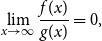 \begin{eqnarray*} \lim _{x\to \infty }\dfrac {f(x)}{g(x)} = 0, \end{eqnarray*}
the asymptotic relation $f(x)=O[g(x)]$
, as
$f(x)=O[g(x)]$
, as $x\to \infty$
holds if
$x\to \infty$
holds if
 \begin{eqnarray*} \limsup _{x\to \infty } \dfrac {f(x)}{g(x)} \lt \infty . \end{eqnarray*}
and the asymptotic relation $f(x)\asymp g(x)$
, as
$f(x)\asymp g(x)$
, as $x\to \infty$
if both
$x\to \infty$
if both $f(x)=O[g(x)]$
and
$f(x)=O[g(x)]$
and $g(x)=O[f(x)]$
. Similarly, for the bivariate functions
$g(x)=O[f(x)]$
. Similarly, for the bivariate functions $f(x,\,y)$
,
$f(x,\,y)$
, $g(x,\,y)$
, the corresponding asymptotic relations hold with
$g(x,\,y)$
, the corresponding asymptotic relations hold with $\min \{x,\,y\} \to \infty$
, as, for example,
$\min \{x,\,y\} \to \infty$
, as, for example, $f(x,\,y) = o[g(x,\,y)]$
, if it holds
$f(x,\,y) = o[g(x,\,y)]$
, if it holds
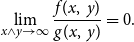 \begin{eqnarray*} \lim _{x \wedge y \to \infty } \dfrac {f(x,\,y) }{g(x,\,y) }=0. \end{eqnarray*}
For a real number $x,y$
, we denote
$x,y$
, we denote $x^{+}\,:\!=\,\max \{x,0\}$
,
$x^{+}\,:\!=\,\max \{x,0\}$
, $x\wedge y\,:\!=\,\min \{x,y\}$
,
$x\wedge y\,:\!=\,\min \{x,y\}$
, $x\vee y\,:\!=\,\max \{x,y\}$
. With bold letters, we denote vectors, and further for the unit and zero vectors, we write
$x\vee y\,:\!=\,\max \{x,y\}$
. With bold letters, we denote vectors, and further for the unit and zero vectors, we write $\textbf { 1}$
and
$\textbf { 1}$
and $\textbf { 0}$
, respectively.
$\textbf { 0}$
, respectively.
1.2 One-dimensional heavy-tailed distributions
The following properties are to be extended in two dimensions:
-
(1) For two random variables $X_1$
,
$X_2$
with distributions
$F_1$
,
$F_2$
, respectively, the distribution of the sum is defined by
$F_{X_1+X_2}(x)={\mathbf{P}}[X_1 + X_2 \leq x]$
with tail
$\overline {F_{X_1+X_2}}(x)={\mathbf{P}}[X_1+X_2 \gt x]$
. If
$X_1$
,
$X_2$
are independent, we write
$F_1*F_2$
instead of
$F_{X_1+X_2}$
.
$X_1$
,
$X_2$
with distributions
$F_1$
,
$F_2$
, respectively, the distribution of the sum is defined by
$F_{X_1+X_2}(x)={\mathbf{P}}[X_1 + X_2 \leq x]$
with tail
$\overline {F_{X_1+X_2}}(x)={\mathbf{P}}[X_1+X_2 \gt x]$
. If
$X_1$
,
$X_2$
are independent, we write
$F_1*F_2$
instead of
$F_{X_1+X_2}$
. -
(2) We say that the random variables
$X_1$
,
$X_2$
or their distributions
$F_1$
,
$F_2$
are max-sum equivalent if
$\overline {F_1*F_2}(x) \sim {\overline {F}}_1(x)+{\overline {F}}_2(x)$
, as
$x\to \infty$
. (In some cases, the max-sum equivalence is extended also to
${\overline {F}}_{X_1+X_2}(x) \sim {\overline {F}}_1(x) + {\overline {F}}_2(x)$
, for weakly dependent random variables
$X_1$
,
$X_2$
).


Now we consider some classes of heavy-tailed distributions. We say that a distribution $F$
is heavy-tailed, and we write
$F$
is heavy-tailed, and we write $F \in \mathcal{K}$
, if it holds
$F \in \mathcal{K}$
, if it holds
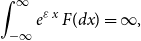 \begin{eqnarray*} \int _{-\infty }^{\infty } e^{\varepsilon \,x}\,F(dx) = \infty, \end{eqnarray*}
for any $\varepsilon \gt 0$
. A large enough class of heavy-tailed distributions is the class of long tails, denoted by
$\varepsilon \gt 0$
. A large enough class of heavy-tailed distributions is the class of long tails, denoted by $\mathcal{L}$
. We have
$\mathcal{L}$
. We have $F \in \mathcal{L}$
if it holds
$F \in \mathcal{L}$
if it holds
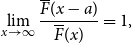 \begin{eqnarray*} \lim _{x\to \infty } \dfrac {{\overline {F}}(x-a)}{{\overline {F}}(x)}=1, \end{eqnarray*}
for any (or, equivalently, for some) $a\gt 0$
. It is well-known that if
$a\gt 0$
. It is well-known that if $F \in \mathcal{L}$
, then there exists a function
$F \in \mathcal{L}$
, then there exists a function $a\;:\;[0,\,\infty ) \longrightarrow [0,\,\infty )$
, such that
$a\;:\;[0,\,\infty ) \longrightarrow [0,\,\infty )$
, such that $a(x) \rightarrow \infty$
,
$a(x) \rightarrow \infty$
, ${\overline {F}}(x\pm a(x)) \sim {\overline {F}}(x)$
, as
${\overline {F}}(x\pm a(x)) \sim {\overline {F}}(x)$
, as $x\to \infty$
. This kind of function
$x\to \infty$
. This kind of function $a(x)$
is called an insensitivity function for
$a(x)$
is called an insensitivity function for $F$
; see further in Cline and Samorodnitsky (Reference Cline and Samorodnitsky1994), Foss et al. (Reference Foss, Korshunov and Zachary2013), or Konstantinides (Reference Konstantinides2018).
$F$
; see further in Cline and Samorodnitsky (Reference Cline and Samorodnitsky1994), Foss et al. (Reference Foss, Korshunov and Zachary2013), or Konstantinides (Reference Konstantinides2018).
A little smaller class than $\mathcal{L}$
is the class of subexponential distributions, introduced in Chistyakov (Reference Chistyakov1964). We say that a distribution
$\mathcal{L}$
is the class of subexponential distributions, introduced in Chistyakov (Reference Chistyakov1964). We say that a distribution $F$
with support on the interval
$F$
with support on the interval $[0,\,\infty )$
belongs to the class of subexponential distributions, symbolically
$[0,\,\infty )$
belongs to the class of subexponential distributions, symbolically $F \in \mathcal{S}$
if it holds
$F \in \mathcal{S}$
if it holds
 \begin{eqnarray*} \lim _{x\to \infty } \dfrac {\overline {F^{n*}}(x)}{{\overline {F}}(x)}=n, \end{eqnarray*}
for any $n \in {\mathbb{N}}$
, where
$n \in {\mathbb{N}}$
, where $F^{n*}$
represents the
$F^{n*}$
represents the $n$
-th order convolution power for
$n$
-th order convolution power for $F$
. The class
$F$
. The class $\mathcal{S}$
has found several applications in the risk models, as, for example, in Li et al. (Reference Li, Tang and Wu2010), Geng et al. (Reference Geng, Liu and Wang2023), and Ji et al. (Reference Ji, Wang, Yan and Cheng2023).
$\mathcal{S}$
has found several applications in the risk models, as, for example, in Li et al. (Reference Li, Tang and Wu2010), Geng et al. (Reference Geng, Liu and Wang2023), and Ji et al. (Reference Ji, Wang, Yan and Cheng2023).
We say that the distribution $F$
belongs to the class of the dominatedly varying distributions, symbolically
$F$
belongs to the class of the dominatedly varying distributions, symbolically $F \in \mathcal{D}$
, if it holds
$F \in \mathcal{D}$
, if it holds
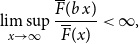 \begin{eqnarray*} \limsup _{x\to \infty } \dfrac {{\overline {F}}(b\,x)}{{\overline {F}}(x)} \lt \infty, \end{eqnarray*}
for some (or equivalently, for all) $b\in (0,\,1)$
. It is well known that
$b\in (0,\,1)$
. It is well known that $\mathcal{D}\cap \mathcal{L}=\mathcal{D}\cap \mathcal{S} \subset \mathcal{K}$
; see Goldie (Reference Goldie1978,Th. 1).
$\mathcal{D}\cap \mathcal{L}=\mathcal{D}\cap \mathcal{S} \subset \mathcal{K}$
; see Goldie (Reference Goldie1978,Th. 1).
Further, a smaller class of heavy-tailed distributions represents the class of consistently varying distributions, symbolically $F\in \mathcal{C}$
. We say that
$F\in \mathcal{C}$
. We say that $F\in \mathcal{C}$
, if it holds
$F\in \mathcal{C}$
, if it holds
 \begin{eqnarray*} \lim _{y\uparrow 1}\limsup _{x\to \infty } \dfrac {{\overline {F}}(y\,x)}{{\overline {F}}(x)} =1, \end{eqnarray*}
or equivalently
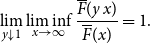 \begin{eqnarray*} \lim _{y\downarrow 1}\liminf _{x\to \infty } \dfrac {{\overline {F}}(y\,x)}{{\overline {F}}(x)} =1. \end{eqnarray*}
Finally, we say that a distribution $F$
belongs to the class of regularly varying distributions, with index
$F$
belongs to the class of regularly varying distributions, with index $\alpha \gt 0$
, symbolically
$\alpha \gt 0$
, symbolically $F \in \mathcal{R}_{-\alpha }$
if it holds
$F \in \mathcal{R}_{-\alpha }$
if it holds
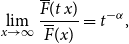 \begin{eqnarray*} \lim _{x\to \infty } \dfrac {{\overline {F}}(t\,x)}{{\overline {F}}(x)} =t^{-\alpha }, \end{eqnarray*}
for any $t\gt 0$
.
$t\gt 0$
.
For these classes, we obtain the following inclusions (see Bingham et al., Reference Bingham, Goldie and Teugels1987; Leipus et al., Reference Leipus, Šiaulys and Konstantinides2023):
 \begin{eqnarray*} \mathcal{R}\,:\!=\,\bigcup _{\alpha \geq 0} \mathcal{R}_{-\alpha } \subsetneq \mathcal{C} \subsetneq \mathcal{D}\cap \mathcal{L} \subsetneq \mathcal{S} \subsetneq \mathcal{L} \subsetneq \mathcal{K}, \end{eqnarray*}
where $\mathcal{R}_0$
is the class of slowly varying distributions. We can find numerous classes of heavy-tailed distributions; however, we mentioned the most popular in the literature. In this paper, we extend into two dimensions the classes
$\mathcal{R}_0$
is the class of slowly varying distributions. We can find numerous classes of heavy-tailed distributions; however, we mentioned the most popular in the literature. In this paper, we extend into two dimensions the classes $ \mathcal{C}$
,
$ \mathcal{C}$
, $ \mathcal{D}$
, and
$ \mathcal{D}$
, and $ \mathcal{L}$
.
$ \mathcal{L}$
.
In Cai and Tang (Reference Cai and Tang2004), we find the following results.
Proposition 1.1.
If $F_1 \in \mathcal{D}$
and
$F_1 \in \mathcal{D}$
and $F_2 \in \mathcal{D}$
are distributions with support on the interval
$F_2 \in \mathcal{D}$
are distributions with support on the interval $[0,\,\infty )$
, then
$[0,\,\infty )$
, then $F_{X_1+X_2} \in \mathcal{D}$
.
$F_{X_1+X_2} \in \mathcal{D}$
.
In Proposition1.1 we find that for non-negative random variables, the class $\mathcal{D}$
satisfies the closure property with respect to sum. As was mentioned in Cai and Tang (Reference Cai and Tang2004), the class
$\mathcal{D}$
satisfies the closure property with respect to sum. As was mentioned in Cai and Tang (Reference Cai and Tang2004), the class $\mathcal{D}$
does NOT satisfy the max-sum equivalence, as it follows from the fact that
$\mathcal{D}$
does NOT satisfy the max-sum equivalence, as it follows from the fact that $\mathcal{D} \not \subset \mathcal{S}$
and
$\mathcal{D} \not \subset \mathcal{S}$
and $\mathcal{S} \not \subset \mathcal{D}$
; therefore, the relation
$\mathcal{S} \not \subset \mathcal{D}$
; therefore, the relation $\overline {F^{2*}}(x) \sim 2\,{\overline {F}}(x)$
, as
$\overline {F^{2*}}(x) \sim 2\,{\overline {F}}(x)$
, as $x\to \infty$
, does NOT hold for
$x\to \infty$
, does NOT hold for $F\in \mathcal{D} \setminus \mathcal{S}$
. In opposite to the dominated variation, the class of the consistently varying distributions satisfies both these properties.
$F\in \mathcal{D} \setminus \mathcal{S}$
. In opposite to the dominated variation, the class of the consistently varying distributions satisfies both these properties.
Proposition 1.2.
If $F_1 \in \mathcal{C}$
and
$F_1 \in \mathcal{C}$
and $F_2 \in \mathcal{C}$
are distributions with support on the interval
$F_2 \in \mathcal{C}$
are distributions with support on the interval $[0,\,\infty )$
, then it holds
$[0,\,\infty )$
, then it holds $F_1 * F_2 \in \mathcal{C}$
and
$F_1 * F_2 \in \mathcal{C}$
and $\overline {F_1* F_2}(x) \sim {\overline {F}}_1(x) + {\overline {F}}_2(x)$
, as
$\overline {F_1* F_2}(x) \sim {\overline {F}}_1(x) + {\overline {F}}_2(x)$
, as $x\to \infty$
.
$x\to \infty$
.
2. Two-dimensional heavy tails
The reason why the multivariate distributions have been so popular is their ability to describe better multidimensional phenomena. This happens because of the interdependence among the components of the random vectors, which affect significantly the final outcome.
The first heavy-tailed distributions class that was extended to a multidimensional frame is the regular variation. We say that the random vector $\textbf { X}=(X_1,\,\ldots, \,X_d)$
represents a multivariate regularly varying vector with index
$\textbf { X}=(X_1,\,\ldots, \,X_d)$
represents a multivariate regularly varying vector with index $\alpha$
and non-degenerate, Radon measure
$\alpha$
and non-degenerate, Radon measure $\nu$
, symbolically
$\nu$
, symbolically $\textbf { X} \in MRV(\alpha, \,F,\,\nu )$
if it holds
$\textbf { X} \in MRV(\alpha, \,F,\,\nu )$
if it holds
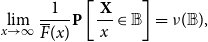 \begin{eqnarray*} \lim _{x\to \infty } \dfrac 1{{\overline {F}}(x)}{\mathbf{P}}\left [ \dfrac {\textbf { X}}x \in {\mathbb{B}} \right ]=\nu ({\mathbb{B}}), \end{eqnarray*}
for any $\nu$
-continuous Borel set
$\nu$
-continuous Borel set ${\mathbb{B}} \subset [0,\,\infty ]^d\setminus \{ \textbf { 0}\}$
, with
${\mathbb{B}} \subset [0,\,\infty ]^d\setminus \{ \textbf { 0}\}$
, with $F \in \mathcal{R}_{-\alpha }$
. The measure
$F \in \mathcal{R}_{-\alpha }$
. The measure $\nu$
is homogeneous; namely, it holds
$\nu$
is homogeneous; namely, it holds $\nu (\lambda \,{\mathbb{B}}) = \lambda ^{-\alpha }\,\nu ({\mathbb{B}})$
, for any
$\nu (\lambda \,{\mathbb{B}}) = \lambda ^{-\alpha }\,\nu ({\mathbb{B}})$
, for any $\lambda \gt 0$
.
$\lambda \gt 0$
.
The frame of multivariate regular variation was introduced in De Haan and Resnick (Reference De Haan and Resnick1981). Under this definition, the multivariate regular variation was used in the study of several issues in multivariate risk models and in risk management, as, for example, in Li (Reference Li2016), Tang and Yang (Reference Tang and Yang2019), and Yang and Su (Reference Yang and Su2023).
Although this kind of extension to multidimensional setup is well-established, it does not happen to other multidimensional distribution classes. Most of the extensions cover the multivariate subexponential distribution class and the multivariate long-tailed distribution class.
Initially, these two distribution classes were introduced in Cline and Resnick (Reference Cline and Resnick1992) as essential extension of the multivariate regular variation, namely, using vague convergence and point processes. Later, in Omey (Reference Omey2006), three different formulations appear for the multivariate subexponentiality and the multivariate long-tailedness. The formulations, which are close to our definitions, are given in classes $\mathcal{S}({\mathbb{R}}^d)$
and
$\mathcal{S}({\mathbb{R}}^d)$
and $\mathcal{L}({\mathbb{R}}^d)$
. We say that the multivariate distribution
$\mathcal{L}({\mathbb{R}}^d)$
. We say that the multivariate distribution $F$
belongs to class
$F$
belongs to class $\mathcal{S}({\mathbb{R}}^d)$
, if it holds
$\mathcal{S}({\mathbb{R}}^d)$
, if it holds
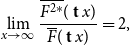 \begin{eqnarray*} \lim _{x\to \infty } \dfrac {\overline {F^{2*}}(\textbf { t}\,x)}{{\overline {F}}(\textbf { t}\,x)}=2, \end{eqnarray*}
for any $\textbf { t} \gt \textbf { 0}$
, with
$\textbf { t} \gt \textbf { 0}$
, with $\min _{1\leq i \leq d} \{t_i\} \lt \infty$
, and that the multivariate distribution
$\min _{1\leq i \leq d} \{t_i\} \lt \infty$
, and that the multivariate distribution $F$
belongs to class
$F$
belongs to class $\mathcal{L}({\mathbb{R}}^d)$
, if it holds
$\mathcal{L}({\mathbb{R}}^d)$
, if it holds
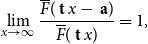 \begin{eqnarray*} \lim _{x\to \infty } \dfrac {{\overline {F}}(\textbf { t}\,x-\textbf { a})}{{\overline {F}}(\textbf { t}\,x)}=1, \end{eqnarray*}
for any $\textbf { a} \geq \textbf { 0}$
and for any
$\textbf { a} \geq \textbf { 0}$
and for any $\textbf { t} \gt \textbf { 0}$
, with
$\textbf { t} \gt \textbf { 0}$
, with $\min _{1\leq i \leq d} \{t_i\} \lt \infty$
.
$\min _{1\leq i \leq d} \{t_i\} \lt \infty$
.
This approach was used to study the asymptotic behavior of the tail of a randomly stopped sum of random vectors, namely, $S_{N}=\sum _{i=1}^N \textbf { X}_i$
, where
$S_{N}=\sum _{i=1}^N \textbf { X}_i$
, where $N$
is a discrete random variable with support
$N$
is a discrete random variable with support ${\mathbb{N}}_0={\mathbb{N}} \cup \{0\}$
and the
${\mathbb{N}}_0={\mathbb{N}} \cup \{0\}$
and the $ \textbf { X}_i$
are independent, identically distributed random vectors with multivariate distribution
$ \textbf { X}_i$
are independent, identically distributed random vectors with multivariate distribution $F$
. For applications of this class, see Omey et al. (Reference Omey, Mallor and Santos2006).
$F$
. For applications of this class, see Omey et al. (Reference Omey, Mallor and Santos2006).
Finally, another formulation of multivariate subexponential distributions was provided in Samorodnitsky and Sun (Reference Samorodnitsky and Sun2016), which represents the only approach with results for the ruin probability in a multivariate continuous-time risk model. Although the approach by Samorodnitsky and Sun (Reference Samorodnitsky and Sun2016) is clearly stronger than the previous two, it describes in some sense the linear multivariate single big jump, but it cannot cover the distributions through their joint tail; see Konstantinides and Passalidis (Reference Konstantinides and Passalidis2024, Sec. 5) for comments about this approach, indicating the complementary function to Samorodnitsky and Sun (Reference Samorodnitsky and Sun2016) of our approach, found below. In the present paper, we confine ourselves to the two dimensions, and we stay close to the formulation in Omey (Reference Omey2006); however, we keep two important differences.
First, we follow a direct approach to the one-dimensional distribution classes’ definitions.
Second, in the case of $d=2$
, the formulation in Omey (Reference Omey2006), and in the definition of multivariate regular variation, the convention
$d=2$
, the formulation in Omey (Reference Omey2006), and in the definition of multivariate regular variation, the convention $\textbf { F}(x,\,y)={\mathbf{P}}[X\leq x,\,Y\leq y]$
is adopted, and the distribution tail
$\textbf { F}(x,\,y)={\mathbf{P}}[X\leq x,\,Y\leq y]$
is adopted, and the distribution tail $1-\textbf { F}(x,\,y)$
, denoted
$1-\textbf { F}(x,\,y)$
, denoted $\overline {\textbf { F}}(x,\,y)$
, is applied on the event
$\overline {\textbf { F}}(x,\,y)$
, is applied on the event $\{X\gt x\} \cup \{Y\gt y\}$
. We consider only the case in which there exist excesses of both random variables
$\{X\gt x\} \cup \{Y\gt y\}$
. We consider only the case in which there exist excesses of both random variables $\{X\gt x\} \cap \{Y\gt y\}$
; namely, we define by
$\{X\gt x\} \cap \{Y\gt y\}$
; namely, we define by ${ {\overline {\mathbf{F}}}_1}(x,\,y)\,:\!=\,{\mathbf{P}}[X\gt x,\,Y\gt y]$
, as the distribution tail of
${ {\overline {\mathbf{F}}}_1}(x,\,y)\,:\!=\,{\mathbf{P}}[X\gt x,\,Y\gt y]$
, as the distribution tail of $\textbf { F}$
, with notation
$\textbf { F}$
, with notation $ { {\overline {\mathbf{F}}}_b}(x,\,y)\,:\!=\,{\mathbf{P}}[X\gt b_1\,x,\,Y\gt b_2\,y]$
, for all
$ { {\overline {\mathbf{F}}}_b}(x,\,y)\,:\!=\,{\mathbf{P}}[X\gt b_1\,x,\,Y\gt b_2\,y]$
, for all $\textbf { b}=(b_1,\,b_2) \in (0,\,\infty )^2$
. The choice of such a definition is due to both the consistency with the univariate case and the ease in asymptotic calculation of the joint tail of random sums as well. We intend that our approach becomes more consistent with the ruin of all portfolios, which represents the worst event that can happen for an insurance company with multiple businesses. In some sense, this is the reason why our classes lead to a nonlinear approach of the single big jump in multidimensional setup.
$\textbf { b}=(b_1,\,b_2) \in (0,\,\infty )^2$
. The choice of such a definition is due to both the consistency with the univariate case and the ease in asymptotic calculation of the joint tail of random sums as well. We intend that our approach becomes more consistent with the ruin of all portfolios, which represents the worst event that can happen for an insurance company with multiple businesses. In some sense, this is the reason why our classes lead to a nonlinear approach of the single big jump in multidimensional setup.
Next, we introduce the first bivariate heavy-tailed distribution class. From now on and further by the notation $\textbf { a}=(a_1,\,a_2)\gt (0,\,0)$
, we mean that
$\textbf { a}=(a_1,\,a_2)\gt (0,\,0)$
, we mean that $(a_1,\,a_2) \in [0,\,\infty )^2 \setminus \{\textbf { 0}\}$
, except it is referred to differently.
$(a_1,\,a_2) \in [0,\,\infty )^2 \setminus \{\textbf { 0}\}$
, except it is referred to differently.
Definition 2.1.
We say that the random pair (X, Y) with marginal distributions $F$
,
$F$
, $G$
belongs to the bivariate long-tailed distributions, symbolically
$G$
belongs to the bivariate long-tailed distributions, symbolically $(X,\,Y) \in \mathcal{L}^{(2)}$
, if the following conditions hold
$(X,\,Y) \in \mathcal{L}^{(2)}$
, if the following conditions hold
-
(1)
$F \in \mathcal{L}$
and
$G \in \mathcal{L}$
. -
(2) It holds
for some, or equivalently for any,
\begin{eqnarray*} \lim _{x\wedge y \to \infty } \dfrac { { {\overline {\mathbf{F}}}_1}(x-a_1,\,y-a_2)}{{ {\overline {\mathbf{F}}}_1}(x,\,y)}=\lim _{x\wedge y \to \infty } \dfrac {{\mathbf{P}}[X\gt x-a_1,\,Y\gt y-a_2]}{{\mathbf{P}}[X\gt x,\,Y\gt y]} =1, \end{eqnarray*}
$\textbf { a}=(a_1,\,a_2) \gt (0,0)$
, with
$a_1$
not necessarily equal to
$a_2$
.


Remark 2.1.
From the previous definition we wonder if by the two-dimensional property of class $\mathcal{L}^{(2)}$
follows directly the inclusion
$\mathcal{L}^{(2)}$
follows directly the inclusion $F,\,G \in \mathcal{L}$
. The answer to this question is no because it holds for any, or equivalently for some,
$F,\,G \in \mathcal{L}$
. The answer to this question is no because it holds for any, or equivalently for some, $(a_1,\,a_2) \gt (0,\,0)$
, as follows from Definition
2.1
.
$(a_1,\,a_2) \gt (0,\,0)$
, as follows from Definition
2.1
.
Let $F \in \mathcal{L}$
be a distribution and
$F \in \mathcal{L}$
be a distribution and $G$
be another distribution, not necessarily from class
$G$
be another distribution, not necessarily from class $\mathcal{L}$
. We assume that the two distributions stem from the independent random variables
$\mathcal{L}$
. We assume that the two distributions stem from the independent random variables $X$
and
$X$
and $Y$
; thus, if
$Y$
; thus, if $a_1\gt 0$
and
$a_1\gt 0$
and $a_2=0$
, we find that
$a_2=0$
, we find that
 \begin{eqnarray*} \lim _{x\wedge y \to \infty } \dfrac {{\mathbf{P}}[X\gt x-a_1, \;Y\gt y]}{{\mathbf{P}}[X\gt x, \;Y\gt y]}=\lim _{x\wedge y \to \infty } \dfrac {{\overline {F}}(x-a_1)\,\overline {G}(y)}{{\overline {F}}(x)\,\overline {G}(y)}=1, \end{eqnarray*}
however, if it holds $G \notin \mathcal{L}$
, then we have not this pair in the class
$G \notin \mathcal{L}$
, then we have not this pair in the class $\mathcal{L}^{(2)}$
.
$\mathcal{L}^{(2)}$
.
The reason why we require that the marginals belong to class $\mathcal{L}$
is to secure some two-dimensional closure properties that could fail if the
$\mathcal{L}$
is to secure some two-dimensional closure properties that could fail if the $\mathcal{L}$
condition is missing.
$\mathcal{L}$
condition is missing.
From Definition2.1 we obtain that if $(F,\,G) \in \mathcal{L}^{(2)}$
, then for any
$(F,\,G) \in \mathcal{L}^{(2)}$
, then for any $(A_1,\,A_2)\gt (0,\,0)$
, it holds
$(A_1,\,A_2)\gt (0,\,0)$
, it holds
 \begin{eqnarray} \sup _{|a_1|\lt A_1,\,|a_2|\lt A_2}\left | {\mathbf{P}}[X\gt x-a_1,\,Y \gt y-a_2]-{\mathbf{P}}[X\gt x,\,Y\gt y]\right |=o\left ( {\mathbf{P}}[X\gt x,\,Y\gt y]\right ), \end{eqnarray}
as $x\wedge y \to \infty$
, which follows from the uniformity of the convergence
$x\wedge y \to \infty$
, which follows from the uniformity of the convergence
 \begin{eqnarray*} \lim _{x\wedge y \to \infty }\dfrac { {\mathbf{P}}[X\gt x-a_1,\;Y \gt y-a_2]}{{\mathbf{P}}[X\gt x,\;Y\gt y]}=1, \end{eqnarray*}
over the parallelogram $[\!-A_1,\;A_1]\times [\!-A_2,\;A_2]$
. Indeed, for
$[\!-A_1,\;A_1]\times [\!-A_2,\;A_2]$
. Indeed, for $-A_1 \leq a_1 \leq A_1$
and
$-A_1 \leq a_1 \leq A_1$
and $-A_2 \leq a_2 \leq A_2$
, we obtain
$-A_2 \leq a_2 \leq A_2$
, we obtain $x-A_1 \leq x+a_1 \leq x+A_1$
and
$x-A_1 \leq x+a_1 \leq x+A_1$
and $y-A_2 \leq y+a_2 \leq y+A_2$
. Hence,
$y-A_2 \leq y+a_2 \leq y+A_2$
. Hence,
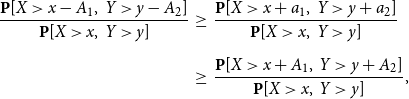 \begin{eqnarray*} \dfrac {{\mathbf{P}}[X\gt x-A_1, \;Y\gt y-A_2]}{{\mathbf{P}}[X\gt x, \;Y\gt y]}&\geq & \dfrac {{\mathbf{P}}[X\gt x+a_1, \;Y\gt y+a_2]}{{\mathbf{P}}[X\gt x, \;Y\gt y]}\\[2mm] &\geq & \dfrac {{\mathbf{P}}[X\gt x+A_1, \;Y\gt y+A_2]}{{\mathbf{P}}[X\gt x, \;Y\gt y]}, \end{eqnarray*}
where the first fraction tends to unity, as $x\wedge y \to \infty$
, by Definition2.1, and the last fraction also tends to unity, as
$x\wedge y \to \infty$
, by Definition2.1, and the last fraction also tends to unity, as $x\wedge y \to \infty$
, after the change of variables
$x\wedge y \to \infty$
, after the change of variables $x'=x+A_1$
and
$x'=x+A_1$
and $y'=y+A_2$
and by Definition2.1.
$y'=y+A_2$
and by Definition2.1.
Definition2.2 provides the insensitivity property in joint distributions; see the univariate analogue, for example, in Foss et al. (Reference Foss, Korshunov and Zachary2013) or in Konstantinides (Reference Konstantinides2018).
Definition 2.2.
Let $a_F(x),\,a_G(y)\gt 0$
for any
$a_F(x),\,a_G(y)\gt 0$
for any $x\gt 0,\,y\gt 0$
be two non-decreasing function. We say that the joint distribution
$x\gt 0,\,y\gt 0$
be two non-decreasing function. We say that the joint distribution $\textbf { F}=(F,\,G)$
of
$\textbf { F}=(F,\,G)$
of $(X,\,Y)$
, with right endpoint
$(X,\,Y)$
, with right endpoint $r_{\textbf { F}}\,:\!=\,(r_F,\,r_G)=(\infty, \,\infty )$
, satisfies
$r_{\textbf { F}}\,:\!=\,(r_F,\,r_G)=(\infty, \,\infty )$
, satisfies $(a_F,\,a_G)$
-joint insensitivity, if
$(a_F,\,a_G)$
-joint insensitivity, if
 \begin{eqnarray*} &&\sup _{|a_1|\leq a_F(x),\,|a_2| \leq a_G(y)}\left | {\mathbf{P}}[X\gt x-a_1, Y \gt y-a_2]-{\mathbf{P}}[X\gt x, Y\gt y]\right |\\[2mm] &&\qquad \qquad \qquad =o\left ( {\mathbf{P}}[X\gt x,Y\gt y]\right ), \end{eqnarray*}
as $x\wedge y \to \infty$
.
$x\wedge y \to \infty$
.
Now we show that class $ \mathcal{L}^{(2)}$
satisfies the
$ \mathcal{L}^{(2)}$
satisfies the $(a_F,\,a_G)$
-joint insensitive property.
$(a_F,\,a_G)$
-joint insensitive property.
Lemma 2.1.
Let assume that $ (X,\,Y) \in \mathcal{L}^{(2)}$
. Then there exist some functions
$ (X,\,Y) \in \mathcal{L}^{(2)}$
. Then there exist some functions $a_F(x),\,a_G(y)$
such that
$a_F(x),\,a_G(y)$
such that $a_F(x) \to \infty$
and
$a_F(x) \to \infty$
and $a_G(y) \to \infty$
, as
$a_G(y) \to \infty$
, as $x\wedge y \to \infty$
, and
$x\wedge y \to \infty$
, and $(F,\,G)$
satisfies the
$(F,\,G)$
satisfies the $(a_F,\,a_G)$
-joint insensitive property.
$(a_F,\,a_G)$
-joint insensitive property.
Proof. For any integer $n \in {\mathbb{N}}$
, from relation (2.1), we can choose an increasing to infinity sequence
$n \in {\mathbb{N}}$
, from relation (2.1), we can choose an increasing to infinity sequence $\{u_n\}$
, such that the inequality
$\{u_n\}$
, such that the inequality
 \begin{eqnarray*} \sup _{|a_1|\leq n,\,|a_2| \leq n}\left | {\mathbf{P}}[X\gt x-a_1,\,Y \gt y-a_2]-{\mathbf{P}}[X\gt x,\,Y\gt y]\right |\leq \dfrac {{\mathbf{P}}[X\gt x,\,Y\gt y]}n, \end{eqnarray*}
holds for any $x\geq u_n$
and any
$x\geq u_n$
and any $y\geq u_n$
. Without loss of generality, we consider that the sequence
$y\geq u_n$
. Without loss of generality, we consider that the sequence $\{u_n\}$
increases to infinity. We put
$\{u_n\}$
increases to infinity. We put $a_F(x)=a_G(y)=n$
, for any
$a_F(x)=a_G(y)=n$
, for any $(x,\,y)\in (u_n,\,u_{n+1}]^2$
. From the fact that
$(x,\,y)\in (u_n,\,u_{n+1}]^2$
. From the fact that $u_n \to \infty$
, as
$u_n \to \infty$
, as $n\to \infty$
, we obtain that
$n\to \infty$
, we obtain that $a_F(x) \to \infty$
, as
$a_F(x) \to \infty$
, as $x\to \infty$
, and
$x\to \infty$
, and $a_G(y) \to \infty$
, as
$a_G(y) \to \infty$
, as $y\to \infty$
.
$y\to \infty$
.
So, from the construction of $a(\cdot )$
, we conclude that
$a(\cdot )$
, we conclude that
 \begin{eqnarray*} \sup _{|a_1|\leq a_F(x),\,|a_2| \leq a_G(y)}\left | {\mathbf{P}}[X\gt x-a_1,\,Y \gt y-a_2]-{\mathbf{P}}[X\gt x,\,Y\gt y]\right |\leq \dfrac {{\mathbf{P}}[X\gt x,\,Y\gt y]}{n}, \end{eqnarray*}
for any $x \gt u_n$
and any
$x \gt u_n$
and any $y\gt u_n$
, which is the required result.
$y\gt u_n$
, which is the required result.
Remark 2.2.
From the $(a_F,\,a_G)$
-joint insensitivity, it does not follow necessarily that
$(a_F,\,a_G)$
-joint insensitivity, it does not follow necessarily that $a_F$
and
$a_F$
and $a_G$
are insensitivity functions for the marginal distributions
$a_G$
are insensitivity functions for the marginal distributions $F,\,G$
, respectively. Furthermore, Lemma
2.1
asserts that
$F,\,G$
, respectively. Furthermore, Lemma
2.1
asserts that
 \begin{eqnarray*} \lim _{x\wedge y \to \infty }\dfrac { {\mathbf{P}}[X\gt x\pm a_F(x),\;Y \gt y \pm a_G(y)]}{{\mathbf{P}}[X\gt x,\;Y\gt y]}=1. \end{eqnarray*}
Let us see now two examples that help either to understanding or to constructing of such bivariate distributions. The first case is the simplest, as we construct $(X,\,Y) \in \mathcal{L}^{(2)}$
through the independence between
$(X,\,Y) \in \mathcal{L}^{(2)}$
through the independence between $X$
and
$X$
and $Y$
.
$Y$
.
Example 2.1.
Let $X$
and
$X$
and $Y$
be random variables with distributions
$Y$
be random variables with distributions $F \in \mathcal{L}$
and
$F \in \mathcal{L}$
and $G \in \mathcal{L}$
, respectively. We assume that
$G \in \mathcal{L}$
, respectively. We assume that $X$
and
$X$
and $Y$
are independent, to obtain
$Y$
are independent, to obtain
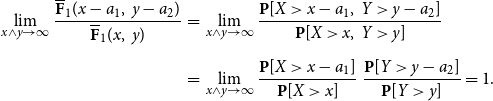 \begin{eqnarray*} \lim _{x\wedge y \to \infty } \dfrac {{ {\overline {\mathbf{F}}}_1}(x-a_1,\,y-a_2)}{ { {\overline {\mathbf{F}}}_1}(x,\,y)}&=&\lim _{x\wedge y \to \infty } \dfrac {{\mathbf{P}}[X\gt x-a_1,\,Y\gt y-a_2]}{{\mathbf{P}}[X\gt x,\,Y\gt y]}\\[2mm] &=&\lim _{x\wedge y \to \infty }\dfrac {{\mathbf{P}}[X\gt x-a_1]}{{\mathbf{P}}[X\gt x]}\,\dfrac {{\mathbf{P}}[Y\gt y-a_2]}{{\mathbf{P}}[Y\gt y]}=1. \end{eqnarray*}
Therefore $(X,\,Y) \in \mathcal{L}^{(2)}$
.
$(X,\,Y) \in \mathcal{L}^{(2)}$
.
The next example makes sense, as it cannot be reduced into univariate distributions. The following dependence structure can be found in Li (Reference Li2018). We say that the random variables $X$
and
$X$
and $Y$
are strongly asymptotic independent (SAI) if
$Y$
are strongly asymptotic independent (SAI) if ${\mathbf{P}}[X^- \gt x,\,Y\gt y]=O[F(\!-x)\,\overline {G}(y)]$
,
${\mathbf{P}}[X^- \gt x,\,Y\gt y]=O[F(\!-x)\,\overline {G}(y)]$
, ${\mathbf{P}}[X \gt x,\,Y^-\gt y]=O[{\overline {F}}(x)\,G(\!-y)]$
hold as
${\mathbf{P}}[X \gt x,\,Y^-\gt y]=O[{\overline {F}}(x)\,G(\!-y)]$
hold as $x\wedge y \to \infty$
, and there exists a constant
$x\wedge y \to \infty$
, and there exists a constant $C\gt 0$
such that if it holds
$C\gt 0$
such that if it holds
 \begin{eqnarray} {\mathbf{P}}[X\gt x,\,Y\gt y] \sim C\,{\overline {F}}(x)\,\overline {G}(y), \end{eqnarray}
as $x\wedge y \to \infty$
.
$x\wedge y \to \infty$
.
If the $X$
and
$X$
and $Y$
are bounded from below, then (2.2) is enough to be SAI.
$Y$
are bounded from below, then (2.2) is enough to be SAI.
Example 2.2.
Let $X$
and
$X$
and $Y$
be random variables with strongly asymptotic independence, with some constant
$Y$
be random variables with strongly asymptotic independence, with some constant $C\gt 0$
and distributions
$C\gt 0$
and distributions $F \in \mathcal{L}$
and
$F \in \mathcal{L}$
and $G \in \mathcal{L}$
, respectively. Then
$G \in \mathcal{L}$
, respectively. Then
 \begin{eqnarray*} \lim _{x\wedge y \to \infty } \dfrac {{ {\overline {\mathbf{F}}}_1}(x-a_1,\,y-a_2)}{ { {\overline {\mathbf{F}}}_1}(x,\,y)}&=&\lim _{x\wedge y \to \infty } \dfrac {{\mathbf{P}}[X\gt x-a_1,\,Y\gt y-a_2]}{{\mathbf{P}}[X\gt x,\,Y\gt y]}\\[2mm] &=&\lim _{x\wedge y \to \infty }\dfrac {C\,{\overline {F}}(x-a_1)\,\overline {G}(y-a_2)}{C\,{\overline {F}}(x)\,\overline {G}(y)}=1. \end{eqnarray*}
Therefore $(X,\,Y) \in \mathcal{L}^{(2)}$
.
$(X,\,Y) \in \mathcal{L}^{(2)}$
.
The first two examples restrict themselves either in the independent case or in some kind of asymptotic independence. Notice that in the next example as class $ \mathcal{L}^{(2)}$
, we understand the class from Definition2.1, but with a restriction with respect to convergence, instead of
$ \mathcal{L}^{(2)}$
, we understand the class from Definition2.1, but with a restriction with respect to convergence, instead of $x \wedge y$
to
$x \wedge y$
to $x=y$
only. In Li and Yang (Reference Li and Yang2015), the dependence structure from relation (2.3) was used, through the survival copula
$x=y$
only. In Li and Yang (Reference Li and Yang2015), the dependence structure from relation (2.3) was used, through the survival copula $\widehat {C}$
, to depict the dependence relation among claims in a bivariate, continuous-time risk model. We assume that for two random variables
$\widehat {C}$
, to depict the dependence relation among claims in a bivariate, continuous-time risk model. We assume that for two random variables $X,\,Y$
following a survival copula
$X,\,Y$
following a survival copula $\widehat {C}$
, there exists some constant
$\widehat {C}$
, there exists some constant $\gamma \geq 1$
and a positive measurable function
$\gamma \geq 1$
and a positive measurable function $h(\cdot, \,\cdot )$
, such that the asymptotic relation holds
$h(\cdot, \,\cdot )$
, such that the asymptotic relation holds
 \begin{eqnarray} \widehat {C}(t_1\,x,\,t_2\,x) \sim x^{\gamma }\,h(t_1,\,t_2), \end{eqnarray}
as $x \downarrow 0$
holds, for any
$x \downarrow 0$
holds, for any $(t_1,\,t_2) \in (0,\,\infty )$
.
$(t_1,\,t_2) \in (0,\,\infty )$
.
Example 2.3.
Let the random variables $X,\,Y$
follow a survival copula from relation
(2.3)
and
$X,\,Y$
follow a survival copula from relation
(2.3)
and $F,\,G$
be their marginal distributions. Furthermore, we assume that it holds
$F,\,G$
be their marginal distributions. Furthermore, we assume that it holds
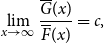 \begin{eqnarray} \lim _{x\to \infty } \dfrac {\overline {G}(x)}{{\overline {F}}(x)}=c, \end{eqnarray}
for some positive constant $c\gt 0$
and either
$c\gt 0$
and either $F\in \mathcal{L}$
or
$F\in \mathcal{L}$
or $G\in \mathcal{L}$
is true. Finally, we suppose that relation
(2.3)
holds with
$G\in \mathcal{L}$
is true. Finally, we suppose that relation
(2.3)
holds with $\gamma =1$
. Then we obtain
$\gamma =1$
. Then we obtain $F,\,G \in \mathcal{L}$
, which follows from the closure property of class
$F,\,G \in \mathcal{L}$
, which follows from the closure property of class $ \mathcal{L}$
with respect to strong equivalence of (2.4); see Leipus et al. (Reference Leipus, Šiaulys and Konstantinides2023). From Li and Yang (Reference Li and Yang2015, Prop. 3.1), we have the random variables
$ \mathcal{L}$
with respect to strong equivalence of (2.4); see Leipus et al. (Reference Leipus, Šiaulys and Konstantinides2023). From Li and Yang (Reference Li and Yang2015, Prop. 3.1), we have the random variables $X,\,Y$
to be asymptotic dependent, and further, they satisfy
$X,\,Y$
to be asymptotic dependent, and further, they satisfy
 \begin{eqnarray*} \lim _{x\to \infty } \dfrac {{\mathbf{P}}[X\gt x,\,Y\gt x]}{{\mathbf{P}}[X\gt x]} =h(1,\,c)\gt 0, \end{eqnarray*}
hence by the last formulas, for any $(a_1,\,a_2)\gt (0,\,0)$
, it holds
$(a_1,\,a_2)\gt (0,\,0)$
, it holds
 \begin{eqnarray*} \lim _{x\to \infty } \dfrac {{\mathbf{P}}[X\gt x-a_1,\,Y\gt x-a_2]}{{\mathbf{P}}[X\gt x,\,Y\gt x]} =\lim _{x\to \infty } \dfrac {h(1,\,c)\,{\mathbf{P}}[X\gt x-a_1]}{h(1,\,c)\,{\mathbf{P}}[X\gt x]}=1, \end{eqnarray*}
so we find $ (X,\,Y) \in \mathcal{L}^{(2)}$
, in the sense that in Definition
2.1
, the convergence is valid with
$ (X,\,Y) \in \mathcal{L}^{(2)}$
, in the sense that in Definition
2.1
, the convergence is valid with $x=y$
.
$x=y$
.
We can find several dependence structures that satisfy the $\mathcal{L}^{(2)}$
condition. However, we choose to pursue theoretical results.
$\mathcal{L}^{(2)}$
condition. However, we choose to pursue theoretical results.
Now we pass to the bivariate subexponential distribution class $\mathcal{S}^{(2)}$
.
$\mathcal{S}^{(2)}$
.
Definition 2.3.
We say that the random pair $(X,\,Y)$
, with marginal distributions
$(X,\,Y)$
, with marginal distributions $F$
and
$F$
and $G$
, respectively, belongs to the class of bivariate subexponential distributions, symbolically
$G$
, respectively, belongs to the class of bivariate subexponential distributions, symbolically $(X,\,Y) \in \mathcal{S}^{(2)}$
, if
$(X,\,Y) \in \mathcal{S}^{(2)}$
, if
-
(1)
$F \in \mathcal{S}$
and
$G \in \mathcal{S}$
. -
(2)
$(X,\,Y) \in \mathcal{L}^{(2)}$
. -
(3) It holds
(2.5)where
\begin{eqnarray} \lim _{x\wedge y \to \infty } \dfrac {{\mathbf{P}}[X_1+X_2\gt x,\;Y_1+Y_2\gt y]}{{\mathbf{P}}[X\gt x,\;Y\gt y]}=2^2, \end{eqnarray}
$(X_1,\,Y_1)$
and
$(X_2,\,Y_2)$
are independent and identically distributed copies of
$(X,\,Y)$
.


Remark 2.3.
In case of $d$
-variate distribution, relation
(2.5)
becomes
$d$
-variate distribution, relation
(2.5)
becomes
 \begin{eqnarray*} \lim _{x_1\wedge \ldots \wedge x_n\; to\; \infty} \dfrac {{\mathbf{P}}[X_{1,1}+X_{1,2}\gt x_1,\;\ldots, \,X_{d,1}+X_{d,2}\gt x_d]}{{\mathbf{P}}[X_{1,1}\gt x_1,\;\ldots, \,X_{d,1}\gt x_d]}=2^d. \end{eqnarray*}
Conjecture 2.1.
In Definition
2.3
, we suppose that the $(1)$
,
$(1)$
, $(3)$
do NOT imply directly the property
$(3)$
do NOT imply directly the property $(2)$
and the membership in
$(2)$
and the membership in $\mathcal{L}^{(2)}$
. Although it is not proved, we consider that this conjecture could be established through a special counterexample, in which the
$\mathcal{L}^{(2)}$
. Although it is not proved, we consider that this conjecture could be established through a special counterexample, in which the $(1)$
,
$(1)$
, $(3)$
are satisfied, and the
$(3)$
are satisfied, and the $(X,\,Y)$
satisfy properties of some special kind of copulas that belong to
$(X,\,Y)$
satisfy properties of some special kind of copulas that belong to $SAI$
in
(2.2)
, but now with
$SAI$
in
(2.2)
, but now with $C=0$
; see Li (Reference Li2018b), Ji et al. (Reference Ji, Wang, Yan and Cheng2023), and Li (Reference Li2024) for examples of such dependence through copulas.
$C=0$
; see Li (Reference Li2018b), Ji et al. (Reference Ji, Wang, Yan and Cheng2023), and Li (Reference Li2024) for examples of such dependence through copulas.
Now we come to the bivariate dominatedly varying distribution class $\mathcal{D}^{(2)}$
.
$\mathcal{D}^{(2)}$
.
Definition 2.4.
We say that the random pair $(X,\,Y)$
, with marginal distributions
$(X,\,Y)$
, with marginal distributions $F$
and
$F$
and $G$
, respectively, belongs to the class of bivariate dominatedly varying distributions, symbolically
$G$
, respectively, belongs to the class of bivariate dominatedly varying distributions, symbolically $(X,\,Y) \in \mathcal{D}^{(2)}$
, if
$(X,\,Y) \in \mathcal{D}^{(2)}$
, if
-
(1)
$F \in \mathcal{D}$
and
$G \in \mathcal{D}$
. -
(2) It holds
(2.6)for some, or equivalently for all
\begin{eqnarray} \limsup _{x\wedge y \to \infty } \dfrac { { {\overline {\mathbf{F}}}_b}(x,\,y)}{ { {\overline {\mathbf{F}}}_1}(x,\,y)}=\limsup _{x\wedge y \to \infty } \dfrac {{\mathbf{P}}[X\gt b_1\,x,\,Y\gt b_2\,y]}{{\mathbf{P}}[X\gt x,\,Y\gt y]} \lt \infty, \end{eqnarray}
$\textbf { b}=(b_1,\,b_2) \in (0,\,1)^2$
, with
$b_1$
not necessarily equal to
$b_2$
.


It is obvious that 2.6 is equivalently with:
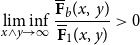 \begin{eqnarray*} \liminf _{x\wedge y \to \infty }\dfrac { { {\overline {\mathbf{F}}}_b}(x,\, y)}{ { {\overline {\mathbf{F}}}_1}(x, y)}\gt 0 \end{eqnarray*}
for some, or equivalently for all $\textbf { b}=(b_1,\,b_2) \in (1,\,\infty )^2$
, with
$\textbf { b}=(b_1,\,b_2) \in (1,\,\infty )^2$
, with $b_1$
not necessarily equal to
$b_1$
not necessarily equal to $b_2$
.
$b_2$
.
Remark 2.4.
In Konstantinides and Passalidis (Reference Konstantinides and Passalidis2024b), the class $\mathcal{D}_{n}$
(for some
$\mathcal{D}_{n}$
(for some $n\in \mathbb{N}$
) of multivariate dominatedly varying random vectors was introduced. It is obvious that in case
$n\in \mathbb{N}$
) of multivariate dominatedly varying random vectors was introduced. It is obvious that in case $n=2$
, our approach includesthis definition. Specifically
$n=2$
, our approach includesthis definition. Specifically
 \begin{equation*} \mathcal{D}_{2}\subset \mathcal{D}^{(2)} \end{equation*}
Definition 2.5.
We say that the random pair $(X,\,Y)$
, with marginal distributions
$(X,\,Y)$
, with marginal distributions $F$
and
$F$
and $G$
, respectively, belongs to the class of bivariate consistently varying distributions, symbolically
$G$
, respectively, belongs to the class of bivariate consistently varying distributions, symbolically $(X,\,Y) \in \mathcal{C}^{(2)}$
, if
$(X,\,Y) \in \mathcal{C}^{(2)}$
, if
-
(1)
$F \in \mathcal{C}$
and
$G \in \mathcal{C}$
. -
(2) It holds
or equivalently
\begin{eqnarray*} \lim _{\textbf { z} \uparrow \textbf { 1}}\limsup _{x\wedge y \to \infty } \dfrac { { {\overline {\mathbf{F}}}_z}(x,\,y)}{ { {\overline {\mathbf{F}}}_1}(x,\,y)}=1, \end{eqnarray*}
where
\begin{eqnarray*} \lim _{\textbf { z} \downarrow \textbf { 1}}\liminf _{x\wedge y \to \infty } \dfrac { { {\overline {\mathbf{F}}}_z}(x,\,y)}{ { {\overline {\mathbf{F}}}_1}(x,\,y)}=1, \end{eqnarray*}
$\textbf { z}=(z_1,\,z_2)$
, and
$\textbf { 1}=(1,\,1)$
.


Examples2.1 and 2.2 remain intact in classes $\mathcal{D}^{(2)}$
and
$\mathcal{D}^{(2)}$
and $\mathcal{C}^{(2)}$
; hence, they keep functioning in class
$\mathcal{C}^{(2)}$
; hence, they keep functioning in class $(\mathcal{D}\cap \mathcal{L})^{(2)}\,:\!=\,\mathcal{D}^{(2)} \cap \mathcal{L}^{(2)}$
.
$(\mathcal{D}\cap \mathcal{L})^{(2)}\,:\!=\,\mathcal{D}^{(2)} \cap \mathcal{L}^{(2)}$
.
Theorem 2.1.
It holds $\mathcal{C}^{(2)} \subsetneq \mathcal{L}^{(2)}$
.
$\mathcal{C}^{(2)} \subsetneq \mathcal{L}^{(2)}$
.
Proof. Let consider that $(F,\,G) \in \mathcal{C}^{(2)}$
. Then, for
$(F,\,G) \in \mathcal{C}^{(2)}$
. Then, for $\textbf { a}=(a_1,\,a_2)>(0,\,0)$
for any distributions
$\textbf { a}=(a_1,\,a_2)>(0,\,0)$
for any distributions $F,\,G$
, we obtain
$F,\,G$
, we obtain
 \begin{eqnarray} 1\leq \liminf _{x \wedge y \to \infty } \dfrac {{\mathbf{P}}[X\gt x-a_1,\,Y\gt y-a_2]}{{\mathbf{P}}[X\gt x,\,Y\gt y]}. \end{eqnarray}
Hence, we have to show that the upper bound of the last fraction is equal to unity. We observe that for any small enough $\delta _1,\,\delta _2 \gt 0$
, there exist some
$\delta _1,\,\delta _2 \gt 0$
, there exist some $x_0\gt 0$
, such that
$x_0\gt 0$
, such that $x\,(1-\delta _1) \leq x- a_1$
and
$x\,(1-\delta _1) \leq x- a_1$
and $y\,(1-\delta _2) \leq y- a_2$
, for any
$y\,(1-\delta _2) \leq y- a_2$
, for any $x \wedge y \geq x_0$
. Therefore, we find
$x \wedge y \geq x_0$
. Therefore, we find
 \begin{eqnarray} \limsup _{x\wedge y \to \infty } \dfrac {{\mathbf{P}}[X\gt x-a_1, Y\gt y-a_2]}{{\mathbf{P}}[X\gt x, Y\gt y]}\leq \limsup _{x\wedge y \to \infty } \dfrac {{\mathbf{P}}[X\gt x (1-\delta _1),\,Y\gt y (1-\delta _2)]}{{\mathbf{P}}[X\gt x,\,Y\gt y]}\to 1, \end{eqnarray}
as $(\delta _1,\,\delta _2) \to (0,\,0)$
, where in the last step, we use the properties of class
$(\delta _1,\,\delta _2) \to (0,\,0)$
, where in the last step, we use the properties of class $\mathcal{C}^{(2)}$
for the pair of distributions
$\mathcal{C}^{(2)}$
for the pair of distributions $(F,\,G)$
. So, by relations (2.7) and (2.8), we conclude that
$(F,\,G)$
. So, by relations (2.7) and (2.8), we conclude that $(X,\,Y) \in \mathcal{L}^{(2)}$
.
$(X,\,Y) \in \mathcal{L}^{(2)}$
.
3. Max-sum equivalence and closure properties with respect to convolution
Now, we present two definitions. In the first one, we define the closure property with respect to convolution in bivariate distributions. In this case, we formulate the main result, showing that the class $\mathcal{D}^{(2)}$
is closed. The second definition, given at the end of the section, under concrete dependence structures, also presented later, is fulfilled with respect to classes
$\mathcal{D}^{(2)}$
is closed. The second definition, given at the end of the section, under concrete dependence structures, also presented later, is fulfilled with respect to classes $(\mathcal{D}\cap \mathcal{L})^{(2)}$
and
$(\mathcal{D}\cap \mathcal{L})^{(2)}$
and $\mathcal{C}^{(2)}$
.
$\mathcal{C}^{(2)}$
.
Definition 3.1.
Let $X_1,\,X_2,\,Y_1,\,Y_2$
be random variables, with distributions
$X_1,\,X_2,\,Y_1,\,Y_2$
be random variables, with distributions $F_1$
,
$F_1$
, $F_2$
,
$F_2$
, $G_1$
and
$G_1$
and $G_2$
, respectively. If the following conditions are true
$G_2$
, respectively. If the following conditions are true
-
(1)
$F_1 \in \mathcal{B}$
,
$F_2 \in \mathcal{B}$
,
$G_1 \in \mathcal{B}$
,
$G_2 \in \mathcal{B}$
and for any
$k,\,l \in \{1,\,2\}$
, holds
$(X_k,\,Y_l) \in \mathcal{B}^{(2)}$
, -
(2) Holds
$(X_1+X_2,\,Y_1+Y_2) \in \mathcal{B}^{(2)}$
,


where $\mathcal{B}^{(2)}$
is some bivariate class, defined in Section
2
, then we say that the class
$\mathcal{B}^{(2)}$
is some bivariate class, defined in Section
2
, then we say that the class $\mathcal{B}^{(2)}$
is closed with respect to sum. If
$\mathcal{B}^{(2)}$
is closed with respect to sum. If $X_1$
,
$X_1$
, $X_2$
are independent random variables, and
$X_2$
are independent random variables, and $Y_1$
,
$Y_1$
, $Y_2$
are also independent, then we say that
$Y_2$
are also independent, then we say that $\mathcal{B}^{(2)}$
is closed with respect to convolution, symbolically
$\mathcal{B}^{(2)}$
is closed with respect to convolution, symbolically $(F_1*F_1, \,G_1*G_2) \in \mathcal{B}^{(2)}$
.
$(F_1*F_1, \,G_1*G_2) \in \mathcal{B}^{(2)}$
.
In the last definition, although the check of $F_{X_1+X_2} \in \mathcal{B}$
,
$F_{X_1+X_2} \in \mathcal{B}$
, $G_{Y_1+Y_2} \in \mathcal{B}$
is implied directly by the univariate closure properties, the check of
$G_{Y_1+Y_2} \in \mathcal{B}$
is implied directly by the univariate closure properties, the check of $(F_k,\,G_l) \in \mathcal{B}^{(2)}$
, for any
$(F_k,\,G_l) \in \mathcal{B}^{(2)}$
, for any $k,\,l \in \{1,\,2\}$
, is still NOT implied. Also, it is NOT implied that the joint tail of
$k,\,l \in \{1,\,2\}$
, is still NOT implied. Also, it is NOT implied that the joint tail of $(X_1+X_2,\,Y_1+Y_2)$
has the desired property of
$(X_1+X_2,\,Y_1+Y_2)$
has the desired property of $\mathcal{B}^{(2)}$
. Hence, we find out that the dependence structures among the components play a crucial role in the closure properties of bivariate vectors.
$\mathcal{B}^{(2)}$
. Hence, we find out that the dependence structures among the components play a crucial role in the closure properties of bivariate vectors.
Next we see that the class $\mathcal{D}^{(2)}$
is closed with respect to sum (of arbitrarily dependent random vectors with arbitrarily non-negative dependent components), under the condition that the point
$\mathcal{D}^{(2)}$
is closed with respect to sum (of arbitrarily dependent random vectors with arbitrarily non-negative dependent components), under the condition that the point $(1)$
in Definition3.1 is satisfied.
$(1)$
in Definition3.1 is satisfied.
Theorem 3.1.
Let non-negative random variables $X_1,\,X_2,\,Y_1,\,Y_2$
with distributions
$X_1,\,X_2,\,Y_1,\,Y_2$
with distributions $F_1$
,
$F_1$
, $F_2$
,
$F_2$
, $G_1$
, and
$G_1$
, and $G_2$
, from class
$G_2$
, from class $\mathcal{D}$
, respectively. We assume that
$\mathcal{D}$
, respectively. We assume that $(X_k,\,Y_l) \in \mathcal{D}^{(2)}$
for any
$(X_k,\,Y_l) \in \mathcal{D}^{(2)}$
for any $k,\,l\,\in \{1,\,2\}$
, then
$k,\,l\,\in \{1,\,2\}$
, then $(X_1+X_2,\,Y_1+Y_2) \in \mathcal{D}^{(2)}$
.
$(X_1+X_2,\,Y_1+Y_2) \in \mathcal{D}^{(2)}$
.
Proof. At first, for the first condition of $\mathcal{D}^{(2)}$
, we obtain
$\mathcal{D}^{(2)}$
, we obtain $F_{X_1+X_2} \in \mathcal{D}$
and
$F_{X_1+X_2} \in \mathcal{D}$
and $G_{Y_1+Y_2} \in \mathcal{D}$
because of Proposition1.1.
$G_{Y_1+Y_2} \in \mathcal{D}$
because of Proposition1.1.
Taking into consideration that all the distributions have support on the interval $[0,\,\infty )$
, by the elementary inequalities
$[0,\,\infty )$
, by the elementary inequalities
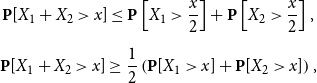 \begin{eqnarray*} {\mathbf{P}}[X_1+X_2\gt x] \leq {\mathbf{P}}\left [X_1\gt \dfrac x2 \right ]+ {\mathbf{P}}\left [X_2 \gt \dfrac x2\right ],\\[2mm] {\mathbf{P}}[X_1+X_2\gt x] \geq \dfrac 12 \left ({\mathbf{P}}[X_1\gt x]+ {\mathbf{P}}[X_2 \gt x]\right ), \end{eqnarray*}
we find
 \begin{eqnarray*} {\mathbf{P}}[X_1+X_2\gt x,\,Y_1+Y_2\gt y] &\leq & {\mathbf{P}}[X_1\gt x/2,\,Y_1+Y_2\gt y]+ {\mathbf{P}}[X_2\gt x/2,\,Y_1+Y_2\gt y]\\[2mm] &\leq & {\mathbf{P}}\left [X_1\gt \dfrac x2,\,Y_1\gt \dfrac y2\right ]+ {\mathbf{P}}\left [X_1\gt \dfrac x2,\,Y_2\gt \dfrac y2\right ]\\[2mm] &&+{\mathbf{P}}\left [X_2\gt \dfrac x2,\,Y_1\gt \dfrac y2\right ]+{\mathbf{P}}\left [X_2\gt \dfrac x2,\,Y_2\gt \dfrac y2\right ], \end{eqnarray*}
hence
 \begin{eqnarray} {\mathbf{P}}[X_1+X_2\gt x,\,Y_1+Y_2\gt y]\leq \sum _{k=1}^2 \sum _{l=1}^2 {\mathbf{P}}\left [X_k\gt \dfrac x2,\,Y_l\gt \dfrac y2\right ]. \end{eqnarray}
From the other side
 \begin{eqnarray*} &&{\mathbf{P}}[X_1+X_2\gt x,\,Y_1+Y_2\gt y] \geq \dfrac {{\mathbf{P}}[X_1\gt x,\,Y_1+Y_2\gt y]+ {\mathbf{P}}[X_2\gt x,\,Y_1+Y_2\gt y]}2 \\[2mm] &&\geq \dfrac {{\mathbf{P}}[X_1\gt x,\,Y_1\gt y]+ {\mathbf{P}}[X_1\gt x,\,Y_2\gt y]+{\mathbf{P}}[X_2\gt x,\,Y_1\gt y]+{\mathbf{P}}[X_2\gt x,\,Y_2\gt y]}4, \end{eqnarray*}
from where we obtain
 \begin{eqnarray} {\mathbf{P}}[X_1+X_2\gt x,\,Y_1+Y_2\gt y]\geq \dfrac 14\,\sum _{k=1}^2 \sum _{l=1}^2 {\mathbf{P}}[X_k\gt x,\,Y_l\gt y]. \end{eqnarray}
Therefore by relations (3.1) and (3.2), due to $(X_k,\,Y_l) \in \mathcal{D}^{(2)}$
for any
$(X_k,\,Y_l) \in \mathcal{D}^{(2)}$
for any $k,\,l\,\in \{1,\,2\}$
, and
$k,\,l\,\in \{1,\,2\}$
, and $\textbf { b}=(b_1,\,b_2) \in (0,\,1)^2$
, we find
$\textbf { b}=(b_1,\,b_2) \in (0,\,1)^2$
, we find
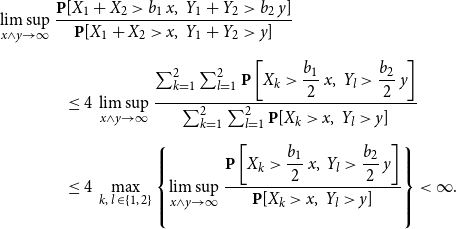 \begin{eqnarray*} &&\limsup _{x\wedge y \to \infty }\dfrac {{\mathbf{P}}[X_1+X_2\gt b_1\,x,\,Y_1+Y_2\gt b_2\,y]}{{\mathbf{P}}[X_1+X_2\gt x,\,Y_1+Y_2\gt y]}\\[2mm] &&\qquad \qquad \leq 4\,\limsup _{x\wedge y \to \infty }\dfrac {\sum _{k=1}^2 \sum _{l=1}^2 {\mathbf{P}}\left [X_k\gt \dfrac {b_1}2\,x,\,Y_l\gt \dfrac {b_2}2\,y\right ]}{\sum _{k=1}^2 \sum _{l=1}^2 {\mathbf{P}}[X_k\gt x,\,Y_l\gt y]}\\[2mm] &&\qquad \qquad \leq 4\,\max _{k,\,l\,\in \{1,\,2\}}\left \{ \limsup _{x\wedge y \to \infty }\dfrac {{\mathbf{P}}\left [X_k\gt \dfrac {b_1}2\,x,\,Y_l\gt \dfrac {b_2}2\,y\right ]}{{\mathbf{P}}[X_k\gt x,\,Y_l\gt y]}\right \} \lt \infty . \end{eqnarray*}
So we conclude $(X_1+X_2,\,Y_1+Y_2) \in \mathcal{D}^{(2)}$
.
$(X_1+X_2,\,Y_1+Y_2) \in \mathcal{D}^{(2)}$
.
Remark 3.1.
Let us notice here that the vectors $(X_k,\,Y_l)$
for
$(X_k,\,Y_l)$
for $k,\,l =1,\,2$
are NOT necessarily under the same dependence structure; for example, we can have
$k,\,l =1,\,2$
are NOT necessarily under the same dependence structure; for example, we can have $(X_1,\,Y_1)$
with independent components and
$(X_1,\,Y_1)$
with independent components and $(X_1,\,Y_2)$
to be
$(X_1,\,Y_2)$
to be $SAI$
, with
$SAI$
, with $C\gt 0$
. A case where we see that
$C\gt 0$
. A case where we see that $(X_k,\,Y_l) \in \mathcal{D}^{(2)}$
for any
$(X_k,\,Y_l) \in \mathcal{D}^{(2)}$
for any $k,\,l =1,\,2$
is the following. Let
$k,\,l =1,\,2$
is the following. Let $X_1,\,X_2,\,Y_1,\,Y_2$
with distributions from class
$X_1,\,X_2,\,Y_1,\,Y_2$
with distributions from class $\mathcal{D}$
and also the
$\mathcal{D}$
and also the $X_1,\,X_2$
and the
$X_1,\,X_2$
and the $Y_1,\,Y_2$
are arbitrarily dependent. If
$Y_1,\,Y_2$
are arbitrarily dependent. If $(X_k,\,Y_l)$
are
$(X_k,\,Y_l)$
are $SAI$
with
$SAI$
with $C_{k,l}\gt 0$
, not necessarily the same for each pair, then
$C_{k,l}\gt 0$
, not necessarily the same for each pair, then $(X_k,\,Y_l)\in \mathcal{D}^{(2)}$
for any
$(X_k,\,Y_l)\in \mathcal{D}^{(2)}$
for any $k,\,l =1,\,2$
.
$k,\,l =1,\,2$
.
Now we are ready to define the max-sum equivalence in two dimensions.
Definition 3.2.
Let $X_1,\,X_2,\,Y_1,\,Y_2$
be random variables. Then we say that they are joint max-sum equivalent if
$X_1,\,X_2,\,Y_1,\,Y_2$
be random variables. Then we say that they are joint max-sum equivalent if
 \begin{eqnarray*} {\mathbf{P}}[X_1+X_2\gt x,\,Y_1+Y_2\gt y]\sim \sum _{k=1}^2 \sum _{l=1}^2 {\mathbf{P}}[X_k\gt x,\,Y_l\gt y], \end{eqnarray*}
as $x\wedge y \to \infty$
.
$x\wedge y \to \infty$
.
This kind of asymptotic relation will be established for classes $(\mathcal{D}\cap \mathcal{L})^{(2)}$
and
$(\mathcal{D}\cap \mathcal{L})^{(2)}$
and $\mathcal{C}^{(2)}$
, under the assumption of some specific dependence structure.
$\mathcal{C}^{(2)}$
, under the assumption of some specific dependence structure.
4. Joint behavior of random sums
In one dimension, the following asymptotic relation attracted attention:
 \begin{eqnarray} {\mathbf{P}}\left [ \sum _{i=1}^n X_i\gt x \right ]\sim \sum _{i=1}^n {\mathbf{P}}[X_i\gt x], \end{eqnarray}
as $x\to \infty$
. Therefore, we study the behavior of both the maximum
$x\to \infty$
. Therefore, we study the behavior of both the maximum $\bigvee _{i=1}^n X_i$
and the maximum of sums
$\bigvee _{i=1}^n X_i$
and the maximum of sums
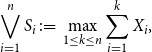 \begin{eqnarray*} \bigvee _{i=1}^n S_i\,:\!=\,\max _{1\leq k \leq n}\sum _{i=1}^k X_i, \end{eqnarray*}
for some distributions and correspondingly with some dependence structures to examine if it holds
 \begin{eqnarray} {\mathbf{P}}\left [\sum _{i=1}^n X_i\gt x\right ] \sim {\mathbf{P}}\left [ \bigvee _{i=1}^n X_i\gt x \right ]\sim {\mathbf{P}}\left [ \bigvee _{i=1}^n S_i\gt x \right ]\sim \sum _{i=1}^n{\mathbf{P}}\left [ X_i\gt x \right ], \end{eqnarray}
as $x\to \infty$
. Relations (4.1) and (4.2) have been studied extensively; see, for example, in Geluk and Ng (Reference Geluk and Ng2006), Geluk and Tang (Reference Geluk and Tang2009), Ng et al. (Reference Ng, Tang and Yang2002), and Jiang et al. (Reference Jiang, Gao and Wang2014). A similar interest has been appeared for weighted sums of the form
$x\to \infty$
. Relations (4.1) and (4.2) have been studied extensively; see, for example, in Geluk and Ng (Reference Geluk and Ng2006), Geluk and Tang (Reference Geluk and Tang2009), Ng et al. (Reference Ng, Tang and Yang2002), and Jiang et al. (Reference Jiang, Gao and Wang2014). A similar interest has been appeared for weighted sums of the form
 \begin{eqnarray*} S_n^{\Theta } \,:\!=\, \sum _{i=1}^n \Theta _i\,X_i,\qquad \bigvee _{i=1}^n S_i^{\Theta }\,:\!=\,\max _{1\leq k \leq n} \sum _{i=1}^k \Theta _i\,X_i, \end{eqnarray*}
and for the circumstances when they satisfy relations (4.1) and (4.2), see, for example, Tang and Yuan (Reference Tang and Yuan2014), Tang and Tsitsiashvili (Reference Tang and Tsitsiashvili2003), Yang et al. (Reference Yang, Leipus and Šiaulys2012), and Zhang et al. (Reference Zhang, Shen and Weng2009).
In this section, we study relation (4.2) in two dimensions. This can be achieved for the class $(\mathcal{D}\cap \mathcal{L})^{(2)}$
under generalized tail asymptotic independence (GTAI). Although the univariate randomly weighted sums are well studied, this is not true for the multivariate case.
$(\mathcal{D}\cap \mathcal{L})^{(2)}$
under generalized tail asymptotic independence (GTAI). Although the univariate randomly weighted sums are well studied, this is not true for the multivariate case.
Let us mention some papers involved in the asymptotic behavior of the joint-tail probability
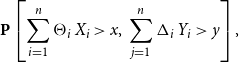 \begin{eqnarray*} {\mathbf{P}}\left [ \sum _{i=1}^n \Theta _i\,X_i \gt x,\;\sum _{j=1}^n \Delta _i\,Y_i \gt y \right ], \end{eqnarray*}
as, for example, Chen and Yang (Reference Chen and Yang2019), Li (Reference Li2018), Shen and Du (Reference Shen and Du2023), Shen et al. (Reference Shen, Ge and Fu2020), and Yang et al. (Reference Yang, Chen and Yuen2024).
We restrict ourselves at the moment in the study of non-weighted random sums of the following form:
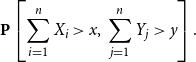 \begin{eqnarray*} {\mathbf{P}}\left [ \sum _{i=1}^n X_i\gt x,\;\sum _{j=1}^n Y_j \gt y \right ]. \end{eqnarray*}
Let us remind that, as before, the $X_i$
,
$X_i$
, $Y_j$
follow distributions with infinite right endpoint.
$Y_j$
follow distributions with infinite right endpoint.
We note that, in almost all existing papers, the dependence structure for the main variables $X_i$
,
$X_i$
, $Y_j$
is either of the form:
$Y_j$
is either of the form: $\{(X_i,\,Y_i),\;i \in {\mathbb{N}}\}$
independent random vectors, and there exists some dependence structure in each random pair, or there exists dependence among
$\{(X_i,\,Y_i),\;i \in {\mathbb{N}}\}$
independent random vectors, and there exists some dependence structure in each random pair, or there exists dependence among $X_1,\,\ldots, \,X_n$
and
$X_1,\,\ldots, \,X_n$
and $Y_1,\,\ldots, \,Y_n$
, but the
$Y_1,\,\ldots, \,Y_n$
, but the $X_i$
and
$X_i$
and $Y_j$
are independent for any
$Y_j$
are independent for any $i,\,j$
. Using GTAI, introduced in Konstantinides and Passalidis (Reference Konstantinides and Passalidis2024), both dependence structures are simultaneously permitted. GTAI is defined as follows. Let us consider two sequences of random variables
$i,\,j$
. Using GTAI, introduced in Konstantinides and Passalidis (Reference Konstantinides and Passalidis2024), both dependence structures are simultaneously permitted. GTAI is defined as follows. Let us consider two sequences of random variables $\{X_n,\;n\in {\mathbb{N}}\},\; \{Y_m,\;m\in {\mathbb{N}}\}$
. We say that the random variables
$\{X_n,\;n\in {\mathbb{N}}\},\; \{Y_m,\;m\in {\mathbb{N}}\}$
. We say that the random variables $X_1,\,\ldots, \,X_n,\,Y_1,\,\ldots, \,Y_m$
follow the GTAI, if
$X_1,\,\ldots, \,X_n,\,Y_1,\,\ldots, \,Y_m$
follow the GTAI, if
-
(1) It holds
for any
\begin{eqnarray*} \lim _{\min \{x_i,\,x_k,\,y_j\} \to \infty } {\mathbf{P}}[|X_i|\gt x_i\;|\;X_k\gt x_k,\, Y_j \gt y_j]=0, \end{eqnarray*}
$1\leq i \neq k \leq n$
,
$j=1,\,\ldots, \,m$
.
-
(2) It holds
for any
\begin{eqnarray*} \lim _{\min \{x_i,\,y_k,\,y_j\} \to \infty } {\mathbf{P}}[|Y_j|\gt y_j\;|\;X_i\gt x_i,\, Y_k \gt y_k]=0, \end{eqnarray*}
$1\leq j \neq k \leq m$
,
$i=1,\,\ldots, \,n$
.


The aim of this dependence structure is to model the dependence both within each sequence of random variables and the interdependence between the sequences. We have to notice that if the $X_i$
and
$X_i$
and $Y_j$
are independent for any
$Y_j$
are independent for any $i,\,j$
, then each sequence of random variables follows tail asymptotic dependence (TAI) (see definition below); however, in any other case, the GTAI does not restrict each sequence to TAI, but in a more general form of dependence.
$i,\,j$
, then each sequence of random variables follows tail asymptotic dependence (TAI) (see definition below); however, in any other case, the GTAI does not restrict each sequence to TAI, but in a more general form of dependence.
It is easy to find that GTAI contains the case when $X_1,\,\ldots, \,X_n$
are independent or when
$X_1,\,\ldots, \,X_n$
are independent or when $Y_1,\,\ldots, \,Y_n$
are independent or both. Even more, this dependence structure indicates that the probability to happen three extreme events is negligible with respect to the probability to happen two extreme events, one in each sequence, and in some sense,
$Y_1,\,\ldots, \,Y_n$
are independent or both. Even more, this dependence structure indicates that the probability to happen three extreme events is negligible with respect to the probability to happen two extreme events, one in each sequence, and in some sense, $GTAI$
belongs to the dependencies of second-order asymptotic independence.
$GTAI$
belongs to the dependencies of second-order asymptotic independence.
In most of our results, we use the TAI dependence structure as an extra assumption, which characterizes the dependence of the terms of each sequence. This dependence structure was introduced by Geluk and Tang (Reference Geluk and Tang2009). We say that $X_1,\,\ldots, \,X_n$
are tail asymptotic independent, symbolically
$X_1,\,\ldots, \,X_n$
are tail asymptotic independent, symbolically $TAI$
(and sometimes named strong quasi-asymptotically independent), if for any pair
$TAI$
(and sometimes named strong quasi-asymptotically independent), if for any pair $i,\,j =1,\,\ldots, \,n$
, with
$i,\,j =1,\,\ldots, \,n$
, with $i \neq j$
, it holds the limit
$i \neq j$
, it holds the limit
 \begin{eqnarray*} \lim _{x_i \wedge x_j \to \infty }{\mathbf{P}}[ |X_i| \gt x_i\;|\; X_j \gt x_j] = 0. \end{eqnarray*}
The next result provides an asymptotic relation for the maximum of two sequences of random variables under the GTAI, WITHOUT imposing any assumption on the distributions of $ X_1,\,\ldots, \,X_n,\,Y_1,\,\ldots, \,Y_m$
(except the infinite right point).
$ X_1,\,\ldots, \,X_n,\,Y_1,\,\ldots, \,Y_m$
(except the infinite right point).
Theorem 4.1.
If $X_1,\,\ldots, \,X_n$
are random variables with distributions
$X_1,\,\ldots, \,X_n$
are random variables with distributions $F_1,\,\ldots, \,F_n$
, respectively, and
$F_1,\,\ldots, \,F_n$
, respectively, and $Y_1,\,\ldots, \,Y_m$
are random variables with distributions
$Y_1,\,\ldots, \,Y_m$
are random variables with distributions $G_1,\,\ldots, \,G_m$
and
$G_1,\,\ldots, \,G_m$
and $X_1,\,\ldots, \,X_n$
,
$X_1,\,\ldots, \,X_n$
, $Y_1,\,\ldots, \,Y_m$
are GTAI, it holds
$Y_1,\,\ldots, \,Y_m$
are GTAI, it holds
 \begin{eqnarray*} {\mathbf{P}}\left [\bigvee _{i=1}^n X_i\gt x,\;\bigvee _{j=1}^m Y_j\gt y \right ]\sim \sum _{i=1}^n \sum _{j=1}^m {\mathbf{P}}\left [ X_i\gt x,\; Y_j\gt y \right ], \end{eqnarray*}
as $x\wedge y \to \infty$
.
$x\wedge y \to \infty$
.
Proof. For $x\gt 0,\,y\gt 0$
holds
$x\gt 0,\,y\gt 0$
holds
 \begin{eqnarray} {\mathbf{P}}\left [\bigvee _{i=1}^n X_i\gt x,\;\bigvee _{j=1}^m Y_j\gt y \right ]\leq \sum _{i=1}^n \sum _{j=1}^m {\mathbf{P}}\left [ X_i\gt x,\; Y_j\gt y \right ]. \end{eqnarray}
Further for the lower bound, we use Bonferroni’s inequality
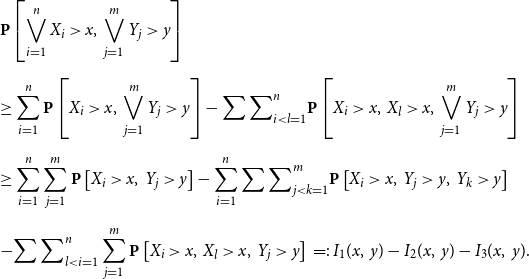 \begin{eqnarray*} &&{\mathbf{P}}\left [\bigvee _{i=1}^n X_i\gt x,\;\bigvee _{j=1}^m Y_j\gt y \right ] \\[2mm] &&\geq \sum _{i=1}^n {\mathbf{P}}\left [ X_i\gt x,\; \bigvee _{j=1}^m Y_j\gt y \right ]- {\sum \sum }_{ i\lt l =1} ^{n} {\mathbf{P}}\left [ X_i\gt x,\;X_l\gt x,\: \bigvee _{j=1}^m Y_j\gt y \right ] \\[2mm] &&\geq \sum _{i=1}^n \sum _{j=1}^m {\mathbf{P}}\left [ X_i\gt x,\; Y_j\gt y \right ]- \sum _{i=1}^n {\sum \sum }_{j\lt k =1}^m {\mathbf{P}}\left [ X_i\gt x,\;Y_j\gt y,\; Y_k\gt y \right ]\\[2mm] &&-{\sum \sum }_{l\lt i=1}^n \sum _{j=1}^m {\mathbf{P}}\left [ X_i\gt x,\;X_l\gt x,\; Y_j\gt y \right ]\,=\!:\, I_1(x,\,y) - I_2(x,\,y) - I_3(x,\,y). \end{eqnarray*}
For $I_2(x,\,y)$
, we obtain
$I_2(x,\,y)$
, we obtain
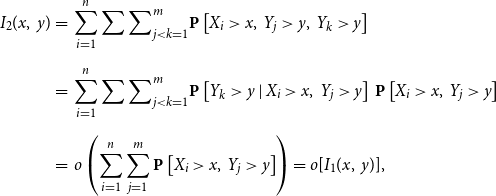 \begin{eqnarray*} I_2(x,\,y)&=&\sum _{i=1}^n {\sum \sum }_{j\lt k =1}^m {\mathbf{P}}\left [ X_i\gt x,\;Y_j\gt y,\; Y_k\gt y \right ]\\[2mm] &=&\sum _{i=1}^n {\sum \sum }_{j \lt k=1}^m {\mathbf{P}}\left [ Y_k\gt y\;|\; X_i\gt x,\;Y_j\gt y \right ]\, {\mathbf{P}}\left [ X_i\gt x,\;Y_j\gt y\right ]\\[2mm] &=&o\left ( \sum _{i=1}^n \sum _{j=1}^m {\mathbf{P}}\left [ X_i\gt x,\;Y_j\gt y \right ]\right )=o[I_1(x,\,y)], \end{eqnarray*}
as $x\wedge y \to \infty$
, where in the last step, we use the GTAI property. In a similar way, we can find
$x\wedge y \to \infty$
, where in the last step, we use the GTAI property. In a similar way, we can find
 \begin{eqnarray*} I_3(x,\,y)=o[I_1(x,\,y)], \end{eqnarray*}
as $x\wedge y \to \infty$
. Hence we conclude
$x\wedge y \to \infty$
. Hence we conclude
 \begin{eqnarray} {\mathbf{P}}\left [\bigvee _{i=1}^n X_i\gt x,\;\bigvee _{j=1}^m Y_j\gt y \right ]\gtrsim \sum _{i=1}^n \sum _{j=1}^m {\mathbf{P}}\left [ X_i\gt x,\; Y_j\gt y \right ], \end{eqnarray}
as $x\wedge y \to \infty$
. Now, from relations (4.3) and (4.4), we have the result.
$x\wedge y \to \infty$
. Now, from relations (4.3) and (4.4), we have the result.
Before next theorem, we need some preliminary lemmas. The next lemma provides an important property of the GTAI structure, presenting itself as closure property with respect to sum.
Lemma 4.1.
If $X_1,\,\ldots, \,X_n,\,Y_1,\,\ldots, \,Y_m$
follow the GTAI, then holds
$X_1,\,\ldots, \,X_n,\,Y_1,\,\ldots, \,Y_m$
follow the GTAI, then holds
 \begin{eqnarray} \lim _{\min \{x_I,\,x_k,\,y_j\} \to \infty } {\mathbf{P}}\left [\left | \sum _{i \in I} X_i \right |\gt x_I\;\Big |\;X_k\gt x_k,\; Y_j\gt y_j \right ] =0, \end{eqnarray}
for $I\subsetneq \{1,\,\ldots, \,n\}$
and
$I\subsetneq \{1,\,\ldots, \,n\}$
and $k \in \{1,\,\ldots, \,n\} \setminus I$
,
$k \in \{1,\,\ldots, \,n\} \setminus I$
, $j=1,\,\ldots, \,m$
. Similarly holds
$j=1,\,\ldots, \,m$
. Similarly holds
 \begin{eqnarray} \lim _{\min \{x_i,\,y_k,\,y_J\} \to \infty } {\mathbf{P}}\left [\left | \sum _{j \in J} Y_j \right |\gt y_J\;\Big |\;Y_k\gt y_k,\; X_i\gt x_i \right ] =0, \end{eqnarray}
for $J\subsetneq \{1,\,\ldots, \,m\}$
and
$J\subsetneq \{1,\,\ldots, \,m\}$
and $k \in \{1,\,\ldots, \,m\} \setminus J$
,
$k \in \{1,\,\ldots, \,m\} \setminus J$
, $i=1,\,\ldots, \,n$
.
$i=1,\,\ldots, \,n$
.
Proof. It is enough to show relation (4.5) as relation (4.6) follows by similar way. Indeed, we observe that
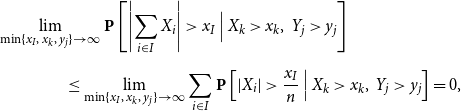 \begin{eqnarray*} &&\lim _{\min \{x_I,\,x_k,\,y_j\} \to \infty } {\mathbf{P}}\left [\left | \sum _{i \in I} X_i \right |\gt x_I\;\Big |\;X_k\gt x_k,\; Y_j\gt y_j \right ] \\[2mm] &&\qquad \qquad \leq \lim _{\min \{x_I,\,x_k,\,y_j\} \to \infty } \sum _{i \in I}{\mathbf{P}}\left [\left | X_i \right |\gt \dfrac {x_I}n\;\Big |\;X_k\gt x_k,\; Y_j\gt y_j \right ]=0, \end{eqnarray*}
where the last step follows from $GTAI$
property.
$GTAI$
property.
In most of the following results, we assume that the random variables $X_1,\,\ldots, \,X_n$
,
$X_1,\,\ldots, \,X_n$
, $Y_1,\,\ldots, \,Y_n$
are
$Y_1,\,\ldots, \,Y_n$
are $GTAI$
and follow distributions from some class
$GTAI$
and follow distributions from some class $ \mathcal{B} \in \{ \mathcal{C},\, \mathcal{D}\cap \mathcal{L},\, \mathcal{L}\}$
, and at the same time, it holds
$ \mathcal{B} \in \{ \mathcal{C},\, \mathcal{D}\cap \mathcal{L},\, \mathcal{L}\}$
, and at the same time, it holds $(X_k,\,Y_l) \in \mathcal{B}^{(2)}$
, for any
$(X_k,\,Y_l) \in \mathcal{B}^{(2)}$
, for any $k,\,l \in \{1,\,\ldots, \,n\}$
. Following a referee’s advice, we provide some examples to show that
$k,\,l \in \{1,\,\ldots, \,n\}$
. Following a referee’s advice, we provide some examples to show that $GTAI$
and
$GTAI$
and $(X_k,\,Y_l) \in \mathcal{B}^{(2)}$
are possible simultaneously. For the sake of simplicity, we consider only the case
$(X_k,\,Y_l) \in \mathcal{B}^{(2)}$
are possible simultaneously. For the sake of simplicity, we consider only the case $n=2$
with non-negative random variables.
$n=2$
with non-negative random variables.
Example 4.1.
Let $X_1,\,X_2,\,Y_1,\,Y_2$
be non-negative random variables with distributions from class
$X_1,\,X_2,\,Y_1,\,Y_2$
be non-negative random variables with distributions from class $ \mathcal{B} \in \{ \mathcal{C},\, \mathcal{D}\cap \mathcal{L},\, \mathcal{L}\}$
. Further, we suppose that the
$ \mathcal{B} \in \{ \mathcal{C},\, \mathcal{D}\cap \mathcal{L},\, \mathcal{L}\}$
. Further, we suppose that the $X_1,\,X_2$
are
$X_1,\,X_2$
are $TAI$
, the
$TAI$
, the $Y_1,\,Y_2$
are also
$Y_1,\,Y_2$
are also $TAI$
, while the
$TAI$
, while the $(X_1,\,X_2)$
and
$(X_1,\,X_2)$
and $(Y_1,\,Y_2)$
are independent random pairs. Then, we directly find that
$(Y_1,\,Y_2)$
are independent random pairs. Then, we directly find that $(X_k,\,Y_l) \in \mathcal{B}^{(2)}$
, and additionally by
$(X_k,\,Y_l) \in \mathcal{B}^{(2)}$
, and additionally by $TAI$
, we obtain that for any
$TAI$
, we obtain that for any $\varepsilon \gt 0$
, there exists some
$\varepsilon \gt 0$
, there exists some $x_0\gt 0$
, such that for any
$x_0\gt 0$
, such that for any $1\leq i \neq k \leq 2$
, it holds
$1\leq i \neq k \leq 2$
, it holds ${\mathbf{P}}[X_i\gt x_i\;|\;X_k \gt x_k] \lt \varepsilon$
, for any
${\mathbf{P}}[X_i\gt x_i\;|\;X_k \gt x_k] \lt \varepsilon$
, for any $x_i\wedge x_k \geq x_0$
. Hence for any
$x_i\wedge x_k \geq x_0$
. Hence for any $1\leq i \neq k \leq 2$
,
$1\leq i \neq k \leq 2$
, $j=1,\,2$
, we conclude
$j=1,\,2$
, we conclude
 \begin{eqnarray*} {\mathbf{P}}\left [X_i\gt x_i,\; X_k\gt x_k, \;Y_j\gt y_j\right ]&=& {\mathbf{P}}\left [X_i\gt x_i,\; X_k\gt x_k\right ]\,{\mathbf{P}}\left [Y_j\gt y_j\right ] \\[2mm] &\lt & \varepsilon \,{\mathbf{P}}\left [X_k\gt x_k\right ]\,{\mathbf{P}}\left [Y_j\gt y_j\right ] = \varepsilon \,{\mathbf{P}}\left [X_k\gt x_k,\,Y_j\gt y_j\right ], \end{eqnarray*}
for any $x_i\wedge x_k \geq x_0$
. From the last relation, because of the arbitrary choice of
$x_i\wedge x_k \geq x_0$
. From the last relation, because of the arbitrary choice of $\varepsilon$
, we get
$\varepsilon$
, we get ${\mathbf{P}}\left [X_i\gt x_i\;|\; X_k\gt x_k, \;Y_j\gt y_j\right ] \to 0$
, as
${\mathbf{P}}\left [X_i\gt x_i\;|\; X_k\gt x_k, \;Y_j\gt y_j\right ] \to 0$
, as $x_i\wedge x_k \wedge y_j \to \infty$
.
$x_i\wedge x_k \wedge y_j \to \infty$
.
Similarly, by symmetry, we obtain for any $1\leq j \neq k \leq 2$
,
$1\leq j \neq k \leq 2$
, $i=1,\,2$
the convergence
$i=1,\,2$
the convergence ${\mathbf{P}}\left [Y_j\gt y_j\;|\; X_i\gt x_i, \;Y_k\gt y_k\right ] \to 0$
, as
${\mathbf{P}}\left [Y_j\gt y_j\;|\; X_i\gt x_i, \;Y_k\gt y_k\right ] \to 0$
, as $x_i\wedge y_k \wedge y_j \to \infty$
. Hence, the
$x_i\wedge y_k \wedge y_j \to \infty$
. Hence, the $X_1,\,X_2,\,Y_1,\,Y_2$
satisfy the
$X_1,\,X_2,\,Y_1,\,Y_2$
satisfy the $GTAI$
.
$GTAI$
.
Example 4.2.
Let $X_1,\,X_2,\,Y_1,\,Y_2$
be non-negative random variables with distributions from class
$X_1,\,X_2,\,Y_1,\,Y_2$
be non-negative random variables with distributions from class $ \mathcal{B} \in \{ \mathcal{C},\, \mathcal{D}\cap \mathcal{L},\, \mathcal{L}\}$
. We suppose that
$ \mathcal{B} \in \{ \mathcal{C},\, \mathcal{D}\cap \mathcal{L},\, \mathcal{L}\}$
. We suppose that $Z_i,\,Z_j,\,Z_k \in \{X_1,\,X_2,\,Y_1,\,Y_2\}$
with
$Z_i,\,Z_j,\,Z_k \in \{X_1,\,X_2,\,Y_1,\,Y_2\}$
with $Z_i \neq Z_j \neq Z_k$
and
$Z_i \neq Z_j \neq Z_k$
and $z_i,\,z_j,\,z_k \in \{x_1,\,x_2,\,y_1,\,y_2\}$
, where the
$z_i,\,z_j,\,z_k \in \{x_1,\,x_2,\,y_1,\,y_2\}$
, where the $z_i,\,z_j,\,z_k$
are allowed to be equal. Let us assume the
$z_i,\,z_j,\,z_k$
are allowed to be equal. Let us assume the $SAI$
property for any duo or trio of them, namely
$SAI$
property for any duo or trio of them, namely
 \begin{eqnarray*} {\mathbf{P}}[Z_i\gt z_i,\;Z_j\gt z_j] \sim C_{ij}\,{\mathbf{P}}[Z_i\gt z_i]\,{\mathbf{P}}[Z_j\gt z_j], \end{eqnarray*}
as $z_i\wedge z_j \to \infty$
, with
$z_i\wedge z_j \to \infty$
, with $C_{ij} \gt 0$
and
$C_{ij} \gt 0$
and
 \begin{eqnarray*} {\mathbf{P}}[Z_i\gt z_i,\;Z_j\gt z_j,\;Z_k\gt z_k] \sim C_{ijk}\,{\mathbf{P}}[Z_i\gt z_i]\,{\mathbf{P}}[Z_j\gt z_j]\,{\mathbf{P}}[Z_k\gt z_k], \end{eqnarray*}
as $z_i\wedge z_j\wedge z_k \to \infty$
, with
$z_i\wedge z_j\wedge z_k \to \infty$
, with $C_{ijk} \gt 0$
. Then, by
$C_{ijk} \gt 0$
. Then, by $SAI$
in duo mode, we obtain
$SAI$
in duo mode, we obtain $(X_k,\,Y_l) \in \mathcal{B}^{(2)}$
, for
$(X_k,\,Y_l) \in \mathcal{B}^{(2)}$
, for $k,\,l \in \{1,\,2\}$
(see Example
2.2
, for the case of class
$k,\,l \in \{1,\,2\}$
(see Example
2.2
, for the case of class $\mathcal{L}$
). Next, by
$\mathcal{L}$
). Next, by $SAI$
in trio mode, we obtain directly the
$SAI$
in trio mode, we obtain directly the $GTAI$
.
$GTAI$
.
From here on, we study only the case $n=m$
. In the next lemma, we find the lower asymptotic bound of the joint tail of the random sums
$n=m$
. In the next lemma, we find the lower asymptotic bound of the joint tail of the random sums
 \begin{eqnarray*} S_n \,:\!=\, \sum _{k=1}^n X_k,\qquad \qquad T_n \,:\!=\, \sum _{l=1}^n Y_l, \end{eqnarray*}
when the summands follow distributions with long tails and the $\mathcal{L}^{(2)}$
property is true for any pair of the summands distribution. A similar result, for the unidimensional case, can be found in Geluk and Tang (Reference Geluk and Tang2009), where the dependence structure is TAI. In the next result, we find generalization to two dimensions and furthermore the GTAI assumption. Next, we introduce the notations
$\mathcal{L}^{(2)}$
property is true for any pair of the summands distribution. A similar result, for the unidimensional case, can be found in Geluk and Tang (Reference Geluk and Tang2009), where the dependence structure is TAI. In the next result, we find generalization to two dimensions and furthermore the GTAI assumption. Next, we introduce the notations
 \begin{eqnarray*} S_{n,k}\,:\!=\,S_n- X_k,\qquad T_{n,l}\,:\!=\,T_n- Y_l, \end{eqnarray*}
for some $k\in \{1,\,\ldots, \,n\}$
and some
$k\in \{1,\,\ldots, \,n\}$
and some $l\in \{1,\,\ldots, \,n\}$
. In what follows, we can choose
$l\in \{1,\,\ldots, \,n\}$
. In what follows, we can choose
 \begin{eqnarray} a=(a_F,\,a_G)\,:\!=\,\left (\min _{1\leq k \leq n}a_{F_k},\;\min _{1\leq l \leq n} a_{G_l} \right ), \end{eqnarray}
namely, the minimum of all the joint insensitivity functions, which means that the function $a(\cdot )$
is insensitive for all the distribution pairs
$a(\cdot )$
is insensitive for all the distribution pairs $(F_k,\,G_l)$
, for
$(F_k,\,G_l)$
, for $k,\,l \in \{1,\,\ldots, \,n\}$
. In what follows, for the sake of simplicity, the function
$k,\,l \in \{1,\,\ldots, \,n\}$
. In what follows, for the sake of simplicity, the function $a(\cdot )$
is understood either as
$a(\cdot )$
is understood either as $a_{F}$
for the
$a_{F}$
for the $X_k$
or as
$X_k$
or as $a_{G}$
for the
$a_{G}$
for the $Y_l$
.
$Y_l$
.
Lemma 4.2.
Let $X_1,\,\ldots, \,X_n,\,Y_1,\,\ldots, \,Y_n$
be random variables with distributions
$X_1,\,\ldots, \,X_n,\,Y_1,\,\ldots, \,Y_n$
be random variables with distributions $F_1,\,\ldots, \,F_n$
,
$F_1,\,\ldots, \,F_n$
, $G_1,\,\ldots, \,G_n$
from class
$G_1,\,\ldots, \,G_n$
from class $\mathcal{L}$
, respectively. We also assume that
$\mathcal{L}$
, respectively. We also assume that $X_1,\,\ldots, \,X_n,\,Y_1,\,\ldots, \,Y_n$
satisfy the GTAI property and it holds
$X_1,\,\ldots, \,X_n,\,Y_1,\,\ldots, \,Y_n$
satisfy the GTAI property and it holds
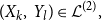 \begin{eqnarray*} (X_k,\,Y_l)\in \mathcal{L}^{(2)}, \end{eqnarray*}
for any $k,\,l \in \{1,\,\ldots, \,n\}$
. Then it holds
$k,\,l \in \{1,\,\ldots, \,n\}$
. Then it holds
 \begin{eqnarray*} {\mathbf{P}}\left [S_n\gt x,\;T_n\gt y \right ] \gtrsim \sum _{k=1}^n \sum _{l=1}^n {\mathbf{P}}\left [ X_k\gt x,\; Y_l\gt y \right ], \end{eqnarray*}
as $x\wedge y \to \infty$
.
$x\wedge y \to \infty$
.
Proof. We choose as $a(\cdot )$
a function with joint insensitivity property for any random pair
$a(\cdot )$
a function with joint insensitivity property for any random pair $(X_k,\,Y_l)$
for any
$(X_k,\,Y_l)$
for any $k,\,l \in \{1,\,\ldots, \,n\}$
. A possible choice of this function is by (4.7). Next, we apply twice Bonferroni’s inequality to obtain
$k,\,l \in \{1,\,\ldots, \,n\}$
. A possible choice of this function is by (4.7). Next, we apply twice Bonferroni’s inequality to obtain
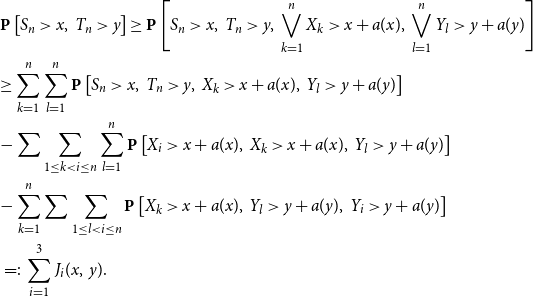 \begin{eqnarray} &&{\mathbf{P}}\left [S_n\gt x,\;T_n\gt y \right ] \geq {\mathbf{P}}\left [S_n\gt x,\;T_n\gt y,\;\bigvee _{k=1}^n X_k\gt x+a(x),\; \bigvee _{l=1}^n Y_l\gt y+a(y) \right ]\nonumber \\ &&\geq \sum _{k=1}^n \sum _{l=1}^n {\mathbf{P}}\left [S_n\gt x,\;T_n\gt y,\; X_k\gt x+a(x),\; Y_l\gt y+a(y) \right ] \nonumber \\ &&- \sum \sum _{1\leq k \lt i \leq n} \sum _{l=1}^n {\mathbf{P}}\left [X_i\gt x+a(x),\; X_k\gt x+a(x),\; Y_l\gt y+a(y) \right ] \nonumber \\ &&- \sum _{k=1}^n \sum \sum _{1\leq l \lt i \leq n} {\mathbf{P}}\left [ X_k\gt x+a(x),\; Y_l\gt y+a(y),\;Y_i\gt y+a(y) \right ] \nonumber \\ &&\,=\!:\,\sum _{i=1}^3 J_i(x,\,y). \end{eqnarray}
Now for each term of $J_2(x,\,y)$
, we find
$J_2(x,\,y)$
, we find
 \begin{eqnarray*} && {\mathbf{P}}\left [X_i\gt x+a(x),\; X_k\gt x+a(x),\; Y_l\gt y+a(y) \right ] \\[2mm] &&={\mathbf{P}}\left [ X_i\gt x+a(x)\;|\; X_k\gt x+a(x),\;Y_l\gt y+a(y) \right ] \,{\mathbf{P}}\left [ X_k\gt x+a(x),\; Y_l\gt y+a(y) \right ] \\[2mm] &&=o({\mathbf{P}}\left [ X_k\gt x,\;Y_l\gt y \right ]), \end{eqnarray*}
as $x\wedge y \to \infty$
, which follows from GTAI property,
$x\wedge y \to \infty$
, which follows from GTAI property, $\mathcal{L}^{(2)}$
membership and the definition of function
$\mathcal{L}^{(2)}$
membership and the definition of function $a(\cdot )$
. So
$a(\cdot )$
. So
 \begin{eqnarray} J_2(x,\,y) =o({\mathbf{P}}\left [ X_k\gt x,\;Y_l\gt y \right ]), \end{eqnarray}
as $x\wedge y \to \infty$
. Similarly, due to symmetry, we have
$x\wedge y \to \infty$
. Similarly, due to symmetry, we have
 \begin{eqnarray} J_3(x,\,y) =o({\mathbf{P}}\left [ X_k\gt x,\;Y_l\gt y \right ]), \end{eqnarray}
as $x\wedge y \to \infty$
.
$x\wedge y \to \infty$
.
Finally, for the first term, we obtain
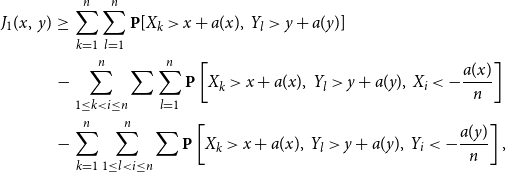 \begin{eqnarray} J_1(x,\,y) &\geq & \sum _{k=1}^n \sum _{l=1}^n {\mathbf{P}}[X_k\gt x+a(x),\;Y_l \gt y +a(y)]\nonumber \\ &-& \sum _{1\leq k \lt i \leq n}^n \sum \sum _{l=1}^n {\mathbf{P}}\left [X_k\gt x+a(x),\;Y_l \gt y +a(y),\; X_i\lt -\dfrac {a(x)}n\right ]\nonumber \\ &-& \sum _{k=1}^n \sum _{1\leq l \lt i \leq n}^n \sum {\mathbf{P}}\left [X_k\gt x+a(x),\;Y_l \gt y +a(y),\; Y_i\lt -\dfrac {a(y)}n\right ], \end{eqnarray}
hence, the last two terms in (4.11), from the $GTAI$
structure and the definition of the function
$GTAI$
structure and the definition of the function $a$
, in combination with properties of class
$a$
, in combination with properties of class $\mathcal{L}^{(2)}$
, become negligible with respect to the first term in (4.11). Therefore, it holds
$\mathcal{L}^{(2)}$
, become negligible with respect to the first term in (4.11). Therefore, it holds
 \begin{eqnarray} J_1(x,\,y) &\gtrsim & \sum _{k=1}^n \sum _{l=1}^n {\mathbf{P}}[X_k\gt x+a(x),\;Y_l \gt y +a(y)], \end{eqnarray}
as $x\wedge y \to \infty$
. Thus, relations (4.9), (4.10), and (4.12), together with relation (4.8), render the desired lower bound.
$x\wedge y \to \infty$
. Thus, relations (4.9), (4.10), and (4.12), together with relation (4.8), render the desired lower bound.
Lemma 4.3.
Let $X_1,\,X_2,\,Y_1,\,Y_2$
be non-negative random variables, with
$X_1,\,X_2,\,Y_1,\,Y_2$
be non-negative random variables, with $GTAI$
property, such that the pair
$GTAI$
property, such that the pair $(X_k,\,Y_l) \in (\mathcal{D}\cap \mathcal{L})^{(2)}$
, for any
$(X_k,\,Y_l) \in (\mathcal{D}\cap \mathcal{L})^{(2)}$
, for any $k,\,l \in \{1,\,2\}$
. If by
$k,\,l \in \{1,\,2\}$
. If by $a$
we denote the insensitivity function from
(4.7)
, then it holds
$a$
we denote the insensitivity function from
(4.7)
, then it holds
 \begin{eqnarray} {\mathbf{P}}\left [X_1\gt x-a(x),\;Y_1 \gt a(y),\; Y_2\leq \dfrac {y}2\right ] &\sim & {\mathbf{P}}\left [X_1\gt x,\;Y_1 \gt a(y),\; Y_2\leq \dfrac {y}2\right ]\nonumber \\ &\sim & {\mathbf{P}}[X_1\gt x,\;Y_1 \gt a(y)], \end{eqnarray}
as $x\wedge y \to \infty$
, and further, it holds
$x\wedge y \to \infty$
, and further, it holds
 \begin{eqnarray*} {\mathbf{P}}\left [Y_1\gt y-a(y),\;X_1 \gt a(x),\; X_2\leq \dfrac {x}2\right ] &\sim & {\mathbf{P}}\left [Y_1\gt y,\;X_1 \gt a(x),\; X_2\leq \dfrac {x}2\right ]\\[2mm] &\sim & {\mathbf{P}}[Y_1\gt y,\;X_1 \gt a(x)], \end{eqnarray*}
as $x\wedge y \to \infty$
.
$x\wedge y \to \infty$
.
Proof. We show only the first relation (4.13), since the second follows along similar steps, due to symmetry. At first, by definition of insensitivity function $a(\cdot )$
from (4.7), and if the pair
$a(\cdot )$
from (4.7), and if the pair $(X,\,Y) \in (\mathcal{D}\cap \mathcal{L})^{(2)}$
, we obtain
$(X,\,Y) \in (\mathcal{D}\cap \mathcal{L})^{(2)}$
, we obtain
 \begin{eqnarray} 1\leq \lim _{x\wedge y \to \infty } \dfrac {{\mathbf{P}}\left [X\gt x-a(x),\;Y \gt y\right ]}{{\mathbf{P}}\left [X\gt x,\;Y \gt y\right ]} \leq \lim _{x\wedge y \to \infty } \dfrac {{\mathbf{P}}\left [X\gt x-a(x),\;Y \gt y-a(y)\right ]}{{\mathbf{P}}\left [X\gt x,\;Y \gt y\right ]}=1, \end{eqnarray}
Hence, because of $(X_1,\,Y_1) \in (\mathcal{D}\cap \mathcal{L})^{(2)} \subsetneq \mathcal{L}^{(2)}$
, we have through (4.14) that it holds
$(X_1,\,Y_1) \in (\mathcal{D}\cap \mathcal{L})^{(2)} \subsetneq \mathcal{L}^{(2)}$
, we have through (4.14) that it holds
 \begin{eqnarray*} {\mathbf{P}}\left [X_1\gt x-a(x),\;Y_1 \gt a(y) \right ]\sim {\mathbf{P}}\left [X_1\gt x,\;Y_1 \gt a(y)\right ], \end{eqnarray*}
or equivalently
 \begin{eqnarray} &&{\mathbf{P}}\left [X_1\gt x-a(x),\;Y_1 \gt a(y),\;Y_2 \leq \dfrac y2 \right ] +{\mathbf{P}}\left [X_1\gt x-a(x),\;Y_1 \gt a(y),\;Y_2 \gt \dfrac y2\right ]\nonumber \\ &&\sim {\mathbf{P}}\left [X_1\gt x,\;Y_1 \gt a(y),\;Y_2 \leq \dfrac y2 \right ] +{\mathbf{P}}\left [X_1\gt x,\;Y_1 \gt a(y),\;Y_2 \gt \dfrac y2\right ]\!, \end{eqnarray}
as $x\wedge y \to \infty$
. We compare the first terms of each side of (4.15), to find
$x\wedge y \to \infty$
. We compare the first terms of each side of (4.15), to find
 \begin{eqnarray*} &&{\mathbf{P}}\left [X_1\gt x-a(x),\;Y_1 \gt a(y),\;Y_2 \leq \dfrac y2 \right ]= {\mathbf{P}}\left [X_1\gt x-a(x),\;Y_1 \gt a(y)\right ]\\[2mm] &&-{\mathbf{P}}\left [X_1\gt x-a(x),\;Y_1 \gt a(y),\;Y_2 \gt \dfrac y2 \right ] ={\mathbf{P}}\left [X_1\gt x-a(x),\;Y_1 \gt a(y)\right ]\\[2mm] &&-{\mathbf{P}}\left [Y_2\gt \dfrac y2 \;\Big |\;X_1\gt x-a(x),\;Y_1 \gt a(y) \right ] \,{\mathbf{P}}\left [X_1\gt x-a(x),\;Y_1 \gt a(y)\right ]\\[2mm] &&\sim {\mathbf{P}}\left [X_1\gt x,\;Y_1 \gt a(y) \right ] -o\left ({\mathbf{P}}\left [X_1\gt x,\;Y_1 \gt a(y)\right ]\right )\!, \end{eqnarray*}
as $x\wedge y \to \infty$
, where in the pre-last step, we used the class
$x\wedge y \to \infty$
, where in the pre-last step, we used the class $(\mathcal{D}\cap \mathcal{L})^{(2)}$
property, relation (4.14), and the
$(\mathcal{D}\cap \mathcal{L})^{(2)}$
property, relation (4.14), and the $GTAI$
property. Similarly, we get
$GTAI$
property. Similarly, we get
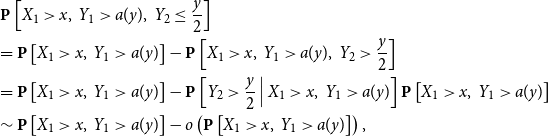 \begin{eqnarray} &&{\mathbf{P}}\left [X_1\gt x,\;Y_1 \gt a(y),\;Y_2 \leq \dfrac y2 \right ]\nonumber \\ &&= {\mathbf{P}}\left [X_1\gt x,\;Y_1 \gt a(y)\right ]-{\mathbf{P}}\left [X_1\gt x,\;Y_1 \gt a(y),\,Y_2\gt \dfrac y2\right ]\nonumber \\ &&={\mathbf{P}}\left [X_1\gt x,\;Y_1 \gt a(y)\right ]-{\mathbf{P}}\left [Y_2\gt \dfrac y2 \;\Big |\;X_1\gt x,\;Y_1 \gt a(y)\right ]{\mathbf{P}}\left [X_1\gt x,\;Y_1 \gt a(y)\right ]\nonumber \\ &&\sim {\mathbf{P}}\left [X_1\gt x,\;Y_1 \gt a(y) \right ] -o\left ({\mathbf{P}}\left [X_1\gt x,\;Y_1 \gt a(y)\right ]\right ), \end{eqnarray}
as $x\wedge y \to \infty$
. Therefore, considering all together relations (4.15)–(4.16), we conclude relation (4.13).
$x\wedge y \to \infty$
. Therefore, considering all together relations (4.15)–(4.16), we conclude relation (4.13).
Remark 4.1.
Taking into account relations (4.15)–(4.16), together with the fact that the $X_1,\,X_2,\,Y_1,\,Y_2$
are non-negative random variables, which are
$X_1,\,X_2,\,Y_1,\,Y_2$
are non-negative random variables, which are $GTAI$
, it follows that
$GTAI$
, it follows that
 \begin{eqnarray*} {\mathbf{P}}\left [X_1\gt x-a(x),\;Y_1 \gt a(y),\;Y_2 \gt \dfrac y2 \right ]= o({\mathbf{P}}\left [X_1\gt x,\;Y_1 \gt a(y) \right ] ),\\ {\mathbf{P}}\left [Y_1\gt y-a(y),\;X_1 \gt a(x),\;X_2 \gt \dfrac x2 \right ]= o({\mathbf{P}}\left [X_1\gt a(x),\;Y_1 \gt y \right ] ), \end{eqnarray*}
as $x \wedge y \to \infty$
.
$x \wedge y \to \infty$
.
The next result shows that in the non-negative part of class $(\mathcal{D}\cap \mathcal{L})^{(2)}$
, the property of joint max-sum equivalence as also under an extra assumption the closure property with respect to convolution are satisfied, as soon as the GTAI holds.
$(\mathcal{D}\cap \mathcal{L})^{(2)}$
, the property of joint max-sum equivalence as also under an extra assumption the closure property with respect to convolution are satisfied, as soon as the GTAI holds.
Lemma 4.4.
Let $X_1,\,X_2,\,Y_1,\,Y_2$
be non-negative random variables, with the following distributions
$X_1,\,X_2,\,Y_1,\,Y_2$
be non-negative random variables, with the following distributions $F_1,\,F_2,\,G_1,\,G_2$
from class
$F_1,\,F_2,\,G_1,\,G_2$
from class $\mathcal{D}\cap \mathcal{L}$
, respectively. Further, we assume that the random variables
$\mathcal{D}\cap \mathcal{L}$
, respectively. Further, we assume that the random variables $X_1,\,X_2,\,Y_1,\,Y_2$
satisfy the GTAI and
$X_1,\,X_2,\,Y_1,\,Y_2$
satisfy the GTAI and
 \begin{eqnarray*} (X_k,\,Y_l)\in (\mathcal{D}\cap \mathcal{L})^{(2)}, \end{eqnarray*}
for any $k,\,l \in \{1,\,2\}$
properties. Then it holds
$k,\,l \in \{1,\,2\}$
properties. Then it holds
 \begin{eqnarray} {\mathbf{P}}\left [X_1+X_2\gt x,\;Y_1+Y_2\gt y \right ] \sim \sum _{k=1}^2 \sum _{l=1}^2 {\mathbf{P}}\left [X_k\gt x,\;Y_l\gt y \right ], \end{eqnarray}
as $x\wedge y \to \infty$
. If further
$x\wedge y \to \infty$
. If further $X_1,X_2$
are TAI and
$X_1,X_2$
are TAI and $Y_1, Y_2$
are TAI, then
$Y_1, Y_2$
are TAI, then
 \begin{eqnarray*} (X_1+X_2,\,Y_1+Y_2) \in (\mathcal{D}\cap \mathcal{L})^{(2)}, \end{eqnarray*}
Proof. From Lemma4.2 and the fact that $(\mathcal{D}\cap \mathcal{L})^{(2)} \subsetneq \mathcal{L}^{(2)}$
, we find
$(\mathcal{D}\cap \mathcal{L})^{(2)} \subsetneq \mathcal{L}^{(2)}$
, we find
 \begin{eqnarray} {\mathbf{P}}[X_1+X_2\gt x,\;Y_1+Y_2\gt y ]\gtrsim \sum _{k=1}^2 \sum _{l=1}^2 {\mathbf{P}}\left [X_k\gt x,\;Y_l\gt y \right ], \end{eqnarray}
as $x\wedge y \to \infty$
, which provides the lower asymptotic bound.
$x\wedge y \to \infty$
, which provides the lower asymptotic bound.
Let us examine now the upper asymptotic bound
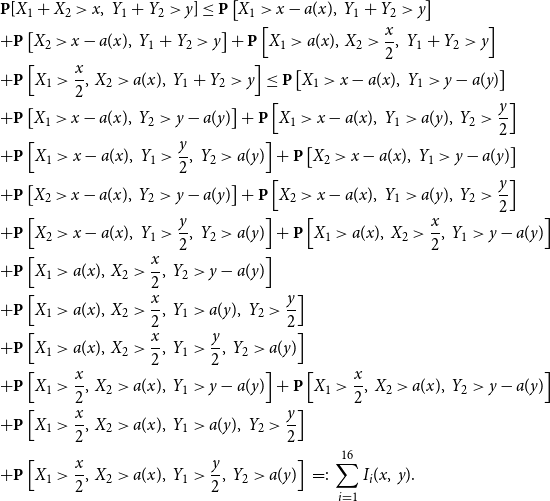 \begin{eqnarray} &&{\mathbf{P}}[X_1+X_2\gt x,\;Y_1+Y_2\gt y ]\leq {\mathbf{P}}\left [X_1\gt x-a(x),\;Y_1+Y_2\gt y \right ]\nonumber \\ &&+{\mathbf{P}}\left [X_2\gt x-a(x),\;Y_1+Y_2\gt y \right ]+{\mathbf{P}}\left [X_1\gt a(x),\;X_2\gt \dfrac x2,\;Y_1+Y_2\gt y \right ]\nonumber \\ &&+{\mathbf{P}}\left [X_1\gt \dfrac x2,\;X_2\gt a(x),\;Y_1+Y_2\gt y \right ] \leq {\mathbf{P}}\left [X_1\gt x-a(x),\;Y_1\gt y-a(y) \right ]\nonumber \\ &&+{\mathbf{P}}\left [X_1\gt x-a(x),\;Y_2\gt y-a(y) \right ]+{\mathbf{P}}\left [X_1\gt x-a(x),\;Y_1\gt a(y),\;Y_2\gt \dfrac y2 \right ]\nonumber \\ &&+{\mathbf{P}}\left [X_1\gt x-a(x),\;Y_1\gt \dfrac y2,\;Y_2\gt a(y) \right ]+{\mathbf{P}}\left [X_2\gt x-a(x),\;Y_1\gt y-a(y) \right ]\nonumber \\ &&+{\mathbf{P}}\left [X_2\gt x-a(x),\;Y_2\gt y-a(y) \right ]+{\mathbf{P}}\left [X_2\gt x-a(x),\;Y_1\gt a(y),\;Y_2\gt \dfrac y2 \right ]\nonumber \\ &&+{\mathbf{P}}\left [X_2\gt x-a(x),\;Y_1\gt \dfrac y2,\;Y_2\gt a(y) \right ]+{\mathbf{P}}\left [X_1\gt a(x),\;X_2\gt \dfrac x2,\;Y_1\gt y-a(y)\right ]\nonumber \\ &&+{\mathbf{P}}\left [X_1\gt a(x),\;X_2\gt \dfrac x2,\;Y_2\gt y-a(y) \right ]\nonumber \\ &&+{\mathbf{P}}\left [X_1\gt a(x),\;X_2\gt \dfrac x2,\;Y_1\gt a(y),\;Y_2\gt \dfrac y2 \right ]\nonumber \\ &&+{\mathbf{P}}\left [X_1\gt a(x),\;X_2\gt \dfrac x2,\;Y_1\gt \dfrac y2,\;Y_2\gt a(y) \right ]\nonumber \\ &&+{\mathbf{P}}\left [X_1\gt \dfrac x2,\;X_2\gt a(x),\;Y_1\gt y-a(y)\right ]+{\mathbf{P}}\left [X_1\gt \dfrac x2,\;X_2\gt a(x),\;Y_2\gt y-a(y) \right ]\nonumber \\ &&+{\mathbf{P}}\left [X_1\gt \dfrac x2,\;X_2\gt a(x),\;Y_1\gt a(y),\;Y_2\gt \dfrac y2 \right ]\nonumber \\ &&+{\mathbf{P}}\left [X_1\gt \dfrac x2, \;X_2\gt a(x),\;Y_1\gt \dfrac y2,\;Y_2\gt a(y) \right ]\,=\!:\,\sum _{i=1}^{16}I_i(x,\,y). \end{eqnarray}
Taking into account the property $\mathcal{L}^{(2)}$
and the definition of function
$\mathcal{L}^{(2)}$
and the definition of function $a(x)$
, we find the asymptotic expressions for
$a(x)$
, we find the asymptotic expressions for $ I_1(x,\,y)\sim {\mathbf{P}}\left [X_1\gt x,Y_1\gt y\right ]$
,
$ I_1(x,\,y)\sim {\mathbf{P}}\left [X_1\gt x,Y_1\gt y\right ]$
, $I_2(x,\,y)\sim {\mathbf{P}}\left [X_1\gt x,Y_2\gt y\right ]$
,
$I_2(x,\,y)\sim {\mathbf{P}}\left [X_1\gt x,Y_2\gt y\right ]$
, $I_5(x,\,y)\sim {\mathbf{P}}\left [X_2\gt x,Y_1\gt y\right ]$
,
$I_5(x,\,y)\sim {\mathbf{P}}\left [X_2\gt x,Y_1\gt y\right ]$
, $I_6(x,\,y)\sim {\mathbf{P}}\left [X_2\gt x,Y_2\gt y\right ]$
, as
$I_6(x,\,y)\sim {\mathbf{P}}\left [X_2\gt x,Y_2\gt y\right ]$
, as $x\wedge y \to \infty$
. Hence
$x\wedge y \to \infty$
. Hence
 \begin{eqnarray} I_1(x,\,y)+I_2(x,\,y)+I_5(x,\,y)+I_6(x,\,y) \sim \sum _{k=1}^2 \sum _{l=1}^2 {\mathbf{P}}\left [X_k\gt x,\;Y_l\gt y \right ], \end{eqnarray}
as $x\wedge y \to \infty$
.
$x\wedge y \to \infty$
.
Next, we follow a similar approach for $I_3(x,\,y)$
,
$I_3(x,\,y)$
, $I_4(x,\,y)$
,
$I_4(x,\,y)$
, $I_7(x,\,y)$
,
$I_7(x,\,y)$
, $I_8(x,\,y)$
,
$I_8(x,\,y)$
, $I_9(x,\,y)$
,
$I_9(x,\,y)$
, $I_{10}(x,\,y)$
,
$I_{10}(x,\,y)$
, $I_{13}(x,\,y)$
and
$I_{13}(x,\,y)$
and $I_{14}(x,\,y)$
. Now, we obtain by Lemma4.3
$I_{14}(x,\,y)$
. Now, we obtain by Lemma4.3
 \begin{eqnarray*} &&I_3(x,\,y) \sim {\mathbf{P}}\left [X_1\gt x,\;Y_1\gt a(y),\;Y_2\gt \dfrac y2 \right ]\\[2mm] &&\qquad ={\mathbf{P}}\left [Y_1\gt a(y)\;\Big |\;X_1\gt x,\;Y_2\gt \dfrac y2 \right ]\,{\mathbf{P}}\left [X_1\gt x,\;Y_2\gt \dfrac y2 \right ]=o\left ({\mathbf{P}}\left [X_2\gt x,Y_2\gt y\right ] \right ), \end{eqnarray*}
as $x\wedge y \to \infty$
, which follows because of properties
$x\wedge y \to \infty$
, which follows because of properties $(\mathcal{D}\cap \mathcal{L})^{(2)}$
and GTAI.
$(\mathcal{D}\cap \mathcal{L})^{(2)}$
and GTAI.
In similar way, we find $I_4(x,\,y)=o({\mathbf{P}}\left [X_1\gt x,Y_2\gt y\right ])$
,
$I_4(x,\,y)=o({\mathbf{P}}\left [X_1\gt x,Y_2\gt y\right ])$
, $I_7(x,\,y)=o({\mathbf{P}}\left [X_2\gt x,Y_2\gt y\right ])$
,
$I_7(x,\,y)=o({\mathbf{P}}\left [X_2\gt x,Y_2\gt y\right ])$
, $I_8(x,\,y)=o({\mathbf{P}}\left [X_2\gt x,Y_2\gt y\right ])$
,
$I_8(x,\,y)=o({\mathbf{P}}\left [X_2\gt x,Y_2\gt y\right ])$
, $I_9(x,\,y)=o({\mathbf{P}}\left [X_2\gt x,Y_1\gt y\right ])$
and finally
$I_9(x,\,y)=o({\mathbf{P}}\left [X_2\gt x,Y_1\gt y\right ])$
and finally $I_{10}(x,\,y)=o({\mathbf{P}}\left [X_1\gt x,Y_2\gt y\right ])$
, as
$I_{10}(x,\,y)=o({\mathbf{P}}\left [X_1\gt x,Y_2\gt y\right ])$
, as $x\wedge y \to \infty$
. Hence
$x\wedge y \to \infty$
. Hence
 \begin{eqnarray} \sum _{j=3}^4 I_j(x,\,y)+ \sum _{i=7}^{10}I_i(x,\,y) +I_{13}(x,\,y) +I_{14}(x,\,y) =o\left (\sum _{k=1}^2 \sum _{l=1}^2 {\mathbf{P}}\left [X_k\gt x, \,Y_l\gt y \right ]\right ), \end{eqnarray}
as $x\wedge y \to \infty$
.
$x\wedge y \to \infty$
.
The $I_{11}(x,\,y)$
,
$I_{11}(x,\,y)$
, $I_{12}(x,\,y)$
,
$I_{12}(x,\,y)$
, $I_{15}(x,\,y)$
,
$I_{15}(x,\,y)$
, $I_{16}(x,\,y)$
can be handled also similarly
$I_{16}(x,\,y)$
can be handled also similarly
 \begin{eqnarray*} I_{11}(x,\,y) &\leq & {\mathbf{P}}\left [X_2\gt \dfrac x2,\;Y_1\gt a(y),\;Y_2\gt \dfrac y2 \right ]\\ &=&{\mathbf{P}}\left [Y_1\gt a(y)\;\Big |\;X_2\gt \dfrac x2,\;Y_2\gt \dfrac y2 \right ]\,{\mathbf{P}}\left [X_2\gt \dfrac x2, Y_2\gt \dfrac y2 \right ], \end{eqnarray*}
or equivalently $I_{11}(x,\,y) =o({\mathbf{P}}\left [X_2\gt x, Y_2\gt y \right ])$
, as
$I_{11}(x,\,y) =o({\mathbf{P}}\left [X_2\gt x, Y_2\gt y \right ])$
, as $x\wedge y \to \infty$
, which follows because of properties
$x\wedge y \to \infty$
, which follows because of properties $(\mathcal{D}\cap \mathcal{L})^{(2)}$
and GTAI. Similarly, we find
$(\mathcal{D}\cap \mathcal{L})^{(2)}$
and GTAI. Similarly, we find $I_{1j}(x,\,y)=o({\mathbf{P}}\left [X_k\gt x, Y_l\gt y \right ])$
, for some
$I_{1j}(x,\,y)=o({\mathbf{P}}\left [X_k\gt x, Y_l\gt y \right ])$
, for some $k,\,l \in \{1,\,2\}$
and for any
$k,\,l \in \{1,\,2\}$
and for any $j\in \{1,\,2,\,5,\,6\}$
. Therefore, we obtain
$j\in \{1,\,2,\,5,\,6\}$
. Therefore, we obtain
 \begin{eqnarray} I_{1j}(x,\,y) =o\left (\sum _{k=1}^2 \sum _{l=1}^2 {\mathbf{P}}\left [X_k\gt x,\;Y_l\gt y \right ]\right ), \end{eqnarray}
as $x\wedge y \to \infty$
, for any
$x\wedge y \to \infty$
, for any $j\in \{1,\,2,\,5,\,6\}$
.
$j\in \{1,\,2,\,5,\,6\}$
.
From (4.20), (4.21), and (4.22), in combination with (4.19), we find that
 \begin{eqnarray*} {\mathbf{P}}[X_1+X_2\gt x,\;Y_1+Y_2\gt y ] \lesssim \sum _{k=1}^2 \sum _{l=1}^2 {\mathbf{P}}\left [X_k\gt x,\;Y_l\gt y \right ] \end{eqnarray*}
as $x\wedge y \to \infty$
, which in combination with (4.18) leads to (4.17).
$x\wedge y \to \infty$
, which in combination with (4.18) leads to (4.17).
Now we check the validity of relation $(X_1+X_2,\,Y_1+Y_2) \in (\mathcal{D}\cap \mathcal{L})^{(2)}$
. At first, by (4.17), we obtain
$(X_1+X_2,\,Y_1+Y_2) \in (\mathcal{D}\cap \mathcal{L})^{(2)}$
. At first, by (4.17), we obtain
 \begin{eqnarray*} &&\limsup _{x\wedge y \to \infty }\dfrac {{\mathbf{P}}\left [X_1+X_2\gt b_1\,x,\;Y_1+Y_2\gt b_2\,y \right ]}{{\mathbf{P}}\left [X_1+X_2\gt x,\;Y_1+Y_2\gt y \right ]}=\limsup _{x\wedge y \to \infty }\\[2mm] &&\dfrac { \sum _{k=1}^2 \sum _{l=1}^2 {\mathbf{P}}\left [X_k\gt b_1\,x,\;Y_l\gt b_2\,y \right ]}{ \sum _{k=1}^2 \sum _{l=1}^2 {\mathbf{P}}\left [X_k\gt x,\;Y_l\gt y \right ]} \leq \max _{k,\,l \in \{1, 2 \}} \left \{\limsup _{x\wedge y \to \infty }\dfrac {{\mathbf{P}}\left [X_k\gt b_1 x, \,Y_l\gt b_2 y \right ]}{{\mathbf{P}}\left [X_k\gt x,\,Y_l\gt y \right ]} \right \} \lt \infty, \end{eqnarray*}
for any $\textbf { b}=(b_1,\,b_2) \in (0,\,1)^2$
, this means that we have one of two conditions of the closure property with respect to
$\textbf { b}=(b_1,\,b_2) \in (0,\,1)^2$
, this means that we have one of two conditions of the closure property with respect to $\mathcal{D}^{(2)}$
.
$\mathcal{D}^{(2)}$
.
Next, we check the closure property with respect to $\mathcal{L}^{(2)}$
. From (4.17), we obtain
$\mathcal{L}^{(2)}$
. From (4.17), we obtain
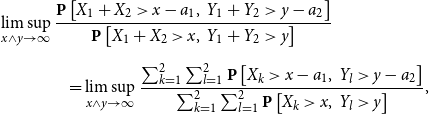 \begin{eqnarray*} &&\limsup _{x\wedge y \to \infty }\dfrac {{\mathbf{P}}\left [X_1+X_2\gt x-a_1,\;Y_1+Y_2\gt y-a_2 \right ]}{{\mathbf{P}}\left [X_1+X_2\gt x,\;Y_1+Y_2\gt y \right ]}\\[2mm] &&\qquad \qquad =\limsup _{x\wedge y \to \infty }\dfrac {\sum _{k=1}^2 \sum _{l=1}^2 {\mathbf{P}}\left [X_k\gt x-a_1,\;Y_l\gt y-a_2 \right ]}{\sum _{k=1}^2 \sum _{l=1}^2 {\mathbf{P}}\left [X_k\gt x,\;Y_l\gt y \right ]}, \end{eqnarray*}
for any $\textbf { a}=(a_1,\,a_2) \gt (0,\,0)$
, and therefore
$\textbf { a}=(a_1,\,a_2) \gt (0,\,0)$
, and therefore
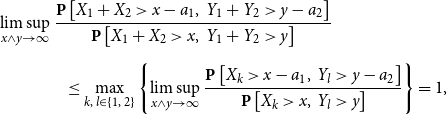 \begin{eqnarray*} &&\limsup _{x\wedge y \to \infty }\dfrac {{\mathbf{P}}\left [X_1+X_2\gt x-a_1,\;Y_1+Y_2\gt y-a_2 \right ]}{{\mathbf{P}}\left [X_1+X_2\gt x,\;Y_1+Y_2\gt y \right ]}\\[2mm] &&\qquad \qquad \leq \max _{k,\,l \in \{1,\,2 \}}\left \{ \limsup _{x\wedge y \to \infty }\dfrac { {\mathbf{P}}\left [X_k\gt x-a_1,\;Y_l\gt y-a_2 \right ]}{{\mathbf{P}}\left [X_k\gt x,\;Y_l\gt y \right ]} \right \}=1, \end{eqnarray*}
and always
 \begin{eqnarray*} \liminf _{x\wedge y \to \infty }\dfrac {{\mathbf{P}}\left [X_1+X_2\gt x-a_1,\;Y_1+Y_2\gt y-a_2 \right ]}{{\mathbf{P}}\left [X_1+X_2\gt x,\;Y_1+Y_2\gt y \right ]}\geq 1, \end{eqnarray*}
which means that we have one of two conditions of the closure property with respect to $\mathcal{L}^{(2)}$
true. So by the extra assumption of TAI between
$\mathcal{L}^{(2)}$
true. So by the extra assumption of TAI between $X_1,X_2$
and
$X_1,X_2$
and $Y_1,Y_2$
by Lemma 4.1 of Geluk and Tang (Reference Geluk and Tang2009), we have that
$Y_1,Y_2$
by Lemma 4.1 of Geluk and Tang (Reference Geluk and Tang2009), we have that $X_1+X_2\in \mathcal{D}\cap \mathcal{L}$
and
$X_1+X_2\in \mathcal{D}\cap \mathcal{L}$
and $Y_1+Y_2\in \mathcal{D}\cap \mathcal{L}$
; as a result, we conclude
$Y_1+Y_2\in \mathcal{D}\cap \mathcal{L}$
; as a result, we conclude $(X_1+X_2,\,Y_1+Y_2) \in (\mathcal{D}\cap \mathcal{L})^{(2)}$
.
$(X_1+X_2,\,Y_1+Y_2) \in (\mathcal{D}\cap \mathcal{L})^{(2)}$
.
An easy example, where we combine the $GTAI$
property for the
$GTAI$
property for the $X_1,\,\ldots, \,X_n$
,
$X_1,\,\ldots, \,X_n$
, $Y_1,\,\ldots, \,Y_m$
with the
$Y_1,\,\ldots, \,Y_m$
with the $TAI$
property for each sequence, is found in case of each sequence to be
$TAI$
property for each sequence, is found in case of each sequence to be $TAI$
but the two sequences to be independent.
$TAI$
but the two sequences to be independent.
Next, we provide a corollary, following from Lemma4.4, where we establish the closure property with respect to $\mathcal{C}^{(2)}$
and the joint max-sum equivalence, under condition GTAI.
$\mathcal{C}^{(2)}$
and the joint max-sum equivalence, under condition GTAI.
Corollary 4.1.
Let $X_1,\,X_2,\,Y_1,\,Y_2$
be non-negative random variables, with the distributions
$X_1,\,X_2,\,Y_1,\,Y_2$
be non-negative random variables, with the distributions $F_1,\,F_2,\,G_1,\,G_2$
from class
$F_1,\,F_2,\,G_1,\,G_2$
from class $\mathcal{C}$
, respectively, and they satisfy the GTAI condition. If it holds
$\mathcal{C}$
, respectively, and they satisfy the GTAI condition. If it holds $(X_k,\,Y_l)\in \mathcal{C}^{(2)}$
, for any
$(X_k,\,Y_l)\in \mathcal{C}^{(2)}$
, for any $k,\,l \in \{1,\,2\}$
, then
$k,\,l \in \{1,\,2\}$
, then
 \begin{eqnarray} {\mathbf{P}}\left [X_1+X_2\gt x,\;Y_1+Y_2\gt y \right ]\sim \sum _{k=1}^2 \sum _{l=1}^2 {\mathbf{P}}\left [X_k\gt x,\;Y_l\gt y \right ], \end{eqnarray}
as $x\wedge y \to \infty$
. If further
$x\wedge y \to \infty$
. If further $X_1,X_2$
are TAI and
$X_1,X_2$
are TAI and $Y_1, Y_2$
are TAI, then it holds
$Y_1, Y_2$
are TAI, then it holds $(X_1+X_2,\;Y_1+Y_2)\in \mathcal{C}^{(2)}$
.
$(X_1+X_2,\;Y_1+Y_2)\in \mathcal{C}^{(2)}$
.
Proof. Relation (4.23) follows from the fact that $\mathcal{C}^{(2)} \subsetneq (\mathcal{D}\cap \mathcal{L})^{(2)}$
(see Theorem2.1) and by application of Lemma4.4.
$\mathcal{C}^{(2)} \subsetneq (\mathcal{D}\cap \mathcal{L})^{(2)}$
(see Theorem2.1) and by application of Lemma4.4.
Next, we check the closure property with respect to convolution. From (4.23), we obtain
 \begin{eqnarray*} {\mathbf{P}}[X_1+X_2\gt d_1\,x,\;Y_1+Y_2\gt d_2\,y ] \sim \sum _{k=1}^2 \sum _{l=1}^2 {\mathbf{P}}\left [X_k\gt d_1\,x,\;Y_l\gt d_2\,y \right ], \end{eqnarray*}
as $x\wedge y \to \infty$
, for any
$x\wedge y \to \infty$
, for any $\textbf { d}=(d_1,\,d_2) \in (0,\,1)^2$
. Hence
$\textbf { d}=(d_1,\,d_2) \in (0,\,1)^2$
. Hence
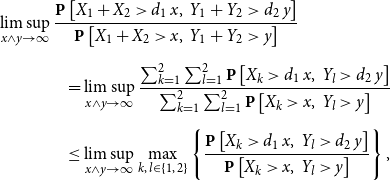 \begin{eqnarray*} &&\limsup _{x\wedge y \to \infty }\dfrac {{\mathbf{P}}\left [X_1+X_2\gt d_1\,x,\;Y_1+Y_2\gt d_2\,y \right ]}{{\mathbf{P}}\left [X_1+X_2\gt x,\;Y_1+Y_2\gt y \right ]}\\[2mm] &&\qquad \qquad =\limsup _{x\wedge y \to \infty }\dfrac {\sum _{k=1}^2 \sum _{l=1}^2 {\mathbf{P}}\left [X_k\gt d_1\,x,\;Y_l\gt d_2\,y \right ]}{\sum _{k=1}^2 \sum _{l=1}^2 {\mathbf{P}}\left [X_k\gt x,\;Y_l\gt y \right ]} \\[2mm] &&\qquad \qquad \leq \limsup _{x\wedge y \to \infty }\max _{k,\,l \in \{1,\,2 \}}\left \{ \dfrac { {\mathbf{P}}\left [X_k\gt d_1\,x,\;Y_l\gt d_2\,y \right ]}{{\mathbf{P}}\left [X_k\gt x,\;Y_l\gt y \right ]} \right \}, \end{eqnarray*}
Thus, because of the definition of $\mathcal{C}^{(2)}$
, we get
$\mathcal{C}^{(2)}$
, we get
 \begin{eqnarray*} 1&\leq & \lim _{\textbf { d} \uparrow \textbf { 1}} \limsup _{x\wedge y \to \infty }\dfrac {{\mathbf{P}}\left [X_1+X_2\gt d_1\,x,\;Y_1+Y_2\gt d_2\,y \right ]}{{\mathbf{P}}\left [X_1+X_2\gt x,\;Y_1+Y_2\gt y \right ]}\\[2mm] &\leq & \lim _{\textbf { d} \uparrow \textbf { 1}} \limsup _{x\wedge y \to \infty } \max _{k,\,l \in \{1,\,2\}} \left (\dfrac {{\mathbf{P}}\left [X_k\gt d_1\,x,\;Y_l\gt d_2\,y \right ]}{{\mathbf{P}}\left [X_k\gt x,\;Y_l\gt y \right ]}\right )\\[2mm] &\leq & \max _{k,\,l \in \{1,\,2\}} \left (\lim _{\textbf { d} \uparrow \textbf { 1}} \limsup _{x\wedge y \to \infty }\dfrac {{\mathbf{P}}\left [X_k\gt d_1\,x,\;Y_l\gt d_2\,y \right ]}{{\mathbf{P}}\left [X_k\gt x,\;Y_l\gt y \right ]}\right )=1, \end{eqnarray*}
this means that one of two conditions of closedness under convolution holds. By the assumptions of TAI in each sequence and by $\mathcal{C}\subsetneq \mathcal{D}\cap \mathcal{L}$
, we use Lemma 4.1 of Geluk and Tang (Reference Geluk and Tang2009), and we take
$\mathcal{C}\subsetneq \mathcal{D}\cap \mathcal{L}$
, we use Lemma 4.1 of Geluk and Tang (Reference Geluk and Tang2009), and we take
 \begin{eqnarray*} 1&\leq & \lim _{{ d_1} \uparrow { 1}} \limsup _{x\to \infty }\dfrac {{\mathbf{P}}\left [X_1+X_2\gt d_1\,x \right ]}{{\mathbf{P}}\left [X_1+X_2\gt x \right ]}=\lim _{{ d_1} \uparrow { 1}} \limsup _{x \to \infty }\dfrac {{\mathbf{P}}\left [X_1\gt d_1\,x \right ]+{\mathbf{P}}\left [X_1\gt d_1\,x \right ]}{{\mathbf{P}}\left [X_1\gt x \right ]+{\mathbf{P}}\left [X_1\gt x \right ]}\\[2mm] &\leq & \lim _{{ d_1} \uparrow { 1}} \limsup _{x \to \infty } \max _{k \in \{1,\,2\}} \left (\dfrac {{\mathbf{P}}\left [X_k\gt d_1\,x \right ]}{{\mathbf{P}}\left [X_k\gt x \right ]}\right )\leq \max _{k \in \{1,\,2\}} \left (\lim _{{ d_1} \uparrow { 1}} \limsup _{x \to \infty }\dfrac {{\mathbf{P}}\left [X_k\gt d_1\,x \right ]}{{\mathbf{P}}\left [X_k\gt x \right ]}\right )=1, \end{eqnarray*}
which gives that $(X_1+X_2)\in \mathcal{C}$
. With the same argument, we have
$(X_1+X_2)\in \mathcal{C}$
. With the same argument, we have $(Y_1+Y_2)\in \mathcal{C}$
. That means
$(Y_1+Y_2)\in \mathcal{C}$
. That means $(X_1+X_2,\;Y_1+Y_2)\in \mathcal{C}^{(2)}$
.
$(X_1+X_2,\;Y_1+Y_2)\in \mathcal{C}^{(2)}$
.
Now we can give the main result, where we find an analogue to relation (4.2) in two dimensions.
Theorem 4.2.
Let $X_1,\,\ldots, \,X_n,\,Y_1,\,\ldots, \,Y_n$
be random variables with the following distributions
$X_1,\,\ldots, \,X_n,\,Y_1,\,\ldots, \,Y_n$
be random variables with the following distributions $F_1,\,\ldots, \,F_n,\,G_1,\,\ldots, \,G_n$
from class
$F_1,\,\ldots, \,F_n,\,G_1,\,\ldots, \,G_n$
from class $\mathcal{D}\cap \mathcal{L}$
, respectively, and they satisfy the GTAI condition, with
$\mathcal{D}\cap \mathcal{L}$
, respectively, and they satisfy the GTAI condition, with $(X_k,\,Y_l)\in (\mathcal{D}\cap \mathcal{L})^{(2)}$
, for any
$(X_k,\,Y_l)\in (\mathcal{D}\cap \mathcal{L})^{(2)}$
, for any $k,\,l \in \{1,\,\ldots, \,n\}$
. If further
$k,\,l \in \{1,\,\ldots, \,n\}$
. If further $X_1,\,\ldots, \,X_n$
are TAI and
$X_1,\,\ldots, \,X_n$
are TAI and $Y_1,\,\ldots, \,Y_n$
are TAI, then
$Y_1,\,\ldots, \,Y_n$
are TAI, then
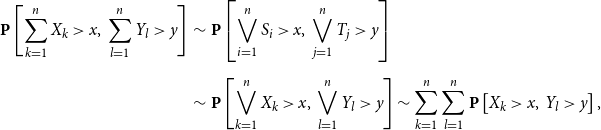 \begin{eqnarray*} {\mathbf{P}}\left [ \sum _{k=1}^n X_k\gt x,\;\sum _{l=1}^n Y_l \gt y\right ] &\sim & {\mathbf{P}}\left [ \bigvee _{i=1}^n S_i\gt x,\;\bigvee _{j=1}^n T_j \gt y\right ] \\[2mm] &\sim & {\mathbf{P}}\left [ \bigvee _{k=1}^n X_k\gt x,\;\bigvee _{l=1}^n Y_l \gt y\right ] \sim \sum _{k=1}^n \sum _{l=1}^n {\mathbf{P}}\left [X_k\gt x,\;Y_l\gt y \right ], \end{eqnarray*}
as $x\wedge y \to \infty$
.
$x\wedge y \to \infty$
.
Proof. By Lemma4.2, we find
 \begin{eqnarray*} {\mathbf{P}}\left [\sum _{k=1}^n X_k\gt x,\;\sum _{l=1}^n Y_l\gt y \right ] \gtrsim \sum _{k=1}^n \sum _{l=1}^n {\mathbf{P}}\left [ X_k\gt x,\; Y_l\gt y \right ], \end{eqnarray*}
as $x\wedge y \to \infty$
. Because of closure property of
$x\wedge y \to \infty$
. Because of closure property of $(\mathcal{D}\cap \mathcal{L})^{(2)}$
with respect to convolution in the positive part, under GTAI condition, we can apply Lemmas4.4 and 4.1, and employing induction, we find
$(\mathcal{D}\cap \mathcal{L})^{(2)}$
with respect to convolution in the positive part, under GTAI condition, we can apply Lemmas4.4 and 4.1, and employing induction, we find
 \begin{eqnarray*} {\mathbf{P}}\left [\sum _{k=1}^n X_k\gt x, \sum _{l=1}^n Y_l\gt y \right ] \leq {\mathbf{P}}\left [\sum _{k=1}^n X_k^+\gt x, \sum _{l=1}^n Y_l^+\gt y \right ]\sim \sum _{k=1}^n \sum _{l=1}^n {\mathbf{P}}\left [X_k\gt x, Y_l\gt y \right ] \end{eqnarray*}
as $x\wedge y \to \infty$
. Now, taking into consideration Theorem4.1, we find
$x\wedge y \to \infty$
. Now, taking into consideration Theorem4.1, we find
 \begin{eqnarray*} {\mathbf{P}}\left [\sum _{k=1}^n X_k\gt x,\;\sum _{l=1}^n Y_l\gt y \right ] \sim \sum _{k=1}^n \sum _{l=1}^n {\mathbf{P}}\left [ X_k\gt x,\; Y_l\gt y \right ] \sim {\mathbf{P}}\left [ \bigvee _{k=1}^n X_k\gt x,\;\bigvee _{l=1}^n Y_l \gt y\right ], \end{eqnarray*}
as $x\wedge y \to \infty$
. Finally, due to the inequality
$x\wedge y \to \infty$
. Finally, due to the inequality
 \begin{eqnarray*} {\mathbf{P}}\left [\sum _{k=1}^n X_k\gt x, \sum _{l=1}^n Y_l\gt y \right ] \leq {\mathbf{P}}\left [ \bigvee _{i=1}^n S_i\gt x, \bigvee _{j=1}^n T_j \gt y\right ]\leq {\mathbf{P}}\left [\sum _{k=1}^n X_k^+\gt x, \sum _{l=1}^n Y_l^+\gt y \right ] \end{eqnarray*}
we get the asymptotic relation
 \begin{eqnarray*} {\mathbf{P}}\left [ \bigvee _{i=1}^n S_i\gt x,\;\bigvee _{j=1}^n T_j \gt y\right ] \sim \sum _{k=1}^n \sum _{l=1}^n {\mathbf{P}}\left [ X_k\gt x,\; Y_l\gt y \right ], \end{eqnarray*}
as $x\wedge y \to \infty$
.
$x\wedge y \to \infty$
.
Recently more and more researchers study two-dimensional risk models; we refer to the reader Hu and Jiang (Reference Hu and Jiang2013), Cheng and Yu (Reference Cheng and Yu2019), and Cheng (Reference Cheng2021), among others. For
 \begin{eqnarray*} U_1(k,\,x)\,:\!=\,x - \sum _{i=1}^{k}X_i, \qquad U_2(k,\,y)\,:\!=\,y -\sum _{j=1}^{k}Y_j, \end{eqnarray*}
for $1\leq k\leq n$
, we define now two ruin times,
$1\leq k\leq n$
, we define now two ruin times,
 \begin{eqnarray*} T_{max}\,:\!=\,\inf \left \{1\leq k\leq n\;:\; U_1(k,\,x)\wedge U_2(k,\,y) \lt 0 \right \}\!, \end{eqnarray*}
which denote the first moment when both portfolios are found with negative surplus, and for each portfolio, we define
 \begin{eqnarray*} T_{1}(x)\,:\!=\,\inf \left \{1\leq k\leq n: U_{1}(k,\,x)\lt 0 |U_{1}(0,\,x)=x\right \}\!, \end{eqnarray*}
 \begin{eqnarray*} T_{2}(y)\,:\!=\,\inf \left \{1\leq k\leq n: U_{2}(k,\,y)\lt 0 |U_{2}(0,\,y)=y\right \}\!, \end{eqnarray*}
as a result, the second type of ruin type is
 \begin{eqnarray*} T_{and}\,:\!=\,\max \left \{T_{1}(x),T_{2}(y)\right \}\!, \end{eqnarray*}
which corresponds to the first moment, when both portfolios have been with negative surplus, but not necessarily simultaneously. Hence we define the ruin probabilities as
 \begin{eqnarray} \psi _{max}(x,\,y,\,n) = {\mathbf{P}}[T_{max} \leq n],\qquad \psi _{and}(x,\,y,\,n) = {\mathbf{P}}[T_{and} \leq n]\!, \end{eqnarray}
for any $n \in {\mathbb{N}}$
and
$n \in {\mathbb{N}}$
and $x,\,y \gt 0$
. From (4.24), we easily find out that
$x,\,y \gt 0$
. From (4.24), we easily find out that
 \begin{eqnarray*} \psi _{and}(x,\,y,\,n) = {\mathbf{P}}\left [ \bigvee _{i=1}^n S_i \gt x,\;\bigvee _{i=1}^n T_i \gt y\right ]\!. \end{eqnarray*}
Therefore, by Theorem4.2, we obtain the following result.
Corollary 4.2. Under conditions of Theorem 4.2 , we obtain
 \begin{eqnarray} \psi _{and}(x,\,y,\,n) \sim \sum _{k=1}^n \sum _{l=1}^n {\mathbf{P}}\left [ X_k\gt x,\; Y_l\gt y \right ]\!, \end{eqnarray}
as $x\wedge y \to \infty$
.
$x\wedge y \to \infty$
.
Remark 4.2.
From relation (4.25) and the definitions for $T_{max}$
and
$T_{max}$
and $T_{and}$
, we can easily observe that
$T_{and}$
, we can easily observe that $\psi _{max}(x,\,y,\,n) \leq \psi _{and}(x,\,y,\,n)$
, for any
$\psi _{max}(x,\,y,\,n) \leq \psi _{and}(x,\,y,\,n)$
, for any $x,\,y \gt 0$
and any
$x,\,y \gt 0$
and any $n \in {\mathbb{N}}$
. Thus, for
$n \in {\mathbb{N}}$
. Thus, for $\psi _{max}(x,\,y,\,n)$
, we find the asymptotic upper bound
$\psi _{max}(x,\,y,\,n)$
, we find the asymptotic upper bound
 \begin{eqnarray*} \psi _{max}(x,\,y,\,n) \lesssim \sum _{k=1}^n \sum _{l=1}^n {\mathbf{P}}\left [ X_k\gt x,\; Y_l\gt y \right ]\!, \end{eqnarray*}
as $x\wedge y \to \infty$
, for any
$x\wedge y \to \infty$
, for any $n \in {\mathbb{N}}$
.
$n \in {\mathbb{N}}$
.
5. Scalar product
Now we examine the closure property of scalar product in $\mathcal{L}^{(2)}$
,
$\mathcal{L}^{(2)}$
, $\mathcal{D}^{(2)}$
, and in their intersection. Later, we check the same for random sums in two dimensions.
$\mathcal{D}^{(2)}$
, and in their intersection. Later, we check the same for random sums in two dimensions.
The scalar product has the following tail:
 \begin{eqnarray} \boldsymbol { \overline {\mathbf{H}}} (x,\,y)\,:\!=\,{\mathbf{P}}[\Theta \,X \gt x,\,\Theta \,Y\gt y]. \end{eqnarray}
Here, we set $\Theta$
to be a non-negative random variable with distribution
$\Theta$
to be a non-negative random variable with distribution $B$
, such that
$B$
, such that $B(0-)=0$
and
$B(0-)=0$
and $B(0)\lt 1$
. We assume also that
$B(0)\lt 1$
. We assume also that $\Theta$
is independent of
$\Theta$
is independent of $(X,\,Y)$
. These products in relation (5.1) have many applications in actuarial mathematics, in risk management, and in stochastic fields. Next, we use an assumption from Konstantinides and Passalidis (Reference Konstantinides and Passalidis2024b).
$(X,\,Y)$
. These products in relation (5.1) have many applications in actuarial mathematics, in risk management, and in stochastic fields. Next, we use an assumption from Konstantinides and Passalidis (Reference Konstantinides and Passalidis2024b).
Assumption 5.1.
Let us suppose that it holds ${\overline {B}}[c\,(x\wedge y)] = o\left ({\mathbf{P}}\left [\Theta \,X\gt x,\;\Theta \,Y\gt y \right ] \right )\,=\!:\,o\left [{ \overline {H}} (x,\,y) \right ]$
, as
${\overline {B}}[c\,(x\wedge y)] = o\left ({\mathbf{P}}\left [\Theta \,X\gt x,\;\Theta \,Y\gt y \right ] \right )\,=\!:\,o\left [{ \overline {H}} (x,\,y) \right ]$
, as $x\wedge y \to \infty$
, for any
$x\wedge y \to \infty$
, for any $c\gt 0$
.
$c\gt 0$
.
Remark 5.1. From Assumption 5.1 , it is implied that
 \begin{eqnarray} {\overline {B}}(c\,x) = o\left ({\mathbf{P}}\left [\Theta \,X\gt x\right ] \right ), \end{eqnarray}
as $x\to \infty$
, for any
$x\to \infty$
, for any $c\gt 0$
, and similarly
$c\gt 0$
, and similarly
 \begin{eqnarray} {\overline {B}}(c\,y) = o\left ({\mathbf{P}}\left [\Theta \,Y\gt y\right ] \right ), \end{eqnarray}
as $y\to \infty$
for any
$y\to \infty$
for any $c\gt 0$
. This condition is well-known; see, for example, Tang (Reference Tang2006). Further, we can see that Assumption
5.1
holds immediately when the distribution
$c\gt 0$
. This condition is well-known; see, for example, Tang (Reference Tang2006). Further, we can see that Assumption
5.1
holds immediately when the distribution $B$
has support bounded from above (because of the unbounded support of
$B$
has support bounded from above (because of the unbounded support of $F,\,G$
).
$F,\,G$
).
The next lemma helps our argumentation and presents a multivariate extension of Tang (Reference Tang2006, Lem. 3.2), providing the existence of an auxiliary function. For a similar paper on auxiliary functions, we refer to Zhou et al. (Reference Zhou, Wang and Wang2012).
Lemma 5.1.
For two distributions $B$
and
$B$
and $\textbf { H}$
, with
$\textbf { H}$
, with ${\overline {B}}(x)\gt 0$
,
${\overline {B}}(x)\gt 0$
, ${ \overline {H}}(x,\,y)\gt 0$
for any
${ \overline {H}}(x,\,y)\gt 0$
for any $x,\,y \gt 0$
, then, Assumption
5.1
holds if and only if there exists a function
$x,\,y \gt 0$
, then, Assumption
5.1
holds if and only if there exists a function $b\;:\;[0,\,\infty ) \to (0,\,\infty )$
, such that
$b\;:\;[0,\,\infty ) \to (0,\,\infty )$
, such that
-
$b(x) \to \infty$
, as
$x\to \infty$
,
-
$b(x)=o(x)$
, as
$x\to \infty$
,
-
${\overline {B}}[b(x\wedge y)]=o[ { \overline {H}}(x,\,y)]$
, as
$x\wedge y \to \infty$
.


Proof.
( $\Leftarrow$
). The existence of such an auxiliary function easily implies Assumption5.1; for example, we consider the function
$\Leftarrow$
). The existence of such an auxiliary function easily implies Assumption5.1; for example, we consider the function $x\wedge y/n$
.
$x\wedge y/n$
.
( $\Rightarrow$
). Let suppose that Assumption5.1 is satisfied. Then we obtain
$\Rightarrow$
). Let suppose that Assumption5.1 is satisfied. Then we obtain
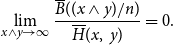 \begin{eqnarray*} \lim _{x\wedge y \to \infty } \dfrac {{\overline {B}}((x\wedge y) / n)}{{ \overline {H}}(x,\,y)}=0. \end{eqnarray*}
Let an increasing sequence of positive numbers $\{\lambda _n,\;n \in {\mathbb{N}}\}$
with
$\{\lambda _n,\;n \in {\mathbb{N}}\}$
with $\lambda _{n+1}\gt (n+1)\,\lambda _n$
, for any
$\lambda _{n+1}\gt (n+1)\,\lambda _n$
, for any $n \in {\mathbb{N}}$
, such that for any
$n \in {\mathbb{N}}$
, such that for any $x\wedge y \geq \lambda _n$
, we have
$x\wedge y \geq \lambda _n$
, we have
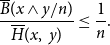 \begin{eqnarray*} \dfrac {{\overline {B}}(x\wedge y/n)}{{ \overline {H}}(x,\,y)} \leq \dfrac 1n . \end{eqnarray*}
Therefore, the points (1), (2), and (3) are satisfied with
 \begin{eqnarray*} b(x\wedge y)\,:\!=\,\sup _{0\leq k \leq x\wedge y} z(k), \qquad \qquad z(x\wedge y) = \sum _{n=1}^{\infty } \dfrac {x\wedge y}n\,\textbf { 1}_{\{\lambda _n\leq x\wedge y \leq \lambda _{n+1} \}}, \end{eqnarray*}
which completes the proof.
Remark 5.2.
We have to mention that in case of distribution $B$
with support bounded from above, the existence of function
$B$
with support bounded from above, the existence of function $b(\cdot )$
follows immediately.
$b(\cdot )$
follows immediately.
Now we study the closure property of class $\mathcal{D}^{(2)}$
with respect to scalar product.
$\mathcal{D}^{(2)}$
with respect to scalar product.
Theorem 5.1.
Let $(X,\,Y)$
be random vector and
$(X,\,Y)$
be random vector and $\Theta$
be random variable, with tail distribution
$\Theta$
be random variable, with tail distribution $ { {\overline {\mathbf{F}}}_1}(x,\,y)={\mathbf{P}}[X \gt x,\,Y\gt y]$
and
$ { {\overline {\mathbf{F}}}_1}(x,\,y)={\mathbf{P}}[X \gt x,\,Y\gt y]$
and $B$
, respectively, and assume
$B$
, respectively, and assume $B(0-)=0$
,
$B(0-)=0$
, $B(0)\lt 1$
. If
$B(0)\lt 1$
. If $\Theta$
and
$\Theta$
and $(X,\,Y)$
are independent, Assumption
5.1
holds and
$(X,\,Y)$
are independent, Assumption
5.1
holds and $(X,\,Y)\in \mathcal{D}^{(2)}$
, then
$(X,\,Y)\in \mathcal{D}^{(2)}$
, then $\textbf { H}(x,\,y) \in \mathcal{D}^{(2)}$
.
$\textbf { H}(x,\,y) \in \mathcal{D}^{(2)}$
.
Proof. Initially, we get from $F,\,G \in \mathcal{D}$
and by Cline and Samorodnitsky (Reference Cline and Samorodnitsky1994, Th. 3.3 (i)) or Leipus, Šiaulys, and Konstantinides (2023, Prop. 5.4 (i)) that the products
$F,\,G \in \mathcal{D}$
and by Cline and Samorodnitsky (Reference Cline and Samorodnitsky1994, Th. 3.3 (i)) or Leipus, Šiaulys, and Konstantinides (2023, Prop. 5.4 (i)) that the products $\Theta \,X$
and
$\Theta \,X$
and $\Theta \,Y$
follow distributions from
$\Theta \,Y$
follow distributions from $\mathcal{D}$
. From Assumption5.1, we obtain that for any
$\mathcal{D}$
. From Assumption5.1, we obtain that for any $\textbf { b} \in (0,\,1)^n$
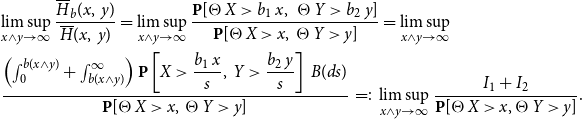 \begin{eqnarray} &&\limsup _{x\wedge y \to \infty }\dfrac {\boldsymbol { \overline {H}_b}(x,\,y)}{{ \overline {H}}(x,\,y)}=\limsup _{x\wedge y \to \infty }\dfrac {{\mathbf{P}}[\Theta \,X\gt b_1\,x,\,\,\Theta \,Y\gt b_2\,y]}{{\mathbf{P}}[\Theta \,X\gt x,\;\Theta \,Y\gt y]}=\limsup _{x\wedge y \to \infty }\nonumber \\ &&\dfrac {\left (\int _0^{b(x\wedge y)}+\int _{b(x\wedge y)}^\infty \right ){\mathbf{P}}\left [X\gt \dfrac {b_1\,x}{s},\;Y\gt \dfrac {b_2\,y}s\right ]\,B(ds)}{{\mathbf{P}}[\Theta \, X\gt x,\;\Theta \, Y\gt y]}\,=\!:\,\limsup _{x\wedge y \to \infty }\dfrac {I_1+I_2}{{\mathbf{P}}[\Theta \, X\gt x,\Theta \, Y\gt y]}. \nonumber\\\end{eqnarray}
Further, we calculate
 \begin{eqnarray*} I_2 \leq \int _{b(x\wedge y)}^\infty \,B(ds)={\overline {B}}[b(x\wedge y)] = o\left [{ \overline {H}}(x,\,y)\right ]\!, \end{eqnarray*}
as $x\wedge y \to \infty$
, due to Assumption5.1. Hence, taking into account also relation (5.4), we find
$x\wedge y \to \infty$
, due to Assumption5.1. Hence, taking into account also relation (5.4), we find
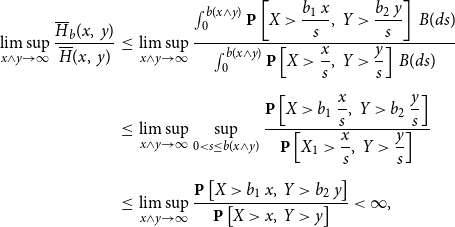 \begin{eqnarray*} \limsup _{x\wedge y \to \infty }\dfrac {\boldsymbol { \overline {H}_b}(x,\,y)}{{ \overline {H}}(x,\,y)}&\leq &\limsup _{x\wedge y \to \infty }\dfrac {\int _0^{b(x\wedge y)}{\mathbf{P}}\left [X\gt \dfrac {b_1\,x}{s},\;Y\gt \dfrac {b_2\,y}s\right ]\,B(ds)}{\int _0^{b(x\wedge y)}{\mathbf{P}}\left [X\gt \dfrac {x}{s},\;Y\gt \dfrac {y}s\right ]\,B(ds)}\\[2mm] &\leq &\limsup _{x\wedge y \to \infty } \sup _{0\lt s \leq b(x\wedge y)}\dfrac {{\mathbf{P}}\left [X\gt b_1\,\dfrac xs,\;Y\gt b_2\,\dfrac ys\right ]}{{\mathbf{P}}\left [X_1\gt \dfrac xs,\;Y\gt \dfrac ys\right ]}\\[2mm] &\leq &\limsup _{x\wedge y \to \infty }\dfrac {{\mathbf{P}}\left [X\gt b_1\,x,\;Y\gt b_2\,y\right ]}{{\mathbf{P}}\left [X\gt x,\;Y\gt y\right ]}\lt \infty, \end{eqnarray*}
where in the last step, we used the condition $(X,\,Y) \in \mathcal{D}^{(2)}$
. So we get
$(X,\,Y) \in \mathcal{D}^{(2)}$
. So we get $\textbf { H}(x,\,y) \in \mathcal{D}^{(2)}$
.
$\textbf { H}(x,\,y) \in \mathcal{D}^{(2)}$
.
Let us observe, that if $\Theta$
has upper bounded support, the proof of Theorem5.1 (as also of Theorem5.2) is implied by similar manipulations, replacing
$\Theta$
has upper bounded support, the proof of Theorem5.1 (as also of Theorem5.2) is implied by similar manipulations, replacing $b\,(x\wedge y)$
by the right endpoint of the distribution
$b\,(x\wedge y)$
by the right endpoint of the distribution $B$
. Next, we provide an analogue for class
$B$
. Next, we provide an analogue for class $\mathcal{L}^{(2)}$
.
$\mathcal{L}^{(2)}$
.
Theorem 5.2.
Let $(X,\,Y)$
be a random vector and
$(X,\,Y)$
be a random vector and $\Theta$
be a random variable, with distributions
$\Theta$
be a random variable, with distributions $\textbf { F}$
,
$\textbf { F}$
, $B$
, respectively, under condition
$B$
, respectively, under condition $B(0-)=0$
,
$B(0-)=0$
, $B(0) \lt 1$
. If
$B(0) \lt 1$
. If $\Theta$
and
$\Theta$
and $(X,\,Y)$
are independent, Assumption
5.1
holds, and
$(X,\,Y)$
are independent, Assumption
5.1
holds, and $(X,\,Y) \in \mathcal{L}^{(2)}$
, then
$(X,\,Y) \in \mathcal{L}^{(2)}$
, then $\textbf { H}(x,\,y) \in \mathcal{L}^{(2)}$
.
$\textbf { H}(x,\,y) \in \mathcal{L}^{(2)}$
.
Proof. From the fact that $(X,\,Y)$
is independent of
$(X,\,Y)$
is independent of $\Theta$
, hold
$\Theta$
, hold $F,\,G \in \mathcal{L}$
and relations (5.2) and (5.3), using Cline and Samorodnitsky (Reference Cline and Samorodnitsky1994, Th 2.2 (iii)), we find that distributions of
$F,\,G \in \mathcal{L}$
and relations (5.2) and (5.3), using Cline and Samorodnitsky (Reference Cline and Samorodnitsky1994, Th 2.2 (iii)), we find that distributions of $\Theta \,X$
and
$\Theta \,X$
and $\Theta \,Y$
belong to
$\Theta \,Y$
belong to $\mathcal{L}$
. Let
$\mathcal{L}$
. Let $\textbf { a}=(a_1,\,a_2) \gt (0,\,0)$
. Then we easily obtain
$\textbf { a}=(a_1,\,a_2) \gt (0,\,0)$
. Then we easily obtain
 \begin{eqnarray} \liminf _{x\wedge y \to \infty }\dfrac {{ \overline {H}} (x-a_1,\,y-a_2)}{{ \overline {H}} (x,\,y) }=\lim _{x\wedge y \to \infty }\dfrac {{\mathbf{P}}[\Theta \,X \gt x-a_1,\,\Theta \,Y\gt y-a_2]}{{\mathbf{P}}[\Theta \,X \gt x,\;\Theta \,Y\gt y]} \geq 1. \end{eqnarray}
Next, we show the opposite asymptotic inequality. Using Assumption5.1, we obtain
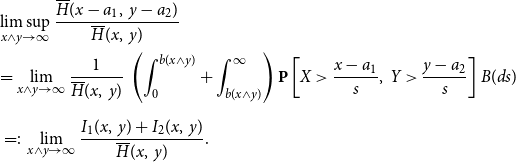 \begin{eqnarray} &&\limsup _{x\wedge y \to \infty }\dfrac {{ \overline {H}} (x-a_1,\,y-a_2)}{{ \overline {H}} (x,\,y) } \nonumber \\ &&=\lim _{x\wedge y \to \infty }\dfrac {1}{{ \overline {H}}(x,\,y)} \,\left (\int _0^{b(x\wedge y)} + \int _{b(x\wedge y)}^\infty \right ){\mathbf{P}}\left [ X\gt \dfrac {x -a_1}{s},\;Y\gt \dfrac {y-a_2}{s} \right ]B(ds)\\[2mm] \notag &&\,=\!:\,\lim _{x\wedge y \to \infty }\dfrac {I_1(x,\,y) +I_2(x,\,y) }{{ \overline {H}}(x,\,y) } . \end{eqnarray}
Thus, by Assumption5.1, we find
 \begin{eqnarray*} I_2(x,\,y) = \int _{b(x\wedge y)}^\infty \,{\mathbf{P}}\left [ X\gt \dfrac {x -a_1}{s},\;Y\gt \dfrac {y-a_2}{s} \right ]\,B(ds) \leq {\overline {B}}[b(x\wedge y)] = o\left [ { \overline {H}} (x,\,y) \right ]\!, \end{eqnarray*}
hence,
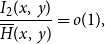 \begin{eqnarray*} \dfrac {I_2(x,\,y)}{{ \overline {H}} (x,\,y)} = o(1), \end{eqnarray*}
as $x\wedge y \to \infty$
. As a consequence, taking into account also (5.6), we get
$x\wedge y \to \infty$
. As a consequence, taking into account also (5.6), we get
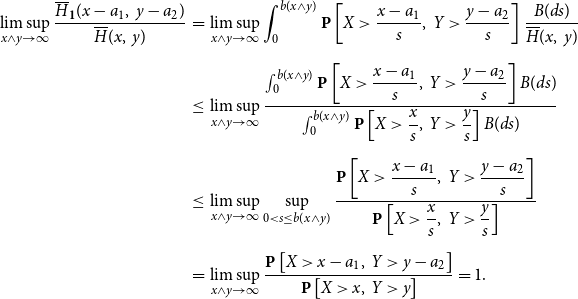 \begin{eqnarray*} \limsup _{x\wedge y \to \infty }\dfrac {\boldsymbol { \overline {H}_1} (x-a_1,\,y-a_2)}{{ \overline {H}} (x,\,y) }&=&\limsup _{x\wedge y \to \infty }\int _0^{b(x\wedge y)} {\mathbf{P}}\left [ X\gt \dfrac {x -a_1}{s},\;Y\gt \dfrac {y -a_2}{s} \right ]\dfrac {B(ds)}{{ \overline {H}} (x,\,y)} \\[2mm] &\leq & \limsup _{x\wedge y \to \infty }\dfrac {\int _0^{b(x\wedge y)} {\mathbf{P}}\left [ X\gt \dfrac {x -a_1}{s},\;Y\gt \dfrac {y -a_2}{s} \right ]B(ds)}{\int _0^{b(x\wedge y)} {\mathbf{P}}\left [ X\gt \dfrac { x }{s},\;Y\gt \dfrac {y }{s} \right ]B(ds)}\\[2mm] &\leq & \limsup _{x\wedge y \to \infty } \sup _{0\lt s \leq b(x\wedge y)}\dfrac {{\mathbf{P}}\left [ X\gt \dfrac {x -a_1}{s},\;Y\gt \dfrac {y-a_2}{s} \right ]}{{\mathbf{P}}\left [ X\gt \dfrac { x }{s},\;Y\gt \dfrac {y }{s} \right ]} \\[2mm] &=& \limsup _{x\wedge y \to \infty } \dfrac {{\mathbf{P}}\left [ X\gt x -a_1,\;Y\gt y -a_2 \right ]}{{\mathbf{P}}\left [ X\gt x,\;Y\gt y \right ]}=1 . \end{eqnarray*}
where in the last step, we consider the fact that $(X,\,Y) \in \mathcal{L}^{(2)}$
. So we have
$(X,\,Y) \in \mathcal{L}^{(2)}$
. So we have
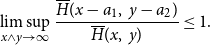 \begin{eqnarray} \limsup _{x\wedge y \to \infty }\dfrac {{ \overline {H}} (x-a_1,\,y-a_2)}{{ \overline {H}} (x,\,y) }\leq 1. \end{eqnarray}
From relations (5.5) and (5.7), we conclude $\textbf { H} (x,\,y) \in \mathcal{L}^{(2)}$
.
$\textbf { H} (x,\,y) \in \mathcal{L}^{(2)}$
.
The next statement stems from a combination of previous results.
Corollary 5.1.
Let $(X,\,Y)$
be a random vector and
$(X,\,Y)$
be a random vector and $\Theta$
be a non-negative random variable with distributions
$\Theta$
be a non-negative random variable with distributions $(F,G)$
,
$(F,G)$
, $B$
, respectively, under condition
$B$
, respectively, under condition $B(0) \lt 1$
. If
$B(0) \lt 1$
. If $(X,\,Y)$
and
$(X,\,Y)$
and $\Theta$
are independent, with
$\Theta$
are independent, with $(X,\,Y)\in (\mathcal{D}\cap \mathcal{L})^{(2)}$
and satisfy the Assumption
5.1
, then
$(X,\,Y)\in (\mathcal{D}\cap \mathcal{L})^{(2)}$
and satisfy the Assumption
5.1
, then $\textbf { H} (x,\,y) \in (\mathcal{D}\cap \mathcal{L})^{(2)}$
.
$\textbf { H} (x,\,y) \in (\mathcal{D}\cap \mathcal{L})^{(2)}$
.
6. Randomly weighted sums
Finally, we extend Theorem4.2 to weighted sums. The first kind of weighted sums takes the form
 \begin{eqnarray*} S_n(\Theta )=\sum _{k=1}^n \Theta \,X_k, \qquad T_n(\Theta )=\sum _{l=1}^n \Theta \,Y_l. \end{eqnarray*}
These quantities have the same discount factor $\Theta$
; hence, the
$\Theta$
; hence, the $(X_k,\,Y_l)$
, for
$(X_k,\,Y_l)$
, for $k,\,l=1,\,\ldots, \,n$
, are the losses or gains of the two lines of business during the
$k,\,l=1,\,\ldots, \,n$
, are the losses or gains of the two lines of business during the $k$
-th period. If the
$k$
-th period. If the $(x,\,y)$
represents the two initial capitals, respectively, then the ruin probability in this model comes in the form
$(x,\,y)$
represents the two initial capitals, respectively, then the ruin probability in this model comes in the form
 \begin{eqnarray} \psi _{and}(x,\,y,\,n)\,:\!=\,{\mathbf{P}}\left [\bigvee _{i=1}^n S_i(\Theta )\gt x,\;\bigvee _{j=1}^n T_j(\Theta )\gt y \right ]. \end{eqnarray}
The ruin probability, in models with insurance and financial risks, plays a significant role in risk theory. For example, we refer to Li and Tang (Reference Li and Tang2015), Yang and Konstantinides (Reference Yang and Konstantinides2015), Cheng (Reference Cheng2021), and Ji et al. (Reference Ji, Wang, Yan and Cheng2023) for discrete-time or continuous-time models, respectively.
The next result is based on Theorem4.2 and Corollary5.1. We have to notice that there exists the asymptotic behavior of the ruin probability in (6.1) as well.
Corollary 6.1.
Let $X_1,\,\ldots, \,X_n,\,Y_1,\,\ldots, \,Y_n$
be random variables with the following distributions
$X_1,\,\ldots, \,X_n,\,Y_1,\,\ldots, \,Y_n$
be random variables with the following distributions $F_1,\,\ldots, \,F_n,\,G_1,\,\ldots, \,G_n$
, respectively, from class
$F_1,\,\ldots, \,F_n,\,G_1,\,\ldots, \,G_n$
, respectively, from class $\mathcal{D}\cap \mathcal{L}$
, and they satisfy the GTAI dependence structure. We assume that
$\mathcal{D}\cap \mathcal{L}$
, and they satisfy the GTAI dependence structure. We assume that $\Theta$
represents a non-negative random variable with upper bounded support, it is independent of
$\Theta$
represents a non-negative random variable with upper bounded support, it is independent of $X_1,\,\ldots, \,X_n,\,Y_1,\,\ldots, \,Y_n$
and
$X_1,\,\ldots, \,X_n,\,Y_1,\,\ldots, \,Y_n$
and $(X_k,\,Y_l) \in (\mathcal{D}\cap \mathcal{L})^{(2)}$
, for
$(X_k,\,Y_l) \in (\mathcal{D}\cap \mathcal{L})^{(2)}$
, for $k,\,l=1,\,\ldots, \,n$
. If further
$k,\,l=1,\,\ldots, \,n$
. If further $X_1,\,\ldots, \,X_n$
are TAI and
$X_1,\,\ldots, \,X_n$
are TAI and $Y_1,\,\ldots, \,Y_n$
are TAI, then the following asymptotic relation is true:
$Y_1,\,\ldots, \,Y_n$
are TAI, then the following asymptotic relation is true:
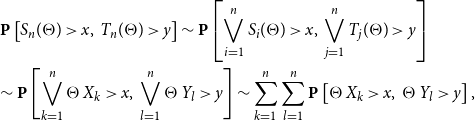 \begin{eqnarray} &&{\mathbf{P}}\left [ S_n(\Theta )\gt x,\; T_n(\Theta )\gt y \right ] \sim {\mathbf{P}}\left [\bigvee _{i=1}^n S_i(\Theta )\gt x,\;\bigvee _{j=1}^n T_j(\Theta )\gt y \right ] \nonumber \\ &&\sim {\mathbf{P}}\left [\bigvee _{k=1}^n \Theta \,X_k\gt x,\;\bigvee _{l=1}^n \Theta \,Y_l\gt y \right ] \sim \sum _{k=1}^n \sum _{l=1}^n {\mathbf{P}}\left [ \Theta \,X_k\gt x,\;\Theta \,Y_l\gt y \right ], \end{eqnarray}
as $x\wedge y \to \infty$
.
$x\wedge y \to \infty$
.
Proof. We start from Konstantinides and Passalidis (Reference Konstantinides and Passalidis2024, Lem. 2.1), and because of the upper-bound of $\Theta$
, we obtain that the products
$\Theta$
, we obtain that the products $\Theta \,X_1,\,\ldots, \,\Theta \,X_n,\,\Theta \,Y_1,\,\ldots, \,\Theta \,Y_n$
are GTAI. Now we can apply Cline and Samorodnitsky (Reference Cline and Samorodnitsky1994, Th. 2.2 (iii), Th.3.3 (ii)) to find
$\Theta \,X_1,\,\ldots, \,\Theta \,X_n,\,\Theta \,Y_1,\,\ldots, \,\Theta \,Y_n$
are GTAI. Now we can apply Cline and Samorodnitsky (Reference Cline and Samorodnitsky1994, Th. 2.2 (iii), Th.3.3 (ii)) to find $\Theta \,X_k \in \mathcal{D}\cap \mathcal{L}$
, and
$\Theta \,X_k \in \mathcal{D}\cap \mathcal{L}$
, and $\Theta \,Y_l \in \mathcal{D}\cap \mathcal{L}$
for any
$\Theta \,Y_l \in \mathcal{D}\cap \mathcal{L}$
for any $k=1,\,\ldots, \,n$
and
$k=1,\,\ldots, \,n$
and $l=1,\,\ldots, \,n$
. Because of the closedness of class
$l=1,\,\ldots, \,n$
. Because of the closedness of class $\mathcal{D}$
and using Theorem 2.2 of Li (Reference Li2013), we conclude that
$\mathcal{D}$
and using Theorem 2.2 of Li (Reference Li2013), we conclude that $\Theta _1\,X_1,\,\ldots, \,\Theta _n\,X_n$
are TAI and
$\Theta _1\,X_1,\,\ldots, \,\Theta _n\,X_n$
are TAI and $\Delta _1\,Y_1,\,\ldots, \,\Delta _n\,Y_n$
are TAI.
$\Delta _1\,Y_1,\,\ldots, \,\Delta _n\,Y_n$
are TAI.
Next, since $\Theta$
is bounded from above, so Assumption5.1 is fulfilled for
$\Theta$
is bounded from above, so Assumption5.1 is fulfilled for $\Theta$
,
$\Theta$
, $(X_k,\,Y_l)$
, for any
$(X_k,\,Y_l)$
, for any $k,\,l=1,\,\ldots, \,n$
, in order to obtain
$k,\,l=1,\,\ldots, \,n$
, in order to obtain $(\Theta \,X_k,\,\Theta \,Y_l) \in \mathcal{D}^{(2)}$
for any
$(\Theta \,X_k,\,\Theta \,Y_l) \in \mathcal{D}^{(2)}$
for any $k=1,\,\ldots, \,n$
and
$k=1,\,\ldots, \,n$
and $l=1,\,\ldots, \,n$
, it is enough to apply Theorem5.1, and similarly, by Theorem5.2, we find
$l=1,\,\ldots, \,n$
, it is enough to apply Theorem5.1, and similarly, by Theorem5.2, we find $(\Theta \,X_k,\,\Theta \,Y_l) \in \mathcal{L}^{(2)}$
for any
$(\Theta \,X_k,\,\Theta \,Y_l) \in \mathcal{L}^{(2)}$
for any $k=1,\,\ldots, \,n$
and
$k=1,\,\ldots, \,n$
and $l=1,\,\ldots, \,n$
. Therefore, the
$l=1,\,\ldots, \,n$
. Therefore, the $(\Theta \,X_k,\,\Theta \,Y_l) \in (\mathcal{D}\cap \mathcal{L})^{(2)}$
and the
$(\Theta \,X_k,\,\Theta \,Y_l) \in (\mathcal{D}\cap \mathcal{L})^{(2)}$
and the $\Theta \,X_1,\,\ldots, \,\Theta \,X_n$
,
$\Theta \,X_1,\,\ldots, \,\Theta \,X_n$
, $\Theta \,Y_1,\,\ldots, \,\Theta \,Y_n$
are GTAI. Finally, applying Theorem4.2, we conclude (6.2).
$\Theta \,Y_1,\,\ldots, \,\Theta \,Y_n$
are GTAI. Finally, applying Theorem4.2, we conclude (6.2).
Now we need some preliminary results. Several times before proving that the convolution product satisfies $H \in \mathcal{B}$
, with
$H \in \mathcal{B}$
, with $\mathcal{B}$
some distribution class, we need to prove that
$\mathcal{B}$
some distribution class, we need to prove that $H_{\varepsilon }(x)\,:\!=\,{\mathbf{P}}[(\Theta \vee \varepsilon )\,X \leq x]$
belongs to this class
$H_{\varepsilon }(x)\,:\!=\,{\mathbf{P}}[(\Theta \vee \varepsilon )\,X \leq x]$
belongs to this class $\mathcal{B}$
for any
$\mathcal{B}$
for any $\varepsilon \gt 0$
. Following the approach in Cline and Samorodnitsky (Reference Cline and Samorodnitsky1994), we show that for some constant
$\varepsilon \gt 0$
. Following the approach in Cline and Samorodnitsky (Reference Cline and Samorodnitsky1994), we show that for some constant $\delta \gt 0$
, if
$\delta \gt 0$
, if $H_{\varepsilon } \in \mathcal{L}^{(2)}$
, for any
$H_{\varepsilon } \in \mathcal{L}^{(2)}$
, for any $\varepsilon \in (0,\,\delta )$
, then
$\varepsilon \in (0,\,\delta )$
, then $H \in \mathcal{L}^{(2)}$
. However, the next results deserve theoretical attention by its own merit.
$H \in \mathcal{L}^{(2)}$
. However, the next results deserve theoretical attention by its own merit.
From here until the end of paper, we assume that $X,Y$
are non-negative random variables.
$X,Y$
are non-negative random variables.
Lemma 6.1.
If for some constant vector $\boldsymbol { \delta }=(\delta _1,\,\delta _2) \gt (0,\,0)$
, for any
$\boldsymbol { \delta }=(\delta _1,\,\delta _2) \gt (0,\,0)$
, for any $\varepsilon _1 \in (0,\,\delta _1)$
and for any
$\varepsilon _1 \in (0,\,\delta _1)$
and for any $\varepsilon _2 \in (0,\,\delta _2)$
, holds
$\varepsilon _2 \in (0,\,\delta _2)$
, holds $((\Theta \vee \varepsilon _1)\,X,\,(\Delta \vee \varepsilon _2)\,Y) \in \mathcal{L}^{(2)}$
, with
$((\Theta \vee \varepsilon _1)\,X,\,(\Delta \vee \varepsilon _2)\,Y) \in \mathcal{L}^{(2)}$
, with $X,Y,\Theta, \Delta$
non-negative random variables, then we conclude that
$X,Y,\Theta, \Delta$
non-negative random variables, then we conclude that $(\Theta \,X,\,\Delta \,Y) \in \mathcal{L}^{(2)}$
.
$(\Theta \,X,\,\Delta \,Y) \in \mathcal{L}^{(2)}$
.
Proof. Keeping in mind that $((\Theta \vee \varepsilon _1)\,X,\,(\Delta \vee \varepsilon _2)\,Y) \in \mathcal{L}^{(2)}$
, we start by Cline and Samorodnitsky (Reference Cline and Samorodnitsky1994, th. 2.2 (i)) to establish that due to
$((\Theta \vee \varepsilon _1)\,X,\,(\Delta \vee \varepsilon _2)\,Y) \in \mathcal{L}^{(2)}$
, we start by Cline and Samorodnitsky (Reference Cline and Samorodnitsky1994, th. 2.2 (i)) to establish that due to $(\Theta \vee \varepsilon _1)\,X \in \mathcal{L},\; (\Delta \vee \varepsilon _2)\,Y \in \mathcal{L}$
, we get
$(\Theta \vee \varepsilon _1)\,X \in \mathcal{L},\; (\Delta \vee \varepsilon _2)\,Y \in \mathcal{L}$
, we get $\Theta \,X \in \mathcal{L}$
and
$\Theta \,X \in \mathcal{L}$
and $\Delta \,Y\in \mathcal{L}$
. Next, we check the second property of class
$\Delta \,Y\in \mathcal{L}$
. Next, we check the second property of class $\mathcal{L}^{(2)}$
. Let
$\mathcal{L}^{(2)}$
. Let $(a_1,\,a_2) \gt (0,\,0)$
, then
$(a_1,\,a_2) \gt (0,\,0)$
, then
 \begin{eqnarray} \liminf _{x\wedge y \to \infty }\dfrac {{\mathbf{P}}\left [\Theta \,X \gt x-a_1,\;\Delta \,Y\gt y -a_2 \right ]}{{\mathbf{P}}\left [\Theta \,X \gt x,\;\Delta \,Y\gt y \right ]} \geq 1, \end{eqnarray}
Next, for any $(\varepsilon _1,\,\varepsilon _2) \gt (0,\,0)$
, we find
$(\varepsilon _1,\,\varepsilon _2) \gt (0,\,0)$
, we find
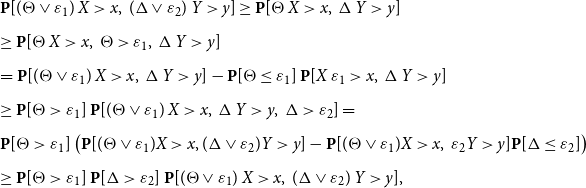 \begin{eqnarray*} &&{\mathbf{P}}[(\Theta \vee \varepsilon _1)\,X\gt x,\;(\Delta \vee \varepsilon _2)\,Y\gt y] \geq {\mathbf{P}}[\Theta \,X\gt x,\;\Delta \,Y\gt y]\\[2mm] &&\geq {\mathbf{P}}[\Theta \,X\gt x,\;\Theta \gt \varepsilon _1,\;\Delta \,Y\gt y]\\[2mm] &&={\mathbf{P}}[(\Theta \vee \varepsilon _1)\,X\gt x,\;\Delta \,Y\gt y]-{\mathbf{P}}[\Theta \leq \varepsilon _1]\,{\mathbf{P}}[X\,\varepsilon _1\gt x,\,\Delta \,Y\gt y]\\[2mm] &&\geq {\mathbf{P}}[\Theta \gt \varepsilon _1]\,{\mathbf{P}}[(\Theta \vee \varepsilon _1)\,X\gt x,\,\Delta \,Y\gt y,\,\Delta \gt \varepsilon _2]=\\[2mm] &&{\mathbf{P}}[\Theta \gt \varepsilon _1] \left ({\mathbf{P}}[(\Theta \vee \varepsilon _1) X\gt x, (\Delta \vee \varepsilon _2) Y\gt y]-{\mathbf{P}}[(\Theta \vee \varepsilon _1) X\gt x,\, \varepsilon _2 Y\gt y] {\mathbf{P}}[\Delta \leq \varepsilon _2]\right )\\[2mm] &&\geq {\mathbf{P}}[\Theta \gt \varepsilon _1]\,{\mathbf{P}}[\Delta \gt \varepsilon _2]\,{\mathbf{P}}[(\Theta \vee \varepsilon _1)\,X\gt x,\,(\Delta \vee \varepsilon _2)\,Y\gt y], \end{eqnarray*}
hence we conclude
 \begin{eqnarray} &&{\mathbf{P}}[(\Theta \vee \varepsilon _1)\,X\gt x,\;(\Delta \vee \varepsilon _2)\,Y\gt y] \geq {\mathbf{P}}[\Theta \,X\gt x,\;\Delta \,Y\gt y]\nonumber \\ &&\geq {\mathbf{P}}[\Theta \gt \varepsilon _1]\,{\mathbf{P}}[\Delta \gt \varepsilon _2]\,{\mathbf{P}}[(\Theta \vee \varepsilon _1)\,X\gt x,\,(\Delta \vee \varepsilon _2)\,Y\gt y]. \end{eqnarray}
Therefore, using (6.4) and due to properties of $\mathcal{L}^{(2)}$
, for
$\mathcal{L}^{(2)}$
, for $((\Theta \vee \varepsilon _1)\,X,\,(\Delta \vee \varepsilon _2)\,Y)$
, we obtain
$((\Theta \vee \varepsilon _1)\,X,\,(\Delta \vee \varepsilon _2)\,Y)$
, we obtain
 \begin{eqnarray*} &&\limsup _{x\wedge y \to \infty }\dfrac {{\mathbf{P}}\left [\Theta \,X \gt x-a_1,\;\Delta \,Y\gt y -a_2 \right ]}{{\mathbf{P}}\left [\Theta \,X \gt x,\;\Delta \,Y\gt y \right ]} \leq \\[2mm] &&\limsup _{x\wedge y \to \infty }\dfrac {{\mathbf{P}}\left [(\Theta \vee \varepsilon _1)\,X \gt x-a_1,\;(\Delta \vee \varepsilon _2)\,Y\gt y -a_2 \right ]}{{\mathbf{P}}[\Theta \gt \varepsilon _1] {\mathbf{P}}[\Delta \gt \varepsilon _2] {\mathbf{P}}\left [(\Theta \vee \varepsilon _1) X \gt x, (\Delta \vee \varepsilon _2) Y\gt y\right ]}=\dfrac {1}{{\mathbf{P}}[\Theta \gt \varepsilon _1] {\mathbf{P}}[\Delta \gt \varepsilon _2]}, \end{eqnarray*}
and leaving $\varepsilon _1$
and
$\varepsilon _1$
and $\varepsilon _2$
to tend to zero, we get
$\varepsilon _2$
to tend to zero, we get
 \begin{eqnarray*} \limsup _{x\wedge y \to \infty }\dfrac {{\mathbf{P}}\left [\Theta \,X \gt x-a_1,\;\Delta \,Y\gt y -a_2 \right ]}{{\mathbf{P}}\left [\Theta \,X \gt x,\;\Delta \,Y\gt y \right ]} \leq 1, \end{eqnarray*}
hence, from (6.3) and from last inequality, we reach to $(\Theta \,X,\,\Delta \,Y) \in \mathcal{L}^{(2)}$
.
$(\Theta \,X,\,\Delta \,Y) \in \mathcal{L}^{(2)}$
.
Lemma 6.2.
Let $X$
and
$X$
and $Y$
be non-negative random variables, with
$Y$
be non-negative random variables, with $(X,\,Y) \in \mathcal{L}^{(2)}$
and
$(X,\,Y) \in \mathcal{L}^{(2)}$
and $\Theta$
and
$\Theta$
and $\Delta$
be non-negative, non-degenerated to zero random variables, independent of
$\Delta$
be non-negative, non-degenerated to zero random variables, independent of $(X,\,Y)$
. We assume that
$(X,\,Y)$
. We assume that
 \begin{eqnarray} &&{\mathbf{P}}\left [\Theta \gt x\right ]=o({\mathbf{P}}\left [\Theta \,X \gt c_1\,x,\;\Delta \,Y\gt c_2\,y \right ])= {\mathbf{P}}\left [\Delta \gt y\right ], \end{eqnarray}
as $x \wedge y \to \infty$
, for any
$x \wedge y \to \infty$
, for any $c_1,\,c_2 \gt 0$
. Then
$c_1,\,c_2 \gt 0$
. Then $(\Theta \,X,\,\Delta \,Y) \in \mathcal{L}^{(2)}$
.
$(\Theta \,X,\,\Delta \,Y) \in \mathcal{L}^{(2)}$
.
Proof. From (6.5), we obtain
 \begin{eqnarray} \dfrac {{\mathbf{P}}\left [\Theta \gt x \right ]}{{\mathbf{P}}\left [\Theta \,X \gt c_1\,x\right ]} \leq \dfrac {{\mathbf{P}}\left [\Theta \gt x \right ]}{{\mathbf{P}}\left [\Theta \,X \gt c_1\,x,\;\Delta \,Y\gt c_2\,y\right ]} \longrightarrow 0, \end{eqnarray}
as $x\wedge y \to \infty$
, and similarly, we find
$x\wedge y \to \infty$
, and similarly, we find ${\mathbf{P}}\left [\Delta \gt y\right ]=o({\mathbf{P}}\left [\Delta \,Y\gt c_2\,y \right ])$
, as
${\mathbf{P}}\left [\Delta \gt y\right ]=o({\mathbf{P}}\left [\Delta \,Y\gt c_2\,y \right ])$
, as $x\wedge y \to \infty$
, for any
$x\wedge y \to \infty$
, for any $c_1,\,c_2 \gt 0$
. Hence, by Cline and Samorodnitsky (Reference Cline and Samorodnitsky1994,Th. 2.2), we find
$c_1,\,c_2 \gt 0$
. Hence, by Cline and Samorodnitsky (Reference Cline and Samorodnitsky1994,Th. 2.2), we find $\Theta \,X \in \mathcal{L}$
and
$\Theta \,X \in \mathcal{L}$
and $\Delta \,Y \in \mathcal{L}$
. Next, we show the second property of
$\Delta \,Y \in \mathcal{L}$
. Next, we show the second property of $(\Theta \,X,\,\Delta \,Y) \in \mathcal{L}^{(2)}$
. Indeed, from Lemma6.1, we see that it is enough to show this for any
$(\Theta \,X,\,\Delta \,Y) \in \mathcal{L}^{(2)}$
. Indeed, from Lemma6.1, we see that it is enough to show this for any $\Theta \geq \varepsilon _1$
and
$\Theta \geq \varepsilon _1$
and $\Delta \geq \varepsilon _2$
almost surely for any
$\Delta \geq \varepsilon _2$
almost surely for any $\varepsilon _1,\,\varepsilon _2 \gt 0$
. Let consider some
$\varepsilon _1,\,\varepsilon _2 \gt 0$
. Let consider some $a_1,\,a_2 \gt 0$
and some
$a_1,\,a_2 \gt 0$
and some $k_1,\,k_2,\,k \gt 0$
, such that for a large enough
$k_1,\,k_2,\,k \gt 0$
, such that for a large enough $x_0 \geq 0$
, it holds
$x_0 \geq 0$
, it holds
 \begin{eqnarray} {\mathbf{P}}\left [X \gt x-\dfrac {a_1}{\varepsilon _1},\;Y\gt y -\dfrac {a_2}{\varepsilon _2} \right ]\leq (1+k)\,{\mathbf{P}}\left [X \gt x,\;Y\gt y \right ], \end{eqnarray}
for any $x \wedge y \geq x_0$
and
$x \wedge y \geq x_0$
and
 \begin{eqnarray} {\mathbf{P}}\left [X \gt x-\dfrac {a_1}{\varepsilon _1}\right ]\leq (1+k_1)\,{\mathbf{P}}\left [X \gt x \right ],\quad {\mathbf{P}}\left [Y\gt y -\dfrac {a_2}{\varepsilon _2} \right ]\leq (1+k_2)\,{\mathbf{P}}\left [Y\gt y \right ], \end{eqnarray}
for any $x \geq x_0$
and
$x \geq x_0$
and $y \geq x_0$
, respectively. Then, for all
$y \geq x_0$
, respectively. Then, for all $x \wedge y \geq x_0$
, we obtain
$x \wedge y \geq x_0$
, we obtain
 \begin{eqnarray} &&{\mathbf{P}}\left [\Theta \,X \gt x-a_1,\;\Delta \,Y\gt y -a_2 \right ]=\left (\int _{\varepsilon _1}^{x/x_0}+\int _{x/x_0}^\infty \right )\,\nonumber \\ &&\left (\int _{\varepsilon _2}^{y/x_0}+\int _{y/x_0}^\infty \right )\, {\mathbf{P}}\left [X \gt \dfrac {x-a_1}{s},\;Y\gt \dfrac {y-a_2}{t} \right ] \,{\mathbf{P}}[\Theta \in ds,\;\Delta \in dt]\,=\!:\,\sum _{m=1}^4 I_m(x,\,y), \end{eqnarray}
where we find
 \begin{eqnarray*} I_4(x,\,y) = \int _{x/x_0}^\infty \,\int _{y/x_0}^\infty {\mathbf{P}}\left [X \gt \dfrac {x-a_1}{s},\;Y\gt \dfrac {y-a_2}{t} \right ] \,{\mathbf{P}}[\Theta \in ds,\;\Delta \in dt], \end{eqnarray*}
that gives
 \begin{eqnarray} I_4(x,\,y) \leq {\mathbf{P}}\left [\Theta \geq \dfrac x{x_0},\;\Delta \geq \dfrac y{x_0}\right ]. \end{eqnarray}
Now we estimate $I_1(x,\,y)$
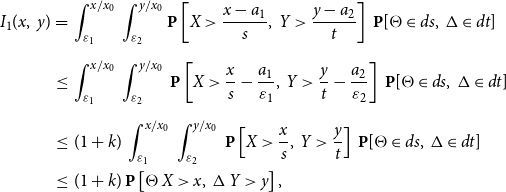 \begin{eqnarray} I_1(x,\,y) &=& \int _{\varepsilon _1}^{x/x_0}\,\int _{\varepsilon _2}^{y/x_0} {\mathbf{P}}\left [X \gt \dfrac {x-a_1}{s},\;Y\gt \dfrac {y-a_2}{t} \right ] \,{\mathbf{P}}[\Theta \in ds,\;\Delta \in dt]\\[2mm] \notag &\leq & \int _{\varepsilon _1}^{x/x_0}\,\int _{\varepsilon _2}^{y/x_0}\,{\mathbf{P}}\left [X \gt \dfrac {x}{s}-\dfrac {a_1}{\varepsilon _1},\;Y\gt \dfrac {y}{t}-\dfrac {a_2}{\varepsilon _2} \right ] \,{\mathbf{P}}[\Theta \in ds,\;\Delta \in dt]\\[2mm] &\leq & (1+k)\,\int _{\varepsilon _1}^{x/x_0}\,\int _{\varepsilon _2}^{y/x_0}\,{\mathbf{P}}\left [X \gt \dfrac {x}{s},\;Y\gt \dfrac {y}{t} \right ] \,{\mathbf{P}}[\Theta \in ds,\;\Delta \in dt]\nonumber \\ &\leq & (1+k)\,{\mathbf{P}}\left [\Theta \,X \gt x,\;\Delta \,Y\gt y \right ], \nonumber \end{eqnarray}
thus we get $I_1(x,\,y) \leq (1+k)\,{\mathbf{P}}\left [\Theta \,X\gt x,\;\Delta \,Y \gt y\right ]$
, which follows from (6.7).
$I_1(x,\,y) \leq (1+k)\,{\mathbf{P}}\left [\Theta \,X\gt x,\;\Delta \,Y \gt y\right ]$
, which follows from (6.7).
Next we consider $I_2(x,\,y)$
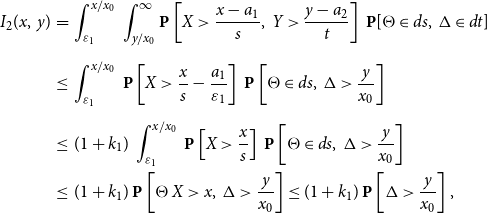 \begin{eqnarray} I_2(x,\,y) &=& \int _{\varepsilon _1}^{x/x_0}\,\int _{y/x_0}^\infty {\mathbf{P}}\left [X \gt \dfrac {x-a_1}{s},\;Y\gt \dfrac {y-a_2}{t} \right ] \,{\mathbf{P}}[\Theta \in ds,\;\Delta \in dt]\\[2mm] \notag &\leq & \int _{\varepsilon _1}^{x/x_0}\,{\mathbf{P}}\left [X \gt \dfrac {x}{s}-\dfrac {a_1}{\varepsilon _1} \right ] \,{\mathbf{P}}\left [\Theta \in ds,\;\Delta \gt \dfrac y{x_0} \right ]\\[2mm] &\leq & (1+k_1)\, \int _{\varepsilon _1}^{x/x_0}\,{\mathbf{P}}\left [X \gt \dfrac {x}{s} \right ] \,{\mathbf{P}}\left [\Theta \in ds,\;\Delta \gt \dfrac y{x_0} \right ]\nonumber \\ &\leq & (1+k_1)\,{\mathbf{P}}\left [\Theta \,X \gt x,\;\Delta \gt \dfrac y{x_0} \right ] \leq (1+k_1)\,{\mathbf{P}}\left [\Delta \gt \dfrac y{x_0} \right ], \nonumber\end{eqnarray}
which means $I_2(x,\,y) \leq (1+k_1)\,{\mathbf{P}}\left [\Delta \gt y/{x_0} \right ]$
, where in the pre-last step, we use the first relation in (6.8).
$I_2(x,\,y) \leq (1+k_1)\,{\mathbf{P}}\left [\Delta \gt y/{x_0} \right ]$
, where in the pre-last step, we use the first relation in (6.8).
For $I_3(x,\,y)$
, we use the second relation in (6.8), and due to symmetry with respect to (6.13), we find
$I_3(x,\,y)$
, we use the second relation in (6.8), and due to symmetry with respect to (6.13), we find
 \begin{eqnarray} I_3(x,\,y) &=&\int _{x/x_0}^{\infty } \int _{\varepsilon _2}^{\infty }\, {\mathbf{P}}\left [X \gt \dfrac {x-a_1}{s},\;Y\gt \dfrac {y-a_2}{t} \right ] \,{\mathbf{P}}[\Theta \in ds,\;\Delta \in dt]\nonumber \\ &\leq & (1+k_2)\,{\mathbf{P}}\left [\Theta \gt \dfrac x{x_0} \right ]. \end{eqnarray}
Therefore, putting the estimation from (6.10) to (6.15) into (6.9), we conclude
 \begin{eqnarray*} &&{\mathbf{P}}\left [\Theta \,X \gt x-a_1,\;\Delta \,Y\gt y -a_2 \right ] \leq {\mathbf{P}}\left [\Theta \gt \dfrac x{x_0},\;\Delta \gt \dfrac y{x_0} \right ] \\ &&\qquad + (1+k)\,{\mathbf{P}}\left [\Theta \,X\gt x,\;\Delta \,Y\gt y \right ]+ (1+k_2)\,{\mathbf{P}}\left [\Theta \gt \dfrac x{x_0} \right ]+ (1+k_1)\,{\mathbf{P}}\left [\Delta \gt \dfrac y{x_0} \right ], \end{eqnarray*}
Now, because of (6.5) and the relation
 \begin{eqnarray*} \dfrac {{\mathbf{P}}\left [\Theta \gt x,\; \Delta \gt y\right ]}{{\mathbf{P}}\left [\Theta \,X \gt c_1\,x,\;\Delta \,Y\gt c_2\,y\right ]} \leq \dfrac {{\mathbf{P}}\left [\Theta \gt x \right ]}{{\mathbf{P}}\left [\Theta \,X \gt c_1\,x,\;\Delta \,Y\gt c_2\,y\right ]} \longrightarrow 0, \end{eqnarray*}
as $x \wedge y \to \infty$
, for any
$x \wedge y \to \infty$
, for any $c_1,\,c_2 \gt 0$
, we find
$c_1,\,c_2 \gt 0$
, we find
 \begin{eqnarray*} \lim _{x\wedge y \to \infty }\dfrac {{\mathbf{P}}\left [\Theta \,X \gt x-a_1,\;\Delta \,Y\gt y -a_2 \right ]}{{\mathbf{P}}\left [\Theta \,X \gt x,\;\Delta \,Y\gt y \right ]} \leq 1+k. \end{eqnarray*}
By these inequalities and relation (6.6), in combination of the arbitrary choice of $k$
and relation (6.3), we have
$k$
and relation (6.3), we have $(\Theta \,X,\,\Delta \,Y) \in \mathcal{L}^{(2)}$
.
$(\Theta \,X,\,\Delta \,Y) \in \mathcal{L}^{(2)}$
.
Next, we consider the asymptotic joint-tail behavior of discounted aggregate claims in a two-dimensional discrete-time risk model, where the vector $(X_k,\,Y_k)$
represents losses in two lines of business at the
$(X_k,\,Y_k)$
represents losses in two lines of business at the $k$
-th period, while the
$k$
-th period, while the $(\Theta _k,\,\Delta _k)$
represents the discount factors of these two lines of business, respectively. In this risk model, we study only the aggregate claims, and we accept that the
$(\Theta _k,\,\Delta _k)$
represents the discount factors of these two lines of business, respectively. In this risk model, we study only the aggregate claims, and we accept that the $\Theta _1,\,\ldots, \,\Theta _n,\,\Delta _1,\,\ldots, \,\Delta _m$
are independent of claims
$\Theta _1,\,\ldots, \,\Theta _n,\,\Delta _1,\,\ldots, \,\Delta _m$
are independent of claims $X_1,\,\ldots, \,X_n,\,Y_1,\,\ldots, \,Y_m$
. For further reading on risk models with dependence among the discount factors and main claims, see Chen (Reference Chen2011, Reference Chen2017) and Yang et al. (Reference Yang, Gao and Li2016), but only in one dimension. Specifically, we have the sums:
$X_1,\,\ldots, \,X_n,\,Y_1,\,\ldots, \,Y_m$
. For further reading on risk models with dependence among the discount factors and main claims, see Chen (Reference Chen2011, Reference Chen2017) and Yang et al. (Reference Yang, Gao and Li2016), but only in one dimension. Specifically, we have the sums:
 \begin{eqnarray*} S_{n}^{\Theta }\,:\!=\,\sum _{k=1}^{n}\Theta _k X_k,\qquad T_{n}^{\Delta }\,:\!=\,\sum _{l=1}^{n}\Delta _l Y_l. \end{eqnarray*}
Assumption 6.1.
There exist constants $0\lt \xi _k \leq \delta _k$
such that hold
$0\lt \xi _k \leq \delta _k$
such that hold $\xi _k\leq \Theta _k \leq \delta _k$
almost surely, for any
$\xi _k\leq \Theta _k \leq \delta _k$
almost surely, for any $k=1,\,\ldots, \,n$
, and there exist constants
$k=1,\,\ldots, \,n$
, and there exist constants $0\lt \gamma _l \leq \zeta _l$
such that hold
$0\lt \gamma _l \leq \zeta _l$
such that hold $\gamma _l\leq \Delta _l \leq \zeta _l$
almost surely, for any
$\gamma _l\leq \Delta _l \leq \zeta _l$
almost surely, for any $l=1,\,\ldots, \,n$
.
$l=1,\,\ldots, \,n$
.
Theorem 6.1.
Let $X_1,\,\ldots, \,X_n,\,Y_1,\,\ldots, \,Y_n$
be non-negative, random variables with the following distributions
$X_1,\,\ldots, \,X_n,\,Y_1,\,\ldots, \,Y_n$
be non-negative, random variables with the following distributions $F_1,\,\ldots, \,F_n,\,G_1,\,\ldots, \,G_n$
, respectively, from class
$F_1,\,\ldots, \,F_n,\,G_1,\,\ldots, \,G_n$
, respectively, from class $\mathcal{D}\cap \mathcal{L}$
, and they satisfy the GTAI dependence structure, with
$\mathcal{D}\cap \mathcal{L}$
, and they satisfy the GTAI dependence structure, with $(X_k,\,Y_l) \in (\mathcal{D}\cap \mathcal{L})^{(2)}$
for any
$(X_k,\,Y_l) \in (\mathcal{D}\cap \mathcal{L})^{(2)}$
for any $k=1,\,\ldots, \,n$
and
$k=1,\,\ldots, \,n$
and $l=1,\,\ldots, \,n$
. We suppose that the random discount factors
$l=1,\,\ldots, \,n$
. We suppose that the random discount factors $\Theta _1,\,\ldots, \,\Theta _n,\,\Delta _1,\,\ldots, \,\Delta _n$
satisfy Assumption
6.1
and are independent of
$\Theta _1,\,\ldots, \,\Theta _n,\,\Delta _1,\,\ldots, \,\Delta _n$
satisfy Assumption
6.1
and are independent of $X_1,\,\ldots, \,X_n,\,Y_1,\,\ldots, \,Y_n$
. Then the products
$X_1,\,\ldots, \,X_n,\,Y_1,\,\ldots, \,Y_n$
. Then the products $\Theta _1\,X_1,\,\ldots, \,\Theta _n\,X_n$
,
$\Theta _1\,X_1,\,\ldots, \,\Theta _n\,X_n$
, $\Delta _1\,Y_1,\,\ldots, \,\Delta _n\,Y_n$
are GTAI with
$\Delta _1\,Y_1,\,\ldots, \,\Delta _n\,Y_n$
are GTAI with $(\Theta _k\,X_k,\,\Delta _l\,Y_l) \in (\mathcal{D}\cap \mathcal{L})^{(2)}$
. If further
$(\Theta _k\,X_k,\,\Delta _l\,Y_l) \in (\mathcal{D}\cap \mathcal{L})^{(2)}$
. If further $X_1,\,\ldots, \,X_n$
are TAI and
$X_1,\,\ldots, \,X_n$
are TAI and $Y_1,\,\ldots, \,Y_n$
are TAI, then the following asymptotic relations hold
$Y_1,\,\ldots, \,Y_n$
are TAI, then the following asymptotic relations hold
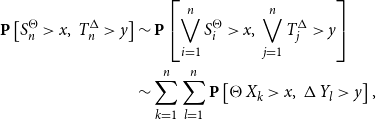 \begin{align} {\mathbf{P}}\left [S_n^{\Theta }\gt x,\;T_n^{\Delta }\gt y\right ] &\sim {\mathbf{P}}\left [\bigvee _{i=1}^n S_i^{\Theta }\gt x,\;\bigvee _{j=1}^n T_j^{\Delta }\gt y\right ] \nonumber \\ &\sim \sum _{k=1}^n \sum _{l=1}^n {\mathbf{P}}\left [ \Theta \,X_k\gt x,\;\Delta \,Y_l\gt y \right ], \end{align}
as $x\wedge y \to \infty$
.
$x\wedge y \to \infty$
.
Proof. Taking into account the upper bound for discount factors $\Theta _1,\,\ldots, \,\Theta _n,\,\Delta _1,\,\ldots, \,\Delta _n$
and their independence from
$\Theta _1,\,\ldots, \,\Theta _n,\,\Delta _1,\,\ldots, \,\Delta _n$
and their independence from $X_1,\,\ldots, \,X_n,\,Y_1,\,\ldots, \,Y_n$
, we apply Konstantinides and Passalidis (Reference Konstantinides and Passalidis2024, Lem. 2.1) to find that the products
$X_1,\,\ldots, \,X_n,\,Y_1,\,\ldots, \,Y_n$
, we apply Konstantinides and Passalidis (Reference Konstantinides and Passalidis2024, Lem. 2.1) to find that the products $\Theta _1\,X_1,\,\ldots, \,\Theta _n\,X_n,\,\Delta _1\,Y_1,\,\ldots, \,\Delta _n\,Y_n$
are GTAI. Now by Cline and Samorodnitsky (Reference Cline and Samorodnitsky1994, Th. 3.3 (i)), we get
$\Theta _1\,X_1,\,\ldots, \,\Theta _n\,X_n,\,\Delta _1\,Y_1,\,\ldots, \,\Delta _n\,Y_n$
are GTAI. Now by Cline and Samorodnitsky (Reference Cline and Samorodnitsky1994, Th. 3.3 (i)), we get $\Theta _k\,X_k \in \mathcal{D}\cap \mathcal{L}$
and
$\Theta _k\,X_k \in \mathcal{D}\cap \mathcal{L}$
and $\Delta _l\,Y_l \in \mathcal{D}\cap \mathcal{L}$
, for any
$\Delta _l\,Y_l \in \mathcal{D}\cap \mathcal{L}$
, for any $k=1,\,\ldots, \,n$
and for any
$k=1,\,\ldots, \,n$
and for any $l=1,\,\ldots, \,n$
. As a result, by class
$l=1,\,\ldots, \,n$
. As a result, by class $\mathcal{D}$
, using Li (Reference Li2013, Th. 2.2), the
$\mathcal{D}$
, using Li (Reference Li2013, Th. 2.2), the $\Theta _1\,X_1,\,\ldots, \,\Theta _n\,X_n$
are TAI, and
$\Theta _1\,X_1,\,\ldots, \,\Theta _n\,X_n$
are TAI, and $\Delta _1\,Y_1,\,\ldots, \,\Delta _n\,Y_n$
are TAI.
$\Delta _1\,Y_1,\,\ldots, \,\Delta _n\,Y_n$
are TAI.
Next, we check if $(\Theta _k\,X_k,\,\Delta _l\,Y_l) \in (\mathcal{D}\cap \mathcal{L})^{(2)}$
for any
$(\Theta _k\,X_k,\,\Delta _l\,Y_l) \in (\mathcal{D}\cap \mathcal{L})^{(2)}$
for any $k=1,\,\ldots, \,n$
and
$k=1,\,\ldots, \,n$
and $l=1,\,\ldots, \,n$
. Let
$l=1,\,\ldots, \,n$
. Let $\textbf {b}=(b_1,\,b_2) \in (0,\,1)^2$
, then
$\textbf {b}=(b_1,\,b_2) \in (0,\,1)^2$
, then
 \begin{eqnarray*} \limsup _{x\wedge y \to \infty }\dfrac {{\mathbf{P}}\left [\Theta _k\,X_k \gt b_1\,x,\;\Delta _l\,Y_l\gt b_2\,y \right ]}{{\mathbf{P}}\left [\Theta _k\,X_k \gt x,\,\Delta _l\,Y_l\gt y \right ]}\leq \limsup _{x\wedge y \to \infty }\dfrac {{\mathbf{P}}\left [X_k \gt b_1\dfrac x{\delta _k},\,Y_l\gt b_2\dfrac y{\zeta _l} \right ]}{{\mathbf{P}}\left [X_k \gt \dfrac x{\xi _k},\;Y_l\gt \dfrac y{\gamma _l} \right ]} \lt \infty, \end{eqnarray*}
which follows from the inequalities
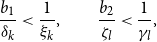 \begin{eqnarray*} \dfrac {b_1}{\delta _k} \lt \dfrac 1{\xi _k}, \qquad \dfrac {b_2}{\zeta _l} \lt \dfrac 1{\gamma _l}, \end{eqnarray*}
and the membership $(X_k,\,Y_l) \in (\mathcal{D}\cap \mathcal{L})^{(2)}$
for any
$(X_k,\,Y_l) \in (\mathcal{D}\cap \mathcal{L})^{(2)}$
for any $k=1,\,\ldots, \,n$
and
$k=1,\,\ldots, \,n$
and $l=1,\,\ldots, \,n$
. Hence, we find the relation
$l=1,\,\ldots, \,n$
. Hence, we find the relation $(\Theta _k\,X_k,\,\Delta _l\,Y_l) \in \mathcal{D}^{(2)}$
for any
$(\Theta _k\,X_k,\,\Delta _l\,Y_l) \in \mathcal{D}^{(2)}$
for any $k=1,\,\ldots, \,n$
and
$k=1,\,\ldots, \,n$
and $l=1,\,\ldots, \,n$
.
$l=1,\,\ldots, \,n$
.
Now, noticing that relation (6.5) is satisfied because of Assumption6.1, we obtain directly from Lemma6.2 the inclusion $(\Theta _k\,X_k,\,\Delta _l\,Y_l) \in \mathcal{L}^{(2)}$
for any
$(\Theta _k\,X_k,\,\Delta _l\,Y_l) \in \mathcal{L}^{(2)}$
for any $k=1,\,\ldots, \,n$
and
$k=1,\,\ldots, \,n$
and $l=1,\,\ldots, \,n$
. Hence
$l=1,\,\ldots, \,n$
. Hence $(\Theta _k\,X_k,\,\Delta _l\,Y_l) \in (\mathcal{D}\cap \mathcal{L})^{(2)}$
for any
$(\Theta _k\,X_k,\,\Delta _l\,Y_l) \in (\mathcal{D}\cap \mathcal{L})^{(2)}$
for any $k=1,\,\ldots, \,n$
and
$k=1,\,\ldots, \,n$
and $l=1,\,\ldots, \,n$
and by application of Theorem4.2 for the products, we conclude relation (6.16).
$l=1,\,\ldots, \,n$
and by application of Theorem4.2 for the products, we conclude relation (6.16).
Acknowledgements
We feel the pleasant duty to express deep gratitude to anonymous referees, who gave concise advices, which significantly improved the paper.
Data availability statement
There are no data used in this research.
Funding statement
None.
Competing interest
None.


 Open access

