


INTRODUCTION
Recent climate change projections for Central Europe suggest an increase in mean temperature of 0·7–2 °C, a decrease in precipitation, and an increase in carbon dioxide (CO2) concentration (up to 500–700 ppm) by 2050 (EEA 2012; IPCC Reference Stocker, Qin, Plattner, Tignor, Allen, Boschung, Nauels, Xia, Bex and Midgley2013).
Numerous studies have shown that crop production will be substantially affected by these changes (Olesen & Bindi Reference Olesen and Bindi2002; Lobell & Field Reference Lobell and Field2007, Smith et al. Reference Smith, Schneider, Oppenheimer, Yohe, Hare, Mastrandrea, Patwardhan, Burton, Corfee-Morlot, Magadza, Füssel, Pittock, Rahman, Suarez and Van Ypersele2009; Olesen et al. Reference Olesen, Trnka, Kersebaum, Skjelvåg, Seguin, Peltonen-Sainio, Rossi, Kozyra and Micale2011; Trnka et al. Reference Trnka, Eitzinger, Semerádová, Hlavinka, Balek, Dubrovský, Kubu, Štěpánek, Thaler, Možný and Žalud2011; Wang et al. Reference Wang, Feng and Schjoerring2013). At the same time, the production of wheat (Triticum aestivum L.) needs to be increased at a rate of 2% per year in order to satisfy the caloric and protein demand of the world's growing population (Singh et al. Reference Singh, Huerta-Espino, Sharma, Joshi and Trethowan2007). According to Tilman et al. (Reference Tilman, Balzer, Hill and Befort2011), global demand for crop calories would increase by 100 ± 11% and global demand for crop protein would increase by 110 ± 7% (mean ± s.e.) from 2005 to 2050. Ray et al. (Reference Ray, Mueller, West and Foley2013) found that wheat yield is increasing at 0·9% per year, much less than the 2·4% per year rate required to double global production by 2050.
In the Pannonian basin, including the eastern part of Austria, winter wheat production is constrained by a short growing season, winter frost, occasional spring heat and frequent drought stresses (Smith et al. Reference Smith, Schneider, Oppenheimer, Yohe, Hare, Mastrandrea, Patwardhan, Burton, Corfee-Morlot, Magadza, Füssel, Pittock, Rahman, Suarez and Van Ypersele2009; Olesen et al. Reference Olesen, Trnka, Kersebaum, Skjelvåg, Seguin, Peltonen-Sainio, Rossi, Kozyra and Micale2011). Climate change is likely to worsen the effects of these limitations (Lobell & Field Reference Lobell and Field2007; Trnka et al. Reference Trnka, Eitzinger, Semerádová, Hlavinka, Balek, Dubrovský, Kubu, Štěpánek, Thaler, Možný and Žalud2011). Elevated CO2 and temperature will affect wheat growth and phenology (Porter & Semenov Reference Porter and Semenov2005; Gouache et al. Reference Gouache, Le Bris, Bogard, Deudon, Pagé and Gate2012) and global wheat production is estimated to fall by 6% for each °C of further temperature increase and become more variable over space and time (Asseng et al. Reference Asseng, Ewert, Martre, Rötter, Lobell, Cammarano, Kimball, Ottman, Wall, White, Reynolds, Alderman, Prasad, Aggarwal, Anothai, Basso, Biernath, Challinor, De Sanctis, Doltra, Fereres, Garcia-Vila, Gayler, Hoogenboom, Hunt, Izaurralde, Jabloun, Jones, Kersebaum, Koehler, Müller, Naresh Kumar, Nendel, O'Leary, Olesen, Palosuo, Priesack, Eyshi Rezaei, Ruane, Semenov, Shcherbak, Stöckle, Stratonovitch, Streck, Supit, Tao, Thorburn, Waha, Wang, Wallach, Wolf, Zhao and Zhu2015). While the former is expected to increase photosynthetic activity due to better radiation and water use efficiency, resulting in potentially higher gross primary production and yields (Wang et al. Reference Wang, Feng and Schjoerring2013), the latter is likely to speed up plant development but reduce crop growth and grain yield (Lobell et al. Reference Lobell, Schlenker and Costa-Roberts2011) due to a shorter grain filling period (Porter & Semenov Reference Porter and Semenov2005; Olesen et al. Reference Olesen, Trnka, Kersebaum, Skjelvåg, Seguin, Peltonen-Sainio, Rossi, Kozyra and Micale2011; Jalota et al. Reference Jalota, Kaur, Kaur and Vashisht2013) or through impairing vernalization (McMaster et al. Reference McMaster, White, Hunt, Jamieson, Dhillon and Ortiz-Monasterio2008).
Improving crop adaptation to heat and drought stresses by plant breeding and site-specific modification of crop management, including the time of sowing and nitrogen (N) fertilizer application, are widely considered to be effective strategies for climate change adaptation (van Ittersum et al. Reference Van Ittersum, Cassman, Grassini, Wolf, Tittonell and Hochman2013). Shifting to earlier sowing might mitigate the negative impacts of heat and drought stress in spring on autumn-sown wheat in eastern Austria (Olesen et al. Reference Olesen, Trnka, Kersebaum, Skjelvåg, Seguin, Peltonen-Sainio, Rossi, Kozyra and Micale2011; Trnka et al. Reference Trnka, Eitzinger, Semerádová, Hlavinka, Balek, Dubrovský, Kubu, Štěpánek, Thaler, Možný and Žalud2011; Gouache et al. Reference Gouache, Le Bris, Bogard, Deudon, Pagé and Gate2012). Based on today's optimum sowing time in that region (mid to end of October, Gouache et al. Reference Gouache, Le Bris, Bogard, Deudon, Pagé and Gate2012), wheat plants germinate, emerge and begin tillering prior to winter rest. Crop growth and biomass accumulation restart again with rising temperatures in spring (usually in March).
Nitrogen is the most important mineral nutrient in terms of the current worldwide fertilizer demand (109·9 million tonnes N in 2012, FAO 2012). It has been estimated that without the input of N fertilizer, only about half of the current global population's food could be supplied based on soil organic N (Dawson & Hilton Reference Dawson and Hilton2011). Crop N fertilizer requirement depends on soil N supply and crop N demand (Gastal & Lemaire Reference Gastal and Lemaire2002). Barraclough et al. (Reference Barraclough, Howarth, Jones, Lopez-Bellido, Parmar, Shepherd and Hawkesford2010) reported that fertilizer efficiency can be improved by matching N applications to crop demand, which is affected by weather and soil conditions. For optimizing N management in winter wheat, the rate and timing of fertilizer application need to be adjusted in order to increase economic yield production while reducing the detrimental environmental impacts of N losses from agricultural fields (Gastal & Lemaire Reference Gastal and Lemaire2002). Increasing N supply appears to be unavoidable with annual fertilizer demand growth rates of 1·3% per year for the world and 1·5% for Central Europe in the future (FAO 2012).
The temporal pattern of N demand in wheat depends on crop development. Phenological stages are used to determine the appropriate timing of N application in order to maximize N-use efficiency (Heyland & Triebel Reference Heyland and Triebel1986; Alley et al. Reference Alley, Scharf, Brann, Baethgen and Hammons2009). In the Pannonian region of Austria, the optimum recommended N rate to satisfy winter wheat demand (average yield of 3·5–6 t/ha) is 110–130 kg N/ha (BMLFUW 2006), and splitting of N fertilizer into two or three applications in spring (i.e. at mid-tillering, at the beginning of stem elongation and at heading) is recommended for high-quality wheat production in Eastern Austria (Heyland & Triebel Reference Heyland and Triebel1986; BMLFUW 2006).
In terms of grain quality, N is an essential component of amino acids, which form plant and grain proteins. Wheat grain protein is a particular indicator of whether crops have received optimum N rate (Kindred et al. Reference Kindred, Verhoeven, Weightman, Swanston, Agu, Brosnan and Sylvester-Bradley2008). It has been documented that increased soil N availability most closely correlates with total protein increase in grain (Daniel & Triboï Reference Daniel and Triboï2002). However, the response of wheat grain yield and protein content to N fertilization is season-specific depending on complex interactions between genetic characteristics, management practices, soil properties and weather conditions. The complex interactions of warmth promoting crop development and drought limiting it are difficult to predict (Nendel et al. Reference Nendel, Kersebaum, Mirschel and Wenkel2014).
In terms of adjusting N application with sowing date, the response of early sown crops to N fertilizer is often more economic compared with late-sown crops (Jones et al. Reference Jones, Olson-Rutz and Dinkins2011). Ehdaie & Waines (Reference Ehdaie and Waines2001) demonstrated that N uptake at anthesis by early sown winter wheat was greater than that by optimum or late-sown crops. Few studies have focused on crop N fertilizer management under climate change conditions (Nendel et al. Reference Nendel, Kersebaum, Mirschel and Wenkel2014).
Mechanistic crop growth models integrate current understanding of the physiological processes within a mathematical framework that allows dynamic simulation of crop growth and development to estimate crop responses to genetic, environmental and management factors (Wang et al. Reference Wang, Robertson, Hammer, Hammer, Carberry, Holzworth, Meinke, Chapman, Hargreaves, Huth and McLean2002, Keating et al. Reference Keating, Carberry, Hammer, Probert, Robertson, Holzworth, Huth, Hargreaves, Meinke, Hochman, McLean, Verburg, Snow, Dimes, Silburn, Wang, Brown, Bristow, Asseng, Chapman, McCown, Freebairn and Smith2003; Stöckle et al. Reference Stöckle, Donatelli and Nelson2003; Manschadi et al. Reference Manschadi, Christopher, deVoil and Hammer2006; Nelson et al. Reference Nelson, Kokic, Crimp, Martin, Meinke, Howden, de Voil and Nidumolu2010). When linked to long-term weather data, they provide a valuable tool for quantitative assessment of the impact of management interventions, such as sowing date or N fertilization, on crop growth and yield formation in a much larger sample of environments than is possible experimentally. The agricultural production systems simulator (APSIM), for instance, is a highly advanced cropping system model consisting of modules that incorporate aspects of soil, water, N, crop residues, crop growth and development and their interactions within a management system that is driven by daily weather data (Keating et al. Reference Keating, Carberry, Hammer, Probert, Robertson, Holzworth, Huth, Hargreaves, Meinke, Hochman, McLean, Verburg, Snow, Dimes, Silburn, Wang, Brown, Bristow, Asseng, Chapman, McCown, Freebairn and Smith2003). It has already been applied successfully for predicting crop responses to tactical and strategic crop/soil management and assessing climate change impact on crops (Manschadi et al. Reference Manschadi, Christopher, deVoil and Hammer2006; Akponikpè et al. Reference Akponikpè, Gérard, Michels and Bielders2010; Zhang et al. Reference Zhang, Feng, Wang, Wang and Xu2013).
The objectives of the present study were: (i) to parameterize and evaluate the APSIM-Wheat model for an Austrian wheat cultivar (T. aestivum cvar Xenos) grown under various management conditions in the Pannonian region of Eastern Austria; and (ii) to assess the impact of climate change on optimum crop management in terms of sowing date and N fertilization (timing and rate) in this region.
MATERIALS AND METHODS
Field experiments
Two sets of field experiments (Expt I, Expt II, Table 1) were conducted at the Experimental Farm of BOKU University of Natural Resources and Life Sciences, Vienna in Gross-Enzersdorf (48°12′N, 16°34′E, 153 m a.s.l.). This site is located in the Pannonian region of Eastern Austria and represents one of the major crop production areas in the country. The climate is characterized as cool semi-arid with frequently severe frosts in winter, often without protecting snow cover, and periodically hot summers. Average annual precipitation is 552 mm and mean annual temperature is 10·9 °C (1981–2010). The monthly precipitation and mean air temperature during the experimental period are presented in Fig. 1. The total rainfall during the 2010/11 wheat growing season (September–June: 396 mm) was similar to 2011/12 (386 mm). However, the accumulated precipitation received during the critical period of shoot elongation, flowering and yield formation (April–June) in 2012 (99 mm) was markedly lower than that in 2011 (146 mm).
Monthly cumulative rainfall and average temperatures, based on daily data from 2010 to 2012 for Gross-Enzersdorf.

Experiments, sowing date, initial plant available soil water (mm) and initial soil mineral nitrogen (N) content (kg N/ha) at 0–0·9 m soil depth

* WW and SW correspond to winter and spring sown wheat, respectively. N rate is in kg/ha.
The soil is a chernozem of fine calcareous sediments with silty loam texture over gravel and sand according to the digital Austrian Soil Map 1 : 25 000 (BFW 2007), with pH 7·2 and organic matter content of 2·4% (Eitzinger et al. Reference Eitzinger, Štastná, Žalud and Dubrovský2003).
The first dataset (Expt I, Table 1), used to calibrate the cultivar-specific traits and the soil water and N conditions, involved two treatments fertilized with 100 kg N/ha during the two vegetative periods in 2010–12. The treatments differed for the sowing dates: a facultative wheat cvar Xenos was sown either as winter wheat or as spring wheat. The second dataset (Expt II, Table 1), used for model evaluation, involved three treatments during the same two vegetative periods in 2010–12. In this case, Xenos was sown in all fields as winter wheat but different total amounts of N were used (0, 60, 120 kg N/ha), split into two equal doses applied at growth stage (GS) 21 and GS31 (Zadoks et al. Reference Zadoks, Chang and Konzak1974). Plants were fertilized with calcium ammonium nitrate (27% N).
The experiments were arranged in a randomized complete block design with four replications. Wheat was sown at a depth of 0·04 and 0·125 m row spacing, with a target plant density of 300 plants/m2 in plots of 15 m2. The crops were hand weeded in bi-weekly intervals to keep them free of weed plants. The commercial product Decis (active ingredient Deltamethrin) was applied at 0·3 litre/ha on 4 April to control insects. Diseases occurred only at levels below control thresholds.
According to the representation in APSIM, main phenological stages were recorded in each plot using the Zadoks scale (Zadoks et al. Reference Zadoks, Chang and Konzak1974). Total above-ground biomass (three to eight sampling dates, from 0·25 m2) and grain yield (at maturity) were measured in both experiments. Samples were oven-dried at 60 °C for 72 h to obtain dry matter. Nitrogen concentrations in shoot biomass and grain were determined as average of ground (<1 mm) samples of c. 50 mg in duplicate by the Dumas combustion method using a carbon–nitrogen–sulphur elemental analyser (Elementar, Hanau, Germany). Plant N uptake was calculated as product of biomass and N concentrations. Gravimetric soil water and mineral nitrogen content (nitrate (NO3 −) and ammonium (NH4 +)) in the profile were determined in 0·3 m increments to a depth of 0·9 m by taking soil core samples prior to sowing, from each plot separately during the vegetative period (four dates) and after harvest. Additionally, soil samples taken before sowing were analysed for total N and organic carbon (OC) content by a combination of dry combustion with C and N analyses (Elementar, Hanau, Germany) and the Scheibler method (ÖNORM L 1084–99 1999). Data from Expt I were used to derive APSIM parameters for cultivar-specific genetic traits as well as soil water and N characteristics; those from Expt II were used to evaluate the capability of the model for predicting the response of wheat to contrasting N fertilizer applications.
Agricultural production systems simulator description
The cropping systems model APSIM (Keating et al. Reference Keating, Carberry, Hammer, Probert, Robertson, Holzworth, Huth, Hargreaves, Meinke, Hochman, McLean, Verburg, Snow, Dimes, Silburn, Wang, Brown, Bristow, Asseng, Chapman, McCown, Freebairn and Smith2003; http://www.apsim.info; accessed 10 November 2015) was used to simulate the performance of wheat in response to various sowing dates and N management regimes under both historical and future climatic conditions in Eastern Austria. The APSIM modules deployed in this analysis were WHEAT (wheat growth and development), SOILWAT (soil water balance), SOILN (soil N dynamics), RESIDUE (surface residue dynamics) and MANAGER (crop management rules).
The APSIM-WHEAT module is based on a generic plant model template (Robertson et al. Reference Robertson, Carberry, Huth, Turpin, Probert, Poulton, Bell, Wright, Yeates and Brinsmead2002; Wang et al. Reference Wang, Robertson, Hammer, Hammer, Carberry, Holzworth, Meinke, Chapman, Hargreaves, Huth and McLean2002) and simulates wheat phenology, biomass production and partitioning, yield formation, root growth and water uptake in response to genetic, environmental and management factors using a daily time-step. Temperature, vernalization requirements and photoperiod determine the rate of crop development. The potential daily above-ground biomass production (radiation-limited growth) depends on radiation intercepted (RI) and radiation use efficiency (RUE). The latter is modified according to stresses induced by extremes of daily mean temperature, oxygen deficit and N deficiency. When the potential supply of water from root uptake cannot meet the transpiration demand for radiation-limited growth (water-limited growth), biomass production is calculated as the product of soil water supply and transpiration efficiency (TE), with the latter adjusted for vapour pressure deficit estimated from daily temperatures. Daily biomass production is partitioned to leaf, stem, root and grain based on phenological stage-dependent partitioning coefficients. Crop N demand is the sum of demand from individual plant organs estimated from actual biomass and stage-dependent optimum (critical) nutrient concentration limits. When N supply is less than demand, N deficiency factors are calculated, which affect photosynthesis, phenology and grain-filling processes. Meinke et al. (Reference Meinke, Hammer, van Keulen and Rabbinge1998), Robertson et al. (Reference Robertson, Carberry, Huth, Turpin, Probert, Poulton, Bell, Wright, Yeates and Brinsmead2002), Wang et al. (Reference Wang, Robertson, Hammer, Hammer, Carberry, Holzworth, Meinke, Chapman, Hargreaves, Huth and McLean2002), Manschadi et al. (Reference Manschadi, Christopher, deVoil and Hammer2006), Moeller et al. (Reference Moeller, Pala, Manschadi, Meinke and Sauerborn2007) and Huth et al. (Reference Huth, Thorburn, Radford and Thornton2010) provide more details. The impacts of changes in atmospheric CO2 concentrations on wheat growth can also be simulated using APSIM by modifying RUE, TE, specific leaf area and critical N concentrations (Reyenga et al. (Reference Reyenga, Howden, Meinke and McKeon1999) for details).
The modules SOILN and RESIDUE simulate N transformation processes (Probert et al. Reference Probert, Dimes, Keating, Dalal and Strong1998), while the SOILWAT module uses a cascading water balance approach to simulate soil water dynamics in a layered profile.
Climate change scenarios and wheat simulations
In order to analyse the potential impact of climate change on N management of wheat grown in Eastern Austria, the APSIM model was run with historical (baseline (BL)) and future weather data (climate scenarios).
Uncertainty in future climate projections was considered by the use of six different climate scenarios. In this regard, the projections of three Global Circulation Models (GCMs), namely MPEH5, IPCM4 and CGMR, for the period 2035–65 were used in combination with two emission scenarios A1B and B1 (Dubrovsky et al. Reference Dubrovsky, Simon, Stuch, Kok and Harrison2011). The emission scenarios represent different possible future developments of global greenhouse gas emissions (Nakienovic & Swart Reference Nakienovic and Swart2000): A1B is characterized by rapid economic growth in the future but also the development of alternatives to fossil energy use in the future. Under this scenario for the period 2035–65 a mean atmospheric CO2 concentration of 536 ppm is assumed for simulation of the direct CO2 effect on crop photosynthesis, whereas in the BL (1981–2010) 385 ppm is given. In contrast, B1 represents a scenario of much lower global emissions where, under the same global population growth, significant mitigation measures are introduced, resulting in a mean CO2 concentration of only 490 ppm for the period 2035–65. Based on statistical characteristics of past measured weather variability, 100 years of daily weather data were generated for the BL (1981–2010) and the scenarios (2035–65) by the stochastic weather generator ‘Met&Roll flexible and improved’ (M&Rfi; Dubrovsky Reference Dubrovsky1997) and used as input for APSIM. To generate the weather series for the future climate, the weather generator parameters were modified according to the monthly climate change signals of the GCM projections (Thaler et al. Reference Thaler, Eitzinger, Trnka and Dubrovsky2012).
The three climate models differ substantially in terms of the magnitude of projected changes in monthly temperature and rainfall for Eastern Austria. Compared with the BL weather data all models predict a warming trend of 0·39–3·13 °C with the highest increases occurring in July and August (Table 2). Compared with CGMR, both IPCM4 and MPEH5 project stronger warming with high emissions. According to CGMR, the impact of climate change on rainfall in the region will not be severe. While a maximum decrease of 17% may occur in summer rainfall, an increase of the same magnitude is projected for the winter and spring months. Projections of IPCM4 under both A1B and B1 scenarios suggest severe reductions in monthly rainfall throughout the year with the strongest decrease (>38%) for the period May to September (Table 2). Similar reductions in rainfall are projected by MPEH5-A1B, while under the B1 emission scenario, MPEH5 predicts a maximum reduction of only 9% in the spring and summer months, and rainfall in winter may even increase slightly.
Changes in monthly mean air temperatures (°C) and rainfall (mm) as projected by three future climate scenarios (CGMR, IPCM4, MPEH5) under emission scenarios A1B or B1 (2035–65) compared with the baseline (BL) data for 1981–2010 at the experimental farm Gross-Enzersdorf, Eastern Austria

In order to analyse the impact of climate change on N management in wheat, APSIM was run with the 100-year stochastic daily weather series for BL as well as those generated by the three GCMs under either A1B or B1 emission conditions. A factorial combination of sowing date and N fertilizer treatments was used in all simulation runs. Wheat was sown on 20 September, 20 October and 20 November and fertilized with 80, 120, 160 and 200 kg N/ha split between Zadoks growth stages (GS) 21 (beginning of tillering), 31 (beginning of stem elongation) and 51 (beginning of heading) (Table 3). Each sowing date × N treatment combination was run for 100 years of daily weather data resulting in a total number of 1200 simulated wheat seasons for each climate scenario: APSIM was run for all these wheat seasons separately with identical initial values. The soil characteristics represented the soil type at Gross-Enzersdorf (Table 4) and were adapted based on APSIM parameterization guidelines (Burk & Dalgliesh Reference Burk and Dalgliesh2008). The initial plant available soil water of 39 mm (0–0·9 m soil depth) was derived from the simulation of average accumulated soil water prior to wheat planting assuming a fallow period of 3 months (July–September) using 100 years of BL weather data. The initial soil mineral N content was set to 35 kg N/ha (0–0·9 m soil depth), assuming a cereal pre-crop that used up most of available soil mineral N.
Factorial combinations of climate models with emission scenarios and management treatments for simulation experiment

GS, growth stage.
Soil bulk density (BD), air-dry soil, lower limit (LL15), drained upper limit (DUL) and saturated (SAT) water content, total organic carbon (OC), fractions of inert (finert) and labile microbial biomass (fbiom) carbon used for soil parameterization of APSIM

Statistical analysis
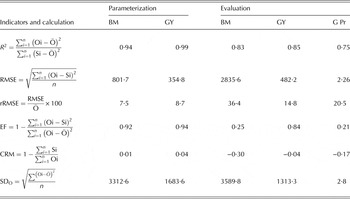
All measured and simulated data were compared graphically and analysed statistically (Moriasi et al. Reference Moriasi, Arnold, Van Liew, Bingner, Harmel and Veith2007) with SAS® 9·2. Coefficients of determination (R 2, 1 : 1) which measure the true deviation of the estimations (Y) from observations (X) and paired t tests were computed. The root-mean-squared error (RMSE, Fox Reference Fox1981), relative root-mean-squared error (rRMSE, Jørgensen et al. Reference Jørgensen, Kamp-Nielsen, Christensen, Windolf-Nielsen and Westergaard1986), modelling efficiency (EF, Nash & Sutcliffe Reference Nash and Sutcliffe1970) and coefficient of residual mass (CRM, Loague & Green Reference Loague and Green1991) were calculated and model performance was estimated based on both, parameterization and evaluation results. If the paired t test was not significant and RMSE was similar to the standard deviation of the observations, model performance was considered as good (Zhang et al. Reference Zhang, Feng, Wang, Wang and Xu2013).
RESULTS
Model parameterization and evaluation
The data from Expt I with contrasting sowing dates in autumn and spring were used to derive the phenology parameters for the cultivar Xenos required for APSIM. The coefficients indicating the sensitivities to vernalization (vern_sens) and photoperiod (photop_sens) were modified by trial and error to represent the characteristic of Xenos as a cultivar with low vernalization requirement and hence suitable for spring planting (Table 5). Also the thermal time (°Cd) requirements of Xenos for completing the phenological phases from the end of the vegetative stage to physiological maturity were derived from Expt I.
Genetic coefficients for parameterization of wheat cvar Xenos for APSIM-Wheat

The parameterized APSIM was able to simulate the response of wheat development and growth to both autumn and spring sowing satisfactorily (Figs 2(a) and (b)). The simulated dates of wheat flowering across sowing dates and seasons, for instance, were within ±2 days of observed dates. The simulated time course of biomass accumulation also agreed well with observed data, except for the WW–11–N100 treatment when the model overestimated wheat growth in spring. This might be the result of an overestimation of leaf area index (LAI), which could not be further explored due to lack of field observations. Due to lower precipitation in critical phases, wheat crops in 2012 yielded less than those in 2011. The lowest yield was observed in SW–12–N100 (2042 kg/ha) and the highest in WW–11–N100 (6010 kg/ha). Finally, APSIM was capable of simulating the observed response of wheat yield to contrasting environmental conditions (Fig. 2(c)).
Comparison of the observed (symbols) and simulated (lines) time courses of phenological stages (a), aboveground biomass (b) and grain yield (c) for treatments WW–11–N100 and WW–12–N100 (filled symbols and bold lines) or SW–11–N100 and SW–12–N100 (open symbols and narrow lines) in 2010/11 (left) and 2011/12 (right), respectively. Parameterization results from Expt I.

Simulated straw and grain N concentrations agreed with observed data, but APSIM underestimated straw N and overestimated grain N by 6% (data not presented) for both winter and spring sowings. However, results of paired t tests for straw N and grain N concentrations showed no significant differences between means of simulated and observed values.
The dynamics of soil water and mineral N (NO3 −) were simulated well throughout both wheat growing seasons. Figure 3 shows the data in individual soil layers for the autumn-sown crops. The observed soil mineral N contents in the deepest layer in spring 2011 were higher that predicted. This is probably due to experimental error, as the simulated values in the upper two layers and also later in the season matched well with the measurements.
Comparison of the observed (symbols) and simulated (lines) volumetric soil water (left) and NO3 − -N (right) content in 0·0–0·3 m (a, d), 0·3–0·6 m (b, e) and 0·6–0·9 m (c, f) soil profile for treatments WW-11-N100 and WW-12-N100, respectively. Parameterization results from Expt I.

The observed wheat yields in the evaluation experiment (Expt II) ranged from 2143 kg/ha (WW–12–N0) to 5715 kg/ha (WW–11–N120). Comparison between simulated and observed data revealed the capability of APSIM to predict the response of wheat yield to contrasting levels of N fertilizer (R 2 = 0·83, RMSE = 482·2 kg/ha) (Fig. 4(a)). The simulated grain N concentrations also agreed well with the observed data (R 2 = 0·75, RMSE = 0·4%) (Fig. 4(b)). Statistical indicators for evaluation of model performance with regard to biomass, grain yield and grain protein concentration are presented in Table 6. Grain protein was considered only for model evaluation because the dataset for parameterization included no N fertilizer levels and thus showed hardly any variability in grain protein. According to the calculated parameters, model performance slightly varied for different traits. As RMSE values were consistently smaller than standard deviations of the observations, model performance can generally be considered as ‘good’ for all traits based on both parameterization and evaluation (Zhang et al. Reference Zhang, Feng, Wang, Wang and Xu2013). The magnitude of relative error was higher for model evaluation. Negative values of CRM for the evaluation dataset indicate some overestimation for biomass and grain protein. The predicted values of other plant and soil variables (phenology, biomass accumulation, soil water and mineral N content) reflected the observed data quantitatively (data not shown).
Relationship between the observed and simulated values of grain yield (left) and grain nitrogen concentration (right) of autumn sown wheat under different fertilizer levels (0, 60 and 120 kg N/ha) in 2011 and 2012. Evaluation results from Expt II.

Statistical indicators for evaluation of model performance at parameterization and evaluation steps with regard to shoot biomass (BM), grain yield (GY) and grain protein concentration (G Pr)
Simulated wheat grain yield, protein concentration and nitrogen uptake
Under the BL scenario, wheat yield ranged from a minimum of 1345 kg/ha to a maximum of 7855 kg/ha with an average of 5002 kg/ha (Fig. 5(a)). The simulated wheat yields under climate change scenarios varied substantially among the three GCMs. While the results for the CGMR model did not differ significantly from the BL scenario, wheat yields under IPCM4 projections were reduced by 30% in B1 and 33% in A1B. For the MPEH5 model, the emission scenario had a marked effect on simulated yields. Under low CO2 (B1), wheat yields were similar to the BL scenario, while high CO2 (A1B) caused 22% yield reduction.
Simulated grain yield (a), grain protein concentration (b) and nitrogen uptake (c) under baseline (1981–2010) and six future climate scenarios of three Global Circulation Models and two emission scenarios for 2035–65. The box plots show 5, 25, 50, 75 and 95 percentiles. The crosses indicate minimum and maximum. The solid and bold lines show median and mean values, respectively.

Due to statistically non-significant differences in simulated mean wheat yields between CGMR and BL, special emphasis is placed on the results of the IPCM4 and MPEH5 scenarios.
The simulated average grain protein concentration for BL was 12%. The overall effect of climate change on this trait appears to be positive (Fig. 5(b)). Under the IPCM4-A1B scenario, wheat grain protein is expected to reach close to 14%. The highest increases in grain protein were observed in the climate scenarios causing the largest reductions in grain yield (IPCM4-A1B, IPCM4-B1 and MPEH5-A1B). Contrasting with yield stability, the stability of grain protein across years increased when yields were reduced due to climate change.
The pattern of shoot N mainly follows the grain yield trend and the higher grain protein concentrations in some climate scenarios did not completely compensate for the predicted yield reductions (Fig. 5(c)).
Effects of sowing date and nitrogen management
Under BL conditions, shifting wheat sowing date from late September to late November resulted in a marked decrease in grain yield (Fig. 6(a)). Across all climate scenarios, the yields of crops sown on 20 October (SD2) and 20 November (SD3) were reduced by 17 and 29%, respectively, compared to 20 September (SD1). The simulated yields for the IPCM4 and MPEH5 models followed a similar trend, although the magnitude of yield reduction in response to sowing date was larger when changing from SD1 to SD2. While moving wheat sowing from SD1 to SD2 caused a yield decrease of 13% in the BL scenario, the corresponding average yield reduction under climate change was 19%. The lowest grain yield (2438 kg/ha) was simulated for crops sown at SD3 with the IPCM4-A1B scenario. Across all climate scenarios, simulations of spring-sown wheat showed even lower yield results than all autumn sowings (data not shown).
Simulated grain yield (a) and grain protein concentration (b) under baseline (1981–2010) and four future climate scenarios of two Global Circulation Models and two emission scenarios for 2035–65 as affected by the sowing date.

The decreasing pattern in grain yield with sowing date was contrasted by an increasing trend in grain protein concentration in response to sowing date (Fig. 6(b)). Sowing wheat later resulted in an increase in grain protein under both BL and climate change scenarios. The maximum protein concentration (14·5%) was simulated for SD3 with the IPCM4-A1B scenario.
Under BL conditions, increasing the rate of N fertilizer resulted in higher simulated wheat yields at all three sowing dates, although the positive effect of N fertilization on grain yield diminished with later sowing dates (Fig. 7(a)). The increase in N rate from 160 to 200 kg N/ha resulted in considerably higher grain yields in the earliest sown crops only. The simulated response of grain protein concentration to increasing N supply was similar to that for grain yield (Fig. 7(b)). The expected decrease in grain protein due to increasing yield with early sowing can be nearly compensated for when 200 kg N/ha is applied.
Simulated grain yield (a) and grain protein concentration (b) under baseline (1981–2010) conditions as affected by crop management (sowing date × N rate).

Simulations with IPCM4 projections, taken as the worst case climate scenario, suggest that application rates above 120 kg N/ha will not be economical irrespective of sowing date (Fig. 8(a)). A slight rise in biological yield at 160 kg N/ha was only seen with early sowing. Relative to BL, yields of wheat plants sown at SD2 and SD3 would be reduced by >30% and percentage reduction increases with increasing N rate (Fig. 8(b)). Grain protein concentration was positively affected by N rate above 120 kg/ha in early sown crops only (Fig. 8(c)). Compared with BL, climate change showed a positive effect on grain protein at all sowing dates, with the greatest increases simulated for crops grown at a rate of 80 kg N/ha after planting in October or November (SD2, SD3) (Fig. 8(d)). All these effects were hardly affected by emission scenario.
Simulated grain yield (a), grain protein concentration (c) and relative changes of yield (b) and protein (d) compared with the baseline under IPCM4 with two emission scenarios (A1B = white, B1 = black bars) as affected by crop management (sowing date × N rate).

In the current simulations, APSIM was configured to apply fertilizer at specific development stages (GS 21, 31, 51). With the BL scenario, the earliest sown crops (SD1) were fertilized on average 67 and 203 days after sowing (DAS) for the N80 treatment. For higher N rates, an additional application was performed 233 DAS (Table 7, cf. Table 3). Under IPCM4-A1B, the first N application was on average up to 1 month (19–29 days) earlier than that for the BL. With low emissions (B1), the first N application occurred 7–20 days earlier than today.
Simulated average days after sowing of fertilizer application at target Zadoks stages under baseline (BL) (1981–2010) and IPCM4 climate scenario with two emission scenarios for 2035–2065 as affected by sowing date

GS, growth stage.
DISCUSSION
The parameterization of APSIM for wheat growth and development at the present study site in the Pannonian region of East Austria was completed successfully. Thus, the comparatively large yield range of 2·1–5·7 t/ha observed in the field experiments for model evaluation was simulated well by the model. It is also in agreement with the expected range of yield on the site (BMLFUW 2006). Additionally the simulated grain quality, i.e. protein concentration, was in good agreement with the field observations. It is worth mentioning, however, that model evaluation should ideally be conducted against completely independent datasets. In the present study, the data from Expt II were recorded from the same experimental site and in the same seasons as for Expt I used for model parameterization. The difference in N management between the experiments, however, underpins the capability of APSIM in predicting wheat response to various levels of N supply, which is the main focus of the present study. Several previous studies reported the suitability of APSIM for predicting wheat growth and yield formation under contrasting genetic, environmental and management conditions (Meinke et al. Reference Meinke, Hammer, van Keulen and Rabbinge1998; Probert et al. Reference Probert, Dimes, Keating, Dalal and Strong1998; Wang & Engel Reference Wang and Engel1998; Asseng et al. Reference Asseng, Van Keulen and Stol2000; Keating et al. Reference Keating, Carberry, Hammer, Probert, Robertson, Holzworth, Huth, Hargreaves, Meinke, Hochman, McLean, Verburg, Snow, Dimes, Silburn, Wang, Brown, Bristow, Asseng, Chapman, McCown, Freebairn and Smith2003; Manschadi et al. Reference Manschadi, Christopher, deVoil and Hammer2006; Moeller et al. Reference Moeller, Pala, Manschadi, Meinke and Sauerborn2007; Chenu et al. Reference Chenu, Cooper, Hammer, Mathews, Dreccer and Chapman2011).
When predicting the yields for 100 random years under the BL climate scenario, the range of 1·3–7·9 t/ha was very large, indicating substantial yield variability under the BL climate. However, the average yield level of 5·0 t/ha agrees well with long-term field data from the region (BMLFUW 2006; Fischl et al. Reference Fischl, Traudtner, Surböck and Kranzler2013).
Variation in simulated yields among GCMs reflects their projections for the magnitude of changes in temperature and rainfall. Yield stability, as indicated by the variance between years, was not strongly affected by climate change, as shown also by other studies (Eitzinger et al. Reference Eitzinger, Trnka, Semerádová, Thaler, Svobodová, Hlavinka, Siska, Takáč, Malatinská, Nováková, Dubrovský and Zalud2013).
According to the IPCM4 model, the future climate in the region will be substantially warmer and drier than the historical data, whereas the projections by CGMR suggest less severe changes in temperature and rainfall. In the current climate of central Europe, including the Pannonian zone of Eastern Austria, farming systems are not markedly sensitive to climate change, because expected changes in temperature or rainfall have moderate impact (Chloupek et al. Reference Chloupek, Hrstkova and Schweigert2004). The adverse effect of climate change on wheat yield in the current simulations may be attributed to higher temperatures, leading to an acceleration of phenological development. This can ultimately result in reduced yield due to shortening of the growing season, especially the grain filling period (Asseng et al. Reference Asseng, Ewert, Martre, Rötter, Lobell, Cammarano, Kimball, Ottman, Wall, White, Reynolds, Alderman, Prasad, Aggarwal, Anothai, Basso, Biernath, Challinor, De Sanctis, Doltra, Fereres, Garcia-Vila, Gayler, Hoogenboom, Hunt, Izaurralde, Jabloun, Jones, Kersebaum, Koehler, Müller, Naresh Kumar, Nendel, O'Leary, Olesen, Palosuo, Priesack, Eyshi Rezaei, Ruane, Semenov, Shcherbak, Stöckle, Stratonovitch, Streck, Supit, Tao, Thorburn, Waha, Wang, Wallach, Wolf, Zhao and Zhu2015). Impacts of increased temperatures on grain yield depend greatly on location (Ludwig & Asseng Reference Ludwig and Asseng2006) and degree of warming. Very cold areas may even benefit from temperature increases, leading to improved crop yields (Berg et al. Reference Berg, De Noblet-Ducoudré, Sultan, Lengaigne and Guimberteau2013).
Contradictory results have been reported about the impact of temperature and rainfall changes and their interactions. Asseng et al. (Reference Asseng, Ewert, Martre, Rötter, Lobell, Cammarano, Kimball, Ottman, Wall, White, Reynolds, Alderman, Prasad, Aggarwal, Anothai, Basso, Biernath, Challinor, De Sanctis, Doltra, Fereres, Garcia-Vila, Gayler, Hoogenboom, Hunt, Izaurralde, Jabloun, Jones, Kersebaum, Koehler, Müller, Naresh Kumar, Nendel, O'Leary, Olesen, Palosuo, Priesack, Eyshi Rezaei, Ruane, Semenov, Shcherbak, Stöckle, Stratonovitch, Streck, Supit, Tao, Thorburn, Waha, Wang, Wallach, Wolf, Zhao and Zhu2015) found that under rain-fed and water- and N-limited conditions, seasonal temperature increases of up to 2 °C increased yields by avoiding water and heat stress due to earlier maturation. However, other experimental evidence suggests that increased temperature has negative impacts regardless of water (Pradhan et al. Reference Pradhan, Vara Prasad, Fritz, Kirkham and Gill2012). Eitzinger et al. (Reference Eitzinger, Orlandini, Stefanski and Naylor2010), however, reported that, under non-limiting water availability, the combined effect of increased temperature and elevated atmospheric CO2 may result in 30–55% higher wheat yield in eastern Austria with moderate reduction in rainfall. According to Harnos et al. (Reference Harnos, Bencze, Janda, Juhász and Veisz2002), the negative effects of water stress for wheat crops grown in phytotron chambers were compensated by elevated CO2 concentration.
In studies performed by Alexandrov et al. (Reference Alexandrov, Oikawa and Yamagata2002) and Kersebaum & Nendel (Reference Kersebaum and Nendel2014), climate effects turned from negative to positive yield changes when the CO2 effect was considered. The current findings, however, suggest that under rain-fed conditions the expected CO2 increase cannot compensate for the negative effects of water deficit on crop yield. Obviously, the projected severe decreases in the rainfall scenarios considered in the present study have substantially contributed to simulated reductions in wheat yield. With less water deficit however, as predicted by CGMR, elevated CO2 might convey slight yield increases.
The current results on future grain protein predictions confirm the commonly observed negative relationship between wheat grain yield and protein concentration, as growing conditions favouring higher crop biomass production and yield result in dilution of N and consequently protein in plant tissue. The variability of grain protein concentration in the current work was found to decrease with impaired yields due to adverse climate effects. This makes the production of high-quality bread-making wheat more reliable in a future with substantial climate change for the study region. Wieser et al. (Reference Wieser, Manderscheid, Erbs and Weigel2008) investigated the effects of different levels of CO2 and N supply on the content and composition of proteins in winter wheat. In contrast to the current findings, the results of Wieser et al. (Reference Wieser, Manderscheid, Erbs and Weigel2008) indicate a significant decrease in grain crude protein content of winter wheat under elevated CO2 and N supply of 100 kg N/ha. Different effects of elevated CO2 might be due to variation of the proportion of the different protein fractions amongst different cultivars.
With view to planting date, the simulation results suggest that in Eastern Austria planting wheat in late September is the best strategy under both current and future climatic conditions. Earlier sowing of wheat will even be more important in future, as delaying of planting to late October will be associated with a much larger reduction in grain yield under climate change conditions compared to BL. At present, wheat is often not sown until October on farms in this region because of: (i) restrictions due to harvesting time of the pre-crop, e.g. sugar beet; and (ii) the risk of early disease infections (insect-transmitted viruses or fungal diseases), which are not considered in APSIM.
Earlier sowing and use of longer-duration (late maturing) cultivars have been suggested previously as possible adaptive strategies to climate change (Tubiello et al. Reference Tubiello, Donatelli, Rosenzweig and Stockle2000; Snape et al. Reference Snape, Butterworth, Whitechurch and Worland2001; Olesen & Bindi Reference Olesen and Bindi2002). Olesen et al. (Reference Olesen, Trnka, Kersebaum, Skjelvåg, Seguin, Peltonen-Sainio, Rossi, Kozyra and Micale2011) questioned whether moving sowing from the optimum date either to a much earlier or later date could be recommended in the Pannonian basin. Therefore other short-term adjustments (e.g. changes in crop species and cultivars) and long-term adaptations (e.g. changes in rotation, water management, land allocation and farming systems) might be introduced to reduce negative effects and exploit possible positive impacts of climate change. In order to find the best adaptation strategy for future conditions in France, Gouache et al. (Reference Gouache, Le Bris, Bogard, Deudon, Pagé and Gate2012) tested advancing sowing date to 20 September and using an earlier cultivar: they concluded that adaptation through earlier sowing dates was least efficient and selecting earlier heading cultivars was somewhat efficient to avoid the summer heat stress. According to the results of Wang et al. (Reference Wang, Wang and Liu2011), the wheat growing season in Australia will probably decrease by 22 days until 2050 and 35 days until 2070 as a consequence of 2·3 and 3·8 °C warming: they see the key advantage of simulation modelling in the quantification of these responses for deriving site-specific recommendations. The simulated shortening of the wheat-growing period (data not shown) and, consequently, decreasing biomass and yield under climate change conditions in the present study are in agreement with estimations of Thaler et al. (Reference Thaler, Eitzinger, Trnka and Dubrovsky2012).
The optimum fertilizer N rate will not change much with changing climate, only very high rates at 200 kg N/ha will be no more economic even with the earliest sowings. Apparently, N fertilizer application dates will be earlier in the future in order to account for the effect of climate change on wheat phenology. However, the first N application (GS21) will become due before onset of winter only after early sowing (SD1), independent of climate change.
In conclusion, the parameterization and evaluation results provide evidence that APSIM-Wheat is a mature crop model that could be adapted to our specific site and soil conditions in order to study the impact of climate change on wheat yield and grain quality in the Pannonian region of East Austria. Linking APSIM with daily weather projections from three GCMs, combined with two emission scenarios, provides a useful tool for analysing the potential impact of climate change on wheat production in the study region. Overall, the simulation results suggest a probable decrease in wheat yield under future climatic conditions, although the magnitude of predicted changes differed substantially between the climate models and even slightly increasing yields seem possible. Grain quality in terms of protein content, however, is affected favourably by climate change. While higher temperatures and decreasing rainfall projected for the region will most probably cause substantial yield losses, modifying crop sowing date and amount and timing of N application may help to partially compensate those adverse effects. Future maximum wheat yields in Eastern Austria could be achieved when crops are sown in September with 120–160 kg N/ha applied at earlier dates than the current practice. Harvesting wheat grain with high baking quality seems more probable due to expected climate change.



