




1. Introduction
The shipping industry has commenced its transformation towards autonomous operations by developing and adapting smart technologies and intelligent systems. Several initiatives focused on the development of Maritime Autonomous Surface Ships (MASS), with major efforts pursued by industrial projects, such as Yara Birkeland (Yara, 2018) and ASKO (Smartmaritime, 2020), which have already launched commercial MASS. Additionally, various aspects of the MASS development have been addressed in recent research/innovation activities and projects, including MUNIN (MUNIN, 2016), AAWA (AAWA, 2016), SISU, SVAN (Daffey, Reference Daffey2018), AUTOSHIP (Bolbot et al., Reference Bolbot, Theotokatos, Boulougouris, Wennersberg, Nordahl, Rødseth, Faivre and Colella2020) and others.
The Autonomous Navigation System (ANS) constitutes one of the key enabling technologies required to facilitate MASS operations. For MASS with high autonomy degree, the ANS is required to include the following functionalities: (a) identification of surrounding objects and weather conditions; (b) communication with other ships; (c) information provision to the Remote Control Centre for decision-making; (d) decision-making with respect to autonomous navigation; and (e) control of power demand requests from power and propulsion systems. The definitions are in line with functionalities for ANS provided in Chaal et al. (Reference Chaal, Valdez Banda, Glomsrud, Basnet, Hirdaris and Kujala2020), however, it is acknowledged that these definitions can be different as reported in other studies (Rødseth et al., Reference Rødseth, Tjora and Baltzersen2015; Wróbel et al., Reference Wróbel, Montewka and Kujala2018; Ventikos et al., Reference Ventikos, Chmurski and Louzis2020; Basnet et al., Reference Basnet, Bahootoroody, Chaal, Valdez Banda, Lahtinen and Kujala2022). In this study, the ANS is practically considered to be the electronic brain of the ship, which will replace the crew dealing with navigation. The functionalities (a)–(d) pertain to the ship's external interactions, whilst the functionalities (e) is associated with the ship's internal interactions.
Since the ANS is responsible for making decisions that directly impact the safety of the own ship and the target ships sailing in the same area, it should be considered as a safety-critical system, as also demonstrated by relevant risk assessments (Bolbot et al., Reference Bolbot, Theotokatos, Andreas Wennersberg, Faivre, Vassalos, Boulougouris, Jan Rødseth, Andersen, Pauwelyn and Van Coillie2021; Chang et al., Reference Chang, Kontovas, Yu and Yang2021). There exist several examples of accidents occurred in other industries that use autonomy and involve similar navigation functionalities (Mirror, 2015; NHK, 2019; TechCrunch, 2019; NYTimes, 2021). The ANS design for technologically advanced systems is associated with a number of challenges, as reported in the literature (Guiochet et al., Reference Guiochet, Machin and Waeselynck2017; National Transportation Safety Board (NTSB), 2017). One of these challenges is pertinent to ensuring adequate situational coverage of the potential conditions that are likely to be encountered by the own ship, which is associated with the prevailing environmental complexity (Alexander et al., Reference Alexander, Hawkins and Rae2015). The term ‘environmental complexity’ refers to all those objects, target ships and potential interactions outside the ship, which the MASSs must deal with during their operation. In crewed ships, these interactions are addressed by employing effective seamanship practices (Zhou et al., Reference Zhou, Huang, Wang, Wu and Liu2020). For assuring the safety of the MASS operations, the surrounding obstacles and target ships must be systematically identified, so that in majority of operating and prevailing environmental conditions, the own MASS is capable of effectively detecting these surrounding objects and perform safe interactions (SASWG, 2020). This will result in fewer unknowns according to definitions reported in (Luft and Ingham, Reference Luft and Ingham1961), therefore reducing the potential for negative surprises (Kaplan and Garrick, Reference Kaplan and Garrick1981).
The preceding challenge can be tackled through systematic identification and analysis of the potential collision and interaction scenarios, proper understanding of the ANS interactions with the other ship systems (Abaei et al., Reference Abaei, Hekkenberg and Bahootoroody2021), as well as by developing effective testing and verification techniques (Pedersen et al., Reference Pedersen, Glomsrud, Ruud, Simonsen, Sandrib and Eriksen2020; Torben et al., Reference Torben, Glomsrud, Pedersen, Utne and Sørensen2022) which would allow for providing sufficient confidence in the effectiveness of the ANS functionalities under varying conditions. Hence, for the safety assurance of the MASS operations, an adequate number of scenarios, including the critical ones, must be first identified and subsequently tested in both virtual and real environments. As the number of the potential scenarios is expected to be enormous, a formal method is required to limit the number of these scenarios to the extent possible and to conclude on the ones that eventually must be tested (either in virtual or in real environments) (Pedersen et al., Reference Pedersen, Glomsrud, Ruud, Simonsen, Sandrib and Eriksen2020; Torben et al., Reference Torben, Glomsrud, Pedersen, Utne and Sørensen2022).
The navigation of ocean-going and short-sea ships is primarily regulated by the International Regulations for Preventing Collisions at Sea (COLREGS) (COLREGS, 1972). However, the COLREGS requirements have been developed to address crewed vessels operations (Woerner et al., Reference Woerner, Benjamin, Novitzky and Leonard2019; Du et al., Reference Du, Banda, Goerlandt, Huang and Kujala2020; Lee et al., Reference Lee, Furukawa and Park2021), whereas operations with autonomous ships are not covered (COLREGS, 1972). As the COLREGS do not include numerical criteria for crew actions (Woerner et al., Reference Woerner, Benjamin, Novitzky and Leonard2019; Abebe et al., Reference Abebe, Noh, Seo, Kim and Lee2021; Ni et al., Reference Ni, Liu, Huang, Cai, Wang and Gao2021), their implementation relies on effective crew judgement (Du et al., Reference Du, Banda, Goerlandt, Huang and Kujala2020; Huang et al., Reference Huang, Chen, Chen, Negenborn and Van Gelder2020). Hence, the COLREGS cannot be employed to develop a comprehensive set of testing scenarios and requirements in encountering cases between the own MASS and surrounding objects (target ships and obstacles) (Woerner et al., Reference Woerner, Benjamin, Novitzky and Leonard2019; Torben et al., Reference Torben, Glomsrud, Pedersen, Utne and Sørensen2022).
The Automatic Identification System (AIS) provides data received from ship traffic systems on the ship's position, velocity and course direction. The AIS data can be employed for enhancing the ship's situational awareness during ship operation. Such data can also constitute a valuable source for identifying collision situations and was widely used for the analysis of traffic conditions as well as the identification of the most likely collision situations, as reported in pertinent studies (Mou et al., Reference Mou, Van Der Tak and Ligteringen2010; Goerlandt et al., Reference Goerlandt, Goite, Valdez Banda, Höglund, Ahonen-Rainio and Lensu2017; Zhang et al., Reference Zhang, Feng, Qi, Shu, Zhang and Wang2019; Gao and Shi, Reference Gao and Shi2020; Kulkarni et al., Reference Kulkarni, Goerlandt, Li, Banda and Kujala2020; Jinyu et al., Reference Jinyu, Lei, Xiumin, Wei, Xinglong and Cong2021; Rawson and Brito, Reference Rawson and Brito2021). However, the use of AIS data for MASS encountering scenarios identification is questionable, as ships with their AIS transponder switched off, small recreational ships (for which AIS is not required), as well as objects other than ships and buoys are not included in this data set (IMO, 2015). Therefore, the sole use of the AIS data during the design phase of MASS will inevitably lead to several objects and interactions not being identified or considered.
This issue can be addressed by including continuous supervision of the own MASS from the remote operator (located in the remote control centre)(Rødseth et al., Reference Rødseth, Tjora and Baltzersen2015) or allowing the MASS operations in strictly confined environments by limiting their operational envelope (Fjørtoft and Rødseth, Reference Fjørtoft and Rødseth2020). This would inevitably lead to delays in launching MASS with a higher degree of autonomy, and would result in higher operational costs or significant operational limitations. This knowledge gap can be addressed by using the existing expertise of the ship crew for the operational environment and procedures in the design process.
To this end, a number of structured methods could be of help, including hazard identification methods such as HAZard IDentification (HAZID) (ISO, 2009b), HAzard and Operability (HAZOP) (ISO, 2009b), Functional Hazard Analysis (FHA) (SAE, 1996) and methods employing fuzzy ranking (Karahalios, Reference Karahalios2020). These methods are well established and have for decades been used for the safety analysis of systems and operations in various industries (Thomas, Reference Thomas2013). Some of these methods were employed for the safety analysis of autonomous systems (Guiochet et al., Reference Guiochet, Machin and Waeselynck2017). However, these methods have been developed for systems with low or no autonomy degree, so they fundamentally may not be adequate to support the hazard identification process relevant to the autonomous systems.
Other advanced and well-established methods, such as the System–Theoretic Process Analysis (STPA) (Leveson and Thomas, Reference Leveson and Thomas2018), have been employed in a number of hazard analysis studies for MASS (Wróbel et al., Reference Wróbel, Montewka and Kujala2018; Valdez Banda et al., Reference Valdez Banda, Kannos, Goerlandt, Van Gelder, Bergström and Kujala2019; Utne et al., Reference Utne, Rokseth, Sørensen and Vinnem2020; Ventikos et al., Reference Ventikos, Chmurski and Louzis2020; Yang et al., Reference Yang, Utne, Sandøy, Ramos and Rokseth2020). However, the environmental complexity poses a challenge that has not been fully addressed by STPA, as it focuses primarily on the system control functions and sociotechnical systems (Bolbot et al., Reference Bolbot, Theotokatos, Bujorianu, Boulougouris and Vassalos2019). Other methods addressing these problems have been proposed, such as Environmental Survey Hazard Analysis (ESHA) based on HAZID (Dogramadzi et al., Reference Dogramadzi, Giannaccini, Harper, Sobhani, Woodman and Choung2014; Harper and Caleb-Solly, Reference Harper and Caleb-Solly2021), and combination of HAZOP with unified modelling diagrams (Guiochet, Reference Guiochet2016). These methods address the issue of environmental complexity in more detail. However, these methods have not been properly marinised, as their initial area of application was the robotics; therefore, the characteristics related to the ship navigation are not considered.
Therefore, this study aims to develop a novel method to address the challenge of the environmental complexity and support the identification of potential hazardous interactions in MASS operations with the external environment. The applicability of the proposed approach is demonstrated by considering a Short-Sea Shipping (SSS) autonomous ship considering fully unmanned and remote operation within the Norwegian coastal area. In this respect, this study contributes to the identification of interacting elements with MASS, which is one of the objectives for autonomous systems safety assurance ((SASWG), 2020).
The novelty of this research stems from the marinisation and adaptation of ESHA method for the needs of MASS. The developed method is called ESHA–Mar (Mar denoting Maritime) and is distinguished from the ESHA through the inclusion of the following amendments: (a) a series of specific questions using input from ship operators and original equipment manufacturers are developed, which facilitate the identification of various types of subsurface, surface and aerial items/objects affecting the ANS performance; (b) the identification of potential consequences is based on the potential consequences types; and (c) the method is accompanied by suitable likelihood and severity index tables to support the systematic criticality ranking for the identified items.
The remaining of this study is structured as follows. Section 2 presents the developed method steps as well as their rationale. Section 3 provides the characteristics of the investigated ship. Section 4 elaborates the derived results and discusses the advantages and drawbacks of the proposed method. Lastly, Section 5 summarises the main conclusions and findings of this study.
2. Methodology
2.1 ESHA–Mar method overview
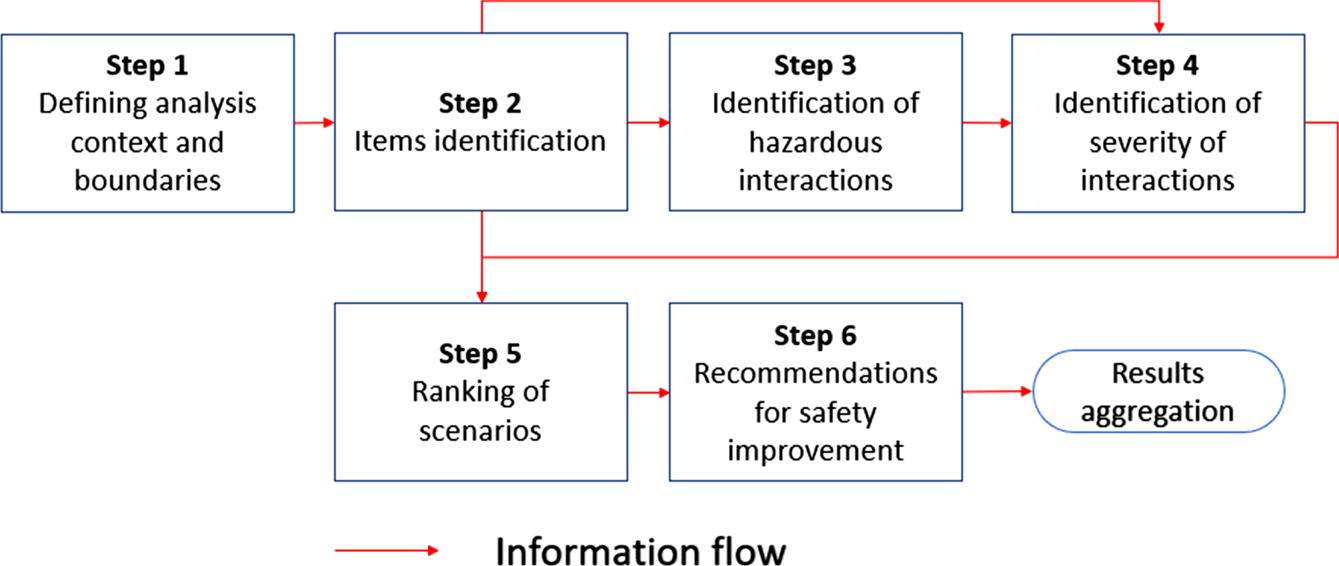
The ESHA–Mar method overview is provided in Figure 1. Step 1 includes the determination of the overall context and the study boundaries. Step 2 focuses on the systematic identification of the items (objects, agents, environmental features) outside the ship that interact with the own MASS. Step 3 addresses the identification of the hazardous interactions between the own MASS and the surrounding items with the support of guidewords. Step 4 identifies the severity of the identified scenarios. In Step 5, the identified scenarios are ranked using the information from previous steps. Step 6 provides recommendations for the improvement of the ANS. Lastly, the results of each step are used to populate a table with items, their interactions rankings and recommended protective barriers. These steps are elaborated in more detail in the next sections.
ESHA–Mar method overview

2.2 Step 1 – Defining the context
The MASS and its ANS operate in a specific area and, therefore, their operation is affected by the prevailing environmental conditions, such as, weather, current, waves, day light duration, and terrain characteristics (COLREGS, 1972). The autonomous navigation is constantly interacting with other ships and the existing infrastructure in the area (Rødseth et al., Reference Rødseth, Faivre, Hjørungnes, Andersen, Bolbot, Pauwelyn and Wennersberg2020). The ANS performance is not isolated from the influence from marine mammals and other humans that may be present in the area. The ANS operation is critical when the ship departs, sails or approaches a location, whilst it is not important when the ship is at berth or anchorage. Still, the autonomous navigation functionality is influenced by the tasks implemented by other actors in ports, e.g. maintenance of ANS (Pedersen, Reference Pedersen2010). Figure 2 graphically depicts the involved interactions with the MASS.
Elements of operational context for ANS

In this respect, the first step of the proposed method is to define the relevant context and boundaries of the analysis. The investigated ship main particulars and the operational area, as well as the intended level of autonomy, are determined. This is required to define the boundaries of the ESHA–Mar analysis as well as the availability of potential safety barriers.
2.3 Step 2 – Item identification
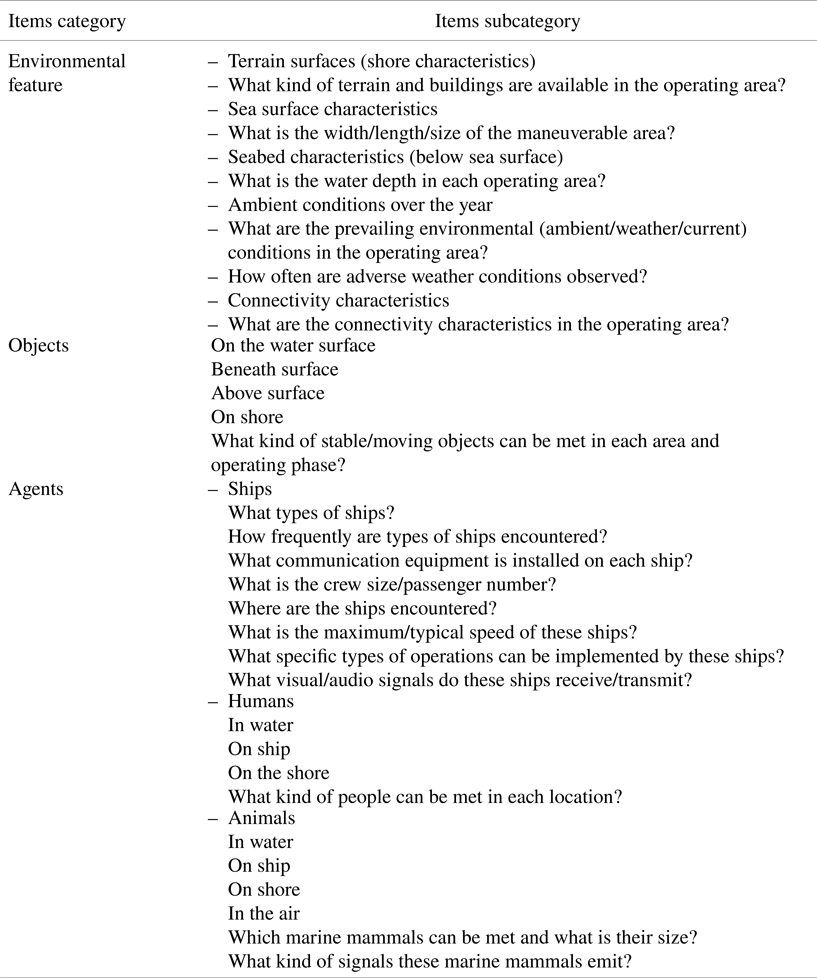
The external items affecting the performance of the ANS can be grouped in the following types (Dogramadzi et al., Reference Dogramadzi, Giannaccini, Harper, Sobhani, Woodman and Choung2014): (a) environmental features, which constitute a permanent characteristic of the operating area; (b) objects which can exist in the operating area, and; (c) agents, which are objects, but ones that can move in a purposeful way. The environmental features can be broken down into terrain surfaces for the shore, water surface characteristics, (e.g. width of the fjord or canal and the below-water-surface conditions using the spatial criteria) as well as ambient conditions (e.g. prevailing weather conditions) and connectivity characteristics, which are considered independent properties describing the area. The objects could be classified based on their location as land, surface, subsurface or aerial. The agents could be split into marine mammal, humans and ships, based on their intelligence level. The humans can be further classified based on their location as being on shore, on ship, or in the water (e.g. swimmers). Similar classification applies for marine mammals and animals. The classification of items is provided in Table 1. This subclassification is required to address the items encountered in the maritime domain, and, thus, its inclusion in the developed methods render the latter differentiating from ESHA.
Classification of items and generated questions

Once the different objects classification has been implemented, questions words, such as, What? How? When? Why? Who? Where? are used to develop more specific questions which would allow identification of items and their specific details based on the provided classification. Whilst these question words have been in use since antiquity (proposed by Aristotle) and are considered essential for information gathering, such as journalism (Sloan, Reference Sloan2010), the use of these question words in the specific context has not been reported in the literature. The developed questions are identified in cooperation with collaborating ship operators and are answered by the ship operator(s), and the obtained responses constitute the basis for the realisation of the next steps of ESHA–Mar.
2.4 Step 3 – Identifying hazardous interactions with items
Once the items with their basic characteristics have been specified, the next step is the identification of the hazardous interactions between the own MASS and the ship. This is implemented by considering the interactions between the ship and the items and specifying the potential failures in interactions. The interactions with other ships are identified using information from COLREGs on potential encountering situations and specific words, such as, overtaking, following, crossing, communication exchange via audio/visual means, approaching, etc. For the other items, expert knowledge along with the words, such as affect, influence, impact, avoid and recognise, are used. For identifying the hazardous interactions, guide words from FHA (Scharl et al., Reference Scharl, Stottlar and Kady2014), HAZOP (ISO, 2009a) and STPA (Leveson and Thomas, Reference Leveson and Thomas2018) are employed, such as provided, not provided, provided too early/late, too much, too little and too early. In this step, the developed method does not significantly differentiate from ESHA method.
2.5 Step 4 – Identifying potential consequences
The consequences are identified using the information retrieved from the previous steps based on the item properties (e.g., crew/passenger number, speed, size, location) and hazardous interactions. The consequences are specified in terms of influence of the items on the ship and the associated financial, safety, environmental or reputational impacts, in a similar fashion with the ones considered in Bolbot et al. (Reference Bolbot, Theotokatos, Andreas Wennersberg, Faivre, Vassalos, Boulougouris, Jan Rødseth, Andersen, Pauwelyn and Van Coillie2021). This allows for consideration of a wider spectrum of potential risks, compared to the case where only safety risks are investigated.
2.6 Step 5 – Ranking
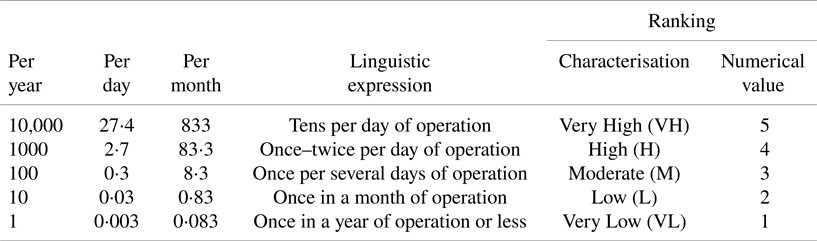
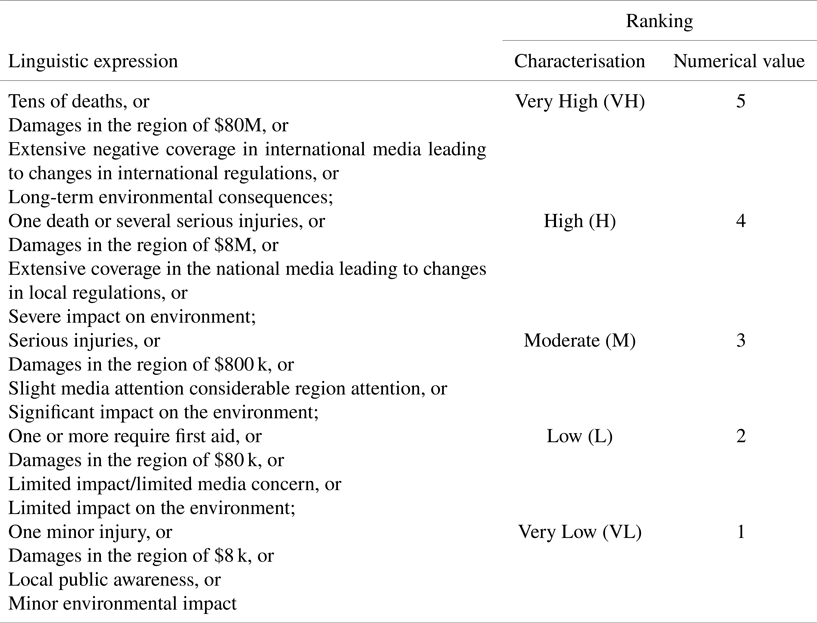
The ranking of the hazardous interactions is implemented using the following strategy. The likelihood of encounter index (LI) is specified for each identified item based on Table 2. The likelihood ranking is supported by the first step output, through information provided by the ship operator. The severity index (SI) is assigned to an item based on the severity of consequences (financial, safety, environmental, reputational) retrieved from the previous step. The sum of the likelihood of encounter (LI) and severity index (SI) is used to compare the criticality of the potential ship encounters with different items.
Likelihood index (LI) for encounter

This sum is not equivalent to risk index used in Formal Safety Assessment studies (IMO, 2018a), as instead of the frequency of occurrence, the frequency of encounter is used herein; this study purpose is not to determine the safety level, but rather to identify which of the items are more critical for the ANS design. In this way, the ESHA–Mar method allows for the identification of items that are encountered more frequently and must be carefully considered during the ANS design.
The ranking is implemented based on the scales provided in Tables 2 and 3. The indices tables correspond to logarithmic values of risk metrics, which is a useful property, as demonstrated by previous studies (Levine, Reference Levine2012; Duijm, Reference Duijm2015). The criticality of each item is determined in relation to the criticality of other items. When ranking scenarios with multiple consequences (reputational, environmental, etc.), the worst-case consequence (with the highest severity) is used. The incorporation of the criticality ranking is also a novel contribution of this study compared to ESHA.
Severity index (SI) for severity of consequences

The likelihood index table (Table 2) was developed based on the potential frequency of encounter situations. The range of potential frequencies was determined based on the discussions with the ship operators and subsequently adjusted in logarithmic scales. The severity index table (Table 3) was determined considering the IMO risk severity index provided in the Formal Safety Assessment guidance (IMO, 2018a), and is based on the provided scale for safety consequences (IMO, 2018a). The cost of averting the fatality was set at $3M corresponding to 1999 (IMO, 2018a). By using a 5% inflation rate, according to the FSA guidance (IMO, 2018a), a single fatality becomes equivalent approximately to $8M in 2021. The correlation between other types of consequences and safety risks was derived by comparing the table in FSA (2018a) with pertinent tables provided by BV (Bureau Veritas, Reference Veritas2019), DNV GL RP A-203 guidelines (Ahluwaja, Reference Ahluwaja2018) and the EMSA report (EMSA, 2020).
2.7 Step 6 – Protective barriers recommendations
During this step, measures that reduce the likelihood and the severity of potential hazardous interactions are determined. As described in (ISO/IEC, 2016), the risk can be reduced by: (a) avoiding risk, e.g. changing the operational area; (b) removing the risk source, e.g. reducing the operation when other ships are present; (c) influencing the likelihood, e.g. adding control barriers; (d) mitigating the consequences, e.g. enhancing the response; (e) sharing risk through insurance; and (f) more effectively detecting of the hazardous interactions. Environmental factors which cannot be controlled but positively influence the operating conditions resulting in risk reduction are also mentioned with the same material.
2.8 Results aggregation
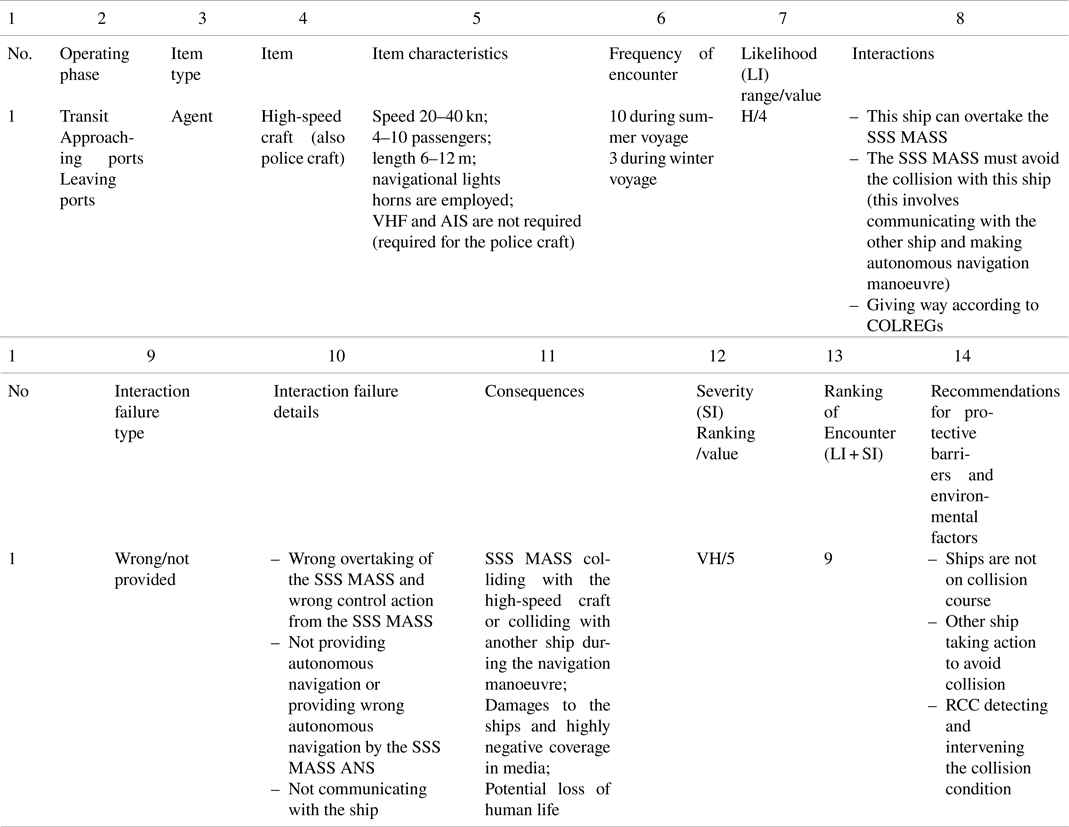
Once Steps 1–6 have been completed, the generated results are aggregated, as presented in Table 4. In specific, the first five columns represent the results generated during the second step (the identified items and their characteristics); the information in columns 8 to 10 is determined during the third step, where the relevant hazardous interactions are determined; column 11 includes information from Step 4 by depicting the potential consequence of hazardous interactions; and columns 6 to 7 and 12 to 13 include the ranking results and recommended barriers are provided in column 14. The presented aggregation is useful for presenting the final results, allowing for more effective communication and management of the generated information. This procedure is also followed in other risk assessment methods, such as Failure Modes and Effects Analysis (Wang, Reference Wang and Bolger2017), HAZOP (ISO, 2009a) and STPA (Leveson and Thomas, Reference Leveson and Thomas2018).
Aggregating the ESHA–Mar results – an example

3. Use case description
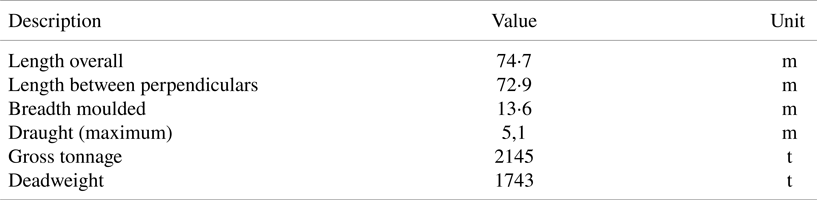
The proposed method is tested for the theoretical use case of a SSS vessel, which is considered to render the actual demonstrator to operate in a fully unmanned mode. The SSS use case main particulars are provided in Table 5, taken from Wennersberg and Nordahl (Reference Wennersberg and Nordahl2019) and Faivre and Nzengu (Reference Faivre and Nzengu2020). It must be noted that the actual demonstrator and the use case investigated herein, albeit share some similarities, are ships with different installed systems and autonomy degrees.
SSS main particulars of the vessel employed as the SSS use case

The investigated SSS use case (or MASS) is considered to have an autonomy degree of 3, according to IMO definitions used for the Regulatory Scoping Exercise (RSE) (IMO, 2020), which specifies ‘Remotely controlled ship without seafarers on board: The ship is controlled and operated from another location. There are no seafarers on board.’ Therefore, the SSS use case is assumed to use a Remote Control Centre (RCC), which controls the ship operations. Still, the ANS remains the first point of decision-making during sailing. The investigated MASS is considered to be operating outside the coast of Norway distributing fish feed to fish farms. The information presented in the next sections was gathered through interviews with the ship operator.
4. Results and discussion
4.1 Step 2 – Items identification
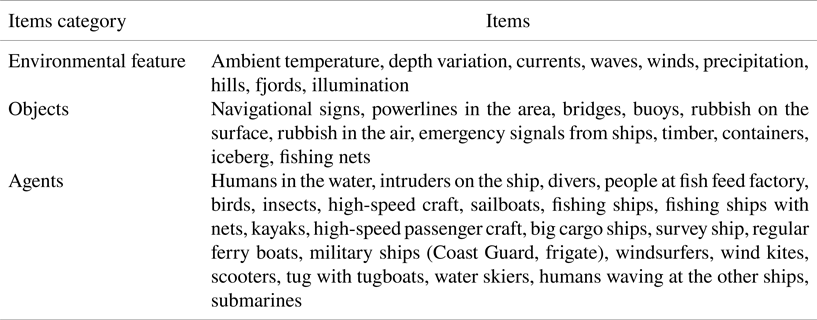
As the description of the case study practically corresponds to the results of the first step of ESHA–Mar, the paper proceeds immediately with the presentation of the next results steps. The list of items of interest for the investigated ship are provided in Table 6. This list includes environmental features, various objects and a number of agents. Note that the list is much more extensive than the one potentially obtained through the AIS data. A number of recreational ships have been identified, such as kayaks or water scooters or objects which might have their AIS transponder switched off, including military ships. Some other recreational ships, such as wind kites and windsurfers, are also identified, however their presence is expected to be unlikely in the considered area. It should be noted that the frequency of encounter with some of the objects and ships varies with the season. The interviewed participant indicated that sensitive mammals do not exist in the investigated area. All these items can be considered during training of the situation awareness system under a number of environmental conditions, which have been also specified by the operator under the category of environmental features.
List of identified items

It should be noted that some of the environmental features, such as ambient temperature over the year, were specified by the ship operator. However, this initial input could be supported by more detailed data from meteorological services. The AIS data in a similar way could support the estimation of likelihood of encounters with the ships carrying AIS transponder.
4.2 Step 3 – Identifying hazardous interactions with items
Not all of the items specified in Table 6 were identified to have direct hazardous interactions with the own SSS MASS. For instance, the powerlines and bridges in the operational area were found to have a significant height, thus creating no obstruction to the MASS operation. Rubbish on the surface were also considered as not causing any damage to the MASS. Yet a scenario can be considered when the height of cables is lowered due to natural disaster or retrofit, or rubbish impeding the recognition of persons in the water. A change in the operational area also can make bridges hazardous for the MASS. A number of interactions were also specified in the analysis, such as an unlikely but possible scenario of a flying plastic bag impeding the visual coverage of cameras, iceberg in the area or floating timbers/containers hitting the ship.
This is one of the ESHA–Mar properties, as several questions results in not-so-obvious responses. Therefore, the identified interactions do not generate immediate hazards, however they can become hazardous under specific circumstances (of low likelihood). This is a by-product of an effort to expand the present knowledge area. When considering a novel technology such as MASS, this is rather a requirement to go through this procedure, since it is important to reduce the potential of unpredicted interactions (Kaplan and Garrick, Reference Kaplan and Garrick1981).
For the interactions of the own SSS MASS with the other ships, it was considered that either failures in communication, objects recognition or improper interactions during manoeuvring, such as violations of COLREGs, can occur. With respect to the environmental features, it was found that they affect the equipment performance, such as salty stains on the cameras. Therefore, it is required to test the equipment/algorithm performance under varying environmental conditions, such as salty deposits on the cameras, or to arrange periodic cleaning maintenance.
4.3 Step 4 – Identifying potential consequences
With respect to consequence, the highest ranking (SI = 5) was provided to the interactions between the own MASS and small ships with more than one crew/passenger number, such as sailing boats, fishing ships, high-speed craft, etc. Due to their size, these ships have small damage and intact stability and can be easily capsized after collision with the MASS, endangering the lives of passengers/crew (Atzampos et al., Reference Atzampos, Paterson, Vassalos and Boulougouris2018). This is in line with several studies highlighting the high accident rates on small ships (de Vos et al., Reference De Vos, Hekkenberg and Banda2021; Wang et al., Reference Wang, Liu, Wang, Graham and Wang2021). The possibility of collisions with other ships or icebergs were considered as less severe (S = 4). However, collision for a MASS may lead to negative coverage in the public media, since it is a novel technology, as it also occured in other industries (Penmetsa et al., Reference Penmetsa, Sheinidashtegol, Musaev, Adanu and Hudnall2021) and, therefore, these potential collisions should be addressed. Damages to infrastructure or degradation of equipment performance due to environmental factors were assigned lower severity (SI = 3) based on the performed discussions. Contact with objects, such as timbers, containers or mooring buoys, were given even lower severity (SI = 2) due to the relatively large size of the own ship compared to these objects. Finally, some of the items, such as rubbish and birds on the surface, received the least severity (SI = 1)
4.4 Step 5 – Ranking
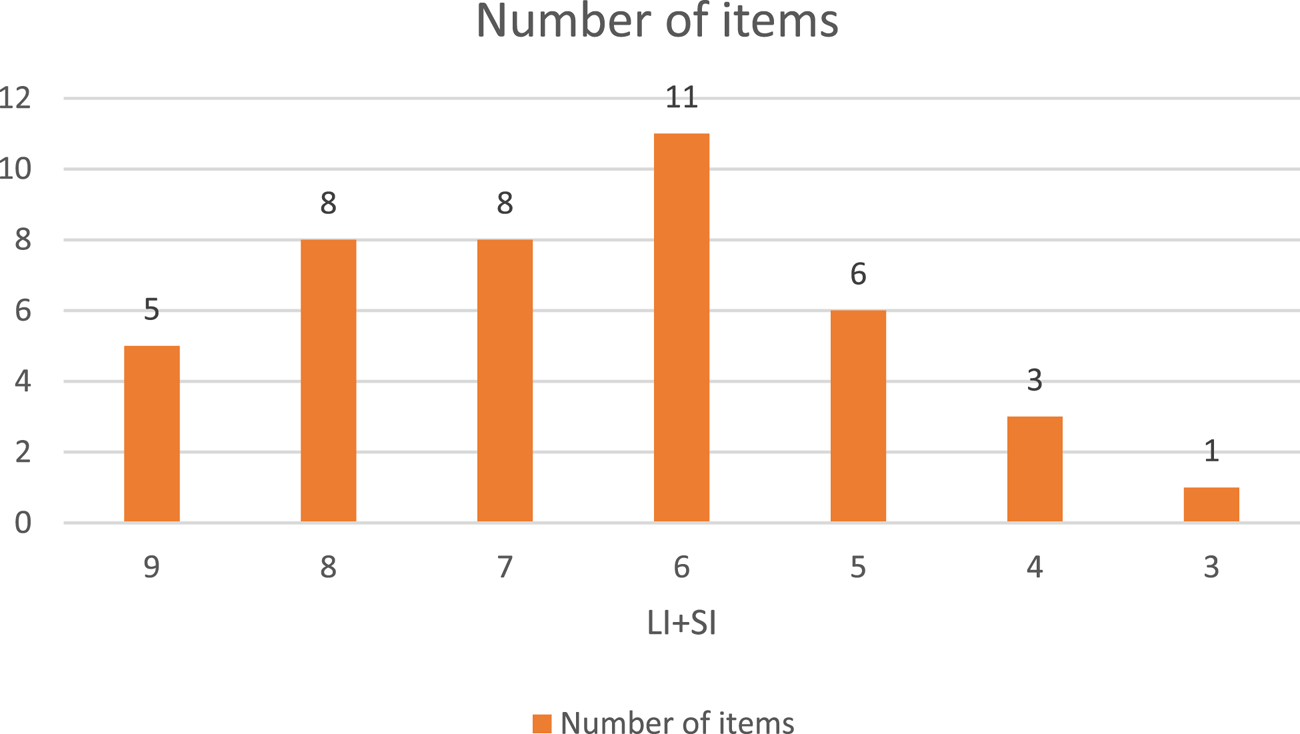
Based on the previous steps, the distribution of rankings and the most critical items are provided in Figure 3 and Table 7, respectively. Note from Table 7 that the most critical items are small ships. This can be attributed to the fact the encounters with small ships are frequent in the operating area, and potential implications in case of collision are rather severe (LI + SI = 9). The collision with other ships is not so frequent or is less severe (LI + SI = 8). The influence of environmental features is considered of less importance, as they affect the equipment performance that might mostly result in grounding incidences and, therefore, damages; however, such incidences frequently occur in the specific area and should be definitely taken into account. A notable exception are the environmental features of foggy and rainy conditions and the presence of hills, which impact the visibility during navigation and (the presence of hills affect the radar image and line of sight which are important when navigating in proximity to shore), therefore, can lead to collision. This justifies their high ranking (LI + SI = 8 or 7). Hazardous interactions with infrastructure or collision with wind kites/ windsurfers were ranked lower (SI + LI = 7 or 6), as the resultant damages are ranked as moderate, or there exists low likelihood for such encounters (as for windsurfers). Interactions with humans in water were ranked as low (SI + LI = 5), as they are expected to be highly unlikely in the cold Norwegian waters, despite having potentially rather severe consequences. Interactions with military ships, both surface and submarines, are considered of lowest rank (LI + SI = 4), as they are deemed highly unlikely in the specific area and of lower severity due to the MASS comparably smaller size and severity of collision.
Items ranking

Identified most critical items.

4.5 Step 6 – Protective barriers recommendations
Based on the analysis results, the focus herein should be put on preventing collisions with smaller ships. The likelihood of incidents can be reduced by having strict requirements for the detection accuracy of small ships by the situation awareness system, as well as by using alert systems which would notify the remote-control centre if a large unclassified object of small ship size is detected. Furthermore, the equipment performance and reliability must be tested in the identified environmental conditions. If the required equipment performance cannot be ensured, operational measures, such as reducing the speed in foggy conditions, might be needed. In such cases, it would be highly beneficial to obtain more data from the meteorological services. Collision with the ships operating in the area can be avoided if collision paths are identified and the RCC crew closely monitors the hazardous encounter situation, or adequate confidence in the ANS performance is obtained through extensive testing and operation.
4.6 Discussion
The implementation of the proposed ESHA–Mar method resulted in the identification of the items interacting with the own MASS through the use of a structured approach. This structured approach uses the operator expertise to reduce uncertainty related to ship navigational parameters and to translate them into the ANS requirements expressed by protective barriers.
This method also supported the identification of objects not visible in AIS, thus providing a more complete picture of the operational envelope, compared to the case where only AIS data are used. The hazardous interactions of the own MASS with these items were also identified and ranked, and the most critical of them were pointed out, thus supporting the risk-based cost-efficient MASS design. The list of the identified objects and agents can be fed as input to the design of the situation awareness system ensuring the ANS safety by specifying more stringent requirements for detecting the most critical objects. A list of recommendations for protective barriers that can be considered in the ANS design was also generated. ESHA–Mar, in its present or enhanced form, can be applied to other ships and operational areas.
The ESHA–Mar method has some limitations. Since the main results were retrieved based on the ship operator input, they exhibit a strong element of subjectiveness. Increasing the number of operators participating in the analysis is expected to reduce this subjectivity and enhance the confidence on the method results. Furthermore, ESHA–Mar is based on a breakdown of the complex environment into constituent parts without considering some more complex emergent conditions, such as interactions between MASS and multiple ships, which is a by-product of the problem simplification. Additional time during discussions was also dedicated to low encounter likelihood and reduced severity scenarios during the implementation of the ESHA–Mar. Still, these results can accelerate significantly the introduction of the MASS, as they will reduce the likelihood of encountering unknown objects, which might not be considered due to the lack of systematicity and hence, the likelihood of improper interactions of the own MASS with these objects.
Furthermore, the complex interactions that can arise between humans and MASSs have not been considered in detail. Other methods which incorporate human reliability analysis or STPA would be employed to address this limitation. These methods could benefit from the ESHA–Mar results by using as input the list of identified items and interactions. The ESHA–Mar method can be also complemented using information from AIS and weather data, which would allow for more accurate ranking of the identified items. All of these limitations pose directions for future research.
It is recommended to implement the ESHA-Mar method by organising workshops or brainstorming sessions, where the experts (the ship operators/bridge officers) in a physical or online meeting provide their answers and feedback on the questions that arise during the application of Steps 1 to 6. In this respect, the application of the method will not differentiate from the typical HAZID sessions (ISO, 2009b) that are used in the maritime industry (IMO, 2018b). Alternatively, the questions could be shared to the experts, who can provide their responses in several rounds, whereas a coordinator undertakes the compilation of the collected responses into a common report. In such a case, the use of the Delphi technique (Dalkey and Helmer, Reference Dalkey and Helmer1963) could be of advantage.
5. Conclusions
In this study, a novel method (ESHA–Mar) for identification of the MASS interactions with other items was presented. The ESHA–Mar was applied to unmanned and remotely controlled versions of the short-sea shipping use case of the AUTOSHIP project, demonstrating its effectiveness in the identification of the interacting items.
The main findings of this study are summarised as follows.
• The ESHA–Mar method supported the identification of several objects and of hazardous interactions in a systematic manner, especially for those that are not visible from AIS data.
• ESHA–Mar also supported the ranking of the objects based on the frequency of encounter and severity of potential interactions, and therefore, the prioritisation of the resources during ANS development.
• With the support of ESHA–Mar, design recommendations for the situation awareness system and components of ANS were derived.
• For the investigated use case, it was found that the small ships constitute a significant source of hazard due to their frequent presence in the operational area and potential collision consequences.
• The identified objects can be used as input to training on situation awareness system reducing the likelihood of observing the unknown objects.
• It is recommended that the functionality of the equipment is tested in a wide spectrum of environmental conditions.
It is expected that the presented ESHA–Mar method will constitute a valuable tool for the MASS designers accelerating the process of designing and accepting the ANS. ESHA–Mar can be further improved through combination with data acquired from AIS, meteorological information, or through combination with other methods, which posesdirections for future research.
Acknowledgements
The study was carried out in the framework of the AUTOSHIP project (AUTOSHIP, 2019), which is funded by the European Union's Horizon 2020 research and innovation programme under agreement No. 815012. The authors affiliated with the Maritime Safety Research Centre (MSRC) greatly acknowledge the funding from DNV AS and RCCL for the establishment and operation of the MSRC. The authors also thank the and individuals from Eidsvaag and Kongsberg Maritime for their comments. The opinions expressed herein are those of the authors and should not be construed to reflect the views of EU, DNV AS, RCCL, Eidsvaag, Kongsberg Maritime or other involved partners in the AUTOSHIP project.



 Open access

