

Storage conditions are known to affect the overall quality of raw milk (Malacarne et al., Reference Malacarne, Summer, Formaggioni, Franceschi, Sandri, Pecorari, Vecchia and Mariani2008; De Jonghe et al., Reference De Jonghe, Coorevits, Van Hoorde, Messens, Van Landschoot, De Vos and Heyndrickx2011; Malacarne et al., Reference Malacarne, Summer, Franceschi, Formaggioni, Pecorari, Panari, Vecchia, Sandri, Fossa and Scotti2013; O'Connell et al., Reference O'connell, Ruegg, Jordan, O'brien and Gleeson2016; Franceschi et al., Reference Franceschi, Brasca, Malacarne, Formaggioni, Faccia, Natrella and Summer2021a), as well as to have influence on the characteristics of the cheese (Mankai et al., Reference Mankai, Boulares, Ben Moussa, Karoui and Hassouna2012; Franceschi et al., Reference Franceschi, Brasca, Malacarne, Formaggioni, Faccia, Natrella and Summer2021a, Reference Franceschi, Malacarne, Formaggioni, Faccia and Summer2021b; Ritota et al., Reference Ritota, Di Costanzo and Manzi2022; Tidona et al., Reference Tidona, Monti, Povolo, Bonvini, Fergonzi, Barzaghi, Locci, Pellegrino, Contarini and Carminati2022). Variations in the storage conditions do not always result in positive effects on the finished products. According to the European Commission Regulation 853/2004 (EC, 2004), farm-fresh raw milk ‘must be cooled immediately to not more than 8°C in the case of daily collection, or not more than 6°C if collection is not daily. During transport the cold chain must be maintained and, on arrival at the establishment of destination, the temperature of the milk must not be more than 10°C’. Hence, attention to cleanliness and cooling of milk have become necessary tools to guarantee the hygienic quality of milk. However, these procedures, besides contributing to lower the number of pathogens and spoilage microorganisms, also decrease the native dairy microflora (Morandi et al., Reference Morandi, Battelli, Silvetti, Goss, Cologna and Brasca2019) which could represent a problem for those cheeses made from raw milk (Mucchetti and Neviani, Reference Mucchetti and Neviani2006) where the native microbiota is a typical trait of the cheese and plays a fundamental role in contributing to the quality of the finished product (Serhan et al., Reference Serhan, Cailliez-Grimal, Borges, Revol-Junelles, Hosri and Fanni2009; Montel et al., Reference Montel, Buchin, Mallet, Delbes-Paus, Vuitton, Desmasures and Berthier2014). Furthermore, refrigeration procedure may favor the growth of psychrotrophic bacteria (Sørhaug and Stepaniak, Reference Sørhaug and Stepaniak1997), which are able to produce thermostable proteases that hydrolyze proteins, causing several problems, such as a decrease in cheesemaking yield and formation of off-flavors (Franciosi et al., Reference Franciosi, Settanni, Cologna, Cavazza and Poznanski2011).
European Commission Regulation EC N. 853/2004 (EC, 2004) allows the competent authority to authorize a higher storage temperature of milk for production of certain dairy products. This can lead to a sort of milk pre-maturation, producing low molecular weight compounds which can stimulate the growth of cheesemaking bacteria, speeding up the following acidification process (Gobbetti et al., Reference Gobbetti, Neviani and Fox2018). This can be helpful for cheeses made with acid–rennet coagulation, where the maintenance of a total microbial load is useful for the development of the dairy microflora that positively affects the cheesemaking. Provolone Valpadana PDO represents a typical Italian example of this. It is a pasta-filata semi-hard cheese made from whole cow milk, with natural acidity from fermentation (GURI, 2019; Mucchetti and Alinovi, Reference Mucchetti and Alinovi2019), where the whey starter represents a unique trait for its manufacturing. Provolone Valpadana regulation strictly disciplines the management of milk at the farm, requiring that the time between the beginning of milking and the beginning of transformation at the cheese factory must be shorter than 60 h (GURI, 2019). During this time, which can be considered a sort of maturation, milk must be cooled to limit bacterial growth and to slow down the activity of lipolytic and proteolytic enzymes, but temperature must be maintained according to Reg. EC N. 853/2004 (EC, 2004).
Most research on the quality of raw milk has focused on the effect of cold storage at 4°C (Celestino et al., Reference Celestino, Iyer and Roginski1996; Lafarge et al., Reference Lafarge, Ogier, Girard, Maladen, Leveau, Gruss and Delacroix-Buchet2004; Leitner et al., Reference Leitner, Silanikove, Jacobi, Weisblit, Bernstein and Merin2008; Gargouri et al., Reference Gargouri, Hamed and ElFeki2013; Zajác et al., Reference Zajác, Čapla, Vietoris, Zubrická and Čurlej2015; Paludetti et al., Reference Paludetti, Jordan, Kelly and Gleeson2018). Few studies have been published on the effects of higher refrigeration temperatures on raw milk for the manufacturing of specific PDO cheeses, in particular Grana and Parmigiano Reggiano (Malacarne et al., Reference Malacarne, Summer, Formaggioni, Franceschi, Sandri, Pecorari, Vecchia and Mariani2008, Reference Malacarne, Summer, Franceschi, Formaggioni, Pecorari, Panari, Vecchia, Sandri, Fossa and Scotti2013; Franciosi et al., Reference Franciosi, Settanni, Cologna, Cavazza and Poznanski2011; Franceschi et al., Reference Franceschi, Brasca, Malacarne, Formaggioni, Faccia, Natrella and Summer2021a). Information about the effects of higher storage temperatures could be helpful also for other manufacturing, such as that of Provolone Valpadana PDO. Furthermore, the storage conditions evaluated in the literature are very different from each other, making the comparison of results rather difficult.
Since Provolone Valpadana is a PDO cheese, variations in the manufacturing process should be carefully evaluated to avoid modifications of the typical traits of this product. Furthermore, nutritional characteristics of raw milk for cheesemaking are an aspect often neglected by the scientific works on the matter, even if it could represent an added value for the finished product. This work is part of an Italian funded project aimed at evaluating a possible increase in the refrigeration temperature of raw milk during Provolone Valpadana cheesemaking (piccante-type). In this study some chemical, nutritional, and technological characteristics of raw milk for Provolone Valpadana cheesemaking were evaluated according to different refrigeration conditions. In order to have an overall assessment of the effect of the considered refrigeration conditions, a multivariate exploratory data analysis approach was carried out by means of Principal Component Analysis (PCA).
Materials and methods
Milk sampling
Raw milk samples were collected from 11 producers of Provolone Valpadana PDO cheese, belonging to the Consorzio Tutela Provolone Valpadana. Each producer collected milk samples from different farms located in various areas allowed by the Product Specification: on arrival at the dairies, bulk milk temperatures ranged between 4 and 10 °C. Hence, bulk milk from each of the 11 producers (hereafter referred to as A1, A2 through to A11) was delivered to the laboratory in refrigerated condition, where two experimental sets were carried out, according to the following conditions:
1. First year of experimentation at fixed temperature/time conditions (milk sampling between September and October 2019):
• one milk aliquot (t0_1) was analyzed immediately after the delivery
• one milk aliquot (T60-6) was analyzed after 60 h of storage at 6 °C in a thermostatic water bath (Gheat Bath Control AG-System, Fratelli Galli, Milano, IT)
• one milk aliquot (T60-12) was analyzed after 60 h of storage at 12 °C in the thermostatic water bath.
2. Second year of experimentation with two-phase thermal cycle conditions (milk sampling between October and November 2020):
• one milk aliquot (t0_2) was analyzed immediately after the delivery
• one milk aliquot (T10°) was analyzed after 15 h of storage at 10 °C followed by 45 h of refrigeration at 4 °C, in the thermostatic water bath
• one milk aliquot (T12°) was analyzed after a storage of 15 h at 12 °C followed by 45 h of refrigeration at 4 °C, in the thermostatic water bath
Except for pH and titratable acidity measurements, carried out immediately after the delivery and the end of storage, all samples were stored at −20 °C until analysis.
Analytical determinations
pH values were evaluated using a pH meter (Portavo 907, Knick, Berlin-Germany), while titratable acidity (°SH/50) was measured by titration with 0.25 M NaOH using the Soxhlet–Henkel method.
Organic acids were determined as described by Ritota et al. (Reference Ritota, Di Costanzo, Barzaghi and Manzi2021). Compounds of the unsaponifiable fraction were determined according to Panfili et al. (Reference Panfili, Manzi and Pizzoferrato1994). Vitamin A was calculated from the determination of retinol isomers (13-cis and trans retinol) and β-carotene, considering the different contributions to vitamin A of all compounds showing the biological activity of retinol (Weiser and Somorjai, Reference Weiser and Somorjai1992). Degree of retinol isomerization (DRI) was calculated as the percentage ratio between 13-cis retinol and trans retinol (Panfili et al., Reference Panfili, Manzi and Pizzoferrato1998). Degree of antioxidant protection (DAP) was calculated according to Pizzoferrato et al. (Reference Pizzoferrato, Manzi, Marconi, Fedele, Claps and Rubino2007). The ash content was determined by gravimetric method (Baldini et al., Reference Baldini, Fabietti, Giammarioli, Onori, Orefice and Stacchini1996) and the total contents of calcium and phosphorus, as well as their soluble fractions, were determined as described by Ritota et al. (Reference Ritota, Di Costanzo, Barzaghi and Manzi2021). Further details on the analytical determinations are given in the online Supplementary materials and methods.
Statistical analysis
Descriptive statistics were carried out using XL-STAT Base 18.06 software (Addinsoft 1995–2017) considering the mean values of each sample for each parameter (measured in triplicate). Significant differences among the mean values were assessed by t-test and one-way analysis of variance (ANOVA). The results were considered significant for P < 0.05. Principal component analysis (PCA) was carried out using PLS-Toolbox (ver. 8.9.2, Eigenvector Research Inc., USA) running in the MATLAB 9.3 (R2017b) environment (The Mathworks Inc., Natick, MA, USA). PCA models were calculated on different datasets, organized as follows:
• DATASET-1 (22 objects, 23 variables): mean values of the analytical determinations on the milk samples at the laboratory arrival of the first (t0_1) and second year (t0_2) of experimentation;
• DATASET-2 (33 objects, 23 variables): mean values of the analytical determinations measured on all milk samples of the first year of experimentation;
• DATASET-3 (33 objects, 22 variables): mean values of the analytical determinations measured on all milk samples of the second year of experimentation;
• DATASET-4 (33 objects, 18 variables): differences between the mean values of the analytical parameters measured during the second year of experimentation at T10° and T12° and the analytical determinations measured at arrival, i.e., (T10° – t0_2) and (T12° – t0_2), respectively. These differences are indicated hereafter as ‘delta values’.
All datasets were pretreated by autoscaling, except for the last dataset, where variance scaling (division by the standard deviation with no mean centering) was carried out. Variance scaling was used for DATASET-4 in order to center the principal components in correspondence with the initial conditions of the milk samples, thus better highlighting the variations of the samples with the two refrigeration conditions.
Results and discussion
Table 1 summarizes the results of the analytical determinations carried out on the milk samples of the two years of experimentation, reported as mean values and standard deviations calculated on all the samples for each experimental condition. Significant differences were observed in the mean values of pH, titratable acidity, lactic acid, total organic acids, cis-retinol and DRI of the milk samples during the first year of experimentation. An increase was observed from t0_1 to T60-12, for all variables apart from pH value, which decreased.
Mean values of pH, titratable acidity, some organic acids and their sum, main compounds of unsaponifiable fraction, vitamin A, Degree of Retinol Isomerization (DRI), Degree of Antioxidant Protection (DAP), ash, calcium and phosphorous (total, soluble and molar ratios) of milk (11 samples) at arrival (t0_1 and t0_2, 1st and 2nd year of experimentation, respectively), after storage for 60 h at 6°C (T60-6) and 12°C (T60-12), and after storage for 15 h at 10°C and 12°C and 45 h of refrigeration at 4°C (T10° and T12°, respectively)

*Mean values are expressed as data ± standard deviation, calculated on all the samples for each experimental condition. Values with different superscript letters along rows are significantly different (P < 0.05).
LOQ, Limit of quantification = 1 mg/100 g.
§ The contents of ash, total calcium and total phosphorus were determined only on the milk samples before the refrigeration treatments (t0_1 and t0_2), because there is no reason to suppose a variation of these parameters according to the storage conditions.
The different behavior of pH according to increasing refrigeration temperatures has been reported in the literature (Malacarne et al., Reference Malacarne, Summer, Formaggioni, Franceschi, Sandri, Pecorari, Vecchia and Mariani2008, Reference Malacarne, Summer, Franceschi, Formaggioni, Pecorari, Panari, Vecchia, Sandri, Fossa and Scotti2013; Franciosi et al., Reference Franciosi, Settanni, Cologna, Cavazza and Poznanski2011). This is because pH values in refrigerated milk are subject to opposite phenomena, namely, a decrease in pH due to the production of lactic acid by the growing microflora, and an increase due to inorganic calcium dissociation from the casein micelle (Malacarne et al., Reference Malacarne, Summer, Franceschi, Formaggioni, Pecorari, Panari, Vecchia, Sandri, Fossa and Scotti2013). According to Celestino et al. (Reference Celestino, Iyer and Roginski1996), when bacteria in milk reach a high number, the contribution of lactic acid to pH value is prevalent. This suggests a high bacterial growth with increasing refrigeration temperature in the milk samples of the first year of experimentation. The increase in titratable acidity with refrigeration temperatures (see Table 1) is a consequence of the pH decrease, since these two parameters are negatively correlated to each other (Malacarne et al., Reference Malacarne, Summer, Franceschi, Formaggioni, Pecorari, Panari, Vecchia, Sandri, Fossa and Scotti2013). However, no significant differences in pH or titratable acidity were observed between milk stored at 9°C and 20°C in the studies of Franceschi et al. (Reference Franceschi, Brasca, Malacarne, Formaggioni, Faccia, Natrella and Summer2021a) and Franceschi et al. (Reference Franceschi, Malacarne, Formaggioni, Faccia and Summer2021b). This was probably due to the shorter time of storage evaluated by the authors, compared to the refrigeration duration of this work (~4 h vs. 60 h).
Organic acids play a fundamental role in milk because they are related to the activities of dairy microflora, starter cultures, bacterial growth and evolution of cheese ripening (González de Llano et al., Reference González de Llano, Rodriguez and Cuesta1996). A great variability was observed in the organic acid contents among the milk samples, probably due to their role as intermediates and metabolites in several biochemical processes, as well as to their dependence on the breed, diet and lactation stage of the raw milk as well as the activity of the many microorganisms present in the milk (Indyk and Woollard, Reference Indyk and Woollard2004; Park et al., Reference Park, Lee and Lee2006; Dinkci et al., Reference Dinkci, Akalın, Gönc and Ünal2007). Lactic acid is the only one which showed a clear increase with storage temperature in the milk samples of the first year of experimentation (see Table 1). Since this compound is the main analyte of lactic acid bacteria (LAB) metabolism, its increase suggests a fermentation process in progress moving from t0_1 to higher refrigeration temperatures for a long time (60 h). This was also confirmed by the decrease in pH and increase in titratable acidity.
Regarding fat-soluble compounds, only cis-retinol showed an increase with refrigeration temperature, which resulted also in an increase of DRI. Light, heat treatment and microorganisms have all been shown to affect DRI (Panfili et al., Reference Panfili, Fratianni, Di Criscio, Gammariello and Sorrentino2008; Niro et al., Reference Niro, Fratianni, Tremonte, Lombardi, Sorrentino, Manzi and Panfili2022). Hence, the increase in cis-retinol and DRI levels in the first year of experimentation could be related to the growth and/or to the activity of the dairy microflora developed during milk storage at higher temperatures. Retinol isomerization also has a great importance in nutrition, since it can result in a decrease of vitamin A content (Niro et al., Reference Niro, Fratianni, Tremonte, Lombardi, Sorrentino, Manzi and Panfili2022), due to a lower vitamin A activity of all other retinol isomers compared to all-trans retinol, which shows 100% vitamin A activity (Weiser and Somorjai, Reference Weiser and Somorjai1992). Fortunately, increasing storage temperature of raw milk did not affect the mean value of vitamin A content in the milks (see Table 1).
No significant variations were observed in the mineral content of raw milk according to the refrigeration temperature in both experimentations. This agrees with the results reported by Franceschi et al. (Reference Franceschi, Brasca, Malacarne, Formaggioni, Faccia, Natrella and Summer2021a). Milk mineral composition is generally considered constant, except in some cases, such as milk from animals with mastitis (Gaucheron, Reference Gaucheron2005). Within milk mineral fraction, calcium and phosphorus have a great nutritional importance. Milk, as well as most dairy products, is an excellent source of calcium, and its absorption is favored by an optimal ratio with phosphorus (Di Costanzo et al., Reference Di Costanzo, Mattera and Manzi2014), as well as by lactose and casein phosphopeptides (Guéguen and Pointillart, Reference Guéguen and Pointillart2000). Total contents of calcium and phosphorus, as well as ash level, did not show great variability among the samples (see Table 1) and their levels, as well as their molar ratio, agreed with data reported in the literature (Manzi et al., Reference Manzi, Di Costanzo and Mattera2013). It is nutritionally noteworthy that calcium to phosphorous molar ratio of all samples ranged between 0.9 and 1.0. This is in agreement with the international recommendation of optimal dietary Ca:P molar ratio, which is suggested to be 1 to ensure optimal bone health for adults (Kemi et al., Reference Kemi, Kärkkäinen, Rita, Laaksonen, Outila and Lamberg-Allardt2010) and is considered safe in diets for infants in the range 0.9–1.7 (SCF, 1993).
The mineral balance between soluble and colloidal phases of milk plays a fundamental role in the cheesemaking process (De la Fuente, Reference De la Fuente1998). The dynamic equilibrium between calcium and phosphorus in the ionic form and calcium and phosphorus associated with casein micelles strongly depends on their concentration as well as the temperature and pH of the milk (Holt, Reference Holt1985). Although the soluble fractions of calcium and phosphorous showed a tendency to increase after refrigeration of 60 h at 12°C (see Table 1), these differences in the mean values were not statistically significant, probably due to the great sample heterogeneity. This could be due to the slight decrease in pH value with increasing refrigeration time: acidification of milk progressively results in decreased amounts of calcium and phosphorus associated with the micellar proteins, with consequent increases in the milk serum (De la Fuente, Reference De la Fuente1998). Malacarne et al. (Reference Malacarne, Summer, Franceschi, Formaggioni, Pecorari, Panari, Vecchia, Sandri, Fossa and Scotti2013) also observed no significant variations in the soluble fraction of calcium in milk with increasing refrigeration temperature, but the authors carried out the determination on rennet whey obtained after warming the stored milk at 30°C, and it is known that salt equilibria in milk can be reversible following warming of the milk (De la Fuente, Reference De la Fuente1998). Similar results were reported by Franceschi et al. (Reference Franceschi, Brasca, Malacarne, Formaggioni, Faccia, Natrella and Summer2021a), who observed no significant difference in the soluble contents of calcium and phosphorous between milk refrigerated at 9 and 20°C. However, the refrigeration storage of their study (maximum 4 h) was much shorter compared to the storage of this work (60 h). Calcium in the soluble form has been demonstrated to be more readily absorbable from the gastrointestinal tract (De la Fuente et al., Reference De la Fuente, Montes, Guerrero and Juárez2003). Therefore, an increase in the soluble calcium of raw milk could have an important nutritional implication. However, a milk poor of calcium in its colloidal form could result in the formation of a demineralized curd, decreasing the technological quality of milk for cheesemaking.
Due to the high heterogeneity of the milk samples, and to better assess the effects of the storage temperature on the whole set of chemical and nutritional characteristics of raw milk for Provolone Valpadana cheesemaking, the parameters analyzed were evaluated for each milk sample set through a multivariate approach.
PCA on DATASET-1: milk samples of the two years of experimentation before the refrigeration treatments
As a first step, in order to verify whether the milk samples of the two years of experimentation had significant differences in terms of chemical composition, a PCA model was calculated considering the parameters measured on all samples before the refrigeration treatments (t0_1 and t0_2). The Q residuals vs. Hotelling T 2 plot (reported in Fig. 1S A in Supplementary Materials) highlights the presence of an outlier with high Q residual value, corresponding to a milk sample of the second year of experimentation, namely A1 (t0_2), suggesting the presence of particular features of A1 sample that were not described by the PCA model. The corresponding contribution plot (Fig. 1S B in Supplementary Materials) reports the analytical parameters with the greatest influence on the Q residual value: even if the variability range of pH was very narrow (6.63–6.79), a much lower pH value for this sample was detected with respect to the other samples (Fig. 1S C), together with a very high β-carotene content (Fig. 1S D). The high β-carotene value found for this sample (25.7 μg/100 g), even if in agreement with previous data reported on milk (Lindmark-Månsson and Åkesson, Reference Lindmark-Månsson and Åkesson2000), represents an exception with respect to the general trend observed for Italian milk, which has been progressively becoming poor in β-carotene in the last decades, probably due to a livestock feed less and less rich in fresh grass (Pizzoferrato and Manzi, Reference Pizzoferrato and Manzi2010). For these reasons, A1 milk at t0_2 was considered as an outlier.
The PC1-PC2 score plot of the PCA model calculated after the exclusion of the outlier sample, reported in Fig. 1A, shows a clear separation between milk samples of the two years of experimentation. Although all samples were obtained from animals bred according to the Product Specification of Provolone Valpadana PDO, this is not surprising since other factors such as season, differences in the lactation stage of the animals, small differences in the feeding or others, could have affected milk composition. The corresponding PC1-PC2 loading plot reported in Fig. 1B shows that milk samples of the first year had higher cholesterol and lactic acid contents compared to milk samples of the second year. It must be pointed out that, although cholesterol values were slightly higher (P < 0.05) in the first year than in the second one (mean values equal to 13.5 and 12.7 mg/100 g, respectively), overall cholesterol values ranged over a narrow interval (11.8–14.8 mg/100 g). Therefore, this difference can be considered within the normal range of variability of cow milk composition, and in agreement with other cholesterol data reported in the literature (Manzi et al., Reference Manzi, Di Costanzo and Mattera2013). Lactic acid was significantly higher (P < 0.05) in the samples of the first experimentation (Fig. 1B), suggesting a greater fermentation by LAB or a higher concentration of these microorganisms in the milk samples of the first year. A further PCA model was calculated excluding lactic acid, but the data structure observed in the space of the first two PCs resulted in essentially the same conclusions (data not shown), confirming that the separation between the samples of the two years was not essentially due to the net difference of lactic acid content.
Results of the PCA model calculated on the milk samples before the refrigeration treatments of the first (labelled in red) and second (labelled in green) year of experimentations: PC1–PC2 score plot (A) and PC1-PC2 loading plot (B).

Since significant differences according to the sampling year were observed before the refrigeration treatments, the results of the two years were analyzed separately from each other, to prevent milk composition at t0_1 and t0_2 from affecting the directions of the PCs and the consequent interpretation of the PCA models. Furthermore, the refrigeration conditions of the two years of experimentation were different, hence it was considered more correct to evaluate the results of the two experimental sets separately.
PCA on DATASET-2: milk samples of the first year of experimentation
The aim of calculating a PCA model on DATASET-2, including milk samples of the first year of experimentation, was to verify the effect of extreme refrigeration conditions (60 h at 6 and 12°C) on the chemical and nutritional characteristics of raw milk for Provolone Valpadana cheesemaking. The Q residuals vs. Hotelling T 2 plot (data reported in Fig. 2S A in Supplementary Materials) showed the presence of a strong outlier with high Hotelling T 2 value, corresponding to sample A6 after refrigeration at 12°C for 60 h, namely A6 (T60-12). The Hotelling T 2 contribution plot of this sample (see Fig. 1S B in Supplementary Materials) showed an anomalous trend for some variables: a significantly higher (P < 0.05) lactic acid value (more than 490 mg/100 g) compared to the other samples, together with significantly lower (P < 0.05) pH value and higher soluble calcium content (Supplementary Fig. 2S C, D, and E, respectively), suggesting extreme fermentation phenomena occurring in this sample at the refrigeration temperature of 12°C. Furthermore, acidification progressively solubilizes the colloidal calcium phosphate and reduces the binding of calcium to casein (De la Fuente, Reference De la Fuente1998), thus resulting in increasing the soluble fractions of calcium and phosphorus. For this reason, sample A6 (T60-12) was considered as an outlier, and it was excluded from the PCA model.
The updated PCA models revealed two further outliers, namely samples A7 (T60-12) and A11 (T60-12) (data not reported). Also in this case, the contribution plots showed anomalous behaviors of the samples due to variables related to ongoing fermentation activities, but to a lesser extent compared to the sample A6 (T60-12). The results of the PCA model calculated after the removal of the three outlier samples are reported in Fig. 2 (A and B). The PC1-PC2 score plot (Fig. 2A) reveals no common trend related to the refrigeration treatment. In some cases, the deviations between t0_1 and T60-12 of the same sample are more evident (as in A1, A2 and A5 milks), while in other samples it is not the same (e.g. A3, A4, A8, A9 and A10 samples). Furthermore, these deviations are not always in the same direction, varying, for example, from left to right (A1 and A2 samples), or from bottom to top (A5 sample). The objects distribution into the PC1-PC2 score space (Fig. 2A) mainly takes into account the heterogeneity of the milk samples, i.e. the differences among the 11 producers of Provolone Valpadana cheese. This is confirmed by the grouping of samples according to the producers, forming more or less narrow clusters according to the deviation of T60-12 and T60-6 from the corresponding t0_1. However, a general tendency of the samples to move from t0_1 to T60-12 along the positive direction of PC2 can be observed in Fig. 2A. The corresponding loading plot, reported in Fig. 2B, shows which variables contribute most to this trend. Positive scores on PC2 correspond to high contents of fat-soluble compounds (except for β-carotene) and of organic acids, as well as to high levels of DRI, acidity, soluble mineral fractions and DAP. The simultaneous increase in organic acids, acidity, DRI and soluble mineral fractions suggests the probable development of fermentation phenomena in the milk samples after 60 h of storage at 12°C.
Results of the PCA model calculated on the milk samples collected from 11 producers of Provolone Valpadana PDO cheese and referred to as A1, A2, …A11. Figure 2A (PC1–PC2 score plot) and 2B (PC1–PC2 loading plot): first year of experimentation at arrival at the laboratory (t0_1), after storage for 60 h at 6 °C (T60-6) and 12 °C (T60-12). Figure 2C (PC1–PC2 score plot) and 2D (PC1–PC2 loading plot): second year of experimentation at arrival at the laboratory (t0_2), after 15 h of storage at 10 °C and 12 °C followed by 45 h of refrigeration at 4 °C (T10° and T12° respectively).

PCA on DATASET-3: milk samples of the second year of experimentation
Results of the PCA model calculated on the milk samples of the second year of experimentation are reported in Fig. 2 (C and D). No outlier was detected, unlike the previous experimentation, suggesting no anomalous behavior of the samples. The PC1–PC2 score plot (Fig. 2C) shows the similar grouping of samples according to the producers already observed in the previous experimentation. No trends of the samples according to the refrigeration temperature were observed, suggesting that mild refrigeration treatments have no influence on the chemical and nutritional characteristics of raw milk. The position of A1 sample in the PC1–PC2 score space is exclusively due to its compositional characteristics, which showed the highest β-carotene content compared to all other samples, reflected in a higher DAP value for the same sample (as confirmed by the loading plot reported in Fig. 2D). β-carotene content in raw milk is generally affected by feeding system, lactation stage and season of sampling (Ellis et al., Reference Ellis, Monteiro, Innocent, Grove-White, Cripps, McLean, Howard and Mihm2007).
PCA on DATASET-4: focus on the effect of second year refrigeration treatments regardless of initial samples composition
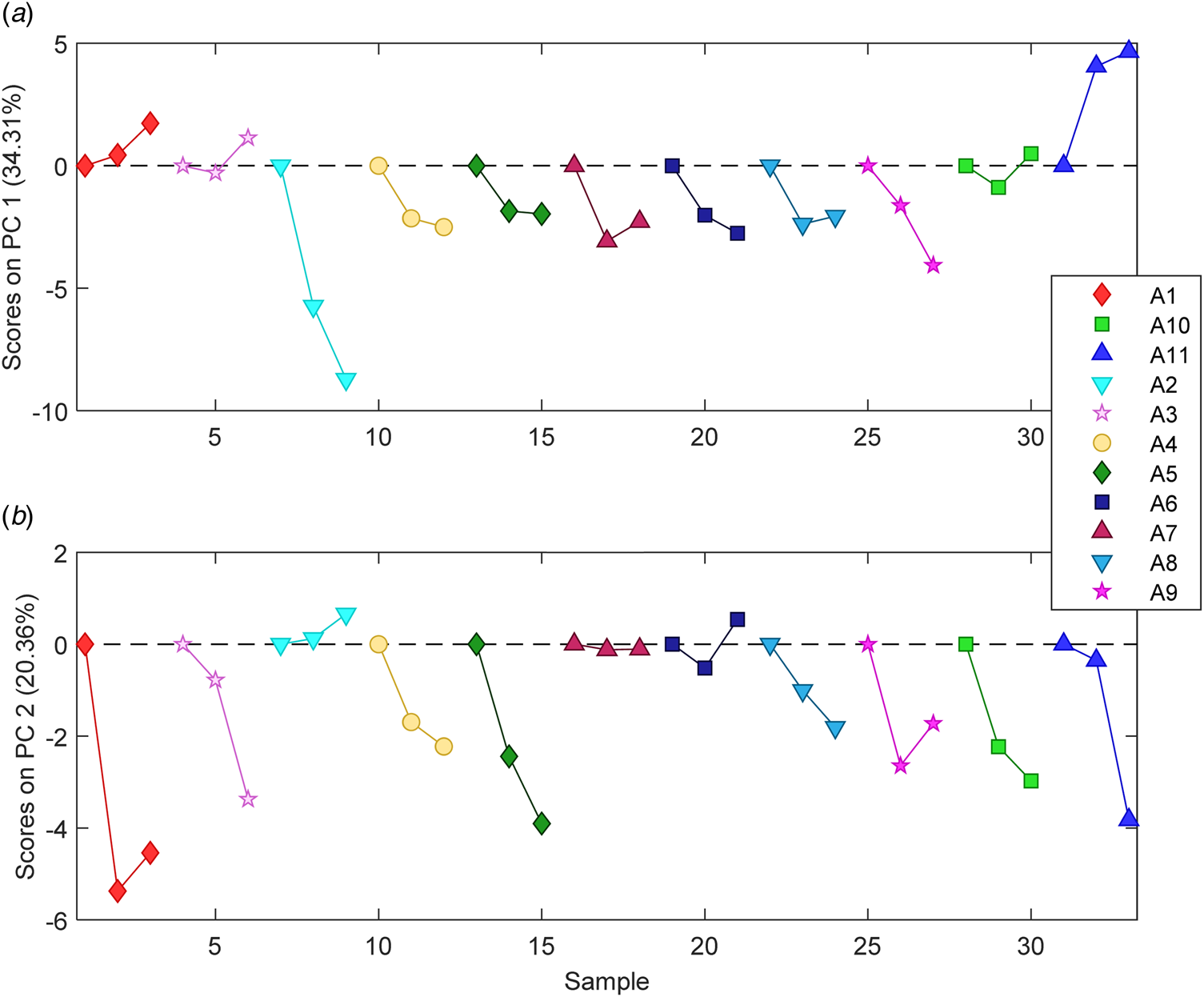
In order to better focus on the presence of possible common trends in the variations of the compositional properties due to the refrigeration conditions adopted during the second year of experimentation, regardless of the differences among the different producers, a further PCA model was calculated. This model considered the differences between the values of the samples at 10 and 12°C and the corresponding values at t0_2 (namely delta values), i.e. (T10° – t0_2) and (T12° – t0_2), respectively. The corresponding results are shown in Fig. 3, where the trends along PC1 and PC2 score vectors are reported (Fig. 3A and 3B, respectively). At variance with the PC1–PC2 score plots reported for the previous datasets, this representation was used to better highlight the possible presence of common trends for the milk samples from the different producers. Some samples, such as A4, A5 and A8, are characterized by similar trends, but no common trend according to the refrigeration treatment can be observed. Furthermore, no difference is evident between the storage temperatures of 10 and 12°C. Essentially, the absence of common trends indicates that no statistically significant variations with respect to the initial milk composition can be observed, suggesting that these refrigeration treatments can be considered to be equivalent.
Results of the PCA model calculated on the milk samples of the second year of experimentation by considering delta values ((T10° – t0_2) and (T12° – t0_2)): spatial distribution of the samples along PC1 (A) and PC2 (B) vectors direction.
We have identified the most suitable conditions (time/temperature combinations) for allowing pre-maturation of raw milk before cheesemaking that does not compromise the quality of the milk for Provolone Valpadana manufacture. According to the Product Specification of this PDO cheese (GURI, 2019), requiring that the time between the beginning of milking and the beginning of milk transformation at the cheese factory must be shorter than 60 h, four different thermal storage cycles were applied: two at fixed temperature (6 and 12°C for 60 h), representative of extreme conditions, and two at variable temperatures (10 and 12°C for 15 h, followed by refrigeration at 4°C for 45 h), representative of more realistic conditions, since milk for Provolone Valpadana PDO cheesemaking is generally transformed before 60 h.
The evaluation of the effect of the different refrigeration conditions on the overall set of investigated features performed by PCA highlighted a great heterogeneity of the milk samples coming from different producers. Furthermore, it evidenced anomalous behaviors of some milk samples, especially after refrigeration at 12°C for 60 h. These extreme conditions led to milk acidification with resulting increases in lactic acid, soluble calcium and DRI levels, hence suggesting the development of unexpected fermentations, which can compromise the technological functionality of milk. No effects of mild refrigeration conditions (10 or 12°C for 15 h, followed by refrigeration at 4°C for 45 h) were observed on the quality of raw milk. Furthermore, a PCA on delta values confirmed the equivalence between the thermal storage cycles at variable temperatures.
In conclusion, the results of this work suggest that raw milk for Provolone Valpadana cheesemaking can be stored at higher refrigeration temperature (up to 12°C), but only for a limited storage time (maximum 15 h), with no deterioration of the most important milk quality characteristics. Cooling and then storing raw milk at higher temperatures or at a refrigeration temperature (4°C) for a shorter time should be encouraged, especially for those cheese productions in which milk pre-maturation could be helpful for the cheesemaking. These storage conditions may also result in lower energy consumption, contributing to increase the sustainability of the dairy production chain. This aspect could also be an economic incentive for farmers.
Supplementary material
The supplementary material for this article can be found at https://doi.org/10.1017/S0022029923000341
Acknowledgments
This work was financially supported by the Italian Ministry ‘Ministero delle Politiche Agricole, Alimentari e Forestali (MiPAAF)’ within the Project ‘TEMPRO – Effetti della temperatura di stoccaggio sulla sicurezza e qualità del latte crudo e sulle caratteristiche del Provolone Valpadana DOP’, D.M. 16837/7100/2019 del 11/04/2019.
Financial support
The authors thank Consorzio Tutela Provolone Valpadana for providing raw milk samples and for its support to the Project TEMPRO.


 Open access

