1 Introduction
The corporation is the greatest single discovery of modern times, whether you judge it by its social, by its ethical, by its industrial or, in the long run … by its political, effects. Steam and electricity would be reduced to comparative impotence without it.
Corporations are indeed the engine of the modern economy – organizing production, generating goods and services, creating jobs, and sustaining a vast network of related industries. As the primary coordinators of manufacturing and services, their rise and expansion have propelled global economic growth. In one of the few studies quantifying their economic contribution, a 2021 McKinsey report estimated that in Organization for Economic Cooperation and Development (OECD) economies, the business sector accounted for roughly 72% of Gross Domestic Product.Footnote 1
Corporations also stand at the center of income distribution through their different payments for labor, materials, equipment, rents, interest, taxes, dividends, and retained earnings for investment. These distributive dynamics are deeply intertwined with the social, ethical, and political effects that Butler identified. Moreover, corporations contribute substantially to social welfare as major employers of people. Few factors shape human well-being more profoundly than earning wages, receiving recognition for one’s work, and seeing both improve over time.
1.1 Neither Shareholder Value Theory nor Stakeholder Theory
Despite their central role in modern economies, however, corporations have been the subject of intense public controversies, polarized between two opposing perspectives: the shareholder value theory and the stakeholder theory. A central thesis of this study is that the dominance of these extremes has produced widespread misunderstanding and undue criticism of corporations, often leading to misguided corporate reforms.
The shareholder value theory, or maximizing shareholder value (MSV) view, holds that corporations exist to maximize shareholder value because shareholders are the sole constituency the corporation must serve.Footnote 2 This view often legitimizes restructuring, layoffs, or even closures so long as share prices rise. MSV has also become a convenient weapon to chastise managers for “underperformance,” even when operational results are sound – an easy criticism when critics can arbitrarily define what counts as “maximum effort.”
The stakeholder theory, by contrast, argues that corporations should pursue social values for the benefit of their stakeholders. Environmental, Social, and Governance(ESG ) investing, championed by institutional investors and civic groups, represents one prominent variant.Footnote 3 Yet like MSV, it provides a pretext for reproaching managers – this time for failing to meet arbitrarily defined social expectations. Because people value social goals differently, no corporation can satisfy them all. Nevertheless, stakeholder theory proponents often denounce firms for not advancing their preferred values, even when these companies contribute meaningfully to society in their own ways.
1.2 The Ontological Foundation of the Corporation: The Two Corporate Axioms
I take here a different approach: examining corporate purpose by starting from its ontological foundation. Shareholder and stakeholder theories only raise the teleological question, “What ends should the corporation serve?” without connecting it to the means to achieve the ends. In contrast, I begin by asking: “What is the nature of the corporation?” “How does it exist?” and “What does it do to survive and prosper?” This ontological approach integrates means and ends, revealing a corporate purpose overlooked by both teleological views.
The ontological foundation rests on Two Corporate Axioms, two undeniable realities that any informed observer must acknowledge. First, the dominance of the corporate form: In modern economies, most sizable enterprises are organized as corporations – joint-stock companies recognized as legal persons. Second, the existence of market competition: Corporations must compete and can survive only by satisfying customers through continuous innovation.
The idea of a legal person with perpetual existence can be traced back to Roman law and had taken institutional shape in Europe by the fourteenth century.Footnote 4 Today, incorporation is simple in most jurisdictions – requiring only minimal capital and a few individuals – and has become the dominant form of enterprise. Legal personality allows a corporation to exist beyond the lifetimes of its founders, providing the foundation for long-term economic growth.
Yet legal personality alone does not ensure survival. Continuity depends on competitiveness: Corporations must attract and retain customers by delivering low-cost, high-quality goods and services. Ownership by a legal person is a necessary but not sufficient condition for perpetuity. The sufficient condition is met only when the corporation competes successfully in the market. The average lifespan of large US firms was just eighteen years as of 2016.Footnote 5 Many fail because they cannot sustain innovation, but this continual exit of losers and rise of winners keeps the economy dynamic. As Joseph Schumpeter observed, such “creative destruction” is the essential fact of capitalism.Footnote 6
1.3 The Eight Corporate Theorems
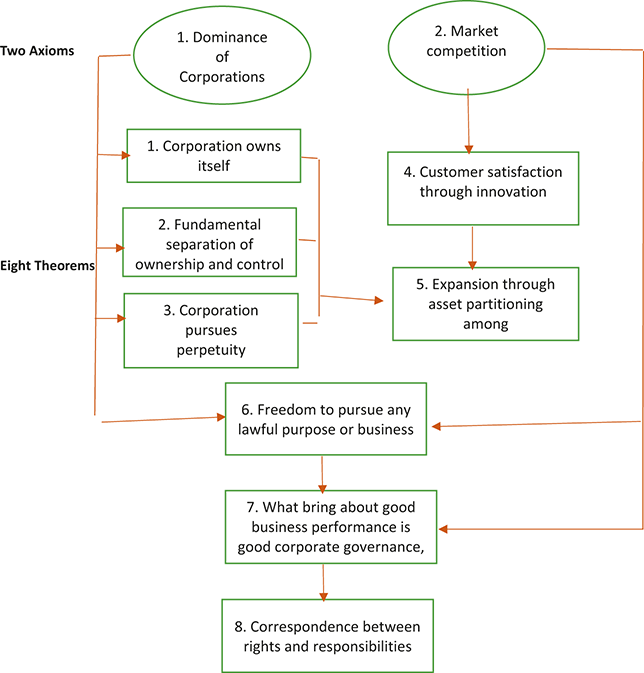
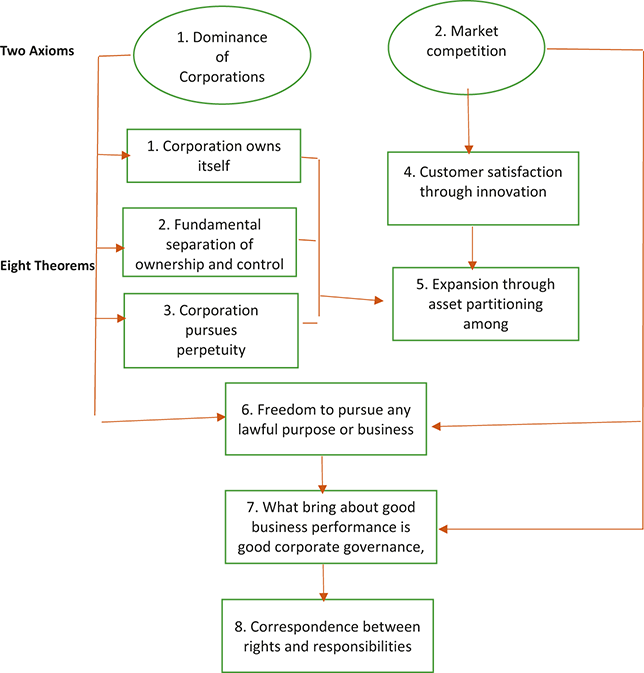
From these two axioms, we can derive the Eight Corporate Theorems. Their schematic relationship is illustrated in Figure 1. Throughout this study, the theorems serve as foundational reference points, enabling readers to develop a comprehensive yet nuanced understanding of corporations through reasoning and common sense.
CT 1 Shareholders are owners of shares – not the corporation. The corporation owns itself.
CT 2 Ownership and control are fundamentally separated when a company is incorporated.
CT 3 The corporation seeks perpetuity.
CT 4 The existential imperative of the corporation is to satisfy customers through innovation.
CT 5 Business groups expand through asset partitioning in the same way as a new company is incorporated.
CT 6 Corporations are free to pursue any lawful purpose or business.
CT 7 What brings about good business performance is good corporate governance, not vice versa.
CT 8 The basic principle of corporate control is the correspondence between rights and responsibilities.
The relationship between the two axioms and the eight theorems.
To illustrate how corporations operate in the real world, I have integrated the corporate theorems into the story of an imaginary company, My Love Co. Initially founded as an artificial intelligence (AI) pet company, My Love grows into a multinational business group and eventually a multiplanetary enterprise. This story is a faction: Fictional in that the company does not exist and the technologies described are slightly ahead of our time, yet factual in that it is grounded in the real-world principles of building and managing a corporation today. By interweaving this narrative with the corporate theorems, I hope to engage a broad audience – businesspeople, financiers, lawyers, policymakers, scholars, and students alike.
1.4 The Ontological Foundation Ahead of the Teleology of the Corporation
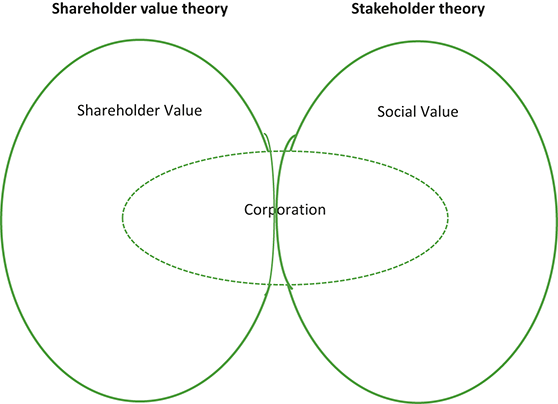
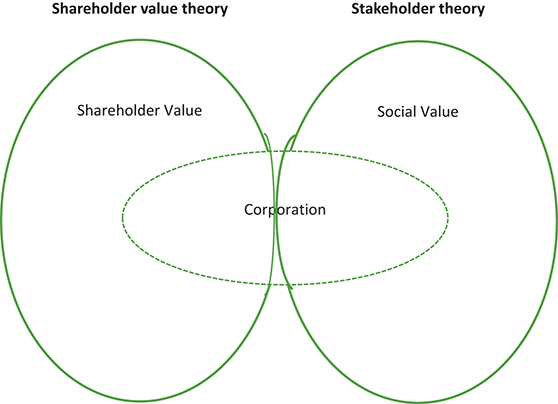
A common flaw shared by both teleological views of the corporation is their neglect of its ontological foundation. First, they deny that the corporation is a real entity. The shareholder value theory treats it merely as a legal “fiction” or shell representing shareholders’ interests.Footnote 7 The stakeholder theory, in turn, arbitrarily dissolves the boundary between the corporation and society, assuming that the corporation should pursue social values prescribed by “stakeholders.”Footnote 8 Second, by denying the corporation’s autonomy, both theories seek its purpose outside the corporation rather than within it, overlooking the social contributions inherent in its very survival. Seen through the lenses of shareholder value and stakeholder theories, the corporation appears as in Figure 2.
The corporation hidden from the two teleological views.
By contrast, this analysis begins with the ontological foundation. The first corporate axiom – the dominance of corporations – is an undeniable reality, not a fiction. Although the legal person originated as a conceptual construct, it has evolved into a social reality by performing vital social functions: enabling the creation, growth, and perpetuation of firms. Over time, the legal person has solidified its existence by assuming unlimited liabilities in business while limiting those of shareholders. Like nations, religions, and cultures, it has evolved into a social reality performing significant functions.Footnote 9
From the first corporate axiom, we derive the three corporate theorems. Through incorporation, founders transfer business-related assets to the legal person in exchange for shares issued by the corporation. In doing so, they become shareholders – owners of shares, not of the corporation – and the corporation assumes a self-owning structure (CT 1). At the same time, ownership and control are permanently separated (CT 2), while both shareholders and the corporation are protected through “asset partitioning” and “entity shielding.” This corporate form thereby enables a company to pursue perpetuity (CT 3).
From the second corporate axiom – the existence of market competition – combined with CTs 1, 2, and 3, we derive CTs 4 and 5. In a market economy, the corporation’s long-term survival depends on satisfying customers through continuous innovation (CT 4). This is the existential imperative of the corporation. To survive and grow amid competition, a corporation expands by creating new entities through asset partitioning, just as natural persons form corporations through asset partitioning (CT 5).
This study emphasizes that the corporation’s ontological foundation precedes its teleology, for it cannot pursue any higher values if it ceases to exist. Moreover, by fulfilling its existential imperative, the corporation already contributes greatly to society. Above all, it delivers customer satisfaction, enhancing human welfare through the provision of desired – and often previously unimagined – goods and services. Beyond that, corporations create jobs, nurture partner firms, enable financial institutions to prosper, build infrastructure, and contribute to public welfare through taxation. These are more intrinsic and substantial social contributions than those achieved by pursuing separate social goals.
Proponents of shareholder value and stakeholder theories overlook this ontological foundation. The former theory illogically claims that maximizing shareholder value automatically enhances corporate efficiency and benefits the economy, reducing the corporation’s ontology to a mere derivative of its teleology.Footnote 10 The latter theory confines the discussion entirely to teleology – social values – ignoring the corporation’s existential imperative and dissolving the boundary between corporation and society.Footnote 11
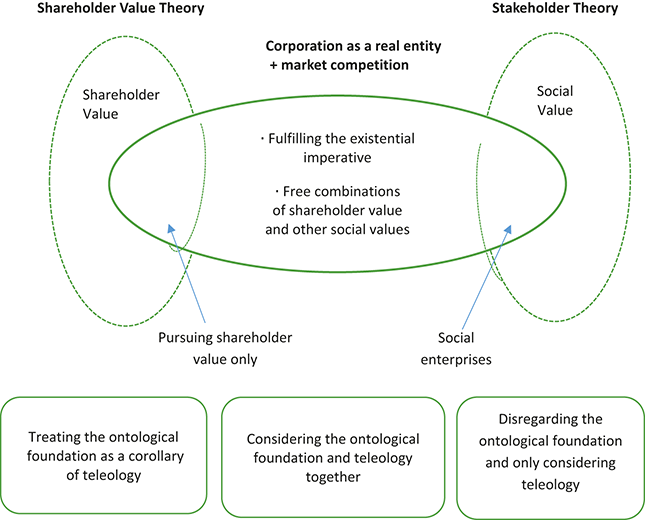
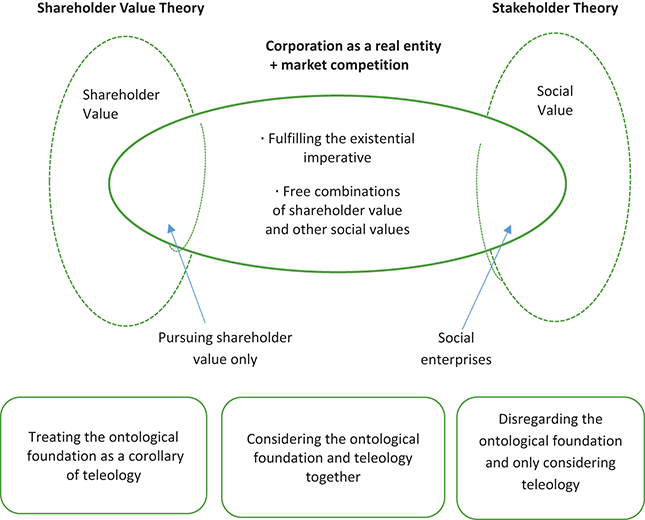
In contrast, this study posits that the corporation considers its ontological foundation and teleology together. It is up to the corporation itself to determine whether to confine its purpose to fulfilling its ontological role, to pursue social values, or combine both (Figure 3). Hence, corporate theorem 6 (CT 6): Corporations are free to pursue any lawful purpose or business.Footnote 12
The corporation seen from the ontological foundation.
Only by recognizing the ontological foundation of the corporation can we develop a coherent understanding of key corporate issues – including the relationship between the board of directors and shareholders, the role of the board in guiding managerial decisions, and the growth of business groups. A realistic understanding of the corporation, grounded in its ontology, should also help reduce the wasteful controversies surrounding corporate governance.
This study also postulates that the widely held belief in a universal, ex ante standard of “good governance” is fundamentally flawed. Instead, it advances corporate theorem 7 (CT 7): What brings about good business performance is good corporate governance. Governance structures vary across countries and corporate contexts, and their effectiveness can only be assessed in retrospect – by observing whether a particular system of control has worked well for a given corporation.Footnote 13
Finally, this study reaffirms a general principle of organizational control that applies equally to corporate control – the correspondence between rights and responsibilities (CT 8). A common flaw in both shareholder and stakeholder theories is the mismatch between the rights and responsibilities. In any organization, greater control entails greater responsibility, while lesser control entails lesser responsibility. This principle must apply equally to managers, shareholders, and stakeholders. Aligning rights with responsibilities thus becomes a cornerstone for developing the corporation as a community of long-term co-prosperity.Footnote 14
1.5 Readers of this volume
I hope this research appeals to a broad audience. Businesspeople form the first group of readers. As a work on the philosophy and guiding principles of the corporation, it invites them to reflect on why they work for their companies and how they make business decisions. I hope the Eight Corporate Theorems and the story of My Love Group will help them recognize and address practical issues in managing their companies.
The second group is finance professionals. With the rise of fund capitalism and the spread of corporate governance activism, financial investors increasingly influence companies through proxy voting and engagement. However, financial investors are largely money-managing trustees – responsible for managing clients’ assets – whereas corporate managers are business-managing trustees, responsible for fulfilling the corporation’s existential imperatives. The fact that these two groups of trustees have different “customers” often leads to conflicts of interest,Footnote 15 which investors should acknowledge when intervening in corporate affairs. I hope the discussion here fosters mutual understanding and better communication between the two.
The third group is scholars. Academia today suffers from overspecialization: Universities praise interdisciplinarity in words but maintain silos in practice. I hope this analysist bridges the divide, laying the foundation for a more integrated understanding of the corporation that connects law, business, and economics. In doing so, it aims to help resolve the century-old debate over corporate purpose – long dominated by studies of large US corporations and the managerial model of Berle and Means (Reference Berle and Means1932).Footnote 16
Last, but not least, politicians and policymakers are part of intended audience. Public policies should be grounded in realities. Yet many corporate regulations are based on misunderstandings, and some even contradict each other in the same economic and legal systems. I hope this discussion serves as a useful reference when policymakers consider corporate regulations.
In undertaking this research, I have received invaluable support from colleagues, family, friends, and acquaintances. While space does not permit me to thank everyone individually, I am deeply grateful for their help. I would also like to express my gratitude to the National University of Singapore (E-122–00–0004–01) and to the Globalization Lab Project (AKS-2018-LAB-1250001) of the Academy of Korean Studies for their support.
2 The Birth of New Owners of Companies
The greatest confusion about the purpose of the corporation arises from a misunderstanding of its ownership. If a business is owned by natural persons, it exists for them. But in modern economies, the dominant organizational form is the corporation, in which a legal person owns all business-related assets. In most developed countries, incorporation is a simple process – anyone can form a corporation by meeting minimal legal requirements. It has therefore become a universal feature of modern enterprise.
Yet many still assume that natural persons own corporations. People casually say, “Tesla is Elon Musk’s company” or “Samsung is the Lee family’s business,” and even scholars often construct theories on the mistaken premise that natural persons ultimately own corporations, overlooking the legal logic of incorporation. Misnomers such as “owner-manager” persist because of this confusion. To clarify who truly owns the corporation – and what that means for its purpose – this section examines the corporation’s legal structure through the lens of three corporate theorems.
CT 1 Shareholders are owners of shares – not the corporation. The corporation owns itself.
CT 2 Ownership and control are fundamentally separated when a company is incorporated.
CT 3 The corporation pursues perpetuity.
These theorems represent different facets of the same legal structure. Upon incorporation, ownership changes fundamentally and irrevocably. The founders transfer all business-related assets to the corporation, which becomes their legal owner – and thus owns itself. In return, the corporation issues shares to the founders, who become shareholders. This transformation limits the founders’ liabilities while giving the corporation a legal foundation for perpetuity. Ownership of assets by a legal person is the institutional basis that has powered the rapid expansion of capitalist economies – what Butler (Reference 90Butler1911) called “the greatest single discovery of modern times.”
2.1 Shareholders Are Owners of Shares – The Corporation Owns Itself
Michael Kim, a data and computer scientist, and Susan Lee, a bio- and neuroscientist, have teamed up to create an AI pet company.Footnote 17 They believe the potential market is vast and will grow rapidly. In Korea, where they are based, about one in four households owns a pet, and the pet industry is valued at about $5.9 billion (KRW8 trillion).Footnote 18 In the US, the pet-dog industry alone is worth about $136.8 billion.Footnote 19
Michael and Susan expect the AI-pet market to grow faster than the market for real pets and ultimately to surpass it. Many people hesitate to own pets because of limited time, money, or space, or emotional strain. Michael’s mother, for instance, adores puppies but avoids raising one because she is meticulous about cleanliness and sensitive about parting with pets – yet she would gladly keep an AI puppy that sheds no fur and poses little emotional burden.
Although AI pets already exist, their appeal remains limited because they still look and feel artificial. Michael and Susan believe they are close to creating AI puppies that will be almost indistinguishable from real ones. Michael has developed an algorithm that enables emotional communication between AI puppies and humans, while Susan has engineered artificial skin and fur that mimic real dogs. Confident that their inventions will work, they prepare to file patents.
Funding, however, is a problem. Patent filing, production facilities, and scaling require millions, and banks or venture capitalists are unwilling to invest in mere ideas. Fortunately, Michael’s wealthy cousin, Collin Park, admires his intelligence and drive and is eager to invest and build his own reputation as a venture capitalist.
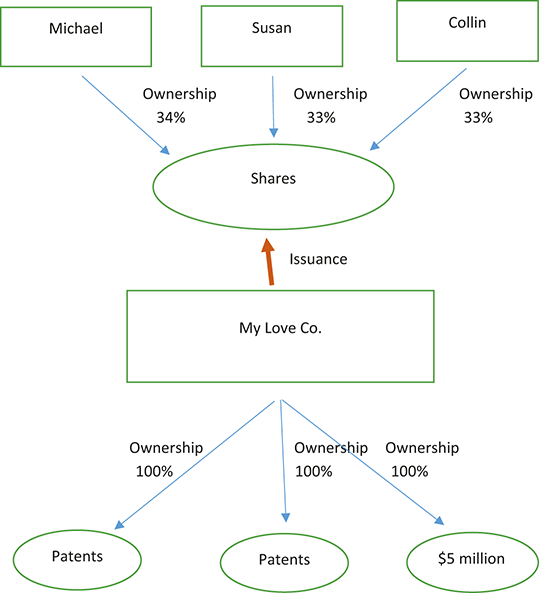
The three partners estimate they will need $5 million to develop patents and prototypes. Collin agrees to provide the funds; they allocate 34% of the company to Michael for his technology, 33% to Susan for hers, and 33% to Collin for his capital. Following a lawyer’s advice, they incorporated My Love Co., Ltd. The ownership and structure of the new company are as shown in Figure 4.
The ownership structure after the establishment of My Love Co.
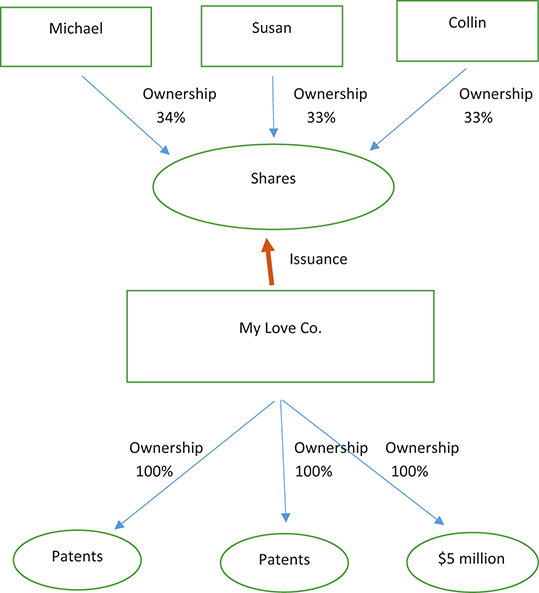
Note that Michael’s and Susan’s (potential) patents and Collin’s $5 million have been transferred to the corporation. This transfer, known as “asset partitioning,” separates the patents and cash from the founders’ personal assets. The partitioning is permanent – there is no way for the founders to recover the assets once handed over. In legal terminology, this process is also called “capital lock-in,” “affirmative asset partitioning,” “asset separation from shareholders,” or “the absence of a repurchase condition.”Footnote 20
In return, the founders receive shares issued by the corporation and become shareholders. They no longer own the assets held by the corporation and therefore are not its owners. Instead, they exercise control through the rights attached to their shares. Thus, the first corporate theorem (CT 1) states: Shareholders are owners of shares, not the corporation. The corporation owns itself.
The relationship between shareholders and the corporation resembles that between bondholders and the corporation. Bondholders own bonds, not the corporation; shareholders own shares, not the corporation. The difference lies in the nature of their securities. Bondholders’ rights are secured by the corporation’s obligation to repay principal and interest – if it fails, they may liquidate assets in bankruptcy. Shareholders, by contrast, have no guaranteed returns: stock prices may fall, dividends may not be paid, yet bankruptcy is not triggered. Their potential reward is capital gains and dividends, and their formal rights are limited to voting on certain matters such as appointing directors and approving mergers and acquisitions (M&As).
How is the corporation managed? Before incorporation, founders own and manage their assets directly. Once incorporated, all business-related assets belong to the corporation, which requires an organizational structure to oversee and manage them. At the top sits the board of directors, responsible for appointing the Chief Executive Officer (CEO) and other executives and guiding the company’s strategic direction. The founders of My Love Co. agree to form a three-member board: Michael, Susan, and Collin. The board elects Michael as Chairman, and President and CEO, Susan as Vice President and Chief Technology Officer (CTO), and, at Collin’s recommendation, his relative Jeremy – a retired executive – as Chief Financial Officer (CFO).
2.2 The Fundamental Separation of Control from Ownership
Why do most companies adopt the corporate form? Because it offers exceptional convenience and protection for both founders and the enterprise. Suppose the three founders of My Love launched their venture without incorporating it. To run operations, they would need to make numerous contracts – employment agreements, bank loans, and supplier deals. But who would bear responsibility for them? Without incorporation, the founders would have to sign them personally, exposing themselves to complex legal and financial risks.
Take employment contracts, for instance. My Love is an ambitious AI company that must hire highly skilled engineers and scientists. If it were unincorporated, prospective employees would hesitate to sign contracts with individuals of uncertain financial standing. Michael and Susan, with limited personal assets, could not inspire confidence, and while Collin’s wealth might provide credibility, he would not want to assume unlimited personal liability for salaries or other obligations beyond his $5 million investment.
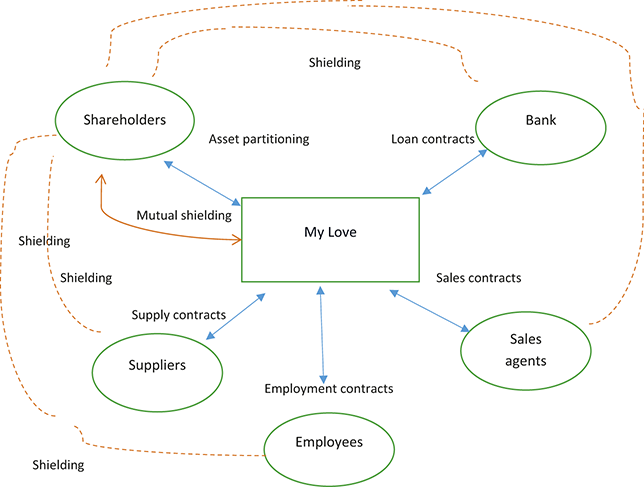
Incorporation resolves this elegantly. By transferring assets to My Love Co. and making the corporation itself the contracting party, the founders limit their liabilities to the amount they have contributed. Their personal assets are partitioned and shielded from corporate assets. At the same time, employees are protected from risks associated with shareholders’ personal financial affairs – they only need to assess the company’s assets and prospects.
The same logic applies to banks and other creditors. When My Love seeks a loan, the bank prefers to contract with the corporation, not with individuals who hold few tangible assets. With its promising patents and Collin’s capital, the corporation offers a credible counterparty. If Michael later faces personal financial troubles, his creditors cannot seize “Patent 1,” as it has already been transferred to My Love. This entity shielding ensures that lenders can rely on the corporation’s own balance sheet rather than on that of its shareholders. These principles extend to all corporate transactions, including bond issuance, insurance contracts, and supplier agreements, as illustrated in Figure 5.
Asset partitioning and entity shielding surrounding My Love.
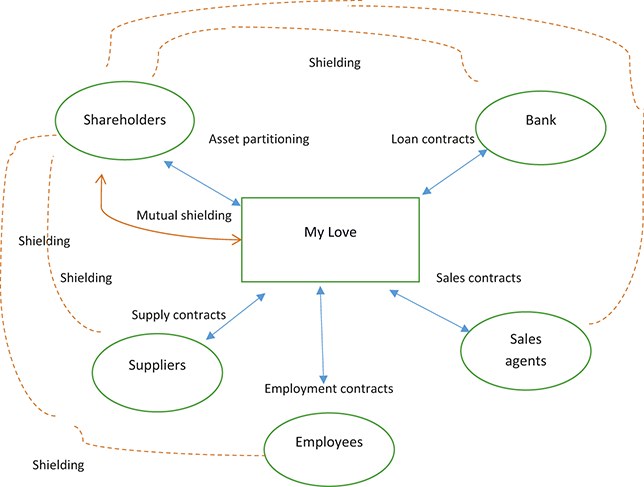
It is important to note that the process of incorporation involves the permanent and irrevocable separation of ownership and control. The founders transfer their assets to the corporation and, in so doing, permanently transform themselves into shareholders. They can no longer reclaim those assets; instead, they hold rights attached to their shares. I call this a “fundamental separation of ownership and control” because it is often misunderstood in academic and legal circles.
The phrase “separation of ownership and control” was popularized by Berle and Means (Reference Berle and Means1932), who described it as a historical process in which founders of major US corporations sold their shares to the public, leading to dispersed ownership in the early twentieth century. Their work became the canonical reference for discussions of ownership and control, almost a “bible” of corporate governance. For nearly a century, scholars and lawyers have adopted this interpretation, producing a vast body of literature based on it.Footnote 21
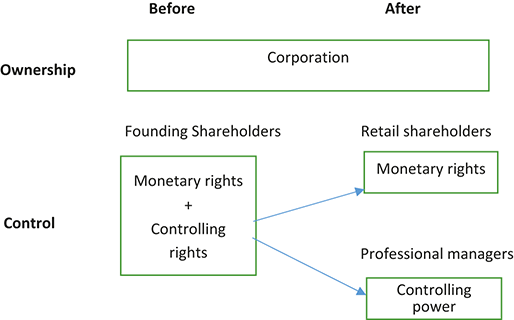
However, the term is incorrect – both legally and historically. The separation of ownership and control had already occurred in those US companies at the time of their incorporation. The change that took place in the late nineteenth and early twentieth centuries was the passing of control from founding shareholders to professional managers, as shown in Figure 6. During those decades, the founding shareholders sold their shares in the market and retired from management. But institutional shareholders hardly existed, and the shares were mostly purchased by individuals who were dispersed and only interested in the monetary rights attached to their shares – prospective dividends and capital gains. Those individuals lacked both the will and capacity to exercise control. The control thus passed to professional managers who had worked for the founders, and the US entered the era of “managerial capitalism.”Footnote 22
Ownership and control at the birth of managerial capitalism.
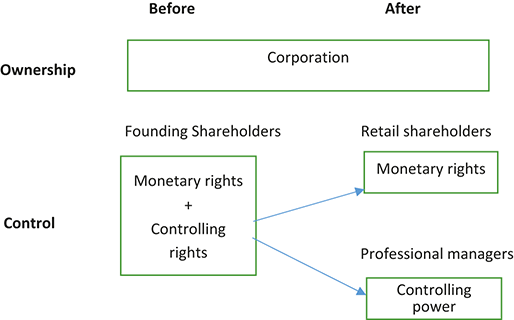
It should also be noted that the conventional claim about the dispersion of share ownership is exaggerated. Even in the US, it is doubtful that managerial capitalism is the dominant form. Approximately one-third of the companies listed are still controlled by major shareholders.Footnote 23 Among unlisted firms, the overwhelming majority are controlled by major shareholders. In numerical terms, corporations without major shareholders account for less than 0.2% of all US corporations.Footnote 24 Outside the US, even among large corporations, managerial capitalism is far from the norm – it is found mainly in the United Kingdom and rarely in continental Europe or in developing economies. It has never been a globally generalized phenomenon.Footnote 25
Furthermore, managerial capitalism has been in decline in the US in recent decades. Financial investors – pension funds, hedge funds, private equity firms, and mutual funds – have gained significant influence. These “minority shareholders” are no longer small and passive; they are now big and increasingly active.Footnote 26 As a result, professional managers no longer hold exclusive control. Managerial capitalism today looks markedly different from its earlier form.
Recognizing the problems in Berle and Means’s terminology, Robé (Reference Robé2011: 25–28) distinguishes between “the first separation of ownership and control,” achieved through incorporation, and “the second separation,” associated with the rise of managerial capitalism. Yet this distinction only adds confusion. The so-called “second separation” never actually occurred: ownership was already vested in the legal person at the time of incorporation (CT 1), and this structure remained intact even as control shifted from founding shareholders to professional managers in the late nineteenth and early twentieth centuries.
Accordingly, this study proposes corporate theorem 2 (CT 2): Ownership and control are fundamentally separated when a company is incorporated.” This is the other side of the coin to CT 1. The separation underpins entity shielding and limited liability and remains in place for as long as the corporation exists. As will be discussed later, understanding this fundamental separation is key to grasping the corporation’s purpose and behavior.
2.3 The Corporation Pursues Perpetuity
The wheels of incorporation, asset partitioning, entity shielding, and limited liability are designed to keep a company rolling for an eternity. They insulate corporate assets from the mortality of natural persons by vesting them in legal persons capable of perpetual existence. This legal foundation enables corporations to accumulate capital and prosper across generations. The story of Singer Manufacturing Co. illustrates this principle.
Isaac Merritt Singer was a renowned industrialist who, in 1851, produced the world’s first sewing machine for domestic use. He partnered with Edward Clark, a lawyer who had successfully defended his patents, to form I.M. Singer & Company. Their partnership flourished, and Singer, already wealthy, became even richer. But he led a complicated personal life, having several extramarital relationships and fathering numerous children, including eight with one long-term partner he never married.
Clark grew worried about the company’s future. What would happen after Singer’s death? He foresaw bitter legal disputes among Singer’s heirs over claims to his estate. Around this time, the corporate form was gaining traction in the US, and Clark began urging Singer to convert the partnership into a corporation. By transferring the business’s assets to an immortal legal entity, he argued, they could protect the firm from inheritance conflicts and ensure its survival beyond the founders’ lifetimes.
Under this structure, Singer’s heirs would receive shares rather than direct ownership of business assets. They would become passive shareholders, living on dividends or by selling their shares, while professional managers handled the company’s operations. Persuaded by Clark’s reasoning, Singer agreed, and in 1863, their partnership was incorporated as the Singer Manufacturing Co. After Singer’s death, professional managers continued to run the company, securing its continuity and its rise as a world-leading sewing machine brand.Footnote 27
Entity shielding through asset partitioning is a cornerstone of long-term corporate success. In traditional agrarian societies, the key productive asset – land – was typically divided among heirs, fragmenting holdings and hindering productivity growth over generations. By contrast, corporations preserve business integrity through asset partitioning: Founders’ family members inherit shares rather than pieces of the enterprise. These shares can be freely sold to relatives or outside investors without impairing the corporation’s continuity. As long as the corporation remains competitive, it possesses a legal foundation for indefinite growth, regardless of who holds its shares.
The corporation has historically evolved into an entity to pursue perpetuity by acquiring legal attributes such as ownership of property and the ability to sue and be sued. The notion of a legal person originated in Roman law.Footnote 28 Early corporate forms, which emerged in medieval Italy, “allowed for the pooling of capital, vesting its control in a manager and providing some sort of shelter limiting the liability of individual investors.”Footnote 29 In the eighteenth century, when the British East India Company was the world’s largest corporation, legal persons were clearly defined as “artificial persons, who may maintain a perpetual succession, and enjoy a kind of legal immortality.”Footnote 30
In modern times, the courts of Delaware State, where more than 60% of large US corporations are headquartered, continue to recognize the corporation as an entity designed for perpetuity. A vice chancellor, J. Travis Laster, notes “the existence of the typical corporation is perpetual and the capital provided by common and preferred stockholders … is permanent.”Footnote 31
Legal personality alone does not guarantee perpetual existence, of course. Exposed to market competition, a corporation may cease to exist if it fails to remain competitive. To survive and thrive, it must continuously innovate and remain competitive. This existential imperative (CT 4) will be discussed in the next section. Legal personality provides a necessary condition for perpetuity: Innovation and competitiveness supply the sufficient condition.
When Michael, Susan, and Collin incorporated My Love, they only dimly grasped these implications. They were unaware that Korean commercial law explicitly stipulates that “the corporate governance structure presupposes the separation of ownership and management.”Footnote 32 They would later come to appreciate the vital importance of asset partitioning for survival and growth – particularly after launching the overseas joint venture My Love Cutie and the affiliate My Love Children, transforming their company into a multinational business group.
2.4 The Legal Person Is a Real Entity
Despite the legal person’s importance, there is a strong tendency among academics and policymakers to dismiss it as a “fictional” or “artificial” entity. This view is particularly prominent among proponents of the nexus of contracts theory.Footnote 33 A seminal example is Jensen and Meckling (Reference Jensen and Meckling1976)’s “Theory of the Firm: Managerial Behavior, Agency Costs, and Ownership Structure,” a foundational text of shareholder value theory.
They wrote: “It is important to recognize that most organizations are simply legal fictions which serve as a nexus for a set of contracting relationships among individuals.” Here, the firm is treated as a fiction, while the contracts among individuals – inside and outside the firm – are seen as the real entities. They even claim: “it makes little or no sense to try to distinguish those things which are ‘inside’ the firm from those things that are ‘outside’ of it.”Footnote 34
However, dismissing the legal person as a fiction is equivalent to ignoring how human society actually functions. Though invisible and intangible, the legal person is a social reality essential to organizing economic activities. Around this conceptual entity, concrete transactions – labor contracts, production, financing, and exchange – are structured and executed. Corporate accounting itself presupposes that the corporation is a real entity.
This is no different from how nations, religions, and cultures, though conceptual, have evolved into powerful social realities. Likewise, the legal person, which began as a legal concept, has become a real social actor – owning property, incurring liabilities, and appearing as a responsible party in court, much like a natural person.Footnote 35 Thus, Jensen and Meckling’s assertion that the corporation is a fiction is itself a fiction.
For businesspeople, it is self-evident that the legal person is a real entity. The founders of My Love also come to grasp this reality through experience. Their managerial responsibilities are greatly simplified by the existence of the legal person. From the outset, they realize that corporate accounting depends entirely on it: All contracts and financial transactions are executed in the name of the legal person, and external auditors review financial statements prepared under its name.
Legal personality and corporate accounting are two sides of the same coin. As Gindis (Reference Gindis, Biondi, Canziani and Kirat2007: 266) aptly observes, the harmonious operation of a corporation’s components – working together as parts of one integrated whole – is held together by the “ontological glue” of business accounting. If the legal person were dismissed as a fiction or façade, business accounting would lose its foundation, and any substantive understanding of the corporation would be impossible.
2.5 The Corporate Board and the Shareholders’ Meeting
Recognizing the legal person as a real entity is also key to understanding the relationship between the corporate board and the shareholders’ meeting. Those who misunderstand the corporation’s legal structure make the mistake of viewing the shareholders’ meeting as the highest decision-making body and the board as its subordinate. This misconception arises when CTs 1, 2, and 3 are ignored or misunderstood. Shareholders are merely owners of shares – they possess certain rights, but not management rights.
Corporate laws worldwide consistently affirm that the board of directors is the corporation’s supreme decision-making body. The Delaware General Corporation Law (DGCL) stipulates that a company’s business and affairs “shall be managed by or under the direction of a board of directors.”Footnote 36 Similarly, Korean corporate law states that “the board of directors has authority to make decisions on all matters regarding a company’s business other than those reserved to the shareholders’ meeting by law or the articles of incorporation, and to supervise the performance of executives.”Footnote 37
The board’s authority derives directly from the process of incorporation, not from any delegation by shareholders. Through asset partitioning and entity shielding, shareholders enjoy limited liability, while the task of management is assigned to the corporation as a separate legal entity. Consequently, shareholders have no power to delegate corporate functions to the board. This principle was firmly established in early twentieth-century US jurisprudence. Several courts ruled that the board’s authority to shape corporate policies is “original and undelegated,”Footnote 38 or “the citation of authorities in its support is unnecessary.”Footnote 39
Similarly, the Supreme Court of Korea held that “the board of directors is an independent corporate body with its own authority, and, therefore, the shareholders’ meeting cannot make matters decided by the board’s unique authority null or void.”Footnote 40 If the shareholders’ meeting were the highest authority, it could overturn board decisions. But because the board is the top decision-making body, it is only natural that the shareholders’ meeting cannot overrule or nullify board decisions.
While recognizing the board as the highest decision-making authority, commercial laws grant limited rights to the shareholders’ meeting in four broadly defined areas. First, shareholders have the right to elect and dismiss directors. Second, they may revise or approve the articles of incorporation. Third, M&As or significant sales of corporate assets require shareholder approval. Fourth, dissolution of the corporation must be approved by the shareholders’ meeting.
Granting only these limited rights is appropriate because shareholders enjoy limited liability. In any organization, rights and responsibilities must correspond. This principle will be explored further as corporate theorem 8 (CT 8): “the basic principle of corporate control is the correspondence between rights and responsibilities.”
Given these clear distinctions between managers and shareholders, the term “owner-manager” is a misnomer. The correct term is “major shareholder-manager.” They do not own the corporation (CT 1) – only exercise control through a substantial shareholding. Such a shareholder becomes a manager only by entering into a contract with the corporation, just as any professional manager would. For the same reason, the expression “a corporation’s ownership has changed” is misleading. The legal person – the corporation – remains the perpetual owner of itself; what has changed are the majority shareholders who exercise control rights.
The shareholder value theory assumes that managers are agents of shareholders. Applied to shareholder-managers, this assumption leads to the absurd conclusion that they are their own agents. This paradox stems from treating the legal person as a fiction and imagining shareholders as corporate owners.Footnote 41 Once the corporation is recognized as a real entity, the paradox dissolves: both shareholder-managers and professional managers are agents of the corporation.
The distinction between managers and shareholders also clarifies why the shareholders’ right to appoint and dismiss directors should not be regarded as a management right. If it were, shareholders would bear responsibility for management performance just as managers do. Yet they are shielded from such responsibility. Therefore, their right to appoint and dismiss directors should be understood as a mechanism to protect their monetary rights, not a managerial right.
Since shareholder rights are not management rights, they are exercised “intermittently”, typically after business performance has been reported. As Arrow (Reference Arrow1974: 78) explains, “[Accountability mechanisms] must be capable of correcting errors but should not be such as to destroy the genuine values of authority … If every decision of A is to be reviewed by B, then all we have really is a shift in the locus of authority from A to B and hence no solution to the original problem.”
It is a general organizational principle to grant executives discretionary authority to manage operations, subject to periodic review. Simply intensifying oversight does not improve business performance; on the contrary, excessive surveillance can undermine executives’ competency and erode the authority required for effective decision-making, leaving the original problem unsolved. The same holds for the relationship between the corporate board and the shareholders’ meeting. The board exercises executive powers, while the shareholders’ meeting reviews and constrains them intermittently.
2.6 Hierarchy and Order in the Corporation
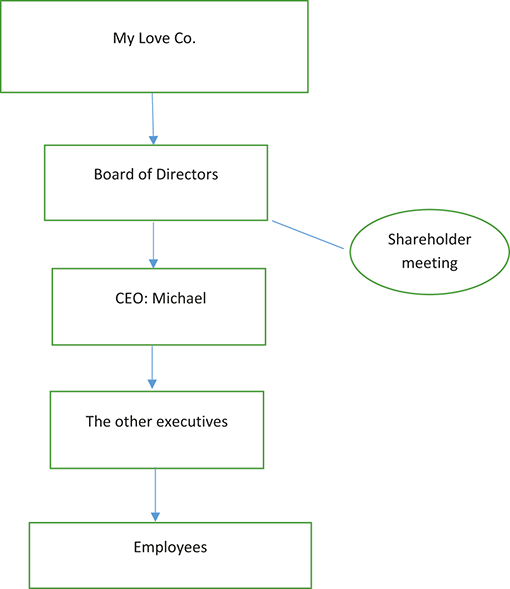
How, then, are management rights exercised in a corporation? To understand this, it is essential to recognize that a corporation is a hierarchical organization, with the board of directors at the top (Figure 7). Decision-making within the board, however, is not hierarchical. For instance, even if Michael serves as chair, he cannot force through a resolution opposed by Susan and Collin; board decisions are normally made by majority vote. But the majority rule ends there: once the board reaches a decision, everyone – including the CEO – must comply. This hierarchical principle extends throughout the organization, defining authority and accountability at every level of the corporation.
Hierarchical chart of My Love’s management.
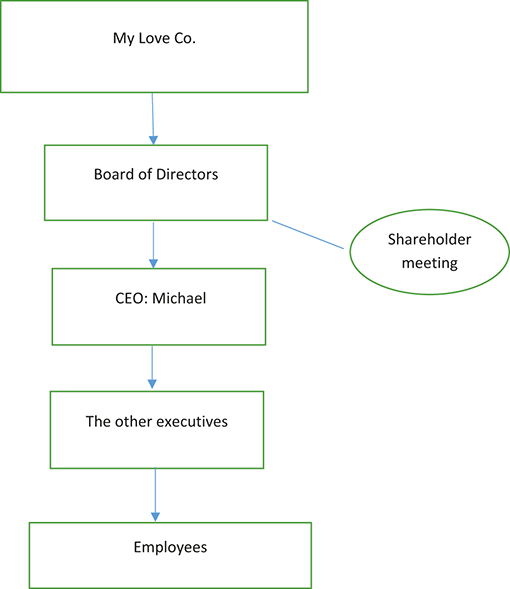
Corporations adopt a hierarchical structure because it is best suited to managing the uncertainties inherent in business decision-making. As discussed in the next section, a manager’s existential task is to satisfy customers through innovation (CT 4). Innovation – creating “New Combinations” – is inherently uncertain and is often a bet on what appears to have a low probability. Most people tend to cling to “Old Combinations,” which are less risky and uncertain. If the decisions were left to majority vote, innovation would hardly occur. It requires strong leadership and judgment from individuals with experience and capability.
The role of hierarchy becomes clearer if we examine the employment contract. It is essentially “a contract of subordination” in which employees agree to follow the employer’s orders “in the sphere in which they accept to be subordinated,” or “in areas of acceptance,” in exchange for compensation.Footnote 42 The contract does not specify all the employee’s tasks in detail. This lack of specificity serves to protect both the employee and the employer from uncertain circumstances that may arise during employment.
At the time of hiring, employees cannot foresee every aspect of their future responsibilities. Only after they begin working for the corporation do they gain clarity about the scope of their tasks. They may also value the flexibility to explore different roles and responsibilities rather than being confined to specific tasks from the outset. Employers face similar uncertainties: Before observing employees’ actual performance, it is difficult to determine which role best suits them. They also need flexibility to reassign employees if their initial placement proves unsuitable. It is, therefore, more practical for an employment contract to be framed in broad terms of subordination, rather than attempting to specify every detail in advance.
Market-oriented theorists often overlook these uncertainties, treating the employment contract as a simple marketplace transaction of goods with perfect knowledge and bargaining conditions. For instance, Alchian and Demsetz (2009: 173–174) argue that “the content of the [employers’] presumed power to manage and assign workers to various tasks … [is] exactly the same as one little consumer’s power to manage and assign his grocer to various tasks,” even calling the view of the corporation as a hierarchical organization a “delusion.”
Their view is, however, a market fundamentalist delusion. One little consumer visiting a marketplace, asking to be shown this and that, and buying one item is a one-time event. It is an exchange in a world of little uncertainty and simply a market transaction, not a contract. Contracts are signed only when necessary, as in the case of employment arrangements, where uncertainty is significant. Yet, the nexus of contract theorists obliterates the distinction between a market transaction and a contract and calls the former a “contract.”
My Love needs many electronic engineers for design and production activities, but does not want to limit their role to electronic engineering. Its products and services integrate diverse disciplines – electronics, data science, biology, and material science. The company benefits when electronic engineers expand their knowledge across fields. Newly hired electronic engineers may also seek to broaden their experience beyond the field they majored in at university, in order to enhance their promotion prospects. Restricting their roles to their initial specialization would run counter to both innovation and personal development.
2.7 Business Judgment Rule
To what extent are managers held responsible for their managerial failures? A principle that has been firmly established for over a century is the “business judgment rule.”Footnote 43 Under this rule, as long as executives fulfill their fiduciary duties of good faith, loyalty, and care, they are not liable to litigation for managerial failures. Managers are, of course, dismissed or penalized for poor performance. But managers are only legally accountable if they are found to have harmed the corporation by violating their fiduciary duties.
The business judgment rule is a necessary safeguard, enabling corporate managers to focus on fulfilling the corporation’s existential imperative: remaining competitive by satisfying customers through continuous innovation (CT 4). For innovations to materialize, managers must be willing to take calculated risks. If they were held legally accountable for business failures, they would become risk-averse, ultimately stifling innovation. In this context, Bainbridge (Reference Bainbridge2002: 67) points out that “the business judgment rule is the offspring of the fundamental principle [that] … the business and affairs [of a corporation] are managed by or under its board of directors,” and it “exists to protect and promote the full and free exercise of the managerial power.”
The founders of My Love have yet to fully grasp the importance of the business judgment rule. At this stage, they own 100% of the shares, serve as directors and top executives, and exercise absolute control. They work collaboratively, sharing the same fate, and it is difficult for any one of them to hold another legally accountable for mishandling the corporation’s affairs. If something goes wrong with My Love, they collectively feel responsible.
However, as new shareholders join following a stock market listing, the business judgment rule will become invaluable to them. For example, suppose My Love invests heavily in a new product that ultimately fails. Its stock price plummets, causing significant losses to new shareholders. What happens if they sue Michael? As founder and CEO, Michael has made numerous contributions to the company, and this failure might be one of only a few missteps in his career. The cofounders and long-term investors might overlook this rare mistake. But new shareholders are not so forgiving. They may focus on recovering their losses or penalizing those they deem responsible.
Without the business judgment rule, lawsuits against management could arise frequently, incurring substantial costs in terms of money, time, and energy – resources better spent on running the business effectively. If Michael were to face such a lawsuit, he might become overly cautious in his decision-making. This would seriously undermine My Love’s innovation capabilities. The business judgment rule shields Michael from this pressure, allowing him to focus on innovation.
3 The Ontological Foundation and Purpose of the Corporation
When Michael, Susan, and Collin launched My Love, they never paused to ponder the philosophical question of why corporations exist. For Michael and Susan, their initial motivation was simple: to make money – ideally a fortune. They could have led stable lives in academia or industry as salaried professionals, but wanted to be successful entrepreneurs, to taste the excitement and prestige that come with building something extraordinary. Collin, already wealthy, was less driven by money. He was already well-off. It would still be fun to multiply his wealth. But he was more thrilled by the prospect of gaining recognition as a successful venture capitalist.
Yet the fun and glamour are now distant dreams. The existential tasks are taking over their lives. My Love must survive. It needs to secure patents, test prototypes, ramp up production, and launch its AI puppies. Michael knows speed is everything in business. The story of how Bill Gates and Paul Allen developed an operating system on the flight to meet their first customer, Ed Roberts, the founder of Micro Instrumentation and Telemetry Systems, made a deep impression on him.Footnote 44 So he applies for patents and starts preparing production simultaneously rather than waiting for the patents to be approved. My Love is in a race against time to release its AI puppies and capture the market ahead of competitors.
3.1 Customer Satisfaction through Innovation
Our Corporate Axiom 2 is the existence of market competition. What are businesses competing for? In a word – customers. They must attract and retain customers by satisfying their needs. Without customers, corporations cannot survive. “The customer is King.” Before the rise of the shareholder value and stakeholder theories in the 1980s, business thinkers and practitioners widely regarded customer satisfaction as the very purpose of the corporation.
Peter Drucker (Reference Drucker1954/2006: 31–32) famously stated: “There is only one valid definition of business purpose: to create a customer. The purpose of business is to create and keep a customer.” Sam Walton, founder of Walmart, echoed his view, “There is only one boss – the customer. And he can fire everybody in the company from the chairman on down, simply by spending his money somewhere else.”Footnote 45
This fundamental dependence on customers is expressed in corporate theorem 4 (CT 4): The existential imperative of the corporation is to satisfy customers through innovation. Corporate theorem 4 naturally follows from CT 3: The only sustainable path to achieving corporate perpetuity in a market economy is to satisfy customers through innovation. Having a legal personality is a necessary condition for perpetuity; satisfying customers through innovation is a sufficient condition.
However, meeting this sufficient condition is far from easy. In the US, the average lifespan of large corporations was sixty-one years in 1958 and dropped to eighteen years by 2016.Footnote 46 Out of the 500 largest companies in 1955, only fifty-three remained on the list in 2018.Footnote 47 Corporations are in relentless struggles for innovation to survive the competitive hell. Yet, this “hell” for corporations becomes a “heaven” for customers, as the competition provides customers with a diverse array of products and services.
We should prioritize the ontological foundation for corporate survival over corporate teleology – the question of whom the corporation serves.Footnote 48 The reason is simple: The ontological foundation is straightforward and indisputable, whereas teleological perspectives vary widely, from shareholder value to stakeholder theory. Framing the question “Why corporations exist” in teleological terms makes it difficult for people with differing values to find common ground.
By contrast, beginning from the ontological foundation offers a common ground from which agreement – or at least constructive compromise – can emerge. Few would deny that a corporation survives and prospers by satisfying customers through innovation (CT 4). Customer satisfaction can therefore be recognized as the immediate and primary purpose of the corporation, a shared starting point for any broader discussion of corporate purpose.
It is important to note that CT 4 is not merely an existential necessity; it already embodies a major part of the corporation’s social contribution. While corporations endure the “hell” of competition, they deliver the “heaven” of consumer welfare. In doing so, they create jobs, enhance employee well-being, support contractors, generate profits that increase shareholder value, and contribute to wider economic and social development.
3.2 Business Group and Multinational Corporation
My Love has made rapid progress. Within just one year, it successfully secured all the necessary international patents and developed a prototype AI puppy named “Dasomi.” Dasomi has since been showcased at several AI exhibitions and pet fairs. Although some organizers objected to an AI puppy’s participation, it was overwhelmingly well-received. Enthusiasm about Dasomi’s upcoming release is palpable, and My Love is flooded with purchase orders and partnership inquiries.
Having confirmed the strong market demand for Dasomi, My Love is now ramping up its production. To offer the product at an affordable price – below $500 for the mass market – it must produce at least 10,000 units annually. It also plans to diversify its product line to include AI cats, monkeys, and panda bears. Jeremy, the CFO, estimates that approximately $50 million will be required to build production facilities, invest in R&D, and establish sales networks.
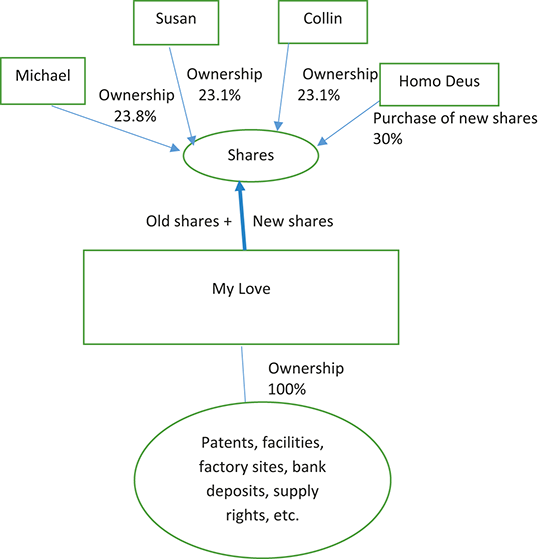
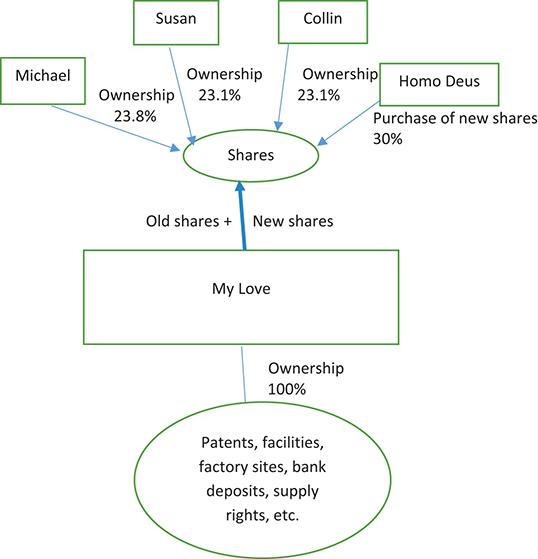
Impressed by the excitement around Dasomi, a venture capital firm, Homo Deus offers $50 million for a 30% stake in My Love – valuing the company at eleven times its original share price. Homo Deus also requests the right to appoint a CFO. Following this investment, My Love’s shareholding structure is reconfigured, as shown in Figure 8.
The ownership structure of My Love after the first external funding.
My Love successfully scales up production of Dasomi. Advances in biotechnology and material engineering make sourcing materials for Dasomi’s fur and skin easier than expected. Susan and her team work tirelessly to make Dasomi’s skin soft and lifelike, while Michael develops technologies that dramatically enhance the puppies’ emotional communication with humans. My Love also begins building its sales force, opening direct sales outlets in affluent districts populated by wealthy and young professionals, while relying on sales agents elsewhere.
One salesperson proposes an ingenious idea – launching a beta test website called the “My Love Puppies (MLP) Community” before the official release. Members can interact with a holographic Dasomi in a virtual environment. Although they cannot physically touch it, they experience its 3D presence and can engage with it virtually. MLP Community members, having a virtual preview of Dasomi, are expected to become enthusiastic buyers and brand ambassadors, spreading excitement among friends and family. The proposal is unanimously adopted.
My Love is eager to expand overseas. However, building international sales networks from scratch is costly and risky, so the company begins searching for foreign partners. At a pet show, a US company, Cutie Pet, proposes to acquire exclusive distribution rights for the American market. Michael, however, envisions more than just sales – he wants to build manufacturing facilities in the world’s largest market and technology testbed. He counters with a proposal to establish a joint venture.
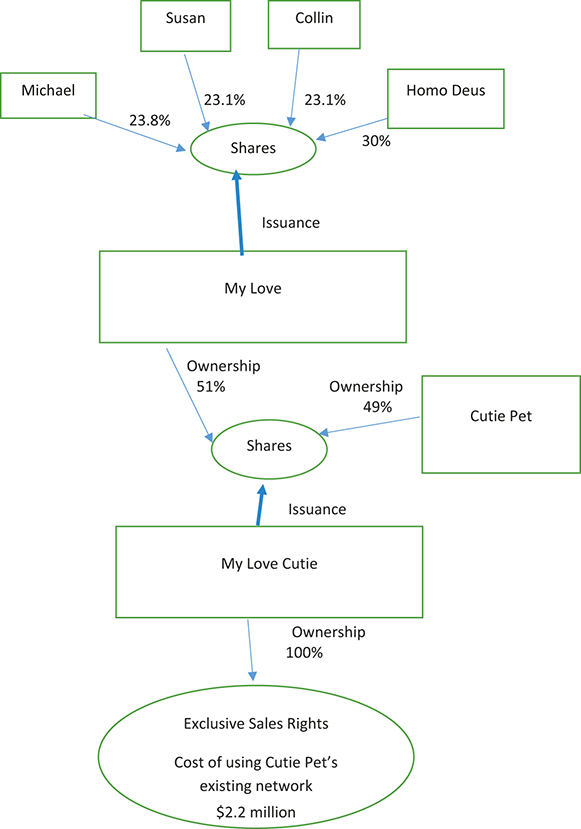
After intense negotiations, the two sides reach an agreement: My Love will hold 51% of the joint venture, named My Love Cutie Co., and Cutie Pet the remaining 49%. My Love Cutie will hold exclusive rights to sell My Love products in the US for five years. Cutie Pet will invest $2 million to establish the venture and its sales network, while My Love will second a manager from Korea to My Love Cutie for the first year at a cost of about $200,000. The board will comprise three members – one from My Love and two from Cutie Pet – with the president selected from Cutie Pet-appointed executives. By forming this joint venture, My Love becomes a multinational business group even before launching its first product. Linked through shareholdings, My Love Co. and My Love Cutie Co. now constitute a business group, as shown in Figure 9.
My Love Group after the first asset partitioning.
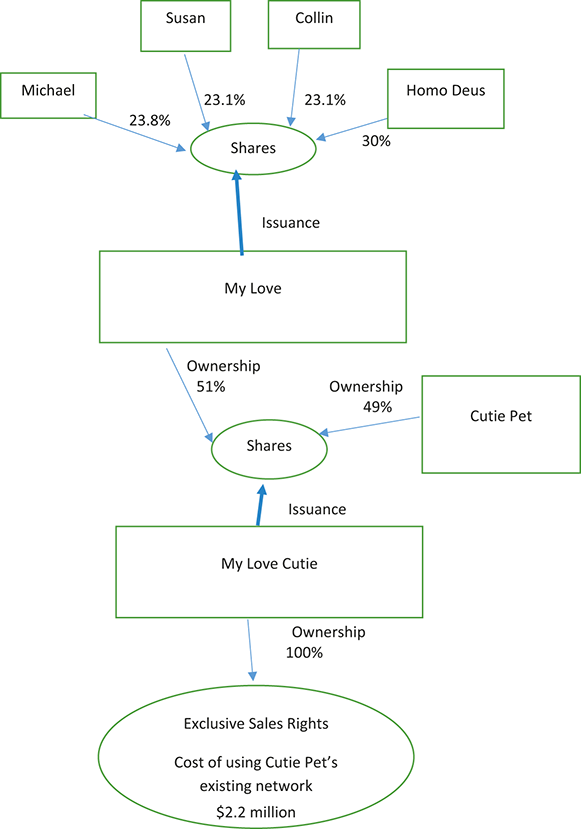
An important feature of this group structure is that the affiliates are created through asset partitioning. My Love divides its corporate assets and permanently transfers a partitioned portion to My Love Cutie. In return, My Love receives shares issued by My Love Cutie. A key difference from My Love’s initial incorporation process is that this time, the partitioned assets originate from a corporation, not natural persons.
Yet the same wheel turns: incorporation, asset partitioning, entity shielding, and limited liability. My Love is shielded by limited liability from My Love Cutie’s business risks. If My Love Cutie fails, My Love’s maximum loss is limited to the five-year exclusive sales rights and the $200,000 secondment expenses. In the same way, entity shielding protects My Love Cutie from My Love’s liabilities.
This principle – creating an affiliate through asset partitioning – applies equally to overseas expansion. Establishing a foreign subsidiary makes a company both a business group and a multinational corporation. Thus, when My Love forms the joint venture My Love Cutie, it becomes both. This logic underpins corporate theorem 5 (CT 5): Business groups expand through asset partitioning among corporations, just as new corporations are created through asset partitioning by natural persons.
Just as natural persons have varying relationships – with family, friends, colleagues, or strangers – corporations interact with one another in different ways. Some corporations are closely connected, while others are loosely affiliated. Some operate domestically, while others expand overseas. A corporation may have first-tier subsidiaries (children) and second-tier subsidiaries (grandchildren), or it may choose to remain independent. In a nutshell, corporations develop varied relational networks shaped by strategy, geography, and degrees of interconnection.
3.3 Perpetual Innovation and Corporate Expansion
Dasomi finally launches, igniting a frenzy among consumers. Eager to own one, people line up outside My Love’s flagship showroom in Myeong-dong, Seoul. Demand far exceeds production capacity. Amazon, initially lukewarm when My Love first approached, now offers to feature Dasomi on its homepage. Meanwhile, the MLP Community buzzes with excitement. Owners share their joy and pet care tips, while others – still waiting – interact with holographic Dasomis, eagerly anticipating the day they can welcome a real one.
Yet Michael is not satisfied with Dasomi’s success. His ambitions stretch far beyond AI pets. Working secretly with Susan, he develops a new product under the code name MLBMLG – short for My Love Boy, My Love Girl. Their goal is to create robot babies indistinguishable from human infants. They know the storm this will unleash. Critics will accuse My Love of “destroying human dignity” or “creating a new robot species destined to dominate humanity.” Some will warn that such robots could “be misused as sex robots.”Footnote 49 Protests outside My Love’s headquarters and large-scale boycotts appear inevitable.
Despite the looming controversy, Michael remains confident in MLBMLG’s potential. He envisions it as a low-cost, high-quality alternative to raising a human child. Many people who love children are choosing not to become parents because of the financial burden of private education or the pressures of child-rearing in hypercompetitive societies. Others struggle with infertility due to delayed marriage or medical complications. For them, MLBMLG could fulfill their longing for parenthood.
Families with children could welcome an AI son or daughter to bring new warmth into their homes. Singles could experience the joy of raising a child without the heavy obligations of marriage, and the elderly might rediscover purpose and comfort in caring for an AI baby – almost like an extra grandchild. Michael believes that nurturing an MLBMLG will be a profoundly human experience – more so than raising a pet. He is convinced that these AI children will not only possess intelligence but also develop a soul that grows and matures over time, much like their physical form.
With this in mind, My Love’s leadership convenes a secret meeting and secures board approval to establish a separate corporation, My Love Children Co. Homo Deus eagerly joins the project. My Love already possesses most of the technologies required to produce MLBMLG. My Love Children will utilize My Love’s established sales and marketing networks, production sites, and talented employees – many of whom are eager to join the new venture.
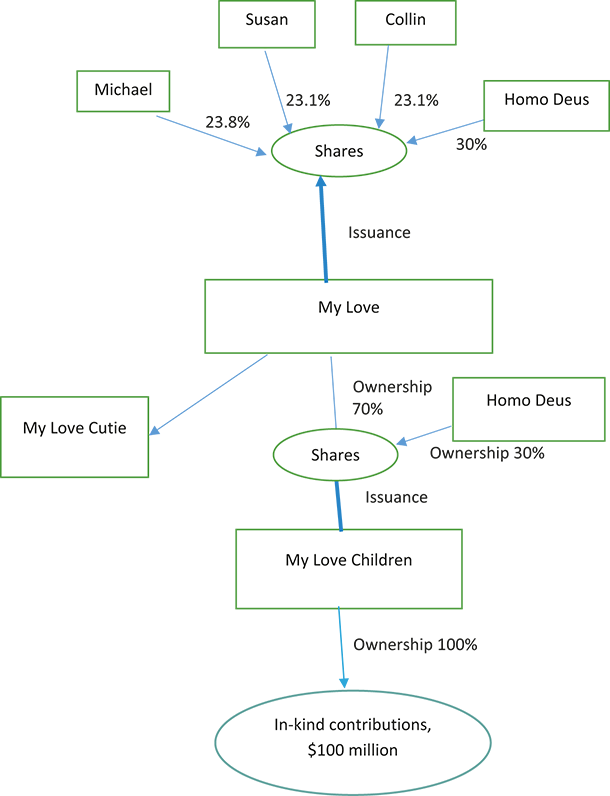
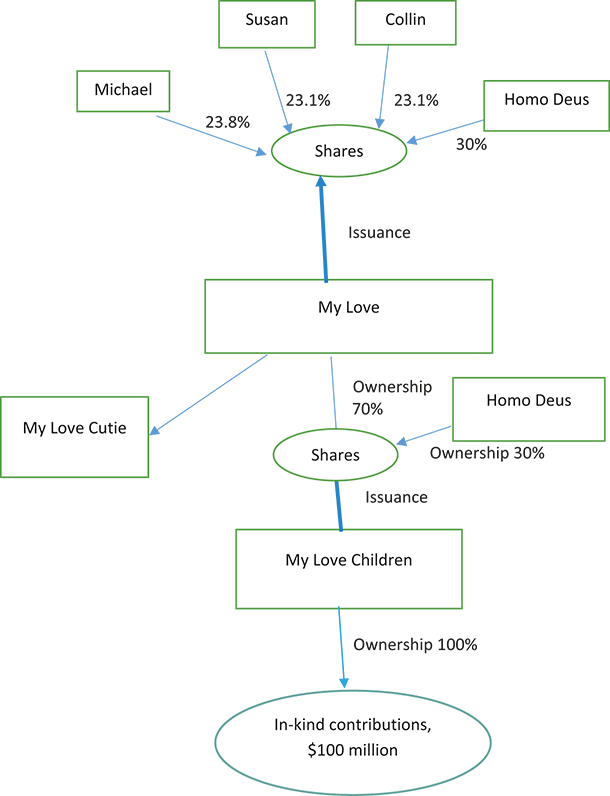
Negotiations with Homo Deus move swiftly. My Love contributes technology, production facilities, and marketing networks in kind, while Homo Deus invests $100 million. They agree on a share distribution of 70% for My Love Co. and 30% for Homo Deus. With this structure, the My Love Group evolves into a multinational business conglomerate, comprising three subsidiaries: My Love, My Love Children, and My Love Cutie – as shown in Figure 10.
My Love Group’s structure after the second asset partitioning.
Note: The relationship between My Love and My Love Cutie is simplified.
3.4 Diversification, Economies of Scope, and Asset Partitioning
Why has My Love chosen to form a business group at the very beginning of its expansion? Why has it opted to add subsidiaries rather than grow the existing company? To answer these questions, let us first examine the options available to an existing company for expanding its business. There are only three options:
(1) Diversification by establishing an entirely new, independent corporation.
(2) Diversification by creating a new business division within the existing corporation.
(3) Diversification by setting up a subsidiary corporation controlled by the existing corporation.
Nascent entrepreneurs can only choose Option (1), as they have no existing corporation to leverage. In contrast, an established corporation can build on its accumulated capabilities, assets, and reputation to pursue Options (2) or (3). The general rationale for preferring these latter options lies in the concept of economies of scope – the efficiency gained from using shared resources and capabilities across related businesses. Option (3) offers an additional advantage: It combines economies of scope with the benefits of asset partitioning, enabling legal separation of risks while maintaining operational synergies.
“Economies of scope” can be divided into two types: nonfinancial and financial economies of scope. The former arises when a corporation reuses its existing technological, managerial, and marketing capabilities for new ventures. My Love, having developed advanced technologies for AI puppies, can apply many of them to AI children. This can be done either by forming a new business division within the company (Option (2)) or by establishing a subsidiary (Option (3)). Both save substantial time and cost compared to Option (1).
Reputation and branding also generate nonfinancial economies of scope. A new business team established within an existing corporation can naturally benefit from the company’s reputation and brand. Similarly, if My Love sets up My Love Children as a subsidiary, My Love’s reputation and brands are great assets that the new company can leverage. Consumers who trust My Love’s products and services are likely to extend that trust to My Love Children’s offerings.
Financial economies of scope operate through a similar mechanism. It is challenging for an independent new corporation to secure funding from external sources because it typically lacks creditworthiness in financial markets. This is why My Love was initially funded with Collin’s money. In contrast, existing corporations have the flexibility to choose Option (2) or Option (3). A new business team simply uses its company’s credit. A subsidiary corporation can leverage the parent company’s credit. Financial institutions are generally more willing to support subsidiaries if they have confidence in the parent company. If the parent company guarantees its subsidiary’s debts, it becomes significantly easier for the subsidiary to secure external funding. In other words, My Love’s creditworthiness is recycled in My Love Children. This is why Homo Deus confidently agrees to invest $100 million in My Love Children.
Corporations will choose Option (3) rather than Option (2) when they seek additional benefits from asset partitioning. If a new business team established within a company fails, the company must assume unlimited liability, potentially being pushed into a financial crisis. Option (3) offers a structured way to manage risks to the parent company through entity shielding and limited liability.
My Love has already achieved success with its AI puppies, and diversification into other AI pets is relatively low risk. Option (2) works well for such cases. But diversification into AI children entails far greater risks and requires careful strategic consideration. The most serious risks stem from public apprehensions about AI children – concerns that are likely to intensify as they become more humanlike. Potential threats include large-scale public boycotts, governmental restrictions, or even an outright ban on AI children production.
Without entity shielding, banks that lent to My Love would become increasingly cautious, shareholders would grow uneasy, and employees might lose focus amid looming risks – undermining morale and productivity. Establishing My Love Children as a subsidiary (Option (3)) is an effective way to limit My Love’s exposure to these risks.
Option (3) also provides significant advantages in developing new businesses because the legally independent subsidiary is less distracted or overshadowed by the parent company’s ongoing priorities. AI children require far more sophisticated technologies than AI puppies because they must develop intellectually, which requires continuous research in language algorithms and big data integration. Yet My Love’s engineers remain focused on the physical and emotional development of AI pets – the company’s current profit center. If the AI-children project were to remain within the parent company, it would risk being treated as peripheral, limiting both motivation and innovation.
Michael vividly remembers how Intel began its journey – a story he learned in the “Technology and Innovation” lecture as an exchange student at the National University of Singapore.Footnote 50 Gordon Moore and other semiconductor engineers were pioneers in their field and proud of their work. However, within AT&T, the focus was on telecommunications, and semiconductors were treated as a peripheral business. US antitrust regulations also prevented AT&T from selling semiconductors on the open market, restricting its semiconductor production to internal consumption.
These constraints severely hindered the semiconductor engineers’ prospects of promotion to executive positions within AT&T. Frustrated by these limitations and driven by their ambition, Moore and his colleagues left AT&T and eventually established Intel – a significant loss for AT&T. Michael has fully grasped the lesson: For innovative, high-risk ventures such as AI children, it is better to establish an independent entity that can focus on its unique technological and strategic goals without being overshadowed by the parent company’s priorities.
Establishing a subsidiary corporation is also an effective way to maintain corporate control. If My Love were to receive another large-scale capital injection from Homo Deus, it would destabilize the company’s control structure. The founders’ shares would be diluted, and Homo Deus could potentially become the largest shareholder. The founders, therefore, wish to retain control over My Love while still securing funding from Homo Deus.
The solution to this dilemma is to establish a subsidiary – My Love Children – and let Homo Deus invest in the subsidiary. As a venture capitalist, Homo Deus has repeatedly emphasized that it does not seek managerial control. So there is no issue with its investment in My Love Children, as it expects a sufficiently high return on investment from the new company. Managing a business is fundamentally about navigating uncertainty. A sound strategy is to prepare multiple options and maintain flexibility in response. The same applies to diversification: Options (2) and (3) remain open, and the corporation chooses between them after weighing internal and external factors.
Michael has made it a rule since founding My Love to sit in interviews with new applicants as much as possible. When My Love Children begins hiring employees, he is in the interview room as usual, listening to the conversations between interviewers and candidates.
During one session, an interviewer raises his voice with an applicant. The company requires male applicants to have completed military service, yet Brian Choo, a fourth-year student at Seoul National University, has not done this. “How could an educated man like you apply for a job without checking the requirements?” the interviewer scolds. Brian calmly replies, “Wouldn’t it be beneficial for both of us if you hire me now? I’ll begin my ROTC (Reserve Officers’ Training Corps) service right after graduation. If you hire me in advance, you’ll secure a capable employee for three years without any cost in the meantime. I can spend my spare time in the army preparing to work at my favorite company, where I’ve already earned a position.”
The interviewer is momentarily speechless. Michael interjects decisively: “You’re hired!” He then asks when Brian’s military service will begin. “I’m in my final semester, just a few months from graduation,” Brian answers. “Then you don’t need to attend classes so diligently anymore,” Michael tells him. “Come and start working here tomorrow. Learn the ropes before you enter the army.” Brian Choo thus becomes the first full-time employee at My Love Group to be hired before graduating from college. After completing his ROTC service, Brian will return to the company and eventually rise to become one of My Love Group’s most successful professional managers.Footnote 51
4 The Teleology of the Corporation
My Love Children grows rapidly, just as My Love once did. It maintains a first-mover strategy – developing the most humanlike AI children – focusing particularly on mental and intellectual growth. While competitors sell AI children with fixed emotional and cognitive levels and later offer upgrade services, Michael takes a different path. He is determined to create an algorithm that enables gradual mental and intellectual development, mirroring the natural growth of human children.
To achieve this, Michael launches a global headhunting drive, recruiting top AI designers and neuroscientists, who work tirelessly and eventually succeed in creating two AI children – “Minjun” and “Songi.”Footnote 52 Like real children, these two grow and learn over time. Their debut at the World Artificial Intelligence Congress draws global attention, and Time magazine names them “Persons of the Year.”
When they founded My Love Children, My Love and Homo Deus agreed on an exit plan allowing investors to sell their shares after five years. As the valuation of My Love companies soars, many Homo Deus clients seek to realize their gains. Collin, still recovering from heavy derivatives losses, also wishes to sell his shares. Susan, facing declining health, decides to liquidate part of hers and transition to a quieter life.
4.1 Initial Public Offerings (IPOs)
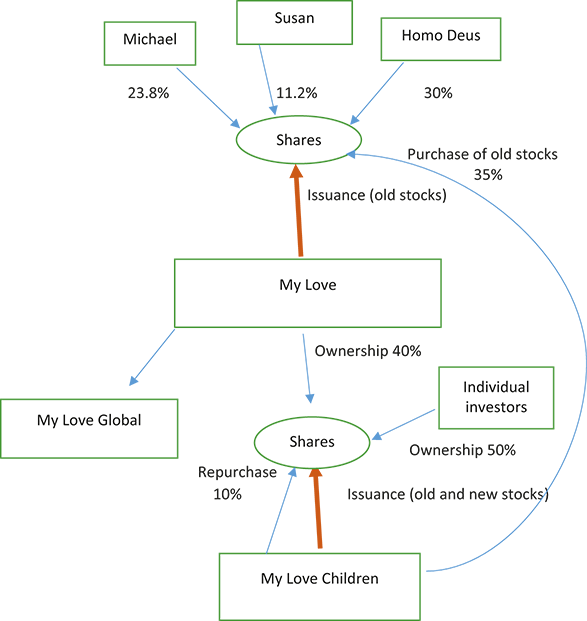
My Love Group decides to list My Love Children on the stock exchange. My Love Co., the group’s operational holding company, remains unlisted. Homo Deus plans to sell its 30% stake in My Love Children through the IPO. Susan and Collin will be compensated via stock swaps: My Love Children will purchase their shares in My Love using funds raised from the new share issuance. The swap ratio between My Love’s old stock and My Love Children’s new stock is set at 1:1.
Under Korea Stock Exchange (KSE) regulations, no shareholder may hold 50% or more of a listed company’s shares. Accordingly, My Love reduces its 70% stake in My Love Children to 40% by issuing and selling new shares on the market. The proceeds are primarily earmarked for future investments, with a portion allocated to purchase Collin’s and Susan’s shares in My Love. At the same time, My Love Children uses part of its newly raised capital to repurchase 10% of its shares, which are reserved for stock options, stock awards, and an Employee Stock Ownership Plan to attract and motivate top managerial and engineering talent.
The listing of My Love Children is an instant market sensation. Its share price hits the daily upper limit for ten consecutive days. Following the IPO, My Love Group’s ownership structure changes dramatically (see Figure 11). Most notably, financial investors now hold 50% of My Love Children’s shares – a shift that introduces new dynamics and potential tensions between financial investors and corporate management over goals, governance, and the use of retained earnings.Footnote 53
My Love Group’s shareholding structure after the IPO.
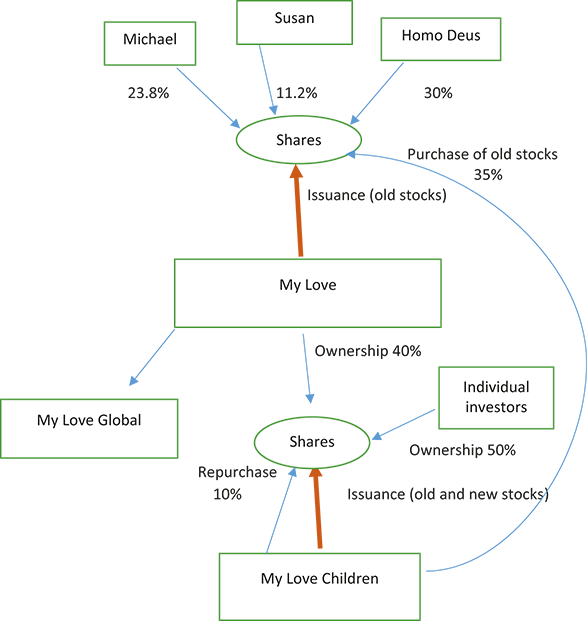
Another notable change is the emergence of cross-shareholding between My Love and My Love Children. My Love holds 40% of My Love Children’s shares, while My Love Children owns 35% of My Love’s shares. This structure is adopted as the most practical way of reconciling the differing needs of shareholders, while simultaneously promoting a long-term perspective and safeguarding the group against potential hostile takeovers.
4.2 The Reality of the “Contract” at the IPO
Michael had a multidimensional view about the purpose of the corporation when he founded My Love. Making a lot of money was, of course, part of his thinking. But he was also interested in exploring and creating new things, as he had been from his younger days. For him, the process of developing AI pets and children was itself exciting. And he believed that My Love would enhance people’s happiness by offering affordable and high-quality products that met their needs. Neither Michael nor Susan would have set up a company whose profit came from making people unhappy.
Their outlook remains unchanged after the IPO. They have already earned enough money to live comfortably – indeed luxuriously. But they do not want to step away. This is not because they are waiting for their share value to maximize before selling out. They enjoy the thrill of achieving what others cannot and are proud of being recognized as successful entrepreneurs. Michael and Susan cannot imagine their future without My Love Group. They assume that other managerial shareholders feel the same way about their companies and their lives.
Those who buy My Love Children’s shares after the IPO, however, view the corporation through a different lens. They are primarily financial shareholders – institutional investors and retail traders – whose chief objective is to earn the highest possible return on investment. Their interest in the corporation extends only as far as its performance influences the market value of their shares. Unlike corporate managers, who devote their full-time effort to a single enterprise, financial shareholders diversify their capital across multiple firms and manage diversified portfolios.
Naturally, they expect managers to focus on raising share prices, and the shareholder value theory mirrors this collective expectation. It is true that, once a company goes public, its stock price becomes an important indicator that management cannot ignore. Yet it is not true that a corporation’s purpose is thereby reduced to maximizing shareholder value. Its most fundamental task remains to satisfy customers through innovation – fulfilling its existential imperative (CTs 3 and 4). Furthermore, founders typically build corporations with broader goals in mind. The founders of My Love may not have defined a specific “social mission,” but they firmly believe that running their business itself constitutes a meaningful contribution to society.
A closer examination of the IPO process clarifies why going public rarely alters a corporation’s purpose. When a company lists its shares, it discloses detailed IPO terms that prospective investors can review before deciding whether to buy. Investors are under no obligation to participate – if they disagree with the company’s terms or philosophy, they can simply abstain. Crucially, no corporation declares in its prospectus that it will maximize shareholder value at the expense of the other principles it has pursued.Footnote 54 The main benchmark for investors is the offer price: They buy shares if they expect a satisfactory return. If they believe that the corporation’s pursuit of other goals could reduce shareholder value, they can adjust their valuation by discounting the share price accordingly.
Consider the New York Times, a publicly traded company on the NYSE. When it went public, investors who purchased its shares fully understood that it was a media company guided by journalistic values.Footnote 55 They did not assume it would abandon its editorial mission in pursuit of shareholder value. Instead, they invested with the expectation that the company would remain a reputable news organization, and they assessed the offer price accordingly.
The same logic applies to other companies. Firms with well-established management philosophies and proven operational track records go public. The essence of an IPO lies in reaffirming a corporation’s existing mission and inviting investors who agree with its direction. Thus, the implicit contract between the corporation and its new financial shareholders is best understood as a commitment to provide “a fair rate of return,” not a maximum financial return for shareholders, as highlighted by Allen (Reference Allen1992: 271). Financial shareholders certainly have the right to voice concerns if their interests are harmed or at risk, but there is no implicit contract that their interests must supersede the corporation’s existing principles.
4.3 Corporations Pursuing “Any Lawful Purpose”
Because the corporation is a legal construct, it is essential to examine how corporate laws define its purpose. The key point is that most jurisdictions grant corporations autonomy in determining their purposes. Delaware is explicit about the libertarian approach. The DGCL states: “a corporation may be incorporated or organized … to conduct or promote any lawful business or purposes, except as may otherwise be provided by the Constitution or other law of this State.”Footnote 56
The message of “any lawful purpose” can be found in other jurisdictions. The UK Companies Act 2006 states that “unless a company’s articles specifically restrict the object of the company, its objects are unrestricted.”Footnote 57 India’s Companies Act declares that “a company may be formed for any lawful purpose.”Footnote 58 The Singapore Companies Act grants companies “full capacity to carry on or undertake any business or activity.”Footnote 59 Australia’s Corporations Act 2001 confers on companies “the legal capacity and powers of an individual” as well as “all the powers of a body corporate.”Footnote 60 Korea’s Commercial Act 2010 defines a company as “a corporation established for the purpose of engaging in commercial activities and any other profit-making activities.”Footnote 61
France and Germany adopt a more formalistic approach. While both require companies to specify their purposes in their founding charters, they still leave the substance of those purposes to the founders, thus maintaining a libertarian spirit. In France, Article 1833 of the Civil Code states that “every company must have a lawful corporate purpose and be constituted in the common interest of its partners.”Footnote 62 In Germany, corporate law similarly requires companies to define their purposes, outlining the scope of activities they are authorized to undertake.Footnote 63
From the start, Michael was open-minded about the purpose of My Love. He was unaware of the American legal principle that allows corporations to pursue “any lawful purposes,” nor did he know that Korea leaves corporate goals open-ended, yet he instinctively felt that business could serve a higher purpose beyond mere profit-making. He simply did not yet know what it was or how it could be achieved.
The common misconception that corporations exist solely to pursue profit arises from both left-wing Marxist economics and right-wing neoclassical economics. Marxists view a company as a mechanism of exploitation, where capitalists extract surplus value from workers. Here, a company single-mindedly pursues profit.Footnote 64 Neoclassical economists assume that firms are profit maximizers and build theories of market behavior on that premise. But this is not a proven truth – it is merely a simplifying assumption. Through decades of repetition in economic teaching, it has come to be mistaken for reality.Footnote 65
Despite their opposing ideologies, both schools share the same flaw: they reduce corporations to schematic abstractions, ignoring the complexity of real business behavior. Most people learn these theories long before they observe how corporations actually operate – and mistake them for reality. A theory is a tool for understanding reality, not reality itself.Footnote 66
Historical evidence shows that corporations and entrepreneurs have pursued a wide variety of objectives. In early modern Europe, many were “chartered companies” operating under state privileges. The British East India Company is a prime example. No one claims it was founded to maximize profit. While it generated vast wealth for its shareholders, it simultaneously served as an arm of British imperial expansion.
With the rise of economic liberalism, corporate formation no longer required government approval. Yet many entrepreneurs continued to pursue goals beyond profit maximization. Henry Ford exemplifies this spirit. In the early twentieth century, automobiles were luxury goods reserved for the wealthy. Ford’s early investors wanted to produce a small number of high-priced cars to maximize profit, but Ford envisioned a radically different purpose – to make cars affordable for ordinary working families. Achieving that vision required sacrificing short-term profits and cutting ties with investors who disagreed.Footnote 67
Ford’s philosophy ultimately gave birth to Model T, the world’s first mass-produced affordable car. His success stems from commitment to “creating low-cost and high-quality products and services.” (CT 4). Profit was not his primary goal but the natural outcome of innovation. Economics textbooks fail to account for such entrepreneurship. If Ford had only pursued profit maximization, Model T would never have existed.
The “15 percent margin rule” set by Costco founder Jim Sinegal also defies the logic of profit maximization. If Costco’s goal were to maximize profits, it would keep retail prices unchanged when supply costs fell. Instead, Costco passes cost reductions on to consumers, adhering to its self-imposed 15% margin cap. This philosophy reflects a commitment to customer satisfaction and sustainable profit, not the pursuit of the highest possible returns.
Similarly, Samsung Group’s founding vision is to “serve the country through business.” Its founder, Lee Byung-chul, explained: “We contribute to the nation’s well-being and society by setting a goal and achieving it through business. … all these activities are contributions to people’s happiness and welfare. Because these goals and values are inherent in corporations, society has high regard for corporations’ social functions and entrepreneurs’ creativity.”Footnote 68 For Lee, profit was a means, not an end.
Huawei, at the center of the US–China trade war, does not pursue shareholder value maximization. Its CEO, Ren Zhengfei, owns only 1.4% of the shares, with the remaining 98.6% held by employees, effectively making Huawei an employee-owned corporation. Despite its meteoric rise, going public has never been on its agenda. Ren remarked that Huawei could “rule over the world if it remains unlisted,”Footnote 69 warning that “it will be a disaster for Huawei if employees lose their hungry spirit” after profiting from stock sales.Footnote 70
Reflecting on the diversity of corporate purposes, Stout (Reference Stout2013: 65–66) likens the corporation to a Swiss Army knife. Although it is a single tool, it serves multiple purposes, such as cutting an apple, opening a wine bottle, or poking a hole. It is not confined to a single, predetermined purpose. Similarly, the corporation is an organizational form that can be employed to do “anything lawful,” and this liberal and open-ended definition in corporate law inherently acknowledges the diversity of corporate purposes.
The prevalence of this libertarian approach in corporate law, coupled with the diverse objectives pursued by real entrepreneurs, underpins corporate theorem 6 (CT 6): Corporations are free to pursue any lawful purpose or business. Like natural persons, corporations – as legal persons – are free to choose their purposes and determine how much profit to seek and which values to prioritize alongside profit.
4.4 The Illogical and Ahistorical Shareholder Value Theory
The term “shareholder value” has a relatively short history. It only gained prominence in the latter half of the twentieth century, whereas corporations have existed since the fourteenth century. Even in the US – the heartland of shareholder capitalism – the term did not appear in major financial publications until 1965, and its usage surged only in the early 1980s.Footnote 71 In historical perspective, shareholder value theory is less than fifty years old, while the real-entity view of the corporation has been established for more than seven centuries. Measured by maturity, the former is a child and the latter an adult; and it is far more reasonable to evaluate the child from the adult’s perspective than the other way around.
The shareholder value theory proceeds as follows: (1) Shareholders (effectively) own the corporation; (2) The purpose of the corporation is therefore to maximize shareholder value; (3) Managers are agents of shareholders and must carry out their directives; (4) Managers, however, tend to pursue their own interests, generating “agency costs”; (5) To minimize these costs, shareholders should monitor managers closely and design incentive structure to align managers’ interests with their own.Footnote 72 Let us examine these claims in the light of the corporate theorems established earlier.
Above all, the core premise of shareholder value theory – that shareholders (effectively) own the corporation – is incorrect, producing a flawed chain of reasoning. Shareholders merely own shares: the corporation owns itself (CT 1). Advocates of shareholder value theory often cite Adolf A. Berle as an intellectual precursor. For instance, Fama and Jensen (1983a: 301) state, “Our goal is to explain the survival of organizations characterized by separation of ‘ownership’ and ‘control’ – a problem that has bothered students of corporations from Adam Smith to Berle and Means ….”Footnote 73 Yet portraying Berle as a champion of shareholder value theory is a serious misrepresentation.
While Berle initially endorsed the shareholder-centric view in the early 1930s, he later abandoned it. At the outset of the famous Berle vs Dodd Debate, in which Dodd (Reference Dodd1932) asserted that the board of directors can pursue social values even if they cannot be justified by shareholders’ interests, Berle contended that one could not “abandon emphasis on the view that business corporations exist for the sole purpose of making profits for their stockholders.”Footnote 74 However, by 1954, Berle conceded that “the argument has been settled … squarely in favor of Professor Dodd’s contention.”Footnote 75 He consistently reaffirmed this position beginning with his 1947 article “The Theory of Enterprise Entity,” where he developed a real-entity view of the corporation.Footnote 76 Yet curiously, contemporary proponents of shareholder value theory cite only Berle’s early work, ignoring this evolution in his thought.
Corporate managers in the US also rejected the shareholder-value view for most of the twentieth century. Owen D. Young, the legendary CEO of General Electric, emphasized that “managers were no longer attorneys of stockholders; they were becoming trustees of an institution.”Footnote 77 Even in the 1980s, managers shared this perspective. The Business Roundtable – a meeting of large corporate managers in the US – declared in its Statement on Corporate Responsibility in 1981 that “balancing the shareholders’ expectations of maximum return against other priorities is one of the fundamental problems confronting corporate management.”Footnote 78
In 1997, when shareholder value theory was at its peak, the Business Roundtable briefly changed its position: “ … the paramount duty of management and of boards of directors is to the corporation’s stockholders; the interests of other stakeholders are relevant as a derivative of the duty to stockholders.”Footnote 79 However, it departed from the shareholder value view in 2019. Its redefinition of the corporation’s purpose states, “while each of our individual companies serves its own corporate purpose, we share a fundamental commitment to all of our stakeholders.”Footnote 80 The shareholder value view started to decline in popularity after a golden age of about twenty to thirty years.
It should also be noted that the Delaware Court ruled against the shareholder value theory in the 1980s. When Time was in merger discussions with Warner Brothers, Paramount intervened with a competing offer nearly three times the value that Time and Warner were negotiating. Time’s board rejected the offer to preserve the “Time culture,” prompting Paramount to sue the board. In 1989, the Delaware Court upheld Time’s decision. It affirmed that the board had the discretionary authority to reject a higher bid in pursuit of the company’s long-term strategy and corporate identity. The ruling publicly confirmed that a board’s fiduciary duties are not confined to short-term shareholder value but encompass broader corporate purposes consistent with its mission.Footnote 81
The concept of agency costs, which the shareholder value theorists consider the root cause of corporate inefficiency, is also problematic. Agency theory is not derived from a comprehensive evaluation of the real-world cost corporations face; it stems instead from the assumptions of neoclassical equilibrium economics. Shareholder value theorists begin with a model of perfect competition – an idealized world without distortions – and then introduce a single imperfection: the agency costs caused by managers. Within this simplified model, eliminating agency costs restores market equilibrium.Footnote 82
In reality, however, corporate managers contend with various costs and seek to minimize total costs, not just agency costs. Even if some agency costs persist, managers will choose strategies that lower overall costs. Targeting agency costs in isolation does not necessarily enhance corporate performance. By failing to distinguish between theoretical “agency costs” and real-world business costs, shareholder value proponents have misrepresented the complexity of managerial decision-making and oversimplified the causes of corporate inefficiency.
Shareholder value theorists attributed the apparent inefficiencies of large US corporations in the 1980s – especially when compared with their Japanese and West German counterparts – to agency costs. Yet this diagnosis ignored crucial historical context. The postwar dominance of US corporations was an anomaly, shaped by America’s victory in a war fought beyond its own borders. Japan lay in ruins, and though Western Europe was among the victors, its economies were severely weakened by years of fighting on home soil. Once these nations recovered from wartime devastation, it was only natural that their corporations would catch up. By the 1980s, US corporations were simply confronting a normalized global competitive environment, not an internal failure of governance.
A number of influential researchers offered a very different explanation for the relative decline of US corporations. Michael Porter and Lester Thurow, among others, argued that, while the bank-based financial systems of Japan and West Germany fostered long-term investment, the US shareholder-centered financial system failed to do so. Several US government reports echoed this critique.Footnote 83 From this perspective, the remedy was not to strengthen shareholder power – as the shareholder value theorists urged – but to encourage managers to pursue long-term strategies insulated from short-term market pressures.
Despite the availability of empirically grounded alternative explanations, shareholder value theorists undertook no serious comparative or empirical investigation and instead continued to rely on abstract theoretical assumptions to claim that agency costs were to blame. From this premise, they promoted a one-size-fits-all model of corporate governance “reform.” In many ways, the theory’s appeal lay precisely in its simplistic diagnosis and prescription. As Stout (Reference Stout2013: 67) aptly observes, it “neatly evades the difficult issue of how to resolve conflicts among the preferences of different groups … by using the intellectual shortcut of assuming only shareholder preferences count.”
4.5 The Fuzzy Stakeholder Theory
While proponents of the shareholder value theory claim that corporations exist for shareholders, advocates of the stakeholder theory argue that corporations exist for stakeholders.Footnote 84 Freeman and Heather (Reference Freeman and Elms2018) explicitly differentiate between the two views with the assertion that “The social responsibility of business is to create value for stakeholders,” juxtaposing this with Friedman’s (Reference Friedman1970) famous declaration that “The social responsibility of business is to increase its profits.”
The stakeholder theory emerged from business studies such as “business policy,” “business ethics,” or “corporate social responsibility” to help corporate managers understand the diverse web of social relationships corporations must navigate. Few would deny that corporate success depends not only on internal factors – such as strategy, organization, and finance – but also on external relationships with partner firms, customers, communities, the media, and government bodies. Business scholarship has long addressed how to manage these relationships effectively.
However, recognizing that corporations must respond wisely to stakeholder demands is fundamentally different from asserting that corporations exist for stakeholders. Corporations do not conduct business to create value for stakeholders; they do so primarily to create value for themselves. The confusion arises from the stakeholder theory’s conceptual fuzziness in distinguishing the corporation from its stakeholders.
Stakeholders are typically defined as “groups and individuals that have a valid interest in the activities and outcomes of a firm and on whom the firm relies to achieve its objectives.”Footnote 85 Let us examine Freeman’s stakeholder map (Figure 12). An immediate question arises: How can a corporation exist for all these stakeholders? Primary stakeholders include employees, suppliers, financial institutions, customers, and the local communities where the firm operates. Secondary stakeholders encompass the government, civic groups, special interest organizations, consumer advocates, the media, unions, and even competitors. The inclusion of nearly all segments of society prompts the question: Should corporations exist to serve society as a whole?
Freeman’s stakeholder map.
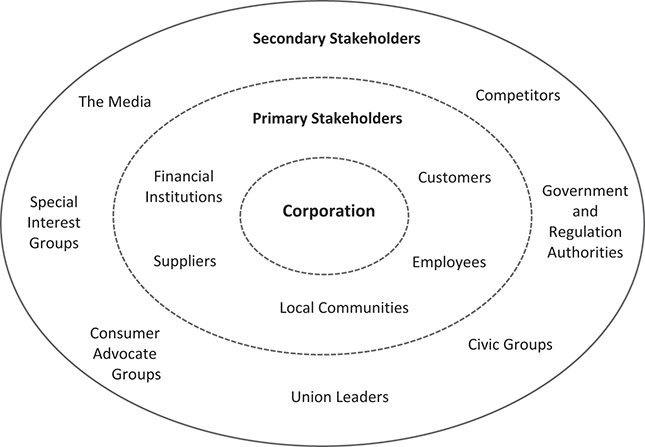
Moreover, the demarcation between different stakeholder groups is arbitrary. For instance, there is no clear rationale for why “local communities” are primary stakeholders alongside employees and customers, why employees are external to the corporation, why “competitors” are secondary stakeholders (do they have stakes in their competitors?), or what distinguishes “consumer advocate groups” from “civic groups.” The concept of “tertiary stakeholders” – those affected by the corporation but not classified as secondary stakeholders – remains unexplored. What criteria should be used to differentiate tertiary stakeholders from secondary stakeholders?
Consider the case of My Love Group. For My Love Children, virtually every human being could be deemed a stakeholder, since AI children influence human children and their parents. For My Love Co., the scope of stakeholders extends even further to include animals, as AI puppies affect animal welfare. How, then, should one prioritize among different animal stakeholders? From the perspective of My Love Group, should human stakeholders take precedence over animal ones? If applied literally, the stakeholder theory would dissolve the corporate purpose into a blend of socialism and pan-animalism.
The stakeholder theory also faces an inherent operational problem: It is impossible to apply the boundaries of “stakeholders” consistently. Consider a real case – Apple and Foxconn. Foxconn, Apple’s largest supplier, is undeniably one of its most important stakeholders. But does Apple have a social responsibility to create value for Foxconn? If Apple finds Foxconn’s services satisfactory, it will continue to work with it; if not, it will replace it. In such supply chain decisions, Apple does not consider Foxconn’s welfare for its own sake. It is concerned with Foxconn’s fortunes only insofar as they affect Apple’s own.
For the stakeholder view to serve as a convincing theory of corporate purpose, it must offer a general principle for determining which stakeholders merit consideration in business decisions. Yet stakeholder relationships are diverse and fluid, making it impossible to establish consistent criteria for identifying which stakeholders a corporation should serve. As Robé (Reference Robé2011: 69) observes, “the stakeholders’ relative positions with regards to the firm are so different that the notion that they each have a ‘stake’ is devoid of any operational meaning.”
The absence of a clear demarcation between the corporation and its stakeholders renders it arbitrary for any stakeholder to claim that the corporation should prioritize the values it espouses. The corporation, as an independent legal entity, is free to choose which social values to support (CT 6), provided it remains within the bounds of its existential imperative (CT 4). There are only two legitimate paths through which a corporation can adopt a particular stakeholder’s values as its own. The first is government regulation: If a stakeholder’s values are codified in law, the corporation must comply, since it may pursue only “lawful” purposes. The second is a charter amendment: If a majority of shareholders wishes to enshrine particular values, they may formally incorporate them into the corporate charter.
However, corporations are increasingly pressured to adopt social values without going through these legitimate channels. Although such pressures are inherently arbitrary, companies often yield to them – especially when they come from powerful actors. A prominent recent example is the ESG movement. It gained enormous momentum after BlackRock, the world’s largest institutional shareholder, embraced it.
In 2019, BlackRock began prioritizing issues such as “governance, including a company’s approach to board diversity,” and “environmental risks and opportunities” in its stewardship engagements with portfolio firms. That same year, CEO Larry Fink’s annual letter to corporate leaders positioned him as a champion of the stakeholder view. Under the heading “Purpose and Profit: An Inextricable Link,” he asserted that “a company’s purpose … [is] to create value for its stakeholders [every day].”Footnote 86 In his 2021 letter, Fink described ESG investing as a “tectonic shift,” openly acknowledging that it represented a major departure from past practice.Footnote 87 BlackRock launched ESG-themed Exchange-Traded Funds and urged portfolio companies to disclose climate-related risks and align their operations with net-zero targets.
Under pressure from major shareholders led by BlackRock, many companies that had initially hesitated soon felt compelled to comply. They hastily established ESG committees and dedicated teams. Financial institutions designed proprietary ESG evaluation frameworks and incorporated them into lending and investment decisions.
Yet within less than two years, the tide turned. In July 2023, Fink publicly distanced himself from the term, declaring, “I don’t use the word ESG anymore because it’s been entirely weaponized – by the far left and by the far right.”Footnote 88 Conservative critics accused BlackRock of exceeding its fiduciary duty by pressuring firms to take political stances, effectively promoting progressive ideology. Several Republican-led states – including Texas – enacted laws withdrawing state-managed funds from asset managers using ESG criteria, and Tennessee even filed a lawsuit. Since the campaign began, conservative “red-state” funds have pulled roughly $13.3 billion from BlackRock.Footnote 89 Meanwhile, progressive advocates attacked it from the opposite direction, arguing that it had retreated from its social responsibility commitments and failed to wield its influence to drive change.Footnote 90
In 2024, BlackRock made a complete U-turn. In its “Investment Stewardship Report,” BlackRock placed “financial resilience” at the center, omitting ESG-related topics entirely from its three key focus areas.Footnote 91 This move signaled a return to its core mission as an asset manager – generating returns and managing risk. As Joud Majeid, BlackRock’s Global Head of Investment Stewardship, put it bluntly, “That is what our clients actually want right now.”Footnote 92
The cost of this oscillation is borne by corporations and financial institutions worldwide. Companies have invested heavily in establishing ESG teams, launching training programs, and revising management strategies – only to be left uncertain and disoriented as expectations shift. For BlackRock, the expenses of issuing Larry Fink’s annual CEO letters or operating its Stewardship Team are trivial relative to its $13.5 trillion in assets under management in the mid 2025 – mere “pocket change.” But for other corporations and financial institutions, the cost of complying with ESG investment requirements is far more substantial.
The use of institutional shareholder power to impose specific social values on corporations is unjustifiable for two main reasons. First, there is no assurance that the values being advanced reflect the collective will of shareholders. In practice, a small number of powerful institutional investors – such as BlackRock – exercise disproportionate influence over portfolio companies, projecting their own priorities rather than a genuine shareholder consensus.
Second, institutional shareholders are money-managing trustees: they are fiduciaries entrusted with other people’s money. Their legal duty is to act in their clients’ best interests, yet there is no evidence that the social values they champion correspond to their clients’ preferences. No official surveys or polls have been conducted to ascertain what those clients actually want. Consequently, the “values” promoted under the banner of ESG often reflect the subjective moral preferences of asset managers – or arbitrary positions tailored to the social sentiments of the day.
As Avi-Yonah and Sivan (Reference Avi-Yonah, Sivan, Biondi, Canziani and Kirat2007: 172–173) emphasize, the corporation is a real entity that “shields corporate management from undue interference from both shareholders and the state.” Both shareholder value theory and stakeholder theory fail to recognize this ontological reality. The former erodes the boundary between shareholders and management by treating managers as agents of shareholders; the latter blurs the line between the corporation and society, inviting unwarranted external intervention in corporate decision-making.
5 The Control of the Corporation
Before the IPO, Michael did not fully grasp the implications of the “separation of ownership and control.” His lawyer explained asset partitioning and entity shielding when incorporating My Love, but Michael has had few occasions to reflect on their significance. As shareholders, board members, and key executives, he and his cofounders had never faced a situation that made the separation feel real.
The IPO, however, has changed everything. As financial shareholders flood in and visibility increases, new challenges arise both inside and outside the group. Michael now faces pressing questions about corporate control. He must reconsider his role as a major shareholder and CEO: How he controls the company, what management rights entail, how to exercise them, and what “corporate governance” truly means.
5.1 Business Management and Business Politics
Michael has been indifferent to politics. From elementary to high school, he was elected class leader every year – not because he sought the position, but because his peers recognized his intelligence and integrity. In college, he focused on his studies, barely glancing at political headlines in the newspaper. Politics – rooted in conflict – felt foreign to his nature. He found fulfillment in making things work. With My Love, he felt he had found his true calling.
As the company grows and becomes public, however, Michael realizes he has become a politician. My Love’s success may falter if he fails to navigate political realities, regardless of product quality. Two challenges now demand his attention: financial shareholders and stakeholders. Shareholders fixate on stock prices, their moods shifting with market fluctuations. Michael still sees price as a byproduct of innovation and customer satisfaction, yet he can no longer ignore it. Institutional and retail investors expect regular dividends, and he must cultivate relations with major institutions to secure their approval on key decisions.
Public scrutiny has also intensified. After My Love Children’s IPO, the company’s stock became a fixture of financial headlines. Michael used to avoid interviews. He was unwilling to boast about his success or invite speculation about his private life. But persistent attention forces him to increase external exposure. The listing has brought new compliance obligations under KSE rules, and My Love’s rise into the ranks of Korea’s top five conglomerates has subjected it to strict fair-trade regulations. Interest groups have begun making their demands: One publishes a report calling for “healthy corporate governance,” while animal rights, human rights, and environmental activists issue statements. Some scholars warn that My Love Children could turn humans into “second-class citizens.”
To manage this growing web of politics, the group strengthened its public relations (PR) team to maintain direct channels with ministries, legislators, and civic organizations. Michael now meets a broader range of people than ever and reads the political pages daily. Once devoted entirely to operations and customers, he now spends at least a quarter of his time on politics. He has come to accept that, for CEOs of large public companies, political awareness and relationship management are not optional – they are essential.
5.2 Corporate Governance Challenges
Among Michael’s political challenges, the most difficult arises from corporate governance. My Love expanded into a group structure purely for business efficiency – leveraging economies of scope and managing risk through asset partitioning.Footnote 93 It adopted the cross-shareholding structure when listing My Love Children to accelerate growth, preserve group control, and accommodate shareholders wishing to sell.Footnote 94 To Michael, there was nothing unethical about this: corporations, as independent legal entities, are free to hold shares in one another.
However, Korea’s Fair Trade Commission (FTC) views cross-shareholding negatively and is considering restricting or even banning it for the top thirty chaebols. Some officials argue that it creates “fictitious” capital and distorts control rights.Footnote 95 Many financial shareholders and academics agree, claiming that cross-shareholding unfairly strengthens controlling shareholders at the expense of financial shareholders.Footnote 96
My Love Group must now address this new challenge. Michael forms a Task Force for Corporate Governance (TFCG) and appoints Brian Choo – the bold interviewee he recruited a decade earlier – as its leader.Footnote 97 Brian’s outstanding performance and international experience make him ideally suited for the role, providing both competence and a global outlook.
TFCG begins by analyzing the OECD Principles of Corporate Governance, frequently cited by FTC officials. But TFCG members are not impressed by its advice on how companies should be governed. The OECD report fails to recognize the corporate values that have driven My Love’s expansion and success and treats corporations as inherently problematic entities in need of stricter external oversight. This prompts a deeper question: “What truly constitutes good corporate governance?” To explore it, the TFCG assembles an advisory panel of leading global experts and examines control structures of high-performing corporations worldwide. Michael fully supports the initiative. Through years of travel and dialogue with business leaders, he has seen how governance differs dramatically across nations – and he wonders how Korean chaebols could have achieved their “economic miracles” if their governance systems were as defective as critics claim.
5.2.1 The Globalization of the US Corporate Governance Model
The OECD began preparing corporate governance reports in the late 1990s when the US economic resurgence coincided with US-led capital market globalization. Japan and Germany entered a recession following the bursting of Japan’s asset bubble and German reunification. This reversal was interpreted as a victory for American stockholder capitalism.
As discussed in Section 4.4, this narrative is both logically and empirically flawed, yet it spread quickly. The Economist (1995) talked of a “golden age of entrepreneurial management,”Footnote 98 and Becht et al. (Reference Becht, Bolton, Röell, Constantinides, Harris and Stulz2003: 42) observed that by the mid 1990s “the US corporate governance model was suddenly being hailed as the one to follow.” The Cadbury Report (1992), commissioned by the London Stock Exchange, first proposed a “global standard” for corporate governance and heavily influenced subsequent OECD reports.Footnote 99
The globalization of the US–UK corporate governance model conveniently served their financial institutions, expanding globally at the time. If other countries adopted Anglo–American norms that strengthened minority-shareholder protections, US and UK investors could invest more easily and securely. By 2000, institutional investors held US$24 trillion in financial assets in the world’s top five markets, with well over two-thirds (76%) of these assets held by US and UK investors; the twenty-five largest US pension funds, which tended to be “shareholder activists” in the US market, accounted for two-thirds of US foreign equity investment, with their foreign-equity ratio more than doubling from 8% in 1993 to 18% in 2000.Footnote 100 McKinsey reinforced this trend by publishing research that legitimized the US and UK institutional investors’ globalization drive. In 1996, it found that 66% of institutional investors were willing to pay a premium for shares of “well-governed” companies; by 2000, over 80% said they would pay up to 28% more.Footnote 101
The OECD soon followed. In 1998, it released the Millstein Report, followed in 1999 by the first OECD Principles of Corporate Governance. These reports – the latest update made in 2023 – became the global benchmark cited by regulators, including Korea’s FTC.Footnote 102 The TFCG focused on the 1999 edition, the most widely invoked by fair-trade authorities worldwide.
5.2.2 “Good Corporate Governance” Necessary to Attract “Patient Capital”?
The 1999 OECD report claims that “international flows of capital enable companies to access financing from a much larger pool of investors” and that “to attract long-term ‘patient’ capital, corporate governance arrangements must be credible and well understood across borders.”Footnote 103 Yet, this statement is unsubstantiated.
First, institutional investors typically buy existing shares in secondary markets. Their funds go to existing shareholders, not corporations. Only purchases of new stock issues – rare for institutional investors – constitute genuine capital inflows. Most cross-border investments are speculative, aimed at buying low and selling high for capital gains. Such funds are not “capital” in any meaningful sense, let alone “patient.”
Second, providers of true long-term capital do not prioritize a specific governance model. At My Love Group, for instance, early long-term investors such as Collin and Homo Deus focused on business potential, not governance form. They relied on monitoring through appointed CFOs, whose primary duty remained to fulfill the corporation’s existential imperative – continuously producing affordable, high-quality products (CT 4).
Third, there is no evidence that US-style governance reforms increase real capital inflows to firms. In fact, the opposite occurred. As shareholder-value ideology and activism spread from the early 1980s onward, “predatory value extraction” intensified.Footnote 104 Capital outflows from the corporate sector surged: Between 2000 and 2024, US corporations were transferring an average of $285.7 billion annually from firms to markets (Figure 13).
The outflow of funds from the corporate sector to the stock market in the US.
(Net equity issues, $ billion, 1946–2024)
Note: Non-financial firms; Net equity issue = Stock issuance – (Stock buybacks + disposals through M&A).
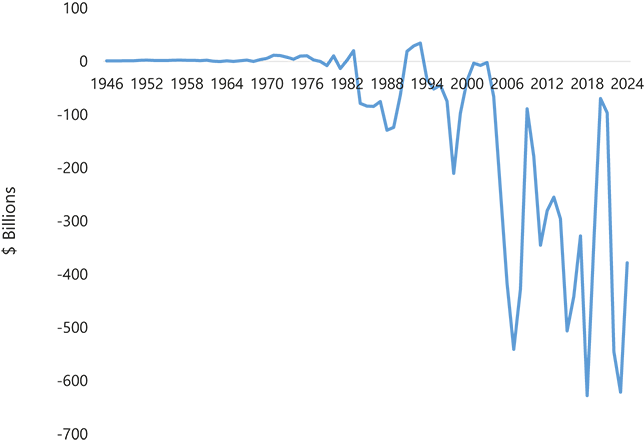
As economies mature and stock markets develop, capital flows increasingly from corporations to shareholders. This reflects a natural shift: As more firms become financially self-sufficient, new capital inflows slow while outflows – through dividends and buybacks – expand. In most advanced economies, therefore, the stock market plays only a minor role in financing corporations. Between 1970 and 1985, the net contribution of the stock market to new capital financing was 1% for the US, 3% for Germany, the UK, and Canada, and 5% for Japan.Footnote 105
Korea exhibited a similar trend after the IMF-led restructuring of 1998, which closely followed the OECD’s governance principles. Before then, Korea’s economy was investment-driven, financed by both banks and equity markets. While bank credit dominated, new equity issuance accounted for 13.4% of corporate investment funds between 1970 and 1989, significantly higher than Germany (2.3%), Japan (3.9%), the UK (7.0%), and the US (–4.9%).Footnote 106 After the restructuring, however, Korea’s stock market, like that of the US, became a channel for capital outflow. From 1999 to 2022, total inflows reached 225.4 trillion won (about $174 billion), while outflows totaled 347.7 trillion won ($269 billion), producing a net outflow of 122.4 trillion won ($122.4 billion) (Figure 14).
The outflow of funds from the corporate sector to the stock market in Korea.
(1999–2022, KRW billion)
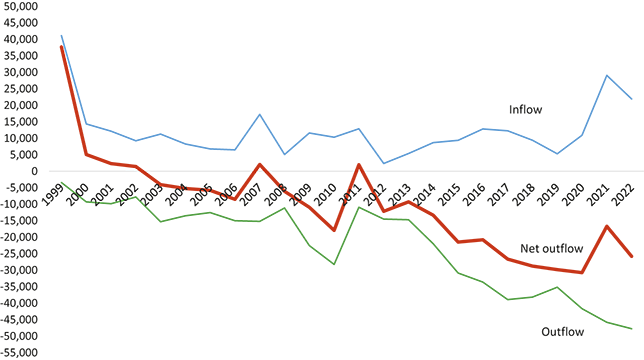
5.2.3 The “Separation of Ownership and Control” Responsible for Corporate Problems?
The OECD report asserts that “the Principles focus on governance problems that result from the separation of ownership and control.”Footnote 107 This reflects a fundamental misconception. Ownership and control are already separated fundamentally since incorporation (CT 2). If such separation were the root of governance problems, every corporation would be flawed, and the rationale for incorporation itself would be in question.
The “separation” the OECD refers to is Berle and Means’ dispersion of ownership in large US firms that produced managerial capitalism.Footnote 108 Yet this structure is hardly universal. Even in the US, it accounts for less than 0.2% of all corporations. Outside the US and UK, most large firms remain under the control of major shareholders.Footnote 109 The governance problems the OECD highlights, therefore, have little relevance to the vast majority of corporations worldwide.
Given that the OECD reports were released when US and UK institutional shareholders were aggressively promoting capital market globalization, their true concern was not the separation of ownership and control but conflicts between themselves – as new financial shareholders – and incumbent major shareholders and managers. The situation resembled post-IPO dynamics.Footnote 110 Local firms already had controlling shareholders and existing governance systems, and new foreign investors sought to reshape them in line with Anglo–American shareholder-value norms.
From a local company’s standpoint, foreign investors merely represent an additional layer of financial shareholders. There is no compelling reason to grant them special treatment by changing governance systems. Like the existing financial shareholders, foreign shareholders could have abstained from investing if they had governance concerns. However, the OECD report presents the preferences of US and UK institutions as the “principles” and urges other countries to conform. It thus effectively served as a facilitator of Anglo–American capital market globalization.Footnote 111
Following the Asian Financial Crisis, Korea eagerly adopted this message as a global standard. In 2004, Kang Chul-Kyu, then Commissioner of Korea’s FTC, emphasized that the “distortion of ownership and control” in Korean chaebols “delays the establishment of a responsible management system led by professional managers.”Footnote 112 The FTC embraced managerial capitalism – Berle and Means’ “separation of ownership and control” – as the ultimate goal for Korean corporations. This stance still underpins its policy today.Footnote 113
5.3 Diversity of Corporate Control
After critically reviewing the OECD report, TFCG turns to a comparative study of corporate control systems worldwide, beginning with the US. OECD analyses often imply that the US model represents the global norm. TFCG sets out to test this assumption.
5.3.1 Berle and Means’ Managerial Corporations? A Minority Even in the US
Burch (Reference Burch1972) was among the first to reassess Berle and Means’ thesis. His study showed that in 1965, management-controlled corporations accounted for 58% of the top 50 US manufacturers, 44% of the top 100, and 42% of the top 200 – far from universal dominance. In other industries, the share ranged from 30% in merchandising to 48% in banking, with the remainder “possibly” or “probably” family controlled (Table 1).
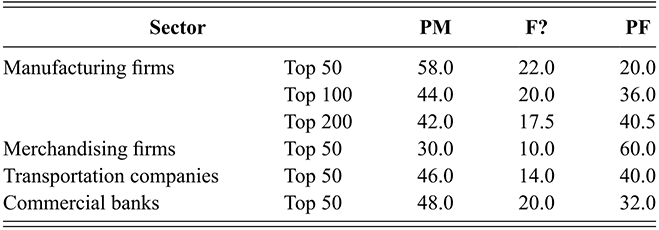
Table 1 Long description
Overview: The table breaks down corporate control for various sectors, including Manufacturing (Top 50, 100, and 200), Merchandising (Top 50), Transportation (Top 50), and Commercial Banks (Top 50). Key Findings in Manufacturing: In the Top 50 manufacturing firms, 58% were probably management-controlled, while 20% were probably family-controlled. As the sample size increases to the Top 200, the share of family-controlled firms rises significantly to 40.5%. Sector Highlights: Merchandising: Shows the highest percentage of family control at 60%. Commercial Banks: Approximately 48% were probably management-controlled.
Notes: Rankings are based on revenues for both public and private companies.
PM; Probably management-controlled
F?; Possibly management-controlled
PF: Probably family-controlled
Holderness (Reference Holderness2009: 1382) reached similar conclusions. Examining 376 listed firms in 1995, he found that 43% of shares were held by blockholders, directors, or officers – implying ownership concentration comparable to firms in other major economies. Comparing this with other countries, Holderness (Reference Holderness2009: 1401) concluded that “ownership concentration in the U.S. is equivalent to what is found in similar-sized firms elsewhere … the United States, rather than being an outlier on ownership concentration, falls in the middle of the distribution.”
In terms of numbers, managerial corporations are a tiny fraction of US firms. In 2022, there were 4,642 publicly listed corporations in the US,Footnote 114 and the number of C-type corporations was roughly 1.4 million.Footnote 115 If we assume that most unlisted corporations are controlled by major shareholders,Footnote 116 and one-third of listed corporations are controlled by major shareholders,Footnote 117 managerial corporations account for only about 0.2% of all US corporations. If “principles of corporate governance” are to be established, they should reflect the full spectrum of corporations, whether listed or unlisted, small or large. Yet, the OECD report attempts to generalize the exceptional US managerial model – already rare even at home – as a global standard.
5.3.2 Diversity of Corporate Control Systems in Europe, Japan, and Emerging Economies
In Europe, large corporations have varying degrees of major shareholder control. A 2002 study found the median voting rights held by the largest shareholders were as follows: in Germany 57%, Belgium 56%, Italy 54%, Austria 52%, the Netherlands 43%, Sweden 34%, and France 20%. Only the UK (9.9%) resembles the US pattern (Table 2). Voting rights are more concentrated than share ownership because European companies frequently use dual-class shares and cross-shareholdings.
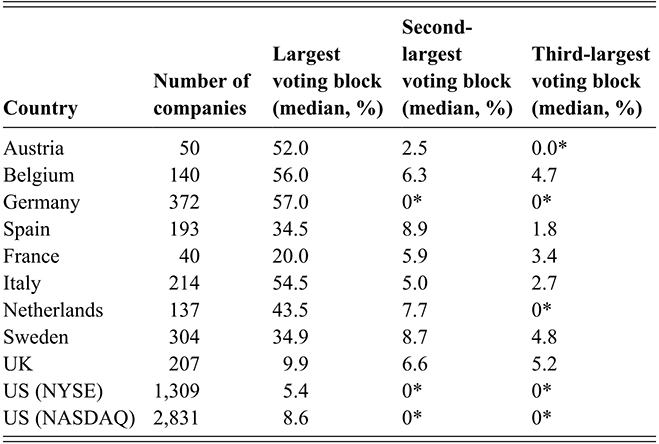
Table 2 Long description
Overview: This table compares voting block concentration across various nations, highlighting the median percentage held by the first, second, and third largest voting blocks. High Concentration (European): Germany has a high concentration for the largest block (57%), but has no other blocks reaching the 5% threshold. Austria (52%) and Belgium (56%) also show very high median control by the primary voting block. Low Concentration (Anglo-American): United Kingdom: The largest block holds a median of only 9.9%. United States: The N Y S E (5.4%) and NASDAQ (8.6%) show the lowest concentration of voting rights among all listed regions, with no secondary blocks reaching 5%.
Notes: * No 5%+ voting block. For France, only the main stock price index (CAC 40) is covered.
5.3.3 The Case of Germany
Germany’s large corporations blend strong bank participation with major-shareholder-management. For example, in BASF and Bayer, the three largest banks – Commerzbank, Deutsche Bank, and Dresdner Bank – control over 40% of voting power.Footnote 118 The Volkswagen Group exemplifies a major-shareholder-managed firm, in which Porsche SE owns 31.9% of the shares and 53.3% of the voting rights. The second major shareholder is the Niedersachsen (Lower Saxony) state government, holding 11.8% of the shares and 20% of the voting rights (Figure 15). The Porsche-Piëch family owns 50% of the Porsche SE shares and 100% of its voting rights.Footnote 119
The distribution of Volkswagen shares and voting rights.
(Based on June 2023 data)
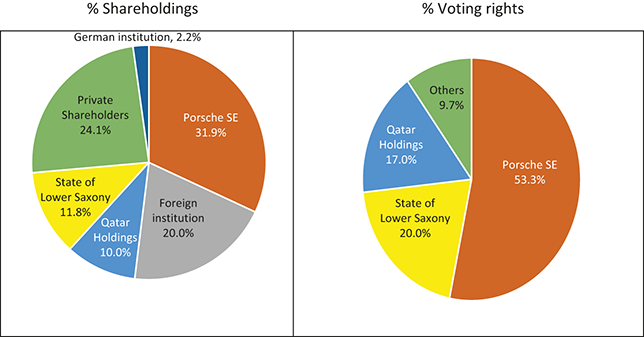
On the surface, the Volkswagen Group’s share distribution suggests that the Porsche family has full control over Volkswagen. In reality, however, Volkswagen and Porsche have exchanged an equity stake for management rights. In 2009, Volkswagen AG’s management agreed to Porsche SE controlling more than 50% in Volkswagen, while in return, it acquired management rights to manufacture and sell both Porsche and Volkswagen products. Consequently, Volkswagen AG oversees corporations and brands such as VW, Audi, SEAT, Škoda, Bentley, Bugatti, Lamborghini, Porsche, Ducati, Scania, MAN SE, and Volkswagen Financial Services.Footnote 120
As of the end of 2023, foreign institutional shareholders, including BlackRock, owned 20.0% of Volkswagen shares.Footnote 121 However, there is very little chance of them influencing Volkswagen’s management. Volkswagen’s control structure falls into the “bad corporate governance” category according to the OECD’s principles. Yet, Volkswagen is the world’s leading automobile company alternating the number one spot with Toyota. Major foreign institutional shareholders continue to hold Volkswagen stocks because they expect Volkswagen to perform adequately with its current system of corporate control.
5.3.4 The Case of France
Many of France’s large corporations are managed by a major shareholder. For instance, 15% of the Renault Group’s shares are owned by the French government, which is the official majority. Renault is also allied with Nissan through cross-shareholding, with each owning 15% of the other’s shares.Footnote 122 Groupe Arnault SE, in 2023, held 48.6% of the stock and 64% of the voting rights of the LVMH Group, which owns Louis Vuitton and Christian Dior.Footnote 123 Of course, France has many firms in which ownership is more dispersed. For example, Michelin’s major shareholder, Mage Invest SAS, owns only 4.3% of its shares. Amundi Asset Management SASU (0.9%) and Eurizon Capital SGR SpA (0.5%) rank second and third.Footnote 124
5.3.5 The Case of Sweden’s Wallenberg Group
Sweden’s Wallenberg Group has been managed by its major shareholder, the Wallenberg family, for five generations. Wallenberg Foundations hold 19% of Investor AB – the group’s holding company – shares and controls 41% of the voting rights. Investor AB, listed on the Swedish stock exchange, has divided its stock into INVE A (A class shares) and INVE B (B class shares). INVE A confers one vote per share, while INVE B confers 1/10 of a vote. The INVE A amount to 40.8% of Investor AB’s total number of shares but confer 87.3% of the voting rights. Wallenberg Foundations hold Investor AB’s INVE A shares only. Investor AB controls various affiliate companies, including ABB, Ericsson, Electrolux, Saab, and Atlas Copco, through various channels (Figure 16).
The control structure of Wallenberg Group.
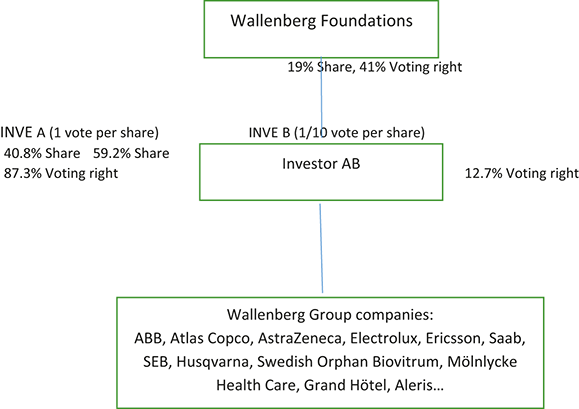
5.3.6 The Case of Italy’s Exor
Italy’s largest business group Exor – which has the automobile companies Fiat and Ferrari, the UK’s magazine The Economist, the football club Juventus, the Club Med hotel chain, Telekom Italia, and more as its affiliates – is another example of major-shareholder management. In the past, the group operated with a complex network of mutual investments and cross-shareholdings centered around the holding company IFI, more than 80% of which was controlled by the Agnelli family. As the investment relationships simplified in 2008, the French holding company Exor, which used to be under IFI’s control, became the most powerful entity in the group. In 2016, the Exor Group moved its headquarters to the Netherlands, where it could use dual-class shares more freely than in Italy. As of the end of 2023, the Agnelli family’s company, Giovanni Agnelli B. V., controlled the Exor Group, owning an absolute majority of shares (52.99%).Footnote 125
5.3.7 The Case of Japan
After its defeat in the Second World War, Japan’s family-controlled business groups, zaibatsu, such as Mitsui and Mitsubishi, were dismantled by the Supreme Command of Allied Powers (SCAP) because they were considered war criminals. Zaibatsu families were forced to break their ties with their companies, and many zaibatsu leaders were prosecuted. SCAP attempted to put an end to Japan’s military capability by removing its heavy industries, dominated by the zaibatsu, altogether.
During the Korean War (1950–53), however, the dissolved zaibatsu companies were regrouped as keiretsu, loose groups of companies run by consensus of their presidents without central control by families or holding companies. This was because the US needed Japan’s heavy industries to support the war effort. The Keiretsu subsequently led Japan’s postwar economic growth and retained their structures as professionally managed business groups. But the absence of major shareholder management in the keiretsu was not a natural development but rather an outcome of the disruptive measures imposed by SCAP.Footnote 126
Currently, family-run business groups such as Toyota and Honda coexist with nonfamily-run keiretsu in Japan. Akio Toyota, the great-grandson of the founder Kichiro Toyota and the current CEO of Toyota Motor Corporation, owned only 0.15% of the shares as of 2018. The whole Toyota family’s ownership accounted for around 2% of the total shares. But the Toyota family controls the group through an intricate network of mutual shareholding described as follows:
Toyota Motor is a major shareholder of Toyoda Automatic Loom Works, and Toyota Automatic Loom Works is the second largest shareholder of Toyota Motor Corporation … Moreover, Toyota Motor is a major shareholder of Denso, and Denso is Toyota Motor’s sixth-largest shareholder. Toyoda Automatic Loom Works is Denso and Aisin Corporation’s second-largest shareholder, while Denso and Aisin are Toyoda Automatic Loom Works’ second and seventh largest shareholders, respectively. Denso is Aisin’s third largest shareholder, and Aisin is Denso’s seventh largest shareholder.Footnote 127
5.3.8 The Case of Emerging Economies
In emerging economies, large corporations are generally managed by their major shareholders within business groups. India’s Reliance Group, Tata Group, and Mittal Group are run by major shareholder families. It is similar in Southeast Asia. Indonesia’s Salim Group, Lippo Group, Astra International, and Sinar Mas Group, Malaysia’s Renong Group, Sime Darby Group, and CIMB Group, and the Philippines’ Ayala Group, Lopez Group, and JG Summit Holdings are all family-run business groups.Footnote 128 In China, many big corporations are governed by the “socialistic market system,” where the central or local government exerts control over corporations. But private corporations such as Alibaba, BYD, or Lenovo mostly take the form of business groups run by major shareholders.Footnote 129 Taiwan also has its own business groups called guanxiqiye, such as Formosa Plastics Group and Hon Hai Group. SMEs of the emerging economies are, as in the US, mostly run by major shareholder managers.
5.4 What Brings About Good Performance Is Good Corporate Governance
If we examine actual corporate control around the world, it is impossible to identify a single most generalized or ideal mode of corporate control. What exists instead is diversity. This is because corporations evolve with different strategies and values, shaped by distinct historical and environmental conditions, and these differences are reflected in their corporate control systems.
Strategy itself presupposes diversity. A strategy that merely imitates others ceases to be strategic; to gain a competitive edge, it must differ. As firms pursue distinct strategies, they naturally develop different organizational forms and governance systems suited to their circumstances. Moreover, every corporation operates within its own legal, fiscal, labor, and financial environment. It would be strange, even unnatural, if all adopted the same strategy, structure, or control model.
If we accept this diversity, the corporate governance discussion should be reversed: Rather than seeking to define a standard or ideal governance model to be imposed universally – as if this were the best recipe for achieving good business performance – we should start by asking what actually brings about good business performance and then understand the resulting governance systems. In this vein, I present “What brings about good business performance is good corporate governance, not vice versa,” as corporate theorem 7 (CT 7).
Corporate governance advocates attempt to create “principles” or “standards” because they view corporate control primarily as external supervision. The shareholder value theory epitomizes this approach: It assumes that stricter monitoring of managers – as agents of shareholders – will automatically enhance corporate performance.Footnote 130 In the early 2000s, when the US-centric corporate governance discourse was sweeping the world, French economist Michel Aglietta (Reference Aglietta2005: 32) pointed out its fallacy:
If you own a business, and you want to improve its ROE, there are two ways of going about it, one of them good, the other not so good: the first is to improve your products, services, marketing, and so on; the second is to install a camera to make sure the manager is not putting his hand in the till. It appears that governance is more interested in the camera than in managing the shop.
Installing cameras – or codes of surveillance – is simple, but better monitoring alone cannot improve performance. Aglietta’s “first way” aligns with corporate theorem 4 (CT 4): Corporations must innovate continually to satisfy customers. True value creation defies any “one-size-fits-all” model; it requires complex capabilities – strategic control, organizational integration, and financial commitment – naturally leading to diverse forms of control.
It should be noted, however, that CT 7 is not meant to justify existing systems of corporate control. Rather, it emphasizes that no single form guarantees success. To perform well, corporations must do far more than improving governance – and governance is often not the decisive factor. The same governance may yield different outcomes, just as different systems may produce similar success.
The Wallenberg family control model has combined strong performance with social contribution,Footnote 131 while the Redstone family’s National Amusements exemplifies the opposite – a family-controlled failure.Footnote 132 The same ambiguity applies to managerial control. 3M, which transitioned to dispersed share ownership in the 1940s, remains among the most innovative corporations,Footnote 133 whereas General Electric and Boeing – long celebrated icons of managerial capitalism – have both suffered steep declines.Footnote 134
6 The Correspondence between Rights and Responsibilities
My Love Group once again stuns the world with a bold declaration: it is transforming into a Multi-Planetary Corporation. Since its inception, My Love has always gone to wherever it has customers. Now, with the success of its AI children, Michael and his team believe that these “children of humanity” need not remain confined to Earth.
Physicist Stephen Hawking warned that recurring civilization-threatening catastrophes will force humanity’s migration into space, perhaps aided by genetic engineering to extend human lifespans.Footnote 135 My Love concludes that sending AI children into space is a far more practical solution. Unlike humans, they can be designed to withstand cosmic radiation, adapt to alien environments, and even communicate with extraterrestrial beings through language algorithms capable of learning entirely new linguistic systems. Using pre-collected planetary data, My Love can even tailor their physical forms to resemble the likely native life forms of other worlds.
Yet the initiative meets fierce skepticism. Shareholders question whether massive space investments will ever pay off, arguing that My Love cannot match SpaceX or the government-led space programs of the US and China. Civil society groups accuse it of promoting “space imperialism,” and some warn apocalyptically that contact with alien civilizations could backfire, enslaving humanity.
6.1 Leaping through Continuous Improvement
While outsiders see My Love’s space expansion as revolutionary, the company views it as evolutionary, simply extending its AI children’s applications from Earth to the universe. Brian Choo, now head of strategy, oversees the transition. He emphasizes that exploring the space market is not a break from the past but a continuation of My Love’s core competencies – the only difference being the terrain, from Earth to space.
He defends the project against shareholder criticisms, arguing that even if immediate profits do not materialize, the stock price can rise if investors have confidence in future value creation. For instance, despite accumulating losses, SpaceX was valued at $25 billion in 2018.Footnote 136 It only became profitable from 2023, more than twenty years after its founding. Its valuation rocketed to $400 billion in 2025.Footnote 137 Brian adds that even without interplanetary trade, space mining could yield immense profits. NASA’s 2017 mission to the asteroid sixteen Psyche estimated its iron content at $10 quintillion.Footnote 138
To address concerns of “space imperialism,” My Love commits to sharing all new knowledge from space exploration with the Global Aerospace Federation and donating 20% of space profits to the United Nations to address Earth’s problems. It also pledges a co-prosperity principle of contributing to community development in every local space economy to earn goodwill and ensure sustainable growth.Footnote 139
When Michael gathers shareholders, partners, and the media to present the group’s venture into space, Brian includes a clip from the K-drama My Love from the Star, in which the male lead Min-Joon (an alien with a humanlike face and body), is being treated by the most famous physician of the Chosun Dynasty, Heo Jun, who quotes a line from his own treatise: “If there is a flow, there is no pain; if there is no flow, there is pain” (通卽不痛, 不通卽痛).Footnote 140 The doctor tells Min-Joon – who has lived on Earth for centuries – that his flow of qi (氣, energy) will eventually become blocked because the “the yin-yang and five elements (陰陽五行)” on the star where he was born are different from what they are on Earth. Heo Jun, therefore, suggests that he will need to leave Earth before he grows weak and dies (Min-Joon, however, falls fatally in love with Song-Ee, the lead actress, just when he must depart). Likewise, earthlings who remain too long in alien environments will suffer. That’s why Hawking said that humans might need genetic engineering to withstand space travel. AI children, Brian notes, are immune to this energetic mismatch – a decisive competitive edge over human explorers and rivals like SpaceX.
6.2 Managerial Authority and Recognition
As corporate managers are forced to respond to political challenges, they inevitably reflect on how to maintain and exercise the power granted to them. Though conferred by contracts, managerial authority can be exercised effectively only when it is properly recognized by those affected. Berle (Reference Berle1959: 99) called this legitimacy. Power is not self-sustaining; it must be recognized as “the rightful possession of power.” In the governance of states as well, political authority is sustainable only when the people acknowledge the leader’s legitimacy.
6.2.1 Recognition of Authority by Employees
Compared with recognition by shareholders and stakeholders, recognition from employees is the least political and most straightforward form of acknowledgement. As Berle (Reference Berle1959: 108) points out, leadership within a corporation arises from “a blend of common sense, foresight, scientific, engineering, or other technical capabilities, and disciplined imagination,” and “there is no reason to believe that someone with these qualities would also be personally popular with thousands of shareholders.” This is mainly because employees enter into a “contract of subordination” with a corporation and are embedded in its hierarchy, whereas shareholders and stakeholders exist outside the hierarchy.Footnote 141 Employees depend on the leadership of their supervisors for their own success at work and possess both the proximity and expertise to evaluate that leadership. Trust in their leaders is an essential glue that enables a team to perform well.
Recognition by employees is especially important because corporations concentrate authority at the top. To say that a newly appointed executive has “earned the stars” is not just hype. Just as there is a significant gap in authority between generals and regular officers, a similar divide exists between executives and rank-and-file managers. Executives typically receive a large pay raise upon promotion and are granted broad discretion, protected by the business judgment rule. From the ordinary employees’ perspective, recognizing the executive’s competence fosters respect and admiration, which in turn motivates them to work harder in hopes of one day attaining a similar status.
Michael, as the CEO and major shareholder from the outset, did not have to climb the corporate ladder or go through a promotion process to gain authority. However, his status alone did not guarantee authority. Had he failed in business, he would not have earned recognition from employees. By continuously developing new products and services and gaining consumer acceptance (CT 4), he grew the company from a venture startup to a multiplanetary business group. This has earned him leadership recognition and respect from his employees. The same principle applies to professional executives: Their authority depends on how much they contribute to the company’s survival and prosperity. The ongoing challenge for a company is to maintain and cultivate a leadership recognized by employees. This will soon become a major issue for My Love as it plans for the post-Michael era.
6.2.2 Recognition of Authority by Shareholders
Once a company goes public, shareholder recognition becomes vital. For better or worse, daily fluctuations in the stock price are perceived as a management scorecard. If the price drops due to management failures, the company must convince the market – via disclosures, press releases, or interviews – that it can resolve the issues. If external factors are responsible, the company must reassure the market that it can overcome them. Because shareholder approval is required for board appointments and M&A decisions, managers must maintain good relationships with shareholders and communicate with them consistently. As the only group with legal control over the corporation, their recognition is indispensable if managerial authority is to be sustained.
To gain their recognition, it is crucial that a manager excel at fulfilling the company’s existential imperative by satisfying customers through innovations (CT 4). Long-term value creation drives stock appreciation, which benefits shareholders. Dividend size is secondary. Shareholders are satisfied as long as the stock appreciates sufficiently, even in the absence of dividends. Warren Buffett’s Berkshire Hathaway, for example, has never paid a dividend, yet its shareholders remain highly content. As long as the company provides satisfactory Total Shareholder Returns–capital gains plus dividends – it can earn shareholder recognition.
From the outset of its IPO, My Love declared that it would manage for long-term shareholder returns. That is the only legitimate promise business-managing trustees can make. Indeed, if the market has confidence in the long-term returns, the share price holds up – or even rises – despite temporary losses. Many venture companies run deficits yet see their stock prices rise because investors are optimistic about their long-term prospects.
However, winning shareholder recognition does not require management to embrace shareholder value maximization. After an IPO, the corporation remains an independent entity, “free to pursue any lawful purpose” (CT 6). While a publicly traded company generally does not act against shareholder value, it retains the discretion to pursue other values. Whether to codify these values in the company’s charter or pursue them under the business judgment rule is a matter of choice. Michael, for instance, does not wish to publicly promote social values. He has not lived by declaring his values and sees no reason to start now. My Love’s management similarly believes that it can contribute to shareholders and society in many flexible and pragmatic ways under the business judgment rule.
6.2.3 Recognition of Authority by Stakeholders
Stakeholders, too, appreciate managers who run the company well. Managerial competence is the primary yardstick by which managers are recognized wherever they go.
Beyond this social recognition coming from business performance, managers can use the company’s capabilities to contribute to society in other ways, thereby earning more approval. For example, My Love can donate AI children and AI puppies to orphanages and senior care homes. It can create “My Love Mom” or “My Love Dad” for children in orphanages, or “My Love Son,” “My Love Daughter,” or “My Love Friend” for seniors in care homes. Such initiatives will make employees proud, face no shareholder opposition, and enhance the company’s public reputation.
From the beginning, Michael did not like the idea of maximizing profits by any means and then donating afterwards. He saw that as a form of atonement. He detested A Christmas Carol for glorifying a sudden moral reversal from an extreme miser to a generous donor. For him, the process of making money or building one’s life should itself be enjoyable and meaningful.
Michael also dislikes being pressured into philanthropy by government or public opinion. He avoids token gestures – such as flood relief donations – made under the gaze of media or regulators. In the past, when Korea was poor, such support was necessary. But today, the government operates an ample, and sometimes an extravagant, welfare budget. He believes disaster response should be financed from government reserves, just as companies rely on retained earnings for emergencies.
Instead, Michael favors original and meaningful social contributions initiated by My Love. He believes such actions will shift public opinion and earn both domestic and global recognition. My Love’s plans – to share space exploration data with the Global Aerospace Federation, donate space profits to the United Nations, and promote coexistence with local extraterrestrial communities – embody this principle.
6.3 Rights and Responsibilities of Shareholders
Within the corporate hierarchy, the rights and responsibilities of managers are normally aligned. The higher one rises, the more authority and responsibility one assumes, and vice versa. This is a principle most people learn early in life – rights as a citizen come with corresponding duties – a notion so familiar it needs no elaborate justification.
This principle should apply equally to shareholders. In fact, it has long been a cornerstone of corporate law and financial regulation. Major shareholders, having the power to influence management, are required to assume corresponding responsibilities. Minority shareholders, by contrast, bear no responsibility because they are presumed not to affect management decisions. Yet, as shareholder value theory gained strength over the past three decades, this balance eroded. Minority shareholders now wield greater rights and influence without bearing responsibility. Corporate theorem 8 (CT 8): “The basic principle of corporate control is correspondence between rights and responsibilities” is a fundamental organizational principle that has been weakened and must be restored.Footnote 142
The principle is applied rigorously to major shareholders under “the doctrine of dominant stockholders” or “the doctrine of controlling shareholders.”Footnote 143 Those with enough shares to influence the board are subject to regulations equivalent to those imposed on directors, even if they hold no formal seat. For instance, if a major shareholder uses influence on the board to have the corporation purchase their assets at a price above market value or to relieve their debts owed to the corporation, they incur legal liability – even if the transaction formally received the board’s approval.Footnote 144
The doctrine holds that if a corporation functions as the personal property of a controlling shareholder, the court may disregard the corporate entity. In such cases, the corporation is treated as a façade serving private interests – and the law may pierce that veil.Footnote 145 Entity shielding is reciprocal: Shareholders are shielded from the corporation’s liabilities, and the corporation is likewise shielded from shareholders’ personal liabilities (CT 2). Once major shareholders breach that boundary, their limited liability turns into unlimited liability.
These differences in rights and responsibilities create a qualitative divide between major and minority shareholders. Major shareholders are treated as insiders and are expected to act with fiduciary responsibility, while minority shareholders are outsiders and not held responsible for corporate actions. Financial regulations reflect this distinction. Most jurisdictions adopt thresholds – commonly the “5% rule” or “10% rule” – to determine when a shareholder is subject to enhanced oversight. Although details vary, the rationale is consistent: Shareholders holding 5% or more are deemed capable of influencing management and must disclose their transactions, particularly with respect to insider trading. Those holding 10% or more are considered full insiders.Footnote 146
Minority shareholders face no such obligations. They may buy and sell freely without disclosure requirements. This is because their individual transactions are presumed to be too small to affect prices, whereas major shareholders’ transactions can move markets and potentially harm minority shareholders. The disclosure duties imposed on major shareholders protect minority shareholders, allowing informed decisions. In this sense, major shareholders serve as trustees for minority shareholders.Footnote 147
6.4 The Mismatch between Rights and Responsibilities in Shareholder Activism
Shareholder activism is driven by minority shareholders such as institutional investors and hedge funds. These minority shareholders have become increasingly assertive, engaging with corporate management and influencing policy. Drawing on agency theory, they contend that if corporations pursue shareholder value maximization, efficiency will improve and the stock price will rise. If this claim were true, CT 8 would be invalidated – since those with fewer responsibilities would be exercising greater rights yet producing beneficial outcomes. However, closer examination reveals no convincing evidence that shareholder activism enhances corporate efficiency or long-term value.
6.4.1 Irresponsible Activism by Large Public Pension Funds
From the mid 1980s to mid 2000s, before activist hedge funds emerged, shareholder activism was led mainly by institutional investors. The California Public Employees’ Retirement System (CalPERS) stood out as the world’s largest institutional investor and a key founder of the Council of Institutional Investors in 1985. An examination of CalPERS’s behavior and performance offers valuable insight into the consequences of institutional activism.
In general, public pension funds are sympathetic to workers and pursue long-term performance. Nevertheless, CalPERS often acted in concert with corporate raiders seeking short-term profits through layoffs and asset sales. This was because CalPERS managed funds for public officials and teachers, shared little sense of community with private companies nationwide, and was indifferent to how corporate bankruptcies or restructurings might harm its own long-term performance.Footnote 148
CalPERS’s activism was also motivated by its own financial difficulties. By the 1980s, it had become one of the most expensive pension systems, paying retirees up to 90% of their final salaries for life, indexed to inflation. To boost returns, it sharply increased its equity holdings and, in 1984, received approval from the state council to remove any percentage limit on stock investments,Footnote 149 an extraordinary move when most US pension funds were risk-averse and rarely invested in stocks.Footnote 150 As Strine (Reference Strine2007: 7) noted, “Interestingly, some of the demand for outsized returns has come from institutional investors – such as public pension funds – facing actuarial risks because of underfunding and past investment mistakes.”Footnote 151
There has been extensive empirical research looking at the effects of shareholder activism since its emergence in the 1980s. By around 2010, scholars had reached a broad consensus that institutional activism had no positive effect. When the US Court of Appeals (2011) invalidated the SEC’s “Rule 14a-11,” which would have expanded minority shareholders’ rights further, it cited an accumulated body of research and pointed out that public pension funds and union pension funds were especially prone to conflicts of interest. In a comprehensive review of the research, “Thirty years of Shareholder Activism: Survey of Empirical Research,” Denes et al. (Reference Denes, Karpoff and McWilliams2017) conclude that shareholder proposals and negotiations with institutional shareholders failed to improve stock prices or earnings.
Studies also uncovered widespread misuse of engagement powers. Pension fund managers often exploited engagement and voting decisions for personal advancement.Footnote 152 Union pension funds used shareholder proposals or merger votes as bargaining leverage in wage negotiations – threatening to proceed unless management yielded. Some union funds even systematically opposed director nominees backed by management, not over governance concerns but to gain a strategic advantage.Footnote 153
Institutional investors often use engagement as a window to extract important insider information from managers. As Cioffi (Reference Cioffi2006: 544) observes, “ … greater governance activism … but at the expense of transparency … Institutional investors … preferred to voice their concerns … in private communications. These communications thus became occasions for managers to disclose significant information to the representative of institutional investors and analysts associated with investment banks and brokerages.”Footnote 154
By around 2010, even scholars advocating shareholder activism admitted the failure of institutional activism and shifted their attention to hedge fund activism. Brav et al. (Reference Brav, Jiang and Kim2010: 2–3) point out that institutional activism has been plagued by “free-rider problems and conflict of interest” and argue that “hedge fund activists are a new breed of shareholder activists that are equipped with more suitable financial incentives and organizational structures for pursuing activism agendas than earlier generations of institutional activists.”
6.4.2 Irresponsible Activism by Hedge Funds
Yet the assumption that hedge fund managers focus solely on raising stock prices is equally flawed. Hedge funds often attempt to profit by front-running price movements. Hedge funds, like institutional investors, have incentives to prefer private communication and access to nonpublic information when engaging with corporate executives. The only plausible distinction is that hedge funds have fewer conflicts of interest than institutional investors.
Nonetheless, a close examination of empirical studies on hedge fund activism reveals that their results are not different from those of institutional activism. Although hedge fund interventions tend to raise short-term stock prices, evidence of long-term gains is weak.Footnote 155 Bebchuk et al. (Reference Bebchuk, Brav and Jiang2015), often cited as empirical research confirming long-term benefits, contains serious flaws. One even suspects statistical manipulation.
First, about half of the companies in their dataset (Compustat) disappear within five years. The average performance of survivors after five years is naturally higher than that of the full sample at the outset. It is a statistical distortion to claim positive effects based on this “half comparison” by omitting the disappeared other half.Footnote 156 Second, they ignored distinguishing between profit trends before and after the intervention. If a company’s profit was already increasing before the intervention, the improvement cannot be attributed to activism. After controlling for the pre-intervention trend, de Haan et al. (Reference Haan, David Larcker and McClure2018) found no positive effect. Third, Bebchuk et al. (Reference Bebchuk, Brav and Jiang2015) place excessive emphasis on Return On Assets (ROA) as a performance measure. This can be misleading because hedge fund interventions are often followed by actions that reduce the denominator through asset sales or stock buybacks. Unless the numerator, that is, returns, increases, a higher ROA cannot be interpreted as genuine performance improvement.Footnote 157
These results align with the corporate theorems: Long-term increases in profits and stock prices arise from fulfilling existential imperatives through innovation (CT 4). Such value creation cannot be achieved through strengthening activism – that is, more surveillance over management – or through distributing more cash to shareholders via stock buybacks or dividends.
Although he is a major shareholder and CEO, Michael has only thought about the managerial side of his obligations before the IPO. He learned the “doctrine of dominant stockholders,” the “doctrine of piercing the corporate veil,” and the “5% rule” only after the IPO, and realized that being a major shareholder also entails important responsibilities. He now understands that the principle of corresponding rights and responsibilities (CT 8), which he once took for granted, imposes broader constraints on him than he had anticipated. He comes to think that this is a principle to keep in mind even after retiring from management and remaining only as a major shareholder.
At the same time, Michael has decided to apply this same principle of corresponding rights and responsibilities to minority shareholders. These shareholders are seldom interested in the corporation’s long-term survival (CT 3); they are primarily motivated by short-term gains – profiting from selling their shares and severing their relationship with the company. Moreover, most of them did not inject capital but purchased shares from existing shareholders in the secondary market. Their money went to former shareholders, not to the company.
Therefore, current minority shareholders cannot be said to have contributed to value creation, and there is little reason to give their demands high priority. Managers must place the highest priority on performing their duty as business-managing trustees and fulfilling the corporation’s existential imperatives through innovation (CT 4). Providing shareholders with a “fair rate of return” is sufficient; maximizing shareholder value is not their duty.Footnote 158
6.5 The Mismatch between Rights and Responsibilities in Stakeholder Theory
From the standpoint of corporate control, the central flaw of stakeholder theory – as with shareholder value theory – is the disconnect between rights and responsibilities. Stakeholders often demand that corporations pursue the social values they deem important, without considering how such demands affect the corporation’s existential imperatives.Footnote 159 They voice opinions freely, yet they are neither the actors implementing their proposals nor those accountable for the results. The corporation acts – and bears the consequences if things go wrong.
If stakeholders merely express their opinions as outsiders and the corporation is free to decide how to respond, rights and responsibilities stay aligned. But when stakeholders behave as though they had a genuine “stake” and insist that their views be implemented, rights and responsibilities are misaligned. In reality, most have little or no real stake, and any stake they may have is trivial compared with the weight of responsibility the corporation must bear.
If stakeholders want their demands adopted, the proper channel – consistent with the principle of corresponding rights and responsibilities (CT 8) – is government policy. Governments derive legitimacy through elections, formulate and execute policy through public deliberation, and are held responsible for policy failures through institutional checks. While all governments are subject to political bias and lobbying, they possess mechanisms geared to ensure objectivity and professionalism.
Because stakeholder claims are advanced in the name of the public good, government verification becomes especially important. The corporation is a business entity designed to pursue any purpose within lawful boundaries (CT 6). If the government enacts laws or regulations requiring certain actions, the corporation must comply – even if reluctantly – and management gains legitimacy in doing so. It is natural for various stakeholders to lobby the government. Corporations do the same. My Love’s Public Relations (PR) team serves this function.
Michael instructs the PR team to engage and communicate with stakeholders proactively. Genuine stakeholders, he believes, will, if they are rational, accept reasonable explanations from the corporate side and reconsider their positions. Michael has established a strict policy of not offering direct financial support to stakeholders. He regards such payments as akin to “paying a ransom” to activist hedge funds in exchange for securing their support. The company already pays substantial taxes, which are used to serve public purposes, and seeks to realize social value voluntarily under the business judgment rule.
While My Love refrains from corporate-level support for civic organizations, it does not interfere with individual employees’ personal contributions. Civil society groups are by nature political, promoting specific ideologies. When individuals choose to support them privately, the company neither can nor should intervene. After all, individuals possess political rights. Corporations, on the other hand, do not have voting rights in national politics and have no legitimate basis for supporting political organizations. Doing so would simply reflect the personal convictions of executives, contradicting the duties of a corporate trustee. Michael thus regards Korea’s ban on corporate political donations (a ban which does not exist in the US) as fully justified.
He also recognizes that many Korean firms continue to donate to civil society groups not from conviction but to appease them so that they cannot exploit corporate vulnerabilities. Likewise, advertising and media sponsorships are sometimes driven less by promotional value than by fear of negative coverage. Michael sees such practices as symptoms of social pathology, not norms to emulate. My Love upholds principles of integrity, refusing to compromise with unreasonable external demands. Even when facing pressure, it maintains a firm stance: Pressure groups must be engaged with transparently, not bought off.
7 Building the Community of Long-Term Co-prosperity
It has been thirty years since Michael, now in his late fifties, founded the company, and he has accumulated a fortune that many would envy. Yet what continues to drive him is the work itself. Solving technical challenges, expanding the business, winning public acceptance of AI children, and creating what others could not – these are what give him joy. If all one gains from working day and night is money, he wonders, where is the meaning in life? Both the process and the outcome of work must be fulfilling. The company offers top-tier pay and benefits, ensuring that high-performing managers are well rewarded, but Michael believes they do not work there merely for material comfort. They find purpose and a sense of accomplishment in what they do.
7.1 The Ideology of the Corporation
Yet both shareholder-value and stakeholder theorists reduce corporations and their managers to mere money-grubbers. The former treat managers as servants bound to generate as much profit as possible for their masters – the shareholders. The latter claim the moral high ground, accusing managers of pursuing profit to the exclusion of social value.
The dominance of these two extremes in public discourse stems largely from the fact that schools teach little beyond right-wing neoclassical economics and left-wing Marxian economics. Those who take advanced management courses at famous Anglo–American business schools often return indoctrinated in shareholder value theory. At Brian’s recommendation, Michael has read The Golden Passport, Duff McDonald’s exposé of Harvard Business School and the moral failure of the MBA elite, and this has reaffirmed his thinking.Footnote 160
7.1.1 “Commanding Heights” for the Corporation
Michael does not wait for academia to resolve the confusion about the corporation’s raison d’être. Managers must act now for their company’s future. He decides to codify the management philosophy he has long internalized as My Love’s corporate ideology. Every organization needs a unifying spirit. Humanity’s dominance arose from the cognitive revolution that enabled large-scale cooperation toward shared goals. Likewise, a corporation must have its cohesive ethos to endure across generations.
In responding to external challenges, having such a unifying spirit makes all the difference. For instance, many firms, when pressured by activist hedge funds, turn to investment banks for advice. Yet most bankers are trained in shareholder-value orthodoxy. Expecting them to propose corporation-centered strategies is futile – they typically recommend buybacks, dividends, or other “shareholder-friendly” concessions. The result is little more than negotiation among the shareholder-value faithful.
By contrast, when a corporation upholds a principle such as “we accept shareholder demands only within rational bounds,” grounded in a coherent ideology, its response is entirely different. Instead of “paying ransom” to appease activists, it focuses on persuading the broader shareholder body, managing proxy contests, and addressing root causes to prevent recurrence.
The same logic applies to political pressures from stakeholders. In any struggle, victory goes to those who seize the commanding heights – the vantage point from which they define the terms of debate. Stakeholder advocates often assume that they hold moral authority over corporate leaders because they deal with societal matters, and corporations are part of society.
Without a clear ideology, managers tend to fall back on apologetic excuses, such as “You’re right, but we can only do so much.” It is like a kind but weak-willed person telling every petitioner, “I’m sorry I wish I could give more, but this is all I can spare.” By contrast, an ideologically grounded company pursues the social values it deems essential, in ways consistent with its existential imperatives, treating external views as reference points rather than commands.
In reality, a company like My Love is far larger than any single government or civic group. Operating globally – and now beyond Earth – it constitutes a society far more complex than stakeholders imagine. There is no reason to assume that stakeholder advocates have a broader view than corporate managers. It is often the case that theirs is narrow, ignoring the vast and varied realities a corporation must navigate.
7.1.2 New Corporate Motto and Michael’s Shareholders’ Meeting Address
To establish its corporate ideology, My Love begins by crafting a clear, forward-looking motto. After deliberation, it adopts “Creation, Challenge, Co-prosperity” – the “3 C” motto. Michael introduces it at the shareholders’ meeting and explains its meaning. The meeting then turns into an open celebration, fostering candid and convivial exchanges between management and investors. Here is Michael’s address on the day.
Dear shareholders and colleagues,
With your support, My Love has grown from a small venture into a multi-planetary enterprise. Looking back, our journey has been one of constant challenge. We raised funds to build technologies not yet patented, worked day and night to create My Love Pets that move and respond like real animals, and later My Love Children that grow in body, emotion, and intelligence. From the start, we aimed for the global market despite knowing little about it. Now we venture into space, unsure whom we will meet.
As if anticipating our entry into space, Nobel laureate Herbert A. Simon wrote in 1997: “Suppose that [an alien] approaches the Earth from space, equipped with a telescope that reveals social structures. The firms reveal themselves, say, as solid green areas … Market transactions show as red lines connecting firms … As our visitor looked more carefully … it might see one of the green masses divide, as a firm divested itself of one of its divisions. Or it might see one green object gobble up another … the greater part … would be within the green areas, for almost all of the inhabitants would be employees, hence inside the firm boundaries. Organizations would be the dominant feature of the landscape.”
I believe companies stand out to the alien because they are agents of creation. We bring forth what did not exist. We are active because we wear the yoke of competition, and it compels us keep creating – to grow if we succeed and disappear if we fail. We form affiliates and acquire other companies to meet new competitive challenges. The yoke can never be cast off. Our only path is to strive ceaselessly to become better creators – and thus ever more active.
Creation does not fall from the sky. It emerges as we challenge – and are challenged. Historian Arnold Toynbee described human history as challenges and responses. Without challenge, nothing new is born. The best results come from taking on what others do not know or avoid as too hard. My Love succeeded by daring what seemed impossible; now we are entering a realm that many believe is beyond reach. We will go farther and faster than anyone.
Through unceasing creation and challenge, we aim to build a community of long-term co-prosperity. As a profit-making corporation, My Love must earn money so that its members prosper and society respects it. What we earn is first shared with those who helped to create it. When rewards match contributions, trust deepens, efforts increase, and share value rises sustainably. We have been successful in achieving co-prosperity between employees and shareholders, and we will remain so. Within our means, we will also broaden our circle of co-prosperity, actively seeking ways to contribute to society, to Earth, and to space.
At this inflection point of our journey, we have reflected deeply on how to carry My Love’s identity forward. In particular, as we extend beyond Earth and establish subsidiaries on other planets, welcoming extraterrestrials as colleagues, how do we give everyone a sense of belonging and a common purpose?
Our answer is to have a clear ideology that unites us. My Love will soon become an unprecedented community of humans, AIs, and extraterrestrials. Only with a unifying ethos can My Love be sustained as a community of long-term prosperity. Today, we take the first step by codifying our motto: Creation, Challenge, Co-prosperity. My Love is a community bound by these principles. Many trials will test their strength, but around them we will systematize, through the Eight Corporate Theorems, a philosophy explaining why we exist. On this foundation, our community will continue to grow and prosper in mutual trust.
I ask for your continued support and encouragement, as steadfast as ever.
Thank you.
7.2 Corporate Culture and Behavioral Codes
After the shareholders’ meeting, My Love launches projects to solidify itself as a community of long-term co-prosperity. The following are the ideology and behavioral codes they establish.
7.2.1 “I Myself Am an Entrepreneur”
From the moment new employees join, My Love instills the conviction that “I myself am an entrepreneur.” While most agree that entrepreneurship drives corporate growth, it is too often seen as the domain of founders or top executives. That is insufficient. Organizations work as cohesive teams, and entrepreneurship must permeate every level to take root in practice.
Corporate ideology is the collective spirit of entrepreneurship running from top to bottom of a company. One condition for innovation – organizational integration – arises only when members share common goals and methods. Such unity cannot be achieved through monetary incentives alone. True teamwork grows from empathy with a shared purpose, cooperation in its achievement, and a fair distribution of the results. Those seeking merely stable pay need not join My Love. The company is for those driven to create and challenge together. At My Love, everyone is an innovator.
7.2.2 Long-Term Performance Rewards Committee
To cultivate entrepreneurship and encourage long-term investment, My Love establishes the Long-Term Performance Rewards Committee. Its mandate is to evaluate performance outcomes after at least five years. However much a company may stress long-term investment, conventional HR and compensation systems struggle to measure it. Personnel changes occur before long-term results come out; bonuses must be paid annually; and as a profit-seeking enterprise, short-term performance cannot be ignored. It would make little sense, for example, to reward a poorly performing unit simply for having once joined a long-term project.
The committee, therefore, complements existing systems by introducing incentives that encourage long-term thinking. It reevaluates projects producing results after five or more years and grants special rewards to contributors. A reverse-tracking mechanism ensures that those behind major successes receive proper recognition and compensation. To further ensure fairness, My Love also launches a Long-Term Performance Ombudsman website. Each year, employees may submit cases where they believe their long-term contributions were overlooked. These submissions are sealed for five years, then reviewed by the committee.
Rewards are granted even if the contributor has moved elsewhere – or, in the event of death, to their family. Anyone who helps build lasting value deserves acknowledgment, wherever they are. This assurance empowers employees to pursue long-term goals without fear of short-term loss. To embed this principle, My Love introduces rules allowing performance bonuses to be paid to former employees and allocates a fixed portion of annual profits to the Long-Term Investment Rewards Fund.
7.2.3 Co-prosperity Committee
My Love also establishes the Co-Prosperity Committee under the Group Council. Although the company has never formally prioritized social value, it has long pursued initiatives that boost morale and contribute meaningfully to society within the bounds of the business judgment rule. The new committee gives structure to these efforts. Unlike the Long-Term Performance Rewards Committee, it serves mainly as an incubator of ideas. Each affiliate decides whether and how to implement its proposals, and from the outset, Michael makes it clear that its recommendations are not binding.
The committee seeks projects that meet three criteria: (1) employees find them fulfilling, (2) shareholders can endorse them, and (3) they contribute to society. Past initiatives – such as donating or custom-producing My Love Pets and My Love Children for orphanages and senior homes – have met all three conditions, as does the space project combining resource development, UN contributions, and cooperation with emerging space communities. The committee continues to identify projects aligned with My Love’s businesses that benefit local communities and partner firms.
To prevent misuse by stakeholders pursuing private interests, the Co-Prosperity Committee operates independently of the PR team. PR handles engagement with government and stakeholders, while the committee focuses on discovering socially beneficial projects consistent with the company’s ideology.
7.3 Succession of the Control
My Love Group also prepares its succession plan. For Michael, selling My Love before his departure is not an option. He has already accumulated personal wealth on a scale he had never imagined, and having more is meaningless. Moreover, selling out is not an honorable exit. He has emphasized long-term investment, and the professional managers have committed themselves to My Love without expecting immediate rewards, trusting in long-term recognition.
In the contemporary corporate and financial landscape, both monetary and controlling rights are transferred to acquirers such as private equity funds, hedge funds, or rival corporations. These new controlling shareholders can dismantle firms, sell them off piecemeal, or flip them for profit; continuity is merely one option among many. In such an environment, incumbent professional managers can no longer uphold the company’s ideology with confidence. They must monitor the major shareholders’ intentions and adapt to survive.
Michael hopes that My Love will continue to prosper as a community of long-term prosperity. He begins to think seriously about succession. Whether control stays within the family or passes to professionals is secondary. The foremost concern is ensuring that My Love’s ethos, spirit, and, as far as possible, its people, are preserved.
On a long flight, he strikes up a conversation with a foreign executive from a family that has managed its business for generations through a foundation. He explains their guiding principle: Judgment rests solely on managerial ability, not lineage. Capable family members rise; those less able are excluded but receive “basic support” from the foundation. Proven professionals are treated on equal terms as family members.Footnote 161
Michael finds this model compelling. If assets are entrusted to an immortal legal entity to pursue perpetuity (CT 3), control, too, should reside in an immortal body. Transferring the controlling block to a foundation – dedicating its income to public good while retaining corporate control indefinitely – offers an elegant solution. The idea is more attractive because, if My Love becomes truly multiplanetary, even the meaning of time shifts: What is long in one world may be short in another. It is better to keep control anchored in perpetuity, spanning all worlds and eras.
Still, the question remains as to who would exercise overall control. Michael is still undecided on this question. His son Chadol Kim is intelligent and well-liked and may join management if he wishes. In a galaxy-wide talent market, there is no reason to bar one’s own son. But Michael does not like the idea of “crown-prince training.” Chadol should find his own path and prove himself from the bottom up.
Michael questions the convention of placing untested heirs in senior roles. Granting authority to those without proven ability undermines the personnel system and violates corporate theorem 8 (CT 8) – the correspondence between rights and responsibilities. As the businessman on the plane said, ability must be the only standard. When Michael’s wife protests, “Other chairmen groom their sons; why are you so hard on ours?” He cuts her off, “He already has lifelong security and only needs to perform. Isn’t that privilege enough?”
Among professional executives, Michael pays the closest attention to Brian. His long-term vision and composure under pressure stand out. He often anticipates Michael’s thinking and resolves problems decisively. Colleagues call him “Little Michael.” Brian is already a mentor to younger executives. When they visit him after promotion, he asks, “Do you have enough assets to live on if you’re fired tomorrow?” If they say yes, he advises: “Then act boldly. Don’t settle for safe, middling work. Aim for the home run, not just a base hit.”Footnote 162
8 Conclusions
I have examined the question “Why Do Corporations Exist?” by deriving eight corporate theorems from two basic axioms – the dominance of the corporate form and the reality of market competition – and illustrating them through the story of My Love Group. This approach clarified, I hope, how corporations function in practice: their ontological foundations, teleological purposes, control structures, and relationships with shareholders and stakeholders. On this basis, I critiqued shareholder value and stakeholder theories and outlined principles for building a corporation as a long-term community of co-prosperity.
8.1 Corporation, Shareholders, and Managers
The key difference between my approach – grounded in the real-entity view of the corporation – and the shareholder value or stakeholder view lies in the understanding of the relationship among corporation, shareholders, and managers. Once a corporation is formed, ownership and control are fundamentally separated (CT 2). The founders become shareholders – owners of shares, not the corporation, and the corporation assumed the form of owning itself (CT 1). Managers – whether shareholder or professional managers – contract with the corporation and become its business-managing trustees. Treating managers as agents of shareholders – the central tenet of shareholder value theory – ignores this corporate reality.
A business-managing trustee’s primary duty is to fulfil the corporation’s existential imperatives – to ensure perpetuity (CT 3) by competing successfully through innovation (CT 4). While both shareholder value and stakeholder theories tend to portray managers as individuals driven solely by money, I emphasized that they make profound social contributions by enabling corporations to survive and prosper. Although managers are fiduciaries of corporations, their contributions extend far beyond their firms, benefiting society at large.
8.2 Corporate Ideology
A clear understanding of the corporate manager’s role is essential for establishing a sound corporate ideology. Pride in one’s work fosters initiative, diligence, and creativity – and managers are no exception. Those who see themselves merely as money earners cannot cultivate such pride and are more susceptible to misusing entrusted power for personal gain.
Great entrepreneurs who succeeded and remained respected over time did not chase money alone. They combined the corporation’s existential imperatives with their own ideals. Henry Ford transformed the automobile from a luxury good for the rich into a mass-consumption product affordable to workers. To create Model T, he endured a painful split with early investors and overcame countless difficulties through sustained investment and technological development.
So was with My Love Group. When Michael and his cofounders first established My Love, their primary goal was to make a fortune. But as the firm expanded into a multinational business group and eventually a multiplanetary enterprise, the pursuit of wealth became far less important. What mattered was the joy of creation, the recognition earned through innovation, and the pride of building a community grounded in “Creation, Challenge, and Co-prosperity.” Because the work itself was fulfilling, they expected the same spirit from every employee – “I myself am an entrepreneur” – and made that conviction the core of the company’s culture.Footnote 163
8.3 Freedom and Diversity of the Corporation
In shareholder value theory, shareholders dictate a single purpose – maximizing shareholder value – leaving managers no role in setting objectives and only discretion over how to achieve them under the “business judgment rule.” Stakeholder theory intrudes on corporate purpose by inviting various interest groups to impose the social values they favor.However, most corporate laws around the world define the corporation as an entity that is free to pursue any lawful purpose and business (CT 6). Such freedom is natural: Just as natural persons choose values that guide their lives, corporations, as legal persons, choose their purposes that guide theirs. Such autonomy is the foundation of innovation. To create “new combinations,” corporations must be able to experiment freely. Corporate diversity is a result of this freedom. Within lawful bounds, a corporation may pursue profit maximization, revenue growth, shareholder value maximization, some blend of shareholder and social value, or even primarily social value. Like a Swiss Army knife, the corporation is a versatile organization whose actual purpose depends on how it chooses to use its many capabilities.Footnote 164
8.4 Embracing Diversity and Finding Common Ground
I emphasized that the corporate governance view, which assumes that stronger external monitoring improves performance, is both illogical and empirically unfounded, and often driven by conflicts of interest. The result has been predatory value extraction in the US, where shareholder activism first took hold, and in Korea, where post–IMF restructuring turned the stock market into a channel of net outflow.Footnote 165
What, then, should be done? The key is to recognize diversity – of corporations, shareholders, and stakeholders – and to address the real issues it creates. Corporations employ diverse strategies and organizations to offer low-cost, high-quality products and services; governance diversity naturally follows. Shareholders, too, are diverse: majority and minority, individual and institutional, long-term investors and short-term speculators.
In the US, corporate governance reform emerged as an attempt to improve the professional management system. Outside the Anglo–American world, governance conflicts often arise between major shareholders (often major shareholder-managers) and minority shareholders. Major shareholder managers bear the duty of realizing the corporation’s existential imperatives. They have limited options to sell their shares quickly and walk away. By contrast, minority shareholders can exit at will and thus tend to focus on maximizing stock prices during the period they hold shares.
Still, they have a common ground: rising share value. Managers must consistently communicate that fulfilling the firm’s existential imperatives is what enhances share value. Sacrificing long-term growth for short-term gain violates their duty as business-managing trustees. Such conflicts must be resolved by applying principles, not by compromise. My Love, for example, has established a rule: Shareholder demands are accepted only within reasonable bounds.Footnote 166 The Group reminds shareholders that there was no promise of share value maximization at the time of IPO; instead, discussions should center on Total Return to Shareholders – its long-term trajectory and prospect – as the true basis for mutual understanding.
8.5 Business Groups and Minority Shareholders
Conflicts surrounding business groups should likewise be resolved by embracing diversity. For business-managing trustees, expansion through a group structure has a clear existential rationale: It enables corporations to grow effectively by leveraging economies of scope (CT 5). Managers focus on the growth of the group as a whole, much like multinational corporations integrating global subsidiaries. Minority shareholders, however, typically hold shares in one affiliate and care about that firm’s stock price. Reform advocates often overlook this fundamental difference and treat condemning group-based management as inherently problematic.
Recognizing these differing objectives – especially in intragroup transactions – can substantially reduce conflict. If a business group publicly sets and discloses clear standards and limits for internal dealings, minority shareholders can incorporate these risks accordingly, just as IPO investors discount for governance concerns. Requiring board or shareholder approval for transactions exceeding those limits would ensure transparency and minimize disputes.
8.6 The Community of Long-Term Prosperity
Corporations are social institutions designed for long-term investment and growth. By entrusting assets to an immortal legal person, they pursue perpetuity (CT 3), achieved through innovation (CT 4). On this foundation, corporations drive capital accumulation and growth across generations.
When business-managing trustees internalize this mission, they will align their efforts with it. Performance evaluation should be aligned, too. For example, My Love Group established the Long-Term Investment Reward Committee to evaluate and reward projects bearing fruit after five years.Footnote 167 Long-term assessment is essential – not optional – for fulfilling a corporation’s existential purpose.
At the national level, long-term corporate investment is also the foundation of sustainable growth. Institutional arrangements should therefore be designed to minimize conflicts between corporations and minority shareholders. For instance, the government could require shareholders to justify their proposals in terms of their impact on long-term value. This would curb short-term profit pressures from activist shareholders. Similarly, corporate management should be required to explain how their proposals would affect long-term corporate value. Such measures would promote more thoughtful investment decisions and greater managerial commitment to sustainable growth.Footnote 168
Thomas Clarke
UTS Business School, University of Technology Sydney
Thomas Clarke is Professor of Corporate Governance at the UTS Business School of the University of Technology Sydney. His work focuses on the institutional diversity of corporate governance and his most recent book is International Corporate Governance (Second Edition 2017). He is interested in questions about the purposes of the corporation, and the convergence of the concerns of corporate governance and corporate sustainability.
About the Series
The series Elements in Corporate Governance focuses on the significant emerging field of corporate governance. Authoritative, lively and compelling analyses include expert surveys of the foundations of the discipline, original insights into controversial debates, frontier developments, and masterclasses on key issues. Its areas of interest include empirical studies of corporate governance in practice, regional institutional diversity, emerging fields, key problems and core theoretical perspectives.