




Exposition: sonata, what do you mean to me?
Thomas Adès's Chamber Symphony, op. 2 (1990) was first performed in 1991, a few days before the composer's twentieth birthday, as part of the Cambridge Festival of Contemporary Music. The work's first professional reading occurred just over two years later, in a concert given by the BBC Philharmonic Orchestra, conducted by Matthias Bamert. In the interim Adès had come to national attention as both performer (having performed with the Park Lane Group in January 1993) and as a composer (having signed for Faber Music). All this, I'm ashamed to say, was somewhat lost on me as I sat in the audience at the BBC Philharmonic concert. Still at school and still finding my way in music, I found far more comprehensible the approaches to tradition embodied in the other pieces in the concert, by Wood, Goehr and Holloway (in that order). I don't recall if I had a copy of the programme with me, but I suspect the bafflement I felt at the time with Adès's Chamber Symphony would not have been diminished had I read that ‘[t]he introduction consists of a tune and a winding-up of the mechanism; this leads to a sonata-form first movement with clearly defined first and second subject groups in the manner of Schubert’.Footnote 1 Simply put, I would not have been able to reconcile my narrow understanding of sonata form at that time with what I was hearing.
A quarter of a century and half a lifetime later, Adès's programme note to his Concerto for Piano and Orchestra (2018) offers a description of the opening movement that, in Alex Ross's words, is ‘almost comically old-fashioned, inviting the audience to listen for first and second themes, development and recapitulation, and so on’.Footnote 2 Again, the notes appeal to a shared understanding of formal conventions, and their audibility, though Adès furnishes his account with sufficient musical landmarks that even a school pupil (such as I used to be) would have been able to follow what was going on:
The first movement Allegramente [sic: the score has Allegrissimo] opens with a statement of the theme by piano and then tutti. A march-like bridge passage leads to the more expressive second subject, first played by the piano and then taken up by the orchestra. The development section interrogates the first theme before an octave mini-cadenza leads to the recapitulation ff. There is then a solo cadenza based on the second subject, first played tremolo and then over many octaves, the piano joined first by the horn and then by full orchestra. The movement ends with a coda based on the first theme and the march.Footnote 3
Comically old-fashioned or not, Ross immediately qualifies his observation: ‘the work is far more than an exercise in nostalgia. It is an unruly romp across familiar terrain – at once a paean to tradition and a sophisticated burlesque of it’.Footnote 4
Ross's characterisation of this ‘unruly romp across familiar terrain’ belongs to a long-standing trope in both the public and scholarly reception of Adès's music. It is there, splashed across the top of Faber Music's website (‘his diverse body of work immediately connects with audiences, and assesses the fundamentals of music afresh’).Footnote 5 It can be found in Richard Taruskin's seminal 1999 review of CDs of Adès's music:
The music never loses touch with its base in the common listening experience of real audiences, so that it is genuinely evocative. At the same time it is quirkily inventive and constantly surprising: enough so to confound short-range predictions and elude obviousness of reference even when models (often Stravinsky) are nameable. And that makes it genuinely novel.Footnote 6
Most recently, Adès's ‘confrontation with the musical past’ forms the basis of the opening chapter of Drew Massey's monograph on the composer.Footnote 7
Despite an ever-expanding body of literature on Adès's ‘unruly romp’ through tradition, the immediate stimulus for Ross's comment – form, and in particular sonata form – has attracted less critical engagement than, say, the use of allusion and quotation,Footnote 8 extramusical meaningsFootnote 9 or surrealism.Footnote 10 As an extreme example of the relative marginalisation of form in Adès scholarship,Footnote 11 Dominic Wells’ TEMPO article on Adès's music made space for just two sentences on the subject:
Other expressions of neoclassical tendencies are apparent in Adès's musical forms, writing symphonies and sonatas, concertos with a three-movement, fast-slow-fast structure. He uses traditional structures such as a theme and variations … and even strict sonata form, as in his Piano Quintet (2000).Footnote 12
The mention of the Piano Quintet is significant. Wells’ description closely parallels Tom Service's programme note on the work (Service describes the Quintet as being ‘cast in a relatively strict sonata form’), and, along with all other commentators on the work, Wells accepts both the utility and applicability of this description.Footnote 13 Service, for his part, concludes that
the sonata form of the Piano Quintet is neither a set of arbitrary structural props, nor a neo-classical framing device. Instead, the architecture of the piece grows out of the transformations of its material. And in re-staging the challenges of sonata form, the Piano Quintet does not just articulate a contemporary creative perspective: it represents a vivid reimagination of the musical past.Footnote 14
This too has been a persistent theme in subsequent writing on the work, but the general idea predates Service. One of the earliest instances can be found in Mathias Tarnopolsky's programme note to Adès's …but all shall be well, op. 10 (1993), in which the three main sections of the work are said to ‘function in a way similar to an exposition, development and recapitulation and Adès adapts Classical sonata form to his own highly original requirements’.Footnote 15 If both Service (and his nod towards transformations of material) and Tarnopolsky (in his invocation of formal function) gesture towards a more complex notion of form, their programme notes nevertheless emulate those that Adès wrote for the Chamber Symphony and the Concerto for Piano and Orchestra in their prioritisation of the large-scale syntactical groupings of sonata form (exposition, including first and second subjects, development, recapitulation, coda). In this sense, sonata form is treated as an a priori category and, more specifically, a top-down norm into which pieces are readily assimilated.
This, in turn, reflects a wider lacuna in the promotion and reception of Adès's music that privileges the relatively straightforward surface articulation of his musical forms over more nuanced accounts. In the case of Adès's sonata forms, there are at least two consequences for our understanding of his music. The first is that too strong an emphasis on syntactical groupings – as can be found, for instance, in uncritical acceptance of sonata-form labels as explanatory concepts – serves to occlude what is happening discursively in the music (such as Service's ‘transformations’). The thematic processes of Adès's music often generate a particular dramatic or teleological drive that happens in dialogue with, rather than as a consequence of, syntactic groupings. Second, the ‘textbook’ models are not the only formal tradition with which Adès's sonata forms engage. Rather, his sonatas bear the traces of a rotational model that recalls the examples of Janáček and Sibelius. In Adès's case, this is most marked in his treatment of large-scale tonal plot.Footnote 16
How, then, might Adès's sonata forms be constituted not as neo-classical prefabrications, but a posteriori as a practice that emerges across works that span his career? As I write this introduction, a few weeks short of Adès's fiftieth birthday, and 30 years after the first informal performance of his Chamber Symphony, it would seem that a re-evaluation of his sonata forms are long overdue. Repurposing Fontenelle's famous question ‘Sonate, que me veux-te?’, I seek to do just that.Footnote 17
Development: from the Chamber Symphony to the Piano Quintet
For Adès, the attraction of sonata form is not, pace Wells, that of a prefabricated neo-classical mould but rather, in Hélène Cao's astute summary, ‘a framework conducive to a more developed instrumental dramaturgy’.Footnote 18 I made a similar claim in a 2005 review when I suggested that ‘the use of sonata form [in the Piano Quintet] is thus no mere crutch or affectation: it is central to the organization of the unfolding temporal drama’.Footnote 19 Key to any such claim is the assumption that the unfolding drama (or narrative) in Adès's sonata-form movements is something that emerges from the bottom-up – from the presentation and development of material – rather than from the top-down imposition of a formal model. Speaking with Kirill Gerstein in 2020 about the form of the Piano Quintet, Adès acknowledged that
There might be an ideal world in which, if you're completely in harmony with your material, that the structure develops as an inevitable result of that material, of what it wants to do. … In order to make the thing have its own… flourish according to its own lights, there has to be a certain amount of pushing and training in some way.Footnote 20
The pushing and training, it is implied, is the way in which material is accommodated within particular forms; this is certainly the case for Adès's treatment of the sonata principle.
Take, for instance, the first movement of the Chamber Symphony. A formal overview of the movement, as in Table 1, which includes the durations of larger sections drawn from two recordings of the work,Footnote 21 would suggest Adès's relatively traditional acceptance of the groupings of sonata form (see Table 1). Indeed, the major syntactic boundaries are articulated by changes of texture and instrumental colour, as well as (to a greater extent) thematic content. Adès, as if to emphasise the point, positions single woodblock strikes at the major formal divisions.Footnote 22 The superimposition of first- and second-group material (designated A and B in Table 1) in the recapitulation contributes to its compression with respect to the exposition. Running almost concurrently with the larger-scale grouping, the underlying tonal plot is characterised by a three-fold rotational presentation of B as a tonal centre, with E♭ and A functioning as local contrasts.
Formal overview, Chamber Symphony, op. 2, first movement (1990)

A, B, etc.: first theme, second theme, etc.; A′: reprise; A1, A2, etc.: new material under same function; TR: transition; RT: retransition; ⇨ : retrospective reinterpretation.
If this overview seems to give emphasis to top-down, a priori conceptualisations of sonata form, an ambiguity over the function of bars 27–40 draws attention to the ways in which Adès reconceives traditional relationships between thematic procedures and grouping syntax, as well as his handling of tonal allusions, as if from the bottom-up. Bars 6–24 are underpinned by a bass – primarily articulated by the double bass and embellished by the bass clarinet – that keeps returning to B as a focal pitch. (The use of brackets for the tonal plot of Table 1 indicates that tonal centres are predominantly asserted through bass notes, rather than individual chords or harmonic progressions.) Beginning in bar 25, the bass shifts to arrive eventually on F♯ in bar 27, accompanied often by its lower neighbour F♮. In bar 35, the centre of gravity moves once more, to A♮, at the point where the rhythmic cycle on cymbal initiated in bars 1–6 transfers to snare drum. From here the texture progressively thickens, rhythmic momentum increases and dynamics grow, leading to a woodblock strike in bar 40 and the start of a clearly defined new subject group in bar 41, built over an E♭ bass.
The tonal plot and surface rhetoric of bars 27–40 would thus suggest a functional parallel with the classical transition from first to second subject group. However, as Jacqueline Greenwood notes, the riff-like material in the double bass that underpins the entirety of bars 15–41 gradually accumulates chromatic pitches, with the 12th and final pitch only arriving with the start of the second subject.Footnote 23 It is the culmination of this thematic process that defines the function of these bars (hence in Table 1 the transition is retrospectively understood as a continuation of the first subject group). Surface rhetoric, syntactical grouping and tonal plot combine to pace, characterise and dramatise the process: they push and train the material, in other words, in response to inherited a priori models of sonata form.
The development preserves the syntactical and rhetorical characteristics of the classical sonata through its juxtaposition and combination of ideas from the exposition. Nevertheless, by continually revisiting harmonic environments built on B, E♭ and A, Adès reprises the tonal plot of the exposition. The same plot underpins the recapitulation. Doing so appears to turn on its head the rotational idea that underpins James Hepokoski and Warren Darcy's sonata theory, in which the archetypal sonata is conceived as successive rotations of thematic modules (comprising primary, transitionary, secondary and closing material), and in which ‘tonality is irrelevant to the task of identifying the rotational principle’.Footnote 24 Adès's rotations are primarily tonal: he never repeats the full thematic process heard in the exposition. Having presented his musical hand at the outset, he is instead content to shuffle his thematic cards to throw light on ever shorter fragments of his ideas, albeit within the framework supplied by repetitions of the tonal plot.
This approach reflects Adès's combinatorial mindset, encapsulated in his interviews by the notions of music offering a series of ‘doorways’ through which one might make several attempts to pass before reaching a point of stability. Speaking of Janáček, for instance, Adès has spoken of how
[h]e'll take one moment, and show you the inner instability of that moment, and then hold that as a sort of frozen moment of emotion… And the ramifications of several of these moments placed next to one another are then only revealed on the last page. In that piece, In the Mists, nothing changes, but you're aware that every time the silence comes back, and he tries another doorway, it transforms from being a phenomenon that opens a new possibility to something that closes the structure. Yet the material doesn't change. There's no rhetoric in a way.Footnote 25
Such stability – precarious as it is – is achieved in the coda of the first movement of the Chamber Symphony through the reversal of the underlying tonal plot so that the movement ends on B. If this seems an obvious way to conclude, it should be understood in conjunction with the expressive trajectory inherited from the sonata design, and in particular the use of climaxes at the start of the recapitulation and coda.
The formal characteristics essayed in the Chamber Symphony – a rhetorical approach to syntax, thematic process rather than thematic statement, and a tonal plan based on repeated departures from fixed centres – are reprised in …but all shall be well (see Table 2).Footnote 26 Tarnopolsky's programme note describes the syntactic plan in terms of three ‘panels’, themselves divisible into three.Footnote 27 Although the exposition and recapitulation survey similar thematic and tonal terrain, suggesting again large-scale rotations, the development omits B-section material. Rather, and as the durations in Table 2 show, rotations are most obviously present at the inter-thematic level, in which varied repetitions of each grouping within the introduction and exposition (for instance, A, A′ and A″) occupy progressively shorter spans of time. The corresponding broadening of groupings in the development and recapitulation provide a counterbalance to the momentum thus gained, but are also to a greater extent motivated by expressive demands, as with the lyrical cor anglais presentation of B′ in bars 246–57. Adès also employs a technique that James Hepokoski describes as an ‘introduction-coda frame’, both encasing the main body of the sonata within this frame and permeating its thematic discourse with materials from the introduction.Footnote 28 Significantly, the placement of introductory material in the sonata proper functions analogously to the woodblock strikes that demarcate the larger formal divisions of the Chamber Symphony.Footnote 29
Formal overview, …but all shall be well, op. 10 (1993)

…but all shall be well most overtly gestures towards the classical sonata through its use of strongly articulated cadential devices, outlining a broad tonic–dominant polarity between exposition and development. Clearly defined tonal centres thus serve rhetorically as points of departure and arrival. Nevertheless, the tonal logic of …but all shall be well, as with its syntax, remains subject to the working-out of underlying thematic procedures, so that formal divisions result from ‘the musical processes running their natural course and, effectively, starting over again’.Footnote 30 The cadential bass motion by fifths heard at the start of the exposition, development and coda is at once a distant echo of functional tonality and a consequence of the intervallic logic established in the introduction to the work. As in the Chamber Symphony, the syntax and tonal plot of …but all shall be well serve to give shape to, and render expressive – to push and train – an underlying thematic process.
Familiarity with Adès's first two sonata-form movements could possibly reduce some of the novelty factor of his third, the Piano Quintet (see Table 3).Footnote 31 The Quintet inherits from …but all shall be well the threefold rotational presentation of A and B material in the exposition (generally involving progressively shorter durations) and from the Chamber Symphony a large-scale tonal plot that is repeated, with various reconfigurations along the way, in three broad spans that correspond with the exposition, development and recapitulation. The much vaunted compression of the recapitulation in the Piano Quintet, less than half the length of the exposition, is not so different to that of …but all shall be well (in which the recapitulation is 53% of the length of the exposition in Adès's recording). But context counts for much: the introduction-coda frame of …but all shall be well and the repeat of the exposition in the Piano Quintet both do much to exaggerate the impact of the conclusion to the latter work. Nor are highly compressed recapitulations limited to Adès's sonata-form movements. The first, second and fourth movements of Asyla, all in ternary form, feature recapitulations that are in their entirety shorter than the first thematic statement of their respective expositions. As with …but all shall be well, the use of introductions and codas in Asyla goes some way to counteracting the brevity of the recapitulations.Footnote 32
Formal overview, Piano Quintet, op. 20 (2000)

Approaching the Piano Quintet against the background of Adès's earlier sonata-form movements also draws attention to departures from his prior practice. For all the ‘remarkably transparent division into the three primary stages of the “text book” sonata form design’ of the Piano Quintet,Footnote 33 the internal groupings within these stages demonstrate greater formal complexity than any work Adès had composed at that time. If this is in part a consequence of the length of the Quintet – of Adès's other instrumental movements and works, only Tevot (2007) rivals it in length – it also points to a more intricate engagement with sonata principles than has been acknowledged. Indeed, Adès has noted with reference to the Piano Quintet that
any sonata – well, any structure – isn't an empty form that you just pour material into. It should have been developed with the material in an organic way. All that I wanted to do in my Piano Quintet was a sonata form that gets from point to point, that conveys the beginning to the end.Footnote 34
Focusing on this trajectory, and the way in which the material communicates beginnings and endings (and middles), shifts attention away from a priori notions of sonata form to the material's discursive functions.
In contrast to the somewhat referential use of tonality (as in the Chamber Symphony) or a simulacrum of tonic–dominant polarity (as in …but all shall be well), the unfolding of the tonal plot in the Piano Quintet is more directly bound up with sonata discourse. Prior scholarship on the Piano Quintet has drawn attention to the irrationally functional harmonies that arise from the use of aligned interval cycles for the A material, and the extent to which they (at least at first) allude to diatonic tonal centres.Footnote 35 But to my knowledge, only Cao has connected this sense of moving in and out of tonal focus within an overarching tonal plot: ‘If the work begins and ends in C major, it affirms two secondary polarities, B and B flat: the instrumentalists move away from the tonal centre which they will have to reclaim, just as they rhythmically desynchronize’.Footnote 36
It is possible to be more precise. The A section of the exposition, as in …but all shall be well, consists of three varied statements of the material. An extension to the ending of the third masks the fact that these statements are, characteristically, increasingly short. Most importantly, however, each of these statements slips down through a semitone: the first half of each statement alludes to a local ‘tonic’ (C, B, B♭), the second half to its ‘subdominant’ (F, E, E♭). The subsequent B section features prominently an augmented triad on B♭ (for example, at the opening of the theme) and a diminished seventh on G♯ (RN 5); as a point on the tonal journey, this might be understood as a staging post as the music slides from the B♭ of RN 3 to the diatonic A major that begins the C section (RN 8). But this moment offers but an illusory stability: at the close of the exposition, the music is dragged back to B♭ as a centre. Significantly, the repeat of the exposition avoids returning to the C major of the very opening, and instead picks up the tonal narrative again at RN 1, holding the ‘tonic’ C major in abeyance.
The exposition, therefore, can be understood as a large-scale motion from C to B♭, animated by key areas a semitone to either side of the latter. (This essential tonal motion is repeated in both development and recapitulation, once again prioritising the rotation of tonal plots over thematic modules.) But there are wrinkles in this journey that are bound up with Adès's inherently dramatic conception of sonata form. Most significantly, the clearly transitory material first heard at RN 3 returns midway through the B section (between the first and second strophes) and again following the A major of the C section. In all cases, it is announced by a brutal unison C–E♭ that remains stubbornly at this pitch regardless of the local tonal context. As with the woodblock in the Chamber Symphony and the glistening percussion of the introductory material of …but all shall be well, the C–E♭ has a certain declamatory function. Cao observes that Adès describes ‘the minor third that breaks the dominance of the tonal scale as “a slit between two tectonic plates, which allows them to slide against each other”’.Footnote 37 The absence of this figure in the recapitulation thus points towards the increasing tonal stability found there.
Further wrinkles arise from thematic placement and relationships. All commentators agree that the second subject (my section B) begins at RN 4; only Cao notes that it is anticipated during the prior transition, claiming that Adès derived the idea from Beethoven's Pastoral Sonata, op. 28.Footnote 38 More recently Adès has suggested that Beethoven's op. 28 provided the model for the third subject as ‘a version of the second subject’ that mediates between the first and second subject; he ‘liked that model because it seemed to be a piece where the articulation of the drama was not very obvious, there wasn't an obvious opposition between first and second subjects, and the whole movement feels like one organic process’.Footnote 39 Christopher Fox's suggestion that the B material results from permutations of the intervals of the A material has been widely accepted;Footnote 40 the short–long iambs of the B material recur in section C.
It is perhaps such techniques of thematic derivation that facilitates the most significant alteration to the standard sonata-form model (and, indeed, Beethovenian model). The C material does not recur in the recapitulation (contributing to its reduced duration), but, rather, it forms the conclusion of the development (RN 18). Fox characterises this as part of the ‘wayward architecture’ of the movement.Footnote 41 Thematically, the correspondences between the B and C sections obviate the need for the latter to recur in the recapitulation. But Adès's sonata forms are not, at heart, motivated by symmetrical repetitions of thematic material: their large-scale rotations are determined by tonal plot. Thus, the motion of the development from B to B♭, without the additional detour to A major, repeats and distils the tonal trajectory of the exposition repeat. The recapitulation reprises this tonal plot and, dramatically, there is no place in the dynamic thrust to its C-major close to accommodate the idyll-like nature of the C material.
Recapitulation: haunted libraries
Adès returned to sonata form in the first movement of his Concerto for Piano and Orchestra, nearly two decades after completion of the Piano Quintet. It is not unreasonable to speculate why he did so. None of his previous works for soloist and orchestra – the Concerto Conciso, op. 18 (1997), the Violin Concerto ‘Concentric Paths’, op. 24 (2005) and In Seven Days (2008) – invoke the traditional precedent of beginning with sonata form, and, indeed, the first two shift the structural weight of the work to their second movements. Certainly, the Concerto for Piano and Orchestra appears to play more overtly with tradition than its predecessors, encouraging a miniature cottage industry in which critics collectively attempted to trace every potential allusion in the work. In response to claims that the opening of the Concerto bore a strong resemblance to Gershwin's ‘I Got Rhythm’,Footnote 42 Adès has replied:
It's very much not from ‘I Got Rhythm’, I didn't even think about it, but it's a perfectly fine… I actually collect those moments when somebody says ‘of course you're quoting from such-and-such’. And that wasn't a quotation, and I may even be quoting from something else – that's often happened like this, that something else buried… but it's almost never the thing that someone thinks it is. But then all of our minds are kind of haunted libraries and so these things are there in some way.Footnote 43
The resemblance to ‘I Got Rhythm’, intentional or otherwise, is just one of a number of encounters between the Concerto and its predecessors in the haunted libraries of musical memory. Kirill Gerstein suggests he hears hints of Ravel, Prokofiev, Liszt, Rachmaninov and Beethoven.Footnote 44 These are names that occur regularly in the critical reception of the work,Footnote 45 to which we can add (with various degrees of frequency and without exhausting the list) Messiaen,Footnote 46 Busoni,Footnote 47 Bartók,Footnote 48 Poulenc,Footnote 49 Britten and Ligeti,Footnote 50 Stravinsky and BernsteinFootnote 51 and even Vaughan Williams.Footnote 52 If many of these echoes occur fleetingly on the musical surface, the Concerto's form is haunted by a more specific ghost. Writing in Gramophone, and encapsulating something of a critical consensus, Andrew Mellor asks, with what is surely a nod to the work's overt use of sonata form, ‘is this the last Romantic piano concerto? [Adès is] lifting a footprint from centuries ago’.Footnote 53
Accordingly, Adès's deployment of sonata form replicates the larger groupings of exposition, development and recapitulation, each corresponding more or less to a threefold rotation of a single tonal plot beginning in F, the second of which (as in …but all shall be well) is truncated, and the third considerably expanded. In both the first and third rotation, the tonal destination is D♭, replicating the tertial harmonic poles of the Chamber Symphony (B and enharmonic D♯) and …but all shall be well (B and G). The more complex tonal plot of the third rotation/recapitulation makes necessary (from the perspective of closing the tonal argument) a coda that ends with the tonic F (the Chamber Symphony is the obvious precedent here).
At a lower hierarchic level the intra-thematic functions of the Concerto also allude to traditional modes of organisation such as the classical antecedent–consequent period (see Table 4).Footnote 54 In this narrow sense the Concerto is far more deserving of a neo-classical label than, say, the Piano Quintet. The apparent reversion to classical phrasing masks, however, a characteristic deployment of an unfolding thematic process that, as in Adès's earlier sonata-form movements, is the primary form-building element. The formal properties of the opening A section can be taken as indicative. Example 1a presents a reduction of the opening five bars; notable here is the oscillation between bars based on crotchet durations and those based on triplet crotchets, as well as busy accompaniment in which the triadic harmonisations rapidly cascade through modal inflections (for example, bar 3, beats 2 and 3, pass through chords of F minor, F major, C major and C minor). Example 1b extends the melodic line of 1a to encompass the entirety of the first phrase (at which point, in bar 11, the orchestra leads for start of the second strain); the underlying harmony has been sketched in. The first half of the phrase begins in a relatively uncomplicated F major before spiralling to sharper-key areas; the second half of the phrase works back to B♭ major. (This loosely recalls, but considerably embellishes, the similar harmonic pattern in the opening of the Piano Quintet.)
Formal overview, Concerto for Piano and Orchestra/i (2018)

* Bar numbers follow the orchestral score.
Thomas Adès, Concerto for Piano and Orchestra, first movement (a) bars 1–5 (reduction); (b) bars 1–11 (melody only); (c) abstraction of material of 1b. © Faber Music Ltd 2018. Reproduced by permission of the publishers.

But for all that both syntactical grouping and tonal plot evoke traditional precedent, the material is generated by a thematic process independent of both. Example 1c abstracts the material, demonstrating how, rhythmically, the passage is based on four statements of a rhythmic idea designated X, itself generated from a pair of dactyls, x (a crotchet followed by two triplet crotchets) and x1 (a crotchet followed by two quavers). This operates as a talea to which an extended colore is added. Annotations to Example 1c demonstrate recurrent intervallic patterns within the colore; it concludes on the downbeat of bar 10 and its second rotation begins out of sync with the talea.
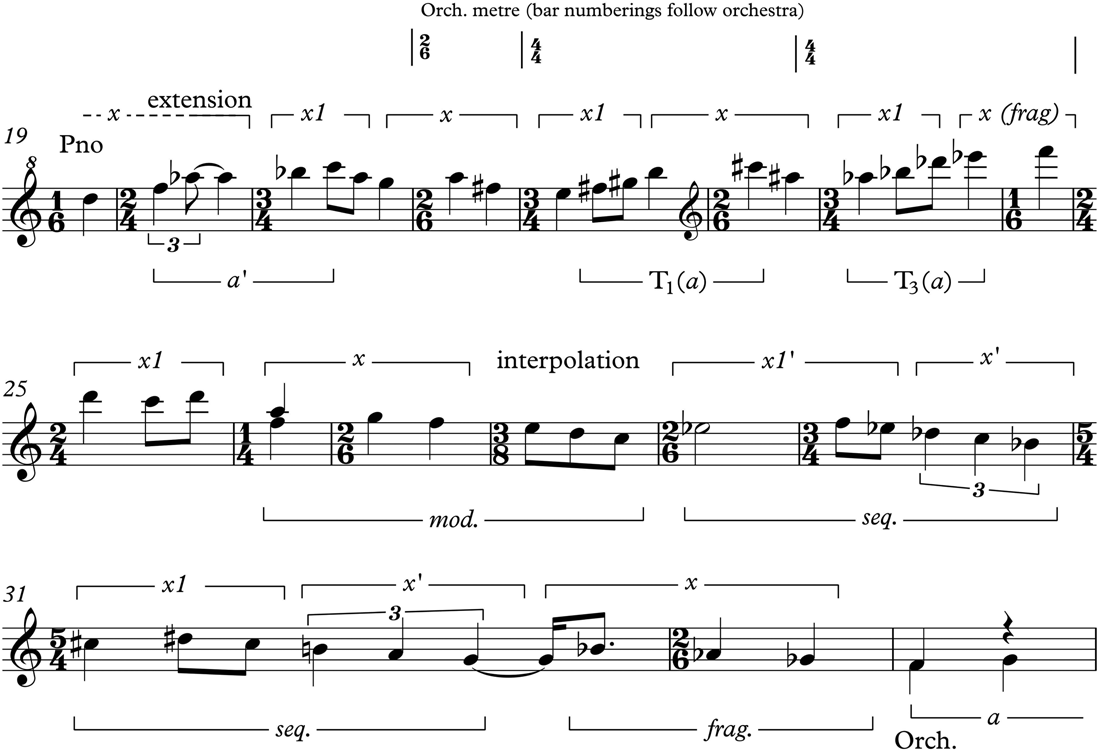
The result is that the second phrase (bars 10–20) functions as a varied repetition, albeit one in which the variation arises through strict adherence to a compositional process rather than, say, a particular harmonic plan (see Example 2). Nevertheless, by bar 20, the working-out of the process ends in a metrically weighted F, ending the second phrase where the first began. From here, the piano and orchestra begin to operate independently; Example 3 follows the piano line. At first, the piano would appear to be reprising the opening of the concerto, but Adès fragments and reworks the material to spiral off into flatter harmonic regions (bars 20–24). The combination of motivic recombination and the metrical complexity that arises through the independence of soloist and accompaniment suggests that it functions in the manner of a classical continuation. It is followed (bars 25–32) by a figure based on descending scales that, contextually, has a cadential function (labelled A2 in Table 4). All told, bars 1–33 recall the functions, and at times the modes of working, of the classical sentence, but the tonal plan and primary means of thematic variation operate independently of classical syntactical groupings.
Thomas Adès, Concerto for Piano and Orchestra, first movement, melodic line (bars 11–20). © Faber Music Ltd 2018. Reproduced by permission of the publishers.

Thomas Adès, Concerto for Piano and Orchestra, first movement, melodic line (bars 20–33). © Faber Music Ltd 2018. Reproduced by permission of the publishers.
Bars 33–51 offer up a shortened reworking of the opening: a truncated consequent to the opening 32 bars’ antecedent. This is one of a number of Adèsian compressed repetitions within the movement. Indeed, the development, based entirely on theme A, is especially fleeting. On paper, the same might be said of the recapitulation (which reduces the 110 bars of the exposition down to just 21), but here (as in …but all shall be well) Adès broadens the tempo significantly of section B (bars 166–93) to allow for a passage of great poetic beauty to counterbalance the madcap metrical complexity of the A sections. Proportionally the recapitulation is the largest to be found in Adès's four sonata-form movements.
Many of the thematic omissions in the development and recapitulation can be attributed to the greater emphasis the composer places on tonal plot as a determinant of form. At the same time, and as in the Piano Quintet, such omissions are also a consequence of the strong thematic connections between ideas in the exposition. Thus, the melody of the transition (Z) is derived from section A2 and given a new fifth-based accompaniment. This accompaniment in turn continues into section B, the melodic contour of which recalls section A1. Dispensing with the need to recall all of this material directly in the development, recapitulation and coda allows Adès to place sonata functions once again in the service of musical dramaturgy, in particular the dramatisation of the interactions between soloist and orchestra.
If the discussion above goes some way to explaining how syntactical grouping, thematic process and tonal plot combine to create a typically Adèsian contribution to sonata form, it does not explain why he chose to emulate the past in this manner. There are doubtless multiple reasons, but I would like to conclude with the notion of the haunted library. The capacity for Adès's music to suggest multiple connections to other composers goes beyond particular thematic ideas and expressive allusions and, as Mellor implies, extends to form as well. Through the evocation of particular gestures, genres and forms, Adès is inviting the listener to ransack the contents of their own haunted library, to make their own intertextual links. The more explicit Adès's syntactical emulation of the broad strokes of, say, sonata form, the easier it is for listeners to bring to bear their own expectations and assumptions, and to have them challenged (or confirmed) as part of a pleasurable exchange of ideas.Footnote 55 The sheer variety of composers cited in reviews of Adès's Concerto for Piano and Orchestra (or his Piano Quintet, for that matter) is ample evidence of this. But it is a high-stakes strategy: the greater the intertextual pleasure, the greater the risk of luxuriating on the musical surface rather than engaging with its content. The danger, to return to Ross's description of the Concerto, is that the ‘paean to tradition’ of Adès's music is emphasised without adequately counterbalancing it with a demonstration of how it is simultaneously ‘a sophisticated burlesque of it’. Although Adès is now in his fifty-first year, with his works having enjoyed over three decades of performances and recordings, there remain many riches yet to be found in the haunted libraries of his music.


 Open access

