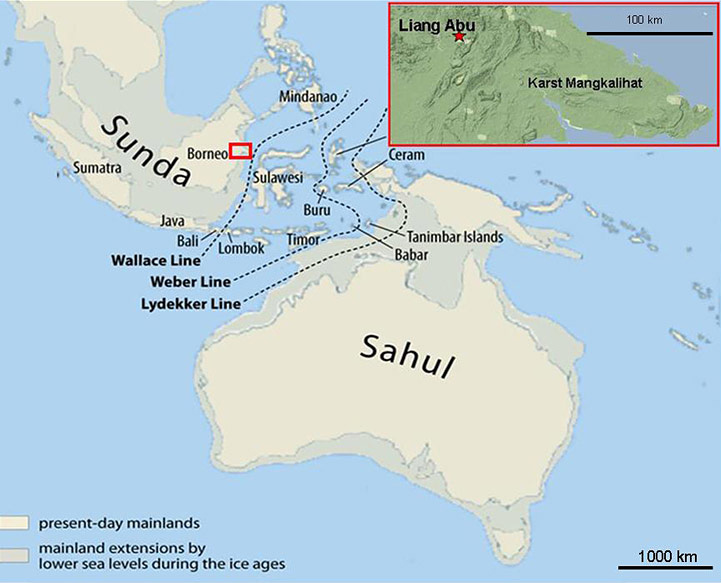


Location of Liang Abu and Mangkalihat peninsula.

Introduction
Island Southeast Asia has been the subject of important archaeological discoveries regarding human evolution and recent human population history (e.g. Reference HarrissonHarrisson 1957; Reference SemahSémah et al. 1992; Reference Morwood, Soejono, Roberts, Sutikna, Turney, Westaway, Rink, Zhao, Due, Hobbs and MooreMorwood et al. 2004; Reference BarkerBarker et al. 2005). Within this context, East Borneo is of special interest because of its strategic location on the edge of Sundaland facing the Wallace line. Relatively little is known about the prehistory of eastern Borneo, mainly due to difficulties in exploring this karstic region.
Since 2003, an archaeological research project, coordinated by Puslitbang Arkeologi Nasional (Indonesia) and the French CNRS (University of Provence and University of Toulouse), has been developed on the karstic region of East Kalimantan (Mangkalihat peninsula, Indonesia) (Figure 1). A new multidisciplinary project was initiated in 2010, involving archaeological, anthropobiological and ethno-linguistic approaches, essential for uncovering the human occupation process during human history.
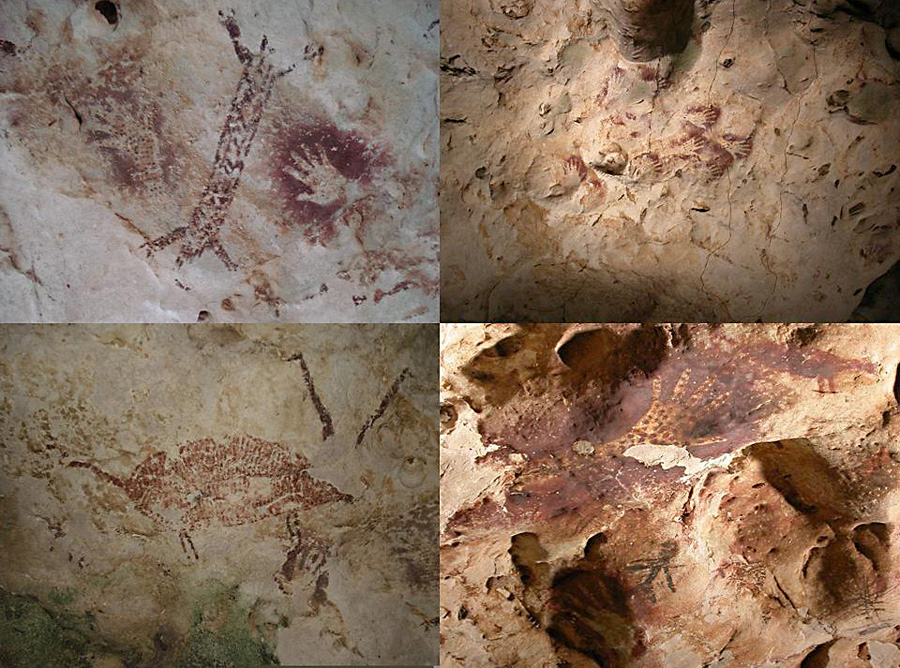
Prehistoric rock art from the cave of Gua Beloyot in the vicinity of Liang Abu.

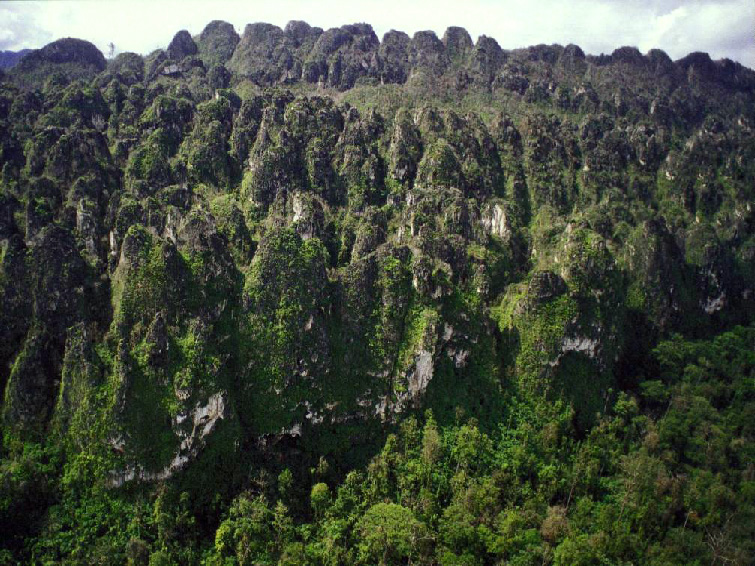
Mountainous karstic area.

Previous surveys have led to the unexpected discovery of more than 150 caves with unique rock art paintings (mostly hand stencils, Figure 2), dating back to at least the Early Holocene (9900 years BP; Reference Plagnes, Causse, Fontugne and ValladasPlagnes et al. 2003) and presenting some similarities to those from eastern Indonesian Islands, West Papua and Australia (Reference FageFage et al. 2010). These discoveries confirmed for the first time the early human occupation of eastern Borneo.
Additional surveys over the last two years have helped us select caves or rockshelters with the greatest potential for excavation to answer our research agenda.
The Liang Abu rockshelter
Liang Abu is located 130km north-west of the shore of the Makassar Strait (Figure 1), within the rainforest of a mountainous karstic area (Figure 3). Hundreds of cliff caves and shelters are present, where human activity occurred on three levels: human settlement at the base, burial in the middle and rock art at the top (Reference ChazineChazine 2005).
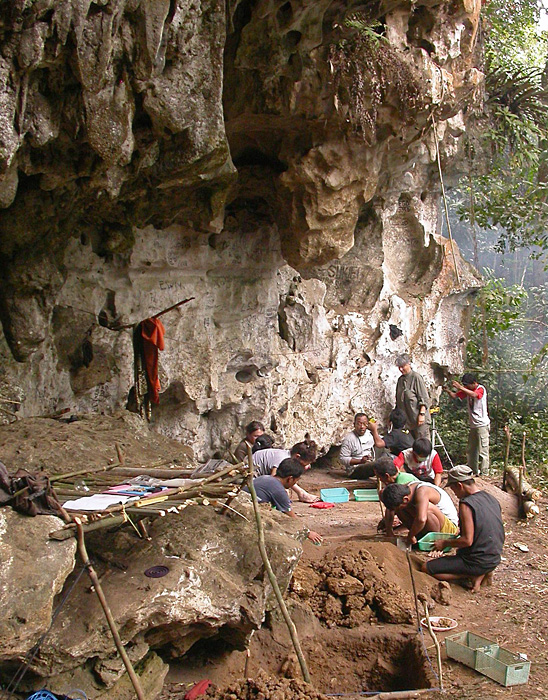
The Liang Abu rock shelter.

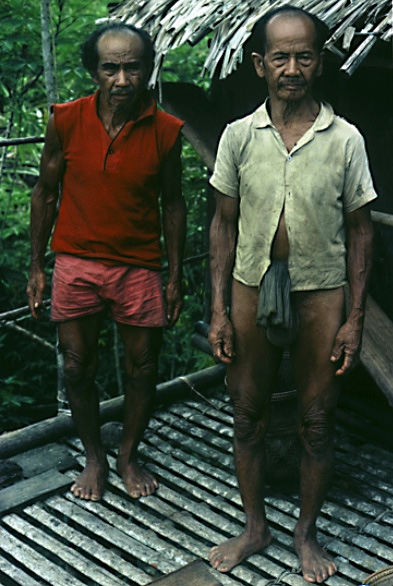
Men from the Lebbo' ethnic group from the Liang Abu area (photograph A. Guerreiro, 1985).

The Liang Abu site is a vast and dry rockshelter facing east. Its dimensions are around 25m in maximum length and of between 5 and 8m in width (Figure 4). The site is located 6km from the remote Lebbo' village of Merabu. The Lebbo' are an isolated indigenous population of hunter-gatherers and are the only ethnic group which have lived in this inner region for a long time (Figure 5). Ethno-linguistic studies of their oral traditions and cultural practices, to document their former use of caves in relation to the proto-historic and pre-historical periods in the region, are currently under way. Some of the Lebbo's representations can be directly related to the prehistoric rock art found in nearby caves.
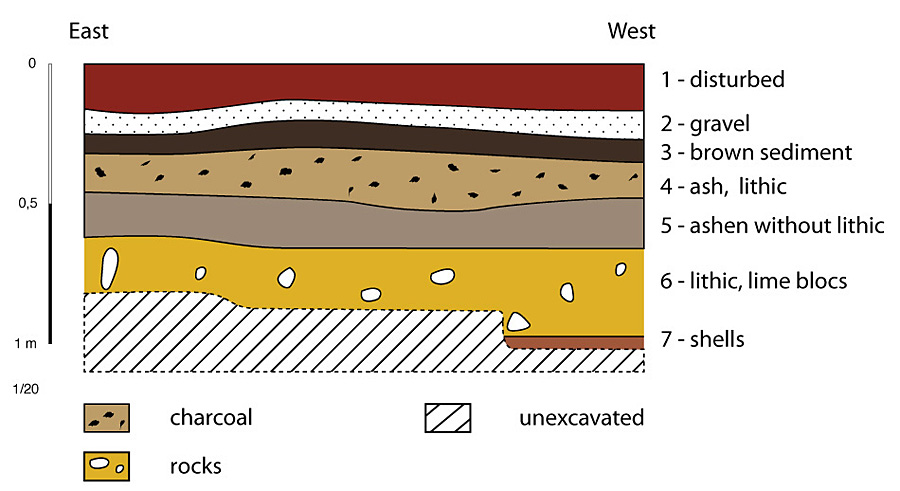
The stratigraphic sequence from test-pit 3.

All these characteristics make Liang Abu a site well suited for the investigation of links between late Pleistocene human occupation, rock art, the communities represented by them as well as the communities of their potential descendants.
To test the archaeological potential of the site, four test-pits were excavated in 2009. They have been opened to a depth of 1m, but the bedrock has not yet been reached. Seven levels have been identified (Figure 6); all of them with archaeological material.
Materials recovered
Among the 480 ceramic sherds recorded, 113 present specific typological features — rims, rim/body juncture or carination — and 59 per cent are decorated. The majority of sherds were found in an undisturbed layer 20cm below the surface. Radiocarbon dating of this layer will supply useful information regarding the spread of ceramic technology in this region.
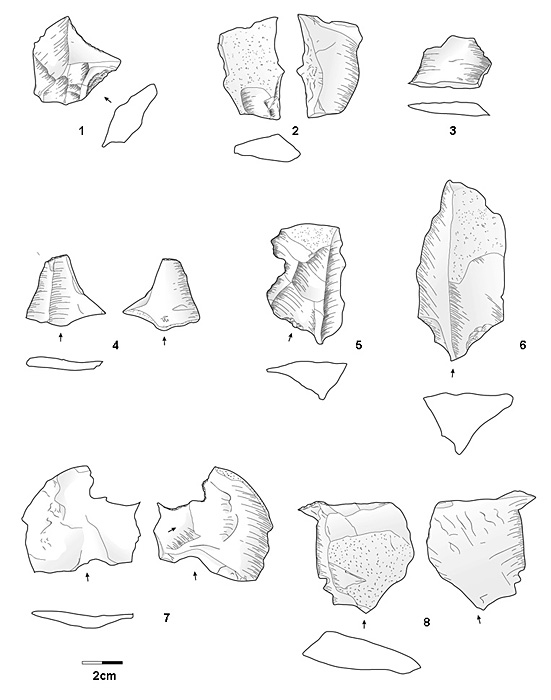
So far the most striking results are from the techno-typological analysis of the lithic assemblages. The tool types consist mainly of a wide range, throughout the stratigraphy, of retouched flakes and small points on flake (Figure 7), which has never been described before. Based on a morphological study, it may be assumed that these points were used on smooth materials like rattan, wood or bone. Microwear analysis should allow us to refine our understanding of their uses.
Lithics from Liang Abu.

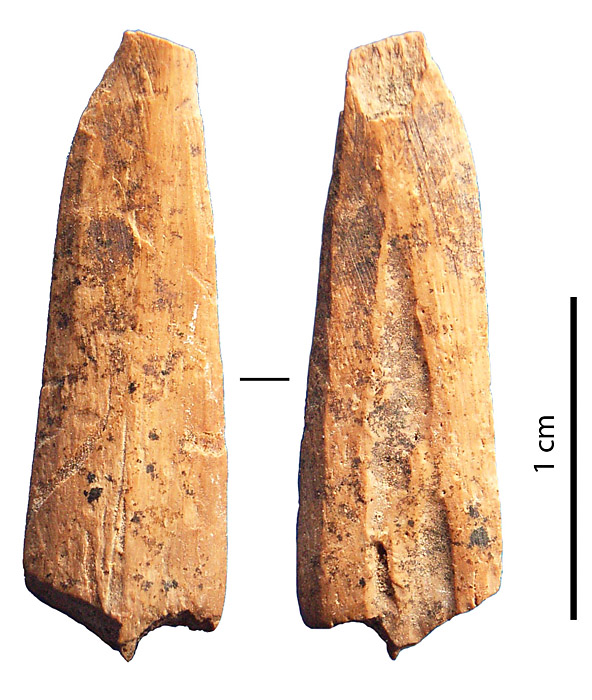
Example of worked bone.

Nearly 10 000 animal bone fragments were recovered, the majority (c. 70 per cent) indeterminate. The faunal remains were highly fragmented and 40 per cent of the assemblage was burnt. Mammals and reptiles were the main taxonomic groups, whereas birds and fish remains were rare. Among the mammals, the bearded pig (Sus barbatus) was the principal hunted prey.
The presence of a bone industry was also documented by 18 modified small bone fragments (Figure 8). A detailed analysis will identify the manufacture processes and their potential function.
Conclusion
The work conducted at Liang Abu in 2009 has documented the presence of important past human occupation in this rock shelter and confirmed the lasting presence of a peculiar lithic industry. Excavations in 20122014 will allow us to define more precisely the nature, stratigraphy and chronology of this occupation. This is an exceptional opportunity and our pluridisciplinary approach is designed to bring to light new archaeological data on a poorly studied area, key to understanding the human evolution and history of this part of Southeast Asia.
Acknowledgements
We thank the excavation team from the Lebbo' village of Merabu and the Puslitbang Arkenas team. This project is funded by the French Ministry of Foreign Affairs in Paris and Jakarta.