

Almost everything we think we know about “the Georgia Minstrels” comes from two sources: Robert C. Toll’s landmark 1974 study of minstrelsy, Blacking Up: The Minstrel Show in Nineteenth-Century America, and Eileen Southern’s “The Georgia Minstrels: The Early Years” (Toll Reference Toll1974; Southern Reference Southern1989).Footnote 1 Toll’s book has long served as a vital source on both white and Black performers of minstrelsy, and it has been immensely influential on other works on the topic (see, for example, Waterhouse Reference Waterhouse1990; Lott Reference Lott1993; Southern Reference Southern1997). Blacking Up draws together original documents sourced from the Harvard Theatre Collection and the New York Clipper, a popular 19th-century newspaper that was a regular platform for minstrel historiography, hagiography, and mythmaking.Footnote 2 In her study, Southern also cites the New York Clipper alongside James Monroe Trotter’s foundational 1878 study of Black musicians, Music and Some Highly Musical People (Trotter Reference Trotter1878).Footnote 3 Though these are undeniably invaluable primary materials, they do not—nor could not—provide a full picture of the Georgia Minstrels and the complex histories of the series of related but not identical companies that performed under that moniker. Nevertheless, from these limited sources, Toll’s book stitches together a narrative in which Black minstrel troupes were occasional curiosities on the stages of the US American North until after the Civil War (Toll Reference Toll1974:198–99). Though select individual Black performers such as William Henry Lane (“Juba”) and Thomas Dilverd (aka Thomas Dilward or “Japanese Tommy”Footnote 4) made individual careers by performing with white blackface minstrel troupes, Toll asserts that no Black minstrel troupe “survived until Brooker and Clayton’s Georgia Minstrels,” who distinguished themselves on their 1865/1866 tour of the northeastern United States (Toll Reference Toll1974:199).Footnote 5 In a similar vein, Southern celebrates “the popularity of the Georgia Minstrels in the last quarter of the nineteenth century, and the important contributions they made to black-American culture” (Southern Reference Southern1989:157).
Perhaps unsurprisingly, then, Toll makes the Georgia Minstrels a centerpiece of his chapter “Black Men Take the Stage,” charting their early successes, their relationship with their Black manager Charles B. (“Barney”) Hicks and his white rivals who fought for control of the company, and Hicks’s eventual founding of rival troupes, some of which he toured to Australia and Aotearoa New Zealand (1974:195–233). Similarly, Southern maps the “early years” of the Georgia Minstrels between 1865 and 1878, tracing a similar though occasionally contrasting narrative of the company that unwittingly confuses different iterations of the Georgia Minstrels (Southern Reference Southern1989:157–67). Indeed, the proliferation of Black ensembles performing under the banner of the “Georgia Minstrels” has proved to be an enduring challenge for Black minstrel historiography, which has tended to conflate the many “Georgia Minstrels” into a singular, continuous company.
Contributing to this pattern of misremembering, Toll’s and Southern’s accounts both omit crucial information about the early history of the first troupe of Georgia Minstrels active during the Civil War in Macon, Georgia. Moreover, neither offers substantial information about the transoceanic tours of Black minstrels, particularly those of Hicks’s troupes to the antipodes. These omissions almost certainly stem from the narrowness of Toll’s and Southern’s archival investigations into materials sourced from the US American North. Of course, Toll’s book promises a history of minstrelsy “in nineteenth-century America”—and not beyond the boundaries of the US nation-state. Nevertheless, it is important to note that both studies’ imaginings of Black performance remain limited to commercially successful acts in the urban north of the United States. What has been overlooked by this narrow focus on Black minstrelsy as a phenomenon bound to the US North? What insights might the Georgia Minstrels provide into the complex racial and performance politics of “the Black Below,” particularly among Black performers and audiences in the US South (Jones Reference Jones2021)? In a different but related vein, how might we understand the history of Black minstrelsy differently if we look beyond the United States and toward its significant role in a transoceanic “Anglophone imperial circuit” of minstrel performance (Hoxworth Reference Hoxworth, Meerzon and Wilmer2023)?
We address these questions by recuperating overlooked histories and archives of the Black minstrel performance of the Georgia Minstrels across their various incarnations, from Macon, Georgia, to Melbourne, Australia. These histories demonstrate that Black minstrelsy has never been a strictly US American phenomenon as it came into being across relays connecting the Confederate States of America to the United States of America to the British imperial colonies in Australasia. Instead, they demonstrate that histories of Black minstrelsy that have long been taken as marginal were in fact central to the development of this vital form of Black performance.Footnote 6
The Georgia Minstrels
The Earliest Years
The early history of the Georgia Minstrels may be traced through available (but long overlooked) newspaper sources beyond New York City. These sources dispel chronic confusion regarding the company across its various incarnations. Indeed, the Rosetta Stone for deciphering the Georgia Minstrels’ origin stories is not the New York Clipper but rather the Macon Telegraph, both for its chronicling of events as they occurred, and later, for its attempt to preserve the memory (however imperfect) of their hometown history-makers.Footnote 7 The paper’s first mention of the troupe that would become the Georgia Minstrels appeared on 28 October 1861, four years earlier than its commonly recognized start date. The Telegraph announced that Brooker’s Negro Minstrels had been organized on the first of that month and would, with the mayor’s approval and under the supervision of three of the city’s loftiest citizens, give a performance to benefit the Soldiers’ Relief Society of Macon (Macon Daily Telegraph 1861a).Footnote 8 A later report trumpeted the group’s success:
The over-crowded houses which have greeted them, and the meritorious and amusing character of their entertainment, not to speak of the noble purpose for which they have devoted their energies will, we are sure, still throng the hall with auditors. (Macon Daily Telegraph 1861b)
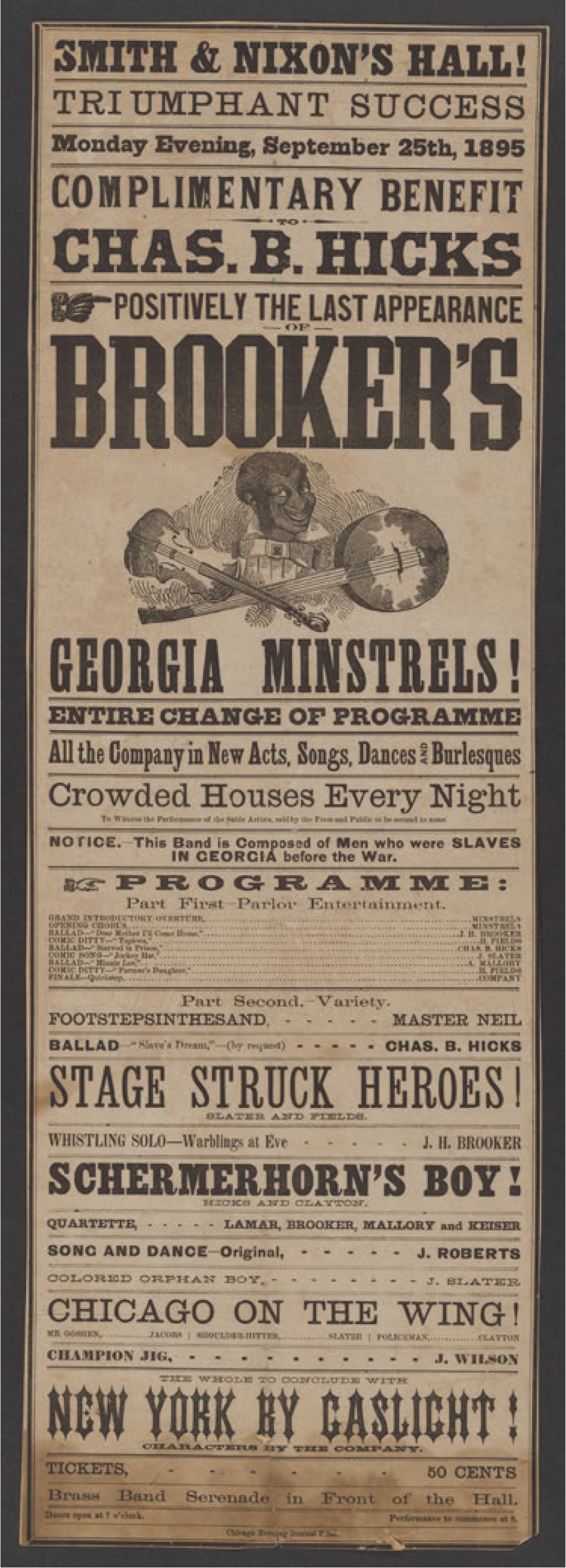
Georgia Minstrels American minstrel show collection 1823–1947, undated. MS Thr 556. (Courtesy of Houghton Library, Harvard University)

Recalling this story more than two decades later, the Telegraph would assert that the group’s history went even further back than these concerts; that before the war these musicians would occasionally perform minstrel shows in town to fill the lull between visits from white traveling troupes and would even travel (presumably under close surveillance) to entertain the wealthy at posh resorts (Macon Telegraph and Messenger 1885). There may be some embellishment here, but it is not unlikely that the group had prior experience together nor that this troupe’s successful organization and early concerts would have led to future performances—albeit with less fanfare or publicity. Indeed, one source dates their first public appearance to 1858, three years prior to the earliest known performance documented in the Macon Telegraph (New York Clipper 1872b).Footnote 9
Scholars of the Georgia Minstrels have omitted or ignored the history of the troupe prior to and during the US Civil War, preferring instead to interpret the originators of Black minstrelsy as a product of free, Northern Black ingenuity rather than to grapple with the complex racial politics of unfree, Southern Black performance. Most centrally, Eileen Southern narrates the early history of the Georgia Minstrels as two distinct companies: one led by a succession of white entrepreneurs comprising “fifteen ex-slaves,” and a troupe led by Hicks who she claims were likely not from Georgia (Southern Reference Southern1997:232; see also Southern Reference Southern1989:158). Central to Southern’s narrative is her explicit skepticism regarding the possibility that musically talented Black performers could have been enslaved: “Were they really ex-slaves? How did they obtain the musical training necessary to produce shows that could compete successfully with those of the nation’s leading white minstrel troupes?” (1989:161).Footnote 10 Southern proceeds to recount the biographies of several musicians who performed with the Georgia Minstrels in the 1870s, all of whom made their careers in the US North. Within this framework, Southern asserts that these latter-day companies of Georgia Minstrels were “at once a haven for the established entertainer […] and a training ground for the neophyte, who could serve his apprenticeship with some of the most eminent black artists of the times” (162). Notably absent from Southern’s consideration is any musical training that might have occurred either informally, in the vernacular, without the imprimatur of “eminent” artistry, or otherwise on the margins of formal musical training and its apparatuses of classed respectability. Yet, the transatlantic success of the Georgia Minstrels troupe comprising formerly enslaved performers from Macon suggests strongly that there was a vibrant musical “Black Below” from which the company members derived their individual and collective talents (Jones Reference Jones2021).
Given their performances from 1858 to at least 1861 in the antebellum and Civil War–era South, the musical education of the Georgia Minstrels necessarily occurred under slavery. Indeed, the occasion of their documented performance in 1861 was a fundraising concert in support of the Confederate soldiers of Macon. A later account of the troupe’s origins attests that the company members were all enslaved by local whites, who conscripted them into musical performances to entertain the white community with imitations of white blackface minstrel shows (Macon Telegraph and Messenger 1885). Such practices continued during the Civil War, when Confederate armies conscripted “thousands [of enslaved people who] worked as teamsters, cooks, and musicians” (Levin Reference Levin2019:4). Though the “Black Confederate” soldier is a pernicious myth, Black musicians were routinely coerced into service in support of the Confederate cause. The Georgia Minstrels were no different. Likely trained through a combination of white tutelage and Black vernacularity, the Georgia Minstrels knew how to perform to satisfy a white audience’s expectations and to hone their skills by “stealing away” from the watchful eyes of the slave master and the overseer to rehearse valuable musical knowledge and to share it communally (Hartman Reference Hartman1997:65–70; Abrahams Reference Abrahams1992). Enslaved black performers could leverage such skills and knowledge to improve their lives and even to earn money (Abrahams Reference Abrahams1992:xix; Levin Reference Levin2019:46).
It is therefore unsurprising that, immediately following the end of the Civil War, the Georgia Minstrels seized the opportunity to establish themselves as independent, professional musicians. The performance that launched the troupe’s career was once again in a Macon theatre, though this time under the auspices of the Union army and their new management: Union soldier W.H. Lee and Telegraph compositor George W. Simpson. On Independence Day 1865, the Georgia Minstrels staged what was billed as a “Grand Fourth July Entertainment”; the language of the playbill attempts to engage a local audience’s sympathies toward celebration of the United (rather than the Confederate) States of America. The playbill sought to leverage the local familiarity of the troupe to court an audience: “It will be remembered that this troupe was organized and performed in this city several years ago, and was greeted by the largest audience that ever assembled at Concert Hall” (Program reprinted in the Chicago Daily Tribune 1889; see also New York Clipper 1872b). The troupe faced serious challenges in generating enthusiasm. The white citizens of Macon, smarting from defeat and the frustration of being under federal occupation, were in no mood for their performance of nationalistic celebration and were even less amenable to newly liberated Black joy, even if framed by minstrelsy and its repertoires of Black mockery. The Macon Telegraph did not publicize their announcement.
Nevertheless, the performance proved a success, and two days later, in advance of a second performance, the Telegraph and Messenger publicized that the troupe comprised “Simon pure Ethiopians”—that is, unvarnished or “authentic” Black Americans—and that they gave a good show:
We listened to the performance of the minstrel troupe on Tuesday night, and pronounce them “Simon pure” Ethiopians and no mistake. Their jokes are fresh and new, their singing is excellent, and what is better their houses are orderly. (Macon Telegraph 1865a)
On its own, the program is a valuable if flawed artifact: Lee and Simpson are listed, along with the time and place (not something to be taken for granted), with the sections, songs, and dances all mapped out. The troupe, however, is listed as “The (Celebrated) Georgia Minstrels” instead of “Brooker’s Georgia Minstrels,” which would later make it more likely for historians to see these as separate organizations (Toll Reference Toll1974:199–201; Southern Reference Southern1989:158; Southern Reference Southern1997:232). More troubling, the performers are identified only by character (or enslaved) names: John James, Pompey, Stephens, Julian, Josh, Ginger, Master Neil, and Bones. On its own, it is of little aid in tracing the membership of the troupe from one incarnation to the next.
Despite this apparent historiographic dead end, an unidentified Macon Telegraph and Messenger writer became—20 years after the event—history’s unsung hero, supplying full names for the performer of each character listed, as well as names for the uncredited musicians, along with the names of each troupe member’s former enslaver:
“John James” was John Brooker, […] “Stephens” was Lewis Slater, […] “Bones” was Henry Fields, […] “Pompey” was Lucius Griffin, […] “Julian” was Aleck Jacobs and “Master Neil” was Neil Rogers, […] “Josh” was Joe Clay […], and “Ginger” was Andrew Gospel. […] The other members of the company were Jeff Kiser, […] Aleck Mallory […] and his brother Phil […,] Austin Brighthaupt, […] Phil Lamar […,] Riley Covington, […] and Albert Slaughter. (Macon Telegraph and Messenger 1885; see also Atlanta Constitution 1885)
From the 15 names listed in that article, nine emerge as a core troupe, present for the remainder of the band’s tenure in the United States: Joe Clayton—banjo, cornet, comedian, eventual coproprietor; Lew Slatter—tambourine, female dancer, bones; Alec (or A Lee) Jacobs—tenor horn and singer (bass); Alex Mallory—guitar and balladist (tenor); Henry Fields—bones and comedian; Lucius Lamar—double bass and tuba; Jeff Keiser—violoncello and singer (basso profundo); Neil Solomon—snare drum and essence dancer; and John Brooker—whistler, singer (B baritone), and leader of the orchestra. The author further provides information regarding the then-current whereabouts of each member, including three that resided in Macon and presumably could have contested the account if it were fictitious.Footnote 11 It is thus probable that a Macon local sought to dispel the many myths regarding the Georgia Minstrels—most centrally, the widespread assertions that they were not from Georgia and had not been enslaved—so as to claim the troupe’s origins as a source of civic pride.Footnote 12 The emerging picture, even before the Brooker’s Minstrels troupe left Macon, is of an established group, and one that chose to identify itself (in the style of Christy’s Minstrels) with a member of that group. Though they were only recently “re-organised” by Lee and Simpson, the troupe was not lacking prior performance experience as some iteration had staged concerts for years prior to their “first bill” (New York Clipper 1872b).
The First Tour of the Georgia Minstrels
The Georgia Minstrels began touring shortly after their initial success. The troupe’s first appearance outside of Macon took place in Chattanooga, Tennessee, and the response there provided them with further encouragement. The troupe had “several fine voices among them,” according to the Daily Gazette, and they showed “a great deal of wit” in their burlesque pieces (Chattanooga Daily Gazette 1865). While the review suggests the audience was smaller than the troupe may have wished for, the paper noted that it grew larger with each performance. Nashville, Tennessee, on the other hand, gave the troupe a very chilly reception. When the Macon paper described the Nashville outing as going very well, the Nashville Daily Union tersely responded, “Brooke’s [sic] Georgia Minstrels have not given us any report of their success up to this date”—suggesting a failure on the business agent’s part to purchase an ad or provide the press with tickets (Macon Telegraph 1865b; Nashville Daily Union 1865).
In Louisville, Kentucky, the troupe found itself the subject of outrage:
BROOKER’S MINSTRELS.—Some unscrupulous white adventurer has gathered together about a half dozen Georgia contrabands and advertises to show them at a first-class hall in this city as Brooker’s Minstrels. We are told that their performances are disgustingly poor and disagreeable. How these colored men can lower themselves to ridicule their own color, we can’t understand; and the rascal or rascals who have these ignorant men under their control ought to be whipped publicly, and be drummed out of town. (Louisville Union Press 1865; see also Louisville Daily Journal 1865)
The Union Press’s rival paper, the Daily Journal (where Simpson had bought an ad) fired back immediately, but only to accuse the Press of hypocrisy:
these negroes were playing on their own account in Georgia, and, finding themselves incapable of managing their own business, contracted with two white men to do it for them. It is the kind of arrangement between white and black which not only the Union Press but the nation is bending every energy to inaugurate and perpetuate. (Louisville Daily Journal 1865)
This debate about exploitation, and even more, about ownership, is an important one, and would become a recurrent theme both for this troupe and for subsequent companies of Black minstrels. Nevertheless, as publicity, the Daily Journal’s response was something of a disaster, especially as it concluded by admitting that the paper had “contented itself with barely announcing the advent of these negroes as a novelty” without commenting on the troupe’s quality. This is to say that the Daily Journal used the Georgia Minstrels to levy a critique at the Republican-leaning Press and then tossed the troupe aside with a shrug of a review.
Enter Charles B. Hicks
The company management’s missteps in Nashville and Louisville seem to have prompted the company to seek more experienced guidance. Within a month, they found such experience—and more—in a Black performer and agent, Charles B. Hicks, whom they hired to share managerial responsibilities with Simpson. When the troupe encountered Hicks, he had been based in Indianapolis, Indiana, for several months after spending at least a year performing with a troupe of Black minstrels across the US North and Midwest. Headlined by the acclaimed Black banjoist Jake Hamilton, that troupe had gone by a few different names (Bishop’s Contrabands, Big Andy’s Blackbirds) and a few different white leaders (one of whom left the band stranded in McGregor, Iowa, with all the bills unpaid), before landing on Jake Hamilton’s Contrabands.Footnote 13 For well over a decade, Hamilton played on New York stages with white minstrels, performed in concert halls solo or with his brother, and started his own troupe. As a member of Hamilton’s company, Hicks had the opportunity to apprentice under Hamilton, and he also seems to have gained firsthand experience working with the press. During that period, it appears that Hicks sometimes passed for white in order to act as a business agent for the troupe, and some of the language used in the mini press releases for Hamilton’s group (“The performers are not white men painted to look like negroes, but real Africans”) would later be repurposed (with minor revisions) for the Macon troupe (Wisconsin State Journal 1864; Semi-Weekly Wisconsin 1864; The Weekly North Iowa Times 1864; Beaver Dam [Wisconsin] Argus 1864; Winona [Minnesota] Daily Republican 1864; Wisconsin State Register 1864).
Almost immediately after the Georgia Minstrels hired Hicks, the success of his methods for generating publicity became clear. Whereas before the ads had just asserted that the men were “the only Simon pure negroes [or Ethiopians] now traveling in the United States,” Hicks provided a narrative for the press. The news blurbs and ads emphasized for their Northern audiences the troupe’s Southern origins, announcing that these men had all been enslaved just a few months prior, that they had been organized in Macon, Georgia, and that they had performed for Union troops. He put their names on the playbills so that reviewers might recognize their individual talents and, perhaps, desire to see them in action. Hicks also seems to have been instrumental in tweaking the band’s routines—introducing more skits and material not bound to plantation scenes and its repertoires of Black enslavement—and scouting new members, himself among them.
Here, it is important to note that extant scholarship has presumed that Brooker’s Georgia Minstrels organized by Lee in Macon was a different, rival troupe from that organized by Hicks in Indianapolis. For instance, Richard Waterhouse claims that the members of one of the “contraband” troupes (such as Hamilton’s company) that Hicks performed with in the Midwest “formed the core of the Brooker and Clayton Georgia Minstrels Company which Hicks organised in September 1865” (Waterhouse Reference Waterhouse1990:50). In a similar vein, Southern states, “Formed by black showman Charles ‘Barney’ Hicks (ca. 1840–1902) in Indianapolis, the troupe was also called the Georgia Minstrels, but it is doubtful that the men came from Georgia” (1997:232). Scholars generally have shared the presumption that, wherever the Georgia Minstrels were from, it was not Georgia. Despite Southern’s doubts and Waterhouse’s speculations, the archival record is clear that Brooker’s Georgia Minstrels were indeed from Macon and had formed well prior to their arrival in Indianapolis. Indeed, their successes in Macon and Chattanooga indicate that they were a talented company of performers who benefitted from Hicks’s entrepreneurial savvy, and that the alliance in turn aided Hicks in his career. Far from a narrative of competing companies, Hicks and the Georgia Minstrels were a model of mutual cooperation.
The troupe’s first big gig after Hicks joined was a four-show engagement at Smith & Nixon Hall in Chicago, Illinois. Hicks’s Northern press-whispering was an immediate success; the Chicago Tribune ran their ads and included a blurb almost every show day, and the review was a rave:
This troupe of colored minstrels—colored in the true sense of the term—opened in Smith & Nixon’s Hall last night to a crowded house. Their entertainment was without doubt one of the very best ever offered to a Chicago populace, comprising excellent selections, presented in a most laughable manner and yet devoid of the forced effort apparent in too many of burnt cork companies […] Among the best things—and all were good—were the overture and the opening and closing choruses, the tapioca and dance of Fields, the banjo duet of Clayton and Hicks, and the dances of Master Neil. Messrs. Brooker, Slater [sic], Roberts and Mallory also exhibited some finely humorous phases of dusky Southern life. From beginning to end the programme is a good one, replete with whimsicalities and oddities of the first water. (Chicago Tribune 1865; see also Georgia Minstrels American minstrel show collection 1823–1947)Footnote 14
The response in Chicago was so positive, and attendance so high, that the troupe added a fifth show to the roster, as a benefit for Hicks.
From Chicago, the troupe headed east. By Detroit, Michigan, they had a new name: Brooker & Clayton’s Georgia Minstrels. Shortly thereafter, they began hammering out a new infrastructure. George Simpson was still advertising agent; W.H. Lee was designated business agent. Initially, proprietorship was attributed to “Thomas, Clayton, and Co.,” then to “Thomas, Clayton, and Hicks,” and finally to “Clayton and Hicks” (New York Clipper 1866a; Brooker and Clayton’s, Georgia Minstrels and Brass Band 1865).Footnote 15 Not all of their performances were successful. They received a lukewarm reception in Buffalo, New York, where one paper was unimpressed and the other encouraged the light-skinned performers to mask themselves in blackface, “or many may attribute their failure to come up to the stand or their white brethren […or] to the unpopular doctrine of miscegenation” (Buffalo Courier 1865). Nevertheless, the troupe found New England very welcoming, with full houses often greeting them. By the spring of 1866, they were successful enough to recruit experienced talent like banjoist Sam Pride, who had briefly headed up a Black minstrel troupe in San Francisco, California, years before, and had only months before returned from Australia. They were also successful enough to have imitators: indeed, the troupe had “quickly established itself as the benchmark all-Black troupe” and subsequent Black minstrel companies were often referred to generically as “Georgia Minstrels” (Jones Reference Jones2021:132). Their ad campaign changed accordingly: while they were still officially Brooker & Clayton’s Minstrels, they were more often marketed as “The Only and Original Georgia Minstrels,” with addendums like “the celebrated Slave Troupe” and “Not white men blacked, but genuine Negroes!”
The Georgia Minstrels Cross the Atlantic
On 21 May 1866, the Georgia Minstrels performed in Utica, New York, at Mechanics Hall. Across the street was an ale house owned by Sam Hague and his brother Tom. An Englishman, Sam was a clog dancer, who had come to the US in the 1850s. He had played with several companies over the years, the last one—in partnership with “Happy” Cal Wagner—had disbanded just the month before. Five days after their arrival in Utica, the Buffalo Courier announced that Hague had “secured the Georgia Minstrels” for a tour of Europe, to be accompanied by headliner “Japanese Tommy,” aka Thomas Dilverd (Utica Daily Observer 1866; Buffalo Courier 1866).Footnote 16 The Buffalo Courier’s own office was preparing all the printing for the tour and, perhaps in the spirit of partnership, took it upon themselves to advise Hague to make staffing changes in anticipation of the trip:
A number of them are a little too light in color and refined in manners and carriage to give Europeans a correct idea of a plantation slave in the South […] We would advise Sam, before he sails, to engage a few more of the pure stock, whose every look and gesture, and twinkle of the eye provokes a laugh. (Buffalo Courier 1866)
The details of the arrangement between Hague, Hicks, and Clayton—the financials, how it was determined who would go and who remain, how finite or open-ended the length of absence, the expectations for those remaining in the US—are unknown and likely unknowable. Regardless, Clayton and all but one of the Macon troupe left for England, along with several newer members.Footnote 17 Hicks remained, as did jig dancer/band leader John Wilson and perhaps a few others.
It does not appear to have been a bitter dissolution, as some weeks later the following announcement—almost certainly by Hicks—was made in the Clipper:
The Georgia Slave Troupe, which sailed from this country a short time ago for England, under the management of Sam Hague, the well known clog dancer, arrived safe in Liverpool, where they gave their first appearance on 9th inst. at the Theatre Royal, and were favorably received […] Sam Pride, Mallory, Slatter, Brooker, Neil Solomon, John Graves, Fernando, Jonson, Lee Jacobs and Japanese Tommy are in the party. The party were to remain in Liverpool for two or three weeks and then make a tour of the provinces. (New York Clipper 1866b)
The popular consensus over time has been that bringing the “American Slave Troupe” on the UK tour was something of a disaster that Hague turned into a triumph by hiring white performers in Britain. That consensus is based on an 1889 interview with Hague:
Was it a success? Well, it was for one night! You see, the public compared my crude representation of real negro life with the educated, refined, minstrel companies that were then so popular in England, and, of course, we suffered by the comparison, the public allowing nothing for the negro’s ignorance, for there was not a man that could read or write, or tell a note of music from a horseshoe […] The emancipated slave was all right for an advertisement, but the public wanted entertainment with it. (Lancaster [Ohio] Gazette 1889)Footnote 18
The archive offers a starkly contrasting picture. Reviews from Liverpool and the provinces were overall positive—a review of their second evening’s performance in Liverpool praised the troupe’s “musical skill, which is very considerable” (Liverpool Daily Post 1866). A performance in Birkenhead was hailed for “the excellence of their entertainment” (The Era 1866a). Early favorites among the company included Japanese Tommy’s comic routines and Sam Pride’s original musical compositions and his banjo playing (Liverpool Daily Post 1866; Illustrated Sporting and Theatrical News 1866; The Era 1866a; Sheffield Daily Telegraph 1866). The dancing was a regular hit, both in the plantation “break down” dance finales and for its soloists; one paper praised the “Slave Serenaders” for having “two of the most agile dancers possible” (Illustrated Sporting and Theatrical News 1866; see also Liverpool Daily Post 1866).Footnote 19 Mallory’s singing also received some appreciation (The Era 1866a), though several commenters thought the overall singing could be improved—a note that apparently Hague agreed with, as he began to hire more (presumably white) singers to balance the cast (The Era 1866b; Birmingham Daily Gazette 1866; The Era 1866c). What is very clear is that at some point, Hague’s vision for the tour changed. Possibly as early as December of 1866, when his title in the advertisements moved from “Manager” to “Manager and Proprietor,” Hague decided that the Slave Troupe would not be returning to the US. As some of the members had not signed on for a permanent stay, they would have to be replaced, and those replacements would more than likely be white.
From the beginning, in a departure from the US performances, Hague had the lighter-skinned members of the group blacken their faces with burnt cork, which made it easier to mask the new, white members while still claiming that the troupe comprised 100% emancipated African Americans. As the number of white players grew, Hague had all his performers “blacken up,” to the reviewers’ occasional annoyance. The Sheffield Daily Telegraph opined, “one would think that in this case, [burnt cork] could be dispensed with advantageously and convey to the audience a better idea of what the Georgians really are” (1868). Despite the increasing number of white performers, Hague held onto the story of the Georgia Slave Troupe for as long as possible, as it was one of the great advantages his troupe had over the longer-running Christy Minstrels. This recalcitrance sometimes backfired, as some papers began expressing skepticism about the entire troupe; in response, Hague and Lee printed a “notice” from a Georgia newspaper:
From Joe Clayton, a member of the Troupe, now at home, we learn that it is their intention to remain abroad some time yet, and will make a continental tour before returning home […] As doubts have been expressed by the British press as to the former status of the members of this Troupe, we beg to assure them that they were Georgia slaves, and owned as such up till June, 1865. (Ulster Gazette 1868)
Even after it became generally accepted by the press, Hague and Lee (who had joined the troupe as Hague’s business agent, then manager) did not publicly advertise the whitening of their troupe until 1872. For the Macon performers, this meant a gradual and largely unacknowledged attrition from the troupe they had started back in 1861 (if not before). By April 1871, only three of the original members of the Macon troupe remained with Hague’s group: Neil Solomon, who had been relegated to playing in Ireland (perhaps as a concession to his Irish wife); and in the orchestra, Lucius Lamar on the double bass and Alec Jacobs on triangle and bells (The Era 1871).Footnote 20
Charles B. Hicks and the “Georgia Minstrels No. 2”
While the “Only and Original Georgia Minstrels” performed in Britain, Hicks remained in the United States, where he began building a new troupe of Georgia Minstrels. His initial plan had been to rebuild in the Midwest as “Booker [sic] and Clayton,”Footnote 21 with Jake Hamilton rejoining him on banjo, but he soon abandoned that strategy (New York Clipper 1866c).Footnote 22 Instead, Hicks finished out the year playing New England, including some of the towns the first group of Georgia Minstrels had left in the lurch to take Hague’s transatlantic offer:
As an item of interest to cleverly disposed persons like ourselves who hold little “I.O.U’s” against Georgia Minstrels No. 1, who didn’t appear here last June, we might say that the Manager of the present concern asserts that they are not the “Original Jacobs” but “Georgia Minstrels No. 2,” who we are happy to say square up with the printer. (Burlington [Vermont] Times 1866)
From 1866–1868, Hicks was not the manager or agent of record for his new troupe of Georgia Minstrels. In ads that listed the names of performers, his was noticeably absent (Hartford [Connecticut] Courant 1868; The One and Only Georgia Minstrels 1868:295). It is only through playbills and occasional posts of misdirection to the Clipper that one finds him at all. In one notice, he warns that a “fraudulent” troupe is going east, while his troupe is going west—namely to perform in New York City with occasional excursions to Pennsylvania (New York Clipper 1867). This was, perhaps coincidentally, around the time Hague’s troupe began using the name Georgia Minstrels again, having dropped it shortly after their arrival in Britain. It is impossible to know what arrangements Hicks made with Hague; nevertheless, the lack of band promotion, or self-promotion—particularly after a full season performing in New York houses—was a marked departure from Hicks’s activity with his prior troupe.
Still, the Georgia Minstrels No. 2 were successful and performed internationally. In 1868, the company made a short tour of Panama (Waterhouse Reference Waterhouse1990:52). Two years later in 1870, after three solid seasons performing together, Hicks decided to take his new troupe of Georgia Minstrels to Germany, with customary fanfare:
C.B. Hicks, manager of the Georgia Minstrels, sails from this city on the 25th inst. for Hamburg, Germany, by the steamer Holsatia, accompanied by his entire troupe of minstrels, numbering eleven. The party intend continuing in Hamburg one week, and go thence to Berlin, and stay at the Leipsic fair about two months, and then make a tour through Germany. They take along with them a panorama giving a view of the plantation in Georgia in which is represented Sherman’s march through Georgia. (New York Clipper 1870)
The details of that voyage are murky, but by the end of April Hicks arranged for himself and some of his troupe members to work for Hague. For about a year, it seems to have been a fine collaboration: Hague got new Black performers, and Hicks got to send glowing reviews back home via the Clipper.
The reunion between Hicks and Hague proved short-lived. The problems began after Hicks’s return to the US in 1871, when he began to publicize his upcoming season: “The Original and Only Georgia Minstrels. The Great Slave Troupe. Having completed their European tour” (New York Clipper 1871a). Irate, Hague and Lee fired off an “IMPORTANT PUBLIC NOTICE,” accusing Hicks of illegally using the title of the company, among other aspersions:
This man HICKS was picked up while in England by Mr. Hague, and his abilities tested in almost every role in the minstrel profession in all of which he proved a “failure,” in consequence of which he was for some time used as a check taker. Having no further use for him in that capacity, a subscription was taken up among the members of the troupe (the proprietor, Mr. Hague, giving the lion’s share) to send him to America, which was done some five months ago. Having managed (in what way is a mystery), after he arrived there, in organizing a party of negroes, he is now traveling through the States representing them as THE SLAVE TROUPE of GEORGIA MINSTRELS from the ST. JAMES’ HALL, LIVERPOOL, ENGLAND. (New York Clipper 1871b)
Hicks neatly avoided the question of whether he had a legal right to the name; considering the number of “Christy Minstrels” performing at that time, his might have been a winning argument (see Davis Reference Davis2013:44–45). Instead, he wrote back with a notice posting the positive things Lee himself had written in the slave troupe newsletter, and then closed the argument:
The original and only GEORGIA MINSTRELS are now returning from a successful tour west, and will appear in all the Eastern cities, when the public can judge for themselves. (New York Clipper 1871c)
Hicks’s response earned him a reputation for being a “very dangerous man,” unafraid of powerful white producers (Simond Reference Simond1974:13). Despite Hicks’s reclamation of the “Georgia Minstrels” moniker, after W.H. Lee died, Hague began claiming that he went to Georgia and rounded up a minstrel troupe—a myth that endured for a long time, especially the Macon troupe faded from public memory. Yet, the collective amnesia about the initial Macon troupe of Georgia Minstrels was also aided by the proliferation of other troupes bearing the same name, including several globally successful companies helmed by Hicks himself.
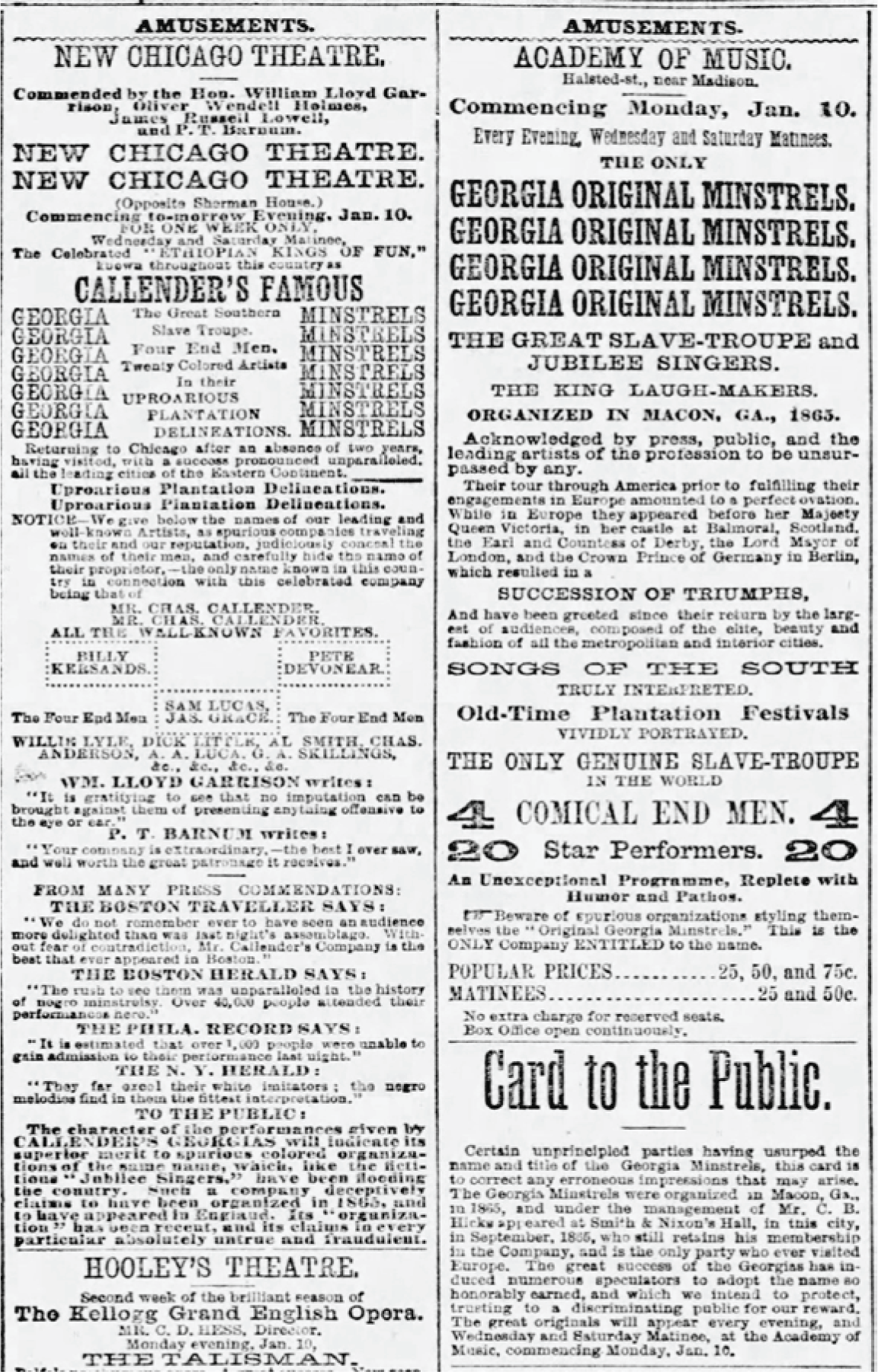
Competing advertisements for Callender’s Famous Georgia Minstrels (left) and Mara’s Georgia Original Minstrels (right top) with Hicks’s “Card to the Public” (right bottom). From the Chicago Tribune (1876:13)

The Original Georgia Minstrels, Callender’s Georgia Minstrels, and the Original Georgia Minstrels (Again)
The prevailing narrative of Hicks’s experience as a manager of his own company of Georgia Minstrels draws primarily from Tom Fletcher’s memoir, where he indicates that Hicks faced challenges both from rival white managers and from antiblack discrimination. “[S]o,” Fletcher recounts, “Hicks, who had a very good show, had very few places to play” (1954:xviii). Yet, the archive again presents a more complicated story that certainly involved significant racial discrimination and maltreatment but nevertheless included Hicks’s widely successful tours of many far-flung “places to play.”
Upon returning from Britain, Hicks toured his so-called Original Georgia Minstrels throughout the US Midwest, including stops in Reading and Pittsburgh, Pennsylvania; Cincinnati and Cleveland, Ohio; Indianapolis, Indiana; a return trip to Pittsburgh; and a concluding three-week engagement at the Brooklyn Opera House (Reading Times 1871; Pittsburgh Post 1871; Indianapolis News 1871; Cincinnati Enquirer 1871; Cleveland Leader 1871; Pittsburgh Commercial 1871; Brooklyn Union 1871). One week into their Brooklyn performances, the Brooklyn Eagle reported that the troupe had “drawn very profitable houses, and their thoroughly original performances have been deservedly applauded” (1871). Despite these successes, the company did encounter racism on the road. In one well-publicized incident, the restaurant in the hotel where they were lodging refused to serve them while whites were dining—a story that went out across the wires and was reported up and down the East Coast from Maine (Portland Daily Press 1872) to North Carolina (Asheville [North Carolina] Weekly Pioneer 1872). Moreover, the necessity of working with white agents, managers, and lessees sometimes left the troupe vulnerable to financial exploitation. In the six months after their return, the Georgia Minstrels twice had their hard-earned money embezzled—both incidents involved humiliating run-ins with local authorities and led to subsequent missed engagements elsewhere (Harrisburg [Pennsylvania] Patriot-News 1871; Waterbury [Connecticut] Daily American 1872). Perhaps in response to these incidents, Hicks spent the early months of 1872 seeking a steady, trustworthy partner. In February 1872, an ad listed Temple & Emmett as the troupe’s business managers (Buffalo Evening Post 1872).
The arrangement with Emmett & Temple proved short-lived, and in March 1872, a white impresario named Charles Callender became sole proprietor of the Georgia Minstrels (Titusville [Pennsylvania] Herald 1872). During the first several months of Callender’s ownership, little appears to have changed in the troupe or its performances. Hicks remained with the company, at times as a “business manager” and at others as an “advance agent” (New York Clipper 1872a; New York Clipper 1873:11). In early 1873, Callender began to assert more visible control. Just before their appearance at Philadelphia’s Horticultural Hall, advertisements rebranded them “Callender’s Famous Georgia Minstrels” (Philadelphia Inquirer 1873). In the fall of that year, Callender brought the Georgia Minstrels on their first tour of Southern states, including stops in Lexington, Louisville, Nashville, Memphis, Natchez, New Orleans, Columbia, Raleigh, and Richmond (Lexington Kentucky Gazette 1873; Louisville Courier-Journal 1873; Nashville Tennessean 1873; Memphis Public Ledger 1873; Natchez [Mississippi] Democrat 1873; New Orleans Times-Picayune 1873; Columbia [South Carolina] Daily Phoenix 1874; Raleigh Sentinel 1874; Richmond Dispatch 1874). While the Southern press had previously reported on the troupe’s activities and mishaps, a tour in that area was something Hicks had been unable (or perhaps unwilling) to arrange. Indeed, likely in response to the enduring antiblack discrimination of the late–Reconstruction era South, Callender dropped Hicks as the company’s advance agent for the duration of the tour, though news reports suggest Hicks remained in the troupe as a performer (New Bern [North Carolina] Republic and Courier 1874; New National Era 1874). Callender’s success in expanding the market into the South paved the way for the troupe bearing his name to become the standard for Black minstrelsy (Toll Reference Toll1974:203–05).
Yet, Callender’s successes required Hicks to accommodate himself to a lesser role in the company—a situation that Hicks evidently found difficult to abide. A few months after Callender renamed the Georgia Minstrels after himself, Hicks ran an advertisement in which he recruited “musicians, comedians and vocalists for the African Minstrels,” presumably a new company that he would lead (New York Clipper 1873:15). According to reports in the St. Louis Globe-Democrat (1873) and the Chicago Tribune (1873), the “Original African Minstrels” were organized for a transatlantic tour that would include an exhibition “at Vienna during the exposition, and then making a tour of Great Britain”—an itinerary that would have allowed Hicks to circumvent the antiblack racism of the US American theatre. However, there is no subsequent record of this troupe performing, and it seems that Hicks did not leave the Callender troupe. Nevertheless, Hicks’s advertisement sent a clear, public signal of his desire to once again lead his own troupe. A year later, Hicks realized this aspiration. In August 1874, he broke off from Callender when he announced the formation a new minstrel company, initially advertising them as “the King Laughmakers,” using one of the signature monikers he had long used for Callender’s troupe (New York Clipper 1874a; see also New York Daily Herald 1872; Buffalo Daily Dispatch 1872). Hicks reclaimed three of the Callender troupe’s biggest stars that he had initially recruited—renowned endman Billy Kersands, orator Charles Crusoe, and comedian Abe Cox—and toured his new troupe under the familiar name “The (Famous) Original Georgia Minstrels” (Green Bay Press Gazette 1874). In response, Callender posted an outraged notice to the Clipper denouncing Hicks (in a striking echo of Hague and Lee’s prior denunciation): “He was for a time under my employ until he showed his worthlessness” (New York Clipper 1874b). Hicks shot back the following week, beginning with the sly retort that he was “Worthless but can’t be bought” and announcing an extended engagement at Myers’s Opera House in Chicago (New York Clipper 1874c).
From September to December 1874, Hicks’s troupe continued touring under the banner of the “Original Georgia Minstrels” through Wisconsin, Illinois, Indiana, New York, and Ontario, often with Hicks performing with the company (Green Bay Press-Gazette 1874; Chicago Tribune 1874; Hamilton [Ontario] Spectator 1874). Despite (or because of) this company’s success, in January 1875, Hicks’s Georgia Minstrels were “reorganized” under the new management of William Mara with Hicks billed as the company’s “Interlocutor and Director” (New York Clipper 1875a).Footnote 23 By March, Mara was named proprietor and manager, but the troupe remained the “Original Georgia Minstrels” in its advertising (Atchison [Kansas] Champion 1875; Rock Island [Illinois] Argus 1875).Footnote 24
Even under Mara’s ostensible ownership, Hicks’s role in the troupe was both publicly visible and professionally vital. In January, when the troupe found itself in direct competition with Callender’s company in Chicago, the early ads took direct aim at Hicks’s former partner:
Certain unprincipled parties having usurped the name and title of the Georgia Minstrels, this card is to correct any erroneous impressions that may arise. The Georgia Minstrels were organized in Macon, Ga., in 1865, and under the management of Mr. C.B. Hicks appeared at Smith & Nixon’s Hall, in this city, in September, 1865, who still retains his membership in the Company, and is the only party who ever visited Europe. (Chicago Tribune 1876)
Subsequent advertisements over the next few months included specious claims that the troupe was “Organized by Chas B. Hicks, April 1865, in Macon, GA” and that it was a single company performing continuously together that was now on its “11th Annual Tour” (Sioux City Journal 1876). Buoyed by the puffery of these advertisements, the Original Georgia Minstrels were an extremely successful touring company. Whereas Callender’s troupe was the first company called Georgia Minstrels to tour through the South, Hicks’s troupe was the first Black minstrel company to tour the West.
On their Western tour, the company’s history becomes murky; various press sources include contradictory information about them. East coast newspapers tended to highlight the owners, managers, and performers of a troupe that were already well-known to their readers. Thus, in March 1876, the Buffalo Evening Post announced:
Chas. B. Hicks, of the Georgia Minstrels and the troupe were in the city last evening. They are on their way to Chicago, where they open a six nights engagement, commencing March 27th. They then go west to San Francisco. (1876)
The following month, several newspapers in California advertised the imminent arrival of “Mara’s Georgia Minstrels” (Oakland Tribune 1876; Sacramento Bee 1876). Yet, Western papers tended not to name Hicks and often omitted mention of Mara, preferring instead to emphasize the local impresarios responsible for booking the Georgia Minstrels to perform. Thus, for instance, the Cheyenne Democratic Leader announced the company’s performances “under the management of J.H. Haverly,” who owned the local theatre in which they performed, while refraining from any mention of the troupe’s proprietors (1876). This has led to some confusion as to the ownership of the troupe—whether the company was still Mara’s or it had changed hands. Nevertheless, one effect of the troupe’s alliance with theatre magnate J.H. Haverly (and later also with Tom Maguire) was that Hicks’s role as advance agent was rendered unnecessary, and he again faded into the background as the troupe’s “Director of Amusements.” Evidently, Hicks was again dissatisfied with this change in his role.
In December 1876, the New York Clipper ran a large advertisement announcing the “Thirteenth Annual Tour of the Original Georgia Minstrels,” listing the company under the management of Hicks and the proprietorship of Sprague & Blodgett (New York Clipper 1876b). Wash Blodgett had previously acted as the advance agent for the Original Georgia Minstrels in the Midwest, and it is possible that he and Sprague claimed control of the company on its tour (Moline [Illinois] Review 1876; Topeka State Journal 1876). It is also possible that, as with Hicks’s prior announcement of the “Original African Minstrels” in the Clipper, this company and its tour were an aspirational project rather than a done deal. Regardless, the promised tour never manifested as Hicks soon made his way to San Francisco where Haverly and local theatre impresario Tom Maguire were planning to tour the Original Georgia Minstrels to Australia. Haverly & Maguire, however, were outpaced by “a new and complete colored troupe” calling themselves the New Georgias or Corbyn’s Georgia Minstrels, who embarked on a trans-Pacific tour to Aotearoa New Zealand and Australia (New York Clipper 1876a; Egan Reference Egan2020:14–28). The proprietor of this new rival troupe of Georgia Minstrels, Sheridan Corbyn, later asserted that Haverly & Maguire’s troupe had been scheduled to leave on the same ship, but that the member had “refused to go, as C.B. Hicks, the founder of the company, had returned to the Southern States, where he organized another company, which he again called ‘The Original Georgia Minstrels’” (The Australasian 1877). Thus, while Hicks was forming his new troupe of Original Georgia Minstrels with Sprague & Blodgett, his former company members were holding out for his return. When Hicks arrived in San Francisco he quickly formed a new company with the principal Black performers from the troupe. Perhaps wary of yet again losing control of the troupe, Hicks immediately brought this iteration of Georgia Minstrels to Aotearoa New Zealand and Australia.
The Georgia Minstrels Down Under
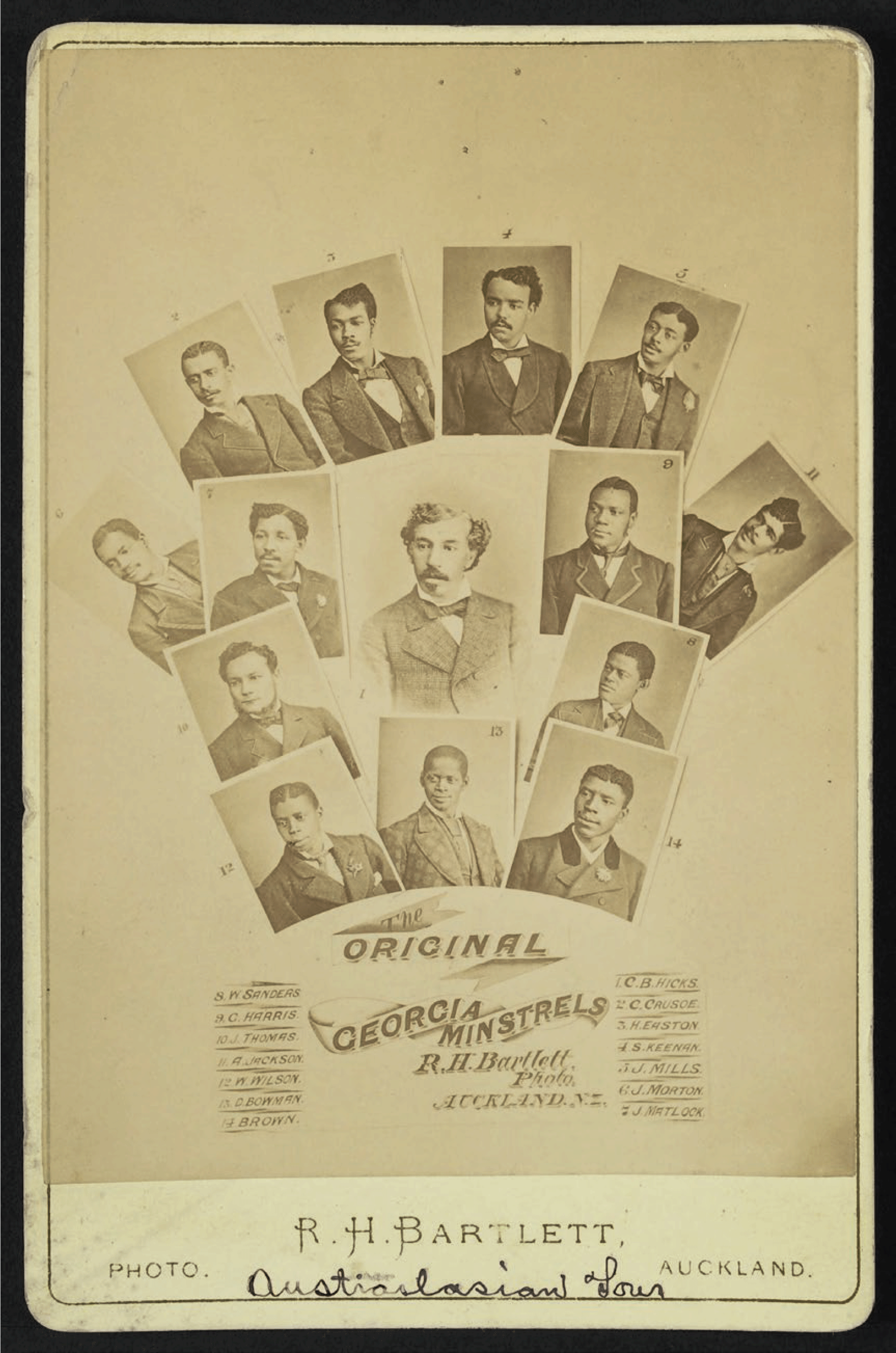
Hicks and the Georgia Minstrels arrived in Auckland on 29 April 1877, where they launched a three-month tour of colonial New Zealand (Wittmann Reference Wittmann2010:253–68). This version of the Georgia Minstrels featured many performers from previous companies assembled by Hicks, going as far back as his 1874 Georgia Minstrels troupe that he billed as the “King Laughmakers”: D.A. Bowman, Taylor Brown, Charlie Crusoe, Hosea Easton, George Harris, A.D. Jackson, Sam Keenan, J.R. Matlock, Jimmy Mills, J.W. Morton, Billy Sanders, J.G. Thomas, and Billy Wilson (Waterhouse Reference Waterhouse1990:66; Wittmann Reference Wittmann2010:249, 256; Egan Reference Egan2020:17).Footnote 25 Indeed, Hicks once again referred to this company of Georgia Minstrels as “The King Laugh-Makers” in his advertisements (Sydney Morning Herald 1878a and 1878b). The troupe was received very positively throughout Aotearoa New Zealand—including in Auckland, Canterbury, Wellington, and Dunedin—and in July 1877 they proceeded to Australia (Egan Reference Egan2020:17).Footnote 26
They toured the two British colonies for a total of three years, with most of their time spent in Australia, aside from a second three-month tour of Aotearoa New Zealand beginning in February 1879 (Wittmann Reference Wittmann2010:266). Through their wide touring, the Georgia Minstrels became a fixture of Australian popular culture, and they were wildly popular with audiences in Adelaide, Brisbane, Hobart, Melbourne, and Sydney (Waterhouse Reference Waterhouse1990:65, 69).
Carte-de-visite for The Original Georgia Minstrels from Auckland, during their Australasian tour (c. 1877). Harvard Theatre Collection MS Thr 1848. (Courtesy of Houghton Library, Harvard University)

The popularity and success of the tour proved to be its undoing. Its long duration led to a slow attrition of performers who left the company to either settle in Australia or return to the United States (Waterhouse Reference Waterhouse1990:74). In May 1880, Hicks ended the tour when he sailed to the United States, where he proudly advertised his triumphs down under and announced his intention to prepare a troupe for a European tour (New York Clipper 1878; New York Clipper 1880a). The European tour never materialized, as Hicks instead formed a series of Black minstrel companies with his former collaborators and rivals: Sprague, Haverly, and Callender (Beloit Daily Free Press 1880; New York Clipper 1880b; Chicago Tribune 1880; Delaware Gazette and State Journal 1880; Brooklyn Union 1881). Meanwhile, back in Australia, several members of the troupe later formed a series of different minstrel troupes (Egan Reference Egan2020:20–23), culminating in yet another company, the Southern Star Minstrels, “consisting of GENUINE NEGROES & EMANCIPATED SLAVES under the direction of Mr. Dave Carson,” which toured “China, the Straits Settlements [Malaysia and Singapore], Burma, and Calcutta” as well as throughout the Indian subcontinent (The [Allahabad] Pioneer 1883; Times of India 1884; Indian Daily News 1884).Footnote 27
As for Hicks, for all his successes abroad, in the United States he again found himself in the familiar situation of competing with white theatre owners on an uneven playing field. In late 1881, Hicks staged a “coup” of the Callender’s Minstrels (New York Clipper 1882b). The company was absent from a scheduled appearance in Buffalo because they were instead performing in Ontario, Canada, under the banner of “Hicks’ Georgia Minstrels” (Hamilton [Ontario] Spectator 1881). After stops across Ontario in Toronto, London, and Hamilton, the troupe traveled to the Midwest and southern US, making stops in Illinois, Kentucky, Missouri, and Tennessee (New York Clipper 1881). Early on, the tour was imperiled when a venue in Owensboro, Kentucky, burned to the ground just before they were to perform; the members escaped unharmed (and staged an impromptu performance in a different location), but they lost property and, apparently, their long-term itinerary (Owensboro Messenger 1882; New York Clipper 1882a). More ominously, Charles Callender called for reinforcements from the Frohman brothers, theatre magnates who sent a representative to intercept Hicks’s troupe in Sedalia, Missouri, where the Callender-Frohman alliance reclaimed ownership of the company—save for Hicks and his partner Charles Crusoe (New York Clipper 1882b).
Following this brief tour, Hicks spent the next several years resigned to his erstwhile role of managing one of the troupes of Callender’s Georgia Minstrels, which were now owned by the Frohmans (New York Clipper 1882c; Oakland Morning Times 1883). Yet, he never stopped trying to form a new Black-owned minstrel company. In April 1885, he united with his star Black minstrel performer and former Hicks protégé, Billy Kersands, to assemble the Kersands Minstrels (Cincinnati Enquirer 1885). The company was a major success, and Hicks hoped to bring this company to Australia (New York Clipper 1886a). However, it seems that Kersands strongly disagreed: Hicks later recalled that “there was a divergency of opinion regarding our next season and we had a bitter fight all through the season on the road” (Indianapolis Freeman 1902). After his falling out with Kersands, in 1886, Hicks united with another Black manager, A.D. Sawyer, to form the Hicks-Sawyer Minstrels (New York Clipper 1886b). This company soon split into two, with Sawyer’s branch becoming “very successful, and travel[ing] through the South a great deal” (Simond Reference Simond1974:13; Waterhouse Reference Waterhouse1990:83). Hicks toured his branch widely in the US, but he never ceased announcing plans to return to Australia (Cincinnati Enquirer 1886; Lancaster [Pennsylvania] Daily Intelligencer 1887). Eventually, in 1888, Hicks took his company of Hicks-Sawyer Minstrels on another three-year tour to Aotearoa New Zealand and Australia (Londonderry [Vermont] Sifter 1888).
Hicks’s return trip to the antipodes was as successful as the first. Upon arriving in Australia, Hicks recruited to the Hicks-Sawyer Minstrels several former members of the Georgia Minstrels who had remained in the British colony: Hosea Easton, O.T. Jackson, J.R. Matlock, and Billy Sanders. One of these former members, Hosea Easton, briefly led a splinter company that competed with the Hicks-Sawyer Minstrels (Waterhouse Reference Waterhouse1990:92). Nevertheless, as with many of his prior companies, Hicks wrested control back into his own hands while welcoming Easton back into the fold. Hicks proceeded to tour Australia and Aotearoa New Zealand until early 1891 (Waterhouse Reference Waterhouse1990:92). The tour concluded when Hicks retired from Black minstrelsy altogether to become the manager of Harmston’s Circus, a traveling enterprise that toured South Asia, Southeast Asia, and Japan (Waterhouse Reference Waterhouse1990:93).
In July 1902, Charles B. Hicks sat down somewhere in Surabaya, Java—then still a Dutch colony—to write a letter to the Indianapolis Freeman in which he addressed the misremembered history of the Georgia Minstrels. He had been out of the country since leaving with the Hicks-Sawyer Minstrels 14 years prior, and perhaps he was mindful of ensuring his legacy would endure stateside. He wrote:
From Indianapolis, in 1865, [I] started the first company of genuine Negro minstrels that had been successful in touring America—The Original Georgia Minstrels, who sailed for England in August of 1866 and there is not a member of that company today in minstrelsy. At some future date I will send you a detail of their career and its influence in making history for the African race. (Indianapolis Freeman 1902)
Hicks died a few days before the paper received and ran his letter; he never was able to send his full firsthand account of the Georgia Minstrels. Nevertheless, the influence of the Georgia Minstrels and of Hicks’s subsequent troupes of Black minstrels in making Black performance history cannot be overestimated. Whereas previous minstrel histories have asserted that “Hicks could succeed only in marginal areas that whites did not covet and control” (Toll Reference Toll1974:214–15), the careers of Hicks and the many troupes of Georgia Minstrels demonstrate the vitality of such “marginal areas” for Black performance. Whether by “stealing away” from the apparatuses of slavery to cultivate performance knowledge in Macon, Georgia, or by traveling half a world away to showcase their talents in Melbourne, Australia, Black minstrels fashioned new possibilities on the margins of 19th-century popular performance culture.