





Introduction
Single ventricle physiology refers to a form of severe CHD characterised by the presence of only one functional or anatomic ventricle, Reference Khairy, Poirier and Mercier1 which accounts for nearly 10% of all congenital heart defects. Reference Kaulitz and Hofbeck2 This heterogeneous condition arises from various embryological malformations.
Children with a single ventricle typically undergo a series of palliative surgeries to optimise systemic and pulmonary blood flow, often including a Norwood procedure and bidirectional Glenn procedure followed by a Fontan procedure. Reference Van den Eynde, Bartelse and Rijnberg3 Despite advances in care for single ventricle patients, these patients continue to face significant challenges, including difficulty achieving adequate nutritional status. Reference Van den Eynde, Bartelse and Rijnberg3–Reference Vogt, Manlhiot and Van Arsdell7
Nutritional status can be quantified using the weight-for-length z-score, which is a measure of a patient’s weight and length compared to the average child’s of the same age. Undernutrition, specifically wasting, can be defined as a weight-for-length z-score below −1 or a drop in major age-indexed z-scores. Reference Anderson, Beekman and Eghtesady4,Reference Ezzat, Albassam, Aldajani, Alaskar and Devol8–10
Nutritional outcomes in single ventricle physiology are thought to be impacted by factors such as surgical interventions, prolonged hospital courses, lengthy sedations, surgical complications, abnormal haemodynamics, hypoxaemia, frequent respiratory infections, hypermetabolic needs, and oral-motor feeding difficulties. Reference Van den Eynde, Bartelse and Rijnberg3,Reference Luo, Xu and Zhang5,Reference Shine, Foyle, Gentles, Ward and McMahon6,Reference Davis, Davis and Cotman11
Undernourished patients have poorer surgical recovery, neurodevelopmental outcomes, Reference Medoff-Cooper and Ravishankar12–Reference Laraja, Sadhwani and Tworetzky14 and heightened risk of social, emotional, and attention impairments. Reference Dykman, Casey, Ackerman and McPherson15 Micronutrient deficiencies in undernourished patients contribute to immune dysfunction, increasing rates of postoperative infections and delayed wound healing. Reference Corman16 Malnourished infants with a single ventricle also face longer hospitalisations compared to well-nourished peers, independent of haemodynamic or echocardiographic indices. Reference Anderson, Beekman and Border17
Despite wide recognition of undernutrition among this population, there is limited research examining the factors that impact these patients’ growth. Most existing literature focuses on nutritional status at the time of the Glenn procedure Reference Anderson, Beekman and Eghtesady4,Reference Luo, Xu and Zhang5,Reference Kelleher, Laussen, Teixeira-Pinto and Duggan18 or earlier, Reference Shine, Foyle, Gentles, Ward and McMahon6 leaving a gap in understanding how longer-term variables, such as surgical timing and other perioperative factors, impact growth outcomes.
This study was designed to identify factors associated with undernutrition at 12 months of age in infants with single ventricle physiology. By analysing an extended period of nutritional and clinical data, this research aims to clarify the variables that predict poor nutritional outcomes and provide insights to guide earlier interventions for those at greatest risk of undernutrition. Understanding the way in which these factors affect nutritional outcomes is critical to improve long-term outcomes for this vulnerable population.
Materials and methods
Participants
This was a retrospective case series of all patients with single ventricle physiology treated at the University of Minnesota Medical Center between 2003 and 2023. The study was approved by the Institutional Review Boards at the University of Minnesota and at Eastern Virginia Medical School. Patients were identified using the UMN Single Ventricle database. A waiver of individual patient consent was approved, and patients who declined to participate in research were excluded. Exclusion criteria included unavailable nutritional data between nine months and 15 months, chromosomal anomalies, patients who received heart transplants prior to one year, and those deceased before one year of age.
Measurements
Anthropometric measurements, including weight-for-age, length-for-age, and weight-for-length z-scores, were recorded closest to one year of age using World Health Organization growth charts. Undernutrition categories reflected World Health Organization child growth standards, with weight-for-length z-scores of −1 to −2 designating mild undernutrition, −2 to −3 designating moderate undernutrition, and less than −3 designating severe undernutrition. Reference Ezzat, Albassam, Aldajani, Alaskar and Devol8–Reference Becker, Carney and Corkins9 A decrease of two major age-indexed z-scores was classified as moderate undernutrition, and a decrease of three z-scores was classified as severe undernutrition. Reference Ezzat, Albassam, Aldajani, Alaskar and Devol8–Reference Becker, Carney and Corkins9 The primary outcome measure was undernutrition.
Variables investigated included surgical interventions, surgical complications, hospital course, cardiorespiratory factors, and nutritional interventions. Demographic information, including gender and self-identified race, was also collected.
Data analysis
Participant demographic and clinical characteristics were summarised using mean with standard deviation for continuous variables and count (%) for categorical variables, overall and by nutrition status. Fisher’s exact tests for categorical variables and t-test for continuous variables were used to identify variables associated with nutrition status. All p-values were two-sided, and statistical significance was considered at the level of 0.05. Analyses were conducted in R (R Core Team (2024)), version 4.4.1.
Results
During the study period, 83 patients underwent single ventricle palliation. Of these, 27 were excluded. Twenty-five patients were excluded based on previously described exclusion criteria, including two patients who underwent orthotopic heart transplant prior to one year. As a result, there were 56 total patients included in the analysis (see Figure 1).
Study inclusion flowchart with undernutrition (specifically wasting) prevalence amongst our study population using World Health Organization (WHO) weight-for-length z-score (WLZ).

Anthropometric data
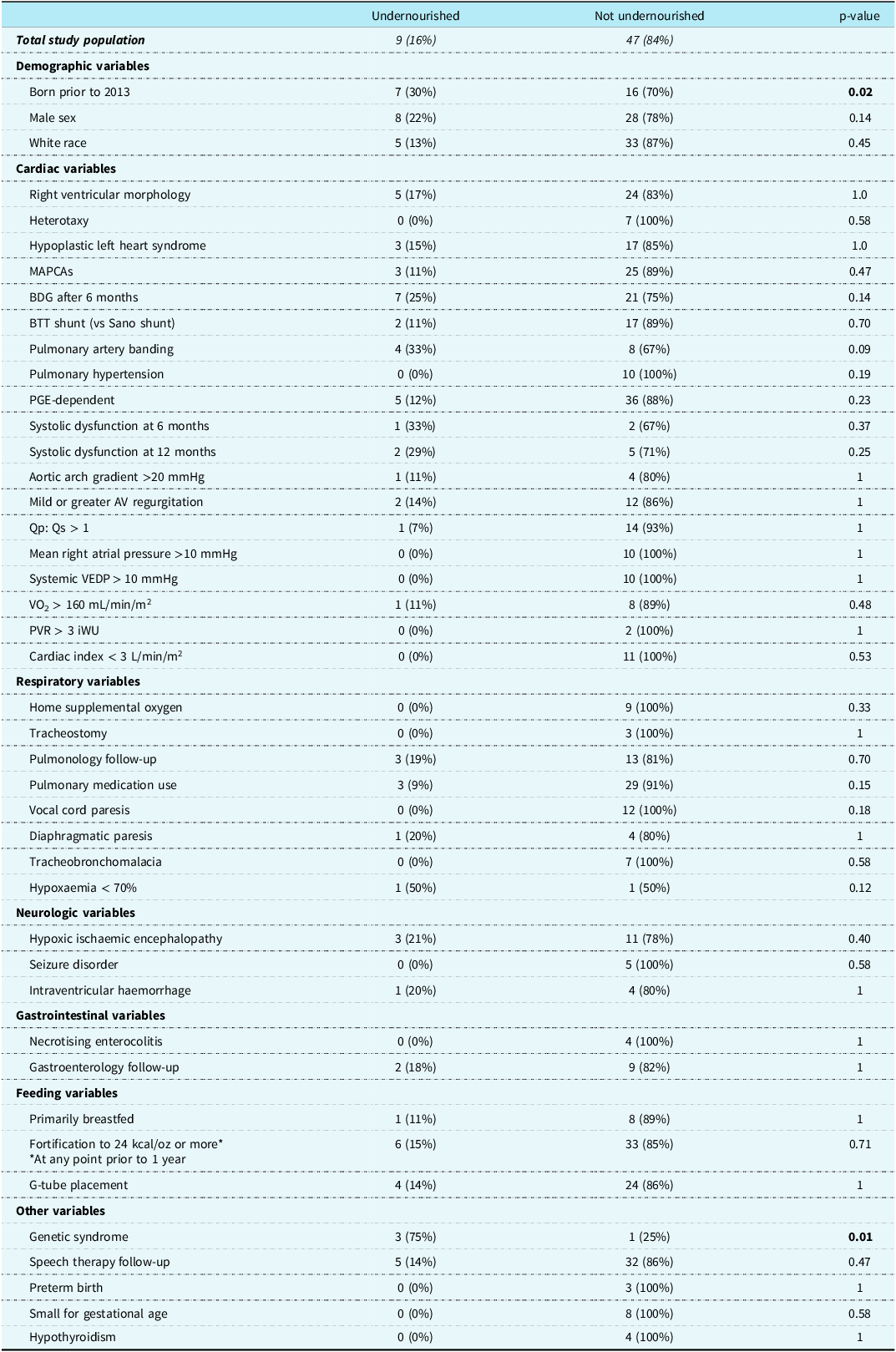
Nine patients (9/56, 16%) met World Health Organization criteria for undernutrition. Six had mild undernutrition, three had moderate undernutrition, and none had severe undernutrition. Sex at birth and identified race were not associated with undernutrition. A greater proportion of patients identified as undernourished were born prior to 2013 (7/9, 78%), compared to those born after 2013 or in the second half of our study period (2/9, 22%, p = 0.02). Further patient characteristics are demonstrated in Table 1.
Characteristics of study subjects

DORV = double outlet right ventricle, LV = left ventricle, AV = atrioventricular, TGA = transposition of the great arteries, BTT = Blalock-Taussig-Thomas, PDA = patent ductus arteriosus, PA = pulmonary artery, BDG = bidirectional Glenn.
Hospital courses and surgical management
Three infants (5%) were born preterm, and eight (15%) were born small for gestational age. Duration of initial hospitalisation ranged from two days (in four patients without prenatal diagnosis) to 417 days. There was a median two-day duration of mechanical ventilation during initial hospitalisation, with a range of 0 to 417 days. Median readmission rate within the first year was four. Neither the duration of initial hospitalisation nor the hospital readmission rate was associated with nutrition status (see Table 2).
Fisher’s exact analysis with undernourishment status as dependent variable

MAPCAs = major aortopulmonary collateral arteries, BDG = bidirectional Glenn, BTT = Blalock-Taussig-Thomas, PGE = prostaglandin E, AV = atrioventricular, Qp: Qs = ratio of pulmonary blood flow (Qp) to systemic blood flow (Qs), VEDP = ventricular end-diastolic pressure, VO2 = volume of oxygen (a marker of oxygen consumption), PVR = pulmonary vascular resistance.
Initial surgical intervention varied widely (see Table 1), with 24 patients (43%) undergoing the Norwood procedure. Twelve patients had pulmonary artery banding, 33% of whom were undernourished. This is compared to 11% of patients who did not have pulmonary artery banding (p = 0.09). Eight patients had a bidirectional Glenn procedure as their first stage of palliation.
Bidirectional Glenn was completed at a median age of 7 months (range 3–28 months). Of those who underwent bidirectional Glenn after 6 months, 25% (7 of 28) were undernourished at one year, versus 7.4% (2 of 27) of those with bidirectional Glenn prior to 6 months (p = 0.14). At one year of age, 45 patients (80%) had undergone bidirectional Glenn, with one patient status-post Kawashima procedure. Completion of bidirectional Glenn or Kawashima prior to one year was not significantly associated with nutrition status.
Surgical complications in the first year included vocal cord paresis (n = 12), diaphragmatic paralysis (n = 5), and chylothorax (n = 7). None of these variables were associated with undernutrition.
Nutritional support
Infants’ nutritional source included strictly formula (48%), strictly breast milk (16%), and a combination of breast milk and formula (36%). The source of nutrition was not related to nutrition status. Gastrostomy tube placement occurred prior to one year in 28 infants (50%). Neither fortification above 20 kcal/oz (p = 0.71) nor gastrostomy tube placement (p = 1.0) was associated with nutrition.
Cardiac variables
Twenty-nine patients (52%) had systemic right ventricular morphology, and 27 patients (48%) had left ventricular morphology. A comprehensive list of cardiac diagnoses can be seen in Table 1, but the most common included hypoplastic left heart syndrome (n = 20, 36%), tricuspid atresia (n = 9, 16%), and double inlet left ventricle (n = 9, 16%). Neither ventricular morphology nor cardiac diagnosis was associated with nutritional status.
Echocardiographic variables included depressed systemic ventricular systolic function on echocardiogram closest to 6 months (n = 3) and 12 months (n = 6), aortic arch gradient >20 mmHg (n = 5), and presence of atrioventricular valve regurgitation (n = 14). There was no statistically significant association between these variables and nutrition status.
Haemodynamic variables were measured during cardiac catheterisation. Thirty-two infants (57%) had cardiac catheterisations documented within the first year, the majority of which were pre-Glenn catheterisations. These haemodynamic variables can be visualised in Figure 2. Pulmonary hypertension, defined by transpulmonary gradient ≥6 mmHg during cardiac catheterisation, Reference Jone, Ivy and Hauck19 was identified in 10 infants (18%) prior to one year.
Respiratory variables
Nine infants (16%) required home supplemental oxygen: five via low-flow nasal cannula, three via tracheostomy, and one via continuous positive airway pressure. None of these infants were undernourished at one year (p = 0.33). There was no association between nutrition status and systemic hypoxaemia (oxygen saturation < 70%) during cardiac catheterisation (n = 2, p = 0.12).
Sixteen infants had regular pulmonology follow-up, and 32 received pulmonary medication during the first year of life. The most commonly used medications were inhaled short-acting beta-2 agonists, followed by inhaled corticosteroids and pulmonary vasodilators.
Pulmonology follow-up slightly declined over time: 35% of infants born prior to 2013 had outpatient visits, compared to 24% of those born in 2013 or later (p = 0.39). Nutritional status was not significantly associated with pulmonology follow-up (p = 0.71).
Among those who used pulmonary medications, 9.4% were undernourished, versus 25% among those who did not (p = 0.15). There were no significant associations between undernutrition and use of bronchodilators (p = 0.41) or pulmonary vasodilators alone (p = 0.37).
Discussion
The rate of mild undernutrition in our study population was 16% (weight-for-length z-score ≤ −1), while the rate of moderate to severe undernutrition was 5% (weight-for-length z-score ≤ −2). These rates are substantially lower than previously reported values (18–24%) for moderate to severe undernutrition amongst a similar patient population, though with different timing of surgical intervention. Reference Luo, Xu and Zhang5,Reference Laraja, Sadhwani and Tworetzky14 Below average weight-for-length z-score (defined as a negative z-score) was present in 50% of patients, which is by definition consistent with the average global rates based on World Health Organization data. Our study also demonstrated that there has been an improvement in nutrition status for infants with single ventricles over the past 10 years at our institution (p = 0.02). This progress may be attributed to various factors, such as global improvements in single ventricle patient care, advances in surgical techniques, enhanced nutritional monitoring, and refinements in multisystemic support strategies.
Demographic factors were not associated with nutrition among our sample population. Prior studies have demonstrated impaired growth for “non-Caucasian” patients at the time of bidirectional Glenn. Reference Anderson, Beekman and Eghtesady4 While our study did not demonstrate similar associations, race as a social construct can have profound impacts on morbidity and mortality in CHD. Reference Duong, Elfituri and Zaniletti20 The impact of race and socioeconomic status requires ongoing investigation to address persistent disparities, particularly as methods for collecting race data evolve.
Nutritional interventions
The benefits of nutritional interventions for patients with CHD have long been recognised. Previous studies on patients with single ventricle physiology have shown that fortification Reference Luo, Xu and Zhang5,Reference Vogt, Manlhiot and Van Arsdell7,Reference Pillo-Blocka, Adatia, Sharieff, McCrindle and Zlotkin22 and enteric tube use Reference Anderson, Beekman and Eghtesady4 are associated with better nutritional outcomes. Other studies Reference Medoff-Cooper and Ravishankar12,Reference Kelleher, Laussen, Teixeira-Pinto and Duggan18 align more closely with our findings, which did not reveal similar associations. This discrepancy may reflect early and appropriate nutritional interventions, such as fortification for infants, during our study period. Breastfeeding is thought to protect against malnutrition, Reference Anderson, Beekman and Eghtesady4 partly because the composition of breast milk aligns with the caloric needs of infants according to their gestational age. About 52% of the cohort received regular breast milk, and no such association was demonstrated.
Cardiac variables
Although the cardiac variables examined did not significantly impact nutritional status, several noteworthy associations were observed. It is widely recognised that catch-up weight gain occurs most notably after bidirectional Glenn. Reference Vogt, Manlhiot and Van Arsdell7,Reference Laraja, Sadhwani and Tworetzky14,Reference Hehir, Cooper, Walters and Ghanayem21 Early surgical intervention is thought to provide benefits through early elimination of volume overload and cyanosis. Reference Luo, Xu and Zhang5 Although not statistically significant, a higher percentage of infants who underwent bidirectional Glenn after 6 months were undernourished compared to those who underwent the procedure earlier. This likely reflects improved catch-up growth following Glenn, potentially due to a decreased metabolic rate resulting from the ventricular offloading that the Glenn procedure provides. Improved oxygenation may also play a role.
Although right ventricular morphology was not significantly associated with nutritional status, a greater proportion of these patients had negative weight-for-length z-scores compared to those with left ventricular morphology (62 vs 37%). Prior studies have demonstrated that those with morphologic right ventricles are more prone to ventricular dysfunction, Reference Graham23–Reference Sano, Ogawa and Taniguchi24 which may have long-term impacts on systemic perfusion and, consequently, growth. In our cohort, right ventricular morphology was significantly associated with depressed systolic function; all six infants with depressed function had a primary right ventricle (p = 0.02), suggesting this may be a contributing mechanism.
Respiratory variables
Arguably, the most notable findings of this study involved respiratory variables. Infants who regularly received pulmonary medications in the first year had lower rates of undernutrition (9.4 vs 25%). This may reflect benefits from improved ventilation, pulmonary clearance, and regular pulmonary surveillance. Prior studies have documented detrimental effects of elevated mean pulmonary arterial pressures on nutrition, Reference Anderson, Beekman and Eghtesady4 suggesting pulmonary vasodilator use may be nutritionally beneficial, though no significant association was observed in our cohort.
While outpatient pulmonology follow-up was not associated with nutritional outcomes, it is difficult to interpret the true impact of pulmonology involvement due to the limited availability of these services at our institution during parts of the study period.
Supplemental oxygen use also appeared to be related to nutritional outcomes. Of the nine patients who used at-home supplemental oxygen, none were undernourished, and only one patient had a negative weight-for-length z-score. We defined supplemental oxygen as the use of an interface that provides oxygen at a fraction of inspired oxygen greater than 21%. While the modalities of respiratory support offer multiple potential physiological benefits, there is conflicting evidence regarding the nutritional impacts of increased systemic oxygenation.
Some studies Reference Van den Eynde, Bartelse and Rijnberg3,Reference Anderson, Beekman and Eghtesady4,Reference Kelleher, Laussen, Teixeira-Pinto and Duggan18 have demonstrated worsened nutritional outcomes with higher systemic oxygenation, thought to be related to detrimental impacts of pulmonary overcirculation, increased ventricular volume load, and decreased splanchnic perfusion. Reference Rao25 Contrasting studies Reference Luo, Xu and Zhang5–Reference Vogt, Manlhiot and Van Arsdell7,Reference Hehir, Cooper, Walters and Ghanayem21,Reference Leitch, Karn and Peppard26 have suggested that chronic hypoxaemia, typically below an oxygen saturation of 75%, is associated with poorer nutritional outcomes.
These conflicting findings highlight the complex physiological adaptations in patients with a single ventricle living with chronic hypoxaemia. While these patients’ hypoxemic respiratory drive is typically depressed, Reference Liang, Bascom and Robbins27–Reference Mouradian, Lakshminrusimha and Konduri28 chronic hypoxaemia also increases peripheral chemoreceptor sensitivity to hypercapnia, which can increase ventilatory drive and metabolic demand. Reference Cherniack, Edelman and Lahiri29 Molecular adaptations, including alteration in adenosine triphosphate (ATP) utilisation and hypoxia-inducible factor (HIF-1) activation, lead to a relative catabolic state with decreased lipid storage and protein synthesis. Reference Fontaine and Leverve30–Reference Raguso and Luthy31 Additionally, chronic hypoxaemia can delay bone age Reference Witzel, Sreeram, Coburger, Schickendantz, Brockmeier and Schoenau32–Reference Danilowicz33 and have disproportionate effects on linear growth. Reference Van den Eynde, Bartelse and Rijnberg3 This increases the risk of stunting but may actually increase weight-for-length z-score.
While physiologic patterns have been broadly identified, the long-term nutritional effects of chronic hypoxaemia remain poorly understood in paediatric populations. Studies involving cohorts of adults with chronic obstructive pulmonary disease have shown that chronic hypoxaemia negatively affects nutrition, Reference Raguso and Luthy31,Reference Westerterp34 with evidence also supporting the nutritional benefits of non-invasive positive pressure ventilation in this group. Reference Budweiser, Heinemann, Meyer, Wild and Pfeifer35 In children with cerebral palsy, tracheostomy use has been associated with mixed nutritional outcomes. Reference Henningfeld, Lang, Erato, Silverman and Goday36–Reference Wong, Derry and Jamous37 However, to our knowledge, no studies have specifically examined the impact of hypoxaemia or respiratory support on nutrition in patients with single ventricle physiology.
Outside of oxygenation, potential benefits of respiratory support also include improved ventilation, leading to decreased energy expenditure from work of breathing. Reference Boles, Bion and Connors38 This could explain some of the nutritional benefits demonstrated in this study. We did not, however, find a relation between oxygen consumption (VO2), a metric for energy expenditure, and nutrition status in our study.
While our study did not find a significant association between hypoxaemia and nutritional status, this may be attributable to limited statistical power due to sparse haemodynamic data among undernourished patients. This limits conclusions that can be made regarding the effects of supplemental oxygen amongst our cohort. Nonetheless, the observed trends, particularly the potential nutritional benefit of supplemental oxygen, underscore the need for larger, prospective studies to better characterise the complex interplay between respiratory support, systemic oxygenation, and growth in patients with single ventricle physiology.
Study limitations
The retrospective design of the study limits conclusions about causation between identified variables and undernutrition. As this was a single-centre study, the findings may not be generalisable to other institutions due to variations in patient cohorts and management strategies. While there were clinically significant associations observed in this study, the relatively small cohort, particularly within the subgroups of moderate and severe undernutrition, could have limited statistical power.
Excluding patients with unavailable nutritional data or those deceased before one year of age, which accounted for 33% of the target population, may have introduced selection bias, potentially underrepresenting the most vulnerable patients in this cohort. In addition, the database used to identify single ventricle patients included patients who were followed longitudinally after surgical palliation. As the mortality rate amongst single ventricle patients is very high in the neonatal period, some of these patients were likely not captured in our data, which contributes to survivorship bias in this study. Anthropometric measurements were restricted to a single time point around one year of age, limiting the ability to assess longitudinal growth patterns and the impact of interventions over time. The collection of race and gender data does not account for other social determinants of health, such as socioeconomic status, parental education, or access to healthcare, which may significantly influence nutritional outcomes.
Finally, the study spanned two decades (2003–2023), during which advancements in surgical techniques, nutritional practices, and postoperative care may have influenced outcomes, introducing temporal variability into the results. These limitations should be considered when interpreting the findings, as they may affect the study’s applicability to broader populations and its ability to inform clinical practice.
Conclusion
This study investigated associations and potential protective factors against undernutrition in infants with single ventricles. Undernutrition rates significantly declined during the study period. Although no statistically significant associations were found, respiratory support, especially the use of supplemental oxygen, was associated with adequate nutritional status. This highlights the complex interplay between cardiorespiratory function and growth. Our conclusions are limited by small sample sizes, reinforcing the need for larger studies to further explore how respiratory interventions might impact nutrition in this population.
Acknowledgements
First, the authors acknowledge the many patients who generously allowed their health information to be used in this research study. The authors would also like to thank the University of Minnesota and Eastern Virginia Medical School for their support of this research.
Financial support
This research was supported by the National Institutes of Health’s National Center for Advancing Translational Sciences, grant UM1TR004405. The content is solely the responsibility of the authors and does not necessarily represent the official views of the National Institutes of Health’s National Center for Advancing Translational Sciences.
Competing interests
There are no relevant conflicts of interest amongst the study authors.



 Open access

