


The future of work has been a focus of inquiry in the organizational sciences for decades, accelerating greatly over the past 10 years due to technological advances influencing every aspect of work (Cascio & Montealegre, Reference Cascio and Montealegre2016). Even in the earliest imaginings of the workplace of the future—before smartphones and the internet—scholars worried about technological advances that would render the roles and contributions of individual workers obsolete (Leach & Chakiris, Reference Leach and Chakiris1985). Today, there is arguably less concern about the availability of work in general and more concern about the types of jobs and the nature of work in the future, and who will have the skills necessary to access those jobs (Autor, Reference Autor2019).
Estimates of the types of jobs available into 2030 suggest that over 85% of the workforce will need to change jobs during the period between 2021 and 2030, and even those who do not change jobs will experience shifts in the types of tasks routinely engaged in at work (Lund et al., Reference Lund, Madgavkar, Manyika, Smit, Ellingrud, Meaney and Robinson2021). The way organizations accomplish their objectives is also rapidly changing. For example, technology and automation allow organizations to operate with fewer employees, utilize more dispersed and remote workforces, and use part-time and temporary labor. Therefore, workers may have less frequent and more informal relations with one another, less support from supervisors and colleagues, a greater necessity to collaborate on work processes, and a need to learn how to share knowledge with other workers, some of whom they may have never met or seen. This physical separation from work will also separate people from opportunities for learning and development, whether through informal/organic (e.g., learning on the job by observing others) or more formal (e.g., company-sponsored training courses) opportunities.
Research on training and development has traditionally focused on maintaining or increasing organizational effectiveness via improving trainee performance through skill learning, transfer, and return on investment (Aguinis & Kraiger, Reference Aguinis and Kraiger2009). Although industrial-organizational (I-O) psychology research has focused on individual characteristics and the environments that facilitate or impede learning in organizations (Alliger et al., Reference Alliger, Tannenbaum, Bennett and Traver1997; Arthur et al., Reference Arthur, Bennett, Edens and Bell2003; Cerasoli et al., Reference Cerasoli, Alliger, Donsbach, Mathieu, Tannenbaum and Orvis2018; Wolfson et al., Reference Wolfson, Tannenbaum, Mathieu and Maynard2018), the motivation for this research is often to improve organizations rather than serving individual learners. Recent research acknowledges the importance of employee-driven development (e.g., see Dachner et al., Reference Dachner, Ellingson, Noe and Saxton2021; Noe et al., Reference Noe, Clarke and Klein2014), but this work also focuses on developing human capital to enhance the success of organizations. In other words, I-O research and practice in training and development has generally sought to increase the capacity of organizations, not individuals.
The case for a new approach to learning
The future of work will favor workers who can adapt and acquire the skills and knowledge they need to remain competitive (Lund et al., Reference Lund, Madgavkar, Manyika, Smit, Ellingrud, Meaney and Robinson2021; World Economic Forum, 2018). Given the extent of these changes and their impact on individuals and organizations, our central argument in this focal article is that organization-centric approaches for learning and development are no longer sufficient. Rather, continuous lifelong learning is central to the future of work, and integrating a person-centered perspective into existing organization-centered approaches is necessary for I-O researchers and practitioners to remain relevant to conversations about workplace learning. A person-centered perspective on workplace learning focuses broadly on individuals in the labor force—whether self-employed, affiliated with an organization, or looking for work—and their opportunities, motivation, and ability to engage in continuous learning to remain productive, employed, and employable. This broader perspective explicitly includes training, learning, skill creation, and skill acquisition that occurs within and outside of the organizational context and thus opens up avenues of future research and practice. We discuss and offer recommendations to address this question: “What needs to change in workplace learning, and what new approaches are needed to prepare individuals for work in the 21st century?” I-O researchers and practitioners are well-positioned to understand and inform workers and organizations about avenues for continuous lifelong learning in the future of work. We envision a role for I-O psychology beyond helping organizations become more successful through these efforts.
In a stable world, with stable jobs, and long, single-organization careers, an organization can afford to focus on refining, revising, and customizing training and development programs that could be applied to waves of new employees. However, with the dynamic future workplace and the increasing prevalence of disruptions described above, designing organization-centric learning systems to meet the needs of a stable workplace may no longer be sufficient. Rather, organizations increasingly need workers who can rapidly develop skills for shifting roles. Workers who cannot do so will lose out on important opportunities for career advancement. The broader implication here is that, for better or for worse, the responsibility for acquiring workplace skills will increasingly shift to, or be shared by, workers themselves.
Below, we describe the landscape of the future of work and the factors influencing it. We add a person-centered perspective to highlight the importance of continuous learning for workers throughout their work lives. Although organizations play an essential role in fostering continuous learning, a “person-centered” approach emphasizes the important role and responsibility that individuals will play in how training and development will unfold in the future of work. Along the way, we discuss how broadening considerations of workplace learning to include a person-centered perspective impacts research and practice in I-O. We conclude by calling for collaborations between scientists and practitioners to study continuous learning in real-world settings. We begin by clarifying some key constructs and definitions to frame our arguments.
Defining key terms
Learning is “the engagement in mental processes resulting in the acquisition and retention of knowledge, skills, and/or affect over time and applied when needed” (Kraiger & Ford, Reference Kraiger and Ford2021, p. 45). Ideally, learning results in relatively long-term or permanent changes. Learning can be intentional or incidental, as a byproduct of everyday life. For the present effort, we focus on intentional learning (learning resulting from experiences that require volitional, conscious engagement in activities with goals to acquire and retain knowledge, skills, and/or affect; Tannenbaum & Wolfson, Reference Tannenbaum and Wolfson2022). Furthermore, we focus on work-related learning, regardless of whether it takes place within an organization (e.g., as part of enrolling in a job-specific training and development program) or outside of an organization (e.g., enrolling in a massive open online course, MOOC) to acquire needed skills when one is unemployed or underemployed (i.e., when one’s skills and abilities exceed those required by the job; Erdogan & Bauer, Reference Erdogan and Bauer2021). Work-related learning includes short-term opportunities, from looking up an online video to acquire a new skill to participating in a year-long leadership development or mentoring program. It also includes learning opportunities—such as educational programs offering degrees and certificates—representing a longer term investment in development.
Training is a systematic approach to acquiring or modifying knowledge, skills, and/or attitudes to improve individual, team, and organizational effectiveness (Kraiger & Ford, Reference Kraiger and Ford2021). Development refers to formal training and less systematic activities such as college coursework, job experience, and mentoring that prepare employees for future roles in their organization (Dachner et al., Reference Dachner, Ellingson, Noe and Saxton2021; Noe et al., Reference Noe, Clarke and Klein2014). Within organizations, the terms training and development are often used interchangeably. However, training tends to refer to an organizationally sponsored activity, and the term development is often used to refer to individual experiences (Brown & Sitzmann, Reference Brown, Sitzmann and Zedeck2011).
The knowledge, skills, and abilities needed for current and future jobs are identified through a needs assessment and systematic training design (Ford, Reference Ford2021). These systematic approaches tend to result in the creation of formal training experiences; that is, experiences that include written learning goals/objectives and structured activities in terms of content presentation and time allotted (Tannenbaum & Wolfson, Reference Tannenbaum and Wolfson2022). By contrast, the term informal learning has been used to describe less structured experiences that are either other directed (i.e., mandated by the organization), such as job shadowing, or self-directed, such as pursuing a “stretch” assignment to gain skills.Footnote 1
Informal field-based learning (IFBL) describes “engaging in intentional, self-directed behavior aimed at learning new, work-oriented, and organizationally valued content outside of a formal learning program” (Wolfson et al., Reference Wolfson, Tannenbaum, Mathieu and Maynard2018, p. 16). IFBL aligns with the concept of development described earlier as an individual activity and is narrower than informal learning in that it includes only learning behaviors executed within an organizational context (Wolfson et al., Reference Wolfson, Tannenbaum, Mathieu and Maynard2018). Here, we consider self-directed learning of work-related knowledge and skills regardless of where that learning occurs. As such, we use the term work-related self-directed learning to describe self-directed development that occurs both within and outside organizations but is geared towards acquiring knowledge or skills relevant to work.
Work-related self-directed learning requires greater self-regulation than engaging in other-directed learning experiences such as training or job shadowing, given that self-directed learning requires learners to decide for themselves what is important to learn, when and how to engage in the learning activity, and when they’ve learned enough to disengage (Tannenbaum & Wolfson, Reference Tannenbaum and Wolfson2022). Work-related self-directed learning that takes place outside of an organization also requires a learner to assess the skills that would lead to the most job or work opportunities and whether they have the abilities and motivation to acquire these skills. In other words, work-related self-directed learning puts the onus of needs assessment (e.g., What skills are marketable? Do I have those skills? How can I acquire them?) and metacognitive monitoring (e.g., Did I learn enough?) squarely on the learner (Cronin-Golomb & Bauer, Reference Cronin-Golomb and Bauer2023). Note, however, that the extent to which people can accurately self-assess their own skills, abilities, and learning is an open question with mixed empirical evidence about their ability to do so (Ackerman et al., Reference Ackerman, Beier and Bowen2002; Kruger & Dunning, Reference Kruger and Dunning1999; Zell & Krizan, Reference Zell and Krizan2014; Zell et al., Reference Zell, Strickhouser, Sedikides and Alicke2020), a point we return to below. The importance of individual self-assessment of training needs and their (in)accuracy in doing so represents an opportunity to combine organization-centric and person-centric approaches to continuous lifelong learning. That is, organizations can likely improve the self-diagnosis of training needs in their employees.
Recently, the terms upskilling (i.e., engaging in training and developmental activities to remain competitive within one’s current profession) and reskilling (i.e., engaging in training and developmental activities to be qualified for a new role) have emerged to describe participating in development activities in applied contexts (ATD Research & DeVry Works, 2018). These terms cut across the training and development processes described above (formal, informal, other directed, and self-directed) but are specific about acquiring new skills that are, or will be, necessary to maintain one’s current role or qualify for a new one. Upskilling and reskilling can take place within a formal educational environment, organizationally sponsored training, or work-related, self-directed development activity. That said, because upskilling is related to gaining new skills to remain productive in one’s same job role, it seems most aligned with traditional training activity, whereas gaining skills/knowledge for a completely new job role (i.e., reskilling) would most likely be initiated by the learners and thus would be most aligned with development and work-related, self-directed learning.
Although the concepts discussed herein are relevant to all the constructs described above (e.g., training, development, informal, IFBL, reskilling, and upskilling), we pay particular attention to work-related self-directed learning because it is most aligned with a person-centered focus on workplace learning. We contend that people have to, and will increasingly need to, focus on their own skill development and engage in self-directed lifelong learning to remain employable in the future of work. Interestingly, such self-directed lifelong learning and skill transfer is historically how millions of workers worldwide have sustained themselves through generations in creative occupations (for instance, artisans such as potters and weavers) in informal economies (Saxena, Reference Saxena2017, Reference Saxena2021). The informal economy refers to work, employment, or economic activity that is at least in part outside of government taxation, regulation, and awareness but is controlled by norms or personal relationships (Godfrey, Reference Godfrey2011).
Unfortunately, with few exceptions (e.g., Dachner et al., Reference Dachner, Ellingson, Noe and Saxton2021; Noe et al., Reference Noe, Clarke and Klein2014), I-O psychology has primarily ignored work-related self-directed learning, particularly when it occurs outside of an organization, partly because of the complexities in studying learning in real-world environments. However, studying workplace skill learning exclusively in organizations is akin to looking for one’s lost keys under the streetlight because that is where the light is, even though the keys were lost in the park (O’Toole, Reference O’Toole2013). It may be easier to study learning in organizations, but neglecting other learning misses a key opportunity to identify opportunities and specific approaches for adult learning and worker skill development in the workplace of the future.
The future of work with implications for workplace learning
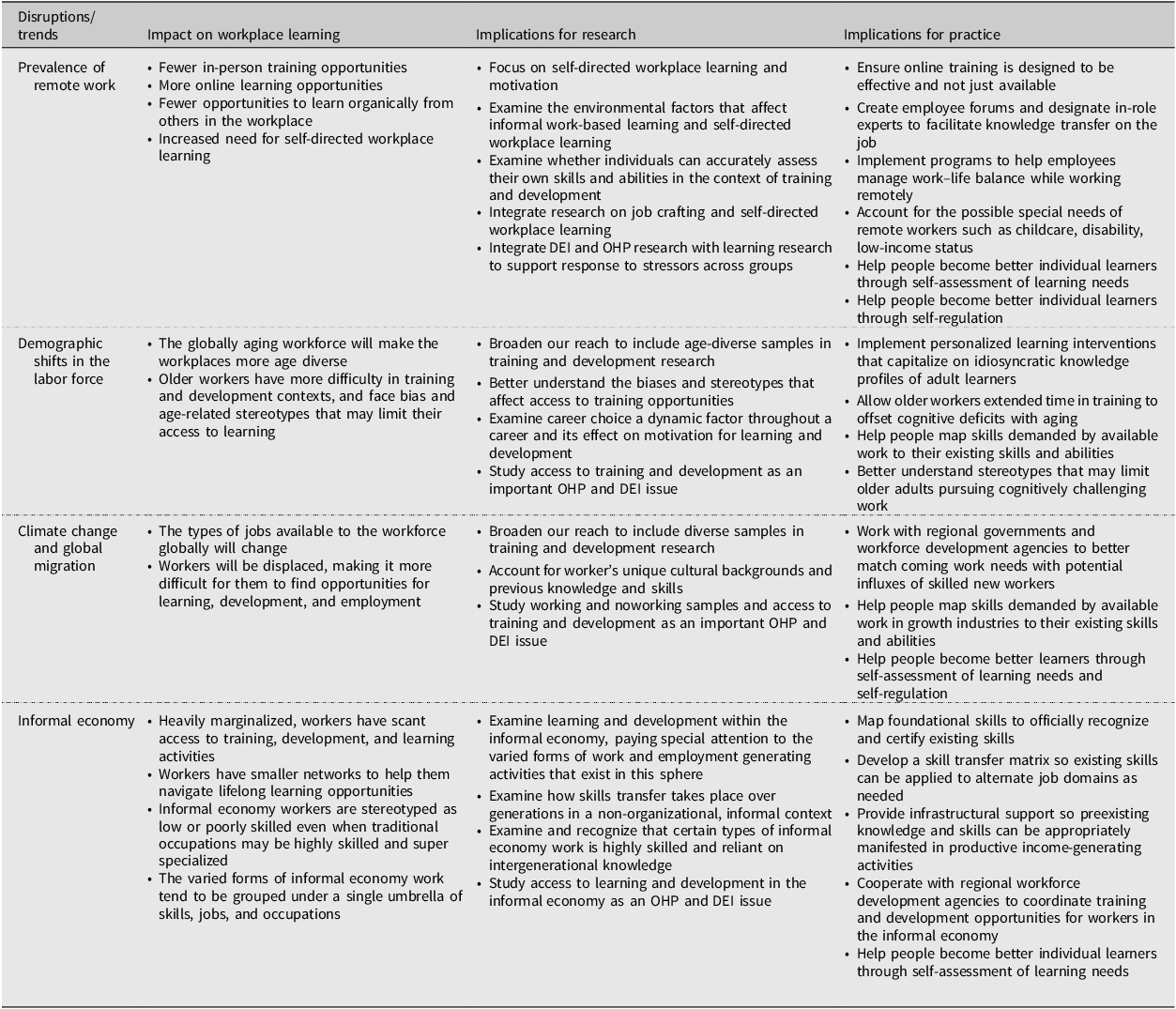
This section addresses four unfolding trends that have implications for workplace learning and person-centric and organization-centric approaches for preparing workers. For each, we describe the macro trend, specify how work has changed, highlight the implications for knowledge and skill training, and connect those changes to broad implications for person- and organization-centric approaches to training and development. Table 1 summarizes this section and provides implications for research and practice.
Future of Work Trends and Implications for Worker Preparedness

Pandemics and prevalence of remote work
Perhaps the most salient—and universal—recent example of global disruption affecting work is the COVID-19 pandemic. Not only were some positions eliminated during the pandemic, others were adapted to be completely remote, whereas others, like service positions, transformed overnight into high-risk/low-wage professions, leading some workers to abandon their jobs altogether. Freelance and gig workers could not find suitable work and had to rapidly adapt and shift their skill sets and find different forms of work to continue to make a living. For organizations, the pandemic unequivocally increased the necessity and prevalence of remote work, a trend that has continued; postpandemic levels of remote work are estimated to be four or five times prepandemic levels (Lund et al., Reference Lund, Madgavkar, Manyika, Smit, Ellingrud, Meaney and Robinson2021), and offices are occupied at barely 50% the prepandemic rate (Telford, Reference Telford2023).
Although the benefits of remote work, such as increased flexibility and less perceived stress, have been studied for years (Allen et al., Reference Allen, Golden and Shockley2015), the wholesale migration to remote work during the COVID-19 pandemic has created practical challenges for organizations. Examples of these challenges include sustaining workforce morale with limited physical interactions and identifying optimal telecommuting arrangements to facilitate both worker well-being and productivity (Beckel & Fisher, Reference Beckel and Fisher2022; Rudolph et al., Reference Rudolph, Allan, Clark, Hertel, Hirschi, Kunze, Shockley, Shoss, Sonnentag and Zacher2021). In these environments, workers become increasingly aware of their own precarity and understand that they cannot count on organizations to provide them with the knowledge and skills needed to adapt to shifts in job availability as a function of these disruptions.
Challenges remaining since the pandemic and the increased prevalence of remote work have implications for workplace learning. Most organizations responded to the pandemic by investing less in training and shifting from face-to-face to online instruction. Although the decline in training quality was not documented nationally, it was apparent to most workers who were moved into newly created online programs. The Association for Talent Development (2021) reported that the percentage of in-person classroom hours dropped from 40% in 2019 to 16% in 2020. More nuanced was the loss in choices about how to learn. In the midst of these changes, individuals were increasingly asked to find their own learning solutions and independently master skills after the scaffolding and social support of high-performing peers or knowledgeable supervisors were removed (Hughes et al., Reference Hughes, Zajac, Woods and Salas2020). Although researchers have not quantified the importance of learning organically through watching others in the workplace on a daily basis (Tannenbaum et al., Reference Tannenbaum, Beard, McNall, Salas, Kozlowski and Salas2010), remote work essentially eliminated these learning opportunities.
The prevalence of remote work may also affect those just entering the workforce. From an organization-centric perspective, for example, new employees report to the workplace for systematic onboarding, which typically includes standardized sets of orientation, training, and HR materials. This approach allows for a consistent experience, ensures the same information is delivered to everyone, and allows people to meet, interact, and bond with one another. However, when employees are remote or dispersed or work in gig or temporary roles, this shared experience is far more difficult to create. Instead, new employees may log on to a virtual orientation session, take online training, and complete insurance and benefit forms without human assistance. In remote work situations, the need for continuous learning and development may become increasingly invisible to supervisors and organizations. Onboarding research does suggest that remote work arrangements are particularly problematic for new workers due to the importance of acquiring general interpersonal workplace skills (e.g., meeting management, navigating organizational politics, etc.) and professional networks that provide a resource for lifelong learning (Sani et al., Reference Sani, Adisa, Adekoya and Oruh2023; Woo et al., Reference Woo, Endacott and Myers2023).
Remote work also influences work-related skill learning regardless of career stage. Experiential and social learning may be dramatically impacted by shifts in the proximity of workers (Zajac et al., Reference Zajac, Randall and Holladay2022). For example, informal interactions that often lead to spontaneous learning could be reduced, as could relationships and connections (i.e., social capital) developed from these beneficial interactions. These losses might prompt individuals to feel they cannot reach out for help if needed and result in additional lost opportunities for learning. To accommodate those returning to work after layoff or other events (e.g., working mothers), organizations will need to balance greater inclusion opportunities against the possible limitations of remote work (Byrd, Reference Byrd2022).
Demographic shifts in the labor force
The global labor force is aging as a function of population aging, with employees working past traditional retirement age (U.S. Bureau of Labor Statistics, 2024) in either full-time or part-time (e.g., bridge) employment arrangements (Zaniboni et al., Reference Zaniboni, Fraccaroli, Truxillo, De Vos and Van der Heijden2015). In the U.S., workers 55 and older make up the fastest growing segment of the labor force, and by 2030, this group is estimated to make up about one-fourth of workers in the U.S. (U.S. Bureau of Labor Statistics, 2020). These trends are global, with the most profound changes affecting Asia and South America into 2050 (International Labour Organization, 2024). Labor force aging is simultaneous with technological advances affecting the types of jobs available to workers. Specifically, artificial intelligence (AI) and automation are rapidly changing the knowledge and skills necessary for workers to remain engaged and productive (Lund et al., Reference Lund, Madgavkar, Manyika, Smit, Ellingrud, Meaney and Robinson2021). In this new environment, workers of all ages must continually learn as they take on new roles or their job requirements change throughout their careers. Both older individuals wishing to stay employed and organizations seeking to maintain a productive workforce will need to ensure that learning opportunities are accessible to, and effective for, aging workers.
Although there is considerable variability in how people age (Hertzog et al., Reference Hertzog, Kramer, Wilson and Lindenberger2008), abilities associated with learning completely new information (e.g., fluid cognitive abilities, such as those associated with reasoning and memory) tend to decline in early adulthood and continue to decline throughout the lifespan. Crystallized abilities, such as knowledge and expertise, can also support learning and can increase throughout a person’s lifespan (i.e., up until age 70 or so, on average; Beier, Reference Beier2022; Salthouse, Reference Salthouse2010). These age-related changes may make learning novel skills/knowledge increasingly difficult as people age. However, learning may not be problematic when the content is related to existing knowledge (e.g., a healthcare worker learns about a new form of heart disease; Beier & Ackerman, Reference Beier and Ackerman2005).
Because learning novel information becomes increasingly difficult as people age, it will be necessary for workers and job seekers to understand how their existing knowledge and skills transfer across jobs and which new skills they might hope to develop, given the proximity to their existing skills. Moreover, as people continue to gain experience throughout their lifespan, they become increasingly idiosyncratic in their ability profiles as they age and develop specialized knowledge and skills (see Ackerman, Reference Ackerman1996). Older workers may face stereotypes about their motivation for and ability to engage in learning, stereotypes that can limit access to learning and development opportunities. However, when individual learners internalize these stereotypes, they may be particularly harmful to workplace learning (Posthuma & Campion, Reference Posthuma and Campion2009). Thus, personalized learning experiences—in which instructors in online training programs adapt to the unique profile of the learner—will become increasingly important for the future of work.
More generally, work-related, self-directed learning may be more difficult for workers unaffiliated with organizations because they may lack clarity about the skills they should develop and where to find development opportunities (Davenport et al., Reference Davenport, Young, Kim, Gilberto and Beier2022). Additional time, effort, resources (financial and energetic), market monitoring, searching, and deciding among the many possible training and learning opportunities will take time and effort beyond the primary income-generating, work-related activities. Older workers are also likely to have less motivation for development activity, particularly if they expect it will be effortful (and their effort will not pay off in terms of skill acquired; Kanfer & Ackerman, Reference Kanfer and Ackerman2004) or they face negative stereotypes (Posthuma & Campion, Reference Posthuma and Campion2009). Although these stressors will impact workers of all ages, they may be even more problematic for older workers, particularly if they find themselves unemployed, given the reduced likelihood of reemployment after age 50 (Wanberg et al., Reference Wanberg, Kanfer, Hamann and Zhang2016).
Climate change and global migration
Anthropogenic climate change and patterns of global migration are also affecting the landscape of work (McLeman & Hunter, Reference McLeman and Hunter2010). An estimated 85% of the world’s population lives in areas impacted by climate change (Callaghan et al., Reference Callaghan, Schleussner, Nath, Lejeune, Knutson, Reichstein, Hansen, Theokritoff, Andrijevic, Brecha, Hegarty, Jones, Lee, Lucas, Maanen, Menke, Pfleiderer, Yesil and Minx2021). Already, it has been estimated that more than 20 million people are displaced annually because of climate-related issues (e.g., increasingly extreme weather events and environmental degradation; UNHCR, n.d.). Climate change will likely make some work (e.g., working outdoors; agriculture) in certain locations untenable (e.g., in Southern and Southeast Asia, West Africa, and Central America). Research has examined worker knowledge about the effects of working in extreme climates and the efficacy of interventions designed to help them manage these challenges (Reinau et al., Reference Reinau, Weiss, Meier, Diepgen and Surber2013). Researchers have also examined training effectiveness regarding safety training for working in conditions caused by extreme climates (Nielsen et al., Reference Nielsen, Ng, Vignoli, Lorente and Peiró2023). Workers most adversely affected by climate change and/or migration are often not affiliated with organizations and are the poorest. These workers—particularly artisans and others in the informal economy—struggle against extreme weather conditions that inhibit their work and threaten their livelihoods (Saxena, Reference Saxena2021). It will be essential to include these individual workers when researching the effects of climate change on workplace learning.
In addition to climate change, migration has grown tremendously over the past few decades, fueled also by major societal, economic, and political crises (International Organization for Migration, 2022). Adverse, climate-instigated migration (i.e. climate migration) internally (i.e. within the same country) also occurs more than international migration (International Organization for Migration, 2024). Global migration ensures that organizations have diverse talent with respect to skills and cultural backgrounds. However, for migrant recipient regions, migration creates several challenges relative to the job market and workplace learning. Importantly, migrant workers likely face tremendous obstacles in terms of increased stressors both on and off work, language barriers, cultural differences, and on-the-job and societal discrimination in their adopter nations. Further, for many professional jobs (e.g., doctors or engineers), the education and licensing requirements in one’s home country may not be recognized in their new country.
Climate change has significant implications for future jobs, whereas migration patterns will impact the available talent pools for those jobs. Both will require changes in how organizations recruit, select, and train workers, and both will require individuals to change how they make themselves employable. Whether and how existing skills translate to future work marked by climate change remain open questions. For example, how do skills associated with fossil-fuel-based energy production (e.g., gas, coal, and oil location, production, and transportation) translate into “green energy” jobs in solar, wind, and nuclear power generation? What happens to work and occupations that have been around for centuries in the face of climate adversity? Climate change raises new opportunities for reskilling to meet the needs of an increasingly “green” economy (e.g., workforce development to teach skills around sustainable work practices; Vidric et al., Reference Vidric, Paulus, Grebner, Treiber, Mayr and Mandler2023). Employers need to be proactive in understanding how jobs may evolve with climate change, and workers will need to be able to anticipate future opportunities and gaps in their knowledge and skills.
For those displaced into new communities, accurately assessing fit to current and emerging jobs may be particularly challenging given language differences, lack of cultural familiarity, degree and licensing/certification equivalency issues, and the general stress and trauma of cross-national and cross-continent immigration and refugee seeking. Moreover, prior difficulties in educational environments are likely to undermine motivation and self-efficacy to engage in learning and development (Wu et al., Reference Wu, Zhao, Cheung, Natsuaki, Rebok and Strickland-Hughes2021). The additional burden for those who are escaping atrocities from terrorism, war, political/civil unrest, and conflict at home is equally important to consider. These factors make it even less likely that vulnerable workers and job seekers will engage in work-related self-directed learning. Simply put, individual access to learning opportunities in the future is a major factor in workplace equity and inclusion.
Organizations operating in areas impacted by climate change and/or global migration should consider how they can provide opportunities for displaced workers to (a) understand the skills needed for current or emerging jobs and (b) acquire those skills. Working with regional workforce development groups may be one way to promote an understanding of dynamic job requirements. Apprenticeships or funding learning/training opportunities and offering jobs to graduates is one way to fund skill acquisition while supporting future hiring needs.
From an organization-centered perspective, businesses in current or future affected areas should invest in strategies to rethink jobs and skill requirements and develop their human capital. Organizations may also need to rethink skill translation as knowledge and skills from migrants’ home nations may apply to unique work tasks and job responsibilities. Apprenticeships or funding external training can help regions and organizations adapt to changing conditions. From a person-centered perspective, the importance of individual-level actions as the “core” of sustainable or “green” work practices suggests that, to some extent, the onus is on individual workers to make bottom-up changes to organizations’ sustainability efforts (Zacher et al., Reference Zacher, Rudolph and Katz2023). However, it can be challenging for individuals to predict the availability and skill requirements of jobs that may not yet be created. Thus, organizations are responsible for communicating their vision of the future within their region. Organizations may also need to rethink skill translation as knowledge and skills from migrants’ home nations may apply to unique work tasks and job responsibilities.
Informal economy and informal workers
A key force influencing the future of work is the globally omnipresent informal economy and the ongoing transition from a full-time, long-term workforce to one characterized by more short-term “gig” roles or other nonstandard work arrangements. Over 61% of the world’s workforce is already part of the informal economy (International Labour Organization, 2019; United Nations Development Programme, 2022), defined as work and economic activity, wholly or partly, outside government regulation or tax (International Labour Organization, 2024). In recent years, large portions of the global workforce have moved toward informal work arrangements often nested within the informal economy (International Labour Organization, 2024). Approximately 78 million workers globally are part of the gig economy, up from 43 million in 2018 (Pew Research center, 2021). Looking ahead, more than 50% of the U.S. workforce will be associated with the gig economy by 2027 (Teamstage, 2023). Acting as a critical disruptor for the world of work, the COVID-19 pandemic further bolstered the number of informal workers (Carr et al., Reference Carr, Hodgetts, Hopner, Young, Carr, Hopner, Hodgetts and Young2024; Glazer et al., Reference Glazer, Robie, Kwantes, Saxena, Jain and Munoz2021; International Labour Organization, 2024). Because independent contractors are more likely to be isolated from resources such as supervisor and coworker support, and due to their tangential relationship with organizations, they will likely have even fewer opportunities for learning and development than remote workers. Similarly, those in the informal economy have historically been removed from efforts that support, preserve, and map their traditional skills.
Historically, I-O researchers and practitioners have paid little attention to workers in the informal economy. Increasingly, we are witnessing greater interest in examining work in the informal economy (Saxena, Reference Saxena2021, Reference Saxena2023a). Broadly, the informal economy consists of two types of workers (Saxena, Reference Saxena2021). The first are high-skill, micro-entrepreneurial intergenerational workers who have sustained themselves through millennia. These are millions of workers in creative occupations, such as artisans, including sculptors, potters, and weavers, who have engaged in traditional forms of livelihoods across generations. Second are various forms of daily-wage workers, such as those engaged in vegetable vending, agricultural labor, plumbing, construction work, tailoring, and so forth. Here we also consider those who engage in contingent work arrangements—informal, freelance, or gig work, such as in jobs related to personal services like home health or food delivery—as affected by many of the same factors affecting workers in the informal economy (Cropanzano et al., Reference Cropanzano, Keplinger, Lambert, Caza and Ashford2023; Saxena, Reference Saxena2023a).
Generally, informal work arrangements tend to be poorly paid and precarious. Pre-COVID, it was well known that workers in the informal economy faced serious challenges to decent work that included economic tenuousness, lack of regular pay and income, work insecurity and precariousness, lack of benefits and protections, and often exploitation, marginalization, and serious occupational health challenges (Saxena, Reference Saxena2021). Post-COVID, those in the informal economy continue to grapple with increased poverty and lack of income-generating opportunities. Many have left their traditional jobs and intergenerational livelihoods due to poor sales and reduced ability to access avenues for sales (such as farmers’ markets, local bazaars, etc.) in search of jobs at the base of the economic pyramid. In the current environment, informal workers and those in the informal economy are increasingly aware of their precarity and potential income tenuousness. They understand that they cannot count on organizations and government support systems to provide them with the knowledge and skills needed to adapt to shifts in job availability as a function of these disruptions.
Informal work roles may become narrower in scope, allowing greater specialization (Marler et al., Reference Marler, Milkovich and Barringer2001). For example, whereas an office worker may be expected to fulfill many duties or responsibilities on site, an informal worker may only find paid employment performing a single task exceptionally well. As a result, the opportunity to stay up to date on the knowledge or skills needed for a particular task will be more challenging for informal workers. Consider an auto mechanic. As AI changes the way in which mechanics can diagnose and resolve engine problems, workers in auto repair shops will be exposed to ongoing training with each new iteration. By contrast, a mechanic in the informal economy will not have access to the same training and their skills may fall behind advances in modern vehicles and diagnostics.
There are several implications for learning and development among workers seeking to remain competitive in the informal economy. Due to complex factors including poverty, informal economy workers may face serious barriers to accessing and participating in lifelong learning opportunities, such as lacking access to technology (e.g., access to computers or the internet). When individuals are responsible for their own learning, it may be harder to self-assess current or anticipated competency gaps. Overall, there are also fewer opportunities for work-related self-directed learning for informal economy gig workers (Tannenbaum & Wolfson, Reference Tannenbaum and Wolfson2022). Remote or gig workers in particular may have fewer coworkers whom they can observe, job shadow, or seek advice from when learning a new skill. Additionally, practice is one of the best ways to acquire new skills (Salas et al., Reference Salas, Tannenbaum, Kraiger and Smith-Jentsch2012). However, informal gig workers may be forced to practice a new skill in providing a service directly to a client or preparing products to sell to future customers. In these instances, there is little margin for error. These workers may have to choose between relying on mastered but outdated methods to earn a living and experimenting and taking risks to improve their skills.
Due to the varied tasks, activities, and work roles that fall within the informal economy (International Labour Organization, 2022), there is no one-size fits all solution that can address learning and development needs within the informal setup. For highly skilled workers in the informal economy engaged in traditional occupations, there is a greater responsibility on local governments, community bodies, and organizations to seek ways to partner and promote learning and development within the context of the work that is being done (International Labour Organization, 2024), as opposed to “reskilling” where individuals are pulled out of their traditional occupations to engage in other base-of-the-pyramid roles in the formal economy (Saxena & Tchagnéno, Reference Saxena, Tchagnéno, Carr, Hopner, Hodgetts and Young2023).
Solutions that have worked in many parts of the world including West Africa and South Asia focus on preserving foundational skills and upgrading informal training systems. Dual format apprenticeships that combine at-work training with in-classroom instruction to transform informal learning that is typical of informal work have also proven to be successful (International Labour Organization, 2024). Recognition of prior learning that enables official certification of skills that are acquired outside of formal education and training is another innovative approach that facilitates skill and knowledge transfer to other types of jobs in times of need. Such an approach finds expression in the form of practical trade tests that have recognized the skills of informal economy workers in India (International Labour Organization, 2024). Such “formalization” of native skills and skill mapping of the informal sector can prove to be highly beneficial for not just the individual workers but also for overall societal cohesion and organizations that may be able to partner with local communities. Learning opportunities that focus on greater technology literacy for leveraging digital sales and creating an ecosystem that supports informal economy work can also be beneficial.
Organization- and person-centered perspectives on workplace learning
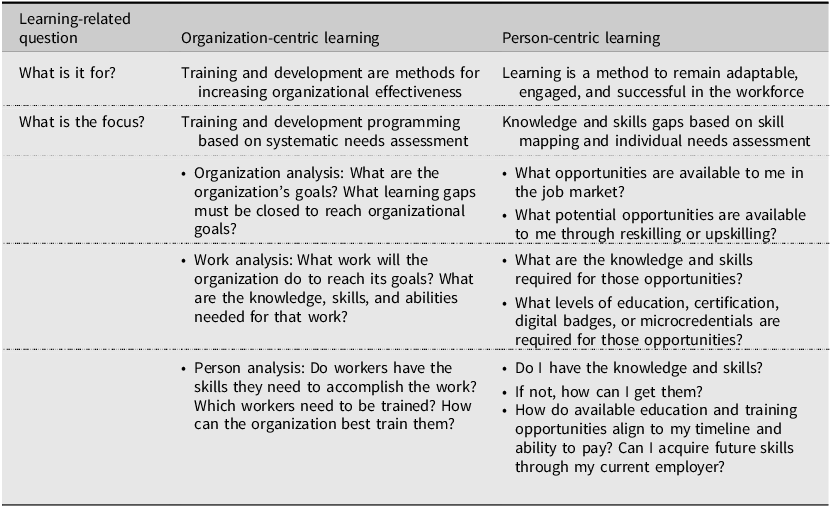
Organization- and person-centered perspectives on workplace learning are differentiated in Table 2. The design of organization-centric training and development programs, foundational in I-O psychology for decades, largely relies on instructional systems design (ISD) models (Ford, Reference Ford2021). Needs assessment in traditional ISD models are conducted to ensure training efficiency and effectiveness for the organization, specifying: (a) what are the performance gaps, (b) what training (if any) is necessary to address those gaps, (c) what job tasks or competencies should be covered in training, and (d) which employees have skill gaps and would benefit from the training (Arthur et al., Reference Arthur, Bennett, Edens and Bell2003; Ford, Reference Ford2021). Although individual skill gaps are addressed in organization-centric approaches to needs assessment, it is typically from the perspective of increasing organizational capacity.
Organization and Person-centric Approaches to Workplace Learning

A person-centered perspective on workplace skill learning shifts the responsibility of needs assessments to individual workers and job seekers to self-assess: (a) the job opportunities available to them in their current organization or job market, (b) the skills and knowledge required for these opportunities, (c) gaps in their own skills and knowledge relative to these opportunities, and (d) whether they can reasonably expect to acquire the skills and knowledge they need by engaging training or development. When an individual is employed and sees learning as a bridge to future internal job opportunities, anticipating the skills needed in future jobs and creating opportunities for growth within the organization will also require appropriate self-assessment (Dachner et al., Reference Dachner, Ellingson, Noe and Saxton2021). However, for job seekers not privy to the inner workings of an organization (e.g., they are unemployed or looking to change organizations) identifying skills gaps for specific positions will be far more opaque. Furthermore, such individual needs assessments may be difficult for individuals unaffiliated with organizations, given that they will likely have limited resources and networks to draw upon (U.S. Bureau of Labor Statistics, 2020). These issues are even more salient for those already engaged full time with gig work with little time to engage in lifelong learning to gain new skills.
A lifelong learning matrix is one method to guide this process (Kraiger et al., Reference Kraiger, Wolfson, Davenport, Beier and London2020). The matrix allows learners to list organizational competencies (e.g., leading and deciding) and lifelong learning competencies (e.g., critical curiosity) as rows and then developmental opportunities inside and outside the organization as columns. This allows individual learners to record reflections on their learning needs and developmental opportunities and then track progress toward their goals.
Pairing organization-centric and person-centric perspectives on workplace learning will assist in developing plans to support individual needs assessment. Enabling their workforce to self-identify training and development needs for a broader range of positions than those immediately available internally can encourage greater individual skill development within organizations. Although providing information about training and development needs can potentially lead to individuals “outgrowing” current roles and leaving their organization, investing in self-managed employee development can reap positive benefits for organizations. For example, multiple studies show that tuition reimbursement plans reduce employee turnover while growing firm-specific human capital (e.g., Benson et al., Reference Benson, Finegold and Mohrman2004; Manchester, Reference Manchester2012). If competencies identified and pursued by individuals can be firm specific, organizations would benefit from skill development without the risk of employees “taking their talents” elsewhere. At worst, organizations may gain a recruitment boost when seen by job seekers as a company investing in employee development (Dachner et al., Reference Dachner, Ellingson, Noe and Saxton2021).
Whether a worker is affiliated with an organization or not, success in the future of work will depend on workers developing the skills and abilities they need to be productive lifelong learners. A major part of this task will be whether workers feel they have the agency to make occupational choices (i.e., work volition, Duffy et al., Reference Duffy, Diemer, Perry, Laurenzi and Torrey2012) and how proactive they are (i.e., the extent to which they take action to influence their environment; Bateman & Crant, Reference Bateman and Crant1993; Dachner et al., Reference Dachner, Ellingson, Noe and Saxton2021). However, many workers—particularly those who are the most vulnerable—may experience low levels of agency in the workplace (Laaser & Bolton, Reference Laaser and Bolton2022) and may be less likely to participate in training and development activities. Thus, we envision a vicious cycle whereby workers who feel disenfranchised and disconnected from resources and organizations may feel lower levels of vocational agency, which puts them at a disadvantage with regard to work-related self-development activity and will impede their ability to reskill for a new role or upskill within their current role.
Although individual agency will be necessary for work-related skill development, we worry that increasing worker responsibility for their own skill development will leave many vulnerable workers behind. Indeed, it is worth considering whether it “should’’ be an individual’s responsibility to self-manage their own knowledge and skill development, particularly for those working within organizations that stand to immediately benefit from employee development (Dachner et al., Reference Dachner, Ellingson, Noe and Saxton2021). Certainly, organizations in the U.S. such as the Occupational Safety and Health Administration (OSHA), the National Institute for Occupational Safety and Health, and the National Institute of Environmental Health Sciences (NIEHS) are developing guidelines and recommendations for organizations intended to protect workers given new realities associated with the future of work (NIEHS, 2018; OSHA, Department of Labor, 2021a, b), but whether this culture of care and protection will extend to workplace learning is another question. Moreover, workers not affiliated with organizations will potentially miss out on these protections. It is helpful to consider whether a shift in responsibility for workplace learning from organizations to individual workers reflects a more general pattern of organizations shifting the onus of their otherwise traditional “duty of care” responsibilities and other tangible benefits (e.g., affording stable employment contracts, healthcare, career development opportunities, etc.) onto employees themselves. Such a shift would also exacerbate disparities in access to resources and opportunities for workers with no sense of agency over their work lives and who are not—or cannot afford to be—proactive.
Technology and access to learning content
After assessing their own learning needs, individuals require access to content (e.g., courses, videos, etc.) to support their learning efforts. As described above, technology is changing the experience of work. Still, technology is rapidly changing how people learn (Committee on How People Learn II, 2018), and the prevalence of technology-enhanced learning will only continue to accelerate (Lund et al., Reference Lund, Madgavkar, Manyika, Smit, Ellingrud, Meaney and Robinson2021). Never before has the opportunity to access content for work-related skills—within or outside an organization—been so plentiful (Beier, Reference Beier2019). Research also suggests that computer-adapted training is generally effective for organizationally based training. However, more research is needed on which tools (e.g., gaming, virtual and augmented reality, intelligent tutors) are most effective across the myriad learning environments and skills to be trained (Gao et al., Reference Gao, Gonzalez and Yiu2019). For those not affiliated with an organization, free or low-cost educational opportunities such as massive open online courses (MOOCs) arguably reduce barriers and increase access to learning opportunities (Lewin, Reference Lewin2012). Over the decades, MOOCs have provided educational opportunities to those who otherwise might not have had access (mainly older and younger learners; Schmid et al., Reference Schmid, Manturuk, Simpkins, Goldwasser and Whitfield2015) to critical, job-relevant information, especially when workers are outside of the organizational context.
One issue with MOOCS is whether job-relevant content that is delivered online is as effective as that offered by organization-centric, internal training. Meta-analytic findings confirm that online instruction is equally effective as face-to-face when highly similar instructional methods (e.g., demonstration, practice, feedback) are used (Sitzmann et al., Reference Sitzmann, Kraiger, Stewart and Wisher2006). However, research also shows that transfer of training is maximized when peer, supervisory, and organizational support is present to encourage, modify, and reinforce on-the-job application (Hughes et al., Reference Hughes, Zajac, Woods and Salas2020), support that MOOCs cannot readily provide. This creates a threat to transfer of training and reduced opportunities for contextual learning, suggesting that traditional methods for long-term skill development in the workplace may be compromised as individuals are more frequently required to access and manage their own learning and as remote work becomes more prevalent.
However, online learning opportunities are only available to those with access to computers and stable internet connections. Although reliable and consistent internet connectivity may be a given for most in the world’s wealthiest nations, many people worldwide are left out of this equation, with approximately one-third of the world’s population lacking access to the internet (Kemp, 2024). Access to online learning via the internet is likely more restricted for recent immigrants, workers in the informal economy, and those living below the poverty line. Consider poverty in the U.S, where about 4% of the labor force is classified as working poor (i.e., working more than 27 weeks a year but living below the poverty level). Poverty is also more likely to be experienced by women, those from minoritized populations, and the less educated (U.S. Bureau of Labor Statistics, 2024). The cost of even the least expensive educational opportunities may be out of reach for these vulnerable populations, not to mention the difficulty of finding the time to engage in lifelong learning when one holds two or three jobs to make ends meet (Wu et al., Reference Wu, Zhao, Cheung, Natsuaki, Rebok and Strickland-Hughes2021).
Where do we go from here?
Incorporating a person-centered perspective into research and practice on workplace learning requires that I-O researchers and practitioners first broaden their perspective from organizational training to include a focus on individual learning (Kraiger & Ford, Reference Kraiger and Ford2021). That is, a person-centered perspective recognizes that the end goal is worker skill development to remain employed and employable, not that a training budget was expended, courses delivered, or seats filled. It also expands the focus of inquiry beyond workers within organizations to people in the labor force, whether working or looking for work. This shift in perspective opens up new and exciting research ideas and considerations for practice. Below, we highlight our best thinking about avenues for future research and practice. Others may have better ideas, and we call for commentaries to highlight how I-O scientists and practitioners can support workers’ continuous learning and development in the future workplace or to argue why traditional training and development models still apply despite seismic shifts in work and working.
Implications for research
Implicit in the above discussion are multiple levels of analysis; some individual learners are nested within organizations and others are not, organizations are nested within industries and communities, and all individual learners are nested within communities. Moreover, because of the idiosyncratic nature of development, particularly on the individual level, researchers may need to expand their analytical toolboxes to include qualitative and other approaches that are more amenable to smaller samples (e.g., Bayesian approaches; Jebb & Woo, Reference Jebb and Woo2015).
Broaden our reach
I-O researchers are increasingly incorporating marginalized populations, vulnerable workers, and those who have historically not been a part of our research. For instance, the lack of representativeness of the samples used in research relative to the labor market has been called out (Bergman & Jean, Reference Bergman and Jean2016). In response, many have heeded the call to diversify their samples to include low-income workers (Carr et al., Reference Carr, MacLachlan, Reichman, Klobas, Berry and Furnham2008; Saxena, Reference Saxena2017) and older learners (Davenport et al., Reference Davenport, Young, Kim, Gilberto and Beier2022), and to incorporate the experience of work in the informal economy (Saxena, Reference Saxena2021). I-O psychologists are exploring novel ways of managing precarious work (Carr et al., Reference Carr, Hodgetts, Hopner, Young, Carr, Hopner, Hodgetts and Young2024), exploring work phenomena related to low-income workers that are not bound to traditional organizations (Saxena, Reference Saxena, McWha-Hermann, Maynard and Berry2015; Saxena & Burke, Reference Saxena and Burke2020) and heretofore uncharted territories such as investigating the effect and impact of living wages (Carr et al., Reference Carr, Parker, Arrowsmith and Watters2016). Skill mapping of informal economy workers (Saxena & Tchagnéno, Reference Saxena, Tchagnéno, Carr, Hopner, Hodgetts and Young2023) and the role of cultural skills in meaningful work have become the focus of investigations.
We believe I-O psychologists have a critical role to play in ensuring a more equitable future of work by calling out and addressing inequities in opportunities for learning through a broadening of research and practice efforts, highlighting access to learning and development opportunities as an essential equity and inclusion issue. We can further increase our efforts in these directions by including gig, precarious, and historically marginalized workers’ development in our research on workplace learning. We can start by examining our samples to ensure they reflect the demographic characteristics of the labor force and that we study the effect of stereotypes—such as those related to aging and informal economy work—that may affect access to learning and development opportunities (Posthuma & Campion, Reference Posthuma and Campion2009; Saxena & Tchagnéno, Reference Saxena, Tchagnéno, Carr, Hopner, Hodgetts and Young2023).
As we expand our view of workers, we can also look at methods and forms of informal learning that may be nontraditional but highly functional. This area is ripe for research to undertake meaningful investigations that can shed light on sustainable learning that has survived eons. For instance, occupations that supported livelihoods for millennia were found to rest on cultural skills passed on intergenerationally within families of highly skilled workers in the informal economy (Saxena, Reference Saxena2021). Such livelihoods that are fundamentally reliant on learning, albeit informally, are found all around the world. Similarly, globally, micro-entrepreneurs engaged in artisan work and related enterprises often learn and develop skills through informal learning and training. These workers and forms of learning have historically not been a part of our research.
We recommend an active, intentional approach toward inclusion of hard-to-reach populations and nontraditional modes of learning and development in our research. This may require us to revisit our theories, rethink our methods, and question the approach to asking the questions that we ask in our research. Currently, dominant paradigms and theoretical approaches, models, and frameworks may fall short in examining many to-be-discovered, novel phenomena in working with so far neglected populations. Such investigations will need us to be explicitly open to alternate methods and modes of research and investigations. Indigenous methods of learning and discovery and nondeductive research methods may present a viable solution to working with understudied populations. We also advocate moving away from comparing new knowledge to the benchmark of what we know towards an open-minded approach that seeks to understand phenomena as they occur in the context in which they present themselves.
Connect with existing research
Although self-directed workplace learning has not been studied as much as formal training in the I-O literature (Bell et al., Reference Bell, Tannenbaum, Ford, Noe and Kraiger2017), job crafting (a person-centered job design approach that examines how workers personally endeavor to increase their fit with their job roles; Wrzesniewski & Dutton, Reference Wrzesniewski and Dutton2001) is a related approach. Job crafting toward strengths and interests includes the self-directed acquisition of skills and knowledge related to obtaining work experiences that fit better with individual workers (Kooij et al., Reference Kooij, van Woerkom, Wilkenloh, Dorenbosch and Denissen2017). To our knowledge, however, research on job crafting does not examine how people successfully craft; that is, it does not examine the process or accuracy of the assessment of market demands or skill self-assessment. Methods of informal learning could be examined for their relevance to effective job crafting.
Similarly, career choice theory and research take a person-centered perspective on career goals and motivation. However, this research primarily focuses on students in secondary or postsecondary educational environments (Brown & Lent, Reference Brown and Lent2019; Lent et al., Reference Lent, Brown and Hackett1994). These theories can be applied to older workers in the context of workplace aging and the rapidity with which technology is changing the available jobs. For instance, it would be interesting to understand the determinants of shifts in career choice and whether workers’ job choices tend to gravitate toward (or away from) their career interests over a career (e.g., Kim & Beier, Reference Kim and Beier2020).
Job design is another closely related area of I-O research, given that the analysis of work that informs job design can also serve as the basis for organizational needs assessment to inform the design of organizational training and development activities (see Table 2). Job design researchers have also begun to examine how workplace changes related to the future of work will affect the jobs available. Organizational workforce analysis could be adapted to understand what knowledge and skills could be outsourced to informal workers and which should be developed internally. Similar to the position we take here, this work highlights the effect of external influences (e.g., shocks such as the pandemic) on the availability of work and suggests that lifelong learning is an essential area of future research (Fraccaroli et al., Reference Fraccaroli, Zaniboni and Truxillo2024).
For individuals not affiliated with organizations to conduct an individual needs assessment (see Table 2), they need to be able to identify relevant skills and then accurately self-assess their own skills relative to market demands. Although professional and career websites like LinkedIn and Indeed regularly post articles about the changing nature of work, it’s unclear whether individuals can “predict the future” well enough to anticipate what skills they should develop. Furthermore, research is mixed on people’s self-assessment ability (Mabe & West, Reference Mabe and West1982). Although some research suggests that people are notoriously bad at self-assessment and reliably overestimate their own abilities (Kruger & Dunning, Reference Kruger and Dunning1999), studies also show that people can be relatively accurate in self-assessment if self-assessments are well-designed and specific (e.g., people provide more accurate assessments when asked if they can solve calculus problems than when asked if they are good at math; Ackerman et al., Reference Ackerman, Beier and Bowen2002; Zell & Krizan, Reference Zell and Krizan2014). To our knowledge, research on skill assessment has not been conducted with adults in relatively high-stakes situations such as job search, reskilling, or upskilling. In summary, researchers know little about workers’ ability to accurately self-assess their own skills and whether such self-assessments affect their perceptions of effort and self-efficacy for training and development activity. Research in I-O psychology could provide insight into these questions, focusing on those skills needed for jobs in growing versus declining job sectors (World Economic Forum, 2018) and how skill self-assessment affects learner self-efficacy, motivation, and engagement in learning and development activities within and outside of organizations.
Focus on person variables and motivation
Beyond the ability to conduct an individual needs assessment, workers and job seekers will need the cognitive resources to engage in continuous lifelong learning. Given demographic changes in the workforce described above and the idiosyncratic needs of diverse learners, affordances in educational technology, such as adaptability powered by AI, promise a learning experience that is well suited to provide personalized learning experiences when done right (Committee on How People Learn II, 2018). Nonetheless, scant research examines technology-enhanced learning for working adults or job seekers. A recent study showed, for instance, that most of the research on online and personalized learning uses undergraduate student samples, with no published studies using working adult samples (Xie et al., Reference Xie, Chu, Hwang and Wang2019). If organizations and individual learners are to thrive in this new environment, researchers and practitioners will need to understand the determinants, facilitators, and barriers to adults learning in online learning environments.
Traditional training and development research tends to focus on cognitive ability determinants and structuring learning environments to increase knowledge and skill development (Kraiger & Ford, Reference Kraiger and Ford2021). Established cognitive learning principles (e.g., spaced learning and practice testing; Donoghue & Hattie, Reference Donoghue and Hattie2021) will generalize to working adult samples. However, given the importance of motivation and self-regulation for self-directed learning, focusing on abilities is no longer sufficient. Workers hoping to reskill to transition to a new job will need to assess the amount of effort such reskilling will take and their efficacy for being successful, not only in terms of skills and abilities but also in terms of making time and space in their already busy lives to engage productively in work-related skill development (Kanfer & Ackerman, Reference Kanfer and Ackerman2004). Some research has examined motivation and abilities in concert during skill learning (Bell & Kozlowski, Reference Bell and Kozlowski2008; Kanfer & Ackerman, Reference Kanfer and Ackerman1989), but this research tends to be conducted with undergraduate students within laboratory environments using decontextualized tasks that participants may not be motivated to learn. More research must be conducted “in the wild” to integrate motivation and abilities realistically. That is, in learning environments that enable the study of motivational (e.g., valence, instrumentality, and efficacy expectations) and cognitive (e.g., executive function/attentional focus) processes associated with learning with samples of workers and job seekers who have a real need for continuous learning and development (Beier & Kanfer, Reference Beier, Kanfer, Kozlowski and Salas2010).
Environmental influences on informal learning
Within the training and development literature, researchers are beginning to recognize and examine self-directed learning within organizations (IFBL; Tannenbaum & Wolfson, Reference Tannenbaum and Wolfson2022), highlighting the importance of motivation and self-regulation in such personal development. Yet, as mentioned, this research remains narrow in considering workers only engaged in learning within an organization and has yet to examine the environmental influences that enhance learning broadly. For instance, very little is known about the general and specific environments and experiences that might lead to skill development for different job roles (Bell et al., Reference Bell, Tannenbaum, Ford, Noe and Kraiger2017). A key consideration is that self-directed learning experiences are likely to be increasingly idiosyncratic and thus difficult to study empirically; yet, understanding these environments in terms of their ability to facilitate or impede learning (e.g., Kraiger & Ford, Reference Kraiger and Ford2021) could prove beneficial for assisting self-directed learning within organizational contexts.
One approach would be to develop a taxonomy of environments—both within and outside of organizations—likely to facilitate self-directed learning (e.g., Parrigon et al., Reference Parrigon, Woo, Tay and Wang2017). Learning environments that provide learners with the time and resources to engage in productive practice (e.g., spaced versus massed practice; Schmidt & Bjork, Reference Schmidt and Bjork1992) and that suggest and facilitate generative learning strategies such as practice testing and self-explanation (Donaghue & Hattie, Reference Donoghue and Hattie2021) may go a long way to enhance self-directed workplace learning outcomes. To this end, Kraiger and Ford (Reference Kraiger and Ford2021) have brought cognitive learning principles into the I-O literature; adopting these in adult skill learning environments would be a valuable first step in creating learning environments for individual workers. More thought should be directed toward helping organizations understand how to support lifelong learners better (Kraiger et al., Reference Kraiger, Wolfson, Davenport, Beier and London2020) or help society direct more resources into developing human capital to fill future jobs (Dondi et al., Reference Dondi, Hieronimus, Klier, Puskas, Schmautzer and Schubert2020).
Implications for practice
Advocacy for disadvantaged workers
Societal inequities described above are enduring and will be exacerbated until and unless there is societal investment in enhancing the skills of all segments of the labor force, not only those already thriving (World Economic Forum, 2018). Thus, broadening the reach of I-O practitioners to include all workers—formal and informal, nations developed and developing (economically), the Global North, and the Global South—will lead to more sustainable global growth and development by enhancing worker skills. As a field, psychologists—in research and practice—can advocate for more equitable distributions of learning opportunities. Similarly, women and those with minority identities in science, technology, engineering, and mathematics fields remain underrepresented and at the receiving end of pay gaps and other adverse gender-based occupational and organizational outcomes (Miner et al., Reference Miner, Walker, Bergman, Jean, Carter-Sowell, January and Kaunas2018; Saxena, Reference Saxena2023b). This advocacy could highlight the power of lifelong learning and development for creating employment opportunities for workers throughout their careers.
Facilitating learning
Lifelong learning is recognized as central to remaining productive and employed throughout the lifespan (Lund et al., Reference Lund, Madgavkar, Manyika, Smit, Ellingrud, Meaney and Robinson2021), and clearly, workplace learning is—and will continue to be—big business. Recognizing that declining numbers of college-aged students will negatively affect enrollments, colleges and universities are expanding their reach to workplace skill learning and development, and many are adding certificate programs to university degrees (Bauman, Reference Bauman2024). Not all learning opportunities will be created equal, however, and many people will spend scarce resources on promising training and development programs only to be disappointed in the skills they obtained and the job opportunities available afterward (Robertson, Reference Robertson2019). I-O psychologists know a lot about individual characteristics related to learning (e.g., knowledge, skills, abilities, and motivation; Brown & Sitzmann, Reference Brown, Sitzmann and Zedeck2011), effective learner behaviors, the characteristics of successful learning environments, and how best people can transfer what they learned back onto the job (Kraiger & Ford, Reference Kraiger and Ford2021). I-O researchers and practitioners are likely contributing to the design and development of adult learning programs such as those available through LinkedIn. However, there is a broader opportunity to help consumers identify quality programs, which would also help organizations assess whether workers who go through these programs have the requisite skills for jobs in a selection context.
Our discussion above also points to the need for learners to become more engaged with their own development (Dachner et al., Reference Dachner, Ellingson, Noe and Saxton2021). Being proactive about seeking development opportunities, developing self-regulation skills, and making time in a busy schedule will all contribute to lifelong learning. Adult learners differ in their motivation to engage in lifelong learning and their abilities to self-manage learning opportunities and make good decisions about where and how to find developmental opportunities (Kossek et al., Reference Kossek, Roberts, Fisher and Demarr1998). Given that there is a rich literature on helping adults “learn to learn” (e.g., Cornford, Reference Cornford2002; Merriam & Baumgartner, Reference Merriam and Baumgartner2020), one role for I-O psychologists is to persuade organizations to encourage the development of skills in their members and to help design effective programs. One good example of this is the work of the Center for Creative Leadership, which conducted hundreds of interviews over the years with successful executives to uncover and codify effective ways of learning from experience (e.g., Dai et al., Reference Dai, De Meuse and Tang2013).
Tools to match skills with work
Beyond psychology, economists have recognized the need to provide both organizations and workers with tools to understand the types of jobs available to them and the skills needed. Based on the Occupational Information Network, O*NET (National Research Council, 2010), and data from Burning Glass Technologies (i.e., a labor market analysis provider), economists have developed a matrix that maps jobs with similar skill demands to understand the potential for skill transfer across jobs. This matrix provides similarity scores based on job fit (knowledge, skills, abilities, work activities, and job zone), which can be used to assess the ease of reskilling and the feasibility of shifting from one profession to another. Similarity scores could also identify reskilling and job opportunities representing easier transitions (see the World Economic Forum, 2018, for more information).
Another example of an approach to match worker skills to jobs and job training and development programs is a skillshed analysis (i.e., a method for assessing the occupational skills of a workforce) to crosswalk declining occupations and growth occupations in the Columbus, OH, region (Khalaf & Jolley, Reference Khalaf and Jolley2020). The resulting matrix highlights the ease of transition from a declining to a growing occupation. For example, due to the overlap (or lack of overlap) between the knowledge and skills demanded in these jobs, the move from computer operator (a declining position) to web developer (a growth position in this analysis) would be considered relatively straightforward, whereas the transition from the declining sewing machine operator to web developer would be much more difficult. Tools such as these, whether developed within an organization, a community, or across industries, would permit workers and job seekers to identify opportunities that capitalize on expertise developed through current or past jobs (e.g., maintenance and repair) and how it might transfer to jobs in growth industries (e.g., technology and healthcare; Khalaf & Jolly, Reference Khalaf and Jolley2020; World Economic Forum, 2018). For organizations, these types of tools would permit strategic reskilling programs focused on ensuring that workforces have the requisite skills and abilities to meet expected job demands. For policymakers, tools that provide a whole-person assessment and suggest adjacent jobs and training programs would ease work transitions (e.g., providing support between jobs, offering opportunities for job training).
Such tools are particularly important because not all job transitions are equal. People in declining occupations tend to transition into other declining occupations; similarly, workers in growth occupations tend to transition into other growth occupations (Lund et al., Reference Lund, Madgavkar, Manyika, Smit, Ellingrud, Meaney and Robinson2021). Organizational scientists can take what we know about job fit, job design, and skills learning to inform these critical advances in policy. Without expanding our focus beyond those already working in organizations and the success of those organizations, however, it is likely that we will miss out on an opportunity to impact this process positively.
One role for I-O psychologists would be to help workers match their skills and knowledge to those demanded by growth industries by providing interventions to assist people in understanding their own skills and abilities, and how they might be further developed to fit into the landscape of available jobs. Researchers have, for example, recently suggested a whole-person assessment approach that would identify individual skills, abilities, and interests (Ackerman & Kanfer, Reference Ackerman and Kanfer2020). Such an approach would also be helpful in identifying skills currently outside of an individual’s repertoire but are still within the zone of reasonable proximity in that the skills might be relatively easy to develop (World Economic Forum, 2018). This would also help avoid wholesale and less successful approaches to reskilling, such as the highly publicized and disastrous effort to train coal miners to be computer programmers (Robertson, Reference Robertson2019). We certainly see this approach being tremendously helpful in preventing failed informal-to-formal work transition programs that pull workers out of their cultural occupations, often placing them at the base of the pyramid, risking getting caught in the poverty trap and occupational extinction (Saxena & Tchagnéno, Reference Saxena, Tchagnéno, Carr, Hopner, Hodgetts and Young2023).
Conclusion
The future of work will continue to be disruptive and dynamic due to various factors requiring workers to be adaptable to remain employed. I-O psychologists have tended to take an organization-centered approach to studying training and development. When examining individual learning, I-O psychologists have focused on workers within an organization. In doing so, the discipline may have fallen prey to a common criticism of I-O psychology, that we are handmaidens to organizational leaders (Gloss et al., Reference Gloss, Carr, Reichman, Abdul-Nasiru and Oestereich2017; Katzell & Austin, Reference Katzell and Austin1992; Lefkowitz, Reference Lefkowitz2008). Although this approach may have made organizations more productive, it has ignored large portions of the labor market not affiliated with organizations and often the most vulnerable workers. We call for I-O researchers and practitioners to broaden their perspectives to incorporate a person-centered perspective on skill development for the future of work. Integrating the organization and the person-centered perspectives will provide I-O psychologists with opportunities to contribute to the value and well-being of workers within and outside of organizations, to enhance the productivity of organizations through supporting a skilled labor force, and to benefit society at large by keeping workers productively engaged beyond skill obsolescence.

 Open access

