


Post-traumatic stress disorder (PTSD) commonly coexists with other psychiatric disorders, especially major depressive disorder (lifetime prevalence 50-95%) and alcohol misuse disorders (lifetime prevalence 12-52%) (Reference Bleich, Koslowsky and DolevBleich et al, 1997; Reference Kessler, Sonnega and BrometKessler et al, 1995). However, PTSD has been found to be associated with functional and social morbidity, even when the presence of comorbid mental illness is taken into account (Zatrick et al, 1997). It has also been suggested that PTSD is a greater cause of work impairment than other psychiatric diagnoses (Reference BreslauBreslau, 2001). Post-traumatic stress symptoms, in the absence of PTSD, have also been associated with increased socio-economic impairment (Reference Vuksic-Mihaljevic, Mandic and LauferVuksic-Mihaljevic et al, 1998; Reference Amaya Jackson, Davidson and HughesAmaya Jackson et al, 1999; Reference De MolDe Mol, 2002). Many of these cited studies have important methodological limitations. The aim of this study was to determine the relationship between diagnoses (PTSD, major depressive disorder and alcohol dependence), symptoms (posttraumatic stress symptoms, depression and alcohol dependence) and disability using a more robust method.
METHOD
Sample and measures
The sample consisted of a consecutive series of 70 UK armed services personnel from military bases worldwide, referred by civilian and military general practitioners to the UK Defence Medical Services PTSD Unit over a 2-year period for the assessment and treatment of possible PTSD. Participants were assessed over 4 days by a single clinician (G.G.) using the following standardised rating instruments.
Structured Clinical Interview for DSM–IV
The Structured Clinical Interview for DSM–IV (SCID; Reference First, Spitzer and GibbonFirst et al, 1997) is a semi-structured interview used for making DSM–IV Axis I diagnoses (American Psychiatric Association, 1994). It has been shown to be highly reliable, with reported κ -values of 0.70-1.00 (Reference First, Spitzer and GibbonFirst et al, 2000). The clinician (G.G.) was trained to use the SCID in accordance with the SCID User's Guide (Reference First, Spitzer and GibbonFirst et al, 2000), and had 12 months’ experience of using the SCID in a clinical capacity before the study commenced.
Impact of Event Scale
The Impact of Event Scale (IES; Reference Horowitz, Wilner and AlvarezHorowitz et al, 1979) is a 15-item self-report scale measuring the current level of subjective post-traumatic psychological distress (range 0-75). It comprises two sub-scales recording symptoms of intrusion (range 0-35) and avoidance (range 0-40).
Beck Depression Inventory
The Beck Depression Inventory (BDI; Reference Beck and SteerBeck & Steer, 1993) is a 21-item self-report scale measuring the severity of depression (range 0-63). A modified version of the BDI was used in addition to the standard inventory, because item 15 in the latter records the severity of work disability, which was a dependent variable in this study. With this item removed, the scale consists of 20 items (range 0-60). For the purposes of this study, this version was designated the Modified BDI (M-BDI).
Leeds Dependence Questionnaire
The Leeds Dependence Questionnaire (LDQ; Reference Raistrick, Bradshaw and ToberRaistrick et al, 1994) is a 10-item self-report instrument used to measure the severity of psychological dependence on alcohol (score range 0-30).
Sheehan Disability Scale
The Sheehan Disability Scale (Reference SheehanSheehan, 1983) is a 3-item self-report scale measuring the severity of disability in the domains of work, family life/home responsibilities and social/leisure activities. Each of these three domains is scored on a ten-point Likert scale, where a score of 0 is ‘not at all impaired’, 5 is ‘moderately impaired’ and 10 is ‘very severely impaired’. It provides a measure of total functional disability (range 0-30). It has been shown to have adequate internal reliability (α-coefficients and factor analyses) and construct/criterion related validity (Reference Leon, Shear and PorteraLeon et al, 1992), and has been used previously as an outcome measure in studies of PTSD (Reference Neal, Shapland and FoxNeal et al, 1997) and panic disorder (Reference KlermanKlerman, 1988).
Statistical procedures
Multivariate analysis of variance (MANOVA) using the Statistical Package for the Social Sciences (SPSS, version 9), was used to determine whether there were between-subject effects and interactions between the factors PTSD, alcohol dependence disorder and major depressive episode, with Sheehan Disability Scale scores as dependent variables. Analysis of covariance (ANCOVA) was conducted with the same factors, but with the continuous variables as covariates. Significance was determined at the level P<0.01.
Multiple linear regression models (SPSS, version 9.0) were conducted to test the associations between the Sheehan Disability Scale scores as dependent variables and the other continuous measures as independent variables, using a backward elimination method to allow each independent variable to be included. While simultaneously adjusting for all variables, nonsignificant variables were dropped (α>0.05). Models were also employed substituting the M-BDI for the BDI and using all combinations with the intrusion and avoidance sub-scales of the IES.
RESULTS
Sample
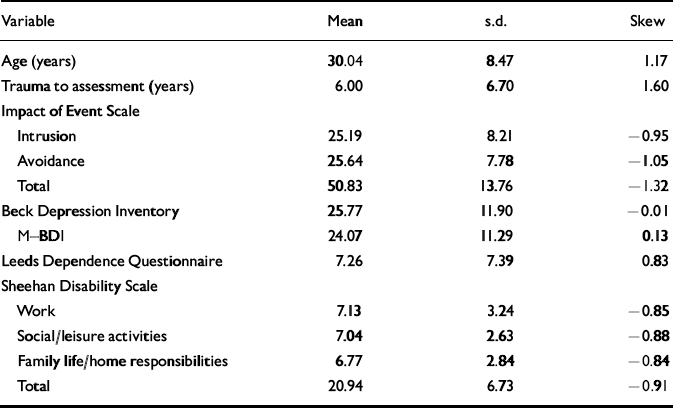
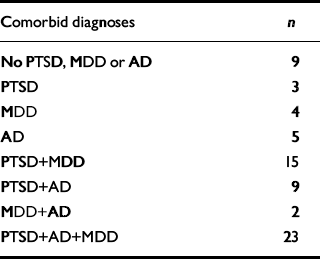
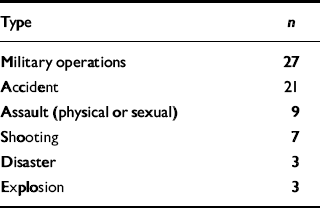
All 70 participants, of whom 3 were female, were either non-commissioned officers or of private rank. All were employed by the Ministry of Defence and were either on sick leave (n=50) or still at work (n=20) at the time of the assessment. Table 1 shows the range of the continuous variables, including time from trauma to assessment, and the mean age of the group. All the variables were observed to be normally distributed. Table 2 shows the distribution of DSM–IV diagnoses made using the SCID. Of the 50 participants with PTSD, 47 (94%) also had a diagnosis of either alcohol dependence or major depressive disorder. Table 3 lists the range of traumatic incidents experienced by the participants.
Table 1 Mean scores, standard deviations and skew for variables (n=70)
| Variable | Mean | s.d. | Skew |
|---|---|---|---|
| Age (years) | 30.04 | 8.47 | 1.17 |
| Trauma to assessment (years) | 6.00 | 6.70 | 1.60 |
| Impact of Event Scale | |||
| Intrusion | 25.19 | 8.21 | -0.95 |
| Avoidance | 25.64 | 7.78 | -1.05 |
| Total | 50.83 | 13.76 | -1.32 |
| Beck Depression Inventory | 25.77 | 11.90 | -0.01 |
| M-BDI | 24.07 | 11.29 | 0.13 |
| Leeds Dependence Questionnaire | 7.26 | 7.39 | 0.83 |
| Sheehan Disability Scale | |||
| Work | 7.13 | 3.24 | -0.85 |
| Social/leisure activities | 7.04 | 2.63 | -0.88 |
| Family life/home responsibilities | 6.77 | 2.84 | -0.84 |
| Total | 20.94 | 6.73 | -0.91 |
Table 2 Comorbid DSM-IV diagnoses in the study sample (n=70)
| Comorbid diagnoses | n |
|---|---|
| No PTSD, MDD or AD | 9 |
| PTSD | 3 |
| MDD | 4 |
| AD | 5 |
| PTSD+MDD | 15 |
| PTSD+AD | 9 |
| MDD+AD | 2 |
| PTSD+AD+MDD | 23 |
Table 3 Classification of traumatic events experienced by the study sample (n=70)
| Type | n |
|---|---|
| Military operations | 27 |
| Accident | 21 |
| Assault (physical or sexual) | 9 |
| Shooting | 7 |
| Disaster | 3 |
| Explosion | 3 |
MANOVA and ANCOVA
Using MANOVA there was no significant interaction or between-subject effect (P<0.01) for the DSM–IV diagnoses of PTSD, major depressive disorder or alcohol dependence using the Sheehan Disability Scale scores as the dependent variables. Using ANCOVA and controlling for the continuous variables of post-traumatic stress symptoms (IES), depression (BDI and M-BDI), alcohol dependence (LDQ), time from trauma to assessment and participants’ age, did not produce any significant between-subject effect (P<0.01) for any DSM–IV diagnosis.
Multiple regression analysis
None of the multiple regression models retained the IES score (including the subscales), LDQ score, time from trauma to assessment or participants’ age as significant predictors of functional disability.
Work disability
Only scores on the BDI (β=0.11, s.e.=0.03; F=12.5, d.f.=1,68, P=0.001; R 2=0.16) and M-BDI (β=0.10, s.e.=0.03; F=11.5, d.f.=1,68, P=0.001; R 2=0.16) remained in the multiple regression models as significant predictors of work disability.
Impaired family life and home responsibilities
Only scores on the BDI (β=0.15, s.d.=0.02; F=40.30, d.f.=1,68, P<0.001; R 2=0.38) and M-BDI (β=0.15, s.e.=0.03; F=37.15, d.f.=1,68, P<0.001; R 2=0.37) remained in the multiple regression models as significant predictors of impaired family life and home responsibility.
Impaired social and leisure activities
Only scores on the BDI (β=0.11, s.e.=0.02; F=21.80, d.f.=1,68, P<0.001; R 2=0.24) and the M-BDI (β=0.11, s.e.=0.02; F=19.75, d.f.=1,68, P<0.001; R 2=0.23) remained in the multiple regression models as significant predictors of impaired social/leisure activity.
Total disability
Only scores on the BDI (β=0.36, s.e.=0.05; F=47.10, d.f.=1,68, P<0.001; R 2=0.42) and the M-BDI (β=0.37, s.e.=0.06; F=42.32, d.f.=1,68, P<0.001; R 2=0.39) remained in the multiple regression models as significant predictors of total disability.
DISCUSSION
The results of our study indicate that the psychiatric variables examined did not explain most of the participants’ disability. Over 60% of the variability in disability was accounted for by other factors, which were not measured in this study. The diagnoses of PTSD, major depressive disorder and alcohol dependence did not predict disability in the domains of work, relationships and social and leisure activity. This held true for each disorder even when controlling for the effects of symptoms of post-traumatic stress, depression and alcohol dependence, and for time from trauma to assessment and the participant's age. The continuous variables post-traumatic stress symptoms, alcohol dependence, time from trauma to assessment and participant's age did not predict any aspects of functional disability in individuals suffering psychological symptoms secondary to exposure to a traumatic event.
On the other hand, symptoms of depression (scored on the M-BDI) accounted for a significant proportion of the variability in terms of total functional disability (shared variance 39%) and, in particular, in the domain of impairment in family life (shared variance 37%). This is consistent with the finding that depression in the general population determines more work loss than any other single psychiatric disorder (Reference Kessler and FrankKessler & Frank, 1997), but runs counter to the contemporary view that PTSD or post-traumatic stress symptoms are the primary cause of disability in people exposed to trauma.
Limitations
The study suffered from several limitations. The results may not be generalisable because the sample was predominantly male and consisted exclusively of service personnel. This population has more restrictive contractual obligations and experiences less social deprivation than is found in the general population. The measures of disability used were self-reported and subjective; objective measures of disability (e.g. unemployment or divorce) might have provided useful additional information. According to Altman (Reference Altman1991) the sample size was sufficient (at least 10 times the maximum number of independent variables) for the multiple regression models to be reliable; however, the measurement instruments used are subject to considerable error and therefore the sample size must be considered a possible limitation.
Implications
The finding that depression consequent upon trauma is responsible for a significant proportion of disability calls into question the relationship between post-traumatic stress symptoms and depression. Overlap between the symptoms of post-traumatic stress and of depression (e.g. loss of interest, irritability, difficulties in remembering and concentration, pessimism about the future and sleep difficulties) raises the issue of whether PTSD is a separate diagnostic entity or a variant of post-traumatic depression. This question has largely been answered by factor analysis (Reference Silver and IaconoSilver & Iacono, 1984; Reference Blanchard, Buckley and HocklingBlanchard et al, 1998) and neurobiological investigations (Reference Van Der KolkVan Der Kolk, 1994; Reference Yehuda, Levengood and SchmeidlerYehuda et al, 1997), which demonstrate that the cluster of PTSD symptoms does appear to constitute a separate syndromal entity.
If PTSD and depression are separate, the question of their relationship to trauma arises. On the one hand, PTSD, and not depression, may be viewed as the primary psychiatric consequence of traumatic exposure (Reference Kessler, Sonnega and BrometKessler et al, 1995). This hypothesis is supported by evidence that the pattern of disruption of the hypothalamic-pituitary axis in patients with comorbid PTSD and depression is significantly different from that in patients with depression alone, unrelated to trauma (Reference Yehuda, Levengood and SchmeidlerYehuda et al, 1997). If this hypothesis is correct, then our findings may indicate that post-traumatic stress symptoms mediate the development of depression, which then leads to disability. On the other hand, it is possible that PTSD and depression emerge simultaneously after a trauma (Reference Bleich, Koslowsky and DolevBleich et al, 1997), a hypothesis that is supported by evidence of individuals with a shared genetic predisposition to both PTSD and depression (Reference Davidson, Swartz and StorkDavidson et al, 1985). If this hypothesis is correct, our findings may indicate that post-traumatic stress symptoms are epiphenomenal.
Either way, our findings indicate that although post-traumatic stress symptoms may cause distress they may be of questionable clinical significance if they are not a cause of disability. This claim has a number of implications. First, the current emphasis on treating PTSD to minimise disability after psychiatric injury may be misplaced, and treatment of depression may be sufficient to alleviate disability. Second, in personal injury litigation, because of the perceived importance of its role in causing disability, PTSD is separated out for special consideration as a condition for compensation (Judicial Studies Board, 2000). This may not be justified. In conclusion, although the scientific literature has been concerned with whether or not PTSD is a valid diagnostic entity (Reference SummerfieldSummerfield, 2001), this study suggests that if PTSD exists, it may not be as clinically important as has previously been claimed.
Clinical Implications and Limitations
CLINICAL IMPLICATIONS
-
▪ ▪ Post-traumatic stress disorder (PTSD) and post-traumatic stress symptoms were not associated with disability.
-
▪ ▪ Comorbid symptoms of depression were significantly associated with disability.
-
▪ ▪ The clinical importance of PTSD and post-traumatic stress symptoms may be questionable if they are not a cause of disability.
LIMITATIONS
-
▪ ▪ The study was conducted on service personnel who were predominantly male and so the findings may not be generalisable to other populations.
-
▪ ▪ The measure of disability was subjective rather than objective.
-
▪ ▪ The sample size might not have been large enough to detect meaningful relationships.
Acknowledgement
We are grateful to Dr Hazel Pilgrim for managing the PTSD assessment. programme and assisting with the collation of data.




eLetters
No eLetters have been published for this article.