





Introduction
Cognitive impairments in schizophrenia are associated with deficits in early perceptual processing, including early auditory processing (EAP). Studies have demonstrated that EAP impacts cognition and daily functioning in schizophrenia (Green, Hellemann, Horan, Lee, & Wynn, Reference Green, Hellemann, Horan, Lee and Wynn2012; Javitt, Reference Javitt2009; Koshiyama et al., Reference Koshiyama, Thomas, Miyakoshi, Joshi, Molina, Tanaka-Koshiyama and Light2020; Rassovsky, Horan, Lee, Sergi, & Green, Reference Rassovsky, Horan, Lee, Sergi and Green2011; Thomas et al., Reference Thomas, Green, Hellemann, Sugar, Tarasenko, Calkins and Light2017). For instance, a large-sample structural equation model (SEM) from the Consortium on the Genetics of Schizophrenia 2 (COGS-2) showed that EAP deficits are related to cognitive impairments and indirectly associated with negative symptoms and reduced functional outcomes (Thomas et al., Reference Thomas, Green, Hellemann, Sugar, Tarasenko, Calkins and Light2017). Hence, EAP and cognition could be pivotal in initiating a cascading effect on daily functioning. Clarifying the associations between EAP and cognition could help guide proper statistical control of these variables and help identify early-stage intervention targets or surrogate endpoints in schizophrenia.
Previous studies have predominantly used latent variable models, such as SEM, to examine the association between early perception and cognition (Green et al., Reference Green, Hellemann, Horan, Lee and Wynn2012; Koshiyama et al., Reference Koshiyama, Thomas, Miyakoshi, Joshi, Molina, Tanaka-Koshiyama and Light2020; Rassovsky et al., Reference Rassovsky, Horan, Lee, Sergi and Green2011; Thomas et al., Reference Thomas, Green, Hellemann, Sugar, Tarasenko, Calkins and Light2017); however, these analyses require challenging assumptions. Latent variable models assume (1) a common cause underlies the observed variables and (2) local independence, such that observed indicators must be independent after accounting for their latent variables (Bollen & Bauldry, Reference Bollen and Bauldry2011; Borsboom, Mellenbergh, & van Heerden, Reference Borsboom, Mellenbergh and van Heerden2003; Rhemtulla, van Bork, & Borsboom, Reference Rhemtulla, van Bork and Borsboom2020). Yet, research on the interplay of EAP and cognitive domains suggests interdependency.
Mismatch negativity (MMN) and P3a are among the most studied event-related brain potentials in schizophrenia (Erickson, Ruffle, & Gold, Reference Erickson, Ruffle and Gold2016; Koshiyama et al., Reference Koshiyama, Kirihara, Tada, Nagai, Fujioka, Koike and Kasai2018; Light et al., Reference Light, Swerdlow, Thomas, Calkins, Green, Greenwood and Turetsky2015; Light & Braff, Reference Light and Braff2005; Light & Näätänen, Reference Light and Näätänen2013; Wynn, Sugar, Horan, Kern, & Green, Reference Wynn, Sugar, Horan, Kern and Green2010). Although earlier components of EAP exist (e.g. prepulse inhibition), MMN and P3a reliably index pre-attentive processing and perception. However, because MMN and P3a are sequentially evoked as a response complex, they are not entirely independent (Braff & Light, Reference Braff and Light2004; Giordano et al., Reference Giordano, Giuliani, Perrottelli, Bucci, Di Lorenzo, Siracusano and Maj2021; Leitman et al., Reference Leitman, Sehatpour, Higgins, Foxe, Silipo and Javitt2010). For example, a path analysis demonstrated that a schizophrenia diagnosis is associated with deficits in MMN, resulting in reduced P3a (Leitman et al., Reference Leitman, Sehatpour, Higgins, Foxe, Silipo and Javitt2010). Notably, the model was not significant when the order of MMN and P3a was reversed. Beyond EAP, the interdependence among cognitive domains is well recognized. For instance, Digit Symbol tasks, often conceptualized as primarily measuring processing speed, require additional cognitive processes for successful task performance, including working memory and visual attention shifts (Abplanalp et al., Reference Abplanalp, Lee, Horan, Kern, Penn and Green2023; Gold, Hahn, Strauss, & Waltz, Reference Gold, Hahn, Strauss and Waltz2009; Sheffield & Barch, Reference Sheffield and Barch2016). Impairments in any of these processes could result in poor task performance.
The potential interdependence of EAP and cognition suggests that these constructs may be better represented as read-outs of interacting brain systems under diverse levels of cognitive challenges (i.e. passive v. active cognitive tasks) rather than as latent variables. Two methods are well-suited to analyze such interdependencies. The first is Gaussian Graphical Models (GGMs). GGMs represent constructs as interacting nodes, in which nodes symbolize variables, and the edges between nodes denote the strength of association between variables after accounting for all other variables in the network (Abplanalp & Green, Reference Abplanalp and Green2022; Borsboom et al., Reference Borsboom, Deserno, Rhemtulla, Epskamp, Fried, McNally and Waldorp2021; Epskamp, Borsboom, & Fried, Reference Epskamp, Borsboom and Fried2018a; Epskamp, Waldorp, Mõttus, & Borsboom, Reference Epskamp, Waldorp, Mõttus and Borsboom2018b). However, GGMs have a limitation – they are undirected. That is, GGMs do not estimate the direction of association (Briganti, Scutari, & McNally, Reference Briganti, Scutari and McNally2022).
A complementary method to GGMs is Bayesian network analysis – a directed network. Bayesian networks represent nodes using Directed Acyclic Graphs (DAGs), mathematical objects that indicate the conditional probability among nodes (Briganti et al., Reference Briganti, Scutari and McNally2022; Geiger, Verma, & Pearl, Reference Geiger, Verma and Pearl1990; Pearl, Reference Pearl and Arbib1998; Pearl & Mackenzie, Reference Pearl and Mackenzie2019; Verma & Pearl, Reference Verma and Pearl2022). For continuous variables, Bayesian networks estimate arcs using Gaussian distributions, allowing the distributions to be modeled as linear regressions (Briganti et al., Reference Briganti, Scutari and McNally2022). The influence of one node, called ‘parents,’ on another node, called ‘descendants’, is estimated by a unit change in the parent node's regression coefficient. Conversely, if two nodes are unconnected, they are conditionally independent. Cross-sectional DAGs can illustrate various dependent structures among nodes and provide insights beyond GGMs (Grosz, Rohrer, & Thoemmes, Reference Grosz, Rohrer and Thoemmes2020; Rohrer, Reference Rohrer2018; Wysocki, Lawson, & Rhemtulla, Reference Wysocki, Lawson and Rhemtulla2022).
An arrow between two variables in a Bayesian network signifies more than correlation. Specifically, an arrow represents a conditional dependency with direction. If there is an arc from A to B, it suggests that A directly influences B even when all other variables in the network are accounted for. Correlation can flow in any direction, but causation only flows in the direction of the arrows (Pearl & Mackenzie, Reference Pearl and Mackenzie2019). Following DAG terminology, we can infer three types of dependent structures. The first structure is a chain (A → B → C), where A has an indirect influence on C through B, making A and C conditionally independent when conditioning on B (A ⊥ C | B). The second structure is a confounder (A ← C → B), where C is a common cause of A and B, making A and B conditionally independent when controlling for C (A ⊥ B | C). The third structure is a collider (A → C ← B), with no association between A and B (A ⊥ B). Collider structures are critical because spurious associations may emerge between A and B if C is not accounted for.
This study used data from COGS-2 (Swerdlow, Gur, & Braff, Reference Swerdlow, Gur and Braff2015) to examine the interdependence between EAP and cognition in schizophrenia patients and controls. We selected variables based on those used in the previous SEM paper on the same dataset (Thomas et al., Reference Thomas, Green, Hellemann, Sugar, Tarasenko, Calkins and Light2017) to highlight how associations between EAP and cognition differ when using latent variable models v. GGMs and Bayesian networks. Our analyses had two primary goals. First, we used GGMs to assess the network structure of EAP and cognition and to determine whether the structure differed between schizophrenia patients and controls. Second, we applied Bayesian network analyses to clarify the direction of network connections. We did this separately by group to identify parent variables and evaluate differences in dependent structures.
Methods
Participants
The study included 1415 patients diagnosed with schizophrenia or schizoaffective disorder, depressed type, and 1062 healthy community controls. We used the Structured Clinical Interview for DSM-IV (First & Gibbon, Reference First, Gibbon, Hilsenroth and Segal2004) to confirm diagnoses. Participants were recruited across five sites: the University of California, Los Angeles; University of California, San Diego; Mount Sinai School of Medicine, New York; University of Pennsylvania; and University of Washington, Seattle. Exclusion criteria included: neurologic or additional Axis I psychiatric disorders; head injury; stroke; and substance abuse. Each site's local Institutional Review Boards approved the study, and all participants provided written informed consent. Details regarding recruitment, participant selection criteria, and clinical assessments are presented elsewhere (Abplanalp, Braff, Light, Nuechterlein, & Green, Reference Abplanalp, Braff, Light, Nuechterlein and Green2022; Greenwood et al., Reference Greenwood, Lazzeroni, Maihofer, Swerdlow, Calkins, Freedman and Braff2019; Joshi et al., Reference Joshi, Molina, Braff, Green, Gur, Gur and Light2023; Lee et al., Reference Lee, Green, Nuechterlein, Swerdlow, Greenwood, Hellemann and Braff2020; Swerdlow et al., Reference Swerdlow, Gur and Braff2015).
Mismatch negativity and P3a
In this study, participants experienced binaural tones by inserting earphones. The tones were set at 1 kHz and 85 dB, featured a 1 ms rise and fall time, and were set to occur every 500 ms. We employed a duration-deviant auditory oddball paradigm, wherein the deviant stimuli's duration differed. A pseudorandom sequence was used to present standard tones, which had a 90% probability and a duration of 50 ms, and deviant tones, which had a 10% probability and lasted 100 ms. A minimum of six standard stimuli was ensured before introducing each deviant stimulus. To determine the MMN/P3a waveform, we subtracted the ERP waveform resulting from standard stimuli from the ERP waveform induced by deviant stimuli. The MMN and P3a amplitudes were measured as the average amplitude within the 135–205 ms and 250–300 ms time windows, respectively (Light et al., Reference Light, Swerdlow, Thomas, Calkins, Green, Greenwood and Turetsky2015).
Cognition
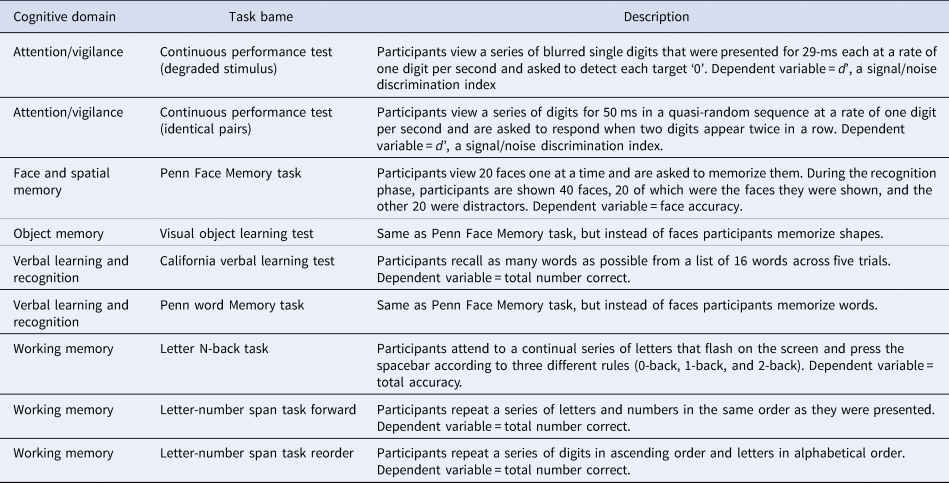
Selected measures of cognition were taken from the prior COGS-2 SEM paper and are defined in Table 1. We measured attention/vigilance with the Degraded Stimulus (DS-CPT) and Identical Pairs (CPT-IP) Continuous Performance Tests (Green & Swets, Reference Green and Swets1966; Nuechterlein et al., Reference Nuechterlein, Green, Calkins, Greenwood, Gur, Gur and Braff2015); face and object memory with the Penn Face Memory task (PFMT) and the Visual Object Learning Test (VOLT) from the Penn Computerized Neurocognitive Battery (Gur et al., Reference Gur, Ragland, Moberg, Turner, Bilker, Kohler and Gur2001, Reference Gur, Richard, Hughett, Calkins, Macy, Bilker and Gur2010, Reference Gur, Braff, Calkins, Dobie, Freedman, Green and Gur2015; Moore, Reise, Gur, Hakonarson, & Gur, Reference Moore, Reise, Gur, Hakonarson and Gur2015); verbal learning and recognition with the California Verbal Learning Test-Second Edition (CVLT) (Stone et al., Reference Stone, Mesholam-Gately, Braff, Calkins, Freedman, Green and Seidman2015; Woods, Delis, Scott, Kramer, & Holdnack, Reference Woods, Delis, Scott, Kramer and Holdnack2006) and the Penn Word Memory task (PWMT) from the Penn Computerized Neurocognitive Battery (Gur et al., Reference Gur, Ragland, Moberg, Turner, Bilker, Kohler and Gur2001, Reference Gur, Richard, Hughett, Calkins, Macy, Bilker and Gur2010, Reference Gur, Braff, Calkins, Dobie, Freedman, Green and Gur2015; Moore et al., Reference Moore, Reise, Gur, Hakonarson and Gur2015); and working memory with the Letter N-back task (N-back) from the Penn Computerized Neurocognitive Battery (Gur et al., Reference Gur, Ragland, Moberg, Turner, Bilker, Kohler and Gur2001, Reference Gur, Richard, Hughett, Calkins, Macy, Bilker and Gur2010, Reference Gur, Braff, Calkins, Dobie, Freedman, Green and Gur2015; Moore et al., Reference Moore, Reise, Gur, Hakonarson and Gur2015) and the Letter-Number Span Task-Forward (LNS-F) and Letter-Number Span Task-Reorder (LNS-R) from the Wechsler Memory Scale-Third Edition (Gold, Carpenter, Randolph, Goldberg, & Weinberger, Reference Gold, Carpenter, Randolph, Goldberg and Weinberger1997; Lee et al., Reference Lee, Green, Calkins, Greenwood, Gur, Gur and Braff2015; Wechsler, Reference Wechsler1997).
Names and descriptions of the cognitive tasks
Statistical Analyses
Gaussian graphical models (undirected networks)
All analyses were performed using R (Version 4.2.0), with code available at: https://osf.io/h78jv/. We used bootnet (Epskamp et al., Reference Epskamp, Borsboom and Fried2018a, Reference Epskamp, Waldorp, Mõttus and Borsboom2018b) to estimate GGMs. Nodes comprised EAP and cognitive variables and lines between nodes are edges, representing undirected (A ─ B) partial correlations. All variables were standardized using z-score transformations. The primary distinction between a standard partial correlation and the ones estimated by GGMs is the use of a regularization technique. We applied regularization using the Extended Bayesian Information Criterion form of the graphical least absolute shrinkage with a tuning parameter gamma of 0.5 (Epskamp et al., Reference Epskamp, Borsboom and Fried2018a, Reference Epskamp, Waldorp, Mõttus and Borsboom2018b). This method employs an L1 penalty that estimates a sparse inverse covariance matrix and shrinks trivially small partial correlations to zero, omitting them from the graph. Hence, there is a higher degree of confidence in the estimated edges within GGMs compared to standard partial correlations. To illustrate how associations among measures of EAP and cognition can differ among correlation types, we also estimated bivariate correlation and standard partial correlation (without regularization) networks (see online Supplementary Material).
We then evaluated accuracy of the GGM edges by using nonparametric bootstrapping with 1000 bootstrap samples. Lastly, we measured node predictability (Haslbeck & Fried, Reference Haslbeck and Fried2017). Node predictability represents the shared variance of each node and is an absolute measure of interconnectedness. Predictability is illustrated in black around each node. GGMs were arranged in a circular layout using the R package qgraph (Epskamp, Cramer, Waldorp, Schmittmann, & Borsboom, Reference Epskamp, Cramer, Waldorp, Schmittmann and Borsboom2012).
GGM network comparison
To assess whether the GGMs between schizophrenia patients and controls significantly differed, we conducted network comparison tests with 2000 iterations via the NetworkComparisionTest (van Borkulo et al., Reference van Borkulo, van Bork, Boschloo, Kossakowski, Tio, Schoevers and Waldorp2022). We used the Network Invariance Test to compare the groups' overall network structure. This test evaluates if there are differences in network edges between groups, and whether those differences are significant. Edges may appear to differ between groups but that does not automatically indicate that the differences are statistically significant. We used the Global Strength Invariance Test to compare the sum of all absolute edge values. Both invariance tests were conducted using the Holm-Bonferroni method for multiple comparisons.
Bayesian networks (directed networks)
Bayesian networks include variables represented as nodes via DAGs and are connected via arcs. An arc from one node to another implies a directed connection – which could be positive or negative. However, Bayesian networks rely on critical assumptions, including the presence of no bidirectional causal relationships (A → B and B → A) or feedback loops (A → B, B → C, and C → A), and that all essential variables are included in the network (Geiger et al., Reference Geiger, Verma and Pearl1990; McNally, Robinaugh, Deckersbach, Sylvia, & Nierenberg, Reference McNally, Robinaugh, Deckersbach, Sylvia and Nierenberg2022; Pearl, Reference Pearl and Arbib1998; Verma & Pearl, Reference Verma and Pearl2022). The assumption of all essential variables is quite difficult to satisfy, given the number of third variables that could affect cognition. Hence, we estimated DAGs using the same variables as the GGMs. We again standardized all variables.
We used a score-based learning algorithm called the hill-climbing (Russell, Reference Russell2010) algorithm in bnlearn (Scutari, Reference Scutari2010) to estimate Bayesian networks. The hill-climbing algorithm is a machine-learning process that estimates DAGs by exploring single-edge additions, removals, and reversals to optimize goodness of fit based on the Bayesian Information Criteria (BIC). First, it calculates the fit of an empty DAG, defined as Score (G), and sets maxscore = Score(G). Next, it computes the modified network G* score for edge additions, deletions, or reversals that do not result in a cyclic network. If any G* has a Score (G*) > Score(G), maxscore is updated to Score (G*), and G* becomes the new candidate network; this process repeats until an optimal fitting DAG is selected.
To ensure network stability, we used a bootstrapping method with 1000 samples (Abplanalp et al., Reference Abplanalp, Lee, Horan, Kern, Penn and Green2023; McNally, Heeren, & Robinaugh, Reference McNally, Heeren and Robinaugh2017a; McNally, Mair, Mugno, & Riemann, Reference McNally, Mair, Mugno and Riemann2017b). The technique involved creating a network for each sample, averaging all networks, and examining the frequency and direction of arcs. If an arc was present (regardless of direction) in a minimum of 85% of the bootstrapped DAGs and pointed in a given direction in at least 51% of those DAGs, it was represented in the final Bayesian network. We also computed the standardized Beta coefficient for each arc of the final network, indicating the degree of influence a unit change in a parent node has on descendant nodes, and the overall fit of Bayesian networks via the BIC. The Bayesian networks were arranged in the same circular layout as the GGM to facilitate comparison.
Bayesian network comparison
We used a form of the Jaccard similarity coefficient to examine differences in Bayesian network structure. This metric divides the number of arcs that are common in both networks by the number of unique arcs across both networks. We also computed a metric called Arc direction agreement to examine differences in arc direction. This metric divides the number of arcs that have the same direction in both networks by the total number of arcs in one of the networks. The Jaccard similarity coefficient and Arc direction agreement range between 0 and 1. Both metrics were bootstrapped using 1000 iterations.
Results
After excluding participants via listwise deletion, the sample included 663 outpatients diagnosed with schizophrenia or schizoaffective disorder and 630 community controls. Missing data were primarily due to the EAP measures being added later in the COGS-2 study. Demographic information is presented in Table 2. Compared to controls, schizophrenia patients were significantly older, t(1291) = −10.37, p < 0.001, had a higher proportion of males χ2(1, N = 1293) = 55.80, p < 0.001, and had a lower proportion of Asian and White participants and a higher proportion of Black participants, χ2(6, N = 1293) = 77.34, p < 0.001.
Demographic characteristic of schizophrenia patients and controls
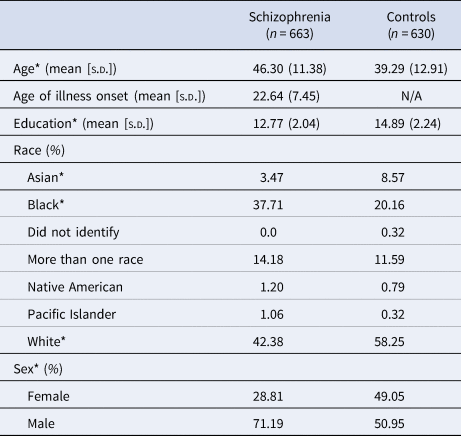
Note. * = Significantly different at p < 0.001.
Gaussian graphical models
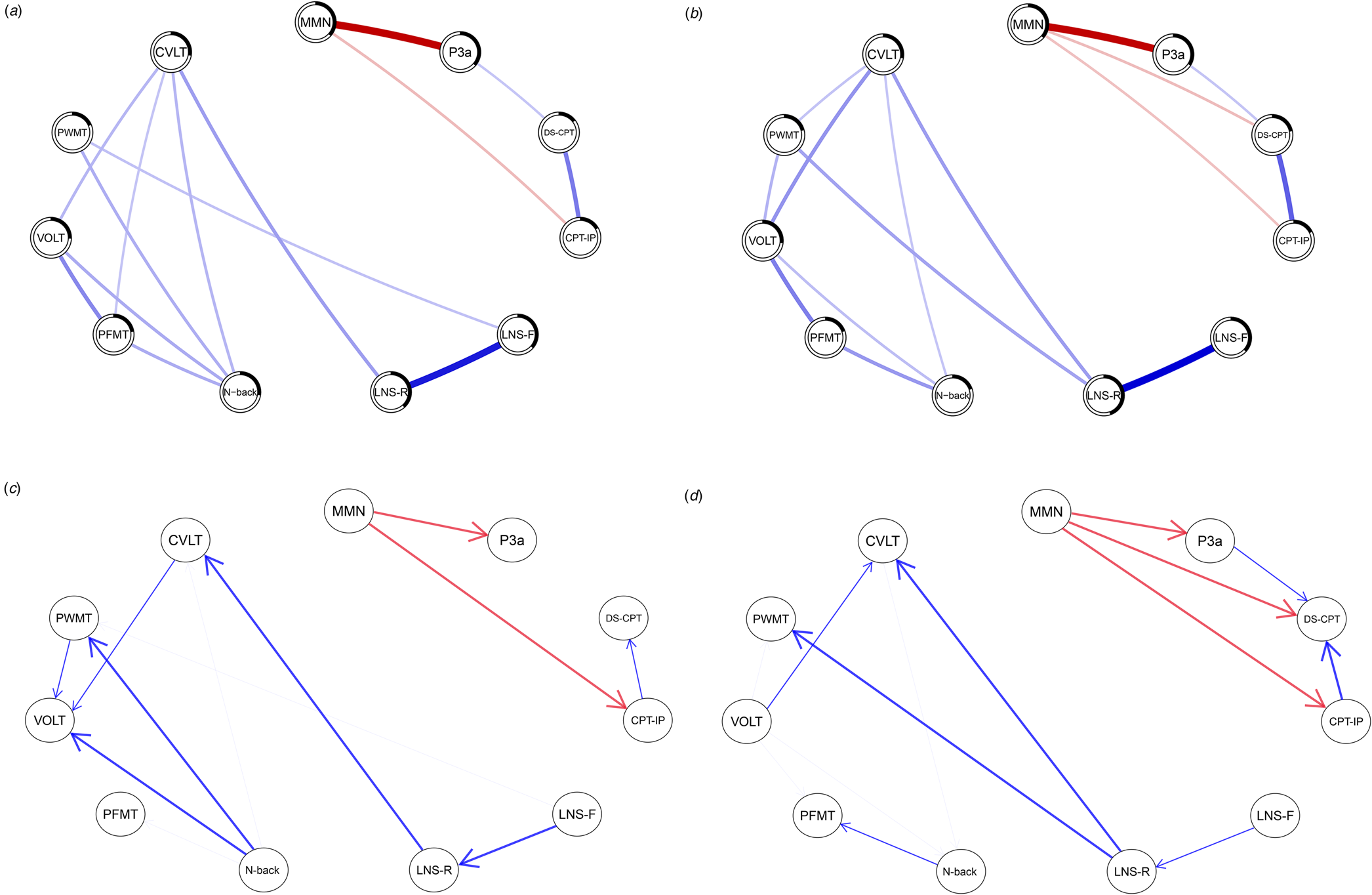
In schizophrenia, the strongest edges were between LNS-F and LNS-R (r p = 0.49) and mismatch negativity and P3a (r p = −0.54). LNS-F and LNS-R (r p = 0.50) and mismatch negativity and P3a (r p = −0.48) were also the strongest edges in controls. The confidence intervals were narrow in both groups for the nonparametric bootstrap analysis, indicating stable estimates (see online Supplementary Material).
In both groups, EAP and attention/vigilance variables were connected but separated from other cognitive domains (Fig. 1). The CVLT and the VOLT had the most connections in schizophrenia patients, and the CVLT and the N-back had the most connections to other variables in controls. The LNS-R had the highest node predictability in both groups.
GGMs and Bayesian networks of EAP and cognitive variables for Schizophrenia patients and controls.
Note. Panel A, GGM for controls; Panel B, GGM for schizophrenia patients; Panel C, Bayesian network for controls; Panel D, Bayesian network for schizophrenia patients. GGM, Gaussian graphical model; EAP, early auditory processing; MMN, mismatch negativity; DS-CPT, degraded stimulus continuous performance test; CPT-IP, continuous performance test identical pairs; LNS-F, letter-number span task forward; LNS-R, letter-number span task reorder; PWMT, Penn Word Memory task; CVLT, California Verbal Learning Test; N-back, Letter N-back task; PFMT, Penn Face Memory task; VOLT, Visual Object Learning Test.
GGM network comparison test
The Global Network Invariance Test indicated no significant differences in the structure between the schizophrenia and control network, even though six edges were different between the baseline networks (M = 0.19, p = 0.33). The Global Strength Invariance Test was also non-significant (S = 0.18, p = 0.53).
Bayesian networks
Figure 1 also depicts the Bayesian networks for schizophrenia patients and controls. Arc thickness indicates the confidence in the directionality from one node to another, with less thick arcs equating to less confident estimates (Table 3). Blue arcs represent positive Beta coefficients, and red arcs represent negative coefficients. The BIC was −9744.99 for the schizophrenia network and −9290.78 for the control network.
Arc frequency, arc direction, and beta coefficients for the Bayesian networks
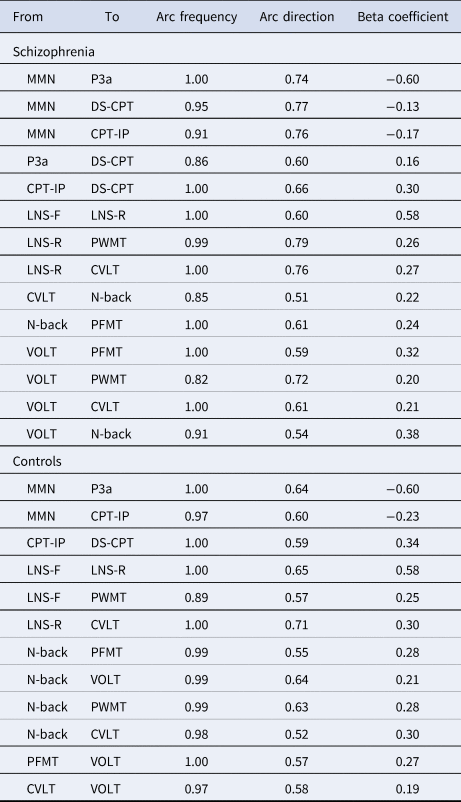
Note. MMN, Mismatch negativity; DS-CPT, Degraded stimulus continuous performance test; CPT-IP, Continuous performance test identical pairs; LNS-F, Letter-number span task forward; LNS-R, Letter-number span task reorder; PWMT, Penn Word Memory task; CVLT, California Verbal Learning Test; N-back, Letter N-back task; PFMT, Penn Face Memory task; VOLT, Visual Object Learning Test; arc frequency refers to the proportion of times that an arc appeared in the bootstrap samples, regardless of direction. Arc direction refers to the proportion of times that the arc pointed in that given direction.
Like the GGMs, EAP and attention/vigilance variables were conditionally independent from the other cognitive domains (EAP ⊥ cognition | attention/vigilance) and conditionally dependent on each other. This means that once controlling for the other cognitive domains, EAP is only associated with attention/vigilance, and attention/vigilance is only associated with EAP. However, EAP is not completely independent from the other cognitive domains given the presence of bivariate associations. The Bayesian networks provide additional information on the direction of these relationships. MMN is a parent variable upon which P3a and the CPT depend. Specifically, MMN was a common cause of P3a, CPT-IP, and DS-CPT in schizophrenia patients. P3a was also a parent variable to DS-CPT in schizophrenia but not in controls. Beta coefficients are included in Table 3.
Regarding the remaining cognitive domains, the groups had differences in parent and descendant variables. In schizophrenia, the VOLT was a parent variable to the CVLT, PFMT, N-Back, and PWMT. In controls, the VOLT was a descendant of the CVLT, PFMT, and N-back. In schizophrenia, the N-back was a parent variable to the PFMT and a descendant variable of the VOLT and CVLT. In controls, the N-back was a parent variable upon which the PFMT, VOLT, PWMT, and CVLT depended.
From these connections, two chains emerged in the control group. One initiates from LNS-F and ends at VOLT (LNS-F → LNS-R → CVLT → VOLT) and the second chain begins from N-back and ends at VOLT (N-back → PFMT → VOLT). These patterns suggest that VOLT is a collider variable with different variables leading to it (e.g. PFMT → VOLT ← CVLT) and functions as a common effect. In contrast, the N-back is a confounding variable (e.g. VOLT ← N-back → PWMT) and is a common cause for more than one variable.
In schizophrenia, two chains also emerged, with one initiating from LNS-F and ending at N-back (LNS-F → LNS-R → CVLT → N-back) and the second initiating from VOLT and ending at N-back (VOLT → CVLT → N-back). In contrast to controls where it functioned as a confounding variable, N-back is a collider in patients (e.g. VOLT → N-back ← CVLT), functioning as a common effect. In contrast to controls where VOLT was a collider, it is a confounder in patients (e.g. PWMT ← VOLT → CVLT) and serves as a common cause.
Bayesian network comparison
The Jaccard similarity coefficient was 0.23, meaning there is a moderate degree of similarity between the arc sets of the two networks. A score of 0.23 suggests that about 23% of the arcs are common between schizophrenia and control networks. Arc direction agreement was 0.46, indicating that 46% of the common arcs between schizophrenia patients and controls have the same direction. This value suggests that when the same relationships (arcs) are present in both networks, the direction of influence differs nearly half of the time.
Follow-up analyses
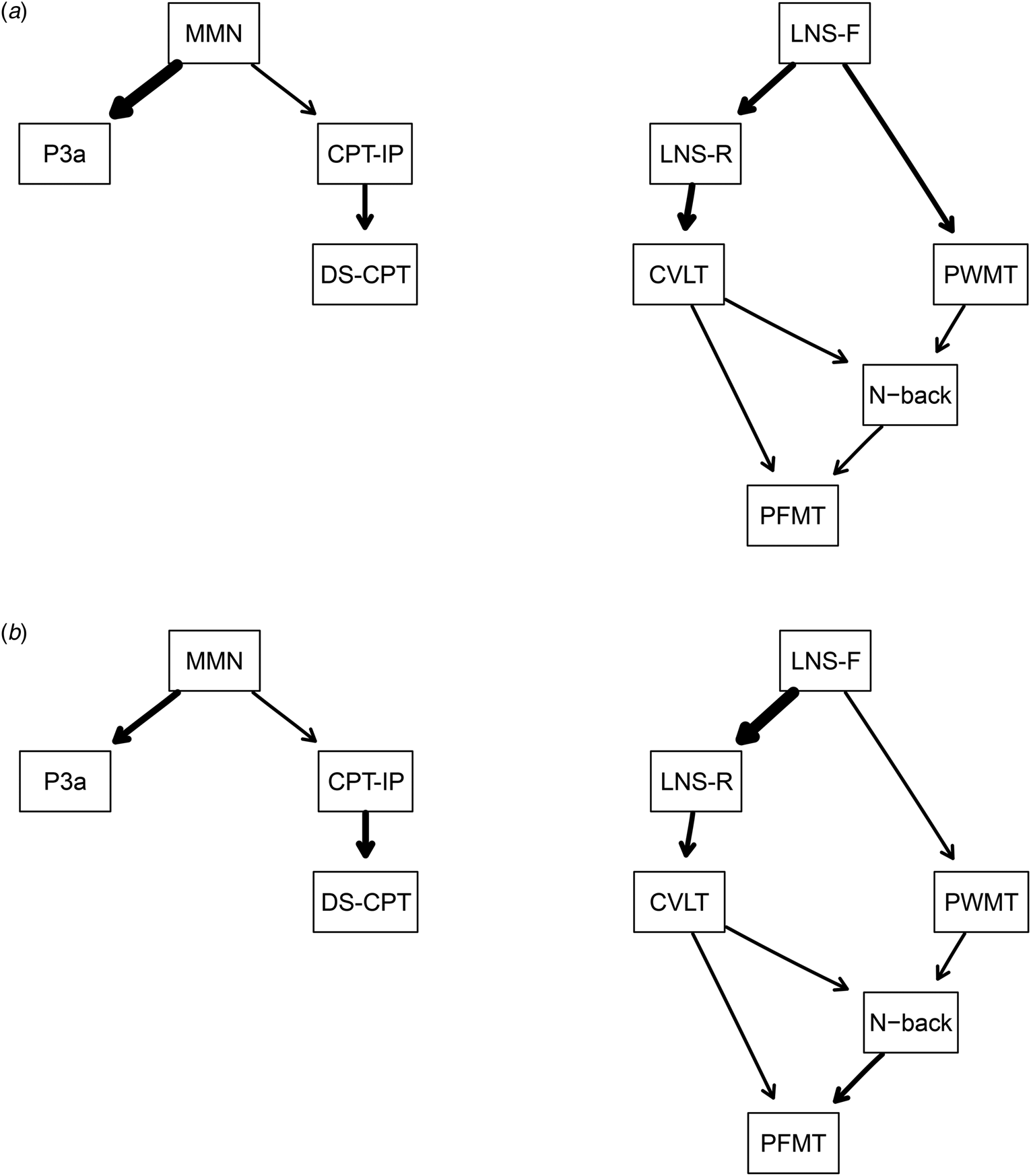
Based on the Bayesian network results, we conducted follow-up analyses. Given the influential role of the VOLT as a parent variable in schizophrenia and a descendant variable in controls, we estimated Bayesian networks (using the same methods as above) that omitted this domain. After removing the VOLT, the network structures appeared similar in both groups (Fig. 2 in the standard bnlearn output). In addition, the VOLT had the strongest between-group effect size of any task used in the study (d = 1.32), suggesting that schizophrenia patients were severely impaired in object learning. Moreover, as cognitive function declines with age (Lee et al., Reference Lee, Green, Nuechterlein, Swerdlow, Greenwood, Hellemann and Braff2020), we stratified age to adjust for its confounding effects in the Bayesian networks. These Bayesian networks showed minimal differences from the original networks (online Supplementary Material). Lastly, we conducted regression analyses to illustrate select dependent structures estimated from the Bayesian networks (online Supplementary Material).
Bayesian networks of EAP and cognitive variables for schizophrenia patients and controls after removing the VOLT.
Note. Panel A, Bayesian network for controls; Panel B, Bayesian network for schizophrenia patients. EAP, Early auditory processing; VOLT, Visual object learning test; MMN, Mismatch negativity; DS-CPT, Degraded stimulus continuous performance test; CPT-IP, Continuous performance test identical pairs; LNS-F, Letter-number span task Forward; LNS-R, Letter-number span task reorder; PWMT, Penn Word Memory task; CVLT, California Verbal Learning Test; N-back, Letter N-back task; PFMT, Penn Face Memory task.
Discussion
This study used GGMs and Bayesian networks to clarify links between EAP and cognition in large samples of schizophrenia patients and controls. The most robust findings across both networks and groups were that EAP and attention/vigilance measures were interconnected but conditionally independent from other cognitive domains used in this study. Even though MMN and P3a are widely presumed to reflect pre-attentive auditory information, this is the first study to provide evidence of their dependent relationships to performance-based measures of attention/vigilance while accounting for other cognitive processes. These findings support hierarchical information processing models of schizophrenia (Dondé, Silipo, Dias, & Javitt, Reference Dondé, Silipo, Dias and Javitt2019; Heinz et al., Reference Heinz, Murray, Schlagenhauf, Sterzer, Grace and Waltz2018; Rissling et al., Reference Rissling, Braff, Swerdlow, Hellemann, Rassovsky, Sprock and Light2012). The Bayesian networks offered additional insights into these relationships. In schizophrenia, MMN was a parent variable upon which P3a, DS-CPT, and CPT-IP depended. In addition, DS-CPT depended on P3a, forming a causal chain in schizophrenia (MMN → P3a → DS-CPT → CPT-IP). In controls, P3a also depended on MMN, but no variables depended on P3a. Hence, a slightly different causal chain emerged in controls (MMN → CPT-IP → DS-CPT). Differences in directional dependency may help explain attentional deficits in schizophrenia. As attention/vigilance are further down the estimated causal pathway, EAP measures could play a more influential role and contribute to more pronounced impairment in schizophrenia.
Using Bayesian networks, we were able to identify differences in the direction of influence of cognitive functions between the groups. In controls, the N-back was a key parent variable, and the VOLT was either a direct endpoint or the endpoint of a chain structure. In schizophrenia patients, the N-back was a collider and operated as a common effect, and the VOLT was a key parent variable that directly influenced multiple cognitive domains. However, removing the VOLT from the model altered each group's cognitive structure so that they were similar, suggesting that both groups may have the same default ‘baseline’ structure when this construct is not included in the model.
The strong effect size of the VOLT may help explain differences in Bayesian network structures and why the structures were similar after their omission. Because schizophrenia patients were more impaired on the VOLT, object memory may be viewed as a rate-limiting factor that affects cognitive performance across multiple domains. The importance of the VOLT in the structure of cognition is consistent with one top-down processing framework of visual perception (Adámek, Langová, & Horáček, Reference Adámek, Langová and Horáček2022; Bar, Reference Bar2003; Bar et al., Reference Bar, Kassam, Ghuman, Boshyan, Schmid, Dale and Halgren2006). According to this framework, object recognition is initiated in healthy individuals by top-down processes within the orbitofrontal cortex (OFC). Brain activation associated with successful object recognition develops and peaks in the OFC earlier than in more traditional visual processing regions, including the temporal cortex. As such, the OFC – and the prefrontal cortex in general – is thought to play a role in top-down predictions about the identity of objects. However, reduced neural activity in the OFC in schizophrenia patients may lead to disruptions in this top-down process. One interpretation of our results could be that controls first engage high-order cognitive functions, such as verbal and working memory, for successful task completion during the VOLT. In contrast, schizophrenia patients may not fully recruit high-order cognitive processes during the VOLT, contributing to a stronger reliance on bottom-up processing (Adámek et al., Reference Adámek, Langová and Horáček2022; Javitt, Reference Javitt2009).
Our analytical approach adds novel insight into the relationship between EAP and cognition beyond what latent variable models have shown. In comparing our results with the previous SEM paper of the same dataset (Thomas et al., Reference Thomas, Green, Hellemann, Sugar, Tarasenko, Calkins and Light2017), three advantages are worth highlighting. First, using SEM, EAP predicted a latent variable of cognitive domains; however, this variable excluded the attention/vigilance tasks. Thus, our analyses yield a clearer understanding of the relationship between EAP and cognition by demonstrating that attention/vigilance is the sole cognitive domain associated with EAP used in this study after accounting for the associations among all cognitive tasks. Second, SEM treated MMN and P3a as interchangeable parts of an underlying factor. However, as demonstrated by EEG, MMN temporally precedes P3a, but SEM does not appropriately capture this nuance. Through Bayesian networks, we were able to represent different components of EAP and clarify how neurophysiological phenomena are linked to higher-order cognitive phenomena. By using latent variables, prior analyses assumed that MMN and P3a had similar effects on cognition, potentially masking unique associations. Leveraging a complementary set of network analyses, we demonstrated that MMN and P3a have distinct effects on cognition. Third, by utilizing DAGs, we were able to identify different dependent structures that can inform statistical control and causal assumptions. For instance, in both groups, EAP is not associated with working memory given attention/vigilance and would be hypothesized to be conditionally independent (EAP ⊥ working memory | attention/vigilance).
One limitation was our reliance on cross-sectional data. Although there is growing emphasis on the need for longitudinal data in network models, EAP and cognition are relatively stable processes (McCleery & Nuechterlein, Reference McCleery and Nuechterlein2019; Pietrzak et al., Reference Pietrzak, Snyder, Jackson, Olver, Norman, Piskulic and Maruff2009; Szöke et al., Reference Szöke, Trandafir, Dupont, Meary, Schürhoff and Leboyer2008). Nonetheless, future studies should examine the dynamic nature of cognition to uncover the appropriate timescale and temporal distance in which cognitive processes influence each other over time (Hopwood, Bleidorn, & Wright, Reference Hopwood, Bleidorn and Wright2022). Our results could be further advanced by examining longitudinal idiographic network models. Recent work indicates that cross-sectional network parameters from baseline partial correlation networks are predictive of within-subject networks over time (von Klipstein, Borsboom, & Arntz, Reference von Klipstein, Borsboom and Arntz2021). Another limitation of the current study was that we did not experimentally control medication effects. We previously showed that the schizophrenia patients of COGS-2 have a high anticholinergic medication burden (ACB), which was associated with measures of EAP and cognition (Joshi et al., Reference Joshi, Thomas, Braff, Green, Gur, Gur and Light2021). However, we chose not to adjust for ACB in the current analyses because it would not provide a valid comparison to the control networks. As such, we view our analyses and results as providing information on the fundamental structure of EAP and cognition. Similarly, our results are limited by the types of EAP and cognitive tasks included in the study. Namely, we did not include any behavioral measures of EAP, such as the Tone Matching Test. In addition, social cognitive tasks that measure auditory emotion recognition and measures of early visual processing, such as visual backward masking, could be relevant for understanding the causal pathways between EAP and cognition (McCleery et al., Reference McCleery, Wynn, Lee, Reavis, Ventura, Subotnik and Nuechterlein2020). Lastly, our Bayesian network analyses may have violated the assumption of acyclicity, as certain domains could overlap and tap into mutually dependent cognitive processes (Gold et al., Reference Gold, Hahn, Strauss and Waltz2009).
Conclusion
We used GGMs and Bayesian networks to examine undirected and directed connections among measures of EAP and cognition in schizophrenia. These results could help identify dependent structures that can guide statistical decisions, such as how accounting for certain variables may lead to biased effects. Secondary, our results could be used to help create experimental or longitudinal studies to help identify intervention targets and surrogate endpoints, such as MMN and the VOLT. Ultimately, these types of analyses may be informative for gaining mechanistic insights into the downstream contributions of EAP to more distal cognitive, clinical, and functional disability.
Supplementary material
The supplementary material for this article can be found at https://doi.org/10.1017/S0033291724000023
Acknowledgements
Nonauthor collaborators of the Consortium on the Genetics of Schizophrenia 2 include: Ruben C. Gur, Raquel E. Gur, William S. Stone, Tiffany A. Greenwood, Laura C. Lazzeroni, Allen D. Radant, Larry J Seidman, Larry J Siever, Jeremy M. Silverman, Joyce Sprock, Catherine A. Sugar, Debby W. Tsuang, Ming T. Tsuang, and Bruce I. Turetsky.
Funding statement
This study was supported by the University of California San Diego: Brain & Behavior Research Foundation (27428, R25 MH101072, K23-MH102420, R01-MH065571, R33-MH125114, and R33-MH123603), Veterans Affairs San Diego Medical Center (IK2 RX003395), Mount Sinai School of Medicine (R01MH065554), University of California, Los Angeles (R01-MH65707), University of Pennsylvania (R01-MH65578), University of Washington (R01-MH65558), University of Stanford (R01MH086135), and State University of New York Downstate: Brain & Behavior Research Foundation. This work was also supported by the VA Advanced Fellowship in Mental Illness Research and Treatment (to Dr Abplanalp). Dr Abplanalp had full access to all the data in the study and took responsibility for the integrity of the data and the accuracy of the data analysis.
Competing interests
Dr Light reported having been a consultant to Astellas, Boehringer Ingelheim, Heptares, Merck, and NeuroSig. Dr Nuechterlein reported receiving unrelated research support from Ortho-McNeil Janssen Scientific Affairs; grants from the National Institute of Mental Health, Janssen, and Alkermes; personal fees from ReCognify; and consulting for Wyeth and Pfizer. Dr Green has been a consultant or speaker for Biogen, Otsuka, Teva, and Sumitomo Dainippon Pharma. No other disclosures were reported.


 Open access

