


Driving towards to Sihecun village, I became more and more excited about meeting the Chinese–Russian families that I had read about in the Chinese media. After a five-hour car journey from Changchun, the provincial capital of Jilin, we arrived at the village, which is in Shulan township, on a late August morning in 2016. Several village leaders welcomed our group, which consisted of a male Chinese university professor, a female Chinese research assistant and me, a Belarusian-British researcher working in a British university, and they led us into the main village office. We sat on one side of the long conference table with the receiving side sitting opposite us. The office assistant filled the glasses with water. Those sitting at the table took out pens and note pads in preparation to start an exchange. The village leaders opened the meeting by describing the village. Sihecun was a civilised village that achieved its developmental targets, we were told. The main driving force of development was migration. Out of every 2,500 village residents, 500 migrated abroad to work, mostly to Russia, where they became involved in trade, farming, manufacturing and other business activities. All the way through the introduction I was eagerly waiting for the speaker to move to the main topic and the reason why I was visiting Sihecun – the Russian–Chinese marriages that had led to the Chinese media sphere nicknaming Sihecun the ‘Russian brides’ village and that had made it famous.Footnote 1
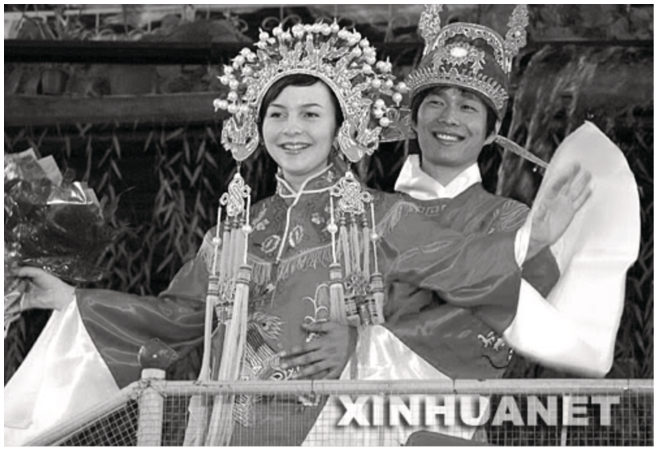
As I waited, I remembered the sequence of events that had led me here. In the mid 2010s, when I was researching cross-border kinship ties on the border between China and Vietnam, a Chinese colleague had prompted me to explore a similar – in his words – ‘trend’ that was taking place in the opposite part of China on the border with Russia. This encouraged me to open a popular Chinese search engine, Baidu, which returned numerous results for my search using the key words ‘Chinese–Russian marriages’ (中俄婚姻 Zhong E hunyin) and ‘Russian wives’ (俄罗斯媳妇 Eluosi xifu). There were a considerable number of articles in the Chinese state and popular media about the growing number of happy Chinese–Russian families in north-east China. These productions ranged from short TV reports, printed news articles, entertainment programmes,Footnote 2 films and TV dramasFootnote 3 to citizen-made products on social media platforms. One article on the Chinese state-run Xinhua News Agency particularly caught my attention. It included a colourful image of a mixed-race couple in traditional Chinese wedding attire, dressed in the way that ethnic minorities are depicted in official documents in China (Fig. I.1). The article about the Russian brides village called Sihecun stated that, ever since 1996, many of the men from this village had been going to Russia to earn money and had returned home with Russian wives. It went on to say that these ‘beautiful and happy marriages between China and Russia have become a local legend’.Footnote 4 All this made me curious to visit the Russian brides village and meet the women who, according to these journalistic accounts, had settled there. I wanted to interview these women about their life trajectories and their married lives in China. Yet the villagers at the meeting in Sihecun were not in a rush to talk about the Chinese–Russian families. The more I searched for material on Chinese–Russian marriages before my trip to Jilin, the more signs I found that this type of marriage had been constructed as a prototype of international love by the Chinese media. For example, the definition of transnational love on the popular Chinese online encyclopaedia, Baidu Baike, uses the examples and images of Chinese–Russian marriages and families to explain the meaning of transnational love.Footnote 5
A Chinese–Russian couple in traditional Chinese wedding garments.
Years after the first publications about the Russian brides village, the same discursive and representational tropes operate in labelling Sihecun as a mecca for Russian brides migrating to China.Footnote 6 The fame of the village has remained alive in the public imagination in China and has also attracted academic interest. In 2013, Sihecun village became the subject of a university research project on cultural adaptation between foreign female spouses and local residents in Chinese–Russian transnational marriages, led by a research team from a university in Beijing.Footnote 7 This state-funded study aimed to investigate cross-cultural communication in cross-border marriages at ‘the deepest and highest level of human relations’.Footnote 8 Yet, according to the lead researcher, the team failed to find a single Russian spouse living in the village during their research trip and they had to use third-hand research with local residents as their primary source of data. Like the media accounts, the project report stated that for over thirty years the village had been transformed from a poor village with bachelors into a prosperous Russian brides village. It also found that the fame of the village had started attracting Chinese bachelors from other parts of the country to Sihecun, hoping to meet Russian women.Footnote 9 The media coverage of the village’s transformation even prompted the establishment of a tourist cooperative to cater for tourists in 2018, a model Russian village, and a special mention of the village in the local government online publicity materials.Footnote 10 The eye-catching images and stories circulating in the public domain have constructed a widely held impression that the number of Chinese–Russian marriages is increasing. They feed into the popular belief that Chinese–Russian marriages are commonplace and the Russian brides village is real.
During our meeting the village representatives spoke enthusiastically about local men who had made a fortune in cross-border trade, but they were unable to name any specific Russian women living there at the time. Indeed, during the visit to the village the only ‘Russian’ (Soviet, to be precise) faces I saw there were those of Lenin and Stalin, alongside the portrait of Mao on a poster memorialising socialist leaders on the wall of the meeting room. This reference to the common ideological lineage was the main trope that joined together Chinese and Russian people in a collective memory of socialist experiments. When I asked, the villagers said that the Chinese–Russian couples had moved away to live in the cities and my hope of interviewing the Russian women was thwarted. At last, one of the officials recalled in passing that the village had served as a film set for the 26-episode TV drama, A Northeast Love Story (东北爱情故事Dongbei aiqing gushi), which had been filmed in the area. I knew then that to understand what was going on I first had to watch this television production. I discuss the themes and storylines constructed by this and other TV drama creators in Chapter 2.
The Russian brides village so vividly depicted in social media and the popular imagination is part of broader processes that feed into a widespread belief in the popularity of Chinese–Russian marriages. Chinese bloggers and the Chinese state media alike regularly remark that ‘marrying a man from China’ has become fashionable among women from the former Soviet Union.Footnote 11 In sharp contrast to the negative public images of ‘mail-order brides’, which is directed at women from south-east Asia, most of the media coverage of ‘Russian brides’ and Chinese–Russian marriages has focused on their positive, progressive and civilised character.Footnote 12 In 2018, for example, the Global Times, the international mouthpiece of the Chinese Communist Party (CCP), published an article suggesting that Chinese–Russian intermarriages are becoming integral to the closer cooperation between the two countries as a result of the Belt and Road Initiative.Footnote 13 This article was later republished on Russia’s main global media platform, Sputnik International. The Chinese national trend to present Chinese–Russian marriages as the party’s preferred type of international romance apparently has the approval of Russia’s leaders. In the heavily censored publishing environment, such media content could have been published only with the approval of the censors.Footnote 14 An important note published in 2013 by the Chinese Central Party Committee to all administrative levels, when China’s first Immigration Law came into force, announced that the management of the cultural sphere was being strengthened to ‘allow absolutely no opportunity or outlets for incorrect thinking or viewpoints to spread’.Footnote 15
Trying to make sense of this disjuncture between the lavish celebration of Chinese–Russian marriages by the media and their relative absence in China is the main motivation for this work. During my frustrated search for the Russian brides village, I have come to observe a constant blurring of reality and fiction, or what Umberto Eco calls hyperreality, which comes about when ‘imagination demands the real thing and, to attain it, must fabricate the absolute fakes’.Footnote 16 The notion of hyperreality refers to an imitation of reality that is so convincing it can be mistaken for the real thing. Although the number of Chinese–Russian marriages has seemingly been growing, along with other kinds of transnational and cross-border intimacies, Chinese–Russian marriages have become a notable subject of Chinese media constructs and national fantasies. The hyperreal in this context signifies the idealised and romanticised portrayals of these relationships that are often perpetuated through media and popular culture. How to understand this particular foreign-brides phenomenon that peppers Chinese media discourses and cultural practices is the main research concern pursued here. Furthermore, how are the media and popular imaginations of the ideal international family model related to the living experiences of the women who married and moved to live in China? I argue that the hyperreality of these marriages emerges from the interplay between the logics of desire, marriage and race in China’s pursuit of national rejuvenation. Chinese imaginations of the shifting global order intersect with the logics of what constitutes national strength and the ideal family form, asserting a particular vision of superior masculinity and desired femininity – both of which are deeply sexualised and racialised.Footnote 17
China’s race for global power is intimately related to the way that the ideal family form is imagined and actively constructed.Footnote 18 My discussion shows that the marriage and immigration regulations are part of the national security agenda premised on the heterosexual family form as the foundational society unit. The China Dream hinges on the continuity of heterosexual domesticity where white femininity plays a significant role as a symbol of China’s growing influence and attractiveness as a global power. White femininity is important in the minds of Chinese propaganda and cultural content makers because it showcases the success of Chinese masculinity. The women who could be conquered and folded into the Chinese patriarchal order take on a central role in the state’s narratives supported by popular attitudes and legal structures. This manifests in the family visitor visa that does not grant their holders a right to work until a long-term residence permit is granted. These restrictions put foreign women in a situation where they have to capitalise on their white privilege and at the same time actively negotiate their and their children’s citizenship rights and resist the order that limits their role in the Chinese society to the familial sphere.
I.1 The China Dream: Between the Hyperreal Constructions and Lived Realities
The China Dream is the latest in the series of ideological orientations (提法tifa) formulated by the Chinese communist leadership since Mao Zedong. In November 2012, in the first address to the nation as the new leader, Xi Jinping pronounced, ‘Now, we are all discussing the China Dream. In my view, to achieve the great rejuvenation of the Chinese nation is the greatest dream of the Chinese nation in modern times.’Footnote 19 Along with ‘scientific development’ (2004), ‘harmonious society’ (2004) and ‘harmonious world’ (2005) that preceded it, the China Dream provides a discursive umbrella for all Chinese domestic and foreign policies. The quest for the China Dream is fuelled by the national desire to make China the most influential global power. In May 2013, Xi specified that ‘the Chinese dream pertains to the past and the present but also the future’. William A. Callahan shows how, in this process, China and the concepts from its past, including 天下tianxia (all-under-heaven), 大同datong (great harmony) and 和谐hexie (harmony), emerged as ideas for the ideal global order with China at its helm. The China Dream works as the meta-narrative that shifts national debates from China’s past of national humiliation to its future as a great power at the centre of the world. It conjures a model of the world in place of what Chinese leaders see as an unjust and chaotic international order. Among official national dreams are reunification with Taiwan and achieving the goal of a moderately developed society by the centenary of the foundation of the People’s Republic of China (PRC) in 2049. This collective China Dream takes shape in the party documents, leaders’ speeches and official celebrations, such as the National Day parades and the CCP’s anniversaries. Chinese museums, history books and school curriculums all participate in drawing up the collective national China Dream. In this process, national histories are revisited and rewritten, and myths and fictions are produced. As well as being oriented towards building an alternative model for the international order, the China Dream works at the level of individuals, accommodating different visions, hopes, anxieties and desires of a wide range of Chinese people. The China Dream serves as a contemporary national framework for hyperreal constructs, exemplified by a Russian brides village that sustains and refines its existence as a convincing, near-real reality mirage.
The government instructs the Chinese people to have dreams and these dreams take on particular expressions. For example, Xi observed that ‘the Chinese dream is the dream of the country and the nation but also of every ordinary Chinese … The great renewal of the Chinese nation will eventually become a reality in the course of the successive effort of youth.’Footnote 20 The dreams’ affective qualities are tangible in the sphere of popular culture that actively engages with official discourses about the meaning of being Chinese in the twenty-first century.Footnote 21 These dreams manifest in how, for example, various social and national issues are coded and represented. Marriages and relations with foreigners are among the topics of China’s national discourse where China’s collective geopolitical and individual dreams intertwine. Looking at the sphere of family and China–foreign relations through the prism of Chinese–foreign marriages lends itself as an angle to approach an understanding of the China Dream as a space where hyperreality, produced through official statements, propaganda slogans, media constructs and popular representations, meets lived experiences and everyday struggles of those who are subjected to its language, structures of feeling, laws and policies.
The official pronouncements do not often mention explicitly but always imply that the realisation of the individual and collective China Dream rests on the principles of family, marriage and procreation and that it is inseparable from the goal of national growth and development. In 2023, the Global Times editorial identified the national goal of becoming a globally ‘trustworthy, lovable, and respectable’ nation as the imperative for the Law on Foreign Relations of the People’s Republic of China.Footnote 22 This longing for global love and respect is an example of what Kerry Brown identifies as ‘bolder thoughts and emotions’ enabled by China’s economic growth and global influence over the last forty-five years of reforms.Footnote 23 In this book, I examine how Chinese man–Slavic woman marriage is constructed as ideal for the pursuit of the China Dream and what it is like to live in the China Dream, in between its hyperreal constructions and the experiences of navigating the institutional and legal dimensions, cultural norms and societal habits of its fast-changing transformations. What is striking about the national fame of the Sihecun village is not only its favourable portrayal of Chinese–Russian marriages but the close association drawn between this model of Chinese–foreign marriages and the development model of post-Mao China. The story of the village’s transformation from poverty to wealth and the role that marriages with Russian women play in this transformation is related to the official Chinese version of China’s modernisation and opening up. It is therefore important to consider the relationship between marriage, sex, race and ideas of development in China’s dream of national rejuvenation.
I.2 Marriage Migration, Development and Racial Hierarchies
The questions of love, marriage and family have been central to the way Chinese people collectively imagine the national success of their nation, as in other instances of revolutionary states.Footnote 24 The institution of marriage is directly related to the themes of national borders, the present and future of the nation, population governance, citizenship and world order.Footnote 25 Up until the early twentieth century, when the power of the Qing, the last ruling dynasty, declined, the imperial rulers of China had relied on peaceful intermarriage (和亲heqin) with people outside the Emperor’s direct rule as a governing principle.Footnote 26 Uradyn Bulag in his research on the historical role of Central Asian frontiers in China’s national dynamics noted that ‘kinship, gender, sexuality, and love’ were at the heart of how civilisation and ethnic identity have been demarcated in China.Footnote 27 Scholars working in other contemporary contexts have examined the geopolitical aspects of international marriages to understand the structural injustice of spousal and family visa regimes,Footnote 28 and the way that state regulations draw boundaries between being a foreigner and being a citizen, the private and public spheres, legal and illegal practices, and fake and real marital relations.Footnote 29 By focusing on marriage and immigration, we can understand the effects of socioeconomic and geopolitical forces on life choices and the emotional dimensions of mobility experiences more clearly.Footnote 30 In China, these processes need to be considered in light of the characteristics of China’s development model and its engagement with the world.
The notion of a heterosexual marriage and a family with one, two and, recently, three children has been at the heart of China’s national narratives of what constitutes successful and wholesome personal development and a strong and healthy nation. Concerns over sexuality and reproduction have played a continuous role in the Chinese political elite’s governing of its population since the late nineteenth century.Footnote 31 Since the foundation of the PRC in 1949, marriage reform and family planning rules have been aimed at maximising the nation’s strength by regulating and closely monitoring the reproductive lives of Chinese citizens. The effects of the forty-year-long family planning (1978–2015) policy that prioritised economic development are enduring, with Chinese society facing a worsening sex-ratio imbalance and an ageing population.Footnote 32 Moreover, the choice of a life partner in China has been historically a matter for the family, community and the state to regulate, and the heavy influence of the state in family affairs has persisted to the present day. In recent years, an ideological stress on ‘beautiful and happy marriages’ has become part of broad Chinese discourses on what constitutes beauty, harmony and modernity, valorising the ideal family at the core of social relationships and extending it to the nation as a whole.Footnote 33 The party-state aims to encourage Chinese citizens to learn and internalise the correct values which will make them happy. The China Dream plays a prominent role in state interference in the sphere of marriage and interpersonal relations. China’s national desire to become a strong and developed nation has been distilled here into promoting a particular kind of international marriage: one between a successful Chinese man and a white woman. The dominant stories of Chinese–foreign marriages all celebrate the combination of a post-Soviet Slavic wife and Chinese husband at the very time when marriages between Chinese men and white women in China are both rare and statistically insignificant.Footnote 34
In the Maoist period, marriages with foreigners were rare as they were officially forbidden by the Communist Party until the restrictions on the contacts with the foreign world were gradually lifted in the reform era.Footnote 35 As a latecomer to the global marriage migration market, China has been primarily known and studied as a source of brides for more affluent destinations in Asia and the West. The dominant dynamic of marriage migration across China’s borders has been the migration of Chinese women to the West and to richer East Asian countries.Footnote 36 In Canada and Taiwan, for example, immigration authorities identified China as one of the countries of origin of high risk ‘fake’ marriages.Footnote 37
Over the last two decades, China has joined other countries in Asia where incoming marriage migration had been on the rise for some time.Footnote 38 Marriage migration to China has become a focus of scholarly inquiries into growing contacts across China’s borders and the emergence of contact zones between foreigners and locals in metropolitan and trading centres.Footnote 39 Among the features that shape and relate it to global processes are the global norms of hypergamy, restrictive citizenship laws and changing gender and family norms.Footnote 40 Chinese–foreign marriages with immediate neighbours, particularly within Greater China and across the borders of China–South Korea, China–Vietnam and China–Japan were the dominant trends of this process. Marriages between South Korean men and ethnic Korean women in China, as well as Greater China marriages across mainland China, Taiwan and Hong Kong, have been characterised by co-ethnic and linguistic ties that played a significant role in driving and shaping this wave of marriage migration.Footnote 41 The proximity, asymmetry and precarious nature of China–Vietnam relations manifested in cross-border interactions marked by anxiety and mistrust – a dynamic that Zhang Juan describes as ‘neighbourly unease’.Footnote 42 The Chinese sense of distrust towards Vietnam extends to Vietnamese women, who are often stereotyped as unreliable and opportunistic. They are frequently associated with sex work and perceived as marrying Chinese men solely for the convenience of staying in China.Footnote 43 These damaging stereotypes affect women from co-ethnic groups over the Chinese borders with Southeast Asia who married through kinship and inter-ethnic ties.
In contrast to the ethnic and cultural connections that underpin marriages between China and South Korea, Vietnam and other southeastern neighbours of China, Yamaura in her study of China–Japan commercial marriages employs the concepts of ‘proximity, similiarity and familiarity’.Footnote 44 Chinese women in Northeast China participating in the matchmaking events with Japanese men perceived a cultural and territorial proximity to Japan, even though geographically they were closer to Russia.Footnote 45 Russia’s culture, language, belief systems and predominantly white population were perceived as more different and exotic compared to Japan’s. The stress on similarity advocated by Japanese men and brokers reinforces the ‘similar but superior’ qualities of Japan.Footnote 46 Marriages between Chinese men and African women, and African men and Chinese women, have attracted negative media and popular attention, even if African women are sometimes portrayed as offering a solution to the problem of the lack of women in rural China.Footnote 47 A new Chinese social media phenomenon of African wives living in rural China, speaking fluent local dialect and expressing their love and devotion to their Chinese families and China in their social media on the one hand attracts praise from the observers, and on the other exposes the anti-Black sentiments aimed at the Black people and children of mixed Chinese–Black heritage.Footnote 48 The racial and gendered logics underlying national belonging in China privilege female whiteness and Chinese paternal ancestry in determining who can claim Chineseness.Footnote 49
Since the 2010s, China has been actively engaged in designing its own immigration regime and infrastructures.Footnote 50 The establishment of the National Immigration Administration in 2018 symbolised China’s emergence as an immigrant destination country. Despite the major disruption caused by strict lockdowns and the closure of borders to foreign entry during the global pandemic between 2020 and 2023, new state activity in the legislative, administrative and regulatory areas of immigration and marriage has accompanied these developments. Meanwhile, media and public interest in cross-border romance has flourished.
As the government prioritises attracting highly skilled workers to drive innovation and high-tech development, family migration and reunion have been regulated through the lens of China’s national development goals and security concerns rather than from the perspective of an individual’s right to family life. In 2020, when Chinese legislators consulted the public on proposed revisions to the ‘Regulations on the Management of Foreigners’ Permanent Residency’, one of the most controversial aspects was a new reunification provision.Footnote 51 The Chief Editor of Global Times, the Party’s main English-language outlet, published an opinion piece arguing that this provision would open the door to chain migration and an influx of cheap imported labour.Footnote 52 He contended that China was not an immigration state and had no need to become one. These debates cannot be separated from the gendered and racialised hierarchies that shape China’s development trajectory and its often fraught relationship with the West.
China’s national narrative of its transformation from poverty and isolation to its global rise attributes its success to the entrepreneurial and personal accomplishments of Chinese people led by the CCP. These accomplishments are constructed along norms of gender and sexuality and are consistent with China’s development values. Specifically, these goals value financial success and the ability to provide and engage in the conspicuous consumption of goods and services, including sex, in men, and are an important measure of their entrepreneurial qualityFootnote 53 and the realisation of their masculinity.Footnote 54 As Zhang Li puts it, men demonstrate their masculinity in China by using their power to provide economic value and consume goods.Footnote 55 This is how favouring a particular kind of Chinese–foreign marriage as an acceptable form of sexual relationship relates to China’s national desire for global acceptance, admiration and power. Self-made entrepreneurs with foreign wives (particularly of a white European genotype) could be seen as the symbols of economic and personal achievement in China. The absence of positive narratives of Chinese women marrying Russian (or other foreign) men is important in this regard.Footnote 56 Ironically, this preference for a particular kind of Chinese–foreign marriage relies on and reproduces the racial hierarchy that has underpinned the logic and expansion of the world order that Chinese elites regularly critique. In this scenario, the Chinese men do not imagine themselves as demolishing the world order constructed by white Western men, but as replacing white men in their position next to white women. Chinese political elites have been imagining an alternative world order modelled on the pre-modern imperial idea of all-under-heaven (tianxia) that some scholars have characterised as a hierarchical order with a Sino-centric view of the world.Footnote 57 Gendered and racialised readings of China’s worldmaking practices are less common. Yet, gender, sex and race are central to how the China Dream is imagined and realised. As I show in this book, gendered and sexualised popular narratives and visual representations of male and national success during the reform period in part rely on the idea of marriage between Chinese men and desirable and accessible white women as the optimal combination for China’s successful global future. A Slavic woman from the former Soviet Union fulfils this image. Understanding how the construction of the China Dream intersects with the politics of gender, race and sexuality enables a deeper grasp of China’s engagement with the world order.
This national desire for an ideal Chinese–foreign marriage cannot be understood independently from the actively constructed collective memory of national humiliation that Chinese leaders rely on in their goal of national unity since the establishment of the PRC in 1949.Footnote 58 The contours of the affective community are closely intertwined with the production of global racial hierarchies that informed how China’s weakness at the hands of imperial powers was first interpreted by the colonial agents and subsequently internalised by Chinese elites, writers and ordinary people. The late-nineteenth to early-twentieth-century tales of the ‘sick man of Asia’ were depicted through the feeble health and ailments of Chinese bodies projected on to Chinese identity as a whole.Footnote 59 The images of pathology that emerged in particular medical contexts fed into broader conceptions of the Chinese self and national identity at the same time as discourses on race became mainstream in Western biomedical knowledge.Footnote 60 The persistent afterlife of these histories produced the key messages for the communist revolution and post-Mao reforms. To build a strong, independent, healthy and economically well-off society became a goal to prove to the world the potential of Chinese people to offer an alternative model of development and prosperity. The infallibility and attractiveness of the Chinese model to the foreign world are conveyed through the notion of friendship and affection that stresses the socialisation of foreigners into China’s worldview yet relies on a clear delineation between self and other, Chineseness and foreignness.Footnote 61 For example, Callahan shows how, in the area of civic education, the PRC’s constructions of political community employ the essential ethno-national understanding of Chinese identity, emphasising common origins and kinship ties.Footnote 62
The party narratives of the China Dream offer the promise of a good life that is available to anyone in China or beyond.Footnote 63 Along with China’s rise to global prominence, the stories of women from the former Soviet republics eagerly marrying Chinese men and settling for a family life in China contribute to the creation of an image of a successful, attractive and confident country suitable for the pursuit of happiness of a particular kind. In depictions of Chinese–foreign marriages, foreign women are welcomed to the Chinese society and family on condition that they submit to the dominant patriarchal order, embracing and approving it as the optimal model for family, society and the world. This is therefore a suitable moment for exploring how the hierarchies of race, gender and sexuality relate to the construction of nationhood, producing new meanings and relations of power.Footnote 64
Similarly to other immigration-receiving societies, the regulation of marriage, family norms, reproductive lives and citizenship entitlements in China are part of the evolving state infrastructure of immigration policies premised on valuing a skilled population and limiting the access of foreigners to China’s labour market. Since the start of the economic reforms in the late 1970s, all social spheres, including family relations, have been regulated by market relationships and the revival of patriarchal Confucian norms. Faced with demographic concerns about China’s gender imbalance and ageing population, the embrace of foreign wives addresses national anxiety over the shortage of women in China as a result of militant family-planning policies. Against the backdrop of the market and because of the lack of women posing societal challenges to the family as a symbol of belonging in Chinese culture,Footnote 65 foreign wives occupy an ambiguous status in the Chinese official and popular imagination as a necessary resource for national reproduction and strength while being outsiders because of their social and cultural attachment to places outside China and their national identity. For the latter reason they cannot be completely trusted and therefore accepted as full members of Chinese society by being given full labour and social rights. I examine this contradiction between the national desire for more ‘foreign wives’ and the exclusionary immigration law that makes their inclusion in China only partial and conditional through analysing life-story interviews and through digital ethnography.
I.3 Chinese–Slavic Marriages and the Global Racial Order
The role of Slavic bridesFootnote 66 in the Chinese national imagination could be approached through an understanding of China’s past collective trauma and desire for national strength and global influence. China’s path to the China Dream is accompanied by specific notions of racialised and gendered relations, in which on the one hand marriages between Chinese men and foreign women are a symbolic expression of national strength, and on the other relationships between Chinese women and foreign men are a sign of national weakness. In China’s perception of the global order, Russia was historically viewed as an equal to China in terms of cultural heritage and influence, but superior to it in its historico-political role as the birthplace of the first socialist state and its military and technological achievements. Russia’s economic decline, combined with its frequent political crises and wars, has shifted the former bilateral power dynamic both in the wider political sphere and at the level of social interaction.Footnote 67 This change in power dynamics has been reflected in sympathetic popular representations of the Russian leadership, and favourable images of marriages between Chinese men and Slavic women. The salience of positive depictions of Chinese men–Russian women marriages is particularly apparent when considered in relation to the representations of Chinese man–African woman intimacies and families that are overwhelmingly stigmatised.Footnote 68
This hyperreal construction of Chinese–Russian marriages can be partly explained by the geographical proximity of the two countries and a shared land border that has historically served to facilitate contacts between people for trade, seasonal labour migration, education, entertainment and leisure, as well as for political cooperation and military conflict. The Sino–Russian border region known as Manchuria evolved alongside the development of Russia’s Chinese Eastern Railway project (1896–1903) and it gained strategic importance in transporting goods, raw materials, arms and people across the border. The development of this national border is the key geopolitical factor in shaping cross-border movement of people and their popular representations. Mixed Chinese–Russian marriages were first documented in the late nineteenth and early twentieth centuries. They were a direct result of colonial expansion into Manchuria after Russia enlarged its territory according to the terms of the Aigun (1858) and Beijing (1860) Agreements. The growing scholarship about this area indicates that these marriages were the result of the predominantly Chinese male labour migration to Manchuria, the Russian Far East and Siberia and the high mortality rate of Russian men during the early-twentieth-century revolutions and wars.Footnote 69 When the border was closed after the Chinese Eastern Railway conflict in 1929 and the Japanese occupation of China, the best prospect for the Chinese men remaining in the Soviet Union at the time was to marry a local woman and obtain Soviet citizenship.Footnote 70 Thus, the long tradition of cross-border mobility in the late nineteenth to early twentieth centuries led to a sizeable number of mixed-race families in the border regions of both countries.Footnote 71
A racialised understanding of cultural diversity, which was imported from Western biological and social sciences at the end of the nineteenth century, has been central to the way that the Chinese elite and general public view the organisation of the world and China’s place in it.Footnote 72 The categorisation of people into different ethnic groups, fused with the Chinese imperial view of the concentric cultural circles that revolve around the Han centre and later theories of human evolution have left their imprint on China’s method of organising its own ethnic diversity, its relations with its neighbours, foreigners and the Chinese diaspora, as well as its views on its own role in the world. Although the ethnic categorisation is a product of communist ideology, it developed from the fusion of Western colonial practices, Chinese imperial conceptions of the world and later socialist ideals. Russians occupy a qualitatively different place within the Chinese worldview and cultural hierarchy from that of other ethnic minority groups in China. Their historically neighbouring statuses and shifting geographical borders are reflected in China’s ethnic demography. The PRC classified the descendants of the first Chinese–Russian families and of Russian migrants as a Russian ethnic group and granted them ethnic minority status during their ethnic identification project in the 1950s.Footnote 73 Since then, Russians (俄罗斯族Eluosizu) have been a recognised ethnic group with a certain degree of autonomy in China’s multi-ethnic society. This is the root of the widespread perceptions and representations of Russian women in China: ‘Asian’ versus ‘(white) Westerners’, with all the complexities and differences that these terms embody. Russian women occupy a liminal self–other position as people who can be embraced within the Chinese sphere on the premise that there is a ready-made ethnic category in which to situate them in China’s multi-ethnic national project. They are liminal, because they can be assimilated and racialised as the officially recognised China’s Russian ethnic minority.
After the period of brotherly socialist relations that was characterised by Sino–Soviet mutual assistance programmes and exchanges between the Communist Parties, the ideological differences over the socialist model following the death of Stalin led to a territorial conflict over Damansky Island which brought to a halt the fragile bilateral relations between Russia and China until the early 1990s. For much of the twentieth century, exchanges between China and Russia took place through formal Communist Party channels, with minimal popular cross-border contacts happening on the ground. Some of these official connections along ideological and party lines, however, led to romantic relationships between Chinese and Soviet citizens.Footnote 74 During the Cultural Revolution (1966–1976) these mixed families suffered for their foreign connections at the hands of the executioners of the hard-line policies. The everyday Sino–Russian contacts resumed with the development of border trade in the late 1980s when both countries took the course of liberalising their economies. The figure of the successful border trader became central to the Chinese narrative of the Northeast border national development.Footnote 75 The collapse of the Soviet Union and the normalisation of bilateral relations in 1991 further stimulated popular Sino–Russian contacts. The reinvention of bilateral relations and the relaxation of entry policies after the border disputes had been settled paved the way for educational exchanges, border trade and business relations, sometimes leading to romantic relationships and long-term engagements.Footnote 76 It also led to the revival of the Chinese belief in the popularity of Chinese–Russian marriages in border areas.
These beliefs have contributed to the imaginative construction of Manchuria as a semi-lost territory where Chinese and Russian people have deep historical ties. Here, the articulations of Chinese national imaginaries, as well as ideas about Asian and European cultures, coalesce and clash, reflecting each other in continual processes of identity-making. Manchurian border areas then became sexualised as a place where romantic encounters between Russian women and Chinese men can be and are enacted. For example, in the 2018 English-language programme Travelogue, broadcast on the state-funded CGTN channel, the virgin birch-tree forest in the Hulunbuir grasslands on the Russian–Chinese border was represented as a place where Russian women date Chinese men.Footnote 77 The Manchurian borderlands have in this way become an important setting for articulating and realising China’s sexualised national desires.
At the level of the individual body, academic enquiries into the globalisation of the marriage and sex economies have captured the dominant dynamics between women from the poor societies of the Global South and men from the affluent Global North. Nicole Constable’s research shows how the globalisation of communication technologies on the one hand, and dominant patriarchal norms on the other, have led to the commodification of intimacy and have produced new global processes of interconnectivity.Footnote 78 My focus on Chinese–Russian marriages shifts attention away from the ‘West versus the rest’ and ‘Global North and Global South’ dichotomies to examine the way that geopolitics and racial hierarchies play out in the intimate relations of those who normally take up the position of the Other.Footnote 79 A relational approach to understanding the gendered, sexualised and racial dimensions of intimate geopolitics lies at the heart of this book. Due to the particular geopolitical meaning of Russia as a neighbour, political ally and successor to the Soviet Union, Russia emerged as what Tlostanova calls a ‘subaltern empire of modernity,’ positioned as the Other to the West but a friend to China.Footnote 80 Consequently, the image of an ideal foreign bride that became constructed as available and desirable for a Chinese man to possess was a Slavic woman from one of the former Soviet republics. This growing stream of official and popular images of Russian, and more recently Ukrainian and Belarusian, women as potential wives for Chinese men serves to dispel the notion that they are unattainable, making them visible and familiar figures in Chinese social, cultural and familial spheres.Footnote 81 It is this junction of geopolitical, racialised and gendered practices and social narratives that informs my analysis of marriage migrations from the post-Soviet republics to China.
I.4 Intimate and Embodied Geopolitics
To make sense of the relationship between the hyperreal constructions of the Russian brides village and Russian–Chinese marriages and their geopolitical implications requires conceptual tools that can account for the interplay of the intimate and the political, the global and the local, and the fake and the real (hyperreal). The term ‘intimate geopolitics’ captures the way in which geopolitical considerations and national fantasies shape intimate decisions and processes. These relate to matters ranging from nationalist discourses, visa applications and naturalisation processes to citizenship rights. One might say intimate geopolitics addresses the geopolitics of family relationships.Footnote 82 What is potent about this concept is its ability to cut across distinctions between private and public spaces, where the private body of the family and its members and the collective geopolitical body of the nation are bound together.Footnote 83 It makes it possible to inquire into the geopolitical and cultural forces that shape Chinese national citizenship and the way that Slavic wives have become the preferred foreign wives and mothers of Chinese nationals, and how they themselves formulate and practise their sense of belonging. Rather than starting with an opposition between global and local, public and private, family and state, native and foreigner, the term intimate geopolitics allows the representations, governance and experiences of marriage and migration at the intersection of these scales to be explored. It draws attention to the intricacies of national border politics, where state borders are not only public expressions of national authorities, but also govern and regulate the intimate relationships of family lives.
The concept of intimate geopolitics allows us to understand how decisions about migration, citizenship and rights are made by those who move to live in a new country. The emotional effort and cost invested in the decision first to move and then to make a successful family life in China are inseparable from citizenship and immigration laws and from changing gender relations and family norms in both the sending and receiving societies. Migration decisions born from existing socioeconomic pressures and gender ideologies and relations are difficult to disentangleFootnote 84 from individual pursuits and journeys of self-discovery. In this context, the notion of intimate geopolitics is a useful tool for analysing the emotionally rich and creative sets of practices that the women whom I encountered put in place. I employ it to gain a better understanding of the formulation of the citizenship regime and how migrant women negotiate their unstable role as foreign wives in an immigration environment that is complicated by family values and gender norms in China. The women’s decisions to marry and settle down in China escape easy categorisation and labelling and can only be understood through a complex web of intimate geopolitics composed of an array of gendered structures, personal reasons and national projects. Reflecting on their decisions, many of these women expressed surprise that they had decided to marry a Chinese man and settle in China. For some, giving birth to a baby of mixed ethnicity was a previously unacceptable idea while others recognised that marrying a man with a different skin colour from theirs was a source of stigma in their society of birth.
The interplay of global and local racial hierarchies plays an important role in shaping the role of women in nationalist projects and paradigms. Scholars of modern China have analysed the trope of the female body in Chinese nationalism, exploring how gender and nation are negotiated through women’s bodies.Footnote 85 However, the role of foreign women, particularly as reproducers of the nation, has been relatively under-researched. The book examines how global racial hierarchies take on localised manifestations in China, with Slavic women embodying a desired form of whiteness perceived as less threatening than their Western counterparts.
Under China’s current immigration regime, foreign spouses are positioned as perpetual foreign guests in their families and Chinese society. Their foreign bodies are subject to control, restrictions and approval by their visa sponsors (typically Chinese national husbands). However, these women are not merely passive subjects; they actively redefine their agency by leveraging their skills, creativity and symbolic capital. By contrast, their children occupy a qualitatively different status, as they automatically become members of the Chinese family and nation at birth. Thus, the negotiation of these children’s national belonging and citizenship is fraught with contestation, often causing distress for parents and even family conflict. In exploring these familial negotiations, I invoke the concept of embodied border sites to illuminate how the politics of identity and belonging play out in the citizenship negotiations of Chinese–foreign children.
Official historical narratives of Chinese nationalism frequently frame national suffering and humiliation at the hands of Western and Japanese imperial powers through gendered symbols – most notably, the rape of Chinese women and the emasculation of Chinese men. The Communist Party sought to rectify these historical wounds by advocating for a strong, powerful China on the world stage.Footnote 86 As Susan Brownell highlights in her research, these narratives centre on the male subject, who is portrayed as unable to protect the women of the nation. Brownell further argues that ‘men who feel impotent are likely to feel threatened by sexually aggressive women, but they can accommodate women who are even more victimized than they themselves feel’.Footnote 87 In line with these insights, Chinese researcher Zhang Jiehai’s study of Chinese men revealed a mental map of foreign women perceived as threatening by Chinese men. Women from the United States, Britain, Canada and Western Europe were deemed the most intimidating, whereas women from Russia and the former Soviet bloc were considered the least threatening.Footnote 88 Notably, Zhang’s map exclusively focused on white women. Within this framework, Slavic women from post-Soviet states emerge as accessible and ideal candidates for reinvigorating the masculine potency of Chinese men and, by extension, the nation. During the reform, this aspiration to strengthen the nation has given rise to new gender norms and constructions of Chinese masculinity, which are intertwined with fresh formulations of patriarchal power and male sexual potency.Footnote 89 Through marriage and childbirth, Slavic wives have been made to serve the Chinese national body.Footnote 90
This construction of the ideal foreign wife in both popular and official narratives directs a male gaze that extends beyond the boundaries of state and societal imagination into individual desires. The attributes assigned to an optimal transnational marriage contribute to cultural frameworks that shape perceptions of the ideal family fitted with China’s aspirations for a prominent global role. Historically, the relationship between marriage and nation has served as a foundational matrix for reproducing the nation by regulating and normalising intimate relationships. These foundational principles have largely reflected the beliefs and values of ruling male elites. The patriarchal perspective and male gaze have been central to how marriage and familial norms are constructed and sustained by the state, reinforcing a dominant and normative social order.Footnote 91 These patriarchal constructions also contribute to the creation of hyperreal fakes presented as reality. For example, the increased visibility of women from the former Soviet Union in entertainment, television programmes, dramas, and modelling is often perceived as evidence of their growing presence as ‘foreign wives’ in China. However, the absence of reliable data makes these claims difficult to verify, leaving them speculative.
Recent studies on state practices have drawn attention to the non-rational foundations of apparently rational state practices and objects, as well as people’s affective attitudes towards state institutions and documents.Footnote 92 Similarly, the interaction between formal laws and procedures governing citizenship and the lived experiences of belonging in contemporary Chinese society is critical to this analysis.Footnote 93 Drawing on Raymond Williams’ work on ‘collective meanings and values that are actively lived and felt’, this study explores how structures of belonging surrounding marriage migration in China are co-constituted by distinct social and material forms of feeling and thinking.Footnote 94
The book points to how these processes reflect China’s shifting relations with the global order and the role that racialised women’s bodies play in shaping the nation’s self-image. By analysing the interplay between formal regulations, cultural norms and affective experiences, the book highlights how marriage migration becomes a site where national identity, belonging and power relations intersect, shedding light on China’s evolving national narrative in the context of its rise to global prominence.
I.5 Methodological Reflections
The combination of existing scholarship and a profusion of visual and media representations of Chinese–Russian marriages motivated me to start my fieldwork and search for research participants in the border zone where, as the media sources suggested, many Chinese–Russian couples resided. Because I was interested in the dynamics of these relationships post-1990s, my choice fell on one of the cross-border trading hubs: the town of Suifenhe on the Chinese–Russian border, which was built in the early twentieth century and is a historically important border-crossing point along the route of the Chinese Eastern Railway.Footnote 95 Since the early 1990s, it has become a popular shopping destination for Russians from the Vladivostok and Khabarovsk regions. It is frequently portrayed as a meeting place for Russians and Chinese, where intercultural romance is held to occur spontaneously.Footnote 96 It is a place for transient cross-border contacts and a stopover point for journeys further into both national heartlands. All white people in Suifenhe are automatically presumed to be Russian. The Russian and Chinese ways of life seemingly co-exist happily there – shop signs, menus and price tags are displayed in both Russian and Chinese, restaurants serve Russified versions of Chinese dishes and nightclubs play Russian and Chinese hits. I arrived in Suifenhe in November 2015 during a period of deep economic crisis in Russia, which had a direct impact on the border trade and traders on the Chinese side. As I walked down the street Chinese traders called out to me in Russian ‘kak pomoch, podruga?’ (‘how can we help, friend?’). The place generated a strange atmosphere of Chinese–Russian co-dependency and mutual reliance. The local Chinese complained that their business had suffered from the lack of Russian visitors after the introduction of Western sanctions on Russia following the annexation of Crimea. The budget hotel, where I stayed for 120 RMB (15 GBP) per night, was mostly hosting Russian pomogaisFootnote 97 and traders. It served a buffet meal throughout the day for 20 RMB (2.5 GBP), including vodka, which was on offer from early morning onward. It felt like a Foucauldian heterotopia, in which I was both present in a real place and displaced from Russia and China at the same time.
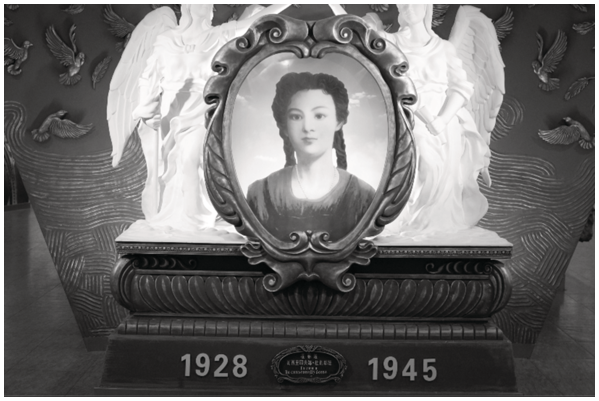
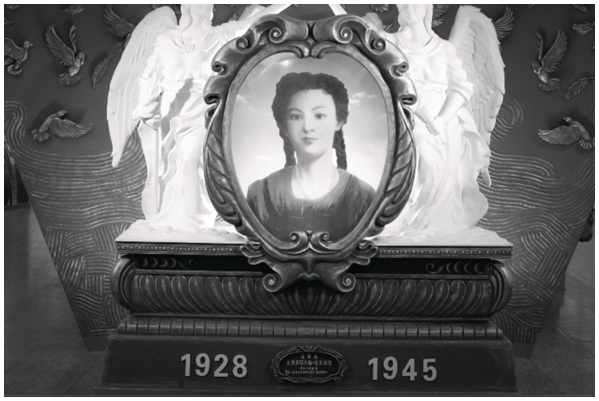
After a week-long search for mixed families in the town I heard of one, but could not locate any of its members. According to Suifenhe’s Civil Affairs Office (mingzheng ju 民政局) in 2006 between eight and ten Chinese–Russian couples had registered their marriage there.Footnote 98 Yet the idealised images of these desirable conjugal couples had created the impression that they were common in the border area. The town’s heritage, memorialised in the museum, celebrates the life of a young mixed-race woman named Galina Dubeeva, the daughter of a local Chinese man and his Ukrainian wife. Between the late 1890s and 1917, a large number of people relocated to these parts of the Russian Empire as colonists, settlers or refugees. Intermarriage in rural and urban Manchuria was defined by the scarcity of women in these remote areas due to the concentration of male labour in the north of China and the difficult economic position of many migrant Russian women.Footnote 99 By the early 1930s, travellers to the north-east of China were talking about the emergence of a distinct ‘Eurasian type’ (Sino-Russian) of Manchurian colonist.Footnote 100 As one of my co-travellers and a Suifenhe native observed during the sleeper-train journey from Harbin to Suifenhe, his hometown ‘is different from other places in China. It is proud of “mixing”. Galina is our hero; there are streets, buildings and a museum named after her.’Footnote 101
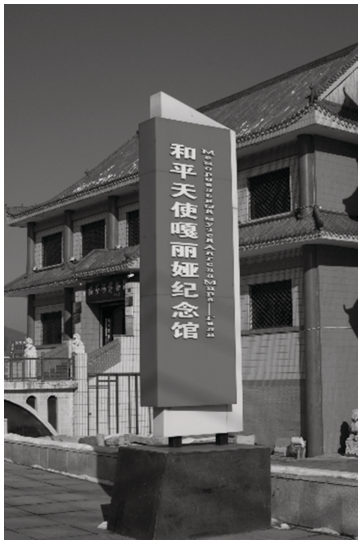
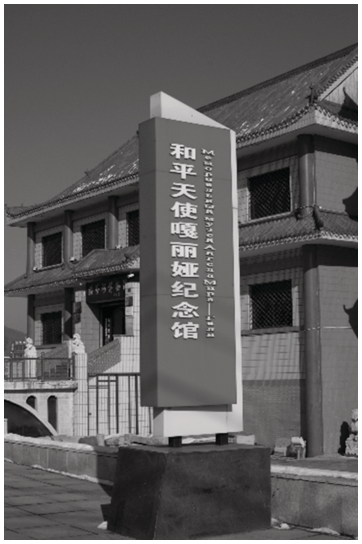
Galina Dubeeva was celebrated as a national hero in 2003, when a Chinese journalist discovered the story of her disappearance towards the end of the Second World War when she had been on a translation assignment with representatives from the Japanese army. The news of this forgotten story spread quickly and was picked up by local and central government officials. In 2005, a monument commemorating her heroism was erected in Suifenhe. In March 2013, the city authorities opened the museum in Galina’s memory, linking her personal life to Suifenhe’s growth and development and the improvement of Chinese–Russian relations (Fig. I.2). In 2015, a two-part documentary film about Galina’s life was broadcast on Chinese television as part of a series commemorating the sixtieth anniversary of the end of the Second World War. Galina Dubeeva became the symbol of Sino–Russian friendship – an ‘angel of peace’ (和平天使heping tianshi) – that expressed Chinese–Russian common interests and values in memory of their victory against the common enemy. Since then, Galina has been celebrated as a hero for her personal sacrifice in China’s national struggle.
Memorial museum dedicated to the life of Galina Dubeeva in Suifenhe.
One aspect of Galina’s history that is always mentioned and emphasised in this memorialisation campaign is her mixed-race background. Several panels in the museum are dedicated to the unique features of the family that nurtured Galina’s heroic character. She is presented as beautiful, clever, strong-willed and independent, with a romantic soul. The museum emphasises that she spoke several languages fluently and was a talented musician and poet.
The creation of this museum and the popularisation of Galina’s story tap into the unfolding narrative of close Chinese–Russian state relations, which have been steadily improving since the resolution of border issues in 2004. In 2007, Hu Jintao and Vladimir Putin issued a joint statement on economic cooperation between north-east China and the Russian Far East, marking the beginning of Putin’s ‘turn to Asia’ policy agenda. Journalists started citing as evidence of these close bilateral relations the growing popularity of Chinese–Russian marriages.Footnote 102 The Suifenhe museum includes a panel with Xi Jinping and Vladimir Putin’s celebrations of Russian–Chinese relations, emphasising Galina’s symbolic role in tying together the histories and destinies of Russia and China. Such forgotten histories of Chinese–Russian intimacy are thus being revived, mythologised and glorified in an attempt to establish continuities with the past and to stimulate future close relations between the two nations.
The portrait of Galina Dubeeva.
My conversations with Russian weekend shoppers and pomogais from the town of Pogranichny, the equivalent of Suifenhe on the Russian side of the border, confirmed my first observations – there were indeed very few Chinese–Russian families in this part of China. It had by now become clear that there was no such thing as a Russian brides village or even a place where Russian wives clustered to migrate to China. However, this research trip helped me to establish contacts with Russian women married to Chinese citizens in other parts of China. My research took me to several towns in the border area, including Suifenhe, Qiqihar and Mudanjiang, before I discovered through one of my research participants a lively and vibrant community of Russian-speaking women in relationships of one sort and another with Chinese men, using the popular Chinese social network WeChat,Footnote 103 and decided to adapt my research strategy to this newfound digital reality. Social media appeared to be central to my research participants’ worlds and, in order to approach an understanding of their journeys and lives in China, I embraced the digital domain as ‘interdependent with their infrastructures of everyday life’.Footnote 104
I had not planned to join women’s digital groups in China until one day I found myself a member of one. In August 2016, one of the women I interviewed invited me to join a closed WeChat group dedicated to the discussion of Chinese–Russian family matters and their children. By the time I joined the group, it had 135 members. Thus, rather than trying to meet all these women in person, I used this group to send out a call written in the Russian language for research participants in several other WeChat groups, introducing myself and my research topic. The women whom I met throughout my three-year search lived in scattered, mostly urban, locations of China. By the time I left the group in 2018, its membership had grown to 500, reaching the limit of members in one group permitted by the company. The group administrator asked people who wanted to stay in the group to tag their profile name with a panda icon. Those who did not do so were deleted from the group. I could not keep up with the volume of messages in the group and missed the deadline by which I had to mark my username with the panda icon. As a result, I was purged from the group. WeChat ethnography and interviews became an important dimension of my fieldwork experience and how I engaged with the ‘digital-material-sensory environment’ of my research participants and research field.Footnote 105
This resulted in my collection of fifty-three oral storiesFootnote 106 by women from different parts of China, rather than in the north-east border area that I had originally planned to focus on. The women whom I interviewed and on whom my analysis is based came to China from post-Soviet Russia, Ukraine, Kazakhstan and Belarus between the mid 1990s and mid 2010s.Footnote 107 They were at different stages of their dating, married and post-married lives at the time of our meetings, which took place between November 2015 and August 2018.
Subsequent interviews with several members of staff at the Russian consulates in Beijing and Shenyang complement my interpretations of women’s personal narratives from the sending state’s perspective. In this book I weave my discussion of their life stories and digital practices of belonging with an analysis of visual images, immigration regimes and population management techniques in an attempt to paint a complex picture of the politics of Chinese national desire and the hyperreality that the Russian brides village reflects. In doing this, I build on the tradition of the feminist research concerned with studying simultaneously the ‘up and down’ of political power.Footnote 108
It became apparent to me early on in my fieldwork that my research positionality had taken on several unexpected and contradictory dimensions. In most cases, I was talking to women of my own generation who had left their country of birth and married a foreigner. We shared both a common language and memories of our Soviet upbringing in the 1980s and 1990s, together with the cultural referents of life during the last years of the Soviet Union and the post-Soviet transformations. We also shared the experience of migration from our home countries and the sense that we had escaped its socioeconomic and cultural dead end. Furthermore, my intercultural marriage and children were in my mind additional areas of common experiences. To find a way to forge links with my prospective research participants, I played up my maternal subjectivity and chose a photo of myself with my children for my WeChat profile. WeChat became an important resource for conducting individual interviews, as it provided the flexibility, distance and anonymity that some participants asked for. The option to turn off a camera also meant that some of them could speak without me seeing them. Most of the women preferred to talk with our cameras switched off. All these fieldwork aspects and my background played a role in shaping my encounters with the people and knowledge emerging in the field.Footnote 109
After distributing a call for research participants into this WeChat group, I asked those who had responded to my call why they had agreed to talk to me. They told me that they welcomed the opportunity to work out their future orientation. Some women explicitly said that it helped them psychologically to push themselves outside their comfort zone to talk about the problems they encountered. Others noted that it was a chance to talk to someone else outside their home.Footnote 110 Many found our conversations interesting and useful as a reference point to compare their stories with those of other women and noted that they wanted to help other women even though they normally did not like sharing the details of their private life.Footnote 111 Others said that they had acted on their initial intuitive reaction that they wanted to be part of the research.Footnote 112 And some participants expressed their hope that the more people knew about mixed marriages, the more they would accept them and understand they were normal and ordinary. ‘Maybe this could bring some benefit to society and challenge stereotypes?’ my interlocutors said hopefully on more than one occasion.Footnote 113 Their hope for such change stemmed from their negative experiences of prejudice and discrimination. One woman recounted episodes from her life in Russia with her Chinese husband and said they had encountered a group of youths who had made offensive comments to them and a taxi driver who asked, ‘Aren’t there enough Russian men for you?’ She told me she was very angry when this happened and expressed her hope that with time more people would have appropriate reactions.Footnote 114 Several of the women involved in artistic industries in China became interested in my project because they found the idea unusual, which was particularly pleasing to me. Yet my research also generated some suspicion and hostility. My presence was not always welcome and some found it strange and suspicious that a publicly funded British research agency would fund a research project on marriage migration to China.
In March 2018, I was added to a new WeChat group by one of its participants. I introduced myself as a researcher who was born and raised in Minsk, educated in Belarus and the UK, and working at the University of Manchester. Several women welcomed me to the group. However, two months later, an anonymous article from a WeChat channel was posted on this group that was rude and offensive about Chinese–Russian marriages. The article called the women stupid for entering into relationships with Chinese men without having paused to think about their security and future in China. This generated a suspicion that someone within the group had written the article and I became the main suspect. The group moderator got in touch with me to say that some members felt uncomfortable with me being a group member and that it was inappropriate for me to be included in the chat because I was not in a relationship with a Chinese man. I was asked to leave the group. I became a subject of what Homi Bhabha calls ‘familiar strangeness’ that becomes unbearable, both politically and conceptually.Footnote 115
My presence had become intolerable to the group, although I felt I had many things in common with the women in it. After all, I also married a foreigner (though he was not Chinese) and live outside my country of birth. My children are of a mixed cultural background, but none of this was enough. For the other women the Chinese context was too different from mine and no one who did not have direct experience of it could be fully trusted. Although many women replied to my call to participate in a life-story interview, I didn’t have the credentials to be a member of their WeChat group.
The administrator of another group on a popular Russian social platform completely refused to let me join the group. The decision to expel me from the WeChat group chat also indicated that, collectively, the women felt vulnerable and exposed to even more public critique in their home countries which, as I had learnt in the interviews, was a common experience for many of them. The widespread Sino-phobic attitudes in post-Soviet societies informed the reactions of some of these women’s families and fellow country people to their decision to form a family with a Chinese man. As one woman on the Vostochnoye Polushariye platform observed: ‘How do you deal with my feeling of shame for having fallen in love with a Chinese man?’ I viewed my expulsion from the WeChat group as an expression of their survival strategy. Excluding an outsider from the women’s collective safe space was a visceral act of self-defence.
I.6 Chapter Outline
In Chapter 1 I examine the development of China’s principles regulating marriages with foreigners from the perspective of the country’s sovereign concerns on border stability, population management and national security. These concerns are considered through the lens of the Chinese state’s material and affective economies that inform and shape the regulations for women migrating to China’. I show how the Chinese state has revised its administrative terms and laws about international marriage and I highlight the historical, racial and gendered forces that shape the content of these laws. I show that marriage migration laws are shaped by feelings about what it is to belong to Chinese society. These clusters of collective attitudes and emotions define the architecture of Chinese immigration policy. They signal the new relationships between power and inequality that are being constructed to capture China’s relations with its neighbours and with the rest of the world.
In Chapter 2 I show that the realisation of the Chinese national dream to become a powerful international actor through the government’s project of national rejuvenation fetishises intercultural marriages and families of a particular kind – marriages between a Chinese man and a white woman from the former Soviet Union who is transformed into an obedient daughter-in-law and then absorbed into Chinese patriarchal structures. I develop this argument through an analysis of three Chinese TV dramas and a feature film that signalled prominent changes in Chinese–Russian relations spanning nearly thirty years of reform (1990–2019). I argue that these cultural products construct a consistent image of a strong, clever, beautiful and independent white woman who ultimately submits to the Confucian patriarchal order with the assistance and through the benevolence of her Chinese husband. Weaving the discussion of TV representations of Chinese–Russian romantic encounters and marriages into wider political and public discourses on China’s foreign relations, I refer to cinematic geopolitics, which I envisage as the construction of hyperreality ‘where the boundaries between game and illusion are blurred’.Footnote 116 The dramatisation and popularisation by the state of intimate Chinese–Russian relations on the screen have helped to produce the image of a post-Soviet white woman who is an object of national desire and the preferred choice of foreign bride. This takes place against growing concerns over the lack of women in China and the national economic revival that gave rise to new gendered images of cultural and sexual conquest.
Chapter 3 discusses women’s narratives of migration and marriage journeys. The stories told to me by the women who travelled to China from the mid 1990s to the late 2010s paint a complex picture that contrasts with existing stereotypes of marriage-migration trajectories. I argue that numerous narratives conflict with the dominant popular perceptions in China and Russia, which claim that most women choose to escape the harsh living conditions in the Russian Far East to live in the north-east of China, where these Russian brides tend to put down their roots. Instead, I show that there are several different and multilayered migrations that these Russian ‘Chinese brides’ make, including as language exchange students, through online encounters and in the entertainment industry. I trace these stories of cross-border romance and desire and what they mean for the women adapting to a new life in China. In Chapter 4 I explore how my research participants navigated the patriarchal norms and cultures that commodify them as sources of Chinese national desire and reproduction, valorising the white woman’s body in the Chinese marriage market and immigration regime as social capital for the Chinese husband and his family and a free womb for nurturing future Chinese citizens.
In Chapter 5 I document how these women encountered and negotiated the citizenship status of their children in China. I employ the theoretical lens of embodied border sites where racialised geopolitics and competing individual values and family norms meet and clash. I show how the politics of citizenship, identity and race have played out in these women’s disputes about where their children belong in national terms, and argue that these women – driven by the precarious position that results from their own unstable legal and socioeconomic status and from the fear of being forced to separate from their children – resort to their home-nation citizenship or informal dual-citizenship arrangements as leverage to defend their parental rights in the context of China’s strict single-citizenship rules.
The women develop strategies to secure their parental rights through the citizenship structures available to them and then seek to deal with their uncertainties amid the various limitations and tenuous immigrant and family statuses available to them in China. I conclude by explaining how China’s single-citizenship law and current immigration laws restrict foreign spouses who live there on ‘family visitor’ visas to engage in the reproductive sphere of marriage, as well as how these inequalities emerge in their subsequent family life in the form of parental negotiations about their children’s citizenship. Confucian values promoted by the state are used to strengthen patriarchal structures and gender inequality in Chinese society.Footnote 117
As most of their everyday lives is devoted to their caring and family responsibilities, the digital sphere is the place where these women turn to vent their emotions, try out entrepreneurial skills and search for belonging, community and support. From the mid 2010s, WeChat has become the main digital social media platform in China and the main place for migrant communities to socialise. In Chapter 6 I discuss the main themes and unfolding conversations in several WeChat groups I participated in. I argue that, although these digital groups are central to the way these women search for forms of belonging in Chinese society, they are ambivalent spaces where their discussions of their legal status, labour rights and citizenship rub against the participants’ personal life choices and ambitions.
Chapter 7 presents an audiovisual exploration of a group wedding festival held on the Chinese–Russian border during the late summer festival of 七夕节 qixi jie. The official goal of this event is to strengthen Chinese–Russian relations, transforming a traditional celebration into an occasion for the articulation and celebration of international love and desire. The symbolic significance of the location, timing and aesthetics of the event, alongside the national, racial and gender identities of the participants, reveals key insights into China’s national aspirations. I argue that this state-sponsored group wedding is not simply a reflection of China’s foreign relations, nor is it an incidental event – it serves as a crucial site for observing and interrogating China’s geopolitical imaginaries and national desires. Furthermore, it provides a space for both reinforcing and contesting these aspirations through the performance of international love, gender roles and an ideal form of marriage.
The conclusion synthesises the book’s arguments, highlighting how marriage and migration serve as pivotal sites for examining the intersection of geopolitical and intimate projects. It reveals the complex relationship between national desire, family, marriage and race within China’s quest to realise the China Dream. The war in Ukraine further amplified these narratives, reinforcing the image of China as a rising force capable of stepping in where other nations falter. A relational approach to China’s interactions with the world, particularly through the lenses of gender and race, necessitates an exploration of the historical, geographical and normative dynamics that shape China’s self–other relations. Russia, in this context, serves as a critical node, connecting China to the racialised global order through its proximity, historical ties and shared geopolitical outlook. The gendered and racialised dimensions of these processes highlight that national security and international relations are deeply intertwined with intimate relations.

 Open access