


Introduction
One of the key insights of the literature on political elites is that compositional differences between the demographic makeup of representatives and that of their voters have important consequences for the quality of democratic representation (Bratton and Ray Reference Bratton and Ray2002; Carnes Reference Carnes2012; Preuhs Reference Preuhs2005). While comparative scholarship in this field has made substantial advances in mapping representational gaps along the dimensions of gender, race, and class origins, this paper aims to investigate to what extent legislatures around the world reflect the geographic diversity of the voters they represent. We do so by developing and computing a comparable measure of inequalities in the descriptive representation of places in parliaments, the Spatial Un-Representativeness of Legislatures Index (SURLI). Alongside this descriptive exercise, we theorize and investigate how electoral systems may explain cross-country variations on this variable, drawing on the common finding in the descriptive representation literature that different electoral institutions produce distinct opportunities for social groups to access political offices.
Our theoretical starting point is the observation that voters want representatives with local ties (Shugart, Valdini, and Suominen Reference Shugart, Valdini and Suominen2005), perhaps because they assume that a local candidate is more likely to share their preferences (Campbell and Cowley Reference Campbell and Cowley2014; Cowley, Reference Cowley2013; Shugart, Valdini, and Suominen Reference Shugart, Valdini and Suominen2005). However, the pool of potential candidates – those with the social connections, political experience, expertise, and motivation to be in politics – may be geographically skewed with, for example, more potential candidates from prosperous urban centres rather than rural areas. Whether the elected legislature is similarly skewed depends in part on how much parties anticipate voters' preference for locals when choosing candidates and the extent to which voters can select locals among the competing candidates. Both of these factors depend, in turn, on the electoral system. Below we offer a theoretical lens through which to view the relationship between electoral systems and the geographical representativeness of legislatures. We also empirically investigate this relationship, focusing on two aspects of variation in electoral systems: constituency structure and ballot structure (Reeve and Ware Reference Reeve and Ware2013). Finally, we offer evidence of a relationship between electoral systems and geographical representativeness using both a cross-country analysis and a within-country analysis of Italy, Britain, and Germany.
To briefly preview our findings, we observe that (perhaps surprisingly) single-member (SM) district systems do not have more geographically representative legislatures than multi-member (MTM) district systems. Although the large number of districts in SM district systems would ensure a representative legislature if parties fielded local candidates in each district, parties may not have much incentive to do so, especially in safe districts. However, we find that mixed-member (MXM) systems (in which candidates compete in single-member and multi-member districts) tend to have more geographically representative legislatures than either of those systems. We suggest that this may reflect the incentives created by spillovers between tiers, which tend to heighten the incentives for parties to field a local candidate, and increase the opportunities for voters to select one, in the nominal (SM) tier. Our analysis of electoral reforms in Italy and of constituency MPs in the UK and Germany provides evidence consistent with this hypothesis.
One of our main contributions is a new, cross-nationally comparable measure of legislatures' geographical representativeness, the Spatial Un-Representativeness of Legislatures Index (SURLI). The basis of SURLI is the discrepancy between the distribution of legislators' birthplacesFootnote 1 and the distribution of citizens' residences, measured using the Earth Mover's Distance (EMD) (Lupu, Selios, and Warner Reference Lupu, Selios and Warner2017) – equivalent to the 1st Mallows distance or the 1st Wasserstein distance. Put simply, this captures the minimum amount of travel necessary to send an equal number of citizens to each MP's birthplace. To make SURLI comparable across countries, we express SURLI as the ratio of the true EMD in a country to the expected EMD for that country if MPs were chosen randomly from the population. Thus, a SURLI of 2 for a given country means that the discrepancy between the distribution of MP birthplaces and the distribution of citizen residences in that country is twice as large as we would expect to arise by chance. Comparing the actual discrepancy in a country to a hypothetical discrepancy in that country helps address cross-country differences in land area, population distribution, assembly size, and other factors.
The paper is structured as follows. In Section 2 we locate our work in the context of existing scholarly works on political geography, electoral behaviour, and descriptive representation. In Section 3 we discuss theoretically the possible channels through which features of electoral systems might influence how places are represented in a legislature. Section 4 tests these expectations on a cross-country sample and presents this paper's main empirical contributions: the measurement of SURLI for sixty-two legislatures and the results of a cross-country regression that describes how it varies across electoral systems. In Section 5 we carry out two separate within-country analyses: first, we leverage electoral system change in Italy to compare indicators of spatial representativeness across systems and tiers in the same polity; second, we compare British and German constituency legislators to explore why single-member districts may be more likely to produce local MPs in mixed systems than in single-member systems. Finally, section 6 briefly discusses the normative implications of the study, its limitations, and further avenues for this research agenda.
Related Literature
Early democratic theorists worried about the ‘problem of space’ (Minicucci Reference Minicucci2001): how large representative democracies could aggregate disparate interests of communities located far apart, avoiding risks of secession or domination of one subunit over the other. Indeed, the territorial segmentation of the electorate in constituencies was often explicitly justified because it would improve the quality of representation via the localness of candidates (Rehfeld Reference Rehfeld2005). For instance, Montesquieu, in The Spirit of Laws (1748), highlights the advantages of local deliberation for selecting representatives:
One knows the needs of one's own town better than those of other towns, and one judges the ability of one's neighbors better than that of one's other compatriots. Therefore, members of the legislative body must not be drawn from the body of the nation at large; it is proper for the inhabitants of each principal town to choose a representative from it. (Montesquieu Reference Montesquieu1989, (1748) 159)
In a similar vein, Alexander Hamilton, in Federalist 36 (1788), touches on how representatives' local ties and knowledge enhance the responsiveness of the centre to the peripheries' needs, thus improving democratic outputs:
If any question is depending in a State legislature respecting one of the counties, which demands a knowledge of local details, how is it acquired? No doubt from the information of the members of the county. Cannot the like knowledge be obtained in the national legislature from the representatives of each State? (Hamilton, Madison, and Jay Reference Hamilton, Madison and Jay2008, (1788), 169)
Even as national parties emerged and cleavages based on class and religion became more salient, the notions of democratic and territorial representation have remained tightly linked in the electoral institutions of modern states. Non-geographical ways of dividing voters into distinct constituencies (such as the class franchises in nineteenth-century Prussia and Austria or Zimbabwe's ‘white rolls’) have always been rare and are almost unheard of in contemporary democracies.Footnote 2 Apart from a few countries, including Israel and the Netherlands, geographically-disjoint electoral districts remain basic building blocks in every national electoral system. Thus, we can still say, with Rehfeld (Reference Rehfeld2005, 3), that ‘in almost every democracy in the world, citizens are represented by where they live’.
Correspondingly, localness continues to be an important prism through which voters evaluate candidates. It is an electoral resource that candidates can count on in places where they have built long-standing personal and political networks. The electoral bonus candidates receive in ‘their own beat’ was famously described by Key (Reference Key1949, 38) in Southern Politics:
A candidate for governor normally carries his own county by a huge majority, and the harshest criticism that can be made of a politician is that he cannot win in his own beat or precinct. If his friends and neighbors who know him do not support him, why should those without this advantage trust a candidate?
There is substantial scholarly agreement that candidates receive an electoral boost in places to which they have personal ties. Evidence in this direction abounds from spatial ecological studies (Garand Reference Garand1988; Gimpel et al. Reference Gimpel2008; Rice and Macht Reference Rice and Macht1987), experimental studies (Campbell and Cowley Reference Campbell and Cowley2014; Panagopoulos, Leighley, and Hamel Reference Panagopoulos, Leighley and Hamel2017; Roy and Alcantara Reference Roy and Alcantara2015), and voter-level survey data (Arzheimer and Evans Reference Arzheimer and Evans2012; Arzheimer and Evans Reference Arzheimer and Evans2014; Evans et al. Reference Evans2017; Johnson and Rosenblatt Reference Johnson and Rosenblatt2006). Evidence for voters’ preference for local representatives has been documented for decades, especially in research on the United States (Garand Reference Garand1988; Gimpel et al. Reference Gimpel2008; Rice and Macht Reference Rice and Macht1987) and Ireland (Gallagher Reference Gallagher1980; Górecki and Marsh Reference Górecki and Marsh2012; Marsh Reference Marsh2007). More recently, research in the UK shows that voters care far more about candidates' localness than about their biological sex (Campbell and Cowley Reference Campbell and Cowley2014), class, religion, and race (Cowley Reference Cowley2013)Footnote 3. Similar evidence is found in Japan (Horiuchi, Smith, and Yamamoto Reference Horiuchi, Smith and Yamamoto2018), Canada (Blais and Daoust Reference Blais and Daoust2017; Roy and Alcantara Reference Roy and Alcantara2015), Estonia (Tavits Reference Tavits2010), and Norway (Fiva, Halse, and Smith Reference Fiva, Halse and Smith2018).
In contemporary scholarship, voters' preference for local representatives is generally disaggregated into a behavioural and a perceptual component (Evans et al. Reference Evans2017). The behavioural component refers to a greater ability of candidates to mobilize supporters in their immediate social networks, including those who live in the immediate surroundings of the candidate's place of residence (Górecki and Marsh Reference Górecki and Marsh2012). The perceptual component describes localness as a heuristic for candidate desirability in voters' considerations. In low-information environments, someone from ‘around here’ can be more easily assumed to understand the community and share its inhabitants' preferences than a ‘parachuter’ or a ‘carpetbagger’ (Campbell and Cowley Reference Campbell and Cowley2014). In this sense, the micro-foundational mechanism is a form of in-group bias (Panagopoulos, Leighley, and Hamel Reference Panagopoulos, Leighley and Hamel2017, 867–8).
Candidates know voters' preference for localness, and some go to great lengths to cue their local credentials to voters. For instance, in a particularly striking example from the 2017 UK General Election, the Green Party candidate in the Brent Central constituency distributed campaign literature stating, ‘I am a life long Brent resident, conceived in Harlesden, born in Kilburn, grew up in Queens Park and now reside Willesden’ (Milazzo and Townsley Reference Milazzo and Townsley2020, 10).
Do politicians with local ties to a certain locale make for better representatives for that area? The evidence is mixed. Carozzi and Repetto (Reference Carozzi and Repetto2016) found evidence of pork barrel spending driven by Italian legislators born outside their district in favour of their municipality of birth. Similarly, Jennes and Persyn (Reference Jennes and Persyn2015, 189) found that between 1995 and 2010, ‘per capita cash transfers to a Belgian electoral district are significantly higher for every federal minister originating from that electoral district’. However, there are also null findings in the literature. For instance, Fiva, Halse, and Smith (Reference Fiva, Halse and Smith2018) leveraged close elections in Norway between 1953 and 2013 and found that representatives did not increase the level of investment in their hometown, and Sällberg and Hansen (Reference Sällberg and Hansen2020) found that localness was unrelated to the number of constituency mentions in the UK House of Commons over the 2015/2016 constituency session. Hence – as with other aspects of the ‘politics of presence’ (Preuhs Reference Preuhs2005) – the literature suggests that descriptive representation does not automatically translate into policy representation; rather, the relationship can be contextual and contingent on institutional factors.Footnote 4
Furthermore, this paper draws on comparative work on the relationship between electoral institutions and descriptive representation in legislatures. In this literature, proportional representation is often found to be conducive to demographically more balanced legislative assemblies. For instance, as far as the gender gap in political representation is concerned, ‘one of the most stable results in empirical research is that the election of women is favored by electoral systems with party lists, proportional representation (PR), and large district magnitudes’ (Wängnerud Reference Wängnerud2009, 54). PR systems seem to be also more inclusive of younger members of parliament (Joshi Reference Joshi2013), and to improve the policy representation of low-income citizens (Carnes and Lupu Reference Carnes and Lupu2015). Existing evidence on the effect of electoral systems on ethnic minority representation (Kostadinova Reference Kostadinova2007; Moser Reference Moser2008; Wagner Reference Wagner2014) is less clear-cut. Cross-national findings on electoral systems and the descriptive representation of places are scarce, not least due to the absence of comparable spatial measures of representational inequalities. Latner and McGann (Reference Latner and McGann2005) examined the official residences of MPs in Israel and the Netherlands (both single-district PR systems) and found moderate variation in geographical representation across regions. Pedersen, Kjaer, and Eliassen (Reference Pedersen, Kjaer, Eliassen, Cotta and Best2007) analysed the approximate level of parachutage – defined as the share of MPs residing outside the district at the time of election – in thirteen Western European countries and found no clear association with electoral institutions. Perhaps the most influential work in this area is theoretical: Matthew Shugart and colleagues developed a series of models to derive candidate incentives to seek a personal vote – and thus the likelihood of representatives being local – as a function of, among other factors, electoral rules. Their work suggests that the probability of a representative being local declines with district magnitude in closed-list PR systems but increases with district magnitude in open-list PR systems (Carey and Shugart Reference Carey and Shugart1995; Shugart, Valdini, and Suominen Reference Shugart, Valdini and Suominen2005). André, Depauw, and Shugart (Reference André, Depauw and Shugart2014b) tested these hypotheses in three open-list PR countries (Finland, Luxembourg, Switzerland) and three closed-list PR countries (Spain, Portugal, Norway) and confirmed that the share of representatives who had held previous local office in the district varied as predicted.
Theory
How might electoral institutions affect geographical representation? Our theoretical starting point is that voters nationwide would prefer, ceteris paribus, legislators with strong ties to their local area. (The previous section summarizes comparative evidence that voters prefer local candidates and discusses why this might be true.) Following Gimpel, Lee, and Thorpe (Reference Gimpel, Lee and Thorpe2011), we assume that potential candidates (people with the motivation and opportunity to compete for a seat in parliament) disproportionately have geographical links to certain types of places, such as urban centers. Whether the set of people elected to the legislature reflects the geographical skew of the candidate pool depends in part on how elections work. Electoral institutions are, we suggest, an important factor determining the extent to which (1) viable seat-winning parties are motivated to field local candidates throughout a country (party incentives) and (2) whether voters can select locals over non-locals as their representatives (voter leverage). In this section, we assess how these two criteria may vary depending on two dimensions of variation in electoral institutions:
• ‘Constituency structure’ refers to the districting arrangements defining the geographical areas where votes are translated into seats (Reeve and Ware Reference Reeve and Ware2013; Shugart and Taagepera Reference Shugart and Taagepera2017). The traditional distinction is between single-member (SM) and multi-member (MTM) systems. In the former, the votes in each constituency count towards the election of one representative; in the latter, they contribute to the election of more than one representative, up to the limit case where all MPs are elected from the same nationwide district. A third type of constituency structure has become prominent since the 1990s, mixed-member (MXM) systems. These entail two spatially overlapping tiers, each electing a share of the assembly's legislators, one constituted by single-member (the nominal tier) and one by multi-member districts (the list tier).
• ‘Ballot structure’ has been used to describe a range of options voters have in the polling booth. For the purposes of this analysis, we focus on a single key aspect, the presence or absence of preferential voting (PV), defined here in terms of any mechanism that allows voters to express a preference for a candidate that is meaningfully different from a preference for a party (Farrell and McAllister Reference Farrell and McAllister2006; Marsh Reference Marsh1985). In single-member districts, the parties field one candidate, so these never entail PV. Multi-member districts fall in the same category if they employ a closed-list system, whereby the party presents voters with an ordered list of candidates, and those in positions from 1 to n are elected, where n is the number of seats allocated to that party in the district. Conversely, under PV rules, voters can affect the intra-party allocation of seats, either by voting for candidates as well as parties, thereby changing the candidate ranking in a list system (for example Finland's open-list ballot), or by voting exclusively for candidates in a non-list system (for example, Ireland's single transferable vote ballot).
We begin by considering parties' incentives to field local candidates in a given district. Fielding local candidates is neither necessary nor sufficient to achieve a nationally representative legislature,Footnote 5 but it is clearly an important ingredient. We assume that fielding local candidates tends to attract votes to a party, but it also carries costs. More so than voters, party insiders know and care about attributes of candidates other than their geographical ties, such as their loyalty to the party, the quality of their policy ideas, their potential to occupy leadership roles or their connections to influential insiders. Because prioritizing local candidates to satisfy voters may mean sacrificing something a party cares about, it can be seen as similar to turnout mobilization or geographically targeted pork-barrel spending: costly to the party but potentially electorally rewarding. Electoral institutions matter, in this view, because they shape the electoral rewards parties stand to gain from fielding local candidates. In particular, assuming that parties want to win seats, the rewards of fielding a local candidate depend on (1) how fielding local candidates affects a party's vote share (the localness-to-votes link) and (2) how a change in a party's vote share affects that party's seat share (the votes-to-seats link) (Cox Reference Cox2015). We also consider how electoral institutions shape voter leverage, meaning voters' ability to translate their preference for locals into electoral outcomes once candidate selection is realized.
Single-Member and Multi-Member Districts
Compared to multi-member (MTM) districts, single-member (SM) districts are often thought to foster normative expectations of a close relationship between the legislators and the districts they represent: the smaller the constituency a legislator is directly accountable to, the more visible and accessible they will be to voters (Wessels Reference Wessels, Schmitt and Thomassen1999) and the more the candidates' personal characteristics (including localness) may matter to electoral success (Cain, Ferejohn, and Fiorina Reference Cain, Ferejohn and Fiorina2013; Curtice and Shively Reference Curtice, Shively and Klingemann2009). Politics in SM systems also tend to be more particularistic, which may encourage voters to prioritize having a representative who is likely to understand local needs and care about satisfying them. It follows that replacing a non-local candidate with a local candidate in the SM case would affect voting results more than replacing a non-locally representative list with a locally-representative one in the MTM case.
The impact of the electoral system on the translation of votes to seats is more ambiguous. Here we follow Cox, Fiva, and Smith (Reference Cox, Fiva and Smith2016), who note an important difference between SM and MTM elections. In an SM district election that is expected to be close, a party might hope to pick up a seat by fielding a local candidate instead of a non-local candidate. However, in a lopsided SM contest, fielding a local candidate may win some additional votes, but will not make a difference as to the party that ultimately wins the seat. In MTM elections, by contrast, a shift in support has roughly the same non-zero probability of changing the allocation of seats regardless of how even or lopsided the expected result will be. The expected benefit of winning additional support from ‘localist’ voters in terms of seats may thus be largest in a competitive SM district, smallest in a safe SM district, and intermediate in an MTM district.
Combining the localness-to-votes and the votes-to-seats steps, we conclude that party incentives to field local candidates are highest in competitive SM districts: voters in SM elections respond to localness and parties competing in tight races are eager to win any marginal support they can. Local representatives may, however, be very rare in safe seats, where the leading party has almost no incentive to field a local candidate and may even deliberately ‘parachute in’ a preferred candidate from elsewhere (Pedersen, Kjaer, and Eliassen Reference Pedersen, Kjaer, Eliassen, Cotta and Best2007). MTM districts are an intermediate case: while localist voters are comparatively fewer here, their votes can never be fully discounted, as even marginal increases in vote share translate into marginal increases in expected seat shares. Therefore, whether an SM system in aggregate favours the selection of local candidates relative to an MTM system would depend in part on the mix of competitive and safe seats in the SM system.
If presented with both local and non-local candidates, voters in an SM election can influence the outcome only if the election is competitive; thus, voter leverage is high in the same districts where parties have a strong incentive to field a local candidate. In MTM systems, the extent of voters' leverage largely depends on the ballot structure. An MTM system that allows preferential voting – for instance, through open lists or single transferable vote – offers a way for voters to express their preference for locals (however slight) within a party slate (Passarelli Reference Passarelli2020; Renwick and Pilet Reference Renwick and Pilet2016). Preferential voting may thus lead to more geographically representative delegations of MPs than under closed-list systems, where voters cannot change the candidate ranking chosen by the party.Footnote 6
Mixed-Member Systems
Mixed-member (MXM) systems allow voters to elect MPs in both a single-member nominal tier and a multi-member list tier (Shugart and Wattenberg Reference Shugart and Wattenberg2001). Considering these tiers as separate entities, we might expect legislatures in mixed systems to have an intermediate level of geographic representativeness between SM and MTM systems. However, when we consider possible ‘contamination effects’ between the two tiers (Cox and Schoppa Reference Cox and Schoppa2002; Ferrara and Herron Reference Ferrara and Herron2005; Ferrara, Herron, and Nishikawa Reference Ferrara, Herron and Nishikawa2005; Herron and Nishikawa Reference Herron and Nishikawa2001), we see reason to doubt that MXM systems are simply a convex combination of SM and MTM systems.
There is fairly robust evidence that voters' choices in the nominal (SM) tier of an MXM system affect their vote choices in the MTM, producing contamination effects. For instance, Hainmueller and Kern (Reference Hainmueller and Kern2008) show that winning an SMD seat in Germany increases a party's subsequent support in the list tier. Likewise, Ferrara (Reference Ferrara2004) finds that placing SMD candidates affiliated with a party running as part of a pre-electoral coalition boosts that party's performance in the PR tier. Qualitative interviews also suggest that parties take cross-tier spillovers into account in crafting their campaign strategies; for instance, a Lithuanian party leader, quoted in Ragauskas and Thames (Reference Ragauskas and Thames2022, 8), noted that the party encourages candidates to ‘campaign for themselves, not even directly for the party, because personal success spills over to list success …. If people vote for the SMD candidate, they will also vote for the list.’
To the extent that vote choices in the nominal tier (SM) affect vote choices in the list tier (MTM), parties have a greater incentive to field local candidates in the nominal tier than they would in a similar district in a purely SM system: fielding a local candidate in the nominal tier could increase a party's chances in both tiers. Crucially, this is true even for parties that are very likely to win the SM seat: it will not affect the SM result in that case, but fielding a local candidate could win the party additional support (and thus possibly an additional seat) in the MTM tier and will result in a local candidate being elected in the SM tier. In addition, a locally less competitive party could also gain list-tier seats by fielding a local candidate (or any candidate) in the nominal tier: this may not directly lead to a local candidate being elected, but it may intensify competition in the nominal tier, further increasing the incentive for the more competitive parties to field local candidates. Contamination effects in MXM systems thus make it more likely that parties field candidates in the nominal tier, that those candidates are locals, and that competition is close enough that the localist vote can be decisive. These factors could make the nominal tier of MXM systems more geographically representative than SM systems.Footnote 7
In principle, contamination effects could also flow in the other direction, with parties fielding more geographically representative lists to win votes in the nominal tier. The literature has mainly focused on contamination from nominal to list tier, but so-called ‘reverse contamination’ (for example, Krauss, Nemoto, and Pekkanen Reference Krauss, Nemoto and Pekkanen2012) would also enhance the incentive to field local candidates in the list tier, especially in the presence of preferential voting (PV) mechanisms.
Summing Up
In this section, we have assessed several theoretical considerations to take into account in predicting the probability that a district has a local as its representative (or one of its representatives). Table 1 summarizes how different types of districts fare according to our criteria of party incentives and voter leverage. There are a number of countervailing considerations for each constituency structure type; therefore, in aggregate, we have few unambiguous theoretical expectations of their relative performance. The question of electoral systems and spatial representativeness remains, therefore, primarily an empirical one, which we will seek to address empirically in the following sections. Our theoretical review does, however, yield some tentative priors on the aggregate level of spatial representativeness of legislatures under different electoral rules:
(1) The probability of districts expressing local candidates is most uneven in SM district systems, which combine the most favourable context for local representation in competitive districts with the least favourable setting in safe districts. Therefore, the performance of SM systems should be highly contingent on a ‘political’ factor relatively independent from the electoral systems’ formal features: levels of seat competitiveness. Thus, an SM district system may be more or less geographically representative than MTM or MXM systems, depending on the distribution of competitiveness across districts.
(2) Conversely, because of contamination effects, we expect that the single-member district tier of MXM systems should positively contribute to the overall representativeness relative to MTM districts. Not only should there be relatively few ‘safe’ seats in the nominal tier, but party incentives to field local candidates also remain substantial in all single-member districts regardless of seat marginality. Therefore, MXM systems should yield more representative legislatures than MTM systems, as their additional single-member tier comprises districts where the likelihood of local representation is high.
(3) Within multi-member districts (both in MTM and MXM systems), the presence of preferential voting mechanisms should increase the spatial representativeness of legislatures.
The probability of a district electing local candidates is increasing in (1) party incentives to elect local candidates and (2) voter leverage
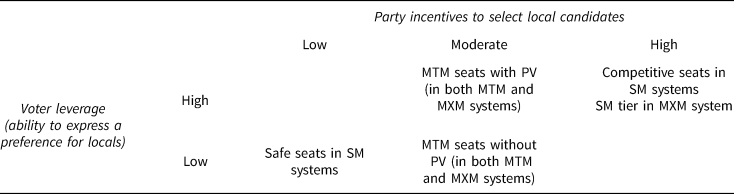
PV, preferential vote; SM, single-member; MTM, multi-member; MXM, mixed-member.
Cross-Country Analysis
We test these theoretical expectations on a sample of legislatures from sixty-two democratic countries, for which we measure our Spatial Unrepresentativeness of Legislatures Index (SURLI) from data on MPs' and population spatial distributions. In this section we describe these data (and additional country-level measures we use in the analysis), explain how we computed alternative measures of SURLI, and present the results of the cross-country analysis on how SURLI relates to electoral system features.
Data
Legislator data
To measure the extent to which legislators' local ties are representative of the population, we gathered legislators' birthplaces at a single point in time for sixty-two legislatures in democratic countries. We chose to focus on politicians' birthplaces because these are often an important indicator of geographical ties (for example, the case of the Green Party candidate for Brent Central mentioned above) and because it is by far the most practical measure of legislators' local ties to collect on a broad scale. Ideally, we might assess various other measures of politicians' local ties, such as where they grew up or where they spent most of their adult lives. Indeed, previous studies have measured MPs' local ties using their residence (Pedersen, Kjaer, and Eliassen Reference Pedersen, Kjaer, Eliassen, Cotta and Best2007) or previous local office (André, Depauw, and Deschouwer Reference André, Depauw and Deschouwer2014a; Shugart, Valdini, and Suominen Reference Shugart, Valdini and Suominen2005) in addition to their birthplaces. Each of these studies examines only a handful of Western European countries, whereas we aimed to cover a much larger and more diverse set of countries. We therefore focused on gathering birthplace data, which (although certainly an imperfect measure of local tiesFootnote 8) are uniquely defined for each MP and are available from official biographies and Wikipedia pages for legislators in many countries. To the extent that birthplaces are noisy measures of MPs' local ties, we expect differences in geographical representatives across electoral systems to be attenuated.
As our source for legislator birthplaces, we rely primarily on data from the Global Leadership Project (GLP) (Gerring et al. Reference Gerring2014) and focus exclusively on lower-house members. The GLP dataset includes biographical facts about over 38,000 MPs and top officials in 145 countries, typically as of 2010 or 2011: much of this data was collected from official government websites. Crucially the GLP includes politicians' birthplaces, recorded as text strings. Coverage of birthplaces in the GLP ranges widely, with many cases near 100 per cent coverage and others (including Portugal, Ireland, Jamaica, and Romania) much lower. We undertook a substantial effort to collect birthplaces in cases where they were missing in the GLP; we also checked and corrected the variable identifying legislators to distinguish legislators from unelected cabinet officials and party leaders who did not have seats in the legislature. We supplemented the GLP data with original data collection for six other legislatures: Cape Verde, Chile, Cyprus, Macedonia, Montenegro, and Taiwan. After filling in missing entries where possible and editing entries that were insufficiently precise (for example, referring to regions rather than municipalities of birth), we excluded foreign-born legislators and geocoded birthplaces using the Google Maps API. Figure 1 lists the countries we analyzed and provides information on data completeness for each one. For most legislature years, we have valid birthplaces for over 90 per cent of legislators.Footnote 9 In terms of case selection, we started with the list of all democracies – countries rated free or partly free in Freedom House (2012) – and proceeded to exclude countries for which, between the GLP and our efforts, we were not able to obtain a sufficient proportion of MP birthplaces.
Valid non-foreign-born legislator birthplaces as a share of assembly size.

Population data
We next need data that characterizes the spatial distribution of the population, which we compare to the spatial distribution of legislator birthplaces. Here, we face a normative judgement. Should a legislature be considered representative if its legislators' birthplaces match the distribution of citizens' residences or the distribution of citizens' birthplaces? The former approach assesses whether people living in different places have the same chance of being represented by a local MP; the latter approach assesses whether people born in different places have the same chance (unconditionally) of becoming an MP. Both approaches have merit, so we gather data to allow both types of analysis. Specifically, we derive two alternative spatial unrepresentativeness of legislatures measures, one that compares legislators' birthplace distribution to the population distribution just before their election (we use 2005 as a benchmark year) and one that compares legislators' birthplace distribution to the population distribution in the mean legislator birth year.Footnote 10 The population distribution in 2005 may differ from that in the mean legislative birth year (and thus, the two measures could yield different results) if there are substantial population shifts over time due for instance to urbanization.
Our data source for population distributions is the gridded population data from the latest version of the History Dataset of the Global Environment (HYDE 3.2)Footnote 11, which includes population estimates for every year between 1861 and 2005 at the level of 5-by-5 arcminute spatial grids (cells of roughly 10 km side at the equator). These have subsequently been assigned to countries via geocoding of their centroids and aggregated up to 15-arcminute side grids. In the aggregation, we made sure that, for each country, these larger cells add up all the 5-arcminute side grids whose centroid falls in the country to minimize information loss or measurement error in cells along borders and coastlines.
Country data
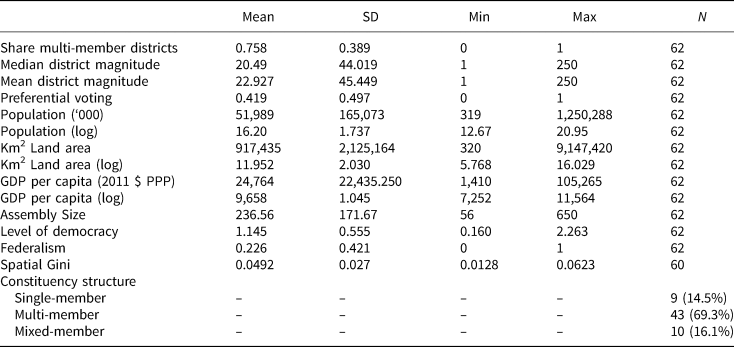
Finally, we gathered country-level variables capturing cross-country variation in electoral institutions in force in the last election prior to legislator data collection and other socio-political characteristics. For constituency structure, we constructed both a categorical variable (single-, multi-, and mixed-member systems) and an interval variable measuring the share of legislators elected in multi-member seats, which we use in the cross-country regression alongside a ‘mixed-member system’ dummy. In addition, a dummy variable for preferential voting was coded via a qualitative assessment of ballot rules from legislation or secondary sources. The variable takes the value of 1 if (i) voters can express a preference for one or more individual candidates that is functionally different from a party vote and (ii) the preference vote can practically determine at least in part the allocation of seats,Footnote 12 and 0 otherwise. We also introduce in our models a measure of district magnitude to account for the fact that for very large districts, a possible source of spatial inequality in representation might be the unequal selection of candidates between different parts of the same district. We followed the coding rules in Carey and Hix (2011) to record this variable. In addition, we computed the median district magnitude and mean district magnitude variables, excluding from the count constituencies that are either non- or extra-territorial (for example, ethnic constituencies, Greenland, and nationals abroad). We also collected country-level data on the level of democracy (V-Dem's unified democracy score), federalism (using the list of countries in Roeder Reference Roeder2009), and a measure of geographic economic inequality, the spatial Gini (population-weighted Gini index of estimated regional GDP per capita, estimated from satellite nighttime light data in Lessmann and Seidel Reference Lessmann and Seidel2017). Finally, we collected population, land area, and GDP per capita data from the World Bank's (Reference World Bank2010) World Development Indicator catalogue. Descriptive statistics for these variables are presented in Table 2.
Country-level data
Measurement of SURLI
To produce the Spatial Un-Representativeness of Legislatures Index (SURLI) for a country's legislature, we begin with the geocoded location of each MP's birthplace and the population proportion in each grid square of the country. After assigning legislators' birthplaces to grid squares, we can express the two distributions (birthplaces and population) in terms of the proportion observed in each grid square. Our objective is to measure the discrepancy between these two distributions in a way comparable across countries of greatly differing territorial size and shape. A natural choice for comparing the two distributions is the Earth Mover's Distance (EMD) (Rubner, Tomasi, and Guibas Reference Rubner, Tomasi and Guibas2000), a metric borrowed from computer science and introduced to political science by Lupu, Selios, and Warner (Reference Lupu, Selios and Warner2017). Simply put, EMD measures the amount of work (mass times distance) necessary to transform one distribution to another; as Lupu, Selios, and Warner (Reference Lupu, Selios and Warner2017) argue, this closely matches our intuitions about when one distribution is close to another. In our case, EMD measures the minimum total amount of travel necessary to move an equal number of citizens to each MP's birthplace.
Although EMD should pick up variations in a legislature's (un-)representativeness due to, for example, the electoral system, cross-country comparisons will also reflect other differences between countries that may obscure these patterns. Notably, it will depend on a country's size. If a country consists of just two cities separated by a desert, then (assuming the proportion of MPs born in each city differs to some extent from the proportion of people living there) the EMD increases in distance between the two cities; also, if a country consists of a single grid square, its EMD is zero regardless of its political institutions. The EMD will also depend on the legislature's size relative to the country's size: generally, the more seats in the legislature, the more closely the distribution of MP birthplaces can match the distribution of inhabitants. Clearly, an investigation into the effect that electoral institutions have on geographical representation using observational data requires that these country-specific determinants of the EMD score be addressed. As a first line of defence, we control for land area, population, and assembly size in the regressions below. To further address these and other sources of heterogeneity, we compute the SURLI for each country as the ratio of the country's actual EMD to the average EMD we obtain for many simulated legislatures we produce by choosing MPs at random from the population. Thus a SURLI of k for a country means that the country's observed EMD is k times higher than the average EMD across random representative legislatures for that country; country i's SURLI will be higher than country j's if country i's EMD is higher relative to what would be observed by chance than country j's.Footnote 13 This normalization procedure helps ensure that variation in SURLI tracks variation in how legislatures are constituted rather than variation in, for example, how countries are shaped or how populations are distributed.
Unfortunately, the time to compute EMD increases exponentially with the number of grid squares, so computing SURLI for a large country like the US (with over 14 thousand grid squares) can take weeks. The complexity of computing EMD in two or more dimensions is well known, prompting efforts to develop efficient implementations and approximations (Cuturi Reference Cuturi2013). We discovered that, at least for our application of the algorithm on square grids, we could obtain a very efficient approximation to the EMD by computing the one-dimensional EMD for each of several rotations of the gridded map (for example, east to west, northeast to southwest, north to south, northwest to southeast) and averaging those. As we show in section S1 of the Supplementary Material, the resulting estimate correlates very highly with the two-dimensional EMD in actual cases and can be computed dramatically faster. In one dimension, in fact, the EMD between two distributions is known to be equivalent to the computationally cheap procedure of integrating the area between two CDFs (as proven in Cohen and Guibas Reference Cohen and Guibas1997, 13–16), which is the method Golder and Stramski (Reference Golder and Stramski2010) suggested for comparing distributions.Footnote 14
Thus, SURLI is computed in three steps. First, for each country we measure the spatial difference between the distribution of the population and the distribution of MP birthplaces (both allocated to squares on a gridded map) by computing the one-dimensional EMD (that is, CDF discrepancy) in each of the four rotations of the map and averaging these. Second, we recompute the same measure for each country but for 500 fictional legislatures where MPs are drawn randomly from the population distribution. Third, we compute SURLI as the ratio of the value obtained in the first step to the average value obtained in the second step. Note that SURLI scores can be less than one, indicating that the actual measure of discrepancy between MPs' birthplaces and the population distribution is smaller than we would expect if legislators were chosen at random.
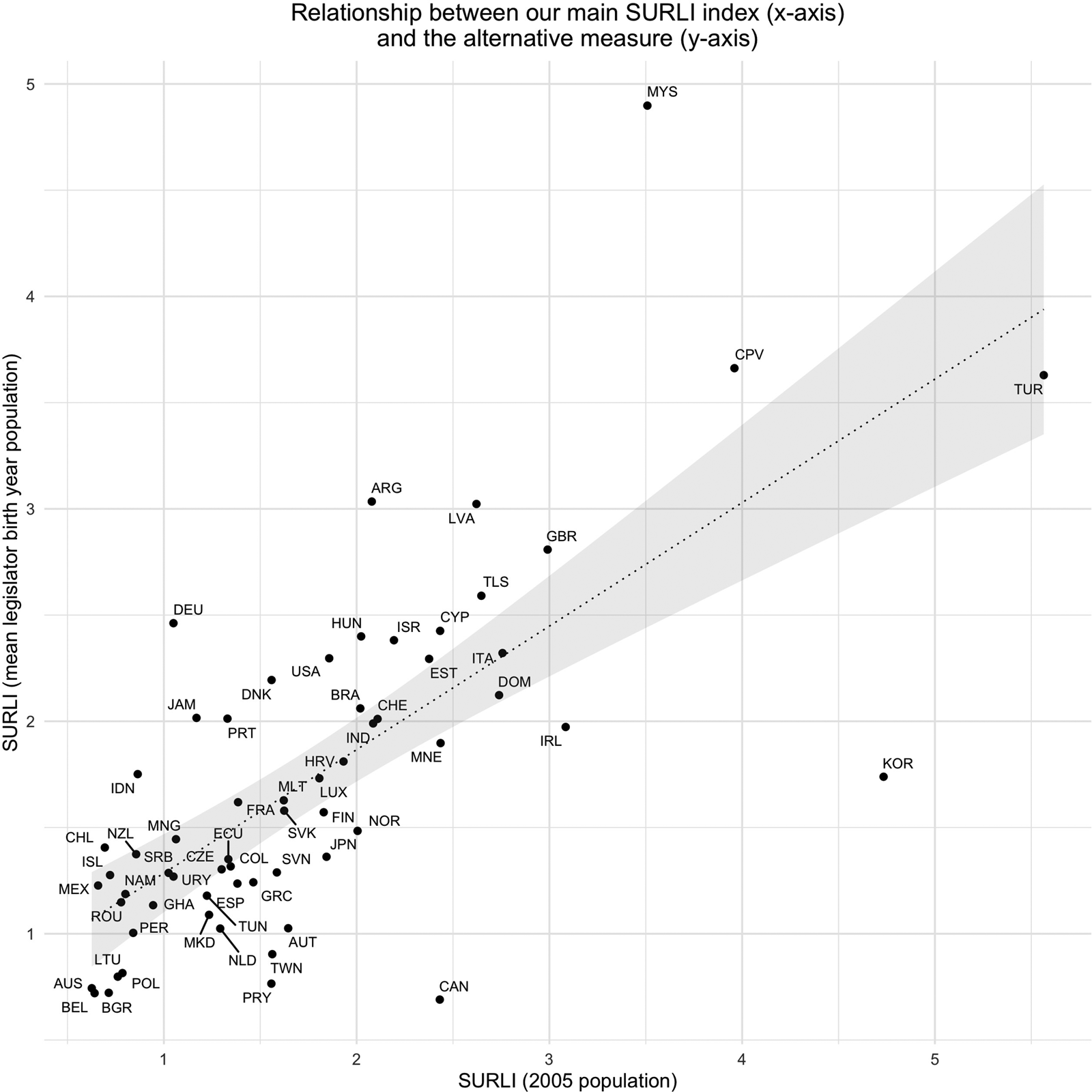
As noted above, we compare the distribution of MP birthplaces to two population datasets, one capturing the distribution of the population in 2005 and one capturing the distribution of the population in the year the average MP was born. As shown in Fig. 2, the correlation between the two sets of scores is quite high (Pearson's r = 0.71). However, there are substantial differences for some countries (particularly those with significant internal migration due to urbanization or, in the case of Germany, reunification). The correlation between land area and the main measure of SURLI is −0.02, suggesting that our method does appear to net out differences in country size, as desired.
Comparison between SURLI computed against the population distribution around the time of the election and SURLI computed against the population distribution in the mean birth year of a country's legislators.
Note that SURLI is a measure of collective rather than dyadic representation (Weissberg Reference Weissberg1978): it compares the geographic distribution of MP birthplaces to the geographic distribution of population rather than asking whether, for example, each MP was born in the area they represent (Pedersen, Kjaer, and Eliassen Reference Pedersen, Kjaer, Eliassen, Cotta and Best2007). A collective measure of representation is more appropriate for our purposes in part because it can be applied to systems (such as Israel and the Netherlands) where MPs do not represent specific districts. However, dyadic geographical representation is doubtless important, and we will examine it in the within-country analysis below.
Results and Discussion
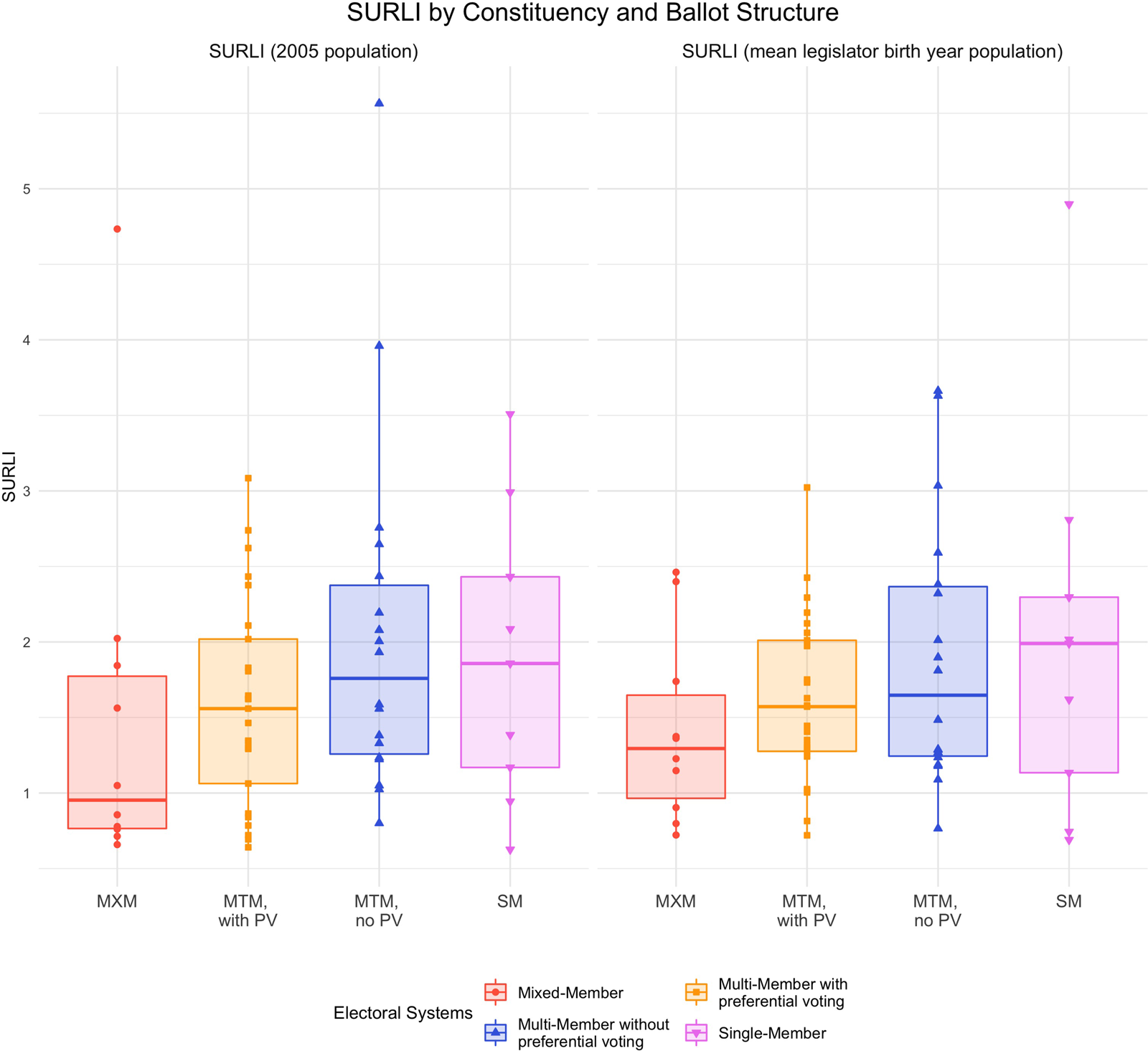
Having derived the spatial unrepresentativeness of the legislatures index (SURLI), we can now investigate its relationship with electoral institutions. Figure 3 shows the distribution of SURLI (2005 population) and SURLI (mean legislator birth year population) across four major families of electoral systems, defined by their constituency and ballot structures. For both versions of SURLI, the median value in mixed-member systems (MXM) is the lowest, followed by multi-member (MTM) systems with preferential voting (PV). In all systems and for both measures, the median SURLI score is between around 1 (indicating the legislature is about as unrepresentative as we would expect if we drew MPs at random) and 2 (indicating that it is twice as unrepresentative). Single-member district systems (SM) fare poorly relative to multi-member district systems (MTM). Conversely, the scatterplots in Fig. 4 show no discernible relationship between SURLI and district magnitude for either SURLI measure.
SURLI scores by electoral systems. SM, single-member; MTM, multi-member; MXM, mixed-member; PV, preferential voting. The only MXM country in our sample with PV in the MTM tier (Lithuania) was grouped with MXM for illustrative purposes.
SURLI scores by median district magnitude.

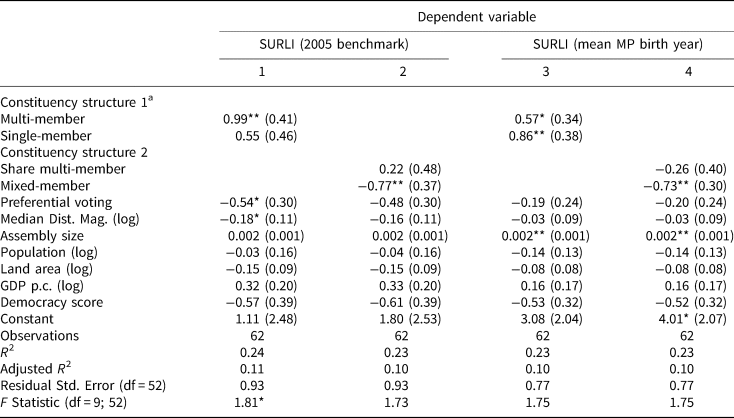
Table 3 shows the results of OLS regression models where our two SURLI measures are regressed on electoral system characteristics and demographic and institutional variables. In models 1 and 3, we characterize constituency structure using a three-factor categorical variable; in models 2 and 4, we employ a continuous variable for the share of legislators elected via MTM districts alongside a dummy for mixed-member systems. (This dummy effectively captures the ‘additional’ effect of mixed-member relative to the predicted value of SURLI if these systems simply functioned as hybrids of single- and multi-member systems.) To capture other potentially relevant features of electoral systems, we include an indicator for preferential voting and a measure of median district magnitude (both described above). We adjust for assembly size and several country features described above.
OLS regression coefficients (standard errors in parentheses)
a reference category: Mixed-member.
*p < 0.1; **p < 0.05; ***p < 0.01.
The results in Table 3 indicate that, even after including control variables, legislatures tend to be less geographically unrepresentative in mixed-member systems than elsewhere. Models 1 and 3 indicate that SURLI in MXM systems is, on average, between 0.5 and 1 point lower than in SM or MTM systems (depending on the SURLI measure) after adjusting for median district magnitude and other factors. Models 2 and 4 indicate that SURLI in mixed-member systems is around 0.75 lower than in other systems, net of the share of legislators elected via MTM districts and adjusting for other characteristics. The magnitude of the implied differences in predicted SURLI between MXM systems and others is consistent with the unadjusted differences in Fig. 3. The findings for preferential voting are less clear-cut: the difference is in the predicted direction in all models – that is, lower SURLI for systems with preferential voting – but it only reaches significance at p < 0.1 in model 1. Similarly, median district magnitude is negatively related to SURLI in all models but only significant at the 0.1 level in the first.Footnote 15 In the cross-country analysis, we do not find consistent evidence that single-member district systems have more geographically representative legislatures than multi-member district systems. Whatever the advantages of SM constituencies for maintaining connections between MPs and localities, SM systems do not seem to engender more equal access to political office for people born in different parts of the country.
Within-Country Analysis
Electoral System Change and Geographic Representation: The Case of Italy
To complement the cross-country analysis, we present a case study where we compute indicators of geographic representativeness for legislators serving in the Italian Chamber of Deputies in the eleven elections between 1983 and 2022. Over this period, Italy experienced three major instances of electoral system change: in 1993, the open-list PR system adopted in 1946 was abandoned in favour of a mixed-member majoritarian formula with a closed-list PR tier; in 2005, it switched to a closed-list PR system with a majority bonus; finally, in 2017, the country moved back to a mixed-member majoritarian system, again with a closed-list PR tier.Footnote 16 Table 4 presents further information on the four institutional set-ups and categorizes them according to constituency structure and preferential voting.
Characteristics of Italy's electoral system (1983–2022)
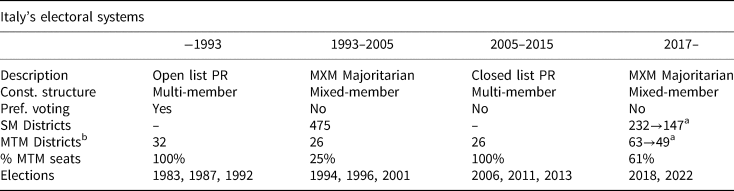
a the number of SM and MTM districts was reduced following the 2020 Constitutional referendum.
b the count of MTM districts excludes those reserved for Italians resident abroad (introduced in 2005) and includes one single-member district (Aosta), suppressed under MXM.
These instances of institutional reform allow us to compare local representation under different institutional set-ups within a single country, holding fixed the factors that cause different countries to choose different electoral systems. Comparisons before and after the reforms were instituted do not, of course, perfectly isolate the effect of electoral system reform. On the one hand, other factors changed along with the electoral system (as in 1993, when there was a change in the party system at the same time), raising concerns about confounding, compound treatment, and incidental time trends. On the other hand, elite selection practices may not change immediately, making it difficult to detect the effect of a short-lived reform. Nonetheless, the institutional variation we observe in Italy can at least allow us to evaluate the plausibility of two building blocks of the theory: the role of the SM tier of MXM systems, which we argue tends to favour geographic representation, and that of preferential voting, which in the cross-country analysis emerges as a weak correlate of SURLI but in a direction consistent with the theory. In particular, we expect to find support for these theoretical implications:
(1) Legislatures elected via a mixed-member system (1993–2005 and post-2017) and an open-list PR (pre-1993) can be expected to be overall more spatially representative than those elected under closed-list PR (2005–2015).
(2) Within mixed-member systems, we expect the subset of legislators elected in the SM tier to be more geographically representative than that of legislators elected in the MTM tier.
Drawing on the Italian Chamber of Deputies registry dataFootnote 17, we compiled information on birthplace and district of election for legislators serving in Italy's Lower House between the ninth (1983–1987) and the nineteenth legislative terms (2022–). The dataset was then reduced to MPs who (i) were in Parliament at the start of the term (thus excluding substitutes) and (ii) were elected to represent Italy's national territory (thus excluding members elected to represent Italians living abroad since 2005). Moreover, for each election year, we compiled population estimates at the level of 15-arcminute side grids, using population-year estimates in HYDE3.2 for elections prior to 2005 and NASA's Gridded Population of the World (GWP, version 4) for elections after 2005.Footnote 18
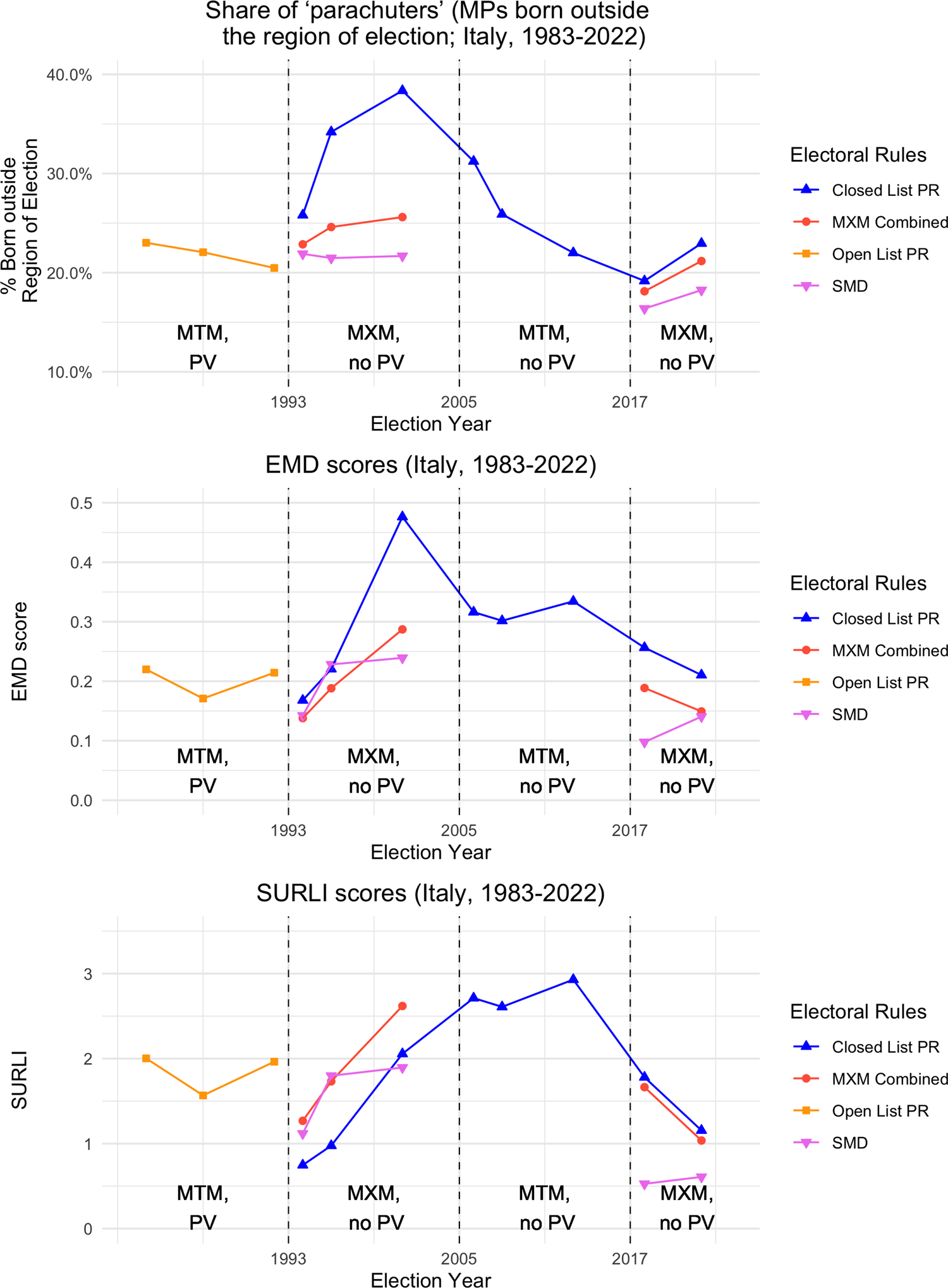
Figure 5 shows the Italian Lower House's geographic (un)representativeness, both overall and within tiers when appropriate, according to three measures. The top panel shows the share of ‘parachuters’ (Pedersen, Kjaer, and Eliassen Reference Pedersen, Kjaer, Eliassen, Cotta and Best2007), defined here as MPs who were born outside of the region in which their electoral district is located.Footnote 19 While the share of parachuters could not be computed for countries without electoral districts and would not be comparable across countries with different definitions of ‘region,’ it is an intuitive measure of (un)representativeness for this single-country case study and helps establish comparability with the analysis of the UK and Germany below. Consistent with expectations, the plot shows that, under MTM, the legislature was more representative (lower share of parachuters) with PV than without (pre-1993 vs 2005–2017); also, under MXM, the SM tier had a lower share of parachuters (in all parliaments) than the PR tier, which is consistent with the idea that the SM tier helps make MXM systems more geographically representative. The evidence appears more mixed about the comparison of MXM and MTM systems: the post-2017 MXM system had a lower share of parachuters than the 2005–2017 MTM system, which in turn had a similar share of parachuters to the 1993–2005 MXM system. When we average the scores for parliaments within each electoral system/tier in Table 5, we see that all three comparisons are in the expected direction.
Indicators of geographical representativeness of legislators across election and MXM tiers, Italy. Dotted lines mark the years of major electoral system change.
Mean values of indicators of geographical representativeness

The second panel shows EMD scores. These results offer solid support for our hypotheses. Under MTM, the PV system more clearly has a lower EMD (pre-1993 vs 2005–2017). In both MXM periods, the SMD tier tends to have a lower EMD than the PR tier, and in each of the MXMs, the legislature is more geographically representative than in the MTM period with no PV (2005–2017). As mentioned above, the system averages in Table 5 are consistent with the theory.
For comparison with the cross-country analysis, the third panel shows SURLI scores. The results are broadly similar to the above panels, with one notable difference: the closed list PR tier appears somewhat more representative than the SM tier in the 1993–2005 period, while the relationship was reversed in the other two plots. The reason is that the PR tier had only 155 MPs (compared to 475 in the SM tier). The average EMD of the simulated legislatures for the PR tier, which is the denominator of SURLI, is substantially higher (because the best case for the smaller tier is less representative than the best case for the larger one, and randomly highly unrepresentative parliaments are more likely for the smaller tier too). This adjustment for assembly size is a desirable feature in our cross-national comparisons, but when focusing on a single country, the share of parachuters or the raw EMD may be a clearer representation indicator. Even so, when averaging within systems/tiers in Table 5, all the differences are in the expected direction.
SM Districts and Local Representation: UK and Germany Compared
The cross-country analysis suggests that mixed-member systems are superior to multi-member districts on our measure of spatial representativeness, which is in line with our theoretical expectations; but they also seem to outperform SM districts. This section further investigates what makes mixed-member systems more geographically representative. In Section 3 we argued that contamination effects in MXM systems could lead to better local representation in the nominal tier of these systems than in ‘pure’ single-member systems; essentially, this is because parties in mixed-member systems expect to gain in the multi-member tier by fielding attractive candidates in the nominal tier, which means that more candidates are local (even in safe seats) and fewer seats are safe. To test this argument, we focus on the district level in this section, asking whether each district's MP is a ‘parachuter’ or local-born and how this relates to competitiveness differently in single-member and mixed-member systems.Footnote 20
For reasons of data availability, we select two countries – the UK and Germany – as examples of, respectively, a single-member district plurality and a compensatory mixed-member system. The analysis is restricted to Germany's single-member tier. In sum,
(1) We expect German single-member district elections to be more competitive than British single-member district elections because contamination effects induce entry.
(2) Compared to British MPs, we expect a smaller proportion of German MPs elected from the nominal tier to be ‘parachuters’ for the reasons stated above; in other words, a greater proportion of German MPs should be local to the seat they represent.
(3) In the UK, we expect the probability of a parachuter being elected to be higher in safer seats. However, we expect this to be less common in the German nominal tier due to contamination effects. A party that expects to win easily may still field a local candidate to boost its results in the multi-member tier.
Given the many ways in which the UK and Germany differ politically, one should not expect a comparison of the two cases to produce conclusive evidence for or against any theory. However, differences consistent with the above expectations would tend to corroborate our interpretation of the broader patterns we find.
We created for each country a dataset that combines biographical information on legislators, district-level data on parties' electoral performance, and spatial data from constituency boundary digital vector files. For both countries, our primary source for MPs' data is the legislatoR database (Göbel and Munzert Reference Göbel and Munzert2022), which includes – among other information – legislator birthplaces, party affiliation, constituency, and electoral tier. We selected British and German single-member district MPs elected in six recent parliamentary elections (respectively, 2001–2019 and 1998–2017) for a total of 3,971 British and 1,823 German legislator-session entries.Footnote 21 We complemented the birthplace data in the dataset with further research. First, we geocoded the locations found, yielding a virtually complete coverage of the sample for this variable (see the first row of Tables 6 and 7). Using constituency names and codes, we linked each entry to party shares of the vote in the previous election (this approximates parties' priors in the candidate selection stage). To account for redistricting, for the UK sample, we combined data from the House of Commons library with notional seat shares estimated by Rallings and Thrasher;Footnote 22 for Germany, we used both ‘real’ and notional district-level results published for each election by the Bundeswahlleiter (German federal electoral commission). Constituencies were then linked to geocoded vector polygon data in shapefiles obtained from the UK Data Service and the Bundeswahlleiter.
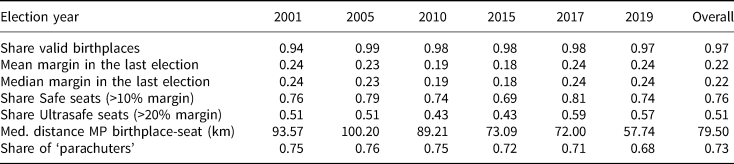
Descriptive statistics, UK MPs sample
Descriptive statistics, German single-member district MPs sample
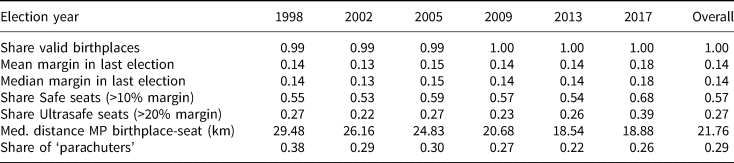
We address the first two hypotheses – concerning district competitiveness and the extent of local representation – via simple descriptive analysis. From real or notional district-level electoral data, we computed a margin in the last election variable as the difference between the share of the vote for the largest party in the previous election and the share of its closest competitor.Footnote 23 Furthermore, we used the digital vector data to compute the seat in the current election that includes the legislator's birthplace. Additionally, we computed the geodesic distance between the legislator's birthplace and the centroid of the seat she represents. Finally, we combined these two pieces of information to create a binary parachuter variable that takes the value of 1 if both the following conditions are satisfied: (i) the legislator's birthplace falls outside the area of the seat she represents, and (ii) the legislator is born farther than 20 km from the centroid of the seat she represents. This double-safe coding rule is meant to minimize measurement errors in districts of varying sizes. For instance, using only the first criterion, any legislator born in London would be coded as being from the central seat of ‘Cities of London and Westminster’ (and a parachuter to any other London seat). Obviously, given that information, they could be local to any other London seat. Equally, using only the second criterion, an MP born in Dumfries – the major settlement in the 4,000 km2 rural Scottish constituency of Dumfries and Galloway – would incorrectly be coded as a parachuter to the seat they were born in because the town is not close enough to the constituency's centroid.
The measures of district competitiveness and local representation we provide in Tables 6 and 7 are consistent with our expectations: UK constituencies are less competitive on average than German SM districts, and British MPs are far more likely to be born outside their constituencies than German SM district legislators. The most competitive election in the UK in terms of mean and median previous margins (2015) is less competitive than the least competitive election in German SM district seats (2017). In over three-quarters of the UK, constituencies are ‘safe’ (the margin is larger than 10 per cent), and over half are ‘ultra-safe’ (larger than 20 per cent), against 57 per cent and 27 per cent in German single-member districts. As far as local representation is concerned, the contrast is equally stark. Under the aforementioned definition of being a ‘parachuter’, only 29 per cent of German single-member district legislators were born outside their constituency compared to 73 per cent of British MPs. This does not appear to be simply an artefact of German constituencies being larger: the median distance between an MP's birthplace and the centroid of the constituency they represent is 22 km in Germany and 79 km in the UK.Footnote 24
Next, we probe the relationship between seat marginality and parties' incentives to parachute candidates in the two cases. We first restrict the two samples to newly-elected legislators, with observations that capture the outcome of party and voter choices made in the same election, based on known priors of seat competitiveness.Footnote 25 This party margin in the previous election regressor is computed as the difference between the vote share of the winning MP's party in the previous election and the vote share of the top-ranking competitor. Unlike the absolute measure of marginality discussed before, this variable can take negative values when the legislator's party has lost the previous contest (or at least would have under the current boundaries). As controls, we include party and election dummies and a measure of constituency land area (a proxy for urban/rural seat distinction). Moreover, in model 2, we include interactions between party and election dummies so that comparisons are effectively between safer and less safe MPs from the same party in the same year, as well as additional controls (region, gender, and the log of constituency land area) in the tables presented in section S5 of the Supplementary Material.
The logistic regression coefficients for the British and German samples of legislators are shown in Tables 8 and 9; the marginal effects of party margin on the dependent variable across model specifications are plotted in Fig. 6 for the two major parties in each country. In the UK sample, we find the expected positive relationship between seat safety and the likelihood of a parachuter being elected: MPs elected from safer seats are less likely to be born in the district than those elected from less safe seats, in part because parties use these seats as comfortable destinations for insiders. Strikingly, the relationship is negative in German single-member districts: MPs elected from safer seats are more likely to be born in the district than those elected from less safe seats. This may be because the opportunity to win party-list votes through spillovers is greater in party strongholds or because potential local candidates are more plentiful in such places.

Binomial logistic models
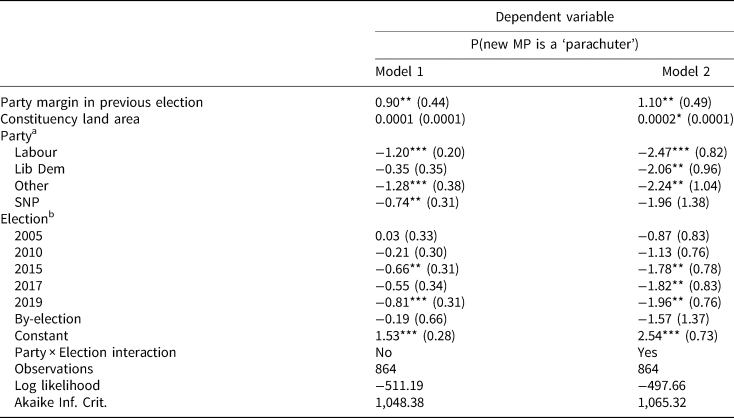
The estimates capture the variables' effect on the probability that a newly elected British MP is born outside the constituency she represents (that is, a ‘parachuter’). Model 2 includes Party × Election interactions: interaction terms' coefficients are not shown for reasons of space.
a = ref. cat. Conservative.
b = ref. cat. 2001.
*p < 0.1; **p < 0.05; ***p < 0.01.
Binomial logistic models
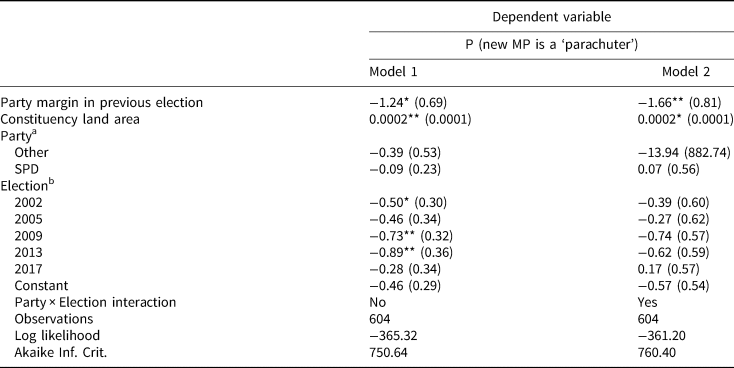
The estimates capture the variables' effect on the probability that a newly elected German single-member district MP is born outside her constituency (that is, a ‘parachuter’). Model 2 includes Party × Election interactions: interaction terms' coefficients are not shown for reasons of space.
a = ref. cat. CDU/CSU.
b = ref. cat. 1998.
*p < 0.1; **p < 0.05; ***p < 0.01.
Conclusion
In the title of their influential edited volume, Shugart and Wattenberg (Reference Shugart and Wattenberg2001) asked whether mixed-member systems offer the ‘best of both worlds’ relative to single-member districts and proportional representation. From the point of view of descriptive representation of places in parliaments, our analysis suggests that we can answer that question positively. Judging by our new measure, there is not much difference in geographical representativeness between single-member and multi-member district systems. However, legislatures elected in mixed-member systems seem to be significantly more geographically representative than both. This finding chimes with our theoretical intuition that, due to contamination effects, the single-member tier of mixed-member systems is more conducive to electing local candidates than either single-member districts in single-member systems or multi-member districts. Alongside a cross-country analysis, we provide additional evidence in this direction by analyzing patterns of local representation among Italian legislators elected under different electoral rules and comparing single-member district MPs elected in an MXM (Germany) and an SM system (UK). We found that Italian legislatures elected under MXM rules are more representative than those elected under MTM rules without preferential voting; moreover, this seems to be attributable to the higher representativeness of MXM systems' nominal tier. Furthermore, we observe that a much larger proportion of German MPs were born in their single-member district than British MPs; safer seats are more likely to be represented by a ‘parachuter’ in the UK, whereas the opposite is true in Germany.
This study has important limitations. First, our cross-country analysis uses a rather coarse system to classify electoral institutions. We mentioned in passing the possible effect of US-style party primaries, but there are other institutional features that we just do not have enough variation in the sample to study comparatively at this stage: different electoral formulae in SM systems, the nature of tier linkage in mixed-member systems, legal electoral thresholds in multi and mixed-member systems etc. An additional limitation, already noted in the cross-country analysis section, is that inferring MPs' ties to geographic locales from birthplaces discounts other aspects of a legislator's biography – education, work, length of residence – that may link them to a community. Systematically gathering this information for a large set of countries is an enormous task, but the resulting measure might better characterize MPs' geographical ties. Another research direction might involve devising a measurement for the substantive representation of places rather than their descriptive representation.
Nonetheless, this paper makes valuable contributions in at least two senses. First, from a methodological point of view, it develops a practical method for measuring the congruence between spatial distributions across polities. It can, therefore, be applied to the study of other spatial inequalities in political outcomes. From a substantive point of view, the analysis has normative implications for electoral system design, providing evidence against the ‘constituency linkage’ argument according to which SM districts lead to better, more personalized representation of locales: an argument not only made by supporters of existing majoritarian systems (Kelly Reference Kelly2008) but also often conceded by electoral reformers (British Columbia Citizens' Assembly on Electoral Reform, 2004; Jenkins Reference Jenkins1998). To the extent that having legislators who reflect the geographic diversity of a country can be considered a relevant democratic objective, it emerges that other electoral institutions – mixed-member systems and possibly preferential voting – may be more effective means to achieve this goal.
Supplementary material
The supplementary material for this article can be found at https://doi.org/10.1017/S0007123423000121.
Data availability statement
Replication Data for this article can be found in Harvard Dataverse at: https://doi.org/10.7910/DVN/JHOD7C.
Acknowledgements
We are grateful to Christine Sheldon and Esme Lillywhite for excellent research assistance; to Erzen Öncel for her help with the GLP data; to Patricia Calca and Sebastian Koehler for data on Portugal; Jaehee Jung for help with Korean MPs; to participants at the Comparative Research on Political Elites conference (Hertie School, Berlin), the Inequality and Representation workshop (Rothermere American Institute, University of Oxford), the Democracy & Elections and Comparative Politics Conference (University of Manchester), and the Moynihan Institute of Global Affairs' Comparative Politics/International Relations Series (Syracuse University) for helpful feedback; to Christian Lessmann for assistance with spatial inequality data; to Matthew Shugart, Jonne Kamphorst, Ben Ansell, Tarik Abou-Chadi, Spyros Kosmidis, Tom O'Grady, Simon Hix, Ashrakat El Shehawy and the four anonymous reviewers for comments.
Financial support
This research was partly supported by an ESRC (Grand Union DTP) research training support grant and studentship (UKRI code ES/P000649/1).
Competing interests
None.


 Open access

