

Introduction
For less than $10 USD, today, parents and children alike can send off a sample of DNA to third-party, direct-to-consumer (DTC) genetic testing companies and purchase genetic reports for educational characteristics such as cognitive ability, intelligence, math ability, reading ability, and educational attainment, which is the number of years of schooling a person has completed in their lifetime.Footnote 1 These reports typically place a customer’s genomic profile on a bell-curve, intuitively demonstrating that these educational abilities are genetic in origin, and that everyone falls somewhere on a spectrum from low to high. Presumably, a child with a very below-average genetic report for math ability has far less genetic mathematical potential than a child with a highly above-average genetic report.
Although the idea of predicting a person’s cognitive ability from DNA is not new, the public availability of such tests certainly is; nonetheless, anyone with $10, an internet connection, and a pinch of curiosity can acquire one. Given the accessibility and realized novelty of this rather provocative technology, we should be inclined to ask: how will it affect individuals and society? Andrew Niccol, writer and director of the 1990s classic, Gattaca, envisioned a future in which a very similar kind of technology ultimately divided human society into “valid” and “invalid”—perfect genetics will be a prerequisite for the best opportunities.
Niccol’s dystopia was contingent on a science-fiction degree of genetic determinism in which not only were DNA tests perfectly accurate but they were perfectly editable too. That vision stands in stark contrast to the current state of affairs in which the reports currently available are “next to worthless,”Footnote 2 subject to a host of predictive and explanatory limitations to be detailed later in this essay. Despite limitations, I am concerned that the scientific development and public accessibility of genetic information about education is a signal of a societal shift toward thinking about educational ability, potential, and variation within schools as largely genetic. This, roughly construed, is the geneticization of education. The remainder of this article is dedicated to expanding on what I mean by this concept, providing more evidence that the process is well-underway, and engaging some of the most pressing downstream bioethical implications.
The geneticization of education
The concept of geneticization is analogous to the concept of medicalization, which, although subject to extensive scholarly debate, can be usefully characterized as the process by which human traits or conditions become defined, diagnosed, and treated as medical conditionsFootnote 3 , Footnote 4. Social anxiety disorder provides an illustrative example. Although the feeling of discomfort or insecurity in social settings has likely been commonplace throughout human history, it eventually transitioned into a diagnosable and pharmacologically treatable psychiatric condition, as outlined in the Diagnostic and Statistical Manual of Mental Disorders (DSM). The ensuing surge in diagnoses has transformed social anxiety from a historically commonplace occurrence into a recognized medical condition. For better or worse, social anxiety has been medicalized.
Analogously, geneticization may be usefully characterized as the process by which human traits or outcomes come to be defined, understood, or treated as genetic conditions.Footnote 5 , Footnote 6 , Footnote 7 , Footnote 8 , Footnote 9 , Footnote 10 , Footnote 11 Colloquially, to say that a trait is “genetic” is to say that it is either determined or strongly influenced by a person’s genes (i.e., highly heritable).Footnote 12 It follows that the “geneticization of education” is the process by which outcomes, abilities, and traits relevant to education come to be understood as either determined or strongly influenced by DNA. If math ability was once generally understood to be something any person could develop with instructive education and practice, the geneticization of math ability would result in the general conception that a person’s performance in mathematics has more to do with genetic makeup than schooling.Footnote 13 If it turns out that specific educational outcomes (e.g., reading and math ability) or even education in general is understood to be genetic, whether it be in scholarly scientific circles or society at large, then education has been geneticized.
The genomics of education and its limitations
Genomic studies of educational traits and outcomes
The geneticization of education starts with genetic studies of educational traits and outcomes. To the extent that intelligence is closely associated with education, one could say that the geneticization of education started with Sir Francis Galton’s publication of Hereditary Genius, which investigated correlations between cognitive abilities in siblings.Footnote 14 Twin and family studies of specific scholastic abilities, which offered estimates regarding the heritability of mathematics, trace back to the 1970s.Footnote 15 Twin and family studies, however, work in a black box: estimation of heritability values for educational outcomes neither provide the capacity to usefully predict educational outcomes from genetic information nor explain variation in educational achievement by appeal to genetics or biology. In this light, my contention is that the genericization of education started, in earnest, with the more recent development of genomic investigations of educational outcomes.
PubMed search depicting surge in “Educational Attainment” research after the publication of EA3 in 2018.

In 2013, geneticists conducted the first ever genome-wide association study (GWAS) of educational attainmentFootnote 16 (today referred to as “EA1”). The results of the study were underwhelming: the examination of 126,559 DNA samples identified only three genetic variants statistically associated with years of schooling. Such results were particularly disappointing for geneticists given the long history of twin and family studies, which suggested that anywhere from 50% to 70% of variation in cognitive ability is accounted for by genetic variation.Footnote 17 Not only was the number of discovered variants in EA1 meager but also the effects of the variants were miniscule: each individual variant exhibited an effect size of a fraction of a percent (<.02). Geneticists realized that a much bigger sampling of DNA would be required to detect the extremely small effects of each individual genetic variant. Therefore, in 2016, researchers published a second GWAS of educational attainment (“EA2”), which examined nearly 300,000 DNA samples and identified 74 variants.Footnote 18
Although an improvement over EA1, the results of EA2 were similarly unsatisfactory: the quantity and effects were too small to draw any useful genomic predictions or profound scientific conclusions; larger sample sets were still needed. In 2018, a bigger team of researchers published a significantly larger GWAS (“EA3”), the findings of which ultimately skyrocketed public and scientific attention to the genetics of education.Footnote 19 In its analysis of over one million DNA samples, the study identified over 1,200 genetic variants associated with EA, explaining approximately 13% variance.Footnote 20 Although the number 13% may seem small, note that even the most impactful environmental variables, such as socioeconomic status (SES) are comparably predictive of EA.Footnote 21 The trend grew: though pleased with the findings of EA3, geneticists called for bigger samples. To that end, in 2022, “EA4” was published, which examined approximately three million DNA samples, and identified nearly 4,000 genetic variants, which explained as much as 16% variance in the number of years of schooling a person completes in their lifetime.Footnote 22
Although GWAS of EA are perhaps paradigmatic of the geneticization of education, the number of years of schooling a person completes in a lifetime is not the only educational outcome that has been subject to genomic investigation. Contributing to a very rich history of genetic studies of intelligence (as quantified by the intelligence quotient, or “IQ”),Footnote 23 the overlapping groups of researchers have conducted GWAS of a range of measures of cognitive ability including “IQ1,”Footnote 24 “IQ2,”Footnote 25 and “IQ3.”Footnote 26 Notably, genomic associations with IQ are significantly less substantial than genomic associations with EA. For example, IQ3 identified a mere 24 significant loci variants, which explained less than 3% variance.
Educational attainment and cognitive ability aside, other scientific investigations contributing to the geneticization of education include genetic and genomic studies of math and reading ability. Although twin and family studies of reading ability date as far back as the 1980s,Footnote 27 , Footnote 28 genomic investigations have gained popularity in recent years. Researchers have conducted genomic studies of mathematics ability or performanceFootnote 29 , Footnote 30 , Footnote 31 , Footnote 32 , Footnote 33 , Footnote 34 as well as reading performance and disability.Footnote 35 , Footnote 36 , Footnote 37 , Footnote 38 , Footnote 39 , Footnote 40 , Footnote 41 , Footnote 42
Genomic prediction of educational traits and outcomes
A key innovation of genomic studies is the capacity to develop DNA-based genomic predictors. Because GWAS identify a large number of genetic variants with small effects, genomic prediction works by summing the many miniscule effects of all variants associated with a particular trait or outcome. Such a genomic predictor is typically called a polygenic score (PGS) or polygenic index (PGI)—although the technology was first referred to as polygenic risk score (PRS), due to its common application for prediction of disease-related traits. A PGS is generated by analyzing a sample of DNA—which may be derived from a sample of blood or saliva—and typically provides information about an individual’s genomic profile in comparison to population averages. Persons with a high PGS for educational attainment are, on average, likely to complete more years of schooling in their lifetime than persons with a low PGS. Genetic reports for educational traits and outcomes available to the public via third-party companies typically provide a PGS.
Scientific limitations
Bioethical deliberation typically proceeds from the notion that scientists have recently reported that they can do—or will soon be able to do—something new and exciting, and, subsequently, scholars will theorize about the implications of that new technology or scientific discovery at face value. Although there is value in abstract reasoning about the implications of some provocative scientific technology, the actual limitations of current technologies, scientific methodologies, and discoveries are deeply relevant to the assessment of downstream implications—whether they be ethical, legal, social, psychological, policy-related, or otherwise.
With this in mind, the predictive and explanatory limitations of the science that ultimately undergirds the ongoing geneticization of education cannot be overemphasized. First, there is a fundamentally important practical problem regarding the usefulness of genomic predictors of educational traits and outcomes. There should be no doubt that genetic reports regarding intelligence and math ability available to the general public are practically useless in predicting individual outcomes.Footnote 43 Although genomic variation is more predictive of educational attainment, the overall predictive power is too small to provide any actionable information. Given the extremely limited predictive accuracy of PGS for math ability—as less than 4% variation in mathematics performance is accounted for by genomic variationFootnote 44—it is inevitable that many children born with below-average PGS for mathematics will grow up to perform average or better in mathematics and, vice versa, many children born with above-average scores will grow up to perform average or worse. Despite genomic studies with sample sizes in the millions, and research expenses conceivably in the billions, the very best genomic predictors of math and reading ability today are, practically speaking, useless.
Furthermore, the limited predictive capacity for individuals is just the tip of an iceberg of predictive limitations and scientific confounds associated with genomic studies of complex human behavioral traits and outcomes. Perhaps, most pertinent to the evaluation of downstream bioethical implications is the problem of portability, the key takeaway of which is this: in addition to meager individual-level prediction in general, PGSs are generally less predictive in samples that are unlike the samples represented in genomic studies.Footnote 45 , Footnote 46 , Footnote 47 , Footnote 48 , Footnote 49 , Footnote 50 , Footnote 51 , Footnote 52 , Footnote 53 The reasons for this are sundry and complicated, ranging from underrepresentation in databases to complex issues of population genetics,Footnote 54 , Footnote 55 , Footnote 56 , Footnote 57 , Footnote 58 but the downstream bioethical implications are obvious. Given that a vast majority of participants in genomic studies are individuals of European ancestry, at least one weighty practical implication of the problem of portability is that PGSs for educational outcomes will be most predictive in individuals of European ancestry.
The relationship between geographic genetic ancestry and the problem of portability warrants a very important point of clarification. Some readers may be tempted to think that because the accuracy of PGS is associated with geographic ancestry there is evidence of biological race realism. Such a temptation should be resisted given consensus in the social and biomedical sciences that race is not a biological concept.Footnote 59 Human demographic history impacts genetic ancestry, which in turn impacts the predictive accuracy of PGS across populations of humans with differing demographic history. The limited portability of PGS across socially defined racial groups does nothing to justify biological conceptions of race realism. Moreover, PGS exhibits variable predictive accuracy within single-ancestry groups yet differing population characteristics such as wealth and age.Footnote 60 Socially defined racial categories are just one of many complex human characteristics that contribute to the problem of portability.
Any bioethical discourse regarding the geneticization of education should attend to not just the predictive utility of the scientific output (i.e., PGS) but also the explanatory utility of the foundational genomic studies of educational traits and outcomes. It may be intuitive to reason that because geneticists have found thousands of genetic variants associated with math ability and educational achievement, there must be some strong causal signal from DNA to behavior. But there is not. Genomic studies of highly complex behavioral phenotypes do not provide biological explanations. In rather stark contrast to genetic studies of some diseases, such as phenylketonuria (PKU),Footnote 61 putative biological mechanisms or etiological stories linking DNA to educational performance are a big black void. At best, proponents will point to biological or phenotypic “annotations,” noting that genetic variants correlated with educational attainment are expressed in neural tissue.Footnote 62
The bottom line is that genomic studies of educational traits and outcomes, which play a major role in the geneticization of education, are bereft of meaningful biological stories or useful predictive power. Furthermore, there is a fast-growing body of theoretical literature questioning the extent to which GWAS findings warrant causal interpretations.Footnote 63 , Footnote 64 , Footnote 65 , Footnote 66 , Footnote 67 , Footnote 68 The missing heritability problem, too, provokes questions about the robustness of scientific understanding of the relationship between genotype and behavioral phenotype. As (we) described in Matthews and Turkheimer (2022):
… heritability of IQ derived from twin and family studies ranges from 0.5 to 0.7, meaning that at least 50% of variance in IQ scores among related individuals is statistically associated with genetic differences between them. In stark contrast, however, cutting-edge GWAS have recently estimated that only 10% of variance in IQ is statistically associated with differences in DNA between unrelated individuals… This ‘missing’ variance between traditional and molecular heritability – a 40% gap for IQ – is characteristic of the MHP. Importantly, there is not a single complex behavioral phenotype today for which there is no missing heritability.
Scholarly attention to this issue of “missing” heritability justifiably raises key questions about weaknesses not only in statistical modeling of genotype-phenotype relationships but also the substantiality of explanatory and mechanistic accounts.Footnote 69 , Footnote 70 , Footnote 71 , Footnote 72 , Footnote 73
Although no single philosophical or methodological criticism of education-relevant genomics may dismantle the science underlying the geneticization of education, the laundry list of predictive and explanatory problems and barriers cannot be ignored. To summarize: scientific evidence underpinning the geneticization of education raises difficult questions about a) causal interpretations of findings, b) lack of meaningful biological explanations or mechanistic etiologies, c) practically useless individual-level prediction; d) problems of portability beyond populations of European ancestry; and e) the missing heritability problem. These issues are pertinent to thinking about the bioethical implications of the geneticization of education.
From education to genomics and back
The theory I put forward here is that the geneticization of education is well-underway. Tethered to a history of behavior genetic studies of specific scholastic abilities in the 1960s and 1970s, it started in earnest when researchers sought to identify putatively causal associations between DNA variation and educational traits and outcomes, particularly mathematics ability, reading ability, and educational attainment. The previously discussed technical concepts within modern genomics and their notable predictive and explanatory limitations have been elucidated to help articulate the nature of the geneticization of education and its bioethical implications. On my view, an important part of the story is that the geneticization of education has something to do with an overarching transition of scientific and broader societal perspectives of the nature and causes of education achievement in human populations. That is, there must be some large-scale shift from viewing education as not necessarily genetic to conceiving of it as determined or strongly influenced by genetics.
Do highly sophisticated and technical genomic studies of educational traits and outcomes influence societal perspectives of education? It is partly an empirical question which is currently under investigation. That being said, the journalistic popularity of genetic studies related to education provides at least some evidence that the science underlying the geneticization of education is being distributed to the masses. Less known examples include Sci.News online article, “Researchers Identify Three Genetic Variants Associated with Mathematical Abilities in Children” (“How Genetic Variation Gives Rise to Differences in Mathematical Ability,” 2022) and Neuroscience News published the piece, “How Genetic Variation Gives Rise to Differences in Mathematical Ability” (“Researchers Identify Three Genetic Variants Associated with Mathematical Abilities in Children,” 2023).
Media attention to the geneticization of education, however, is not limited to low-profile web reporting, as even the New York Times published “Years of Education Influenced by Genetic Makeup, Enormous Study Finds.”Footnote 74 Additional examples include the Los Angeles Times piece, “About half of a kids’ learning ability is in their DNA, study finds”Footnote 75; the Atlantic piece, “An Enormous Study of the Genes Related to Staying in School”Footnote 76; and the Washington Post, “How Genes Influence Children’s Success in School.”Footnote 77 NBC online, which purportedly tracks millions of readers per month across various platforms, reported, “A new way of predicting which kids will succeed in school: Look at their genes.”Footnote 78 The widespread coverage of genomic studies in education, from reputable newspapers to online platforms with extensive readership, underscores the growing influence of genetic research on societal perspectives of education. As this discourse continues to evolve, it prompts critical questions about the implications of geneticization on public perceptions, and educational practices and policies.
Precision education
Perhaps, the strongest signal of the geneticization of education is the controversial notion of “precision education.” If “precision medicine” is the practice of tailoring medical care to a patient’s genomic profile,Footnote 79 then “precision education” is the educational analogue. Although the history undergirding the intersection of genetics and education certainly is not new,Footnote 80 the relatively recent development of polygenic scores for education has revitalized scholarly discourse on the role of genetic testing and information in educational settings. Although it can be tempting to lump all proposals involving some interaction of education and genetics under the umbrella of “precision education,” there are a few important conceptual and methodological differences on the table. With the broader goal of exploring the bioethical implications of the geneticization of education, it is important here to draw a few key distinctions between the stronger, controversial claims and the more modest, and likely feasible, claims regarding precision education. I propose a distinction between three varieties of precision education, each of which varies in strength of claim and feasibility.
Systematic precision education
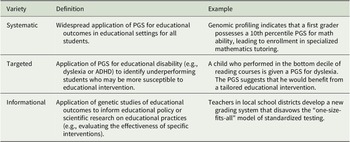
By far the strongest and most controversial call for precision education is developed in Kathryn Asbury and Robert Plomin’s G is for Genes: The Impact of Genetics on Education and Achievement. Although PGS for reading and math ability had not yet gained widespread attention, behavioral geneticists Asbury and Plomin, dedicated to unraveling the genetic underpinnings of intelligence, were keenly aware of—and partly responsible for—this emerging technology. They foresaw its imminent availability, stating that DNA “chips” would soon enable the prediction of individual students’ strengths and weaknesses, facilitating the implementation of personalized strategies to support their learning (Asbury & Plomin, 2014, p. 14). Elsewhere, Plomin writes: “A ‘precision education’ based on [polygenic scores] could be used to customize education, analogous to ‘precision medicine’.”Footnote 81 This strong form of precision education is “systematic” in the sense that its proponents suggest institution-wide genetic testing of all children for any trait or outcome relevant to education (see Table 1). For example, an institutional implementation of systematic precision education would entail that PGS for reading, math ability, and educational attainment are generated for all students who enter the first grade. Presumably, trained educators working in conjunction with genetic counselors would review each genomic profile with the goal of identifying particular children at risk for struggle in specific areas, and, consequently, to provide individualized education plans (IEPs) for those children.
Varieties of precision education

Feasibility and likelihood
In the United States, a lot of barriers would have to be overcome to have any sort of systematic implementation of genetic testing and information in educational settings. For one, as discussed above, the predictive accuracy of educational PGS would have to be reliable and useful for individuals across a wide range of genetic ancestries. Although proponents contend that the technology is in its infancy and its utility will come to fruition with the development of more sophisticated statistical modeling and bigger and more diverse GWAS, there is good reason to be skeptical. Elsewhere, I pointed out, for example, that the problem of portability is just as severe today as it was 50 years ago.Footnote 82 Furthermore, technical and sophisticated perspectives from population geneticists raise serious questions about the possibility of disentangling the extremely complex interactions of genes, environments, and factors that confound genetic studies of complex behavioral traits.Footnote 83 , Footnote 84 A second major barrier to the feasibility of systematic precision education would be the transition from theory to policy. Given the extremely controversial history related to the intersection of genetics and education, it is reasonable to assume that it would be a great fight to pass the relevant laws (e.g., privacy laws, nondiscrimination laws, informed consent regulations, ethical guidelines, education policy revisions, and regulation of testing laboratories), although this would not bar private institutions.
Targeted precision education
Although systematic precision education would involve genomic profiling of all educational phenotypes for all children, a less comprehensive approach would involve a restricted set of phenotypes for a smaller subject of students. I propose targeted precision education as the practice of using PGS for psychiatric disorders, diseases, neurological conditions, or learning disabilities that carry strong negative association with school performance. This form of precision education has been taken more seriously by scholarsFootnote 85 , Footnote 86 and has even garnered some journalistic attention.Footnote 87 Polygenic scores for autism, dyslexia, or Attention-deficit/hyperactivity disorder (ADHD) could be used to identify children likely to struggle in educational settings and, accordingly, to implement an educational intervention designed to mitigate negative impacts.
Feasibility and likelihood
An empirical survey of public views about targeted precision education revealed that most participants agreed that genetic test results should be used to aid in the development of individual education plans.Footnote 88 More impactful, however, is the notion that scientific studies probing the potential efficacy of targeted precision education have already begun. Notably, the New Haven Lexinome Project (NHLP), a study conducted by a research team at Yale University, sought to examine the efficacy of genetically informed educational interventions for children with dyslexia.Footnote 89 , Footnote 90 Because the project was privately funded, little information about the studies is publicly available. According to the NHLP website,
We believe that in the future we can make significant improvements in the proportion of children with successful outcomes through reading interventions that are informed by knowing the genetic variants of an individual child. We will be able to use the combined information from this study to individually tailor interventions that are most likely to be effective for each child. This is a new field called ‘precision education’ (http://yalenhlp.org/).
To the extent that this study aimed to evaluate the potential efficacy of precision education, it could be considered “early-form” precision education. It worked in the following way: First, the research team recruited children from the New Haven public school district who had underperformed in literacy. The children were given the opportunity to enroll in rigorous and well-known reading programs—“Reading Recovery” and “Empower”—that involved four years of additional reading help from trained educators.
Although the efficacy of these interventions has been studied,Footnote 91 the NHLP research team sought to examine the efficacy of the program in relation to the children’s genomic profile. As such, at the end of the study, consenting participants provided DNA samples. The research team was then able to assess whether differences in the children’s genomic profiles—presumably polygenic scores for reading ability—were associated with the efficacy of the reading interventions. The results of this project have not yet been published; thus, we cannot say that precision education proper is underway. However, the existence of studies into the potential viability of precision education speak to its feasibility.
Informational precision education
The aforementioned varieties of precision education involve the application of polygenic scores to individual students—whether complete student populations or only students with a disability. A more plausible and modest proposal, however, calls for a more abstract and general practice of altering educational policies and practices in light of findings from the field of genetics.Footnote 92 , Footnote 93 Aside from strong claims that individual polygenic scores could be used to tailor educational interventions, an overarching argument of G is for Genes is indicative of a more general proposal to use behavior genetic findings to influence educational practice and policy.
Asbury and Plomin, for example, challenge the notion of the “blank slate” model, contending that genetic findings debunk the idea that all individuals are born with identical educational potential and that environmental factors solely dictate educational outcomes. Thus, on their view, genetics informs an approach to educational practice that rejects the “one-size-fits-all” standard. Asbury and Plomin’s model could be seen as “informational precision education” in the sense that it proposes that educational practice can be informed by genetic findings.
Another type of informational precision education simply involves using genetics of education as a part of scientific studies of educational outcomes more generally. Kathryn Paige Harden,Footnote 94 , Footnote 95 for example, makes this case:
Knowing which genes are associated with educational success will help scientists understand how different environments also affect that success. The eventual development of a polygenic score that statistically predicts educational outcomes will allow researchers to control for genetic differences between people, so that the causal effects of the environment are thrown into sharper focus. Understanding which environments cause improvements in children’s ability to think and learn is necessary if we want to invest wisely in interventions that can truly make a difference.Footnote 96
Here, the general idea is that the genetics of education can inform scientific studies of educational interventions and outcomes.
Feasibility and likelihood
Informational precision education is very feasible and likely to be implemented. In fact, a study revealed that PreK–12 American educators are open to learning more about Asbury and Plomin’s proposals to include genetics research in education policy.Footnote 97 With respect to Harden’s proposal to use genetics of education as a control variable, such studies are underway.Footnote 98 The efficacy of such proposals is an empirical question that remains to be answered.
On the implications of the geneticization of education
The implications of the geneticization of education encompass a spectrum of scope and severity. In terms of scope, narrow implications may affect a limited segment of society, targeting specific groups or individuals, whereas broad implications may usher in sweeping societal transformations that touch on the entire populace. Regarding severity, minor implications might bring about subtle or temporary effects, whereas severe implications could precipitate substantial and enduring changes that alter the course of individuals’ lives. Implications also vary in kind, including (but not limited to) ethical, legal, social, psychological, political, and philosophical. Although an exhaustive analysis of implications cannot be completed here, in what follows I try to highlight some of the more profuse or likely results.
Self-fulfilling prophecies and the polygenic Pygmalion effect
Public availability of DTC genetic reports for reading and math ability and the potential for systematic or targeted precision education point to the possibility of specific psychological impacts. Because polygenic scores are predictors, they confer a kind of expectation, which is relevant to a growing body of experimental psychology literature on the way expectation influences performance. Much of this literature traces back to Rosenthal and Jacobson’s “Pygmalion effect” from their book Pygmalion in the Classroom, which described empirical studies regarding how teacher expectation influences student performance.Footnote 99 The gist of their findings highlighted the potential for teacher’s expectations to give rise to a kind of self-fulfilling prophecy. In a longitudinal study, the students of educators with high expectations performed better than the students of educators who did not hold high expectations.
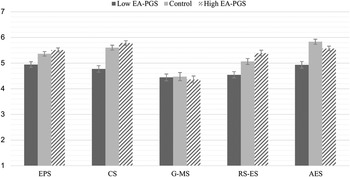
Although there have been notable challenges to the replication of Rosenthal and Jacobson’s particular study, empirical evidence for Pygmalion effects and self-fulfilling prophecies are robust across a wide range of settings—from scientific laboratories and surgical mentoring to management and physical education.Footnote 100 , Footnote 101 , Footnote 102 , Footnote 103 Most recently, and pertinent to the context of the geneticization of education, we sought to identify the potential psychological impacts of either low-percentile or high-percentile polygenic scores for educational attainment (EA-PGS).Footnote 104 In an online survey-based study, participants asked to imagine having received a low EA-PGS reported significantly lower self-assessments of self-esteem (RS-ES), academic efficacy (AES), educational potential (EPS), and competence (CS) than participants asked to imagine having received a high score, and those assigned to a control group (see Figure 2).
In a web-based survey using experimental randomization, participants assigned to the “Low EA-PGS” condition provided significantly lower self-assessments of educational potential (EPS), competence (CS), self-esteem (RS-ES), and academic efficacy (AES).

The findings point to the potential for a kind of polygenic Pygmalion effect, in which the expectation conferred by genetic test results could influence student performance. Although systematic precision education may be unlikely, the threat of a polygenic Pygmalion effect is realized in the DTC availability of genetic reports for educational outcomes. There are at least two primary modes in which negative impacts could be realized (Figure 3). On the one hand, it is inevitable that there will be parents who seek out the education-related PGS of their children— perhaps out of mere curiosity, perhaps with the intention of tailoring parenting behavior. Parents who learn that their child has a low-percentile EA-PGS, or math ability PGS may well lower their expectations of that child’s potential in educational settings. Such implicit biases may influence parenting behavior, perhaps resulting in lower self-esteem or self-conception of educational potential in the student, ultimately resulting in diminished educational performance.
Polygenic Pygmalion effects could be realized through the influence of a low score on parental or educator attitudes and beliefs toward a student, which could then in turn impact student self-perceptions, confidence, and subsequent educational performance.

Similarly, precision education initiatives may result in return of results to educators responsible for interventions. Educator beliefs, perhaps through genetic essentialist biases, that particular students have low “genetic propensity” for specific coursework may influence educator behavior, which may in turn be internalized by a student. Even when results are not returned to educators, teachers may still infer from intervention assignments informed by DNA tests that a given classroom comprises students with a low genetic propensity for specific coursework.
Another plausible mode in which a harmful polygenic Pygmalion effect could be realized would be in the case in which an individual student—say, a college junior deciding whether to apply for graduate or medical school—seeks out DTC genetic tests online. Again, it is inevitable that there will be young adults with great academic potential who are steered away from furthering their education because of a (dubious) polygenic score.
Stigma and discrimination
Matthews et al. (2018) performed a second experiment in which the vignette described a hypothetical classmate with either a low or high EA-PGS. Again, the study resulted in low assessments of academic efficacy, educational potential, and competence for hypothetical classmates with a low EA-PGS. Evidently, the perspectives of others can significantly influence self-fulfilling prophecies. Stigma and discrimination in educational settings is a sad and pervasive phenomenon, and the inclusion of negative genetic information may only make matters worse. Whether it be through learning, inferring, or guessing, students could be stigmatized or discriminated against simply for having a disappointing or below-average polygenic score.
The notion that intelligence has a genetic component, and that some individuals have superior or inferior genetics, is not new. There is a very rich and disturbing history of psychological and social research regarding race and the genetics of intelligence.Footnote 105 It stands to reason that stigma and discrimination associated with beliefs regarding race and IQ will only be exacerbated by the geneticization of education. In fact, genetic studies of education have already begun to develop a history of misuse, misinterpretation, and weaponization by extremists and white supremacists.Footnote 106 , Footnote 107 Famously, the self-described white supremacist “Buffalo shooter” cited genetic studies of education in his online manifesto.Footnote 108 As more and more genetic studies of education are published, further instances of “citizen science” that misappropriates or misinterprets data to harmful, discriminatory ends should be anticipated.
Educational inequality
One particularly notable impact of the geneticization of education would be the exacerbation of already rampant educational inequality. If systematic precision education were to come to fruition, it would likely occur first in the context of private schools that offer admission only to students with the most promising polygenic scores. Certified polygenic reports would be cost-prohibitive, further problematizing educational equality across socioeconomic classes. Despite the limited likelihood of systematic applications of polygenic scores in educational settings, an overall societal change in which educational outcomes are perceived to be caused mostly by genetics could increase educational inequality through myriad mechanisms. A society collectively convinced that students’ poor performance in educational settings stems solely from immutable genetic factors, rather than environmental influences such as limited resources or unhealthy family environments, may balk at enacting policies supporting educational interventions and funding. These problems are exacerbated by the problem of portability, which entails that polygenic scores are drastically less accurate in historically and currently disadvantaged populations.
Occupational screening
Although prohibited by the Genetics Non Discrimination Act (GINA) in the United States, another potential implication of the geneticization of education in other countries would be the application of polygenic scores or similar genetic reports to hiring decisions. Private institutions could, for example, recruit potential employees by inquiring about PGS results for educational traits and outcomes. In the same way that employers typically require educational achievement to be described in job applications, it is conceivable that some employers may request, too, genetic reports for educational traits and outcomes. Such screening practices could have a range of downstream sociological impacts. Selecting job applicants for PGS results, as opposed to skills or education, may contribute to an erosion of meritocracy. Again, these problems are exacerbated by the problem of portability for PGS, which favors individuals of European ancestry.
Mate selection, embryo selection, and eugenics
Polygenic embryo selection has already begun. Companies such as Genomic Prediction and Orchid offer selection services related to common diseases as well as complex behavioral disorders, such as schizophrenia. That private, for-profit companies will soon offer polygenic embryo screening for educational traits and outcomes seems inevitable. Although there is good reason to doubt the efficacy of such embryo selection practices,Footnote 109 their implementation by families would nonetheless be likely to impact parental attitudes toward children.
Looking forward, minimizing harms
The harms and negative impacts of the geneticization of education originate where people are exposed to information regarding the genetics of educational traits and outcomes. So, a first step for countering and mitigating potentially negative implications would be to focus efforts on the careful and responsible dissemination of genetic study results. This source highlights the critical importance of geneticists scrutinizing their own actions and emphasizes the need for meticulous attention to their reporting practices. Although it is acknowledged that some geneticists already prioritize this, there is a call for a broader commitment to ensuring thoroughness and accuracy in their work. There is, for example, a growing repository of FAQs on genomic studies, comprising explanatory documents written by scientists who have conducted genomic studies likely prone for misinterpretation or misunderstanding.Footnote 110 These explanatory documents frequently emphasize the limited predictive capacities of polygenic scores and the fact that PGS are not deterministic.
There is good reason, however, to be doubtful about the mitigating influence of such FAQs, as it is likely that the first thing people read is the abstract of the scientific study and only those who are curious might go as far as to find a repository of explanatory secondary documents about the original study. Including information that helps clarify common misunderstanding of genetic studies in the original publication might be a scholarly norm worth considering. Then again, there is also the problem of how scientific results are communicated from publication to public audiences—typically through journalism and media. Therefore, another putative avenue for mitigating harmful effects of the geneticization of education would be to promote careful dissemination of results to journalists who intend to present them to broader audiences.
Policy changes could also help. If there is some real threat of educational genomics giving rise to, say, discrimination in school or in the workplace, then it seems reasonable to push for public policies that would regulate such applications. Genetic Information Nondiscrimination Act (GINA), which currently prohibits genetic discrimination in health insurance and the workplace, should be extended to prohibit genetic discrimination in educational settings.Footnote 111 Policies that regulate the marketing and communication of commercial genetic testing and information could also do well to mitigate potentially negative impacts. As of this writing, although numerous federal regulations, including those enforced by the FDA, restrict the claims commercial entities can make regarding genetic products linked to health and disease, there exist no equivalent policies governing claims about nonmedical genetic information.Footnote 112 This includes genetic reports on intelligence and math ability, which are accessible through DTC and third-party genetic testing companies. Regulations regarding how these reports are communicated, with attention to their predictive and explanatory limitations, could help members of the general public make better-informed decisions about the genetic information to which they are exposed.
I hope to have convinced readers that the geneticization of education has already begun and that its downstream implications are cause for concern. The process is the direct result of relatively recent technical advancements in human genomics. Before the development of GWAS, which permit the identification of many units of variation across the genome, the notion that one could predict something as abstract as “educational attainment” from DNA was science fiction. Today, it is a reality. Despite the inherent (and significant) limitations in accurately predicting highly complex educational outcomes such as math and reading ability through genomic analysis—traits well known to be significantly influenced by environmental factors—the emerging field has already begun to shape societal perspectives on education. Not only are genomic studies of educational traits and outcomes some of the most well-hyped and popular across the sciences but today anyone can send off a sample of blood or saliva to an online, third-party DTC company and receive a genetic report for educational attainment or math ability.
The emergence of the geneticization of education heralds a profound shift, demanding our utmost attention and collective action. Although its psychosocial impacts may already be subtly weaving through our educational landscape, it is not too late for scholars and policymakers to engage in a concerted effort to identify and mitigate potential and real harms. One must discern the potential boons and perils this transformation brings forth and to enact measures that safeguard against its unintended consequences.
The responsibility falls on diverse shoulders. Geneticists must be extremely careful and humble in communicating both the strengths and limitations of their results. Journalists must be accurate in communicating to the public what scientists have actually written about genetics and education. Social and psychological scientists must illuminate the nuanced ramifications of geneticized education, whereas bioethicists and ethical legal and social implications (ELSI) scholars must develop careful guidelines and recommendations. Concurrently, policymakers must confront the uncharted territory of unregulated genetic practices in education, striving to institute meaningful reforms before irreversible consequences manifest. Finally, the broader public—particularly parents who seek out genetic testing for their children (including embryos)—must be well-informed of the profound predictive and explanatory limitations inherent in genetic information related to complex behavioral traits and outcomes.
Acknowledgments
Paul Appelbaum, Daphne O. Martschenko, Josh Rutner, and Matt Lebowitz.
Funding statement
This research was made possible by NIH NHGRI grant #K01HG011683.
Competing interest
The author declares no conflicts of interest.



 Open access

