





Introduction
In many countries, Voting Advice Applications (VAAs) are among the most widely used information tools for voters. VAAs are digital applications that systematically compare voters’ policy preferences with the bundled policy preferences of the parties (Garzia and Marschall Reference Garzia, Marschall, Garzia and Marschall2019; Heinsohn, Fatke, Israel et al. Reference Heinsohn, Fatke, Israel, Marschall and Schultze2019; Munzert and Ramirez-Ruiz Reference Munzert and Ramirez-Ruiz2021). The comparison informs voters about the parties that are close to or distant from their own policy preferences, and, by providing this information, they assist voters in casting their vote on a proximate party. VAAs strive to simplify complexity, making it easier for voters to know what parties have to offer policy-wise and to what extent the party’s offer matches their views. The popularity of VAAs is striking. Especially in multi-party systems, the use of VAAs has skyrocketed. In recent elections, Europe’s most popular voting advice applications reached millions of users, with the Dutch StemWijzer engaging over 9 million voters in 2023, Germany’s Wahl-O-Mat 21 million in 2021, and Switzerland’s Smartvote covering around 30% of the electorate in 2023. In Belgium, De Stemtest, the VAA under investigation here, has been used over 7 million times during the 2024 campaign by a Belgian population of 11 million, setting a VAA reach record. In sum, VAAs have become tremendously popular instruments for voters to inform themselves during the campaign, with millions relying on these digital tools; they are also very popular amongst young citizens (Kleinnijenhuis, Van De Pol, Van Hoof et al. Reference Kleinnijenhuis, Van De Pol, Van Hoof and Krouwel2017).
Their widespread adoption led to a quickly expanding body of research on VAA effects on various outcomes. Most work has focused on VAA effects on turnout (e.g., Fivaz and Nadig Reference Fivaz and Nadig2010) or on party vote (e.g., Walgrave, Van Aelst, and Nuytemans Reference Walgrave, Van Aelst and Nuytemans2008; Kamoen, Holleman, Krouwel et al. Reference Kamoen, Holleman, Krouwel, Van De Pol and De Vreese2015; Tromborg and Albertsen Reference Tromborg and Albertsen2023). Recently, scholars turned to examining whether VAAs perform their primary function, i.e., informing voters. A modest body of work examines the knowledge effects of VAA use (e.g., Munzert and Ramirez-Ruiz Reference Munzert and Ramirez-Ruiz2021). Indeed, what VAAs essentially do is transmit information: users provide their policy preferences and, in return, get information about the distance between their views and each of the parties’ views. In spatial voting terms (Downs Reference Downs1957), VAAs provide information that enables voters, if they want, to maximize their utility regarding the proximity between their policy positions and those of political parties (Dalton Reference Dalton, LeDuc, Niemi and Norris2002). It is then up to users to apply that information to cast a correct vote (Lau, Patel, Fahmy et al. Reference Lau, Patel, Fahmy and Kaufman2014).
Do VAAs succeed in fulfilling their primary information task? Do people who use a VAA become more knowledgeable about politics? It depends on how one conceptualizes political knowledge. Prior research has assessed VAA effects on one specific type of knowledge, being party position knowledge (PPK) (Kamoen, Holleman, Krouwel et al. Reference Kamoen, Holleman, Krouwel, Van De Pol and De Vreese2015; Heinsohn, Fatke, Israel et al. Reference Heinsohn, Fatke, Israel, Marschall and Schultze2019; Munzert and Ramirez-Ruiz Reference Munzert and Ramirez-Ruiz2021). It has examined whether VAA users can more correctly identify parties’ concrete policy preferences than non-VAA users. The focus on PPK makes sense since VAAs do work with party positions (that are compared with voters’ positions). A meta-analysis by Munzert and Ramirez-Ruiz (Reference Munzert and Ramirez-Ruiz2021) found that the average effect of VAA participation on party position knowledge is moderately positive. However, VAAs may also have knowledge effects that go beyond being able to identify party positions. By engaging with a VAA, users may learn other things as well. This study, for the first time, examines VAA effects on another type of political knowledge, namely ideological knowledge.
What we call ideological knowledge here implies that one is informed about the party system’s underlying ideological cleavages and dimensionality (Campbell, Converse, Miller et al. Reference Campbell, Converse, Miller and Stokes1960; Converse Reference Converse2006). It entails that one knows what labels such as ‘left-wing’ or ‘right-wing’ mean and can discern between both. Such knowledge allows parties to be classified in the ideological space and to derive a general ideological position from a specific policy position and vice versa. Ideological knowledge is a more abstract and, we argue, a more advanced and versatile form of political knowledge (Delli Carpini and Keeter Reference Delli Carpini and Keeter1996). It goes beyond being able to connect specific positions to specific parties and consists of understanding how parties differ more fundamentally on the fundamental value dimensions structuring the party system. Its essential strength is that ideological knowledge is transferable across issues and policy domains. It supposes one knows the principles of the ideological structure of a party landscape. If they have ideological knowledge, voters no longer need precise information about parties’ concrete positions on every issue since they can fill in the gaps without specific information and extrapolate what position a party will adopt on unknown or new issues. Ideological knowledge can be considered one of the most cognitively complex types of knowledge (Luskin Reference Luskin1990).
Here, we ask the question of whether VAA exposure enhances participants’ ideological knowledge. As far as we can tell, these possible effects of VAA exposure have never been looked at before. Our key expectation is that VAAs – through asking to provide one’s specific policy positions and being exposed to parties’ specific policy preferences – make citizens learn in a more abstract sense about how the party landscape is ideologically structured. Importantly, we focus on young voters, a highly relevant group: they constitute a large share of VAA users and are in a formative phase of political socialization. For them, learning beyond party positions is essential to making sense of the political environment, and VAAs targeted at young citizens may support this process.
The case we study is the effect of two real-life VAAs issued in Belgium at the June 2024 general elections: a general VAA (De Stemtest) and a VAA designed specifically for young citizens (De Jongerenstemtest). Made by the same academic team, substantially overlapping in terms of policy statements, and sponsored by the same media groups, both VAAs differed in a number of aspects. The Youth VAA contained more statements specifically geared to young citizens, its layout was different, and it contained more information about the policies encapsulated in the statements. Before these two VAAs went live in April 2024 and became publicly accessible, we randomly exposed a sample of young citizens to both VAAs in a controlled fashion. In a pre-registered experiment,Footnote 1 we compared them with a similar sample of young citizens who had not been experimentally exposed to the VAAs. The dependent variable, ideological knowledge, was measured by asking subjects to identify a fictional party as a left- or a right-wing party after it had been described in terms of its ideology. Depending on the description, the fictional party should be classified correctly as a socio-economically or socio-culturally left- or right-wing party. Young participants exposed to the VAA in the experiment displayed higher ideological knowledge than those not exposed; exposure to the Youth VAA made a difference. This VAA effect is moderated by political sophistication: those with lower initial levels before exposure gain more ideological knowledge. This implies that VAAs could equalize ideological knowledge. Next to this controlled experiment, we assessed the robustness of our findings in an observational study tracking the same respondents during the campaign. Among respondents in the experimental control group, we compared those who reported spontaneously using a VAA with those who did not. This additional analysis, reported in the online Appendix, confirms that the experimental pattern replicates under natural exposure. Concluding, we find that VAA use can enhance ideological knowledge among young voters. Their potential to foster political learning during campaigns appears more substantial than earlier research suggests, particularly for citizens with lower political sophistication.
Theoretical framework
Ideological knowledge effects of VAAs
Issue voting has gained relative significance in voting decisions. Voters are increasingly guided by the perceived proximity between their own and parties’ policy positions (Downs Reference Downs1957; Dalton Reference Dalton, LeDuc, Niemi and Norris2002). Issue-voting assumes that voters are able to identify the preference overlap and then vote for the party that best matches their policy positions (Walgrave, Van Aelst, and Nuytemans Reference Walgrave, Van Aelst and Nuytemans2008). Hence, citizens require minimal knowledge of political issues to participate adequately in politics (Delli Carpini and Keeter Reference Delli Carpini and Keeter1996). For representative democracies to operate effectively, voters must, at least partly, be influenced by their policy preferences. When citizens vote aligned with their preferences, elected officials are more likely to enact policies that reflect the public’s desires (Miller and Stokes Reference Miller and Stokes1963). The significant amount of ‘incorrect’ voting found in much research (Lau and Redlawsk Reference Lau and Redlawsk1997; Richey Reference Richey2008) is probably caused by a lack of insight into what parties stand for policy-wise or, in other words, by a lack of party position knowledge (Westle, Begemann, and Rütter Reference Westle, Begemann and Rütter2014; Heinsohn, Fatke, Israel et al. Reference Heinsohn, Fatke, Israel, Marschall and Schultze2019). An adequate level of party position knowledge is even more pressing in multi-party systems where casting a correct vote can be challenging. With many parties on offer, choosing the ‘best’ one is difficult, requiring more knowledge than in two-party systems – especially amid volatility, weak loyalty, fragmentation, numerous salient issues, and vague or even misleading party positions (Bischof and Senninger Reference Bischof and Senninger2018).
VAAs address the party-position knowledge problem by comparing participants’ policy views with those of parties or candidates, thereby increasing voters’ awareness of their own issue congruence. Extant research has reported a positive effect of VAA exposure on party position knowledge (Schultze Reference Schultze2014; Westle, Begemann, and Rütter Reference Westle, Begemann and Rütter2014; Van de Pol Reference Van de Pol2016). Although the evidence has mixed outcomes, with some studies reporting null effects (Heinsohn, Fatke, Israel et al. Reference Heinsohn, Fatke, Israel, Marschall and Schultze2019), a meta-analysis has pointed to an average significant and positive effect on party position knowledge (Munzert and Ramirez-Ruiz Reference Munzert and Ramirez-Ruiz2021).
Yet, VAAs may also have other political knowledge effects. By thinking about their own policy positions while doing a VAA, by getting information about what parties stand for, and by being informed about the distance between oneself and the parties, voters may also gain an understanding of the ideological structure of the party system. Put differently, voters may generalize what they glean from VAAs and learn in a more abstract sense about the ideological dimensions in the party landscape and their position therein. Ideological knowledge is a ‘static’ type of knowledge, to use the classic distinction coined by Barabas and colleagues (Reference Barabas, Jerit, Pollock and Rainey2014), since it is disconnected from parties’ evolving issue positions and is supposed to exhibit stability. We argue that such abstract knowledge may be developed by being confronted with concrete and often more evolving policy stances of parties (Converse Reference Converse2006). Ideological knowledge implies awareness of the primary structuring dividing lines in the political landscape and the parties’ positions in that landscape (Luskin Reference Luskin1990). The main advantage of ideological knowledge is that it applies to many issues and is less vulnerable to parties’ changing issue positions. Once young people develop a sense of what being left-wing or right-wing implies, they can use this heuristic to learn about their own policy positions, and they can estimate what positions parties would adopt even without precise information about parties’ specific issue preferences (Lau and Redlawsk Reference Lau and Redlawsk2001; Dancey and Sheagley Reference Dancey and Sheagley2013; Fortunato and Stevenson Reference Fortunato and Stevenson2019). As Luskin has argued (Reference Luskin1990, 332), ideology ‘is the high end of sophistication: a political belief system that is particularly large, wide-ranging, and organized’. Some scholars emphasize the role of ideological knowledge for informed democratic participation, as it enables citizens to understand the complexities of political issues and the ideological underpinnings of political decisions (Galston Reference Galston2001).
H1: VAA exposure has a positive effect on ideological knowledge of young voters.
Ideological knowledge effects of VAAs specifically targeting young citizens
This study deals with VAA effects on young citizens’ ideological knowledge. Young citizens are in a formative phase of political socialization (Neundorf and Smets Reference Neundorf and Smets2017) and still have a lot to learn. Given that young citizens primarily consume information through digital platforms, digital tools like VAAs may be particularly effective in delivering political knowledge in a format that resonates with their daily life experiences (Schmuck, Hirsch, Stevic et al. Reference Schmuck, Hirsch, Stevic and Matthes2022). For these reasons, a VAA intervention may influence young citizens more profoundly and durably than older citizens. Hence, we study a more likely case of VAA effects on ideological knowledge.
However, there is another reason to examine specifically young citizens’ learning from VAAs. Apart from measuring whether VAAs in general may influence people’s ideological knowledge, we also want to examine whether some VAAs may have a larger ideological knowledge effect than others. More specifically, are VAAs designed explicitly for a specific target group more effective in instilling ideological knowledge? In the current VAA boom in many countries, there are increasingly VAAs focusing on specific issues (e.g., environmental issues, welfare) or VAAs designed for particular target groups (e.g., older or younger voters) (Fivaz and Nadig Reference Fivaz and Nadig2010; Kamoen and Liebrecht Reference Kamoen and Liebrecht2022). Therefore, we examine whether a VAA designed explicitly for young citizens exerts a larger ideological knowledge effect compared to a generic, general-purpose VAA.
There are good reasons to expect a youth-tailored VAA to exert a larger effect on them, be it an ideological knowledge effect or another effect. For instance, we know that adjusting online applications to resonate better with young citizens is beneficial for recall amongst the young (Bode Reference Bode2016). Here, we test whether a Youth VAA that differs in three respects from a Generic VAA is more impactful. The Youth VAA at stake diverged from the Generic VAA in three respects: policy content, status quo information, and layout. Regarding content, VAAs mainly cover a broad array of issues and policy domains, but we assume some issues resonate better with young citizens than others (Matthieu, Jacobs, Van Campenhout et al. Reference Matthieu, Jacobs, Van Campenhout and Walgrave2026). The more issue statements are related to young citizens’ daily lives and are directly relevant to them, the more they engage with the VAA, and the larger the effects should generally be. So, Youth VAAs with more statements geared towards the daily lives of the young should exert a larger effect. Second, young people are, in general, less informed about politics. They are less aware of current policy debates, do not know the status quo, and often lack insight into the arguments in favor or against specific policy proposals. Therefore, a VAA that explicitly anchors the statements in the status quo and that offers common arguments in favor or against a policy should affect the young more than a VAA that does not provide such information but merely confronts users with the policy statements and party positions (Matthieu, Jacobs, Van Campenhout et al. Reference Matthieu, Jacobs, Van Campenhout and Walgrave2024). Third, in terms of layout and navigation, it seems plausible to expect that when VAAs are made more aesthetically and format-wise appealing to young citizens – when they match the format and navigation of the online applications this group uses daily – they would engage more and stronger effects would ensue (Bode Reference Bode2016). Formats and layouts can stimulate learning (Masullo Chen, Ng, Riedl et al. Reference Masullo Chen, Ng, Riedl and Chen2020). Hence, we expect that a VAA tailored to youth in terms of issue content, additional information (status quo, arguments), and layout yields stronger effects on young citizens’ ideological knowledge:
H2: Youth VAA exposure has a larger positive effect on ideological knowledge of young citizens than Generic VAA exposure.
Equalizing the ideological knowledge effects of VAAs
VAAs offer an opportunity to learn about politics. However, their knowledge effect likely depends on prior knowledge. Before exposure, some citizens already have a higher level of ideological knowledge, while others do not. This distinct baseline may influence the actual gains VAA users may realize. Ideally, VAAs have an equalizing effect with young citizens who have less knowledge and are catching up disproportionately compared to those who are already knowledgeable (Matthieu and Junius Reference Matthieu and Junius2023). Recent literature on citizenship education indicates that offering civic learning opportunities might elicit such equalizing or compensatory effects (Campbell Reference Campbell2019; Matthieu and Junius Reference Matthieu and Junius2023). The growth margin is larger for those with initially lower levels of ideological knowledge, while those starting with a higher baseline might encounter a ceiling effect. Note that in this study we do not pre-measure ideological knowledge prior to the treatment. We simply assume that political sophistication – a construct we measure using political interest and education (Luskin Reference Luskin1990; Cutler Reference Cutler2002) – is a proxy for pre-existing ideological knowledge.
H3: VAA exposure has a larger positive effect on the ideological knowledge of young citizens with lower prior political sophistication than of young citizens with higher prior political sophistication.
Data and method
Country and VAA case
We test our hypotheses in Flanders, the Dutch-speaking, northern part of Belgium. On 9 June 2024, regional, federal, and European elections were held. Belgium has a system of compulsory turnout. The voting age was lowered for the European elections: young citizens who had reached the age of 16 were obliged to vote for the European Parliament. During the campaign, the public broadcaster Vlaamse Radio- en Televisieomroeporganisatie (VRT), the public broadcaster and the newspaper De Standaard, in collaboration with the University of Antwerp, launched De Stemtest, an all-purpose, Generic VAA, and De Jongerenstemtest, a VAA aimed at young citizens (Walgrave, Rihoux, Goovaerts et al. Reference Walgrave, Rihoux, Goovaerts, Jacobs, Lefevere, Matthieu, Mongrain, Tsoulou-Malakoudi, Van Campenhout, Uyttendaele, Nuytemans and Henkens2025). Both VAAs were extensively consulted during the campaign: the Generic VAA was completed 3,931,582 times in Flanders, and the Youth VAA 601,977 times, reaching a large segment of the electorate. We consider young voters from 16 to 30. The lower age limit aligns with the minimum age for the right to vote for European elections, and the higher age limit matches the rule youth organizations and parties in Belgium use when defining young citizens. Flemish young people are a typical case in the European context: they score close to the international mean in political knowledge and civic engagement (Sampermans, Maurissen, Louw et al. Reference Sampermans, Maurissen, Louw, Hooghe and Claes2017), making them broadly comparable to youth populations in other Western democracies.
Sample
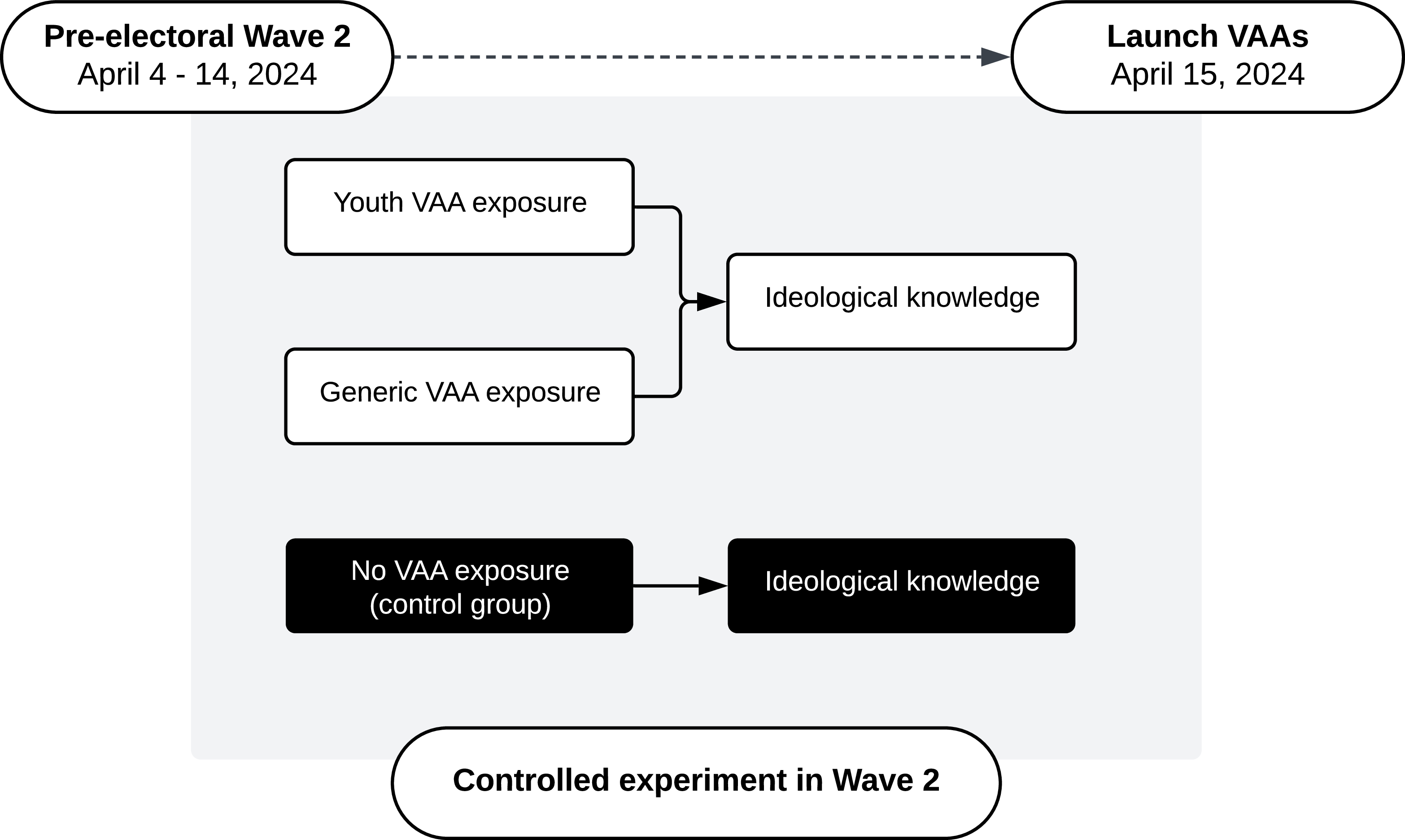
We rely on the YouVoice panel (Figure 1 ). This is a five-wave panel study that examined young voters’ levels of political knowledge throughout the 2024 election campaign (Jacobs, Matthieu, Waeterloos et al. Reference Jacobs, Matthieu, Waeterloos, Lissens, Hermans, Van Campenhout, Opgenhaffen, Schmuck, Walgrave and Van Aelst2024). Participants were recruited via physical and online recruitment, combining random stratified sampling at the regional level (sampling respondents in all thirteen large, five medium-sized, and five small cities in Flanders) and snowball sampling techniques. Hence, we rely on a convenience sample. While it is highly advisable to replicate the experiment with a representative sample (extending it to the broader adult population and a representative youth sample) for at least three reasons, we still think our use of a convenience sample is still valid. First, our goal is not to estimate population parameters or generalize descriptive statistics, but to identify causal effects of exposure to different types of VAAs. The internal validity of these causal estimates mostly rests on the random assignment of participants to experimental conditions and less on sample representativeness. Randomization checks show no significant differences across conditions in key background variables (Table B1 in Appendix B), strengthening our confidence in the results’ internal validity. Second, research demonstrates that convenience samples do not systematically bias estimates of treatment effects when the sample is randomly assigned across experimental conditions (Krupnikov, Nam, and Style Reference Krupnikov, Nam, Style, Druckman and Green2021). Finally, our convenience sample – politically interested and relatively highly educated young people – likely provides a conservative test of our hypotheses. In a more representative sample with lower average political knowledge, VAA effects may be even stronger, as informational cues could exert greater influence on perceptions and choices. Thus, while not representative, our findings are unlikely to be inflated by sample characteristics. We nevertheless ensured diversity in the youth sample by region, gender, education, and migration background. We obtained approval from the university’s ethics board and privacy commission, as the study involves minors.
Overview of experimental design.

Experiment with controlled VAA exposure
Design. A controlled, between-subjects experiment (n = 2308) was included in Wave 2 of the YouVoice Panel (4–14 April 2024), where we exposed subjects to one of two experimental conditions – doing the Generic VAA or the Youth VAA – or a control condition with no VAA treatment. This allows us to draw causal inferences about the effects of VAA exposure. Afterwards, we measured subjects’ ideological knowledge. Pre-treatment is highly unlikely, as the vast majority of respondents were young (16–30), most of them being first-time voters (68%), without any prior exposure to VAAs. In Belgium, VAAs are only available during election periods and are tailored to each electoral cycle; the VAA used in our study was the first of the 2024 campaign and launched after our data collection. Any prior exposure would date back to 2019 and affect only a small subset of participants, making within-wave contamination improbable. To measure ideological knowledge, we designed four vignettes describing the political ideology of a fictional party. To ensure experimental control and isolate ideological reasoning, we used fictional parties with clearly defined ideological profiles. This approach avoided confounding influences such as partisan attachments, prior knowledge, or media framing, which are especially pronounced in multiparty systems where familiarity with real parties varies widely. Using fictional parties also allowed us to abstract from real-world ambiguities and strategic issue combinations, which could have led respondents to question the accuracy of our descriptions or rely on prior beliefs. By removing reputational and emotional associations tied to real parties, our design offered a more ‘idealized’ test of how respondents interpret ideological cues. While fictional, the used profiles do reflect plausible and recognizable combinations in the Flemish party landscape – such as left-left, right-right, or mixed configurations – ensuring that our stimuli remain grounded in political reality while serving our theoretical goals.
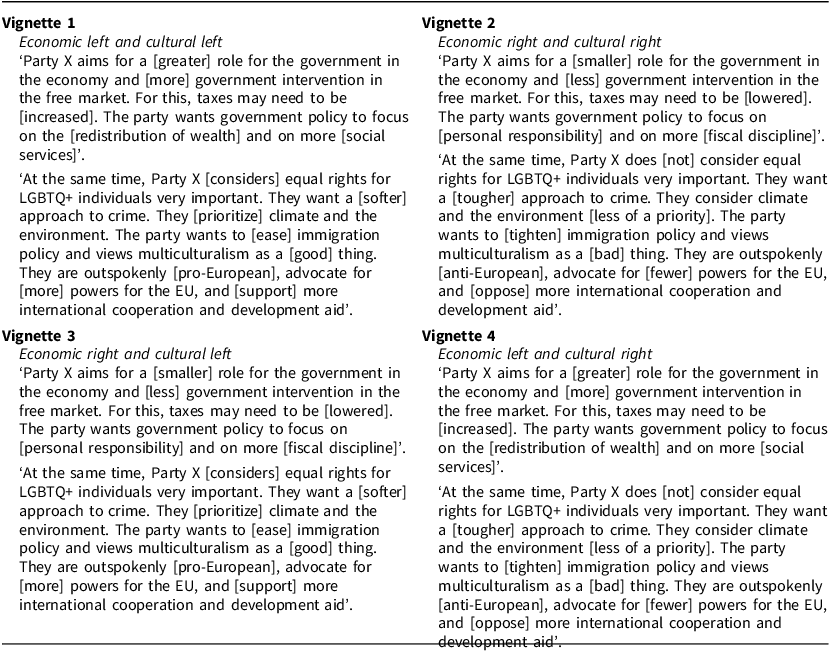
In the four vignettes, the party’s ideology was either described as (1) left-wing on the sociocultural and socioeconomic axis; (2) right-wing on the sociocultural and socioeconomic axis; (3) left-wing on the sociocultural axis, right-wing on the socioeconomic axis; or (4) right-wing on the sociocultural axis, left-wing on the socioeconomic axis. We measured ideological knowledge in Wave 2, directly after exposure to the VAA. The four vignettes were randomized: each respondent was randomly exposed to only one of the four vignettes. Table 1 displays the exact wording of the vignettes, which was closely guided by theory-building on left-right ideology in contemporary liberal democracies (i.e., the GAL-TAN and classical economic left-right dimension). While the GAL-TAN dimension categorizes political parties based on socio-cultural issues, distinguishing green, alternative, libertarianism (GAL) from traditionalism, authoritarianism, and nationalism (TAN), the socioeconomic dimension separates (left-wing) parties in favor of more redistribution and government intervention in the economy from (right-wing) parties in favor of lower taxes and less state intervention (Hooghe and Marks Reference Hooghe and Marks2018; Jolly, Bakker, Hooghe et al. Reference Jolly, Bakker, Hooghe, Marks, Polk, Rovny, Steenbergen and Vachudova2022; Dassonneville, Hooghe, and Marks Reference Dassonneville, Hooghe and Marks2024).
Content of vignettes

Stimuli. The stimuli were the actual versions of De Stemtest and De Jongerenstemtest launched on 15 April 2024, after we fielded our experiment. Hence, the stimuli materials were realistic: they were real VAAs that were later effectively aired, an element that adds a great deal of ecological validity to our design in addition to the natural exposure setting. The core of the Stemtest is very much in line with other VAAs in most other countries (while a systematic overview is beyond the scope of the current study, Van Camp, Lefevere, and Walgrave Reference Van Camp, Lefevere and Walgrave2014 offer a comparative study). The most popular VAAs in Europe (Belgium, Germany, and the Netherlands) typically are party and not candidate VAAs (but see popular candidate-based VAAs in Switzerland, such as Smartvote). Also, the VRT Stemtest’s choice for specific policy proposals is typical for most VAAs; some do include more general value statements, and sometimes even past policies are incorporated, but this is rare. When it comes to learning parties’ more general ideological stance, it probably is the way the results are presented in the end that has the most effect. In this respect, the Flemish Stemtest is in line with what most other VAAs do: the end screen simply shows all parties in decreasing order of overlap with the user’s personal views. Furthermore, some VAAs have a kind of boost option (to indicate which policy issues users find most important), but not all of them (overview in Van Camp, Lefevere, and Walgrave Reference Van Camp, Lefevere and Walgrave2014). While youth-targeted VAAs remain rare and are not yet widely known or adopted across representative democracies, there is a growing trend toward developing digital civic tools tailored to specific population groups. Also, general-purpose VAAs – from Wahl-O-Mat to Stemwijzer or Smartvote – are nonetheless highly popular among young people. This widespread use underscores the strong engagement of youth with VAA-like tools. We build on this pattern of engagement and investigate the added value of youth-specific VAAs, particularly in enhancing ideological understanding and political reasoning among younger users. It is important to note that in neither of the two VAAs was anything explicit about ideology mentioned; the words ‘left-wing’ or ‘right-wing’ were not used, nor were they in the statements or in any explanation about them.
The two VAAs were similar in some respects but differed in others. Similarities were that each of the users responded to 30 policy statements about prospective policies by parties, with access to clarifying editor notes and anonymous pro/con justifications from parties (in the Youth VAA). During the test, parties remain unidentified. The result screen shows how closely their views match each party, via a histogram and ranking. Users can then explore full party motivations, adjust answers, and examine congruence with each party per policy statement. Both VAAs differed, however, in the content of the statements, status quo information, and layout. The Generic VAA included some statements different from the Youth VAA, although 76% of statements were identical (Walgrave, Rihoux, Goovaerts et al. Reference Walgrave, Rihoux, Goovaerts, Jacobs, Lefevere, Matthieu, Mongrain, Tsoulou-Malakoudi, Van Campenhout, Uyttendaele, Nuytemans and Henkens2025). More particularly, the Youth VAA contained statements that were more relevant and closer to young citizens’ daily lives, as established during focus groups (see Table A1 in online Appendix A for an overview of the statements included in either the Generic or Youth VAA). Moreover, the Youth VAA contained additional information and explanations on the policy statements: they discussed the status quo regarding the policy issue at hand and clarified difficult concepts or terms while offering pro and con arguments. In the Generic VAA, in contrast, participants could boost statements, a feature left out of the Youth VAA. This entails that participants could indicate which statement they found personally important, which resulted in a higher score if they had given a position in line with a party for whom this issue is also salient. Finally, the layout and visuals were distinct. The Youth VAA contained interactive features in which participants could swipe for more information in a digital environment that resembled the popular Instagram news page NWS NWS NWS (with over 381,000 followers) of the public broadcaster VRT. It had flashy colors and was dynamic. The format and layout closely mirrored actual news consumption habits of young citizens: the YouVoice Panel confirms that 87.1% of young citizens use Instagram at least daily to consume news, indicating NWS NWS NWS as the most popular channel. The Generic VAA was a more sober application with a less colorful, less interactive, and less playful layout. Figure A1 in the Appendix offers a visual illustration of both VAAs. Next to the Generic and Youth VAA experimental conditions, there was a control condition where all respondents answered the same questions but were not exposed to any VAA. These control group respondents were then used for a robustness check (tracking them over time during the campaign to assess natural exposure), which we explain below.
Dependent variable. After exposure to the vignette, participants rated the fictional party described in the vignette on both the socioeconomic and sociocultural axes: ‘Please indicate where you would place Party X on the economic and cultural axis, where 0 is the most left-wing position, and 10 is the most right-wing position’. In Wave 1, fielded two months before Wave 2 (see Figure 1), we provided all participants with an explanation of what being left- or right-wing on both axes means before asking them about their own placement.Footnote 2 , Footnote 3
We convert the scores given to the fictional party into a binary variable that assesses the correctness of the respondent’s ideological placement on both the economic and cultural axes. Each vignette describes a fictional party with a specific ideological profile: for example, vignette 1 positions the party as left-wing on both axes, vignette 2 as right-wing, vignette 3 as right-wing economically but left-wing culturally, and vignette 4 as left-wing economically but right-wing culturally. Responses are coded as correct (1) or incorrect (0) based on how well they match the expected ideological direction. Under the conservative coding scheme, only responses that are clearly aligned are considered correct: 0–3 for left-wing vignettes and 7–10 for right-wing vignettes. Under the lenient coding scheme, a broader range is accepted: 0–4 for left-wing vignettes and 6–10 for right-wing vignettes. These two coding approaches (see Tables B3 and B4 in Appendix B) allow us to test the robustness of our results to more or less strict definitions of ideological accuracy.Footnote 4
Each vignette thus yields two binary indicators – one for the economic and one for the cultural axis. Participants are coded as 1 if they placed the party correctly on at least one of both axes, and 0 if they placed it incorrectly on both axes or twice at the midpoint (scores 4–6). See Table B2 in Appendix B for an overview of the answer key and coding operationalizations. For descriptive figures and tables, we aggregate these item-level scores to the respondent level and display the average proportion of correct ideological placements per person. For the regression analyses, however, we model the dependent variable at the item level (economic and cultural placements nested within respondents), including random intercepts for individuals. This multilevel approach enables us to retain all available information across items while accurately modeling the non-independence of repeated observations within the same respondent, thereby enhancing both statistical precision and theoretical validity.Footnote 5
Moderating variables. We use political interest and educational level as proxies of political sophistication and, hence, of pre-existing ideological knowledge. We expected that lower initial levels of interest and lower educational levels would lead to relatively more ideological knowledge gains through VAA exposure. Political interest was measured as follows: ‘To what extent are you interested in politics in general?’ The question was answered on an eleven-point scale, from 0 (Not at all) to 10 (A great deal). Education was measured on a 5-point scale from 1 ‘no education’ to 5 ‘university education’, recoded into two categories reflecting low and high educational levels (since we had to align it across different age groups with young citizens that had already finished their education and those who did not), and included as a binary variable in the analyses. Online Appendix D includes a more elaborate explanation of the operationalization of the educational level variable.
Randomization. Participants were randomly assigned to one of two experimental or control conditions (see Table 2). We oversampled the control condition as they were tracked across the campaign to examine potential natural exposure to a VAA (for which we tracked natural exposure as a robustness check; see Appendix C). We needed to keep sufficient respondents who would not be forcibly exposed. The randomization was effective. One-way ANOVA analyses verify that the participants in the experimental and control conditions do not significantly differ on key characteristics, such as age, gender, occupation, education, and left-right placement (details in Table B1 in Appendix B). We, therefore, report analyses without covariates in the experiment; analyses including covariates (overview in Appendix C) yield identical results.
Randomization of participants

Manipulation check. We asked participants in the Generic or Youth VAA conditions to rate their VAA experience on an eleven-point scale from 0 (‘Fully disagree’) to 10 (‘Fully agree’) on the following items: ‘The statements in the VAA dealt with issues that young citizens consider important’; ‘The statements in the VAA are comprehensible for young citizens’; ‘The VAA is visually attractive to young citizens’. We tested these questions separately but also made a scale, as the three items were proven to be unidimensional and internally consistent (α = 0.74). We also included a direct question: ‘Please indicate to what extent the voting advice application was aimed at young people (“0”) or adults (“10”)’. Participants correctly identified that the VAA was either aimed at adults or young citizens. Participants in the Youth VAA condition scored higher (M = 8.29, SD = 1.44) than those in the Generic VAA condition (M = 7.00, SD = 1.58). A one-way ANOVA revealed a significant effect of condition on the VAA rating, F (1955) = 170.1, p < 0.001. For the direct question, respondents in the Youth VAA condition perceived the VAA to be significantly more aimed at young citizens (M = 4.18, SD = 2.11) than those in the Generic VAA condition (M = 6.19, SD = 2.05) (F (1955) =221.0, p < 0.001).
Findings
Baseline level of ideological knowledge
To assess baseline levels of ideological knowledge, we first validated the coding of correct responses (Table B1 in Appendix B). Conservative coding applies a stricter definition, requiring placements at the ideological poles (0–3 or 7–10), while lenient coding also accepts responses closer to the midpoint (0–4 or 6–10). Descriptive results for the control group (Table B2 in Appendix B) show that, on average, respondents classified the fictitious parties more accurately on the cultural than on the economic dimension. Under conservative coding, between 73% and 80% of cultural placements were correct, compared to 49% to 61% on the economic dimension. Lenient coding raises accuracy by about 4–7 percentage points across both axes. Hence, even without VAA exposure, young respondents already demonstrate a substantial baseline understanding of ideological left–right distinctions, particularly in the cultural domain. To verify whether specific vignettes were inherently easier or more difficult, we ran item-level logistic regression models (Table B5 in Appendix B). The results show that no vignette differs significantly from the baseline (V1) under either coding scheme, confirming comparable difficulty and that treatment effects are not vignette-driven. We therefore omit vignette dummies from the analyses.
Main effects
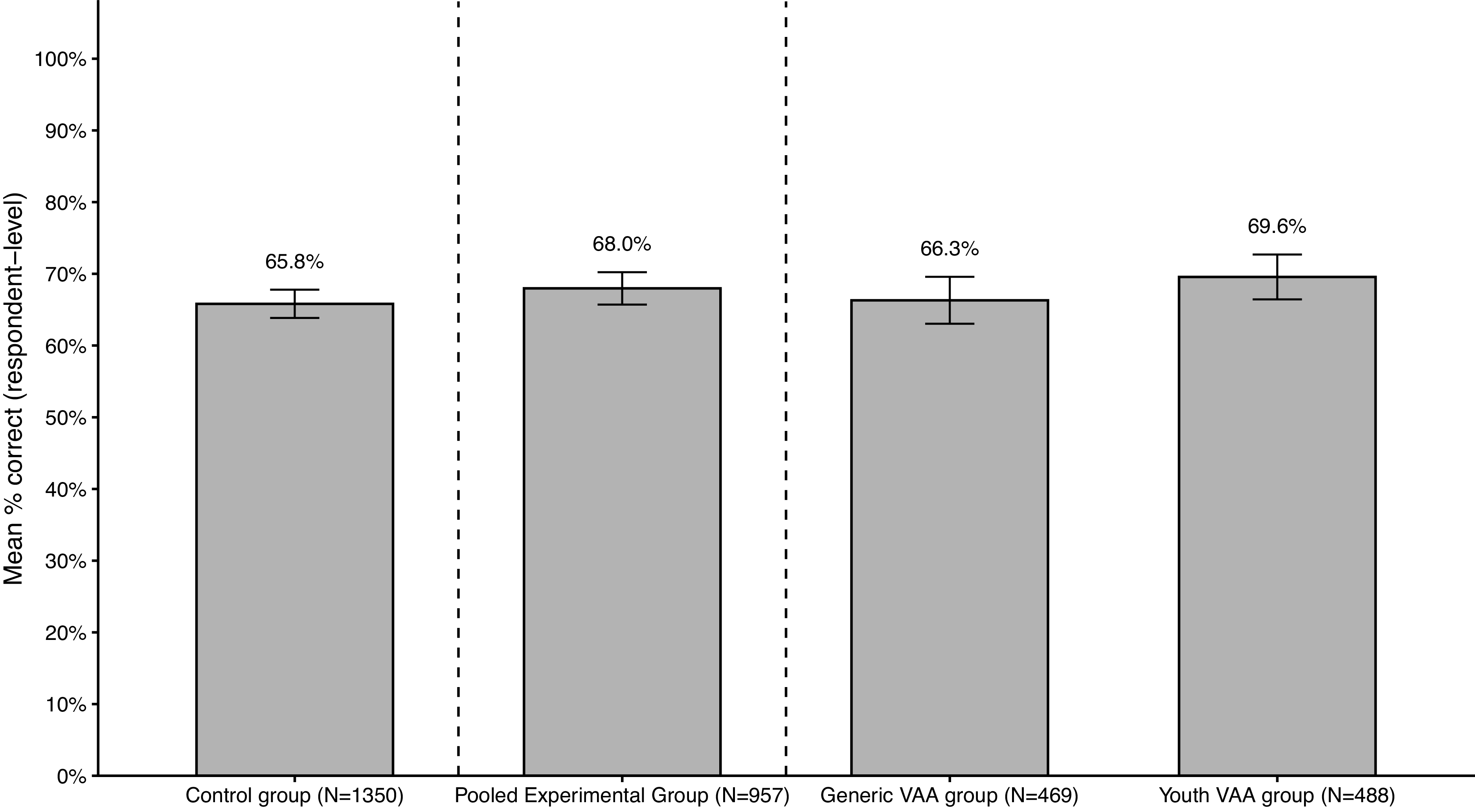
Participants in a VAA condition scored higher on ideological knowledge than those in the control condition. On average, respondents in the control group answered 65.8% of the items correctly, compared to 68.0% in the pooled VAA group, 66.3% in the Generic VAA group, and 69.6% in the Youth VAA group. Hence, after exposure, participants in the VAA conditions – whether pooled, Generic, or Youth VAA – display slightly higher levels of ideological knowledge than those in the control group (Figure 2; Table B2 in Appendix B).
Mean ideological knowledge by treatment group.
Note: Bars display the mean percentage of correct answers at the respondent level, based on two ideological placements per vignette (conservative coding scheme). Error bars indicate 95% confidence intervals.

Logistic regression (Models 2–3 in Tables B6–B7 in Appendix B) shows that participants in the VAA conditions are somewhat more likely to place the fictitious party correctly than those in the control group. Under the conservative coding scheme, the pooled treatment effect (Model 2) is positive but not significant. When distinguishing between the two treatment groups (Model 3), only the Youth VAA shows a significant positive effect compared to the control group (p = 0.022, one-tailed), whereas the Generic VAA does not (p = 0.399). Using the lenient coding scheme, the pooled effect (Model 2) reaches significance (p = 0.040, one-tailed), and again, only the Youth VAA condition significantly increases ideological knowledge (p = 0.009, one-tailed). H1 is thus partially supported: exposure to the Youth VAA significantly improves ideological knowledge, while the Generic VAA does not.
To test whether the Youth VAA yields stronger learning effects than the Generic VAA (H2), Model 4 in Tables B6–B7 in Appendix B re-estimates the models with the Generic VAA group as the reference category. Results confirm that respondents in the Youth VAA group were more likely to place the party correctly, although this difference only reaches significance under the lenient coding (p = 0.047, one-tailed). Respondents in the control condition were significantly less likely to answer correctly than those in the Youth VAA group (p = 0.022 under conservative coding; p = 0.009 under lenient coding). These findings again point to stronger learning effects among participants exposed to the Youth VAA.
Equalizing effect (moderation)
We expected that the ideological knowledge gains would be larger for those with lower initial political sophistication. Both political interest and education are strongly associated with ideological knowledge while controlling for treatment assignment (Tables B8 and B9 in Appendix B). Respondents with higher political interest (p < 0.001) and higher education (p < 0.001) display significantly more ideological knowledge, confirming that our moderators capture baseline differences in political sophistication.
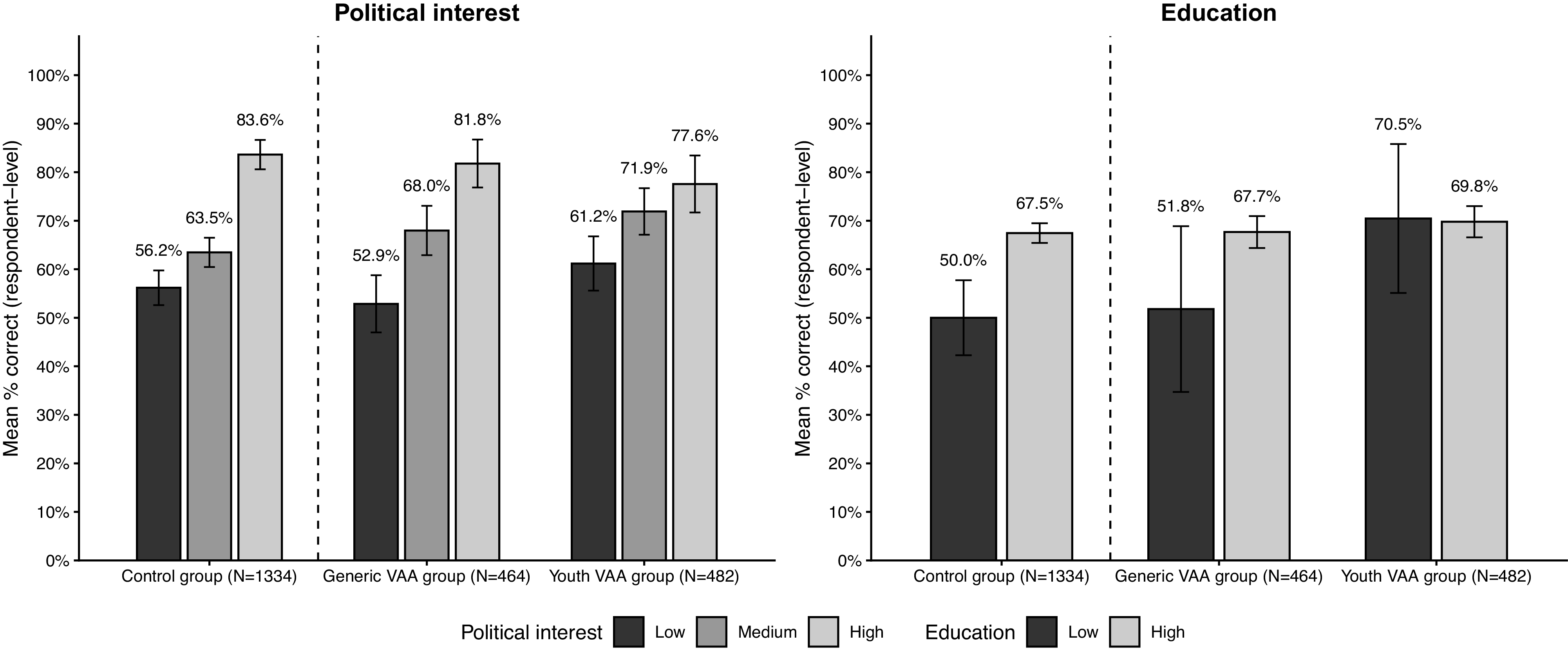
Descriptive results in Figure 3 suggest a clear equalizing tendency. While ideological knowledge increases with political interest in all groups, the gap between low- and high-interest respondents is somewhat smaller in the VAA conditions than in the control group. The equalizing pattern is most pronounced for education: in the Youth VAA condition, differences between low- and high-educated respondents nearly disappear, whereas in the control and Generic VAA groups, higher-educated respondents still score slightly better.
Mean ideological knowledge by treatment group and level of political interest (left panel) and educational level (right panel).
Note: Bars display the mean percentage of correct ideological placements at the respondent level (two placements per vignette) (conservative coding scheme). Political interest is categorized into low (bottom tertile), medium (middle tertile), and high (top tertile) based on the 10-point scale. Error bars represent 95% confidence intervals.

Youth VAA exposure and political interest points in the expected equalizing direction (p = 0.076, one-tailed), suggesting that low-interest respondents may benefit somewhat more from exposure than their high-interest counterparts. The interaction between Youth VAA exposure and education similarly approaches significance (p = 0.050, one-tailed), indicating that respondents with lower education may gain more from exposure than those with higher education. Under the lenient coding scheme, the same tendencies emerge, albeit less strongly (p = 0.312 and p = 0.054, one-tailed). For the Generic VAA, both interactions remain weak and non-significant.
Overall, these findings provide cautious support for H3: although the effects are not statistically significant, both the descriptive and model-based results indicate that the Youth VAA tends to reduce inequalities in ideological knowledge, particularly by narrowing educational gaps.
Robustness check: panel study on natural VAA exposure
To provide a modest robustness check under real-life campaign conditions, we include a supplementary observational analysis using the same respondents tracked between Wave 2 and Wave 4 (10–20 June 2024). This second study is exploratory and descriptive in nature, and its full details (design, measures, findings) are reported in the online Appendix. More particularly, we tracked respondents in the Wave 2 control group (n = 1221) – thus, those not exposed to the VAAs during the experiment – across the campaign and, in Wave 4, asked whether they had used any VAA during the election period. We measured whether they had naturally exposed themselves to a VAA during the campaignFootnote 6 . Ideological knowledge was measured identically as in the experiment, and we used the same moderation variables (political interest and education). To account for confounding variables, typical of observational VAA research, we included controls for gender, first-time voter status, indecision in Wave 3, internal political efficacy, and overall campaign information exposure. Full operationalizations and descriptive statistics are reported in Appendix C (Table C1); an overview of the design is found in Figure C1. More details on descriptives and the type of VAAs citizens used can also be found in Tables C3 and C4, next to the figures (Figures C2 and C3 with Venn diagrams visualizing the overlap between natural VAA exposure of different media brands for all respondents and the control group alone, respectively).
The panel data mirror the experimental pattern. As Figure C4 shows, naturally exposed (M = 0.67) and non-exposed respondents (M = 0.66) start Wave 2 with nearly identical ideological knowledge. By Wave 4, those who used a VAA scored slightly higher (M = 0.73 vs. 0.67). Table C2 reports descriptives by exposure group. Figure C5 also reflects similar learning dynamics: improvements from incorrect to correct placements between Waves 2 and 4 are more common among exposed respondents (18% vs. 12%), while fewer remain incorrect (15% vs. 21%). Overall, these descriptive patterns align with the experiment: VAA exposure appears to foster ideological learning, albeit modestly. Regression analyses in Tables C4–C5 nuance these trends. Ideological knowledge in Wave 2 strongly predicts Wave 4 knowledge (p < 0.001), underscoring its stability. Natural VAA exposure is positive in baseline models but turns non-significant once individual differences are included (Model 3). Thus, unlike the experimental treatment – which guarantees exposure and produces clear effects – spontaneous VAA use yields only limited, non-robust effects after accounting for self-selection. This aligns with prior VAA research and indicates that causal impacts are most detectable when exposure is assured.
Turning to moderation, the panel results again parallel the experiment. Figure C6 plots Wave 4 ideological knowledge by political interest and education for exposed vs. non-exposed respondents. Differences by political interest remain broadly similar across groups, but educational gaps are smaller among exposed respondents – echoing the experiment’s equalizing pattern. Interaction models (Tables C4–C5) support this: under the conservative coding, natural exposure significantly moderates political interest (β = 1.27, p = 0.006, one-tailed), indicating stronger gains for low-interest respondents. The education interaction is negative and marginally significant (β = 0.39, p = 0.096), suggesting somewhat larger improvements among the lower educated. Under the lenient coding, both interactions point in the same direction (interest: β = 1.19, p = 0.034; education: β = 0.45, p = 0.131). Although observational, these findings reinforce the experiment: VAA exposure appears more beneficial for less politically sophisticated respondents, suggesting VAAs do not widen – and may even narrow – knowledge gaps.
Discussion
Our study is the first to examine whether VAA use affects a type of knowledge that may be particularly valuable, namely, ideological knowledge. Based on an experimental design, we found converging evidence that VAA exposure may enhance people’s knowledge of the ideological structure of the party landscape and the meaning of ideological left-right labels and may contribute to reducing inequalities in such knowledge. Our findings imply that the learning effects of VAAs may go further than so far assumed (Munzert and Ramirez-Ruiz Reference Munzert and Ramirez-Ruiz2021). VAAs may teach young citizens what concrete policy issues parties adopt (party position knowledge) and provide them with a more abstract instrument to dissect ideological positioning and categorize the party’s offer (ideological knowledge). We found that this holds particularly for our experiment with a VAA specifically tailored to young citizens (and these are largely replicated by robustness checks, where we tracked the control group’s natural VAA exposure during the campaign). All in all, these findings are relevant and innovate extant VAA scholarship.
Our results have a high ecological validity, as they were conducted in a real campaign setting with a real-life VAA. Both the randomized experiment and the observation of VAA effects after natural exposure point in the same direction, validating the robustness of our results. The effects are modest in size, but they are consistent and robust across operationalizations of ideological knowledge. Moreover, our analyses constitute a conservative test of learning effects, as our sample mainly consists of politically interested and highly educated young respondents – precisely the group for whom additional knowledge gains are hardest to detect due to ceiling effects. At the same time, this is also the audience that VAAs reach successfully in real-world settings due to self-selection (Pianzola Reference Pianzola2014; Kleinnijenhuis et al. Reference Kleinnijenhuis, Van De Pol, Van Hoof and Krouwel2017; Walder et al. Reference Walder, Fivaz, Schwarz and Giger2024). That we observe consistent learning effects in the experiment is therefore encouraging: it suggests that when exposure is guaranteed, as in a classroom or civic education context, VAAs can effectively stimulate ideological learning, even among already engaged young citizens.
Not only do we find main effects of VAA exposure among young citizens, but we also observe that these effects are not uniform across subgroups. Gains in ideological knowledge tend to be stronger among those who initially display lower levels of political sophistication – a pattern most clearly visible for education in the experiment and echoed in the robustness check (for political interest), suggesting that VAAs may partly help reduce existing inequalities in political understanding. Hence, those who might gain the most profit most from VAA exposure. This again highlights the possible utility of VAAs as a way to help educate (young) citizens and as a civic education tool (Fivaz and Nadig Reference Fivaz and Nadig2010). VAA use does not seem to exacerbate existing knowledge inequalities; instead, it can help level the differences and make them more equal (Matthieu and Junius Reference Matthieu and Junius2023). These intergroup differences appear in both the experimental and observational outcomes, attesting to the consistency of our findings. This implies that integrating VAAs in civic education for young citizens of different backgrounds (who otherwise might not use a VAA due to self-selection) offers a key avenue to stimulate political learning. Our results also suggest that a VAA designed explicitly for the young exerts more influence. All effects found for the Youth VAA were larger and more consistent than those for the Generic VAA; adapting a VAA to youth – the content of the statements, status quo information, and layout – stimulates young citizens’ political learning and affects their ideological knowledge.
While establishing, for the first time, a highly relevant knowledge effect of VAA use, our study has limitations. The most important limitation is that we are unsure about the exact mechanism that produces an increase in ideological knowledge. We observe that VAA exposure enhances people’s ability to classify parties ideologically. But why? What precisely is it in a VAA that makes people develop a better ideological grasp on their views and those of the parties? We think it is likely that most people have an intuitive idea about whether their own positions are generally left- or right-wing. When participating in a VAA, they are shown which parties are close to them and which are further away. By comparing the parties with their known, own ideological position, they get better at classifying parties as left- or right-wing. Alternatively, before exposure, people have an idea of the party system’s left- and right-wing parties. By doing the VAA, they learn about their own ideological position by deriving it from their proximity to the parties they know the ideological position of. Another option is that VAA exposure simply activates people’s existing knowledge by engaging them, making them think about politics and their views, and confronting them with the parties’ positions. Not the VAA as such, but the act of performing a political task may stimulate ideological knowledge. Either way, we encourage studies to dig deeper into the exact mechanisms generating the knowledge effects of VAAs. At the same time, we acknowledge that our operationalization of ideological knowledge captures only one aspect of what such learning entails. Our vignette-based measure captures respondents’ ability to classify parties along ideological dimensions, but not their capacity to compare parties’ relative positions or relate them to their own stance. This comparative understanding – central to the heuristic function of ideological knowledge – is an important dimension for future research, which should ask respondents to place multiple real parties or themselves within the ideological space. While our design prioritizes conceptual clarity and control, it limits what can be inferred about the broader cognitive effects of VAAs. Future work should also assess whether similar patterns of ideological reasoning appear with real parties, where prior knowledge and affective attachments may interact with or override abstract cues. Using fictional parties provides a controlled test, whereas real-world contexts likely yield more complex dynamics.
While our design allows for high ecological validity, some reflections are in order regarding the generalizability of the findings to other VAAs, a more representative sample of the general population, other countries, and real-life settings. First, the VAAs that we studied are quite representative of Western European VAAs in terms of party focus, concrete policy choice, and presentation of their results (see Van Camp, Lefevere, and Walgrave Reference Van Camp, Lefevere and Walgrave2014). Two specific features of the Flemish Stemtest may have enhanced ideological learning compared to other VAAs: party justifications and interactive end options. Users could read short party-issued justifications, which sometimes have used ideological language, potentially prompting learning. The end screen allowed users to explore and adjust answers, boosts, parties, and justifications – offering more learning opportunities than most VAAs. However, we do not know whether participants in our study used these features, and overall, few real-life users engaged with them. While some youth-targeted VAAs currently exist – beyond the one we used and YoungVoice in the Netherlands – our results suggest that such tools may yield additional, targeted benefits for younger voters. The demonstrated popularity of general-purpose VAAs among youth, especially in educational settings (see Fivaz and Nadig Reference Fivaz and Nadig2010), signals both a demand and a readiness for more tailored formats. From a comparative perspective, our study provides empirical support for the development and implementation of youth-specific VAAs in other democratic contexts. This highlights the broader potential of adapting civic technologies to meet the needs of younger citizens better and reinforces the value of digital tools for improving political understanding. Our study suggests that there is merit in further developing tailored VAAs, as these tools may yield stronger and more positive effects. It remains to be assessed whether similar dynamics are at play in other Western democracies using VAAs. While our findings are rooted in the Flemish case, they might travel to comparable democracies with established VAA traditions (Switzerland, Germany, the Netherlands), albeit with context-specific nuances linked to the institutional system. This is likely since our findings complement research that has pinpointed effects on party position knowledge in these cases. Second, our findings should be interpreted as evidence for the existence and direction of VAA effects, rather than as estimates of their precise magnitude in the general population.
Moreover, findings leave us similarly unsure about why the Youth VAA led to higher knowledge gains than the Generic VAA. The more effective Youth VAA differed from the Generic VAA in several respects. As explained above, both VAAs varied in the content of the statements, the offering of status quo information, and their layout. As both VAAs contained a bundled treatment, we cannot disentangle the effect of each of these factors. That VAAs tailored to youth may cause higher knowledge gains amongst young citizens is relevant and promising, but in order to formulate advice on how to build more effective VAAs, we need to measure the contribution of each factor separately. Follow-up studies should experiment by separating the three factors and isolating their independent effect. In sum, there is work to do regarding the mechanism of VAA knowledge effects.
A final limitation of our study is that we ran it on young citizens only, arguably the group most sensitive to experiencing VAA effects. Politically socializing young citizens is pertinent in its own right. Still, it remains to be seen whether similar effects would emerge when examining adults with more established political views and higher levels of pre-existing knowledge. We showed that VAAs exert a hitherto unknown effect on a highly relevant type of political knowledge, but we established this for young citizens only. The next step is to replicate our studies on an adult sample. In a similar vein, future comparative research could examine whether these effects generalize to other national contexts and political systems. Future research could also experiment with varying the difficulty of ideological knowledge questions to capture better differences in learning across groups.
Supplementary material
The supplementary material for this article can be found at https://doi.org/10.1017/S1475676526100905.
Data availability statement
Due to the nature of the research and due to ethical and legal restrictions, supporting data is not available. We report data on minors (youngsters from 16 until 30), which prevents us from sharing our data due to the sensitive nature and restrictions imposed by our board and university privacy commission. Additional analyses and robustness checks can be found in the online Appendix.
Acknowledgements
The authors would like to thank the entire YouVoice team at the University of Antwerp and KU Leuven for their valuable feedback and support, and in particular Cato Waeterloos (KU Leuven), Margot Lissens (KU Leuven), Babette Hermans (KU Leuven), Michaël Opgenhaffen (KU Leuven), Desiree Schmuck (KU Leuven), Matthias Van Campenhout (University of Antwerp), and Peter Van Aelst (University of Antwerp). We would also like to thank Jonas Lefevere (University of Antwerp) and the Bpact team for their valuable support while collecting our experimental data. We also thank the entire Stemtest team that helped create De Stemtest and De Jongerenstemtest.
Funding statement
The authors would like to acknowledge funding from the inter-university iBOF under grant number [iBOF/23/036: FN5429].
Competing interests
The authors declare that they have no conflicts of interest to disclose.
Ethical standards
This study was approved by the Ethics Committee for Social Sciences and Humanities (EASHW) of the University of Antwerp (reference number of approval: SHW_2023_230_1).
Use of AI disclosure
The authors used OpenAI’s ChatGPT (GPT-5; accessed October 2025) as a supportive tool for language editing and to streamline R code for data preparation and analysis. In both cases, the tool was used with modification under author supervision. The authors made all substantive decisions and interpretations and accept full responsibility for the final manuscript.



 Open access

