




Introduction
From the Disney animated film Mulan (1998) to the video game Total War: Three Kingdoms (2019), contemporary popular culture has staged medieval (ca. 200–1000 CE) Chinese stories of women in war for the global audience.Footnote 1 Behind these legendary tales, however, there is an under-recognized history of Chinese women who assumed leadership in violent settings.Footnote 2 They engaged in fighting, mounted and on foot. They mobilized troops, in numbers large or small.Footnote 3 As the boundaries between politics and warfare remained particularly porous in medieval China, these women came to wield substantial degrees of overt authority beyond a rigid civil/military divide.Footnote 4 For this reason, I use the etic term “female commanders” to cover a wide range of women who led in different contexts of violence, from military campaigns to palace coups d’état.
Previous research has shown how the literary-historical tradition of imperial China has retrospectively reconstructed female commanders, adapting their deeds into episodes more or less palatable to preexisting conceptions.Footnote 5 Absent from existing scholarship, however, is an examination of how the court described female commanders when it rewarded them with titles, honors, and other benefits, or even when it sought their support through real-time negotiation. In other words, when the regime was obliged to promote female commanders, how would it phrase its documents addressing these women? Focusing on these cases, I show that medieval courts were not ideologically rigid, sticking to a single set of models of proper female behavior—that women should always be submissive and serve men of the family. Instead, the courts deployed distinct rhetorical tools to eulogize individual female commanders; taking into account the particularities of the situation, they eulogized these women to pursue specific political goals. Thus, the rhetoric these courts used provides critical insight into the ways by which Chinese empires interpreted and reacted to women's successes in the midst of concrete military and political crises, and will thus help us to understand how the patriarchal regimes actually worked in times of turmoil.
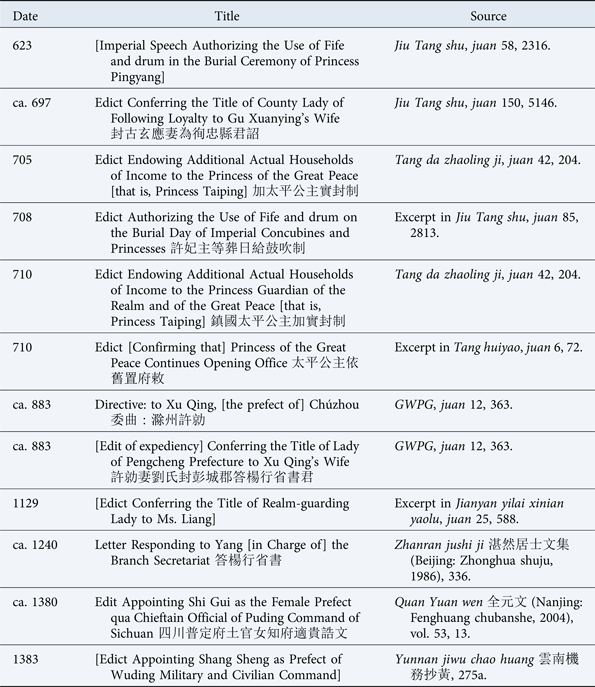
While biographical genres are important sources of medieval Chinese history that no researcher can afford to overlook, this article focuses on an alternative corpus: edicts and other official documents (including orders and court-issued letters) rewarding female commanders with privileges, titles, ranks, and incomes.Footnote 6 These documents, which leave us records of real-time politics, have long evaded scholarly attention, partly because the texts survive for contingent reasons and in a number of different forms, so that serious effort is required to identify them. Here I bring together, for the first time, edicts and official documents culled from a variety of sources, ranging from collections surviving in Korea to archival materials from the imperial chancellery (see the Appendix). Reading them in the context of and in comparison with biographical and historical writings of different genres, I identify three ideal-type strategies of representing female commanders.
I start by identifying a key strategy by which biographies and other sources describe female commanders. This strategy, which I call the reductionist approach, eulogizes female commanders by reducing them to filial daughters or faithful wives, who temporarily transgress gender boundaries only to better fulfill more important responsibilities that the patriarchal order prescribes for them. Then, turning to edicts that have survived in different places, I argue that the imperial court of the seventh and eighth centuries sometimes portrayed female leaders as exceptional individuals who transcended the gender order prescribed to commoners—an approach that I call the transcendent strategy. Last but not least, I examine a set of official documents dating to ca. 883, when Ch'oe Ch'i-wŏn 崔致遠 (857–ca. 908),Footnote 7 a native of Silla Korea, was crafting orders on behalf of the provincial government of Huainan. I propose that in the particular circumstances of the 880s, Ch'oe resorted to an eclectic approach. He endeavored to reconcile, rhetorically or philosophically, women's subordinate roles in the family and their leadership on the battlefield, seeking to find a middle ground to justify their simultaneous military valor and wifely virtues.Footnote 8 In the end, highlighting the fact that a variety of women-related edicts and official documents remain understudied, I close this article by showing that late imperial regimes continued to exploit the rhetorical strategies that their medieval predecessors had developed.
Female Commanders as Filial Daughters/Chaste Wives
This section introduces literary tropes by which medieval authors retrospectively re-described women in war. Since early times, genres ranging from official dynastic histories to poems and tales sought to justify female leadership in war by highlighting the heroine's resolve to rescue, to aid, or to avenge her father or husband. This rhetoric contrasts with that embedded in real-time political negotiations, which we shall examine in subsequent sections.
Women in warfare have a long history in China. Since at least the first century BCE, dynastic histories identified a variety of women that led their own troops into war, though it was usually during periods of dynastic change that female leaders came to public notice.Footnote 9 These women included Mother Lü 吕母 (d. 18 CE), Chi Zhaoping 迟昭平 (ca. 21 CE), and Chen Shuozhen 陳碩真 (ca. 653 CE).Footnote 10 Not surprisingly, the dynastic histories featured their rebellion against the political order by highlighting their transgression of the gender hierarchy. This, however, does not mean that normative texts of early China always castigated women who participated or led in warfare. From different perspectives, Anne Cheng and Luo Manling have shown that poems and verses of Han times and of the following centuries sometimes eulogized filial daughters who avenged their husbands or fathers, even though vengeance remained a controversial matter in legal debates.Footnote 11 Against this backdrop, it is not surprising that biographical writings eulogized—and criticized—female commanders based on the criterion of whether/how they aided their fathers or husbands.
The “Biographies of Women” in Jin shu 晉書 (History of Jin, finalized in 648) provide various interesting examples of praiseworthy women who led troops and/or fought in person. One entry details how in the tumultuous 300s, when the Western Jin (266–316) fell, Xun Guan荀灌 (ca. 316), a thirteen-year-old girl, stood out from the crowd:
Xun Song's young daughter was [Xun] Guan. Since her childhood, Guan was outstanding in terms of moral character. When Song was Governor of Xiangcheng, he was besieged by Du Ceng. Weak in military force, and with food provisions exhausted, he wanted to seek help from his previous subordinate Shi Lan, the General Pacifying the South, but he could not find a way [to get out of Xiangcheng]. Guan was thirteen by then. She thus commanded several dozens of warriors; they passed over the walls, broke through the siege, and went out for help at night.
荀崧小女灌,幼有奇節。崧為襄城太守,為杜曾所圍,力弱食盡,欲求救於故吏平南將軍石覽,計無從出。灌時年十三,乃率勇士數十人,踰城突圍夜出 … …Footnote 12
The Jin shu narrative is unambiguous in justifying why Xun Guan “commanded warriors”—she did so for the sake of seeking reinforcements to rescue her beleaguered father. What it leaves out, of course, is how she actually led and fought. To cite another example, in 402, Xie Daoyun 謝道韞 (ca. 399), whose talents in poetry are well known, also engaged in fighting. As Jin shu describes it, “after she heard that her husband and sons were slaughtered by the bandits,” she led her servants into blade-to-blade battle, and “killed several bandits with her own hands before she was captured.”Footnote 13 Though the Jin shu account briefly describes the fighting, the narrative gravity focuses on the fact that she resorted to fighting only to defend her household and herself, after the bandits forced themselves into her domestic space.
During Xun Guan and Xie Daoyun's times, a variety of groups originating from the Eurasian Steppe started to build their own regimes in north China. Jin shu provides a vivid account of how Empress Mao 毛皇后 (?–389), a woman of Di 氐 ethnic origin, led troops into battle:
Strong and courageous, she excelled in mounted archery. When Fu Deng was attacked by Yao Chang, his camp fell. Ms. Mao was still bending her bow on horseback. Leading several hundred warriors, she fought against Chang and imposed heavy casualties upon her enemy. Greatly outnumbered, she was captured by Chang. Chang wanted to take her. She railed: “I am the Empress of the Son of Heaven [i.e. Fu Jian (338–385)]. How can I bear to be humiliated by a Qiang barbarian bandit? Why not kill me immediately!” Then, facing heaven, she burst into tears: “Yao Chang violated the Way: previously he murdered the Son of Heaven (that is, Fu Jian); now he humiliates the Empress. Oh, August Heaven and the Grand Earth, how can you not see what is happening?” Angered, Chang killed her.
壯勇善騎射。登為姚萇所襲,營壘既陷,毛氏猶彎弓跨馬,率壯士數百人,與萇交戰,殺傷甚眾。眾寡不敵,為萇所執。萇欲納之,毛氏罵曰:「吾天子后,豈為賊羌所辱?何不速殺我!」因仰天大哭曰:「姚萇無道,前害天子,今辱皇后,皇天后土,寧不鑒照!」萇怒,殺之。Footnote 14
It is important to note that this narrative fails to inform readers that Fu Deng, on campaign elsewhere, had left Ms. Mao in charge of the camp.Footnote 15 Specifically, it deletes a crucial line found in earlier sources that explains that “[Fu] Deng left Ms. Mao and the supplies at the camp.”Footnote 16 In fact, with Fu Deng's young son under her care, Empress Mao was among the most important decision makers on site. The Jin shu biographical entry, however, directs readers’ attention away from Empress Mao's leadership role. Instead, it suggests that Ms. Mao was confined to her domestic space in the camp, and, much like Xie Daoyun, resorted to fighting only because she had no other choice. What the narrative focuses on, in the end, is her resolution to die for a righteous cause (from the perspective of the medieval author)—namely, the rejection of a humiliating remarriage or even rape. In this sense, the biography shapes a story of female military command into the story of a faithful wife, which better fits patriarchal conventions of women's behavior.
There are many similar examples in dynastic histories and narrative poems. By far the best-known case can be found in Mulan shi 木蘭詩 (Ballad of Mulan). According to this tale, which arguably originated from stories of the sixth or seventh century, Mulan joined the army only with the goal of exempting her aged father from military conscription.Footnote 17 But there are other examples as well. Yang Dayan's 楊大眼 (fl. early sixth century) biography in Wei shu 魏書 (The dynastic history of the Northern Wei) informs us that his wife Ms. Pan 潘氏 was noted for her skills in mounted archery. However, according to the biography, “[Yang] Dayan ordered his wife to dress in military clothing” (大眼令妻潘戎裝) and to join him in charging on horseback. In other words, the narrative portrays her as someone who entered the battlefield only when her husband ordered her to do so.Footnote 18 As we shall see below, Tang female commanders were also often portrayed as followers of a male family member in their biographies in dynastic histories. However, in the heat of the moment in the midst of complicated political necessities that the aforementioned biographers—writing in retrospect—did not face, the authors of edicts and other official documents deployed somewhat different rhetoric, which the following sections examine.
Female Commanders as Exceptions to Patriarchal Rule
While Jin shu illustrates how early Tang litterateurs depicted female commanders who fought centuries earlier in terms of existing models of proper female behavior, this section turns to examine how the court of the seventh and early eighth centuries conferred titles and rewards on contemporary women. Though the early Tang is noted “for relatively few restrictions and oppressive measures on women,” this does not mean that women of high social status were “entirely free to move about in public places,” much less lead military forces.Footnote 19 Even during the decades of female (co-)rulership of the empire (ca. 664 to 713),Footnote 20 many—if not most—imperial documents adhered to a rhetoric that in no way undermined the patriarchal worldview. Instead, the court portrayed female leaders not as exemplary figures according to established gender norms, but as transcendent figures who rose above the gender norms prescribed to commoners.Footnote 21 In other words, vis-à-vis women's success in military leadership, the edicts that we shall read repeatedly emphasized that these women were exceptions because they were imperial princesses, and exceptional ones at that.
Princess Pingyang (?–623) affords the natural starting point for an inquiry into Tang female commanders. Like the female rebel leaders of earlier centuries, she built her own army when the political order broke down. As her biography in Jiu Tang shu 舊唐書 (Old history of the Tang) explains, “she used the family property to recruit men at large in the mountains”—an act that, as it was usually associated with male leadership in times of turmoil, also attested to her power in disposing of property.Footnote 22 Eventually, she gathered an army reported to number about 70,000 soldiers.Footnote 23 As her biography illustrates, thanks to her effective military actions (alongside those of her brothers), her father Li Yuan 李淵 (Tang Gaozu, 566–635, r. 618–626) was able to seize Chang'an and declare himself emperor of the new Tang Dynasty.Footnote 24 When Princess Pingyang died in 623, Li Yuan ordered that her burial ceremony should include processional music of the army composed of drums and fifes, known as guchui 鼓吹. The Bureau of Rites objected to this, arguing that the honor of having drums and fifes in one's burial ceremony was reserved for men. But Gaozu, in his edict, proposed a different interpretation. According to her biography in Jiu Tang shu:
Emperor Gaozu replied:
(I) Fife and drum is the music of the army. (II) Previously, the Princess raised troops at Sizhu to join the righteous campaign; [by then,] she controlled the signal gongs and drums [that is, she herself gave orders of retreat and attack to the army]. She has the merit of pacifying the realm. Mother Wen of Zhou is among the Ten Worthies [who helped King Wu establish the Zhou.] The Princess, [likewise,] has contributed to the founding of the imperial enterprise. She was not simply one of the ordinary women! (III.1) How can her [burial ceremony] be without fife and drum?
(III.2) Thus, the court added fife and drum for her as an exception, so as to honor her exceptional achievements.
Under Gaozu's order, the bureau in charge followed the posthumous naming rule that “those with illustrious virtues who have rendered great service will be called Zhao [literally, Bright],” and so endowed her with the posthumous name of Zhao.
高祖曰:鼓吹,軍樂也。往者公主於司竹舉兵以應義旗,親執金鼓,有克定之勳。周之文母,列於十亂,公主功參佐命,非常婦人之所匹也!何得無鼓吹?遂特加之,以旌殊績;仍令所司按諡法「明德有功曰昭」,諡公主為昭。Footnote 25
Based very closely on an original imperial speech, this text thus well attests to the mentality at court in 623, when the court added fife and drum for Princess Pingyang. By then, although the Tang had triumphed over its major opponents in the Chinese heartland, it was still facing substantial challenges from rebels in recently conquered regions, not to mention the threat posed by the Eastern Türk confederation.Footnote 26 Against this backdrop, the allusion to “Mother Wen of Zhou” commands particular attention. In the chapter of the Grand Proclamation (tai shi 泰誓) of the Shangshu 尚書 (Classic of Documents), King Wu of Zhou, having summoned all the troops, illustrated various reasons for which the Zhou was destined to conquer the Shang. One of the reasons articulated was that “We have ten worthy ministers” (予有亂臣十人), among whom was Mother Wen of Zhou.Footnote 27 Eulogizing Princess Pingyang in terms of Mother Wen, the “worthy minister,” the imperial speech confirms that the boundaries between “minister” and “general,” civil and military, were particularly porous in the early Tang context. Equally importantly, the document thus likened the Li family of the Tang to that of King Wen of Zhou, implying that the founding of the Tang was comparable with that of the exemplary dynasty of the Zhou.
One should note in addition that the speech makes it clear that Princess Pingyang was a key commander who gave orders of attack and retreat by controlling “the signal gongs and drums,” another trope commonly associated with male commanders-in-chief.Footnote 28 In other words, far from reducing Princess Pingyang to a mere follower of her husband or her father, the imperial speech employed an alternative rhetoric that staged her as an exceptional woman. The description of Princess Pingyang was thus in accordance with Emperor Gaozu's political needs at this moment right after the founding of the dynasty. Highlighting the extraordinary achievements of its female members helped reinforce the claim that the Li family was destined to ascend to the throne. More generally, by recognizing the formula of imperial edicts within dynastic biographies, we can begin to see how imperial speech—shaped by contemporaneous political exigencies—could differ from the more conventional moral glossings of dynastic-history authors.
Princess Pingyang was by no means the only female leader in war and politics during the seventh century.Footnote 29 After 664, Wu Zhao 武曌 (624–705, r. 690–705) came to dominate imperial decision making; from 690 to 705, she ruled China as sovereign. Even after her downfall, her achievements continued to inspire female powerholders like Empress Wei 韋后 (664–710) and a variety of princesses to compete for political power.Footnote 30 These decades of female rule meant that authors in court and beyond developed new rhetorical devices to legitimize these women in power.Footnote 31
To understand how the court honored female leaders who won violent conflicts, I focus on the “Edict Endowing Additional Actual Households of Income to the Princess Guardian of the Realm and of the Great Peace [i.e., Princess Taiping]” 鎮國太平公主加實封制 (710), a document that has survived in the Tang da zhaoling ji 唐大詔令集 (Collection of grand edicts and decrees of the Tang). As early as 705, Princess Taiping had played an important role in deposing Wu Zhao to re-establish the Tang dynasty.Footnote 32 Five years later, she mobilized imperial troops to lead another coup d’état, together with her nephew Li Longji 李隆基 (685–762, r. 712–756), better known for his lengthy reign as Emperor Xuanzong. At that time, however, her nephew was only a twenty-six-year-old prince with limited experience at court. The pair executed their rivals and re-enthroned the impotent Emperor Ruizong (662–716)—who was Princess Taiping's elder brother and Li Longji's father. Against this backdrop, the following edict was issued in the name of Ruizong to reward Princess Taiping with additional households of income:

The edict, together with the reward, was a part of the complicated negotiation at the heart of the delicate alliance between Li Longji and Princess Taiping.Footnote 36 On its surface, the throne was using this edict to reward Princess Taiping; in reality, Princess Taiping was one of the real powerholders behind the throne, and her agency permeated every part of the imperial decision making. Indeed, the edict acknowledged, in the emperor's voice, that Princess Taiping supported “Us” as the emperor. In other words, the edict publicly proclaimed a version of history that featured Princess Taiping as the agent who rescued the empire and pacified the realm.
In fact, it is only in this edict that we hear this narrative so explicitly articulated, because the official histories, compiled after Li Longji's later triumph over Princess Taiping, present the event of 710 in a radically different tenor. In later accounts, Li Longji, the young prince and rightful heir to the throne, bravely led his followers in person, breaking into the palace and executing the “vicious” women who attempted to usurp power; what is more, such misogynistic historiography was eager to situate the 710 event as a part of Li Longji's larger project to eradicate female rule, a project that culminated in the execution of Princess Taiping in 713.Footnote 37 Accordingly, the Jiu Tang shu biography, while downplaying Princess Taiping's role in the coups d’état in 705 and 710, was highly critical of the power she had wielded.Footnote 38 It stated that because “her power had eclipsed that of the sovereign … and thus she was increasingly arrogant, [such that] her estates encompassed all fertile lands in the vicinity of the capital” (權移人主 … 公主由是滋驕,田園遍於近甸膏腴).Footnote 39
While Jiu Tang shu utilized the trope of excessive luxury to delegitimize Princess Taiping's leadership, the 710 edict for her argues that given her supreme contributions, she deserved the very rewards that included the estates. The document itself attests to her power in constructing a narrative featuring her autonomous leadership and then incorporating this narrative into the imperial proclamation. Part (II) of the edict, one may also note, starts the eulogy with the imagery of flowers (hua 華, nongli liufang 穠李流芳). The floral tropes not only metaphorically stand for female beauty, but also metonymically refer to the virtues of male ministers, especially in accordance with the Chuci 楚辭 tradition. In addition, the flower of the plum (li 李) is a clever political pun, alluding to not only the blossom but also the ruling Li family. Thus, the language of flowers exuding their fragrance serves to foreground the femininity of Princess Taiping, but does so without subsuming her under a gender order with feminine attributes of yielding or gentleness.Footnote 40 Indeed, when detailing her moral virtues and capacities, the edict deploys language that was traditionally associated with exemplary males. In other words, the use of floral metaphors and “male” virtues creates at an alternative rhetoric that weaves femininity and leadership together, a rhetorical strategy explored in more detail below.
At this point, it helps to compare the 623 imperial proclamations on Princess Pingyang with the 710 ones for Princess Taiping. The difference between the two concerns first and foremost the production and reception of each text. In the imperial speech of 623, because Princess Pinyang had already died, it was Emperor Gaozu (and his secretariat) that honored this heroine, while glorifying the Li family's founding of the Tang. In the case of the edict of 710, Princess Taiping, while being the recipient of the document, was also one of the powerholders behind its production. What is more, Princess Pingyang's biography in Jiu Tang shu ultimately incorporated the very speech of Emperor Gaozong. In contrast, in her biography in Jiu Tang shu, Princess Taiping is portrayed as becoming increasingly corrupt from at least 705 to her death in 713.Footnote 41 The edict of 710 thus offers unique access to how the court, under the influence of her power, described her achievements.
By modern standards, Princess Pingyang might better represent a typical female commander than Princess Taiping, but the Tang rhetoricians eulogized them using a similar rhetorical repertoire featuring the brilliance of princesses. Neither text depicts the heroine as a mere leader of troops, and both emphasized that the women were critical to the pacification of the entire realm. What is more, both edicts strongly emphasized the exceptional nature of the princesses. If the imperial speech of 623 authorized the use of the fife and drum band for Princess Pingyang on the grounds that she was an extraordinary woman who deserved this honor previously monopolized by men, the 710 edict for Princess Taiping further advanced the claim that a female might “greatly transcend” all her peers, both male and female. Accordingly, while both edicts attest to the independent agency of the princesses, they present them as exceptional cases, not subject to normative gender expectation.
Balancing Female Virtues and Army Commanderships
Not all women of military valor attained the honor of a biography in the dynastic histories, but we can sometimes glimpse them in other surviving documents. At least since 883, one Ms. Liu 劉氏 had been commanding troops and attacking fortifications; together with her husband Xu Qing 許勍, the Prefect of Chúzhou in Huainan, she helped to consolidate their gains in this prefecture.Footnote 42 Meanwhile, in 887, when Zheng Hanzhang 鄭漢章 was attacking Yangzhou, Huainan's provincial seat, his wife (whose name is not preserved in extant records) was defending the key garrison of Huaikou, frustrating the besiegers for dozens of days until her husband's side triumphed and broke the siege.Footnote 43 The two scenarios are revealing of the emerging military and political situation of the 880s. While the imperial court and even the provincial authorities were losing control over prefectures, individuals—and married couples—with their own bands of soldiers became important powerholders.Footnote 44 Autonomously controlled fortifications pointed to new patterns of domination.Footnote 45
This section proposes that official documents endowing titles and rewards to women offer unique access to the micro-mechanisms of power. As we shall see, on the one hand, these female commanders played an important role through the patrimonialization of power during which rising magnate families competed to appropriate governmental offices and territorial jurisdiction as an inheritable asset within the family. On the other hand, provincial governors, having seized the authority to issue edicts on behalf of the imperial court, sought to communicate with these female commanders, conferring titles on them with the hope of gaining their support. Ch'oe Ch'i-wŏn, the Silla-born belletrist working at the provincial court, demonstrated his rhetorical virtuosity in weaving women's marital and martial roles together.
Re-Writing the Female “General” in the Late Tang
To understand female commandership in late Tang Huainan, it is helpful to start with a general background of the Tang after the An Lushan Rebellion (755–763). While historians have noted that provinces had gained increasing importance during the eighth and the ninth centuries, recent scholarship has shown that this does not mean the empire was in inevitable decline.Footnote 46 As Nicolas Tackett has notably argued, the Tang had successfully adapted itself to the new situation during most of the ninth century.Footnote 47 It suddenly collapsed in the 880s, only after the Huang Chao Rebellion (874–884) led to massacres of the capital's population and the physical annihilation of the aristocracy that constituted the political backbone of the empire.
Huang Chao was able to break into the Tang capital region in 880 precisely because he could penetrate the Tang defensive lines in and around Huainan, the region of our current focus. No later than 880, the provincial governor Gao Pian 高駢 (821–887)Footnote 48 employed Ch'oe Ch'i-wŏn to draft documents in his name. Before going back to Silla in 884, Ch'oe crafted a variety of administrative documents on behalf of Gao, many of which have survived in Ch'oe's collected works. Thus, his collection is particularly valuable in revealing how the Tang provincial government functioned during the years when the rebels crossed this very area and destroyed the empire.
It informs us, among other things, that most likely in late 883 but no later than early 884, Gao was communicating with Xu Qing, the Prefect of Chúzhou, concerning Xu's wife who had volunteered to join the battle. The timing is important, because in 883 Gao lost control over a number of his subordinate prefectures.Footnote 49 Though he appointed his trusted generals to the prefectures of Hezhou and Luzhou, in both cases his appointees were expelled by magnates who had their own troops in the respective locales, and Gao could do nothing but recognize the rising magnates as the legitimate prefects, hoping to establish an alliance with them.Footnote 50 As Hezhou and Luzhou together formed a bridge to the western half of the province, Gao's influence was thereafter confined to prefectures adjacent to the provincial capital of Yangzhou.
Chúzhou, where Ms. Liu and Xu Qing were based, was one of the three prefectures contiguous with Yangzhou. Both of peasant origin, Ms. Liu and Xu Qing had joined rebel forces no later than 878, and during previous years, they had been fighting together. Having defected to Gao in the first month of 879,Footnote 51 the couple brought their own troops to Chúzhou around 883, whereupon Xu Qing was granted the title of prefect by Gao. Gao, for his part, hoped to maintain his dominion, and Xu also knew it was to his advantage to maintain a friendly relationship with Gao. It is against this background that Xu memorialized Gao, pleading for official recognition for his wife. This in turn gave Gao an opportunity to extend his influence over Chúzhou through diplomatic means. By this point, the events in Hezhou and Luzhou had taught him that it was hardly possible, if desirable at all, to subjugate these prefectures militarily. Though the original letter from Xu Qing does not survive, Gao's reply, drafted by Ch'oe Ch'i-wŏn and translated below, offers a glimpse of the complicated relationship between Gao and his prefect Xu:
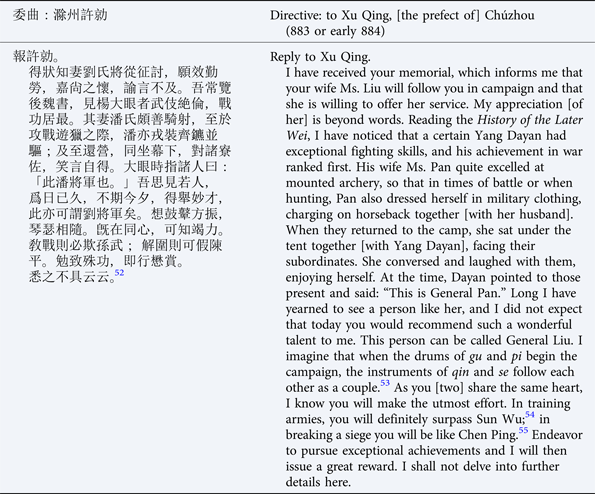
This document, categorized as weiqu 委曲, which I translate as a “directive,” is the kind of official document by which mid- and late Tang provincial authorities could communicate with their subordinates in a highly informal manner.Footnote 56 The order was released under Gao's own name; however, as a practice of the times, Ch'oe was responsible for crafting the text, and it is for this reason that it survives in Ch'oe's collected works. The making of such official documents, as Robert Ashmore has illustrated, was premised upon a collaborative process between the governor and the document-drafting official.Footnote 57
A substantial part of the text centers upon Wei shu's account of Ms. Pan, Yang Dayan's wife. Raising this historical precedent of female commandership, Ch'oe adroitly fulfilled the main task of this document, that is, to promise future rewards to Ms. Liu if she would side with the provincial authorities in the future. While Ch'oe recounts a scene from Wei shu, his rewriting of the story is subtle yet significant:

The account in Wei shu explicitly emphasizes that Yang ordered his wife to join him in battle and in hunting. In Ch'oe's account, however, Ms. Pan became the grammatical subject of the sentences and she, on her own initiative, put on military attire and then entered onto the battlefield. In this way, Ch'oe deliberately rejects the Wei shu approach of portraying Ms. Pan as a passive follower of her husband's orders. Instead, Ch'oe brings Pan to the foreground, exploring an alternative approach to writing about female commanders: it is not the wife who assists the husband to achieve his goals, but the couple—composed of two autonomous individuals, that is, the wife and the husband—who together pursue the goals that they share. However, this does not mean that Ch'oe treated husband and wife as equals or peers. Ch'oe would conceptualize their relationship in a more complex way, as seen below.
Balancing Marital and Martial
As Gao fulfilled his promise of bestowing a title on Ms. Liu, Ch'oe was commissioned to compose the relevant edict. The title of the document in the received collection—“Conferring the Title of Lady of Pengcheng Prefecture on Xu Qing's Wife” (許勍妻劉氏封彭城郡君)—makes it explicit that it belongs to the genre of “edict bestowing a noble title on a woman outside [the palace] (wai mingfu 外命婦).” Under normal circumstances, it was the imperial court that issued such edicts. In the early 880s, because Huang Chao was occupying the capital, the court found itself in exile in Chengdu. It had no choice but to delegate to Gao (and certain other governors) the imperial prerogative of issuing edicts of expediency (mochi 墨敕) on behalf of the throne—a privilege that the court would find hard to revoke in subsequent years. As Gao seized the imperial authority of issuing the mochi edict, Ch'oe was thus entrusted with the responsibility of crafting edicts that, under normal circumstances, only the imperial court could issue.Footnote 59 Thus, while parts (I) to (III) of the following document follow the tri-partite structure of an imperial edict, the document incorporates a fourth part, acknowledging its expedient nature and anticipating that an imperial envoy (the “phoenix”) would bring a further document to fully validate the appointment.

In the previous weiqu directive, Gao, via the brush of Ch'oe, left Ms. Liu with the impression that she would earn rewards if she achieved military success. Here, Gao seems to fulfill that promise, but it is a mere gesture. Gao endowed her with the rank that she should have obtained by default, given her husband's position. As the order itself acknowledges, “since antiquity,” a wife of an accomplished official, as a dependent of her husband, received her own title of nobility. By then, Xu Qing's official position as Prefect of Chúzhou gave him the rank of Upper 4b; and according to the Tang institutional code, his wife should have received the title of Lady of such-and-such Prefecture, which, indeed, was what she was granted via the above order.Footnote 66 In other words, Gao did not really confer more honors upon Ms. Liu than she should have already received.
Crafting this mochi or edict of expediency posed a challenge for Ch'oe. On the one hand, unlike the informal communication (weiqu), the genre of wai-mingfu 外命婦 edicts had its own formula. It was imperative to eulogize the recipient in terms of feminine virtues prescribed by normative texts, among which gentleness and a yielding disposition were some of the default attributes. On the other hand, it was supposed to convey the message that the court was justly rewarding Ms. Liu's military achievements. In fact, what really distinguishes the current document from the edicts of the wai-mingfu tradition is that Ch'oe's piece states without ambiguity that Ms. Liu earned her title, not only as a result of her husband's official rank, but also as an award (shang 賞) to “reward her previous contribution.” In brief, while the genre of wai-mingfu dictated that he should portray Ms. Liu as an exemplary wife, the real situation in Huainan required Ch'oe to eulogize Ms. Liu in a way that acknowledged her military valor.
Ch'oe did not shy away from this challenge.Footnote 67 Instead, he evoked the transcendent strategy—a strategy that we have encountered in the edicts for Princesses Pingyang and Taiping—at the very beginning, stating that Ms. Liu differed from commoners. However, he then embarked upon an alternative model, reframing the relationship between women's marital and martial roles. At first glance, the rhetorical crux lies in his allusion to Confucius's authoritative instructions with regard to the cultivation of virtue (in the case of noble men) and the study of wen 文 (literature). According to the Lunyu 論語 (Analects) 1.6:
The Master said: “At home, a young man must respect his parents; abroad, he must respect his elders. He should talk little, but with good faith; love all people, but associate with the virtuous. Having done this, if he still has energy to spare, let him study literature.”Footnote 68
For Confucius, his disciple should exemplify the five virtues first; and then, if he still has “energy to spare,” he should move on to study wen 文, meaning literate learning in a broad sense. Ch'oe applies the same rhetorical structure to Ms. Liu: as she already exemplified the four virtues that early normative texts ascribed to women, her remaining energy allowed her to step into the field of army commandership, just as virtuous men with remaining energy might delve into literary learning.
However, Ch'oe was not composing a philosophical exegesis. The rhetoric of government documents was supposed to proceed through pairs of parallel lines, where a four-six meter was required. Ch'oe's literary mastery gave him the tools to turn this formulaic parallelism into a literary vehicle for reconciling the tensions between femininity and war leadership. To give an example, Ch'oe used zulian 組練 (literally, grouping and training) to describe Ms. Liu's leadership of troops, paralleling it with qiluo 綺羅 (splendid silk, commonly associated with female beauty). The same radical of si 糹 (literally, silk or fine thread), shared by both pairs of characters, diminishes the sharpness of the contrast between martiality and femininity, thereby helping to bridge two otherwise opposing imageries.
In this manner, Ch'oe builds a narrative in which both the husband and the wife were commanders in their own right, though the latter was still inferior to the former. In part (III), for instance, the edict specifies that both the husband and the wife deserved rewards for their deeds, though the husband stands before his wife as pine before grass. Ch'oe carefully distances himself from depicting the female commander as a mere dependent of her campaigning husband, even while he maintains a gender hierarchy that places the husband above the wife. In short, while concrete political negotiations in Huainan around 883 facilitated an alternative articulation of femininity and military commandership, it was Ch'oe's literary mastery that wove the two themes together.
Ms. Liu was not the only woman who led troops independently while pursuing a military campaign together with her husband. As mentioned above, Zheng Hanzhang's wife was simultaneously leading troops in Huaikou. The eleventh-century chronicle Zizhi tongjian 資治通鑑 (The Comprehensive Mirror for Governance), synthesizing multiple tenth-century accounts, explains that Zheng Hanzhang “left his wife behind to defend Huaikou.” (留其妻守淮口).Footnote 69 Here, as in the dynastic history biographies, what actually happened was retroactively sanitized by means of the reductionist approach. In the absence of documents such as those that survive for Ms. Liu, we can know little about the leadership of Zheng's wife.
The rise of female commanders in this region as observed in these documents attests to a broader historical trajectory whereby military leadership was increasingly premised upon personal ties later formalized by official positions conferred from above. It is probably safe to assume that, like other, more successful magnates in the region, Xu Qing and Ms. Liu hoped to turn the troops as well as government office into an inheritable asset that they could pass down to their descendants.Footnote 70 The major obstacle that they faced was not only that the provincial government sought to avoid acquiescing to their de facto autonomous status marked by the hereditary transition of the position of the prefect. It was also that many of their followers were themselves leaders of personal armies; if the situation allowed, they would themselves seize a territorial unit, be it a garrison town or a county seat. The increasing prevalence of small family dynasties of this sort meant that Ms. Liu was an especially reliable partner for Xu Qing.
Women and Warfare Beyond Medieval China: Concluding Remarks
Overall, this article has identified three distinct strategies of writing about female commanders. In conclusion, we can ask how the rhetorical differences outlined in the previous sections shed new light upon deeper patterns of gender and power in Chinese history. Put differently, how shall we understand the phenomenon of the court or its regional administration deploying approaches different from the “reductionist” one? Given that the evidence for the “transcendent” and “eclectic” strategies are taken from Tang sources, one may wonder if these two approaches were innovations of that dynasty. For example, perhaps a Sino-Steppe culture inherited by the Tang founders made it possible for Tang authors to write about women of power in different ways—a possibility that other scholars have explored.Footnote 71 But it is important to remember that relatively fewer documents representing imperial speech survive from pre-Tang times.
Against this backdrop, I would like to suggest another alternative, especially in light of the Huainan examples, where we are dealing not with an author seeped in Sino-Steppe interactions, but rather with a rhetorician-minister with roots in the Sino-Korean classical tradition. I contend that, in the context of the concrete political need to engage with and respond to female commanders, medieval Chinese courts deployed different approaches to eulogize them despite their transgression of perceived gender norms.
Here it is significant that the sources I have investigated are edicts and other official documents. I obtained these previously under-utilized sources both through a survey of collections (including those surviving outside of China) and also through a critical reading of dynastic history narratives. If biographical narratives of a retrospective nature can be seen as “a negotiation between what actually happened and what can be found in the discursive tradition,” as Rebecca Doran nicely puts it, edicts and other official documents were further shaped by specific political needs of the court that issued them.Footnote 72 Emperor Gaozu, through eulogizing the deceased Princess Pingyang, sought to reassert the legitimacy of his dynasty—an issue of grave concern a mere five years after the dynasty's founding. By rewarding Princess Taiping, the court (under her influence) re-confirmed her claim to political power in the context of the delicate alliance among different powerholders. And by re-framing the marital and martial virtues of Ms. Liu, Gao Pian (via the hands of Ch'oe) sought to gain her (and her husband's) loyalty. In all these cases, the recognition of women's achievements was conditioned not only by deep cultural/literary tradition(s) but also by immediate political/military goals of the regime. The implication, accordingly, is that it will be productive to bring gender studies and official document studies into closer dialogue with each other. Further examinations of descriptions of women in all kinds of functional documents will likely lead to a more dynamic picture of how patriarchal regimes actually functioned in premodern China, and perhaps beyond.Footnote 73
Appendix: List of Cited and Mentioned Edicts

 Open access

