


Introduction
Hospice focuses on compassionate care at the end of a person’s life. Reference Hui and Bruera1 The utilization and integration of hospice has grown tremendously in the past few years. Reference Hui and Bruera1,Reference Buss, Rock and McCarthy2 In the United States (US), enrollment in hospice requires a diagnosis that results in an anticipated life expectancy of six months or less, and patients have chosen to forgo curative treatments in favor of comfort-focused measures. 3 Similar to other medical care, hospice creates an environment where symptom management is prioritized and patients are not prescribed medications that do not provide benefit in their situation. One class of medications prescribed during hospice care is antimicrobials. However, currently there are no official guidelines to assist providers in facilitating prescribing decisions. Reference Ford, Fraser, Davis and Kodish4,Reference Novak, Noble, Fromme, Tice, McGregor and Furuno5 It is important to define prescribing factors for the administration of antimicrobial medications as this will guide prescribing decisions. For the purpose of this study, antibiotics, antifungals, and antivirals, comprise the term antimicrobials.
Antimicrobial use is prevalent in end-of-life (EOL) hospice care. One of the first studies revealed that 27% of patients received antimicrobials during the last seven days of life yet only 15% of patients had an infectious indication. Reference Albrecht, McGregor, Fromme, Bearden and Furuno6 Previous research has also examined antimicrobial prescriptions during the last 7–14 days of life. Reference Albrecht, McGregor, Fromme, Bearden and Furuno6–Reference Servid, Noble, Fromme and Furuno8 Virik and Glare Reference Virik9 validated the PPS upon admission to an inpatient specialist palliative care unit finding a median postadmission survival to be 29.1 days which informed our focus on the last 30 days of life in this study. Despite utilization of antimicrobials, data is limited on the effectiveness, limitations, and indications for antimicrobial use among hospice patients. Reference Rosenberg, Albrecht and Fromme10–Reference Pandey, Wisniewski and Morjaria12 There are no clear guidelines on appropriate use of antimicrobials during EOL. Reference Ford, Fraser, Davis and Kodish4,Reference Furuno, Noble and Fromme13 It is crucial to remember that antimicrobials are not harmless; patients may develop adverse reactions such as Clostridioides difficile infection, allergic reaction, or create antimicrobial resistance. Reference Tamma, Avdic, Li, Dzintars and Cosgrove14–Reference Carmichael, Asch and Bendavid17
Physicians can utilize a variety of objective measures to assess their patients. Objective tools such as the Eastern Cooperative Oncology Group performance status (ECOG) and Karnofsky Performance Scale (KPS) are used by oncologists when deciding cancer therapy. Similarly, the Palliative Performance Scale (PPS) is a reliable tool that predicts survival among cancer patients and has been further generalized to other terminal diagnoses, Reference Baik, Russell, Jordan, Dooley, Bowles and Masterson Creber18,Reference Lau, Downing, Lesperance, Karlson, Kuziemsky and Yang19 wherein higher PPS scores are associated with higher functional status. The Association for Professionals in Infection Control and Epidemiology (APIC) and the Healthcare Infection Control Practices Advisory Committee (HICPAC) have published definitions and criteria for infections among home hospice patients. To our knowledge, there has not been a study reviewing antimicrobial use associated with PPS functional status in the US.
There is a growing need for antimicrobial stewardship in hospice as well as the field of palliative medicine. Reference Kaiser, Kaiser, Schmidt, Vehling-Kaiser and Hitzenbichler20,Reference Awada, Zribi, Al Ghoche and Kanj21 With ever-evolving antimicrobial resistance, identifying characteristics among non-hospitalized outpatient hospice patients who received antimicrobials may assist providers in deciding patient appropriateness for antimicrobials during EOL and maintain consistency. Therefore, this study is aimed at providing more insight into what factors contribute to antimicrobial prescribing in outpatient, non-hospitalized hospice care to further improve antimicrobial guidelines.
Methods
Study design and setting
We conducted a retrospective chart review of patients who died while receiving care from Cleveland Clinic Hospice (CCH) between January 1, 2019, and December 31, 2019. CCH provides inpatient and outpatient hospice services across the Cleveland Clinic Health System, with an average daily census of 250–300 patients. In this study, we reviewed hospice deaths where antimicrobials were prescribed in the last 30 days of life Reference Virik9 to non-hospitalized outpatient hospice patients. Data, such as demographics (gender, race/ethnicity, residence), PPS score, hospice diagnosis, illness, code status, and presence of advanced directives, such as living wills or power of attorneys, were obtained. These predictors were chosen based on prior studies reviewing antimicrobial use in EOL care. Reference Lantz, Noble and McPherson22,Reference Clark, Halford, Herndon and Middendorf23 This retrospective chart review utilizing decedent data did not require Institutional Review Board (IRB) approval.
Study population and data collection
We identified all patients who received antimicrobial prescriptions within their last 30 days of life and died in a non-hospital outpatient care setting. Patients who elected transitioning to inpatient hospice and subsequently died in the hospital were excluded to decrease confounding variables. Three US fellowship trained hospice and palliative medicine authors (KSF, AS, RVS) reviewed an equal number of patient charts to collect demographics, antimicrobial prescription details, prescriber information, hospice diagnosis, infection diagnoses, and PPS scores. Infection diagnoses were determined through hospice caregiver documentation of signs, symptoms, or specific infection diagnoses with International Classification of Diseases Tenth Revision (ICD-10) codes located in their medical records.
Variables of interest
The variables of interest were: (1) characteristics of patients receiving antimicrobial prescriptions and (2) comparison of functional status, using PPS scores, between patients who did and did not receive antimicrobials. PPS scores range from 0% (death) to 100% (fully functional), with each 10% decrease representing a decline in physical function. Reference Ford, Fraser, Davis and Kodish4,Reference Novak, Noble, Fromme, Tice, McGregor and Furuno5 We used the PPS score recorded closest to the antimicrobial written prescription date.
Statistical analysis
A computer-generated random group of controls equal to the number of our case patients were selected from the remaining group of decedents who did not receive antimicrobial prescriptions. Categorical variables were summarized using frequencies and percentages, and continuous variables using median, IQR, and range. Fisher’s exact test and Wilcoxon rank-sum test were used for categorical and continuous variables, respectively. A multivariable logistic regression model assessed the association between prespecified patient characteristics and antimicrobial prescription status. A univariable analysis estimated the association between each predictor and outcome. A Research Electronic Data Capture (REDCap) platform was utilized to securely collect, store and manage data. All tests were two-sided with significance set at p≤.05. Analysis was performed using SAS Studio 3.7 (SAS Institute, Cary, NC).
Results
Among 1,111 patients who died while receiving CCH care in 2019, 212 patients (19.1%) received antimicrobial prescriptions in their last 30 days of life while admitted to a non-hospitalized outpatient setting. This accounted for 272 total prescriptions as some patients received more than one prescription. Additionally, there were 212 random computer-generated group of controls that were selected from the remaining group of decedents who did not receive antimicrobial prescriptions.
Patient characteristics were evaluated as seen in Table 1. Antibacterials were most frequently prescribed (62%), followed by antifungals (36%), and antivirals (2%). Of the documented indications for antimicrobial use (n = 169, 62.1%), the most common were skin/wound symptoms (18.8%), genitourinary symptoms (14.3%), and respiratory symptoms (9.9%). Seven prescriptions were for continued prophylaxis in immunocompromised patients. In 103 cases (37.9%), the indication for antimicrobial prescription was not documented.
Demonstrating patient characteristics in the study. *Unknown code status was not included in analysis. Hospice facility refers to a dedicated hospice residential center

Cancer was the predominant diagnosis (n = 109, 51.4%) among patients receiving antimicrobials, followed by heart disease (13.7%), non-dementia neurologic disease (10.9%), lung disease (9.0%), and dementia (7.5%). Cancer sub-types included: blood (n = 11), neurologic (n = 2), breast (n = 6), gastrointestinal (n = 35), genitourinary (n = 11), gynecologic (n = 8), lung (n = 23), skin (n = 2), and unknown/miscellaneous (n = 11), which included cancers of unknown origin. Non-hospice fellowship trained physicians wrote 60% of prescriptions, while hospice-trained or in-training physicians wrote 38% and non-physician advanced practice providers comprised 2% of prescribers.
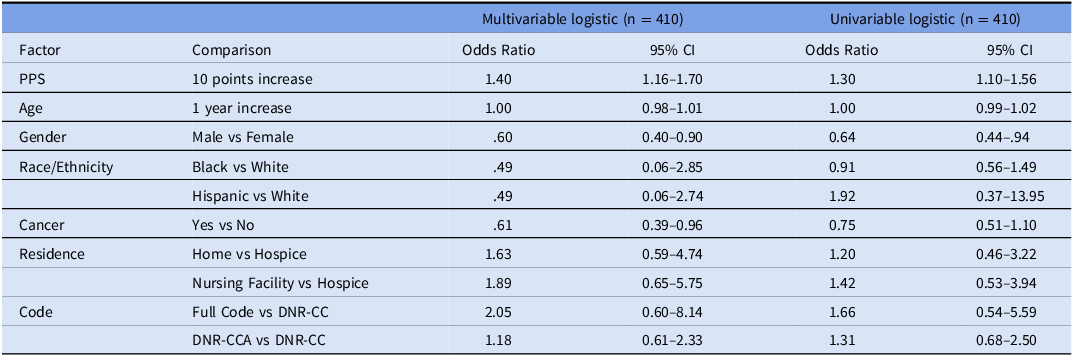
Multivariable analysis revealed three significant associations with antimicrobial prescribing: Female gender (OR 1.67, 95% CI 1.11–2.52), and higher PPS score [PPS 40 vs 30] (OR 1.40, 95% CI 1.16–1.70), were associated with increased likelihood of antimicrobial prescriptions whereas cancer diagnosis (OR .61, 95% CI .39–.96) was associated with decreased likelihood of antimicrobials (Table 2). Other demographic factors, including age, race/ethnicity, patient residence, illness, and code status/resuscitation, showed no significant associations (Tables 2 and 3). A summary of the multivariable and univariable analysis is seen in Table 2 while Supplemental Figure 1 demonstrates the above characteristics in a Forest Plot for better clarity (supplemental data).
Summary of multivariable and univariable logistic regression model for antimicrobial use status during the last 30 days of life. Hospice refers to a dedicated hospice residential center
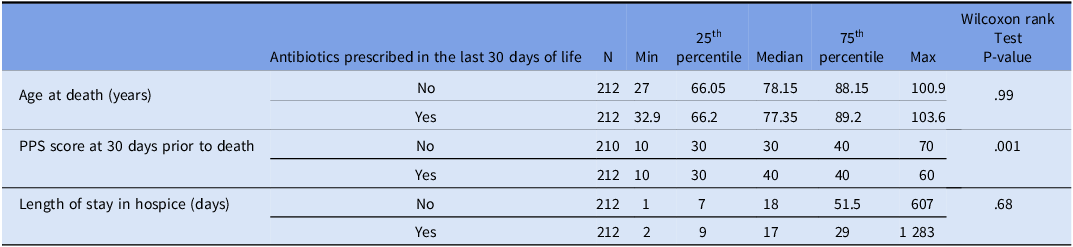
Evaluating age, PPS, and length of stay between antimicrobial group at EOL compared to those that did not receive antimicrobials at EOL, P value via Wilcoxon rank test
Discussion
Our study examined antimicrobial prescribing patterns near EOL in non-hospitalized outpatient hospice care patients. We found that 19.1% of patients received antimicrobials in their final 30 days of life. Previous studies performed in various clinical settings have documented antimicrobial use at EOL ranging from 17.6 to 63%. Reference Albrecht, McGregor, Fromme, Bearden and Furuno6–Reference Servid, Noble, Fromme and Furuno8,Reference Marra, Puig-Asensio, Balkenende, Livorsi, Goto and Perencevich11,Reference Oneschuk, Fainsinger and Demoissac24,Reference Abduh Al-Shaqi, Alami, Zahrani, Al-Marshad, Muammar and MZ25 Baghban and Juthani-Meta Reference Baghban and Juthani-Mehta26 proposed an algorithm that incorporates goals of care discussions to guide antimicrobial use at EOL. By utilizing the PPS to assess prognosis and subsequently functional status decline, providers may identify those patients approaching EOL. This study offers observations on the association between a person’s functional status and antimicrobial prescribing in EOL care. Implementing PPS scores and goals of care conversations can inform antimicrobial prescribing patterns and stewardship programs.
Patients with higher functional status, as measured by PPS, were associated with an increased likelihood of receiving antimicrobial prescriptions (OR 1.40, 95% CI 1.16–1.70). The functional difference between a PPS of 30 versus 40 is clinically significant; patients with PPS 30 are completely bedbound, require total care in their activities of daily living, and have reduced oral intake. Reference Baik, Russell, Jordan, Dooley, Bowles and Masterson Creber18 The association observed in our study suggests a pattern where functional status may influence providers’ prescribing decisions. This observation aligns with findings by Pereira et al. Reference Pereira, Watanabe and Wolch27 where infections were not treated due to underlying poor general condition and imminent death as well as Crowley et al. Reference Crowley, Whalen, Siegel and Challener7 where hospice patients with decreased survival time are less likely to receive antimicrobials. In hospice care, quality of life is the primary goal, therefore medications should be reviewed for their usefulness prior to prescribing.
In our study, cancer patients were associated with a lower likelihood of receiving antimicrobial prescriptions when compared to non-cancer diagnoses (OR .61, 95% CI .39–.96). This aligns with findings from White et al. Reference White, Kuhlenschmidt, Vancura and Navari28 where patients with advanced cancers often chose limited use of antimicrobials when goals of care conversations occurred with their care providers.
The gender disparity with women more likely to receive antimicrobials (OR 1.67, 95% CI, 1.11–2.52) mirrors community prescribing patterns described by Schroder et al. Reference Sommer and Gladstone29 This may be partially explained by the observed difference in urinary tract infection (UTI) prevalence between females and males. According to Vittetta et al. Reference Vitetta, Kenner and Sali30 UTIs were the most treated source of infections in hospice patients. Documentation of urinary symptoms in females occurred more frequently in our cohort. Additionally, Lau et al. Reference Lau, Downing, Lesperance, Karlson, Kuziemsky and Yang19 surmised that females had increased survival time therefore higher functional status as was measured by the PPS.
Antimicrobial stewardship implications
Documentation of specific infectious indications was present in 62.1% of prescriptions (n = 169), with skin/wound (n = 51, 18.8%), genitourinary (n = 39, 14.3%) and respiratory symptoms (n = 27, 9.9%) being the most common. These align with Clark et al. Reference Clark, Halford, Herndon and Middendorf23 where the three main symptoms being treated were similar to our study. There were 7 antimicrobial prescriptions that were continued as prophylaxis for an underlying immunocompromised state and raises further questions about appropriate discontinuation of antimicrobials near EOL. There was a lack of documented antimicrobial indications for 37.9% of prescriptions which highlights a gap in antimicrobial stewardship practices. This finding is particularly concerning as many studies have discussed over prescription of medications Reference King, Fleming-Dutra and Hicks31,Reference Zetts, Stoesz, Smith and Hyun32 and most prescriptions in our study (60%) were written by non-hospice fellowship trained providers.
The rationale for decreasing antimicrobial overuse near EOL extends beyond individual patient care. Unnecessary exposure to antimicrobials can lead to adverse effects such as allergic reaction, antimicrobial associated diarrhea, Clostridioides difficile, and unnecessary side effects in an already debilitated population. Reference Tamma, Avdic, Li, Dzintars and Cosgrove14–Reference Carmichael, Asch and Bendavid17 Moreover, varied antimicrobial use may lead to development of multidrug-resistant organisms posing a significant threat to public health. Reference Salam, Al-Amin and Salam33 Of note was the number of prescriptions for skin/wound symptoms utilizing antibiotics and antifungals. The Centers for Disease Control and Prevention (CDC) has urged physicians to be judicious in prescribing antifungals in light of the emergence of resistant skin infections. Reference Benedict, Smith, Chiller, Lipner and Gold34
Study limitations
Our retrospective design limited our ability to assess symptomatic improvement following antimicrobial therapy. Inconsistent documentation also challenged our ability to determine an infectious diagnosis, which was also noted in previous studies by D’gata et al. Reference Mitchell35 Clark et al. Reference Clark, Halford, Herndon and Middendorf23 and Albrecht et al. Reference Albrecht, McGregor, Fromme, Bearden and Furuno6 Additionally, as we reviewed prescription data, this may not reflect actual patient medication usage or adherence. Another limitation was the study was conducted in a single hospice system thus narrowing our study population. Furthermore, the lack of objective assessment of appropriateness could be considered a limitation as our data did not determine if antimicrobials were truly indicated.
Future directions
This study is the first to review antimicrobial prescribing in relation to functional status using PPS scores in non-hospitalized, outpatient hospice care. The PPS is validated for assisting in prognostication of diseases in hospice Reference Baik, Russell, Jordan, Dooley, Bowles and Masterson Creber18 and is currently utilized by American hospice interdisciplinary teams. Antimicrobial stewardship guidelines already exist for hospital systems and long-term care facilities. Reference Barlam, Cosgrove and Abbo36 Our findings suggest a multilevel approach to improve antimicrobial stewardship including: development of PPS-based antimicrobial prescribing guidelines, implementation of standardized documentation requirements for prescriptions, creation of education programs (especially focusing on non-hospice fellowship trained providers), and establishing criteria for antimicrobial discontinuation in EOL care. Stewardship interventions utilizing PPS in the non-hospitalized outpatient hospice setting could enhance appropriate use of antimicrobials near EOL.
Conclusion
This case-control study identified associations between patient characteristics and antimicrobial prescribing patterns near EOL in non-hospitalized outpatient hospice care. Patients with higher functional status as measured by PPS tend to be more likely to receive antimicrobial prescriptions. Overall, PPS is associated with antimicrobial prescribing and could be explored in future prospective studies as a potential tool to help guide prescribing practices.
Supplementary material
To view supplementary material for this article, please visit https://doi.org/10.1017/ash.2025.10104.
Acknowledgments
We would like to acknowledge Christopher Michael and Margaret Durkin from Cleveland Clinic Hospice informatics for assistance with obtaining our patient population. We thank Matthew Rump for compiling our RedCap Database. We also acknowledge and thank Dr. Steven M. Gordon for reviewing and providing insight into the manuscript.
Author contribution
All authors have contributed to the writing and submission of this manuscript.
Financial support
There was no funding associated with this project.
Competing interests
All authors report no conflicts of interest.


 Open access

