



Principles of shared decision-making within teams
“The reason that academic politics are so vicious is that the stakes are so small.”
-Often attributed to Henry Alfred Kissinger, Nobel laureate and statesman.
Background
It is often stated that caring for children with congenital cardiac disease is a “team endeavor”, bringing together a variety of professionals to maximize the outcomes. Paediatric cardiac intensivists often have a sophisticated level of understanding of many aspects of cardiac surgery. Cardiac surgeons typically spend much of their careers looking after critically ill children in ICUs. Paediatric cardiac critical care nurses provide excellent moment-by-moment care to critically ill patients and possess a unique and valuable knowledge base. Paediatric cardiologists provide diagnostic and therapeutic care to paediatric cardiac patients over the entire continuum of the lives of the patients. Paediatric cardiac anaesthesiologists have an integral role in acute paediatric cardiac care. Multiple other healthcare professionals also participate in the care of these children with complex diseases, including perfusionists, respiratory therapists, occupational therapists, speech therapists, ultrasonographers, and many others. Many of these specialties tend to attract intelligent and driven individuals with strong self-belief. Typically, members of all of these sub-specialties will have an opinion regarding a clinical problem. It is not surprising, then, that conflicts can arise in the cause of delivery of high-quality paediatric cardiac care.
In the domain of paediatric and congenital cardiac care, the stakes are huge. Likewise, the care of these children assembles a group of “A+ personality” individuals from the domains of cardiac surgery, cardiology, anaesthesiology critical care, and nursing. This results in an environment that has opportunity for both powerful collaboration and powerful conflict. We should avoid conflict when it has no bearing on outcome, as it is clearly a squandering of individual and collective political capital that will be needed later.
Quality in paediatric and congenital cardiac care
The medical literature contains multiple publications that discuss the following three intersecting domains (Fig 1):Reference Barach, Jacobs, Lipshultz and Laussen1, Reference Barach, Jacobs, Lipshultz and Laussen2
∙ outcomes analysis;
∙ quality improvement;
∙ patient safety.
This figure depicts the intersecting domains of outcomes, quality, and safety.

Outcomes after cardiac surgery are now being reported transparently and publicly.Reference Jacobs, Cerfolio and Sade3–Reference Shahian, Edwards and Jacobs5 The rationale for such transparency is multi-factorial. Public reporting of the outcomes of paediatric and congenital cardiac care is our professional responsibility. Patents and their families have the right to know these data. In addition, if we (clinicians) do not publish our own results using accurate clinical data, the public will judge our performance based on unadjusted or inadequately adjusted administrative data.Reference Cronk, Malloy and Pelech6–Reference Pasquali, Peterson and Jacobs9
In the present era of transparency, one may wonder how to balance the following potentially competing demands (Fig 2):
∙ quality healthcare;
∙ transparency and accountability;
∙ teamwork and shared decision-making.
This figure depicts the intersecting domains of outcomes, transparency, and teamwork.
An understanding of transparency and public reporting in the domain of paediatric cardiac surgery facilitates the implementation of a strategy for teamwork and shared decision-making.
Public reporting and transparency
In January, 2015, the Society of Thoracic Surgeons (STS) began to publicly report outcomes of paediatric and congenital cardiac surgery using the 2014 Society of Thoracic Surgeons Congenital Heart Surgery Database (STS-CHSD) Mortality Risk Model [http://www.sts.org/quality-research-patient-safety/sts-public-reporting-online].10–13 The 2014 STS-CHSD Mortality Risk Model facilitates description of operative mortality adjusted for procedural and for patient-level factors. The 2014 STS-CHSD Mortality Risk Model adjusts for the variables listed in Table 1.
Variables in the 2014 Society of Thoracic Surgeons Congenital Heart Surgery Database Mortality Risk Model.
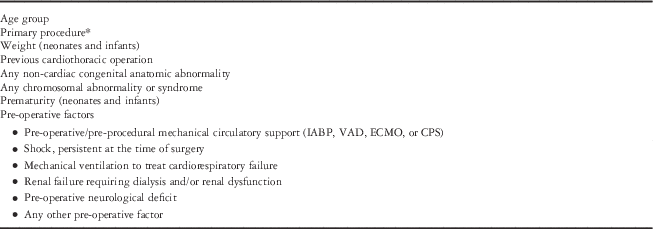
Abbreviations: CPS, cardiopulmonary support; ECMO, extracorporeal membrane oxygenation; IABP, intra-aortic balloon pump; VAD, ventricular assist device.
* The model adjusts for each combination of primary procedure and age group. Coefficients obtained via shrinkage estimation with STAT mortality category as an auxiliary variable
Operative Mortality is defined in all STS databases as (1) all deaths, regardless of cause, occurring during the hospitalization in which the operation was performed, even if after 30 days (including patients transferred to other acute care facilities); and (2) all deaths, regardless of cause, occurring after discharge from the hospital, but before the end of the 30th postoperative day.Reference Jacobs, Mavroudis and Jacobs14, Reference Overman, Jacobs and Prager15
For all STS Congenital Heart Surgery Database participants who consent to participate in voluntary Public Reporting, STS Public Reporting Online reports the following:
∙ the overall Operative Mortality rate for each STS-CHSD participant over a 4-year period for all ages;
∙ the Operative Mortality rate for each STS-CHSD participant over a 4-year period for all ages for each of the five Society of Thoracic Surgeons – European Association for Cardio-Thoracic Surgery Congenital Heart Surgery Mortality Categories (STAT Mortality Categories).
The STAT Mortality CategoriesReference O’Brien, Clarke and Jacobs16–Reference Jacobs, O’Brien and Jacobs18 are a tool for complexity stratification that was developed from an analysis of 77,294 operations entered into the EACTS Congenital Heart Surgery Database (33,360 operations) and the STS Congenital Heart Surgery Database (43,934 patients). Procedure-specific mortality rate estimates were calculated using a Bayesian model that was adjusted for small denominators. Operations were sorted by increasing risk and grouped into five categories (the STAT Mortality Categories) that were designed to be optimal with respect to minimising within-category variation and maximising between-category variation. STAT Category 1 is associated with the lowest risk for mortality and STAT Category 5 is associated with the highest risk for mortality. The STAT Mortality Categories allow hospitals to be compared based on the complexity of the operations being performed.
STS Public Reporting Online also includes the following data to provide a clear summary of the Operative Mortality of an STS-CHSD participant:
∙ Number/Eligible: this column of data presents a fraction with the numerator representing the number of observed patient deaths and the denominator representing the number of patients included in the calculation of Operative Mortality.
∙ Observed: this column of data presents the observed rate of Operative Mortality as a percentage. This percentage is calculated by dividing the number of observed deaths by the total number of eligible patients included in the calculation.
∙ Expected: this column of data presents the expected Operative Mortality rate as a percentage. The 2014 STS-CHSD Mortality Risk Model is used to estimate the number of expected patient deaths when considering the case mix of an STS-CHSD participant, or the mix of patients treated as defined by all the variables listed in Table 1.
∙ O/E (95% CI): this column of data presents the observed-to-expected (O/E) Operative Mortality ratio with 95% confidence intervals (CI). The O/E ratio is the number of observed deaths divided by the number of expected deaths. An O/E ratio >1 means that the STS-CHSD participant had more deaths than expected based on the actual case mix of that STS-CHSD participant. An O/E ratio <1 means that the STS-CHSD participant had fewer deaths than expected based on the actual case mix of that STS-CHSD participant. Small differences in the O/E ratio are usually not statistically significant, unless one is dealing with very large sample sizes, which is why the O/E ratio is reported along with 95% CIs.
The 95% CIs provide a range of O/E ratios that could represent the underlying true O/E ratio of a given STS-CHSD participant. The underlying true O/E ratio of a given STS-CHSD participant is the ratio that would be observed hypothetically if the STS-CHSD participant operated on a very large number of patients. If the CI is very wide, it means that the O/E ratio of the STS-CHSD participant is a less exact estimate of the true underlying O/E ratio of the STS-CHSD participant. In general, the width of the CI decreases as the number of patients included in the calculation increases.
∙ Adjusted rate (95% CI): this column of data presents the adjusted mortality rate (AMR) with 95% CIs. The AMR estimates what the Operative Mortality rate of a given STS-CHSD participant would be if its case mix was similar to the overall STS case mix – that is, the combined case mix across all STS participants.
The 95% CIs provide a range of adjusted mortality rates (AMRs) that could represent the underlying true adjusted Operative Mortality rate of a given STS-CHSD participant. The underlying true adjusted Operative Mortality rate of a given STS-CHSD participant is the rate that would be observed hypothetically if the STS-CHSD participant operated on a very large number of patients. If the CI is very wide, this means that the adjusted Operative Mortality rate of the STS-CHSD participant is a less exact estimate of the true underlying adjusted Operative Mortality rate of the STS-CHSD participant. In general, the width of the CI decreases as the number of patients included in the calculation increases.
A model for shared decision-making: the SDM tool for shared decision-making
A somewhat whimsical insight into “shared decision making” can be gained from the example of a breakfast of ham and eggs. The chicken is most certainly concerned, but it is the pig who is truly involved. We must bear in mind that it is the patient who is most at risk, not the team providing healthcare. Having said that, when it comes to assigning responsibility for outcomes, particularly with transparency and public reporting, and whether “fair” or not, it is the surgeons who are under the greatest scrutiny when outcomes are analysed. In general, cardiac surgeons are often the most visible and frequently the only members of the team specifically identified by name. Mortality statistics are rarely, if ever, assigned to or calculated for intensivists or other members of the team. Nevertheless, the need for transparency in reporting of outcomes can create pressure on healthcare providers to implement strategies of teamwork and shared decision-making in order to assure outstanding results. A simple strategy of shared decision-making was described by Tom Karl and was implemented in multiple domains by Jeff Jacobs and David Cooper. In a critical-care environment, it is not unusual for healthcare providers to disagree about strategies of management of patients. When two healthcare providers disagree, each provider can classify the disagreement into three SDM Levels (SDM = Shared Decision Making):
∙ SDM Level 1 Decision: “We disagree but it really does not matter, so do whatever you desire!”
∙ SDM Level 2 Decision: “We disagree and I believe it matters, but I am OK if you do whatever you desire!!”
∙ SDM Level 3 Decision: “We disagree and I must insist (diplomatically and politely) that we follow the strategy that I am proposing!!!!!!”
What may seem like a SDM Level 2 Decision to one member may seem like a SDM Level 1 Decision or a SDM Level 3 Decision to another. In fact, one might opine that the disagreement on prioritization may cause as much conflict as the matter being discussed. However, the SDM Level is whatever an involved practitioner thinks it is. The idea is not to agree on the SDM Level, but for an individual to abstain when he doesn’t consider the decision to be critical to outcome, thereby avoiding superfluous conflict. So, deciding a level is individual and should not cause conflict in and of itself.
A SDM Level 1 Decision implies that both strategies are acceptable, and neither strategy would likely increase risk for the patient. In such a situation, a reasonable response would be “I do not need to weigh in on this decision”. An example of a SDM Level 1 Decision is choosing a continuous Lasix (furosemide) infusion versus intermittent administration of Lasix (furosemide) in a post-operative patient with oliguria. A given provider may prefer the Lasix drip; however, for the patient in question, it is likely that it really does not matter one way or the other.
A SDM Level 2 Decision implies that we disagree, but it would be difficult to prove that one of the two strategies is better; and, in any case, this decision is unlikely to have an important effect on the outcome of the patient. The conflict generated would outweigh the potential benefit of either strategy. In such a situation, a reasonable response would be “You have my opinion, but you are welcome to weigh the evidence and reach your own conclusion”. An example of a SDM Level 2 Decision is choosing to use epinephrine (adrenaline) versus dopamine in a post-operative patient with hypotension and echocardiographic evidence of poor left ventricular contractility. In this example, a given provider may truly believe that either epinephrine or dopamine is better; however, the provider decides not to argue and instead agrees to use the treatment advocated by his colleague. It is often best in this instance to determine objective measures that reflect success of the chosen strategy, with a plan to adopt the alternate strategy if not met.
A SDM Level 3 Decision implies that we disagree, but based on scientific evidence as well as my own education, training, experience, and knowledge, I know that the only safe course of action is the one that I am proposing. In such a situation, a reasonable response would be, “I have dealt with this in the past using various approaches and I strongly believe that only strategy ‘X’ will be effective. The medical literature also supports this approach. In such cases, the risk for the patient will escalate if my strategy is not followed”. An example of a SDM Level 3 Decision is deciding whether or not to return to operating theatre to repair a residual lesion. In this case, either the surgeon or the intensivist may feel quite strongly that his opinion is true and correct and must be chosen. It is important that we utilize objective measures to assess this decision, and reassess the treatment strategy if it is ineffective.
One could write similar scenarios for intensivists in their daily interactions with surgeons. In fact, one could write similar scenarios involving the daily interactions of any of the various members of the healthcare team. We all want to do what we have devoted our lives to learning. Changing the concept from “patient ownership” to “shared responsibility” can create an environment that promotes this concept. Neither abdication of responsibility, micromanagement, nor distancing oneself from a bad outcome will help achieve our goals. However, at the end of the day, it may be necessary for one person to ultimately decide on a specific course of action (in situations when multiple options exist and disagreement persists regarding on the best choice). In many units, this responsibility rests with the “physician of record”, who may vary from patient to patient and unit to unit, and may be the referring cardiologist, the cardiac surgeon, or another member of the healthcare team.
SDM Level 1 Decisions and SDM Level 2 Decisions typically do not create stress on the team, especially when there is mutual purpose and respect among the members of the team. SDM Level 3 Decisions are the real challenge, and most typically occur in the sickest of patients with more time-sensitivity for decision making. Periodically, the healthcare team is faced with such Level 3 Decisions, and teamwork and shared decision-making may be challenged. Teamwork is a learned behaviour, and mentorship is critical to achieve a properly balanced approach.Reference Cohen, Jacobs and Quintessenza19 If we agree to leave our egos at the door, then, in the final analysis, the team will benefit and we will set the stage for optimal patient care. In the environment of strong disagreement, true teamwork and shared decision-making are critical to preserve the unity and strength of the multi-disciplinary team and simultaneously provide excellent healthcare.
Acknowledgement
None.
Financial Support
This research was not supported by any specific grant or funding agency.
Conflicts of Interest
None.



