

1. Introduction
Basement rocks crop out in tectonic windows in many orogens, doming the structurally overlying units (Rodgers, Reference Rodgers1995). Although such rocks (here neutrally called Window-Basement) occur throughout the Scandinavian Caledonides (Fig. 1; Gee et al. Reference Gee, Kumpulainen, Roberts, Stephens, Thon, Zachrisson, Gee and Sturt1985 b, Reference Gee, Fossen, Henriksen and Higgins2008), their structural status remains uncertain, causing problems in palaeogeographic reconstructions and interpretations of the late- to post-Caledonian structural evolution (extension) of Baltica.
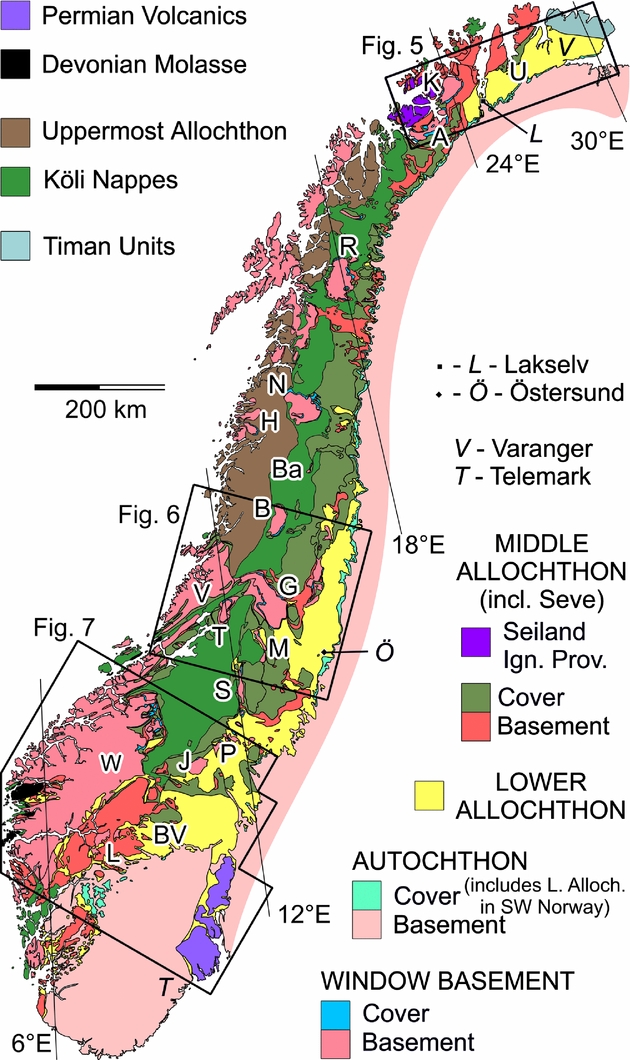
Distribution of the main tectonic units within the Scandinavian Caledonides (modified from Gee et al. Reference Gee, Kumpulainen, Roberts, Stephens, Thon, Zachrisson, Gee and Sturt1985 b). Areas covered by Figures 5–7 are shown. Window-Basement (from north to south): U – Kunes; K – Komagfjord; AK – Alta-Kvænangen; R – Rombak; N – Nasafjäll; H – Høgtuva; Ba – Bångonåive; B – Børgefjell; V – Vestranden; GO – Grong-Olden; T – Tømmerås; M – Mullfjället; S – Sylarna; P – Spekedalen; J – Atnsjøen; BV– Beito-Vang; L – Aurdal-Lærdal; W – Western Gneiss Region.
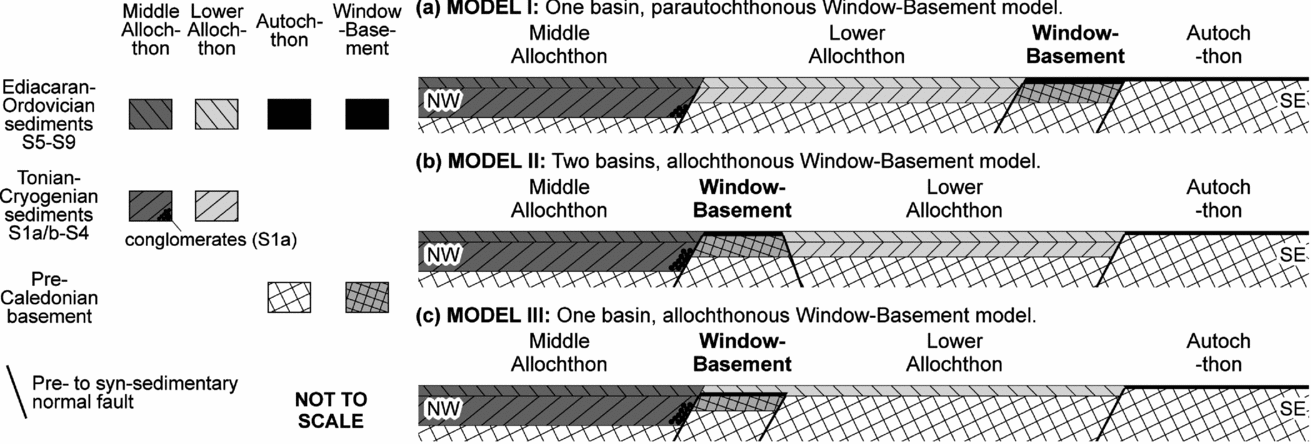
Here, two previously proposed structural and palaeogeographic models for the restoration of the external parts of the Scandinavian Caledonides (i.e. the structurally lower and predominantly brittle deformed parts) are compared from four areas. Model I presumes that the Window-Basement is parautochthonous and Model II assumes that it is allochthonous. A third model (Model III), combining aspects of the other models, is proposed for some parts of the orogen.
Restorations of the areas selected (east Finnmark to east Troms; Västerbotten to Nordland; Jämtland to north Trøndelag; and Telemark to Møre og Romsdal) have been published previously (Fig. 1; Gayer & Roberts, Reference Gayer and Roberts1973; Gee, Reference Gee1975, Reference Gee1978; Gayer et al. Reference Gayer, Rice, Roberts, Townsend and Welbon1987; Gayer & Greiling, Reference Gayer and Greiling1989; Rice, Reference Rice2005, Reference Rice, Corfu, Gasser and Chew2014; Andersen et al. Reference Andersen, Corfu, Labrousse and Osmundsen2012). Definitive new restorations are not necessarily given here, due to some uncertainties in the input data. Rather, a range of alternatives are critically evaluated; at issue is whether the models are equally valid and if the same model must be applied throughout the orogen.
All deformation and metamorphic grades referred to here are of Caledonian age. In this text, basement refers to rocks formed (deposited/intruded) prior to the Caledonian Wilson Cycle, while cover refers to rocks formed during the Caledonian Wilson Cycle. Allochthonous and autochthonous refer, respectively, to whether rocks were, or were not, deformed (thrust-transported, extended) during the Caledonian Orogeny. These give four possibilities – autochthonous basement, autochthonous cover, allochthonous basement and allochthonous cover – all of which are relevant here. This paper is not concerned with basement-cover (unconformity) relationships.
2. Scandinavian Caledonides overview
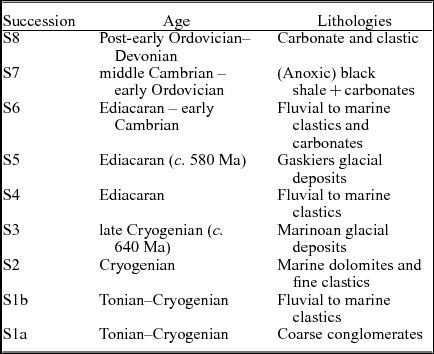
The Scandinavian Caledonides have been divided into the Uppermost, Upper, Middle and Lower allochthons overlying an Autochthon (Gee et al. Reference Gee, Kumpulainen, Roberts, Stephens, Thon, Zachrisson, Gee and Sturt1985 b, Reference Gee, Fossen, Henriksen and Higgins2008; Fig. 1), although the value of these terms has been criticised recently (Corfu, Andersen & Gasser, Reference Corfu, Andersen, Gasser, Corfu, Gasser and Chew2014). To simplify regional correlations between the cover sediments in the Autochthon, the Lower and Middle allochthons and the Window-Basement, which were all derived from the Iapetus Baltoscandian continental margin and are lithologically comparable (e.g. Nystuen & Siedlecka, Reference Nystuen, Siedlecka and Winchester1988; Nystuen et al. Reference Nystuen, Andresen, Kumpulainen and Siedlecka2008), the stratigraphy has been divided here into nine informal successions (S1a–S8; Table 1). In the following text, the succession number is given without further reference to Table 1. Except for the basal thrust sheets, the Middle Allochthon is generally not discussed here.
Simplified lithostratigraphy of the Iapteus Baltoscandian continental margin
The Autochthon comprises dominantly clastic rocks overlying the crystalline Baltic Shield. Except in NE Norway, the sediments are of syn- to post-Gaskiers glaciation (S5, late Ediacaran, c. 580 Ma; Bowring et al. Reference Bowring, Myrow, Landing, Ramezani and Grotzinger2003) or younger age, and typically have a condensed thickness (<300 m) compared to equivalent units in the Lower Allochthon (Føyn, Reference Føyn1967, Reference Føyn, Gee and Sturt1985; Gee et al. Reference Gee, Karis, Kumpulainen and Thelander1974; Andresen, Reference Andresen1978; Rickard et al. Reference Rickard, Willdén, Marinder and Donnelly1979; Thelander, Reference Thelander1982; Bockelie & Nystuen, Reference Bockelie, Nystuen, Gee and Sturt1985; Gayer & Greiling, Reference Gayer and Greiling1989; Bierlein & Greiling, Reference Bierlein and Greiling1993; Page, Reference Page1993; Nielsen & Schovsbo, Reference Nielsen and Schovsbo2006). The upper part frequently comprises mechanically weak graphitic shales (S7; Gee et al. Reference Gee, Karis, Kumpulainen and Thelander1974; Thelander, 1978; Morley, Reference Morley1986; Gayer & Greiling, Reference Gayer and Greiling1989; Bierlein & Greiling, Reference Bierlein and Greiling1993). Metamorphic studies (mostly illite crystallinity) indicate a diagenetic – lower anchizone alteration (Bergström, Reference Bergström1980; Kisch, Reference Kisch1980; Snäll, Reference Snäll1988; Anderson, Reference Anderson and Gayer1989; Rice et al. Reference Rice, Bevins, Robinson, Roberts, Daly, Cliff and Yardley1989a ; Warr, Greiling & Zachrisson, Reference Warr, Greiling and Zachrisson1996).
The Lower Allochthon (external imbricate zone) overlies the Autochthon along the Caledonian basal décollement, except in Telemark and Varanger (south and NE Norway, respectively; Fig. 1), where deformation dies out gradually without a major thrust (Morley, Reference Morley1986; Townsend, Reference Townsend1987). Hossack & Cooper (Reference Hossack, Cooper, Coward and Ries1986) suggested that the pre-erosional Caledonian thrust-front in the central Scandinavian Caledonides lay c. 90–120 km east of the present-day front. Anderson (Reference Anderson and Gayer1989) used metamorphic criteria to constrain the pre-erosion front in the Rombak area (Fig. 1) to c. 120 km east of the present-day eroded thrust front; this is very similar to the 110 km proposed by Hossack & Cooper (Reference Hossack, Cooper, Coward and Ries1986). In contrast, Garfunkel & Greiling (Reference Garfunkel and Greiling1998) estimated that the pre-erosional thrust-front lay c. 80 m east of the eroded thrust front in the Västerbotten area, considerably less than the 120 km inferred by Hossack & Cooper (Reference Hossack, Cooper, Coward and Ries1986).
Brittle imbrication in the Lower Allochthon, mostly with thrust shortening of <60% (Chapman, Gayer & Williams, Reference Chapman, Gayer, Williams, Gee and Sturt1985; Hossack, Garton & Nickelsen, Reference Hossack, Garton, Nickelsen, Gee and Sturt1985; Morley, Reference Morley1986, Reference Morley1987a , Reference Morley1987b ; Townsend et al. Reference Townsend, Roberts, Rice and Gayer1986; Gayer & Greiling, Reference Gayer and Greiling1989; Townsend, Rice & Mackay, Reference Townsend, Rice, Mackay and Gayer1989; Bierlein & Greiling, Reference Bierlein and Greiling1993; Greiling, Gayer & Stephens, Reference Greiling, Gayer and Stephens1993) occurred during diagenetic zone to anchizone metamorphism (Kisch, Reference Kisch1980; Anderson, Reference Anderson and Gayer1989; Rice et al. Reference Rice, Bevins, Robinson, Roberts, Daly, Cliff and Yardley1989a ; Warr, Greiling & Zachrisson, Reference Warr, Greiling and Zachrisson1996; Angerer & Greiling, Reference Angerer and Greiling2012).
The Lower Allochthon preserves a fluvial to shallow-marine, predominantly clastic, sedimentary succession of Tonian–Devonian age (S1–S8; Gee et al. Reference Gee, Karis, Kumpulainen and Thelander1974; Bjørlykke, Elvsborg & Høy, Reference Bjørlykke, Elvsborg and Høy1976; Johnson, Levell & Siedlecki, Reference Johnson, Levell and Siedlecki1978; Nystuen, Reference Nystuen1982, Reference Nystuen1987; Basset, Cherns & Karis, Reference Basset, Cherns and Karis1982; Kumpulainen & Nystuen, Reference Kumpulainen, Nystuen, Gee and Sturt1985; Nystuen & Siedlecka, Reference Nystuen, Siedlecka and Winchester1988; Roberts & Stephens, Reference Roberts, Stephens, Lundqvist and Autio2000; Nystuen et al. Reference Nystuen, Andresen, Kumpulainen and Siedlecka2008).
The Middle Allochthon comprises ductilely deformed nappes of both cover and basement lithologies (Fig. 1). The cover includes predominantly clastic, fluvial to shallow-marine sediments of Tonian and younger ages (S1b–S7; Kumpulainen, Reference Kumpulainen1980; Føyn, Chapman & Roberts, Reference Føyn, Chapman and Roberts1983; Bockelie & Nystuen, Reference Bockelie, Nystuen, Gee and Sturt1985; Kumpulainen & Nystuen, Reference Kumpulainen, Nystuen, Gee and Sturt1985; Nickelsen, Hossack & Garton, Reference Nickelsen, Hossack, Garton, Gee and Sturt1985; Greiling, Reference Greiling and Gayer1989), sometimes with very thick, proximally derived alluvial-fan basal conglomerates (S1a; Nickelsen, Reference Nickelsen1974; Hossack, Reference Hossack1978; Føyn, Chapman & Roberts, Reference Føyn, Chapman and Roberts1983; Gayer & Greiling, Reference Gayer and Greiling1989; Plink-Björklund, Björklund & Loorents, Reference Plink-Björklund, Björklund and Loorents2005; Nystuen et al. Reference Nystuen, Andresen, Kumpulainen and Siedlecka2008; Table 2).
Succession 1a conglomerates in the base of the Middle Allochthon

*These may partly be younger than S1a (Greiling, pers. comm. 2016).
The Window-Basement crops out throughout the length of the orogen (Fig. 1), with different tectonic windows showing slightly different features. For example, the Western Gneiss Region is extremely large and underwent ultra-high-pressure metamorphism in its internal parts (Hacker et al. Reference Hacker, Andersen, Root, Mehl, Mattinson and Wooden2003) while the Kunes Nappe (Rice, Reference Rice2001) is very small and underwent low- to middle-greenschist facies alteration (Føyn, Chapman & Roberts, Reference Føyn, Chapman and Roberts1983). The Nasafjäll Window-Basement comprises two exposed, relatively large, basement-cover slices (Thelander, Bakker & Nicholson, Reference Thelander, Bakker and Nicholson1980), as do several other areas of Window-Basement in Central Scandinavia (Tømmerås, Grong-Olden, Mullfjället, Western Gneiss Region; Fig. 1), while the Bångonåive Window-Basement comprises a large number of small and thin basement-cover imbricates (Greiling, Gayer & Stephens, Reference Greiling, Gayer and Stephens1993). Other Window-Basement units comprise a single exposed slice of basement (Aurdal-Lærdal, Vang, Beito, Atnsjøen, Spekedalen, Børgefjell, Rombak, Alta-Kvænangen, Altenes, Komagfjord, Kunes), although these may have minor amounts of internal shortening (e.g. Fareth, Reference Fareth1979; Greiling, Reference Greiling1988).
Despite this variability, the Window-Basement can be summarized as consisting of a central tectonic unit (Parautochthon of Gee et al. Reference Gee, Kumpulainen, Roberts, Stephens, Thon, Zachrisson, Gee and Sturt1985 b), often with a lithologically comparable upper unit (Gee, Reference Gee1980; Krill, Reference Krill1980, Reference Krill, Gee and Sturt1985; Thelander, Bakker & Nicholson, Reference Thelander, Bakker and Nicholson1980; Roberts, Reference Roberts1989, Reference Roberts1997; Fig. 1). Both units may locally have an unconformable cover succession, usually of Ediacaran (S5) or younger age and condensed compared to the Lower and Middle Allochthon successions, but similar to those forming the Autochthon (Brown & Wells, Reference Brown and Wells1966; Gee, Reference Gee1980; Krill, Reference Krill1980; Thelander, Bakker & Nicholson, Reference Thelander, Bakker and Nicholson1980; Nystuen & Ilebekk, Reference Nystuen and Ilebekk1981; Siedlecka & Ilebekk, Reference Siedlecka and Ilebekk1982; Lindqvist, Reference Lindqvist1984, Reference Lindqvist1988; Føyn, Reference Føyn, Gee and Sturt1985; Pharaoh, Reference Pharaoh, Gee and Sturt1985; Björklund, Reference Björklund1987; Bax, Reference Bax1989; Gayer & Greiling, Reference Gayer and Greiling1989; Schouenborg, Reference Schouenborg1989; Greiling, Gayer & Stephens, Reference Greiling, Gayer and Stephens1993).
The metamorphic grade of the Window-Basement cover sediments is higher or equivalent to that in the adjacent Lower Allochthon and generally, but not always, lower or equivalent to that in the overlying Middle Allochthon (e.g. Andréasson & Gorbatschev, Reference Andréasson and Gorbatschev1980; Lindqvist & Johansson, Reference Lindqvist and Johansson1987; Anderson, Reference Anderson and Gayer1989; Rice et al. Reference Rice, Bevins, Robinson, Roberts, Daly, Cliff and Yardley1989a ; Lindqvist, Reference Lindqvist1990; Table 3).
Variation in peak metamorphic grade across the transects. NA – data not available; NP – unit not preserved (eroded away) or not developed; L, M, U – lower, middle, upper; Ec, Am, G, Ep, An, D – eclogite, amphibolite, greenschist, epizone, anchizone, diagenetic zone facies alteration.

Construction of a ‘generalized’ cross-section through the orogen is not possible, not only because of the uncertainty in the restoration of the Window-Basement, which has an important effect on the geometry of the basal décollement towards the hinterland, but also because significant along-strike changes in the development of the orogen, including the variable development of the Uppermost and Lower allochthons and also the amount of basement in the Lower and Middle allochthons (e.g. Björklund, 1985, unpub. PhD thesis, Chalmers Tekniska Högskola, Göteborgs University, Sweden, 1989; Fig. 1), preclude any such cross-section at a meaningful level.
3. Published restorations of the Window-Basement
Only thrusting-related models for the restoration of the Window-Basement are reviewed here. Models in which exposure of the Window-Basement is linked to post-Caledonian normal faulting (Osmundsen et al. Reference Osmundsen, Braathen, Sommaruga, Skilbrei, Nordgulen, Roberts, Andersen, Olesen, Mosar, Wandaas and Gradstein2005) are evaluated in the Discussion (Section 6.f).
3.a. One-basin model: parautochthonous Window-Basement (Model I)
In central Jämtland, Gee (Reference Gee1975) and Dyrelius et al. (Reference Dyrelius, Gee, Gorbatschev, Ramberg and Zachrisson1980) proposed that the Müllfjället and Tømmerås Window-Basement (Fig. 1) were parautochthonous (or allochthonous, but not far-travelled, if an upper imbricate of the Window-Basement). They were derived from a step in the basement topography at the eastern margin of the Tonian–Cryogenian basin (S1b, S2) that formed on the Baltoscandian continental margin (Fig. 2a). The Window-Basement was, therefore, imbricated during late shortening in the Lower Allochthon. The thin, upper Ediacaran – lower Palaeozoic autochthonous sedimentary cover succession (S6, S7) was inferred to continue unbroken from the Caledonian front to the Window-Basement, everywhere resting directly on the basement, giving an autochthonous cover of at least c. 200 km width. This inference was supported by borehole data in the Tåsjön area that traced autochthonous sediments (S7) for 30 km west of the Caledonian front (Gee, Kumpulianen & Thelander, Reference Gee, Kumpulianen and Thelander1978) and by seismic data (Palm et al. Reference Palm, Gee, Dyrelius and Bjørklund1991; Fig. 3). Gee et al. (Reference Gee, Gezou, Roberts, Wolff, Gee and Sturt1985a ) presented a similar model in which the shelf deepened stepwise to the west, reflecting the eastwards onlap of the cover onto the Window-Basement (Fig. 4). Although the scales are approximate in Figure 4, the distances from Östersund to Müllfjället and Tømmerås are essentially the present-day distances (Fig. 1). Further, the youngest sediments in the basin (S8) have been restored to above or west of the Tømmerås Window-Basement, whereas currently they lie east of Tømmerås. The Middle Allochthon sediments represent a continuation of the Lower Allochthon basin in Model I, reflecting a westwards deepening of the continental shelf towards Iapetus, deposited directly outboard of the Window-Basement (Fig. 4; Gee, Reference Gee1978).
Schematic representation of the models used to restore the Window-Basement and external part of the Scandinavian Caledonides: (a) paratochthonous, one-basin model (Gee, Reference Gee1975); (b) allochthonous two-basin model (Gayer & Roberts, Reference Gayer and Roberts1973); and (c) combined model with allochthonous Window-Basement and one basin. See Discussion (Section 6.c.4) for details.
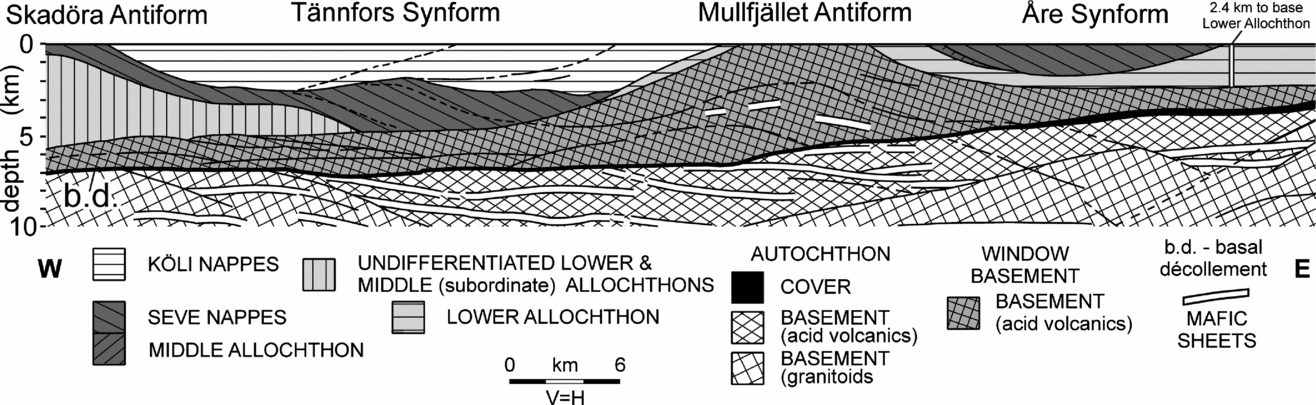
Upper 10 km of the seismic interpretation of the structure of the central part of the Scandinavian Caledonides (from Palm et al. Reference Palm, Gee, Dyrelius and Bjørklund1991). Note the smoothed ramp-flat appearance of the basal décollement. See Figure 6 for the profile line.
Semi-schematic restored profile through the eastern part of the central Scandinavian Caledonides from Gee et al. (Reference Gee, Gezou, Roberts, Wolff, Gee and Sturt1985a ) showing the relative restored positions of the Tømmerås and Mullfjället Window-Basement and the Lower and Middle allochthons.

3.b. Two-basin model: allochthonous Window-Basement (Model II)
In Finnmark, Gayer & Roberts (Reference Gayer and Roberts1973) determined a 35 km displacement from the NW for the Tonian–Cryogenian sediments (S1b, S2) of the Lower Allochthon because its branch-line overlapped the autochthonous Ediacaran sediments (S6) around Lakselv (Fig. 1). Rhodes (unpub. PhD thesis, University College of Cardiff, Wales, 1976) noted that the restored Lower Allochthon overlay the unconformable Ediacaran cover (S5, S6) on the Komagfjord Window-Basement (Fig. 1) and estimated a c. 15 km displacement for the Window-Basement from the NW. The Komagfjord Window-Basement was therefore incorporated into the orogen prior to deformation in the Lower Allochthon. Since the Lower Allochthon is continuously exposed from Lakselv to east Finnmark, with no reported major thrusts (Føyn, Reference Føyn1967), the possibility of moving the Lower Allochthon to the hinterland side of the Komagfjord Window-Basement was not considered. Subsequent restorations included shortening of up to 60% within the Lower Allochthon, and also postulated the presence of two buried Window-Basement units based on large-scale antiformal structures in the Middle Allochthon (Chapman, Gayer & Williams, Reference Chapman, Gayer, Williams, Gee and Sturt1985; Townsend et al. Reference Townsend, Roberts, Rice and Gayer1986; Gayer et al. Reference Gayer, Rice, Roberts, Townsend and Welbon1987; Rice, Reference Rice, Corfu, Gasser and Chew2014). In this model, the Window-Basement formed a palaeo-topographic high separating two sedimentary basins, imbricated into the Middle and Lower allochthons (Fig. 2b).
4. Orogenic transects
Only transects where both the Lower Allochthon and the Window-Basement are well developed are useful when considering their inter-relationships. A transect across the Nasafjäll Window, in which the Window-Basement is particularly well documented (Thelander, Bakker & Nicholson, Reference Thelander, Bakker and Nicholson1980), is therefore not included; the Lower Allochthon is very poorly developed (Fig. 1). However, Anderson (Reference Anderson and Gayer1989) presented a restoration of the Rombak Window-Basement (Fig. 1) relative to the poorly preserved Lower Allochthon (Rautas Complex) in northern Scandinavia, based on metamorphic criteria.
In all descriptions, the Window-Basement is documented last, to avoid prejudging the conclusions. Much of the lithological, structural and metamorphic data are summarized in Tables 2–5.
Variations in thickness (km) of the stratigraphic units (cf. Table 1) across the transects.

See text for data sources.
Variation in thrust transport directions across the transects

*Data for the Lower Allochthon on Transect 3 is taken from Transect 2.
4.a. Transect 1: east Finnmark to east Troms
Transect 1, from eastern Varangerhalvøya to Kvænangen, is c. 325 km long (Figs 1, 5). All localities are shown in Figure 5.
Geological map of the Finnmark Caledonides (Transect 1; Fig. 1). TKF – Trollfjorden-Komagelva Fault; EFPA – East Finnmark Parautochthon; HTS – Hanadalen Thrust Sheet; eRTS – eastern part of Ruoksadas Thrust Sheet; wRTS – western part of Ruoksadas Thrust Sheet; eMIZ/LD – eastern part of Munkavarri Imbricate Zone and Lakkaskaidi Duplex; wMIZ – western part of Munkavarri Imbricate Zone; BAS – Betusordda Antiformal Stack; BD – Børselv Duplex; Kf, At, AK – Komagfjord, Altenes and Alta-Kvænangen tectonic windows; H, R – branch-lines around Hatteras and Revsbotn Basement Horses; K – branch-line around the Komagfjord Antiformal Stack; An – Andabakoaivi; Kv – Kvænangen; L – Lakselv; VF – Vargsund Fault. Arrows indicate thrusting direction. Modified from Rice (Reference Rice, Corfu, Gasser and Chew2014).
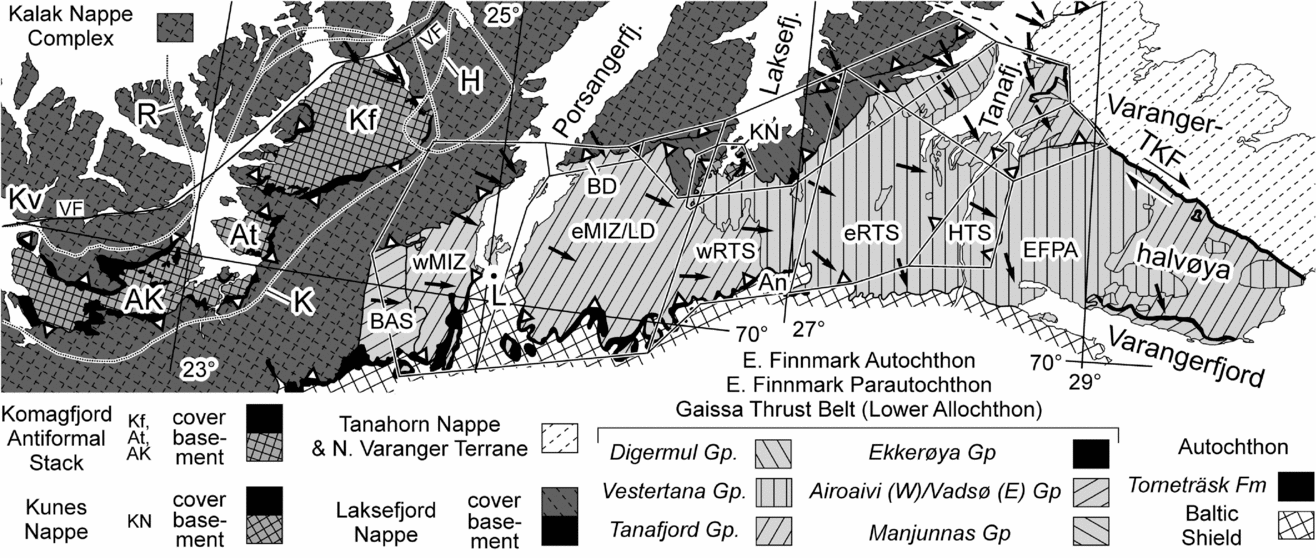
West of Andabakoaivi, the Autochthon comprises the Torneträsk Formation (S6, <260 m; Føyn, Reference Føyn1967; Thelander, Reference Thelander1982). East of Andabakoaivi, the age of the Autochthonous cover increases down to the Vadsø Group (S1b, c. 600 m thick; Johnson, Levell & Siedlecki, Reference Johnson, Levell and Siedlecki1978). The Autochthon is overlain by the East Finnmark Parautochthon, with the Hanadalen Thrust (base Hanadalen Thrust Sheet) forming the base of the Lower Allochthon (Gaissa Thrust Belt; Rice, Reference Rice, Corfu, Gasser and Chew2014; Fig. 5).
The same lithostratigraphy occurs in the East Finnmark Autochthon, East Finnmark Parautochthon and Gaissa Thrust Belt. In east Finnmark, this comprises Tonian–Tremadocian deposits (Vadsø, Ekkerøya and Tanafjord groups, S1b–S2, c. 2.5 km, overlain by the Vestertana and Digermul groups, S3–S8, c. 2.5 km; Johnson, Levell & Siedlecki, Reference Johnson, Levell and Siedlecki1978; Føyn & Siedlecki, Reference Føyn and Siedlecki1980; Edwards, Reference Edwards1984; Rice & Townsend, Reference Rice and Townsend1996; Røe, Reference Røe2003). In the Porsangerfjord area, similar Tonian–Cryogenian deposits occur (Airoaivi, Ekkerøya and Tanafjord groups, S1b–S2; Reference WilliamsWilliams, 1976a , b; Townsend, Rice & Mackay, Reference Townsend, Rice, Mackay and Gayer1989; Rice & Townsend, Reference Rice and Townsend1996). The total thickness is unknown due to uncertainties in the Airoaivi Group thickness (S1b), but is likely to be >2 km.
The predominantly E- to ESE-directed shortening in the Gaissa Thrust Belt increased from 16% in the Hanadalen Thrust Sheet to 59% in the Munkavarri Imbricate Zone (Chapman, Gayer & Williams, Reference Chapman, Gayer, Williams, Gee and Sturt1985; Townsend, Reference Townsend1987; Townsend et al. Reference Townsend, Roberts, Rice and Gayer1986; Townsend, Rice & Mackay, Reference Townsend, Rice, Mackay and Gayer1989; Rice, Reference Rice, Corfu, Gasser and Chew2014; Fig. 5). The metamorphic grade increased from lower anchizone – diagenetic zone in the east to epizone – upper anchizone in the west (Rice et al. Reference Rice, Bevins, Robinson, Roberts, Daly, Cliff and Yardley1989a ).
Although the Middle Allochthon is basement-dominated (Kirkland, Daly & Whitehouse, Reference Kirkland, Daly and Whitehouse2006), the basal unit (Laksefjord Nappe; Fig. 5) comprises 7.1 km of the Laksefjord Group, with proximally derived basal alluvial-fan conglomerates (Ifjord Formation, S1a, c. 3 km; Chapman, unpub. PhD thesis, University College of Cardiff, Wales, 1980; Føyn, Chapman & Roberts, Reference Føyn, Chapman and Roberts1983).
Caledonian thrusting was predominantly SE-directed in the Kalak Nappe Complex, but E- to ESE-directed movement occurred in the basal mylonites (Townsend, Reference Townsend1987; Rice, Reference Rice1998). Metamorphism in the Laksefjord Nappe reached epizone grade (Rice et al. Reference Rice, Gayer, Robinson and Bevins1989b ) during SE-directed thrusting (Milton & Williams, Reference Milton, Williams, McClay and Price1981). Later brittle out-of-sequence thrusting may have been E- to ESE-directed (Williams, Milton & Chapman, Reference Williams, Milton and Chapman1984; Rice, Reference Rice, Corfu, Gasser and Chew2014).
Window-Basement in the (1) Komagfjord, (2) Altenes and (3) Alta-Kvænangen tectonic windows (Fig. 5) is unconformably overlain by (1) the Slettfjell (S5, S6) and Lomvatn formations (?S1b), (2) the Rafsbotn Formation (S5, S6) and (3) the Bossekop (S1b) and Borras (S5, S6) groups, respectively (Føyn, Reference Føyn, Gee and Sturt1985; Pharaoh, Reference Pharaoh, Gee and Sturt1985). An epizone grade metamorphism occurred during SE-directed thrusting (Rice et al. Reference Rice, Gayer, Robinson and Bevins1989b ; Torgersen & Viola, Reference Torgersen and Viola2014). Two other buried Window-Basement units, the Hatteras and Revsbotn Basement Horses, have been postulated, underlying the Middle Allochthon (Chapman, Gayer & Williams, Reference Chapman, Gayer, Williams, Gee and Sturt1985; Gayer et al. Reference Gayer, Rice, Roberts, Townsend and Welbon1987; Fig. 5).
The Kunes Nappe Window-Basement (Fig. 5) comprises basement unconformably overlain by dolomites (S2). These were deformed at lower greenschist facies during SE-directed thrusting, doming the Laksefjord Nappe (Føyn, Chapman & Roberts, Reference Føyn, Chapman and Roberts1983; Rice, Reference Rice2001).
4.b. Transects 2 and 3: Västerbotten to Nordland and Jämtland to Trøndelag
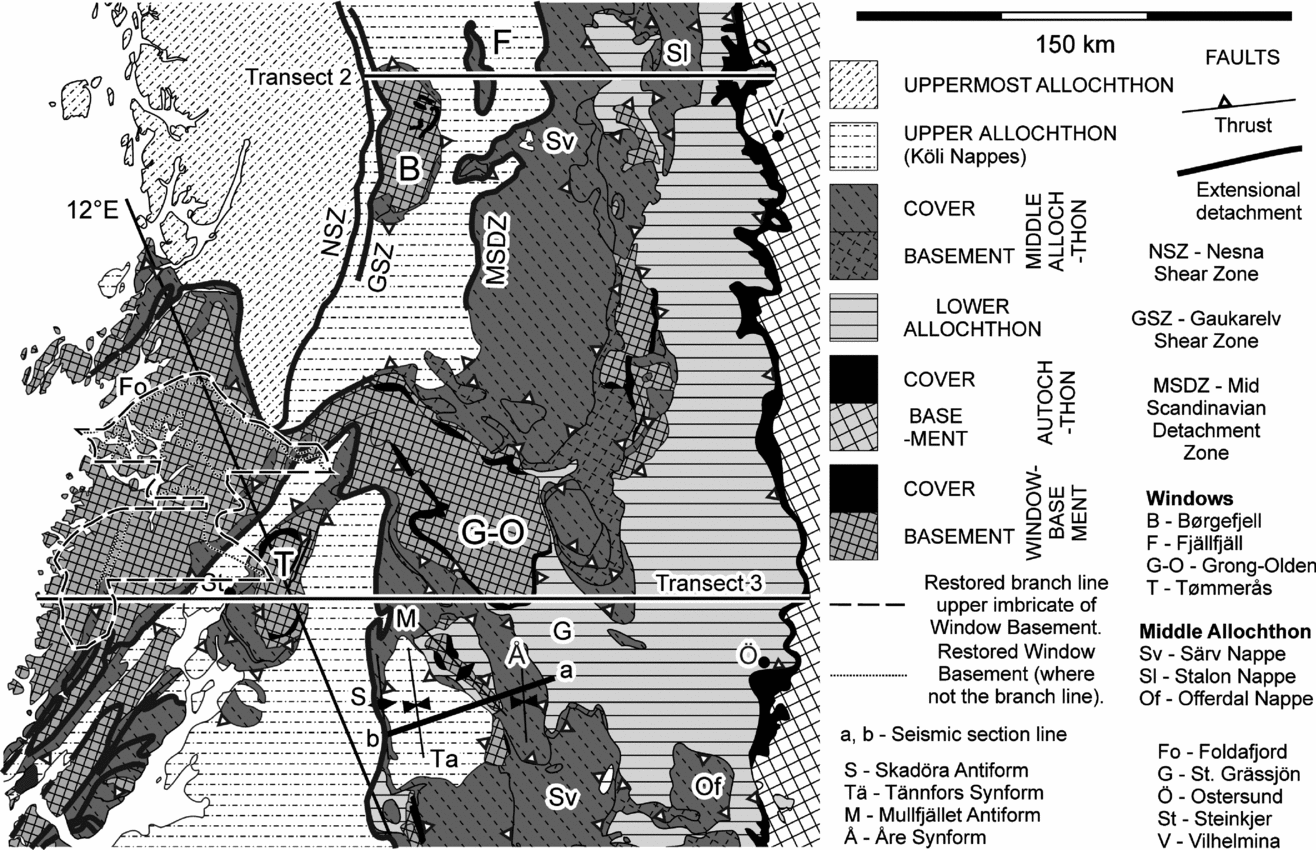
These two transects have similar regional geologies (Figs 1, 6). Transect 2, from north of Vilhelmina in Västerbotten to east of Børgefjell in Nordland is c. 140 km long. Transect 3, from north of Östersund in Jämtland to Steinkjer in Nord Trøndelag is c. 205 km long. When extended to the pre-erosional thrust-front (Hossack & Cooper, Reference Hossack, Cooper, Coward and Ries1986), the transects are c. 120 & 90 km longer, respectively. All localities are shown in Figure 6.
Geological map of the central Scandinavian Caledonides (transects 2 and 3; Fig. 1). Modified from Gee et al. (Reference Gee, Kumpulainen, Roberts, Stephens, Thon, Zachrisson, Gee and Sturt1985 b).
Both transects are cut by low-angled detachment faults (Fig. 6; Rice, Reference Rice1999; Osmundsen et al. Reference Osmundsen, Braathen, Nordgulen, Roberts, Meyer and Eide2003, Reference Osmundsen, Braathen, Sommaruga, Skilbrei, Nordgulen, Roberts, Andersen, Olesen, Mosar, Wandaas and Gradstein2005; Grimmer et al. Reference Grimmer, Glodny, Druppel and Greiling2015; Robinson et al. Reference Robinson, Roberts, Gee, Solli, Corfu, Gasser and Chew2014). These are reviewed in the Discussion (Section 6.f).
The Jämtland Supergroup (c. 1.1–1.7 km thick; Gee et al. Reference Gee, Karis, Kumpulainen and Thelander1974, Reference Gee, Gezou, Roberts, Wolff, Gee and Sturt1985 a; Basset, Cherns & Karis, Reference Basset, Cherns and Karis1982) forms the Autochthon, Lower Allochthon and cover units in the Window-Basement.
4.b.1. Transect 2: Västerbotten to Nordland
On Transect 2 (Fig. 6), the Autochthon comprises the Sjoutälven Group (Gärdsjön Formation, S6, <5 m), overlain by the Tåsjön Group (Fjällbränna Formation, S7, <10 m; Gayer & Greiling, Reference Gayer and Greiling1989), at diagenetic to lower anchizone metamorphic grades (Warr, Greiling & Zachrisson, Reference Warr, Greiling and Zachrisson1996).
In the Lower Allochthon (Blaik Nappe Complex), the Risbäck Group crops out in the east (S1a, b, c. 600 m; S2, 110 m; Fig. 6). The overlying Sjoutälven Group comprises the Långmarkberg (S5, 50 m) and Gärdsjön (S6, 280 m) formations, overlain by the Tåsjön Group (Fjällbränna Formation, S7, 80 m; Gayer & Greiling, Reference Gayer and Greiling1989; Kumpulainen & Greiling, Reference Kumpulainen, Greiling, Arnaud, Halverson and Shields-Zhou2011). These were deformed by E- to ESE-directed thrusting during anchizone to epizone metamorphism (Gayer & Greiling, Reference Gayer and Greiling1989; Bierlein & Greiling, Reference Bierlein and Greiling1993; Warr, Greiling & Zachrisson, Reference Warr, Greiling and Zachrisson1996; Angerer & Greiling, Reference Angerer and Greiling2012). Gayer & Greiling (Reference Gayer and Greiling1989) estimated a bulk 50% shortening.
The Middle Allochthon crops out (1) above the Lower Allochthon near the Caledonian front; (2) in the Fjällfjäll Window through the Upper Allochthon and (3) around the Børgefjell Window-Basement (Fig. 6). Near the Caledonian front, Greiling (Reference Greiling and Gayer1989) described two units. The lower, the Stalon Nappe Complex, comprises >250 m conglomerates (S1a) with large basement-derived clasts, overlain by >750m of sandstones (S1b) (the S1a conglomerates may partly be younger; Greiling, pers. comm. 2016). These are overlain by ‘pebbly sandstone’, possibly of glacial origin (S5, >250 m; Greiling, Reference Greiling1985; Gayer & Greiling, Reference Gayer and Greiling1989). The upper part of the Middle Allochthon consists of the Särv Nappe (see Transect 3) cut by within-plate basalt to mid-ocean-ridge basalt (WPB-MORB) dykes (Greiling et al. Reference Greiling, Grimmer, de Wall and Björk2007).
The lower part of the Middle Allochthon occurs around the Børgefjell Window-Basement (Rainesklumpen and Dearka units) while the upper part (Fjällfjäll Unit) is exposed in the Fjällfjäll Window and above the Rainesklumpen Unit (Zachrisson, Reference Zachrisson1964, Reference Zachrisson1969; Greiling, Reference Greiling1985, Reference Greiling and Gayer1989; Fig. 6).
The Middle Allochthon was affected by SE-directed ductile deformation during upper greenschist to lower amphibolite facies metamorphism (Greiling, Reference Greiling and Gayer1989).
The Børgefjell Window-Basement consists of two or more thrust sheets (Greiling, Reference Greiling1988, Fig. 6), with thin cover successions of the Långmarkberg Formation (S5, c. 2.5 m), Gärdsjön Formation (S6, 16 m) and Fjällbränna Formation (S7, >2 m). Both the cover and the directly underlying basement underwent ESE-directed deformation during middle to lower greenschist facies (epizone) metamorphism (Gayer & Greiling, Reference Gayer and Greiling1989).
4.b.2. Transect 3: Jämtland to Trøndelag
On Transect 3 (Fig. 6), the Autochthon comprises the Tåsjön Group (Fjällbränna Formation, S7, 20–40 m; Gee et al. Reference Gee, Gezou, Roberts, Wolff, Gee and Sturt1985a ). Conodont Alteration Index (CAI) values of 3.5–5 suggest a lower anchizone metamorphism (Bergström, Reference Bergström1980). However, comparison of CAI data from the Lower Allochthon (Bergström, Reference Bergström1980), where it can be directly compared with illite crystallinity data (Kisch, Reference Kisch1980), suggests that the equivalent illite crystallinity grade for the CAI from the Autochthon is diagenetic zone. The latter estimate is used, since illite crystallinity has been more widely applied to constrain metamorphic grades in the Scandinavian Caledonides.
Within the Blaik Nappe Complex (Lower Allochthon), the oldest sediments exposed (Gärdsjön Formation, S6, <200 m) crop out at St Grässjön, unconformably overlying allochthonous basement (Sveriges Geologiska Undersökning, 1984; Fig. 6). Elsewhere, the Tåsjön Group (Fjällbränna Formation, S7, 50 m and Norråker Formation, S8, 200–600 m) is overlain by the Änge Group (S8, 270 m; Gee et al. Reference Gee, Karis, Kumpulainen and Thelander1974, Reference Gee, Gezou, Roberts, Wolff, Gee and Sturt1985 a; Basset, Cherns & Karis, Reference Basset, Cherns and Karis1982). The maximum known thickness on this transect is therefore up to 1.12 km.
No detailed structural data are available for the Blaik Nappe Complex; the shortening vector and bulk strain from Transect 2 have been assumed (E- to ESE-directed; 50% shortening). This is supported by the outcrop pattern, which shows pervasive NNE-trending folding (Sveriges Geologiska Undersökning, 1984; more detailed maps are available on line at http://www.sgu.se/). Deformation occurred during diagenetic/lower anchizone metamorphism in the east, rising to epizone grade in the west (Bergström, Reference Bergström1980; Kisch, Reference Kisch1980).
The Middle Allochthon, exposed north and south of the section (Fig. 6), comprises thick imbricates of basement and cover; only the latter are described here. The Offerdal Nappe, the lowest cover thrust sheet, has been divided into three units (Plink-Björklund, Björklund & Loorents, Reference Plink-Björklund, Björklund and Loorents2005). The basal part contains proximal, basement-derived alluvial-fan conglomerates (S1a, >300 m). The overlying units consist predominantly of turbidites and fluvial sandstones (S1b, c. 1.2 km). Gee (Reference Gee1975) correlated these rocks with the Risbäck Group.
The 4.5–6 km thick Tossåsfjället Group in the overlying Särv Nappe (Kumpulainen, Reference Kumpulainen1980) consists of sandstones (Lunndörrsfjällen and Kråkhammeren formations, S1b, c. 4 km) overlain by dolomites (Storån Formation, S2, c. 100 m) and then by glacial deposits (Lillfjället Formation, S5, c. 120 m but maybe >600 m; Kumpulainen, Reference Kumpulainen, Arnaud, Halverson and Shields-Zhou2011) and shales, sandstones and conglomerates (Lövan Formation, S6, c. 1.5–2.0 km). These are cut by abundant WPB-MORB metadolerite dykes (Solyom, Gorbatschev & Johansson, Reference Solyom, Gorbatschev and Johansson1979).
The Lower and Upper Leksdal Nappes, exposed around the Tømmerås Window-Basement, are equivalent to the Offerdal and Särv Nappes (Fig. 6; Gee, Reference Gee1977; Andréasson, Solyom & Roberts, Reference Andréasson, Solyom and Roberts1979). In the Norwegian coastal area, Meakin (Reference Meakin1983) recorded a thinned package of the Middle Allochthon, with metadolerite dykes comparable to those in the Särv Nappe (Solyom, Gorbatschev & Johansson, Reference Solyom, Gorbatschev and Johansson1979), complexly infolded with other nappes and the Western Gneiss Region Window-Basement.
The Middle Allochthon was affected by SE-directed deformation during upper greenschist to lower amphibolite facies metamorphism (Andréasson & Gorbatschev, Reference Andréasson and Gorbatschev1980; Gilotti & Kumpulainen, Reference Gilotti and Kumpulainen1986; Simpson & de Paor, Reference Simpson, de Paor and Sengupta1997).
The Tømmerås and Grong-Olden Window-Basement both contain two major exposed basement-cover slices (Fig. 6; Gee, Reference Gee1980; Roberts, Reference Roberts1989, Reference Roberts1997). The cover successions (Bjørndalen and Grasåmoen formations, S6–S8, <65 m; Andréasson, Reference Andréasson1980; Gee, Reference Gee1980; Roberts & Stephens, Reference Roberts, Stephens, Lundqvist and Autio2000) have been lithostratigraphically correlated with, and were presumed to be direct continuations of, the Autochthon cover succession (Gee, Reference Gee1975, Reference Gee1978, Reference Gee1980; Gee et al. Reference Gee, Gezou, Roberts, Wolff, Gee and Sturt1985a ). The Grong-Olden Window-Basement was affected by middle greenschist facies metamorphism in the east (biotite grade; Johansson, unpub. PhD thesis, University of Lund, 1986) with SE-directed deformation (Sjöström & Talbot, Reference Sjöström and Talbot1987; Stel, Reference Stel1988). The Tømmerås Windows Basement was affected by SE-directed deformation during middle to upper amphibolite facies metamorphism (Gee, Reference Gee1980; Lindqvist, Reference Lindqvist1990).
Near Foldafjord, arkoses/conglomerates lie unconformably on the Vestranden Window-Basement (Fosså Formation, 70 m; Schouenborg, Reference Schouenborg1989; Fig. 6). As no lithologically diagnostic rocks of the Jämtland Supergroup are present (essentially S5 and S7), correlations are uncertain. The Vestranden Window-Basement was emplaced during SE-directed shortening (Kruhl, Reference Kruhl1984) and granulite facies metamorphism (Johansson & Möller, Reference Johansson and Möller1986; Möller, Reference Möller1988).
Gee (Reference Gee1975, Reference Gee1978) used very simple linear ‘branch-lines’ to infer large thrust-displacements for the nappes along Transect 3. However, no shortening was inferred within the Lower Allochthon and no displacement was proposed for the Window-Basement since the Offerdal Conglomerate, at the base of the Middle Allochthon, was restored to directly west of the present-day outcrop of the Tømmerås Window-Basement (cf. fig 5. in Gee, Reference Gee1978; Fig. 4). Further, the significance of extension within the middle to upper parts of the orogen was unrecognized (cf. Norton, Reference Norton1986; Rice, Reference Rice1999; Osmundsen et al. Reference Osmundsen, Braathen, Nordgulen, Roberts, Meyer and Eide2003, Reference Osmundsen, Braathen, Sommaruga, Skilbrei, Nordgulen, Roberts, Andersen, Olesen, Mosar, Wandaas and Gradstein2005; Robinson et al. Reference Robinson, Roberts, Gee, Solli, Corfu, Gasser and Chew2014; Grimmer et al. Reference Grimmer, Glodny, Druppel and Greiling2015). Thus the estimated displacements of Gee (1975, 1978), which in any event do not incorporate the strain within the rocks under discussion here, are no longer structurally admissible.
4.c. Transect 4: Telemark to Møre og Romsdal
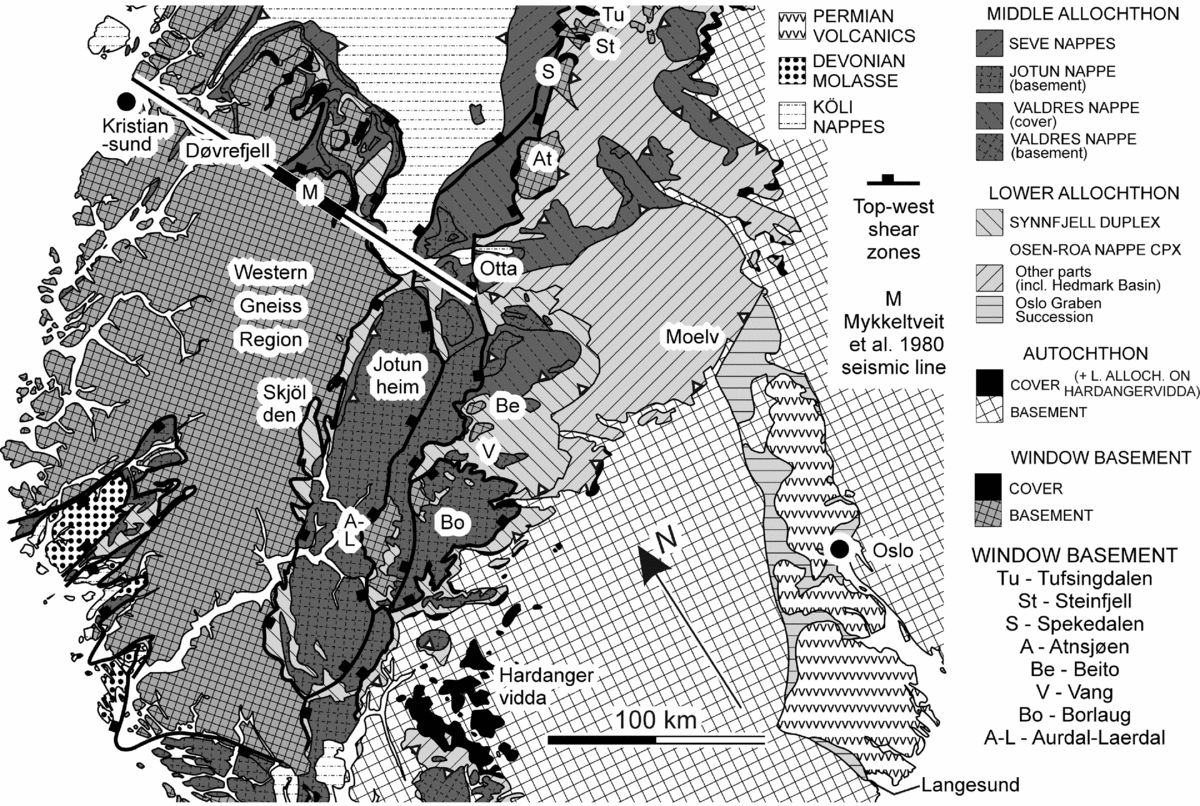
The branch-line restoration of Transect 4 is constrained by the c. 490 km long section from Langesund in southern Telemark to Kristiansund in west Norway. This line was chosen as it includes the widest and best-studied part of the Lower Allochthon (Bjørlykke et al. Reference Bjørlykke, Elvsborg and Høy1976; Nystuen, Reference Nystuen1981, Reference Nystuen1982, Reference Nystuen1983, Reference Nystuen1987; Bockelie & Nystuen, Reference Bockelie, Nystuen, Gee and Sturt1985; Morley, Reference Morley1986, Reference Morley1987a , Reference Morley1987b ). The internal part of the Window-Basement is very complexly deformed (Krill, Reference Krill1980, Reference Krill, Gee and Sturt1985; Robinson et al. Reference Robinson, Roberts, Gee, Solli, Corfu, Gasser and Chew2014); a proper restoration of this ductile strain is beyond the scope of the paper. All localities are shown in Figure 7.
Geological map of the southern Scandinavian Caledonides (Transect 4; Fig. 1). Modified from Gee et al. (Reference Gee, Kumpulainen, Roberts, Stephens, Thon, Zachrisson, Gee and Sturt1985 b).
On Hardangervidda, the Autochthon comprises undeformed and unmetamorphosed (taken as diagenetic zone alteration) rocks of the Bjørno Member (S7, <30 m) at the base of the Vidda Group, underlying strongly deformed rocks of the Vidda Group at lower greenschist facies, here presumed to be part of the internal Lower Allochthon (Fig. 7; S7–S8, 400 m; Andresen, Reference Andresen1978, unpub. PhD thesis, University of California; Davis, 1982, pers. comm. 2016; Andresen & Færseth, Reference Andresen and Færseth1982). Note that in Figures 1 and 7, both of these units are shown as Autochthon.
At Langesund, the Autochthon consist of c. 1.1 km of clastic and carbonate deposits (S7–S8) overlain by the Bruflat Sandstones (S8, 0.5–1 km; Bockelie & Nystuen, Reference Bockelie, Nystuen, Gee and Sturt1985; Worsley et al. Reference Worsley, Baarli, Howe, Hjaltasan and Alm2011).
The Osen-Røa Nappe Complex (Lower Allochthon; Fig. 7) consists of three hangingwall flats linked by ramps (Morley, Reference Morley1986). The first flat lies in the Alum Shale Formation (S7) overlain by S8 (820 m). The basal thrust cuts 320 m down-section in the hangingwall at the first ramp to the Moelv Tillite or Ekre Shale (S5 – base S6). Along the second ramp it cuts c. 3 km down-section to the base of the Brøttum Formation (S1a/S1b), with a pre-S7 thickness of c. 3.4 km in the Hedmark Basin (Nystuen, Reference Nystuen1982; Kumpulainen & Nystuen, Reference Kumpulainen, Nystuen, Gee and Sturt1985; Morley, Reference Morley1986).
Thrusting in the Osen-Røa Nappe Complex was SE-directed in the north and SSE-directed in the south (Nystuen, Reference Nystuen1981, Reference Nystuen1983; Morley, Reference Morley1986, Reference Morley1987a , Reference Morley1987b ), with the metamorphic grade changing from epizone grade in the north to diagenetic zone in the south (Bergström, Reference Bergström1980; Robinson & Bevins, pers. comm. 1986). Shortening dropped from 60% in the north to c. 0% in the south, with a bulk shortening of 50% (Morley, Reference Morley1986).
The upper part of the Lower Allochthon comprises the Aurdal and Synnfjell Duplexes and the Strondafjord Formation (Hossack, Garton & Nickelsen, Reference Hossack, Garton, Nickelsen, Gee and Sturt1985; Fig. 7). The Aurdal Duplex imbricates c. 350 m of Dalselvi and Ørnberget formations (S6-S8) overlying c. 10 m of autochthonous shales (S7; Nickelsen, Hossack & Garton, Reference Nickelsen, Hossack, Garton, Gee and Sturt1985). The Synnfjell Duplex imbricates c. 410 m of successions S6–S8. The duplexes were formed during SE-directed shortening, with 63 and 84% shortening, respectively (Hossack, Garton & Nickelsen, Reference Hossack, Garton, Nickelsen, Gee and Sturt1985) at lower- to middle greenschist facies in the Synnfjell Duplex (Nickelsen, Hossack & Garton, Reference Nickelsen, Hossack, Garton, Gee and Sturt1985).
The Middle Allochthon comprises the Valdres and overlying Jotun Nappes, with similar cover and basement rocks (Fig. 7). The cover consists of the Valdres Group (S1b, S5, S6, >4 km), including the thick Bygdin and Ormtjernskampen basal conglomerates (S1a; Table 2), overlain by the Mellsenn Group (S6–S7, 250 m; Nickelsen, Reference Nickelsen1974; Hossack, Reference Hossack1978; Hossack, Garton & Nickelsen, Reference Hossack, Garton, Nickelsen, Gee and Sturt1985; Nickelsen, Hossack & Garton, Reference Nickelsen, Hossack, Garton, Gee and Sturt1985).
The Valdres and Jotun Nappes are separated by a zone containing ultramafic (serpentinite) to basic nodules, interpreted by Banham, Gibbs & Hopper (Reference Banham, Gibbs and Hopper1979) as a Caledonian suture. Rice (Reference Rice2005) took these rocks as evidence for a minor ocean (Fjordane Sea) between the restored Valdres and Jotun Nappes. Andersen et al. (Reference Andersen, Corfu, Labrousse and Osmundsen2012) suggested that the ‘ophiolitic’ material represented a hyper-extended continental margin, separating the restored Valdres and Jotun Nappes.
The Window-Basement comprises the small outcrops of the Tufsingdalen, Steinfjell, Spekedalen, Atnsjøen, Beito, Vang, Borlaug and Aurdal-Lærdal Window-Basement (here together called the External Window-Basement) and the very large Western Gneiss Region Window-Basement (Figs 1, 7). A <150 m thick succession (S5–S8) unconformably overlies the Atnsjøen-Spekedalen Window-Basement, affected by NW–SE-oriented deformation, possibly at greenschist facies metamorphic conditions (based on the description of the rocks as phyllites and as having a Caledonian stretching [ductile] lineation; Nystuen & Ilebekk, Reference Nystuen and Ilebekk1981; Siedlecka & Ilebekk, Reference Siedlecka and Ilebekk1982). NW–SE-oriented greenschist facies lineations also occur in the Beito Window (Hossack, Reference Hossack1976), but tectonic contacts in this area may have been affected by relative extension (Andersen, Reference Andersen1998).
The basement in the Western Gneiss Region at Skjølden is comparable to the Fillefjell-Beito Basement Complex (Beito and Vang Window-Basement; Milnes & Koestler, Reference Milnes, Koestler, Gee and Sturt1985; Fig. 7). This suggests that the Window-Basement is contiguous between the Western Gneiss Region and the External Window-Basement, under the nappes. Near Døvrefjell, the Gjevilvatnet Group (S5?–S7, <300 m) unconformably overlies basement (Gee, Reference Gee1980; Robinson et al. Reference Robinson, Roberts, Gee, Solli, Corfu, Gasser and Chew2014); similar cover rocks occur elsewhere within the Western Gneiss Region (Hacker et al. Reference Hacker, Andersen, Root, Mehl, Mattinson and Wooden2003; Andersen et al. Reference Andersen, Corfu, Labrousse and Osmundsen2012). Deformation and metamorphism in the Western Gneiss Region involved burial to ultra-high pressure conditions at its NW margin (Hacker et al. Reference Hacker, Andersen, Root, Mehl, Mattinson and Wooden2003). This was followed by rapid exhumation, involving relative top-hinterland deformation between the Western Gneiss Region and the overlying nappes. Two models for this have been presented. (1) In the eduction model (Andersen et al. Reference Andersen, Jamtveit, Dewey and Swensson1991, Reference Andersen, Corfu, Labrousse and Osmundsen2012), the Western Gneiss Region is autochthonous and exhumation occurred by absolute top-hinterland movement of the overlying nappes. (2) In the buoyancy model, the Western Gneiss Region is allochthonous and exhumation occurred through gravitational forces along the subduction channel, contemporary with orogenic shortening (Hacker et al. Reference Hacker, Andersen, Root, Mehl, Mattinson and Wooden2003; Rice, Reference Rice2005); top-hinterland movements were only relative to the hangingwall and footwall, not absolute compared to the Baltic Shield.
Seismic studies across the Western Gneiss Region revealed a 4 km thick low-velocity zone at 14 km depth (Mykkeltveit, Husebye & Oftedahl, Reference Mykkeltveit, Husebye and Oftedahl1980). This was interpreted as oceanic sediments separating autochthonous crystalline basement from a Laurentia-derived Western Gneiss Region (see Fig. 7 for seismic line). Rice (Reference Rice2005) proposed that the sediments were a relict of the Hedmark Basin (S1a, b and younger), underlying Baltica-derived Window-Basement.
Late-orogenic extension occurred in the area, orthogonal to the thrusting direction in the nappes (Robinson et al. Reference Robinson, Roberts, Gee, Solli, Corfu, Gasser and Chew2014). Most of this, but not all, affected rocks above the structural levels which this paper is concerned with (Fig. 7). Such movement will have resulted in material moving out of the cross-section plane. The assumption here is that the material that moved out was replaced by similar material moving in, such that no significant difference is present.
5. Alternative restorations
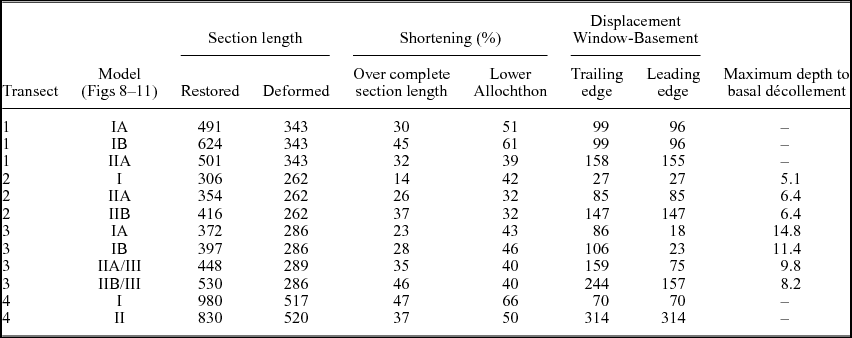
For each transect, two or more restorations based on the models outlined in Figure 2 are given. These are then evaluated in the Discussion (Section 6). A summary of the restored section lengths and shortening for each restoration is given in Table 6.
Summary of restored transects (all lengths and depths in kilometres)
5.a. Restoration Transect 1: east Finnmark to east Troms
The restorations presume a planar basal décollement as far west as the trailing branch-line of the Komagfjord Antiformal Stack or Revsbotn Basement Horse (Window-Basement; cf. Gayer et al. Reference Gayer, Rice, Roberts, Townsend and Welbon1987; Fig. 5). The Komagfjord Antiformal Stack and the still-buried Hatteras and Revsbotn Basement Horses must be restored to an internal position relative to this line, a minimum distance of 99 km. Alternatives to this constraint are reviewed in the Discussion in Section 6.b.
For all the models outlined in the following descriptions, restoration of the more internal units (Børselv Duplex, Kunes and Laksefjord Nappes and Kalak Nappe Complex; Fig. 5) essentially follows that given in Rice (Reference Rice, Corfu, Gasser and Chew2014).
Branch-line restoration of the East Finnmark Parautochthon and Hanadalen and Ruoksadas Thrust Sheets in the Gaissa Thrust Belt moves the trailing branch-line of the Ruoksadas Thrust Sheet 59 km to the WNW (Rice, Reference Rice, Corfu, Gasser and Chew2014). This removes the stratigraphic repetition of the Tanafjord and Ekkerøy groups (S1b, Gaissa Thrust Belt) over the Torneträsk Formation (S6, Autochthon) near Lakselv (Figs 5, 8). Further restorations depend on the model used (Fig. 2).
Branch-line restorations based on models I and II for Transect 1 in the north Norwegian Caledonides (Fig. 5; see text for details).
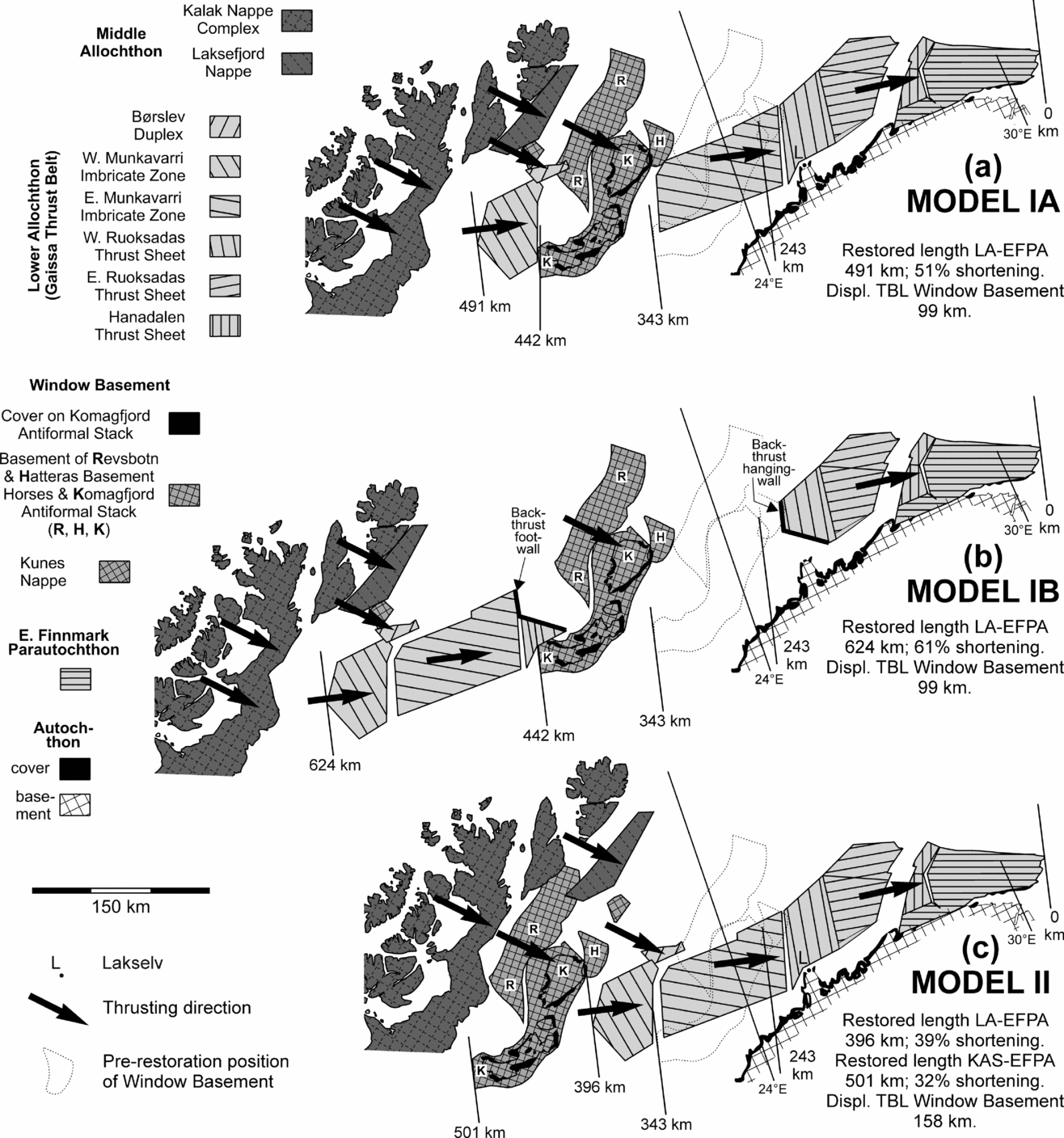
For Model I, two alternative restorations are given. In Model 1A (Fig. 8a), further in-sequence restoration of the Gaissa Thrust Belt places the trailing branch-line of the eastern Munkavarri Imbricate Zone directly adjacent to the leading branch-line of the Hatteras Basement Horse after it has been restored by the minimum distance of 99 km (Fig. 8a).
Subsequent restoration of the E- to ESE-directed shortening in the western Munkavarri Imbricate Zone leads to a stratigraphic overlap of the Tanafjord Group (S1b, S2) over the unconformable Window-Basement cover (S5–S6). In the model, this can only be corrected by moving the western Munkavarri Imbricate Zone to W to WNW of the Window-Basement, such that the Window-Basement crops out ‘within’ the Munkavarri Imbricate Zone (Fig. 8a). The two parts of the Munkavarri Imbricate Zone are separated by a minimum of c. 103 km.
During deformation, the western Munkavarri Imbricate Zone must therefore be thrust over the Window-Basement as far as the eastern Munkavarri Imbricate Zone. The total restoration of the trailing branch-line of the eastern Munkavarri Imbricate Zone, from its deformed position in Porsangerfjord, is 124 km. Thus, after 25 km of this shortening, ESE-directed displacement of the Window-Basement (99 km total displacement) started.
Deformation within the Window-Basement was SE-directed, with c. 3 km shortening (Gayer et al. Reference Gayer, Rice, Roberts, Townsend and Welbon1987; Torgersen & Viola, Reference Torgersen and Viola2014). When this displacement occurred is uncertain. If it was directly after SE-directed shortening in the Kalak Nappe Complex and Laksefjord and Kunes Nappes, and hence prior to E- to ESE-directed thrusting, deformation in the western Munkavarri Imbricate Zone would have been out-of-sequence. (Strictly this scenario does not conform to Model I, in which deformation in the Window-Basement starts after the onset of imbrication in the Lower Allochthon.) Conversely, if thrusting was in-sequence, then the SE-directed internal shortening in the Window-Basement represents a short-term change in thrusting direction during the dominant E- to ESE-directed phase of shortening.
In Model 1A, the restored length of the East Finnmark Parautochthon and Gaissa Thrust Belt is 491 km with the Window-Basement displaced by 99 km (Fig. 8a). Combined shortening in these units was 51%.
For Model IB (Fig. 8b), in contrast, all the pre-S3 rocks in the Porsangerfjord area (Fig. 5) have been restored to W- to WNW of the Window-Basement, since a division of the Tanafjord Group reflecting the c. 103 km or more separating the eastern and western Munkavarri Imbricate Zones in Model 1A (Fig. 8a) has not been recognized in the sedimentology (White, Reference White1968, Reference White1969; Roberts, Reference Roberts1974; Tucker, Reference Tucker1976, Reference Tucker1977; Reference WilliamsWilliams, 1976a , b). This not only requires that the contact between the Tanafjord Group (S1b) and the overlying Vestertana Group (S3, S4) within the western Ruoksadas Thrust Sheet be re-interpreted as a major back-thrust (Figs 5, 8b), but also creates a >90 km gap in the restoration between the restored Vestertana Group (S5, S6) of the Ruoksadas Thrust Sheet and the leading edge of the Hatteras Basement Horse (after restoration by 99 km). The two parts of the Gaissa Thrust Belt are separated by c. 230 km.
In this model, the Munkavarri Imbricate Zone (both parts) and the low-strain SW part of the Ruoksadas Thrust Sheet are imbricated and thrust over the Window-Basement for 230 km, with a back-thrust sense relative to the hanging wall during at least the last stages of this movement (to under the Vestertana Group in the western part of the Ruoksadas Thrust Sheet). The same arguments for the 3 km of SE-directed shortening within the Window-Basement documented for Model 1A also apply here.
In Model IB, the restored length of the East Finnmark Parautochthon and Gaissa Thrust Belt is 624 km with the Window-Basement displaced by 99 km (Fig. 8b). Combined shortening in these units was 61%. This model more closely follows the definition of Model I (Fig. 2a), as all S1 and S2 rocks were restored to west of the Window-Basement and deformation in the Lower Allochthon started before that in the Window-Basement.
For Model II (Fig. 8c), the Window-Basement, Laksefjord and Kunes Nappes and Kalak Nappe Complex are all pinned to the trailing edge of the Gaissa Thrust Belt and moved towards the hinterland during restoration of all E- to ESE-directed deformation (Rice, Reference Rice, Corfu, Gasser and Chew2014). During the final 99 km of this movement, the Window-Basement moves down its footwall ramp to its restored position WNW of the Lower Allochthon. Subsequently, SE-directed thrusting in the Børselv Duplex (Gaissa Thrust Belt), Window-Basement and Kunes and Laksefjord Nappes was sequentially restored (cf. Rice, Reference Rice, Corfu, Gasser and Chew2014). No significant gaps are present within the restored section.
In Model II, the restored length of the East Finnmark Parautochthon and Gaissa Thrust Belt is 396 km (Fig. 8c). Combined shortening in these units was 39%. If the Window-Basement is included, the length is 501 km with the Window-Basement displaced by 158 km. The overall shortening is 32%.
5.b. Restoration Transect 2: Västerbotten to Nordland
The dimensions of the Børgefjell Window-Basement in the semi-schematic deformed profile were estimated from inferring a planar basal décollement (except where the restoration subsequently necessitates otherwise; see below) dipping 2°WNW (cf. Palm et al. Reference Palm, Gee, Dyrelius and Bjørklund1991; Fig. 3) and 30° ramp angles. A horizontal topography was extrapolated westwards from the present-day Caledonian front, which gives an initial thickness of 4.7 km for the Børgefjell Window-Basement (Fig. 9, section 2.1). A projection of the basement-cover contact below and parallel to the initially inferred basal décollement is taken as the boundary between successions 1a–2 and 5–8 where the former have been deposited.
Balanced cross-sections showing restorations based on models I and II for Transect 2 in the central Scandinavian Caledonides (Fig. 6; see text for details).
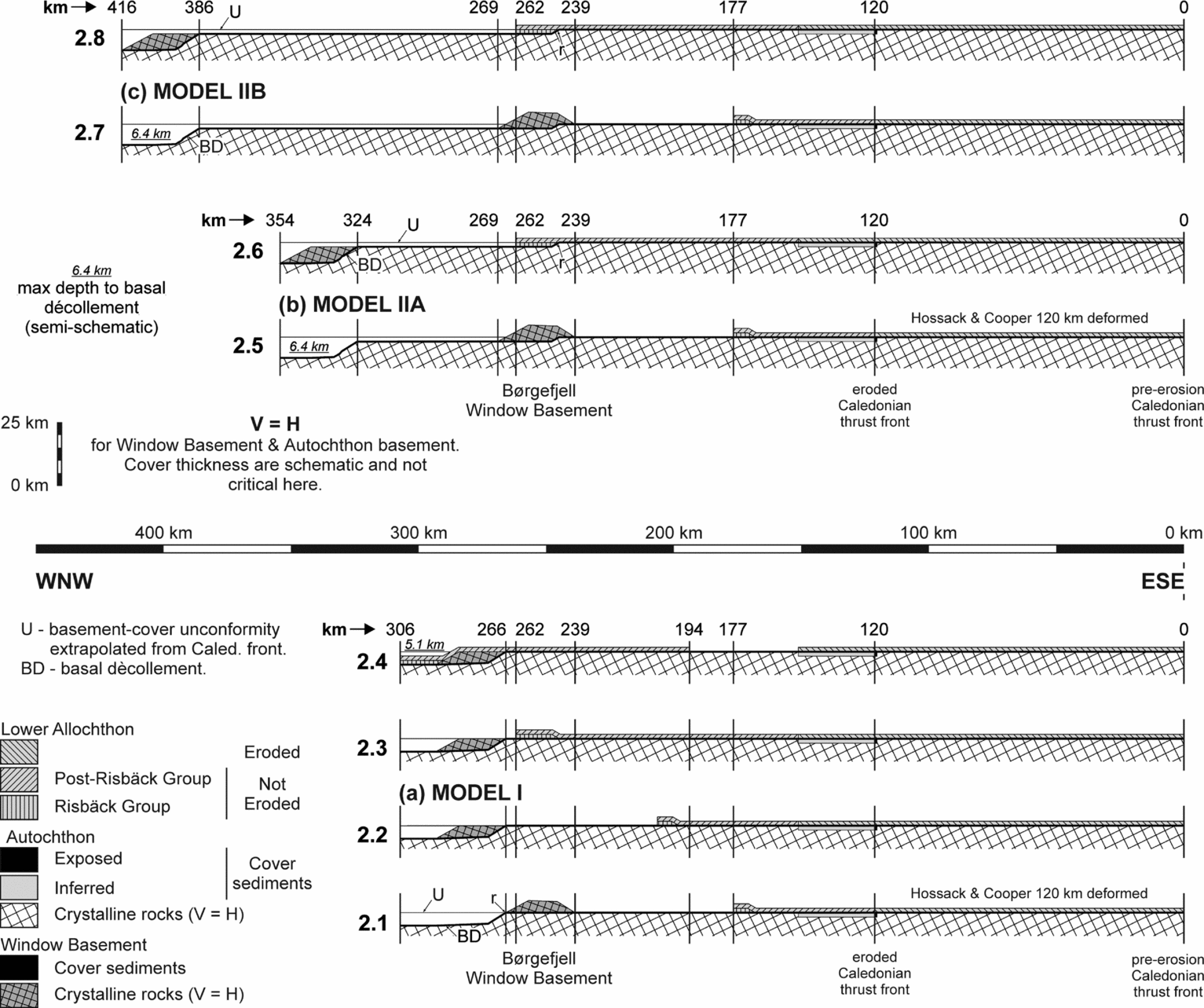
For the basement rocks of the Autochthon and Window-Basement, vertical and horizontal scales are the same. Cover sediment thicknesses are semi-schematic; the Risbäck Group is modelled as being c. 1.6 km thick, not 0.7 km, to make it visible on the sections. Thickening of the Window-Basement towards the hinterland is therefore slightly exaggerated in Figure 9, sections 2.5 and 2.6.
Shortening occurred within the Window-Basement (Fig. 6; Greiling, Reference Greiling1988), but this cannot be modelled due to the lack of published data. Including this deformation would increase the restored section lengths.
A 30 km long buried Autochthonous cover succession (S7 and younger) is extrapolated from the Tåsjön area (Gee, Kumpulianen & Thelander, Reference Gee, Kumpulianen and Thelander1978) and a pre-erosion thrust front c. 120 km east of the present front is assumed (Hossack & Cooper, Reference Hossack, Cooper, Coward and Ries1986; Fig. 9, sections 2.1–2.8). This value has been used, rather than the c. 80 km proposed by Garfunkel & Greiling (Reference Garfunkel and Greiling1998) but, as shown later in this section, the actual value chosen makes little difference since the fully restored section length is controlled by the position of the Børgefjell Window-Basement.
Restoration of an inferred bulk shortening of 20% is needed in the eroded segment of the Lower Allochthon to move the Gärdsjön Formation (S6) in the preserved Lower Allochthon to the west of the 30 km wide Autochthon (S7) preserved under the nappes (Fig. 9; cf. Gee, Kumpulianen & Thelander, Reference Gee, Kumpulianen and Thelander1978).
In Model I, the Børgefjell Window-Basement is restored during restoration of the eroded part of the Lower Allochthon. That is, it was imbricated essentially during the latest phase of thrusting in the Lower Allochthon. The leading edge of the footwall ramp is inferred to be coincident with the trailing edge of the deformed Window-Basement (r in Fig. 9, section 2.1), such that there is no overlap of the deformed and restored positions of the Børgefjell Window-Basement. A more easterly position can be used for the footwall ramp, giving an overlap in deformed and restored positions; this results in a thicker Window-Basement block, however (see Fig. 9, sections 2.5–2.8).
Subsequent restoration of the 50% shortening in the Lower Allochthon (Gayer & Greiling, Reference Gayer and Greiling1989) places its trailing edge close to the leading edge of the restored Børgefjell Window-Basement (Fig. 9, section 2.3). To move the Risbäck Formation to the west side of the Børgefjell Window-Basement, required for Model I, a part of the Lower Allochthon has to be moved 44 km to the WNW (Fig. 9, section 2.4), creating a c. 44 km wide gap in the section. This is here shown between the leading edge of the preserved Lower Allochthon and the trailing edge of the restored eroded part. Increasing the shortening in the eroded part to 38% closes this gap (not shown in Fig. 9).
For Model I, the restored section length is 306 km, with a bulk shortening in the Lower Allochthon (including the eroded part) of 42%. The Børgefjell Window-Basement was displaced 27 km (Fig. 9).
In Model II, two possible restorations have been shown, differing only in the restoration of the 62 km gap in the section between the trailing edge of the Lower Allochthon and the leading edge of the Børgefjell Window-Basement. In both alternatives, restoration of the eroded part of the Lower Allochthon is the same as that for Model I. During subsequent restoration of the preserved part of the Lower Allochthon the Risbäck Group is restored to its final position, forming a step in the basement-cover interface (and hence, later, a ramp in the basal décollement; r in Figure 9, section 2.6) under the present position of the Børgefjell Window-Basement. To fill the space in the deformed section created by this ramp, the Window-Basement must thicken to the west (Fig. 9, section 2.5).
During restoration of the Lower Allochthon, the Børgefjell Window-Basement must be restored to the WNW since, in Model II, imbrication of the Window-Basement occurs prior to shortening in the Lower Allochthon. The same distance (62 km) must be kept between the trailing edge of the Lower Allochthon and the leading edge of the Window-Basement as seen now in the deformed section (Fig. 9, sections 2.5, 2.6). This implies that any Jämtland Supergroup sediments that lay between the Window-Basement and the preserved Lower Allochthon were thrust over the Lower Allochthon in the footwall of the Middle Allochthon, prior to imbrication of the Børgefjell Window-Basement, and have been eroded away (Fig. 9, sections 2.5, 2.6).
Alternatively, the Lower Allochthon might continue to the west, buried under the structurally higher nappes, as far as the leading edge of the Window-Basement, with 50% shortening. Restoration of this model would move the Børgefjell Window-Basement 124 km (2×62 km) to the WNW of the trailing edge of the Lower Allochthon (Fig. 9, sections 2.7, 2.8). In this model the material from this gap, now shortened, still lies buried under the structurally higher nappes.
For Model IIA, the restored section length is 354 km with a bulk shortening in the Lower Allochthon (including the eroded part) of 32% (Fig. 9). The Børgefjell Window-Basement was displaced 85 km. For Model IIB, the restored section length is 416 km, with a bulk shortening in the Lower Allochthon (including the eroded part) of 38%. The Børgefjell Window-Basement was displaced 147 km.
5.c. Restoration Transect 3: Jämtland to Trøndelag
The initial parameters for constructing the deformed section (Fig. 10) are the same as for Transect 2 (first paragraph), except that the eroded part of the Lower Allochthon is 90 km wide (Hossack & Cooper, Reference Hossack, Cooper, Coward and Ries1986). In all restorations, the eroded part has been restored using the same shortening value (20%) as in Transect 2, giving a displacement of 23 km; this does not move the preserved Lower Allochthon to the hinterland of the 30 km wide buried Autochthon (Fig. 10) but, since both hangingwall and footwall lie in the Fjällbränna Formation (S7), an absence of stratigraphic overlap is assumed.
Balanced cross-sections showing restorations based on models I and II for Transect 3 in the central Scandinavian Caledonides (Fig. 6; see text for details).
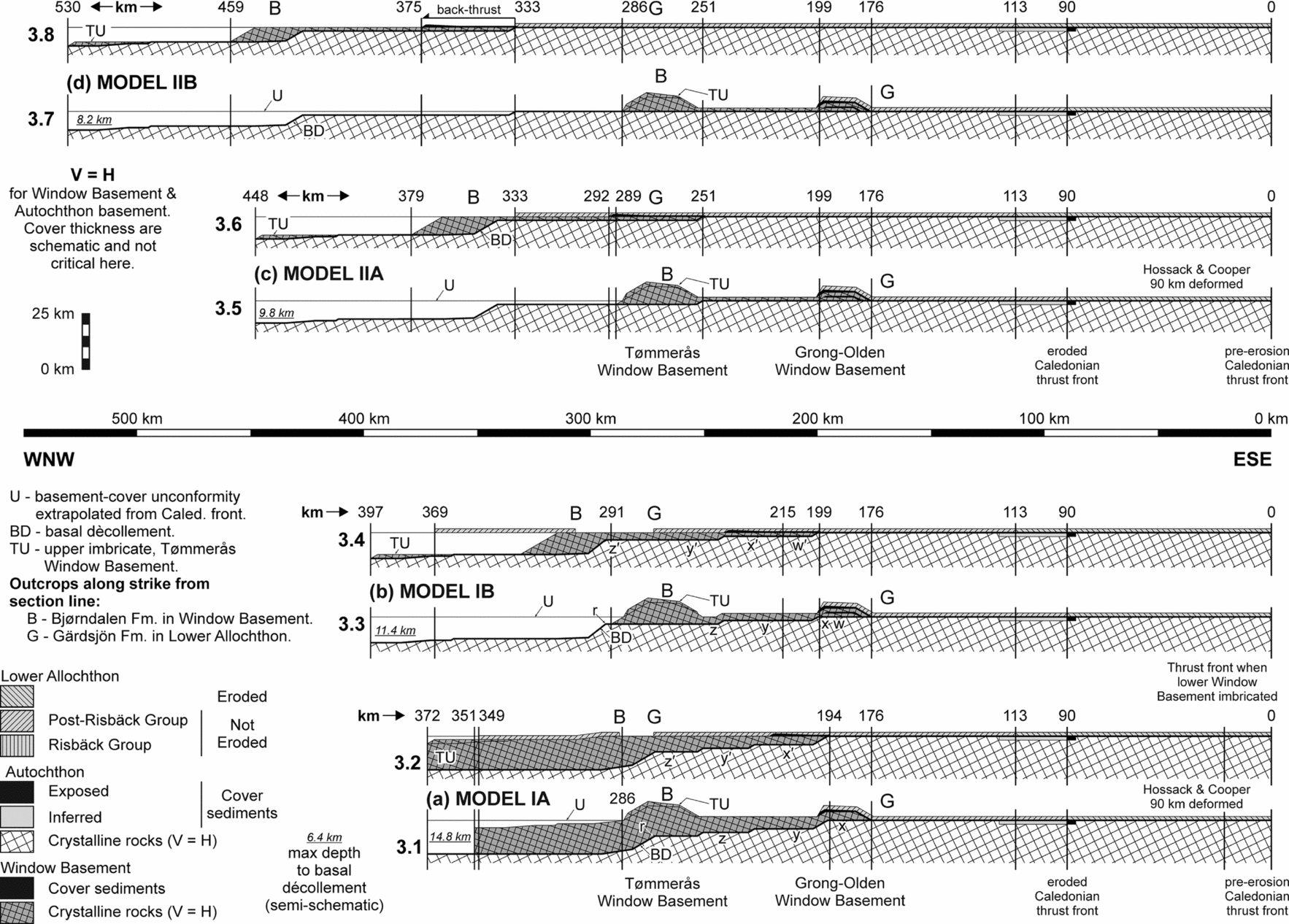
The section cuts the lower imbricate of the Grong-Olden Window-Basement and both imbricates of the Tømmerås Window-Basement (Fig. 6); lateral continuity between the lower imbricates of these two units has been assumed. Taking a planar basal décollement, the lower imbricate of the Grong-Olden Window-Basement is 3.7 km thick and of the Tømmerås Window-Basement 6.2 km, linked by an inferred 1.6 km thick basement slice (Fig. 10, section 3.7, east of kilometre 286 shows this presumed initial geometry). Reducing the thickness of this slice would affect the final modelled thickness of the Window-Basement by a similar amount in Model IA (Fig. 10, sections 3.1, 3.2). A branch-line has been constructed around the upper imbricate and restored to the WNW until it does not overlap the Bjørndalen Formation in the lower imbricate of the Tømmerås Window-Basement, a displacement of 66 km (Fig. 6).
Two alternative restorations are shown for Model I: one in which the lower imbricate of the Grong-Olden Window-Basement is inferred to be a single slice of basement 3.7 m thick; and one in which it is inferred to comprise two equally thick basement slices, both overlain by a cover succession (Fig. 10, sections 3.1–3.4).
In Model IA, the 3.7 km thick lower imbricate of the Grong-Olden Window-Basement has been restored by the shortest possible amount (21 km) that keeps the thickness of this part of the unit the same in the deformed and restored sections. (If the footwall ramp were moved to the east, the Window-Basement would thicken dramatically.) This restoration occurred during restoration of the 20% shortening in the eroded part of the orogen (23 km); it is therefore modelled as a very late event.
Since the combined lower imbricates of the Grong-Olden and Tømmerås Window-Basement presently overlie their restored positions in this model, and the restored upper surface of the Window-Basement (excluding the cover sediments) is kept at the level of the basement-cover interface at the eroded Caledonian front (lines U in Fig. 10), the Window-Basement must thicken westwards. Essentially, the Window-Basement at x (Fig. 10, section 3.1) restores to y, with the depth to the basal décollement below the planar basement-cover unconformity constrained by the thickness at x (see x′, Fig. 10, section 3.2). As the deformed basement-cover contact at y lies above the restored position, the basement that moves onto y during deformation must be thicker than that at x. This is also the case for the basement at z, moving onto y (see x′, y′, z′ in Fig. 10, section 3.2). The basement wedge therefore thickens gradually to the west with these constraints, until the lower imbricate of the Window-Basement has been fully restored. In the model, the maximum depth of the basal décollement (at the WNW end) is 14.8 km.
West of the restored position of the trailing branch-line of the lower imbricate of the Tømmerås Window-Basement, the thickness of the Window-Basement has been kept constant at c. 13 km, until the upper imbricate of the Tømmerås Window-Basement is restored using the branch-line geometry documented above (Fig. 10, section 3.2). As the section line does not cut the branch-line around the upper imbricate of the Grong-Olden Window-Basement, a gap is present in all the restorations of this transect between the restored positions of the upper and lower imbricates of the Tømmerås Window-Basement.
For Model IA, the restored section length is 372 km with c. 21 km displacement for the lower imbricate of the Tømmerås Window-Basement. Shortening in the Lower Allochthon, including the eroded part, is 42%.
In restoration Model IB (Fig. 10, sections 3.3, 3.4), the lower imbricate of the Grong-Olden Window-Basement is presumed to consist of two equally thick basement slices (w and x), both with a cover succession. These imbricates restore to w′ and x′ and together define the length of y, which is overlain by the inferred 1.6 km thick basement slice joining the lower imbricates of the Grong-Olden and Tømmerås Window-Basement. Since the west end of y lies east of the leading edge of the lower imbricate of the Tømmerås Window-Basement, the Window-Basement can retain its original thickness (1.6 km) rather than thickening (part z). Further, since the trailing edge of z′ lies west of the trailing edge of the deformed lower imbricate of the Tømmerås Window-Basement (r, Fig. 10, section 3.3), the latter does not thicken significantly more when restored (compare with the position of r relative to the Tømmerås Window-Basement in Figure 10, section 3.1).
In this restoration, the lower imbricate of the Win-dow-Basement does not continue to the west as a thick slice of basement (for example, as thick as at y′); the upper imbricate of the Tømmerås Window-Basement is therefore restored to c. 10 km below the top of the upper imbricate (Fig. 10, section 3.3).
In Model IB, the restored section length is 397 km, with c. 40 km displacement for the lower imbricate of the Tømmerås Window-Basement. Shortening in the Lower Allochthon, including the eroded part, was 46%.
For both alternatives, it has been assumed that there is no stratigraphic repetition between the restored Lower Allochthon and the Grasåmoen Formation. However, the Gärdsjön Formation crops out directly south of the transect line and this overlaps the Bjørndalen Formation at the southern end of the Tømmerås Window-Basement (G and B, Fig. 10, sections 3.1–3.4). If this is taken into consideration, the restored lengths increase to 349 and 369 km, respectively, giving 43% and 46% shortening in the Lower Allochthon (including eroded part).
In Model II, restoration of the 20% shortening in the eroded part and the 50% shortening in the preserved part of the Lower Allochthon places its trailing edge 333 km WNW of the eroded thrust front (Fig. 10, sections 3.6, 3.8). The lower imbricate of the Grong-Olden Window-Basement is presumed to comprise two thin basement-cover sheets.
For Model IIA (Fig. 10, sections 3.5, 3.6) the lower imbricate of the Grong-Olden Window-Basement has been restored to below the restored Lower Allochthon, since it now underlies the deformed Lower Allochthon, to avoid back-thrusting. The most westerly position possible for the Window-Basement is constrained by the 50% shortening inferred for the Lower Allochthon lying now to the hinterland of the leading edge of the Grong-Olden Window-Basement. In the model, this must be shortened prior to thrusting of the lower imbricate of the Grong-Olden Window-Basement. In Figure 10, section 3.6, the trailing edge of the restored cover of the Grong-Olden Window-Basement (at 292 km) must therefore lie by the length of the restored cover (292–251 = 41 km) to the foreland of the restored trailing edge of the Lower Allochthon (at 333 km). This puts the restored position of the Window-Basement partially under its deformed position and hence the Tømmerås Window-Basement must be thicker than initially drawn (compare thicknesses in Fig. 10, sections 3.5, 3.7). Restoration of the lower imbricate of the Window-Basement places the trailing edge of the Tømmerås Window-Basement 128 km to the hinterland of the leading edge of the Grong-Olden Window-Basement. The upper imbricate of the Window-Basement is restored by 66 km, using the branch-line geometry in Figure 6; this places the trailing edge of the Window-Basement at 358 km from the eroded thrust front.
During deformation, the trailing edge of the Lower Allochthon (at 333 km) was shortened until it was coincident with the trailing edge of the restored cover on the lower imbricate of the Grong-Olden Window-Basement (at 292 km). This started after, but was partly coincident with, the 66 km emplacement of the upper imbricate of the Window-Basement. As shortening is set at 50%, deformation in the Lower Allochthon during this period progressed towards the leading edge of the cover on the lower imbricate of the Grong-Olden Window-Basement (at 251 km). As deformation in the Lower Allochthon reached the leading edge of each of the two minor thrust slices within the lower imbricate of the Grong-Olden Window-Basement, shortening in this lower imbricate occurred. The combined Window-Basement and Lower Allochthon were then transported together, towards the foreland.
For Model IIA, the restored section length is 448 km with c. 90 km displacement for the lower imbricate of the Tømmerås Window-Basement. Shortening in the Lower Allochthon, including the eroded part, was 40%.
In Model IIB (Fig. 10, sections 3.7, 3.8), the Window-Basement has been restored completely to the hinterland side of the restored Lower Allochthon. Subsequent restoration of the minor thrust slices in the lower imbricate of the Grong-Olden Window-Basement moves its trailing branch-line 16 km more towards the hinterland. The upper imbricate of the Window-Basement is restored a further 66 km, using the branch-line restoration in Figure 6.
During thrusting, emplacement of the upper imbricate and shortening within the lower imbricate of the Window-Basement is followed by thrusting of the lower imbricate under the Lower Allochthon, which undergoes 50% shortening at the same time. The trailing edge of the Lower Allochthon must back-thrust 42 km relative to the trailing edge of the cover on the Grong-Olden Window-Basement. The amount of back-thrusting decreases as imbrication moves towards the foreland.
For Model IIB, the restored section length is 530 km, with 173 km displacement for the lower imbricate of the Tømmerås Window-Basement. Shortening in the Lower Allochthon, including the eroded part, was 40%, the same as for Model IIA, but includes up to 42 km of relative back-thrusting on its floor thrust.
5.d. Restoration Transect 4: Telemark to Møre og Romsdal
The average shortening estimate of 50% (Morley, Reference Morley1986) has been used everywhere for restoring imbrication within the Osen-Røa Nappe Complex (Lower Allochthon). No constraints are made for the depth to the basal décollement, although Morley (Reference Morley1986) gave depths for the Osen-Røa Nappe Complex. The similarity of the basement in the Western Gneiss Region and External Window-Basement (Milnes & Koestler, Reference Milnes, Koestler, Gee and Sturt1985) indicate that they can be taken as a single unit c. 221 km wide from NW to SE. No net internal shortening or stretching has been assumed in the Window-Basement (Fig. 11a, b).
Branch-line restorations based on models I and II for Transect 4 in the south Norwegian Caledonides (Fig. 7; see text for details). External Window-Basement units: A-L – Aurdal-Lærdal; A – Atnsjøen; B – Beito; Bo – Borlaug; H – Haugesund; K – Kikedalen. M – Mykkeltveit, Husebye & Oftedahl (Reference Mykkeltveit, Husebye and Oftedahl1980) seismic line.
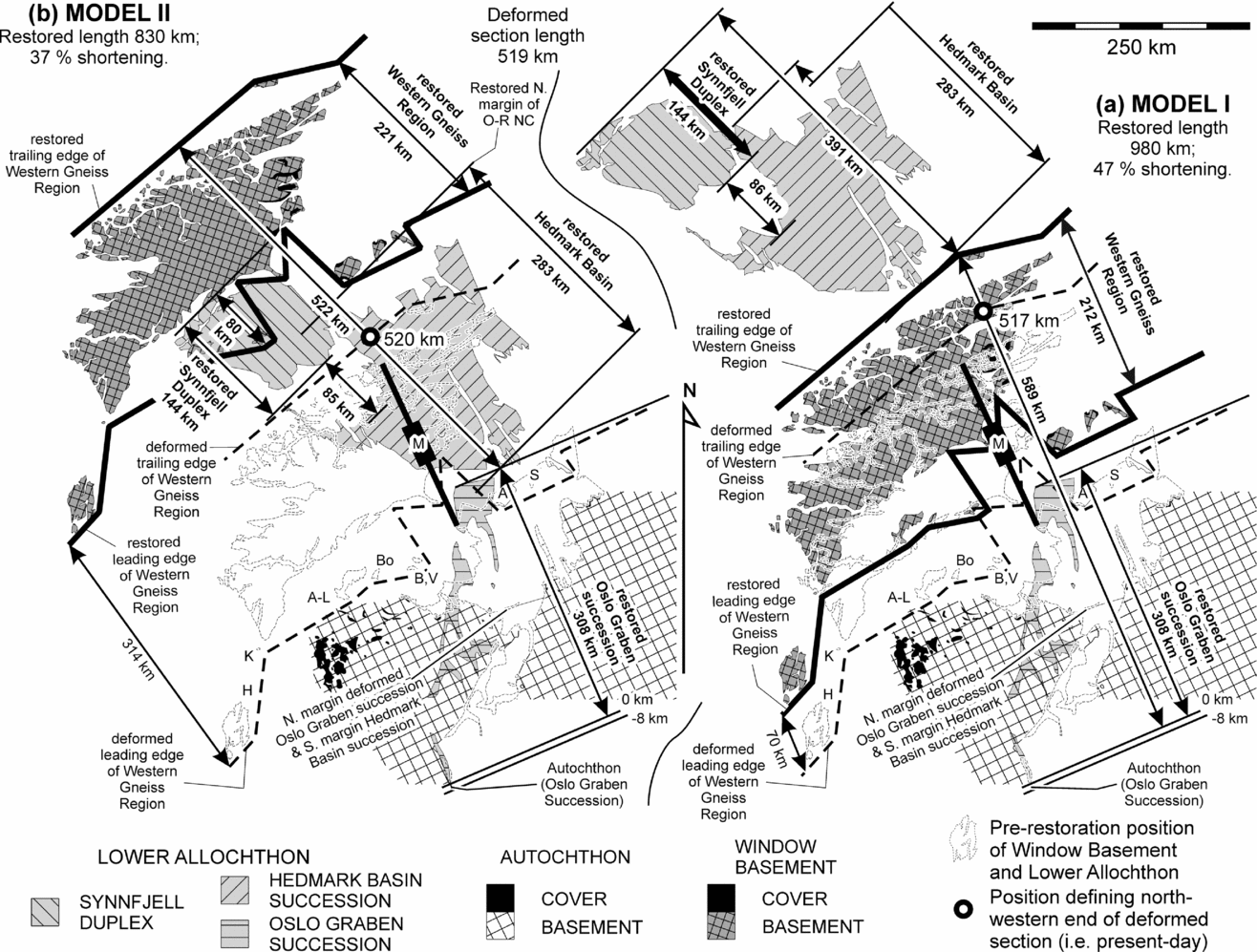
In both models, branch-line restoration of the SSE-directed shortening in the Osen-Røa Nappe Complex in the Oslo Graben places its trailing branch-line c. 308 km NNW of its leading edge, which is coincident with the Autochthon at the south end of the section (Fig. 11a, b). This restoration causes a stratigraphic repetition of Moelv Tillite/Ekre Shale (S5, S6) in the Lower Allochthon above S8 in the External Window-Basement cover (Morley, Reference Morley1986; Nystuen & Ilebekk, Reference Nystuen and Ilebekk1981).
In Model I, restoration of the Window-Basement (required by the stratigraphic repetition described earlier in this section) occurs during restoration of the later stages of thrusting in the Lower Allochthon in the Oslo Graben (Fig. 2a). Thrust emplacement of all the Window-Basement must therefore also have been SSE-directed. In Figure 11b, a displacement of 70 km has been shown for the Window-Basement but, in the absence of a proper balanced section, this is schematic. A minimum value (c. 42 km) is constrained by the trailing branch-line of the restored Oslo Graben part of the Osen-Røa Nappe Complex.
NNW-directed restoration of the Hedmark Basin part of the Osen-Røa Nappe Complex, during restoration of the Oslo Graben part, places the Brøttum Formation (S1a, b and younger; Kumpulainen & Nystuen, Reference Kumpulainen, Nystuen, Gee and Sturt1985) above the Gjevilvatnet Group and other comparable rocks (S7 and younger) lying unconformably on Døvrefjell (Fig. 4) and many other parts of the Western Gneiss Region (Gee, Reference Gee1980; Hacker, Reference Hacker, Andersen, Root, Mehl, Mattinson and Wooden2003; Andersen et al. Reference Andersen, Corfu, Labrousse and Osmundsen2012). The Hedmark Basin must therefore be restored to NW of the Western Gneiss Region Window-Basement, a displacement of 281 km, consistent with Model I (Fig. 2a). Restoration of imbrication within the Hedmark Basin gives it a width of 283 km parallel to the SE-directed thrusting direction (Fig. 11b). The two parts of the Lower Allochthon are separated by c. 280 km.
The Synnfjell Duplex (S6–S8) repeats the Hedmark Basin stratigraphy (S1a–S8) and must be restored 86 km to the NW. Since Hossack, Garton & Nickelsen (Reference Hossack, Garton, Nickelsen, Gee and Sturt1985) documented 63% shortening in the southeastern part, but the northwestern part underwent thinning and top-NW extension (Milnes & Koestler, Reference Milnes, Koestler, Gee and Sturt1985; Milnes et al. Reference Milnes, Wennberg, Skar, Koestler, Burg and Ford1997), the ‘restored’ Synnfjell Duplex is kept the same size as the deformed duplex here (Fig. 11b).
For Model I, the combined length of the restored section is 980 km with the Window-Basement displaced 70 km. Total shortening in the Osen-Røa Nappe Complex was 66%. The Synnfjell Duplex was not included in the shortening calculation due to its complex deformation history (cf. Krill, Reference Krill, Gee and Sturt1985; Robinson et al. Reference Robinson, Roberts, Gee, Solli, Corfu, Gasser and Chew2014).
In Model II (Fig. 11a), the Hedmark Basin part of the Osen-Røa Nappe Complex is restored to the NNW of the restored Oslo Graben part and then the internal shortening (50%; Morley, Reference Morley1986) is restored to the NW, giving a restored width of 283 km. The Synnfjell Duplex is here restored with the same constraints as Model I: an 86 km offset to the NW relative to the fully restored Hedmark Basin and no net length change.
The amount of NW-directed restoration of the Window-Basement, which was pinned to the trailing edge of the Osen-Roa Nappe Complex relative to the Synnfjell Duplex, depends on the extent of the cover succession preserved on the Window-Basement. Since Andersen et al. (Reference Andersen, Corfu, Labrousse and Osmundsen2012) suggest that cover sediments are widespread on the Western Gneiss Region, only those parts of the External Window-Basement without a cover succession are overlain by the Synnfjell Duplex in the restoration (Fig. 11a).
For Model II, the combined length of the restored section is 830 km with the Window-Basement displaced 314 km. Shortening in the Lower Allochthon was 50% (as given in Morley, Reference Morley1986). The Synnfjell Duplex was not included in the shortening calculation due to its complex deformation history (cf. Krill, Reference Krill, Gee and Sturt1985; Robinson et al. Reference Robinson, Roberts, Gee, Solli, Corfu, Gasser and Chew2014).
6. Discussion
The basal thrust of the Window-Basement is, by definition, not exposed. Indirect evidence must, therefore, be used to evaluate which model is more likely correct. The critical question is whether initial deformation in the Window-Basement preceded the onset of deformation in the Tonian–Cryogenian deposits (S1a, b, S2) in the Lower Allochthon or vice versa or, to put it another way, whether the basal thrust of the Window-Basement underlies or overlies the Tonian–Cryogenian sediment of the Lower Allochthon. Seismic data in the central Scandinavian Caledonides (Palm et al. Reference Palm, Gee, Dyrelius and Bjørklund1991; Fig. 3) was interpreted as supporting Model I. In contrast, Rice (Reference Rice2001) showed that the Kunes Nappe in Finnmark (Fig. 5) was essentially comparable to the Window-Basement and that it clearly overlay the S1b and S2 sediments in the Lower Allochthon, supporting Model II.
6.a. Restoration techniques
The balanced cross-sections used (Figs 9, 10) are semi-schematic with a brittle-style ramp-flat geometry applied to the Window-Basement, although this underwent ductile deformation (e.g. Krill, Reference Krill1980, Reference Krill, Gee and Sturt1985; Sjöstrom & Talbot, Reference Sjöström and Talbot1987; Robinson et al. Reference Robinson, Roberts, Gee, Solli, Corfu, Gasser and Chew2014; Torgersen & Viola, Reference Torgersen and Viola2014). This was done to ensure that material was not lost from the sections during restoration. Further, the top-hinterland strain in the Western Gneiss Region and Synnfjell Duplex on Transect 4 (Milnes & Koestler, Reference Milnes, Koestler, Gee and Sturt1985; Milnes et al. Reference Milnes, Wennberg, Skar, Koestler, Burg and Ford1997) has been presumed to cancel earlier top-foreland shortening (Hossack, Garton & Nickelsen Reference Hossack, Garton, Nickelsen, Gee and Sturt1985). Although these are important simplifications they have been applied to both models, giving internal consistency for each transect.
In transects 2 and 3, horizontal dimensions from Gee et al. (Reference Gee, Kumpulainen, Roberts, Stephens, Thon, Zachrisson, Gee and Sturt1985 b) were combined with a 2° planar basal décollement (cf. Palm et al. Reference Palm, Gee, Dyrelius and Bjørklund1991) to obtain an initial first-order estimate of the thicknesses of the Window-Basement units (4.7 km Børgefjell; 6.2 km Tømmerås lower imbricate, 3.7 km Grong-Olden lower imbricate). These are underestimates, as a horizontal topography was assumed, but similar to the 6 km thickness of the complete Müllfjället Window-Basement (Palm et al. Reference Palm, Gee, Dyrelius and Bjørklund1991; Fig. 3); some restorations indicated that the thickness could be greater (Fig. 10, sections 3.1, 3.2), giving a greater depth to décollement. Where multiple imbricates were inferred, comparable to the Bångonåive Window-Basement (Greiling, Gayer & Stephens, Reference Greiling, Gayer and Stephens1993), a shallower depth to décollement develops but the section length increases (Fig. 10, sections 3.3–3.8).
The branch-lines used in restorations of transects 1, 3 and 4 (Figs 8, 10, 11) are partly based on balanced cross-sections (Morley, Reference Morley1986; cf. Rice, Reference Rice, Corfu, Gasser and Chew2014). Where only the surface outline of a unit was used to define the branch-line, the subsurface ramps will make these larger, but not enough to significantly affect restorations.
6.b. Restoration lengths and displacements
For Transect 1, the restored lengths of the Lower Allochthon and Window-Basement for models IA and II are similar (Fig. 8a, c; 491 and 501 km, respectively; Table 6). Model IB is longer (624 km), partly because a planar basal décollement was assumed to underlie the deformed Window-Basement (cf. Gayer et al. Reference Gayer, Rice, Roberts, Townsend and Welbon1987), forcing a minimum displacement of 99 km for the Window-Basement. Without this constraint, the length could be reduced by having the footwall ramp directly under the Window-Basement.
On transects 2 and 3, deformation in the Window-Basement was a very late event in Model I (Figs 9, 10) and so the leading edge of the Window-Basement must only be restored by a minor distance to achieve a planar upper surface. With no stratigraphic repetition inferred for most/all of the restored Lower Allochthon and the Window-Basement cover, the former can be partially restored to above the latter, giving shorter restored section lengths than Model II. Only the Risbäck Group (S1a–S2) is older than the Børgefjell Window-Basement cover, and must be restored to the hinterland of the Window-Basement.
Deformation started in the Window-Basement in Model II, and so the leading edge of the Window-Basement is pinned in most cases to the trailing edge of the Lower Allochthon during restoration of the latter (Fig. 9, sections 2.5–2.8 and Fig. 10, sections 3.7 and 3.8). On Transect 3, Model IIA (Fig. 10, sections 3.5, 3.6) however, the leading edge of the Grong-Olden Window-Basement is pinned to the immediately overlying Lower Allochthon such that sediments currently lying west of the leading edge have been restored to a similar relative position. Part of the Lower Allochthon, therefore, restores to above the Window-Basement. Nevertheless, thrusting still started in the upper imbricate of the Window-Basement before that in the Lower Allochthon in Model IIA. For Model IIB, no overlap of the restored Lower Allochthon onto the Window-Basement is inferred, making this restored section longer than both models I and IIA (Fig. 10, sections 3.7, 3.8).
For Transect 4, Model I is 150 km longer than Model II (Fig. 11). However, the 70 km displacement for the Window-Basement in Model I is c. 28 km longer than the absolute minimum. Further, the partial overlap of the trailing edge of the Synnfjell Duplex and the leading edge of the External Window-Basement, based on the lack of exposed cover on the Window-Basement, also shortens Model II by 80 km (Fig. 11b). Combining these reduces the difference in restored lengths to c. 40 km, not markedly significant.
Thrust displacement of the trailing edge of the Window-Basement is significantly greater than that of the leading edge only on Transect 3 (Fig. 10), because there are two major Window-Basement imbricates (Fig. 6). Dividing the lower imbricate of the Grong-Olden Window-Basement into two thin slices only lengthens the restored sections by 16 km (199–215 km; Fig. 10, sections 3.3, 3.4 and the same distance for Fig. 10, sections 3.6 and 3.8).
In summary, displacement of the Window-Basement is always less for Model I than Model II (Table 6), but Model I restorations are not necessarily shorter than those of Model II.
6.c. Constraints on models
6.c.1. Sedimentological constraints
All transects have thick basement-derived alluvial-fan deposits at the base of the Middle Allochthon (S1a; Table 2; Nickelsen, Reference Nickelsen1974; Hossack, Reference Hossack1978; Føyn, Chapman & Roberts, Reference Føyn, Chapman and Roberts1983; Plink-Björklund, Björklund & Loorents, Reference Plink-Björklund, Björklund and Loorents2005), indicating a proximal uplifting basement source-area. Gee (Reference Gee1975) correlated the conglomerates of the Offerdal Nappe (Plink-Björklund, Björklund & Loorents, Reference Plink-Björklund, Björklund and Loorents2005) with the Risbäck Group but did not show specifically the synsedimentary relationship between the Lower and Middle allochthons. Nystuen & Kumpulainen (Reference Kumpulainen, Nystuen, Gee and Sturt1985) correlated the Tossåsfjället Group with the Offerdal and Risbäck groups, but gave no detailed palaeogeographic model.
In Model I, the basement source-area must have been drowned at the end of the alluvial-fan deposition to allow conglomerate-free deposits to pass through the Lower Allochthon basin into the Middle Allochthon basin (Fig. 2a). In Model II, the basement-high persisted until at least the Gaskiers glaciation (S5; the Alta-Kvænangen Window-Basement is an exception; Føyn, Reference Føyn, Gee and Sturt1985) since diamictites often form the base of the cover succession of the Window-Basement, but it was certainly drowned before/during deposition of the middle Cambrian – Lower Ordovician S7 black shales (Gee, Reference Gee1980; Siedlecka & Ilebekk, 1981; Lindqvist, Reference Lindqvist1984; Pharaoh, Reference Pharaoh, Gee and Sturt1985; Gayer & Greiling, Reference Gayer and Greiling1989; Fig. 2b). Even then, subsidence was slower than in the adjacent basins, since thicknesses are lower (Table 4).
Palaeocurrents reflecting a northwesterly basement source-area in the Lower Allochthon have only been recorded in Finnmark (Tucker, Reference Tucker1977). Sedimentary structures are poorly preserved within the Risbäck Group along Transect 2 (Greiling, pers. comm., 2016) and the palaeogeography of the Hedmark Basin (NW–SE-trending rift; Nystuen, Reference Nystuen1987) make such a distinction invalid. This scarcity is surprising considering the size of the source-area required for the alluvial-fan deposits in the Middle Allochthon.
In Model I on both transects 1 and 4, the Lower Allochthon is restored into two distinct parts, separated by the Window-Basement. There is no sedimentological evidence in either area for such gaps; thicknesses, lithologies and facies are unbroken across the proposed gap, which may be c. 280 km wide (Figs 8a, b, 11b; Roberts, Reference Roberts1974; Bjørlykke, Elvsborg & Høy, Reference Bjørlykke, Elvsborg and Høy1976; Reference WilliamsWilliams, 1976a , b; Nystuen, Reference Nystuen1982, Reference Nystuen1987; Bockelie & Nystuen, Reference Bockelie, Nystuen, Gee and Sturt1985; Morley, Reference Morley1986). Essentially, it was impossible to identify a realistic place where such a division could be made; the divisions used are entirely artificial.
6.c.2. Structural constraints
Soper et al. (Reference Soper, Strachan, Holdsworth, Gayer and Greiling1992) documented a consistent change in thrusting direction: SE-directed in the Middle Allochthon and E- to ESE-directed in the Lower Allochthon, except in southernmost Norway, where it was SE- and SSE-directed. If Model I is correct, evidence of E- to ESE-directed or SSE-directed deformation should be seen in the Window-Basement, similar to that in the external part of the Lower Allochthon; if Model II is correct, SE- and/or E- to ESE-directed lineations should be preserved (Morley, Reference Morley1986; Townsend, Reference Townsend1987; Gayer & Greiling, Reference Gayer and Greiling1989). On transects 1, 3 and 4, deformation in the Window-Basement was SE-directed (Table 5; Hossack, Reference Hossack1976; Nystuen & Ilebekk, Reference Nystuen and Ilebekk1981; Stel, Reference Stel1988; Lindqvist, Reference Lindqvist1990; Torgersen & Viola, Reference Torgersen and Viola2014), while on Transect 2 it is E- to ESE-directed (Gayer & Greiling, Reference Gayer and Greiling1989). This indicates Model II is applicable. In Transect 1, stretching lineations at the base of the Middle Allochthon preserve the change from SE-directed to E- to ESE-directed movement (Townsend, Reference Townsend1987; Rice, Reference Rice1998).
Model I divides the Lower Allochthon into two parts on transects 1 and 4. To bring these parts together implies thrusts with displacements of up to c. 280 km (Figs 8a, b, 11a). No evidence for such thrusts has been found (Føyn, Reference Føyn1967; Nystuen, Reference Nystuen1983; Morley, Reference Morley1986; Townsend, Reference Townsend1987; Gayer et al. Reference Gayer, Rice, Roberts, Townsend and Welbon1987). On Transect 1, the inferred thrust for Model IA was placed along Porsangerfjord (Fig. 8a) where exposure is ‘poor’ despite numerous islands. For Model IB on Transect 1 (Fig. 8b), a back-thrust offset is required along the contact of successions S1b–2 and S3–4. No evidence for this has been found (Føyn, Chapman & Roberts, Reference Føyn, Chapman and Roberts1983).
Back-thrusting is also inferred for Model IIB on Transect 3 (Fig. 10, sections 3.7, 3.8) between the Lower Allochthon and the Grong-Olden Window-Basement. As there is no field evidence for this, the model is rejected; Ediacaran and younger sediments now lying to the hinterland of the leading edge of the Window-Basement must be restored to a similar relative position.
6.c.3. Metamorphic constraints
In-sequence thrust sheets within collisional orogens show a general increase in metamorphic grade from foreland to hinterland (Daly, Cliff & Yardley, Reference Daly, Cliff and Yardley1989), reflecting higher structural levels within the orogen and, therefore, more internal restored positions. Once rocks have been imbricated into the orogen, tectonic burial ceases and erosion of the orogenic wedge, combined with accretion of more units into the footwall, leads to decreasing pressure with subsequent falling temperature (Rice, Reference Rice1987). Anderson (Reference Anderson and Gayer1989) used across-strike and along-strike metamorphic-grade variations in cover rocks of the Autochthon, the Lower Allochthon (Rautas Complex) and the Windows-Basement to argue for restoration of the Rombak Window-Basement to a position significantly outboard of their equivalents in the Lower Allochthon.
Both out-of-sequence thrusting and synorogenic hinterland directed extension (e.g. Grasemann, Fritz & Vannay, Reference Grasemann, Fritz and Vannay1999) can disturb this pattern. The latter process has been documented in the Scandinavian Caledonides at the contact of the Seve (Middle Allochthon) and Köli (Upper Allochthon; Grimmer et al. Reference Grimmer, Glodny, Druppel and Greiling2015) nappes. More significantly, the internal parts of the Window-Basement on Transect 4 (and also on Transect 3, in part of the Window-Basement not included here) were subducted to/exhumed from ultra-high-pressure/high-pressure (UHP/HP) conditions (cf. Möller, Reference Möller1988; Hacker et al. Reference Hacker, Andersen, Root, Mehl, Mattinson and Wooden2003), disturbing the in-sequence pattern of metamorphism.
A gradual but irregular increase in metamorphic grade occurs on all transects from the Autochthon (diagenetic zone – lower anchizone) to the internal part of the Lower Allochthon (anchizone – lower/middle greenschist facies; Table 3; Bergström, Reference Bergström1980; Kisch, Reference Kisch1980; Nickelsen, Hossack & Garton, Reference Nickelsen, Hossack, Garton, Gee and Sturt1985; Rice et al. Reference Rice, Bevins, Robinson, Roberts, Daly, Cliff and Yardley1989a ; Warr, Greiling & Zachrisson, Reference Warr, Greiling and Zachrisson1996).
In Model I, peak metamorphism in the Window-Basement occurred after that in the internal part of the Lower Allochthon since it was imbricated later, and should have a lower metamorphic grade than the more internally derived overlying Lower Allochthon. However, restoration of the Window-Basement to ‘within’ (transects 1 and 4) or under (transects 2 and 3) the Lower Allochthon places higher-grade rocks (epizone to eclogite facies) to the foreland of lower-grade rocks of the same orogenic cycle.
In contrast, Model II generally preserves a gradual increase in metamorphic grade from the internal parts of the Lower Allochthon to the lower imbricate or external part of the Window-Basement. The only possible exception is on Transect 4, in which the Synnfjell Duplex underwent lower–middle greenschist facies metamorphism (Nickelsen, Hossack & Garton, Reference Nickelsen, Hossack, Garton, Gee and Sturt1985) while the External Window-Basement, which underlies the Synnfjell Duplex (Fig. 11), underwent greenschist alteration; further definition of the grade from the published data is not possible (Hossack, Reference Hossack1976; Nystuen & Ilebekk, Reference Nystuen and Ilebekk1981; Table 3)
The East Finnmark Autochthon (Vadsø Group) and the Autochthon at Lakselv (Fig. 5) are >150 km apart, but the metamorphic grade is diagenetic zone – lower anchizone in both areas (Rice et al. Reference Rice, Bevins, Robinson, Roberts, Daly, Cliff and Yardley1989a ). Similarly, the Autochthon at Langesund and 150–200 km further north (parallel to the SSE-directed thrusting direction) on Hardangervidda are both diagenetic zone (Fig. 7; Robinson & Bevins, pers. comm. 1986; Andresen, pers. comm. 2016). Extending this length scale from the eroded thrust-front of Hossack & Cooper (Reference Hossack, Cooper, Coward and Ries1986) to transects 2 and 3 indicates that the Autochthon should still be at or below lower anchizone conditions under the eastern part of the Grong-Olden Window-Basement and not much higher under the Børgefjell and lower imbricate of the Tømmerås Window-Basement. The available data indicate grades of epizone–middle greenschist facies (Table 3) in these areas, indicating that the Window-Basement has been transported a considerable distance.
6.c.4. Summary of preferred models: models II and III
The previous sections indicate that in-sequence deformation started in the Window-Basement and subsequently cut down into the Tonian–Cryogenian sediments of the Lower Allochthon.
Model II, by definition, implies imbrication of a sedimentary basin comprising Tonian–Cryogenian sediments (S1a, S1b, S2; Table 1; Fig. 2b) in the Lower Allochthon. The oldest sediments on Transect 3, the Gärdsjön Formation (<200 m) at St Grässjön, are of Ediacaran (S6) age and these unconformably overlie a slice of allochthonous basement (Fig. 6; Sveriges Geologiska Undersökning, 1984; Gee et al. Reference Gee, Gezou, Roberts, Wolff, Gee and Sturt1985a ). The Jämtland Supergroup on Transect 3 has an S6–S8 thickness of up to 1.12 km (Gee et al. Reference Gee, Karis, Kumpulainen and Thelander1974, Reference Gee, Gezou, Roberts, Wolff, Gee and Sturt1985 a). Assuming 50% tectonic shortening and, therefore, 100% thickening, implies a c. 2.2 km depth to the Caledonian basal décollement under the exposed Lower Allochthon. This is consistent with the geophysical data of Palm et al. (Reference Palm, Gee, Dyrelius and Bjørklund1991) at the eastern side of the Seve Nappes in the Åre Synform (2.4 km depth to décollement; Fig. 3). The preferred restoration for Transect 3 therefore combines the allochthonous Window-Basement status of Model II with the Model I palaeogeography espoused by Gee (Reference Gee1975), in which the Window-Basement lies at the western margin of a shelf overlain by S7 and younger sediments. This is shown as Model III in Figure 2c.
The difference between Model III and that proposed by Gee (Reference Gee1975, Reference Gee1980) partly lies in the restoration of the Lower Allochthon. Gee (Reference Gee1975, Reference Gee1980), like Gayer & Roberts (Reference Gayer and Roberts1973) in Transect 1, made no attempt to restore the deformation within the external imbricate zone; such methods were not available (cf. Elliot & Johnson, Reference Elliot and Johnson1980; McClay & Price, Reference McClay and Price1981). Restoration of the shortening within the Lower Allochthon (Gaissa Thrust Belt) in Transect 1, presented at the Uppsala Caledonide Congress in 1981 (Chapman, Gayer & Williams, Reference Chapman, Gayer, Williams, Gee and Sturt1985), led, from the ensuing stratigraphic overlap, to the realization that the Window-Basement must be far-travelled. The alternative, that the Lower Allochthon was derived from the hinterland of the Window-Basement, was not considered. The lack of stratigraphic overlap between the Lower Allochthon and Window-Basement cover successions in central Scandinavia (Gee, Reference Gee1975; Gee et al. Reference Gee, Gezou, Roberts, Wolff, Gee and Sturt1985a ) allowed the par-autochthonous Model I to be retained.
6.d. Imbrication of the Lower Allochthon
The differences between models II and III have consequences for the deformation history. In Model III (Fig. 2c), imbrication of the Ediacaran and younger sediments (S6–S8) deposited above the Window-Basement must have occurred prior to imbrication of the underlying Window-Basement (unless out-of-sequence thrusting is invoked). The base of the Lower Allochthon therefore overlies the Window-Basement. If the displacement due to this early imbrication is minor, the sediments may still partially overlie the Window-Basement, as for the lower imbricate of the Grong-Olden Window-Basement on Transect 3. In Model II (Fig. 2b), imbrication of the Window-Basement occurred prior to thrusting within the Tonian–Cryogenian sediments (S1a, S1b, S2) in the Lower Allochthon. The base of the Lower Allochthon therefore underlies the Window-Basement. In both cases, the Window-Basement can be considered as a separate unit to the Lower Allochthon, either under- or overlying it.
In areas where both Tonian–Cryogenian and Ediacaran–Ordovician sediments occur both above and to the foreland of the Window-Basement on the same transect through the orogen, the deformation sequence is likely to have been complex. By definition, the basal thrust of the Lower Allochthon would underlie the Window-Basement while the roof thrust would lie above it, making the Window-Basement a part of the Lower Allochthon. It is not clear if such an area is preserved within the Scandinavian Caledonides; in areas where Tonian–Cryogenian sediments are preserved in the Lower Allochthon, the sediments younger than those lying unconformably on the Window-Basement were imbricated in the footwall of the Middle Allochthon prior to deformation in either the Window-Basement or the Lower Allochthon. The difference in deformation history could be ascribed to the differing requirements needed to keep a stable critical taper.
If the sediments deposited on the Window-Basement are thrust-transported beyond the leading edge of the Window-Basement, then no structural evidence of where they were deposited remains. In Transect 3, Model IIA (Fig. 10, sections 3.5 and 3.6) the minimum structural constraint was used to avoid back-thrusting and this is consistent with the metamorphic data. This indicates that sections with Tonian–Cryogenian sediments in the Lower Allochthon are likely to be much more useful in evaluating the Caledonian structural history/restoration of the Window-Basement.
6.e. Basement architecture and the basal décollement
Two Window-Basement geometries are shown in transects 2 and 3 (Figs 9, 10) although, in all cases, the depth to the Autochthonous basement increases towards the hinterland, with a maximum modelled depth of 14.8 km (within the constraints of the semi-schematic models). In Transect 3, Model 1A (Fig. 10, sections 3.1, 3.2), the lower imbricate of the Window-Basement is shown as a thick slice continuing to the west with the upper imbricate derived from above this; in the other models (Fig. 10, sections 3.3–3.8), the lower imbricate thins out immediately west of the restored position of the Window-Basement seen in outcrops and the upper imbricate is restored to directly above the Autochthon. Restorations of Transect 2 follow the latter model (although there is no upper imbricate; Fig. 9, sections 2.1 and 2.2).
These differences partly result from the different internal structures inferred for the lower imbricate of the Grong-Olden Window-Basement. Where this has been left as a single slice of basement (Fig. 10, sections 3.1 and 3.2), thickening (compared to the initial inferred thickness) of the lower Window-Basement imbricate to the west continues to underneath the Tømmerås Window-Basement; where it has been divided into thinner slices, as in the Bångonåive Window-Basement (Greiling, Gayer & Stephens, Reference Greiling, Gayer and Stephens1993; Fig. 10, sections 3.3–3.8), it does not thicken as much. However, for Model IA on Transect 3, the lower imbricate of the Window-Basement could have been drawn to thin down to the level of the basal décollement immediately west of the restored position of the exposed lower imbricate of Tømmerås Window-Basement (at kilometre 286 in Fig. 10, sections 3.1 and 3.2), with the upper imbricate taken as a slice from the Autochthon (as in the other models). Equally, for models IB, IIA and IIB the restored lower imbricate of the Tømmerås Window-Basement (and the Borgefjell Window-Basement on Transect 2) could have been drawn as a thick, buried unit continuing further west than the shown trailing edge. It is in this sense that no definitive reconstruction is shown here; a range of options is provided instead.
If the Window-Basement in Transect 3 is continued westwards as a thick slice, this could be taken as a continuation of the Window-Basement exposed along the Norwegian coast (Vestranden; Figs 1, 6), forming the northern part of the Western Gneiss Region; this is seen in the NW part of the Grong-Olden Window (Roberts, Reference Roberts1989, Reference Roberts1997). The 14.8 km depth to the basal décollement in Model IA (Fig. 8, section 3.1 and 3.2) is comparable to that seismically imaged in the Trøndelag area; much of this thickness is filled by a basement antiformal stack (Hurich et al. Reference Hurich, Palm, Dyrelius and Kristoffersen1989). The modelled 11.5 km thickness of the basement slice is also of the same order of magnitude as the estimated thickness of the Western Gneiss Region Window-Basement (c. 14 km; Mykkeltveit, Husebye & Oftedahl, Reference Mykkeltveit, Husebye and Oftedahl1980).
However, space is required to the hinterland side of the Window-Basement for the deposition of the alluvial-fans of the Offerdal conglomerates (S1a, S1b, 1.5 km; Plink-Björklund, Björklund & Loorents, Reference Plink-Björklund, Björklund and Loorents2005) and the >6 km thick Tossåsfjället Group (S1b – S6; Kumpulainen, Reference Kumpulainen1980). The sedimentary basin must therefore have deepened somewhere west of the cover sediments on the upper imbricate of the Tømmerås Window-Basement. In a profile across the Western Gneiss Region, Rice (Reference Rice2005) restored the Valdres Nappe (with the Bygdin and Ormtjernskampen S1a conglomerates; Nickelsen, Reference Nickelsen1974; Hossack, Reference Hossack1978) to NW of the Western Gneiss Region Window-Basement.
6.f. Detachment: footwall-uplift model
Osmundsen et al. (Reference Osmundsen, Braathen, Nordgulen, Roberts, Meyer and Eide2003, Reference Osmundsen, Braathen, Sommaruga, Skilbrei, Nordgulen, Roberts, Andersen, Olesen, Mosar, Wandaas and Gradstein2005) proposed that the Børgefjell, Nasafjäll and Rombak Window-Basement areas are wholly autochthonous and formed by footwall-uplift (presumably isostatically controlled) as a result of low- and high-angled normal faulting. Such normal faults trending parallel to the Norwegian coastline occur close to the western margins of these tectonic windows (Fig. 6; Nesna Shear Zone; Gaukarelv Shear Zone; Osmundsen et al. Reference Osmundsen, Braathen, Nordgulen, Roberts, Meyer and Eide2003, Reference Osmundsen, Braathen, Sommaruga, Skilbrei, Nordgulen, Roberts, Andersen, Olesen, Mosar, Wandaas and Gradstein2005).
Taking a simplistic approach, the initial constraints used in the balanced cross-sections along Transect 2 indicate that the topographic difference between an isostatically uplifted crest of the Børgefjell Window-Basement and the undisturbed basal décollement dipping at 2° to the WNW from the Caledonian front (Palm et al. Reference Palm, Gee, Dyrelius and Bjørklund1991) is c. 4.7 km. As a horizontal topography projecting from the eroded Caledonian thrust-front was used to derive this thickness, this is a minimum value. Isostatic uplift of the Caledonian basal décollement necessitates an equivalent uplift of the crust–mantle boundary. Balancing the added c. 4.7 km of mantle with loss of overlying continental rocks suggests that 5.5 km of the Caledonian nappe pile must have been removed, either tectonically or by erosion (using mantle and crust densities of 3300 and 2800 kg m−3).
Seismic studies show that where major high-angled Mesozoic faults have developed within the Norwegian continental shelf (Lofoten area) the Moho has been uplifted under relatively small-scale blocks, reflecting isostatic re-adjustment (Faleide et al. Reference Faleide, Tsikalas, Breivik, Mjelde, Ritzmann, Engen, Wilson and Eldholm2008).
Although there is relatively little onshore seismic data available, Kinck, Husebye & Larsson (Reference Kinck, Husebye and Larsson1993) showed that the depth to Moho under the Scandinavian Caledonides increases rapidly from c. 30 km along the Norwegian coast to c. 40–45 km under the Caledonian front. More recent studies (Ottermöller & Midzi 2003; Ebbing, Reference Ebbing2007; Kolstrup, Pascal & Maupin, Reference Kolstrup, Pascal and Maupin2012) have largely confirmed these findings. In detail, the 40 km Moho depth line passes directly through the Børgefjell, Nasafjäll and Rombak Window-Basement, with the 45 km depth contour close to the eastern margin of the Børgefjell and Nasafjäll Window-Basement.
Although Osmundsen et al. (Reference Osmundsen, Braathen, Sommaruga, Skilbrei, Nordgulen, Roberts, Andersen, Olesen, Mosar, Wandaas and Gradstein2005) indicated that the Komagfjord Window-Basement was not formed as a gneiss-cored dome, the NW margin of the Window-Basement is cut by the >200 km long Vargsund Fault, for which a Mesozoic component of movement has been proposed (Fig. 5; Lippard & Roberts, Reference Lippard and Roberts1987; Roberts & Lippard, Reference Roberts and Lippard2005). Gayer et al. (Reference Gayer, Rice, Roberts, Townsend and Welbon1987) estimated a throw of c. 600 m for the Vargsund Fault at the west margin of the Komagfjord Window-Basement. In contrast, no normal faults occur at the NW margins of the inferred Hatteras and Revsbotn Basement Horses in the same area as the Komagfjord Window-Basement, and these remain buried under the Middle Allochthon (Fig. 5; Gayer et al. Reference Gayer, Rice, Roberts, Townsend and Welbon1987).
The field evidence (structural and metamorphic) outlined above indicates that the Window-Basement is allochthonous. Seismic data in the central part of the Scandinavian Caledonides has also shown this, and that the underlying basal décollement is essentially planar (Fig. 3; Palm et al. Reference Palm, Gee, Dyrelius and Bjørklund1991; Juhlin et al. Reference Juhlin, Hedin, Gee, Lorenz, Kalscheuer and Yan2016). Equally, data have shown that it is most probable that post-Caledonian extensional faults have modified a pre-existing Window-Basement topography; basement imbrication almost certainly also occurred in the areas between the observed Window-Basement, but is not exposed. A combination of processes therefore seems more likely, with initially thrust-developed basement culminations controlling the positioning of late- to post-Caledonian extensional shear-zones that modified and enhanced the doming. In particular, the foliation in the nappes adjacent to the steeply dipping roof-thrusts of the west side of the Window-Basement may have acted as easy-slip horizons, compared to cutting through the Window-Basement. Since the thickness of the Børgefjell Window-Basement used here was derived from a horizontal projection from the eroded Caledonian thrust front at c. 0.3 km a.s.l and the Børgefjell Window-Basement has an altitude of c. 1.5 km, at least 1.2 km of footwall uplift during late- to post-Caledonian extension can be accommodated by the model presented here.
6.g. Combined palaeogeography
Figure 12 shows the allochthonous Window-Basement restoration for the four transects superimposed on the geology of the present-day Scandinavian Caledonides, using models II and III. For transects 1 and 4 the complete branch-line restorations for the Lower Allochthon and Window-Basement have been shown, while for transects 2 and 3 only the restored positions of the Window-Basement are shown. Between transects 1 and 2, the Rombak, Bångonåive and lower imbricate of the Nasafjäll Window-Basement (Andersen, Reference Anderson and Gayer1989; Bax, Reference Bax1989; Thelander, Bakker & Nicholson, Reference Thelander, Bakker and Nicholson1980; Greiling, Gayer & Stephens, Reference Greiling, Gayer and Stephens1993) have been restored by the same amount as the Børgefjell Window-Basement (essentially pinned together). The upper imbricate of the Nasafjäll Window-Basement (Thelander, Bakker & Nicholson, Reference Thelander, Bakker and Nicholson1980) and the Høgtuva Window-Basement (Lindqvist, Reference Lindqvist1990) have been pinned and restored by the minimum amount to remove the basement-cover overlap in the Nasafjäll Window-Basement.
Summary of restorations of the Window-Basement (in red and blue) superimposed on a simplified geology of the Scandinavian Caledonides (from Gee et al. Reference Gee, Kumpulainen, Roberts, Stephens, Thon, Zachrisson, Gee and Sturt1985 b). The lower imbricate of the Nasafjäll and Rombak Window-Basement units were pinned to the Børgefjell Window-Basement for restoration. The Høgtuva and upper imbricate of the Nasafjäll Window-Basement was restored until no basement-cover overlap occurred with the lower imbricate. The green restoration shows where the Vestranden, Tømmerås and Grong-Olden Window-Basement units should lie with respect to the Western Gneiss Region Window-Basement, based on their present-day relative positions.
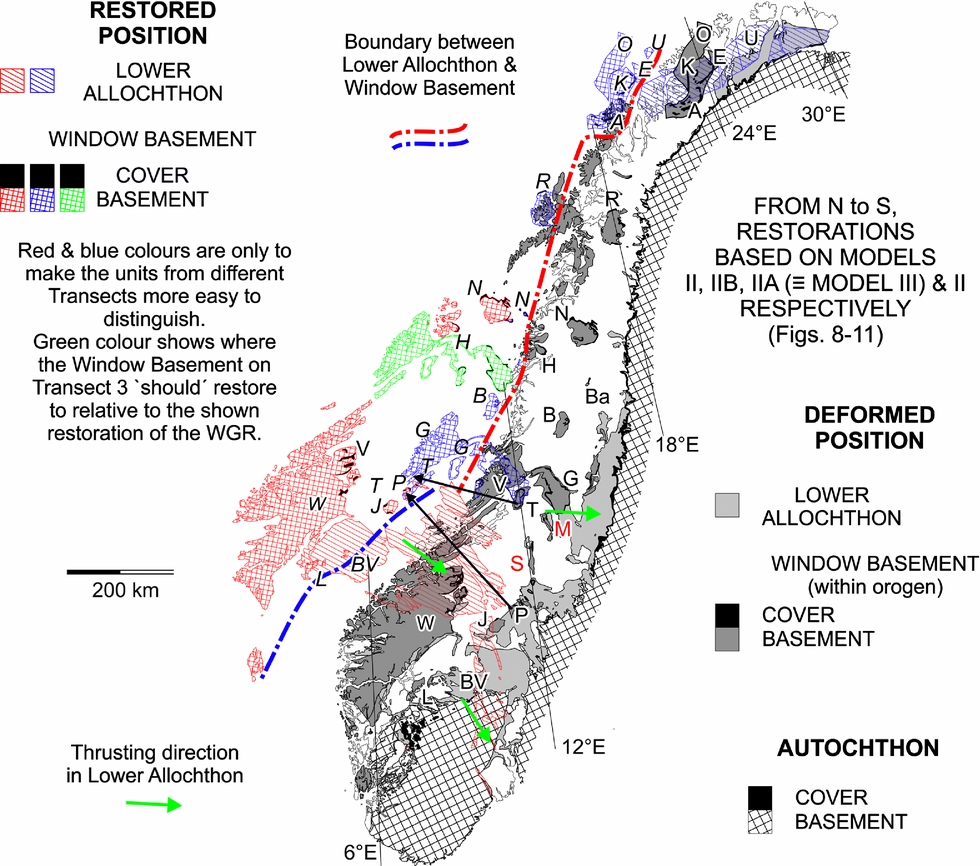
For transects 1–3, where the thrusting directions within the orogen are parallel and an early SE-directed shortening was followed by E- to ESE-directed shortening (Soper et al. Reference Soper, Strachan, Holdsworth, Gayer and Greiling1992), this restoration gives an eastern margin to the restored Window-Basement that lies close to the Norwegian coastline (Fig. 12).
Similarly in the south, the leading edge of the External Window-Basement delineates a boundary between the Lower Allochthon and Window-Basement that lies c. 100 km offshore (Fig. 12).
Joining these lines presents major problems, however, not only because the restored Window-Basement of transects 3 and 4 overlap, but also because there is no space in the restoration for either the Mullfjället or Sylarna Window-Basement, several smaller Window-Basement units and the Vemdalen Nappe (Lower Allochthon) between transects 3 and 4 (Fig. 1). In their restored positions the Tømmerås and Spekedalen Window-Basement are essentially adjacent, while in the deformed position they lie close to 180 km apart.
The failure of the restored segments of transects 3 and 4 to link together poses a major problem in understanding the pre-orogenic palaeogeography of Baltica. This is due to the SE- and SSE-directed transport directions recorded within the Lower Allochthon on Transect 4 (Morley, Reference Morley1986) compared to the E- to ESE-directed shortening in the Lower Allochthon elsewhere (e.g. Townsend, Reference Townsend1987; Gayer & Greiling, Reference Gayer and Greiling1989). The nature of the boundary between the E- to ESE-directed and SE- and SSE-directed shortening areas of the Lower Allochthon is currently unknown.
7. Conclusions
-
1. Four transects across the Scandinavian Caledonides (Finnmark–Troms, Västerbotten–Nordland, Jämtland–Trøndelag, Telemark–Møre og Romsdal) have been restored using a combination of balanced cross-sections and branch-line maps.
-
2. Each transect is different in detail. Transect 1 has a Lower Allochthon basal décollement in upper Ediacaran – lower Cambrian sediments (S6), while in transects 2–4 the middle Cambrian – lower Ordovician ‘Alum Shales’ (S7) is an easy-slip horizon. Transects 1, 2 and 4 have Tonian–Cryogenian basins in the Lower Allochthon, while Transect 3 has only Ediacaran and younger sediments. Transects 3 and 4 underwent (ultra)-high-pressure metamorphism along the internal margin of the Window-Basement. There is, therefore, no transect or area that can be taken geologically as ‘typical’ of the external part of the Scandinavian Caledonides.
-
3. On transects 1 and 4, Model I results in the Lower Allochthon being divided into two parts separated by up to 280 km; no sedimentological or structural data have been found for such divisions.
-
4. Thrusting in Model II shows a gradual swing from SE-directed in the hinterland to E- to ESE-directed in the foreland on transects 1–3, and from SE-directed to SSE-directed on Transect 4. In Model I, thrusting directions show complex changes when the Window-Basement is accreted into the orogen.
-
5. The lack of Tonian–Cryogenian sediments on Transect 3, reflecting a different lower – middle Neoproterozoic basin geometry along the Baltoscandian continental margin, makes this profile less reliable for establishing the relationships between the Lower Allochthon and the Window-Basement. Model III is proposed for this transect: allochthonous Window-Basement with no pre-Ediacaran basin in the Lower Allochthon.
-
6. Despite the along-strike variability in geology, the four transects all suggest that Model II (or III) is more likely correct and can be applied along the whole orogen. However, there remain considerable unsolved problems in linking the restorations of transects 3 and 4.
Acknowledgements
AHNR thanks Christa & Rhian Hofmann for 24 years of help in the field and Arild & Jorunn Pettersen for hospitality in Finnmark during most of that time. AHNR received no grant or financial support from any funding agency of any form whatsoever for this work, which was partly undertaken at University College, Galway, Ireland and at Ruprecht-Karls Universität, Heidelberg, Germany, and completed while at the University of Vienna, Austria. MA thanks Plymouth University for funding numerous undergraduate mapping projects in northern Norway and Sweden which facilitated the fieldwork used to develop this work. We thank Arild Andresen for further information of his research on Hardangervidda, Kateřina Schöpfer for details about the development of the Norwegian continental margin, Per Terje Osmundsen for information about extensional faulting in the Caledonides and Bruno Meurers for discussions about the Moho. Reinhard Greiling and David Gee are thanked not only for their helpful reviews but also for answering subsequent calls for clarification and further information. The editor, Dennis Brown, is thanked for his work on the manuscript.



