

Introduction
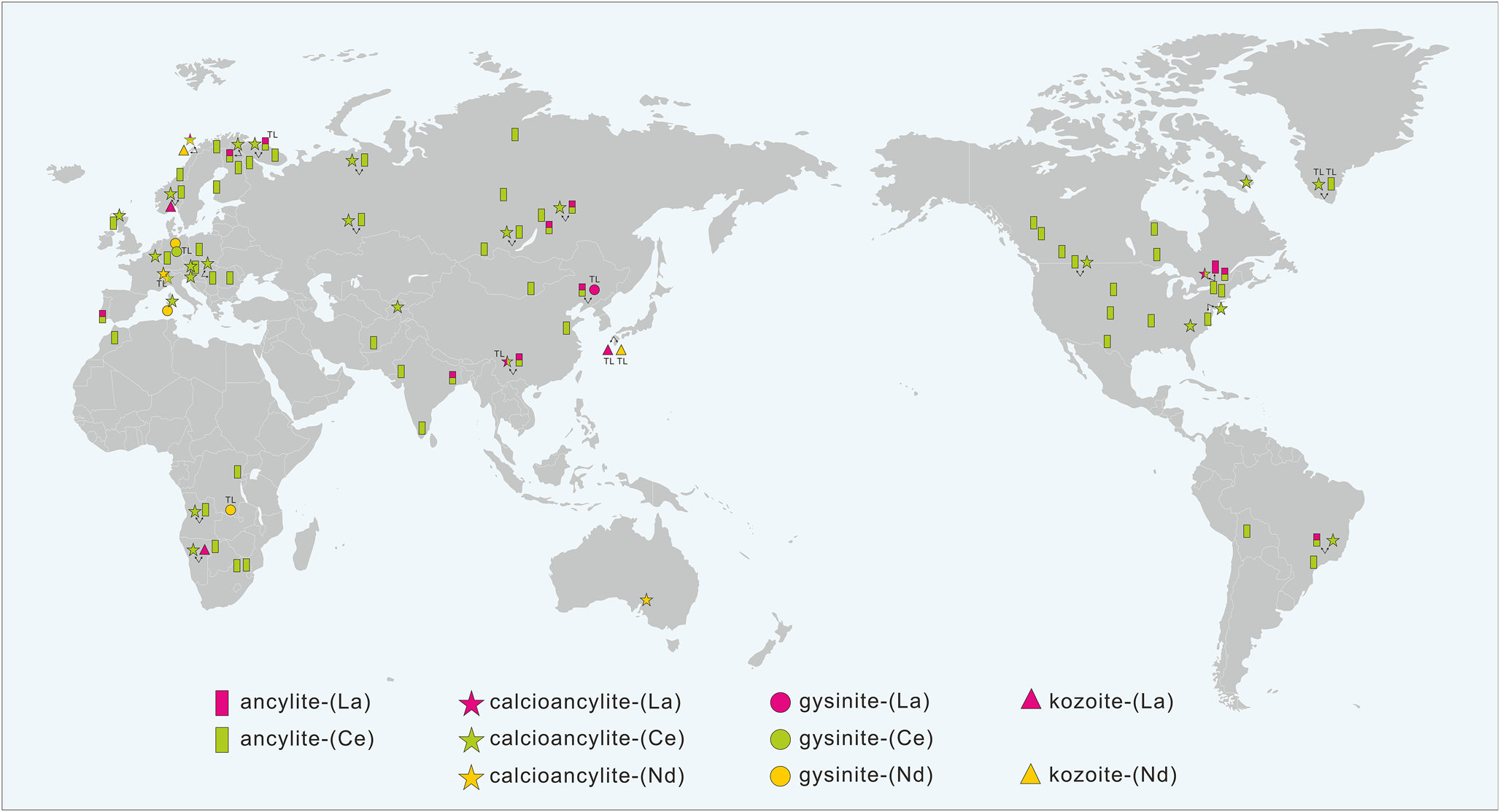
Ancylite-type minerals, which are hydrous/hydroxyl carbonates containing rare earth elements (REEs), Ca2+, Sr2+ and Pb2+ as major cations, commonly occur in alkaline rocks as late accessories or, in some types of carbonatites, as rock-forming minerals and important concentrators of light rare earth elements (LREE) and strontium (Fig. 1).
The localities of ancylite supergroup minerals worldwide, following the literature records on Mindat.org (Accessed November 2023). TL = Type Locality.
Prior to this work, neither ancylite group nor supergroup were formally approved by the Commission on New Minerals, Nomenclature and Classification of the International Mineralogical Association (IMA–CNMNC). However, the term ‘ancylite group’ appeared in the Fleischer's Glossary of Mineral Species in 2008 (Back and Mandarino, Reference Back and Mandarino2008), has been repeated in subsequent editions, and is now a common term in literature. The general chemical formula for ancylite-group minerals was previously described as: M 3+xM 2+2–x(CO3)2(OH)x⋅(2–x)H2O (Z = 2), where 1 < x ≤ 2, M 3+ = REE 3+ such as La3+, Ce3+ and Nd3+, M 2+ = Ca2+, Sr2+ and Pb2+ (Dal Negro et al., Reference Dal Negro, Rossi and Tazzoli1975; Sarp and Bertrand, Reference Sarp and Bertrand1985; Miyawaki et al., Reference Miyawaki, Matsubara, Yokoyama, Takeuchi, Nakai and Terada2000). Note that there are significant differences in the formulae given in the original descriptions of valid mineral species belonging to the ancylite group, e.g. ancylite-(La): Sr(La,Ce)(CO3)2(OH)⋅H2O (Yakovenchuk et al., Reference Yakovenchuk, Menshikov, Pakhomovsky and Ivanyuk1997); calcioancylite-(Ce): (Ce,Ca,Sr)(CO3)(OH,H2O) (Belovitskaya et al., Reference Belovitskaya, Pekov, Gobechiya and Kabalov2013); calcioancylite-(Nd): Nd2.8Ca1.2(CO3)4(OH)3⋅H2O (Orlandi et al., Reference Orlandi, Pasero and Vezzalini1990). Without detailed knowledge of the crystal chemistry of this group, it is not easy to understand whether trivalent REEs and the other divalent cations occupy the same crystallographic site or independent sites. For example: chemically, formulae of some REE minerals can be written as La2Sr(CO3)3(OH)2⋅H2O or La3Sr(CO3)4(OH)3⋅H2O, the ratio of La to Sr is 2:1 or 3:1, which is different from the ideal formula of ancylite-(La) [LaSr(CO3)2(OH)⋅H2O] in the current IMA mineral list (Pasero, Reference Pasero2024). This suggests potentially two new mineral species, however they are intermediate between the end-members, (LaSr)(CO3)2[(OH)(H2O)] (revised ideal formula, this work) [ancylite-(La)] and La2(CO3)2(OH)2 [kozoite-(La)]. This ambiguity is potentially confusing, not only for novices but also for expert crystallographers. The situation is additionally complicated by the specific behaviour of the M 3+:M 2+ ratio in the solid-solution series between ancylite-(Ce) and calcioancylite-(Ce) (Pekov et al., Reference Pekov, Petersen and Voloshin1997).
These problems of inconsistent chemical formulae, the complex chemical variability of the ancylite supergroup minerals, and vague boundaries between different hierarchies, have prompted us to formally establish the ancylite supergroup and to recommend updating the ideal formulae of ancylite supergroup members in the IMA–CNMNC official mineral list (Table 1). The proposal for the “Nomenclature of the ancylite supergroup” has been approved by the IMA–CNMNC (Bosi et al., Reference Bosi, Hatert, Pasero and Mills2024). The present work aims to not only identify and classify complex ancylite supergroup minerals but to also convey important chemical information for mineralogists and ore geologists who are interested in alkaline complexes and REE behaviours.
Formulae of ancylite supergroup minerals.
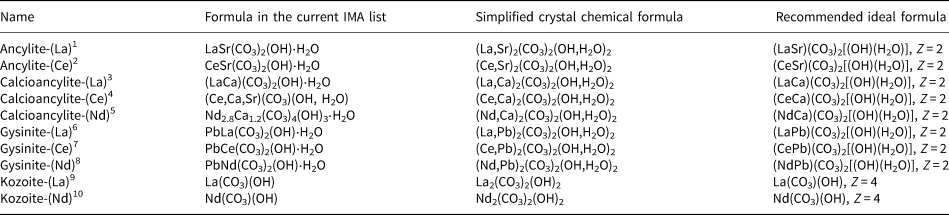
References: 1 Yakovenchuk et al. (Reference Yakovenchuk, Menshikov, Pakhomovsky and Ivanyuk1997); Petersen et al. (Reference Petersen, Niedermayr, Gault, Brandsttter and Giester2001); 2 Dal Negro et al. (Reference Dal Negro, Rossi and Tazzoli1975); Belovitskaya et al. (Reference Belovitskaya, Pekov, Gobetchia, Yamnova, Kabalov, Chukanov and Schneider2002); 3 Wang et al. (Reference Wang, Gu, Dong, Hou, Nestola, Yang, Fan, Wang and Qu2023); 4 Belovitskaya et al. (Reference Belovitskaya, Pekov, Gobechiya and Kabalov2013); 5 Orlandi et al. (Reference Orlandi, Pasero and Vezzalini1990); 6 Wu et al. (Reference Wu, Gu, Rao, Wang, Xing, Wan and Zhong2023); 7 Kampf et al. (Reference Kampf, Möhn, Ma, Désor and Groß2023); 8 Chabot and Sarp (Reference Chabot and Sarp1985); 9 Miyawaki et al. (Reference Miyawaki, Matsubara, Yokoyama, Iwano, Hamasaki and Yukinori2003); 10 Miyawaki et al. (Reference Miyawaki, Matsubara, Yokoyama, Takeuchi, Nakai and Terada2000).
Crystal structure
In the structure of the ancylite supergroup minerals, trivalent and divalent cations (M cations), such as La3+, Ce3+, Nd3+, Ca2+, Sr2+ and Pb2+, centre ten-vertex polyhedra, formed by oxygen atoms at three independent O sites. Two of them, at the apices of triangular (CO3)2– anion, are occupied by oxygen atoms, whereas the third one, expressed as O(3) in Table 2, is statistically filled with (OH)– groups and H2O molecules. The chains of this ten-vertex polyhedral are stretched along the c axis and connected by sharing the triangular faces of three oxygen atoms of MO10 coordination polyhedra. The chains are interconnected into a three-dimensional framework via (CO3) triangles (Fig. 2a).
Characteristics of the ancylite supergroup described by the general formula (M 3+xM 2+2–x)(CO3)2[(OH)x⋅(2–x)H2O], with Z = 2.
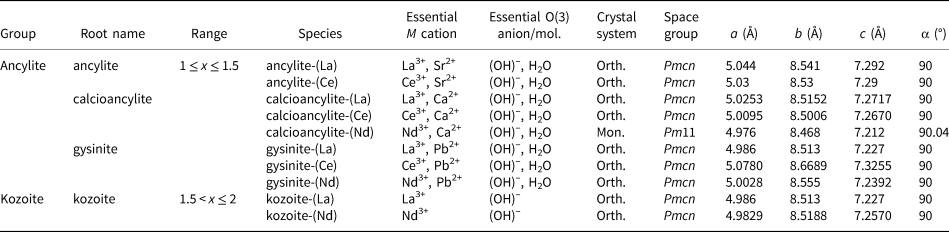
Note: The references are the same as in Table 1 for each mineral, respectively.
(a) The crystal structure of ancylite supergroup minerals viewed along [001]; (b) quaternary diagram, showing the boundaries between kozoite REE(CO3)(OH), ancylite (REESr)(CO3)2[(OH)(H2O)], calcioancylite (REECa)(CO3)2[(OH)(H2O)], and gysinite (REEPb)(CO3)2[(OH)(H2O)]. Figure 2a drawn using Vesta software (Momma and Izumi, Reference Momma and Izumi2011).
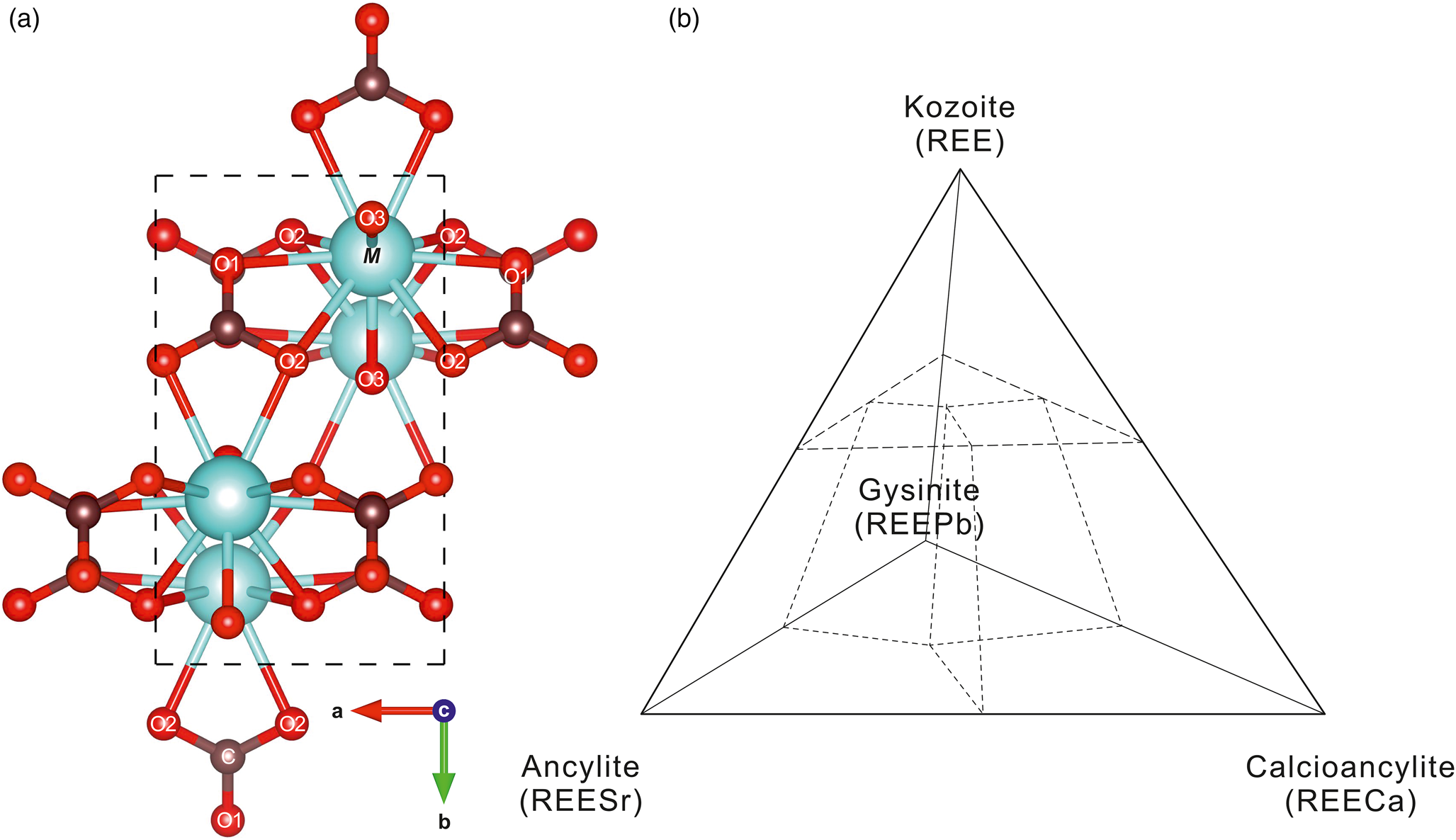
The crystal structure of ancylite-(Ce) was solved for the first time by Dal Negro et al. (Reference Dal Negro, Rossi and Tazzoli1975). Belovitskaya et al. (Reference Belovitskaya, Pekov, Gobetchia, Yamnova, Kabalov, Chukanov and Schneider2002) performed the structure refinement for two specimens of ancylite-(Ce) within the space groups Pmcn and Pmc2 1. Belovitskaya et al. (Reference Belovitskaya, Pekov, Gobechiya and Kabalov2013) studied the crystal structure of calcioancylite-(Ce) using the Rietveld method and showed that most minerals of the ancylite group were regarded as orthorhombic, and that the whole structure of ancylite group minerals can be derived from orthorhombic carbonates by adding hydroxyl groups that are positioned on the mirror planes and bonded to the M cations. It should be noted that calcioancylite-(Nd) from Baveno, Italy, described by Orlandi et al. (Reference Orlandi, Pasero and Vezzalini1990) has revealed that M 3+ and M 2+ cations order into four M sites in the ancylite-type structure to lower the symmetry from orthorhombic (Pmcn) to monoclinic (Pm11) with a minor deviation of α from 90° to 90.04(3)° (Belovitskaya et al., Reference Belovitskaya, Pekov, Gobechiya and Kabalov2013). It is the only approved valid mineral species with monoclinic symmetry in the ancylite supergroup so far (Table 2). However, if the crystal structures of the polymorphs have essentially the same topology, differing only in terms of a structural distortion or in the order–disorder relationship of some of the atoms comprising the structure, such polymorphs are not regarded as separate species (Nickel and Grice, Reference Nickel and Grice1998). The recommendation is that both of the ordered monoclinic and disordered orthorhombic phases be classified into a mineral species. The difference in symmetry owing to the order–disorder can be indicated by a suffix, as is the polytype distinction, e.g. calcioancylite-(Nd)-M and calcioancylite-(Nd)-O.
Nomenclature and classification of the ancylite supergroup
In the frame of the present IMA-approved nomenclature (Mills et al., Reference Mills, Hatert, Nickel and Ferraris2009), ancylite-type minerals are divided into two groups: the ancylite group and the kozoite group. These mineral groups compose the ancylite supergroup (named after the first adequately characterised mineral). In addition, the members are classified into root names corresponding to the essential M cations: ancylite (REE 3+Sr2+), calcioancylite (REE 3+Ca2+), gysinite (REE 3+Pb2+) and kozoite (REE 3+).
The general chemical formula of ancylite supergroup minerals can be defined as (M 3+xM 2+2–x)(CO3)2[(OH)x⋅(2–x)H2O] (1 ≤ x ≤ 2, Z = 2), and different combinations of M 3+ and M 2+ constituents should be regarded as separate mineral species. Both M 3+ and M 2+ cations generally occupy the same crystallographic site, and the formula is charge-balanced through the following substitution mechanism: M 3+ + OH− ⇆ M 2+ + H2O. The excess positive charge of M 3+ is compensated by the incorporation of (OH)−, and the number of hydroxyl ions and water molecules are equivalent to those of M 3+ and M 2+, respectively (Wang et al., Reference Wang, Gu, Dong, Hou, Nestola, Yang, Fan, Wang and Qu2023). Taking into account the recently defined species, the boundaries between different hierarchies of the ancylite supergroup is as follows (Fig. 2b):
(1) 1 ≤ x ≤ 1.5, REE 3+ dominant for M 3+: ancylite group
(a) Sr2+ dominant for M 2+: ancylite (root name)
(b) Ca2+ dominant for M 2+: calcioancylite (root name)
(c) Pb2+ dominant for M 2+: gysinite (root name)
(2) 1.5 < x ≤ 2, REE 3+ dominant for M 3+: kozoite group
Each distinct mineral species within the ancylite supergroup has a hyphenated suffix between parentheses, the Levinson modifier (Levinson, Reference Levinson1966), indicating the dominant REE constituent (Hatert and Burke, Reference Hatert and Burke2008; Hatert et al., Reference Hatert, Mills, Pasero and Williams2013). To date, the supergroup includes ten valid mineral species: ancylite-(La), ancylite-(Ce), calcioancylite-(La), calcioancylite-(Ce), calcioancylite-(Nd), gysinite-(La), gysinite-(Ce), gysinite-(Nd), kozoite-(La) and kozoite-(Nd) (Table 2).
Historical synopsis of the ancylite supergroup minerals
The name ancylite first appeared in literature in 1898, when this mineral was discovered in Narsaarsuk, Southern Greenland. The name is taken from the Greek word αγκυλός (ankylos) for ‘curved’, in allusion to the planes of the crystals usually rounded and distorted. The formula was given by Flink (Reference Flink1898, Reference Flink1901) as Ce4Sr3(CO3)7(OH)4⋅3H2O. The La-dominant ancylite species, ancylite-(La), was discovered by Yakovenchuk et al. (Reference Yakovenchuk, Menshikov, Pakhomovsky and Ivanyuk1997) from a hydrothermal vein at the Kukisvumchorr mountain, Khibiny alkaline complex, Kola peninsula, Russia.
A brief but interesting review of the history of the discoveries and early studies of calcioancylite-(Ce) has been given by Pekov et al. (Reference Pekov, Petersen and Voloshin1997): Chernik (Reference Chernik1904) described a Ca-dominant analogue of ancylite but without a clear locality, with the address written as “Western land of the Russian Empire” (Pekov et al., Reference Pekov, Petersen and Voloshin1997); the name ‘calcio-ancylite’ in literature was first mentioned by Chernik (Reference Chernik1923), and it has been renamed to calcioancylite-(Ce) according to the revised nomenclature for the REE-bearing minerals (Nickel and Mandarino, Reference Nickel and Mandarino1987). The Nd-dominant calcioancylite was found in miarolitic cavities of Baveno granite, Italy (Orlandi et al., Reference Orlandi, Pasero and Vezzalini1990). At the same time, Orlandi et al. (Reference Orlandi, Pasero and Vezzalini1990) re-examined the type samples identified as ‘weibyeite’ by Artini (Reference Artini1915) from Baveno, and their powder X-ray diffraction and chemical analyses indicated that the material was actually a calcioancylite-(Ce). It should be noted that the term ‘weibyeite’ was first introduced by Brögger (Reference Brögger1890) to describe a REE carbonate phase in Langesundsfjorden, Norway. If it is the same material as the ‘weibyeite’ from Baveno, it should be the first finding of the ancylite-type mineral, but, unfortunately, Saebø (Reference Saebø1963) discredited Broegger's ‘weibyeite’ and the result shows that it is just a bastnäsite-(Ce) pseudomorph. Recently, the La-dominant calcioancylite species, calcioancylite-(La), was discovered from Gejiu nepheline syenite, Yunnan Province, China (Wang et al., Reference Wang, Gu, Dong, Hou, Nestola, Yang, Fan, Wang and Qu2023).
Gysinite-(Nd), the first Pb-dominant member of the ancylite group, was discovered by Sarp and Bertrand (Reference Sarp and Bertrand1985) in a specimen from the mineral collection at the Geneva Natural History Museum. The sample was originally labelled ‘schuilingite’ from Shinkolobwe, Shaba, Zaïre (now the Democratic Republic of the Congo). The mineral is named after the late Professor Marcel Gysin (1891–1974) from the University of Geneva. Almost four decades later, the La-dominant mineral species, gysinite-(La), was discovered in lujavrite from the Saima alkaline complex, Liaoning Province, China (Wu et al., Reference Wu, Gu, Rao, Wang, Xing, Wan and Zhong2023). Gysinite-(Ce), the mineral species with Ce prevailing among REEs, has recently been found in Abendröthe Mine, located in Sankt Andreasberg, Braunlage, Goslar District, Lower Saxony, Germany (Kampf et al., Reference Kampf, Möhn, Ma, Désor and Groß2023).
In 1997, a kind of pale pink REE carbonate was collected by Koichi Takeuchi from alkali olivine basalt from Hizen-cho, Saga Prefecture, Japan. Miyawaki et al. (Reference Miyawaki, Matsubara, Yokoyama and Takeuchi1998) found that it was different from other ancylites because it was characterised by very low Ca and Sr and almost absent Pb. Several years later, two new minerals and mineral names were approved by the IMA Commission on New Mineral and Mineral Names (IMA–CNMMN, the predecessor of the IMA-CNMNC, as kozoite-(Nd) and kozoite-(La), respectively (Miyawaki et al., Reference Miyawaki, Matsubara, Yokoyama, Takeuchi, Nakai and Terada2000; Reference Miyawaki, Matsubara, Yokoyama, Iwano, Hamasaki and Yukinori2003). The minerals are named in honour of the late Kozo Nagashima (1925–1985), a chemist and pioneer in the study of the crystal chemistry of rare earth minerals in Japan.
Note that if considering the extension of the solid solution of the ancylite series beyond the point M 2+/M 3+ < 0.5, there probably exists the potential compound Ca(CO3)H2O (for x close to 0 in the general formula) (Sarp and Bertrand, Reference Sarp and Bertrand1985). However, monohydrocalcite, as a mineral with the chemical formula Ca(CO3)(H2O) that occurs in nature (Semenov, Reference Semenov1964), has a topology and symmetry differing from the ancylite-type series (Effenberger, Reference Effenberger1981; Swainson, Reference Swainson2008). While it is not clear if that composition could be stable with the ancylite topology, previous studies that reviewed the reported chemical compositions of ‘ancylites’ and ‘calcioancylites’ from several localities showed that the value ‘x’ in the general formula, (M 3+xM 2+2–x)(CO3)2[(OH)x⋅(2–x)H2O], always exceeded 1 (Bulakh et al., Reference Bulakh, Zaitsev, Le Bas and Wall1998; Pekov et al., Reference Pekov, Petersen and Voloshin1997). This indicates that ancylite supergroup minerals are not intermediate solid solutions between M 3+(CO3)(OH) and M 2+(CO3)(H2O). The end-members of this group are M 3+(CO3)(OH) and (M 3+M 2+)(CO3)2[(OH)⋅H2O] (Sarp and Bertrand, Reference Sarp and Bertrand1985; Miyawaki et al., Reference Miyawaki, Matsubara, Yokoyama, Takeuchi, Nakai and Terada2000). Taking into account the above reasons and the fact that no minerals having an ancylite-type topology and a chemical composition with x close to 0 (even < 0.5) have been found in Nature so far, the potential ancylite-type topology M 2+(CO3)(H2O) phases are not included in this nomenclature.
Acknowledgements
The helpful comments from three anonymous reviewers are greatly appreciated. We are grateful to Stuart Mills and CNMNC members for their valuable suggestions regarding the nomenclature. This study was supported by the Natural Science Foundation of China (NSFC) (Grant: 92062217, 92062220, and 42072054 for GD, KQ, and XG, respectively). YW and KQ acknowledge financial support from the China Scholarship Council (CSC) (Grant: 202106400047, 202108575009, respectively).
Competing interests
One of the co-authors is a guest member of the editorial board of Mineralogical Magazine for the special issue “Mineralogy, petrology and geochemistry of pegmatites”. The peer-review process was guided by an independent editor, and the authors also have no other competing interests to declare.


 Open access

