

1. Introduction
Mechanical power generation is possible by using the steam engine, by electricity, and by using combustion engines with burning coal as the basis for our unique wealth and civilization. The emission of carbon dioxide into the air until 1960 could be tolerated without changing the climate. Since then the carbon emission is five times higher, and during the next 30 years, it is expected to double again. Changing the climate is evident with rising of the average temperature by the green house effect, with measured accelerated rising of the ocean levels from melting of the glaciers, and irreversibly changing of the nature. The European President Dr. von der Leyen at her inauguration to the council on 1 December 2019 mentioned her two aims [Reference Leyen1], of which one is that one has not only to prevent the inherent climatic catastrophe but also more severely to realize that this is existentially vital.
One must realize what an extremely monstrous task the solution generation is. In this task, all the renewable energies, photovoltaic, wind energy, and so many others, are of little help. We must realize that, for the next 20 years, to arrive at low carbon energy generation—not to zero—burning carbon will be indispensable, but down to the level of 1960. By the present generation of electricity of about 20 terawatt, it is needed to change to other energy sources. This means we need more than 10,000 new electric power stations, each of the usual costs of nearly 1 billion dollars. This large number of power stations must be drastically less expensive as well as the fuel of the future [Reference Tennenbaum2].
For energy, we have a solution at hand: it only needs a modified exploration. We must forget several earlier presumptions, ideologies, and prejudices. The answer is nuclear energy. Since the tremendous discoveries of Lord Rutherford 120 years ago, we know that the energy at a nuclear reaction is in the orders of multiples of 10 million times higher than the energy gained from a chemical reaction such as carbon burning. To get the nuclei to react, one must smash them with accelerators of at least 10 million volts together. When such accelerators worked [Reference Cockroft and Walton3], it was then a surprise that reactions happened with light nuclei with energies around 100,000 V. One of these reactions is hydrogen H with the boron isotope 11 [Reference Oliphant and Rutherford4], namely, HB11 fusion

resulting in three helium 4He, with an energy spectrum spread between 1.5 MeV and 6 MeV with a maximum in our Sun, four hydrogen nuclei are fused to one helium nucleus (a net reaction) at temperatures above 15 Million of at about 5 MeV ± 1 MeV [Reference Dimitriev5, Reference Hoffmann6]. When a heavy hydrogen nuclei D (deuterium) and a superheavy hydrogen T (tritium) interact, it results in a neutron (n) and an alpha (DT fusion):

The nuclear fusion reactions are involved in the energy sources of the myriads of stars, e.g., in our Sun, four hydrogen nuclei are fused to one helium nucleus (a net reaction) at temperatures above 15 Million of °C. In the past 60 years, such fusion reactions are tried for power stations on earth, but a solution seems to be many years ahead.
Otto Hahn 1938 by moving the electrically noncharged neutron to very heavy uranium nuclei, causing splitting (fission) and an energy release in the range of 200 MeV, discovered another solution. Today, more than 10% of all global electricity is produced from these nuclear fission power stations. There is the risk—if the control is not perfect—that a meltdown of the reactor as in the USA at Three Mile Island can happen or in Ukraine at Chernobyl with extreme damage. In addition, the handling of the ash is difficult because of the nuclear radiation. What is needed are environmentally clean, safe, electricity generators for abundant nuclear energy and fuel within a short period.
What was interesting from the beginning with the numerous exothermic fusion reactions of light nuclei was that the HB11 reaction (1) resulted primarily only in harmless stable helium and not into radioactive nuclei. We shall consider secondary side reaction by producing a small number of neutrons.
The previous proposals of laser compression of HB11 fusion needs densities up to 100,000 times of the solid state and temperatures of the order of few hundred kiloelectron volts. This situation for laser-driven fusion was changed after the discovery of CPA (chirped pulse amplified) lasers [Reference Strickland and Mourou7] that produce extremely short laser pulses of short duration, less than one picosecond (ps) with extremely ultrahigh powers above petawatt (PW).
With these laser pulses, the first thousand HB11 fusion reactions per laser interaction were measured [Reference Belyaev, Matafonov, Vinogradov, Krainov and Lisitsa8] and then increased above one million [Reference Labaune, Baccou and Depierreux9] and above one billion [Reference Picchiotto, Margarone and Velyhan10]. The last and simple laser experiment [Reference Giuffrieda, Belloni and Margarone11] has a gain about one order of magnitude less than the best DT fusion from NIF. This led to the design of a laser fusion reactor (see Figure 16 of [Reference Hora, Korn and Giuffrida12]) needing a cylindrical trapping of the fusion reactions by kilotesla magnetic fields. The measured high fusion gains profited from the avalanche multiplication by the three generated alpha particles [Reference Eliezer, Hora, Korn, Nissim and Martinez Val13].
As recently shown in [Reference Putvinski, Ryutov and Yushmanov14], by using the old cross section for pB11 [Reference Nevins and Swain15] at the high temperatures appropriate for the proton-boron-11 fusion, the medium losses more energy by inverse bremsstrahlung that it gains by the nuclear fusion. The novel rates of pB11 fusion (see Figure 4 of [Reference Putvinski, Ryutov and Yushmanov14]) are on the limit of breakeven, but not viable for a fusion reactor. Therefore, our proposal for non-LTE fusion, without heating to high temperatures, is mandatory for a pB11 fusion reactor [Reference Eliezer and Martinez-Val16–Reference Hora, Miley, Eliezer and Nissim18]. These reactors are environmentally clean with respect to nuclear radiation and safe. The initiation of the ignition of the HB11 fusion reaction is possible without needing temperatures of few hundred million degrees Celsius. The CPA laser pulses of picosecond duration and powers above petawatt produce nonthermal pressures above 6 × 10¹² J/cm3 for initiating the ignition of the HB11 nuclear fusion.
2. Elimination of Secondary Neutrons
To the question of generation of neutrons by secondary reactions in the spherical HB11 reactor [Reference Hora, Korn and Giuffrida12], their sufficient elimination by neutron capture with stable daughter nuclei is used [Reference Hora, Eliezer and Nissim19]. While HB11 fusion is neutron-free, a secondary reaction occurs by the alpha particles reacting with the boron-11 nuclei present in the fuel, creating harmless stable nitrogen and a neutron. This reaction,

is less than 0.1% [Reference Walker20] of the number of HB11 reactions for the given spectrum of alphas as described [Reference Dimitriev5, Reference Hoffmann6] after equation (1).
The neutron elimination device includes tin and is arranged such that the neutrons are brought to nuclear reactions with the tin. We suggest adding the tin that has proven to be particularly advantageous because of its high effective cross section [Reference Harper, Godfrey and Weil21], and the neutron reactions with tin transform the tin nuclei into stable nuclei with a higher atomic weight. The tin includes isotopes 114 to 119 and, with less than 0.01%, isotopes 112 and 122. The tin in purely metallic or compound form (e.g., alloy) absorbs the neutrons produced by the primary reaction or by secondary reactions in the reactor. The range of fast neutrons, which normally travel long distances through materials, is reduced if they have elastic collisions with protons or deuterons. This thermalization of fast neutrons is achieved with water or heavy water or with solid or liquid paraffin of sufficient thickness.
We can estimate the tin wall thickness needed for such a reactor in the following way: for a wall of length x, the relative number of neutrons going through the wall is calculated by

where N n0 is the initial number of neutrons hitting the tin wall and l is the mean free path for neutron absorption = 1/(n 0 σ), in which n 0 is the density number (cm−3) of the tin medium absorbing the neutrons and σ is the absorption cross section. The density of natural tin (Sn) in a solid state is ρ = 7.26 g/cm3; therefore, we can calculate the number density to be n 0 = 0.037 × 1024 cm−3. As a typical example, we take a cross section σ = 6b = 6 × 10⁻²⁴ cm2 yielding
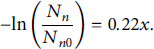
Therefore, if we require N n /N n0 = 10−2 (i.e., 1% of the neutrons not absorbed), we get the tin wall thickness to be x ≈ 21 cm. This estimation can be done for every relevant neutron energy.
A further advantage of the tin is the fact that no radiating residues remain.
Data Availability
The data can be made available upon request to the authors.
Conflicts of Interest
The authors declare no conflicts of interest.

 Open access

