


1 INTRODUCTION
Photometric variability is a fundamental characteristic of the pre-main sequence (PMS) stars, which manifests as transient increases in brightness (outbursts), temporary drops in brightness (eclipses), irregular or regular variations for a short or long time scales. Both types of PMS stars the widespread low-mass (M ⩽ 2M⊙) T Tauri Stars (TTSs) and the more massive Herbig Ae/Be (HAEBE) stars indicate photometric variability with various amplitudes and periods Herbst et al. (Reference Herbst, Herbst, Grossman and Weinstein1994, Reference Herbst, Eislöffel, Mundt, Scholz, Reipurth, Jewitt and Keil2007). The TTSs can be separated into two subclasses: Classical T Tauri (CTT) stars surrounded by a massive accretion disk and Weak line T Tauri (WTT) stars without indications of disk accretion Bertout (Reference Bertout1989). According to Herbst et al. (Reference Herbst, Eislöffel, Mundt, Scholz, Reipurth, Jewitt and Keil2007) the large amplitude variability of CTT stars is caused by magnetically channeled accretion from the circumstellar disk onto the stellar surface.
Some PMS stars show variability in brightness with very large amplitudes, dominated by fading or bursting behaviour. The large amplitude outbursts can be grouped into two main types, named after their respective prototypes: FU Orionis (FUor) and EX Lupi (EXor) Reipurth & Aspin (Reference Reipurth, Aspin, Harutyunian, Mickaelian and Terzian2010). Both types of eruptive stars seems to be related to young stellar objects with massive circumstellar disks, and their outbursts are commonly attributed to a sizable increase in the disc accretion rate onto the stellar surface Hartmann & Kenyon (Reference Hartmann and Kenyon1996). During the quiescence state FUors and EXors are normally accreting TTSs, but due to thermal or gravitational instability in the circumstellar disk accretion rate enhanced by a few orders of magnitude up to ~ 10−4M⊙yr−1.
A significant part of HAEBE stars and early type CTT stars show strong photometric variability with sudden quasi-Algol drops in brightness and amplitudes up to 2.5 mag (V) Natta et al. (Reference Natta, Grinin, Mannings and Ungerechts1997); van den Ancker, de Winter, & Tjin A Djie (Reference Ancker, de Winter and Tjin A Djie1998). During the deep minimums of brightness, an increase in polarisation and specific colour variability (called ‘blueing effect’) are observed. The prototype of this group of PMS objects with intermediate mass named UXors is UX Orionis. The widely accepted explanation of its variability is a variable extinction from dust clumps or filaments passing through the line of sight to the star Dullemond et al. (Reference Dullemond, van den Ancker, Acke and van Boekel2003); Grinin et al. (Reference Grinin, Kiselev, Minikulov, Chernova and Voshchinnikov1991). Normally, the star becomes redder when its light is covered by dust, but when the obscuration rises sufficiently, the part of the scattered light in the total observed light become considerable and the star colour gets bluer.
The PMS star GM Cep lie in the field of the young open cluster Trumpler 37 (~ 4 Myr old) at a distance of 870 pc Contreras et al. (Reference Contreras2002) and most likely is a member of the cluster Marschall & van Altena (Reference Marschall and van Altena1987); Sicilia-Aguilar et al. (Reference Sicilia-Aguilar, Hartmann, Hernández, Briceño and Calvet2005). The early long-term photographic observations of the star performed by Suyarkova (Reference Suyarkova1975) and Kun (Reference Kun1986) indicate for a large amplitude photometric variability (the observed amplitudes are Δmpg = 2.2 mag and ΔV = 2.15 mag respectively). A multicolour photometric study based on optical, infrared and millimeter observations of GM Cep was reported by Sicilia-Aguilar et al. (Reference Sicilia-Aguilar2008). The authors found the star much brighter in 2006 than in 1990 and conclude that the most probable explanation for the brightness increase is an EXor type outburst.
According to Sicilia-Aguilar et al. (Reference Sicilia-Aguilar2008) GM Cep is a PMS star with solar mass (M ~ 2.1 M⊙) from G7V–K0V spectral type and with radius between 3 and 6 R⊙. The observed strong IR excesses have been explained by the presence of a very luminous and massive circumstellar disk. The Hα emission line in the spectrum of GM Cep has a strong P Cyg profile and the equivalent width of the line vary significantly from 6 to 19 Å Sicilia-Aguilar et al. (Reference Sicilia-Aguilar2008). A variable accretion rate (up to ~ 10−6 M⊙ year−1) are also detected in the study of Sicilia-Aguilar et al. (Reference Sicilia-Aguilar2008).
A long-term photometric study of GM Cep for several decades period was performed by Xiao, Kroll, & Henden (Reference Xiao, Kroll and Henden2010). The photographic plate archives from Harvard College Observatory and from Sonneberg Observatory are used to construct the long-term B and V light curves of the star. The results suggest that GM Cep do not show fast rises in brightness typical of EXor variables and the light curves seem to be dominated by dips superposed on the quiescence state. Evidences for periodicity of observed dips in brightness were not found in the study of Xiao et al. (Reference Xiao, Kroll and Henden2010).
In our first paper Semkov & Peneva (Reference Semkov and Peneva2012), the results from BVRI optical photometric observations of the star collected in the period 2008 June–2011 February are reported. During out photometric monitoring two deep minimums in brightness are observed. The collected multicolour photometric data show the typical of UXor variables a colour reversal during the minimums in brightness. Chen et al. (Reference Chen2012) reported results from intensive BVR photometric monitoring of GM Cep during the period 2009–2011. They confirm the UXor nature of variability and suggest an early stage of planetesimal formation in the star environment. Chen & Hu (Reference Chen and Hu2014) suggest a periodicity of about 300 days at the observed deep declines in brightness.
Recent BVRI CCD photometric observations of GM Cep collected in the period 2011 April–2014 August are reported in the present paper. The multicolour observations give us the opportunity to clarify the mechanism of the brightness variations.
2 OBSERVATIONS
Our photometric CCD data were obtained in two observatories with four telescopes: the 2-m Ritchey-Chrétien-Coudé (2-m), the 50/70-cm Schmidt (Sch) and the 60-cm Cassegrain (60-cm) telescopes of the National Astronomical Observatory Rozhen (Bulgaria) and the 1.3-m Ritchey-Crétien (1.3-m) telescope of the Skinakas ObservatoryFootnote 1 of the Institute of Astronomy, University of Crete (Greece). The technical parameters and chip specifications for the cameras used with the 2-m RCC, the 1.3-m RC and the 50/70-cm Schmidt telescopes are summarised in Semkov & Peneva (Reference Semkov and Peneva2012). Observations with the 60-cm Cassegrain telescope were performed with FLI PL09000 CCD camera (3056 × 3056 pixels, 12μm pixel size, 16.8 × 16.8 arcmin2 field, 8.5 e−rms RON) As references, we used the comparison sequence of fifteen stars in the field around GM Cep published in Semkov & Peneva (Reference Semkov and Peneva2012).
All frames were taken through a standard Johnson-Cousins set of filters. Twilight flat fields in each filter were obtained each clear evening. All frames obtained with the ANDOR and Vers Array cameras are bias subtracted and flat fielded. CCD frames obtained with the FLI PL16803 and FLI PL09000 cameras are dark subtracted and flat fielded. Aperture photometry was performed using DAOPHOT routines. All the data were analysed using the same aperture, which was chosen as 6 arcsec in radius, while the background annulus was from 10 to 15 arcsec.
A medium-resolution spectrum of GM Cep was obtained on 2008 June 27 with the 1.3-m RC telescope in Skinakas Observatory. The focal reducer, ISA 608 spectral CCD camera (2000 × 800 pixels, 15 × 15μm pixel size), 1300 lines mm−1 grating and 160 μm slit were used. The combination of used CCD camera, slit and grating yield a resolving power λ/Δλ ~ 1300 at Hα line. The exposure of GM Cep were followed immediately by an exposure of an FeHeNeAr comparison lamp.
3 RESULTS AND DISCUSSION
3.1. Photometric monitoring
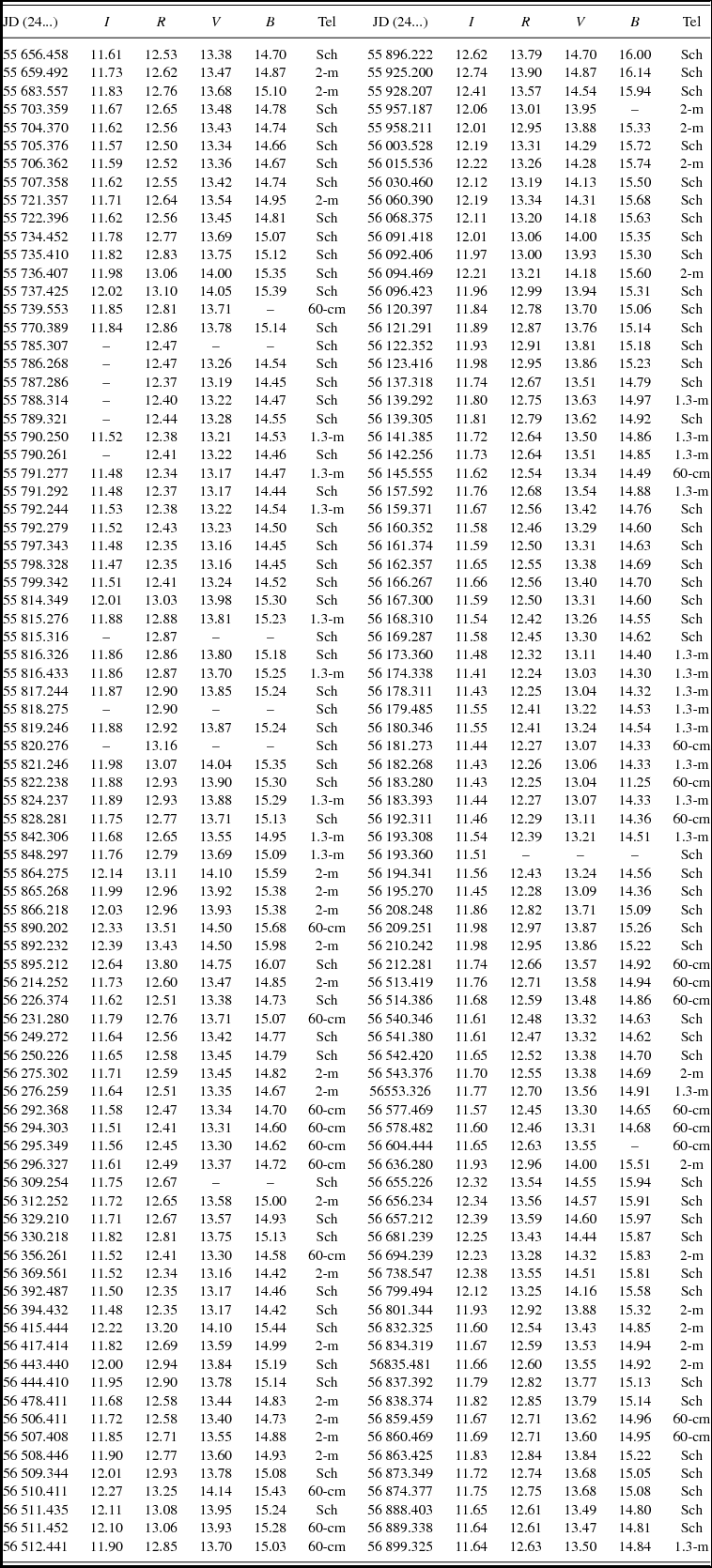
The results of our photometric CCD observations of GM Cep are summarised in Table 1. The columns provide the Julian date (JD) of observation, IRVB magnitudes, and the telescope used. In the column Tel abbreviation 2-m denote the 2-m Ritchey-Chrétien-Coudé, Sch - the 50/70-cm Schmidt, 60-cm - the 60-cm Cassegrain and 1.3-m the 1.3-m Ritchey-Crétien telescope. The typical instrumental errors from IRVB photometry are reported in our previous study Semkov & Peneva (Reference Semkov and Peneva2012). In addition, we present in Table 2 data from observations in U filter for the whole period of our photometric monitoring (2008–2014). The values of instrumental errors of U band photometry are in the range 0.04-0.08 mag.
Photometric IRVB observations of GM Cep during the period April 2011–August 2014.

Data from U band observations of GM Cep during the period July 2008–February 2014.
The UBVRI lights curves of GM Cep from all our observations (Semkov & Peneva Reference Semkov and Peneva2012 and the present paper) are shown in Figure 1. On the figure triangles denote I-band data; squares - R-band, circles - V-band; diamonds - B-band, and the pluses - U-band.
UBVRI light curves of GM Cep for the whole period of our photometric monitoring (2008–2014).
The new photometric data showed continued strong brightness variability of GM Cep as the registered in the previous studies Sicilia-Aguilar et al. (Reference Sicilia-Aguilar2008); Xiao et al. (Reference Xiao, Kroll and Henden2010); Semkov & Peneva (Reference Semkov and Peneva2012); Chen et al. (Reference Chen2012). Out of deep minimums GM Cep shows significant brightness variations in the time scale of days and months. In our first paper Semkov & Peneva (Reference Semkov and Peneva2012) we presented data about two observed deep minimums in brightness. During the period 2011 April–2014 August, three new well defined minimums in brightness are observed. The third registered minimum is very extended covering the period from the end of 2011 to mid-2012. The fourth minimum has a duration of only 8–9 days and it is registered in 2013 August. A drop in brightness with 0.74 mag (V) for a period of four days and a rise to the maximum level for the same time was observed. The fifth minimum is registered in the period from 2013 December to 2014 June and it resembles in duration and amplitude the minimum of 2011/2012.
The summarised results of over six years period of observations show very strong photometric variability. We have registered five deep minimum in brightness in the light curve of GM Cep. The first two minimums observed in 2009 and 2010 have a duration of between one and two months, the third (2011/2012) and the fifth (2013/2014) minimum have duration at about half an year, and the fourth minimum (2013 August) has at one week duration (Figure 2). Other drops in brightness with duration of about a week have not been surely registered in our photometric study, but the occurrence of such short events cannot be ruled out. Our photometric data do not confirm the existence of a long-term periodicity, as suggested by Chen & Hu (Reference Chen and Hu2014). Eclipses in the light curve of the star are probably caused by objects of different sizes and densities. Such objects could be massive dust clumps orbiting the star, inhomogeneous structures of the circumstellar disk or planetesimals at different stages of formation.
BVRI light curves during the deep minimum on August 2013.
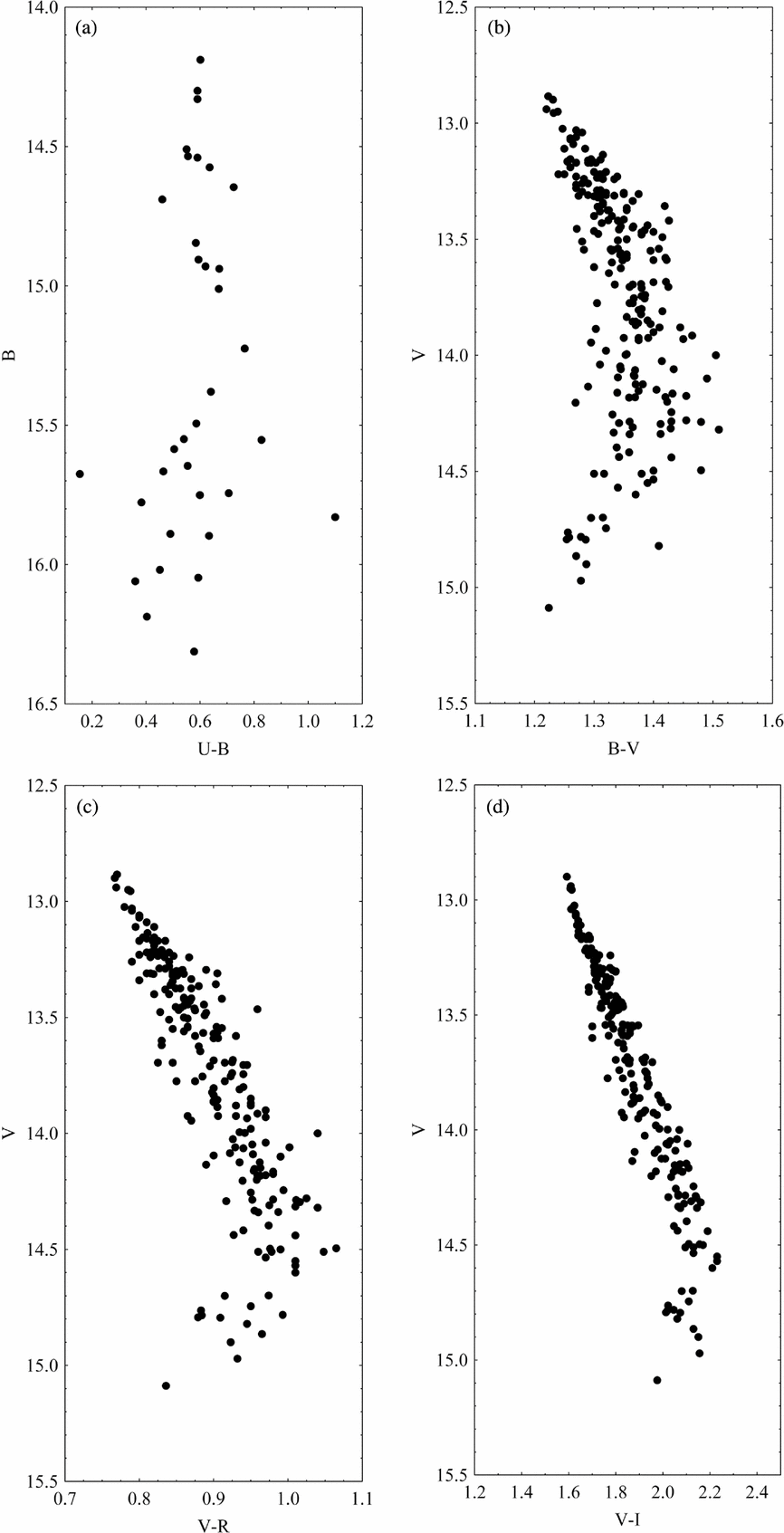
Another important result of our study is the change in colour of GM Cep at the deep minimums. Using data from our UBVRI photometry the four colour-magnitude diagrams (U −B/B, B − V/V, V − R/V and V − I/V) of the star are constructed and displayed on Figure 3. The existence of a turning point of each of the diagrams is seen on the figure. In accordance with the model of dust-clump obscuration, the observed colour reversal is caused by the scattered light from small dust grains. Generally, the star becomes redder when its light is covered by dust clumps on the line of sight. But when the obscuration rises enough, the part of the scattered light in the total observed light becomes significant and the star colour gets bluer. For each colour, such a turning point occurs at different stellar brightness, for example on V/B − V diagram the turning point occurs at V ~ 14.0 mag, while on V/V − I diagram at V ~ 14.6 mag. As we mentioned in our first paper Semkov & Peneva (Reference Semkov and Peneva2012), ‘the observed change of colour indices suggest for existence of a colour reversal in the minimum light, a typical feature of the PMS stars from UXor type’. The new data confirm the presence of ‘blueing effect’ at minimum light and they are independent evidence that the variability of GM Cep is dominated by variable extinction from the circumstellar environment.
The colour-magnitude diagrams of GM Cep in the period of observations 2008 June–2014 June.
After analysis of data collected our conclusion is that the photometric properties of GM Cep can be explained by superposition of both: (1) highly variable accretion from the circumstellar disk onto the stellar suffice, and (2) occultation from circumstellar clumps of dust, planetesimals or from features of the circumstellar disk. Our photometric results for the period 2008 June–2014 August suggest that the variable extinction dominates the variability of GM Cep. In low accretion rates both types of variability can act independently during different time periods and the result is the complicated light curve of GM Cep.
Due to the complex circumstellar environment around PMS stars, such a mixture of different types of photometric variability can be expected. In recent studies, a similar superposition of the both types of variability is seen on the long-term light curve of others PMS stars: V1184 Tau Semkov et al. (Reference Semkov2008); Barsunova, Grinin, & Sergeev (Reference Barsunova, Grinin and Sergeev2006), V1647 Ori Aspin et al. (Reference Aspin2009), V582 Aur Semkov et al. (Reference Semkov2013) and V2492 Cyg Hillenbrand et al. (Reference Hillenbrand2013). Recently, the results of two long-term photometric studies in the field of NGC 7000/IC 5070 Findeisen et al. (Reference Findeisen2013); Poljančić Beljan et al. (Reference Poljančić Beljan, Jurdana-Šepić, Semkov, Ibryamov, Peneva and Tsvetkov2014) has shown that the eclipsing phenomena are widespread type of variability in among the PMS stars. It seems that the time variable extinction is characteristic not only of HAEBE and early type CTT stars but is also a common phenomenon during the evolution of all types of PMS stars.
3.2. Spectral data
The medium-resolution spectrum of GM Cep obtained in Skinakas Observatory is shown in Figure 4. At the time of spectral observations (2008 June) the star was at the maximal level of brightness (V ~ 12.9 mag). The analysis of spectrum was made using the standard procedures in IRAF. We fits the line profiles with Gaussian and estimate the equivalent width of the lines. The spectrum shows the typical of CTT stars absorption lines of iron, calcium, sodium and other metals and a very broad Hα emission line.
Spectrum of GM Cep obtained on 2008 June 27 with the 1.3-m RC telescope in Skinakas Observatory.

The double-line profile of the Hα line suggest that the line is formed in a disk-like region Horne & Marsh (Reference Horne and Marsh1986). There are similarities between the profiles of the Hα lines of GM Cep and some Be/X-ray binary stars, e. g. LS I +61 303 Zamanov et al. (Reference Zamanov, Stoyanov, Martí, Tomov, Belcheva, Luque-Escamilla and Latev2013). The circumstellar disks in Be/X-ray binaries are formed from the fast rotation of the Be star, non-radial pulsations and slow and dense equatorial wind. The PMS stars are characterised with strong stellar winds. In case of GM Cep, the wind probably form disk-like structure near the surface of the star. The depth of the central absorption of Hα line suggest that the inclination of the star to the line of sight is i ~ 75° Hanuschik (Reference Hanuschik1996). In Table 3, the measured parameters of the Hα line are given.
The parameters of the two peaks and the central dip of the Hα line. Given are as follows: equivalent width (EW) of the line, full width at half maximum (FWHM) and the radial velocity (V rad).

For rotationally dominated profiles, the peak separation can be regarded as a measure of the outer radius of the Hα emitting disk Huang (Reference Huang1972):
 \begin{equation}
R_{\text{disk}} = \frac{G M_* \sin ^2\,i}{(0.5\,\Delta V)^2},
\end{equation}
\begin{equation}
R_{\text{disk}} = \frac{G M_* \sin ^2\,i}{(0.5\,\Delta V)^2},
\end{equation}
From the spectrum we estimate Δ V = 379.4 ± 0.3 km s− 1 (the distance between the blue and red peaks of Hα). This velocity is connected with the outer edge of the disk. Using mass of the star M* = 2.1 M⊙ and inclination angel i = 75°, we calculate the outer radius of the Hα emitting region to be 10.4 ± 0.5 R⊙.
Using the correlation between the Hα velocity wings at 10% of the maximum (V Hα10%) and Ṁ ac, we can estimate the accretion rate Natta et al. (Reference Natta, Testi, Muzerolle, Randich, Comerón and Persi2004):
 \begin{equation}
\log \dot{M}_{\text{ac}} = -12.89 (\pm 0.3) + 9.7 (\pm 0.7)\times 10^{-3} V_{H\alpha 10\%}
\end{equation}
\begin{equation}
\log \dot{M}_{\text{ac}} = -12.89 (\pm 0.3) + 9.7 (\pm 0.7)\times 10^{-3} V_{H\alpha 10\%}
\end{equation}
where V Hα10% is in km s− 1 and Ṁ ac is in M⊙ yr−1.
For measured velocity 633 km s− 1 on 10% of the maximum, the accretion rate is 1.8 × 10− 7 M⊙ yr− 1, which is close to the value 3 × 10− 7 M⊙ yr− 1, obtained by Sicilia-Aguilar et al. (Reference Sicilia-Aguilar2008).
4 CONCLUSION
Photometric and spectral data presented in this paper show the usefulness of systematically monitoring of PMS stars with large amplitude variability. On the basis of our photometric monitoring over the past six years, we have confirmed that the variability of GM Cep is dominated by fading events rather than by bursting events. The effect of a colour reversal at the minimum light is evidence of variable extinction from the circumstellar environment. We plan to continue our photometric monitoring of the star during the next years and strongly encourage similar follow-up observations.
ACKNOWLEDGEMENTS
This study was partly supported by ESF and Bulgarian Ministry of Education and Science under the contract BG051PO001-3.3.06-0047. The authors thank the Director of Skinakas Observatory Prof. I. Papamastorakis and Prof. I. Papadakis for the award of telescope time. The research has made use of the NASA Astrophysics Data System Abstract Service.