


Introduction
The still young literature on “democratic backsliding” and the “deconsolidation of democracies” continues to grow at a rapid pace—driven by a general democracy falling concern (Foa and Mounk, Reference Foa and Mounk2017; Levitsky and Ziblatt, Reference Levitsky and Ziblatt2019; Mechkova et al., Reference Mechkova, Lührmann and Lindberg2017; Mounk, Reference Mounk2018). Besides institutional malfunctions and policy failures, a major strand of this literature assumes that the reasons for the steeply rising electoral successes of right-wing populism (RWP) and the subsequent cutbacks on democracies’ liberal qualities result from reactionary and anti-liberal shifts in public opinion (Foa and Mounk, Reference Foa and Mounk2017; Mounk, Reference Mounk2018).
Focusing on advanced post-industrial democracies, scholars of public opinion suspect an authoritarian reaction against the decade-long rise of emancipative values among the increasingly educated societal mainstream and its progressive-liberal agenda on matters of cultural diversity, sexual liberation, and ecological sustainability (Norris and Inglehart, Reference Norris and Inglehart2019). Prominent studies assume that this “authoritarian reflex” prevails among culturally marginalized (i.e., “left-behind”) voter segments at the low education end of the middle-class spectrum. Often characterized as the “petty bourgeoisie” (Bernstein, Reference Bernstein1988; Poulantzas, Reference Poulantzas1979), this spectrum comprises low-to-middle income occupations with vocational training, like artisans, craftsmen, shopkeepers, and other manual workers (see, e.g., Engler and Weisstanner, Reference Engler and Weisstanner2021; Gidron and Hall, Reference Gidron and Hall2020; Goodhart, Reference Goodhart2017; Han and Han, Reference Han and Han2023). Already Lipset (Reference Lipset1960) saw in this electoral spectrum a chronic predisposition to “working-class authoritarianism.” Now, “[a]fter almost 60 years, the Lipset working-class authoritarianism thesis stands the test of time” (Norris and Inglehart, Reference Norris and Inglehart2019, p. 279).
Against the backdrop of rising income inequalities and existential insecurities in the wake of economic globalization, scholars presume that the alleged authoritarian reaction among “modernization losers” increases ideological class polarization over key dimensions of political conflict. Following widening ideological polarization, economically vulnerable and culturally marginalized population segments become increasingly alienated from the democratic system, its central institutions, and their guiding liberal principles. The progressing alienation allegedly manifests itself in crumbling trust in public institutions and eroding support for liberal democracy writ large, especially among the reactionary voter segments. As a result, trust-vs-distrust in public institutions and approval-vs-disapproval of liberal democracy turn into a new domain of polarization in its own right, separating increasingly alienated from still allegiant voters. The anti-establishment rhetoric of RWP capitalizes on alienated voters’ accrued frustration and mobilizes them to leave their detainment in the growing nonvoter camp (cf. Minkenberg, Reference Minkenberg2000; Dunn, Reference Dunn2015; Bonikowski, Reference Bonikowski2017; Gidron and Hall, Reference Gidron and Hall2020). Accordingly, RWP becomes electorally stronger, seizes government positions more frequently, and eventually uses its power to curtail democracies’ liberal qualities.
This narrative represents a dominant subtext inspiring the “democratic backsliding” and “deconsolidation of democracy” literatures (Foa and Mounk, Reference Foa and Mounk2017; Mechkova et al., Reference Mechkova, Lührmann and Lindberg2017; Norris and Inglehart, Reference Norris and Inglehart2019).
The assumptions underlying the democracy falling narrative are, however, more often told than demonstrated. Filling this void, we analyze data from the European Values Study/World Values Survey to trace the development of institutional trust, democracy support, and ideological polarization among European electorates over a twenty to twenty-five-year timespan. The purpose of this examination is to figure out whether, and to what extent, the sweeping public opinion trends that are stereotypically taken for granted in much of the democracy falling literature actually hold true in a broadly comparative perspective with a wider time horizon.
The remainder of this article proceeds in four steps. The first section outlines the democracy falling narrative in theory. The second section portrays the study design intended to examine the main assumptions inspiring this narrative. The third section describes the data and variables used. The fourth section presents the results in a three-step sequence, moving from “exemplary case evidence” to “fully comparative evidence” to “pooled multilevel evidence.” The concluding section discusses the limitations and further implications of our study.
The democracy falling narrative
We abstain from a detailed recapitulation of all the debates in the large and still growing inequality, backsliding, deconsolidation, and RWP literatures. Instead, we distill from a selection of relevant works in these fields some key interpretive elements that combine into an overarching frame, which we call the democracy falling narrative.Footnote 1 There is no single reading to which we can attribute the democracy falling narrative as a whole; instead, the narrative emerges from a combination of the overlapping interpretive elements in a large and diverse body of writings. As such, the democracy falling narrative comprises a series of temporally ordered assumptions about how public opinion dynamics in advanced post-industrial democracies propel the electoral rise of RWP and its attacks on the liberal principles of democracy. Sequentially ordered, we phrase these assumptions as follows (see Figure 1 for a schematic depiction):
-
(1) Over the past decades, the electorates of post-industrial publics experienced a gradual emancipatory shift in values away from conformity and obedience toward individual self-determination and equality of opportunities. This emancipatory shift was strongest among the increasingly educated middle-class segments. As a result, populations’ overall emphasis on emancipative values rose on average, bringing more support for migratory openness, sexual self-determination, and ecological sustainability.
-
(2) Contrasting with the accelerating educational expansion among the mainstream post-industrial electorates, the remaining voters in less educated lower-middle class positions face greater socio-economic vulnerabilities and feel culturally marginalized under advancing de-industrialization and growing in-migration—policy outcomes favored by the electoral mainstream’s increasingly liberal agenda. In response, the vulnerable and marginalized voters react with an adamant conservative resistance against further liberal progressions on the policy domains of migration, sexuality, and sustainability.
-
(3) Consequently, class-based ideological polarization over conservative-vs-liberal (authoritarian-vs-emancipative) policy priorities grows so steeply that the reactionary conservative voters become increasingly alienated from the democratic system.
-
(4) Systemic alienation manifests itself, for one, in reactionary voters’ growing distrust in democracies’ central political institutions.
-
(5) Systemic alienation manifests itself also in an increasing disapproval of democracies’ liberal principles, paralleled by spreading sympathy for authoritarian-style strongmen rule.
-
(6) Both manifestations of systemic alienation finally feed rising support for RWP parties’ anti-establishment rhetoric and their verbal as well as real attacks on democracy’s liberal principles, especially media freedom, judicial independence, and minority rights.
The hypothetical sequence of the eroding democracy narrative.

To date, there is no comprehensive test of this system of sequential trend assumptions that informs the democracy falling narrative as portrayed here. The following section describes the study design by which we intend to fill this gap.
Study design
Conceptual set-up
The democracy falling narrative addresses developments among mature post-industrial democracies. Accordingly, our ambition narrows down to this category of countries. Geographically, economically advanced (i.e., post-industrial) democracies exist in large parts of EuropeFootnote 2 and include North America (USA, Canada), Australia and New Zealand, as well as parts of East Asia (certainly Japan, South Korea, Taiwan), parts of Latin America (certainly Chile, Uruguay), and Israel.Footnote 3 To keep our study within a manageable scope among this geographically wide array of countries, we focus on the European Union (EU) as the world’s largest and, at the same time, most diverse collection of mature democracies within the same regulatory framework.
Taking EU democracies as the point of departure, we recognize that the Union’s countries divide into four distinct geo-historic regions, which entered the EU at different points in time, under different circumstances, and with a different legacy. The four geo-historic regions comprise what we call (1) the Western Core, (2) the Scandinavian North, (3) the Mediterranean South, and (4) the Post-Communist East (Hutter and Kriesi, Reference Hutter and Kriesi2019). Doing justice to this geo-historic structuration of the EU-space mandates to study the ideological patterns and dynamics among European electorates separately for the countries of each of the four regions—at least in a first step, before jumping right away into a pooled analysis of all countries at once.
Both the classic and contemporary writings in political sociology, electoral behavior and party politics presume that individual differences in income, education and occupation divide electorates into socio-economic segments of varying existential vulnerability, ordered from less privileged lower and lower-middle class strata to more privileged upper-middle and upper class strata (Lipset, Reference Lipset1960; Lipset and Rokkan, Reference Lipset and Rokkan1967; Kitschelt, Reference Kitschelt1994; Dalton, Reference Dalton1996; Kitschelt and Rehm, Reference Kitschelt and Rehm2019). Different socio-economic vulnerabilities, in turn, embody conflicting interests and preferences on given policy domains. In mature post-industrial democracies, the contested policy domains typically boil down to four larger ideological “cleavages.” Each of these four cleavages embodies the conflict between a conservative/defensive (or authoritarian) position at one extreme end and a progressive/interventionist (or emancipatory) position at its opposite end, with intermediate positions in the center between the extremes.
In our terminology, the four ideological cleavages include (1) the market cleavage over the deregulation of (conservative) versus intervention in (progressive) the economy, (2) the migration cleavage over the exclusion (conservative) versus inclusion (progressive) of immigrants, (3) the sexuality cleavage over the restriction (conservative) versus extension (progressive) of sexual self-determination, and (4) the sustainability cleavage over job preservation (conservative) versus environmental protection (progressive) as policy priorities.
The market cleavage represents an old line of tension that reaches back in time to the material conflicts during the era of modern democracies’ industrialization. With the transition into the post-industrial age, the old market cleavage has lost its once overwhelming dominance and now competes in salience with the post-industrial cleavages on matters of migration , sexuality , and sustainability . Our focus of interest, therefore, concentrates on the three post-industrial ideological cleavages. We nevertheless include the market cleavage into our consideration to obtain a complete picture of the electorates’ ideological patterns and dynamics.
In line with the literature, the democracy falling narrative assumes that socio-economically vulnerable voters in lower and lower-middle class positions tend toward more conservative positions on the post-industrial ideological cleavages. More importantly, the democracy falling narrative claims that these voter segments’ conservative/defensive distancing from the electoral mainstream has increased over time, thus enlarging ideological polarization between the electorates’ lower and lower-middle class segments, on the one hand, and the upper-middle and upper class segments, on the other.
Besides ideological polarization, the democracy falling narrative presumes the emergence of two new political cleavages that differ from the previous four ideological cleavages in the sense that they do not center on differences in policy content but on differences in voters’ general aversion-vs-affection to the political system. Thus, in addition to the four ideological cleavages, we consider two (supposedly intertwined) systemic cleavages, which we call (1) the trust cleavage over alienation versus confidence to the system’s political institutions and (2) the regime cleavage over preferences for authoritarian-like strongmen rule versus democratic governance tied by checks and balances. Alienation on the trust cleavage and authoritarianism on the regime cleavage represent the aversive side on the systemic polarity; confidence on the trust cleavage and democracy support on the regime cleavage represent the affectionate side.
Against the backdrop of this setting, the democracy falling narrative suggests that ideologically conservative voters in socio-economically vulnerable class positions have enhanced class polarization over both the trust and regime cleavages by shifting away from the electoral mainstream, that is, toward greater aversion on both of these systemic cleavages. Allegedly, the grown system aversion of these electoral segments feeds a growing readiness to vote for RWP parties.
Analytical strategy
One question to test this narrative is to ask whether and to what extent the RWP vote has throughout Europe’s electorates a solid micro-foundation in (a) more vulnerable socio-economic class strata, (b) more extremely reactionary (i.e., conservative) positions on the three post-industrial ideological cleavages, and (c) more aversive postures on the two systemic cleavages. Yet, even if these micro-foundations exist as suggested (and as evidenced in the broad literature on the electoral determinants of RWP success),Footnote 4 the mere existence of these micro-foundations cannot explain the rise of the RWP vote over time—unless the three characteristics that constitute the psychological micro-foundations of RWP (i.e., socio-economic vulnerability, conservative extremism, system aversion) did also increase over time. Hence, a proper trend description alongside a comparative mapping-and-tracking scheme is our first analytical task in testing the democracy falling narrative.
As of note, this task is not a matter of sophisticated statistical modeling but simply a descriptive fact-checking exercise, albeit a complex one that requires extensive data mining on a wide spatial and temporal scope. Indeed, our mapping-and-tracking scheme comprises a matrix of twenty-three countries, five socio-economic classes, six political cleavages, and two distant time points, which yields (23 × 5 × 6 × 2 =) 1,380 aggregate data points to compare. There are way too many data points on too many dimensions to visualize the ideological trends of our interest in a readable manner for all EU electorates at once.
Therefore, we choose a different approach and—in a first step—reduce complexity by zooming into the EU’s four geo-historic regions. The idea is to select from each region the country with the largest population. We do this in the hope that what we find among a region’s largest national electorate is more or less typical for most electorates in the same geo-historic region. Given each of the four regions’ formative cultural legacies, the assumption that cleavage patterns and dynamics show intra-regional similarities does not seem to be off base (cf. Hutter and Kriesi, Reference Hutter and Kriesi2019).
Following these rationales, the first step of the mapping-and-tracking examination (“Exemplary Case Evidence”) focuses on Germany, Sweden, Spain,Footnote 5 and Poland as representative cases of their respective geo-historic region. Separately for each of the four countries, we trace positional shifts of five lower-vs.-upper class voter segments on the four ideological cleavages listed above over the twenty to twenty-five-year timespan from the mid/late 1990s till the late 2010s/early 2020s. The purpose is to see whether these shifts unfolded as predicted by the democracy falling narrative—with the vulnerable socio-economic segments moving into a growing reactionary distance to the mainstream’s supposed emancipatory progression in ways that increase class polarization over the four ideological cleavages and shift the vulnerable segments into a more aversive stance on the two systemic cleavages, visible in greater alienation on the trust cleavage and stronger authoritarianism on the regime cleavage. Visualizing the ideological dynamics in this setting gives us a first impression of the extent to which the first three steps of the democracy falling narrative depicted in Figure 1 hold true. In other words, is there convincing evidence for (1) a long-term emancipatory progression among the center-middle and upper-middle class mainstream of the electorates, (2) an authoritarian ideological reaction among the socio-economically vulnerable lower and lower-middle class segments, and (3) a subsequent polarization along our four ideological and two systemic cleavages?Footnote 6
To trace ideological shifts, we chose the twenty to twenty-five years timespan just mentioned because such a rather wide temporal range helps avoid confusing short-term fluctuations with the long-term trend. Moreover, when examining the reasons for RWP parties’ electoral success, it is appropriate to select as the reference a time point before their electoral ascension began to pick up speed—hence, the mid-late 1990s as the starting point of our temporal observation. This is also a calmer period before the EU introduced the joint Euro currency and began to approach the turbulent era of consecutive crises that followed (financial crisis, refugee crisis, Corona crisis, etc.).
In the “Exemplary Case Evidence” section, we plot—next to the different socio-economic voter segments—also the position of the voters of the main RWP party in each country. In Germany, this is the “Alternative für Deutschland” (Alternative for Germany: AfD); in Sweden, the “Sverigedemokraterna” (Sweden Democrats: SD); and in Poland, the “Pokój i Sprawiedliwość” (Peace and Justice Party: PiS).Footnote 7 We do so in order to figure out how much the positions of RWP voters are out of range from the electorates’ positional differentiation alongside socio-economic divisions. Unfortunately, we can only plot the position of RWP voters for the latest point in time because the right-wing party spectrum looked very different at our first point of observation. Also, the RWP electorate was too small back then to calculate reliable positional averages. Because our focus on mean values hides the potential variability behind these values, we extend our analyses and provide the changes in distribution for our four exemplary cases across time and across SES in Supplementary Online Material (SOM) Figures S18–S37. The distributions paint a very normal single-peaked picture for all continuously measured variables and further substantiate our findings.
After illustrating the dynamic pattern for the four exemplary countries, we move on to our second step (“Fully Comparative Evidence”). Here, we zoom out and adopt an encompassing perspective in comparing voters’ positional shifts on the ideological and systemic cleavages as well as their polarization dynamics for most of the EU-27 electorates. The graphics in this second part of the analysis visualize how far the first three chain links of the democracy falling narrative depicted in Figure 1 hold true in a more comprehensive European perspective beyond the four exemplary countries of the first step.
The third part of the examination (“Pooled Multilevel Evidence”) means a further and final step of generalization in that we integrate many of the EU-27 electorates into a single universe and apply multilevel modeling. We use these models to estimate how strongly the European electorates’ RWP votes are anchored in micro-foundations related to the variables of scrutiny in our descriptive trend analyses: that is, socio-economic vulnerability, reactionary distancing, and systemic aversion. We estimate the strength of these micro-foundations in a multilevel framework to figure out how sweeping these micro-foundations operate across important country-level differences in policy performance (i.e., economic growth, unemployment rates, price inflation, corruption, and crime) as well as in migration stocks (i.e., share of migrants in the residential population). On the individual level, we estimate respondents’ distance from their country mean as a measure of ideological extremity. In a sense, ideological extremity represents the individual-level equivalent of group-level polarization.
We expect that—seen as a whole—our three-step analytical sequence informs a conclusive judgment about the validity of the widely believed democracy falling narrative. Since displaying the complete material exceeds the space limits of this article, most of the documentation is outsourced to SOMs. Where appropriate, the text refers to the respective section in the SOM.
Data and variables
Data
To implement our study design, we need nationally representative data of individuals’ socio-economic status (SES), their ideological and systemic positions, and their voting preferences. These data should cover most of the EU-27 countries, and they should cover them at several—and preferably distant—points in time.Footnote 8
These premises draw our attention to Europe’s repeated cross-national surveys: the Eurobarometer Surveys (EBS), the European Social Survey (ESS), and the European Values Study/World Values Surveys (EVS/WVS). Among these, the questionnaire design of the EVS/WVS fits more closely than the EBS the variables of interest in our study, especially since the EBS is not primarily a values survey and, thus, lacks a focus on the deeper-seated psychological orientations that shape people’s ideological and systemic positions. Compared to the ESS, the EVS/WVS reaches farther back in time, which allows us to base our trend analysis on an earlier reference point (mid-late 1990s), located before the EU’s series of consecutive crises and before the subsequent booming era of RWP. Consequently, the evidence reported in this article is based on EVS/WVS data (Haerpfer, Inglehart, Moreno, Welzel, Kizilova et al., Reference Haerpfer, Inglehart, Moreno, Welzel, Kizilova, Jaime Diez-Medrano, Norris, Ponarin and Puranen2021).
Variables
Socio-economic status
Since SES derives primarily from the combination of individuals’ income and education, we rely on respondents’ self-reported income and education, which are available on 10- and 9-point ordinal scales, respectively. Using the country-time pooled individual-level EVS/WVS data (N ∼ 50,000), we enter respondents’ education and income into a principal component analysis and extract as a new variable for each individual her/his factor score on the first (and only) principal component. This way, we capture in a single measure about two-thirds joint variation of both income and education.
The advantage of this measure is that it recognizes the empirical relationship between income and education, instead of relying on a theoretically predefined but empirically uninformed categorization.
We normalize the factor scores into a 0-to-1 range and collapse the resulting scale into five categories alongside equally sized intervals (0 to 0.2 […] 0.8 to 1.0). We label the intervals in descending order of socio-economic vulnerability: lower class (LC), lower-middle class (LMC), center-middle class (CMC), upper-middle class (UMC), and upper class (UC). Figure 2 shows the country-time pooled individual-level distribution.
SES distribution in the country/time pooled EVS/WVS individual-level data.

In addition to income and education, certain characteristics of occupational status also define individuals’ SES. They include a set of binary characteristics indicating such things as to whether a working person is self-employed or employed, fulfills a supervisor role or not, has decision-making autonomy or not, and works in the private or public sector. The combinatory complexity of these occupational characteristics, however, makes it difficult to squeeze them into a coherent coding scheme. For this reason, the occupational status variable in the EVS/WVS is plagued by an unusually large number of missing responses, which greatly reduces the representative reliability of the respective information. Therefore, the SES index used in the analyses here ignores occupational status.Footnote 9 Still, SOM Table S4 documents a supplementary analysis based on an augmented SES index that includes occupational status information.Footnote 10 Doing so largely replicates the results reported here.
Political cleavages
We operationalize the four ideological cleavages alongside a conservative-vs.-progressive conflict line, with scores growing toward the progressive end on each cleavage. We measure the domains of conflict on which the cleavages center as follows:
Market Cleavage: We summarize three questions asking respondents for their degree of support for income inequality reduction, public ownership of industries and government responsibility for individuals’ material wellbeing, each asked on a 1 to 10 scale.Footnote 11 Hence, this cleavage captures a classical left-right perspective on economic issues with a tradeoff between neo-liberal economic freedom with privatized risks and benefits on the lower end of the spectrum and social-safety nets and public steering of the economy on the other end.
Migration Cleavage: We rely on responses to a question asking for respondents’ attitude toward the prioritization of national citizens over migrants when jobs in their country are scarce (“agree,” “disagree,” “neither”). We compare the results with two additional variables, which ask about attitudes toward migration (see SOM Figures S1 and S2).Footnote 12
Sexuality Cleavage: We summarize three questions, each asking on a 1–10 scale to what degree respondents find “homosexuality,” “abortion,” and “divorce” acceptable.
Sustainability Cleavage: We use a question asking respondents whether, in case of a goal conflict, environmental protection should always come first, or whether preserving/creating jobs should always have priority, or whether it depends.
For each individual, we standardize all ideological cleavage variables into a 0-to-1 format. On each cleavage, the low scale end (0) represents the conservative extreme (i.e., economic restraint, migrant exclusion, sexual restriction, job preservation), while the high scale end (1.0) represents the progressive extreme (i.e., economic intervention, migrant inclusion, sexual liberation, environmental protection). Decimal fractions measure intermediate positions between the conservative and progressive poles, with the closeness to 0 and 1.0 indicating the prevailing conservative-vs-progressive direction.
We operationalize the two systemic cleavages alongside an aversion-vs.-alegiance conflict line as follows:
Trust Cleavage: We summarize responses to three questions asking for interviewees’ confidence in the “national parliament,” “government,” and “political parties” on 4-point Likert scales each (1 “a lot of confidence,” 2 “some confidence,” 3 “little confidence,” 4 “no confidence at all”).
Regime Cleavage: We contrast the wish to live in a democratic system with the desire for authoritarian strongmen rule, relying on two questions asking respondents whether “having a democratic system” and “having a strong leader who does not have to bother with parliaments and elections” is a “good thing” or a “bad thing” on a four-point scale each. We subtract the desire for authoritarian leadership from the desire for a democratic system, resulting in a difference variable that captures support for authoritarian leadership (−1) versus support for democracy (+1), with scores closer to 0 indicating mixed preferences.Footnote 13
We normalize the systemic cleavage variables, too, into a 0-to-1 format, such that the low scale end (0) represents aversive positions (alienation, authoritarianism), while the high scale end (1) represents alegiant positions (i.e., confidence, democraticness).
Additional variables
For the “Exemplary Case Evidence” and “Pooled Multilevel Evidence” sections, we identify for each country’s most recent EVS/WVS the major RWP parties and code a voting preference for this party as 1 and 0 otherwise. SOM Table S3 documents which party we treat as the major RWP party for each country. For this coding, we closely follow Rooduijn et al. (Reference Rooduijn, Pirro, Halikiopoulou, Froio, Kessel, De Lange, Mudde and Taggart2024) and classify a party as RWP if the PopuList V3 codes it as both populist and right-wing.
For the “Multilevel Evidence” section, we use additional variables, including basic demographic controls at the individual level (gender, age, age squared) and important country-level differences that plausibly affect individuals’ RWP vote. Specifically, we focus on countries’ migration stocks (i.e., share of immigrants among the residential population) and standard indicators of national policy performance (i.e., economic growth, unemployment rate, price inflation, corruption, and crime). Intuition suggests that larger migration stocks and weaker policy performance heighten citizens’ system aversion and, as a consequence, also the base level of their RWP vote. SOM Notes S3 and SOM Table S1 document the sources, scales, and distributions of the additional variables.
Findings
Exemplary case evidence
WEST European core (e.g., Germany)
Figure 3A plots the ideological shifts of the German electorate’s SES segments on the trust cleavage (horizontal axis) against the market cleavage (vertical axis). Surprisingly, in light of what most of the literature suggests, the different SES segments of the German public each have moved toward more, instead of less, institutional trust over the past twenty-five years, namely from an overall population average of about .30 scale points to roughly .40 scale points, which is significant on a total 0-to-1 range. At the same time, however, the upper-middle and upper classes have shifted so much farther toward greater trust that—compared to the situation twenty-five years ago—we now see a slightly bigger trust gap to the lower-middle and lower classes, although they too moved toward a more allegiant position. Overall, the German public’s differentiation on the trust cleavage is weakly determined by the electorate’s SES segmentation.
(A, B, C, D clockwise): Cleavage dimensions in Germany.

In stark contrast, the AfD supporters exhibit an exceptionally alienated position at half of the institutional trust level of the overall German average (roughly .20 compared to .40 scale points). As of note, the AfD supporters’ distinctive alienation does not match with any of the German electorate’s class segments, not even the socio-economically most vulnerable lower-middle and lower classes. In this respect, the exceptionally alienated position of German RWP supporters is only weakly anchored in socio-economic vulnerabilities. Besides, when we evaluate the positions of RWP voters, we neglect their absolute scale positions and instead comment on their positions relative to a country’s SES segments.
Against expectations that growing economic divisions over low-vs-high paid jobs and precarious-vs-secure occupations would have increased ideological polarization over distributional issues, no evidence for such polarization exists on the classic right-vs-left market cleavage. At any rate, right-vs-left polarization over distributional issues is less dividing than one would guess. Indeed, the different SES segments of the German public differ from each other within a rather narrow range on classical right-vs-left questions: that is, between .42 and .58 on a scale range from 0-to-1, with the margin having even become narrower over the past twenty years.
AfD voters show no out-of-range position on the market cleavage, which reveals that the AfD elites’ neo-liberal position on economic issues is not the major attractor for the party’s supporters in the electorate.
This pattern repeats itself in the other three geo-historic regions of the EU, as we will see. In a nutshell, deregulation-vs-intervention issues on the market cleavage are not the main dividing line of the day and show no sign of obtaining this status anytime soon again.
Contrary to the widely held belief that ideological polarization over the migration cleavage has significantly increased, Figure 3B exhibits a surprisingly strong increase in pro-migration attitudes. The German public, as a whole, became much more inclusionary in its orientation toward migration, measured as the acceptance of migrants’ equal access to the labor market. And no increased polarization among the population’s SES segments over the migration cleavage is visible. Using an alternative measure—namely the acceptance of immigrants as neighbors—we also find increasing migrant acceptance on an even higher base level across the German SES segments, again without any indication of increased class polarization (see SOM Figures S1A and S2A).
AfD supporters, by contrast, stick out by a clearly exclusionist orientation toward migrants, taking a position that was held by the lower-middle class in the mid-late 1990s.
On the sexuality cleavage (Figure 3C), all segments of the German public shifted considerably toward a more libertarian position. Thus, we note a strongly increased tolerance of divorce, abortion, and homosexuality throughout the population. And even though the standard polarization narrative suggests that the lower classes would withstand the sexual liberation trend or even move into the opposite direction, the exact contrary holds true: It is precisely the lower class moving the farthest toward libertarian sex norms, thus causing a decrease instead of an increase in class polarization over sexuality matters. Expectedly, AfD supporters score on the conservative end of the sexuality cleavage. But their position is fully within the range of differences among the German public’s middle-class spectrum, in contrast to what we have seen with respect to the trust and migration cleavages, on both of which AfD supporters widely diverge from the mainstream of the German public.
On the sustainability cleavage (Figure 3D), again, all middle-class segments moved toward a more progressive, post-materialist position by placing greater emphasis on environmental protection relative to job preservation. And once more, the lower class, as the most conservative group on this issue, made the biggest post-materialistic move, thus closing the gap with the upper-middle class. Hence, there is no increased class polarization over the sustainability cleavage either. As with the sexuality cleavage, AfD supporters score at the conservative materialistic end of the sustainability cleavage, yet remain within the range of differences that characterize the German middle-class spectrum.
In summary, the German case offers no evidence for increased class polarization over mature democracies’ four main ideological cleavages, except for the systemic trust cleavage on which the upper and upper-middle classes shifted so far toward greater institutional confidence that class differences over alienation-vs-confidence are now larger, albeit on a higher base level of allegiance (not alienation). AfD supporters diverge from the German public’s differences over political cleavages by far out-of-range positions on the trust cleavage (alienated) and the migration cleavage (exclusion), yet not on the market , sexuality , and sustainability cleavages. The fact that the extreme AfD positions on the trust and migration cleavages are not particularly close to the positions of the lower and lower-middle class segments of the German electorate indicates that AfD support is, socio-economically speaking, not sharply demarcated but, instead, exists throughout all electoral segments.
Scandinavian NORTH (e.g., Sweden)
Sweden (Figures 4A–4D) offers even less evidence for growing class polarization over mature democracies’ political cleavages. As in Germany, all SES segments of the Swedish public moved toward more, instead of less, trust in institutions as well as toward more progressive positions on the migration cleavage (i.e., inclusion), the sexuality cleavage (i.e., liberation), and the sustainability cleavage (i.e., sustainability). As in Germany, these progressive ideological shifts did by no means increase positional differences between lower and lower-middle class segments, on the one hand, and upper-middle and upper class segments, on the other. As in Germany, supporters of RWP (i.e., “Sweden Democrats”: SD) hold more conservative positions on all of these cleavages, yet with out-of-range positions only on the trust cleavage (i.e., alienation) and on the migration cleavage (i.e., exclusion). Sweden also showcases the national culture’s powerful gravitational pull. Indeed, even though voters of the Sweden Democrats take more extreme anti-liberal positions on all cleavages than the average Swede, they are still much more liberal in comparison with (e.g.) the Polish PiS voters. The reason for these astonishingly liberal RWP voters is Sweden’s global leadership in the progression of the emancipatory agenda in terms of migrant inclusion, sexual self-determination, and ecological sustainability. Thus, in the Swedish context, even RWP supporters do not demand the broadband rejection of asylum seekers, the re-criminalization of homosexuality, and the deforestation of natural reserves.
(A, B, C, D clockwise): Cleavage dimensions in Sweden.

Overall, the different segments of the Swedish middle class moved toward more liberal positions in a relatively uniform manner, with the lower and lower-middle classes catching up with the center-middle and upper-middle classes. The latter two score close to the ceiling of our scales. As is the case for AfD supporters in Germany, the ideological conservatism of the voters of the “Sweden Democrats” remains within the SES segments’ range of difference in the case of the market and sexuality cleavages. Also like German AfD voters, Swedish SD voters clearly stick out from the remainder of the electorate on the trust cleavage (i.e., alienation), the migration cleavage (i.e., exclusion), and—in contrast to AfD supporters—also on the sustainability cleavage (i.e., less environmental protection).
Mediterranean SOUTH (e.g., Spain)
Spain (Figures 5A–5D) is our exemplary case for the EU’s Mediterranean South. As we can see, institutional trust in Spain (as in the Mediterranean South more generally) is lower (at about .35 scale points) than in the Western European Core (e.g., Germany at .45 scale points) and the Scandinavian North (e.g., Sweden at .50 scale points). In contrast to Germany and Sweden, institutional trust in Spain is not only lower but has further dropped, especially among the lower and upper-middle classes, thus making the alienation-vs-confidence gap between SES segments somewhat bigger than before (Figure 5A). The decline of the upper-middle class’s trust in institutions (from .36 to .29 scale points) may be due to the socialist party’s (PSOE) long periods in power: PSOE was the ruling party in 1982–1996, 2004–2011, and 2019–2023. On the other hand, the PSOE was also the governing party responsible for the severe austerity policies after the EU financial crisis. Such policies contradict the historic mission of socialist parties to protect poorer citizens from economic hardship, which is a plausible reason why the Spanish lower class, too, lost institutional trust.
(A, B, C, D clockwise): Cleavage dimensions in Spain.

As in the EU’s other geo-historical regions, class polarization on the market cleavage in Spain is modest and has not increased over time (Figure 5A), albeit on a more leftist-interventionist base level around roughly .55 scale points, which is high compared to Germany (.45) and Sweden (.40).
On the migration cleavage, a significant movement toward a more inclusive position occurred throughout the electorate (Figure 5B). At the same time, this progression proceeded unevenly between the lower and upper classes, increasing their gap to a point where 80% of the upper class support equal job access for migrants, while only 40% of the lower class share this position. However, the positional distance between the three middle-class segments became smaller on the migration cleavage. Since the three middle-class segments (i.e., lower-, center-, and upper-middle class) are much larger in size than the lower and upper class segments, the de-polarization among the middle-class segments greatly outbalances in demographic weight the polarization between the lower and upper class extremes.
Considering the sexuality cleavage (Figure 5C), all class segments shifted pronouncedly toward a more libertarian position in favor of greater reproductive freedoms. As this happened, the distance between the middle-class segments shrank, while the lower class remains in a sexually more conservative position, albeit on a higher level of sexual libertarianism than twenty years ago—hence, no reactionary response of the socio-economically most vulnerable electoral segments to the mainstream’s emancipatory progression on the sexuality cleavage.
As concerns the sustainability cleavage (Figure 5D), class polarization has somewhat grown, mostly by a progressive, post-materialistic move of the upper-middle and upper classes toward a more environmentalist position (Figure 5D). The salience of the sustainability cleavage may grow further in the future, since Spain is severely affected by climate change, visible in longer-lasting droughts, occasionally interrupted by catastrophic floods and other extreme weather events. Overall, however, evidence for a dramatic growth of class polarization over mature democracies’ main ideological cleavages is modest in Spain, too.
Unfortunately, we cannot show the position of RWP supporters in Spain because the party preference variable in the Spanish EVS/WVS does not code a voting preference for Vox Populi, the main RWP party in Spain.
Post-communist EAST (e.g., Poland)
Turning to Poland as the exemplary case for the EU’s Post-Communist East (Figures 6A to 6D), the dynamic shows more resemblance with the Mediterranean South than with the other two geo-historic regions. As in the Mediterranean South, institutional trust is generally low and has further decreased by a large margin throughout all segments of the Polish electorate (from close to .40 scale points to just above .20 scale points). And while there was almost no gap between the lower-middle and upper-middle classes in the mid-late 1990s, the distances grew larger over time (Figure 6A).
(A, B, C, D clockwise): Cleavage dimensions in Poland.

As in Germany and Sweden, supporters of Poland’s RWP party (PiS) stick out on the trust cleavage. But here it is a pronouncedly more confident position. This deviation from the usual RWP pattern is easily explained because PiS was in power from 2015 until 2023, thus massively increasing institutional trust among PiS supporters in Poland. Vice versa, we see a sharply decreasing trust of the center-middle and upper-middle class segments, whose members do not feel represented by PiS and who had to witness its anti-democratic interferences into the judicial and media systems.Footnote 14
As in the EU’s other geo-historic regions, the market cleavage is neither a source of deep class divisions nor has class polarization over this cleavage increased over time. Instead, it actually decreased, with the upper and upper-middle classes moving more leftward (i.e., toward more intervention) and the lower and lower-middle classes more rightward (i.e., toward more deregulation), while the center-middle class held its position.Footnote 15
Inclusionary views on the migration cleavage were on a very low baseline in the mid-late 1990s (below .20 on our 0-to-1 scale). They steadily progressed to a higher level of inclusiveness but—typically for the Post-Communist East—still remain low compared to the other EU-regions (Figure 6B). In numbers, around 55% of the upper-middle class agrees that, in times of scarcity, employers should prioritize Polish nationals over people with a migration background. In comparison, this nativist attitude among the upper-middle class decreased to 20% in Spain and Germany and to 10% in Sweden. During the modest decline of nativism among the Polish electorate, the Polish upper and upper-middle class segments moved further away from the lower and the lower-middle classes, thereby slightly widening class polarization. Like AfD supporters in Germany and SD supporters in Sweden, PiS supporters in Poland hold a pronouncedly more conservative position, with almost 90% of PiS voters opposing giving immigrants the same access to the job market as nationals.
On the sexuality cleavage (Figure 6C), all three middle-class segments of Polish society moved toward a more progressive position. The upper class currently ranks as the most libertarian group, although—in comparison with the EU’s other three geo-historic regions—sexual libertarianism among the Polish upper class remains low. PiS supporters again hold the sexually most conservative position, even more so than RWP supporters in other EU countries.Footnote 16
On the sustainability cleavage (Figure 6D), we see a minor decline in support for environmental protection among all segments over the last twenty-five years. PiS supporters, for their part, clearly prefer job preservation over environmental protection, in line with the preferences of the lower class.
In summary, even the Polish case refuses evidence of increased class polarization over mature democracies’ main ideological divisions—except for the migration cleavage, which shows growing polarization, albeit in an overall progressive direction.Footnote 17
The regime cleavage
The regime cleavage is not an ideological cleavage over conflicting policy preferences on given thematic domains. Instead, like the trust cleavage, the regime cleavage is a systemic cleavage over aversion-vs-allegiance with respect to the democratic order. This is an important element in the democracy falling narrative, which claims that alienated voters in the lower and lower-middle class segments turn their back on democracy in supporting authoritarian forms of strongmen rule, which then feeds voters’ attraction to RWP parties’ anti-system rhetoric and the personalistic leadership styles of their representatives. This is problematic insofar as the power-greedy ambitions of populist leaders operate directly against democracies’ protective constitutional guardrails (“checks and balances”), especially those anchored in an independent judiciary and free media (Brunkert and von Soest, Reference Brunkert and von Soest2022). Because socio-economically better-off and less alienated voters supposedly remain as supportive of democracy as before, the alienated segments’ alleged turn toward authoritarianism (“authoritarian reflex”) should have increased voter polarization over the regime cleavage.
Figure 7 disconfirms this assumption. To be sure, the four exemplary countries exhibit different base levels in democracy support (i.e., higher in Germany and Sweden, lower in Spain and Poland), which is typical for the EU’s four geo-historic regions. Apart from this noteworthy difference, the key takeaway is that none of the electorates’ SES segments moved away from democracy support toward strongmen rule. On the contrary, all voter segments—including the lower and lower-middle classes in all four major EU electorates—shifted toward stronger support for democracy. What is more, no increase in class polarization over the regime cleavage is visible over time.
(A, B, C, D clockwise): Regime cleavage in Germany, Sweden, Spain, and Poland.

Expectedly, RWP voters endorse strongmen rule more readily (visible in their low position on the vertical scale in Figure 7), but their position on this issue is not out of range of the electorates’ differences related to their segmentation in SES terms.
With respect to the four exemplary countries representing the EU’s four geo-historic regions, the evidence largely disproves the democracy falling narrative. There is no generic trend among the socio-economically most vulnerable class segments, neither toward reactionary conservatism on the four ideological cleavages nor toward greater affective aversion on the two systemic cleavages. The following section shows whether and to what degree this finding repeats itself across the entire universe of national electorates in the EU.
Fully comparative evidence
In this section, we contextualize our exemplary case evidence within the entire community of EU electorates. For ease of oversight, we focus on the positional distance between the lower-middle and upper-middle classes as the two demographically largest opposites below and above the center-middle class (see again Figure 2). Focusing on these two segments makes sense, as they constitute a major share of most nations’ electorates, while still besetting polar positions in terms of socio-economic status.
We calculate cleavage polarization as the change in positional distance from the first to the last observation, estimating whether and to what extent the lower-middle and upper-middle classes drifted further apart or moved closer together on both the ideological and systemic cleavages. Our calculation yields polarization scores on a cleavage-by-cleavage basis. Positive scores on the polarization index represent grown polarization, while negative scores indicate the opposite. For each cleavage, the formula for the polarization index reads:
 $$\Delta {\it{Middle\;Class\;Polarizatio}}{{\it{n}}_{2000 - 2020}} = {\rm{\;}}({{\rm{\mu }}_{{\it{UMC}} - 2020}} - {\rm{\;}}{{\rm{\mu }}_{{\it{LMC}} - 2020}}) - ({{\rm{\mu }}_{{\it{UMC}} - 2000}} - {\rm{\;}}{{\rm{\mu }}_{{\it{LMC}} - 2000}})$$
In addition to electorates’ upward and downward shifts in polarization, the following bar graphs also report upward and downward shifts in electorates’ average position on each cleavage.
Figure 8 focuses on the trust cleavage. It displays on a country-by-country basis the changes in polarization over trust in dark bars (decreased or increased polarization) as well as changes in the mean trust levels in light bars (declined or inclined trust). The two dotted horizontal lines below and above the vertical axis’ zero-position demarcate the significance corridor for the changes in polarization. Our discussion focuses only on changes reaching outside this corridor, as there is no point in resonating about shifts of statistical insignificance.
Change in class distance for trust in institutions.
Notes: The dashed red lines indicate the corridor of significance.

With this limitation in mind, the takeaway from Figure 8 is threefold. First, there is no overall trend in institutional trust at all. Polarization did not increase overall; instead, four cases of increasing polarization (Germany, Bulgaria, Hungary, Netherlands) contrast with five cases of decreasing polarization (Italy, Slovakia, Romania, Slovenia, Sweden). Still, overall trust levels decreased in a majority of the countries, though on a modest scale. Second, there is no correlation between shifts in trust polarization and shifts in trust levels, such that drops in trust levels would coincide with increases in trust polarization, or vice versa. Third, the significant changes that exist are (a) few in number, (b) moderate in scale and (c) void of any discernable pattern related to the EU’s four geo-historic regions. In a nutshell, the comprehensive EU evidence about electorates’ changes on the trust cleavage reveals nothing sweeping, generic, or systematic that could be taken to confirm the democracy falling narrative.
By and large, these conclusions repeat themselves when focusing on the four ideological cleavages shown in Figure 9 and on the regime cleavage in Figure 10. First, only a few shifts in polarization reach out of the significance corridor and, if they do, the changes are usually modest in scale. Second, there is no sweeping trend as the number of increases and decreases in polarization cancel each other out. Third, only the shift in electorates’ average cleavage positions exhibits a discernible trend: shifts toward more progressive positions greatly outnumber those in the opposite direction on the migration , sexuality , and sustainability cleavages. The same holds true for the regime cleavage on which the overall trend points toward greater democracy support and less authoritarian leader support, with no evidence for a sweeping increase in electoral polarization over the regime cleavage. In a nutshell, descriptive evidence of the entire EU-space provides no support for the democracy falling narrative, thus confirming the illustrative evidence from the four exemplary countries within the broader context of the EU writ large.
Change in class distance for the four ideological cleavages and the regime cleavage.
Notes: The dashed red lines indicate the corridor of significance.

Change in class distance for the democracy cleavage.

Pooled multilevel evidence
We turn to the final outcome variable in the depiction of the democracy falling narrative in Figure 1: individuals’ decision to vote for the main RWP party in their country. For this purpose, we use all available country waves of the EU’s national electorates. We do so to test in multilevel models whether and to what extent citizens’ RWP vote has a micro-foundation in the individual characteristics that the democracy falling narrative sees as critical: vulnerable socio-economic positions in the lower and lower-middle class segments; reactionary conservative extremism on the migration , sexuality , and sustainability cleavages; and a system-aversive position on the trust and regime cleavages.
By definition, polarization is a group-level phenomenon that has no direct equivalent at the individual level: unless schizophrenic, a single person cannot be polarized. Arguably, however, the presence of positional extremity among the citizenry can be seen as an individual-level manifestation of group-level polarization. Accordingly, our models capture individuals’ ideological and systemic orientations from the viewpoint of positional extremity. Specifically, we measure on each cleavage individuals’ positional extremity by subtracting from their own cleavage position the respective country mean on this cleavage at the given time. By centering individual cleavage positions on the respective country means, we standardize individual positions for the given county’s and timepoint’s center of gravity.
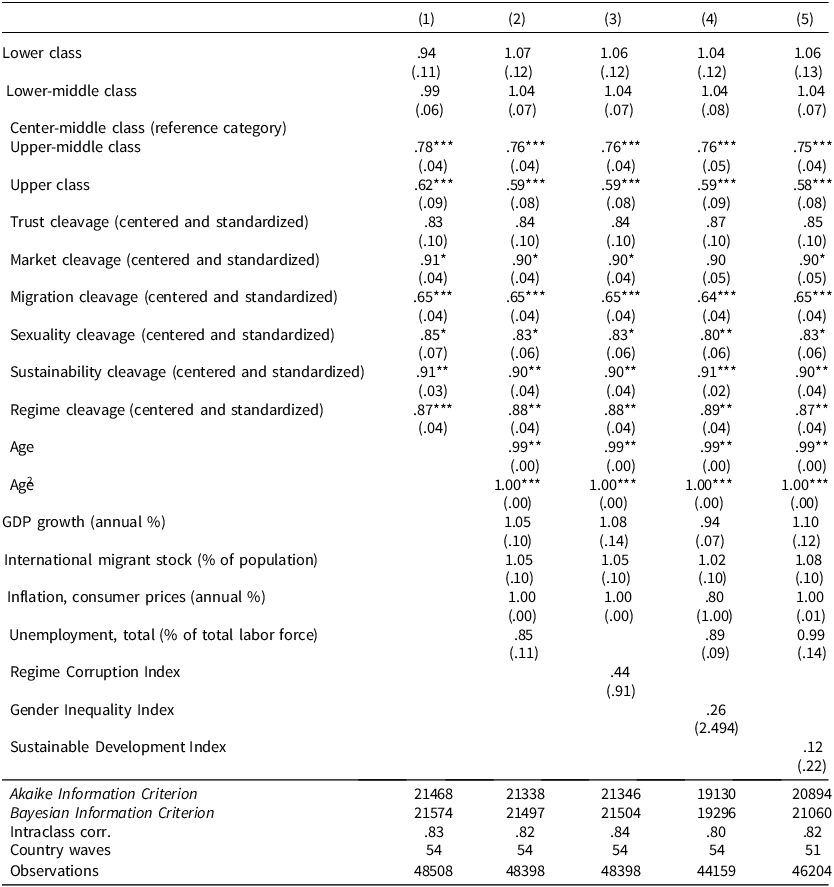
We apply multilevel models to figure out whether extremity in individuals’ cleavage positions operates as a micro-foundation of electorates’ RWP vote across the boundaries of national electorates, even under control of country-level differences that should affect the electorates’ base levels of RWP support. These country-level characteristics include countries’ migration stocks (i.e., share of migrants among the residential population) and standard indicators of policy performance, including economic growth, unemployment rates, price inflation, and corruption (Coppedge et al., Reference Coppedge2023; World Bank Group, 2025). Moreover, we include two distinct measures of countries’ performance on the sexuality and sustainability domains: the Gender Inequality Index (United Nations Development Program, 2019) and the Sustainable Development Index (Hickel, Reference Hickel2020).Footnote 18 However, the simultaneous inclusion of these two indices, as well as the simultaneous inclusion of our measures for unemployment and corruption, infuses multicollinearity biases into the models. To avoid this problem, we include these country-level characteristics in separate models (Models 3–5 in Table 1).
Explaining RWP vote

Odds ratios (exponentiated coefficients); cluster-robust standard errors in parentheses; *p < 0.05, **p < 0.01, ***p < 0.001.
As concerns the role of migration stocks, one can have conflicting assumptions: is it high or low migration stocks that elevate countries’ base level of RWP support? Examples exist for both possibilities. France contains a large migrant population and shows a high level of electoral support for the Rassemblement National, while Poland (before the Ukraine war) includes a tiny migrant population combined with a high level of electoral support for PiS. As concerns indicators of policy performance (e.g., growth, unemployment, inflation) and systemic functioning (e.g., corruption), the expectation is clearer: evidence for malperformance and malfunctioning should elevate overall electoral support for RWP parties. Overall, however, we are not primarily interested in the specific RWP effects of these country-level characteristics as such. Instead, we are interested in whether and to what extent the supposed micro-foundations of electoral RWP support operate uniformly across country-level differences in migration stocks, policy performance, and system functioning.
Looking at the evidence, the odds ratios in Table 1 illustrate that citizens in privileged upper-middle and upper class positions exhibit 25%–40% lower odds to vote for RWP parties than voters in the central-middle class (i.e., the reference category). But people in lower-middle and lower class positions are hardly less likely to vote for RWP parties than those in the central-middle class. This is an important indication that RWP support is by no means limited to socio-economically vulnerable electoral strata but, instead, has made broad inroads into the center of society.
Looking at voters’ ideological cleavage positions, more extreme rightist positions on the market cleavage are associated with slightly higher odds to vote for RWP parties. Most importantly, more extreme nativist positions on the migration cleavage strongly increase the odds of the RWP vote. In numbers, citizens who score one standard deviation below the national mean in openness to immigrants are 35% more likely to vote for RWP parties.Footnote 19
More generally, more extreme conservative positions on all four ideological cleavages are associated with a higher likelihood to vote for RWP parties. Likewise, a more extreme system aversion on the trust cleavage (i.e., more alienation) and on the regime cleavage (i.e., more authoritarianism) is strongly associated with a higher likelihood for an RWP vote. Overall, the strongest micro-foundations of RWP votes across European democracies are more extreme nativist positions on the migration cleavage and more extreme system aversion on the trust and regime cleavages.Footnote 20
The observation that country-level differences in migration stocks and policy performance show no significant RWP vote impact on their own is somewhat surprising but should not bother us here. The key point is that these country-level differences do not disturb the uniform impact of the RWP vote’s micro-foundations. In other words, the micro-foundations function in a generic manner across the country-level differences between the EU’s national electorates.
Conclusion
Multilevel evidence from EVS/WVS data across the EU-27 electorates confirms that individuals’ inclination to cast a vote for their country’s major RWP party has a significant, albeit statistically weak, micro-foundation in socio-economic vulnerabilities. Indeed, although members of the least vulnerable upper-middle and upper classes are less likely to vote for RWP parties than the lower, lower-middle, and center-middle classes, these differences are small in scope. More importantly, RWP vote inclinations are anchored in particular psychological orientations, including a general system aversion manifest in distrust in democracies’ political institutions (i.e., trust cleavage) and support for authoritarian leadership at the expense of democratic governance (i.e., regime cleavage). The psychological anchors of RWP support also involve a reactionary conservative mainstream-distance on post-industrial ideological cleavages centering on sexuality (i.e., patriarchal gender and fertility norms instead of sexual self-determination), sustainability (i.e., job preservation instead of environmental protection), and—more than anything else— migration (i.e., rejection instead of inclusion of immigrants). These micro-foundational anchors of RWP support are uniform in the sense that they operate in the same fashion across country-level differences in migration stocks and policy performance on matters of economic prosperity and physical security.
In the aggregate, electorates’ overall conservative extremism across the three post-industrial ideological cleavages associates just significantly and weakly with the same electorates’ overall socio-economic vulnerability (r = .28, p = .010) across 84 country-by-time units.Footnote 21 Electorates’ overall conservative extremism, in turn, associates strongly with their overall system aversion on the trust and regime cleavages combined (r = .86, p < .001, N = 101).
These findings echo the political sociology/psychology literature in this field on a broader evidence base and in a more nuanced manner as concerns the specificities regarding socio-economic inequalities and ideological as well as systemic cleavages. The findings are also compatible with the democracy falling narrative.
But compatibility is not confirmation. Specifically, evidence about socio-economic and politico-psychological anchors of RWP support, no matter how strong, does by no means prove the claim that the explanation of the massive increase in RWP support roots in these very anchors. The latter would be the case, if—and only if—the characteristics constituting these anchors had been rising as well. Indeed, to confirm the democracy falling narrative, there needs to be a demonstrable growth in the electorates’ socio-economically vulnerable class segments as well as in these segments’ conservative extremism and systemic aversion. And this growth must have happened in such orchestration that a dynamic association between the rise in electorates’ RWP votes, on the one hand, and an expansion of these electorates’ conservative extremism and systemic aversion, on the other, can be established. Yet, such a dynamic relationship is inexistent. The rise of the EU electorates’ RWP vote simply does not map on a corresponding increase in these electorates’ conservative extremism and system aversion. The exact opposite is the case: both conservative extremism and system aversion shrank, even among the electorates’ socio-economically most vulnerable lower and lower-middle class segments.Footnote 22 Therefore, class polarization over ideological and systemic political cleavages shows no sign of a generic increase either. All of this contradicts the key trend assumptions of the democracy falling narrative.
To defend the democracy falling narrative against our non-evidence for positional polarization, one might argue that—while positional distances might not have increased—the emotional salience of these distances might very well have grown. Plausibly, an increase in emotional salience has fueled “affective” polarization: even though voters’ cleavage positions have not grown more distant, voters in different positional camps adopted more hostile views of each other.
It is a noteworthy limitation of our data that we have no direct measure of either emotional saliency or affective polarization. Hence, more research in this area is needed. However, the argument that affective polarization has increased in spite of non-existing positional polarization is inherently implausible. Indeed, if voters become emotionally more adamant about their cleavage positions and begin to feel more hostile toward voters with different positions, an urge for positional distancing would follow suit as an emotional stabilization mechanism to cement contrast to the opposite camp. The inevitably resulting positional radicalization would manifest itself in positional distancing at the group level and positional extremity at the individual level. The data for twenty-seven EU electorates over a timespan of twenty-five years provide no evidence for this. Assuming that affective and positional distancing operate in symbiosis, non-evidence for growing positional distancing strongly suggests that affective distancing cannot have grown dramatically either. But as said, more research on this issue is needed.
Taking these pieces together, the tendency of the democracy falling narrative to bash voters for the electoral rise of RWP is mistaken. If the problems of democracy that explain the electoral success of RWP do not primarily reside in extremist and polarizing ideological shifts on the side of the electorates, these problems must root somewhere else. And, if in democracy’s demand-supply relationship between public opinion and public policy, the demand side cannot be identified as the main source of the problem, we logically turn to the supply side as the location of this “somewhere else.”
Although this is speculation, our suspect is the academization of the political and media elite. With 90% and more of these elites holding a university degree, certain cartel tendencies kicked in through which parties and the media—including those on the center-right side of the spectrum—implement more liberal-progressive policies on migration, sexuality, and sustainability issues than their clienteles in the electorate support. The accruing representation deficits became visible in declining voter turnout, reflecting citizens’ emigration into the growing camp of nonvoters.Footnote 23 Since nonvoters do not matter in electoral competition, their ideologically conservative preferences could be ignored, thus reinforcing existing representation gaps, with the result of growing frustration and anger in the nonvoter camp. As long as the established parties and media exercised a recruitment and agenda-setting monopoly, which decided who had access to the political arena and what could be said in public discourse, the growing nonvoter camp posed no problem to the established party and media cartels. With the occurrence of social media, the monopolies of the pre-RWP cartel era have been radically broken, and RWP parties now articulate (in a vulgar language that was previously banned under journalistic standards) the concerns of large segments of the nonvoter camp (see Schäfer et al., Reference Schäfer, Zürn and Curtis2023; Peffley and Rohrschneider, Reference Peffley, Rohrschneider, Faas, Huber, Krewel and Roßteutscher2023).
No matter how despicable one might find the language and policy positions of RWP parties, as long as democracies’ institutional guardrails are strong enough to block RWP parties’ attacks on liberal constitutional principles, the electoral success of these parties might simply be a sign that democracies’ seismographic function to indicate representation deficits does actually work. Electoral RWP success also functions as a display of how much the liberal-progressive agenda of an academically educated elite cartel overwhelms sizeable voter segments with more traditional and conservative positions.
Speaking about knowledge gaps, the biggest shortcoming in existing cross-national data collections is the lack of panel studies in which the same individuals are interviewed repeatedly. In the absence of such data, dynamic public opinion/public policy relationships can only be established in the aggregate but not among individuals. From both a multilevel and a life course perspective, this is a serious limitation in studying societies’ politico-psychological dynamics. It would be easy to overcome this shortcoming if the ESS, EVS/WVS, and other repeated cross-national data collections ended their interviews with a question asking respondents if they are ready to leave their email address for another survey in the future.
Supplementary material
The supplementary material for this article can be found at https://doi.org/10.1017/S1755773925100209.
Data availability statement
Data is available on request. Please contact the authors.
Funding statement
This article has been prepared with the support of the TRUEDEM “Trust in European Democracies” research project funded under the European Union’s Horizon research and innovation program (grant agreement no. 101095237). Views and opinions expressed are those of the authors only. Neither the European Union nor the granting authority can be held responsible for them.
Competing interests
The author(s) declare no conflicts of interest with respect to the research, authorship, and/or publication of this article.




 Open access

