


Introduction
There is an increasing interest in understanding the processes through which humans conceptualize and prepare for interaction with intelligent technologies (Brougham & Haar, Reference Brougham and Haar2018; Zanatto, Bifani & Noyes, Reference Zanatto, Bifani and Noyes2024). In recent years, the rapid evolution of artificial intelligence (AI) has reshaped modern workplaces (Hossain, Fernando & Akter, Reference Hossain, Fernando and Akter2025), particularly in areas requiring creativity and innovative problem-solving (Amankwah-Amoah, Abdalla, Mogaji, Elbanna & Dwivedi, Reference Amankwah-Amoah, Abdalla, Mogaji, Elbanna and Dwivedi2024; Ayoko, Reference Ayoko2021). A 2024 McKinsey survey indicates that 72% of organizations have adopted AI, up from approximately 50% in previous years (McKinsey & Company, 2024). In addition, research suggests that the creative sector has been particularly proactive in exploring AI technologies (Anantrasirichai & Bull, Reference Anantrasirichai and Bull2022; Sajjad, Reference Sajjad2024). For instance, a study by Adobe found that 90% of creators believe AI tools can help them save time and money by relieving them of menial tasks and supporting their creative brainstorming process (Adobe, 2024). This highlights the growing role of AI in shaping expectations surrounding cognitive efficiency and innovation potential (Füller, Tekic & Hutter, Reference Füller, Tekic and Hutter2024).
Generative AI involves using tools such as ChatGPT, Google Gemini, and Microsoft Copilot to create new content and ideas including text, images, videos, audio, and computer code in response to user prompts (Fui-hoon Nah, Zheng, Cai, Siau & Chen, Reference Fui-hoon Nah, Zheng, Cai, Siau and Chen2023). It is swiftly becoming a central focal point across industries including design, advertising, and technology, offering anticipated capabilities ranging from automating routine tasks to facilitating idea generation and creative experiences (Ayoko, Reference Ayoko2021; Gujar & Panyam, Reference Gujar and Panyam2024).
However, despite the impressive potential of generative AI in creative domains, the mechanisms driving individuals’ psychological readiness and cognitive acceptance of these tools are not well understood. In addition, concerns are emerging regarding a possible psychological overreliance on AI, which could diminish individual agency and self-regulation in the creative process (Galindo-Domínguez, Delgado, Sainz-de-la-maza & Etxabe, Reference Galindo-Domínguez, Delgado, Sainz-de-la-maza and Etxabe2026). This points to an important gap in the current literature. To help fill this gap, the current study explores the following research question: What proactive personal self-regulatory resources might serve to enhance an individual’s psychological readiness and intention to adopt generative AI within creative endeavors? Generative AI acceptance is defined as one’s beliefs and intentions to use AI (Yilmaz, Yilmaz & Ceylan, Reference Yilmaz, Yilmaz and Ceylan2023). As AI becomes increasingly prominent in ideation contexts, understanding how technological intentionality affects the dynamic between anticipated machine support and human initiative becomes critical, especially because self-regulatory behaviors remain central to maintaining personal agency in creative work (Luthans, Reference Luthans2011). Self-leadership is conceptualized as a personal self-regulatory resource with potential for enabling individuals to actively engage in the creative process (Knotts et al., Reference Knotts, Houghton, Pearce, Chen, Stewart and Manz2022). Prior research suggests that self-leadership encompasses self-regulatory strategies, such as self-goal setting, self-observation, and self-reward, which collectively empower individuals to maintain motivation, demonstrate resilience, and engage deeply with creative tasks (DiLiello & Houghton, Reference DiLiello and Houghton2006; Neck & Houghton, Reference Neck and Houghton2006; Ghosh, Reference Ghosh2015).
In the current study, we explore self-leadership as a possible psychological catalyst for enhancing generative AI acceptance and subsequently creative processes at work.
Specifically, we conceptualize generative AI acceptance as a proximal cognitive–intentional outcome of self-leadership and as a proactive expression of self-regulation. Traditionally, self-leadership has facilitated proactive behaviors crucial for navigating complex problem-solving and iterative idea development (Amabile, Reference Amabile1983; Zhang & Bartol, Reference Zhang and Bartol2010a). Yet, the advent of generative AI tools capable of producing novel content, such as language, images, or designs, introduces new layers of complexity to this cognitive dynamic (Ratten, Reference Ratten2024). Traditional perspectives on AI-augmented creative contexts often stress AI’s potential to relieve lower-level cognitive tasks, allowing individuals to focus on higher-order creative thinking (Amabile & Pratt, Reference Amabile and Pratt2016; Boden, Reference Boden2016). Thus, the cognitive orientation toward adopting AI could either complement or challenge traditional self-leadership strategies (Zhou, Xiang & Xie, Reference Zhou, Xiang and Xie2025). For some, an open orientation toward AI might support self-regulation by providing real-time feedback or managing routine tasks. For others, an excessive cognitive reliance on AI could undermine active self-regulation, leading to stress, reduced personal initiative, and a more passive orientation toward creative work (Galindo-Domínguez et al., Reference Galindo-Domínguez, Delgado, Sainz-de-la-maza and Etxabe2026).
Central to this exploration is the concept of creative self-efficacy, defined as an individual’s belief in their ability to achieve creative outcomes (Tierney & Farmer, Reference Tierney and Farmer2002). Creative self-efficacy is consistently recognized as a key mediating variable that explains how self-leadership translates into creative behavior (Chughtai & Khalid, Reference Chughtai and Khalid2022; Khan, Li, Chughtai, Mushtaq & Zeng, Reference Khan, Li, Chughtai, Mushtaq and Zeng2023). Individuals with high creative self-efficacy are more likely to engage in and persist through creative tasks, even in the face of challenges, due to the confidence necessary to navigate complex problems (Bandura, Reference Bandura1997; Gong, Huang & Farh, Reference Gong, Huang and Farh2009). This confidence solidifies commitment to goals and the ability to execute creative strategies. However, the role of creative self-efficacy becomes more intricate when introducing technology acceptance into the causal chain. In this study, we propose that generative AI acceptance acts as a first-stage mediator, influenced by self-leadership. This intentionality toward adopting AI tools may enhance an individual’s confidence in their ability to generate novel and valuable ideas (creative self-efficacy), which then increases engagement in creative tasks.
The purpose of this study is to develop and test a hypothesized serial mediation model of the relationship between self-leadership, generative AI acceptance, and creative self-efficacy within creative work contexts. Specifically, we examine how generative AI acceptance – as an expression of technological readiness – serves as a vital upstream mechanism that enhances creative self-efficacy, which subsequently drives creative process engagement. This study contributes to the literature by probing the cognitive mechanisms through which individuals prepare to share creative contexts with intelligent machines. By exploring these relationships, this research challenges the oversimplified view of AI as merely a displacement tool and highlights how technological readiness and intention can serve as psychological means for augmenting human creative work processes.
Theoretical framework and model development
In the following sections, we review the existing literature while using social cognitive theory (SCT; Bandura, Reference Bandura1986) and the job demands–resources theory (JD-R theory; Bakker, Demerouti & Sanz-Vergel, Reference Bakker, Demerouti and Sanz-Vergel2014, Reference Bakker, Demerouti and Sanz-Vergel2023; Demerouti, Bakker, Nachreiner & Schaufeli, Reference Demerouti, Bakker, Nachreiner and Schaufeli2001) as our primary theoretical frames for developing and presenting a hypothesized conceptual model. This model maps the relationships between self-leadership, generative AI acceptance, creative self-efficacy, and creative process engagement within work environments defined by the availability of AI tools. Within this conceptual framework, illustrated in Fig. 1, self-leadership serves as the independent variable, facilitating effective self-regulatory practices, including self-goal setting, self-regulation, and self-monitoring, that individuals employ to sustain creativity (Knotts et al., Reference Knotts, Houghton, Pearce, Chen, Stewart and Manz2022; Manz, Reference Manz1986). These self-leadership strategies provide individuals with a proactive structure for approaching creative work, enhancing both their ownership and accountability over creative tasks (Houghton & Neck, 2006).
Hypothesized serial mediation model.
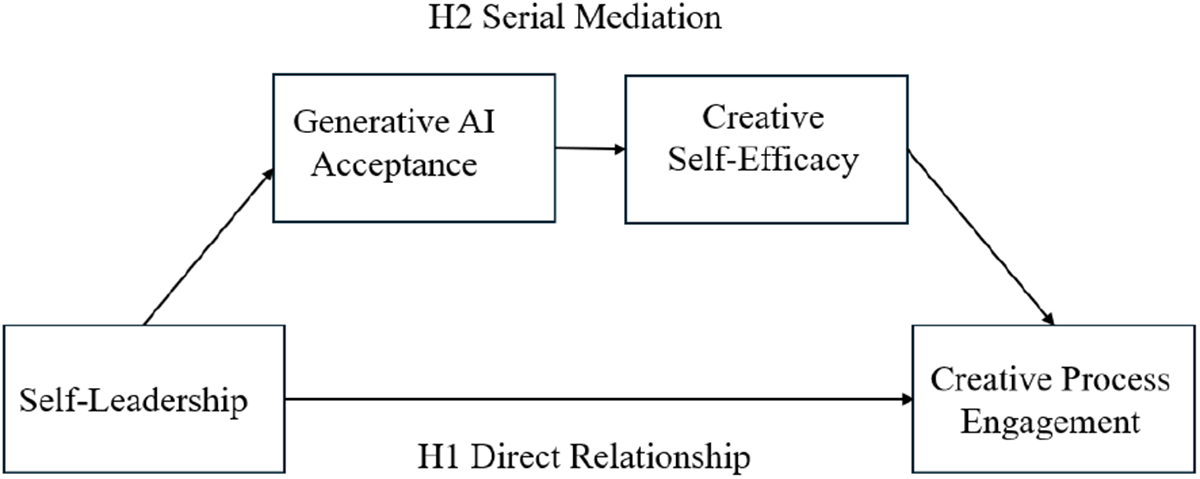
Figure 1 Long description
The diagram shows a conceptual model with labeled components and connections. The components are: Self-Leadership, Generative AI Acceptance, Creative Self-Efficacy and Creative Process Engagement. Self-Leadership connects directly to Creative Process Engagement, labeled as H1 Direct Relationship. Additionally, Self-Leadership connects to Generative AI Acceptance, which then connects to Creative Self-Efficacy, leading to Creative Process Engagement. This sequence is labeled as H2 Serial Mediation.
Self-leadership and creative process engagement
Self-leadership, defined as a proactive process through which individuals influence and motivate themselves to pursue personal and professional goals (Manz, Reference Manz1986; Neck & Houghton, Reference Neck and Houghton2006), serves as an important personal resource for fostering creativity within dynamic and uncertain work environments (DiLiello & Houghton, Reference DiLiello and Houghton2006; Ghosh, Reference Ghosh2015; Knotts et al., Reference Knotts, Houghton, Pearce, Chen, Stewart and Manz2022). Traditional self-leadership strategies such as self-goal setting, self-observation, and self-reward enable individuals to structure their creative efforts, remain resilient in the face of challenges, and sustain motivation throughout creative tasks (DiLiello & Houghton, Reference DiLiello and Houghton2006). Meta-analyses have shown self-leadership to be a strong predictor of numerous individual outcomes including task performance, self-efficacy, and job attitudes such as job satisfaction and work engagement (Harari, Williams, Castro & Brant, Reference Harari, Williams, Castro and Brant2021; Knotts et al., Reference Knotts, Houghton, Pearce, Chen, Stewart and Manz2022). Importantly, Knotts et al. (Reference Knotts, Houghton, Pearce, Chen, Stewart and Manz2022) found that the effect size between self-leadership and creativity/innovation (ρ = .49) was substantially stronger than other outcomes including task performance (ρ = .28), suggesting a key role for self-leadership strategies in enhancing individual creativity. Although the term creativity can broadly be used to describe both creative processes and creative outcomes (Shalley & Zhou, Reference Shalley, Zhou, Zhou and Shalley2008), creativity is more often defined as an outcome involving the production of novel and useful ideas (Hennessey & Amabile, Reference Hennessey and Amabile2010). In contrast, creative process engagement is defined as the cognitive process through which creativity happens (Zhang & Bartol, Reference Zhang and Bartol2010a). Creative process engagement involves three distinct creativity-related cognitive phases: problem identification, information searching and encoding, and idea and alternative generation (Zhang & Bartol, Reference Zhang and Bartol2010a). Empirical research suggests that creative process engagement is a primary antecedent of employee creativity (Zhang & Bartol, Reference Zhang and Bartol2010a), with employee creative performance mediating the relationship between creative process engagement and job performance (Zhang & Bartol, Reference Zhang and Bartol2010b). Creative process engagement has been shown to be especially important in contexts requiring innovation and proactive cognitive resources (Raihan & Uddin, Reference Raihan and Uddin2023). For example, Cheng and Yang (Reference Cheng and Yang2019) found that creative process engagement was related to new product development speed and new product performance in a sample of 245 companies from high-tech industries in China.
Although no studies to date have explored the relationship between self-leadership and creative process engagement, researchers have suggested that self-leadership may play a crucial role in shaping creative process engagement (Yang, Xie, Tang, Hou & Ming, Reference Yang, Xie, Tang, Hou and Ming2025). This supposition is supported by both theoretical and empirical evidence. JD-R theory (Bakker et al., Reference Bakker, Demerouti and Sanz-Vergel2014, Reference Bakker, Demerouti and Sanz-Vergel2023; Demerouti et al., Reference Demerouti, Bakker, Nachreiner and Schaufeli2001) posits that employees are influenced by both job demands (job aspects requiring sustained emotional, physical, or cognitive effort) and job resources (job or personal factors that can help achieve work goals, reduce job demands, or enhance individual development). Importantly, JD-R theory positions work engagement as a proximal outcome of job resources that mediates their effects on distal outcomes such as job performance (Bakker et al., Reference Bakker, Demerouti and Sanz-Vergel2014).
Self-leadership is often conceptualized as a cognitive job resource that can facilitate important individual outcomes (Maykrantz, Langlinais, Houghton & Neck, Reference Maykrantz, Langlinais, Houghton and Neck2021; Neck, Houghton, Sardeshmukh, Goldsby & Godwin, Reference Neck and Houghton2013) such as work engagement and work intensity (Bäcklander, Rosengren & Kaulio, Reference Bäcklander, Rosengren and Kaulio2021; Knotts & Houghton, Reference Knotts and Houghton2021; van Dorssen‐boog, van Vuuren, de Jong & Veld, Reference van Dorssen‐boog, van Vuuren, de Jong and Veld2021). For instance, Gomes, Curral and Caetano (Reference Gomes, Curral and Caetano2015) found that work engagement mediated the relationship between self-leadership and individual innovation. Consequently, and in harmony with JD-R theory, it seems reasonable to suggest that self-leadership will be positively related to creative process engagement, a specific type of cognitive engagement essential in creative work contexts.
Tangential empirical evidence adds weight to these theoretical arguments. For example, Henker, Sonnentag and Unger (Reference Henker, Sonnentag and Unger2015) provided support for a promotion focus as an antecedent of creative process engagement. Regulatory focus theory (Higgins, Reference Higgins2012) contends that a promotion focus involves a motivation to attain desirable end-states, while a prevention focus entails the motivation to avoid undesirable end-states. Research findings have shown a positive relationship between promotion focus and self-leadership’s behavior-focused strategies (Lin, Reference Lin2017). Similarly, Mahmood, Uddin and Fan (Reference Mahmood, Uddin and Fan2019) reported that intrinsic motivation, a key conceptual underpinning of self-leadership (Manz, Reference Manz1986; Neck & Houghton, Reference Neck and Houghton2006), serves as a primary predictor of creative process engagement. Accordingly, based on these theoretical and empirical lines of reasoning, we advance:
Hypothesis 1: Self-leadership is positively related to creative process engagement.
Mediating mechanisms: generative AI acceptance and creative self-efficacy
A mediating mechanism refers to a generative underlying process, explanatory variable, or pathway through which an independent variable (X) exerts its influence on a dependent variable (Y) (Baron & Kenny, Reference Baron and Kenny1986). Whereas a main effect explores whether two variables are related, a mediating mechanism explains how and why that relationship occurs by capturing the causal transmission between them (Hayes, Reference Hayes2022). In the current study, we conceptualize generative AI acceptance and creative self-efficacy as vital mediating mechanisms that represent the generative process through which individual self-leadership transmits its effect to creative process engagement. We define generative AI acceptance as beliefs and intentions to use AI, rooted in perceptions of usefulness and ease of use (Yilmaz et al., Reference Yilmaz, Yilmaz and Ceylan2023). Acceptance reflects perceptions of usefulness and effort expectancy that motivate individuals’ intentions to incorporate AI into their creative processes (Venkatesh, Morris, Davis & Davis, Reference Venkatesh, Morris, Davis and Davis2003; Venkatesh, Thong & Xu, Reference Venkatesh, Thong and Xu2012). Kim, Kim, Kim and Lee (Reference Kim, Kim, Kim and Lee2025) showed that perceived ease of use and perceived usefulness are positively related to generative AI usage intentions, while Huy, Nguyen, Vo-thanh, Thinh and Thi Thu Dung (Reference Huy, Nguyen, Vo-thanh, Thinh and Thi Thu Dung2024) found that performance expectancies (perceived usefulness) and effort expectancies (perceived ease of use) resulted in greater actual use of ChatGPT. In our hypothesized model, we conceptualize AI acceptance as a self-leadership-driven cognitive–intentional state that initiates the efficacy–engagement pathway. Founded on SCT’s emphasis on self-efficacy and self-regulation, we view AI acceptance as a proximal adoption orientation (beliefs/intentions) stemming from self-leadership. Consequently, generative AI acceptance is not treated as a boundary condition that moderates whether self-leadership translates into creative engagement; rather, we position AI acceptance as a direct and immediate cognitive–intentional outcome of self-leadership.
Creative self-efficacy refers to a person’s belief in their ability to produce creative outcomes (Tierney & Farmer, Reference Tierney and Farmer2002). As a central component of SCT, self-efficacy influences motivation and persistence in creative tasks (Bandura, Reference Bandura1997). High creative self-efficacy enables individuals to engage deeply in creative tasks and remain resilient through iterative problem-solving (Tierney & Farmer, Reference Tierney and Farmer2002). This confidence facilitates self-leadership’s influence on creativity by reinforcing individuals’ belief in their ability to overcome obstacles and produce novel solutions (Gong et al., Reference Gong, Huang and Farh2009). In work environments characterized by the availability of generative AI, creative self-efficacy influences how individuals orient themselves toward AI tools. Those with high creative self-efficacy are more likely to view AI as a complementary asset rather than a replacement for their creative abilities (Dwivedi et al., Reference Dwivedi, Hughes, Ismagilova, Aarts, Coombs, Crick and Williams2021; Gong et al., Reference Gong, Huang and Farh2009). This confidence allows individuals to maintain a mindset of autonomy and focus on higher-order cognitive tasks, even with anticipated AI-generated suggestions available. Conversely, those with lower self-efficacy may anticipate a psychological dependency on AI, reducing active cognitive engagement and limiting the effectiveness of self-leadership strategies (Glikson & Woolley, Reference Glikson and Woolley2020). Recent findings highlight the importance of fostering creative self-efficacy in contexts where AI tools are prominent. In highly automated environments, self-efficacy enables individuals to balance the prospective leverage of AI support with the preservation of personal agency to achieve creative outcomes (Dwivedi et al., Reference Dwivedi, Hughes, Ismagilova, Aarts, Coombs, Crick and Williams2021). Brynjolfsson and McAfee (Reference Brynjolfsson and McAfee2014) argue that teams with high collective self-efficacy can conceptualize AI’s cognitive support more effectively, viewing it as a tool to enhance – not substitute – creative capabilities.
Self-leadership strategies help individuals maintain cognitive control over their work, ensuring that personal initiative remains central to creative processes. Neck and Houghton (Reference Neck and Houghton2006) characterize self-leadership as an individual competency, one that empowers individuals to remain self-motivated and resilient. Because generative AI tools provide real-time feedback, automate task management, and enhance cognitive capabilities, they may increasingly become an important contextual factor in how self-leadership is enacted in practice. An open orientation toward AI may complement self-leadership by mapping out a path to relieve individuals of repetitive cognitive demands, allowing them to focus on higher-level creative activities. However, as Stewart et al. (Reference Stewart, Courtright and Manz2019) caution, such tools must be approached in ways that preserve autonomy and personal agency. The challenge lies in ensuring that self-leadership retains its effectiveness as AI takes a more prominent role in the cognitive landscape of creative workflows.
Originally, self-leadership was conceptualized as a set of individual competencies to help people regulate their behavior and mindset to optimize performance (Manz, Reference Manz1986). Over time, it expanded to include cognitive strategies, such as constructive thought pattern management, which enable individuals to remain solution-focused and actively engaged (Manz & Sims, Reference Manz and Sims2001). Self-leadership aligns closely with SCT’s emphasis on environmental supports in self-regulated behavior (Bandura, Reference Bandura1986). Within this theoretical context, AI acceptance can be seen as a cognitive–intentional outcome shaped by self-leadership and, in turn, as an internal contextual support that fosters efficacy beliefs and enhances creative persistence.
Generative AI acceptance within creative work may thus serve as a cognitive–intentional extension of self-leadership, best understood as an intermediate mechanism through which proactive individuals enhance their perceived capacity for creativity. Intentionally accepting and intending to use AI can be seen as an expression of self-leadership – translating strategic self-regulation into a clear adoption orientation. This intentional acceptance of AI may, in turn, strengthen individuals’ belief in their creative capacity by establishing anticipated gains in productivity, ideation quality, or task mastery. Therefore, generative AI acceptance can be conceptualized as a mediating bridge that links self-leadership to enhanced creative self-efficacy.
Moreover, generative AI provides a perceived source of cognitive and behavioral support that individuals can strategically plan to integrate into their creative endeavors. When intentionally adopted as a cognitive orientation, it allows self-leaders to plan the reallocation of mental effort from repetitive tasks to higher-order ideation and problem-solving. This deliberate cognitive alignment with AI strengthens the benefits of self-leadership by amplifying creative focus and reducing task-related friction. However, if individuals intend to rely too heavily on AI without exercising self-regulation, it may diminish personal agency and reduce the depth of creative engagement. Thus, the effectiveness of an individual’s orientation toward AI is closely tied to how they frame its use within broader self-leadership strategies that sustain autonomy and active involvement. While AI tools have the potential to streamline cognitive processes, such as providing feedback, automating routine tasks, and supporting ideation, their impact on creativity largely depends on how much cognitive effort and control individuals intend to maintain. When approached strategically, an open orientation toward AI tools can complement self-leadership practices by offering anticipated cognitive support, enabling individuals to focus their attention on more complex, creative tasks. In such cases, AI is conceptualized as an extension of the cognitive capabilities of individuals, allowing them to stay engaged in the creative process while preserving their autonomy and motivation (Boden, Reference Boden2016; Brynjolfsson & McAfee, Reference Brynjolfsson and McAfee2014).
Theoretical support is available to bolster these logical arguments. SCT (Bandura, Reference Bandura1986) provides a comprehensive theoretical framework for understanding the mediating role of generative AI acceptance and creative self-efficacy in the relationship between self-leadership and creative process engagement. SCT posits that self-efficacy significantly affects individuals’ motivation, resilience, and persistence in tackling challenging tasks (Bandura, Reference Bandura1997). SCT emphasizes that behavior is a function of both internal beliefs, such as self-efficacy, and external environmental factors, such as AI tools, which work together dynamically to shape creative engagement. In creative contexts defined by the presence of AI, SCT suggests that individuals with high self-efficacy are more likely to view AI as a supportive resource rather than a replacement for their agency. This aligns with the interaction between self-efficacy and environmental factors, where individuals actively plan to leverage AI outputs instead of relying passively on them (Oldham & Cummings, Reference Oldham and Cummings1996). This perspective allows them to strategically position AI to extend their cognitive capacity without undermining their control or ownership over creative outputs (Dwivedi et al., Reference Dwivedi, Hughes, Ismagilova, Aarts, Coombs, Crick and Williams2021; Gong et al., Reference Gong, Huang and Farh2009).
Furthermore, individuals rely on both automatic, heuristic-based thinking and deliberate, systematic thinking when solving complex problems (Evans & Stanovich, Reference Evans and Stanovich2013). In generative AI-supported tasks, individuals with strong self-leadership may adopt systematic approaches that involve critically evaluating and strategically planning to iterate AI-generated content. Those with lower levels of self-leadership may fall into more heuristic patterns, intending to rely uncritically on AI output. This divergence underscores the importance of cognitive flexibility when forming an orientation toward AI – those who thoughtfully and proactively plan to engage with AI can transform it into a tool that reinforces creative self-efficacy rather than replacing personal judgment. These cognitive processes are central to understanding the functional role of generative AI acceptance as a mediator. When an open orientation toward AI supports deeper engagement by scaffolding deliberative thinking, it fosters the development of confidence and creative persistence. Conversely, when an orientation toward AI enables shortcut thinking without reflection, it may undermine creative self-efficacy by displacing agency. This suggests that AI tools are not neutral in the creative process – their anticipated effect depends on the user’s regulatory approach.
In addition, JD-R theory (Demerouti et al., Reference Demerouti, Bakker, Nachreiner and Schaufeli2001) posits that job resources like generative AI can enhance motivation when positioned to offset high job demands, such as cognitive complexity or time constraints. For individuals high in the personal cognitive resource of self-leadership, the availability of AI serves as another potential resource that they may proactively choose to adopt to amplify their performance. As a result, the acceptance of AI becomes not just an intention to use a tool, but a cognitive–intentional manifestation of self-leadership itself – one that builds the confidence necessary for sustained creative engagement. In this framing, generative AI functions as an anticipated resource embedded in the motivational pathway from self-regulation to self-efficacy to engagement. Taken together, these theoretical frameworks support a sequential logic: individuals high in self-leadership are more likely to strategically develop an orientation to integrate AI (as both a resource and thinking aid), which then enhances their creative self-efficacy and ultimately leads to deeper creative process engagement. Hence, based on these logic- and theory-based assertions, we hypothesize:
Hypothesis 2: Generative AI acceptance and creative self-efficacy serially mediate the positive relationship between self-leadership and creative process engagement.
Method
Sample and procedures
Participants were recruited via Prolific, an online platform recognized for providing access to a diverse and high-quality sample of professionals across different creative industries such as marketing, design, and technology. This broad sampling method allows the study to reflect a range of contexts in which generative AI tools, such as ChatGPT and Google Gemini, are utilized. Prolific was chosen not only for its diversity but also for its rigorous data quality controls (Douglas, Ewell & Brauer, Reference Douglas, Ewell and Brauer2023). The platform employs mechanisms to ensure valid responses, such as attention checks, demographic verification, and prescreening for participant experience. Prolific also offers transparency in its recruitment process, allowing for the targeting of specific participant profiles. In the current study, we screened for participants using the question ‘How often a week do you use AI or tools that use AI as part of your work?’ to ensure that all participants were regular users of AI in their work.
The final sample consisted of 258 full-time employees. A total of 386 respondents initiated the survey, with 114 responses being removed from the final dataset for failing to complete the survey in its entirety (either voluntary returned through Prolific or removed in data cleaning). Subsequently, another 14 responses were removed for failing attention checks. Participants self-identified as female (n = 130, 50.4%), male (n = 125, 48.4%), and ‘other/prefer not to answer’ (n = 3, 1.2%). The participants were primarily Caucasian/White (n = 171, 66.3%), African American/Black (n = 54, 20.9%), Hispanic (n = 17, 6.6%), Asian (n = 9, 3.5%), Native American/American Indian (n = 3, 1.2%), and ‘other/prefer not answer’ (n = 4, 1.6%), with an average age of 39.66 years. A diverse range of industries was represented in the sample, with participants reporting working across 16 different trades. In these roles, participants reported utilizing AI in their work once a week (n = 40, 15.5%), 2–6 times per week (n = 99, 38.4%), every day (n = 60, 23.3%), and multiple times per day (n = 59, 22.9%).
Power analysis
As noted above, a total of 258 participants were included in the study. A statistical power analysis was conducted to determine the minimum required sample size for detecting indirect effects in the proposed serial mediation model. The analysis assumed a small-to-medium effect size (f 2 = 0.10), a significance level (α) of 0.05, and statistical power (1 − β) of 0.80, which aligns with standards in organizational behavior research (Cohen, Reference Cohen1988). Based on these parameters and using G*Power 3.1 (Faul, Erdfelder, Buchner & Lang, Reference Faul, Erdfelder, Buchner and Lang2009) for an ordinary least squares regression with three predictors, a sample size of approximately 220 was required to account for potential data loss and ensure the robustness of bootstrapping procedures. Consequently, our sample size of 258 provides adequate power for detecting both direct and indirect effects in the mediation model tested (Fritz & MacKinnon, Reference Fritz and MacKinnon2007).
Measures
Self-leadership
Self-leadership was assessed using 25 items from the Revised Self-Leadership Questionnaire developed by Houghton and Neck (Reference Houghton and Neck2002). Sample items include statements like ‘I use my imagination to picture myself performing well on important tasks’ and ‘I establish specific goals for my own performance’ and were rated on a 5-point Likert scale from ‘not at all accurate’ to ‘completely accurate’. The alpha reliability estimate for the current study was .930.
Generative AI acceptance
Generative AI acceptance was measured with 12 items from the Generative Artificial Intelligence Acceptance scale by Yilmaz et al. (Reference Yilmaz, Yilmaz and Ceylan2023), which was developed based on the unified theory of acceptance and use of technology (Venkatesh et al., Reference Venkatesh, Morris, Davis and Davis2003, Reference Venkatesh, Thong and Xu2012). Specifically, 7 items assess participants’ performance expectancy (perceptions of usefulness) and 5 items assess participants’ effort expectancy (perceptions of ease of use), which taken together indicate the participants’ intention to use AI in their work (Yilmaz et al., Reference Yilmaz, Yilmaz and Ceylan2023). Sample items include ‘I find generative AI applications useful in my daily life’ and ‘The use of generative AI applications increases my chances of achieving the things that are important to me’ and were rated on a 5-point Likert scale from ‘strongly disagree’ to ‘strongly agree’. The alpha reliability coefficient for the current data set was .941.
Creative self-efficacy
Creative self-efficacy was assessed using the 3-item Creative Self-Efficacy Scale by Tierney (Reference Tierney1997) and Tierney and Farmer (Reference Tierney and Farmer2002). This scale was based on Spreitzer’s (Reference Spreitzer1995) self-efficacy framework as well as the work of Bandura (Reference Bandura1977, Reference Bandura1986) and reflects the efficacy perceptions for being creative workwise and includes items that gauge participants’ confidence in their ability to produce creative outcomes. Participants responded on a 7-point Likert scale to statements such as ‘I feel that I am good at generating novel ideas’ and ‘I have confidence in my ability to solve problems creatively’ from ‘very strongly disagree’ to ‘very strongly agree’. The alpha reliability for this scale was .803 for the current study.
Creative process engagement
Creative process engagement was assessed using Zhang and Bartol’s (Reference Zhang and Bartol2010a) 12-item Creative Process Engagement Scale, which draws on foundational work by Amabile (Reference Amabile1983) and Reiter-Palmon and Illies (Reference Reiter-Palmon and Illies2004). This measure evaluates participants’ involvement in various creative stages, including problem identification, information searching and encoding, and idea generation. Statements like ‘I spend considerable time trying to understand the nature of the problem’ and ‘I think about the problem from multiple perspectives’ were rated on a 5-point Likert scale from ‘never’ to ‘very frequently’. Alpha reliability for this scale was .891.
Ethical approval and informed consent
Before launching this research project, we were granted ethical approval from the Institutional Review Board of our affiliated university. Prior to the data collection, we secured the participants’ informed consent, assured them that their responses would be anonymous and used in the aggregate only for research purposes, and notified them that they would be free to withdraw consent and exit the study at any time.
Results
Means, standard deviations, alpha reliabilities, and correlations for the variables are presented in Table 1. To test our hypotheses, we examined a serial multiple mediator model with self-leadership indirectly and positively predicting creative process engagement through AI acceptance and, subsequently, creative self-efficacy. Direct and indirect effects were estimated using PROCESS 4.2 (Hayes, Reference Hayes2022) using 10,000 percentile bootstrap samples with 95% confidence intervals (CIs). The significance of effects was determined by whether the bootstrapped 95% CIs excluded zero. When the confidence interval does not contain zero, the effect is statistically significant, and one can confidently conclude that the relationship or indirect path is real and did not occur by chance. In contrast, if the confidence interval contains zero then the effect is not statistically significant. Because zero is a plausible value, one cannot rule out the possibility that the true effect size is zero.
Correlation matrix, with alpha reliability, means, and standard deviations

Table 1 Long description
The table reports reliability (alpha), means, standard deviations, and correlations for self-leadership, creative self-efficacy, AI acceptance, and creative process engagement. Reliability is high for self-leadership and AI acceptance, good for creative process engagement, and acceptable for creative self-efficacy. Average scores are highest for creative self-efficacy and lowest for self-leadership, with moderate spread across measures. All correlations are positive and statistically reliable. The strongest association is between creative process engagement and creative self-efficacy, followed closely by creative process engagement with self-leadership. AI acceptance shows moderate positive relationships with self-leadership, creative self-efficacy, and creative process engagement. Correlations indicate co-occurrence and do not establish cause and effect.
** p < .001.
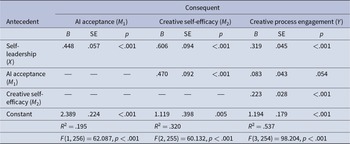
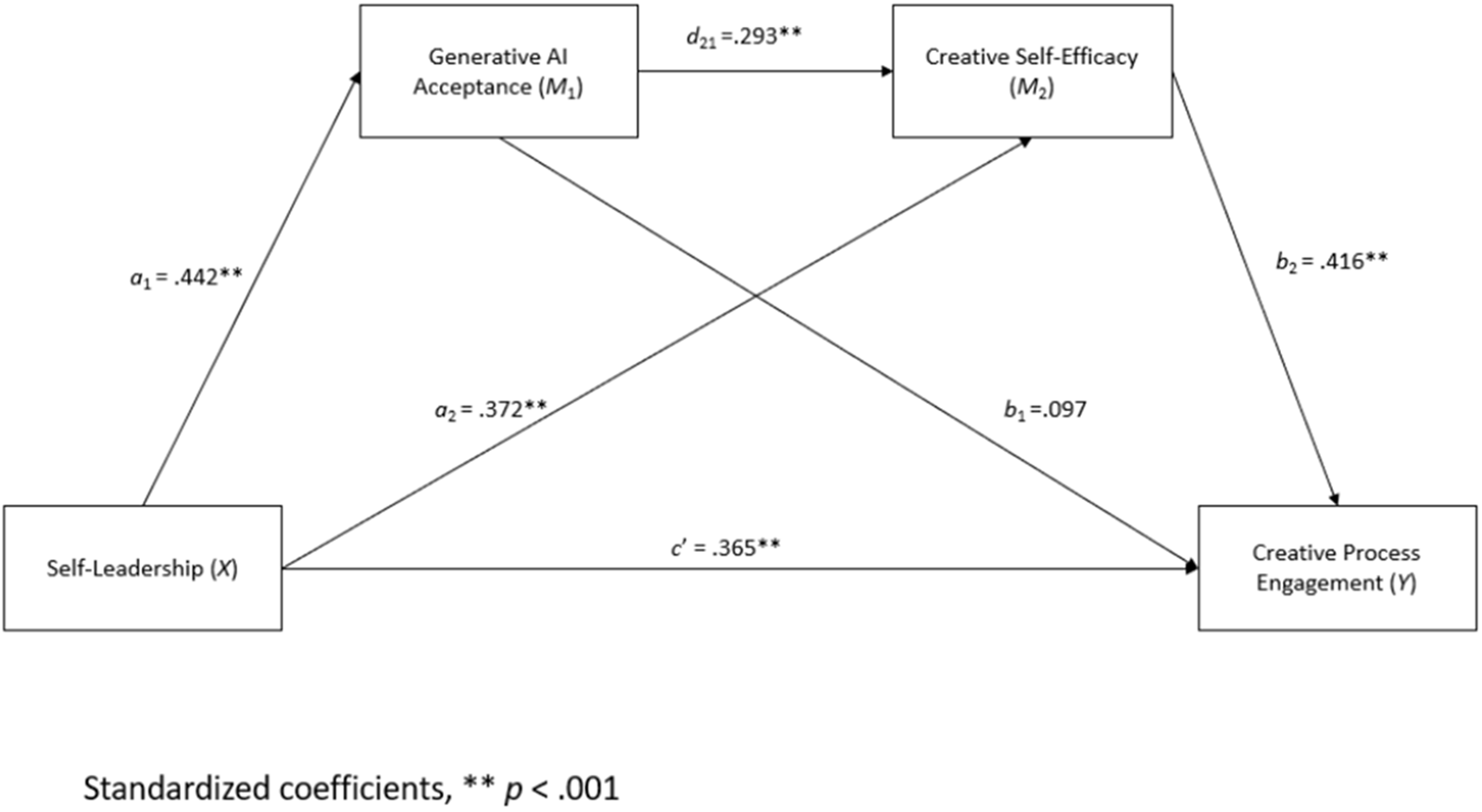
The results of our serial mediation analysis are summarized in Table 2. Results indicate that the direct effect of self-leadership on creative process engagement was significant (c′ = .319, SE = .045, p < .001). Consequently, Hypothesis 1 predicting self-leadership to enhance creative process engagement was supported. Additionally, results revealed evidence for a serial indirect effect of self-leadership on creative process engagement through AI acceptance and, in turn, creative self-efficacy with an unstandardized serial indirect effect of .047 (SE = .018, 95% CI [.019, .089]) and completely standardized indirect effect of .054 (SE = .019, 95% CI [.022, .098]). The simple indirect effect of self-leadership on creative process engagement through AI acceptance included zero in the confidence interval indicating that there was no evidence of mediation through this pathway (a 1b 1 = .037, SE = .023, 95% CI [−.006, .085]; a 1b 1cs = .043, SE = .026, 95% CI [−.007, .097]). However, results revealed evidence for the simple indirect effect of self-leadership on creative process engagement through creative self-efficacy (a 2b 2 = .135, SE = .031, 95% CI [.078, .200]; a 2b 2 = .155, SE = .035, 95% CI [.089, .228]). In sum, these results lend support to Hypothesis 2, which predicted that generative AI acceptance and creative self-efficacy would serially mediate the relationship between self-leadership and creative process engagement. Standardized path coefficients for our serial mediation model are shown in Fig. 2.
OLS path coefficients: serial mediation
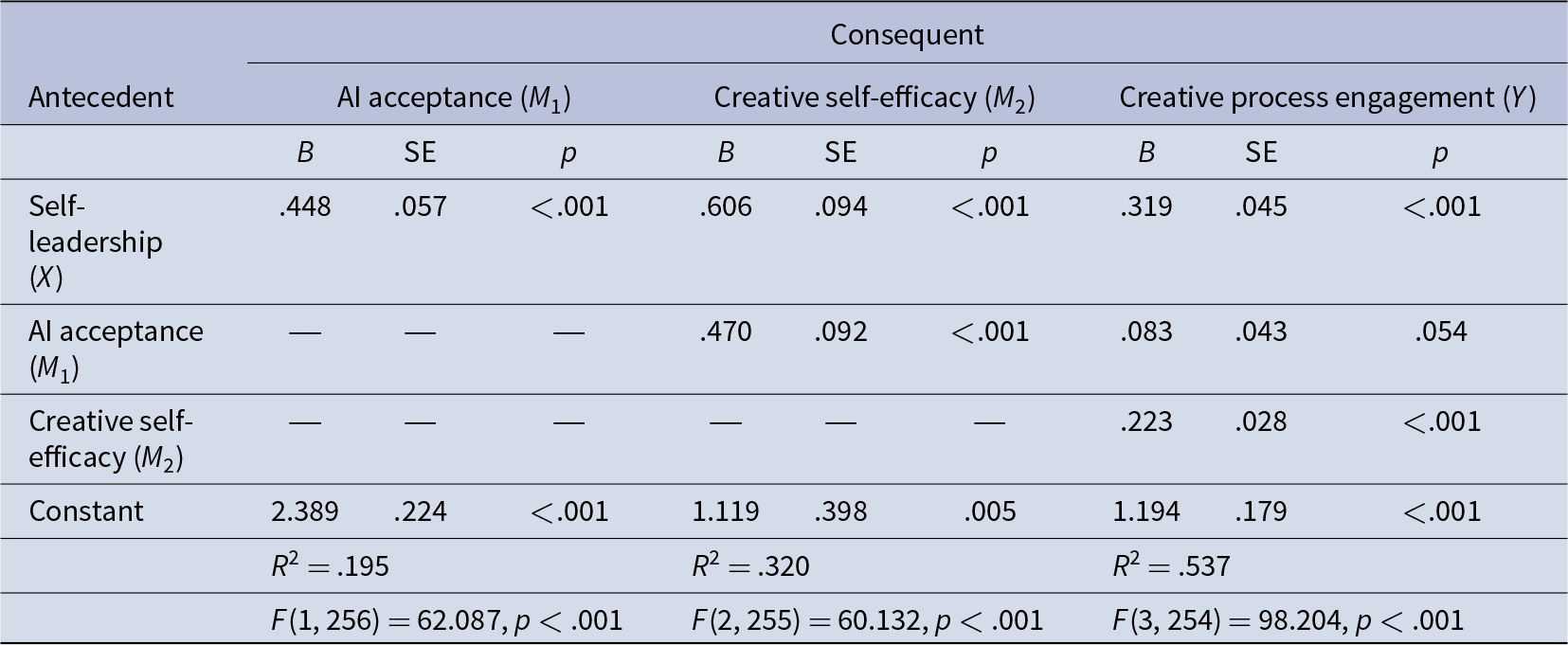
Table 2 Long description
The table reports ordinary least squares regression path coefficients for a mediation model with self-leadership as the predictor, AI acceptance and creative self-efficacy as mediators, and creative process engagement as the outcome. Self-leadership is a significant positive predictor of AI acceptance and creative self-efficacy, and it also directly predicts creative process engagement. AI acceptance significantly predicts creative self-efficacy, but its direct link to creative process engagement is not statistically significant. Creative self-efficacy is a significant positive predictor of creative process engagement. Model fit improves across equations, with explained variance rising from about one-fifth for AI acceptance to about one-third for creative self-efficacy and just over one-half for creative process engagement. Coefficients are unstandardized, so effect sizes should be compared cautiously across outcomes with different scales.
Note. B = unstandardized coefficient. See Fig. 2 for standardized coefficients.
Summary of indirect effects.
Indirect effect 1: Self-leadership → AI acceptance → Creative process engagement.
Not supported, a 1b 1 = .037, 95% CI [−.006, .085]; a 1b 1cs = .043, 95% CI [−.007, .097].
Indirect effect 2: Self-leadership → Creative self-efficacy → Creative process engagement.
Supported, a 2b 2 = .135, 95% CI [.078, .200]; a 2b 2 = .155, 95% CI [.089, .228].
Indirect effect 3 (serial mediation): Self-leadership → AI acceptance → Creative self-efficacy → Creative process engagement.
Supported, a 2d 21b 2 = .047, 95% CI [.019, .089]; a 2d 21b 2cs = .054, 95% CI [.022, .098].
Serial mediation model with standardized path coefficients.
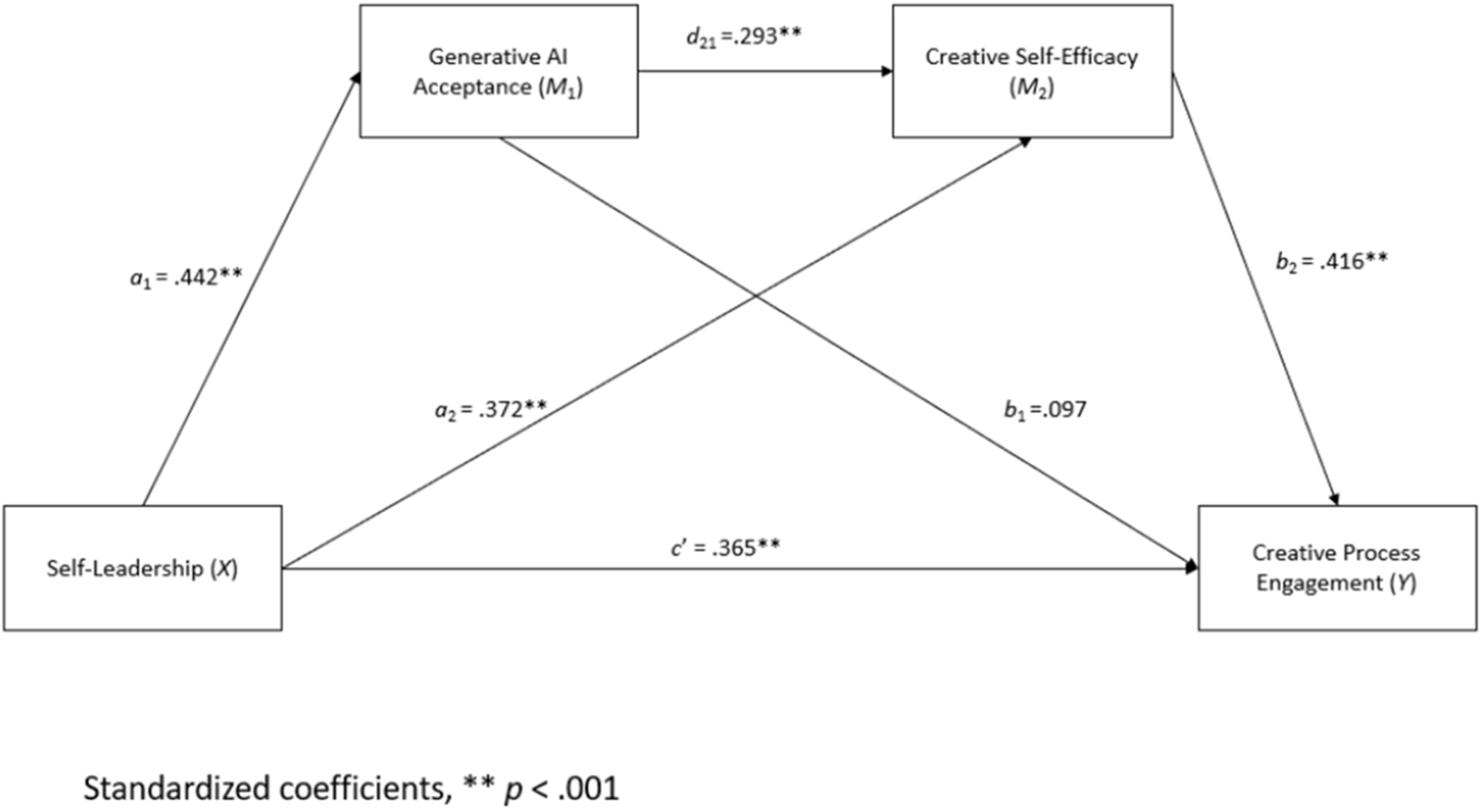
Figure 2 Long description
The diagram illustrates a serial mediation model with standardized path coefficients. It consists of four main elements represented as rectangles: Self-Leadership labeled as X, Generative AI Acceptance labeled as M subscript 1, Creative Self-Efficacy labeled as M subscript 2 and Creative Process Engagement labeled as Y. Self-Leadership is positioned at the bottom left, Generative AI Acceptance at the top left, Creative Self-Efficacy at the top right and Creative Process Engagement at the bottom right. Arrows indicate the direction of influence between these elements. An arrow from Self-Leadership to Generative AI Acceptance is labeled with a coefficient of a subscript 1 equals point 442 double asterisk. Another arrow from Self-Leadership to Creative Process Engagement is labeled c prime equals point 365 double asterisk. Generative AI Acceptance connects to Creative Self-Efficacy with an arrow labeled d subscript 21 equals point 293 double asterisk. Creative Self-Efficacy connects to Creative Process Engagement with an arrow labeled b subscript 2 equals point 416 double asterisk. Additionally, an arrow from Generative AI Acceptance to Creative Process Engagement is labeled b subscript 1 equals point 097. The arrow from Self-Leadership to Creative Self-Efficacy is labeled a subscript 2 equals point 372 double asterisk. The diagram notes that the coefficients are standardized, with double asterisk indicating p less than point 001.
Discussion
This study, grounded in SCT and JD-R theory, demonstrates that as generative AI transforms creative workflows, self-leadership remains a critical antecedent of creative process engagement. Findings validate a serial mediation model linking self-leadership to engagement via AI acceptance and creative self-efficacy, while also establishing that self-influence relates to engagement independently of technology. The results highlight a necessary balance where AI complements, rather than supplants, human agency, emphasizing that effective AI integration hinges on its interaction with self-regulatory processes.
The explanatory boundaries of generative AI acceptance
Our empirical findings offer a critical nuance to the burgeoning literature on AI in creative workflows. While we positioned generative AI acceptance as a central mediating mechanism linking self-leadership to creative process engagement, our results reveal that its standalone indirect effect is non-significant. Instead, creative self-efficacy emerged as the dominant mediator driving behavioral engagement. This suggests that technology acceptance, on its own, represents a necessary but insufficient condition for creative action. Merely accepting or being open to utilizing generative AI does not automatically translate into deep engagement with complex creative processes. Rather, traditional self-regulatory mechanisms – specifically, an individual’s belief in their own creative capabilities – remain the primary psychological engine of creative work.
The incremental value of generative AI acceptance is therefore uniquely structural, operating as an upstream psychological gateway within a serial chain. Self-leadership empowers employees to accept and embrace these novel technologies. However, this technological openness must first be converted into heightened creative self-efficacy before behavioral engagement can occur. In an AI-augmented workplace, AI acceptance serves as the baseline prerequisite that allows employees to confidently leverage digital tools, which subsequently builds the domain-specific self-efficacy required to execute creative tasks. By demonstrating that AI acceptance routes through creative self-efficacy, this study tempers overly optimistic views of technology adoption by underscoring that new tools cannot bypass foundational human psychological processes.
Implications for research and practice
This study offers theoretical and practical insights for organizations aiming to maintain a balance between human agency and prospective technological adoption. Theoretically, this research advances the conceptualization of generative AI acceptance as an upstream cognitive mediator in the relationship between self-leadership and creative process engagement, adding nuance to existing frameworks of human–AI interaction orientations (Xu & Wang, Reference Xu and Wang2021). More specifically, our findings extend SCT by suggesting that self-leadership not only influences internal psychological states such as creative self-efficacy but also shapes proximal adoption orientations – namely, generative AI acceptance. In turn, this intentional adoption orientation strengthens creative self-efficacy, thereby broadening SCT’s account of how efficacy beliefs develop in environments characterized by prominent digital tools. Thus, this study highlights critical potential roles for self-efficacy and self-regulation in determining how individuals strategically frame the utility of AI for creative tasks. This perspective underscores that a cognitive orientation toward AI is not unidimensional; instead, it can psychologically empower or potentially stifle human agency depending on the user’s regulatory approach. This nuanced understanding of AI’s dual role as a prospective enabler or disruptor of creative cognition underscores the importance of self-leadership as a proactive tool for allowing AI to complement, rather than psychologically displace, human creativity. Likewise, our study enriches JD-R theory by positioning self-leadership as a personal resource that frames technology adoption as an additional, accessible job resource, which subsequently fuels cognitive engagement in the creative process. Together, these insights highlight an expanded resource-based pathway – personal resources initiating a positive technological readiness orientation that builds further psychological resources.
From a practical standpoint, this research provides actionable insights for organizations seeking to manage expectations surrounding AI within creative contexts while prioritizing and maintaining human agency. By focusing on self-leadership enhancement and bolstering creative self-efficacy through targeted training and development programs, the findings suggest that organizations can cultivate an environment where the introduction of AI complements rather than overrides self-leadership practices. For instance, structured training that emphasizes self-goal setting and strategic intentionality toward AI can support employees in effectively framing AI as an assistive resource, enhancing their creative capabilities rather than diminishing their autonomy. This approach is particularly important in knowledge-intensive industries – such as marketing, design, and technology – where innovation is a critical driver of competitive advantage. For example, in a design agency setting, pairing self-leadership workshops with a structured introduction to AI tools can help foster an environment where employees view AI as a supportive cognitive asset. Training employees to leverage AI to conceptually generate initial ideas or visualize design elements, while maintaining complete psychological autonomy to adapt and personalize these outputs, can improve both anticipated productivity and the overall orientation toward creative work. This dual approach encourages ownership and enhances employees’ capacity to manage their cognitive creative processes proactively.
Organizations are encouraged to prioritize the development of self-leadership skills alongside AI onboarding programs that underscore strategic, intentional orientations toward digital tools. This approach fosters environments where employees feel empowered to view AI as a supportive resource, rather than as a substitute for their own creativity. Implementing policies and training that emphasize strategic AI readiness can help employees maintain an active cognitive role in creative processes, thereby preserving the intrinsic motivation, ownership, and agency critical for innovative outcomes.
Additionally, this study provides practical recommendations for HR professionals, training specialists, and organizational leaders on balancing technological automation with human-centered creative engagement. A key recommendation is to develop policies that encourage an orientation toward AI as an assistive tool that amplifies human ingenuity, rather than one that fully automates the creative domain. These policies can support employees’ intrinsic motivation and ownership of their work, promoting a dynamic where AI serves to enhance personal agency within creative processes. In practice, organizations could establish guidelines for AI adoption that emphasize the need for critical assessment and cognitive discretion, ensuring that AI outputs are framed strictly as conceptual starting points rather than definitive solutions. This approach is essential in fields where maintaining cognitive control over the creative process is key to fostering sustainable innovation and adaptive problem-solving.
Furthermore, this study sets the stage for future research on technological readiness and human agency by encouraging exploration of how different organizational structures, cultures, and industry-specific factors influence the formation of AI acceptance in creative tasks. As organizational dynamics and technological capabilities vary widely across sectors, understanding how self-leadership and creative self-efficacy interact with an orientation toward AI tools in diverse settings will be critical for identifying the specific conditions that enable AI to maximize its potential for fostering creativity and innovation. For example, future studies could examine whether flat organizational structures, which encourage autonomy, are more conducive to psychological AI readiness compared to hierarchical structures that may limit personal agency.
In sum, this study contributes both theoretically and practically by providing a comprehensive framework that addresses the strategic, intentional acceptance of AI in creativity-driven environments. This research highlights the importance of fostering self-leadership and creative self-efficacy, enabling organizations to design prospective workflows that support sustainable, human-centered innovation. Through these insights, the study offers a roadmap for organizations aiming to maintain a balanced psychological approach in an increasingly automated landscape, ensuring that AI acceptance reinforces rather than diminishes human creativity and strategic thinking. This study ultimately advances the understanding of human-technology interaction by positioning generative AI acceptance not merely as a passive stance, but as a vital cognitive mediator that activates belief-driven engagement in creative work.
Limitations and future research opportunities
Despite its theoretical and practical insights, our study is subject to several boundary conditions that present fruitful avenues for future inquiry. First, while Prolific provides access to a diverse, multi-industry cohort of working professionals, our sample remains subject to self-selection bias due to its voluntary nature. This digital sample may not perfectly reflect populations in less technologically integrated or niche sectors, potentially constraining the broader generalizability of our findings. Future research should replicate this framework utilizing targeted corporate samples or industry-specific registries to ensure generalizability across different operational contexts.
Second, our reliance on cross-sectional, self-reported data limit our ability to make definitive causal inferences and leaves the data susceptible to common method variance. Although we took proactive procedural steps to minimize common method variance by introducing varied scale metrics and anchors, the structural relationships must still be interpreted with care. Future inquiries should leverage time-lagged or multi-source data collection designs (e.g., pairing supervisor ratings of creative engagement with employee self-assessments) to establish stronger causal patterns.
Third, our study is bounded by its reliance on perceptual and intentional metrics of technology acceptance – specifically perceived usefulness and intention to use. While intention is a powerful, validated predictor of technology adoption, our data does not capture objective behavioral usage metrics such as active platform logs, prompt engineering hours, or external expert ratings of creative performance. This distinction may be particularly important in AI contexts, where favorable attitudes and intentions toward emerging technologies may not necessarily translate into sustained or strategic behavioral use. Future research should distinguish between psychological readiness for AI adoption and actual patterns of AI utilization to better understand how these constructs independently shape creative outcomes.
Finally, future research should investigate how changing macro-level variables and evolving technologies impact these psychological dynamics. Longitudinal studies tracking employees over extended periods (e.g., 6 months to a year) would reveal whether sustained exposure to AI tools continuously reinforces creative self-efficacy or whether overreliance eventually erodes intrinsic motivation and personal autonomy. Furthermore, cross-industry comparisons could uncover how varying levels of creative freedom and compliance requirements – such as comparing highly regulated healthcare fields with less restricted marketing sectors – moderate the psychological pathways between self-leadership, technology acceptance, and creative engagement.
Conclusion
In conclusion, our study advances the literature by providing critical insights into how individual self-leadership shapes creative process engagement within work contexts defined by the prominence of generative AI. Our findings reveal that self-leadership’s self-regulatory strategies actively foster creative process engagement through two distinct pathways: directly as an independent behavioral driver, and indirectly by establishing a proactive cognitive orientation toward generative AI acceptance that subsequently enhances creative self-efficacy. Ultimately, these results affirm self-leadership as a vital psychological foundation for creative work, demonstrating that technology adoption cannot bypass traditional human self-regulation; rather, technological readiness must be successfully converted into domain-specific creative confidence before deeper engagement can occur. For organizations, these findings underscore the value of pairing traditional self-leadership training with digital onboarding initiatives that emphasize the intentional, strategic framing of AI tools as assistive assets. By illuminating these serial cognitive pathways, we hope this study encourages future scholars to continue exploring the delicate balance between technological readiness, human agency, and the psychological boundaries of creativity.
Conflict(s) of Interest
The authors declare none.


 Open access

