

Dairy products play a crucial role in human nutrition. They offer a highly digestible and nutritionally comprehensive source of fats, proteins, vitamins, carbohydrates and minerals that are essential for maintaining optimal health (Ahmed et al., Reference Ahmed, Sheikh, Ubaid, Chauhan, Kumar and Choudhary2024). As illustrated in Fig. 1a, milk production has steadily increased from 2015 to 2022 (Heerden, Reference Heerden2023). According to the Organisation for Economic Co-operation and Development - Food and Agriculture Organization of the United Nations (OECD-FAO) Agricultural Outlook 2023–2032 report, global per capita consumption of fresh dairy products is projected to increase at an average annual rate of 1.0% over the next decade, slightly exceeding the growth rate of the previous decade. This growth is mainly driven by rising per capita incomes, indicating significant potential for increased consumption (FAO, 2023). Nevertheless, it is important to strike a balance between this potential and the necessity of ensuring the quality and safety of dairy products.
Bacterial biofilms are defined as structured microbial communities encapsulated in a self-synthesized extracellular matrix. This structure allows bacteria to adhere to biotic or abiotic surfaces and endure harsh environmental stresses (Bhatt et al., Reference Bhatt, Bhatt, Huang, Li, Wu and Chen2023). The formation of biofilms entails bacteria attaching to surfaces and generating extracellular polymers (EPS) for protection (Didouh et al., Reference Didouh, Khadidja, Campos, Sampaio-Maia, Boumediene and Araujo2023). Compared to planktonic organisms, these biofilm cells exhibit enhanced survival strategies, greater resistance to cleaning and an outstanding ability to evade sterilization mechanisms.
During dairy processing, the environments of dairy farms and processing facilities are prone to the formation of biofilms. This phenomenon presents a substantial threat to the hygienic quality and safety of the dairy environment (Hebishy et al., Reference Hebishy, Yerlikaya, Reen, Mahony, Akpinar, Saygili and Datta2024). Biofilms that form on the surfaces of milking equipment, such as cups and piping systems, provide ideal conditions for the growth and reproduction of various pathogens due to the protein and fat residues left by milk (Kathiriya et al., Reference Kathiriya, Sindhi, Bhedi, Suthar and Rana2025). Additionally, bacteria can form biofilms on the inner walls of bulk milk tanks and remain viable even after cooling and processing. These bacteria produce heat-stabilizing enzymes that lead to the spoilage of dairy products. Pasteurizers, conveyor belts and packaging lines can also become contaminated with heat-resistant spores or bacteria capable of producing EPS (E, Reference E2020). It is crucial to emphasize that equipment design characteristics, such as areas that are difficult to clean, can further exacerbate biofilm accumulation. This, in turn, heightens the risk of microbiological contamination during dairy processing (Chowdhury et al., Reference Chowdhury, Reem, Ashrafudoulla, Rahman, Shaila, Jie‐won Ha and Ha2025). Consequently, once biofilms are formed, the standard cleaning and sterilization procedures employed in dairy processing facilities may not be able to effectively eradicate all viable bacterial cells, thereby potentially contaminating the dairy environment. Biofilms containing pathogenic or spoilage microorganisms can contaminate food and have an adverse impact on the quality and safety of the final product. This may lead to increased food spoilage, a shortened product shelf life and more arduous cleaning procedures on dairy farms or processing plants, ultimately inflicting significant economic losses on dairy producers. Additionally, biofilm growth can cause clogging, inefficient heat transfer and even corrosion in dairy processing equipment (Fig. 1b).
(a) Global milk production from 2015 to 2022. (b) Hazard transmission routes of biofilms during dairy processing. (c) Number of publications on Web of Science related to mixed biofilms and dairy products.

Most biofilms found in nature are not formed by a single species of bacteria but rather by two or more microorganisms, collectively referred to as mixed biofilms. Studies have shown that, in comparison to single-species biofilms, mixed biofilms are characterized by high diversity, complex spatial distribution, increased resistance to antimicrobial drugs and high adaptability to environmental conditions. These characteristics not only exacerbate their impact on the organoleptic properties (e.g., colour and flavour) and nutritional value of the dairy environment but also potentially threaten food safety. As shown in Fig. 1c, the number of researchers investigating the dairy environment, mixed biofilms and their intersection has gradually risen. This trend underscores the necessity of addressing the numerous risks presented by mixed biofilms in the dairy environment. To alleviate the hazards caused by microbial biofilm formation in dairy environments, it is essential to gain a deeper understanding of the processes involved in the formation of mixed biofilms and the interactions between microbial cells (Diarra et al., Reference Diarra, Goetz, Gagnon, Roy and Jean2023). By comprehensively understanding the formation mechanism of mixed biofilm, targeted control measures can be developed to prevent or eliminate biofilm formation (Li et al., Reference Li, Liu, Guo, Zhang, Liu and Ruan2021).
Given the significant impact of mixed biofilms on the dairy industry, it is crucial to investigate the formation mechanisms, characterization and effective control strategies of common biofilm strains in dairy processing. This review focuses on the formation of common strains and their mixed biofilms in the dairy environment, the interactions within mixed biofilms and the unique characteristics of mixed biofilms compared to single biofilms, and it aims to identify effective control methods to inhibit their formation.
Common microorganisms and their biofilm formation in the dairy environment
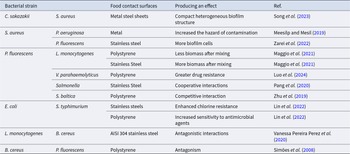
The most frequently encountered pathogenic and spoilage bacteria in the dairy environment include Cronobacter sakazakii, Staphylococcus aureus, Pseudomonas fluorescens, Escherichia coli, Listeria monocytogenes and Bacillus spp. The formation of their biofilms and mixed biofilms is described below (Table 1).
Formation of mixed biofilms with other microorganisms by biofilms of major harmful microorganisms in dairy environment

Cronobacter sakazakii
C. sakazakii is a gram-negative, facultatively anaerobic, motile, rod-shaped pathogen belonging to the Enterobacteriaceae family. It is a globally recognized opportunistic microorganism (Srikumar et al., Reference Srikumar, Cao, Yan, Van Hoorde, Nguyen, Cooney, Gopinath Gopal, Tall Ben, Sivasankaran Sathesh, Lehner, Stephan and Fanning2019). Studies have shown that C. sakazakii can adhere to biotic and abiotic substances, including food products, food-processing equipment and infant-feeding equipment, followed by biofilm formation (Phair et al., Reference Phair, Pereira, Kealey, Fanning and Brady2022). This is closely associated with infections in newborn infants, particularly those with compromised immune systems, leading to severe consequences such as high infant mortality rates. Fei et al. (Reference Fei, Jing, Ma, Dong, Chang, Meng, Jiang, Xie, Li, Chen and Yang2022) conducted a comprehensive analysis of commercially available infant formulas and uncovered a significant concern: 27 Cronobacter strains were identified. Among these isolates, 22 belonged to the C. sakazakii subspecies, highlighting its wide prevalence and the associated potential risks. Ma et al. (Reference Ma, Zhang, Shan, Wang and Xia2022) verified the biofilm-forming capacity of C. sakazakii. To further elucidate the formation of mixed biofilms involving C. sakazakii and other microbial species, Song et al. (Reference Song, Jia, Qi, Dong, Liu, Man, Yang and Jiang2023) investigated the development of mixed biofilms between C. sakazakii and S. aureus. Their findings revealed that the mixed biofilm formed by these two species exhibited a higher density, a more compact structure and more prominent bacterial aggregation compared to C. sakazakii biofilms.
S. aureus
S. aureus is a facultative anaerobic, gram-positive bacterium that typically appears as spherical (coccoid) cells arranged in clusters that often resemble bunches of grapes (Duza, Reference Duza2021). As a highly adaptable pathogen, it can cause a diverse array of human infections, including skin and soft tissue infections, pneumonia and bloodstream infections. Notably, it is well recognized for producing enterotoxins. When contaminated food is ingested, these enterotoxins can trigger symptoms such as nausea, vomiting and diarrhoea. Specifically, enterotoxins, including staphylococcal enterotoxins and toxic shock syndrome toxin-1, exhibit high heat stability, enabling them to survive cooking processes, thereby posing a significant threat to food safety (Hennekinne et al., Reference Hennekinne, De Buyser and Dragacci2012). Biofilms serve as a protective shield for the bacteria, defending them against host immune responses and antibiotics, which in turn contributes to persistent infections and foodborne outbreaks. In the dairy industry, S. aureus poses a risk by contaminating raw milk throughout the production chain (Shen et al., Reference Shen, Wang, Zhu, Zhang, Shang and Xue2021).
The remarkable ability of S. aureus to form biofilms in the dairy environment is a major concern for researchers, given its potential threat to the safety and quality of dairy products. Shen et al. (Reference Shen, Wang, Zhu, Zhang, Shang and Xue2021) isolated five strains of S. aureus from different batches of milk samples and evaluated their biofilm-forming capabilities. Their study showed that these strains could produce dense biofilms even under harsh conditions, such as high temperatures and dryness, highlighting the significant risk that S. aureus poses to the quality and safety of the dairy environment. Furthermore, the nutrient-rich environment of milk promotes the formation of S. aureus biofilms. In dairy processing environments, S. aureus often forms mixed biofilms with other bacterial species. For instance, Song et al. (Reference Song, Jia, Qi, Dong, Liu, Man, Yang and Jiang2023) found that mixed biofilms of C. sakazakii and S. aureus exhibited greater biomass, more compact structures and enhanced bacterial aggregation compared to single-species biofilms, which exacerbates the risk of dairy product contamination. Additionally, Meesilp and Mesil (Reference Meesilp and Mesil2019) observed that S. aureus and Pseudomonas aeruginosa form biofilms on metal equipment, generating a resilient and diverse biofilm matrix.
P. fluorescens
P. fluorescens is a gram-negative, rod-shaped bacterium. Owing to its rapid growth rate, simple nutritional requirements and environmental adaptability, it can contaminate raw milk and other dairy environments (Gade and Koche, Reference Gade, Koche, Singh and Vaishnav2022). This bacterium produces enzymes such as proteases, lipases and pectinases, which break down proteins, fats and polysaccharides in dairy products, respectively (Martin et al., Reference Martin, Murphy, Ralyea, Wiedmann and Boor2011). The by-products generated during this breakdown process can cause spoilage, off-flavours, discolouration and acidification, all of which adversely affect the quality and safety of dairy products (Soltani Firouz et al., Reference Soltani Firouz, Mohi-Alden and Omid2021). Additionally, P. fluorescens can produce mucus polymers, giving foods a sticky, waterlogged appearance and a mucus-like texture, thereby further reducing their appeal. The ability of P. fluorescens to form biofilms is a crucial aspect in its contamination of dairy environments. A critical factor in the contamination with P. fluorescens in dairy environments is its ability to form biofilms. Biofilm formation enhances its persistence in food processing facilities, making it more challenging to eliminate from equipment and surfaces (Yuan et al., Reference Yuan, Zhang, Mi, Zheng, Wang, Li and Yang2024). Supporting this, Zarei et al. (Reference Zarei, Yousefvand, Maktabi, Pourmahdi Borujeni and Mohammadpour2020) successfully isolated 27 P. fluorescens strains with high biofilm-forming ability from cold raw milk, indicating the widespread presence of this bacterium and its biofilm-forming capabilities in these products. Furthermore, Maifreni et al. (Reference Maifreni, Bonaventura, Marino, Guarnieri, Frigo and Pompilio2023) demonstrated that P. fluorescens isolated from the dairy environment exhibits a high biofilm-forming capacity under conditions relevant to the food industry. Collectively, these findings underscore the need for effective control measures to prevent biofilm formation in such environments. Notably, studies on mixed-species interactions further highlight these risks. Maggio et al. (Reference Maggio, Rossi, Chaves-López, Serio, Valbonetti, Pomilio, AP and Paparella2021) found that mixed cultures of P. fluorescens and L. monocytogenes led to an increase in biomass and alterations in biofilm structure under conditions simulating dairy processing, exacerbating the hazards associated with biofilms. Similarly, Zarei et al. (Reference Zarei, Rahimi, Saris and Yousefvand2022) found that after co-culturing P. fluorescens and S. aureus on stainless steel surfaces. Taken together, these studies confirm that P. fluorescens can adhere to surfaces and form biofilms, posing a substantial threat to the quality and safety of dairy environments.
E. coli
E. coli is a rod-shaped, motile, gram-negative bacillus with distinctly rounded ends (Bonten et al., Reference Bonten, Johnson, van den Biggelaar, Georgalis, Geurtsen, de Palacios, Gravenstein, Verstraeten, Hermans and Poolman2020). As a facultatively anaerobic bacterium, pathogenic strains of E. coli can cause foodborne illnesses, with symptoms ranging from mild diarrhoea to severe syndromes such as haemolytic uremic syndrome (Zhang et al., Reference Zhang, Shigemura, Duc, Shen, Huang, Sato, Masuda, K-i and Miyamoto2020). Madani et al. (Reference Madani, Esfandiari, Shoaei and Ataei2022) analysed 200 samples isolated from milk and dairy products in Isfahan, Iran, and detected 54 E. coli isolates, of which 68.42% were capable of forming biofilms. Similarly, Bhardwaj et al. (Reference Bhardwaj, Taneja, Dp, Chakotiya, Patel, Taneja, Sachdev, Gupta and Sanal2021) evaluated E. coli isolated from Indian soft cheese and raw milk, finding that this species efficiently forms high-biomass biofilms on glass and stainless-steel surfaces within 96 h. These findings confirm that E. coli can form biofilms, posing a significant risk in dairy production. Furthermore, Lin et al. (Reference Lin, Wang, Li, Zhou and Yang2022) quantified the biomass of single- and mixed-biofilms on stainless steel specimens using confocal laser scanning microscopy (CLSM). Their results revealed that the biomass of mixed biofilms was two to six times higher than that of single-species biofilms, highlighting the potential for an increased risk of contamination in dairy production environments where diverse microorganisms may coexist. Consequently, effective control measures are essential to prevent biofilm formation and mitigate the risks associated with E. coli and other microorganisms in dairy environments.
L. monocytogenes
Listeria monocytogenes is a gram-positive, facultatively anaerobic microorganism. It grows optimally within a temperature range of −4°C to 45°C, exhibiting a particular preference for room temperature. Importantly, this microorganism causes the severe infectious disease known as listeriosis, which has one of the highest morbidity and mortality rates among foodborne illnesses (Allerberger, Reference Allerberger2003). Dairy processing environments have been well-documented as a common source of L. monocytogenes contamination in food products, making consumers more susceptible to this potentially life-threatening disease. This is primarily due to the formation of biofilms on processing line equipment, which can be challenging to eradicate and persist even under rigorous cleaning and sterilization protocols (Andritsos and Mataragas, Reference Andritsos and Mataragas2023). L. monocytogenes in dairy processing environments represents a significant hazard, emphasizing the need to implement robust food safety measures to prevent contamination and protect public health. A substantial body of research has demonstrated the capacity of L. monocytogenes to form biofilms. For instance, Abou Elez et al. (Reference Abou Elez, Elsohaby, Al-Mohammadi, Seliem, Tahoun, Abousaty, Algendy, Mohamed and El-Gazzar2023) observed that L. monocytogenes isolated from milk and cultured at varying temperatures exhibited a pronounced biofilm-forming ability. Similarly, Di Ciccio et al. (Reference Di Ciccio, Rubiola, Panebianco, Lomonaco, Allard, Bianchi, Civera and Chiesa2022) highlighted the role of biofilm formation in the persistence of this pathogen in food-processing facilities. Beyond single biofilms, Maggio et al. (Reference Maggio, Rossi, Chaves-López, Serio, Valbonetti, Pomilio, AP and Paparella2021) investigated the ability of L. monocytogenes to form mixed biofilms with other species, such as P. fluorescens. They observed that L. monocytogenes could form more complex and robust biofilms in the presence of other microorganisms.
Bacillus spp
Bacillus is a group of gram-positive, rod-shaped bacteria that are mainly aerobic or facultatively anaerobic (Catania et al., Reference Catania, Di Ciccio, Ferrocino, Civera, Cannizzo and Dalmasso2023). Bacillus species such as Bacillus cereus produce a range of heat-stable extracellular enzymes, including proteases and lipases. Proteases can lead to bitterness, while lipases are usually associated with rancidity (Catania et al., Reference Catania, Civera, Di Ciccio, Grassi, Morra and Dalmasso2021). Catania et al. (Reference Catania, Di Ciccio, Ferrocino, Civera, Cannizzo and Dalmasso2023) evaluated the biofilm formation potential of Bacillus spp. isolates (B. cereus and B. subtilis) from processed cheeses in an Italian dairy processing plant, observing a significant tendency for biofilm growth on polystyrene surfaces. The ability of Bacillus to adhere to the surface of dairy processing equipment and form biofilms poses a challenge to the dairy industry: these biofilms are a continuous source of contamination that continuously jeopardizes the quality and safety of the dairy environment. For instance, Wang et al. (Reference Wang, Jin, He and Yuan2021) investigated the formation of biofilms on stainless steel surfaces immersed in skimmed milk. They found that Bacillus licheniformis had a synergistic relationship with Aspergillus flavus, increasing the overall biomass and causing more significant contamination. Vanessa Pereira Perez et al. (Reference Vanessa Pereira Perez, Andréia Miho Morishita and Dirce Yorika2020) found antagonistic interactions between L. monocytogenes and B. cereus by studying the formation of a two-strain biofilm on dairy product-isolated bacteria. These findings underscore that, within dairy processing lines, Bacillus frequently acts as part of a mixed biofilm together with other microorganisms, influencing the overall stability of biofilm, persistence and potential hazards.
The aforementioned research highlights that the presence of common microorganisms in dairy products facilitates the spread and dissemination of contaminants. As a result, it poses a significant threat to the overall environmental hygiene and safety of dairy facilities. This situation brings about substantial challenges for the control and elimination of such microorganisms in dairy processing environments. Therefore, implementing effective biofilm prevention and control strategies in these settings, which aim to inhibit biofilm formation and reduce the risks posed by these bacteria during dairy processing, has become a crucial priority for the dairy industry.
Bacterial social interactions in mixed biofilms
Mixed biofilms form through a structured sequence of processes: attachment, growth, maturation and dispersion. Within these structures, microbial communities exist as complex multispecies assemblages, where microorganisms interact in diverse ways to form and stabilize the foundational structure of the microbial ecosystems they inhabit. These interactions can be either positive or detrimental. On one hand, they may promote growth by enhancing nutrient utilization or creating new ecological niches. On the other hand, they may inhibit growth through nutrient competition or the production of inhibitory compounds. These compounds, which include antibiotics, bacteriocins, toxins and peptides, enable certain community members to adapt to the environment (Gorter et al., Reference Gorter, Manhart and Ackermann2020). Bacterial interactions are pivotal in shaping the composition and functional stability of microbial communities. To deepen our understanding of these interactions, researchers can examine metabolic linkages between species. Within this framework, potential trophic interactions fall into two distinct categories: antagonistic interactions, where one species harms the other, and mutualism, where each species provides nutrients or metabolites to support the growth of the other.
Antagonistic interactions
Antagonism in mixed biofilms involves microorganisms coexisting in a state of continuous competition for limited nutrients and space, particularly among those with overlapping ecological niches. Microbial competition falls into two categories: exploitation competition and interference competition. Exploitation competition occurs when microorganisms compete for resources like space, nutrients and energy, thereby restricting the growth and fitness of others. For instance, Lyng et al. (Reference Lyng, Jørgensen, Schostag, Jarmusch, Aguilar, Lozano-Andrade and Á T2024) identified an iron-dependent interaction between B. subtilis and Pseudomonas marginalis, where B. subtilis restricted the colony spread of P. marginalis by inhibiting the transcription of the histidine kinase-encoding gene gacS, indicating an antagonistic relationship. Additionally, Zhu et al. (Reference Zhu, Yan, Wang and Qu2019) observed an antagonistic relationship between Shewanella baltica and P. fluorescens, attributing it to the bacterial supernatant. In contrast, interference competition is characterized by direct damage to competitors through the production of compounds such as enzymes, hydrogen peroxide, organic acids, ethanol, quorum-sensing (QS) signals, volatile organic compounds, bacteriocins or eukaryotic antimicrobial peptides (Vanessa Pereira Perez et al., Reference Vanessa Pereira Perez, Andréia Miho Morishita and Dirce Yorika2020). Biofilm formation is mainly regulated by the QS mechanism. The QS system regulates various microbial activities, including biofilm formation, pathogenicity, antibiotic production, interplasmid transfer, pigmentation and synthesis of EPS (Liu et al., Reference Liu, Deng and Jaksa2019). Bacteria secrete and detect QS signalling molecules that bind to specific receptors. Once a critical concentration is reached, these molecules initiate cell density-dependent adaptive responses (Dandekar et al., Reference Dandekar, Chugani and Greenberg2012). These responses frequently involve the expression of extracellular factors, such as food-degrading enzymes, virulence factors, antibiotics or biosurfactants (Oslizlo et al., Reference Oslizlo, Stefanic, Dogsa and Mandic-Mulec2014). For example, quorum-quenching (QQ) bacterial strains, including B. cereus QSP03, B. subtilis QSP10, Pseudomonas putida QQ3 and P. aeruginosa QSP01, can interfere with the QS system by secreting QQ enzymes, thereby controlling the biofilm formation of P. aeruginosa (Khalid et al., Reference Khalid, Ain and Khan2022). Interference competition is mainly manifested as the inhibition of some microorganisms by others through the secretion of substances. For instance, Bacillus velezensis AP 183 can inhibit the biofilm formation of S. aureus (a causative agent of mastitis) by producing secondary metabolites, particularly the macrolide antibiotic bacillusin A (Afroj et al., Reference Afroj, Brannen, Nasrin, Al Mouslem, Hathcock, Maxwell and Liles2021). Similarly, Vanessa Pereira Perez et al. (Reference Vanessa Pereira Perez, Andréia Miho Morishita and Dirce Yorika2020) found that B. cereus can produce antagonistic substances to inhibit the formation of L. monocytogenes biofilms on the surface of AISI 304 stainless steel.
Mutualism
Mutualism, also referred to as cross-feeding, a cooperative interaction where each participant gains from the metabolic activities of the other, is widespread among bacterial strains in mixed biofilms (E, Reference E2020). In this symbiotic partnership, bacteria exchange substances, including amino acids, vitamins or growth factors, fostering the growth of their counterparts while acquiring vital nutrients from their secretions (S, Reference Duza2021). This reciprocal exchange bolsters the collective growth, multiplication, stability and resilience of the bacterial community within the biofilm (Luo et al., Reference Luo, Wang, Sun, Liu and Xin2022). Cross-feeding is a typical pattern of mutually advantageous interaction among microorganisms and plays a pivotal role in nurturing symbiotic relationships within mixed biofilms, including those found in dairy environments (Zhao et al., Reference Zhao, Liu, Zhang, Cai, Yao, Zhang, Deng and Hu2023). This cooperative behaviour, where one microorganism supplies essential nutrients or metabolic intermediates to another, underpins the synergistic growth and collective competitiveness of mixed microbial communities (Mori et al., Reference Mori, Ponce-de-león, Peretó and Montero2016). Wang et al. (Reference Wang, Guo, Zhang, Wang and Shi2024) illustrated this phenomenon through the interaction between Comamonas sp. A23 and Enterobacteriaceae A11. The l-phenylalanine produced by A23 activated the degradation pathway in A11, enhancing biofilm formation and sequestration of cadmium (Cd [II]). This, in turn, protected A23 from Cd (II) and H2O2 stress. Such instances highlight the prevalence of cross-feeding among bacteria and its crucial role in promoting mutually beneficial interactions and metabolic cooperation within mixed biofilms. The existence and significance of cross-feeding in bacterial and other microbial systems deepen our understanding of the stability, diversity and functionality of mixed biofilms across diverse environments, including dairy-related ecosystems (E, Reference E2020).
Properties of mixed biofilms
Mixed biofilms exhibit high diversity, complex spatial distribution, enhanced resistance to antimicrobial drugs and greater adaptability to environmental conditions compared to single-species biofilms.
Diversity and interactions
There exist two core distinctions between mixed biofilms and single-species biofilms. Firstly, there is species diversity, which refers to the coexistence of multiple microbial taxa. Secondly, there is the complexity of interspecific interactions, which can be classified as either antagonistic or mutually beneficial (Shokeen et al., Reference Shokeen, Dinis, Haghighi, Tran and Lux2021). These two factors act synergistically to drive the structural and functional heterogeneity of mixed biofilms. Conversely, due to the lack of interspecific interactions, single-species biofilms possess relatively homogeneous structures, stable yet limited functions and exhibit minimal dynamic changes during their development (Sadiq et al., Reference Sadiq, De Reu, Steenackers, Van de Walle, Burmølle and Heyndrickx2023). The diversity of mixed biofilms is mainly manifested in their compositional diversity, which arises primarily from species diversity. Through the intricate and diverse interspecific relationships, mixed biofilms develop a variety of distinct characteristics. These include changes in biofilm biomass, cell density and EPS composition, as well as alterations to their structure and function.
In dairy environments, the compositional diversity of biofilms is evident, as biofilms in these environments often consist of two or more microbial species. This multi-species composition frequently brings about significant alterations in biofilm biomass (Periasamy et al., Reference Periasamy, Nair, Lee, Ong, Goh, Kjelleberg and Rice2015). Sadiq et al. (Reference Sadiq, De Reu, Steenackers, Van de Walle, Burmølle and Heyndrickx2023) reported a four-species biofilm model consisting of Stenotrophomonas rhizophila, Bacillus licheniformis, Microbacterium lacticum and Thermus indicus. These strains were all isolated from the surface of a dairy pasteurizer following cleaning and disinfection procedures. Despite belonging to different genera, possessing unique physiological characteristics and involving distinct synergistic and antagonistic relationships, these four bacterial species form a stable mixed biofilm, and the total biomass of this mixed biofilm is 3.13 times that of the single-species biofilms. Similarly, Lin et al. (Reference Lin, Wang, Li, Zhou and Yang2022) quantified the biomass of single- and two-species biofilms of E. coli and Salmonella typhimurium on stainless steel samples using CLSM and found that mixed biofilms (total biovolume, 148,000–167,000 mm3) stimulated the growth of biomass two to six times that of single-species biofilms. Their results further confirm that mixed biofilm formation leads to biomass changes. Notably, EPS plays a crucial role in biofilm structure and performance. The formation of mixed biofilms gives rise to complex EPS compositions and biological properties, which, in turn, affect biofilm biomass and spatial structure (Kai Wei Kelvin et al., Reference Kai Wei Kelvin, Joey Kuok Hoong, Manisha, Saravanan, Peter, Staffan and Scott2015). Wang et al. (Reference Wang, Li, Wang, Zhang, Zhu, Zhang and Zhu2018) extracted natural mixed biofilms from Xuanwu Lake (32°4′8″N, 118°48′17″E) as experimental samples. They found that the removal of EPS led to a substantial decline in the respiration rate, typical enzyme activity and stability of the biofilms, thereby increasing their susceptibility to antibiotics. Although this experiment was not conducted in a dairy environment, it further verifies that the abundant EPS produced by mixed biofilms are crucial to the properties of biofilms. Moreover, the mixed culture of microorganisms may alter cell density. Iñiguez-Moreno et al. (Reference Iñiguez-Moreno, Gutiérrez-Lomelí and Avila-Novoa2019) investigated the biofilm development of pathogenic microorganisms (including B. cereus, E. coli, L. monocytogenes, Salmonella enteritidis and S. typhimurium serotypes) and spoilage microorganisms (including B. cereus and P. aeruginosa) in a dairy-mimicking environment. The study found that the multi-species biofilms formed by pathogenic and spoilage microorganisms had a higher cell density.
Spatial distribution complexity
The complexity of spatial distribution is a key distinguishing feature between mixed biofilms and single-species biofilms. In mixed biofilms, interactions between different microbial species significantly influence their spatial distribution within the biofilm, which in turn affects the development and function of these communities (Yao et al., Reference Yao, Hao, Zhou, Jin, Huang and Wu2022). A common spatial pattern in mixed biofilms is that of one species surrounding another. For example, Dhekane et al. (Reference Dhekane, Mhade and Kaushik2022) examined the structures of mixed biofilms formed by P. aeruginosa and S. aureus at multiple organizational levels, including overall size, biomass thickness, co-location, spatial organization of strains within the biomass, total biomass composition and interspecific interactions. This revealed that S. aureus aggregates were embedded in and surrounded by the lower part of the P. aeruginosa biofilm. The growth of the mixed strains correlated with the spatial organization of the two biofilms. Other studies have documented additional spatial distribution patterns. Sadiq et al. (Reference Sadiq, De Reu, Yang, Burmølle and Heyndrickx2024) systematically investigated the impact of bacterial spatial organization and extracellular matrix production on survival against chemical disinfectants. CLSM analysis demonstrated that S. rhizophila was preferentially localized within the biofilm architecture formed by B. licheniformis and M. lacticum. Notably, this species exhibited heightened susceptibility to the disinfectant C&D compared to its co-colonizers. On the other hand, some mixed biofilms exhibit a layered distribution. For example, earlier research utilized a continuous-flow biofilm reactor with a stainless-steel substrate for investigation. B. cereus became the dominant colonizer of the surface layer because of its strong adhesion to SS surfaces, while P. fluorescens occupied the middle layer of the biofilm (Simões et al., Reference Simões, Simões, Pereira and Vieira2008). Furthermore, Rodríguez-Melcón et al. (Reference Rodríguez-Melcón, Alonso-Hernando, Riesco-Peláez, García-Fernández, Alonso-Calleja and Capita2021) investigated single-species and dual-species biofilms formed by four pathogenic bacteria: Salmonella enterica serovar Agona, L. monocytogenes, methicillin-resistant S. aureus (MRSA) and vancomycin-resistant enterococci. Bacteria exhibited a bilayer distribution pattern, with S. enterica located in the upper layer and gram-positive bacteria in the lower layer. Therefore, considering these diverse spatial patterns and their implications for biofilm behaviour, when formulating effective biofilm elimination measures in dairy environments, targeted strategies should be developed according to specific spatial distribution characteristics.
Enhanced antimicrobial tolerance
Several studies have demonstrated that mixed biofilms exhibit greater resistance to antimicrobial agents and disinfectants compared to single-species biofilms. For example, Lin et al. (Reference Lin, Wang, Li, Zhou and Yang2022) conducted a chlorine disinfection test on stainless steel surfaces comparing single-species and dual-species biofilms of E. coli O45, O121 and S. typhimurium. They discovered that the biofilm consisting of two strains displayed significantly higher resistance. Similarly, Svet et al. (Reference Svet, Parijs, Isphording, Lories, Marchal and Steenackers2023) observed increased antimicrobial resistance in certain strains when co-cultured, due to competitive interactions leading to elevated levels of sulphathiazole, which enhanced the resistance of P. aeruginosa to this antibiotic. Additionally, Yuan et al. (Reference Yuan, Wang, Sadiq and He2020) formed mixed biofilms of Aeromonas hydrophila and P. aeruginosa isolated from raw milk in China and studied the effects of disinfectants on them. They found that mixed biofilms were more resistant to hydrogen peroxide, acetic acid peroxide and sodium hypochlorite compared to single biofilms. Furthermore, researchers have noted that mixed biofilms with high interspecies diversity exhibit greater resistance to antimicrobial stress (Kai Wei Kelvin et al., Reference Kai Wei Kelvin, Joey Kuok Hoong, Manisha, Saravanan, Peter, Staffan and Scott2015). These findings highlight the importance of understanding bacterial interactions within dense and diverse biofilms in order to develop strategies to mitigate the development of resistance and reduce the impact of mixed biofilms on the dairy industry.
Several factors contribute to the elevated resistance of biofilms to disinfectants. Firstly, the presence of efflux pump genes plays a crucial role (Tong et al., Reference Tong, Hu, Chen, Li, Li and Zhang2021). These genes encode proteins that actively expel antimicrobial agents from the cells within the biofilm, significantly enhancing the ability of the biofilm to withstand disinfectants. Vandecandelaere et al. (Reference Vandecandelaere, Van Nieuwerburgh, Deforce and Coenye2017) studied the expression of protein-coding genes involved in metabolism in single-species and dual-species biofilms of S. epidermidis and S. aureus isolates and found that resistance genes in S. epidermidis ET-024 were upregulated in dual-species biofilms. Secondly, the production of the extracellular matrix is another key mechanism. Comprising extracellular polysaccharides, proteins and extracellular DNA (eDNA), this matrix acts as a physical barrier, shielding the biofilm from the damaging effects of disinfectants (Li et al., Reference Li, Xu, Zhou, Huang, Wang, Liao and Dai2024b). Pang et al. (Reference Pang, Chen and Yuk2020) found that P. fluorescens and Salmonella have cooperative interactions, with P. fluorescens producing large amounts of polysaccharides, which enhances the resistance of S. enterica subspecies to QAC in dual-species biofilms. Additionally, within biofilms, there exists a subpopulation of dormant and persistent cells. These cells, which are in a metabolically inactive state, can survive exposure to biocides, further contributing to the resistance of biofilm (Maillard and Pascoe, Reference Maillard and Pascoe2024). In mixed biofilms, the situation becomes even more complex, as interspecies interactions can amplify these resistance mechanisms, thereby complicating the efforts to eradicate the biofilms.
Prevention and control measures
Given the resilience of biofilms to traditional antibiotics and the associated toxicity of these antibiotics, various novel anti-biofilm agents have been developed. In the dairy industry, there are three primary strategies employed to target harmful microbial biofilms: physical elimination, chemical application and biological methods. However, most studies have focused on control of single-species bacterial biofilms, whereas research on the mixed biofilms in dairy environments remains insufficient. To address this gap, the control measures for mixed biofilms in dairy environments are summarized as follows:
1. Blocking microbial adhesion: Novel materials that modify the surface properties of packaging or processing equipment (e.g., anti-biofilm materials) can reduce the specific recognition and adhesion of bacteria to material surfaces. This physical approach effectively prevents the initial formation of biofilms.
2. Inhibiting biofilm formation: During the developmental stages of biofilm formation, specific compounds that interfere with bacterial quorum sensing, a crucial communication mechanism in bacteria, can be utilized to prevent the formation of stable biofilm structures. Biocontrol tools like anti-biofilm enzymes and bacteriophages are typical examples of such substances.
3. Removal of formed biofilms: For pre-formed biofilms, bacteriostatic agents (e.g., citric acid, p-hydroxybenzoic acid) are first used to reduce the biofilm thickness and make it more fragile. Subsequently, a combination of chemical methods (e.g., natural products, potent biocides like acidic electrolytic water) and physical methods (e.g., ultrasound, photodynamic technology [PDT], cold atmospheric pressure plasma) can be employed to achieve efficient biofilm removal.
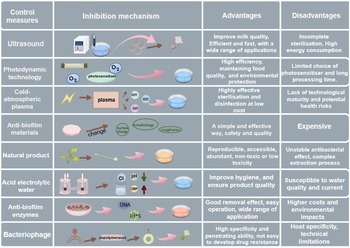
These strategies are designed to address the challenges posed by mixed biofilms in dairy environments and thereby ensure the safety and quality of dairy products (Fig. 2).
Common biofilm control measures and their advantages and disadvantages in dairy processing.

Physical eradication
Ultrasound
Ultrasound is a chemical-free method for inactivating bacteria and preserving nutrients in dairy environments. It utilizes mechanical energy to disrupt biofilms and detach microbial aggregates from food matrices and associated processing equipment (Lu et al., Reference Lu, Hu and Ren2022). The degradation of biofilms by ultrasound is closely linked to the dynamics of bubble formation and fluid motion during sonication (Bigelow et al., Reference Bigelow, Northagen, Hill and Sailer2008). As ultrasound waves pass through a fluid medium, they generate longitudinal waves that compress and expand the medium, causing pressure fluctuations that trigger cavitation. This fills microscopic bubble nuclei with energy, leading to their implosion and collapse. The resulting localized extreme temperatures and pressures produce a strong shock wave, which disrupts surface-associated biofilms.
Low-frequency, high-intensity ultrasound has been demonstrated to effectively separate biofilms from contact surfaces, alter adhesion and induce microbial lethality. The effectiveness of this method depends on parameters such as contact time, ultrasonic distance and microbial strain type (Yu et al., Reference Yu, Liu, Li, Guo, Xie, Cheng and Yao2020). In contrast, low-frequency, low-intensity ultrasound may enhance bacterial metabolism and growth, promoting biofilm formation. Hoedke et al. (Reference Hoedke, Kaulika, Dommisch, Schlafer, Shemesh and Bitter2021) reported that high-frequency sonication achieved more significant bacterial reduction in the dual-species biofilm composed of E. faecalis and S. oralis. However, the bactericidal effect of ultrasound alone is limited, as the dense EPS matrix of biofilms and bacterial cell envelopes impedes its mechanical action. Fortunately, when combined with chemical disinfectants, ultrasound can enhance the penetration of the disinfectant into the biofilm through mechanical vibration, improving its bactericidal effect (Zhao et al., Reference Zhao, Poh, Wu, Zhao, He and Yang2022). Several studies have validated this synergistic effect of ultrasound and antimicrobials on biofilm control. For instance, Sun et al. (Reference Sun, Wang, Sun, Liu, Du and Wang2021) inactivated planktonic and biofilm cells of S. aureus in food systems by treating with ultrasound combined with 1% chlorogenic acid for 60 min, resulting in a 1.13 log CFU/g reduction in bacterial counts. Similarly, Yu et al. (Reference Yu, Liu, Yang, Xie, Guo, Cheng and Yao2021) found that treating S. aureus biofilms with high-intensity ultrasound (20 kHz, 60 W) combined with chlorine dioxide (ClO2) for 10 min exhibited a synergistic removal effect, reducing biofilms by 99.03% compared to either treatment alone.
Studies have shown that low-frequency ultrasound can improve milk quality, while high-frequency ultrasound can modulate the biological, physical and chemical properties of organic and inorganic materials (Pegu and Arya, Reference Pegu and Arya2023). Despite its potential in dairy production, ultrasound technology still faces several limitations. First, sterilization may be incomplete. Jiang et al. (Reference Jiang, Wang, Bai, Bai, Tu, Li, Guo, Liao and Qiu2024) observed that Streptococcus putrefaciens entered the viable but non-culturable (VBNC) state after thermosonication treatment (50 kHz, 300 W, 30 min and heating at 70°C), indicating that bacterial VBNC states pose a major challenge to food safety. Notably, this VBNC state can be controlled by inhibiting key proteins of the bacterium. Second, scaling this technology to large-scale dairy production lines remains challenging, which requires: (i) efficient and reliable equipment operation; (ii) precise control of processing parameters to ensure consistent product quality; and (iii) mitigation strategies for equipment failures to minimize production disruptions. Nevertheless, under optimized conditions, ultrasound can effectively inactivate microorganisms and remove biofilms that may be generated during dairy processing. It may also improve the chemical properties and organoleptic attributes of milk, as well as modulate the microenvironment of dairy production (Pegu and Arya, Reference Pegu and Arya2023).
Photodynamic technology
PDT, an innovative antimicrobial approach, has recently garnered significant attention across fields from clinical medicine to the food industry (Warrier et al., Reference Warrier, Mazumder, Prabhu, Satyamoorthy and Murali2021). Its efficacy in eliminating mixed biofilms of bacteria on food-contact surfaces, such as stainless steel, is particularly noteworthy. PDT offers several advantages, including ease of installation, cost-effectiveness and high efficiency. A key advantage lies in its operation as a non-thermal bactericidal approach. This effectively alleviates the development of bacterial resistance, a characteristic that renders PDT a promising option for controlling microbial contamination in various scenarios (Ribeiro et al., Reference Ribeiro, Gomes, Saavedra and Simões2022). For the dairy industry, this non-thermal characteristic is particularly valuable since it prevents nutrient degradation associated with thermal processing.
In PDT-based anti-biofilm research, photodynamic inactivation (PDI) has been extensively explored. Tan et al. (Reference Tan, Zhao, Li, Peng, He, Liu, Zeng and Wang2022) pioneered a PDI technique for anti-biofilm applications, using slightly acidic electrolytic water (SAEW) as a photosensitizer. They evaluated the efficacy of this method by assessing mixed biofilm biomass, cell viability, regeneration capacity and spatial structure, and observed a significant reduction of 72.4% in the biomass of Vibrio parahaemolyticus and Shewanella putrefaciens biofilms. Complementing this work, Saraiva et al. (Reference Saraiva, Sestito, Bezerra, de Oliveira, da Silva Júnior, Machado, Nakamura, Alfieri and MSdS2024) utilized riboflavin as a photosensitizing agent and further confirmed the inhibitory effect of PDI on P. fluorescens and S. aureus biofilms formed in milk. Notably, their study found that PDI had no significant effect on the dairy matrix, preserving a significant amount of nutrients and proteins.
In conclusion, PDT significantly enhances food safety and contributes to the reduction of microbial resistance. Notably, the application of PDI in the dairy industry does not adversely affect milk quality. However, to fully capitalize on the advantages of this technique and optimize its efficacy, it is essential for future research to address the challenges posed by interference from biological media, particularly in dairy environments.
Cold-atmospheric plasma
Plasma is widely recognized as the fourth fundamental state of matter, alongside liquids, solids and gases. Based on its generation method, plasma is primarily classified into two categories: thermal and non-thermal plasma. Thermal plasma is defined by thermal equilibrium between electrons and ions (Simoncicova et al., Reference Simoncicova, Krystofova, Medvecka, Durisova and Kalinakova2019). When interacting with microbial cells, plasma species can induce multiple damaging effects, including: (i) disruption of the outer membrane; (ii) structural and/or functional alterations of proteins and lipids; and (iii) oxidative damage to DNA (Govaert et al., Reference Govaert, Smet, Walsh and Van Impe2019). Cold plasma offers distinct advantages for food applications, such as simple equipment requirements, low energy consumption, no toxic residue generation, room-temperature operation and high safety. Notably, its operation relies solely on electrical power and non-toxic gas input, making it an environmentally friendly and cost-effective alternative to conventional antimicrobial technologies (Zhu et al., Reference Zhu, Li, Cui and Lin2020).
Among cold plasma technologies, cold atmospheric plasma (CAP), an innovative biofilm removal approach, has recently attracted attention in the food industry due to its strong bactericidal activity. CAP utilizes its unique properties to inactivate bacteria when combined with biofilm inhibitors. Lunder et al. (Reference Lunder, Dahle and Fink2024) found that CAP significantly reduced the number of bacteria in both nascent and mature biofilms of S. aureus and MRSA. Beyond single-species biofilms, several studies have validated the efficacy of CAP against mixed biofilms. Denes et al. (Reference Denes, Somers, Wong and Denes2001) were pioneers in using CAP to inactivate mixed biofilms, showing a 56.5% reduction in bacterial adhesion and a 72.2% reduction in biofilm formation in mixed biofilms of Staphylococcus epidermidis, Streptococcus fluorescens and S. typhimurium. For the dairy industry, cold plasma (especially CAP) is particularly valuable, as it controls foodborne pathogens while minimizing quality changes in milk and dairy products. Wang et al. (Reference Wang, Liu, Zhang, Lü, Zhao, Song, Zhang, Jiang, Zhang and Ge2022) found that treating goat milk with cold plasma for 300 s achieved microbial inactivation comparable to pasteurization, while maintaining proteins in a more homogeneous and dispersed state. Similarly, Nguyen et al. (Reference Nguyen, Palmer, Phan, Shi, Keener and Flint2022) showed that high-voltage atmospheric cold plasma treatment for 20 min did not significantly alter milk colour, further supporting the potential of CAP as a safe and effective dairy processing method. Overall, CAP represents a promising strategy for controlling the formation of foodborne pathogen-derived mixed biofilms in the dairy industry, with the key advantage of preserving product quality.
Anti-biofilm materials
Biofilm formation is a complex process influenced by the physicochemical properties of the material surface (Uneputty et al., Reference Uneputty, Dávila-Lezama, Garibo, Oknianska, Bogdanchikova, Hernández-Sánchez and Susarrey-Arce2022). Given that the initial phase of biofilm formation is highly dependent on bacterial adhesion to surfaces, a process governed by surface physicochemistry, researchers have concentrated on targeting this stage through artificial surface modification. This approach entails integrating antimicrobial agents into surface coatings to regulate crucial properties related to biofilm initiation, such as surface charge, roughness, chemical composition, hydrophobicity and morphology. A diverse array of antimicrobial agents has been explored for these coating applications, including: (i) inorganic materials (e.g., metal-based and carbon-based antimicrobials); (ii) biological agents (e.g., enzymes, antimicrobial peptides and bacteriophages); and (iii) organic antimicrobials (Lu et al., Reference Lu, Hu and Ren2022). For example, Rubini et al. (Reference Rubini, Vedha Hari and Nithyanand2021) demonstrated that a chitosan-coated catheter could inhibit the formation of mixed biofilms of S. epidermidis and C. albicans by downregulating virulence factor genes. Lin et al. (Reference Lin, Zhang, Zou, Lu, Li, Wu, Cheng, Zhang, Chen and Yu2023) created a superhydrophobic photothermal coating that resisted initial bacterial adherence and killed residual bacteria under near-infrared irradiation, preventing biofilm formation for at least 2 weeks. This method provides a simple and effective way to eliminate biofilms in the dairy industry. Porter et al. (Reference Porter, Schwass, Tompkins, Bobbala, Medlicott and Meledandri2021) developed alginate nanocomposite (AgNP) hydrogels that exhibited anti-biofilm activity against gram-positive and gram-negative bacteria. Xiao et al. (Reference Xiao, He, Lu, Wu, Fan and Yu2021) also found that E. coli could be induced into the VBNC state by AgNP nanomaterials, but that the bacteria could be inhibited through the production of reactive oxygen species and the release of Ag+. Applying these surface modification technologies to dairy production line equipment can form a protective barrier against biofilm formation and subsequent contamination of dairy processing environments. Overall, the development and implementation of such antimicrobial surface coatings are expected to mitigate risks posed by persistent, drug-resistant biofilms, thereby enhancing the safety and quality of dairy products.
Chemical addition
Natural products
Owing to their unique chemical composition, various plant-derived natural products possess antimicrobial and anti-biofilm properties (Lu et al., Reference Lu, Hu, Tian, Yuan, Yi, Zhou, Cheng, Zhu and Li2019). These compounds exert their effects by inhibiting cell adhesion, disrupting the formation of EPS and reducing the production of virulence factors, ultimately impeding the development of QS networks and biofilms. A diverse range of such natural products has been identified, including flavonoids, phenols, terpenoids, furan acetylenes, steroidal glycoalkaloids, stilbenes, sulphur-containing compounds and indoles (Gonçalves et al., Reference Gonçalves, Leitão, Simões and Borges2023). Jafri et al. (Reference Jafri, Banerjee, Khan, Ahmad, Abulreesh and Althubiani2020) combined eugenol with antimicrobial drugs to successfully eradicate mixed biofilms of C. albicans and P. aeruginosa, reducing the C. albicans counts from 6.3 log CFU/cm2 to 4.2 log CFU/cm2 and 3.8 log CFU/cm2 in single and mixed biofilms, respectively. Tan et al. (Reference Tan, Leonhard, Moser, Ma and Schneider-Stickler2019) used curcumin in combination with 2-aminobenzimidazole to successfully eradicate mixed-species biofilms of C. albicans and S. aureus, achieving a clearance rate of 97.6%. Plant-derived natural products represent promising alternatives to synthetic antimicrobials, as their natural origin and low toxicity make them compatible with food safety requirements. When these compounds are incorporated into the pretreatment of dairy processing equipment, following compliance with food additive regulations, they can effectively inhibit biofilm formation and enhance the safety and quality of dairy products.
Acid electrolytic water
Acid electrolytic water (AEW) is a cost-effective, eco-friendly and easy-to-apply solution that has been widely used in the food industry. Its efficacy in inhibiting biofilm formation by various harmful bacteria is well-documented, with antibacterial activity attributed to the synergistic effects of its inherent properties: low pH, high oxidation–reduction potential (ORP) and effective chlorine content. Specifically, a low pH environment promotes the production of hypochlorous acid (HClO), which can penetrate bacterial cells and disrupt essential cellular structures. Simultaneously, a high ORP disrupts cell membranes and causes intracellular imbalance, rendering bacteria more susceptible to the toxic effects of active chlorine (Iram et al., Reference Iram, Wang and Demirci2021). A key subtype of AEW, SAEW, has attracted particular attention for biofilm control. Yan et al. (Reference Yan, Chelliah, Jo, Chen, Tyagi, Jo, Elahi, Woo, Wook and Oh2024) demonstrated that SAEW heated at 40°C treatment significantly reduced both food surface cells and MRSA 2.41 log (CFU/g) biofilm cells. Tao et al. (Reference Tao, Liao, Xu and Wang2022) found that SAEW inhibited the adhesion of C. sakazakii cells to solid surfaces, thereby preventing biofilm formation. To further enhance biofilm removal efficacy, combinations of AEW/SAEW with other technologies have been explored. Luo et al. (Reference Luo, Chang, Yu, Ni, Liu, Zhou, Liu and Wang2024) observed that combining 0.5 kGy EBI with 60 mg/L SAEW effectively disrupted the EPS matrix of V. parahaemolyticus and P. fluorescens biofilms, leading to the disruption of their primary structures. However, it is worth noting that Chang et al. (Reference Chang, Gui, Huang, Hung and Chen2023) found that L. monocytogenes could enter the VBNC state when treated with SAEW at a concentration of 8–10 mg/L, posing a potential risk to food safety. In the dairy industry, where stainless steel is a prevalent processing surface, the optimization of AEW-based cleaning and disinfection procedures, in conjunction with surface modification technologies, provides a promising approach. This integrated approach can reduce surface cell adhesion, improve hygiene and ensure product quality. In summary, the versatility and effectiveness of electrolytic water, particularly AEW and SAEW, in food-related applications highlight its promising prospects for further development in the food industry. Ongoing research into innovative applications of these solutions will continue to expand their potential for enhancing food safety and quality.
Biological methods
Anti-biofilm enzymes
Biofilm EPS plays a critical role in protecting microorganisms from environmental stresses (Karygianni et al., Reference Karygianni, Ren, Koo and Thurnheer2020). Composed primarily of nucleic acids, proteins, lipids and polysaccharides, these EPS form a ‘protective layer’ that shields microorganisms from antimicrobial agents and the host immune system. Thus, degrading and removing this EPS layer is a prerequisite for the effective eradication of harmful biofilms. Deoxyribonucleases (DNases) are pivotal in inhibiting biofilm formation and eradicating established biofilms, as they target eDNA – a key EPS component that regulates bacterial attachment, growth and biofilm maturation (Hu et al., Reference Hu, Kang, Shan, Yang, Bing, Wu, Ge and Ji2022). By degrading eDNA, DNases disrupt the structural integrity of the biofilm, rendering it more susceptible to subsequent antimicrobial treatments. In addition to eDNA, polysaccharides represent another critical EPS component, contributing to microbial adhesion to surfaces and providing biofilm strength and stability. To address these challenges, polysaccharide-degrading enzymes such as glycoside hydrolases (GH) and polysaccharide lysozymes (PL) are essential. GH efficiently disperses mature, self-producing biofilms, while PL utilizes a β-elimination mechanism to solubilize polysaccharides and disrupt the EPS matrix (Ramakrishnan et al., Reference Ramakrishnan, Singh, Singh, Chakravortty and Das2022). Collectively, effective biofilm eradication relies on the precise analysis of biofilm composition and the selection of enzymes with specific hydrolytic activities to target distinct EPS components (Mnif et al., Reference Mnif, Jardak, Yaich and Aifa2020). Fanaei Pirlar et al. (Reference Fanaei Pirlar, Emaneini, Beigverdi, Banar, van Leeuwen and Jabalameli2020) demonstrated that a combination of 0.15 μg/mL trypsin and 50 U/mL DNase was more effective in eradicating biofilms formed by S. aureus and P. aeruginosa than either enzyme alone. Similarly, Puga et al. (Reference Puga, Rodríguez-López, Cabo, SanJose and Orgaz2018) found that after treating mixed biofilms formed by P. fluorescens and L. monocytogenes from dairy products with 1 mg/mL DNase I, pronase and pectinase for 1 h, the coverage area and volume of the biofilms changed significantly. These studies highlight the potential of enzyme-based biofilm control strategies and the importance of understanding biofilm composition to select appropriate enzymes for targeted degradation.
Anti-biofilm enzymes truly present a promising yet challenging green antimicrobial strategy. By targeting the EPS that forms the protective layer of biofilms, these enzymes can disrupt the EPS network, making biofilms more susceptible to disinfection and antimicrobial treatments (Shokeen et al., Reference Shokeen, Dinis, Haghighi, Tran and Lux2021). When combined with biocides, anti-biofilm enzymes further improve the penetration of these agents into biofilms and interfere with signalling pathways that regulate biofilm formation and intercellular communication (Yin et al., Reference Yin, Xu, Wang, Zhang, Chou, Galperin and He2021), a synergistic effect that significantly boosts overall biofilm eradication efficacy. Beyond their antimicrobial benefits, the use of anti-biofilm enzymes helps to minimize reliance on chemical reagents, reduce water consumption and energy costs and align with sustainable practices, an increasingly critical priority in global research and industry.
To further advance the use of anti-biofilm enzymes, future research should focus on optimising their production process to reduce costs and make them more economically viable. Additionally, a deeper understanding of their mechanism of action on biofilms and their synergistic effects with other antimicrobial agents is essential to enhance the efficacy and specificity of enzyme-based therapies. However, when it comes to applications in the dairy industry in particular, factors such as the influence of residual enzymes on the flavour of dairy products and the cost of enzyme materials need to be taken into account. Ultimately, by disrupting the EPS matrix and eliminating harmful biofilms, enzyme-based methods can play a role in enhancing food safety, hygiene and public health.
Bacteriophages
Bacteriophages are naturally occurring bacterial viruses that exclusively infect and replicate within their specific hosts, bacteria (Mgomi et al., Reference Mgomi, Yuan, Chen, Zhang and Yang2022). As a safe and environmentally benign alternative to conventional antimicrobials, they offer unique advantages for eradicating drug-resistant bacteria, particularly those embedded in biofilms. Phages disrupt biofilm structures by targeting sessile bacteria, integrating their genetic material into the bacterial genome for replication, and ultimately inducing bacterial cell lysis to release progeny phages, which propagate further infection (Duc et al., Reference Duc, Son, Ngan, Sato, Masuda, K-i and Miyamoto2020). Notably, phages secrete polysaccharide depolymerases, which are enzymes typically anchored to their tail fibres or spikes. These enzymes can degrade bacterial capsules, thereby facilitating the adsorption of phages onto bacterial cells. More importantly, they can also break down EPS within biofilms. By enhancing biofilm permeability and disrupting the EPS matrix, these enzymes allow phages to more efficiently target and eliminate bacterial cells. Moreover, the co-evolution of phages and bacteria drives adaptive changes, equipping phages with sophisticated mechanisms for penetrating the surface of bacterial cells. This adaptability increases the potential of phages as an effective means for controlling biofilm-associated bacterial infections (Ferriol-Gonzalez and Domingo-Calap, Reference Ferriol-Gonzalez and Domingo-Calap2020).
Several recent studies have validated the efficacy of phages against both single-species and mixed biofilms. For instance, Zhang et al. (Reference Zhang, Shigemura, Duc, Shen, Huang, Sato, Masuda, K-i and Miyamoto2020) exposed a mixed biofilm of haemorrhagic E. coli O157:H7 and O91:H to the phage. They observed a clearance rate of over 60% within 6 h, and the viable count of E. coli O157:H7 and the total viable count decreased by 2.07 and 1.93 log, respectively. This finding highlights the potential of phages in addressing mixed biofilms. Zhang et al. (Reference Zhang, Shahin, Soleimani-Delfan, Ding, Wang, Sun and Wang2022) recently demonstrated the efficacy of vB_SauS_JS02, a relatively benign phage, in inhibiting and degrading S. aureus biofilms. They found that this phage decreased biofilm formation by 68% and was more effective than antibiotics, especially ceftazidime, in removing biofilms. Li et al. (Reference Li, Zhou, Guo, Qin, Hu, Li, Tan, Liu, Han, Ma, Du and Zhang2024a) reported the development of a k3-specific phage targeting Klebsiella pneumoniae in milk that effectively disrupted biofilm formation. Given its efficient biofilm removal, its application in mixed biofilms also holds promise. Akturk et al. (Reference Akturk, Melo, Oliveira, Crabbé, Coenye and Azeredo2023) combined phages targeting P. aeruginosa and S. aureus with a disinfectant to enhance the effectiveness of phage treatment on mixed biofilms formed by these two species. The results showed a reduction of 6.2 log CFU for P. aeruginosa and 5.7 log CFU for S. aureus. These studies collectively highlight the broad potential of phages for mitigating biofilm-related bacterial infections.
Despite these promising laboratory results, the application of phage therapy in the food industry, particularly in dairy manufacturing environments, raises critical concerns, most notably residual phage activity. While numerous studies have documented strategies to neutralize residual phages and ensure technical safety, the feasibility and efficacy of phage-based biofilm control methods in industrial-scale settings remain insufficiently verified. To facilitate the widespread adoption of phage therapy in the food industry, future research must address these gaps: optimizing phage therapy protocols, deepening the understanding of phage-bacteria interactions (especially in complex mixed biofilms), and developing scalable, cost-effective methods for neutralizing residual phage activity. By resolving these challenges, phage therapy has the potential to become a safe, efficient and sustainable approach for controlling bacterial contamination and biofilm formation in the food industry.
Conclusion
In dairy processing environments, the formation of mixed biofilms is a prevalent phenomenon that poses a substantial contamination risk of microbial contamination, threatening product safety and quality. To develop effective control strategies, it is essential to comprehend the characteristics of these biofilms, which consist of both pathogenic and non-pathogenic bacteria, and the complex interspecific interactions among diverse microbial populations. Although researchers have made gradual progress in elucidating microbial interactions in mixed biofilms, the mechanisms by which these interspecific interactions modulate biofilm composition and functionality are not fully elucidated.
Moreover, as the dairy and broader food industries keep expanding to satisfy global demand, the requirement for sustainable and cost-effective contamination control strategies will intensify. The successful development and industrial application of advanced anti-biofilm materials, such as functional nanomaterials and novel biocompatible polymers, are expected to enhance the contamination resistance of food processing surfaces (e.g., stainless steel, pipelines) and significantly reduce the proliferation and spread of harmful bacteria (e.g., L. monocytogenes, E. coli) and other microbial contaminants. Significantly, research on the effectiveness of physical treatments like ultrasound in disrupting mixed biofilms is still limited, emphasizing an urgent need for further exploration of its action mechanisms and optimization for dairy processing situations.
The advancement of these anti-biofilm technologies, encompassing both innovative materials and optimized physical treatments, holds the potential to raise food safety standards, decrease post-processing contamination occurrences and boost consumer confidence in dairy and other food products. Furthermore, the extensive implementation of such technologies could bring about a revolution in traditional food production and processing methods. This would minimize the dependence on chemical disinfectants and be in line with the global trend towards sustainable food manufacturing. Such a transition would not only improve producers’ operational efficiency but also mark a crucial milestone in the long-term and safe development of the food industry.
Funding statement
This work was supported by the Open Project Program of the State Key Laboratory of Dairy Biotechnology (No. SKLDB2023-007).
Competing interests
The authors declare that they have no known competing financial interests or personal relationships that could have appeared to influence the work reported in this paper. No data were used for the research described in the article. No AI was used to influence the accuracy, integrity and originality of the paper.