In this chapter, we get acquainted with the concepts of leadership, sustainability and governance, concepts we will need to develop our perspective on sustainability leadership. Leadership to move communities in a more sustainable direction will have to go through governance, through the process of collective decision-making that can place communities on a different development path. What amounts to good leadership will depend on the community, its stories about good governance and about leadership itself.
Introduction: Thinking and Organizing
Leadership for sustainability will have to create effects in thinking and organizing, and the relations between those two activities will be at the core of our story. Dealing with Grand Challenges requires coordinated action, organization, and governance to articulate the appropriate policies, plans and laws. We will speak of institutions, as policies, plans and laws all function as coordination tools in society (Van Assche et al., Reference Van Assche, Beunen and Duineveld2013). They enable the making and implementation of collectively binding decisions and, after a while, the guided transformation of communities and societies. Addressing such sustainability challenges also requires the creation of new stories about the good community, a desirable relation with the environment and a belief in the collective capacity to organize for the long term (Czarniawska, Reference Czarniawska2002; Kornberger, Reference Kornberger2022).
Our idea of sustainability leadership hinges on the power of stories to create understanding and to engender change. This entails that we need to pay close attention to the influence of stories on modes of organization and vice versa. Not all stories have the same effect, and not all systems of governance create or reinforce stories in the same manner (Czarniawska, Reference Czarniawska2014). Thinking and organizing shape each other but can never be reduced to each other. In communities, the relation goes through governance, where some stories acquire prominence, and others are discredited or rejected. The selection of stories at the table has an impact on the selection of forms of knowing that come to bear on collective decisions and their implementation (Latour, Reference Latour2009). The organization of the governance system will determine how expert stories and others enter governance, while some stories have the potential to transform governance, to build or dismantle it.
Thinking and organizing belong to different domains of human activity, and despite their intricate interweaving, they cannot be translated into each other perfectly. This is true in a double sense. Real forms of organization, and, by extension, community, cannot live up to their ideal imagined form (Seidl, Reference Seidl2016). Critical observations and stories about the system might hold true or not, yet as soon as the critique sparks actual reorganization, that new mode of organizing cannot perfectly address the issues observed. Next, we are bound to notice that several translations are always available. No story of a desirable community, of a sustainable future or even of good governance can produce only one form of organization (Bevir & Rhodes, Reference Bevir and Rhodes2005). The same system of governance, even the same decision, always leaves space for different interpretations, for different and new stories to develop about them.
A governance system, or, at a smaller scale, one organization, will always show traces of several stories, ideas and forms of knowing that went into its formation (Luhmann, Reference Luhmann2018). Those perspectives can be coherent or less so. Different stories might have contributed to the evolution of the system over time or were influential in different domains of governance, in different departments or arenas (Howlett & Rayner, Reference Howlett and Rayner2007). In democratic systems of governance, new stories can come in more easily, and a diversity of stories can more easily contribute, yet other polities, seemingly dominated by one voice, still reveal diversity and discontinuity in the stories structuring governance.
What helps to deepen our understanding of the relation between thinking and organizing, between stories and institutions in governance, is that governance is both a form and a process (Colebatch, Reference Colebatch2014). This is not surprising, as organizing is a process, while the form it takes at one point in time, the structure that enables the process and is the result of it, is an organization. A governance system is marked by a process of organizing and by a structure of actors and institutions, its organization. Each community will develop its own structure and process, even if many aspects are prescribed by higher-level governments (Brans & Rossbach, Reference Brans and Rossbach1997). The process is always harder to observe than the structure, yet might be on a path to change that structure.
A department of nature conservation within a ministry of environment can be an actor in governance, when it has a voice, and can speak with one voice. The voice does not have to coincide with a formal mandate. Sometimes, the ministry will be an actor in dealing with other ministries, courts, producing institutions that need to coordinate with others. Sometimes, individuals within the department can influence decision-making in and outside that organizational setting. In the name of the department, the term “conservation” rather clearly indicates that what is aimed at is a process, and as conditions change, the governance of conservation also needs to reveal itself as a process, a process which relies on structures such as the department.
Stories can play a role in governance and its transformation because of structure and process, and they can transform both. New stories, though, need to be understood by and resonate with the community and with the actors in governance before they can make a difference (Yanow, Reference Yanow2000). They need to connect with a fabric of existing stories and the values, assumptions and emotions associated with it. At the same time, they need to be amenable to translation into the categories of governance: Are there actors that can identify with them? Can they be reformulated so they produce something that looks like a recognizable policy goal or a problem (Peters, Reference Peters2018)? Do we have institutions and policy tools available to pursue the goal that is supported by the story or the capacity to enact such tools?
Stories, to gain traction, thus need to fit the worlds of thinking and organizing. They need to perform the double act of fitting into a world of other stories, and a world of policies, plans and laws, of organizational structures and processes that provide only limited access to newcomers (Van Assche et al., Reference Van Assche, Beunen and Gruezmacher2024). What makes this performance slightly easier is that stories are also in demand by governance; they are helpful to actors who might not know how to connect to the community, how to solve internal disagreement or how to recognize relevant goals and problems (Miller, Reference Miller2012). Governance systems thus select, use and craft stories that allow them to keep doing their work.
Stories about poverty in the third world gained traction in the decades after the Second World War, as decolonization was underway, as media landscapes became more globalized, and as international organizations such as the UN expanded their agenda and mandate. Poverty was not a new concept, yet the third world was one, and the ideological competition between capitalist and communist blocs sparked a competition to support “development,” where poverty was the most obvious first roadblock. Thinking and organizing on poverty in the global south thus coevolved, and were affected by other stories, on the right form of political organization and the correct understanding of progress.
The process, however, is never perfect, and we will encounter many reasons for this imperfection. Relations between governance systems, their communities and the encompassing ecological and material environment are never stable for long (Luhmann, Reference Luhmann1989). Something always happens. There is the issue of translation between thinking and organizing, already hinted at. Conflicts might arise, resources could be scarce and the hopes, fears and desires of the community might shift in such a way that an immediate response through governance is not possible. Chapters 2 and 4 will illuminate that some stories are harder to change than others, even when they are long past their due, and that the same holds for institutions and organizations.
Leadership
Why Leadership?
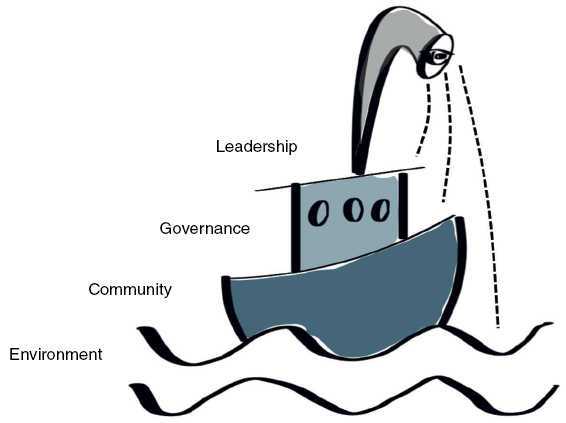
Perfect governance systems, therefore, do not exist. They must adapt continuously, and they ought to be the subject of ongoing conversations about their improvement (Folke et al., Reference Folke, Hahn, Olsson and Norberg2005). Structures and processes might be the result of long deliberations, might find support broadly in the community, and they might have functioned reasonably well for a rather long time, yet that does not mean they are immune to the imperfections observed everywhere (Mansfield, Reference Mansfield1979). If there is no space for self-reflection in the system, no conversation on its value and adequacy, things will go awry. If a system is too well adapted to its environment and seems perfect in that sense, chances are that the capacity to adapt to change has been overly constrained (Plummer & Armitage, Reference Plummer, Armitage, Armitage and Plummer2010) (Figure 1.1). Moreover, structures might be in place, but making them work is a different issue: Implementation is so much more than pushing a button. Structure does not naturally engender or support process, while the available structures or processes might not easily assert their own suitability for pursuing a particular policy goal.
Sustainability leadership
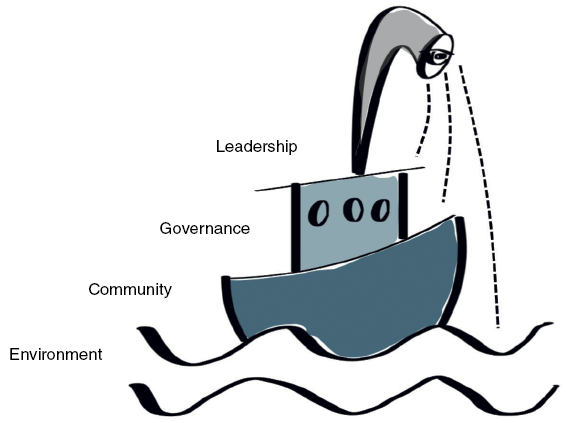
Here, in our view, leadership comes in. Leadership is needed to make things work, and it is especially important when new problems barge in with new demands for governance. Even in communities where procedures, rules and regulations for seemingly everything exist, leadership is of the essence (Alvesson, Reference Alvesson1996). This book starts from the observation that our planet is in deep trouble, that all communities are obliged to face sustainability challenges and it starts from the idea that our governance systems are not equipped to handle them. Stories about those challenges are not persuasive enough. In many parts of the world, people choose politicians and stories that evade or deny the issues.
Saying that we need strong leadership does not imply a reliance on old-fashioned strongmen. Rather, we understand leadership as distributed. By this we mean that it ought to be distributed over a group of people, in democracies, and we say that it always is distributed (Bolden, Reference Bolden2011). If we understand leadership as all the initiatives that go beyond procedures and routines, then leadership cannot be embodied by one person (Blaschke, Reference Blaschke2015; Seidl et al., Reference Seidl, Ma and Splitter2024). Even under a harsh dictatorship, commands from the Great Leader do not easily translate into chains of orders and actions that actually fulfill that command. Others need to understand what the leader might mean, how it could become reality, who should be mobilized, where resistance might be expected and how resources might be marshalled in unorthodox ways.
How leadership is distributed will differ per community and depend on what is possible and desirable there. Where direct participation in governance is deeply rooted, leadership tends to be distributed more widely and can shift more easily (Luhmann, Reference Luhmann1990). Where expert-led administrations tend to wield power, political and economic actors can still be relevant, and their interplay might depend on the stability of the political scene (Fischer, Reference Fischer2000). The distributed character of leadership enables communities to manage complexity, develop administrative and political specialization and cultivate adaptive capacity. Distribution, however, does not always entail flexibility, as broad sharing does not always require flexible sharing. When new problems assert themselves, leadership might be able to navigate their imperfect governance systems and modify them perhaps, yet leadership itself is likely imperfect (Luhmann, Reference Luhmann1997b). Hence, new forms of leadership might be called for.
Leadership can be distributed in many nonobvious ways, similar to the way obstacles to community development can be opaque for outsiders. Large landowners in a South American country can block any attempt at democratic reform and institution building and remain insensitive to critiques that they benefit from the colonial creation of large land holdings. The same class can hold the key to change, not only by managing their lands differently, but also by shifting stories in national politics and providing quiet support for larger land reform or withdrawing their backing of para-military groups destabilizing rural governance.
Rather than trying to define one new form of leadership which is expected to perform better under new and trying circumstances, we argue it is more helpful to think of leadership functions which can be distributed in different ways. Communities might require a different or new combination of leadership functions at a given point, while some useful functions might not be available or might not be recognized as relevant.
Leadership Functions
Identifying a timeless set of leadership functions is a nonstarter, as the role of routines changes over time and place; hence, what goes beyond routines will vary. Yet, many leadership qualities and activities do recur. Leadership in governance tends to involve the creative search for resources, which can be money or anything. Even if nothing changes in governance, the resources needed for previously routinized operations might vanish or might become insufficient. When new initiatives materialize, chances are that they must draw on resources currently used elsewhere or simply not there. When administrative reform is a necessity to deal with new issues, this will take resources, and the resource distribution after the reform will differ from the old situation.
As we used the words “initiative” and “resources,” we can immediately intimate that taking initiative and reshuffling power relations are priceless qualities for leaders (Flyvbjerg, Reference Flyvbjerg1998). Or, in our terms, they embody valuable leadership functions. Even when a community wholeheartedly desires a governance change, either a new policy direction or a change in procedure or structure, real obstacles might appear and vested interests might stand in the way. Even where a general direction might be agreed upon, a translation into policy initiatives might require, indeed, initiative. Mobilizing resources might mean that re-relating inside and outside is on the agenda, that leadership must establish new connections between governance and community and between different levels and systems of governance (Lichtenstein & Plowman, Reference Lichtenstein and Plowman2009).
Leadership, in the search for resources and support, might have to re-relate formal and informal institutions (Helmke & Levitsky, Reference Helmke and Levitsky2004). Indeed, if we understand formal institutions as policies, plans and laws, then we still need to acknowledge the existence of a world of informal coordination mechanisms. Sometimes, they can be parallel modes of coordination; elsewhere, they are better understood as traditions and habits embedding the formal institutions, enhancing their support and chances at implementation. Formal and informal institutions can respond to each other in myriad manners, and leaders ought to be aware of both formal and informal institutions, with an eye on managing their interplay. This means that leaders need to acquaint themselves with rules to break the rules, as well as rules to informally smoothen the application of other rules (Borins, Reference Borins2000). They can benefit from knowledge of informal and formal tools enabling quick action, which is often necessary to keep long-term policies on track. Complementing strategy with tactics thus appears as another leadership function, while the crafting of strategy is a fundamental one that will prove key to sustainability governance (Carter et al., Reference Carter, Clegg and Kornberger2008).
Crafting strategy is a leadership function that assumes many qualities and activities, which could also be regarded as separate functions. For a strategy to work, there needs to be a long-term perspective, and leadership ought to consider it a task to either create long-term perspectives or create the spaces where they can emerge (Mintzberg, Reference Mintzberg1998). A persuasive perspective on the future will have to be a story, so finding, crafting and telling stories have their place in the toolbox of leadership (Throgmorton, Reference Throgmorton1996). One might object that many communities possess governance routines and entrenched habits of deliberating desirable and feared futures, but the point is that this is not true generally and uniformly. What leadership finds in terms of structure and process of governance, in terms of relations with community and environment, will vary greatly, so what is needed to make the system work will show the same variation.
Futures can become visible slowly in a community and its governance system. A Central European country might have a multi-tiered planning system in place, yet at a local level, this is felt as a series of restrictions on local action, and a legacy of a communist ideology that has lost its lustre. Local politicians with national connections, local administrators with academic backgrounds, in addition to some well-traveled entrepreneurs, grasp the benefits of coordinated action that can both preserve environmental and heritage assets and create a predictable and open business environment. As they all know each other, informal consultation comes easy, and an insight develops that plans and policies can actually support local agency, that interests can be compatible.
In strategizing, and in the more daily activities of governance, leadership will need skills to identify new policy tools to pursue common goods or figure out how to use old tools in new ways (Grin et al., Reference Grin, Hassink, Karadzic and Moors2018). This requires a deep knowledge of system and environment, a knowledge which he or she might not possess, but could recognize in trusted allies and advisors. We arrive again at an advantage of distributed leadership, and, one can add, a difficulty in recognizing leadership, as formal leaders often live in the fiction that they are the only ones (Alvesson & Sveningsson, Reference Alvesson and Sveningsson2011). Administrative actors often fulfill leadership functions, without individuals or organizations ever willing to admit this, and the same can be said for corporate players, influential families, professional associations or civil society organizations playing an outsized role.
Strategy helps communities to navigate risk and opportunity, yet such navigation is part and parcel of other governance activities (Luhmann, Reference Luhmann2017). Without leadership, many risks and opportunities might be missed, even when sophisticated procedures are in place to take care of navigation. It takes great interpretive skill to recognize problems and opportunities independently of current routines (Boin & Hart, Reference Boin and Hart2003). New problems might rear their head, yet old problems might become slowly invisible for communities relying on procedural governance, and all too easily skip discussion or reflection. Risk and opportunity are assessed more adequately when both the governance system and its environments are sharply observed. In Chapters 6 and 7, we will argue that sustainability leadership is under considerable pressure in this function.
Environmental risk and economic opportunity cannot be balanced by mere calculation. What looks like an acceptable risk looks so in a story about opportunity and what appears as an amazing opportunity does so in a perspective of self and environment that supports an imagined future felt as desirable and realistic. A tourism future can take hold in a European region of coastal wetlands that hopes to emulate Palm Beach Florida, not calculating that climate, landscape, water quality, infrastructure, available space and investment potential all differ significantly. Leadership aware of this might temper the enthusiasm, maybe not for tourism, but for the American guiding example. This private reassessment of risk cannot sound publicly as a return to a self-image of low potential, and a new story is required, of a future maybe slightly less glamorous, but more reassuring, and with a greater local input and flavor.
Leadership functions become possible and desirable in a particular context, but all functions introduced above will prove useful for any community. If we say that leadership is always needed, because of the impossibility of perfect institutions, we do not suggest that leadership merely accepts such imperfection (Eggertsson, Reference Eggertsson2005). Working around routines, or finding ways to shake them up, modify them, have their place, but even distributed leadership cannot function on an ad hoc basis. Where new routines can be built, to deal with recurring problems, stable goals and provided of predictable resourcing and implementation tools, this ought to be favored (Howard-Grenville, Reference Howard-Grenville2005). Procedures engender blindness and rigidity, but they cannot be missed, as the alternatives of ad hoc governance and authoritarian centralization are decidedly riskier. Keeping an eye on the community and the diversity of voices and sentiments there helps to minimize blind spots, to prevent over-identification with the system of governance itself, its structures and processes (Kump & Scholz, Reference Kump and Scholz2022).
Leadership Roles
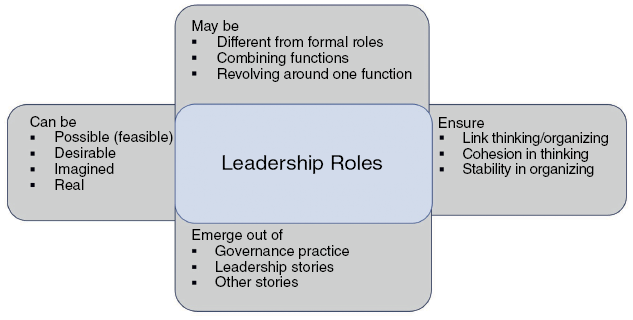
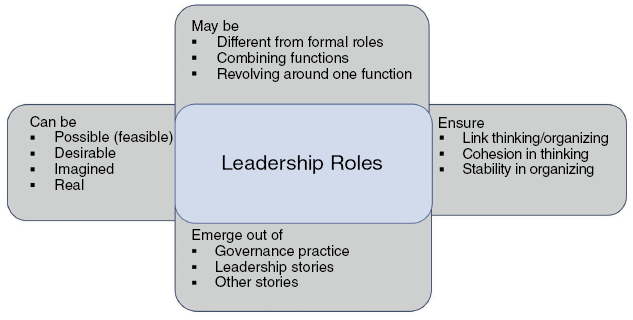
Leadership functions can be combined, or packaged, in various ways, and some packages can be aptly described as roles. Individuals can perform a function, but could also play a role, integrating different functions, a role that allows her to rise to the occasion. Roles can become fashionable or opportune, and fashions can change, so new combinations of leadership functions can become more prevalent (Alvesson, Reference Alvesson, Bryman, Collinson, Grint, Jackson and Uhl-Bien2011). Changing roles can stem from new challenges, new practices or competition in academic and consultancy circles. Usually, a new leadership role crystallizes around several changes at the same time, with new ideas regarding leadership stemming from emerging practices, from academic reflection on figures that seem to perform well under new market and institutional conditions, sometimes individuals that seem to embody a future at the doorstep (Czarniawska, Reference Czarniawska1997, Reference Czarniawska2003).
Leadership roles can often be described in metaphoric terms, which, for now, we can understand as comparisons. A good leader can be presented as a captain or a gardener, as a commander under siege or in full attack mode. Each image of the leader is a role, and we have to understand that, in distributed leadership, several roles can coexist, while one person can shift roles depending on circumstances (Alvesson & Spicer, Reference Alvesson and Spicer2010). A role will favor or emphasize certain leadership functions and pay less attention to others. Attack modes favor tactics over strategy, while a gardener tends to embrace long-term perspectives, allowing continuous adaptation and an openness to initiative from elsewhere. We return to leadership metaphors in Chapter 3.
No role will fit all situations, and the current state of the world calls for new roles. This has been understood in much of the literature on leadership, on governance and sustainability (Chaffin et al., Reference Chaffin, Garmestani, Gunderson, Benson, Angeler, Arnold, Cosens, Craig, Ruhl and Allen2016). What is more problematic is that in swaths of that literature, this led to the uncritical embrace of a type of leadership that is supposed to solve all our problems. Speaking of transformative leadership and transformative governance, the assumption is that transformation is needed, hence leaders capable of catalyzing it. Which then leads to the creation of an ideal type of leader and the neglect of the diversity of starting points and challenges leaders must work with (Alvesson & Kärreman, Reference Alvesson and Kärreman2016). Even where transformation of governance, towards a sustainability transition in society, is of the utmost importance, one cannot assume that an immediate focus on transformation will be productive. More fundamentally, the desire to move to rapid action embodied in the creation of such leadership concept, glosses over the fact that, even where reform is the focus, the skillset needed can differ radically from place to place.
What a sustainability transition would look like, and which leadership functions and roles would be helpful, cannot be formulated in the abstract. How much transformation would be involved, and how this would come about, cannot be coupled to one leadership role, to a fixed set of leadership functions, and attributes making them suitable to perform those functions. Thus, transformative leadership is not always good nor always possible, and what it means can vary so drastically that it cannot be delineated as a role. This is not surprising as the essence of the role is a generic goal of systems change, without too many indications with regards to leadership attributes or styles (Rosenhead et al., Reference Rosenhead, Franco, Grint and Friedland2019).
A Central African town dominated by cement factories of colonial origin, controlled now by affiliates of the party in power nationally, is confronted with degradation of the local landscape, to the extent that much of the remaining limestone deposits are about to become unexploitable. Working conditions, moreover, are such that locals refuse to take up jobs in the factories, and management attracts workers from other regions and ethnicities. Nationally, leadership is aware of the risky dependence on one town for its ambitious infrastructure agenda. Forking paths appear: If sustainable development entails the construction of new infrastructure – and therefore increased cement production – should the response involve investment in the establishment of new cement factories across multiple regions? Or, alternatively, should the emphasis be placed on minimizing environmental harm and limiting further investment in cement, by directing national attention to the existing cement-producing region? This latter approach would involve reorganizing factory management and fostering new forms of collaboration with a strengthened local administration.
Other leadership roles burdened with high expectations ought to be scrutinized with the same stringency (Luhmann, Reference Luhmann1997a). What could clarify the discussion might be a simple reminder that roles are constructions which emerge in a context and serve a purpose in that context. For sustainability leadership, that context is always triple: the governance system, the community and its ecological environment. Neither actors in governance nor community members have a perfect understanding of those nested systems, of the potential and limitations of governance to alter the relations between them. Problems that seem insurmountable can inspire calls for utopian or authoritarian leaders, and elsewhere to blind trust in participatory processes that replace insight in the real issues with overconfidence and overidentification with the community (Cooke & Kothari, Reference Cooke and Kothari2001; Scott, Reference Scott1998). Problems and opportunities, in other words, create problems and opportunities for governance, and for leadership. They bring out desires for leadership roles that may or may not measure up to the situation, and that may or may not find a place in the governance system (Figure 1.2).
Leadership roles
Understanding governance, in other words, is of the essence, if we want to grasp what sustainability leadership could mean.
Governance
Governance is always there, in any community. Yet, the potential of governance to pursue collective goals, and to manage problems is not always used. If pursuing a more sustainable community has to be coordinated through governance, it makes sense to delineate the potential and limitations of governance systems themselves to effectuate change (Van Assche et al., Reference Van Assche, Beunen and Gruezmacher2024). That change can be societal, it can pertain to the relation with the ecological environment and it can involve change in governance itself. Not all goals can be reached in the current organization of collective decision-making.
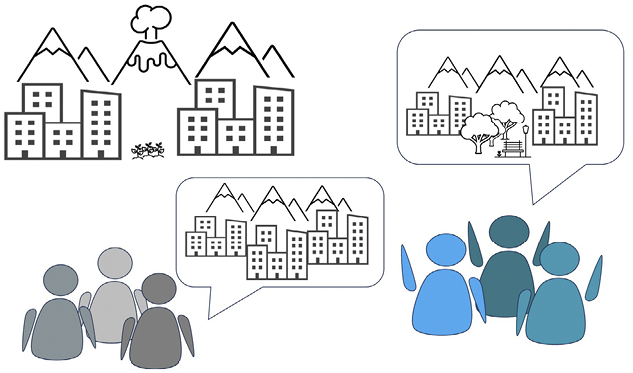
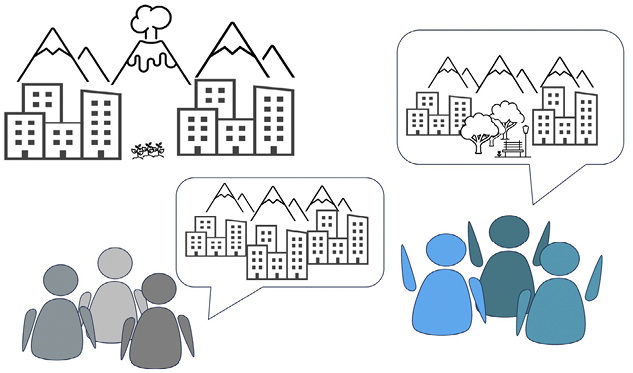
In fact, not every community, and not every environment is amenable to change to the same degree; each governance system has its own limits of steering. The modes of self-transformation available to a governance system are similarly constrained (Jessop, Reference Jessop, Amin and Hausner1997). If we need more than trivial change or change that goes beyond the routines of self-transformation, we must invoke leadership again, in its different functions outlined above. Even with strong and creative leadership, limits will persist, and it is therefore of the utmost importance to locate those limits. Elections, public participation processes, policy assessments, procedures for policy coordination, opportunities for debate and deliberation are all valuable, and contribute to guided self-transformation, hence adaptation, of governance systems, but in many cases, they are not enough. In fact, they might reproduce an old blindness to problems, and they might easily introduce new blind spots (Foucault, Reference Foucault2007) (Figure 1.3). Transcending old limits of steering, where new problems would favor an expansion of the toolbox, does not necessarily occur, even where many adaptation mechanisms are in place. Why is this the case?
Blindness in governance perpetuated
Coevolution
Much can be ascribed to the coevolutionary character of governance systems.
First of all, we should understand governance configurations as sub-systems of communities. They fulfill the task of coordinating collective action and regulating some individual behaviors. Both tasks involve collectively binding decisions, which can take the form of institutions: policies, plans and laws (Van Assche et al., Reference Van Assche, Beunen and Duineveld2013). Institutions regulate governance itself, while governance articulates new institutions, which need to fit the network of existing ones. Governance thus regulates itself, and it has the potential to shape communities (Hartley & Howlett, Reference Hartley and Howlett2021). It can affect relations between the community and its ecological and material environment. Institutions guide the use of natural resources, the protection of natural areas, the building of infrastructures and so forth. We must distinguish therefore three co-evolving systems: governance, community and the encompassing social-ecological system. One can speak of co-evolution, because one cannot understand the trajectories of the systems without reference to the others. They shape each other over time, although to different degrees and in different respects (Beunen et al., Reference Beunen, Van Assche and Gruezmacher2022). Wolves do not decide on villages the way the village council decides on pest control, yet village and wolves respond to each other, and a history of human interventions alters landscapes to such a degree that wolves find no place in them.
Second, actors and institutions co-evolve. We spoke of configurations because governance systems can be understood better when considering their unique combinations of actors and institutions, rather than by looking at each separately. This is the case for the rather obvious reason that actors and institutions are the product of the same evolutionary process, a process of emergence, where individuals and communities shape themselves and try to achieve things (North, Reference North2006). For that, they develop forms of organization that delineate actors and institutions. Banks, bankers and banking tools appear at the same time; new banking tools enhance the position of bankers in communities, and at some point self-regulation within the profession gives way to governance, to rules governing the behavior of banks, the relations between bankers and the rest of society (Mahoney & Thelen, Reference Mahoney and Thelen2010).
Co-evolution does not require complete simultaneity. Things do not need to happen at exactly the same time. Rather, a change in one element of a co-evolving system is likely to trigger change elsewhere, and over time, the coupling between the elements can become tighter (Luhmann, Reference Luhmann1995). New environmental regulations benefit certain sitting actors, can bring new actors to life, that is, within the orbit of governance, and they can reinforce the position of other policy tools or institutions, such as environmental plans. When this happens, it can reinforce the position of planning, and of planning experts in governance, either as consultants or in administration.
Third, knowledge and power co-evolve. We lean on Michel Foucault here, in emphasizing that knowledge is never neutral, certainly not knowledge that plays a role in governance. Governance embodies the promise of power, as aspirations, stories and ideas can generate decisions that bind the collective. Which means that they can shape the collective or even bring that collective into being (Foucault, Reference Foucault2012). As soon as an idea, a story, a perspective on reality enters governance, it changes color. It will be assessed by proponents and opponents on its possible influence on decision-making, which means its potential reshuffling of power relations in governance and community.
Knowledge, for Foucault and for us, is always produced in a frame that represents a particular ordering of the world, a particular set of power relations (Foucault, Reference Foucault2002). Any ordering of the world affects the production of knowledge in that frame, as well as the production of rules and regulations keeping that order in place. New understandings of the world have the potential to reshuffle power relations, as a shift in the construction of realities tends to bring about changes in what looks like a problem, an asset or a lofty aspiration. Expert knowledge cannot be isolated from these dynamics, as its presence in governance depends on the belief in its importance, which is in turn underpinned by a story about a reality where that particular expertise is important (Hillier, Reference Hillier2002).
Stories about problems, about the environment, about looming threats are not always welcome in governance or in the community. That is, they are accepted if they fit the fabric of existing stories and beliefs, which might be reinforced by expertise that is believed and believed to be relevant. Stories are given free entrance if it appears to actors that they represent something real and important for the community and could lead to decisions. If new policies are the result, the stories or derived expertise can achieve a prominent place in governance and community and might slowly take an appearance of neutrality (Miller & Fox, Reference Miller and Fox2007).
In the former USSR, secret cities existed, inaccessible to foreigners and most Soviet citizens, not appearing on maps and in most policy documents. Those cities often accommodated industries deemed of national interest, industries that tended to come with a heavy environmental burden. Local actors have little influence on the future of such cities, except perhaps the management of the key industries, provided they had strong Moscow connections. In Moscow, few signals would be received from such communities, as they revolved around a few key players, interested in very few topics, and as Moscow elites expected to hear about those same things only. Environmental pollution, working conditions, rule of law would not make for stories registering in the capital, or finding a listening ear locally.
A story might look real enough for experts, but that holds no guarantee that it will have the same effect on the rest of us. Citizens might feel uncomfortable with the truths presented to them, actors in governance might feel their positions threatened, everybody might experience some difficulties in connecting the new problem or opportunity to the fabric of other stories that makes up their reality (Latour, Reference Latour2009). The question of fit is not merely one of cognitive compatibility. People might see no logical reason to disagree yet still feel entirely unconvinced. The reasons can be manifold, but one important explanation is that what people want to be real, what they feel to be real and what they understand to be real are always blended (Zizek, Reference Zizek2019). For people, for organizations and communities, drawing hard distinctions between what they want, what they feel and what they believe amounts to a categorical impossibility. Neutral observation is not our forte, as humans, and in governance, where the specter of power is always present, where what we want might become reality, distinctions become blurred more easily (Van Assche & Gruezmacher, Reference Van Assche and Gruezmacher2025).
Governance is never a level playing field for competing versions of reality, in other words, and altering the reality of governance systems will never entirely depend on new facts or additional expertise. The co-evolution of actors and institutions, of power and knowledge and of those two configurations ensures that new stories enter only selectively, that those stories are never just about new facts. It has the effect that some versions of reality and certain governance structures and processes keep each other in place. We speak of rigidities in governance evolution (Beunen et al., Reference Beunen, Van Assche and Duineveld2015).
Rigidities
Working towards sustainable communities must take notice of governance, as collectively binding decisions will be expected. Sustainability initiatives will likely necessitate a transformation of governance, based on new understandings of environmental problems (Berkes, Reference Berkes2017). We know by now that neither communities nor their governance systems are naturally amenable to self-transformation; merely presenting them with dramatic facts about a worsening environment tends to be insufficient. New stories are needed, and new forms of leadership, as the routines established over time will require fixing, and as stories hold greater potential to relate affect, desire and ideas in a way that can mobilize the community (Tewdwr-Jones, Reference Tewdwr-Jones2011).
For leadership, the understanding of rigidities in governance comes at a premium. Where leaders craft new stories, or when they focus on finding new policy tools to make a still cherished story reality, they need to be thoroughly familiarized with governance constraints. In evolutionary governance theory (EGT), we speak of dependencies and note that each governance path is marked by a unique combination of rigidity and flexibility (Van Assche et al., Reference Van Assche, Beunen and Duineveld2013). Rigidity is not to be vilified, as the dependencies also embody deeply held values, policy orientations, and as they perform the task of stabilizing governance and community. Simultaneously, what stabilizes limits adaptation, and delimits adaptive capacity, which is always the capacity to adapt to a circumscribed range of events.
Later in this chapter, we will introduce the idea of dependencies and throughout the book point out that leadership also consists in the observation and management of dependencies (Van Assche et al., Reference Van Assche, Duineveld, Gruezmacher and Beunen2021). What can be changed at what cost rarely transpires transparently from the formal description of the governance system (Easterly, Reference Easterly2006). Even long-time insiders retain blind spots in their observation of governance, and easily overestimate rigidities, taking too lightly the possibilities for disruption, the need for adaptation or, alternatively, overlooking the corrosion of trusted adaptation tools (Flyvbjerg, Reference Flyvbjerg2005). Leadership can assert itself in reassessing, in public or in private, what can be expected of the current system, and how it might be adjusted.
Governance systems have capacities to observe themselves and their environment, and they are able to articulate versions of past and future to orient their present operations. Not all systems realize this potential, and whether it happens or not is a matter of empirical observation (Voß & Kemp, Reference Voß, Kemp, Voss, Bauknecht and Kemp2006). In other words, one cannot take governance at its word. The self-description destined for outsiders and the self-understanding of governance systems are limited by the stories available to them, the values embraced, the positions defended (Czarniawska, Reference Czarniawska2002). If communities are serious about sustainability, the quality of observation and self-observation in governance takes on additional relevance.
A state government in the US might be inclined to fight inequality in new ways, and to stretch ideas of good governance and rule of law by considering affordable housing and health care as basic rights. It finds out quickly that inherited stories of individual freedoms and responsibilities, a court system based on common law, privileging jurisprudence and a federal government steeped in a diverging ideology constitute formidable obstacles for the envisioned reforms. Leadership then must carefully pick its battles, as it also relies on federal government through a variety of programs, and as some legal rigidities are easier to reinterpret than others.
Without an image of the future, of futures feared and desired, long-term policies and strategies are not in the cards, while some problems and goals will warrant coordination over the long term. Without an understanding of the past, learning from that past, from the origins of problems, and the difficulties to strategize earlier, will be tenuous (Van Assche et al., Reference Van Assche, Gruezmacher, Marais and Perez-Sindin2023; Van Assche & Gruezmacher, Reference Van Assche and Gruezmacher2025). And without observation and self-observation, any pursuit of common goods will be blind (Alvesson et al., Reference Alvesson, Sveningsson and Blom2016). Leadership might focus on fixing some of these issues, if they represent structural obstacles to sustainability strategy, rather than on crafting workarounds, finding resources or other leadership functions. We will speak of leaders as builders and storytellers.
Sustainability
The absence or presence of versions of the future in governance systems and the quality of observation make a difference for the range of options available to governance and its leadership (Adger & Jordan, Reference Adger and Jordan2009). Which self-understanding is in place, which lessons are drawn from history and which futures are deemed desirable and susceptible to steering are relevant for the assessment of policy options and reform risk (Bennett & Howlett, Reference Bennett and Howlett1992). These questions become even more pertinent in considering the rigidities that might support or jeopardize sustainability policy. If systems operate on the basis of problematic understandings of self and environment, or lack interest in collective futures, this severely hampers the space to maneuver. Observing such situation does offer pointers for what might need repair before anyone can embark on a sustainability journey.
Yet, what is sustainability? The question cannot be dismissed merely because it supposedly has been answered so often. We know that sustainability thinking emerged in the 1970s, that it was popularized under the auspices of the Club of Rome, who called the attention of the world to the limits of growth ideologies, both capitalist and communist. Swedish Prime Minister Gro Brundtland chaired the writing of a report for the United Nations. Under the title Our Common Future, the report sparked a flurry of policy formulation towards sustainability, and it recognized the importance of economic and social sustainability, besides the environmental concerns that were the impetus of the writing (Seefried, Reference Seefried2015).
Meanwhile, a group of Canadian and European ecologists had coined the concept of resilience, as the capacity of ecosystems to bounce back after shocks and explored its relevance beyond the discipline. Hence, the concept of social-ecological systems, and the idea that communities and ecologies could damage each other beyond repair but also find a relation whereby shocks could more easily be tolerated. Whereas much of the early sustainability rhetoric still aimed for sustainable development, resilience thinking is less clearly positioned in the corner of softened capitalism (Brown, Reference Brown, Pelling, Manuel-Navarrete and Redclift2012). Robust systems and damage control take center stage and the influential Stockholm Resilience Centre, representing a core group of resilience researchers, has worked with great zeal towards governance systems engendering more resilient system states (Steffen et al., Reference Steffen, Richardson, Rockström, Cornell, Fetzer, Bennett, Biggs, Carpenter, de Vries, de Wit, Folke, Gerten, Heinke, Mace, Persson, Ramanathan, Reyers and Sörlin2015).
In 2015, the United Nations adopted a list of seventeen sustainable development goals (SDGs) which could further the coordination within and between countries. The SDGs show an expanded understanding of sustainability compared to the Brundtland report and reveal the influence of resilience thinking. In this book, we will refer often to the SDGs, in the main narrative and especially in examples and vignettes, as they frame much of the current sustainability thinking, not only in international politics but also at the level of organizations, where universities now target sustainability rankings, to name one thing.
Sustainable development goals and their definition:
1. No Poverty: End poverty in all its forms everywhere.
2. Zero Hunger: End hunger, achieve food security and improved nutrition and promote sustainable agriculture.
3. Good Health and Well-being: Ensure healthy lives and promote well-being for all at all ages.
4. Quality Education: Ensure inclusive and equitable quality education and promote lifelong learning opportunities for all.
5. Gender Equality: Achieve gender equality and empower all women and girls.
6. Clean Water and Sanitation: Ensure availability and sustainable management of water and sanitation for all.
7. Affordable and Clean Energy: Ensure access to affordable, reliable, sustainable and modern energy for all.
8. Decent Work and Economic Growth: Promote sustained, inclusive and sustainable economic growth, full and productive employment and decent work for all.
9. Industry, Innovation and Infrastructure: Build resilient infrastructure, promote inclusive and sustainable industrialization and foster innovation.
10. Reduced Inequalities: Reduce inequality within and among countries.
11. Sustainable Cities and Communities: Make cities and human settlements inclusive, safe, resilient and sustainable.
12. Responsible Consumption and Production: Ensure sustainable consumption and production patterns.
13. Climate Action: Take urgent action to combat climate change and its impacts.
14. Life Below Water: Conserve and sustainably use the oceans, seas and marine resources for sustainable development.
15. Life on Land: Protect, restore and promote sustainable use of terrestrial ecosystems, sustainably manage forests, combat desertification and halt and reverse land degradation and halt biodiversity loss.
16. Peace, Justice and Strong Institutions: Promote peaceful and inclusive societies for sustainable development, provide access to justice for all and build effective, accountable and inclusive institutions at all levels.
17. Partnerships for the Goals: Strengthen the means of implementation and revitalize the global partnership for sustainable development.
While a fair share of the academic literature on sustainability and resilience aims to capture more sustainable system states in quantitative terms, our perspective underlines the importance to understand sustainability as a spectrum of possible system relations, a spectrum moreover which will differ between social-ecological systems (Scoones et al., Reference Scoones, Leach, Smith, Stagl, Stirling and Thompson2007). The problems facing communities diverge, and the answers available to them, partly in terms of governance responses, are similarly varied.
Besides the diversity of possible system relations we could call sustainable, and besides the unique path and goal a community must define for itself, we must recognize another issue. What sustainability could mean for a community and which specific sustainability path to choose cannot be ascertained directly. Creative interpretation is involved, stories are needed to pin down an actionable meaning. In fact, images, analogies and stories were part and parcel of sustainability discourse from its inception. Even if early advocates of sustainability and resilience policy were not entirely aware of it, they too needed narrative support to stabilize their new and cherished concepts. They found that support in images of stability and shock absorbance, in narratives of harmonious relations between humans and nature, while later authors branched off into new narrative realms, finding new images to further articulate what sustainability might mean in diverse fields of application (Larson, Reference Larson2011).
An East African nation plagued by civil war for decades and coming out of a history of incomplete governance reforms, is looked upon in the western world as primarily suffering from hunger. Support, some of it under the banner of sustainability, hopes to prevent future famine. National elites, meanwhile, frame the situation differently, attributing hunger to conflict and machinations by competing factions. In rural areas, not all affected by the conflict, the major obstacle to sustainability manifests itself as the fragmented and incoherent governance that resulted from wave after wave of reform. Sustainability itself thus appears sometimes as a positive goal yet elsewhere emerges as a product of problems. A problem starts to look as an obstacle to something, to a sustainable state that only then becomes defined.
In Chapters 2 and 3, we unpack the nature of narrative and metaphor, which helps to understand why they prove so useful in grasping what eludes our grasp, to structure ideas and ideals, fears and other feelings about our relationship with the natural environment. After which, in Chapter 4, we can productively return to the theme of sustainability, how it has been steeped in stories and our effort to interpret the interpretive base of sustainability will enable us to delineate more sharply what sustainability leadership could mean. Because the landscape of literature on sustainability and leadership has been cluttered with mythologies, we devote Chapter 5 to the deconstruction of these myths, as they are unhelpful at best and obstruct the view on both sustainability and sustainability leadership.
Chapter 6, then, presents our perspective on sustainability leadership, marking the centrality of sustainability strategy, and the leadership and governance capacities that need to be in place to render strategy and its implementation realistic. We identify several leadership roles that might prove key to efforts at sustainability strategy and its enabling governance transformation. Recognizing the diverse forms of and paths towards sustainability, the associated variety of governance configurations, we nevertheless distill characteristics of good governance that are especially partial to the pursuit of sustainability goals and derive beneficial leadership roles and functions from these requirements of good sustainability governance.
In our discussion of sustainability governance, we first impress on the reader the importance of long-term perspectives in governance, and the systematic coupling with understandings of the past (Hajer & Oomen, Reference Hajer and Oomen2025). If little interest in the future, in collective goods that can be pursued over the longer term, can be traced, or if governance unduly constrains itself in their pursuit, any leadership interested in sustainability must step in. Where the past remains blurry, or captured in self-aggrandizing or victimizing mythologies, the construction of sustainable futures remains highly unlikely (Asad & Sadler-Smith, Reference Asad and Sadler-Smith2020).
Second, we stress the centrality of observation and self-observation, the diversity of observations available to governance. Especially relevant is the observation of always shifting systems relations, between governance, community and environment. The mutual effects of the social and ecological environment on each other, and the implications for system stability and the further evolution of the relations, deserve close attention (Luhmann, Reference Luhmann1989). Observation without self-observation leads to dead ends, as both the reasons for and effects of observations within the system cannot be assessed without a cultivation of reflexivity.
Third, we reiterate our belief in strategy, so the capacity of governance systems to articulate strategy deserves our interest. Leadership can greatly contribute to the formation and implementation of strategy, through the crafting and telling of stories, the integration of policies and, fundamentally, the strengthening of community. If people do not feel there is a community worth defending, arguments assuming common interests become significantly less persuasive (Leopold, Reference Leopold1970). If the common interest is reduced to the prevention of the same sort of harm to all individuals, sustainability strategy will shrink and shrivel to the point of irrelevance.
For sustainability strategy to emerge, governance will have to do more than cultivating observation and self-observation, and the image of good governance, as in enabling sustainability transition, will be detailed in subsequent chapters. We will make a broad-stroke distinction between situations where most features of good sustainability governance are in place, and others where even basic requirements are not met. What leaders should do, which functions and roles would be helpful under such different conditions, is bound to diverge, yet the answer in concrete cases is complicated by the fact that the most effective leadership roles in terms of problem-solving might not be the ones desired by the community or supported by the governance system.
Our final chapter, Chapter 7, further elaborates the idea of sustainability strategy, the difficulties for leadership in navigating dilemmas posed by any sustainability transition, and the value of interpretive perspectives on sustainability leadership. If we can elucidate the narrative construction of sustainability and leadership and locate effective and legitimate sustainability leadership within governance configurations that always shape themselves through stories and institutional structures, then the importance of narrative will appear inescapable. Recognizing and crafting narrative, performing stories and discreetly assessing other performances transcend “soft skills”; they are at the core of sustainability leadership.
Sustainability can only be comprehended productively as emerging from a tangle of stories, stories about ourselves, the real community and the real world, stories about past and future, about threats and opportunities appearing in the relation with our environment (Descola & Palsson, Reference Descola and Palsson2003). Sustainability issues can only be addressed when a second set of stories is considered, stories about good and acceptable leadership and about the governance structures and processes we prefer to solve problems and grasp opportunities. If our understanding of governance is self-limiting to the extent that common goods, shared futures and broader system relations are excluded from the picture, our futures are bleak indeed. If, on the other hand, we accept a collective future, and leadership mobilizing governance systems measuring up to the Grand Challenges of our day, optimism cannot be written off as fantasy (Pestoff, Reference Pestoff2014). Stories and metaphors structure what is and what could be, for leaders and for everyone else. Before we get carried away too much, let us take a closer look at what narratives can achieve.