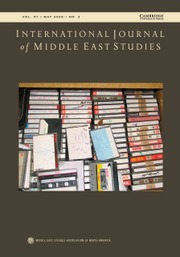


Over the last few years, Egypt's literary scene has been enriched by the appearance of a new medium: adult comics. This medium encompasses a wide range of styles and an array of themes, from manga-inspired horror stories to crime noir, from the funny and surreal to the deeply disturbing. The most visible venue for these comics is the bimonthly independent magazine Tuk-Tuk, which since its founding in 2011 has been run by a collective of young artists (Figure 1). At the time of writing, fourteen issues of Tuk-Tuk have been published, and it is highly popular among a small but dedicated group made up mostly of young adults. The print run of the first five issues was 1,500 copies, all of which, according to the main editor Muhammad Shinnawi (b. 1982), were sold.Footnote 1
Two examples of the new Egyptian comics. Top: cover of Tuk-Tuk 5 (2012). Bottom: excerpt from “The Sponge Bob Gang,” by Muhammad Shinnawi, Tuk-Tuk 5 (2012).

Comics as such are not new to Egypt. The country has a long tradition of children's comics magazines that, despite having traditionally dwarfed books and periodicals in terms of print run, have received very little scholarly attention. In fact, I have found only one book-length study of any form of Arabic comics.Footnote 2 What makes this lacuna all the more surprising is that comics—and adult comics in particular—are a fascinating lens through which to view contemporary Arab culture. Catering to a much smaller audience than mainstream cultural products, the new adult comics upon which I focus are largely produced and consumed by young adults.Footnote 3 They voice an emancipatory social and political message, often in tongue-in-cheek fashion. In other words, the makers of these comics do not take themselves too seriously. They may be said to inhabit a niche between Walter Armbrust's “mass culture” and Richard Jacquemond's serious literary field where authors often see themselves as the “conscience of the nation.”Footnote 4 While their comics merit attention for their artistic and aesthetic value, this article approaches them in terms of ideology.
The connection between comics and ideology is well established.Footnote 5 As noted in the introduction to a recent volume on the subject, portrayals of life in comics, be they for children or adults, “are not neutral or random,” but rather “have significant ideological implications.”Footnote 6 The combination of pictures and text, and the restricted space available to the writer and graphic artist, tend to encourage social stereotyping and semantic ambiguities, two useful tools for propagating and criticizing ideology. Accordingly, comics have served as powerful vehicles of ideology, whether in the service of power or in challenge to it.
Clifford Geertz conceived of ideologies as symbolically mediated cultural systems, “maps of problematic social reality and matrices for the creation of collective conscience.”Footnote 7 Building on Geertz, John B. Thompson developed a critical theory of ideology as “meaning in the service of power,” prompting him to study symbolic forms (i.e., texts, images, rituals, statues) in light of the “structured social relations which their employment or deployment may serve, in specific circumstances, to create, nourish, support and reproduce.”Footnote 8 It follows from this that symbolic forms which challenge dominant social relations are critical or subversive. Adapting Thompson's approach to ideology, I focus not on the dominant ideology—or, in the case of Egypt, the regime's patriarchal authoritarianism—but rather the cultural expressions that subvert that dominant ideology. In Egypt, adult comics are one such cultural expression, ordering an alternative matrix for the creation of, to use Geertz's phrase, a collective conscience in challenge to social relations upheld by the Egyptian regime. In what follows, I will show, first, how these comics directly challenge Egypt's prevalent ideology of patriarchal authoritarianism, and second, how they constitute both an important part of a political and cultural cross-fertilization that emerged hand in hand with the 2011 uprising and a lasting heritage of this process.
Allowing for the considerable difference in context, Egypt's new adult comics are in some ways comparable to the countercultural “comix” phenomenon (the “x” short for “X-rated”) of the 1960s and 1970s, which challenged taboos and value systems in American and British society. This phenomenon inspired mainstream comics artists and storywriters to exploit the potential for social criticism inherent in the art form and to establish their own organizations and collectives free from the constraints of the big comics publishing houses.Footnote 9 The new Egyptian comics are similarly contributing to the formation of a subculture. Situating them within contemporary Egyptian society, I argue that they are a channel for youth to express subversive, antipatriarchal views that were indicative of the revolutionary process in 2011. Like the youth activists who partook in the Egyptian uprising, these comics critique authoritarianism on all levels of society and challenge the marginalization of women, two characteristics of contemporary Egyptian society that have become more accentuated since the military coup in 2013.
A NEW MEDIUM: COMICS FOR ADULTS
Published in 2008, Majdi al-Shafiʿi's graphic novel Metro was the first of its kind in Egypt, and a landmark achievement in the development of Arab comics. The narrative revolves around a young computer programmer who turns to crime to overcome a corrupt system that will not let him succeed using legitimate means. The novel combines a haunting portrait of Cairo's dark side, a crime noir plot, and scathing criticism of the corruption and violence experienced daily by so many young Egyptians. Perhaps due to its critical posture, Egyptian authorities banned the work and briefly arrested Muhammad al-Sharqawi, the owner of the publishing house that printed it. He and al-Shafiʿi were later issued a fine of EGP 5,000. Neither the arrest nor the fine did anything to diminish the standing of the work in the eyes of independent-minded literati and art lovers—not to mention foreign observers. Metro was translated into English, German, and Italian, and reissued in Arabic after the ban on it was lifted in 2013. In addition to gaining wide appeal in Egypt and abroad, it heralded a new development on the Egyptian cultural scene: independent comics for adults.
An intense blossoming of adult comics started just before the Egyptian uprising and has continued unabated. The first issue of Tuk-Tuk was published in January 2011. Its title refers to the small three-wheel motorbike taxis associated with the popular quarters of Cairo, signaling the magazine's affinity with street life and ordinary people. The appearance of Tuk-Tuk more or less coincided with that of two collaborative comics anthologies, Autostrade and Kharij al-Saytara (Out of Control). While these were one-offs, Tuk-Tuk has been published regularly since 2011, reaching its fourteenth issue in March 2016. Several initiatives inspired by and similar to Tuk-Tuk have recently appeared, including Garage, an independent comics magazine that published its first issue in August 2015.Footnote 10 Publishing houses devoted to comics have also been established. The most visible of these, called simply Kumiks li-l-Nashr (Comics Publishing), has published three comic books, two of which treat the 2011 Egyptian uprising.Footnote 11 Last but not least, the first comics festival in Egypt, Cairocomix, was held in September and October 2015.Footnote 12 Clearly the comics scene is sufficiently active to warrant talk of a cultural phenomenon (Figure 2).
Cover pages of (left) the anthology Out of Control (2011), ed. Ranya Amin, and (right) the graphic novel 18 Days (2012), by Muhammad Hisham ʿUbay and Hanan al-Kararji. The yellow sticker on the cover of Out of Control says “for adults.”

The roots of the new comics are diverse. Two important influences are comics for children and cartoon art in Egypt. Several of the current makers of adult comics have a background in comics for children, including Majdi al-Shafiʿi, who used to write and draw stories for the children's comics magazine ʿAlaʾ al-Din. Some of the Egyptian creators of new comics whom I interviewed cited the Egyptian comics magazine Flash (not to be confused with the American superhero comic of the same name) as an inspiration. The influence of this magazine, which was popular in the 1990s but seems to have been largely forgotten except by comics aficionados,Footnote 13 stems from its depiction of ordinary Egyptian life and characters in smart and amusing ways, and from its use of ʿāmmiyya (Egytian dialect), which was unusual for children's comics at the time.Footnote 14 Two other influences are the famous cartoonist and comics artist Ahmad Hijazi and the late graphic artist and cartoonist Muhi al-Din al-Labbad (1940–2010). In the 1980s, Hijazi created the subtly subversive al-Tanabila (The Lazy Boys), a series that was ostensibly meant for children but, through stories of the exploits of its protagonists (the lazy boys), offered commentaries on contemporary Egyptian and Arab culture.Footnote 15 Al-Labbad drew iconic cartoons that appeared in periodicals such as Ruz al-Yusuf and Sabah al-Khayr (Good Morning). In general, cartoons (a venerable art form in Egypt that is distinct from comics due to its lack of sequence and the importance it lends to text) have been important to the evolution of the new comics. Important comics artists such as Muhammad Qandil (b. 1986, artist name Andeel) have doubled as successful cartoonists.
Other influences came from abroad. With its long-standing tradition of mostly French-language comics, Algeria has been important to the development of Egyptian comics, not least through the annual Festival International de la Bande Dessinée d'Alger (Algiers International Comics Festival), which gathers comics creators from all over the world. In my interviews with Egyptian comics creators, several identified the European tradition as important, particularly Hergé’s Tintin and significant figures from the American underground scene of the 1960s and 1970s, such as Robert Crumb.Footnote 16 The driving force behind Tuk-Tuk, Muhammad Shinnawi, acknowledges his debt to fanzine comics and other independent expressions of the ninth art. Ashraf Yusuf, the editor of the collective effort Out of control, mentions the United States, France, and Japan as sources of influence. Meanwhile, one of the most active Egyptian comics artists, Hanan al-Kararji, acknowledges her debt to manga style and aesthetics on the one hand, and the Disney universe on the other.Footnote 17
The phenomenon of the new comics is driven by a small but growing number of young and enterprising artists and writers who operate outside of Egypt's established publishing houses and cultural institutions. They skillfully employ social media to advertise and organize their activities and to create platforms for sharing knowledge and information. Thus, news about the recent Cairocomix festival was mainly spread via Facebook, and in 2015 the comics enthusiast Ahmad ᶜAbduh set up the online portal Comics Gate as an information hub for Arabic and translated comics.Footnote 18 Self-publishing technology has made it easier to produce comics and has made adult comics available to a wider audience. The website Kutubna (Our Books) has made it possible for comics creators to sell their work without intermediaries, and visitors to the website can buy back issues of Tuk-Tuk and other magazines in digital form, readable on PCs or other devices in high-resolution PDF format.Footnote 19 Digital technology makes comics easier and cheaper to produce, easing for comics creators the financial burden associated with printing. To allay this burden, some comics creators, such as the Tuk-Tuk team, have received foreign support. Other writers and artists are self-financed. Their lack of institutional support means they stand on shaky economic ground, but the trade off is that they enjoy greater freedom to pursue their own interests and ideas. (Though it should be noted that TukTuk's European Union support does not seem to have affected the artistic or political expression of this magazine.).Footnote 20 This independence recalls the underground comix tradition in the United States and the United Kingdom during the 1960s and 1970s, which was similarly free of institutional constraints. Printed on cheap paper using simple technologies, the commix publications defied the Comics Code Authority in the United States by sidestepping the big publishers such as Marvel and DC. The artists in the commix community set up their own small, independent publishing houses through which they articulated radical critiques of predominant values and ways of life in Western countries.Footnote 21 As a contemporary observer put it: “The first thing [the reader] notices is that these comics deal with ‘taboo’ subjects: drugs, sex (including accurate drawings of penises, vaginas, and other necessary evils), shit, religion, snot, politics, etc.”Footnote 22 The Egyptian comics discussed here are not as explicit as their American and British peers, but they are daring enough to warrant a “for adults” sticker on the cover page, and they deal with issues such as drugs, sex, and politics in irreverent ways. Thus, it is perfectly logical to ask how they are connected to the 2011 Egyptian uprising.
The adult comics appear to be part of a wider blossoming of popular literature, art, and music in Egypt that began in the late 1990s and 2000s. Several of the new comics magazines, including Tuk-Tuk and Out of Control, were produced in late 2010 and early 2011, just before the Egyptian uprising. Muhammad Shinnawi, a key figure on the Cairo comics scene, places the emergence of the new comics within the context of that cultural efflorescence:
All the people who were born during the last regime—me, for example, I am thirty years old—grew up in a society with its own form. And although the press was freer in Egypt than in many other Arab countries, it did not offer youth a proper venue for expressing themselves. And so people started making their own underground and independent projects, not least because sources of funding became available. And they started discovering that there was a market for this—independent books by new authors sold pretty well, for example. The same happened on the music and theater scene.Footnote 23
In the early 2000s, new publishing houses such as Mirit and Dar ᶜAyn brought fresh and unconventional authors onto the literary scene, and the established publisher Dar al-Shuruq soon followed suit. One notable trend was the publication in book form of blogs written in a casual style, often with a heavy dose of ʿāmmiyya. This development coincided with the rise to prominence of cultural centers and a new bookstore culture. Institutions such as Townhouse and Sawi Cultural Wheel in Cairo and the Bibliotheca Alexandrina in Alexandria have drawn young crowds to experimental and mainstream expressions of art, theater, literature, and music.Footnote 24 Several new bookstores have appeared in the opulent neighbourhoods of these two urban centers, often sporting a café that hosts literary and other cultural events. The new and youthful literature sold in appealing café-bookstores has an atmosphere of “coolness” about it. A well-known example is the bestseller Taksi (Taxi), in which author Khalid al-Khamisi recalls and reflects on conversations he had with taxi drivers during rides in Cairo in the early 2000s.Footnote 25 The conversations, reproduced in ʿ āmmiyya, address aspects of Cairo (and Egyptian) life well known to Cairenes with a directness and humor that make them appealing and easy to read. The new adult comics may be seen as a further extension of this new, youthful, and fashionable cultural scene.
CHALLENGING PATRIARCHAL AUTHORITARIANISM
Far from all of the new comics for adults are intended to be subversive or critical of the existing social and political order. Many seem to have been made solely for entertainment. Others are pedagogical. The beautiful “Story of an Autistic Child” in Out of Control, for example, tries to convey what it is like to be an autist. Told from the perspective of an autistic child, the story describes how the child feels when he is alone and with others, and the behaviors of those around him that make him happy and relaxed or tense and stressed. Rania Amin, the creator of this story as well as the successful children's book series Farhana, and the main driving force behind Out of Control, disagrees explicitly with the way some of her colleagues insert politics into comics. Feeling that these colleagues create more problems than they solve, she prefers to leave out politics from her writing altogether.Footnote 26 Nevertheless, a critical attitude toward Egypt's social and political realities is a prominent feature of many new comic stories for adults, including those by Amin, which I return to below. Here, I will focus on two objects of this critical attitude: patriarchal authoritarianism and discrimination against women.
To define patriarchal authoritarianism, I draw on Hisham Sharabi's concept neopatriarchy.Footnote 27 According to Sharabi, postcolonial elites in Arab countries have appropriated modern political institutions and processes to perpetuate a traditional patriarchal order that leaves their societies crippled and young people marginalized. Despite his sometimes sweeping generalizations about language and the collective psyche, Sharabi convincingly describes a social order of dependent and distorted modernism, where the “paternalism of colonialism and the bureaucratic apparatus of the modern state were combined,” enabling the dominance of the father figure on all levels of society.Footnote 28 Sharabi quotes Lebanese social psychologist ʿAli Zayʿur to the effect that “the child is brought up to become an obedient youth, subservient to those around him—his father, older brother, clan chief, president.”Footnote 29 Sharabi's assertions, unqualified as they are, may obscure the fact that patriarchal domination, whether on the familial or national level, is often accompanied by subversive “hidden transcripts” articulated by the dominated.Footnote 30
Analyzing the case of Syria, Lisa Wedeen has demonstrated that successful domination does not preclude a modicum of subversive agency on the symbolic plane by the dominated. This agency can take the form of inventing jokes that ridicule the regime in subtle ways,Footnote 31 or more direct public irreverence, such as that expressed in many daring newspaper cartoons in Egypt. Still, the fact remains that the Egyptian regime, like most other Arab regimes, relies on a system of unidirectional respect, fear, and submission. This system permeates the social and political realms so that “crime is not distinguished from sacrilege or rebellion; and punishment is intended not to reform but to restore the sanctity of the law and to safeguard existing social relations.”Footnote 32
Sharabi's concept of neopatriarchy is admittedly controversial, not least among scholars who analyze political and social processes in the Arab world, as his ill-defined notion of “culture” replaces historical, social, and economic dynamics and structures as explanatory factors.Footnote 33 In his zeal to reform, Sharabi engages in unwarranted generalizations about language, collective psyche, and phenomena such as Islamism. However, his central idea—that patriarchal traditionalism has been coupled with modern political institutions—has enabled him to accurately pinpoint sources of youth marginalization in the Arab world that are still relevant today.
Patriarchal authoritarianism operates on both the material and symbolic levels. It is widely acknowledged that Egypt, like several other Arab countries, has failed to reap the benefits of the so-called demographic dividend, where youth make up a relatively disproportionate percentage of society. Just before the uprising, unemployment among youth (fifteen to twenty-five years old) was 28.8 percent against a national average of 8 percent. The proportion of unemployed women is significantly higher than that of men.Footnote 34 Without hope for future employment, young people—many with a higher education—feel suspended in limbo as they grow older without the ability to marry and establish themselves—a situation of “waithood” forced upon them by the social system.Footnote 35 As Linda Herrera has shown through her interviews with young Egyptians in the late 2000s, economic difficulties are accompanied by social and political oppression. One of her informants, a twenty-two-year-old, lower middle-class man, deplores the system of wāsṭa,Footnote 36 which undermines citizenship rights, justice, and social advancement based on merits. On the symbolic level, he states that “in our home the father was everything and everyone was expected to obey him.”Footnote 37
Husni Mubarak's speech to the nation on 8 February 2011, shortly before his ouster, furnishes another example of the symbolic aspects of neopatriarchy. He started the address by stating, “I am addressing all of you from the heart, a speech from the father to his sons and daughters.” Thus, Mubarak explicitly likened his role to that of the benevolent patriarch of the family whose word is law. Egypt's current president, ᶜAbd al-Fattah al-Sisi, has assumed the same condescending rhetoric towards ordinary Egyptians, whom he seems to regard as subjects rather than citizens.Footnote 38 In his public discourse, he associates “honorable citizens” (al-muwāṭinūn al-shurafāʾ) with obedience to violent state authorities who are exempt from accountability.
I propose that the remarkable cultural efflorescence that started shortly before the uprising was part of an attempt to devise an alternative ideology, or in Geertz's terms, a “map of problematic social reality.”Footnote 39 As Geertz notes, “it is when neither a society's most general cultural orientations nor its most down-to-earth, ‘pragmatic’ ones suffice any longer to provide an adequate image of political process that ideologies begin to become crucial as sources of sociopolitical meanings and attitudes.”Footnote 40 In Egypt, comics, literature, art, and music have expressed the ideals of that alternative ideology: tolerance, civic rights and duties, individualism, creativity, and criticism of power.
The comic story “The Prison” by Hisham Rahma (b. 1982), which appeared in the anthology Out of Control in early 2011, is a salient example (Figure 3). Depicting a generic Arab country, presumably Egypt, as a prison located on a small isolated island, Rahma tells a Kafkaesque tale of a youngster who, like his fellow inmates, does not understand why he is behind bars. He tries to get out via formal channels, at one point meeting with the prison director, but his stated reason for wanting to leave—that there are no jobs in the prison—is met with sarcasm and scorn. He is then approached by a suspicious-looking character who offers to smuggle him out. In a clear reference to today's refugee crisis in the Mediterranean region, the protagonist is instructed to jump into the ocean and swim to a waiting boat that will take him to the mainland. The story ends abruptly when the boat sinks and the protagonist is depicted as fish food.
Hisham Rahma, “The Prison,” Out of Control, ed. Ranya Amin (2011), 25, 27.

Rahma's rather chaotic panels and sinister-looking characters add to a claustrophobic and surreal feel to the story that perhaps reflects the emotions of the many young and poor Egyptians who are stuck in a country that offers them no future prospects. Scott McCloud has noted that comics tend to represent concepts rather than reality. The drawings in Rahma's story starkly express the metaphor of Egypt as a prison,Footnote 41 with the whole first page taken up by a panel depicting the edifice: a massive, cone-shaped form that is reminiscent of a beehive, though lifeless on the outside and, as the reader learns later in the story, suffocating on the inside. Lest there be any doubt about the nature of social relations within the prison, Rahma depicts a pirate banner fluttering on top of the structure. The accompanying text states that the “head” (al-rayyis in Egyptian dialect) lives at the very top, with no connection to “us” down below. The use of the first person here is telling, since the narrator is someone other than the protagonist. The category “us” can be interpreted to include the reader to whom the text is addressed, and that reader is likely to be a young Egyptian. The graphics and the narrative convey scathing criticism of a top-down political system that literally kills its youth.
In his work, Andeel, one of the co-founders of Tuk-Tuk, comments upon the oppressiveness of this patriarchal system in similarly explicit terms, criticizing its social and political structures. His story “The Boy Who Cried Wolf”Footnote 42 is about a brutal officer in the secret police who routinely tortures his victims to death, leaving the cleanup to his assistant (see the right-hand frame in Figure 4). During one interrogation, the officer's young male victim, unable to endure more verbal abuse, jumps out of the window to his death on the pavement below. Appalled that his manner of speaking alone could induce another to commit suicide, the officer becomes a broken man, a symbol of a failed and evil political system.
“The Boy Who Cried Wolf,” drawn and written by Andeel, Tuk-Tuk 5 (2012), 22–23.

The story's drawings and language contribute to its message. The officer's eyes—the mirror of the soul—are almost invisible to the reader until the turning point of the story, where Andeel devotes a panel to the wide open eyes of the officer who is shocked by the sight of the young man leaping to his death. Similarly, Andeel has the officer utter the curse word aḥā on realizing that his words caused the young man to kill himself. This word, roughly equivalent to the English word “fuck,” has taken on particular significance in Egypt since the uprising, with many using it privately and some daring artists publicly to characterize the deterioration of the country's political arena.Footnote 43 Off the tongue of the security officer the word can be read on one level as an expression of dismay, and on another as Andeel's own commentary on a brutal security establishment that has reemerged with a vengeance. For Andeel, the struggle against patriarchy is particularly central:
I think it is everywhere—I think patriarchy is what shapes our world right now. . . . The whole world is designed by the mentality of the father looking after his children. . . . The problem is that in countries like Egypt you can see it on a very primitive level. . . . You can see how Sisi goes on TV and calls the Egyptian people his children. . . . I believe that patriarchal design exists in Egypt, but also on a global scale.Footnote 44
Al-Sisi's references to Egyptians as his “children” are the benign face of patriarchy; the coercive policies of his regime are the less friendly face, and it is this violent manifestation of patriarchy that Andeel's story critiques. The immediate political context is relevant to this story, as it appeared just after the Egyptian Supreme Council of the Armed Forces oversaw a massacre of largely Coptic demonstrators and a brutal crackdown on revolutionaries during the so-called Muhammad Mahmud clashes (in October and November 2011, respectively; Figure 4).
THE DEVALUATION AND OPPRESSION OF WOMEN
Sharabi considers the liberation of women the linchpin of successfully overturning the neopatriarchal order.Footnote 45 Judging from recent research, however, women's liberation is nowhere on the horizon in Egypt. In a recent report, Amnesty International wrote that “today, discriminatory laws trap women in abusive marriages, the judicial authorities fail to bring perpetrators of sexual and gender-based violence to justice, and security forces subject women in detention to torture and ill-treatment.”Footnote 46 Both public and domestic violence against women are widespread. Egyptian human rights organizations have documented 500 cases of gang rape and sexual assault between June 2012 and June 2014. In a survey conducted by Amnesty International, “over 47 percent of respondents among married, divorced, separated or widowed women stated that they had experienced some form of physical domestic violence at least once after reaching their 15th birthday.”Footnote 47 The accuracy of such figures is uncertain because of a lack of reliable statistical data, but they indicate a serious situation. As Sylvia Walby writes, male violence against women, such as rape and physical abuse, is a form of social control over women in which the state is often involved.Footnote 48 This is clearly the case in Egypt. The legal system is not designed to deal with domestic violence, and sexual assaults in the public sphere tend to go unpunished.Footnote 49 In fact, the state has even perpetrated sexualized violence against women, using it for political purposes. One particularly grotesque example is the so-called “virginity tests” carried out by the military on young, unmarried female demonstrators during a sit-in at Tahrir Square after the ouster of Mubarak. The women were led into the cellars of the Egyptian Museum or into military prisons where they were subjected to humiliating “medical investigations” of their genitals by medical staff who did not even bother to shield them from the soldiers’ gaze. The then head of military intelligence and current president al-Sisi publicly defended the practice by stating that these girls were “not like your daughter or mine,” suggesting they were immoral and deserved the mistreatment they had experienced.Footnote 50 In another infamous and highly mediatized incident, soldiers dragged a female protester down a street, exposing her stomach and bra and stepping on her as she lay on the sidewalk.Footnote 51 A recent report by a group of Egyptian NGOs suggests that incidents of state violence against women such as these, both before and after Mubarak's ouster, are a tool to discourage women from getting involved in activism. It describes the widespread harassment of women as a “systemic” problem in Egypt.Footnote 52
Opposite such state-supported practices directed at women, the new adult comics in Egypt have been characterized by the inclusion of women as writers and drawers, and depict women positively and sympathetically. The notable presence of women in the comics scene is closely connected to the spirit of the 2011 uprising. The gender question was an important aspect of the revolutionary process and remained central to the goals of activists after the ouster of Mubarak, not least because young women's newfound sense of liberty clashed with the military's and the Islamists’ insistence on patriarchal values in the post-Mubarak period. Shereen Abouelnaga describes how the backlash against women after the eighteen days of protests transformed women from victims into warriors. They began to challenge the state politically, ignoring dominant patriarchal values that equated women's bodies with national honor.Footnote 53 In the comics realm, female graphic artists such as Duʿaʾ al-ʿAdl began to publish cartoons critical of patriarchal authoritarianism in the Egyptian independent daily al-Misri al-Yawm, and the artistic project WOW (Women on Walls) created graffiti works in Egyptian cities that challenged the then president Muhammad Mursi and the Islamist movement's gender policies.Footnote 54 The first anthology of Egyptian adult comics, Out of Control, was put together by Rania Amin, who first made a name for herself as the author-illustrator of the children's book series Farhana. Other young female comics creators soon appeared on the scene. Hanan al-Kararji and Shirin Hanaʾi collaborated on comics inspired by manga aesthetic, including the comic album 18 Yawman (18 Days), a portrayal of the Egyptian uprising, and the horror story book al-Mawt Yawman Akhar (Death Another Day). Al-Kararji is a prolific artist who employs a distinctive style that she describes as a blend of manga and Arabness. The presence of women on the comics scene was enhanced by the establishment of the feminist comics initiative by the NGO Nazra (View) and its publication Shakmajiyya (Treasure Box), to be discussed shortly. That most of the prize winners at the 2015 Cairocomix festival were women is evidence of the high level of success that female comics creators have achieved. Given that comics are a media form traditionally dominated by men, the fact that women have been an important part of Arab adult comics from the very start is indicative of a progressive bent in this particular milieu.
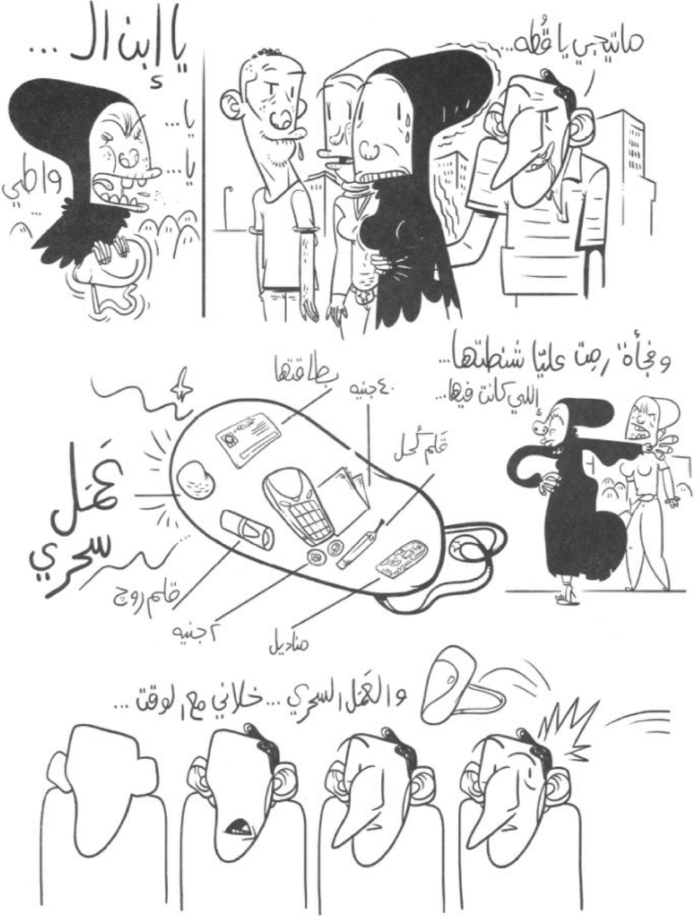
What about the representation of women and gender relations in Egyptian adult comics? The Tuk-Tuk collective has addressed this issue in no uncertain terms. Its seventh issue was dedicated to Egyptian girls and women and contained several narratives that tackle the problem of harassment and violence in creative ways. In one story by Hisham Rahma the protagonist is a classic male street harasser whose facial features gradually disappear due to his harassment of girls in the street, forcing him to go to a psychologist to cope with his loss of public face.Footnote 55 The harasser attributes this development to witchcraft, claiming that an object from the girl's handbag, which she had thrown at him, possessed special powers. His loss of face may be read as the storyteller's commentary on how harassment continues to degrade the humanity of the harasser and how resisting harassment makes one a hero. Rahma's story contains two other notable features. First, the curious onlookers in the background of the second and third panels are depicted as featureless, passive, ghost-like beings, unable or unwilling to respond to the agitation of the offended girl. In Egyptian public debate over sexual harassment, the apathy of the public in the face of these crimes has been an important issue. Second, the story does not include frames. As Thierry Groensteen suggests, their absence may serve to concentrate the narrative “only on the characters, solitary figures developed in an empty décor or one that is minimally suggested by a few elements.”Footnote 56 The story focuses on the personal development (or rather, deterioration) of the protagonist rather than on an elaborate storyline (Figure 5).
A harasser literally loses face. “Al-ʿAr bi-l-Zayt al-Harr” (A Real Disgrace), by Hisham Rahma, Tuk-Tuk 7 (2012), 51.
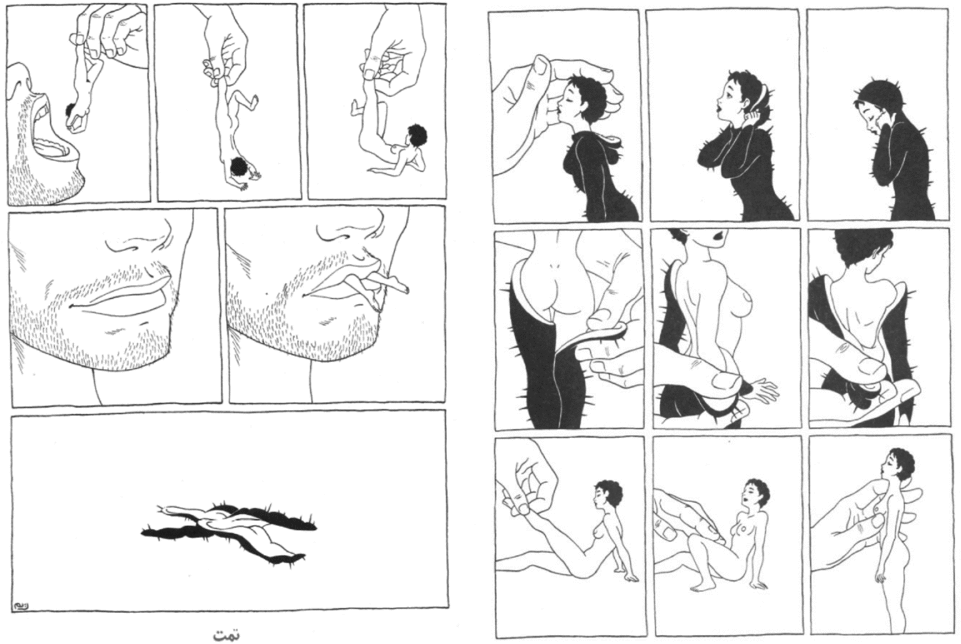
Another perspective on relations between men and women in Egypt is provided by the wordless and allegorical story entitled “Shawk” (Thorn) by a certain author using the pseudonym Rim.Footnote 57 The story starts by describing a girl who is dressed in a cactus bodysuit and planted in a flower pot. When she wakes up from her sleep and leaves the pot she is approached by the hand of a male giant that, after it begins to caress her, is stung by one of her thorns. In order not to hurt the hand more, the girl removes her protective cactus suit and the giant male proceeds to pick her up, put her into his mouth, and eat her alive. The story is subtly humorous, but also a damning commentary on violence against women. The decreasing number of panels on the last page, from three in the uppermost strip to one in the lowermost strip, may indicate a ritardando, or a sort of cadence towards the end—a common technique in comics.Footnote 58 But the increasing size of the panels in the last two strips also highlights how male domination devours femininity, as it were, leaving only the lifeless, unfriendly shell with which women have to protect themselves from the male gaze (and hands; Figure 6).
“Shawk” (Thorn), Tuk-Tuk 7, 37–38.
On the more realist end of the scale, the same issue features a disturbing story about a young man who can hear a woman in the neighboring apartment being battered by her husband. Unable to bring himself to directly confront the husband, he slips a note under the door containing the phone number of an emergency call center and promises himself that he will intervene the next time. Written by a male, the story is a harsh condemnation of Egyptian men's failure to defend women from private and public abuse.
Gender relations and women's emancipation are also treated outside the bounds of direct criticism. The comic album Ana wa-Ana (Me and Myself), with texts by Michel Hanna and artwork by Rania Amin, contains a number of dialogues, two of which are between a young man and his girlfriend. I purposefully mention the man first, for in different ways both stories highlight the power differential between men and women. In the first dialogue, an engaged couple's conversation about where to go for their honeymoon turns sour when the man insists on Prague, while the woman insists on Sharm el-Sheikh, “where everybody goes.” He romanticizes the Czech city, its interesting history, people, and cultural life, while she has never heard of the Czech Republic, no less Prague. The story depicts a cultural gulf between young, upper middle-class men and women that is symbolized by the physical distance between the couple: in the first panel, they sit very close to each other at a small table, while in the last panel, after having engaged in a real conversation, the table has become very long, leaving them in separate lifeworlds with no way to communicate. The story provides an evocative portrayal of an awkward moment of communication breakdown, but it can also be interpreted as a commentary on social conformism and stereotypical views of romance and married life. Read in this way, the story can be seen to refer to the satirical bestseller ᶜAyza Atgawwiz (I Want to Marry) by Ghada ʿAbd al-ʿAl, which makes fun of such stereotypical views.
Another story in the same album depicts a conversation in a café between a minibus driver and his girlfriend. Before we even learn of the young man's job, the drawings convey a clear sense of the societal stratum to which the pair belong: he has a ponytail and a casual style, wearing jeans and a t-shirt, while she is modestly dressed in a long dress and veil. The atmosphere of the café, called The Emerald Casino, is somewhat evocative of the lower middle-class environment depicted in the 1984 movie “al-Hubb fawq Hadbat al-Haram” (Love above the Pyramid Plateau), based on the short story of the same name by Naguib Mahfouz. This story is full of warmth and sympathy for both characters, and ends in her agreeing to marry him. However, both the dialogue and the drawings convey the extent to which power relations between the two are skewed. It is the man who drives the conversation, while the woman is reduced to murmuring or answering in monosyllables. He looks directly at her and smiles confidently, while she rarely looks up and smiles modestly. Through the sophisticated interplay between text and image, the story conveys the beauty of two young persons gingerly taking their first steps toward a life together to show how social conventions reduce women's space for agency.
Comics are also used for the explicit purpose of educating people about women's rights—often in humorous ways. The first issue of the magazine Shakmajiyya, which was started with the support of the feminist organization Nazra in 2014, includes stories by accomplished comics creators and famous cartoonists. It also contains a text-only section that describes the antiharassment law recently enforced by Egyptian authorities. But most of the content is taken up by comics. In a surreal story that provides the illustration for the cover, Tawfiq (artist) and Muhammad Ismaʿil Amin (author) describe a scenario in which an Egyptian woman has evolved to have eyes all over her skull, four arms, and a giant mouth. Her evolution was a direct result of her need to protect herself from thieves and harassers. The story is a vivid metaphor for how gender relations in public urban space affect Egyptian females physically and psychologically.
COMICS AS A CRITICAL ART FORM
Far from all of the new comics have explicit political or social agendas. Many can be read mostly or only for pleasure. However, those creators who do pursue social and political criticism are very clear about their goals. As an example, Majdi al-Shafiʿi, who produced the graphic novel Metro discussed earlier, went on to collaborate with the Hisham Mubarak Law Center in 2011–12 to publish a comic album entitled Dushma about the new Egyptian constitution and human rights. His comments about the project leave no doubt about his political intentions:
We want to change society. There are real democratic signs, but the revolution made democracy's deficits clear in its first year! . . . You want to teach people that the will is free, and that the President ought to serve them. But things don't work like that now, and we need to strive to make that a reality. That's my political vision. . . . We have something that the people who restrict free thought don't have—imagination—because imagination is connected to freedom. And they fear this. And so we decided to express the problems with the constitution in the form of comics.Footnote 59
Similarly, Muhammad Shinnawi of Tuk-Tuk has been explicit about his own and the Tuk-Tuk collective's aim of addressing political and social issues and taboos. Given the current political climate in Egypt, it is remarkable that these writers and artists still dare and are able to publish critical comics. A key to understanding their successful navigation of post-2011 politics in Egypt is their use of disarming humor, such as when Shinnawi has his signature character, a parking lot attendant, help an Egyptian army tank find a free parking spot in central Cairo (Figure 7). The cartoon may well be interpreted to suggest that Shinnawi accords the military no more respect or deference than any ordinary Egyptian. But the tongue-in-cheek delivery of this message allows it to slip past the censor.
(Top) Ganzeer's street art piece depicting a tank pointing its turret against a bread boy on a bicycle. (Bottom) Muhammad Shinnawi's cartoon in Tuk-Tuk 11. It features his signature character helping a tank find a free parking spot in the midst of Cairo's chaotic traffic.

Comics may be connected to other art forms such as music and theater that have seen a blossoming during recent years in Cairo and Alexandria. In an interesting article on music in Alexandria, Youssef El Chazli notes that the veritable explosion of an alternative music scene has its roots in the cultural revival of the 2000s, with the aforementioned Al-Sawi Culture Wheel in Cairo and Bibliotheca Alexandrina in Alexandria serving as alternative cultural venues for young people.Footnote 60 Their political attitudes range from centrist to far left, but in cultural terms the environment is liberal: this author remembers well an experimental theater production that was abruptly discontinued after the first night because of its explicit treatment of homosexuality. Many of the young artists who partake in this liberal environment were politicized through the 2011 uprising, but it is important to note that comics, music, street art, and theater are not epiphenomena of the Egyptian uprising; they all appeared earlier. Populated as these art forms are by young people, they may be seen as part of a wider social and cultural emancipatory trend that has much in common with the uprising's ideals and went hand in hand with the political acts of mobilizing and demonstrating.
The effect of the art/politics cross-fertilization was, in the words of Egyptian author Ahdaf Soueif, “a miraculous manifestation of the creative energy the revolution had released across the country.”Footnote 61 And as I have tried to show, this creative energy contains an element of progressive gender politics. As Sondra Hale has recently argued, what all this amounts to may be “a whole new politics that does not mimic the characteristics of modernity,” as the participants are all “searching for new and freer forms of association that have already had, and will continue to have, a profound effect on gender dynamics.”Footnote 62
It is no coincidence that comics are closely related to the revolutionary art par excellence—graffiti. Tellingly, the graphic artist and graffiti icon Ganzeer designed the front page of Egypt's first comics anthology, Autostrade, which was published in late 2010. Ganzeer is one of the main revolutionary artists. One of his most famous pieces depicts a bread boy juxtaposed with a tank, which was created under an overpass next to the ʿAbd al-Munʿim Riyad bus station by the Nile in downtown Cairo (Figure 7). The theme of Ganzeer's piece is related to the cartoon by Shinnawi shown above, notwithstanding that Shinnawi's drawing is more light-hearted than Ganzeer's graffiti. Both comment on the military's relation to ordinary people. Chad Elias writes of graffiti in revolutionary Egypt that it is part of the same kind of activism as the Mosireen and Kazeboon groups, which use mobile phone footage to document state repression: “Graffiti could be seen as an extension of this activist model of consciousness-raising.” Elias adds that graffiti artists “employ a more playful and self-reflexive set of semiotic strategies to engage their public,” a comment that is also applicable to comics.Footnote 63
The new comics are also closely related to the highly politicized art form of newspaper cartoons. Two of the cofounders of Tuk-Tuk, Makhlouf and Andeel, were already well-known cartoonists, having drawn explicitly political cartoons in independent newspapers before and after the 2011 uprising. Makhlouf is a main cartoonist for the widely read al-Misri al-Yawm. Andeel started working for the (then) boldly oppositional al-Dustur (The Constitution) in 2005, later moved to al-Misri al-Yawm, and now draws for Mada Masr, currently one of the few truly independent news outlets in Egypt.Footnote 64 He was the first cartoonist to draw caricatures of al-Sisi, but there is much more to his approach to cartoons and comics than breaking political taboos. In a recent interview published by Jadaliyya, Andeel nicely summarizes his view of critical art, which fits with the boundary-breaking idiom of contemporary Egyptian comics for adults: “Critical art to me is art that opens possibilities.”Footnote 65
CONCLUSION
In 2014, I interviewed publisher Hani ʿAbd Allah at one of the main hangouts for (affluent) young people in Cairo, the Citystars shopping mall in Nasr City. He had recently started the publishing house al-Riwaq, which has enjoyed a measure of success. Together with a colleague he also started Egypt's first and only publishing house dedicated to comics. Comics Publishing has produced two graphic stories, the previously mentioned 18 Days and Taʾthir al-Jarada (The Locust Effect), both about the uprising and both drawn by feminist comics creator Hanan al-Kararji. When I asked why he decided to establish a comics-only publishing house, he answered:
The revolution . . . discarded some old givens [thawābit], like the idea of Mubarak as a father. There was this idea of loyalty to him and then, suddenly, “Go! We don't want you to stay.” That changed the personality of Egyptians and made them explore directions in reading and creativity, [including in] comics.
The critical potential of comics and their relation to a wider culture of liberation from patriarchal authoritarianism could hardly be stated more clearly. Egyptian comics for adults are still in their infancy, but they have already proven capable of tackling social issues and giving a voice to youth in sophisticated and creative ways. I have argued in this article that to the extent that the new comics address social and political questions, one of their central features is their criticism of patriarchal authoritarianism and its oppression of young people, particularly women. This incisive criticism is often expressed in funny, engaging, and sophisticated ways. Given the ongoing backlash against free speech and the independent media in Egypt, it will be interesting to see if the current generation of comics creators find ways to continue their criticism or if they are forced to turn to less potent themes. Ominously, one of Egypt's most popular creators of cartoons and comic strips, Islam Jawish, was detained in January 2016 and held for a day by the police because of the political nature of his strips.Footnote 66 Even more seriously, author Ahmad Naji, whose novel Using Life contains comic sequences, was sentenced to two years in prison because of his explicit treatment of sex.Footnote 67 It is clear that, in the Egyptian context, the new adult comics are an addition to a burgeoning underground culture scene. As such, they represent an enduring part of the ferment that gave rise to the Egyptian uprising in 2011.



