





Impact statement
-
1. Robust modelling of flow and pressure-controlled pumping stations in the analysis of hydraulic pipe networks.
-
2. Minimization of electrical power consumption using lookup tables for pumps operating within a pumping station is introduced.
-
3. Hybrid modelling by coupling deterministic modelling, surrogate modelling and neural networks improves performance by a factor of $ {10}^5 $
.
$ {10}^5 $
.

Introduction
Many modern pressurized water distribution systems (WDSs) use pumps to add energy where a system, because of the prevailing conditions, is energy deficient. Fixed-speed pumps (FSPs) come with characteristic curves (CCs) that define their hydraulic behaviour. WDS modelling software packages, such as EPANET, adapt the FSP characteristic pump curves to model variable speed pumps (VSPs). For both FSPs and VSPs, how the pump is used comes from the relationship between the required pump head and pump flow. VSPs come with a controller that is used to determine the pump’s revolutions per minute (rpm), which is required to achieve the pump’s set flow or head at the downstream node. In modelling, it is this pump speed that is required to be determined from the hydraulics of the system.
Modelling of groups of parallel pumps that have a common control target (given set downstream head, set suction head, set pressure at a critical node and total pump flow) has still been an open problem in hydraulic modelling. In this article, the authors show how to model flow-controlled pumps (FCPs), FCP stations (FCPSs), pressure-controlled pumps (PCPs) and PCP stations (PCPSs) in water distribution networks.
The approach is based on previous work of the authors and the decomposition of the WDS model into a modified global model and models for pumping stations (PSs) that are denoted as local models. In the global model, the PSs are replaced by a single virtual link with control constraints. It will be shown that the decomposition concept is not only useful for the straightforward steady-state simulation of systems with PCPSs and/or FCPSs, but also offers great benefits for other applications, such as, for example, solving the pump scheduling problem in real time.
The authors of this article have, over the last few years, developed a framework for solving WDS problems, which is based on the content function, first introduced by Cherry (Reference Cherry1951) and Collins et al. (Reference Collins, Cooper, Helgason, Kennington and LeBlanc1978). In this approach, the steady-state heads, linkflows and outflows of a WDS without any flow or pressure controls are found as the solutions of an equality-constrained convex optimization problem. This same framework was later extended by the authors by adding flow constraints to the convex optimization problem, to find the steady-state heads, linkflows and outflows of WDSs (Piller et al., Reference Piller, Elhay, Deuerlein and Simpson2020; Elhay et al., Reference Elhay, Piller, Deuerlein and Simpson2022).
In a further development (Deuerlein et al., Reference Deuerlein, Elhay, Piller and Simpson2023), the authors extended the framework to handle pressure-reducing valves (PRVs) by reformulating the problem as a game between non-cooperating players (Osborne and Rubinstein, Reference Osborne and Rubinstein1994): on the one hand, the linkflows and outflows comprise one player; on the other hand, the headlosses of the control valves in the system comprise the other $ {n}_v $
players – one for each PRV. The Nash equilibrium of this system of
$ {n}_v $
players – one for each PRV. The Nash equilibrium of this system of $ {n}_v+1 $
optimization problems provides the required solution.
$ {n}_v+1 $
optimization problems provides the required solution.
The new contribution in this article is a decomposition concept that first separates the pump groups from the rest of the network, resulting in a hybrid surrogate model that replaces the pump groups by virtual control links and separate models for the pump groups. The hydraulic calculation at the network level (global model solution) is carried out for the surrogate model, and the pump groups are treated separately.
There are two cases to consider: FCPs and PCPs. In modelling FCPs or collections of FCPs in PSs, a positive lower linkflow constraint is introduced for the virtual link, and so the Lagrange multiplier of the active flow constraint is understood as pumping head, not head loss. By contrast, when modelling VSPs, for which the heads at the nodes downstream of the VSPs are set, the authors’ Nash equilibrium approach is used: this is the case for PCPs or PSs comprising PCPs, either in parallel or in series. In modelling a WDS with PCPSs, each station is replaced in the model by a single virtual link with unknown pressure-flow characteristics, and the head at its downstream node is set. The non-negative variable, which in the case of a PRV represented a head loss, is now non-positive and represents a head gain. The operational states of the pumps are always given by the Lagrange multipliers.
Under certain conditions, similar to those of the control valve problem, there is a unique solution to the global problem. The flows and pumping heads calculated for the virtual links are used as input to the final step, the solution of the local pump station problems. In general, there exists no unique hydraulic solution to the pump station problem. Especially, in the case of multiple VSP pumps, there exist multiple combinations that achieve the PS set flow and pumping head. Therefore, as an extra criterion, the combination that delivers the flow and head with minimal electrical power is sought. The results are the individual speeds of the VSP pumps. In summary, the benefit of the decomposition results from the ability to solve the local pump group optimization problem independently from the hydraulic network model and, vice versa. The latter is done independently of the behaviour of each individual pump.
As an application example, the modular framework is also used to solve the pump scheduling problem. Here, the pump groups are also separated from the rest of the system, and the local problem is solved for different head and flow combinations, with the results stored in lookup tables. For better performance that is required for real-time applications, the surrogate model is replaced by neural networks (NNs).
In fact, this article is an extension of research that was presented at the WDSA-CCWI-2024 (Deuerlein et al., Reference Deuerlein, Elhay, Piller, Fischer and Simpson2024). In addition, it includes detailed information about the solution of the local pump station problem and, as an example, its application in optimal pump scheduling with strongly varying electricity tariffs as part of the project TwinOptPRO (Bernard et al., Reference Bernard, Deuerlein, Dresen, Fischer, Guth, Höche and Kühnert2024).
The pump scheduling problem addresses the overall objective of achieving greenhouse gas neutrality by 2045. The stock market and day-ahead energy prices are driven by the share of green energy. The idea is to fill the tanks when the price is low, which is equivalent to using a higher share of green energy. Therefore, energy minimization is only used at the lower level of local pump station optimization. The approach could also be used for pure energy optimization by using constant energy prices. However, that is beyond the focus of this research.
Pump scheduling in PSs is a problem that demands a significant computational burden (Marchi et al., Reference Marchi, Salomons, Ostfeld, Kapelan and Simpson2014; Janus et al., Reference Janus, Ulanicki and Diao2024). Integrating deterministic modelling, machine learning and meta-modelling provides ways to address this challenge in real-time management and maintenance settings. This is done as follows.
-
(a) Precomputation: A set of local solutions to the PS problem corresponding to a wide range of PS flows or heads is precomputed and made into a lookup table.
-
(b) Precomputation: NNs are trained to solve the hydraulics of the pumping sections between the PSs and the tanks of the global problem (with PSs replaced by virtual pressure control or flow control links) using the Nash equilibrium solution framework or possibly another hydraulic solver.
-
(c) An online optimization framework is established for solving the time-dependent energy cost minimization problem. It integrates the precomputed lookup tables of the local PSs and the NNs of the pumping sections with the tank differential equations and constraints.
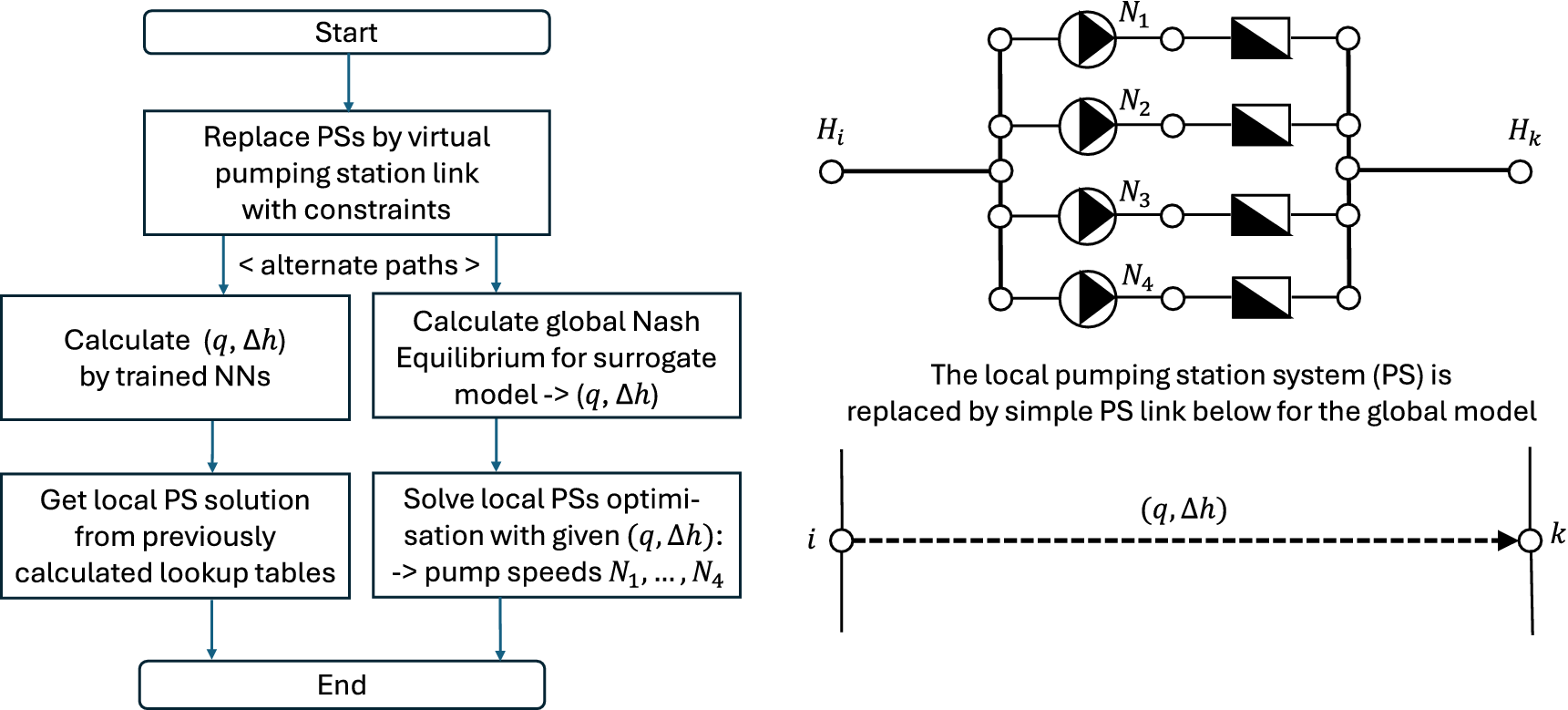
In the left panel of Figure 1, we show a flow chart schematic for the whole solution process. The flow chart has two branches that represent alternative paths that can be taken. The left branch depicts the path (taken in this study), which uses NNs trained on the Nash equilibrium global model solutions (or any other suitable hydraulic solver) to solve the hydraulic simulations and then recovers the local PS model optimal solution from a lookup table. The right branch shown in the flow chart depicts the global and local models solved by directly computing the Nash equilibrium, and the local pump group optimization involved. We demonstrate with an example that taking the left branch leads to a $ {10}^5 $
factor speed-up for one simulation.
$ {10}^5 $
factor speed-up for one simulation.
On the left, a flowchart shows the alternative paths for solving the global network model, followed by the local PS models. On the right, a pumping station with four parallel pumps is shown, and its surrogate link representation for the global network problem and the determination of PS flow rate and delivery head.

The right panel of Figure 1 shows, at the top, a schematic diagram of a local PS and, at the bottom, the simple virtual link by which it is replaced when the global network model problem is solved.
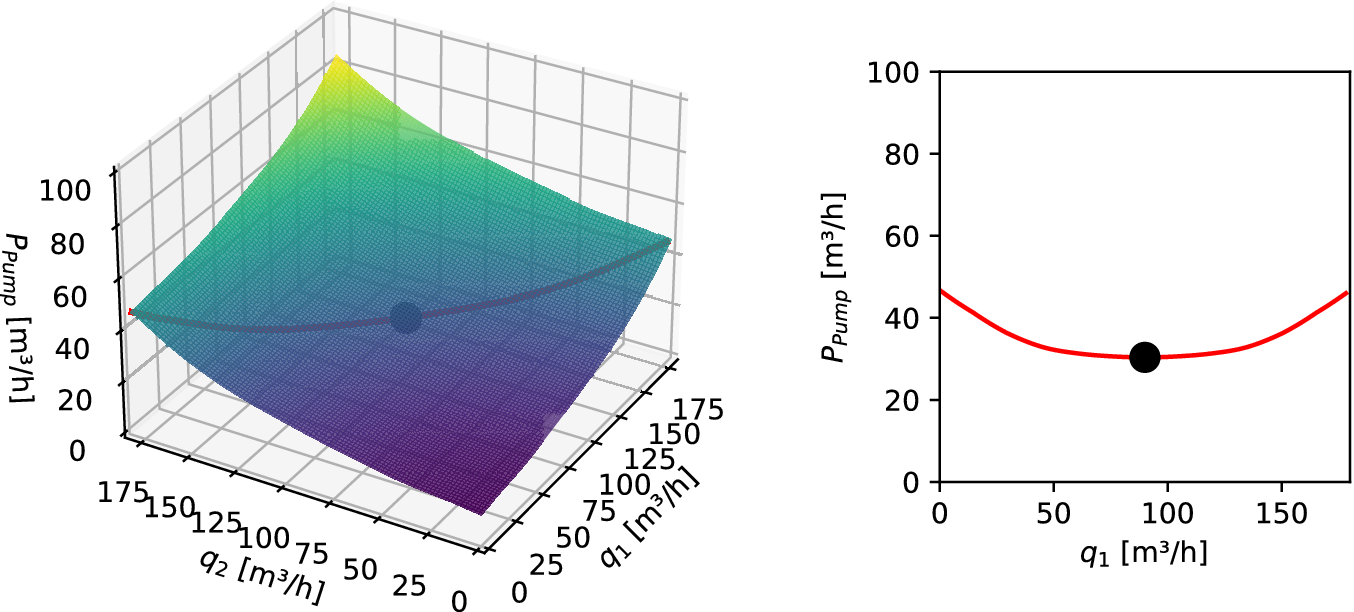
Example configuration consisting of two pumps. Left: An objective function dependent on two single pump flows $ {q}_1,{q}_2 $
with the cut line given by the pump station flow constraint (5) (red) and optimum. Right: The line to search (intersection of the objective function with the flow constraint [red line from left]) and the optimum.
$ {q}_1,{q}_2 $
with the cut line given by the pump station flow constraint (5) (red) and optimum. Right: The line to search (intersection of the objective function with the flow constraint [red line from left]) and the optimum.

The paper is organized as follows. The first part deals with how the Nash equilibrium is used to solve the problem of pump control, and the second part of the article is devoted to the solution of the local pump control problems, that is, the problems within PSs. The third part of the article deals with a realistic application in which all the concepts in the study are brought together. An important advantage of the methods presented in this article is that in no case are heuristics used: all methods give the actual solutions to the problems set.
Mathematical modelling
A surrogate model of PSs
Pumps are used in WDSs and other hydraulic systems for the purpose of fluid transportation. The energy supplied by the pump is used both to overcome geodetic height differences and to compensate for friction losses. In PSs of larger systems, it is common for several pumps to be combined in so-called pump groups. A distinction is made between pumps arranged in parallel and series. For pumps arranged in parallel, the total discharge of the pump group is calculated by adding the delivery rates of the individual pumps, whereas for pumps arranged in series, the delivery heads are added together. Pumps arranged in parallel increase the supply reliability of the PSs because a replacement is immediately available if one pump fails. Where possible, parallel pumps are often operated by turns to reduce pump wear.
Pump groups with several pumps arranged in parallel can cover a wide range of flow rates by combining several pumps, thereby not degrading the efficiency of the whole system. This strategy is particularly useful if one or more pumps are equipped with frequency converters. In hydraulic simulation models such as EPANET, PSs are modelled by the hydraulic behaviour of the individual pumps. The pump curve, or at least an operating point and the current speed, must be specified for each of these pumps. The total flow rate and head of the PS result from the hydraulic calculation of the overall system. A higher-level instance for controlling the entire pump group does not exist, for example, in EPANET. In practice, pump groups are often operated with a common control task. For example, the control task could be to ensure that the total delivery rate corresponds to a specified set point value. Alternatively, it could be that the delivery head of the pump, or the output or suction pressure of the entire pump station, should not fall below or exceed certain values. In the case of control systems with remote data transmission, the control objective is often to maintain a certain minimum pressure at a certain location (critical point) in the network.
Modelling of groups of parallel pumps that have a common control target (given set downstream head, set suction head, set pressure at a critical node and total pump flow) has still been an open problem in hydraulic modelling. For example, in EPANET, pumps are modelled based on a CC, which can be defined by an operational point, three points on the CC or by individual points on this curve. It is also possible to adopt the CC by applying different pump speeds. However, all these methods have in common that the calculation is directly based on the individual pump characteristics. As a workaround, in EPANET, sometimes pump groups are combined with PRVs or FCVs and the pumps are run with maximum power, thereby enabling a realistic global solution for the pipe network, but failing to model the real operation of the pump group. By contrast, the method presented in the article addresses the inverse problem, where the pump characteristics are unknown and replaced by a common control target. For one pump, the problem is very similar to the previously published modelling of flow and pressure control devices.
The integration of such control systems in stationary hydraulic simulation calculations poses a number of challenges. We seek the model parameters (pump rpm) at which a state variable (flow or pressure) reaches a prescribed value. This is an inverse problem for which there may be no unique solution. For example, there is no unique solution for a PS with two VSPs and a specified target flow rate, because the flow rates of the individual pumps can be combined as required so that the total flow rate corresponds to the target value. Unique solutions only exist for such problems under certain conditions. A second complicating factor is that when several pumps are involved, this introduces the combinatorial problem of deciding which pump combination to use. For practical reasons, it is therefore natural to consider, as an additional objective, that the pump group as a whole should require the minimum amount of electrical energy to reach the set point, that is, to maximize the overall efficiency of the system.
However, even if energy optimization is added as an objective, a unique solution may still not always be guaranteed. For example, if two parallel pumps are identical in design and only one pump is required to achieve the set point, the pumping time can be allocated to the two pumps in any ratio. In this case, further criteria, such as minimizing the maximum running times of the individual pumps, may be taken into account to determine the actual mode of operation.
To overcome these difficulties, the use of surrogate models is proposed here for the integration of pump groups into hydraulic simulation software. For this purpose, the system is decomposed into an aggregated global system and local pump groups. The pump groups are each replaced in the global system by a simple single link whose hydraulic properties are unknown. In place of the hydraulic characteristic of the link, a target value for a state variable (pressure, pressure increase and flow rate) is specified. For the calculation of a pump group with a given set flow, the link has an additional minimum flow constraint. If the pump group is pressure-controlled, the recently published Nash equilibrium approach for modelling pressure that regulates the valves is slightly adapted.
The detailed solution of the local system (the allocation of individual pumping speeds and individual flow targets within the PSs) can be calculated after the solution of the global system equations is known. The flow rate and pumping pressure head of the virtual link resulting from the global solution are used as constraints in the detailed calculation of the pump group. As already mentioned, the solution of the local problem is an optimization task. The decision variables are the individual pump speeds required to achieve the given total discharge and pumping head from the higher-level global model with minimum use of electrical energy.
The global network model and its steady-state solution
A recent development in the analysis of pressure-dependent modelled (PDM) WDSs with flow and pressure controls is the use of the Nash equilibrium, a concept that comes from game theory. The Nash equilibrium occurs at a point found by arbitrating between optimization problems with conflicting objectives. In the present case, the conflict is between (i) determining the linkflows and outflows that minimize the system’s content function, where the decision variables are linkflows and outflows, and (ii) determining the local pressure valve losses (the decision variables) required of the controls that regulate the pressures by actuating valves, such as PRVs and pressure sustaining valves. This approach has two merits: it covers all operational regulating states and derives exact conditions for the existence and uniqueness of the WDS equilibrium problem with control. The Nash equilibrium method does not require heuristics, produces the problem solution in about as many steps as the Global Gradient Method takes to solve a demand-driven problem without controls and, unlike most existing methods, which do rely on heuristics, does not require interrogation of the valve states at each iteration of the solution method.
The solution to this combination of optimization problems is found by the application of a Newton method to the necessary and sufficient Karush–Kuhn–Tucker (KKT) conditions, which result from zeroing the gradient of the Lagrangian associated with the set of optimization sub-problems defined by (i) and (ii) above. A comprehensive exposition of the modelling of PDM WDSs with PCPs and FCPs as a Nash equilibrium problem, their solution and an illustration of the method’s use can be found in Deuerlein et al. (Reference Deuerlein, Elhay, Piller and Simpson2023).
It is relatively straightforward to extend this formulation to handle pump station controls (Deuerlein et al., Reference Deuerlein, Elhay, Piller, Fischer and Simpson2024). In the context of PSs with flow control, a minimum positive linkflow constraint is added to the content minimization, and the associated Lagrange multiplier is the pumping head necessary to deliver the set flow. In fact, the modelling of the PSs with flow control can be achieved through content minimization alone (Piller et al., Reference Piller, Elhay, Deuerlein and Simpson2020; Elhay et al., Reference Elhay, Piller, Deuerlein and Simpson2022). By contrast, for PSs with pressure control, an additional local control problem is added for each PS. The distinction is, however, that for pump head gain, the non-negative variable representing head loss is replaced by a non-positive head gain variable.
Local pump station problem
The pump station problem consists of determining the combination of parallel pumps, one for each PS, for which the total power consumption of the pump station is a minimum under specified pumping control constraints of flow or pressure gain. For FSPs, this means determining which pumps are active, and for VSPs, this means finding the optimal pump speed. We note that in this context, we assume that $ {q}_{PS} $
, the PS flow is positive.
$ {q}_{PS} $
, the PS flow is positive.
There are three typical pump configurations in PSs. These are as follows:
-
• All pumps are FSPs. In this case, the operating points of the pumps (heads and discharges) will be determined by the intersection of the composite pump curve (determined by the number of pumps operating and whether the pumps are in parallel and/or in series) and the system curve (made up of the static head plus the friction loss in the pipe at the PS discharge). Thus, it is not possible to select exactly the PS discharge that will be delivered. If a smaller discharge is required, the valve on the downstream side of the PS could be closed slightly to throttle the flow. However, it is not possible to achieve a larger flow.
-
• All pumps are VSPs. This configuration is used where it is desired to set the pressure head to a set level on the downstream side of the PS. An example is an irrigation delivery system to multiple farmers who have pre-ordered their required flows and have opened up valves on their properties to water their crops. An aggregate flow meter at the outlet of the pump station measures the total flow being used by all irrigators who are taking water. A pumping head versus total flow curve can be used to determine the desired outlet pressure head to maintain this flow. The speed of the pumps is thus controlled by setting the speed of the variable speed drives to maintain this outlet pressure. Variable speed drives are more expensive than FSPs, so this is a disadvantage.
-
• Several FSPs and one VSP, all in parallel. In this case, any flow below the maximum possible but which lies between those that are achievable by a combination of FSPs can be delivered by adding the VSP to make up the shortfall.
The non-linear optimization local PS problem can be formulated as the following hierarchical optimization: Find
 $$ {\displaystyle \begin{array}{c}\mathbf{O}\mathbf{u}\mathbf{t}\mathbf{e}\mathbf{r}\ \mathbf{p}\mathbf{h}\mathbf{a}\mathbf{s}\mathbf{e}:\\ {}\underset{j\in {C}_{P,j}}{\min }{P}_{Station}\left({q}_{PS},{h}_{PS}:j\right)\hskip0.22em \mathrm{w}\mathrm{h}\mathrm{e}\mathrm{r}\mathrm{e}\end{array}} $$
 $$ {\displaystyle \begin{array}{c}\mathbf{I}\mathbf{n}\mathbf{n}\mathbf{e}\mathbf{r}\ \mathbf{p}\mathbf{h}\mathbf{a}\mathbf{s}\mathbf{e}:\\ {}{P}_{Station}({q}_{PS},{h}_{PS}:j)\triangleq \underset{\mathbf{N},\mathbf{q}}{\min}\left({\sum}_{i\in {C}_{P,j}}{P}_{Pump}({N}_i,{q}_i,{h}_{PS})\right)\end{array}} $$
 $$ {\displaystyle \begin{array}{c}\mathrm{subject}\ \mathrm{to}\\ {}{q}_i\ge {q}_{min},\hskip1em \forall i\in {C}_{P,j}\end{array}} $$
 $$ {q}_i\le \mathit{\min}\left({q}_{max},{q}_{PS}\right),\hskip1em \forall i\in {C}_{P,j} $$
 $$ {\sum}_{i\in {C}_{P,j}}{q}_i={q}_{PS}. $$
The solution of the optimization problem is the minimal consumed power $ {P}_{Station}\left({q}_{PS},{h}_{PS}\right) $
for a given pump station flow
$ {P}_{Station}\left({q}_{PS},{h}_{PS}\right) $
for a given pump station flow $ {q}_{PS} $
and pumping head
$ {q}_{PS} $
and pumping head $ {h}_{PS} $
together with the corresponding (active) pump combination,
$ {h}_{PS} $
together with the corresponding (active) pump combination, $ {C}_{P,j} $
, chosen from the set of all possible (active) pump combinations,
$ {C}_{P,j} $
, chosen from the set of all possible (active) pump combinations, $ {C}_P $
, and respective flows,
$ {C}_P $
, and respective flows, $ {q}_i $
, through each pump. It is minimized with respect to the single pump flow,
$ {q}_i $
, through each pump. It is minimized with respect to the single pump flow, $ {q}_i $
, and the pump speed,
$ {q}_i $
, and the pump speed, $ {N}_i $
, for the combination chosen from the set of all pump speeds
$ {N}_i $
, for the combination chosen from the set of all pump speeds $ N $
. The inner sum represents the total pump power for a given combination
$ N $
. The inner sum represents the total pump power for a given combination $ {C}_{P,j} $
of (active) pumps. The cardinality of
$ {C}_{P,j} $
of (active) pumps. The cardinality of $ {C}_P $
is
$ {C}_P $
is $ {2}^n-1 $
. The minimum is taken over all possible combinations. Single-pump flows are restricted to
$ {2}^n-1 $
. The minimum is taken over all possible combinations. Single-pump flows are restricted to $ {q}_{min}\le {q}_i\le {q}_{max} $
: they have to sum up to the pump station flow
$ {q}_{min}\le {q}_i\le {q}_{max} $
: they have to sum up to the pump station flow $ {q}_{PS} $
, which is given or determined by the global model, and they have to provide at least the required head gain
$ {q}_{PS} $
, which is given or determined by the global model, and they have to provide at least the required head gain $ {h}_{PS} $
.
$ {h}_{PS} $
.
The calculation of the single $ {i}^{th} $
VSP’s pump power
$ {i}^{th} $
VSP’s pump power $ {P}_{Pump} $
for given speed and flow
$ {P}_{Pump} $
for given speed and flow $ {N}_i,{q}_i $
and head
$ {N}_i,{q}_i $
and head $ {h}_{PS} $
is based on the pump characteristic plots.
$ {h}_{PS} $
is based on the pump characteristic plots.
An example of the inner minimization problem (2) surface is shown in Figure 2. In the left figure, the objective function for a sample configuration of two pumps is shown. As a consequence of the pump station flow constraints, the minimum lies on the right cut line, which is the reduced search space. As shown in the figure on the right, this constrained objective function has a clear minimum indicated by the black point.
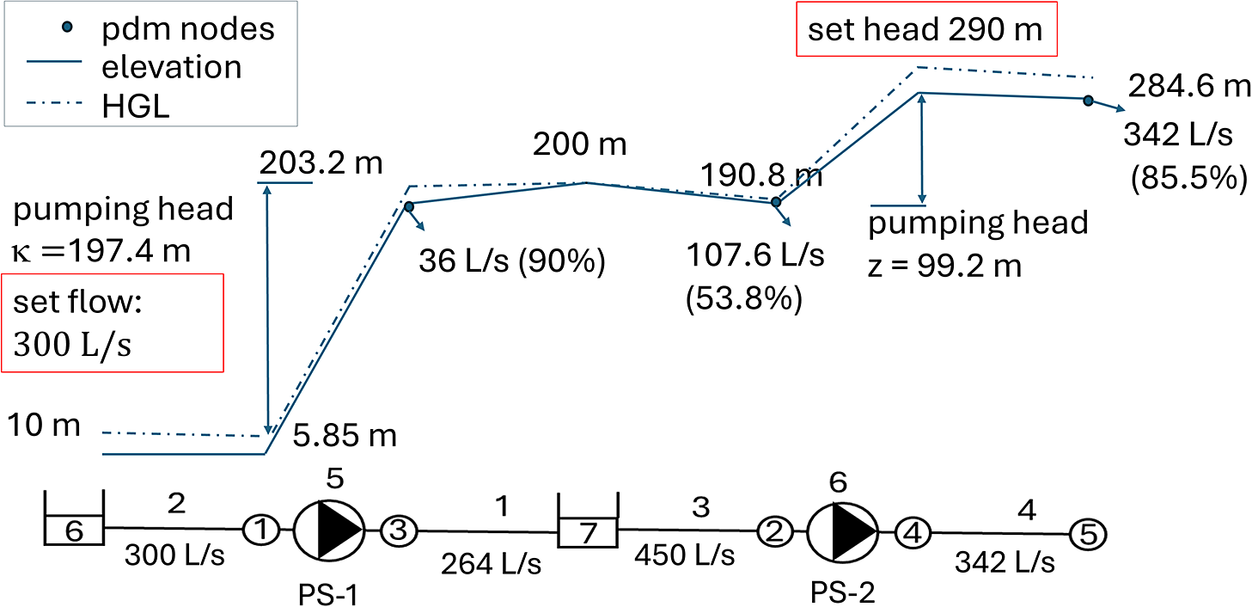
Example system with two PSs: PS-1 represents a PS with flow control, and PS-2 represents a PS with pressure control.

A significant time saving (e.g., for real-time management) can be achieved by pre-computation: the local PS problem, which is solved using a Sequential Least Squares Programming (SLSQP) algorithm (Virtanen et al., Reference Virtanen, Gommers, Oliphant, Haberland, Reddy, Cournapeau and Burovski2020), is solved repeatedly for a wide range of PS heads and flows, and the results are saved in a lookup table. This lookup table can be dealt with efficiently using parameterization/fit or machine learning methods.
Examples
Global solution of a PS example with an FCPS and a PCPS
As illustrated in Figure 3, a link with a positive lower flow bound, $ {q}_5\ge 300 $
, here models an FCPS, and a link with an imposed positive head gain,
$ {q}_5\ge 300 $
, here models an FCPS, and a link with an imposed positive head gain, $ -{z}_6\ge 0 $
, can model a PCPS. Each link has diameter
$ -{z}_6\ge 0 $
, can model a PCPS. Each link has diameter $ D=500\;\mathrm{mm} $
and pipe roughness 0.25 mm. Source nodes 6 and 7 have heads of
$ D=500\;\mathrm{mm} $
and pipe roughness 0.25 mm. Source nodes 6 and 7 have heads of $ 10 $
and
$ 10 $
and $ 200 $
m, respectively. Links 5 and 6 each incorporate a pump element and a pipe element with a length of
$ 200 $
m, respectively. Links 5 and 6 each incorporate a pump element and a pipe element with a length of $ 1 $
m, while all other links have length
$ 1 $
m, while all other links have length $ L=1000\;\mathrm{m} $
.
$ L=1000\;\mathrm{m} $
.
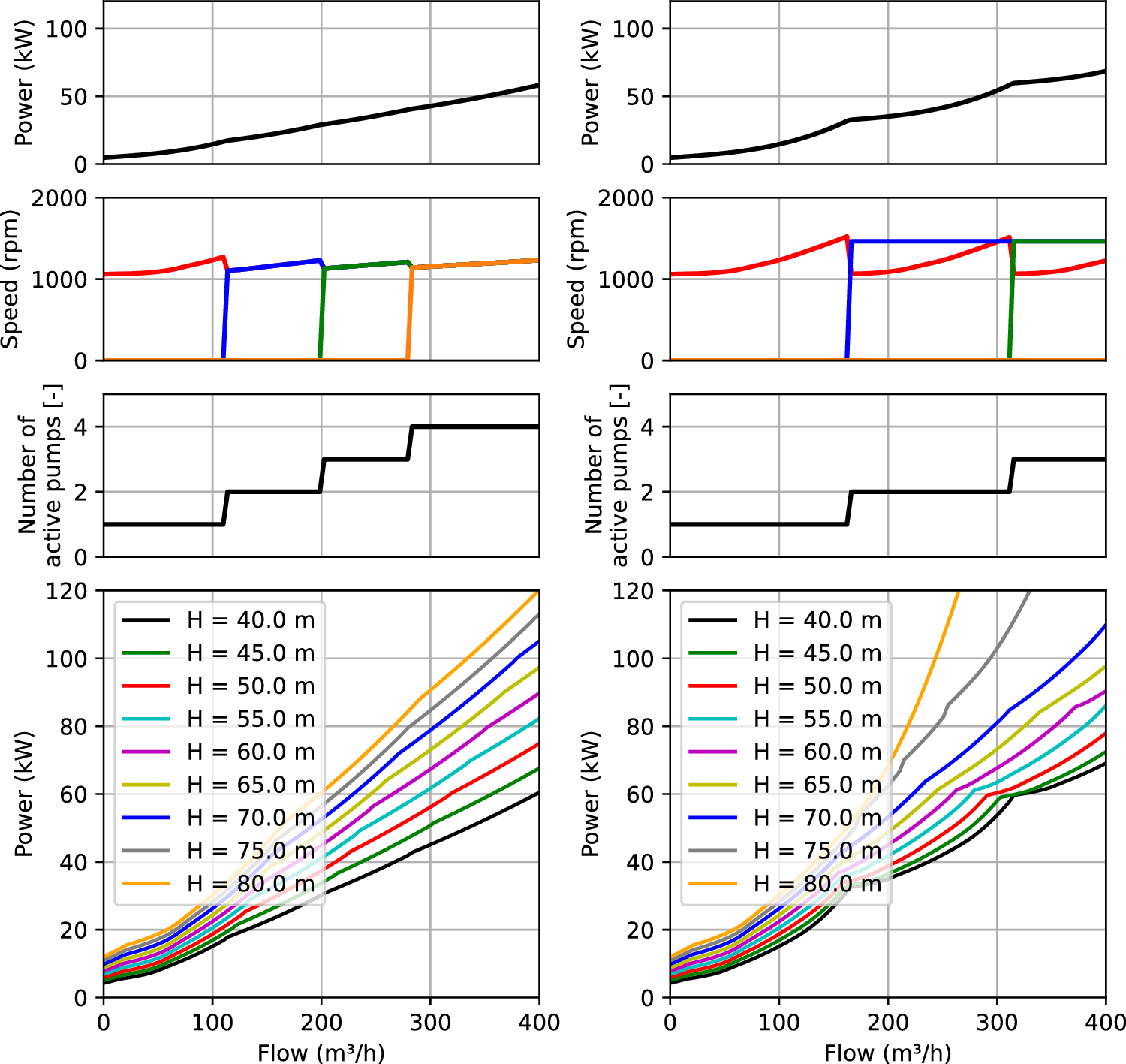
Minimum pump station power, the rotational speeds of the pumps, number of active pumps as a function of flow for a given head, as well as minimum pump station power as a function of flow and head (from top to bottom): VSPs only (left) and 0–3 FSPs and one VSP (right). The rotational speed of the VSP in the second case (one VSP and 0–3 FSPs) is represented by the red line.

Head loss is modelled by the Darcy–Weisbach formula, and the pressure outflow relationship used is the one-side regularized Wagner function of Deuerlein et al. (Reference Deuerlein, Piller, Elhay and Simpson2019), with a service pressure head, $ {h}_s=20 $
m, and a minimum pressure head,
$ {h}_s=20 $
m, and a minimum pressure head, $ {h}_m=0 $
m. The linkflow rate in Link 5 is constrained to be ≥
$ {h}_m=0 $
m. The linkflow rate in Link 5 is constrained to be ≥ $ 300 $
L/s. Furthermore, at Node 4, which is located downstream of Link 6, the z-value must be <
$ 300 $
L/s. Furthermore, at Node 4, which is located downstream of Link 6, the z-value must be < $ 0 $
, and its head must be at least
$ 0 $
, and its head must be at least $ 290 $
m.
$ 290 $
m.
The solution was determined after seven iterations of the authors’ Matlab code to solve the KKT equations for the Nash equilibrium by a Newton method, yielding a delivery fraction of $ 75.9\% $
. The demand was reduced at nodes 2, 3 and 5 due to the failure to meet the service head requirement. For the PCPS at Node 4, the set head is achieved by a pumping head of
$ 75.9\% $
. The demand was reduced at nodes 2, 3 and 5 due to the failure to meet the service head requirement. For the PCPS at Node 4, the set head is achieved by a pumping head of $ {z}_6=-99.2\;\mathrm{m}. $
The head differences at nodes 1 (
$ {z}_6=-99.2\;\mathrm{m}. $
The head differences at nodes 1 ( $ 5.85\;\mathrm{m} $
) and 3
$ 5.85\;\mathrm{m} $
) and 3 $ (203.23\;\mathrm{m} $
) indicate to a designer that the head gain that the pump in Link 5 would be required to provide is (the Lagrange multiplier)
$ (203.23\;\mathrm{m} $
) indicate to a designer that the head gain that the pump in Link 5 would be required to provide is (the Lagrange multiplier) $ \kappa =197.38\;\mathrm{m} $
. The complete dataset can be obtained from the authors upon request.
$ \kappa =197.38\;\mathrm{m} $
. The complete dataset can be obtained from the authors upon request.
Local solution of a PS example
The two cases that are considered for a PS with four pumps in parallel are as follows:
-
(a) each pump is of type VSP
-
(b) a combination of three FSPs and one VSP
This results in $ {2}^n-1 $
possible combinations for
$ {2}^n-1 $
possible combinations for $ n $
pumps. For
$ n $
pumps. For $ n=4 $
, the set of possible combinations,
$ n=4 $
, the set of possible combinations, $ {C}_p $
, is:
$ {C}_p $
, is:
 $$ {C}_p=\left\{1,2,3,4,12,13,14,23,24,34,123,124,134,234,1234\right\} $$
The local PS problem was solved for the two example PSs set to one prescribed pumping head over a range of pumping flows. The minimum consumed power, the rotational speeds of the pumps and the number of active pumps as a function of the pumping flow are shown in Figure 4.
Full system (top) and meta-model (bottom).

The results differ for the two example PSs. For low flows, only one pump is active (VSP in both example pump stations) with the same rotational speed and, correspondingly, the same minimum consumed power. At higher flows, the VSP-only PS achieves lower minimum consumed powers due to the higher flexibility of using different pump combinations. As expected, with decreasing pump flow, a decreasing number of pumps are put into operation for minimal power consumption. The results of solving the local PS problem over a range of pumping flows and pumping heads are shown at the bottom of Figure 4. Creating a precomputed lookup table of these results can save significant real application computation time. In addition, creating the lookup tables for the four-pump station examples used in this study was achieved with a few minutes of computation on a modern desktop computer.
Application to optimal pump scheduling
The method for modelling and optimizing PSs is part of a pump scheduling optimization software package that has been developed in the multi-partner project TwinOptPRO (Bernard et al., Reference Bernard, Deuerlein, Dresen, Fischer, Guth, Höche and Kühnert2024). The pump scheduling problem is modelled as the following bilevel optimization:
 $$ \underset{q_{s,t}\in \mathcal{Q}}{\min}\sum \limits_{t=1}^{n_{steps}}{\sigma}_t\sum \limits_{s=1}^{n_{PS}}{P}_{s,t}^{\ast}\left({q}_{s,t},{h}_{s,t}\right) $$
 $$ \hskip-12.2em s.t.\hskip10em {w}_{i,t}\ge {w}_{i,\mathit{\min}},\hskip1em \forall i=1,\dots, {n}_{tank} $$
 $$ {w}_{i,t}\le {w}_{i,\mathit{\max}},\hskip1em \forall i=1,\dots, {n}_{tank} $$
 $$ {w}_{i,{n}_{steps}}={w}_{i,0},\hskip1em \forall i=1,\dots, {n}_{tank} $$
 $$ {w}_{i,t+1}={w}_{i,t}+{a}_{i,t}{\hat{q}}_{i,t},\hskip1em \forall i=1,\dots, {n}_{tank} $$
where $ {P}_{s,t}^{\ast } $
is the optimal value determined in Equation (1) for the local pump station optimization problem for the pump station
$ {P}_{s,t}^{\ast } $
is the optimal value determined in Equation (1) for the local pump station optimization problem for the pump station $ s $
,
$ s $
, $ \mathcal{Q} $
is the box constraining the flows for the whole PS,
$ \mathcal{Q} $
is the box constraining the flows for the whole PS, $ {w}_{i,t} $
is the water level in the tank
$ {w}_{i,t} $
is the water level in the tank $ i $
at the time step
$ i $
at the time step $ t $
and
$ t $
and $ {\sigma}_t $
is the cost function coefficient for time
$ {\sigma}_t $
is the cost function coefficient for time $ t $
. Equation (10) imposes the constraint that tank levels at the end of the cycle are back to the initial tank levels. The last constraint Equation (11) is an integration (forward Euler) for the time-dependent tank-filling differential equation, where
$ t $
. Equation (10) imposes the constraint that tank levels at the end of the cycle are back to the initial tank levels. The last constraint Equation (11) is an integration (forward Euler) for the time-dependent tank-filling differential equation, where $ {\hat{q}}_{i,t} $
is the total inflow
$ {\hat{q}}_{i,t} $
is the total inflow $ \left(>0\right) $
minus outflows
$ \left(>0\right) $
minus outflows $ \left(<0\right) $
to the tank and
$ \left(<0\right) $
to the tank and $ {a}_{i,t} $
is the inverse surface area of the tank at time
$ {a}_{i,t} $
is the inverse surface area of the tank at time $ t $
.
$ t $
.
The objective function in Equation (7) is used to minimize the total pumping cost; the pump flows $ {q}_{s,t} $
and the corresponding pump heads,
$ {q}_{s,t} $
and the corresponding pump heads, $ {h}_{s,t} $
are the decision variables. The constraints define the water levels at time
$ {h}_{s,t} $
are the decision variables. The constraints define the water levels at time $ t $
. As described above, the bottom-level optimization includes the minimization of the electrical power required to achieve the given flow determined as the top-level solution. The decision variables of the PS optimization fall into two categories according to the pump types: (i) in the case of VSPs, the solution gives optimal rpm of the pumps; and (ii) for FSPs, the combination of which pumps operate (i.e., are on/off) is determined. In addition, there are other possible combinations, for example, where one pump has a frequency controller and the other pumps do not.
$ t $
. As described above, the bottom-level optimization includes the minimization of the electrical power required to achieve the given flow determined as the top-level solution. The decision variables of the PS optimization fall into two categories according to the pump types: (i) in the case of VSPs, the solution gives optimal rpm of the pumps; and (ii) for FSPs, the combination of which pumps operate (i.e., are on/off) is determined. In addition, there are other possible combinations, for example, where one pump has a frequency controller and the other pumps do not.
Thus, the non-linear optimization problem builds upon a non-linear objective function, but is subject to linear constraints. As a first step, the initial guess is generated by solving the linear optimization problem for the constraints with slack variables (Phase 1 optimization). In the second step, the non-linear problem is solved using the SLSQP algorithm.
An important contribution of this research is the introduction of the idea to precompute minimum pump station power as a function of flow and head for all possible pump combinations and then to use table lookup to significantly accelerate the optimization process. The implications of this approach to real-time pump station management are considerable. This is now discussed.
The dependence of the solution on the frictional and minor head losses along the transport pipes is accounted for in the hydraulic modelling.
In terms of the computational burden, we find that it is better not to directly use the hydraulic model but rather to train a NN offline using the hydraulic model and to use it as a meta-model in the online context.
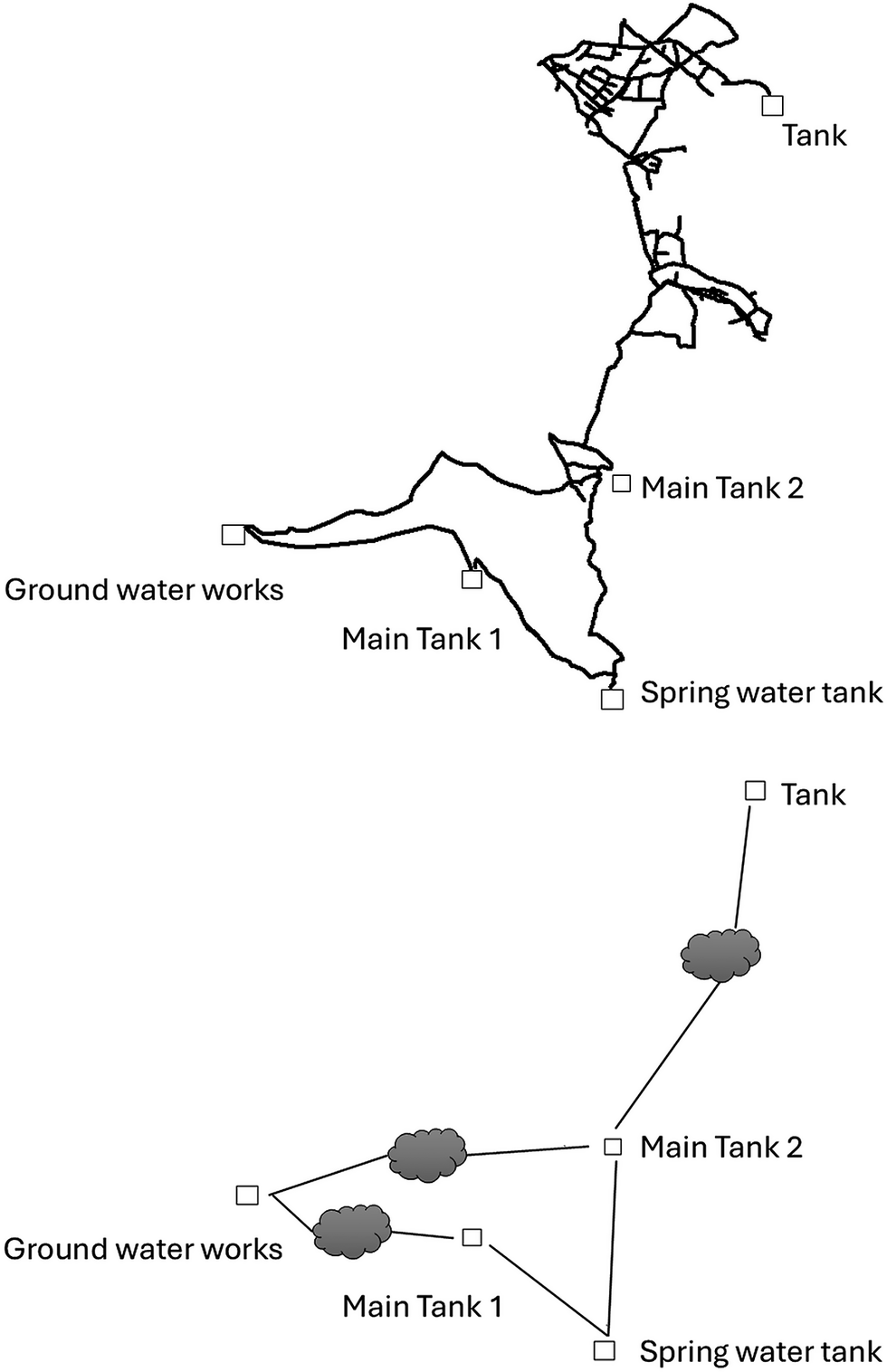
Thus, the method described in the main part of this article is used for the training of the NN meta-model. Figure 5 shows (a) the original main distribution system in the hydraulic model and (b) the meta-model where the cloud symbol indicates the parts that have been replaced by NN models.
As suggested above, the local pump station problem can be solved in advance, and the results can be used via lookup tables during real-time optimization. Similarly, the calculation of the network hydraulics in combination with the PS can be simulated in advance for a set of pumping flows, load cases and combinations of tank water levels. For the training phase of the NN models, the PS can be replaced by a virtual link and a prescribed total flow or outlet pressure, as described earlier in this article. In the online context, the minimum power required for a set pump flow, load factor and tank water level difference is immediately available by first using the NN model to determine the required pumping head, and then using the lookup tables for the minimum electrical power and the corresponding pump speeds that are required to achieve the combination of pump flow and head.
Figure 1 of Bernard et al., Reference Bernard, Deuerlein, Dresen, Fischer, Guth, Höche and Kühnert2024 shows a compact schematic of (i) two boundary nodes, groundwater works on the left, (ii) a spring water input node on the right, (iii) two main mixing, storage tanks, (iv) a trio of PSs and (v) two major demand nodes. The NNs, which are in place of the hydraulic models for the optimization, are shown as clouds. The hydraulic modelling was performed using the software package SIR 3S®.
As the results of the optimization are determined, they are delivered to a digital twin of the actual WDS so that they can be validated by comparison with an extended period simulation that spans the next 24 h.
Conclusions
This study proposes a methodology for the regulation of pressure and flow in WDSs by PSs. The methodology is adaptable to complex scenarios and accounts for the interplay between demand and distribution constraints. It involves a two-stage process: first, the operating flow or head gain is determined for each pump station, taking into account the demand load and the distribution network’s constraints; second, at the pump station level, the selection of active pumps and optimal pump speed is decided to meet specific requirements while minimizing power consumption.
In the initial phase of the method, a mathematical model is used to ascertain the global network model solution. This model incorporates the Nash equilibrium concept for the control of pump station pressure, or alternatively, a lower bound constraint for the regulation of flow rate. In the subsequent phase of the method, an energy optimization problem was formulated in order to ascertain the optimal selection of pumps and pump speeds within a pump station.
As an application example, the decomposition method was used to solve the pump scheduling problem. It was illustrated using a real network comprising multiple tanks and pump stations. In the initial phase, it was imperative to substitute a meta-model via artificial NNs with training on the mathematical model of the global hydraulic network solution. Other essential components include deterministic modelling of the time-dependent tank model and solving the local optimality problem in advance and utilizing the results via a lookup table. In addition to operational optimization, the integration of these techniques results in a factor of $ {10}^5 $
speed enhancement in the execution of hydraulic simulations. The implementation of these lookup tables within real-world programmable logic controllers facilitates the optimal operation of FCPSs or PCPSs.
$ {10}^5 $
speed enhancement in the execution of hydraulic simulations. The implementation of these lookup tables within real-world programmable logic controllers facilitates the optimal operation of FCPSs or PCPSs.
Open peer review
To view the open peer review materials for this article, please visit http://doi.org/10.1017/wat.2025.10005.
Data availability statement
None of the materials used to produce the results in this study are available because of the security of critical infrastructure.
Acknowledgements
The authors would like to thank their project partners Fraunhofer IOSB, geoSYS and Stadtwerke Bühl for providing access to their data.
Author contribution
Conceptualization and methodology: O.P., S.E., M.F., J.W.D. and A.R.S. Software: S.E. and M.F. Validation: S.E. and M.F. Formal analysis: S.E., M.F. and O.P. Original draft preparation: All authors. Writing – review and editing: All authors. Funding acquisition: J.W.D. All authors have read and agreed to the published version of the manuscript. All authors agree to be accountable for all aspects of the work in ensuring that questions related to the accuracy or integrity of any part of the work are appropriately investigated and resolved.
Financial support
This research was supported by grants from the German Ministry for Education and Research (Funding number 02WQ1646).
Competing interests
The authors declare none.
Appendix
Illustration of the use of Lagrange multipliers for characterization of operating states for pressure-controlled PSs
In this section, we derive, via the relevant hydraulic equations, KKT conditions, and the conditions of complementary slackness, the four possible operating states of a VSP.
Consider the WDS link, $ k $
which connects nodes
$ k $
which connects nodes $ i $
and
$ i $
and $ j $
and which has a PCP, and suppose that the flow in the link is from node
$ j $
and which has a PCP, and suppose that the flow in the link is from node $ i $
to node
$ i $
to node $ j $
. Denote by
$ j $
. Denote by $ {h}_i $
and
$ {h}_i $
and $ {h}_j $
the heads at nodes
$ {h}_j $
the heads at nodes $ i,j $
, respectively,
$ i,j $
, respectively, $ {\xi}_k\left({q}_k\right) $
the total head loss (i.e., including frictional and minor head losses) in the link
$ {\xi}_k\left({q}_k\right) $
the total head loss (i.e., including frictional and minor head losses) in the link $ k $
,
$ k $
, $ {z}_k $
the head gain (negative head loss) in the link
$ {z}_k $
the head gain (negative head loss) in the link $ k $
and denote the Lagrange multiplier associated with the lower flow bound constraint,
$ k $
and denote the Lagrange multiplier associated with the lower flow bound constraint, $ {q}_k\ge {q}_{min} $
, by
$ {q}_k\ge {q}_{min} $
, by $ {\kappa}_k $
and the Lagrange multiplier for the upper
$ {\kappa}_k $
and the Lagrange multiplier for the upper $ z $
bound,
$ z $
bound, $ {z}_k\le 0 $
, constrained by
$ {z}_k\le 0 $
, constrained by $ {\chi}_k $
. Denote also the downstream node’s set head by
$ {\chi}_k $
. Denote also the downstream node’s set head by $ {h}_j^s $
. It follows from the theory of the Nash equilibrium conditions that the PCP can assume four possible states: two (open and active) states when
$ {h}_j^s $
. It follows from the theory of the Nash equilibrium conditions that the PCP can assume four possible states: two (open and active) states when $ q>0 $
and two closed states when
$ q>0 $
and two closed states when $ q=0 $
. These states are now discussed.
$ q=0 $
. These states are now discussed.
It is important to note that there may be, in some practical situations, a discrepancy between the model’s set points and a pump group’s actually achievable pumping head. For example, the model’s set point for a given pump group might be beyond the reach of the characteristic curve for those pumps. There is no accommodation, for example, in the form of a constraint, for a maximum pump group head. In the case of design, appropriate pump groups would be chosen to meet the requirements determined by the model, and the set points would then always fall within the pump group’s achievable head.
The characterization of the four PCP states can be derived from the following three conditions on the PCP link:
-
(a) The energy equation for the PCP link
 $$ {h}_i-{\xi}_k\left({q}_k\right)-{z}_k+{\kappa}_k={h}_j $$
where $ {\kappa}_k\ge 0 $
is the Lagrange multiplier for the lower flow bound constraint in the link
$ {\kappa}_k\ge 0 $
is the Lagrange multiplier for the lower flow bound constraint in the link $ k $
,
$ k $
,
-
(b) The KKT condition for local optimality
 $$ {h}_i-{\xi}_k\left({q}_k\right)-{z}_k-{\chi}_k={h}_j^s $$
where $ {\chi}_k $
is the Lagrange multiplier for the head gain constraint in the link
$ {\chi}_k $
is the Lagrange multiplier for the head gain constraint in the link $ k $
,
$ k $
,
-
(c) Complementary slackness
 $$ {z}_k{\chi}_k=0. $$
Subtracting Equation (12) from (13) gives, dropping subscripts where there is no ambiguity,
 $$ -\chi -\kappa ={h}^s-{h}_j $$
PCP closed states
The PCP closed state is characterized by $ q=0 $
and
$ q=0 $
and $ \kappa \ge 0 $
and this immediately implies that
$ \kappa \ge 0 $
and this immediately implies that
 $$ {h}^s\le {h}_j. $$
Furthermore Equation (12) simplifies to
 $$ z=\kappa +{h}_i-{h}_j $$
and so, complementary slackness requires
 $$ \left(\kappa +{h}_i-{h}_j\right)\left(\kappa +{h}^s-{h}_j\right)=0 $$
This equation has two solutions: $ \kappa ={h}_j-{h}_i $
and
$ \kappa ={h}_j-{h}_i $
and $ \kappa ={h}_j-{h}^s $
. The first solution implies
$ \kappa ={h}_j-{h}^s $
. The first solution implies $ {h}_j\ge {h}_i $
and the second implies
$ {h}_j\ge {h}_i $
and the second implies $ {h}_j\ge {h}^s $
, which is consistent with Equation (16). These two relations can be simultaneously satisfied for
$ {h}_j\ge {h}^s $
, which is consistent with Equation (16). These two relations can be simultaneously satisfied for $ {h}_i\lesseqqgtr {h}^s $
. The first case is:
$ {h}_i\lesseqqgtr {h}^s $
. The first case is:
 $$ {\displaystyle \begin{array}{l}{h}_j\ge {h}_i\ge {h}^s\\ {}\kappa ={h}_j-{h}_i\ge 0\\ {}z=0\\ {}\chi ={h}_i-{h}^s\ge 0\end{array}} $$
and the second case is
 $$ {\displaystyle \begin{array}{l}{h}_j\ge {h}^s\ge {h}_i\\ {}\kappa ={h}_j-{h}^s\ge 0\\ {}\chi =0\\ {}z={h}_i-{h}^s\le 0\end{array}} $$
PCP open and active states
A similar analysis leads to the characterizations of the open and active states. There, $ q>0 $
,
$ q>0 $
, $ \kappa =0 $
and the case
$ \kappa =0 $
and the case $ z=0 $
represents an open PCP and the case
$ z=0 $
represents an open PCP and the case $ z<0 $
represents an active PCP.
$ z<0 $
represents an active PCP.
(a) If $ z=0 $
(open state), then Equation (12) becomes
$ z=0 $
(open state), then Equation (12) becomes
 $$ {h}_i-\xi (q)={h}_j $$
and Equation (13) becomes
 $$ {h}_i-\xi (q)-\chi ={h}_j^s $$
from which it follows that
 $$ \chi ={h}_j-{h}^s $$
and so
 $$ {\displaystyle \begin{array}{l}{h}_j\ge {h}^s\\ {}z=0\\ {}\chi ={h}_j-{h}^s\ge 0\end{array}} $$
(b) If $ z<0 $
(active state), then Equations (12) and (13) together imply that
$ z<0 $
(active state), then Equations (12) and (13) together imply that
 $$ {\displaystyle \begin{array}{l}{h}_j={h}^s\\ {}z<0\\ {}\chi =0\end{array}} $$


 Open access

