

Introduction
Within modern global governance scholarship, scholars have widely acknowledged two trends as largely undisputed. First, global governance has become increasingly complex with greater institutional density as well as the growing interconnectedness and complexity of markets and value chains (Aggarwal, Reference Aggarwal1985, Reference Aggarwal1998). This has made global governance increasingly disaggregated, with a greater diversity of actors operating in an increasingly dispersed and fragmented stakeholder arrangement (Curran and Eckhardt, Reference Curran and Eckhardt2018; Kellow, Porter and Ronit, Reference Kellow, Porter and Ronit2021, p. 14). Second, private business actors are widely seen to play an important role in global governance dynamics, as recognized in international law (Durkee, Reference Durkee2016, Reference Durkee2023), private authority literature (Cutler, Haufler and Porter, Reference Cutler, Haufler and Porter1999; Cashore et al., Reference Cashore2021), and transnational business governance literature (Eberlein et al., Reference Eberlein2014; Wood et al., Reference Wood2019).
Yet while global governance scholarship widely recognizes this dual trend of increasing complexity and the role of private business actors, the nature of business influence in the context of increasing complexity has not been fully theorized (Bartley Reference Bartley2018; Cashore et al Reference Cashore2021). Two theoretical gaps in the literature can be identified. First, global governance literature has long recognized the interconnectedness and blurring of boundaries between various state and private actors through self-regulation, private regulation, and hybrid forms of public–private regulation, all of which demonstrate the engagement of business actors with the “meta-regime” of principles and norms as discussed by Aggarwal (Reference Aggarwal1985, p. 18). However, there is room for more explicit theorizing on the unique role and influence of business actors on international regulation in complex governance arrangements specifically, as distinct from civil society or hybrid and multistakeholder initiatives (Betsill and Corell, Reference Betsill and Corell2008; Renckens, Reference Renckens2020). Business actors possess distinct sources of power and positions of influence in the international sphere and are often said to occupy a “structurally privileged” advantage over civil society organizations which have different sources of power (Sell et al., Reference Sell2003, p. 98; Johns, Pelc and Wellhausen, Reference Johns, Pelc and Wellhausen2019). The specific focus on the constellations and roles of businesses is therefore an important pursuit (Cutler, Haufler and Porter, Reference Cutler, Haufler and Porter1999; Flohr et al., Reference Flohr2010; Tallberg, Lundgren and Geith, Reference Tallberg, Lundgren and Geith2024). Within the category of business actors, distinguishing individual corporations from industry associations, roundtables, think tanks, and other forms can also help to understand the intricate trajectories of business power (Kellow, Porter and Ronit, Reference Kellow, Porter and Ronit2021). Most importantly for our analysis here, Bartley (Reference Bartley2018) has distinguished three roles for business actors in global governance: business as sponsors, inhibitors, and providers of global governance.
Second, the influence of regime complexity on the role of business actors in global governance requires more attention and has not yet been adequately addressed by existing theories of global governance. Transboundary developments such as climate change, environmental degradation, digitalization of the economy and the growth of AI, have created new areas for concerted business interest representation on the global plane and contributed to the need for businesses to influence regulation beyond the nation state (van Erp et al., Reference van Erp2019; Beaumier, Reference Beaumier2023; Tallberg, Lundgren and Geith, Reference Tallberg, Lundgren and Geith2024). This likely changes the relative power of states vis-a-vis business actors and the constellations in which business actors advocate. For example, globalization has led to a proliferation of international business networks, advocacy and associations, and shifted corporate political activities from mainly domestic, to increasingly transnational activities (Curran and Eckhardt, Reference Curran and Eckhardt2018). Yet, less focus has been directed specifically to the opportunities or challenges presented by complexity to the role of business in global governance, and how business actors navigate and operate in such conditions. Complexity in itself is a broad phenomenon that has been the subject of considerable study and can encompass the complexity of the problem (Lemos and Agrawal, Reference Lemos and Agrawal2006), the product (Auld, Betsill and VanDeveer, Reference Auld, Betsill and Van Deveer2018), and the governance arrangement. In this paper, we focus specifically on regime complexity, which relates to the latter aspect of complexity, the complexity of the governance arrangement. Using International Regime Complexity theory, we specifically consider whether regime complexity, as a form of complexity of the governance environment created by overlapping and parallel regimes (Raustiala and Victor, Reference Raustiala and Victor2004), presents opportunities or challenges for the role of businesses in complex global governance.
Together, these gaps in the literature prompt the question of how does regime complexity influence the role of business actors in global governance and impact opportunities for business actors to influence international regulation. A promising body of scholarship to address these questions is International Regime Complexity theory (IRC theory hereafter). IRC theory is a prominent theory of global governance which centers on how institutional complexity and interactions shape the governance of international affairs, including international regulation (Gomez-Mera, Reference Gomez-Mera2020). IRC theory emerges from the complex interdependence and institutional complexity literature (Aggarwal, Reference Aggarwal1985, Reference Aggarwal1998) and proposes a realist approach to the growing density of international affairs by emphasizing the importance of institutional context (Raustiala and Victor, Reference Raustiala and Victor2004; Gehring and Faude, Reference Gehring and Faude2013; Alter and Raustiala, Reference Alter and Raustiala2018). A regime complex is a non-hierarchical type of global governance arrangement which exists at the “joint” of policy sectors and is characterized by overlapping, nested, or parallel institutions that create competing authority claims (Raustiala and Victor, Reference Raustiala and Victor2004; Orsini, Morin and Young, Reference Orsini, Morin and Young2013; Alter and Raustiala, Reference Alter and Raustiala2018). IRC theory takes complexity as the starting point to understand how this shapes the behavior of institutional actors and, ultimately, the regulatory outputs (Alter and Meunier, Reference Alter and Meunier2009). Alter and Meunier (Reference Alter and Meunier2009) argue that regime complexity has consequences for the “strategies and dynamic interactions” of actors within the complex and offer five pathways through which actors can use complexity to affect change in international problems. IRC theory therefore possesses a strong theoretical basis routed in complexity to support the exploration of how business actors operate under complexity to influence international regulation. This paper therefore asks how regime complexity influences the role of business actors in global governance and impacts opportunities for business actors to influence international regulation.
Within the realm of global governance, defined as “sets of relatively formalized rules, standards, agreements, and/or administrative bodies that seek to establish order and solve problems across numerous national jurisdictions” (Bartley Reference Bartley2018), IRC has emerged as one area of scholarly focus. IRC has a state-centric focus on international regulation and focuses on public regulation through state, intergovernmental or international organizations and their interactions. It therefore sits alongside other areas of global governance scholarship like international relations and international political economy (IPE) which have given more focus to private or hybrid regulation. To distinguish formal public regulation, we use the term “private standards” to refer to business or “private” regulation. While the early IRC scholarship has not explicitly discussed the role of business actors, more recent scholarship has sought to change this by expanding the theory’s focus beyond international regulation to better reflect the presence of business and non-state actors (Abbott, Reference Abbott2012; Green, Reference Green2013; Green and Auld, Reference Green and Auld2017; Abbott and Faude, Reference Abbott and Faude2022). In doing so, IRC literature has started considering private standards and how they change and interact with international regulation. The 2022 special issue on regime complexity in Review of International Organizations, and the articles therein took an important step forward in this direction (Eilstrup-Sangiovanni and Westerwinter, Reference Eilstrup-Sangiovanni and Westerwinter2022). This paper therefore contributes to the conversation about the role of business in global governance by taking a complexity perspective and considering how regime complexity creates opportunities or challenges for business actors to influence international regulation.
To answer this, we explore how regime complexity literature has theorized and engaged with the role of businesses and what can we learn from this literature about the opportunities and challenges complexity creates for the role of businesses in international regulation. To that end, we conducted a scoping literature review of theoretical and empirical IRC literature. We reviewed a total of 243 articles which was narrowed to 124 final articles. We find that the IRC literature is characterized by a conceptually limited understanding of the role and influence of business actors. At the same time, the empirical IRC studies offer rich insights into the roles of business actors. We use perspectival theorizing as a method to develop conceptual insights based on the scoping literature review. As a starting point, we use the three roles of businesses as sponsors, inhibitors, and providers of global governance as identified by Bartley (Reference Bartley2018) to see whether complexity changes these roles.
This paper makes two contributions to the literature. First, we complement business and politics scholarship in global governance by placing complexity center stage in explanations of how business actors exert influence. Our review demonstrates that a complexity perspective refines and further develops previously identified roles of businesses as sponsors, inhibitors, and providers of global governance. It demonstrates that complexity provides opportunities for different types of “sponsor” and “inhibitor” roles depending on the type and extent of complexity. It also demonstrates that complexity allows business actors to influence areas of global governance usually seen as the domain of state actors, and public international regulation. Our study thereby reveals the added value of research from a complexity perspective and specifically focuses on business actors in the context of global governance to better understand their distinct ways of exerting influence on international regulation under conditions of complexity. Second, our paper offers an important conceptual advancement to IRC theory by offering the first theoretical assessment of business roles in international regime complexes. We complement and update earlier literature reviews in IRC scholarship which explored private authority and the presence of private business actors and non-state actors in IRCs (Green, Reference Green2013; Green and Auld, Reference Green and Auld2017; Alter, Reference Alter2022). In doing so we are able to systematically consider recent attentions and discussions within empirical IRC literature on the roles of non-state actors. Of the 124 articles included in our review, 76 of them are from 2017 onward therefore demonstrating that there is a growing focus on businesses in the literature.
Private business actors in IRC theory: approach and methodology
This paper uses a scoping literature review methodology based on Arksey and O’Malley’s (Reference Arksey and O’Malley2005) framework to understand how IRC scholarship has conceptualized the involvement of businesses in IRCs. By adopting this methodology, this paper considers how the conceptualization of business involvement differs in empirical and conceptual articles regarding the level of analytical engagement with business actors, and where authors have chosen to place the emphasis on studying their involvement.
Based on the scoping review findings, this paper uses the interpretative theorizing technique of perspectival theorizing to reframe IRC theory and place business actors at the center (Cornelissen, Höllerer and Seidl, Reference Cornelissen, Höllerer and Seidl2021). Perspectival theorizing is a technique of theory building which reframes existing conceptualizations within a topic to “create opportunities for knowledge development” (Cornelissen, Höllerer and Seidl, Reference Cornelissen, Höllerer and Seidl2021, p. 7). Using Bartley’s three roles as a starting point, we will use the IRC literature to distill theoretical assumptions already implicitly present in IRC scholarship regarding the influence, presence, and role of private business actors in IRCs.
A scoping literature review: methodology
The first stage of a scoping review is to identify a research question. In this paper, we are guided by the broader question of how does regime complexity influence the role of business actors in global governance and impact opportunities for business actors to influence international regulation? In order to operationalize this for the scoping review, we ask how has the involvement of private business actors been conceptualized in IRC scholarship? The second stage in a scoping review is the identification of the relevant studies. We began our search in the Web of Science database and then added to the results through snowballing, expert recommendations, and studies identified in previous research studies. The search encompassed all studies on international regime complexes from across law, social sciences, environmental science, political science, international relations, and organizational studies. As we wanted to gain an overarching view of IRC scholarship, we kept the inclusion as broad as possible and conducted the search using the keywords “[international] regime complex[ity].” We chose to only exclude those which had an irrelevant subject matter, such as articles from physics and biology. Further, we excluded any articles that were not in the English language and were not peer-reviewed. This left a database including a total of 243 relevant articles about IRCs.
In the third step of the scoping review framework, we selected the studies to be included in the analysis from the broader database. As this paper focuses specifically on private business actors, studies were included based on whether they included references to private business actors. In order to ascertain this, the 243 articles were searched for the following keywords: “business,” “corporation,” “industry(ies),” “multinational,” “firm,” “company(ies),” “private,” and “nonstate.” The last two terms are intentionally broader to also capture where scholars have used the encompassing category of non-state actors to also refer to business or “private” actors. This is to ensure that a wide net is thrown to understand business involvement in IRCs. This left a total of 124 articles, a full list of which can be found in Appendix A, Supplementary material.
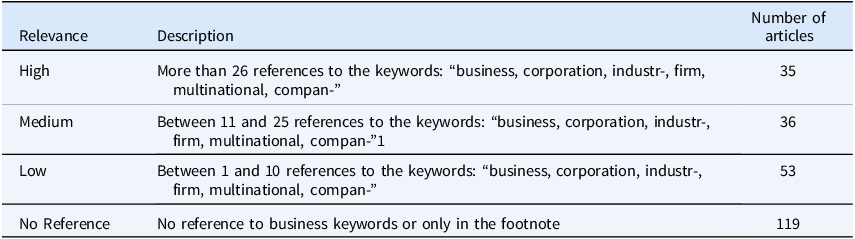
In the fourth stage, the 124 articles are coded and categorized based on high, medium, or low relevance based on its engagement with the business actor keywords. This coding was based on a quantitative measure of how many times the terms were used. The boundaries for high, medium, or low categorization were based on the median (11) and upper quartile (25)—the number of references to the business keywords (business, industry(ies)-, corporation, multinational, firm, company(ies), were taken from the median and quartile articles as the boundaries of the categories. The coding can be found in Appendix B. The references to private and non-state actors were not considered in the categorization as we were interested in business actors specifically and thus wanted to ensure the relevance was capturing this and not a general discussion of non-state or private actors. A sample of articles from each categorization were skimmed to confirm the selection method.Footnote 1
In many of the articles the term “private” was used in a more general way, for example, to reference public–private partnerships or private law. While these are still included in the references as they highlight the interaction between public and private spheres, to include them in the categorization runs the risk of skewing the results. Nevertheless, the comparison between references to the two groups clearly depicts the tendency in IRC scholarship to use the broader category of non-state actors, or private actors rather than specifying the type. This therefore illustrates the value of this research as it specifically focuses on and highlights the significance of business actors.
Eventually, this selection resulted in a database of 70 articles as the basis for our conceptual analysis and empirical synthesis. The 53 low relevance articles have been used in some cases to identify trends, as well as to complement and corroborate the conclusions drawn from the high and medium relevance articles. The medium articles have been used to identify the more descriptive references to what private business actors are doing and where they are present. Highly relevant articles have formed the bedrock for section three of this paper as they extend the discussion of business to a critical analysis level and focus specifically on business actors. It was not surprising that most of these articles originated from the IPE domain, where market actors are generally more widely considered as being highly influential. A breakdown of the categorisation of the articles can be found in Table 1.
Quantitative categorization of articles based on the references to the keywords
The fifth and final stage of the review is to report and summarize the results. These will be discussed in the following subsection.
Private business actors in IRC scholarship: main findings from the scoping literature review
The scoping literature review has uncovered that over half of the IRC articles studied (51 percent) in fact acknowledge and refer to the involvement of private business actors in global governance. This corroborates the findings of the 2021 special issue, that business actors have always been within the scope of IRC theory (Alter, Reference Alter2022; Eilstrup-Sangiovanni and Westerwinter, Reference Eilstrup-Sangiovanni and Westerwinter2022). The breadth of engagement with private business actors indicates that they may also be influential and key elemental units in other types of regime complexes than as discussed by Alter (Reference Alter2022). Moreover, the scholarship refers to industry associations as well as individual corporations which demonstrates that businesses appear in multiple ways within IRCs. This is in line with surrounding scholarship in global governance and lobbying literature which holds that it is increasingly easier for corporations to lobby individually as opposed to through industry associations (Braithwaite and Drahos, Reference Braithwaite and Drahos2000; Ruggie, Reference Ruggie2018; Aizenberg and Hanegraaff, Reference Aizenberg and Hanegraaff2020; Hanegraaff, Poletti and Aizenberg, Reference Hanegraaff, Poletti and Aizenberg2023).
Despite the prevalence of business actors in IRC scholarship, the broader category of “non-state actors” which encompasses private business actors and civil society actors is more present. This explains the relatively high number of articles coded as medium relevance; articles coded as medium relevance often theorized about non-state actors more in general while still explicitly referring to businesses within this group and offering some specific descriptions of business interactions. One such example is Kawabata (Reference Kawabata2020). They discuss private governance arrangements, such as voluntary standards and certification schemes, as well as the influence private standards can have on public regulatory action, for example creating avenues for regulation, or raising momentum to instigate public authority action (Kawabata, Reference Kawabata2020). Their paper provides important insights into the influence of private standards and their interaction with other governance instruments, but it does not deal explicitly with business standards and instead takes the broad brush of “private” actors with some specific examples of corporate actions.
As a result, most of the discussion of business actors in IRC scholarship remains descriptive, signposting explicit business involvement but not elevating the analysis from “nonstate actors” to the more granular level of business actors. In 54 of the articles, scholars have referenced private business actors by mentioning rather than explaining their presence or involvement. For example, private authority was “part of agenda setting in REDD+” (Zelli, Möller and Asselt, Reference Zelli, Möller and van Asselt2017), or discussions that businesses steer or frame interactions within a governance issue area (Morin et al., Reference Morin2017; Ryland, Reference Ryland2018), or more generally “engage in rule making” (Jordan et al., Reference Jordan2015). Some more theoretically focused articles such as Keohane and Victor (Reference Keohane and Victor2011), acknowledged that private business actors do influence the interests and interactions in the climate change regime complex but nevertheless decided to exclude non-state and business actors from the explanatory theorization of the regime complex (Cornelissen, Höllerer and Seidl, Reference Cornelissen, Höllerer and Seidl2021). The conceptual basis of the role of businesses in regime complexity is therefore limited as they are not included in the substantive discussion of influence and consequences of regime complexity. This echoes the earlier finding of Green (Reference Green2013) who found that there is only marginal conceptual awareness of private business actors in IRC scholarship.
This review thus demonstrates that the conceptualization of private business actors within IRC literature remains general and descriptive as they have been theorized within the broader group of non-state actors. Moreover, while there is a large acknowledgment of the presence and potential for influence, there has been less exploration of how businesses use regime complexity to influence international regulation in these issue areas. The high relevance studies such as Bach (Reference Bach2017) and Newell and Taylor (Reference Newell and Taylor2018) demonstrate that private business actors deserve specific individual consideration as they do not behave like every other interest group (Culpepper, Reference Culpepper2015). Therefore, this first analysis has unearthed a conceptual gap within IRC theory. Private business actors are more prominent in empirical literature but their theorization in conceptual literature has fallen behind, their influence remains implicit and inseparable from other non-state actors. While the difference between the various types of non-state actors and the overrepresentation of private business actors in global governance literature, is indicated in IRC scholarship (Newell and Taylor, Reference Newell and Taylor2018), IRC theory is not yet fully able to explain the consequences of their presence and their overall influence as a result of the conceptual gap.
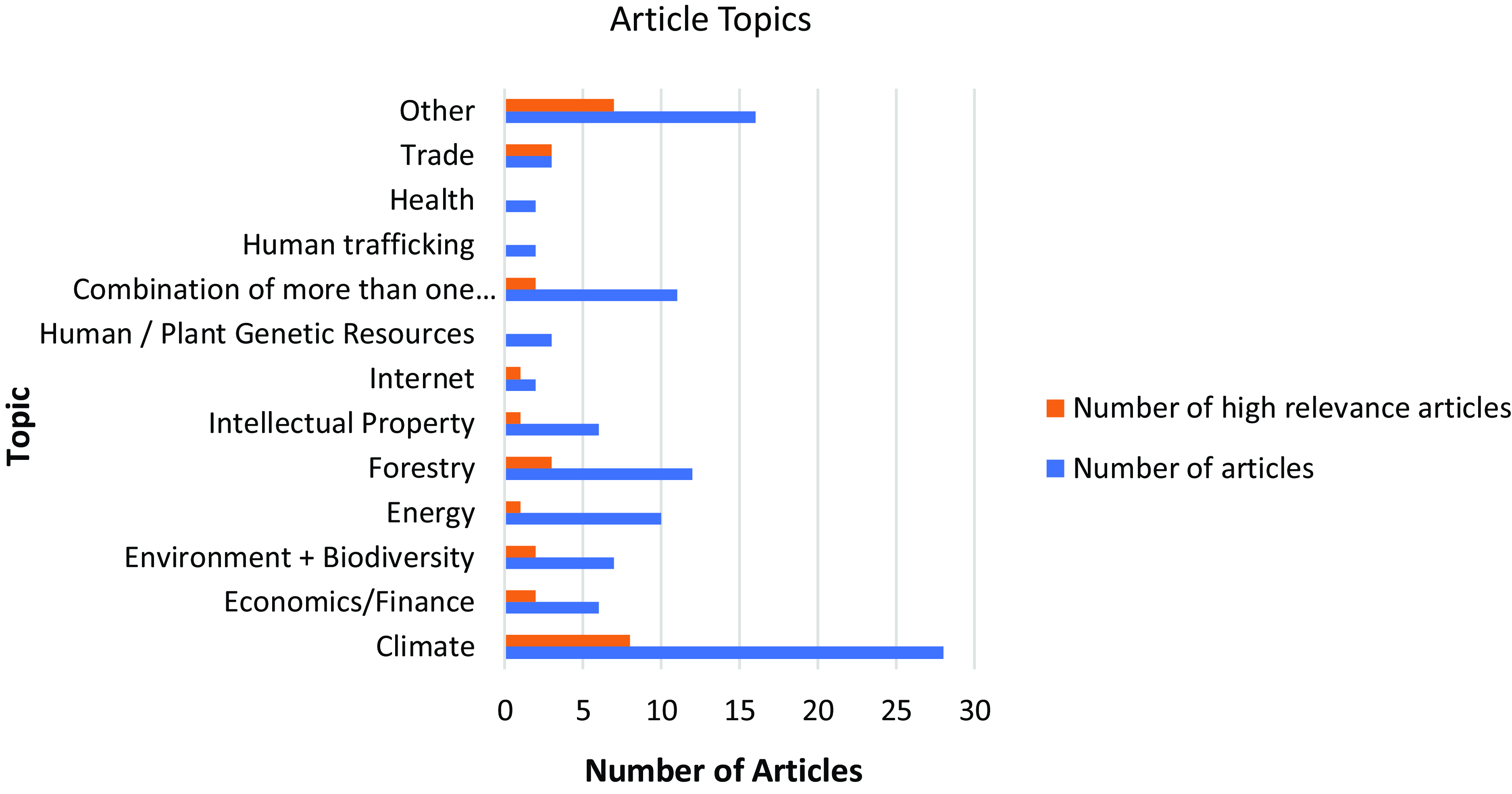
Nevertheless, the considerable body of empirical studies available within IRC scholarship, allows us to begin to build such a foundation based on the current studies within the scholarship. As Table 1 demonstrates, there are 71 articles which engage in a meaningful way, and 35 of those engage in depth with the involvement of business actors. These articles cover a wide variety of topics. As expected from trends in private governance literature, there is a considerable number of studies on the topics of climate change, the environment, and forestry. Due to the prevalence of private governance schemes and private authority in these areas, business actors and their roles are particularly visible in these complexes. However, regime complexity literature has also covered several other topics which are commonly seen as more public regulatory areas, such as the education, energy, and terrorism regime complexes. The broad spread of topics demonstrates the breadth of issue areas that have been covered by regime complexity literature, particularly of those which discuss the role of businesses. An illustration of these topics is demonstrated in Figure 1.
Overview of topics covered by the 124 reviewed articles in this study.
Topic areas within the “other” category are: Agriculture*, Antarctica*, CSR*, Palm Oil and Sustainability*, Shipping*, Dispute Resolution*, Piracy, Aviation, Fisheries, Nanotechnology, Food, Terrorism, Education, The Artic, and Security. Out of topics within the “other” category listed above, those with an asterisk were classified as high relevance studies. Note there were also a total of 13 studies which were primarily theoretical as opposed to case studies. High relevance articles were identified based on the coding scheme in Table 1 above.
As regime complexity has often been (mis)understood as only discussing state regulation, there is less focus on areas where private actors have otherwise been prevalent. While this forms a limitation in terms of how IRC scholarship has theoretically understood the role of private business actors, it has also manifested in strengths in the empirical studies. In particular, where the highly relevant articles have considered business roles, it has led to insightful contributions of business engagement in areas that are not typically studied in other fields because they are seen as public regulatory regimes only. For example, in the human trafficking regime complex, Gómez-Mera Reference Gómez-Mera(2016) demonstrates how businesses play an important role in the inhibition, acceptance and enforcement of forced labor standards in supply chains. Further, Newell and Taylor Reference Newell and Taylor(2018) demonstrate that the fragmentation of the climate change regime complex has implications or feedback effects (Alter and Raustiala, Reference Alter and Raustiala2018) on the agriculture regime complex. They demonstrate how climate-smart agriculture developed to satisfy the increasing focus on the link between climate change and agriculture and was sold as a “triple win” by the FAO (Newell and Taylor, Reference Newell and Taylor2018, p. 112). However there was little clarity on what this actually meant, and businesses were free to define it in line with their own CSR codes of conduct and the discursive power of agribusinesses through their roles as sponsors of existing practices and inhibitors of greater reforms is demonstrated (Newell and Taylor, Reference Newell and Taylor2018). Similarly, Eilstrup-Sangiovanni, (Reference Eilstrup-Sangiovanni2022, p. 20) demonstrates how the International Air Traffic Association, an aviation industry association stepped in to “supply a governance function” and acted to harmonize international operations. These examples demonstrate how using regime complexity to understand business roles in global governance provides a promising new perspective to explore areas of regulation where said roles, or private governance, are less apparent.
Therefore, the existing body of IRC literature can provide important insights and inferences into the roles of businesses; however, as these insights have not yet been theorized within the broader picture of IRC theory, they cannot be fully explained or understood based on the current position of IRC theory.
Regime complexity and business influence: what can we learn from IRC scholarship?
The previous sections in this paper have demonstrated that IRC has a strong potential to help further our understanding of business roles in complex global governance. In particular, the empirical IRC scholarship facilitates a more thorough understanding of business influence in regime complexity. We use the interpretative theorizing technique of perspectival theorizing (Cornelissen, Höllerer and Seidl, Reference Cornelissen, Höllerer and Seidl2021) to distill the insights from the IRC literature into the different roles of businesses in regime complexity.
Bartley’s 2018 review paper synthesizes research from numerous domains on the role of transnational and multinational corporations in global governance (Bartley, Reference Bartley2018). He argues that corporations perform the roles of sponsor, inhibitor, and provider of global governance. Business actors fulfill the role of sponsor when they act as architects, shapers, or supporters of global rules. They play an inhibiting role when resisting or hindering global governance by maintaining the status quo of differentiated governance arrangements when these have competitive advantages; pressing for less stringent, and fewer binding rules or more narrow definitions of regulated behavior. Last, they act as direct providers of global governance, without government action, by pushing private standards, for example through their global supply chains.
When analyzing the results from the scoping literature review, we used these roles as a template in order to see if we find the same roles, and what IRC scholarship can add to further our existing understandings.
Businesses as providers—insights from regime complexity
Bartley’s understanding of the role of businesses as providers refers to their role in promoting private standards rather than influencing intergovernmental agreements. We may not expect to directly encounter such a provider role in IRC literature as it mainly focuses on international regulation and is therefore generally state-centered. Yet, even within IRC literature, there are examples of business influence in international regulatory complexes broadly compatible with the role of “providers of governance.”
The multi-layered nature of international regime complexes allows businesses to use the national level to develop standards and then translate them to the international sphere (Selin, Reference Selin2012). This also works the other way, where businesses diffuse international private standards into various national standards, with the potential to control the interpretation and implementation of these standards into public regulation (Cao and Ward, Reference Cao and Ward2017; Roger, Hale and Andonova, Reference Roger, Hale and Andonova2017; Durkee, Reference Durkee2021).
IRC literature recognizes the role of business actors as providers and mostly refers to private standards as innovations (Shiroyama et al., Reference Shiroyama2012; Sengers, Turnheim and Berkhout, Reference Sengers, Turnheim and Berkhout2021), examples of entrepreneurial governance (Roger, Hale and Andonova, Reference Roger, Hale and Andonova2017; Hale, Reference Hale2020; Kawabata, Reference Kawabata2020), or experimental governance schemes (Dubash and Florini, Reference Dubash and Florini2011; Nance and Cottrell, Reference Nance and Cottrell2014; Albareda and Waddock, Reference Albareda and Waddock2018). IRC literature demonstrates that the common motivations for private standard creation are pre-empting public rules, filling a governance gap, and streamlining domestic blockages. Complexity can mean that there are more public, private, or conflicting institutions involved in regulatory decision-making which can inhibit action through slow bureaucratic processes to reach consensus. Business and non-state actors are however more flexible and able to react and adapt to changes in the political climate and therefore have an advantage over intergovernmental institutions and states (Cashore and Stone, Reference Cashore and Stone2014; Shackelford and Raymond, Reference Shackelford and Raymond2014; Green and Auld, Reference Green and Auld2017; Beaumier, Reference Beaumier2023). As a result, business and private actors can gain a first-mover advantage or influence which initiatives and standards become part of the formal regime complex.
An example from IRC literature of business actors as “providers” is from the maritime piracy regime complex. Struett, Nance and Armstrong (Reference Struett, Nance and Armstrong2013) demonstrate the different types of providers of global governance business actors can be and how institutional complexity can influence opportunities for norm creation. In the first instance, businesses acted as providers of governance in the form of monitoring and reporting functions; the International Chamber of Commerce created a specific Piracy Reporting Centre within its International Maritime Bureau (IMB). It exploited the lack of infrastructure for monitoring in the existing institutional context to place itself in a focal position, coordinating the reporting on and responses to piracy attacks (Struett, Nance and Armstrong, Reference Struett, Nance and Armstrong2013). The IMB built up a significant body of knowledge which created a knowledge asymmetry between it and the other institutions regulating piracy. This asymmetry, coupled with the “heightened role” of experts created by complexity (Alter and Meunier, Reference Alter and Meunier2009) created a subsequent opportunity for business influence, notably to act as norm creators. Building on its focal position and knowledge asymmetry, the IMB Piracy Centre was able to reframe the priorities of the complex by introducing new standards which shifted the focus toward protecting cargo and commercial interests, as opposed to the underlying social and economic causes of piracy (Struett, Nance and Armstrong, Reference Struett, Nance and Armstrong2013). A regime complexity perspective therefore demonstrates how the IMB’s priracy center leveraged its “provider” role as a monitor to subsequently play a “sponsor” role and create standards which furthered the commercial interests of the ICC members. Thus, the roles of businesses interact and can be leveraged against one another to build further influence of those business actors on international regulation.
Regime complexes are characterized by overlapping and parallel regimes on the same issue matter which interact and influence one another. Alter and Meunier (Reference Alter and Meunier2009) argue that this leads to greater porosity in regime complexes and thus more access opportunities for non-state actors. An example of how businesses use this porosity to attempt to act as providers of regulation can be found in the study by Fuentes-George (Reference Fuentes-George2017) on ocean iron fertilization (OIF). Here, businesses identified a new process of carbon capture and storage, OIF, which is the process where “iron is added to the sea to stimulate plankton growth…plankton blooms would then capture CO2 and sink to the bottom of the ocean” (Fuentes-George, Reference Fuentes-George2017). Various companies identified that they could profitably exploit this technology and sought to establish new private standards which facilitated and recognized this process (Fuentes-George, Reference Fuentes-George2017).
The increased institutional porosity created by complexity within climate change regulatory regimes (Alter and Meunier, Reference Alter and Meunier2009) created an opportunity to not only access the regime complex but to target multiple institutions and use cross-institutional political strategies to attempt to shift to a new venue and create a new regime (Fuentes-George, Reference Fuentes-George2017). When OIF was excluded from the Kyoto Protocol in the UNFCCC the firms turned to individual member states and alternative forums in an attempt to introduce those standards in parallel regimes (Fuentes-George, Reference Fuentes-George2017). Although they were able to gain legitimacy in some member states including the UK, New Zealand, and Canada, they were unable to introduce the standards within the existing regimes, nor muster enough support from states to create a new regime (Fuentes-George, Reference Fuentes-George2017). A regime complexity perspective demonstrates that businesses employ various roles to profit from the opportunities of overlapping institutions and regimes to create new standards and rules within international regulatory regimes—although unsuccessfully in this case. This demonstrates a competitive interaction between the inhibitors and hopeful providers in this complex. Further, it indicates that complexity can present challenges to the business role of norm creators if the inhibitor coalition is too strong by excluding access to institutional fora.
In both cases, the business actors sought to use information and knowledge asymmetry as a cornerstone of their approach and establish legitimacy. Alter and Meunier (Reference Alter and Meunier2009) already pointed to bounded rationality as an important consequence of regime complexity. We can now build on this further and argue that businesses try to consolidate knowledge asymmetry within regime complexes to maintain their structural position as owners of knowledge as part of their role as governance providers. In the case of Piracy regulation, the IMB piracy center used its institutional position to create knowledge asymmetry which increased its own legitimacy and centrality which it then used in its provider role strategy (Struett, Nance and Armstrong, Reference Struett, Nance and Armstrong2013). Similarly, the OIF study shows how the businesses created knowledge in order to increase the legitimacy of OIF as a scientific method of carbon capture, in attempts to influence the acceptance of OIF in the carbon capture regime (Fuentes-George, Reference Fuentes-George2017). Other examples show how businesses use the bounded rationality inherent to regime complexes to engage in norm creation to define a solution to the problem (Alter and Meunier, Reference Alter and Meunier2009; Abbott, Reference Abbott2012; Breitmeier et al., Reference Breitmeier2021; Park, Reference Park2021), or as an illustration of an asymmetry of knowledge to demonstrate the business community’s technical authority on a matter (Struett, Nance and Armstrong, Reference Struett, Nance and Armstrong2013; Fuentes-George, Reference Fuentes-George2017). For example, in the Antarctica regime complex, the industry association International Association of Antarctica Tour Operators (IAATO) was able to propose new rules regulating tourism in the region based on its technical and practical expertise (Green, Reference Green2022). The information asymmetry in favor of the IAATO created a high level of deference from the other institutions in the complex and thus allowed unencumbered standard creation by the IAATO (Green, Reference Green2022). The IAATO therefore provided industry standards under the auspices of the public regulator, the Artic Council, which had the formal mandate to regulate tourism (Green, Reference Green2022).
Business as sponsors—insights from regime complexity
The second role Bartley identifies is where businesses act as sponsors and actively promote, support, or shape international rules or governance regimes. Bartley (Reference Bartley2018, p. 152) argues that corporations will often promote global or regional governance “to gain competitive advantages, harmonize divergent national regimes, or level the playing field against less-regulated competitors.” A similar sponsor role was demonstrated in IRC articles where businesses sought to protect existing standards or regulatory approaches to promote certainty and coherence in the regime complex which was facilitated by forum linking and cross-fertilization of concepts (Orsini, De Bievre and Van Ommeren, Reference De Bievre and Van Ommeren2021).
Insights from the regime complexity literature provide insights into how businesses will promote or sponsor particular regulations in conditions of complexity. In particular, Curran and Eckhardt’s (Reference Curran and Eckhardt2018) study of the gambling regulations in the USA provides an illustration of how regime complexity creates opportunities for businesses to act as sponsors, and of the interaction between the roles of inhibitor and sponsor. They demonstrate how multinational gambling companies used complexity to entrench and enforce international trade rules in the national context, in response to restrictive trade barriers on gambling firms (Curran and Eckhardt, Reference Curran and Eckhardt2018). The gambling firms used cross-institutional political strategies such as regime shifting and regime linking in order to promote international trade rules in a new policy area (gambling) and at the national level to challenge and inhibit the restrictive US gambling regulations. The international trade regime was more favorable to the gambling firms due to the principle of national treatment, which is part of the core “promoting fair competition” principle within the WTO regime. It ensures that foreigners and locals are treated equally once the product has entered the market and is applicable because the US regulation targeted firms which offer cross-border betting services to US customers (Curran and Eckhardt, Reference Curran and Eckhardt2018; WTO, 2023). This captured many of the gambling companies operating in the US which had relocated to Antigua in the 1990s because Antigua offered a more attractive and supporting institutional environment for gambling firms (Curran and Eckhardt, Reference Curran and Eckhardt2018).
The gambling case depicts how businesses can exploit complexity to favor some standards over others and thereby influence the shape of the salient standards and regulations within a regime complex. Alter and Meunier (Reference Alter and Meunier2009) found that implementation politics is a consequence of regime complexity; as actors implement and choose between the overlapping or parallel regulations, they in turn shape the salient interpretation or meaning of these rules. In the gambling case, the gambling firms chose the international trade regulations and sought to act as sponsors and implement them in the US gambling regime through the WTO regime. A complexity perspective can therefore demonstrate the overlap between sponsor and inhibitor roles. While the gambling firms were acting as sponsors for the international trade regulations by implementing and diffusing them into the US national gambling regulations, this also sought to achieve the outcome of inhibiting the latter regulations.
Moreover, the gambling case study provides some insight into how states choose which standards and regulations to sponsor or not. In this case, the gambling firms were unable to lobby domestically and act as inhibitors because they lacked the political power in this regime. However, complexity allowed these companies to venue shift to Antigua, where they had more political and economic leverage as the gambling industry was the second largest employer after tourism and thus was a key part of the Antiguan economy (Eckhardt and Bièvre, Reference Eckhardt and Bièvre2015; Curran and Eckhardt, Reference Curran and Eckhardt2018). In doing so, complexity presented an opportunity to act as sponsors of the international trade regulations within the US gambling regime to promote the former as the salient interpretation. Through enforcing and extending international trade regulation principles into US domestic regulation through the WTO dispute body, they promoted these principles by transposing them to the national level and diffusing them to a new issue area. In this way, complexity allowed the firms to use their role as sponsors of international trade regulations as a sword with the effect of an inhibitor.
Regime complexity demonstrates the multi-level and strategic exploitation of the opportunities to forum and regime shift and the effect that this has on the roles of businesses. It therefore provides important additions to Bartley’s role of sponsor by indicating the close connections and overlap with his other two roles of provider and inhibitor. The gambling case is an example of the mix of sponsor and inhibitor roles. It demonstrates that when businesses seek to act as inhibitors but do not have the political leverage or power to do so, they can regime shift and regime link and then act as sponsors of favorable rules from an overlapping or parallel regime.
A mix of provider and sponsor roles have been found in many regime complexes; studies identified that business or non-state actors would engage and develop private governance schemes in order to enshrine, promote and diffuse public standards (Green, Reference Green2013; Gómez-Mera, Reference Gómez-Mera2016; Hickmann and Elsässer, Reference Hickmann and Elsässer2020; Morin, Reference Morin2020). An illustration of this is the introduction of private carbon offset standards which diffused existing principles from public regulation, as discussed by Green (Reference Green2013). Green (Reference Green2013) demonstrates how private standards were developed in order to entrench the Kyoto Protocol standards regarding greenhouse gases. She depicts how the growth of private carbon offset standards served to diffuse the standards within the Protocol to strengthen them and ensure they outlast their finite lifespan (Green, Reference Green2013). In diffusing the public standards through private governance schemes, the complexity of the offsets regime complex was increased as more institutions overlapped and thus the Protocol standards became harder to displace. The overlap between business roles as providers of governance and sponsors of public regulation is demonstrated by the fact that the private standards which most closely overlapped with the public regulation (Kyoto Protocol), in particular, the Clean Development Mechanism, Greenhouse Gas Protocol, Verified Carbon Standards and ISO standards, had a high centrality among all the private governance standards (Green, Reference Green2013). This therefore meant that the complexity of the climate regime complex provided access to business actors to act as providers of governance which was then exploited in order to achieve harmonization and certainty of global standards, motivations which Bartley associates with the sponsor role. In this way, they used complexity and rule ambiguity to “sponsor” existing standards and ensure that they would become the salient interpretation (Alter and Meunier, Reference Alter and Meunier2009; Green, Reference Green2013). Therefore, regime complexity literature demonstrates that the greater opportunities of access afforded by complexity have allowed business actors new ways to influence global governance dynamics.
Businesses as inhibitors—insights from regime complexity
Bartley (Reference Bartley2018, p. 146) categorizes the role of inhibitors as when corporations inhibit “the expansion of global governance” for example through “mobilizing to defeat or defang rules” as they have done in the areas of labor, the environment and health. He argues that although businesses and corporations have been shown to act as sponsors for global governance and harmonization, they also benefit from “cross-national regulatory differences.” A common example of this is the use of tax havens while lobbying against harmonization of international tax regulation. Inhibitor roles, as understood by Bartley, do not have to result in the complete prevention of regulation, but can also be used to hinder governance by establishing “less stringent, less binding, or more narrowly defined versions” of that standard (Bartley, Reference Bartley2018, p. 152). Such instances were also depicted in the IRC literature. For example, Ciplet and Roberts (Reference Ciplet and Roberts2017, p. 150) illustrated how the agriculture industrial actors, along with other industries, were able to narrow the scope of the Montreal Protocol to exclude a commonly used ozone depleting substance and move toward more “market-based policy mechanisms and considerations.” They also demonstrated how industry actors were able to reframe toxic waste as “essential” for economic development and thus defang some of the threats from the Basel Convention relating to toxic waste as an “environmental harm” (Ciplet and Roberts, Reference Ciplet and Roberts2017, p. 150).
Regime complexity literature can offer further insights into the role of business as inhibitors under conditions of complexity by offering insights from the institutional domain. As complexity facilitates greater access of non-state actors, like business actors, into a regime complex, it also allows such actors to challenge or inhibit procedural rules which exclude them. Kienzle (Reference Kienzle2019) uses regime complexity to consider the increasing prevalence of the private sector in the weapons of mass destruction and terrorism regime complex, despite the resistance from the implementing committee set up by the UN, the 1540 committee. He found that there was a changing attitude in the UN and surrounding institutions which encouraged the committee to “draw on” the expertise of civil society and the private sector (Kienzle, Reference Kienzle2019). Private sector and business actors frequently sought to cooperate with the Committee and the most promising collaboration was eventually found through an annual outreach conference with private industry, national governments, and the committee (Kienzle, Reference Kienzle2019, p. 492). This demonstrates that business actors also use the role of inhibitors to target procedural rules, such as the exclusion of private actors from consultations and decision-making. Moreover, it also demonstrates that such a tactic could be used as a first step to substantive inhibition, as first the business actors must be given access before they can seek to steer the substantive regulations in a particular direction. Complexity therefore provides opportunities for businesses to act as inhibitors by providing greater access as well as by facilitating and promoting cooperation with non-state actors by creating a “heightened role” for experts (Alter and Meunier, Reference Alter and Meunier2009).
IRC literature also highlights the intersection between business actors as providers and as inhibitors by demonstrating how private standards can emerge to challenge existing standards and regulations or, to redefine their application. Gómez-Mera (Reference Gómez-Mera2016, p. 570) argued that private actors can create “counter-regime norms or contradictory rules in parallel regimes” to “challenge the normative framework” and facilitate norm shifting. Evidence from the literature often indicates this as being linked with the rule ambiguity and implementation politics consequences that are created by regime complexity (Helfer, Reference Helfer2009; Gehring and Faude, Reference Gehring and Faude2013; Gulbrandsen, Reference Gulbrandsen2014). Similarly, Shackelford and Raymond (Reference Shackelford and Raymond2014) demonstrate that private business actors can use industry standards to challenge international regulations. A complexity perspective thus forces researchers to explore and acknowledge this overlap as it requires them to place the private standards in the broader institutional context.
The international forestry regime complex has been the subject of a considerable amount of research within IRC, but also within private and global governance literature. As this paper draws only on the studies from the IRC scoping review, it does not claim to do justice to this breadth of the work on forestry. However, we do draw from the three highly relevant studies in the results that focus on forestry to understand how regime complexity presents challenges and opportunities for the role of businesses in the forestry regime complex.
The FSC standards emerged as a multi-stakeholder private certification scheme developed predominantly by civil society and business actors such as retailers (Pattberg, Reference Pattberg2005a, Reference Pattberg2005b), as a result of a failure of governments to agree on sustainable forestry standards at the 1992 Rio Conference (Burns, Yapura and Giessen, Reference Burns, Yapura and Giessen2016). The introduction of the FSC standards reflects businesses playing a provider role through cooperation with civil society and other homogenous interests seeking to regulate international forestry. However, it was predominantly retailer businesses involved as opposed to producers and private landowners (Pattberg, Reference Pattberg2005b). Businesses on the production side were, generally speaking, less in favor of the FSC which was stricter and sought to restrict, or equalize, business influence (Pattberg, Reference Pattberg2005b; Overdevest and Zeitlin, Reference Overdevest and Zeitlin2014). The early years of sustainable forest management certification saw considerable competition between the emerging programs initiated by various business coalitions. During the 1990s when momentum was building for the FSC between NGOs and retailers, alliances of timber producing businesses undertook several attempts to start alternative certification programs. As these were mainly organized at the country level, they sought to develop national-level certification programs and failed in providing a viable alternative to the global reach of the FSC (Auld, Reference Auld2014, p. 86). Thus, we see that the structure, scale and degree of collective organization of businesses in associations, matters for effective provider roles. In 1998 private landowners, forest-based industries and production-orientated industries created a more “industry-friendly” competition private governance scheme, the Programme for the Endorsement of Forest Certification (PEFC), to challenge the FSC standards (Burns, Yapura and Giessen, Reference Burns, Yapura and Giessen2016, p. 23). The PEFC quickly gained prominence alongside the FSC and developed a strong share of the certification market for sustainable forest management processes (Burns, Yapura and Giessen, Reference Burns, Yapura and Giessen2016; Fernández-Blanco, Burns and Giessen, Reference Fernández-Blanco, Burns and Giessen2019). Through creating the PEFC, these business actors tried to act as inhibitors of the FSC standards through forum shifting and providing new, competing standards in the form of the PEFC. This demonstrates how regime complexity can create opportunities for businesses to combine the provider and inhibitor roles in complex global governance. In providing new private governance standards, they are able to challenge, compete, or at least limit the potential acceptance of the FSC by offering an alternative. This is indeed what happened, while it did not replace the FSC, the two standards became relatively equal in prevalence (Fernández-Blanco, Burns and Giessen, Reference Fernández-Blanco, Burns and Giessen2019).
The forestry case thus demonstrates that regime complexity can provide opportunities and challenges for different actors to respond to market conditions and influence the global governance architecture in their interest. There has been a continual competition between these two standards which has resulted in a fragmented and decentralized forestry regime complex (Giessen, Reference Giessen2013; Orsini, Reference Orsini2013; Fernández-Blanco, Burns and Giessen, Reference Fernández-Blanco, Burns and Giessen2019). Orsini (Reference Orsini2013) demonstrated that most of the non-state actors in the forestry regime which attend multiple forums predominantly do so to engage in forum-shifting, with the second most prevalent strategy being forum-linking. This therefore provides evidence that business actors, and civil society actors for that matter, exploit regime complexity through cross-institutional strategies made available by continual fragmentation to exert influence on the principles guiding the regime complexity. The PEFC business coalition thus used the consequences of regime complexity in the form of regime shifting and implementation politics to create strategic ambiguity as part of their strategy to challenge the existing standards enshrined by the FSC.
Further, these opportunities can also be viewed as challenges depending on the interest of the actor; as illustrated by Pattberg (Reference Pattberg2005b), retailer and demand-based business interests sought to sponsor the FSC standards and thus were challenged by regime complexity which facilitated the access and emergence of competing private standards, PEFC, by a rival interest group. While both the FSC and PEFC demonstrate a strong influence of the role of provider of global governance as these standards are both now widely established, by virtue of this, we can conclude that their attempts to inhibit the other standards were less successful. This corroborates the insights presented by Alter and Meunier (Reference Alter and Meunier2009, p. 16) who stated that “where preferences diverge ambiguities will persist.” In this way, complexity presented opportunities for business actors to coexist, albeit in competition with one another, as a likely result of “implementation politics” (2009). However, over time there has been a general convergence of the two schemes which has resulted in a heightening of the sustainability requirements of the PEFC endorsed standards (Gulbrandsen, Reference Gulbrandsen2014, p. 79). Put another way, we could say that the FSC interested business and civil society actors used the sponsor role to achieve a level of broad convergence of competing standards, such as the PEFC, to converge toward the FSC’s rules. However, through sponsoring their own standards they were also able to inhibit the PEFC’s standards by watering down their pro-production industry approach.
This brief case study offers a simplified overview of forestry standard-setting as a complex area of global governance that has been studied from numerous angles and disciplines. However, we have been able to demonstrate that the three roles can help appreciate and categorize the complexity of interactions to understand the impacts of regime complexity, and business influence, thereon. From a regime complexity perspective, based on the limited overview in this paper, we can already appreciate that the role of businesses and their ability to use them to exert influence is impacted by the conditions of regime complexity, such as centralized vs decentralized, and competitive vs cooperative governing dynamics. Based on the Forestry IRC case study, for example, a competitive decentralized regime complex is likely to pose a greater challenge for the inhibitor role than the provider and sponsor roles.
IRC literature therefore provides further insights into the role of businesses as inhibitors of international regulation and adds to the question of how this is done under conditions of complexity. Firstly, it identifies the opportunities complexity can create for businesses to engage as inhibitors. The WMD/Terrorism and forestry examples both show that business actors take advantage of the increased porosity and accessibility created by complexity in order to engage in global governance. Further, the WMD/Terrorism complex stresses the implication of the heightened role of experts and bounded rationality created by complexity and how this can be used by businesses when acting as inhibitors. Additionally, it demonstrates that some potential steps and pathways must first be taken or unlocked before a business can act to inhibit substantive standards, for example by first challenging procedural rules. Secondly, it demonstrates the overlap between providers and inhibitors and how businesses use and build off both to try to strengthen their influence. In the forestry complex, the role of businesses as providers was stronger than their role as inhibitors because of the competitive fragmented nature of the regime complex and the fact that there were divergences in opinions means that ambiguities and competing standards will exist (Alter and Meunier, Reference Alter and Meunier2009).
Summary
Our review demonstrated that the empirical studies in IRC literature largely echo the three roles of business in global governance identified by Bartley (Reference Bartley2018). IRC studies have allowed us to refine these roles by demonstrating how regime complexity impacts these roles and provides opportunities or challenges for business influence in international regulation. As global governance becomes more complex, such insights are invaluable to refine and further develop our understanding of business roles in international regulation under conditions of complexity.
IRC literature has demonstrated that complexity creates greater access to international institutions and thereby creates opportunities for influence. For example, IRC insights demonstrate that complexity presents opportunities for regime shifting and therefore allows businesses to act as sponsors for parallel regulations in order to influence the salient interpretations in new regimes (such as the US gambling regime). Further, it creates opportunities for business actors to act as providers of global governance to fill governance gaps, or to challenge (inhibit) existing regulations and private standards as in the forestry complex (Burns, Yapura and Giessen, Reference Burns, Yapura and Giessen2016; Fernández-Blanco, Burns and Giessen, Reference Fernández-Blanco, Burns and Giessen2019). IRC theory however, also demonstrates that factors such as political power, knowledge resources, and centrality are also important factors to shape the type and extent of the influence of various roles of business actors in international regulation.
Across all the roles identified, there is a clear synergy with the consequences of regime complexity as discussed by Alter and Meunier (Reference Alter and Meunier2009), and most notably the heightened role of experts. This demonstrates that knowledge and information form a keystone of business influence as it was demonstrated as a significant contribution in examples of business roles as providers, inhibitors, and sponsors. However, the institutional context and power dynamics within a complex also form an equally important contributing factor, and thus we can expect cross-institutional political strategies to be used in order to shift to or create a more favorable institutional context. The forestry (Burns, Yapura and Giessen, Reference Burns, Yapura and Giessen2016), gambling (Curran and Eckhardt, Reference Curran and Eckhardt2018), and intellectual property (Sell et al., Reference Sell2003; Helfer, Reference Helfer2009; Dreyling, Reference Dreyling2021) cases provide examples of this. Therefore, the IRC literature demonstrates that businesses have not only adapted to the growing complexity of global governance but in fact, exploit its consequences to exert influence on international regulation.
Conclusion and Discussion
In this paper we sought to bring together two key trends in global governance: institutional complexity and the roles of private actors. We used international regime complexes (IRC) theory to explore how regime complexity influences the role of business actors in global governance and impacts opportunities for business actors to influence international regulation. Based on an extensive review of IRC literature, we specifically identified how private business actors are currently conceptualized in IRC theory, and what empirical IRC studies teach us about business influence on international regulation in complex global governance.
With regard to the first question, we find that while IRC scholarship focuses on public international regulation, IRC scholarship’s consideration and theorization of non-state actors has significantly grown over the past 10 years. Our review of the IRC literature supports the conclusions of Alter (Reference Alter2022) and Eilstrup-Sangiovanni and Westerwinter (Reference Eilstrup-Sangiovanni and Westerwinter2022) that private business actors are within the scope of IRC theory. Yet, this paper has also uncovered a conceptual gap between the way private business actors are theorized and the observations made in empirical studies. It has identified that IRC theory by and large theorizes about non-state actors as one overarching group whereas empirical studies more often separate business and civil society actors. This has led to a conceptual gap between the empirical findings of IRC scholarship and IRC theory itself. IRC theory’s conceptualization of private business actors thus remains very descriptive and predominantly signposts business involvement while its empirical contributions allow for further unpacking the consequences of their involvement or how they seek to exert influence. Other global governance theories involving business, most prominently transnational business governance interactions and IPE (Henning and Pratt, Reference Henning and Pratt2023), primarily look at areas with significant degrees of private authority in which “nonstate actors exercise significant authority to perform regulatory actions along or with state actors” (Eberlein et al., Reference Eberlein2014, p. 3). Future research should continue to build on and explore the intersection of IRC with these disciplines, and IPE in particular given its focus on economic actors and the existing work exploring this connection in the 2023 special issue of Review of International Political Economy (Henning and Pratt, Reference Henning and Pratt2023).
While IRC theory has been criticized for its focus on formal legal arrangements, our analysis of IRC scholarship shows that despite this, it provides relevant insight into the role of business in international regulation. With regard to the second question, the empirical observations in conjunction with IRC’s general theorizing on non-state actors have yielded important insights on the role of businesses in IRCs and thus how regime complexity in global governance impacts opportunities for business actors to influence international regulation. Building on Bartley’s (Reference Bartley2018) three roles of corporations in global governance, we demonstrate that complexity provides businesses with opportunities to inhibit unfavorable regulations or sponsor favorable regulations and even to act as direct providers of governance in international regime complexes. The institutional porosity under regime complexity provides greater access to different institutions and facilitates regime shifting and regime linking. Further, numerous IRC studies clearly illustrate that businesses use their flexibility and interconnectedness across regimes to build informational asymmetry in order to exploit the increased reliance on experts under conditions of complexity. Such opportunities are implicit in these articles, however, by theorizing specifically about business actors using Bartley’s roles we have been able to deepen our understanding of how regime complexity impacts the opportunities of businesses to influence international regulation.
IRC theory has demonstrated how these three roles overlap. For example, the gambling case illustrated how regime complexity provides opportunities to manipulate the sponsor role to inhibit US gambling regulation. Therefore, complexity fosters a greater fluidity which, by placing it at the center, allows one to appreciate the broader institutional context and influence of the actions of businesses. A regime complexity perspective therefore facilitates the consideration of all these three roles together and how they are used concurrently by businesses and thus responds to Bartley’s call for researchers to study these roles together rather than independently.
Further, complexity in global governance is only continuing to grow as more actors continue to emerge as political actors and assume regulatory functions. The international context is in flux as new economic power states emerge and business and civil society continue to gain legitimacy as international governance actors. Future research could further explore the influence of the changing international context on the underlying conditions of complexity and how this could shape the roles of business actors identified in this paper. It should also be noted that as the roles we have identified are not exhaustive, greater consideration of the international context could also identify further roles or variations thereof (for example see, Auld et al., Reference Auld2022). In particular, as business actors and civil society work increasingly closely together, further research could focus on how this impacts the three roles of businesses in complexity. Also, while extant research on business influence and lobbying has shown that various business constellations, such as lobbying through individual corporations or business associations, and nationally or in global value chains, can lead to different outcomes (Auld, Reference Auld2014), a regime complexity perspective provides new ways to understand these outcomes. Thus, the regime complexity; business influence; and private governance literatures can benefit from closer engagement. Last, IRC theory has uncovered several different variants of regime complexes which vary based on the type of complexity (Abbott, Reference Abbott2012; Abbott and Faude, Reference Abbott and Faude2022; Alter, Reference Alter2022; Eilstrup-Sangiovanni and Westerwinter, Reference Eilstrup-Sangiovanni and Westerwinter2022). Fruitful future research could be conducted by focusing on specific types of regime complexity and how this impacts the different roles of business actors. All in all, the contributions in this paper therefore offer a new perspective on business influence in global governance, as well as avenues for future research focusing specifically on complexity which increasingly is becoming the modern reality of global governance.
Supplementary material
To view supplementary material for this article, please visit https://doi.org/10.1017/bap.2024.29
Competing of interests
This author does not have any competing interests.


 Open access

