

Introduction
The species of the genus Hedruris Nitzsch, 1821 are parasites of the digestive tract of lampreys, fish, amphibians and reptiles, commonly found in their stomach and duodenum. Females attach to the epithelial wall using a characteristic eversible hook situated in their caudal end, while males are found either coiled around the female ones or free in the stomach lumen (Baker, Reference Baker1982, Reference Baker1986; Blair, Reference Blair1984). The genus is widely distributed and comprises 28 species, four of which are considered doubtful, that is, Hedruris iheringi Pereira & Vaz, 1933, H. hylae Johnston & Mawson, 1941, H. scabra Freitas & Lent, 1941 and H. marinus Kurochkin & Korotaeva, 1974 (Baker, Reference Baker1982, Reference Baker1986; Ramadan et al., Reference Ramadan, Awad and Taha2014; Jones & Resasco, Reference Jones and Resasco2016; Rossin & Timi, Reference Rossin and Timi2016). In the Neotropical region, nine species of Hedruris were recorded: H. siredonis Baird, 1858, H. orestiae Moniez, 1889, H. mucronifer Schuurmans Stekhoven, 1951, H. basilichtensis Mateo, 1971, H. juninensis Bendezú, 1976, H. moniezi Ibañez & Córdova, 1976, H. heyeri Bursey & Goldberg, 2007, H. suttonae Brugni & Viozzi, 2010 and H. bifida Rossin & Timi, 2016. Among them, only H. mucronifer, H. suttonae, H. bifida and H. orestiae occur in Argentina (Bursey & Goldberg, Reference Bursey and Goldberg2000; Palumbo et al., Reference Palumbo, Capasso, Cassano, Alcalde and Diaz2016; Rossin & Timi, Reference Rossin and Timi2016; Serrano-Martinez et al., Reference Serrano-Martinez, Quispe, Plascencia and Hinostroza2017).
Only two valid species of Hedruris were reported in freshwater turtles: H. pendula (Leidy, 1851), which parasitizes the painted turtle Chrysemys picta (Schneider, 1783), the spotted turtle Clemmys guttata (Schneider, 1792) and the Blanding's turtle Emys blandingii (Holbrook, 1838) in Canada, United States, France and Germany (in a zoo), and H. orestiae, which parasitizes the Argentine snake-necked turtle Hydromedusa tectifera Cope, 1870 in Buenos Aires, Argentina (Baker, Reference Baker1982; Palumbo et al., Reference Palumbo, Capasso, Cassano, Alcalde and Diaz2016).
Only two species of the genus were molecularly characterized: (i) Luque et al. (Reference Luque, Vieira, Herrmann, King, Poulin and Lagrue2010) sequenced a partial region of the 18S and the third domain of 28S (D3) rRNA genes from 16 isolates of Hedruris spinigera Baylis, 1931 from Retropinna retropinna Richardson, 1848 and Paracorophium excavatum (Thomson, 1884); (ii) Choudhury & Nadler (Reference Choudhury and Nadler2018) sequenced a partial region of the18S gene from one isolate of Hedruris sp. from salamander Taricha granulosa (Skilton, 1849). Thus, little molecular data are accessible at GenBank to make comparative analyses.
Information is available on the life cycles of four species of the genus Hedruris: H. androphora Nitzsch, 1821 and H. ijimai Morishita, 1926 require isopods of the genus Asellus Geoffroy, 1762 as intermediate host and amphibians as definitive host (Petter, Reference Petter1971; Hasegawa & Otsuru, Reference Hasegawa and Otsuru1979), whereas H. spinigera and H. suttonae need amphipods as intermediate hosts (Paracorophium Stebbing, 1899 and Hyalella Smith, 1874, respectively) and fishes as definitive hosts (Petter, Reference Petter1971; Hasegawa & Otsuru, Reference Hasegawa and Otsuru1979; Brugni & Viozzi, Reference Brugni and Viozzi2010; Luque et al., Reference Luque, Vieira, Herrmann, King, Poulin and Lagrue2010).
In this work, we describe a new species of Hedruris parasitizing two species of freshwater turtles, Hyd. tectifera and the Hilaire's toad-headed turtle Phrynops hilarii (Duméril & Bibron, 1835), in streams of Buenos Aires province, Argentina, based on morphological and molecular data. In addition, we provide information about its life cycle based on the larval stages recovered from its intermediate host Hyalella bonariensis Freitas dos Santos, Araujo & Bond-Buckup, 2008. Moreover, we update the host and geographic distributions of all species in the genus Hedruris.
Material and methods
Sampling
Between December 2016 and November 2017, stomach contents and faecal matter were obtained from 47 Hyd. tectifera and two P. hilarii in the stream Rodríguez (SR) (34°53′02″S, 58°02′30″W), 16 Hyd. tectifera in the stream Carnaval (SC) (34°52′20″S, 58°05′22″W) and 14 Hyd. tectifera in the stream El Gato (SG) (34°53′26″S, 57°59′40″W) in Buenos Aires province, Argentina. The geodetic datum of the geographic coordinates is WGS84. Stomach washes were collected according to the methods of Legler (Reference Legler1977) and then preserved in 70% ethanol. Faecal samples were preserved in 70% ethanol. All samples were analysed using a stereoscopic microscope (Olympus SZ61, Tokyo, Japan); the nematodes and prey items were quantified and preserved in 70% ethanol. In addition, a single Hyd. tectifera specimen found dead on the road to the stream Rodríguez in October 2017 was necropsied. It was fixed in 10% formaldehyde for further analysis.
In order to find larval stages in the intermediate hosts, we examined the crustaceans found in the stomach contents of the turtles. Moreover, 100 amphipods were collected in the stream Rodriguez by a plankton net.
Morphological identification
For morphological studies under a compound microscope (Olympus BX51, Tokyo, Japan), nematodes were temporarily mounted and cleared in Amman's Lactophenol. Additionally, photographs were taken with a Q-Imaging Go-3 digital camera. Drawings were made with the aid of a camera lucida. Some specimens were dehydrated, critical point dried, gold coated and observed and photographed using a scanning electron microscope (Jeol/SET 100, Tokyo, Japan). Nematodes were identified according to Yamaguti (Reference Yamaguti1961), Ibañez & Córdova (Reference Ibañez and Córdova1976), Baker (Reference Baker1986) and Moravec & Vargas-Vázquez (Reference Moravec and Vargas-Vázquez1998). Measurements are given in micrometres unless otherwise indicated. The number (n), prevalence (P) and mean intensity (MI) of nematodes were calculated following Bush et al. (Reference Bush, Lafferty, Font and Shostak1997) and using the Quantitative Parasitology Program (QP 3.0, Rozsa et al., Reference Rozsa, Reiczigel and Majoros2000). Voucher specimens were deposited in the Helminthological Collection of the Museo de La Plata, La Plata, Buenos Aires province, Argentina.
The crustaceans were cleared using Amman's Lactophenol and examined for endoparasites under a stereoscopic microscope.
Molecular and polymerase chain reaction (PCR) methods
A total of 14 individual nematodes were isolated in Eppendorf® tubes and frozen at −20°C for subsequent DNA extraction and genotyping: nine adult specimens from the stomach of Hyd. tectifera (five males and four females) and five subadults from Hy. bonariensis. DNA was extracted from the isolates using 200 µl of 5% Chelex solution (Bio-Rad Laboratories, CA, USA) containing 0.2 mg/ml Proteinase K (Roche), incubated at 56°C overnight, followed by 10 min at 95°C. Nuclear 18S rDNA amplification was done using primers Nem_18S_F and Nem_18S_R (Floyd et al., Reference Floyd, Rogers, Lambshead and Smith2005), which span approximately 900 bp of the gene Each 50 µl PCR contained 25 µl of GoTaq Green Master Mix (Promega, Madison, WI, USA), 2.5 µl of each primer, 17 µl of water and 3 µl of extracted DNA. PCR amplifications for 18S were performed using an Eppendorf Mastercycler ep gradient S (Thermal Cycler 96 WELL, Hamburg, Germany), consisting of 94°C for 15 min, followed by 35 cycles of 94°C for 30 s, 60°C for 30 s and 72°C for 70 s, with a final extension of 72°C for 240 s. PCR products were further purified and sequenced (Macrogen, South Korea). Sequences were edited and aligned using Chromas version 2.6.6® and Gap version 4.11.2® (Bonfield et al., Reference Bonfield, Smith and Staden1995) then compared to the NCBI database using BLAST version 2.2.26 (Altschul et al., Reference Altschul, Madden, Schäffer, Zhang, Zhang, Miller and Lipman1997) to identify sequences with high similarity to DNA sequences obtained.
Phylogenetic analyses
The newly obtained 18S sequences were aligned with other sequences of Hedruris available in the GenBank using CLUSTAL W program (Larkin et al., Reference Larkin, Blackshields and Brown2007). The phylogenetic tree was reconstructed using the Maximum Likelihood method and the genetic distance was estimated using Kimura's (Reference Kimura1980) two-parameter (K2-P) model implemented in the Mega 7.0.26 program (Kumar et al., Reference Kumar, Stecher and Tamura2016). A sequence of one Spiruridae species (GenBank accession number JQ771746) was included as outgroup. Bootstrap analyses were conducted using 500 replicates. The genetic differences in datasets were also calculated with Mega program, using uncorrected p-distances.
Host and geographic distribution
To estimate the host and geographic distribution of the genus Hedruris, an exhaustive analysis was made of the available bibliography up to 2018. Publications in indexed journals and records in renowned books were taken into account.
Results
A total of 2573 nematodes were obtained from the visceral dissection, stomach washes and faecal samples of the turtles examined, whereas 24 nematodes (one fourth-stage larva and 23 subadults) were recovered from the Hy. bonariensis specimens collected from the stream Rodriguez. Every time amphipods were found in the turtle's stomach contents, at least one of them was parasitized. Both adult and larval nematodes found belonged to the genus Hedruris. Only ten adult and one subadult specimens from eight Hyd. tectifera and one subadult found in Hy. bonariensis from the stream Rodriguez were identified as H. orestiae. The remainder nematodes belonged to a new species of the genus Hedruris, which is described in the following.
Systematics
Hedruridae Railliet, 1916
Hedrurinae Chitwood & Wehr, 1934
Hedruris Nitzsch, 1821
Hedruris dratini n. sp.
Taxonomic summary
Type host. Hydromedusa tectifera Cope, 1870 (Pleurodira, Chelidae).
Other hosts. Phrynops hilarii (Duméril & Bibron, 1835) (Pleurodira, Chelidae); Hy. bonariensis Freitas dos Santos, Araujo & Bond-Buckup, 2008 (Amphipoda).
Type locality. Stream Rodríguez (34°53′02″S, 58°02′30″W; datum: WGS84), Buenos Aires province, Argentina.
Other localities. Stream El Gato and stream Carnaval, Buenos Aires province, Argentina.
Type material. Holotype: MLP-He-7510 (male). Paratypes: MLP-He-7511 (two males and two females).
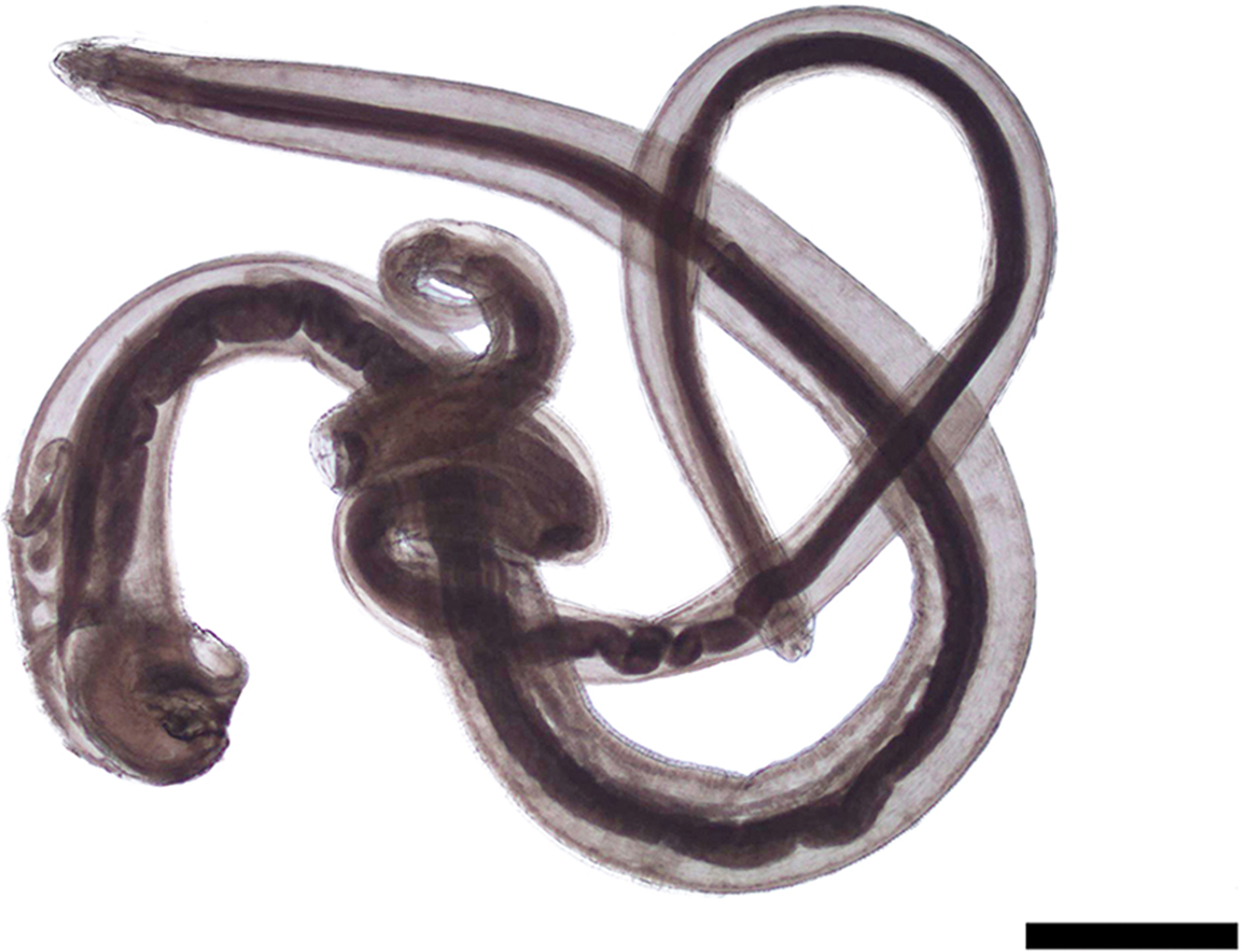
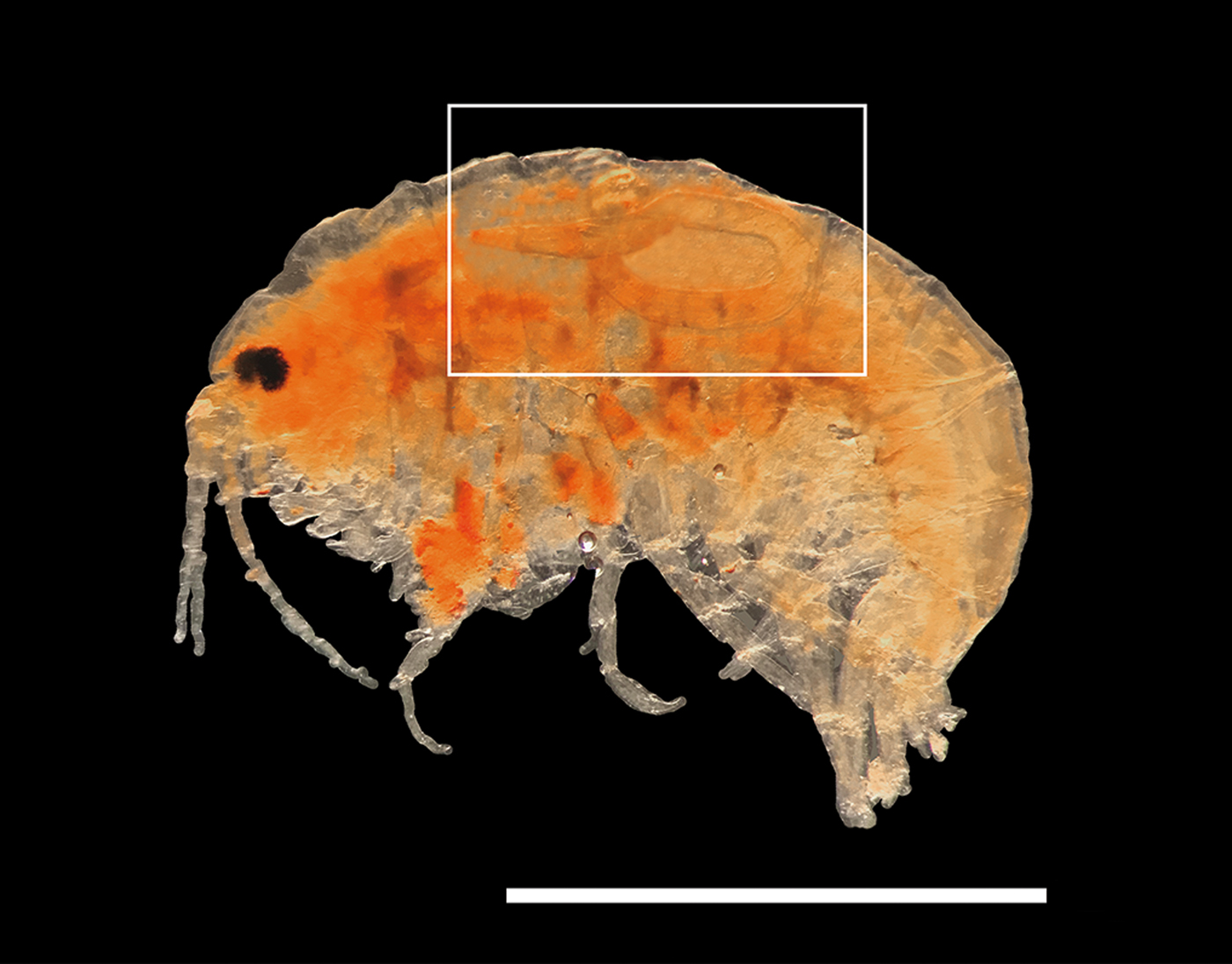
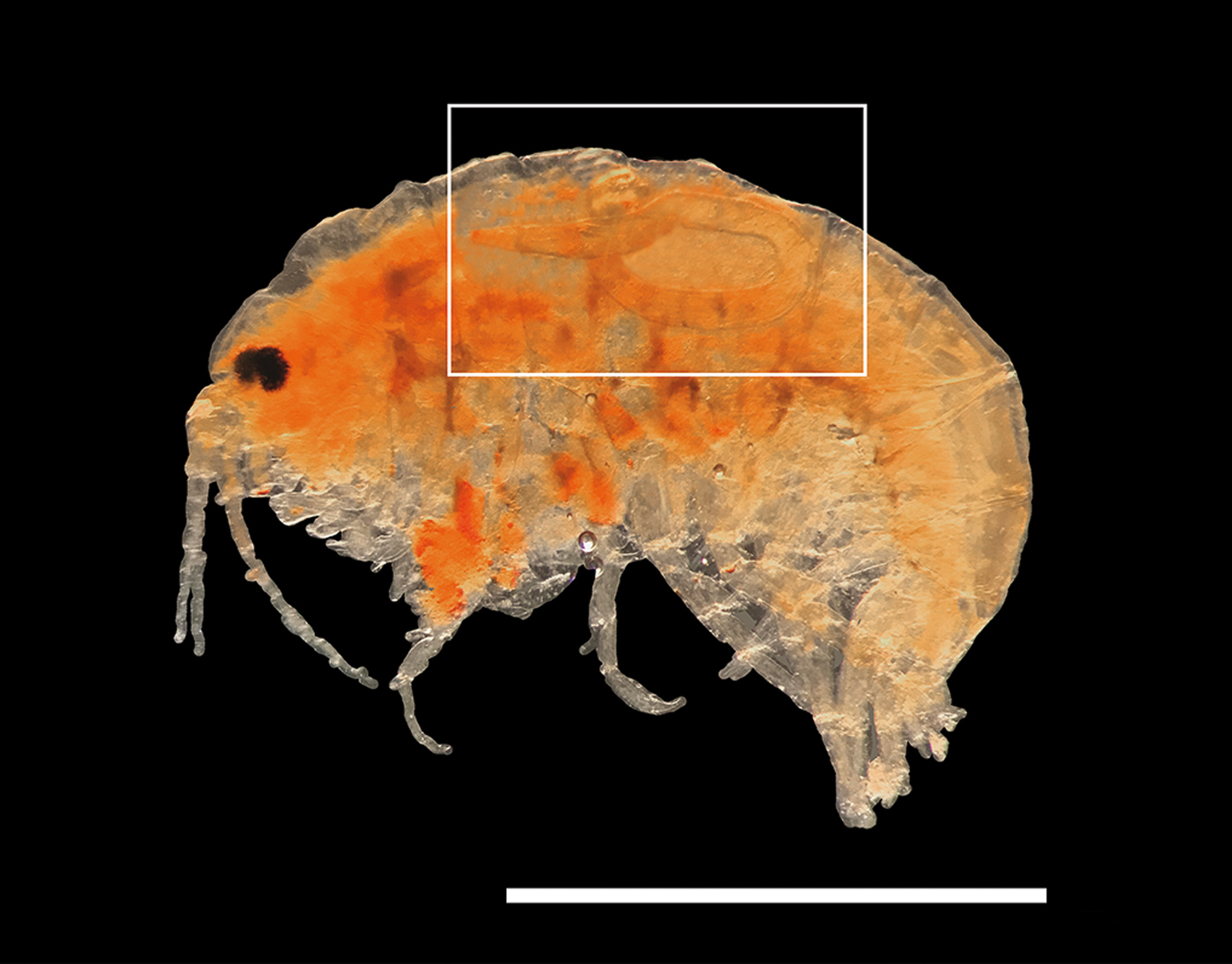
Site of infection. Adults in the stomach of turtles (fig. 1), larvae in the haemocoel of amphipods (fig. 2).
Fig. 1.Male of Hedruris dratini n. sp. encircling female. Scale bar: 500 µm.
 Fig. 2.
Hyalella bonariensis with subadult of Hedruris dratini n. sp. (white square). Scale bar: 1 mm.
Prevalence (P) and mean intensity (MI) in definitive hosts. Hydromedusa tectifera. SR: n = 2286, P = 97.8%, MI = 51 (2–198); SG: n = 2, P = 14%, MI = 1; SC: n = 136, P = 43%, MI = 19.4 (1–119). Phrynops hilarii. SR: n = 3, P = 100%, MI = 1.
Prevalence (P) and mean intensity (MI) in the intermediate host. Hyalella bonariensis. SR: n = 100, P = 23%, MI = 1.
Etymology. The specific name is an arbitrary combination of two words (dra = dragon; tini = tiny).

General description (based on 40 specimens) (figs 3 and 4). Body cuticle thick, transversally striated. Cephalic end with two large lateral pseudolabia, each bearing a pair of small apical digitiform papillae, a pair of lateral sessile papillae and an amphid. Base of each pseudolabium supported by posteriorly directed cuticular ridge. Dorsal and ventral interlabium between pseudolabia, each with anteriorly directed lobe, curved over surface of apical region, and two bifurcated lateral cuticular structures; cuticular ridge posteriorly directed between bifurcations. Base of each interlabium supported by a large, posteriorly directed ridge. Buccal cavity thin-walled, oesophagus not clearly divided into muscular and glandular portions. Deirids simple, situated at level of excretory pore and just anterior to nerve ring. Female with posterior sclerotized hook for attachment to host; male generally found encircling female.
Line drawings of Hedruris dratini n. sp. (A) Anterior end of female, lateral view; (B) caudal end of male, sublateral view; (C) vulva of female, lateral view; (D) egg; (E) posterior end of female, lateral view. Scale bars: (A, B) 100 µm; (C) 200 µm; (D) 20 µm; (E) 500 µm. Abbreviations: LP, lateral pseudolabium; DI, dorsal interlabium; VI, ventral interlabium.

Scanning electron micrographs of Hedruris dratini n. sp. (A) Apical view of male (arrowhead: sessile papillae; arrow: digitiform papillae; asterisk: amphid); (B) anterior end of male, sublateral view; (C) tail of male, ventral view (arrow: phasmid); (D) posterior end of female, subdorsal view. Scale bars: 100 µm.

Male (based on 20 specimens measured) (figs 3b and 4c). Body length 5.97 (3.64–9.24) mm, maximum body width 203 (138–275). Oesophagus 1.07 (0.8–1.27) mm long. Deirids and excretory pore at same level, 200 (148–245) from anterior end. Nerve ring 220 (168–265) from anterior extremity. Posterior end of body with 1–3 coils. Nine pairs of postcloacal papillae: eight pairs subventral and one pair lateral, situated between second last and last pair of subventral papillae. A pair of tiny ventro-lateral phasmids, just posterior to last pair of subventral papillae. Area rugosa with ten ventral longitudinal ridges with scale-like knobs. Spicules 182 (169–233) long, markedly slender, fused in their distal two-thirds, with membranous expansions. Gubernaculum lacking.
Female (based on 20 gravid specimens measured) (figs 3c–e and 4d). Body length 9.1 (7.09–10.94) mm, maximum body width 424 (215–571). Oesophagus 1.7 (1.3–1.8) mm long. Deirids and excretory pore at same level, 270 (252–285) from anterior end. Nerve ring 295 (275–340) from anterior end. Vulva 716 (465–1127) anterior to anus. Tail bulbous, curved dorsally, with eversible prehensile structure (holdfast) armed with sclerotized hook. Cuticular spines in posterior part of body, distributed in two areas; one with scale-like spines near region of anus, the other with sharply pointed spines on the dorso-lateral surface of holdfast. Didelphic, prodelphic. Egg-filled uteri occupying body cavity completely when gravid. Mammilated eggs 36 (27–41) long and 19 (13–24) wide, operculated at both poles, containing fully developed larva.
Fourth-stage larva (based on one specimen found in Hy. bonariensis) (fig. 5). Cephalic end poorly developed, with interlabia and pseudolabia, but with little development of posterior bridges at base of lips. Digestive tract simple with an anal plug. Cuticle of previous moult observed in posterior region of body. Male larvae with well-developed testicle and a pouch in final part of intestine where primordial spicules appear.
Line drawing of male fourth-stage larva of Hedruris dratini n. sp. with primordial spicules (arrow), lateral view. Scale bar: 500 µm.

Subadult (based on 23 specimens found in Hy. bonariensis). Morphological characteristics of this stage seem to be identical to the adults previously described, but these differ in size and in the degree of development of their reproductive organs (e.g. smaller size of the testes in males and absence of eggs in females).
Remarks
Hedruris dratini n. sp. can be easily distinguished from all other species of the genus by the position of the deirids in relation to the excretory pore. Both structures are located at the same level in the new species, whereas the excretory pore is located far posterior to the deirids in the rest of the species of the genus. The features commonly used to distinguish species of Hedruris are the shape of the eggs and the number and distribution of the caudal papillae in males (Bursey & Goldberg, Reference Bursey and Goldberg2000). Among the 24 valid species described to date, only H. androphora, H. siredonis and H. ijimai have mammilated eggs, as in H. dratini n. sp. (Baird, Reference Baird1858; Petter, Reference Petter1971; Hasegawa & Otsuru, Reference Hasegawa and Otsuru1979). However, males of H. androphora and H. ijimai possess precloacal and adcloacal papillae (Petter, Reference Petter1971; Hasegawa & Otsuru, Reference Hasegawa and Otsuru1979), which are absent in the new species. Hedruris siredonis can also be distinguished from the new species by the distribution and number of caudal papillae in males: 20–2:2:16 (total number of papillae–precloacal:adcloacal:postcloacal + anterior cloacal lip) in H. siredonis vs. 18–0:0:18 in H. dratini n. sp. (Baird, Reference Baird1858).
There are five species with the same distribution of caudal papillae in males as H. dratini n. sp. (i.e. 18–0:0:18), all of them from the Neotropics: H. orestiae, H. basilichtensis, H. moniezi, H. suttonae and H. bifida (Bursey & Goldberg, Reference Bursey and Goldberg2000; Rossin & Timi, Reference Rossin and Timi2016). However, none of them possess mammilated eggs. Additionally, females of H. moniezi are described as opistodelphic, those of H. suttonae and H. bifida are monodelphic, but Hedruris dratini n. sp. females are didelphic, prodelphic (Ibañez & Córdova, Reference Ibañez and Córdova1976; Brugni & Viozzi, Reference Brugni and Viozzi2010; Rossin & Timi, Reference Rossin and Timi2016).
Molecular analyses
A total of six sequences (up to 889 bp) were yielded from subadults and adults of H. dratini n. sp. (GenBank accession numbers MK928970, MN233055–MN233060). The alignment of these sequences returned 701 bp fragments, which exhibited 99.43% identity to each other, a single polymorphic site and three insertion/deletion events. A sequence of 840 bp was also yielded from a subadult male of H. orestiae (GenBank accession number MN263058). By BLAST similarity analysis, the correct 18S gene amplification was confirmed and no identical matches were found. The sequences obtained from H. dratini aligned closest to H. spinigera from New Zealand smelt (GenBank accession number HM484346) (95–96% identity), followed by Hedruris sp. from American T. granulosa (GenBank accession number MG594292) (93–94% identity).
The tree topology showed the isolates from subadults and adults of H. dratini n. sp. clustered together with a high bootstrap support of 99%, and very closely with the isolate of H. orestiae obtained in our study (100% bootstrap support). The isolates of H. spinigera from New Zealand smelt grouped as a sister clade (fig. 6).
Phylogenetic tree based on Hedruris rDNA sequences newly obtained in this study (bold type) compare with all Hedruris sequences available in GenBank using Maximum Likelihood method with a distance matrix calculation with K2P. A Spiruridae species was used as outgroup. The numbers at the nodes represent the percentages of 500 bootstrap replicates. Sequences are identified by GenBank accession numbers, taxa names and hosts.

Pairwise analyses showed that the genetic difference between H. dratini n sp. and H. orestiae was 1.3%; between H. dratini n sp. and H. spinigera ranged from 4 to 4.1%; and between H. dratini n. sp. and Hedruris sp. from T. granulosa ranged from 7 to 7.2%.
Double infection
We occasionally found adults of H. orestiae and H. dratini n. sp. within the same host specimen. In some cases, H. orestiae females and H. dratini n. sp. of both sexes were observed together and none of the H. dratini n. sp. males were coiled around those females. In other cases, H. orestiae males were found together with H. dratini n. sp. of both sexes and, similarly, none of those males were coiled around H. dratini n. sp. females. In all these cases, H. orestiae females were non-gravid and we never found males and females of H. orestiae infecting the same individual host.
Host and geographic distribution
Including the present paper, a total of 123 literature records have been found for Hedruris species worldwide (fig. 7, table 1). Both the reported species richness and number of records are greater in the southern than in the northern hemisphere (17 vs. nine species, and 75 vs. 48 records, respectively). Amphibians as definitive hosts show the highest number of records (46, of which 26 in frogs and 20 in salamanders), followed by 41 records in fish, 35 in reptilians (24 in lizards, ten in turtles and one in snakes) and only one record in lampreys.
Map of geographic distribution of Hedruris species: (1) H. androphora; (2) H. basilichtensis; (3) H. bifida; (4) H. bryttosi; (5) H. hanleyae; (6) H. heyeri; (7) H. hipsirhinae; (8) H. ijimai; (9) H. juninensis; (10) H. longispicula; (11) H. lutjanenses; (12) H. minuta; (13) H. miyakoensis; (14) H. moniezi; (15) H. mucronifer; (16) H. neobythitis; (17) H. orestiae; (18) H. pendula; (19) H. saltuarii; (20) H. siredonis; (21) H. spinigera; (22) H. suttonae; (23) H. transvaalensis; (24) H. wogwogensis; (25) H. dratini n. sp. Colours indicate the biogeographical provinces proposed by Udvardy (Reference Udvardy1975): green, Nearctic; orange, Neotropics; red, Afrotropics; violet, Palearctic; yellow, Indo-Malaya; blue, Australia; light violet, Oceania.

Host and geographic distribution of Hedruris Nitzsch, 1821 species.

Discussion
As regards their life cycles, Hedruris species require an isopod or amphipod as intermediate host in which all larval stages develop up to the subadult stage. Subsequently, sexual maturity is reached in the definitive host (Anderson, Reference Anderson2000). Petter (Reference Petter1971) found H. androphora in the salamander Triturus vulgaris (Linneus, 1758) and studied its development in the isopod Asellus aquaticus (Linneus, 1758) by allowing them to ingest larvated eggs. First-stage larvae invade the isopod haemocoel close to the cephalic end. Subsequently, development to the subadult stage takes place, but sexual maturity is only reached in the stomach of the definitive host (Anderson, Reference Anderson2000).
In the Hy. bonariensis specimens collected from both the stomach contents and the natural aquatic environment, subadults of H. dratini n. sp. were found inside the haemocoel or penetrating the amphipod's cuticle towards the stomach lumen of the definitive host. Subadults have all the characteristics of the adults and are ready to leave the intermediate host, invade the stomach of the definitive host and reproduce, as was described by Moravec (Reference Moravec1998). Mature and gravid H. dratini n. sp. were found both in the stomach and faeces of the examined turtles. Larvated eggs were also present in the faeces. It can, therefore, be deduced that the life cycle of H. dratini n. sp. begins when the female releases the eggs in the digestive tract of the turtle, which are later expelled together with the faeces. Once in the aquatic environment, Hy. bonariensis ingest the nematodes eggs, which hatch inside the digestive tract. The first-stage larva migrates to the haemocoel and moult repeatedly to reach the subadult stage. When a turtle swallows the infected amphipods, the subadult is released and reaches sexual maturity in the stomach. Eggs are released with the faeces into the environment, repeating the cycle. This is the first report of the life cycle of a species of Hedruris parasite of reptilians.
According to Mayr (Reference Mayr1942: 247), ‘species are groups of natural populations that potentially interbreed, and are reproductively isolated from other similar groups’, which is evidenced by these two co-occurring species (H. dratini n. sp. and H. orestiae), reinforcing the aforementioned morphological distinction between them. We are convinced that the low prevalence of H. orestiae found is due to the interspecific competition with H. dratini n. sp., which dominates over H. orestiae in this population of Hyd. tectifera. These results contrast with Palumbo et al. (Reference Palumbo, Capasso, Cassano, Alcalde and Diaz2016), who found only H. orestiae in Hyd. tectifera in a stream 100 km away from the study area of the present study.
Sequencing the 18S rRNA gene is a valuable tool for the characterization of isolates to the genus or species level (Liu, Reference Liu2011; Yooyangket et al., Reference Yooyangket, Muangpat, Polseela, Tandhavanant, Thanwisai and Vitta2018). Present molecular results support the classification of the new species into the genus Hedruris, corroborating that H. dratini n. sp. differs from the other two species submitted in the GenBank (Luque et al., Reference Luque, Vieira, Herrmann, King, Poulin and Lagrue2010; Choudhury & Nadler, Reference Choudhury and Nadler2018), because the identity is less than 97%. Additionally, present findings confirm that larval nematodes found in amphipods are the same species as those found in turtles. The partial sequences of 18S gene analysed in this study are highly conserved among the Hedruris species. Although the genetic distance between H. dratini n. sp. and H. orestiae is low, the morphological characters distinguish these two closely related species, which share both the intermediate and definitive host. This point deserves further molecular analysis using other genetic markers (e.g. COI, ITS), which tend to be more variable, providing more reliable species-specific identification (Avise, Reference Avise1994; Palomares-Rius et al., Reference Palomares-Rius, Cantalapiedra-Navarrete, Archidona-Yuste, Subbotin and Castillo2017). However, the obtained sequence information can be considered as a useful resource for taxonomic and phylogenetic studies.
Despite a broad distribution worldwide, South America is the region with the greatest number of species described. Even if areas in which few or no studies have been conducted are taken into account, the distribution map of Hedruris species illustrates that members of the genus follow a Gondwanian distribution (fig. 7, table 1). According to the biogeographic provinces proposed by Udvardy (Reference Udvardy1975), Hedruris species are mostly distributed in the Neotropics (ten species, 38 reports), followed by Australia (six species, 30 reports), the Palearctic (six species, 20 reports), the Nearctic (two species, 16 reports), Oceania (one species, 15 reports), Indo-Malaya (three species, three reports) and the Afrotropics (one species, one report). This analysis allows us to hypothesize that the speciation and radiation of Hedruris occurred first in Gondwana, probably in fish, and that, subsequently, species dispersed to other hosts as well as to the northern hemisphere because of the great plasticity and host adaptability of the genus.
Hedruris dratini n. sp. is the fifth valid species of the genus in Argentina, which suggests a great adaptive success of the genus in this country.
Acknowledgements
We thank Leandro Alcalde (Instituto de Limnología Dr R.A. Ringuelet) for providing the hosts, Kabe Solas for assisting with the plates and Inés Cesar for the identification of amphipods. We are also grateful to Patricia Sarmiento from the Servicio de Microscopía Electrónica de Barrido del Museo de La Plata (FCNyM, UNLP), Walter Ferrari and Diego Balcazar for their support in obtaining molecular data and to Pilar Martínez (English Public Translator) for the revision of the manuscript. This research was partially funded by UNLP (N828 to JD).
Financial support
This research was partially funded only by Universidad Nacional de La Plata (N828 to JD).
Conflicts of interest
None.