





Historians often present the early history of Virginia as a tale of despair, focusing on early challenges and starvation or looking forward to the collapse of the Virginia Company and a plantation culture built on tobacco and slavery.Footnote 1 Yet during the period between 1609 and 1618, a corporate and collaborative grouping of English merchants, landowners, and other investors built something that was unique in the early history of Britain's emerging empire.Footnote 2 In this time, the Virginia Company established up to six settlements and numerous local industries, developed farming and husbandry, built ships, grew tobacco, imported a range of commodities, and awarded a huge dividend in seized land to investors. Rather than founding an English settlement as a hub for maritime activity, a trading entrepôt, or a mining or cash-crop economy, the leaders of the company sought to establish a plantation that would do all of these things. In this way, the plantation would add another strand to an already considerable global web of trade, exploration, and privateering carried out by English actors.Footnote 3 Placing the colony within this connected context refocuses attention on the expectations of the plantation's investors and managers and supports a reinterpretation this period of colonization and empire.Footnote 4 From this perspective, it is more evident that the Virginia plantation was conceived and managed and how, by many measures its leaders would have used, it was a success.
Assessing the Virginia Company through the lens of the connections and collaboration that its corporate structure entails examining the colony as part of multiple and entangled networks.Footnote 5 The plantation was just one of the many commercial activities of its investors, who understood the colony in relation to their global connections and interests.Footnote 6 Indeed, in England, corporations facilitated a useful institutional framework for overseas activities precisely because they were integrative, porous organizations attracting expertise from across a broad spectrum of commercial society and drawing upon their experiences to organize new ventures.Footnote 7 Recognizing these relationships, I take, in the words of Sebastian Conrad, “the interconnected world as its point of departure,”Footnote 8 and in so doing I bring into focus the development of the colony within the wider milieu of English overseas activity. Indeed, viewing the Virginia colony as part of the connected global interests and experiences of its supporters, settlers, and leaders requires reexamining long-held beliefs about the early history of the Virginia plantation.
Looking outward from Virginia also allows historians to build on work that positions the colony within an entangled Atlantic world, drawing together histories of colonization and trade and highlighting the ways in which North American settlement was shaped by networks reaching into Europe, the Mediterranean, and Asia.Footnote 9 Much activity relating to Virginia was of course geographically located in the Atlantic, but situating the colony within broader histories of exchange reveals how it depended on and was shaped by connections elsewhere.Footnote 10 It also enables further consideration of the structures and processes that mediated between the global and local in Virginia's early history—and how corporate governance presented a means of doing so.Footnote 11 Recent studies have sought to integrate the colony's development into histories of the Atlantic world, with arguments connecting Virginia to Ireland or the Caribbean both offering important perspectives.Footnote 12 Peter Mancall, in particular, has contributed to a shift in positioning Virginia within a wider context and has drawn attention to the impact the movement of ideas, goods, and people had on the development of the colony. Entanglements between the empires of Spain, Portugal, France, the United Provinces, and England helped facilitate the passage of information about the New World.Footnote 13 Such contributions offer a critical reassessment of Virginia's early history and, by drawing on the colony's Atlantic connections, highlight the importance of embedding the colony within a broader context. This article takes these connections further still by highlighting and drawing out the most common experiences of the Virginia Company's leadership in the East India, Levant, and Spanish companies.
The company's leaders in England and its commanders in Virginia, many of whom drew on experience serving overseas, had a considerable impact both in terms of how wider interests shaped the plantation's productive and commercial development and how they influenced its material culture and built environment. Jonathan Eacott, for instance, has shown how early English colonists in Virginia developed a political-economic vision that was, in part, influenced by their thinking about India and so highlighted the need for both commerce and cultivation in the American plantation.Footnote 14 As discussed below, the colony's promotors envisioned a plantation that would align with many of the agendas presented by humanist writers of the later sixteenth and early seventeenth centuries and with information that had been shared by travelers.Footnote 15 In addition, the governance of both the company and colony was informed by practices of civic imperialism that in the 1610s were taking shape in colonies in Ireland and by a competitive corporate environment in England that helped generate new ideas about these organizations’ changing role in society and the economy.Footnote 16
These diverse inputs have rarely been presented as contributing effectively to the development of the plantation. Nicholas Canny dismissed the colony as part of “trial-and-error efforts” to establish empire that received little support from the crown or the public.Footnote 17 Jack Greene's focus on how “new colonial peripheries in America” were “relatively autonomous centres of European power effectively under local control” similarly sidelines the involvement of corporate leadership in the development of the colony.Footnote 18 Both Wesley Craven's and Robert Brenner's interpretations of the company's failings center on the idea that its leaders “approached the west with something of the same hopes and methods with which they plied their trade in India, the Levant, and the Baltic.”Footnote 19 Even while highlighting the role that traders played in managing the company during this period, Brenner dismisses their mercantile interest in the plantation, suggesting they did not expect “meaningful profit” and merely invested out of a “sense of duty.”Footnote 20 While duty may well have been one incentive, the corporation's leaders would almost certainly have sought to make the company a success—for personal profit, for the public good, for their understanding of imperial competition, and on religious grounds.Footnote 21 Brenner's assumption that “the entrepreneurs behind American colonial companies of this period achieved neither organizational stability nor financial success” is problematic and has skewed understanding of merchant involvement in Virginia and the development of the colony itself, and how it fits into broader histories of empire. Footnote 22 In fact, the Virginia plantation developed in line with many of the expectations and orders issued by its corporate leadership.
A major challenge facing historians regarding this period is a relative dearth of sources. Problematic printed accounts created on behalf of the Virginia Company or its detractors represent the most detailed accounts of the plantation, but these also served promotional or antagonistic objectives. Therefore, I draw on these materials in conjunction with archaeological material, private correspondence, and the company's few surviving records to interpret both the printed texts and the history of the colony more effectively. Doing so allows reassessment of traditional narratives of colonial failure in Virginia that have subsumed the colony's early history into the post-1619 period—a teleological approach that warps studies of the earlier plantation.Footnote 23 Thus, in examining the varied interests of the company's members, I assess the promotional material produced to elicit support for the Virginia Company, highlighting how the colony's proponents understood its potential for success in terms of its placement alongside a range of global processes; systematically reassess the colony's development between 1610 and 1616 to uncover the ways in which the interests, expertise, and expectations of the corporation's leadership were brought to fruition in Virginia; and consider the place of the colony within England's wider trading networks in the years leading up to 1618, after which corporate leadership changed. This connected approach to the history of the colony allows me to shed new light on the early history of the Virginia colony and the development of English settlement in North America.
Investment in the Virginia Plantation
After 1609, the management of the Virginia Company fell largely—though not exclusively—to merchants; “gentleman adventurers . . . withdrew themselves, in despair of the enterprise, and so gave it over, not enduring to repair the ruins, nor to supply what themselves had underwritten.”Footnote 24 The experiences, relationships, and business practices of Virginia Company members between 1609 and 1618 help illuminate how they governed the colony, revealing its origins, purpose, and success criteria. For experienced investors, Virginia helped diversify their trading portfolios; for first-time investors, it would lead to their support for other far-flung projects. For these investors, Virginia was not detached from England, Europe, or the world; their understanding and experience of global structural, political, and economic change informed how they conceived the Virginia venture and their strategy for undertaking it.
However, analyzing individual investors is not straightforward. While Theodore Rabb and others have used the company's charters to identify its members, they have struggled to clarify which of them maintained their support during the plantation's difficult early years.Footnote 25 A list of three hundred investors sent by the Virginia Company, along with a letter encouraging investment in 1611, offers an alternative means of assessing ongoing participation.Footnote 26 The list is the best means of identifying ongoing, creditable investors and helps demonstrate the social backgrounds of investors during this period. It is organized into three sections: knights (101 listed), esquires (59), and “citizens and others,” especially merchants (140).Footnote 27 Knowing who retained their interest in the Virginia Company and their social status presents a starting point for exploring how different types of participants brought different experiences to their involvement in the Virginia plantation that likely shaped how they understood the colony.Footnote 28
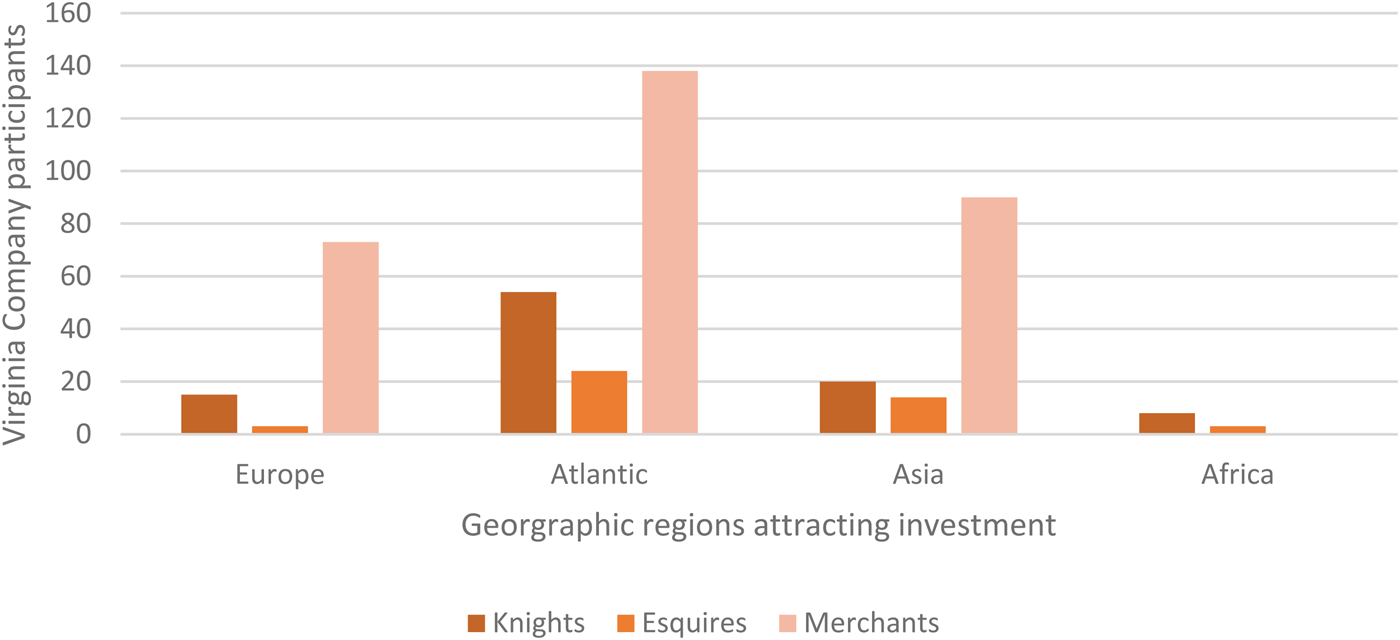
From this list, we learn that the average value of a knight's investment in the Virginia Company was £68, whereas the average value of an esquire's investment was £53 and that of citizen members was £49. However, over the course of their lives, knights participated in an average of 2.06 overseas activities—a number higher than that of esquires (1.77) but much lower than that of citizen members (3.16).Footnote 29 These other activities included exploring for the Northwest passage, trading for spices in the East Indies, privateering in the Caribbean, purchasing furs in Muscovy, and exporting woolen cloth to Europe.Footnote 30 Across ventures focused on trading, privateering, colonization, and exploration, citizen and merchant investors were more experienced than the knights and esquires put together (figure 1), and Virginia Company members had generally undertaken geographically diverse activities (figure 2).
Virginia Company investors’ experience, by social status and type of activity.

Virginia Company investors’ experience, by social status and geography of activity.
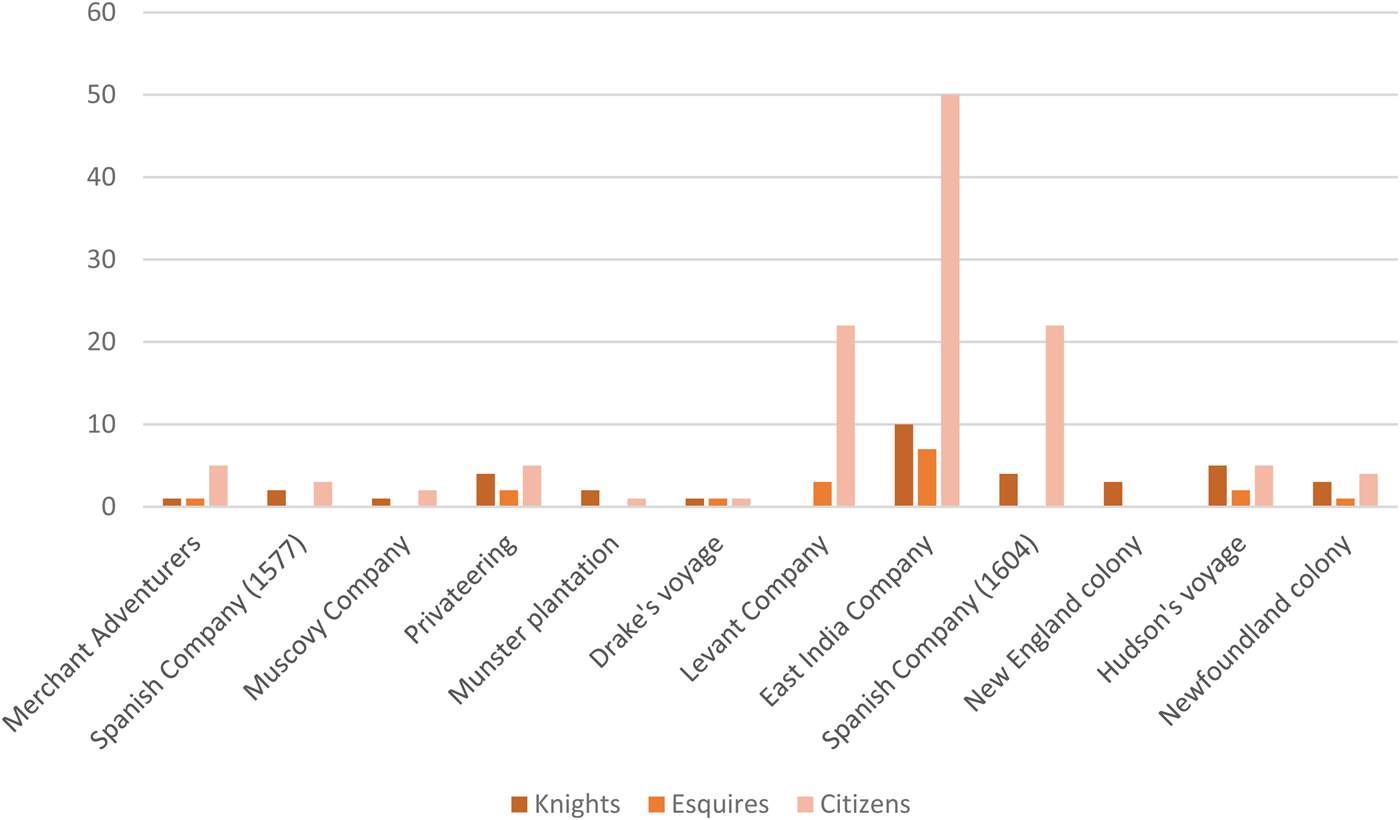
Of 294 Virginia Company investors identified, ninety had invested prior to joining the company: forty-seven on one occasion, seventeen on two, ten on three, eleven on four, three on five, and two on six.Footnote 31 The East India Company was their most common investment, followed by the Levant and Spanish companies (figure 3).Footnote 32 While some investors had previously funded exploration, privateering, and even colonies, commercial activities were considerably more common. For instance, John Merrick's first investment was in the Muscovy Company, followed by participation in the East India and Spanish companies, before his £37 10s. investment in the Virginia Company in 1609. Links like these mean it is unsurprising that the Virginia Company's plans emerged in part in relation to its perceived benefits to other trading ventures, such as in providing new markets or shipping materials—while they were also aware of the social and financial benefits of becoming landowners.
Investments by Virginia Company members before 1610.
After investing in Virginia, 146 of these listed members went on to invest again in other projects. Seventy-five invested once more, forty-two twice, seventeen three times, seven four times, two five times, two six times, and one on seven occasions.Footnote 33 This participation in further ventures was effected through diverse portfolios (figure 4). Far from being deterred by their foray into colonial activities, many Virginia Company members invested in the Somers Island Company.Footnote 34 Others took part in colonial activities in Ireland.Footnote 35 Further popular investments included the French, East India, and North-West Passage companies. In one illustrative example, the experience of investing in Virginia proved a transformative experience. Abraham Chamberlain, a member of the Merchant Adventurers and Spanish Company before joining the Virginia Company in 1609, went on to invest in Henry Hudson's exploratory voyages and the North-West Passage Company before eventually joining the East India Company in the 1620s. For Chamberlain, the Virginia plantation was a stepping-stone from commercial activities in Europe to a wider global economy.
Investments by Virginia Company members after 1610.

The proponents of the Virginia plantation and executors of their strategy understood the diverse interests, experiences, and motivations of the company's supporters outlined here. Efforts to develop the colony in Virginia drew on these members’ experiences, responding to the specific local conditions in America and integrating the project into international circuits of trade and empire.
Planning and Promoting the Virginia Plantation
For the leading members of the Virginia Company, commercial expertise, lives spent in corporate environments, threats of imperial and economic competition, and an awareness of globally connected markets all affected how they conceived the plantation. In promotional literature encouraging investment, this perspective was clear, and the ideal vision of the colony these texts presented shows how the company's leaders framed their enterprise in the context of other mercantile ventures and the embeddedness of the plantation in existing interests of English commercial actors. To meet the needs and expectations of potential investors, the company's plans for the colony took a long-term perspective that required a willingness from participants to wait for returns and highlighted the need for a diversified and connected economy in Virginia.
The company promised prospective investors that the plantation would “augment your glory, or increase your wealth, or purchase your eternity” and distributed detailed texts outlining how the colony would be managed.Footnote 36 These texts assured readers that the Virginia Company would spread the Gospel, alleviate overpopulation, increase England's might and wealth, and “furnish and provide this Kingdom with all such necessities.”Footnote 37 The colony was encouraged specifically to provide access to commodities that “cannot be produced at home.”Footnote 38 Other texts carefully highlighted challenges, urging patience and drawing comparisons with Spain, which lost many “fleets, battalions and armies” in colonizing America.Footnote 39 Couching the venture in the language of commonwealth and Protestant crusade to highlight the public good, its proponents were nevertheless careful to lay out the possibilities for material gain: long-term profits from rents and industry would serve both investors’ purses and the English state and commonwealth.Footnote 40
Orders from the Virginia Company similarly reminded appointed officers to “establish religion” but dedicated considerably more time to instructing them on how to manage the colony.Footnote 41 As the company wrote in 1611, “The chiefest thing in our intention . . . is and ought to be the propagation of Christian religion,” but it was “not the first in prosecution”; a self-sufficient colony that could support itself and provide long-term profits was their priority.Footnote 42
Robert Johnson's Nova Britannia of 1609 offers the most useful text for understanding how the company's leadership presented their plans. It includes a lengthy moral and legal justification for the colony and an assessment of strategies for developing the plantation.Footnote 43 In addition to holding a prominent role in the Virginia Company, Johnson was a supplier of Mediterranean products and an investor in the East India Company, and he presented the new plantation in a globally connected trading context familiar to his readers.Footnote 44 For example, in Nova Britannia, he suggested that Virginian wines could compete with French ones and Virginian silk might replace “that of Persia, Turkey or any other place” and assured readers that “in searching the land, there is undoubted hope of finding cochineal, the plant of rich indigo, grain berries, beaver hides, pearls, rich treasure, and the south sea, leading to China.”Footnote 45 He also highlighted shipbuilding supplies, which “can hardly now be obtained from any other part of the world.”Footnote 46 Wood was a scarce commodity in England, one that corporations were often accused of wasting, and merchants were under pressure to find alternative sources.Footnote 47 Johnson was confident that Virginian timber would “yield gold or silver in any our bordering nations” and that “about three hundred thousand pounds sterling every year” was spent on similar supplies in England and Holland each year. Timber from the colony would cater to markets in “Hamburg, Holland, or other places,” where it could be sold “fifty per cent better cheap than from Prussia or Polonia, from whence they are only now to be had.”Footnote 48 According to Johnson, materials from Virginia would benefit England and might restructure trade routes across Europe.
These wide-ranging expectations led to instructions from the Virginia Company to its officers that suggest its leaders were unsure what to expect of the colony and happy to experiment. They listed “such things” for export to England as dried sassafras roots, “sarsapilla [which] is a root running within the ground like licorice,” a hogshead or two of wine, beaver skins, sturgeon, oak clapboards, and samples of locally produced pitch and tar.Footnote 49 Plans for Virginia were not limited to hopes of mines, privateering, or tobacco, and investors were interested in goods and industries that could support or supplant markets elsewhere. Johnson hoped that through investment, “art and industry,” and “a little patience to bring these things to pass,” the plantation might help England overtake the Dutch, who currently “surpass and go beyond us in continual plenty of corn and shipping.”Footnote 50
Promoters also presented a successful colony as a potential entrepôt for trading with Indigenous people: as Johnson suggested, “when the colony is thoroughly increased . . . it will cause a mighty vent of English cloths” and other supplies.Footnote 51 Cloth exports, long the bedrock of the English economy, were in decline, and finding new markets was an important incentive for many overseas ventures.Footnote 52 Virginia was only one project contributing to the “lifting up” of the cloth trade already underway, as merchants “willingly engage[d] themselves to undertake all new discoveries, as into this of the West, and by the North-West to find out China, and unto the East beyond the cape, into the Red Sea, the Gulf of Persia, the Straights of Sunda, and among all the kings of India.”Footnote 53
Trade offered one possibility for profit in Virginia, but for many investors the most valuable item it could offer was land. A self-sufficient and secure colony would enable investors to receive property in America, a promise of long-term returns that would further benefit from agricultural or manufacturing developments in the plantation.Footnote 54 One promotional text highlighted that the Virginia Company “propose[d] to maintain and carry all in a joint-stock for seven years, and then to divide the lands.”Footnote 55 Another assured investors they would receive “lands to them and their heirs forever.”Footnote 56 This offer was attractive, with demand for land in England very high, and investors would have been aware how lucrative land ownership in Virginia might be. Many of them would have known that London's livery companies relied on property for most of their income and that by 1615, the East Indian Company too had purchased property to provide an additional, reliable revenue stream.Footnote 57 In England, Johnson pointed out, properties “not worth five shillings” thirty or forty years earlier “now do go for forty and more.”Footnote 58 Therefore in Virginia, lands currently uncultivated and insecure “are now worth little indeed, yet time and means will make them better, considering how they pass our grounds in England, both in regard to soil and climate, fit for many precious uses.”Footnote 59 Cheap labor from Indigenous workers employed “for such wages as may please them” would make properties even more valuable.Footnote 60 Settling towns with agricultural hinterlands to support them would also mean that “we shall be soon freed from further expense, our gains will grow and our stock increase, we shall fell our timber, saw our plank, and quickly make good shipping there.”Footnote 61 These developments would create a chain reaction—towns would secure land for agriculture, agriculture would support the towns, towns would develop industries to supply the colony and export goods, and together they would engender a populous new market for English goods.
Virginia presented an opportunity to establish an English settlement to respond to structural changes in the global economy, but it also had to function effectively on a local level.Footnote 62 The leaders of the company did not envision a simple undertaking or quick returns. They understood how ambitious their plans were. As one colonist who wrote an account of his time in Virginia, Richard Rich, put it in 1610, “We hope to plant a nation, where none before has stood.”Footnote 63
Building and Improving the Virginia Plantation
The Virginia Company's hopes for the plantation—a mixed economy with extensive landholdings, military security, trade goods, and a consumer population, which was in a position to act as a commercial entrepôt—contributed to the ways in which it sought to manage the enterprise. It was an approach that would by no means satisfy all the company's investors, as the later takeover and change in strategy of the company by a faction led by Edwin Sandys would suggest, but it did align with many of the aims presented in promotional literature and with the experience and expertise of company leaders obtained elsewhere across England's trade and empire. To execute this widely publicized vision, the company appointed carefully selected officers to oversee the settlements. These men were instructed to build a colony that would not depend on England for basic supplies, could feed itself, and had the structures in place to welcome new colonists without disruption. Thomas West, the newly appointed governor, was instructed to start looking for “proofs of some valuable commodities” that might encourage further support, but only after securing food for the colonists. Their immediate interest was best served by the development of a self-sufficient colony.Footnote 64
In 1610, when West first landed in Virginia, after the colony's disastrous period of starvation in 1608–1609, these plans looked in doubt. Since the first settlement of the colony, poor management had resulted in a perilous period for settlers, with many dying from starvation and the elements. The situation had resulted in changes in the colony's leadership in 1609, who appointed West to oversee the colony. A few days before West's arrival in 1610, survivors from an earlier fleet who had only now reached Jamestown “found some three score persons living” in the colony and in recognition of its dire situation had decided to desert the settlement.Footnote 65 To restore and secure the colony, West sent “some to cleanse the town, some to make coal for our forges [and] sent fishermen out to provide fish,” with others going to Bermuda for hogs.Footnote 66 Cleansing the town removed the detritus of previous failures, allowing a fresh foundation for construction.Footnote 67 West also ordered that the old well be filled and that a new, wood-lined well dug to serve the plantation.Footnote 68
A second large fleet, costing £8,000 and commanded by Thomas Dale, another new appointment intended to take command in the colony, also reached Virginia in May 1611 carrying three hundred settlers with provisions.Footnote 69 By 1611, West reported (and the company published) that Virginia now housed two hundred men, “the most in health, and provided of at least ten months victuals in their storehouse.”Footnote 70 In private correspondence, West further described excellent soil quality and the cultivation of crops, noting signs of profitable output due to “a greater quantity than may easily win belief, [of] vines.”Footnote 71 Captain George Yeardley reiterated the plantation's fertility and good corn harvests.Footnote 72 To capitalize on this momentum, the company “bent all their wits and consultations [to] how to second this good beginning” and decided “without delay to furnish out Sir Thomas Gates with six ships, three hundred men and a hundred kine, with other cattle, munition and provisions of all sorts.”Footnote 73 These initial, positive activities were widely publicized, and promotional literature assured potential settlers “there is no fear of hunger here” but plentiful land.Footnote 74
Recognizing the challenges that the earlier colony had faced, the Virginia Company turned from early efforts to populate the colony as quickly as possible and focused on obtaining skilled settlers.Footnote 75 A 1610 pamphlet stated, “experience has too dearly taught, how much and many ways it hurts to suffer parents to unburden themselves of lascivious sons, masters of bad servants, and wives of ill husbands, and so to clog the business with such an idle crew.” The company “resolved, that no such unnecessary person shall now be accepted, but only such honest and good artificers.”Footnote 76 The company insisted “that none but honest sufficient artificers, as carpenters, smiths, coopers, fishermen, brickmen, and such like, shall be entertained into this voyage.”Footnote 77 A list of these tradesmen was sent to officers in Virginia so that “upon view of the list and consideration of their several trades and qualities,” they would “dispose of and employ” such men “immediately upon their arrival.”Footnote 78 In 1610 the company detailed 132 settlers to undertake tasks ranging from identifying mines, planting sugar, and drilling pearls to making salt, tiles, bricks, ploughs, beer, bread, and silk.Footnote 79 Another list from 1611 identified settlers needed for building, farming, ship building, domestic crafts, sailing, fishing, iron working, armaments, and one for medical work.Footnote 80 Although no lists of outgoing settlers survive to attest to the company's success in this regard, we can nevertheless see clearly its priorities for the plantation: builders and farmers were desired, but supplemented by craftsmen to develop local industries.Footnote 81
The company also extended attractive offers to entice skilled settlers. Not only would “men of worth for special services . . . be maintained at the common charge” but they would also “receive their dividend (as others do) at seven years end.”Footnote 82 A lone surviving record from a Virginia Company court meeting from 1612 shows the continuation of policies for attracting settlers. It stated that each settler would receive six months of supplies, “a house and plot of ground for a garden and orchard, and ten acres of ground,” “seed corn to sow his grounds the first year” and swine, poultry, goats, and cattle.Footnote 83
Considering these efforts, the company leaders informed officers, “it is not to be expected that the adventurers here will be at any more charge (after this year) with victualling the colony.” The company's leaders envisioned settling “people in a wholesome air” and encouraged them to “use all means for providing sustenance and providing food,” reminding officers that “a main scandal has been raised against that Colony, for want and baseness of food.” It was imperative that a “great store of grain must always be seasonably sown not only to serve the Colony . . . but also such other companies as we shall send thither.”Footnote 84 Cultivating corn, beans, peas, pumpkins, roots, herbs, cabbages, apple trees, and pear trees was recommended, so “that the colony may have plenty of wholesome herbs, roots and fruits which in so hot a climate are of great relief.”Footnote 85 Settlers were also advised to catch and salt fish, helped by skilled fishermen and equipment from England, and to send a boat to Jamaica “for fetching of supplies of calves, goats and swine.”Footnote 86
Company officers took up the challenge of food supply. Dale, now governor, informed the company, “We have built a town in an excellent place, very wholesome and commodious,” and in “the last year I set 80 acres of ground with corn.”Footnote 87 The improvements were soon noted in London, in keeping with the company's expectations, and one member optimistically reported how “this main objection of wanting food is utterly removed.”Footnote 88 Another merchant explained how “our plantation in Virginia stands hopeful in many ways” because now “victuals, the chief thing they formerly wanted, they are well furnished” with meat, dairy, fish, and corn.Footnote 89 This private correspondence supports archaeological evidence that the plans were at least partly effective in terms of the increased scale and practices of agriculture and the improved diets of colonists.Footnote 90 Colonists had already begun to adapt their techniques to local conditions and were replicating native slash-and-burn farming techniques to rapidly clear land and increase production.Footnote 91 Animal husbandry became important, and large complexes outside Jamestown helped provide a range of dairy products (figure 5).Footnote 92
After 1611, dairy production began in Jamestown, as seen from the emergence of cheese strainers in the archaeological record (Surrey-Hampshire Border ware). Courtesy Jamestown Rediscovery Foundation/Preservation Virginia.

Commerce with local Algonquian people also improved the food supply, with trade continuing throughout this period, even during conflicts with the Powhatan.Footnote 93 It was defined by “bilateral exchange, with goods moving both to and from the English.”Footnote 94 For example, when Samuel Argall obtained food and furs from nearby Patawomeke, with whom he exchanged 40s. worth of goods including copper, lead, hatchets, knives, bells, and scissors.Footnote 95 Returning the following year “to fetch corn from Patawomeke, by trading with the Indians,” Argall was happy to find “they had good store of corn for me, which they had provided the year before.” He purchased 1,100 bushels of corn, soon “delivered into the several store-houses” newly built in Jamestown.Footnote 96 Other local groups reportedly traded “skins, bowls, maize, baskets, tobacco” with the English.Footnote 97 Patawomeke women may have been living in the English colony, further strengthening ties and integrating local customs and material cultures into the lives of the colonists.Footnote 98 This ongoing commercial contact and mutually beneficial exchange contributed to the integration of the colony into local networks.Footnote 99
Despite these successes, the Virginia Company was drawn into both local and international conflicts. The Spanish, who claimed the North American territory as their own, disputed the colony's legality; Captain Argall led attacks on French settlements further north, which were intended to facilitate English access to the region's fur trade but also created further rivalry with the French merchants they sought to supplant.Footnote 100 In 1613, Don Diego de Molina, a Spanish prisoner in Virginia, sent a warning to Spain: he hoped “His Majesty will have opened his eyes and seen this new Algiers of America, which is coming into existence here.”Footnote 101 He believed the colony would soon produce enough corn and livestock to grow exponentially and urged Spain to “stop the progress of a hydra in its infancy, because it is clear that its intention is to grow and encompass the destruction of all the West.”Footnote 102 In light of this competitive imperial environment, English fear of European attack led to defensive efforts: West had reportedly built two forts on the coast immediately after his arrival, which Dale had supplemented in 1611 when he planned a fortified settlement at Point Comfort that would “hold open the mouth of our river, to let shipping into us” and enable the plantation to resist any naval blockade.Footnote 103
In addition to being seen as a threat to other Europeans’ enterprises, the colony's development was threatened more immediately by local conflict with Powhatan (as the leader of the indigenous Powhatan people was known).Footnote 104 The company's new leaders blamed the previous leadership for “alienating of the native people of the country, especially by injuries” that were “an exceedingly great error and has turned to the great hindrance” and “manifold disprofit of the colony.”Footnote 105 They hoped their attempts to build bridges would be aided by “the exact observation of justice . . . chiefly in public punishment of such as shall wrong them,” and laws issued in the colony followed these instructions.Footnote 106 Strict laws adopted after 1610 sought to protect the colonists from “all wrongful dealing amongst themselves, or injurious violence against the Indians.”Footnote 107 Fortifications were also built inland intended to “keep out the savages.”Footnote 108 But by 1614, “after five years . . . war with the revengeful, implacable Indians,” they were able to conclude “a firm peace (not again easily to be broken),” leading witnesses to hope there was now “no reason why the colony should not thrive apace.”Footnote 109 The news was well received in England, and the merchant Thomas Woodall rejoiced the plantation's now being “in amity as you no doubt have heard with the natives.”Footnote 110 Peace with Powhatan presented the opportunity for further expansion in terms of land acquisition, population growth, and commercial opportunities.Footnote 111
During the years of conflict, the colony had already seized and settled lands across the James River valley.Footnote 112 Expansion reputedly led to plans for “three or four ploughs going,” hoping that “in short time” the colony would “be able to repay England the corn they have lent us.”Footnote 113 The colonist Ralph Hamor credited this progress to the division of labor, whereby each settler was given three acres of land for private use and in returned provided labor for one month each year and supplied “into the store two barrels and a half of corn: there to be reserved to keep new men.”Footnote 114 Even John Rolfe's often-critical account reported the plantation's agricultural success, describing regulations that required each settler to “yearly manure, set and maintain for himself and every manservant two acres of ground with corn” before planting any tobacco.Footnote 115 Crop surplus led to Algonquian peoples coming to the plantation to trade for corn, a dramatic reversal from only a few years earlier.Footnote 116 Maintaining agricultural output while planting cash crops was essential, and the colony's success was reported widely.Footnote 117 Increasing output also helped support new towns and their nascent industries—the largest at Henrico eighty miles upriver from Jamestown in “a place of higher ground, strong and defensible by nature, a good air, wholesome and clear.”Footnote 118 Here, colonists reportedly “impaled” (palisaded) seven acres of ground “in a manner secured from the Indians” and constructed watchtowers, a church, and storehouses.Footnote 119 By 1615, one merchant described the colony as well fortified and settled on both sides of the James River.Footnote 120 When Rolfe left Virginia in 1616, he reported six settlements: Henrico, Bermuda City, West and Sherley, Jamestown, Kequoughtan, and Dales Gift (at Cape Comfort). Each had a specific role: one was “maintained by the colony” in return for making salt; another focused on tobacco; and settlers in a third, Rolfe wrote, “labour generally for the colony, amongst whom, some make pitch and tar, pot-ashes, charcoal, and other works.”Footnote 121
In these new settlements, the Virginia Company's leaders sought to shape the built environment to provide for the colonists and create the foundations of a civic-law-abiding society.Footnote 122 For instance, they encouraged that “persons be appointed as officers in every company to see that their cabins and lodgings be kept cleanly and healthily” and suggested settlers “have their diet at communal tables by companies after the fashion of the old world.”Footnote 123 Changing material culture in the colony suggests this latter practice was adopted, with larger vessels for cooking and serving food marking a distinct break from the pre-1610 period (figure 6). Cooking was undertaken in larger complexes that fed larger groups of colonists at a time.Footnote 124 Efforts to recreate an urban environment also affected architectural design, where mud-and-stud buildings reminiscent of rural Lincolnshire were torn down and replaced with row houses similar to those in English towns and cities.Footnote 125
After 1610, the size of vessels for eating and cooking increased as these activities became more communal. In this image, two mall Surrey-Hampshire Border ware vessels on the left; two large (pipkin and dish) objects of the same ware on the right). Courtesy Jamestown Rediscovery Foundation/Preservation Virginia.

The colony's settlements were more than simple farmsteads, and the Virginia Company's control of territory was reinforced as residential, civic, religious, and industrial buildings transformed the landscape. These local facilities enabled the colony to function independently locally and helped its supporters argue for integrating the colony into the global economy. These mutually reinforcing visions of Virginia provided a framework for undertaking the improvement of urban spaces. In Henrico, reports described “competent and decent houses, the first story of all bricks,” “within this town 3 streets of well framed houses,” and “five fair block houses . . . wherein live the honester sort of people.”Footnote 126 Jamestown, too, had been “reduced into a handsome form, and has in it two fair rows of houses, all of framed timber, two stories and an upper garret, or corn loft high,” and near the town were “some very pleasant and beautiful houses” and “certain other farmhouses.”Footnote 127 Although the precise figures were likely exaggerated in promotional texts, their details of brick houses in Henrico and timber houses in Jamestown suggest some degree of accuracy, at least in the forms of homes constructed. The archaeological record supports these claims, and large structures built from 1611 onward have been uncovered, with “cobblestone foundations,” “brick chimney bases,” and wooden floors (figure 7).Footnote 128 Archaeological evidence from Jamestown also supports large parts of these accounts and confirms that the town had spread across much of the island.Footnote 129
Jamestown row houses and governor's house. Courtesy Jamestown Rediscovery Foundation/Preservation Virginia.

In addition to housing, colonists constructed public buildings. These reportedly included “a hospital with fourscore lodgings (and beds already sent to furnish them)” in Henrico.Footnote 130 In Jamestown, archaeological research has revealed an extensive storehouse built and probably expanded at least once during this period to meet the needs of the growing plantation.Footnote 131 To provide room for expansion, colonists took down the east wall of the wooden fort and built new buildings, including a large church, across its former path.Footnote 132 The town was also likely built around an extensive marketplace, designed to facilitate intra-plantation trade and mercantile enterprises.Footnote 133 West's quickly constructed wood-lined well was supplemented with or supplanted by a new brick-lined well to supply the growing population.Footnote 134
Industrial sites such as limekilns and brick kilns built in and around Jamestown enabled these urban developments, suggesting that at least in part the Virginia Company was successful in attracting artisans and other workers who contributed to a viable, self-sustaining colony.Footnote 135 Although the plantation brought in material from overseas, including stone from England and the Caribbean and quantities of lead and iron, many of its needs were met locally.Footnote 136 A number of limekilns, at least one dating from this period, reveal the sophistication of activities undertaken—manufacturing lime “was a delicate operation, requiring experience and care that the charge was not ruined by uneven heating.”Footnote 137 Other structures reveal extensive brick and tile manufacturing on the island.Footnote 138 Workers were also sent to construct waterworks in the James River.Footnote 139 The scale of industrial activities around Jamestown suggests they were expected to provide useful commodities for across the colony. These industries also generated the conditions necessary for long-term profits in the colony, with town building and local industry important for generating higher rents from the land available.Footnote 140
Industries for supplies other than building materials also developed in Jamestown during this period. Some catered to the local population, such as production of clay tobacco pipes, manufacture of pottery, dressing flax, and making soap ash. The products were supplemented by the import of materials from across the world for consumption by the plantation's growing population (figure 8).Footnote 141 Other industries developed in the colony with an export market in mind.Footnote 142 As noted above, the company took an experimental approach to exports, but only sassafras, furs, and clapboards retained their place as key exports. Some commodities, such as fur, were prepared in Virginia before export, boosting local productivity.Footnote 143
Material culture in Virginia reflected the global trading interests of its merchant leaders. From left to right: top, Portuguese dish, Spanish mercury jar; center, Ligurian costrel, Chinese bowl, Turkish dish; bottom, Augsburg cloth seals and Bavarian buttons, Muscovy lantern glass, beads from Venice and India. Courtesy Jamestown Rediscovery Foundation/Preservation Virginia.

Efforts were also made to cultivate goods not native to the region, including hemp, flax, and silkworms.Footnote 144 As early as 1610, experimental wine production was attempted, reportedly “twenty gallons at a time, leading colonist William Strachey to wonder “unto what perfection might not be brought by the art and industry of many skilled vignerons, being this naturally good?”Footnote 145 By 1614, settlers were reported to have “replanted [grapes] in a vineyard adjoining Henrico, the quantity of three or four acres.”Footnote 146 It is possible that the pursuit of Virginian wine faltered after the French Company improved access to the European market in 1612, or that the East India Company's increasing interest in Persian silk in the 1610s stifled the colony's efforts to produce silk.Footnote 147 More likely, these efforts were laid aside after the successful cultivation of tobacco, a valuable and more competitive cash crop.
As investors had hoped and the Virginia Company promised, Virginia proved a source of numerous materials required for shipbuilding. Returns were almost immediate, and news that “there are pines infinite, especially by the sea coast” led to repeated assurances that the colony would lessen England's dependency on Muscovy and Polonia.Footnote 148 As early as 1610, a three-hundred-ton ship was “fitted and prepared with scupper holes to take in masts” and found the colony so well stocked that it was only able to take on half the available stores.Footnote 149 The following year, two ships reached “London from Virginia laden with masts for ships and other heavy commodities.”Footnote 150 The use of specially prepared vessels suggests that merchants had considerable confidence in the nascent industry. Their success was timely; when merchant John More wrote to William Trumbull about concerns regarding deforestation in England, he noted in the same letter that “our colonies in Ireland and Virginia do now begin to promise good success.”Footnote 151 Two years later, Don Diego de Molina, a Spanish prisoner in Virginia, also noted the colony's capacity in this area, commenting, “There is much oak timber and facilities for making ships.”Footnote 152 In 1616, John Chamberlain reported that clapboards were being exported from Virginia to England, although he was dismissive of the value that these goods might fetch.Footnote 153 At the very least, these activities demonstrate the concerted efforts of colonists exploit the possibilities of Virginian timber, and even during this early period, it was not an insignificant export.
Importantly, along with being a potentially profitable export, timber stores contributed to local shipbuilding, and so skilled shipbuilders were sought as settlers.Footnote 154 Officers were ordered to ensure “the diligent employing of our shipwrights, to whom we give great wages . . . as also of the sailors and watermen.”Footnote 155 The Virginia Company envisioned a plantation with strong maritime roots—as a fishery, a port, and a dockyard. These developments aligned with mercantile interests elsewhere, including the East India Company's plan to settle a town in Ireland for ironworking and shipbuilding.Footnote 156 Ships constructed in Virginia were likely constructed at Cape Comfort at facilities manned by skilled carpenters.Footnote 157 Here, in 1614, Argall “set my men to the felling of timber, for the building of a frigate, which I left half-finished in the hands of the carpenters,” returning three weeks later to collect his finished ship and “to build a fishing boat.”Footnote 158 In 1615, settlers traveled to Virginia specifically “to build ships there, having materials great store there for the purpose and for that business intend to send and employ some 200 men”; it was predicted that five ships would be built in six months.Footnote 159 Archaeological evidence suggests that by 1618 wharfs were being developed for a deep-water channel near Jamestown, and by 1619 merchants were shipping large quantities of cordage to the colony, either for repairing or building ships locally.Footnote 160
Locally built ships were important for fishing, and the company was aware of that industry's potential, sending skilled fishermen and essential tools (figure 9).Footnote 161 One town, called Dales Gift, was built specifically for fishing and salting industries.Footnote 162 Argall's journal noted opportunities for fishing in local rivers and the Atlantic, and he sent senior officers on separate voyages, one officer in his main ship “fitted for an intended fishing voyage,” another “employed in the frigate, for getting of fish at Cape Charles,” and a third in the newly built fishing boat.Footnote 163 In 1615, the Virginia Company sent five ships on a fishing expedition to support the colony.Footnote 164 The colony also had some potential for whaling, and small volumes of “Trayne [whale] oil” were exported to England from the plantation.Footnote 165 These industries were vital for supplying the new colony, and the company was well aware of their global value.
Large numbers of North Devon earthenware salted fish pots attest to the importance of fishing for the Virginia Colony. Courtesy Jamestown Rediscovery Foundation/Preservation Virginia.

In addition to seeking to extract value from Virginia's coasts, colonists also maintained hope to extract mineral wealth from the land. In 1610, West approved one expedition for mines but denied William Faldoe permission to establish a silver mine six miles inland, citing difficulties of “raising forts and planting so far into the country.”Footnote 166 News of potential mining locations was well received in England, such as when officers “gathered many scattered pieces of crystal” or when locals promised “to bring them where they shall meet with gold mines,” but the reports never led to concerted efforts.Footnote 167 Even when metals were successfully identified, such as “a goodly iron mine” that Dale identified, which had previously produced fourteen tons “so good, as the East India merchants bought It off the Virginian Company,” they remained underdeveloped.Footnote 168 Despite numerous suggestions for mines further inland, the Virginia Company never made them a priority. Considering the entanglements between the company and the East India Company and other commercial efforts, this underdevelopment might reflect competing visions about where and how English merchants could be supplied with iron. The East India Company had, after all, recently invested considerable sums in developing its own ironworks at Dundaniel in Ireland and its own dockyard at Blackwall in England.Footnote 169 Despite purchasing iron from Virginia during this period, it may not have wanted to encourage competing facilities across the Atlantic, suggesting that this aspect of Virginia's industrial development may have been stymied by the very networks that provided investment, management expertise, and governing oversight.
Instead, tobacco came to dominate as an exportable, high-volume export.Footnote 170 A strain of tobacco from the Caribbean planted in Virginia by John Rolfe in 1613 grew well, and efforts to produce large quantities continued apace.Footnote 171 Poor knowledge of production methods led to early difficulties, but experimentation and adaptation of Algonquian methods soon brought improvement.Footnote 172 By 1615, the company had established a regulated entity within the corporation known as the Magazine to oversee the trade. Here goods from England were exchanged for tobacco “at such prices that the adventurers may be no losers.”Footnote 173 Tobacco cultivation made trade with the colony more immediately viable and land in the plantation more valuable.
Despite early losses, by 1616 a self-sufficient colony that straddled the James River was emerging. It had dependable stocks of food, several established nucleated settlements, and numerous local industries; it was a market for merchants’ goods and was starting to produce a significant cash crop. From the sixty men whom West first met leaving Jamestown, the population had swelled to between 350 and 400.Footnote 174 These were necessary foundations for meeting investors’ expectations that the colony could serve as a market for goods, a site for manufacture, and a source of both long-term rental income and raw materials. On his return to England, Rolfe declared, “no country in Christendom is so small a circuit, so well stored.”Footnote 175 Company leaders must have been delighted; their plantation was growing, industries were blooming, and money was starting to flow.
Profiting from the Virginia Plantation
By 1616, the Virginia plantation had achieved many of its initial aims. Writing to Ralph Winwood on his return to London that year, Dale recounted “the hardest task that ever I undertook” and celebrated leaving “the colony in great prosperity and peace contrary to many men's expectations.”Footnote 176 Merchants in London praised him widely in print and some showed their appreciation by appointing him admiral of a large fleet sent to the East Indies.Footnote 177 The plantation had not only survived, which had been doubtful only six years before, but it had prospered; it was ambitiously predicted to become “one of the goodliest and richest kingdoms of the world.”Footnote 178
Such a dramatic turnaround in fortunes forced critics to ask, “How is it possible Virginia can now be so good? So fertile a country? So plentifully stored with food and other commodities? Is it not the same still it was, when men pined with famine?”Footnote 179 Success was laid at the feet of the Virginia Company's leadership and its officers in America—but so was criticism that it had not achieved enough.Footnote 180 Some investors were unhappy, frustrated that “all I can learn of it is that the country is good to live in” and complaining “there is no present profit to be expected.”Footnote 181 After 1616, there were growing differences between investors who accepted that the budding plantation was meeting expectations and those who demanded greater returns. The very success of the colony drove them to question ongoing policy: if it was now well furnished and supplied, why not send more settlers, take more land, and proselytize aggressively?
However, the Virginia Company's leadership remained dedicated to maintaining the sought-after peace with Powhatan, and the visit of “the most remarkable person . . . Pocahontas (daughter to Powhatan a king or calique of that country)” was widely celebrated in England.Footnote 182 Peace meant that the colony was not only more secure but its residents now inhabited six locations obtained—so it was claimed—“not so much by conquest” but purchased with a “just and lawful title.”Footnote 183 Earlier claims that Powhatan “has granted freedom of trade and commerce to our English people” alongside privileges to “plant, fortify and possess” territory in America suddenly seemed more legitimate.Footnote 184 Taking advantage, the company declared, “We are now by the natives liking and consent, in actual possession of a great part of the country,” and the rest was free to be planted once trees were cleared and land surveyed.Footnote 185 Consequently, the company began to organize a dividend at the rate of fifty acres per share, covering lands alongside both banks of the James River and around the settled towns.Footnote 186 Further investment was required to defray the cost of surveyors sent to Virginia with instructions to return to England with “a perfect map and description of the said lands and ground divided, that every man may see and know in what condition and where his land lies.”Footnote 187
Dividends were allotted to allow any adventurer receiving land to “dispose thereof at his pleasure, either by going himself in person to possess it, or by sending families to manure it for yearly rent, or for half the clear profits as many others do.”Footnote 188 Much as was the case for livery companies in Ireland, the option to rent property to a third party was attractive, and if rents in Virginia were close to those in England, investors would see positive returns very quickly.Footnote 189 Others chose to manage their lands directly. Argall, now the owner of a large tract of land and governor of the colony, had “undertaken to transport and carry thither a certain number of men” with “their wives, their children and their families” to work on his property. Their transport from England was covered in part by “the charge of others his friends that join with him in that voyage”—suggesting some degree of a secondary investment market for Virginian property. Argall's approach was presented as an ideal example of how the ongoing project “may be brought to good perfection, by the division and setting out of lands to every particular person, the settling of trade, and return of commodities.”Footnote 190 Some adventurers certainly took this advice, and later in 1617, one landowner, Lord Zouch, paid the passage for seven men to oversee his lands, in return for a third of all profits as rent.Footnote 191 Travel to and from the colony was no longer restricted, and opportunities for private investment grew.Footnote 192
The company continued to develop its own properties, sending up to 160 settlers in 1618 and planning another fleet the following summer.Footnote 193 It also ensured that time was spent time repairing and improving facilities—including the construction of a new church and school.Footnote 194 Other urbanization projects included improvements at the governor's residence: the addition of bay windows, elaborate plaster décor, and locally made tile floors.Footnote 195 Returning to Virginia in 1617, Rolfe reported the “good estate of the colony” and informed Edwin Sandys that the plantation had “never enjoy[ed] a firmer peace, nor more plenty.”Footnote 196 Similarly positive news was distributed across England, and descriptions of how settlers “sow and reap their corn,” that “their kine multiply already to some hundreds, their swine to many thousands [and] their goats and poultry in great numbers” helped attract new settlers.Footnote 197 “There wants nothing for settling of that Christian plantation,” the company declared, “but more hands to gather and return those commodities which may bring profit to the adventurers.”Footnote 198 The population continued to rise rapidly and by the end of 1618 had reached around 1,200—a threefold increase in only three years to a size equivalent to that of many small English towns.Footnote 199 As the population and settlements grew, the value of land in the colony grew as well.
Trade to and from the colony remained largely in the hands of the company's members. After an agreement made “as a special favour to that Company in regard of their charge and industry in the settling of that plantation,” goods transported to England were allowed “for some further time to be customs free.”Footnote 200 Ships continued to carry locally produced commodities, including “exceedingly good tobacco, sassafras, pitch, pot ashes, sturgeon and caviar and other such like commodities” including timber.Footnote 201 Tobacco, of course, had become the most important single crop, and exports to England rose rapidly: 2,500 pounds in 1616; 18,839 in 1617; and 49,518 in 1618.Footnote 202 In 1618, the Virginia Company sold £5,250 worth of tobacco in England.Footnote 203 Shipments were carefully scheduled to ensure the cargo would reach England before the East India Company fleets’ autumn departure, suggesting that Virginian tobacco was already making an impact in global markets.Footnote 204
In return for tobacco and other commodities, the Virginia Company transported numerous goods to Virginia. These included products from across Europe, the Mediterranean, and Asia, and merchants used their connections elsewhere to supply the colony with goods suitable for its growing urban population. In addition to simple English and northern European wares, the archaeological record suggests settlers were attracted to decorative items that demonstrated social value. Two voyages from England to Virginia by the English ship the George in 1617 reveal a wide range of goods. A first voyage transported sixteen small pigs of lead and nine hundred rolls of canvas, items primarily for practical use, but the second voyage delivered a greater variety of items.Footnote 205 These included knives, swords, flintlock firearms, two-hundred-weight of sugar, a ton of lead, and a ton of iron—goods necessary for both day-to-day tasks of colonists and to supply domestic industries now found across the Virginia plantation. It also carried cambrics, 295 rolls of Holland cloth, 750 linen cloths from Brittany, 120 yards of diaper napkins, 360 yards of Silesian diaper tabling, 340 good cottons, 50 coarse Irish rugs, 300 yards of East Country ticking, 120 felt hats, 36 Monmouth caps, 604 pairs of children's stockings, 10 Genoese fustians, 20 Osnabruck fustians, 9.5 English fustians, and 17 “pieces of striped stuff.”Footnote 206 Trade between England and Virginia was successful enough that the merchant charged with running it in Jamestown, “at first a very poor man . . . through his employment in the said Magazine, was become exceedingly rich.”Footnote 207
The colony was yet another market for Virginia Company merchants who were already looking across the globe for prospects to export English products or obtain valuable commodities. It also supported English trade in other ways, as a source of shipping materials and for goods that could be re-exported across the globe. Together, trade, local industry, food production, and the cultivation of tobacco contributed not only to the viability of the Virginia colony as a self-sustaining enterprise but increasingly also as one where land was increasingly valuable. Land in Virginia had been presented as an important investment opportunity, especially for merchants looking to use profits from activities in Spain, the Levant, and East Indies to diversify portfolios and even elevate their social position. It is not surprising, then, that these individuals whose livelihood depended on burgeoning trade and connectivity across the world developed a strategy for the colony that drew on this experience while also providing them with opportunities for new types of long-term returns—in industry and in land. In Virginia, they saw the possibilities of building a colony that would contribute to their connected interests on numerous levels. Despite their brief tenure governing the colony, they created a plantation that was profitable, self-sufficient, and intricately tied into wider networks of trade and empire.


 Open access

