

Introduction
In an increasingly balkanized an enclaved world, where do we find the deadliest migration routes? Europe! Where do we find skeletons at sea in the world’s largest marine cementery? Europe! (Mbembe, Reference Mbembe2024, p.37)
In recent decades, the so-called (and undefined) war on terror, largely driven by the governments of the Global North, has led to an escalation of warfare in many parts of the world, and to political and social destabilization in many countries of the Global South. The generation and reification of narratives concerning who represents good (us) and who represents evil (them) in the media and political establishment continue to underpin efforts to identify a common enemy who is to be divided or destroyed. This social construction of the enemy and the fantasy of extermination (Mbembe, Reference Mbembe2016, Reference Mbembe2019) has a particular impact on Black, Arab, and Muslim people, and on refugees, due to the hegemonic social construction of the other as a terrorist, sexual predator, or criminal that is often found in Europe. In this context, as De Genova (Reference De Genova2017) points out, it is important to approach the analysis of migration policies and the development of the fortification of Europe by taking into account how these same policies respond to the reshaping of a transnational apartheid that is turning the Mediterranean into an ever-growing mass graveyard.
According to Achiume (Reference Achiume2019), one of the ironies of our time can be seen in the way in which so-called First World states defend their right to exclude Third World economic migrants, when Europe has historically benefited from a legal system imposing White economic migration on colonized countries. This unequal system is based on the existing interconnections between racism, migration regimes, and liberal democracy (FitzGerald et al., Reference FitzGerald and Cook-Martin2014) but is also historically rooted in European colonial conquest and transatlantic slavery (Danewid, Reference Danewid2017), which corresponds to the current anti-black racism in the Mediterranean region (Hawthorne, Reference Hawthorne2022). An example of this is the way in which the Schengen visa system, in discriminating on the basis of nationality, ultimately establishes a racial border pattern by excluding most of the world’s nonwhite population, while at the same time opening its doors to those from the most predominantly White countries (Achiume, Reference Achiume2022). Almost all African countries are on the Schengen “blacklist,” with the exception of Mauritius and the Seychelles. This system of exclusion means that a significant proportion of migrants of African origin who wish to migrate to Europe attempt to do so clandestinely, via more dangerous routes (Pastore, Reference Pastore2021).
One concept that can help us better understand the processes in which post-colonial migration policies of externalization are rooted is the concept of necropolitics. By necropolitics, Mbembe (Reference Mbembe2011) means the sovereignty or capacity of power that makes life possible, and which also has the sovereign power to redistribute death. This capacity is rooted in the colonial project and in racism as a form of warfare, in the creation of barriers, and in the generation of the settlers’ permanent fear of living surrounded by “evil objects.” In this sense, the border becomes a mode of organized violence within contemporary capitalism that separates children from their parents and leads to hundreds, even thousands, of sinkings and drownings per week (Mbembe, Reference Mbembe2024). These processes of borderization, through which certain spaces are made inaccessible to certain classes and populations, induce death not only in the areas surrounding so-called border territories but also in transit zones, as borders are deterritorialized and segmented. In the case of Spain’s southern border, Andersson (Reference Andersson and De Genova2017) highlights how border policies have moved from “holding the line” to “monitoring the grid” through joint military, police, and humanitarian efforts in the Atlantic between Spain, Frontex, and a number of African countries.
Although states seek to control their borders by designing and redesigning their migration policies according to the “migration routes” identified by the authorities, several authors have pointed to the agency of migrants and those accompanying them in identifying the border strategies of European agencies and readjusting their actions and routes accordingly (Casas-Cortes, Cobarrubias, Pickles, Reference Casas-Cortes, Cobarrubias and Pickles2015). In this sense, the increased securitization of the border and the mobilization of agents and processes in several places simultaneously (Cobarrubias, Reference Cobarrubias2020) has not slowed down migration flows but has encouraged migrants to take more dangerous routes and become more dependent on their smugglers (Andersson, Reference Andersson2014, Reference Andersson and De Genova2017).
In parallel with externalization policies, some governments and political parties in the European Union and the United Kingdom have engaged in public discourses that legitimize inaction or the withdrawal of sea rescues as a policy of deterrence, arguing that, if migrants were aware of the difficulty and danger of the journey, they would not set out to cross the sea. In the case of the UK, Mayblin et al. (Reference Mayblin, Turner, Davies, Yemane and Isakjee2024) argue that the dominant humanitarian discourses around border policy are framed within either an illiberal discourse that criminalizes and dehumanizes boat crossings, or a technocratic liberal discourse that emphasizes the need for greater efficiency in border control and is based on legitimizing the current status quo and denying racism and contemporary capitalist imperialism.
This paper presents data and an analysis of the approaches that underpin the increase in deaths along the Spanish southern border from 2017 to the present, and the way in which these approaches are embedded in transnational dynamics of externalization and militarization that not only hinder maritime rescue and put the lives of those trying to reach Europe at greater risk but which are also underpinned by a necropolitical framework of impeding the passage of people from the global South, in an escalation of securitization and borderization that leaves an increasing death toll in its wake. Recently, some contributions (Vives, Reference Vives2023; Vives et al., Reference Vives, Banos, Martel, Hessek and Williams2024) have shown changes in Search and Rescue (SAR) management influenced by border militarization and externalization policies in the southern EU border and beyond. This article contributes to the existing literature using the necropolitics approach by providing recent empirical data on how these developments are related to the increase in mortality rates at the Spanish southern border, and how border externalization is also influencing the adoption of riskier routes by those attempting to reach Spanish shores from Africa.
Spanish Management of Sea Arrivals at the Southern Border
The arrival of small boats on European shores is frequently reported in the media, with Europe having become one of the principal global destinations for migrants and refugees (de Haas, Reference De Haas2023). Since 2015, media coverage of the arrival of migrants and refugees on the shores of the Mediterranean has markedly increased and has also been used as a political weapon within this same sphere (Arcila-Calderón et al., Reference Arcila-Calderón, Blanco-Herrero, Matsiola, Oller-Alonso, Saridou, Splendore and Veglis2023). The use of immigration as a scapegoat by the far right has also shaped the position and policy agenda of traditionally social democratic parties (Gessler and Hunger, Reference Gessler and Hunger2022). Although center-left parties may present more humanitarian narratives, their migration policies show a tendency towards greater border control and are often conditioned by the common European policy of securitization, which has intensified in the years following 2015 in particular (Niemann and Zaun, Reference Niemann and Zaun2023). An example of this is the case of the Aquarius, a ship belonging to the NGO SOS Mediterranée, which was refused permission to disembark 600 previously rescued people in Italian and Maltese ports, and which the Spanish president, Pedro Sánchez of the Socialist Party, in a center-left government coalition with Podemos, allowed to dock in the port of Valencia (Spain) in 2018. While Sánchez was portrayed in some quarters as a humanitarian hero who welcomed the Aquarius to the port of Valencia (Pasetti, Güell and Garcés, Reference Pasetti, Güell and Garcés2023), the government’s securitization policy in the same year moved towards the militarization and externalization of maritime rescue operations (Vives, Reference Vives2023).
From 2018 to the present day, there has not only been a change in political narratives but also a significant escalation in the militarization of the southern border and outsourcing agreements that represent a shift in the humanitarian rescue model on the Spanish coast that had existed up until this point (Vives, Reference Vives2023). Maritime rescue operations, under the civilian authority of the Spanish Maritime Safety and Rescue Agency (SASEMAR), were previously focused on attempts to save lives regardless of who was in distress. This model differed from that of other countries, such as Italy, where the state refrains from rescue and criminalizes NGO ships operating in the Mediterranean, such as Open Arms and SOS Mediterranée (Cusumano and Villa, Reference Cusumano and Villa2021). This observable shift, and the increase in militarization and externalization, is not only taking place in the Central Mediterranean (Cusumano and Riddervold, Reference Cusumano and Riddervold2023) but also in the Western Mediterranean, making necropolitics—the role of the state in deciding who can live and who can die (Mbembe, Reference Mbembe2011)—more evident regardless of the political party in government. Despite a change in government in Spain in 2018, from the conservative Partido Popular to a coalition between the Socialist Party and Podemos (center-left and left-wing, respectively), an increasingly securitarian approach to border policy has continued unabated, with significant changes in maritime rescue.
In this regard, shifts in maritime rescue operations stand as a testament to how changes in the governance of migration at the European level affect the lives and deaths of people trying to reach Europe by sea. This article analyzes how this paradigm shift in maritime rescue is taking place in Spain and provides evidence of the consequences of these changes for maritime rescue and the mortality rate among those who attempt to reach Spanish shores in an unauthorized manner. These changes in border enforcement reinforce a system of racialized exploitation in which states that have historically benefited from economic and racial exploitation are those that impose greater restrictions on citizens of states that are not predominantly White (Aitchison, Reference Aitchison2023).
Methodological note
This paper is the result of a theoretical reflection using existing empirical data from secondary sources collected by NGOs, the Spanish government, international organizations, and investigative journalists, as well as microdata requested by the researcher from the Spanish Ministry of Public Works, the competent body for maritime rescue. The existing data on irregular arrivals, deaths, and disappearances in the Mediterranean and the Atlantic poses many challenges, as only known deaths and disappearances can be counted, and each source counts according to its own criteria and methodology. What this shows us is not the accuracy of the data, but trends, taking into account the main sources of data available in Spain today. With the data from secondary sources, the estimated migrant mortality rate was calculated as the number of detected deaths (deaths and disappearances) divided by the number of detected departures (detected and apprehended arrivals + detected deaths x 1000), following the same method used by Jorg Carling (Reference Carling2007a) to show the trend in the late 1990s and early 2000s. One of the challenges of this method is that not all arrivals are detected, nor are all deaths; nevertheless, it does provide an assessment of the trends in the available data.
Shift Towards Increased Militarization and Externalization of the Spanish Southern Border
Spain is one among a number of European Union countries that have received a significant number of immigrants in the last thirty years and has become one of the countries with the highest proportion of foreign-born residents (16%), above the European average (12%) and similar to Germany (18%) or the Netherlands (14%) (Migration Policy Institute, 2023). Migratory flows to Spain have increased since it joined the Schengen area in 1995, although border control mechanisms, visa requirements for certain countries such as Morocco (Berriane, de Haas and Natter, Reference Berriane, de Haas and Natter2015), and border fortification have also intensified in recent years.
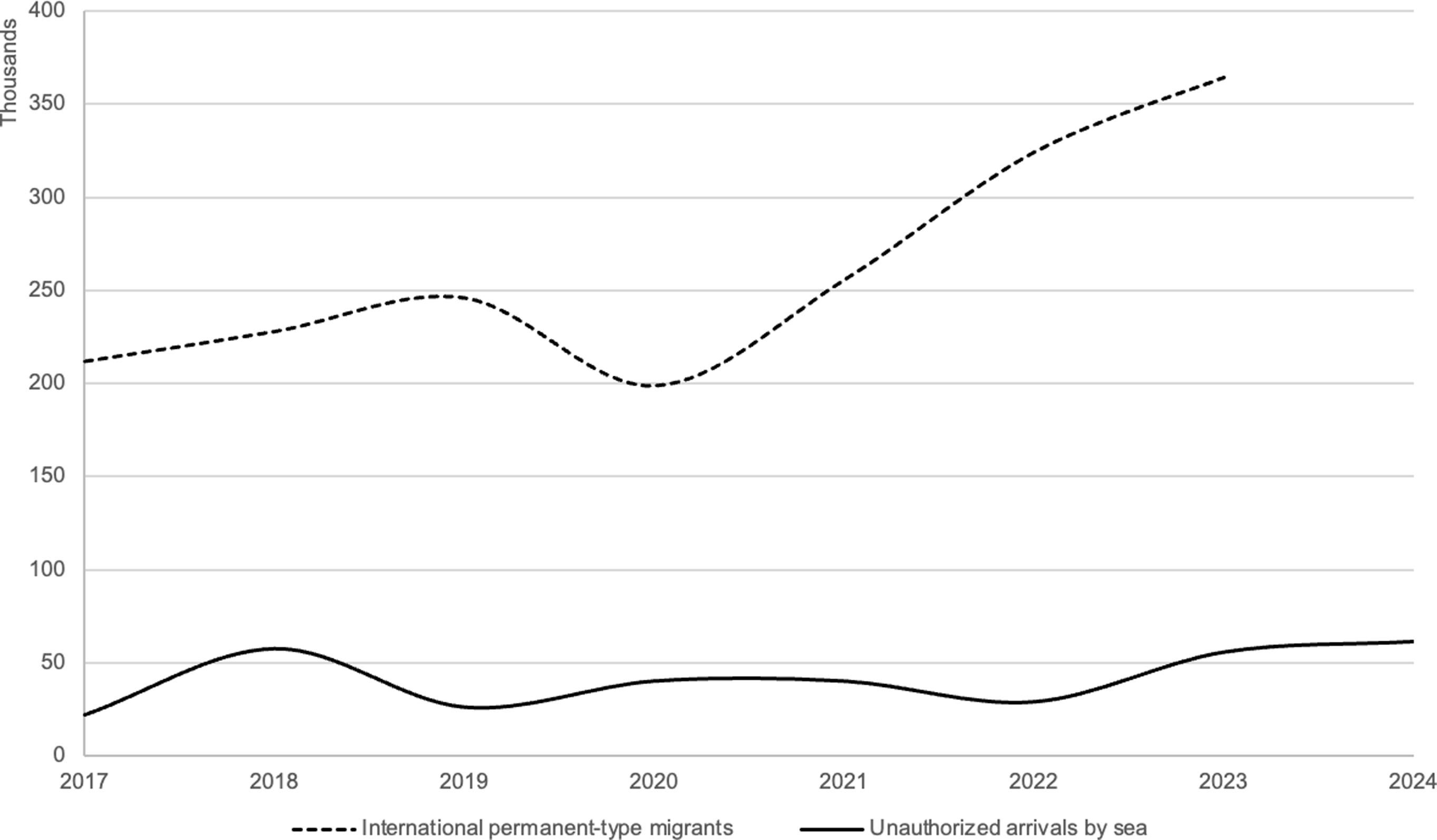
Figure 1 shows that the main flow of migrants arriving in Spain via airports, many of them on tourist visas, increased between 2017 and 2023, except for the year 2020, when airports were closed due to COVID-19 lockdowns. Conversely, although the arrival of African people in small boats on the Spanish coast has remained relatively constant over the same period, media coverage of this has not only been remarkably intense but has also presented the arrival of migrants within a clear separation between citizens (Spanish people) and outsiders (immigrants), portraying the latter as illegal migrants rather than members of the community, and thus perpetuating the “we-they” dichotomy (Martínez Lirola, Reference Martínez Lirola2022a, Reference Martínez Lirola2022b).

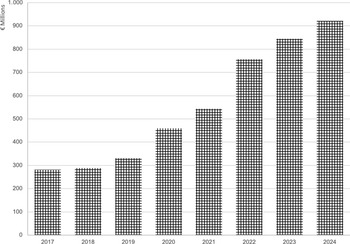
In parallel, from 2017 onwards, Frontex (the European Border and Coast Guard Agency) budget allocations for joint operations with the Guardia Civil (the Spanish military police) designed to “combat irregular immigration,” such as Hera, Indalo, and Minerva, have increased significantly. Figure 2 shows how Frontex’s general budget tripled between 2017 and 2024. Due to the agency’s lack of transparency, the only data that it has been possible to obtain on the budget items dedicated to border control at the southern border relate to the change in border control in Spain as of 2018, with the creation of the so-called “mando unico” (single command)Footnote 1 . These range from the €8 million earmarked for the Indalo operation (between the Strait of Gibraltar and the Alboran Sea) to €18 million (European Commission, 2019). In 2023, the cost of all maritime control operations along Spain’s southern border (including the Canary Islands) was scheduled to increase to €63 million (Ruiz, Fraile and Ladan, Reference Ruiz, Fraile and Ladan2024).
Frontex annual budget.
Source: Frontex.

This budgetary increase does not only include a significant deployment of members of Spanish and European police forces in countries of origin and transit to collaborate with local police in the control of migration in the so-called “fight against illegal human trafficking.” Agreements have also been reached between the European Union and countries such as Morocco and Mauritania, to make cooperation and development aid conditional on migration control (Nogueira, Reference Nogueira2024). For example, Morocco received €2.1 billion from the EU between 2014 and 2022 (European Union, 2023). A number of bilateral agreements, such as the EU Emergency Trust Fund for Africa, provide financial support for the improvement of the control systems and infrastructure of both the Moroccan Royal Guard and the Moroccan Maritime Rescue Service. However, these pacts or agreements are contingent on political negotiations, and in some cases, migration has been used as a political and coercive bargaining chip by states to secure additional resources or to condition agreements (Greenhill Reference Greenhill2015). In the case of Spanish-Moroccan relations, control of the southern border has been wielded for geopolitical ends by both states as part of a strategy of further securitization and containment of the border by Morocco in exchange for Spain’s recognition of Moroccan sovereignty over Western Sahara, a hitherto longstanding point of contention (Álvarez-Miranda and Brey, Reference Álvarez-Miranda and Brey2023).
Said increase is reflected in the growth in the number of troops, boats, planes, and technological resources used to control the Spanish border, which is one of a number of entry points to European territory. One of the first actions of the Sánchez government, parallel to the announcement of the reception of the Aquarius on the Spanish coast, was the creation of a single operational command, currently coordinated by the Guardia Civil, to centralize both information on irregular migration in countries of origin and the surveillance of irregular migrant vessels, in addition to the bringing SASEMAR operations under its direction (La Moncloa, Reference Moncloa2018). This directive represents a significant change in the management of maritime rescue in that, prior to the implementation of this operational command, rescue calls were handled directly by SASEMAR, which immediately initiated rescue action by deploying tracking aircraft and a rescue fleet. Since 2018, when an emergency call is received, it is the Guardia Civil’s single command that coordinates the operation, together with Frontex, SASEMAR, and other agents. SASEMAR sources have explained that intervention under this new system is subject to two restrictions that shape how they carry out their work (Martín, Reference Martín2020). The first is an increase in the time required to carry out rescues, and the second is that they cannot do so beyond the 35º 55’ parallel—the Moroccan rescue zone—except in an emergency and on the orders of the Guardia Civil.
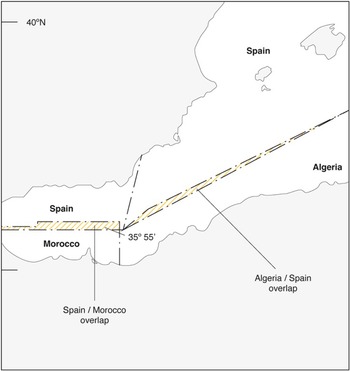
Prior to 2018, rescues by SASEMAR in Moroccan waters were common, as they responded to calls in accordance with the International Maritime Rescue Convention on cooperation between States, which requires the granting of immediate authorization to enter waters if the objective is search and rescue (see Figure 3, International Convention on Maritime Search and Rescue 1979). Figure 4 shows how the number of SASEMAR rescues in the waters of the joint or Moroccan SAR zone significantly decreased from 2019 onwards after the single operational command came into force at the end of 2018.
Search and rescue areas in the West Mediterranean route from Morocco.
Source: IMO.

Percentage of rescues according to the Search and Rescue zone (2015–2024).
Source: Author’s work, using Spanish Maritime Safety and Rescue Agency (SASEMAR 2023) and Galán and Sevillano (Reference Galán and Sevillano2022) data.

Figure 5 shows the relevance of SASEMAR’s rescue operations in the appraisal of unauthorized arrivals on the Spanish coast until 2019. As can be seen in the graph, the gap between rescues and arrivals begins to widen from this date onwards, with the number of arrivals via the Canary Islands route increasing significantly since 2018 and the number of arrivals via the Strait of Gibraltar route decreasing significantly during the same period. As an example, 2,687 people arrived at a port in the Canary Islands in 2018, with this number increasing to 23,023 in 2019 and 39,910 in 2023 (Ministry of the Interior, 2023). In contrast, arrivals to Spain via the Strait of Gibraltar and the Alboran Sea route fell from 54,703 people in 2018 to 14,431 arrivals recorded in 2024. One of the hypotheses for such a significant decrease in sea rescues since 2018 is that it is not owed exclusively to the increased control of the Strait and Alboran Sea coasts and the outsourcing of migration control to the Moroccan Royal Guard but also to military and socio-political conflicts taking place in Mali, Niger, Burkina Faso, and Senegal between 2020 and 2023, and to migrants’ agency in seeking alternatives to border fortification via other routes (Vives, Reference Vives2017).
Evolution of maritime rescue of unauthorized migrants by the Spanish Maritime Safety and Rescue Agency (SASEMAR) (2017–2023).
Source: Author’s work, using SASEMAR and Ministry of the Interior data.

Riskier Routes, Higher Death Toll
One of the consequences of the externalization and militarization of the southern border, including in countries of origin and transit, is that migrants develop evasion strategies and new routes. Some of the routes they take are often more dangerous; this is done in order to evade increased police control in the country of origin or transit. As an example, arrest in Morocco can lead to years of detention in inhumane conditions, or transfer to and abandonment in remote desert areas near the Algerian border (Mixed Migration Center, 2022). In order to avoid this, migrants either attempt to remain unnoticed or hidden or depart in boat from more distant points of origin with the aim of reaching destinations which, until now, were relatively uncommon. On the Canary Islands route, for example, the islands with the highest number of arrivals in the past were those closest to the African continent, such as Lanzarote, Fuerteventura, and Gran Canaria (Carling, Reference Carling2007b). However, most of the boats that arrived in the Canary Islands in 2023 reached the island of El Hierro, the furthest from the African coast, in order to avoid border control forces on the coasts of Mauritania and Morocco during crossing (see Figure 6). This type of route tends to be more dangerous since, due to the distance from the coast, there is no mobile phone coverage for most of the route, and crew members are therefore unable to make rescue calls if necessary. It is also a risky route given that currents can divert ships out into the Atlantic (UNODC, 2022). Similarly, circuitous routes have emerged on the Strait and Alboran Sea routes. Due to greater surveillance in the Strait area by Spain and Morroco, routes have been diverted east to the Algerian area, resulting in longer journeys at sea due to the greater distance from the coast and a greater risk of sinking (Ballesteros, Reference Ballesteros2023). This route has been the second deadliest route on the Spanish southern border after the Canary Islands route since 2020 (Caminando Fronteras, 2022, 2024).
Search and Rescue areas in the Atlantic and most common routes.
Source: Author’s work, using IMO map.

Carling (Reference Carling2007a) is one of the few researchers to have calculated the estimated migrant mortality rate at the southern border between Spain and the African continent. His calculations, based on data between 1997 and 2004, indicate a decline in the estimated migrant mortality rate, as a result of technological improvements in the Integrated System of External Vigilance (SIVE), a camera and radar system operated by the Guardia Civil, which increased the frequency with which boats carrying migrants attempting to cross the Mediterranean were detected and intercepted. Some estimates at the time suggested that this surveillance system was able to detect 96% of boats attempting to cross (Bárbulo, 2004). The fact that the majority of fatal accidents occurred without being detected by SIVE suggests that the technology was useful in the first decade of the 2000s in rescuing boats and preventing deaths in the Strait (Ugarte, Reference Ugarte2004; Carling, Reference Carling2007a).
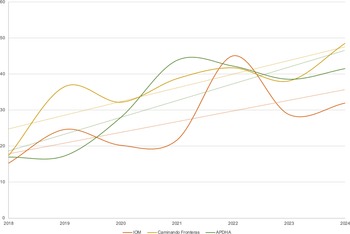
Although Carling (Reference Carling2007a) has shown that border control measures between 1997 and 2004 did not lead to an increase in the estimated migrant mortality rate on Spain’s southern border - as has happened on the US-Mexico border (Cornelius, Reference Cornelius2004) - the change in policy to control migration flows in recent years shows a different trend. The externalisation of the border and the creation of the Single Command have had a significant impact on increasing the current estimated migrant mortality rate. According to data obtained from the International Organization for Migration (IOM) and from two of the main human rights NGOs working in the southern border area, Caminando Fronteras and the APDHA (Asociación Pro Derechos Humanos de Andalucía), the mortality rate of migrants in the Strait and the Alboran Sea stood at around 15 deaths per 1000 in 2018. Increases since then may be explained by a combination of the following situations: the nonintervention of SASEMAR rescues in Moroccan waters, as had been the case before 2019; the lack of rescue missions by the Moroccan rescue service; the lack of coordination between the rescue services responsible for the SAR zone, and the consequent delay in rescues (see Figure 7). These and other circumstances have been highlighted by journalists and NGOs working in the area (Caminando Fronteras, 2023). It should also be noted that migrants are seeking new, more dangerous routes further east. A clear figure that illustrates this is the number of people who have arrived in Spain by sea via one of the riskiest routes, the Algerian route. The consolidation of this route is illustrated not only by the increase in the absolute number of unauthorized arrivals in the Balearic Islands over the years but also by the greater share of this route in the total number of arrivals in Spain. The data show that this figure rose from 2579 people in 2021 to 5846 in 2024, which represents an increase from 14.9% to 40.5% of the total number of unauthorized arrivals in Spain via the Mediterranean route (Ministerio del Interior, 2024).
Estimated migrant mortality rate in Western Mediterranean routes to Spain.
Sources: Author’s work, using datasets from IOM, Caminando Fronteras, and the Asociación Pro Derechos Humanos de Andalucía.

In the case of the Atlantic routes to the Canary Islands, the estimated mortality rate of migrants does not follow a common pattern across the different sources consulted (see Figure 8). While Caminando Fronteras sources reflect a marked increase in deaths and disappearances in the Atlantic, with an estimated mortality rate of 208 deaths per 1000, the data from the other two sources do not follow the same pattern, with the IOM data even indicating a slight decrease in mortality between 2018 and 2024. This could be due to several factors: one is that the IOM method of counting deaths only considers recorded deaths of migrants while transiting to a country other than their country of residence (IOM, 2020). In this case, only the lifeless bodies of people rescued on the Atlantic route would be counted, or the number of people on the boat who did not reach port after having died en route and whose bodies could not be rescued. Conversely, the Caminando Fronteras data include not only deaths but also disappearances of boats that have either registered an emergency call and disappeared or have been lost altogether. On the one hand, the IOM data does not take into consideration those boats that drift or sink without reaching the coast; on the other, it is difficult to obtain an approximate figure for the number of people on board each boat. In the case of the APDHA, data sources are usually the media, official sources, and the organization’s own contacts on the ground (APDHA, 2023).
Estimated migrant mortality rate in the Atlantic routes to Spain.
Sources: Author’s work, using datasets from IOM, Caminando Fronteras, and the Asociación Pro Derechos Humanos de Andalucía.

Conclusions
This paper has presented evidence of the consequences of the change of course in the governance of migration at Europe’s southern border and in particular of the changes relating to the militarization of the border and maritime rescue operations. As a result of these changes, maritime rescue went from being overseen by an autonomous civilian authority, which carried out its duty to save lives regardless of who was in danger, to being carried out under military supervision. The prohibition of rescue operations carried out by SASEMAR in the Moroccan SAR zone and increased police and military surveillance on the coasts of the countries of origin and transit have had an impact on the mortality rate of migrants in the Strait of Gibraltar and the Alboran Sea. Although sources differ as to the exact figure, there would appear to have been an increase in the mortality rate on the Atlantic routes, despite the fact that only the dead whose bodies are rescued or reported on ships that manage to reach the Spanish coast are officially counted. This notwithstanding, more recent data and additional sources are needed to confirm this trend.
This article shows how militarization of the border is a consequence of a necropolitical approach taken by neocolonial Europe, and more specifically by Spain, in the rescue of racialized migrants on the Southern border. As long as states continue to use the hegemonic framework of international law to exclude economic migrants in an unequal manner, the neocolonial and racist system of admission and exclusion will continue to reproduce itself (Achiume, Reference Achiume2019). It also shows how Europe is increasingly deploying a technological iron curtain that goes beyond borders, creating more dangerous routes for African migrants and feeding back into a securitarian infrastructure that causes more deaths. The bureaucratization of maritime rescue and the increase in controls precipitate an increase in the mortality rate of migrants; those who die while attempting to reach Spanish coasts do so because their rescue is delayed because the Spanish sea rescue agency no longer operates in Moroccan waters, or because they take more dangerous and often more circuitous routes from which emergency calls cannot be made. In this sense, there is a need to gather more evidence that not only shows the devastating consequences of border militarization on human lives but also to identify the nuances of the cause of these deaths with institutional racism, so that international courts can hold states responsible for the deaths of people at sea.
These situations are rooted in the increase in border controls in Europe, regardless of the political party or coalition in government (De Haas, Reference De Haas2013), whether by land or sea (Vives et al., Reference Vives, Banos, Martel, Hessek and Williams2024). In this regard, and in line with Solano et al. (Reference Solano and Massey2022) recommendations, governments must scale back the securitization and criminalization of migration which have led to increased risks to the well-being of those who migrate, something which contributes to rather than forestalls the proliferation of crime and violence. Other alternatives are, for example, to take into account a decolonial perspective on migration and to recognize, admit, and include unauthorized Third World migrants not as lawbreakers but instead “as entitled to a form of First World citizenship as a matter of corrective and distributive justice” (Achiume, Reference Achiume2019, p. 1553). This also requires a change in perspective toward a more humanizing and human-life-focused approach. Such a shift would represent a step forward in the fight against racism and for deborderization, and promote life (and not death) by not only redressing injustices but also by establishing bonds of solidarity between all humans and “living things” [l’ensemble du vivant] (Mbembe Reference Mbembe2024).
Acknowledgments
The author is indebted to the Harvard Migration and Immigrant Incorporation Workshop for the opportunity to present this paper. Gratitude is extended to Professors Carola Suárez-Orozco and Mary Waters for their instrumental role in facilitating this opportunity, and to the other participants whose insightful comments have significantly enhanced the quality of the paper.
Funding statement
This research did not receive any specific financial support.
Competing interests
The author declares none.




 Open access

